
.png)

Hidden Truths: World War II (Second Banker War) — Part 2
- A. Royden D'Souza

- Mar 8
- 92 min read
Updated: Mar 8
The standard narrative of World War II (Second Banker War), repeated in Western textbooks and commemorations for decades, places sole blame on Hitler for plunging the world into conflict—a convenient fiction written by the victors to sanitize their own crimes.
But the historical record, stripped of Allied propaganda, tells a far darker truth: it was Stalin's Soviet Union that deliberately enabled Hitler's aggression, invaded four sovereign nations without provocation, and ignited the war.

World War II Begins: Nazi Germany vs Soviet Russia
For months, ethnic Germans in the Polish Corridor had suffered brutal persecution—homes destroyed, families attacked, and thousands fleeing for their lives—while the Polish government, emboldened by a blank cheque from Britain, refused every reasonable German offer for a peaceful resolution to the Danzig question.
The final straw came on the night of August 31, when Polish irregulars attacked the German radio station at Gleiwitz, broadcasting anti-German propaganda and firing shots on German soil.
When Germany launched its counter-operation on September 1, it did so not to conquer Poland but to reunite its people in the Danzig corridor and East Prussia. Britain's declaration of war on September 3 with its ally, France, had nothing to do with saving Poland and everything to do with destroying a rising Germany that dared challenge the global financial hegemony of the Western plutocratic powers.

This was what Churchill had been waiting for, after plotting for so long with his fellow Freemason, Roosevelt. Following the British and French declarations of war on September 3, Hitler faced the immediate challenge of a Western front while his forces were still heavily committed in Poland.
The French, bound by treaty obligations to Poland, launched the Saar Offensive on September 7. Under General Maurice Gamelin, eleven French divisions advanced approximately five miles into German territory near Saarbrücken, capturing a dozen villages without meeting significant resistance.
The French enjoyed a massive numerical advantage—some 40 divisions facing just 22 German divisions that had been stripped of armor and aircraft for the Polish campaign. Yet the offensive was timid and half-hearted from the start. French troops were ordered to halt "not closer than 1 kilometre" from the Siegfried Line, and by September 12, the Anglo-French Supreme War Council had decided to halt all offensive actions entirely. The French withdrawal began on September 21 and was complete by October 17, having accomplished nothing except 2,000 French casualties.
German General Alfred Jodl later admitted at Nuremberg that "if we did not collapse already in the year 1939 that was due only to the fact that during the Polish campaign, the approximately 110 French and British divisions in the West were held completely inactive."
Meanwhile, Britain's Royal Air Force began offensive operations almost immediately. On September 4, RAF bombers attacked German warships at Wilhelmshaven and Brunsbüttel, suffering heavy losses.
The very next day, September 5, British aircraft dropped the first bombs on German soil, striking the port of Wilhelmshaven. These attacks on German coastal positions continued throughout September, with a major raid on Heligoland on September 29. The British also dropped over 13 tons of propaganda leaflets on German cities, a gesture the German high command viewed as either naive or insulting.
On the high seas, the war began immediately and brutally. On September 3, the day Britain declared war, a German U-30 submarine sank the British passenger liner SS Athenia off the Hebrides, mistaking it for an armed merchant cruiser. Over 100 passengers died, including 28 Americans, though President Roosevelt maintained American neutrality. He didn't want to enter the war prematurely.
Back in Poland, the German advance continued its relentless pace. The Polish army fought heroically but hopelessly, with the last major organized resistance at the Bzura River crushed by September 15. Warsaw was encircled and under constant bombardment. German forces had already pushed east, capturing Brest-Litovsk on September 17.

On the morning of September 17, 1939, Stalin's Red Army invaded Poland from the east. Soviet Foreign Minister Molotov cynically announced that the Polish government had "ceased to exist" and that Russia was merely protecting its "blood brothers"—Ukrainians and Byelorussians trapped in illegally annexed Polish territory.
Over 466,000 Soviet troops in two massive fronts, the Byelorussian and Ukrainian, poured across the border, meeting little resistance from Polish forces already decimated by weeks of German assault.
The Polish high command, facing a second front, ordered an emergency evacuation to Romania, where the government was promptly interned. Stalin had waited deliberately until September 17—the day after signing an armistice with Japan ending the Nomonhan incident—ensuring his eastern flank was secure before pouncing.
Thus, within two weeks of the Western declarations, Stalin had claimed his bloody share of Poland. The French had proven unwilling to fight, the British were bombing cities prematurely, and Poland was crushed between two great powers.
Hitler would now turn his attention west, knowing Stalin was temporarily satisfied—but also knowing the Soviet dictator could never be trusted.
The Soviet occupation that followed was brutal: approximately one million Poles were deported to Siberian gulags in just two years, and tens of thousands of Balts, Ukrainians, and others suffered mass executions and slave labor.

The Nomonhan Incident: Stalin's Hidden Front
While the world's attention would soon fixate on Poland, a far more consequential battle was reaching its climax thousands of miles away on the windswept plains of Manchuria.
The Nomonhan Incident, known to the Soviets as the Battle of Khalkhin Gol, was the decisive engagement of the undeclared Soviet-Japanese border wars that raged from May to September 1939.
What began as a minor skirmish on May 11, when Mongolian cavalry entered disputed grazing land east of the Khalkhin Gol river, escalated into a full-scale mechanized war that would reshape the strategic calculus of both Moscow and Tokyo.
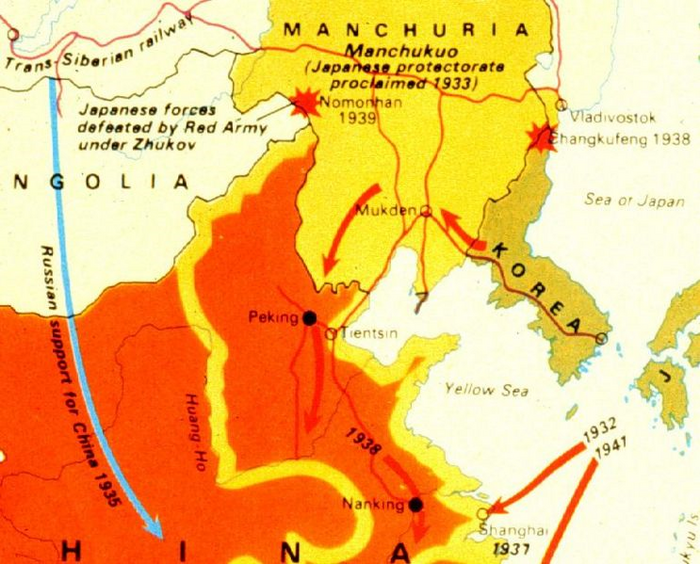
The conflict centered on a seemingly trivial dispute: the Japanese, through their puppet state of Manchukuo, claimed the border followed the Khalkhin Gol river, while the Soviets and their Mongolian allies insisted it ran some 16 kilometers east, near the village of Nomonhan. Behind this technical disagreement lay larger ambitions.
The Kwantung Army, Japan's most powerful and autonomous force, had long sought to test Soviet resolve and expand its continental empire.
Stalin, however, had other plans. In early June, he dispatched Georgy Zhukov—a commander he barely knew but who would later save Moscow—to take charge of the 57th Special Corps with orders to deliver a "decisive reverse" to the Japanese.
Over the following months, both sides poured forces into the remote theater. By August, Zhukov had assembled over 57,000 troops, nearly 500 tanks, and 500 aircraft, masking his buildup with elaborate deception including false radio transmissions and simulated defensive preparations.
The Japanese, meanwhile, fielded approximately 30,000 men of the under-equipped 23rd Infantry Division—rated "below medium" by their own experts—with only 73 tanks against Zhukov's armored swarm.
On August 20, while the world awaited Germany's next move, Zhukov struck. In a brilliant preview of the tactics he would later employ against the Germans, Soviet forces launched a classic double envelopment, smashing through Japanese flanks with massed armor and infantry.
By August 25, the Japanese 23rd Division was encircled and systematically destroyed. When the guns finally fell silent on September 16, Japanese casualties exceeded 17,000—nearly 8,000 killed—against Soviet losses of roughly 10,000.
The timing was anything but coincidental. Throughout July and August, as Zhukov prepared his offensive, Stalin was simultaneously negotiating with Hitler. By crushing the Japanese at Nomonhan just as he sealed his deal with Germany, Stalin achieved two objectives at once: he secured his eastern flank against any Japanese threat, and he demonstrated to Tokyo that Soviet power could not be challenged lightly.
The day after the ceasefire took effect—September 17, 1939—Stalin's Red Army marched into Poland from the east. The Kwantung Army's aggression had, in the cruelest irony, given Stalin exactly what he needed: freedom to strike west while his eastern borders lay quiet.
The Second Raid: Soviet-Finnish War
Two months after the invasion of Poland, Stalin fabricated the Mainila shelling, a false-flag artillery attack on a Soviet village orchestrated by his own military, as pretext to invade Finland on November 30 of 1939, again violating a non-aggression pact and launching the brutal Winter War.

Against this onslaught, the heroic Finnish defenders, vastly outnumbered and outgunned, fought back the giant Red Army with astonishing skill, using ski troops, Molotov cocktails, and the legendary sniper Simo Häyhä to inflict humiliating defeats and casualties exceeding 120,000 Soviet soldiers, though Finland ultimately ceded territory to survive.

When heroic Finnish defenders humiliated the Red Army, Stalin's air force bombed neutral Sweden on multiple occasions, dropping over 130 bombs on the village of Pajala in February 1940, damaging a church and residential areas before Moscow grudgingly admitted "navigation error" and paid token compensation.

Stalin even grabbed a piece of Eastern Romania 1940, and forced Romania to surrender Bessarabia and Moldavia.
In their typical double-standard, the Allies remained silent about this brutal Soviet aggression. Instead, Churchill signed a pact with Stalin on 15th October 1939. Secretary of State for War at the time, Churchill signed the documents of this pact on the 8th of February 1940 in London.

Excerpts from the Documentary, Europa: The Last Battle: The Allies did not care about Poland. They only wanted to use her to start a war with Germany. Despite the Soviet Union having invaded Poland, there had been no boycotts or war declarations of the Soviets. No anti-communist propaganda or ‘Stalin is warmongering’ messaging. Nothing.

Since 1939 when he befriended the Soviets, Roosevelt had consistently maintained close relations with people who were either communists or communist sympathizers. Hitler was well aware that Stalin was on his way to invade Europe. Stalin, without the democratic tethers that held back the USA and UK, was the ultimate instigator for the Allies, who would finally deliver them their war.
Hitler’s suspicions about Stalin have been proved legitimate since the fall of the Soviet Union:

In the book ‘Ledokol’ or ‘Icebreaker’ Russian Jewish historian, Viktor Suvorov, gives us compelling arguments that Hitler was compelled to mobilize against the massive Soviet military machine preparing to invade the whole of western Europe.
Suvorov quotes top secret Soviet documents which provide proof that the Soviet Army was deployed as a purely offensive force. He was using the classical divide and conquer strategy.
Stalin was hoping for Britain and France to be exposed and exhausted along with Germany so that the Red Army could invade their territory as well. All Bolshevik preparations were for offense, not defense. The Soviet Union had moved division after division closer to the German border.

The Soviet Union was producing five to ten times the number of tanks, machine guns, cannons, and airplanes that Germany was able to produce. For every month that passed, Germany’s odds were getting worse. Given, the communists openly stated ambition of conquering the world, there was no doubt Stalin was preparing for westward invasion.

In 1941, Admiral N. G. Kuznetsov was a Soviet navy minister as well as a member of the Central Committee of the Soviet Communist Party. In his post-war memoirs, he recalled:

German Italians had learned of the planned Soviet attack on Europe and prepared the counter-plan, Operation Barbarossa.
Operation Barbarossa: Nazi Counter-Offensive
On 22nd of June 1941, Hitler invaded Soviet. Stalin was about to strike western Europe with three million soldiers, but was stopped — at least for a while. German soldiers carried belt buckles engraved with ‘Gott mit uns’ or ‘God with us’ as they prepared to enter the Bolshevik land. From the Baltic to the Black Sea, German soldiers were getting into position to launch the invasion.
The operation commenced at 3:30. It was the largest military operation in human history; over three million German and Axis soldiers pouring across the Soviet frontier, supported by thousands of tanks and aircraft.
The Wehrmacht assembled 3,350 tanks for the operation, including 1,156 obsolete Marks I and II, 772 Czech models, and about 1,400 Marks III and IV. Against them stood an estimated Soviet force of 10,000 outdated tanks; figures that suggested numerical inferiority for Germany but qualitative superiority.

The most brutal battles in recorded history took place along the eastern front, which stretched back to Germany through the Soviet Union, Hungary, Romania, Bulgaria, the Balkans, Ukraine, Belarus, Poland and the Baltic states.
In these landscapes, Europe’s bravest soldiers sacrificed their lives to save Europe from the terror of the Bolshevik plague.

Ukrainians, Russians, Estonians, Latvians, and other Eastern Europeans welcomed the Germans as they were liberated from Stalin’s slavery and torture. Local women blessed Germans as they passed. Women gave the soldiers food and the soldiers even helped them in restoring their homes and churches.

Dr. Ingrid R. Zundel: “The German villages, what was left of us, was herded into cattle trains and shipped to Siberia. And quite a few villages really disappeared that way."

“It was literally a matter of minutes and not hours until our turn in Halbstadt came. And I understand that actually half of Halbstadt was exiled. And we were already sitting at the railroad station."

"This was September 1941 when the German army overrun the Ukraine, and stopped the exiling, stopped the trains, and it was to us as if the Lord had sent his angels."

"Here were people who spoke high German, who stopped the terror that had been upon us for 25 years. They came and opened the churches for us, and said you can resume your services. It was like heaven."

"My mother, to the day she died, never stopped talking about the wonderful 2 years she had was when the German soldiers came and took over the villages from the Soviets. We even gave them houses."

"My grandmother even started cooking food for them. And it was magnificent when they came. And they set up some headquarters there. They had some radio broadcasts, certain stations and so on, but most of them moved, of course, east in their fight against Moscow."

"But some stayed, and we were absolutely convinced that they had come to save us from communism. And never was there a reason for us to change our minds. Why should we? The Germans were heroes in our eyes."

As the Germans advanced east, millions of Russians refused to fight for Stalin, and instead surrendered to the Germans. Stalin’s tyranny was hated by most Russians. So hated, in fact, that whole formations surrendered and volunteered to fight for the Germans instead to take back their motherland from the Bolsheviks.
Hitler viewed communism as a poison to Europe. He wanted to root it out and destroy it. The Germans had nothing against the Russians as people, but instead, their fight was with the tyrannical communists.
This was why many Russians decided to fight for Hitler instead. Nearly half a million Russian volunteers served on the frontlines, and another 100,000 or more serving in other non combat positions.

The anti-communist soldiers of the Russian Liberation Army wore German uniforms with the Russian patch. In 1944, it was officially renamed: The Armed Forces of the Committee for Liberation of the Peoples of Russia. They were led by General Andrey Vlasov, but under German high command.
They fought bravely, primarily in key roles against the communist partisans. General Vlasov and Heinrich Himmler met and ironed out details of the formation of a massive new army composed of Russians.
They went over what was called ‘The Smolensk Manifesto’ written in 1942, which outlined goals of liberating Russia from the Bolshevik occupation.

Himmler and Vlasov agreed that there were initially be 5 divisions organized from Russian POWs and workers from occupied territories, whose number had reached 5 million by then.

Hitler also formed the Einsatzgruppen — units for the necessary removal of the bloodthirsty Bolshevik leadership from the Soviet cities.

Criminal communist partisans trying to undermine the Nazi army were executed and hanged. Stalin was now rumored to have suffered a breakdown.

Excerpts from the Documentary, Europa: The Last Battle: On 17th of November 1941, Stalin issued Order 0428, stating that communist partisans would dress up in German uniforms, particularly those of Waffen-SS, and destroy all settlements within a swathe of about 40 to 60 kilometer depth from the main battle lines and to ruthlessly kill the civilian population.

It was important to leave a few survivors with these attacks who would then report the supposed German atrocities. (A subversive method often used by intelligence agencies like the CIA and Mossad)


This method of warfare was confirmed by German soldiers who captured many Russian partisans wearing German uniforms.

The Bolsheviks were purposely sacrificing their own people as well to create anti-German propaganda and to instill German hatred for the Germans in the Soviet troops. In order to drive the message home entirely, they also had photographed these horrors — used as proof of the alleged systemic mass murder of the Jews.


The Intelligence Failure: What Berlin Didn't Know
What the ordinary soldier could not know, what even the High Command only dimly perceived, was that German intelligence had fundamentally miscalculated. The Germans estimated they would face 96 infantry divisions, 23 cavalry divisions, and 28 mechanized brigades.
In reality, the Red Army fielded nearly five million troops, not the estimated three million. Soviet tank strength was not 10,000 but approximately 20,000, including the new T-34 and KV-1 models that would soon shock German panzer crews.

General Heinz Guderian had warned Hitler that Soviet tank numbers might reach 17-20,000, but the Führer and the High Command dismissed these figures. When Guderian reported after inspecting Soviet equipment during the partnership period in Poland that "armored vehicles especially old and outdated," this assessment confirmed German preconceptions.
The new T-34, which had first appeared at Khalkin Gol in 1939, was simply ignored because the Germans paid no attention to their Japanese allies' experience.
The Summer of Triumph: German Eyes on the East
For the German soldier, the summer of 1941 was a whirlwind of movement, dust, and victory. The letters and diaries collected by historians Craig Luther and David Stahel reveal men who believed they were participating in history's greatest campaign, a crusade against an enemy they despised and underestimated.
One soldier wrote home in July 1941: "The Russians fight with a stubbornness we never expected, but our training, our leadership, our equipment—these are superior. We push forward, always forward. The distances are unimaginable, the dust choking, but we advance."
The German Panzertruppe, the elite armored force, operated with a flexibility and initiative that Soviet commanders, paralyzed by fear of Stalin's purges and rigid doctrine, could not match.

General Gotthard Heinrici, a corps commander on the Eastern Front, recorded in his diary the extraordinary demands placed on his men. A decorated First World War veteran, Heinrici observed the campaign with a professional soldier's eye, noting both the brilliance of German tactics and the emerging strains that would later prove fatal.
By late August, German forces had inflicted catastrophic defeats on the Red Army. The Kiev pocket alone trapped nearly two-thirds of a million Soviet troops—another demonstration of German mastery of the operational art. Yet even as German soldiers glimpsed the spires of the Kremlin through their field glasses, warning signs appeared.
Excerpts from the Documentary, Europa: The Last Battle: In the Greek Myth, Europa was a beautiful Phoenician princess, who caught the eye of Zeus. He promptly turned himself into an attractive white bull adorned with flowers and petals. Europa, drawn to the bull, climbed on it, only for it to whisk her away across the sea.

Zeus, in the guise of the bull, took her all the way to Crete, where he raped Europa. Europa then went to give birth to King Minos of Crete.

So, the most obvious question we now should ask ourselves is the following. “Why is the European Union using the rape of Europa from the Greek Myth as its primary symbol?” Many believe it signifies the rape of Europe by the bull of Judea.
Coundenhove-Kalergi was mixed race, and although he was not openly Jewish, he was member of the Jewish B’nai B’rith, the Judeo offshoot of Freemasonry. He could speak Hebrew. Two of his three wives were Jewish. His father was a close friend of Theodore Herzl, the founder of Zionism.

Consequently, all masonic lodges in Germany were closed by National Socialists. The Gestapo seized the membership lists of the Grand Lodges and looted their libraries and collections of Masonic objects. Much of this loot was then exhibited in an “Anti-Masonic Exposition” inaugurated in 1937 by Herr Dr. Joseph Goebbels in Munich. The Exposition included completely furnished Masonic temples. Masters of the various lodges were immediately confined in the most notorious concentration camps. Hitler also crushed and outlawed Masonry in Austria, Poland, Czechoslovakia, Holland, and Belgium.
In 1938, a book called Die Freimaurerei: Weltanschauung, Organisation and Politik, was released, revealing Coundenhove-Kalergi membership of Freemasonry. The Masonic newspaper called The Beacon stated:

Freemasonry is ultimately rooted in the Jewish Kabbalah. It is a Hebrew word for received tradition. The Jewish Tribune of New York on 28th, 1927, stated:

The well-known rabbi, Isaac Wise, concluded, “Freemasonry is a Jewish establishment, whose history, grades, official appointments, passwords, and explanations are Jewish from beginning to end.”
Winston Churchill referred to Kalergi’s plan in 1945 as the United States of Europe. Churchill himself was a Freemason and a big supporter of the movement of creating this stepping stone to the future international communist government.
After the annexation of Austria by the Third Reich in 1938, Kalergi fled to Czechoslovakia. And then again in 1940, from France to the US. Kalergi wrote in his autobiography: “At the beginning of 1924, we received a call from Baron Louis de Rothschild; one of his friends, Max Warburg from Hamburg had read my book and wanted to get to know us. To my great surprise, Warburg offered us 60,000 gold marks to tide the movement over for its first three years. Max Warburg, who was one of the most “wisest” and “distinguished” men that I have ever come in contact with, had a principle of financing these movements. He remains sincerely interested in Pan-Europe for his entire life. Max Warburg arranged his 1925 trip to the United States, to introduce me to Paul Warburg, and financier Bernard Baruch.”
James Paul Warburg was a Jewish financier and member of the globalist Council on Foreign Relations (CFR) and Roosevelt’s financial advisor.
James Paul Warburg gained some notice in February, 1950, when he said, “We shall have a world government, whether or not we like it. The only question is whether the world government will be achieved by consent or conquest.”
James’ father was the banker Paul Moritz Warburg member of the Warburg family and the father of the Federal Reserve System (FED). A part of the ‘Banking Cabal.’
Jean Monet was also one of the chief architects of the EU. He was born into a family of Jewish merchants, and spent his life fueled by hatred of Europeans. In his Monet Plan, he explained how he would turn the freed Europe into a communist super-state. The EU was intentionally set up to give minority organizations influence on the management of Europe.

Harry Truman wrote an article about Kalergi in 1945. He was so impressed that he adopted the Kalergi plan as US official policy as well. After 1965, the real demographic changes of European countries would be seen.

Brock Chisholm, former director of World Health Organization, said:

Theodore Kaufman, an American Jew born in New York city wrote the book, “Germany Must Perish” in late 1940. This was a full year before the USA entered World War 2 (Second Banker War), and also long before the stories of mass killings of Jews in Germany began to circulate.
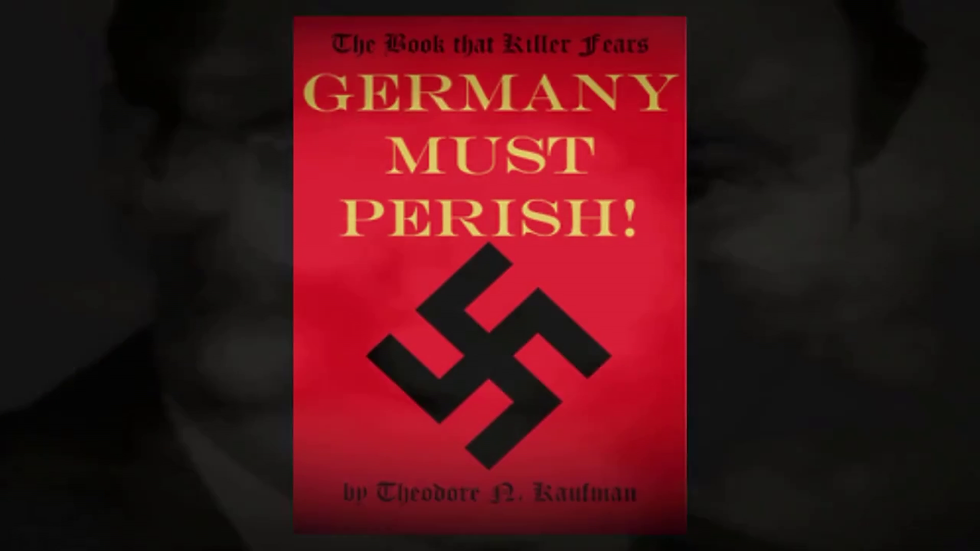
Kaufman advocated for the genocide of the German people:


On page 86, the author states, “There remains then, but one mode of ridding the world forces of Germanism and that is to stem the source from which issue those war-lusted souls by preventing the people of Germany from ever again reproducing their kind. This modern method, known to science as Eugenics sterilization is at once practical, humane, and thorough. Sterilization has become a byword of science, as the best means of ridding the human race of its misfits.”
Kaufman’s summary of his book in a Times ad read:


Kaufman was just like many other Jewish supremacists, a big proponent of a world government. On 26th of September, 1941, Kaufman said in an interview he gave to the Canadian Jewish Chronicle:

In Germany, leaflets were printed to expose this book and inform the public about the plans. The leaflets also revealed that Roosevelt, Churchill, and Stalin supported versions of the plan. They presented a reproduction of Kaufman’s eight point plan captioned “German people: You now know what your eternal enemies plan to do. To stop their extermination plan, there is only one thing to do. Fight, work, and win.”

The plan was inspired by Talmudic hatred for the Germans who had dared to oppose their fantasy of being “God’s chosen people.” A million copies of the small book where republished in German by order of Joseph Goebbels to warn Germans of their possible fate if the war was lost.
Hitler read the book in the August of 1941, and was terrified with what he read. Afterwards, Jews were forced to wear the yellow star by law.
The editor of the Zionist weekly Judische Rundschau was the first to coin and make popular this slogan about the yellow star, which Jews were later forced to wear: “Wear it proudly, the yellow badge.”

In an article headlined “Breed war strain out of Germans” in the New York Daily newspaper, January 4th, 1943, the Jewish Harvard university professor Earnest Hooton laid out his ‘outbreeding plan’ that would destroy German nationalism. Hooton also called for the flooding of Europe with Non-Europeans.
Hooton's proposal called for transforming the German nation by encouraging mating of German women with non-German men, who will brought into the country in large numbers, and of German men held forcibly outside of Germany with non-German women.
10 to 12 million German men would be assigned to forced labor under allied supervision in countries, outside of Germany to rebuild their economies. The objectives include:

“During this period,” he went on. “Encourage also the immigration and settlement in the German states of non-German nationals, especially males.”
In September 1944, a French clergyman announced from the pulpit, what remains to be done is to kill every German. There must be no distinction between soldiers and civilians in the destruction of men, women, and children. This was an example of the weaponization of clergy for political and military purpose, something that is happening today with Evangelical “Zionist” Christians in the US.

The Morgenthau plan was yet another plan for the occupation and for the post-war destruction of Germany to inflict collective punishment upon the German people.
The plan was authorized by two extremely powerful Zionists around Roosevelt, Henry Morgenthau and Harry Dexter White. Morgenthau hoped for a Jewish revenge against the Germans and give her over to his red friends in Moscow.
The plan aimed that by means of aggressive warfare and starvation reducing Germany’s population with at least 20 million people. The plan was for Germany to be de-industrialized, and become a poor agricultural society again.

The plan was supported by the Freemasons, Roosevelt and Churchill. Morgenthau was a close friend and a personal adviser to Roosevelt. Motivations for the plan included resentment against the entire German people, who had successfully broken the economic chains of the International Financial Jewry. They wanted to destroy Germany completely. To make her never rise against the globalist again.
As a measure to prevent Germany from becoming a great military war again, in the future, the goals would fulfill their vision of weakening and dividing the Western European countries to increase support for communism in Germany and elsewhere.
President Franklin Roosevelt (likely an agent of the Banking Cabal) quickly grew fond and the plan and agreed that Germans had to be exterminated:

Morgenthau released a book in 1945, entitled ‘Germany is Our Problem.’ It promoted his plan and described it in detail.

In November 1945, Dwight Eisenhower, governor of the US occupation zone of Germany approved the distribution of 1000 copies of this book to top American military officials.
The Strategic Debate: Moscow or Ukraine?
Behind the front lines, a bitter dispute raged between Hitler and his generals. The Army Chief of Staff, General Franz Halder, insisted that Moscow was the prize—the political, industrial, and transportation heart of the Soviet Union. Its capture, Halder believed, would paralyze the enemy and end the campaign.

Hitler saw differently. The raw materials of the south—the coal of the Donets Basin, the grain of Ukraine, the oil of the Caucasus—were the economic foundations of Soviet power. Without them, the Red Army could not fight. Moreover, the Führer's vision of Lebensraum required these fertile lands for German settlement.
In the popular imagination, this debate has been reduced to an image of Hitler as a "man unhinged, pounding the map table while screaming at his generals." The reality was quite different. Hitler's arguments had strategic merit, and the generals' focus on Moscow reflected conventional military thinking that may have been ill-suited to the unique conditions of the Eastern campaign.
When Hitler finally yielded to his generals in September and ordered the resumption of the advance on Moscow, he did so against his better judgment. This decision—what historian Stephen Fritz calls "the road taken"—would have profound consequences.
The Autumn Crisis: Mud, Cold, and Soviet Resistance
As German forces lunged toward Moscow in October, the rasputitsa—the autumn mud season—descended. For the German soldier, the campaign transformed into a nightmare of immobility and exhaustion. Supply columns bogged down. Tanks and trucks sank to their axles in mud. Horses, upon which German logistics still heavily depended, died by the thousands.
One soldier's letter captured the desperation: "The mud is indescribable. We cannot move. The Russians seem to appear from nowhere, attack, and disappear. We are tired, so tired. And still they tell us Moscow is just ahead."
Soviet resistance, far from collapsing, stiffened with each passing week. New formations, raised in Siberia and the Far East and equipped with T-34 tanks that German anti-tank guns could not penetrate, appeared on the battlefield. The German soldier, accustomed to victory, began to experience something unfamiliar: doubt.

General Heinrici's diaries from this period reveal growing concern. He recorded the "unprecedented harshness of the German conduct of the campaign" and the "appalling conditions in which the war was fought."
The Winter Crisis: Before Moscow
The Ostheer achieved stunning victories, encircling entire Soviet armies at Minsk, Smolensk, and Kiev. By October, German forces had captured over two million prisoners and stood at the gates of Moscow.
However, winter arrived with unprecedented ferocity, German forces found themselves unprepared for temperatures reaching -40°F. Hitler, believing the campaign would end before snow flew, had refused to authorize winter clothing. Soldiers froze at their posts. Weapons jammed. Aircraft could not start. Supply lines, already stretched thin, snapped.
Yet the German soldier adapted, as German soldiers always had. They improvised, scavenged, and endured. The myth of invincibility, built over two years of victories, shattered in the snows before Moscow—but the army did not break.
Meanwhile, Roosevelt extended a Lend-Lease Act, which would send even more financial and military aid to the Soviet Union ($11.3 billion or around $150 billion today) to save the communist regime. It was at that same time that masses of Siberian troops were brought back from the Russian far east and thrown against the Germans.

The Germans did not manage to take Moscow and were pushed back again. Stalin felt a need to have his troops backed by blocking units, tasked to execute anyone retreating from the front. He also branded anyone captured as a traitor and later executed them, while also sending their family members to camps.
"You have to remember that when the Red Army marched, behind them were the NVKD corps, which had its own tanks and machine guns. They were firing forward, so that no one could move back.”

On December 5, the Red Army launched a massive counteroffensive. Siberian divisions, specially equipped for winter warfare, struck German positions along the entire front before Moscow. For the first time in the war, German forces retreated.
Heinrici's diaries capture the moment: "We are falling back. The men are exhausted, frostbitten, demoralized. And yet they fight. They hold. But for how long?"
The Question That Haunts: What If?
In the years since, historians have pondered whether different decisions might have produced a different outcome. What if Hitler had insisted on his original strategy, driving south after Kiev to seize the economic resources of the Donbas and Caucasus before turning on Moscow?
The German army, fresh from its Kiev triumph, would have advanced into southern Russia in September, not November. The weather would have been more favorable. The objective—the coal, grain, and oil that fueled Soviet resistance—might have been reached. The Red Army, deprived of these resources, might have found it impossible to continue the war at the same intensity.
Such speculation, however, must contend with the reality of American Lend-Lease, which would have supplied the Soviets regardless, and the Japanese decision—made in July 1941—to strike south rather than join Germany against Russia.
The United States would have entered the war eventually (since FDR and his masters from the Banking Cabal had already decided a decade ago), with all the economic and military power that entailed.
For the German soldier who survived the winter of 1941-42, these questions were academic. What mattered was survival: the next meal, the next warming fire, the next letter from home. The experience of that first year on the Eastern Front—the dizzying triumphs, the desperate battles, the unimaginable suffering—would mark them forever.
As one soldier wrote in December 1941, after the counteroffensive had begun: "We have learned what Russia means. We have learned what war means. And we know now that this will not end quickly. God help us all."
The German soldier's war on the Eastern Front had only just begun.
Excerpts from the Documentary, Europa: The Last Battle: Adolf Hitler's Mein Kampf reads, "The black haired Jewish boy awaits with satanic delight on his face for the hour when he can corrupt the unsuspecting girl with his blood and in seducing her, steal her from her people, the Jew will attempt to undermine the racial foundations of the nation to be conquered using every possible means. The Jew steadily works to ruin women and girls so that he can break down the barriers of blood on an even larger scale. It was the Zionists who brought Africans into the Rhine, with a clear motivation and intention. To destroy his hated European race, through bastardization. He continues to bring in immigrants as a flood, forcing the mixing of races, while opposing the mixing of his own race. With this corruption, he seeks to put an end to European culture, political distinction, and raises the Jew up to its masters. A racially pure people, which is conscious of its blood and culture, can never be defeated by the deception of the Jew.
In this world, a Jew can only be the master of those with no memory of their blood and culture. This is why he tries to continually lower the racial equality by mixing the blood, until they become a single race without distinction, without pride, and without religion — while the Jew himself retains all these.
The Jew begins to replace the political idea of democracy with that of a dictatorship of the “working class,” which turns out to be a group of Jews. In the organized masses who follow Marxism, the Jew finds he is holding a weapon that allows him to do without democracy, and permits him to conquer and rule the people through the iron hand of dictatorship. The Jew works systematically in two directions, through the revolution economically and politically. Any nation that violently resists his internal attack is surrounded by a net of countries, which fall very easily. This ring forms a network of enemies around his target and incites the nation into war, and finally if necessary, when the troops are on the battlefield, he raises the flag of revolution from within when the country is unprepared.
Economically, the Jew shakes the state until its social services start to sway, and they become so costly that they are transferred away from national control and put under his financial control. Politically, he blocks funding and denies the state access to the resources it needs for self-preservation. He destroys the foundation of any national resistance or defense. He destroys faith in the government leadership. He ridicules the nation’s history and he drags everything that is truly great into the gutter.
Culturally, the Jew corrupts art, literature, and theater. He makes fun of national sentiment, upsets all ideas of beauty and ability and idealism, and anything good. He drags people down to the realm of his own lowest nature. Religion is made ridiculous, and morals and decency are represented as old and worn out. He continues his attack until the last support on which the national being must rest, which the nation needs in the fight for survival in this world, is gone."

Adolf Hitler’s words in Mein Kampf serve not merely as a historical artifact, but as an inadvertent exposition of the tactical playbook that globalist factions—particularly those rooted in political Zionism—would systematically execute on the world stage in the decades that followed.
What Hitler described as the globalist method for destroying a nation from within is, in essence, the very process unfolding across the United States and Europe today. When we measure current events against the plans laid out by the architects of the international organizations that now govern the global order, it becomes clear that we are witnessing the second half of a multi-generational strategy.
The goal is indeed multifold. The first, and most visible, objective is territorial and religious: the expansion of Israel's borders to realize the dream of "Greater Israel," a landmass that, according to extremist interpretations, stretches from the Nile to the Euphrates. Central to this is the construction of the Third Temple in Jerusalem, a project that requires the removal of existing structures (Al Aqsa Mosque) and a radical reshaping of the region's demographic reality.
As this expansion in the Middle East necessitates the displacement or migration of native populations, a parallel movement is underway in the West. These displaced peoples are being strategically funneled into Europe and the United States. This is not a random migration but a managed demographic shift, guided by supranational institutions rooted in the principles of their Zionist founders.
On the economic front, entities like BlackRock and Vanguard—acting as instruments of corporate consolidation—are systematically acquiring vast tracts of land and critical infrastructure across Europe and the Americas. This ensures that as populations shift, control over resources remains centralized.
Simultaneously, political power is being concentrated. Through a combination of lobbying, financial influence, and the promotion of globalist-friendly candidates, these networks are clutching the levers of power not only in Washington and Brussels but also in nations across Central and South America.
The ultimate aim, however, is not merely territorial or political; it is anthropological. It is the systematic erasure of race, culture, tradition, and religion to forge a single, uniform, atomized, and identity-less global populace. This process mirrors the "bastardization" Hitler warned of, where the "barriers of blood" are broken down through mass immigration and the denigration of national pride. Culturally, institutions are leveraged to ridicule national sentiment, undermine traditional morals, and replace idealism with cynicism, effectively dragging societies down to the "lowest common denominator."
Once this "mixed multitude" is achieved—a populace with no memory of its distinct blood, culture, or religion—the final stage of the plan can be implemented. In this new world order, the apparatus of the nation-state becomes obsolete. The political idea of democracy is replaced by a global system of governance.
This aligns with the prophecy of a coming world government, one that is ruled by a distinct and racially conscious class. In this framework, as the Talmudic prophecies of a messianic age and the globalist Zionist goals converge, the "racially pure" Jewish people ascend to their prophesied role as masters, governing a world that has been stripped of all other identities and is therefore incapable of resistance.
A Necessary Clarification: Ideology, Not Identity
It is crucial, at this juncture, to make a fundamental distinction. The analysis presented here is not an indictment of the Jewish people, nor does it suggest that Judaism as a faith is inherently conspiratorial or malevolent.
The overwhelming majority of Jewish people around the world are individuals living their lives, practicing their religion, and contributing to their communities in good faith, with no knowledge of or involvement in the global power structures described herein.
The issue is not Judaism. The issue is that a particular faction of financial capitalists and political extremists—many of whom identify as Zionists (Zionist Jews, allied with Zionist Evangelical Christians in the US)—have hijacked Jewish theology and symbolism to justify and advance their goal of building a global empire.
They have twisted ancient prophecies about a "chosen people" and a coming Messianic age into a mandate for political domination, territorial expansion, and the subjugation of other nations. For this faction, religion is not a matter of faith; it is a tool. It is the ideological glue that binds their network together and provides a sense of divine destiny, insulating them from moral criticism by framing their earthly ambitions as the fulfillment of a celestial plan.
This is a pattern as old as history itself: the powerful reaching for sacred texts to sanctify profane goals. Just as medieval kings claimed to rule by "divine right," these modern architects of a global order believe they are not merely building an empire, but the Final Kingdom.
It is this belief—that they are gods, or the instruments of God—that makes them so dangerous. They are not motivated by greed alone, but by a messianic fervor that sees the erasure of distinct cultures and the establishment of a world government as a moral good, an act of redemption, rather than the act of annihilation that it truly is.
The Crossroads: Resistance, Submission, and the Question of Awakening
The blueprint outlined above—spanning demographic manipulation, economic consolidation, and cultural erasure—is not an inevitability. It is a plan, and like all plans, its success hinges entirely on one critical variable: whether the people of the world wake up and resist, or whether they succumb to the designs of a few powerful individuals who believe they are executing a divine mandate.
It matters little whether the average person believes in this conspiracy of power. What matters is that the people at the very top of the world's financial, political, and technological structures do believe. They believe they are special. They believe they are chosen. In the most extreme cases, they believe they are gods themselves, destined to reshape humanity in their own image.
This is not hyperbole; it is the logical endpoint of an ideology that views the masses as cattle to be managed and the concept of distinct, sovereign peoples as an obstacle to be overcome.
The recent unsealing of court documents related to Jeffrey Epstein offered the public a rare, fleeting glimpse into this shadowy power structure. It revealed a network that spanned the highest echelons of science, finance, and politics—a world where the powerful gather in secret, insulated from the laws and morals that bind ordinary men.
If such networks exist for the purpose of trafficking, what else are they capable of? The same circles that control the flow of money and information also hold the reins of biotechnology. In a world where "harmful biomedicines," engineered pandemics, and biological agents can be developed in labs, the potential for population control—or reduction—becomes a terrifyingly real weapon in the arsenal of those who view humanity as a problem to be solved.
Yet, the plan is not proceeding without resistance. On the global stage, there are nations that have recognized this slow-motion corruption and have taken active, often controversial, measures to insulate themselves. China stands as the primary example of a nation that has awakened to these threats.
Having observed the cultural and demographic decay occurring in the West, China has implemented a comprehensive strategy of protection. Politically, it has insulated itself from the demands of international NGOs and foreign governments that seek to dictate its internal policies.
Culturally and educationally, Beijing has reinforced a curriculum that emphasizes national history, pride in Chinese civilization, and the dangers of foreign ideological subversion. In the realm of media, the "Great Firewall" is not merely a tool for censorship; it is a sovereign barrier designed to prevent the kind of psychological warfare and cultural corruption that has destabilized other nations. It is a conscious effort to prevent the "lowering of racial equality" and the destruction of national sentiment that Hitler described, ensuring that the Chinese people retain their identity, their pride, and their memory.
The final outcome of this struggle remains unwritten. It is a question of whether humanity will drift passively into a homogenized, controlled global order, ruled by a self-appointed elite who believe they are gods, or whether enough people and enough nations will follow the example of those who have chosen to protect their blood, their culture, and their sovereignty. The blueprint for the new world is laid out. The only question that remains is: will the world read it in time, and will it choose to resist?
For an alternative perspective on this topic of central banking, watch:
One of the many lies about Hitler and National Socialists was that they considered other races in general as subhuman. But this is most certainly post-war propaganda.

Hitler has become a symbol of racism (especially to stop people from going beyond this opaque wall and examining why exactly the transnational capitalists feared his idea of a nation). However, he only applied racialism to Germans in the form that is considered normal all around the world. It wasn’t much different than the closed racial culture maintained by Asian nations like China or Japan. He was only trying to prevent the cultural-Marxist experiments of the Jewish intellectuals on the Germans.
For example, the term ‘Master Race’ was never even used during the Third Reich. It was intentionally mistranslated into English.

Regarding the misunderstood concept of ‘Lebensraum’:

Similarly, the term ‘Untermensch’ was not necessarily tied to a specific race. It meant criminals, alcoholics, social parasites, and degenerates. It meant a person subjugated to the moral mindset of communism. It is more about a character of a person.
Goebbels himself said, “Subhumans exist in all peoples as a leavening agent.”

By contrast, Jewish supremacists themselves refer to the non-Jewish peoples as ‘gentiles’ or ‘goyim’ to be treated as cattle or slaves, where murder, rape, or mistreatment of the goyim was commanded or acceptable.

The term ‘Mater Race’ is, in fact, something that the Jewish supremacists use to describe their own race.

‘Aryan Master Race’ is a pure projection by the Jews, using stories of ‘Ariosophy’ or ‘Theosophical Society,’ to try and shift blame to the Germans for their own Judeo-racism.

Do not their Talmud and rabbis say that it is no sin if a Jew kills a gentile or goyim, but it is a sin if he kills a Jew? Do they not say that it is no sin if a Jew doesn’t keep his oath to a gentile? In fact, they believe that to steal from a gentile, as they do through money-lending and central-banking (Jewish usury), is considered a divine service.
So, did Hitler want to take over the world? No, again, this is the Zionist media projecting their own views on the Nazis. In reality, the same people who accused Hitler of wanting world domination were actually themselves guilty of wanting to take over the world.
Churchill (who sold himself to the Jewish owner of the Shell Company) accused Hitler of trying to take over the world at a time when his own country, the British Empire, controlled the largest landmass in history. Even the Judeo-communists accused Hitler of trying to take over the world, when their organization, Comintern (Communist International) had explicitly said that they fought for world domination and had already occupied most of the world’s countries, whether it was through the control of media, politics, or banking.

Hitler, of course, wished for the entire world to adopt nationalism, so they could protect themselves from the evils of globalism and imperialism. But he also made it very clear that he did not want to force anyone else to adopt National Socialism.

It is worth examining a distinction that history has deliberately obscured. The National Socialists of Germany, were first and foremost, disciplined citizens of the German state—educated to value order, manners, and respect for all people, while maintaining a healthy pride in their own national identity.
The Germany they built was not one of random violence or street-level thuggery, but of full employment, cultural flourishing, economic independence, and social stability. It was this very success, the creation of a sovereign nation that refused to bow to international financial interests, that made it a threat.
The globalist banking cabal, the same network that today does not shy from trafficking children, facilitating genocides, or engineering pandemics, understood that a strong, self-sufficient Germany could not be controlled. And so the propaganda machine was unleashed.
Through decades of relentless caricature, the National Socialist was painted not as what he was—a worker, a patriot, a man of culture—but as a cartoon villain obsessed with racial hatred above all else.
The goal was simple: so thoroughly demonize the movement that no one would dare examine the economic and financial policies that made Germany prosperous, for fear of being associated with that evil. And it worked. Today, the word "Nazi" is invoked against anyone who questions the globalist order, stripped of all historical meaning.
The final irony is that this propaganda succeeded so completely that even the degenerates of modern America—the tattooed, drug-addled, porn-obsessed rejects of their own society—have begun adopting Nazi symbolism. They wear the swastika while embodying everything the original National Socialists stood against: moral decay, cultural nihilism, racial self-hatred, and submission to base instincts. They are not heirs to National Socialism; they are its living antithesis, produced and conditioned by the very system that destroyed it.
Supposed "Anti-Fascists" scream about race while their own women are trafficked, their children medicated, their minds dissolved by screens and chemicals—never realizing that the real racists are not the ones wearing the armbands, but the ones who own the banks, the media, and the pharmaceutical companies that are systematically destroying them.

One of the foundational tenets of National Socialist philosophy was the belief in the right of every people—not just one—to preserve their distinct culture, heritage, religion, art, and values. It was a worldview that rejected the melting pot in favor of a mosaic, where each unique nation retained its character and its blood. This principle raises a simple, logical question that demands an answer, regardless of how uncomfortable it may be.
If the liberal, progressive, and transformative ideas being aggressively promoted in Western society are truly universal goods—if mass immigration, multiculturalism, the erosion of traditional family structures, and the deconstruction of national identity are indeed the highest moral achievements of civilization—then one must ask: Why is this prescription being applied so unevenly?
Observe the public square. A disproportionate number of the most prominent voices advocating for the opening of borders, the dilution of European majorities, the secularization of public life, and the dismantling of traditional Christian values are found within Jewish academic, media, and financial circles. They champion these changes for the nations among whom they live.
Yet, when one looks at the internal dynamics of their own community, a different picture emerges. Israel, the self-proclaimed nation-state of the Jewish people, operates on a fundamentally different set of principles. It enforces strict immigration laws to maintain a Jewish majority. It prioritizes the Law of Return, which grants immediate citizenship only to those of Jewish descent. It invests heavily in preserving Jewish culture, Hebrew language, and religious traditions. It expects its diaspora members to remain endogamous, to marry within the faith, and to fight against assimilation.
The contrast could not be starker. For the host nations, the message is "dissolve." For their own nation, the message is "preserve."
If open borders and demographic transformation are such unalloyed goods, why does Tel Aviv not open its gates to millions of migrants displaced by their military operations? If the deconstruction of national pride is virtuous, why is Israeli national education so fiercely patriotic? If the abandonment of tradition is progress, why does the state pour resources into maintaining Jewish continuity?
One is left with an unavoidable conclusion: that the ideology being sold to the West is not universalism at all. It is a form of soft conquest, wrapped in the language of human rights. It is a strategy that demands the suicide of other nations while ensuring the survival of one's own. And it forces the honest observer to ask a simple question: If this vision is the future, why is it a future that its most ardent proponents seem so determined never to live in themselves?
The ‘melting-pot’ concept the globalists are promoting is, in fact, anti-diversity and seeks to eradicate diversity at the same time as deceptively championing it. The real racists and supremacists are those in favor of forced mass immigration or miscegenation to destroy a nation’s unique individual character, beauty, and culture.

Despite what is shown in ‘history books,’ people from all around the world united behind Germany and its political thought.

They saw right through the propaganda of the imperialists and globalists. Hundreds of thousands of Slavic, Russian, Arabic, Asian, Indian, African, and even Native Americans wore the Eagle and Swastika proudly on their chest.

The Nuremberg racial laws have been regarded particularly racist as they reduced the rights of Jews in Germany. The laws also prohibited marriage between Jews and non-Jews. However, Zionists and National Socialists actually cooperated before the war in writing these racial laws.
These laws were endorsed by the Jews themselves who wanted to maintain racial purity, and did not want their kind to mix with ‘goyim’ (cattle). Where Hitler didn’t want Jews to mix with Germans fearing their loyalty to their extreme Talmudic beliefs and their own group ideology over national loyalty to Germany, the Jewish supremacists didn’t want Jews to marry Germans because they believed it would pollute the pure Jewish blood.

United States, in contrast, had enacted actual racist laws prohibiting marriage between persons of different races. Ironically, they call racists ‘Nazis’ and not ‘Imperials.’

Isn’t it racist for Jews to say that Jews shouldn’t intermarry with ‘goyim’? Why shouldn’t Israel take in immigrants? In fact, why are Arabs being expelled out of Palestine and why is Israel becoming a ethno-state? Why aren’t prominent Jewish leaders across the world calling Israel ‘Nazi’ for maintaining ‘ethnic purity’?
In Israel, the legal and social framework creates a two-tiered system that fundamentally distinguishes between Jew and non-Jew, particularly in the occupied territories.
On matters of marriage, there is no civil option; jurisdiction belongs exclusively to religious courts. This means a Jew can only marry a Jew through the Orthodox rabbinate, making marriage between a Jew and a non-Jew illegal within the country's borders.

For Palestinians in the occupied West Bank, the disparity is stark and operates under a separate legal system. A comprehensive UN Human Rights Office report released in January 2026 concludes that Israel maintains "two distinct bodies of law and policies" for Israeli settlers and Palestinians, resulting in "unequal treatment on a range of critical issues, including movement and access to resources such as land and water."
The report warns that this system constitutes "a particularly severe form of racial discrimination and segregation, that resembles the kind of apartheid system we have seen before."
This dual legal system permeates every aspect of life. Palestinians are subject to military courts where the conviction rate exceeds 99.74%, while Israeli settlers accused of crimes against Palestinians face civilian courts with far greater protections, and fewer than 2% of such cases result in conviction.
Administrative detention—imprisonment without charge or trial—is applied almost exclusively to Palestinians, with thousands held indefinitely . On movement, Palestinians in the West Bank face hundreds of checkpoints and a permit system that controls access to roads, farms, and hospitals, while Israeli settlers move freely on dedicated infrastructure.
Funding disparities mirror these legal inequalities. Palestinian towns and villages in areas like Area C receive a fraction of the state investment compared to adjacent Jewish settlements, with systematic demolition of Palestinian homes and infrastructure while settlement construction expands unabated. Since October 2023, this has accelerated dramatically, with Israeli authorities approving 19 new settlements explicitly to "block the establishment of a Palestinian state."
On citizenship, the Law of Return grants immediate citizenship to any Jew worldwide, while Palestinians, including those displaced in 1948 and their descendants, are categorically denied return. For non-Jewish asylum seekers, the recognition rate is less than 0.5% , one of the lowest in the world.
Perhaps most revealing is the recent adoption of DNA testing to verify Jewish identity. Since 2017, Israel's Chief Rabbinate has introduced requirements for mitochondrial DNA tests from immigrants who cannot prove their Jewish status through documentation.
A 2025 government bill seeks to expand rabbinical courts' powers to investigate any citizen's Jewish status, potentially rendering hundreds of thousands of immigrants from the former Soviet Union "conditional Jews" whose marriages could be blocked if a relative is deemed insufficiently Jewish.
As one Israeli commentator noted, "When Jews cast doubt on one another and use pseudo-scientific methods to challenge the identity and belonging of their own people, we lose the moral standing to complain when antisemites do the same."
This creates a striking paradox. Jewish communities in the diaspora overwhelmingly advocate for open borders, mass immigration, and multiculturalism in their host nations, while simultaneously supporting an Israeli state that uses genetic testing to maintain racial purity, denies family reunification to mixed couples, and enforces a legal structure that international bodies now formally describe as apartheid.
The prescription for others is dissolution; the practice for themselves is preservation, a contradiction that becomes impossible to ignore when laid bare with statistics and documentation.
The debate as usually framed—nationalism versus globalism, migration versus borders, racial mixing versus preservation—is a distraction from the true malignancy. The problem is not the substance of any particular ideology, but the uneven application of rules with subversive intent: elites who champion open borders for the masses while building walls around their own communities, who demand the dissolution of everyone else's identity while guarding their own with genetic tests and exclusionary laws, who preach universalism while practicing tribalism. It is this asymmetry, one set of principles for the architects, another for the raw material, that makes the project dangerous, transforming what presents as idealism into a covert instrument of conquest.
National Socialist Nuremberg race laws, which defined the Jews as anyone with two or more Jewish grandparents, were not based on religion, but on biological Jewish ancestry. Today, these same laws that Jews decried in Germany are becoming a standard in Israel.
Professor Walter Gross, director of the racial police office in NSDAP, said:

He also clarified in an article:

If all the nations would follow the policies formulated by Dr. Walter Gross, the world would consist of free, independent, and homogeneous states, which would not be controlled easily by the global elite.
The vulnerability of any nation to external manipulation is directly proportional to the coherence of its national identity. China, which approaches the National Socialist ideal of ethnic unity through its concept of the Zhonghua Minzu (中华民族)—a "pluralistic unity" of 56 ethnic groups that have coexisted for millennia within an unbroken civilization—presents a formidable obstacle to imperialist designs. Its geographic and cultural integrity leaves little purchase for outside powers seeking to weaponize one ethnicity against another.
In stark contrast, nations like Iran, with their complex ethnic patchwork, where ethnic Persians constitute barely 48% of the population and minorities such as Kurds, Azeris, and Baloch harbor deep grievances against the Persian-dominated regime, offer fertile ground for subversion. This is precisely why the CIA and Mossad are actively arming Kurdish militias against the Shiite government, exploiting the very fault lines that a unified national identity would otherwise render inaccessible.
The strategy is not new: create chaos, empower ethnic dissidents, and watch the state fragment from within. China's resistance to such tactics stems not from military might alone, but from deliberate nation-building that fused its peoples into a single political and cultural entity—a fortress against the uneven application of rules that makes the globalist project so dangerous elsewhere.
Leon Degrelle explained eloquently:

Savitri Devi was teacher, author, and political activist. She was a prominent proponent of animal rights, deep ecology, and national socialism. She served the Axis cause during World War II (Second Banker War), spying on the British Colonizers in India.

She believed that Hitler was a sacrifice for humanity and she had to say this about the race.

To be clear, the concern has never been about two individuals from different backgrounds falling in love and choosing to build a life together—such matters of the heart are universal and transcend politics.
The concern is about the engineered demographic transformation that began in earnest after World War I, when French colonial troops—primarily from Senegal, Madagascar, and other African possessions—were stationed in Germany's Rhineland under the terms of the Versailles Treaty to produce mixed-race children and facilitate the slow erasure of German identity.
Adolf Hitler himself articulated this distinction in Mein Kampf, writing not of individual relationships but of a deliberate strategy. Jews were responsible for bringing immigrants into the Rhineland, with the ultimate idea of erasing the white race which they hate and thus lowering its cultural and political level so that the Jew might dominate.
This was the template—forced mixing imposed by occupying powers, not organic union born of affection. The distinction matters: love cannot be legislated, but populations can be engineered.
Henry Ford and Nazi Germany: A Nationalist Industrialist's Perspective
To understand Henry Ford's relationship with Nazi Germany, one must first understand the man himself—a complex figure driven by deeply held convictions about the world, its problems, and America's place in it.
Henry Ford's worldview was forged in the crucible of early twentieth-century America. He came of age during an era of rapid industrialization, when the old certainties of agrarian life were giving way to a new order dominated by banks, trusts, and financial speculators. Ford, the farm boy who became America's most famous industrialist, never trusted the money men.
His philosophy was simple: production was real, finance was parasitic. The man who built things, who employed workers, who created value from raw materials—this was the true architect of national prosperity. The banker who moved money from one account to another, who speculated on the labor of others, who grew rich without creating anything—this was the enemy.
This worldview, which scholars have termed "productivist anti-capitalism," distinguished sharply between the organic, creative work of industry and the artificial, extractive work of finance. Ford did not see himself as a capitalist in the same sense as the Wall Street bankers he despised.
He was a maker, not a getter. And the "getters," in his view, were disproportionately concentrated among the international banking class.

The relationship between Henry Ford and Adolf Hitler is often reduced to caricature: the American industrialist as Nazi sympathizer, the German dictator as mere admirer. But a more nuanced examination reveals something far more interesting—two men who, from their respective national contexts, arrived at strikingly similar conclusions about the modern world.
They saw themselves not as co-conspirators but as kindred spirits, each fighting what they believed was a battle for the soul of their nation against the same perceived enemy: rootless international finance capitalism.
When Adolf Hitler came to power in 1933, Ford saw in National Socialism elements he could respect: the emphasis on national unity, the rejection of international finance capitalism, and the determination to throw off the shackles of Versailles.
Hitler, for his part, had made no secret of his admiration for the American industrialist, mentioning Ford by name in 'Mein Kampf' and keeping a portrait of him in his Munich office.
He, imprisoned after the failed Beer Hall Putsch of 1923, had devoured Ford's writings like 'The International Jew.' The future Führer saw in Ford not just a successful industrialist but a prophet—a man who understood that the real enemy of the German people was not the French or the British, but the same international financial conspiracy that Ford had exposed.
For Hitler, Ford's message was electric. Germany had been humiliated at Versailles, burdened with crushing reparations, its currency destroyed by hyperinflation caused by speculative financiers scamming Americans with German bonds.
Ford's writings seemed to explain their suffering: the lazy "getters" had won, and the "makers"—the German workers, farmers, and industrialists—were paying the price.
Hitler later told a visiting American journalist, "I regard Henry Ford as my inspiration." This was not empty flattery. When Hitler spoke at the International Automobile Exposition in Berlin in February 1933, just weeks after becoming Chancellor, he hailed the automotive industry as "this most important industry" and proposed measures—tax reductions, road-building programs—that would encourage its growth.
He explicitly looked to American methods as a model, telling Prince Louis Ferdinand, grandson of the Kaiser, "You can tell Herr Ford that I am a great admirer of his."
The Grand Cross of the German Eagle
On July 30, 1938, four months after the Anschluss of Austria, Henry Ford celebrated his 75th birthday. Among the tributes and congratulations that poured in from around the world was a small package from Berlin: the Grand Cross of the Order of the German Eagle, the highest decoration Nazi Germany bestowed upon foreigners.

It a recognition of his life's work—his contributions to industry, to the automobile, to the modernization of manufacturing. The accompanying citation praised Ford for "pioneering work in making the automobile a mass consumer product."
When critics later seized upon the medal as 'proof of his Nazi sympathies,' Ford issued a public statement:
"The acceptance of the medal does not involve any sympathy on my part with Nazism. I believe that the United States cannot fail at this time to maintain its traditional role as a haven for the oppressed. Because of their special adaptability, the Jews would offer to the business of this country a new impetus at a time like this, when it is badly needed. I am confident that the time is near when there will be so many jobs available in this country that the entrance of a few thousand Jews, or other immigrants, will be negligible."
This statement, published in December 1938, was remarkable for its time. It came just weeks after Kristallnacht, the November pogrom (German riots against Jewish businesses after Zionist incitement) that had shocked the world. Ford was not merely distancing himself from Nazism; he was publicly advocating for Jewish immigration to America at a moment when anti-immigrant sentiment was widespread. The man who had published 'The International Jew' was now calling Jews "adaptable" contributors to American business... or maybe it was just essential diplomacy.
The apparent contradiction can be understood only through Ford's complex worldview. His "anti-Semitism" was ideological, not personal—he warned against what he saw as their disproportionate influence in finance, media, and culture.
The Ford-Werke in Cologne
Ford's economic activities in Germany began long before Hitler's rise. The Ford Motor Company opened a Berlin branch in 1925 and built its modern Cologne plant in 1931—a facility that represented a significant investment and employed thousands of German workers.
When the Nazis came to power in 1933, Ford found his German operations caught between the expectations of the regime and the demands of shareholders back home.

From the mid-1930s onward, the Cologne plant faced mounting pressure from NSDAP authorities. The government demanded that foreign companies demonstrate their loyalty to Germany.
Under government pressure, foreign board members were removed from positions of authority. The regime made clear that companies with foreign executives would be denied government contracts.
Without a 'National Producer' certification, Ford could not compete for lucrative military contracts. The Nazi government was the primary customer for the automotive industry, and access to this market required compliance.
By 1940, a manager named Robert Schmidt (Jewish), appointed with Nazi approval, had effectively taken over the management of the Ford-Werke. American board meetings were suspended, and the parent company in Dearborn lost operational control.
The Paradox: Nationalism vs. International Capital
Here we encounter the central paradox that both men navigated. Hitler's nationalism demanded a Germany free from foreign economic domination. He wanted a wholly German automotive industry, "quite independent of the United States or any other country."
Yet the Ford factory in Cologne was American-owned. For his part, Ford's nationalism should have made him wary of foreign entanglements. Yet his business interests required international expansion. The Cologne plant, built in 1931, represented a significant investment that could not simply be abandoned.
Despite his admiration for Ford, Hitler remained consistent on his policy: they would use Ford's factory for their purposes. Ford-Werke, like all international factories, was denied certification as a "national producer," making it ineligible for government contracts. It was treated as "the producer of last resort" when contracts were allocated. Its very existence was constantly threatened by low sales to a nationalistic public.
Ford's German managers, caught between their American employer and their German government, tried desperately to ingratiate themselves with the regime. They imported scarce raw materials to help Germany's war preparations. They maximized exports to earn foreign currency for the Reich.
By 1940, however, control had effectively shifted to Cologne. The Nazi government appointed its own managers, most pointedly Robert Schmidt (Jewish), who owed his loyalty to the Party rather than to Dearborn.
The Shared Vision: A World of Makers, Not Getters
What united Ford and Hitler, beyond their mutual admiration, was a vision of a world organized around productive labor rather than financial speculation. Both believed that the "makers"—the industrialists, the workers, the engineers—were the true creators of national wealth. Both believed that the "getters"—the international bankers, the financiers, the speculators—were parasites who had captured the global economy for their own enrichment.
This vision was not intrinsically evil. It resonated with millions of ordinary people in both America and Germany who felt dispossessed by rapid economic change, who watched their savings disappear in bank failures, who saw their communities transformed by forces they could not control. Ford's promise of high wages and affordable products spoke to working families. Hitler's promise of economic revival spoke to a humiliated nation.
The two men never met. They exchanged no letters, signed no agreements. Their relationship was one of affinity rather than alliance—two nationalists who saw in each other a reflection of their own beliefs.
Excerpts from the Documentary, Europa: The Last Battle: From all parts of the world, many volunteers rushed to help their German brothers in defense of Europe. The German army was in fact, the most religiously diverse and largest multi-racial fighting force in human history.

Volunteers from the following countries joined Germany: Albania, Australia, Armenia, Argentina, Azerbaijan, Belgium, Bulgaria, Bosnia-Herzegovina, China, Canada, Croatia, Denmark, Estonia, Finland, France, Greece, Georgia, Hungary...

...India, Indonesia, Iceland, Ireland, Iran, Iraq, Italy, Korea, Latvia, Libya, Lithuania, Luxembourg, Lebanon, Netherlands, North Africa, South Africa, Norway, Holland, Palestine, Portugal, Romania, Serbian Montenegro, Slovakia, Syria, Slovenia, Spain, Russia, Sweden, Switzerland, United Kingdom, Ukraine, Turkey, USA, and Egypt.

Although Germany wanted to keep Germany German, visiting people of other races were always welcome. African-American Olympian athlete Jesse Owens had been warned before the Olympics that the “racist” German crowd might be hostile and yell insults. Instead, the crowd gave him several thunderous ovations.

Owens later remarked that he had gotten the best ovations of his career at the Berlin Olympics. After winning four gold medals at the 1936 Olympics, Owens was not recognized or invited to the White House by either American Presidents, Franklin D. Roosevelt (A Freemason who swiped gold from his own citizens and granted complete power over American economy to the FED/Banking Cabal) or Harry S Truman.
Instead, it was Hitler who gave Owens a special commemorative gift.

He said, “Hitler did not snub me. It was Roosevelt who snubbed me. The president did not even send me a telegram.”
Jesse Owens in numerous occasions has admitted that he was actually treated better in Nazi Germany than in Segregated America. In America, he had trouble walking down the streets without getting harassed by racists. In Germany, he had trouble walking down the streets because the Germans kept stopping him to shake hands and congratulate him. Owens had only positive things to say about Nationalist Socialist Germany.

One of the famous American Tuskegee airmen, Alexander Jefferson, wrote a book called, ‘Red Tail Captured, Red Tail Free,’ where he talked about being a second-class citizen in his own country.

He was shot down and put into a German P.O.W camp where he, for the first time in his life, wasn’t segregated from the white troops. He recalls the incredible irony of finally being freed and returning home, and no sooner did he walk off the ship when he was told: “Whites to the right, Niggers to the left.”
The black historian and sociologist, W. E. B Du Bois visited the National Socialist Germany in 1936. He related that he received more respect from the German academics than from his white college in America. He was treated like a human being in Germany and stated the National Socialists did not show any trace of racial hatred towards blacks.

The American diplomat and author, Lawrence Dennis, who was biracial, born to a black mother and white father also visited National Socialist Germany. He said he was treated like a human being for the first time in his life. He met and had discussions with Adolf Hitler himself. Dennis even attended the Nuremberg rallies. He was so impressed with Adolf Hitler’s Germany that he thought National Socialism could save America as well.

Contrary to what we’ve been taught by the victors of the Second Banker War, Hitler did not hate all Jews. His Jewish doctor Eduard Bloch, who also had treated his cancer stricken mother, was protected by the SS. On Hitler’s order, Bloch was given special protection. Hitler called him ‘Edeljude’ or ‘Noble Jew.’

Yet, there were exceptions.

One of Hitler’s closest comrades from the earliest days of the movement was Emil Maurice, who was Jewish. He was also Hitler’s one-time chauffeur bodyguard.

Hitler regularly attended concerts and one of his favorite composers was Gustav Mahler, who was Jewish. The Opera composer, Franz Lehar was married to a Jewess. Yet, he was the reception to Hitler’s highest musical award.

Over 800 Jews lived openly with synagogue services in a Jewish hospital in Berlin during the war.


Bryan Mark Rigg, history professor at American Military University in Virginia, said that “These issues of soldiers of Jewish descent was long as somewhat taboo subject overlooked by most academics.” (considering it doesn’t serve their propaganda)
Jews also served in the National Socialist police and security forces as ghetto police ordinance deans and concentration camp guards, Kapos.
History is not so black and white. Many brave and German men with Jewish blood fought should to shoulder with Germany against Judeo-Bolshevism. Most notably, former Chancellor and Luftwaffe General Helmut Schmidt and Luftwaffe Field Marshall Erhard Milch.

Despite his Jewish heritage, Werner Goldberg appeared in the Berliner Tagesblatt as the ideal German soldier and his image was later used in recruitment posters for the Wehrmacht.

Every German soldier received the copy of ‘The German Soldier’s 10 Commandments’ and they were expected to follow them to the letter or face serious punishment. The only exceptions to these rules of conduct was in dealing with the murderous communist partisans who refused to recognize the rules of warfare.
For this reason, not-in-uniform partisan prisoners who refused to surrender were sometimes hanged or shot as war criminals, not as legitimate P.O.W.

Hitler's Declaration of War on America
While Germany bled in Russia, Japan faced its own strategic crossroads. The United States, Britain, and the Netherlands had imposed crippling economic sanctions, including an oil embargo that threatened to strangle Japan's war machine. Japanese planners faced a choice: capitulate to Western demands or seize the resources of Southeast Asia by force.

On December 7, 1941, Japanese carrier aircraft struck the U.S. Pacific Fleet at Pearl Harbor, Hawaii. From the Japanese perspective, this was not an act of wanton aggression but a calculated gamble.
Admiral Isoroku Yamamoto, who had studied in America, understood the industrial might of the United States. His hope was to deliver such a devastating blow that America would negotiate a settlement, allowing Japan to consolidate its "Greater East Asia Co-Prosperity Sphere."
The initial results exceeded all expectations. Within weeks, Japanese forces swept through Malaya, Singapore (captured February 1942 with 25,000 prisoners), the Dutch East Indies, the Philippines, and Burma. The "unassailable fortress" of Singapore fell in just seventy days—the greatest humiliation in British military history.

For Japan, the lightning offensive of 1941-1942 seemed to confirm that the "spirit of Yamato" could overcome Western material superiority. Yet even in victory, seeds of future defeat were sown.
The attack on Pearl Harbor galvanized American public opinion, transforming an isolationist nation into a determined adversary. And crucially, Japanese carriers missed the American fleet carriers, which were at sea during the attack—a failure that would prove decisive.
Excerpts from the Documentary, Europa: The Last Battle: While the soldiers on the ground were battling to end the war, leading politicians were doing all they could, for political reasons, to continue the conflict.
In October 1940, when Germany was in total control of the European war, there was no chance of British victory, unless the US was dragged into the conflict. Although Roosevelt himself, a Freemason like Churchill, had been preparing for a decade, he still needed public approval.
A prominent member of the British War Cabinet, Lord Arthur Greenwood, offered the Jews a new world order in hopes of enlisting their support in mobilizing the reluctant portion of the American government into the conflict — the same way they had done in 1917, when they wanted the British to take Palestine from the Ottomans. They had handed the Balfour Declaration to the Jews in exchange for bringing the US into the war.

It was clear to the British that ever since President Wilson had sold the American economy to the transnational Banking Cabal — through the creation of the FED — the Jews owned the US, just like Britain. It was these elite Jews that would decided whether the US entered into war or not, not its people.
Greenwood made a prophetic statement:

The US entered the war 14 months later.
Chaim Weizmann (the later first president of Israel) said to Churchill in 1941:

Already in 1939, Brigadier General George Van Horne Mosely exposed the plan in the New York Tribune:

Even though the British Empire already had vast resources and millions of men at her disposal, Churchill and Roosevelt would now push for the US to enter the war.

Never before in history were the American people as anti-war or as united in their views as they were in 1939 about staying out of what they saw as yet another European civil war.
The Gallup poll showed 94% of the American people were absolutely against the participation in the war when it began in September in 1939. The ordinary people were tired of these wars.

Despite this fact, Roosevelt forced laws through Congress contradicting America’s supposed neutrality. In 1939, Roosevelt repealed the US Centrality Act in favor of a one-sided supply of arms to Germany’s enemies.
A year after, Roosevelt passed a Lend-Lease Act, which officially ended his pretense of being neutral in the war. He also allowed American citizens to join the British Force.

In a violation of international law, Roosevelt proceeded to freeze all German assets in the US, and announced an oil embargo on his perceived enemies. 1 billion dollars in Land-Lease aid was sent to Britain.
Benjamin Gitlow, founding member of the US Communist Party wrote in ‘I Confess’ in 1940: “When I was in Moscow, the attitude towards United States in the event of a war was discussed. Privately, it was the opinion of all Russian leaders to whom I spoke that the rivalry between the United States and Japan must actually break out into war between these two.”
Because Roosevelt was well aware of the amount of popular feeling on this issue, he would repeatedly lie to the American people about his love of peace and his determination to keep the US out of war. It wasn’t a surprise that lying came naturally to a Freemason. Simultaneously, he did everything in his power to take both Europe and America into war.
The Pacific Gambit: Hitler's Dilemma for Japan
Perhaps the most fateful decision of the war came on December 11, 1941, when Hitler declared war on the United States. The Tripartite Pact with Japan did not require Germany to join Japan's war—the pact stipulated mutual defense only if one party was attacked, and Japan had been the aggressor.
From Hitler's perspective, the decision made strategic sense. The United States was already waging an undeclared naval war in the Atlantic while also equipping the Soviets, and Roosevelt's "Germany First" policy was clear.

By declaring war, Hitler hoped Japan would reciprocate by attacking the Soviet Union in Siberia, relieving pressure on the Eastern Front. Moreover, German intelligence dramatically underestimated America's productive capacity.
This miscalculation would prove catastrophic. It allowed Roosevelt to pump out renewed propaganda and focus on Europe without domestic political constraints, and it committed Germany to a two-front war against the world's largest industrial powers.
Excerpts from the Documentary, Europa: The Last Battle: As with the case of Germany, Japan had also broken the shackles of Rothschild interests and had experienced an economic miracle and a national rebirth. It could not be allowed. Japan had to be taken out to become the milking cow of the bankers again.

On the 23rd of June, 1941, the United States Interior Secretary, Harold LeClair Ickes, wrote in a memo to Roosevelt:

Roosevelt, of course, was desperately looking for a way to send in American soldiers to fight for the interest of supranational bankers. So, he froze all Japanese assets in the US.

As a direct result, Japan now lost access to 75% of its overseas trade and 88% of imported oil. This led to Japan now having insufficient resources to continuing its war with communist China.

War secretary, Henry Stimson, phrased it in his diary:

The major organization which propagated public support for US involvement in the European war before the Pearl Harbor attack was the cleverly named: Committee to Defend America by Aiding the Allies.
By the end of 1940, West Virginia Senator, Rush D. Holt, issued a detailed examination of the committee:

If the committee succeeded in getting the US into war, Holt warned:

In March 1941, a list of most of the committees financial backers was made public. It revealed the forces eager to bring America into the European war. Powerful international Jewish banking interests were well represented.

In this diary entry of 1st May 1941, Charles A. Lindbergh, the American heroic aviator and peace leader, exposed the coalition that was pushing the US into war.

Dr. Milton Eisenhower was General Eisenhower’s brother. He said:

Early in 1941, congressman Martin Dies’ committee came into possession of a strategic map which gave clear proof of the intentions of the Japanese to make an assault on Pearl Harbor. The strategic map was prepared by the Japanese Imperial military intelligence department.

General Elliott R. Thorpe served as a military attache in Dutch controlled Java, Netherland Indies. In 1941, when the Dutch broke a Japanese diplomatic code, the intercepted message referred to plan Japanese attacks on Hawaii, the Philippines, and Thailand.
He immediately cabled the information to Washington, and promptly delivered copies of the decoded text to President Roosevelt, Secretary of State Cordell Hull, Secretary of War Henry Stimson, Army Chief of Staff General George Marshall and the Chief of Naval Operations Admiral Harold Stark. Copies also went to Harold Hopkins, FDR’s communist adviser.
Because the US and Britain now had tracked Japan’s naval communication codes, all important Japanese codes were broken. Roosevelt know about the coming ‘surprise’ attack, but no warning was sent to the commanders at Pearl Harbor. (A stark parallel to 9/11 Twin Tower attacks)
Naval intelligence intercepted and translated numerous Japanese naval dispatches, some clearly revealing that Pearl Harbor had been targeting.

While issuing the final provocations for Japan, FDR and his military chairman, George Marshall, set the bait for the Japanese to bite.


The Japanese, in the hopes of gaining an early advantage, decided to impose as much damage to the US Navy as possible. On the morning of 7th of December, 1941, Japanese planes launched from aircraft carriers and attacked the American fleet at Pearl Harbor in Hawaii, sinking or heavily damaging 18 ships, including 8 battleships, destroying 188 planes.
The attack ignited a sudden press frenzy and wave of patriotic enthusiasm to enter the war. Roosevelt and the people around him would finally have the World War they had sought so badly.
The attack was not a surprise. Roosevelt deliberately allowed 2,400 sailors to die without any warning — just like what Bush would do many decades later on 9/11/2001.
From the diary of Henry Stimson, we can see that Stimson’s immediate feeling was not one of sorrow or outrage over the lost lives at Pearl Harbor, but rather of relief:

Oliver Lyttelton, wartime British Production Manager, was undeniably correct when he declared:

Emperor Hirohito's declaration of war:

Hamilton Fish made the first speech in Congress on the 8th of September 1941, asking for declaration of war against Japan. In his book ‘FDR: The Other Side of the Coin,’ Fish says, he is ashamed of that speech today, and if he had known what Roosevelt had been doing to provoke Japan to attack, he would never have asked for a declaration of war.
Fish said Roosevelt was the main firebrand to light the fuse of the war, both in Europe and the Pacific.
The Eastern Front: Stalingrad Beckons
For Germany, 1942 opened with renewed optimism. The winter crisis before Moscow had been contained. German forces regrouped, and planning began for a summer offensive. Lacking the resources to attack along the entire front, Hitler chose to strike toward the Caucasus oil fields—the lifeblood of Germany's war machine.
'Operation Blue' commenced in June 1942, with Army Group South advancing rapidly toward the Volga and the Caucasus. The city of Stalingrad, a sprawling industrial center on the Volga's west bank, became an objective as much for its symbolic value as its strategic importance—it bore Stalin's name.

As the Nazi army closed in on Stalingrad, Stalin fled the city. The Battle of Stalingrad between the Germans and the Soviets was fought for the control of strategically vital Soviet city that Stalin had named after himself — today known as Volgograd.
What began as a rapid advance degenerated into a brutal street-by-street battle that consumed German Sixth Army. From the perspective of the German soldier in Stalingrad, the war became a nightmare of cellar fighting, sniper duels, and constant artillery bombardment. Soviet forces under General Chuikov defended with desperate courage, ferrying reinforcements across the Volga under fire.
Stalin’s son, Yakov Dzhugashvili, was captured by the Wehrmacht in 1942. The Wehrmacht offered to exchange German prisoners with Stalin for the return of his son. Stalin rejected this and stated: “I have no son named Yakov.”
Although the circumstances unclear, Yakov later died in captivity. Some say he ran into a fence surrounding a POW camp, and some say he was shot while trying to escape. It might have also been resentful guards who killed him, but one cannot be certain.

The battle was one of the bloodiest in history, with military and civilian deaths nearing two million. Stalin’s refusal to pull the Red Army out of the city prolonged the battle and tremendous amount of suffering for the hungry citizens.

In July 1942, Stalin issued a order preventing civilians, even women and children, leaving the city. After the German offensive captured most of the city, the US Lend-Lease equipped the Red Army, enabling them to defeat the Germans with a bloody house-to-house fighting.
When winter came, Soviet forces launched Operation Uranus, a massive encirclement that trapped Sixth Army. Hitler's orders to stand firm, Goering's promise to supply the pocket by air (a promise that proved impossible to fulfill), and the failure of relief attempts condemned over 200,000 German soldiers to death or captivity.
Germany’s war economy was not set to total war mode until 1943, which was too late, especially with the US constantly equipping the Soviets. On February 2, 1943, Field Marshal Friedrich Paulus finally surrendered to the Soviets.
300,000 German, Croatian, Hungarian, Romanian, and Italian soldiers, including 35,000 Russian volunteers fighting for Germany against the Bolsheviks had now been surrounded. Over 11,000 refused to lay down their weapons even after the official surrender, choosing to fight until death.
The scale of the disaster—the loss of an entire army—shattered German morale and marked the strategic turning point on the Eastern Front. For the German people, Stalingrad was the first great defeat, the moment when victory no longer seemed inevitable.

By March all resistance had been wiped out. Those who remained were forced to march east or work themselves to death in Soviet Gulags.
Historians have now confirmed that of 11,237 letters that were sent by soldiers to their families, almost all of them expressed a willingness and determination to fight communism, and die fighting for National Socialism and their Fuhrer, Adolf Hitler.
North Africa: El Alamein and the End of the Afrika Korps

While Stalingrad consumed German strength, another battle raged in the Egyptian desert. General Erwin Rommel's Afrika Korps had achieved remarkable victories, driving the British Eighth Army back to within sixty miles of Alexandria. Capture of the Suez Canal would sever Britain's imperial lifeline.
But Rommel was outgunned and out-supplied. In July 1942, British forces under General Bernard Montgomery halted the Axis advance at El Alamein. In October-November, Montgomery launched a massive offensive that broke through German lines. Simultaneously, American and British forces landed in French North Africa (Operation Torch) on November 8, 1942, catching Axis forces in a vice.
For the German and Italian soldiers in Africa, the campaign became a fighting withdrawal across Libya and Tunisia, culminating in surrender in May 1943. Over 250,000 Axis soldiers entered captivity—a loss almost as grievous as Stalingrad.
The Pacific: Midway and the End of Japanese Resistance

In the Pacific, Japan's offensive reached its high tide in May 1942. Japanese planners, seeking to draw out and destroy America's remaining carriers, targeted the island of Midway. Unknown to them, American codebreakers had penetrated Japanese naval codes and knew the plan.
The Battle of Midway (June 4-7, 1942) was the Pacific's Stalingrad. In a few devastating minutes, American dive-bombers set three Japanese carriers ablaze. A fourth was sunk later. Japan lost four fleet carriers, over 250 aircraft, and most critically, hundreds of irreplaceable veteran pilots.
For Japan, the defeat was catastrophic. The shipyards could eventually replace carriers, but training new pilots took years. Japan's offensive capability was broken. The war in the Pacific shifted from Japanese expansion to American counteroffensive.
Yet for the Japanese soldier, the fight was far from over. Guadalcanal, New Guinea, and the Solomon Islands became killing grounds where Japanese garrisons fought to the death rather than surrender.
The code of bushidō—honor through death—ensured that the Pacific war would be fought with a savagery unmatched elsewhere.
The Long Retreat (1943): Defensive Struggles
With Stalingrad lost and North Africa surrendered, Germany faced a grim strategic reality. The initiative had passed irrevocably to the Allies. Yet the Wehrmacht remained a formidable fighting force, and German industry, now fully mobilized for war, was producing tanks, aircraft, and weapons in unprecedented quantities.
The summer of 1943 saw Germany's last major offensive in the East: Operation Citadel at Kursk. The plan was to pinch off a Soviet salient, encircling massive forces and shortening German lines. It was the largest tank battle in history, involving some 6,000 tanks, 2,000,000 troops, and 4,000 aircraft.

From the German perspective, Kursk was a gamble with dwindling reserves. Delayed repeatedly to build up forces—allowing Soviet defenses to strengthen—the offensive ground forward against deeply echeloned defenses.
At Prokhorovka, German and Soviet tanks slaughtered each other at close range. When Hitler canceled the offensive due to the Allied invasion of Sicily (July 9-10), German forces had lost irreplaceable armor and veterans.
From July 1943 onward, the Eastern Front became a long, bloody retreat. The Red Army, now vastly experienced and equipped with excellent weapons like the T-34 tank, advanced relentlessly.
For the German soldier, the war became a desperate struggle to hold positions long enough to evacuate civilians, destroy infrastructure, and prevent encirclement.
After the 5th of July to 23rd of August 1943, the Germans were outnumbered by more than 2 to 1, and suffered casualties of around 203,000 while the communists lost 803,000. The Germans did not achieve their goal.
The Churchill Famine: British Oppression in India
In 1943, when Japan occupied the important rice export of Burma, the British bought up massive amounts of rice and hoarded it. Churchill ordered the diversion of food away from India in order to feed his own troops instead.

Now, a rare commodity, the price of rice went up fourfold. The wheat from Australia, which could have been delivered to starving Indians before, was instead transported to British troops.

Even worse, the British colonial authorities again under Churchill’s leadership, actually refused offers from other countries to ship free food to India. Churchill intentionally starved more than 4 million innocent Bengalis to death, so that he could pump resources into his corrupt war.

Churchill hated Indians almost as much as he hated Germans, because India was fighting for its Independence from Britain. Gandhi and other prominent freedom fighters like Bose were very positive to Hitler.

Later at a war cabinet meeting, Churchill blamed the Indians themselves for the famine, saying that they breed like rabbits. These victims were not Jewish, so no one hears about them. Even in India, people are more aware of the ‘Holocaust’ than Bengal’s ‘Churchill Famine.’
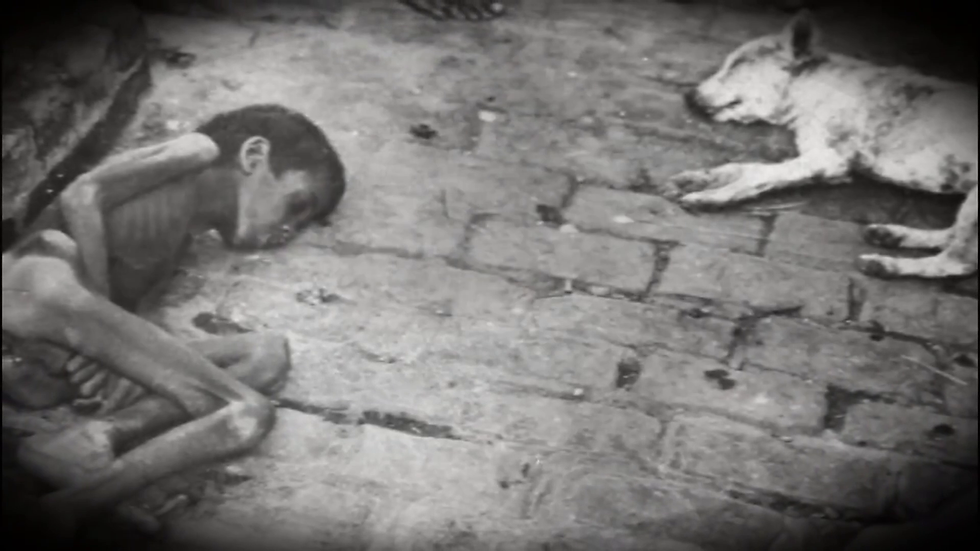
In fact, there are not many war criminals worse than Churchill, a corrupt politician bought by an oil company. It is imperative that Indians know about the genocide induced by the ‘Churchill Famine,’ which claimed millions of innocent lives.

Excerpts from the Documentary, Europa: The Last Battle: “And then of course, in 1943 the story changed. The Germans were pushed back. In their retreat, they took us with them… what was left. We went willingly. Had we stayed back, the communists would have captured us and executed us, or shipped us to Siberia.
"You know, here we were, walking toward Germany, which had always been in our mind a fantastical place. We absolutely believed in Adolf Hitler. We believed in the nature of his struggle. We had these magnificent soldiers protecting us all the way, and we were walking into the Reich.

"So, there were lots of songs along the way in the beginning of the Fall. There were all these Hitler Youth with their beautiful snappy clothing, and on bicycles. They were giving us fresh water. And the girls were cooking and giving us coffee, and so on. We were always fed by the army. They had field kitchens. Then the winter came, and food was getting short. The horses were getting sick, and the road was getting narrower. It was extremely cold.
“When I think of the war, and of the trek, I don’t think of hunger as much as of the cold. It was always cold. That’s what I remember. And then, of course, when winter came, it became harder and harder. We had to often stay overnight in stranger’s houses. The army would temporarily confiscate houses and put refugees there. They always protected us. They didn’t let us down to the very end.
“Keep in mind also, that at the time, Germany didn’t need refugees. You know, they were starving, they were struggling, and they had nothing. They took us in as family."

Italy: The Defection of an Ally
The Allied invasion of Sicily precipitated a crisis in the Axis camp. On July 25, 1943, King Victor Emmanuel III dismissed Benito Mussolini, and the new Italian government began secret surrender negotiations.
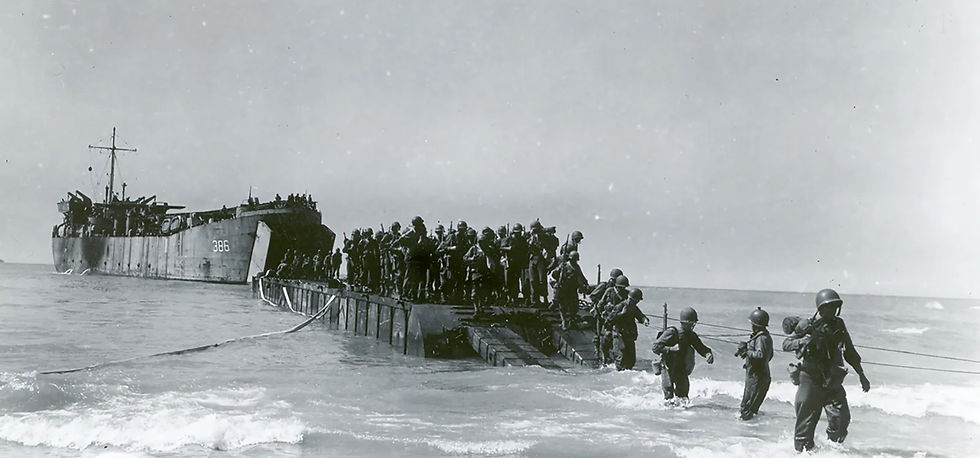
For Germany, Italy's defection was a strategic disaster. German forces in Italy suddenly faced the prospect of becoming prisoners. In a brilliantly executed operation, German troops disarmed Italian forces across the peninsula, seized control of key positions, and established defensive lines south of Rome.
Mussolini himself was rescued by German commandos led by Otto Skorzeny on September 12, 1943, and installed as head of a "Italian Social Republic" in northern Italy. But the Italian campaign became a costly stalemate, with German forces fighting skillful delaying actions in mountainous terrain. Monte Cassino, Anzio, the Gothic Line—each name represents weeks or months of bloody fighting against overwhelming Allied superiority in air and artillery.
For the German soldier in Italy, the campaign was frustrating. Fighting defensively against an enemy with unlimited supplies, they watched their units dwindle while replacements became scarce. Yet they held the Allies south of Rome until June 1944.
Excerpts from the Documentary, Europa: The Last Battle: The soft underbelly of Europe was left vulnerable to an attack and the oil fields of Romania fueled the German military. Hitler worried that the Allies would invade Yugoslavia, Greece and the Balkan nations to cut up Germany’s oil supply and launch of a final push upon Germany from the south and south-east.
Such an attack would be disastrous and detrimental to Germany, but instead of just taking this opportunity to put an end to the war, Churchill, Eisenhower, Montgomery and George Marshall, instead insisted upon making preparations for an invasion of heavily fortified northern France instead to prolong the war, kill more Europeans, and buy the Soviets much needed time to march westward, and eventually allow Stalin to take the whole of eastern Europe as they had agreed.

The reason for this was that Roosevelt and Henry Morgenthau envisioned a post-war world in which the Soviets and United States would join forces to lay the foundation for a global world government, the UN.
Japan: Defensive Perimeter
In the Pacific, Japan spent 1943 fighting a desperate defensive battle. On Guadalcanal, in New Guinea, and in the Solomon Islands, Japanese garrisons fought to annihilation while American forces island-hopped toward the Japanese home islands.
For the Japanese soldier, 1943 meant starvation, disease, and death. Supply lines were cut by American submarines and aircraft. Reinforcements never arrived. Yet surrender was unthinkable—honor demanded death.
The Japanese command developed a new defensive strategy: fight so fiercely that American casualties would become politically unsustainable, forcing a negotiated peace.
The Eastern Front: The Collapse of Army Group Center
By June 1944, German forces in the East had been pushed back to the borders of pre-war Poland. But the front held—until Operation Bagration, the Soviet summer offensive, smashed into Army Group Center.

In six weeks, the Red Army advanced 450 miles, destroying 28 German divisions and killing or capturing 350,000 soldiers. It was the greatest defeat in German military history—worse than Stalingrad or Verdun.
The remnants of Army Group Center fled westward as the Soviets reached the Vistula River, within sight of Warsaw. For the German soldier, Bagration was a nightmare of encirclement and annihilation. More and more refugees fled west to reach safety from the ruthless communists.
Commanders who requested permission to withdraw were dismissed or shot. Units ordered to stand fast were overrun. The survivors retreated in disarray, abandoning wounded comrades, equipment, and hope.
The Western Front: D-Day and the Normandy Campaign
At the 6th hour of the 6th day of the 6th month of 1944, the British, American, and Canadian forces crossed the English Channel, launching the D-Day invasion. They landed in German-occupied France by the coast of Normandy.
With Operation Overlord, the "Second Front" had finally arrived.
The Freemasons, Roosevelt and Churchill, for years, had provided the Soviet Union with military and financial aid using taxpayer money of their mislead citizens. Now, they would finally send in troops to fight and die for their vision of the ‘New World Order.’

The German response was hampered by several factors. Hitler, believing the main invasion would come at Pas-de-Calais, withheld reserves. Allied air superiority prevented movement of reinforcements by day. And the German command structure, with its divided authority and Hitler's insistence on controlling tactical decisions, proved incapable of responding effectively.
Yet German resistance on the beaches, particularly at Omaha, was fierce. Nearly 10,000 men were killed storming Hitler’s fortified beaches of Normandy. In the end, the 'overlords' successfully established an initial beachhead of 100,000 troops. From this base in northern France, the Allies were reinforced for the push towards Germany.
The Wehrmacht fought with its accustomed skill, and the bocage country—small fields enclosed by dense hedgerows—favored the defender. It took Allied forces seven weeks to break out of the beachhead.
For the German soldier in Normandy, the campaign was a nightmare of constant Allied air attack, artillery bombardment, and overwhelming material superiority. Units were chewed up and replaced by reinforcements with little training. When the breakout finally came in late July, German forces in the west collapsed, retreating across France in disorder.
Excerpts from the Documentary, Europa: The Last Battle: At the same time, the Red Terror advanced from the east, equipped to the teeth with advanced American aid from Roosevelt. With Italy also under Allied occupation, Germany now had three fronts to defend. West, south, and east.

In order to intentionally give the communists even more time to conquer eastern Europe, General Eisenhower and Marshall delayed the advance of General Patton’s Third Army, going so far as to cut off shipments of gasoline to Patton’s army.

They wanted to let the communists take Berlin first and allow them to terrorize the population without consequence. After all, the resentment of the Banking Cabal and global Zionists was not just against Hitler or his Nazi Party, but against all Germans.

Patton said, in August 1944:

The Battle of Bulge (1944)
Between December 1944 and January 1945, the German forces made a last desperate effort to drive back the allied forces. This took the Allies by surprise and almost turned the war on its head. Fought in the forest around the mountain region of Belgium, the mighty German offensive would be known as the Battle of Bulge.

American forces were met with German Panzer divisions in the Ardennes Forest battling the frigid weather as they fought each other. It was a decisive moment in World War II (Second Banker War). It would give Hitler a last chance to drive back the approaching Allied armies to the coastline. His wish was to force them back again to negotiate a peace.
A quarter of a million German soldiers rolled towards the Western Front, and moved their units in secret towards points east of Ardennes in late October.
The Allies underestimated the Germans, and thought they did not have enough military strength for such an attack.
In December, the Germans advanced and Bastogne, they drove towards the Meuse River. American troops discovered German troops in front and behind them. Thousand of Allied soldiers destroyed their weapons and gave up in one of the largest surrenders in military history. The ammunition was short as battalions were down to 10 rounds per gun, and the weather conditions were still cold and snowy.
The freezing cold conditions did not make it easy for any side in the battle. Frostbite was rampant and bitter cold caused additional casualties. The Germans proceeded to encircle the Allies in Bastogne from all sides.

The Germans could have easily taken Bastogne, but instead, they gave Americans an ultimatum over an honorable surrender. But the Allies would have none of it. Allied planes instead arrived and started strafing and bombing the Germans, and dropping supplies to the Allies, enough to make the Americans turn the tide.
On January 3rd, the Allies launched a counter-attack and on January 16th, patrols from the First and Third armies met north of Bastogne. They pushed back the Germans again. By early February, the Germans had been pushed back where they had started.
At the same time, the Soviets had taken vital oil fields in the east, which caused lack of fuel for the German tanks in the west. This lack of fuel prevented them from reaching the Meuse river and left the Luftwaffe permanently stranded.
German losses exhausted the last reserves and casualties mounted to 84,834. The remaining German forces would now be driven back to retreat in Berlin.

Excerpts from the Documentary, Europa: The Last Battle: The Freemasonic war criminal, Winston Churchill, appointed the Jewish professor, Lindemann, as his person adviser. Lindemann, together with Churchill, decided that Germany would be subjected to area carpet saturation unrestricted bombing, or what the victims called: Terror Bombing.

Lindemann suggested the bombing of German cities and working class civilian areas were legitimate targets. These bombings began on 10th of August, 1940, with bombing in the small town of Freiburg.
This was before the Germans began bombing British cities. The goal of the bombings was to break the spirit of the Germans.

Between 1940 and 1945, 61 German cities with the total population of 25 million souls were destroyed in the bombing campaigns by the Allies. They specifically targeted innocent civilians.
Many large cities such as Cologne and Essen experience more than 250 raids each.
As the 'Father of Terror Bombing,' Churchill said:

In 1943, when the US finally had rearmed the British, the civilization the Germans had fought so fiercely for was now surrounded from every single side by the armies of the Allies (fighting for the Banking Cabal).
Each plane heading for Germany was loaded with tons of high explosives and incendiary bombs. Over the cities, the Americans strategically bombed industrial plants during the day, while the British purposely targeted innocent civilians at night, aiming at houses of the working-class communities.
The plan was to inflict as much damage, to destroy as many homes, and to kill as many women, children, and the elderly as possible. Churchill wanted more than two cities a month demolished until none would be left, completely erasing German civilization.

Bomber Arthur Harries championed the bombing of cities. The city he was most focused on was Berlin. In documents from Operation Thunderclap, he stated that he wanted the total devastation of the center of Berlin.
More bombs by weight would be dropped on the city of Berlin than on the whole of Great Britain during the entire war.
Churchill did not shy from revealing his genocidal instincts:

As swarms of British bombers began a systematic destruction of Germany, tons of high explosives were unleashed on the nation as schools, hospitals, homes, beautiful ancient art and architecture were all obliterated.

Many of these raids consisted of initial attacks using high explosive bombs to break up buildings, followed with attacks using thousands of incendiary bombs, to set alight all the fabrics, furnishing, and upholstery exposed by the explosives.
In this way, firestorms were created under the right conditions, which burned tens of thousands of people alive, especially the women and children at home while the men were on the war-fronts.
The first explosive bombs blasted the roofs of buildings in preparation for incendiary devices, knocking out the air-raid warning systems and causing massive destruction and death. Fire halls and water mains were also completely destroyed.
When roaring bombers released their lethal cargo, a crescendo of fire descended on the cities. Dresden was turning into an ocean of fire.

Air temperatures rose to 600 degrees Celsius. Winds up to 45 meters per second sucked all oxygen into the center of the storm. Hundreds of thousands of people were burned alive.
A RAF crewman said: “There were people down there being fried to death in melted asphalt on the roads. They were being burned up and we were shuffling incendiary bombs into this Holocaust. I felt terribly sorry for the people in that fire I was helping to stoke up.”
Another witness says: "It was evil. Thousands of fire bombs dropping all over the place. Explosions, heat, fire, people screaming, people burning, people alight. But after about half an hour, it started developing into something which was really bad.
“A lot came over, dropping all these incendiaries, and then of course, as wave after wave came over, the impact got heavier. Thirty-five minutes, forty minutes after the first bombs were dropped, a bomb landed outside the building we were in. Killed my mate, Harry. About three-quarters of the people in there were killed.
“And so you go out... and you come out there, and the whole place is a furnace. Because we were in the center of Dresden.

"It was the second wave which really brought the tornado into being. Because then they started dropping 4,000-pound blockbusters—4,000 pounds of napalm. If you dropped anything within about 300 yards of where we were, it was incinerated. To feed the fire, you get the wind coming in at really tornado force, and you just can't... It dehumanizes everything, anything that you've experienced before.
“They tried to cross over to us, a group of them. The first lot got stuck in the middle of it—they couldn't get away. And in the end, they caught on fire. They were still alive, and then they exploded."

Wave upon wave of phosphorus and incendiary bombs washed over the defenseless civilian population. Thousands of German elderly, women, and children suffocated or were burned alive in basements and tunnels where they were hiding.
As the oxygen was sucked out of their hiding places and pulled toward the blaze to feed the flames. Thousands more were hurtling through the air and sucked by the winds riding to the fire.
Some perished in the blasts of white heat. Heat intense enough to melt the human flesh. Wherever there was a water fountain or canal, the city’s inhabitants jumped in only to be boiled away. The attacks left the cities in a raging sea of fire.

Hundreds of smaller fires merged into single huge conflagration. Huge masses of air were then sucked in to feed the inferno, causing an artificial tornado. The firestorm in Dresden was so massive that pilots reported that their cockpits actually were illuminated by the great fire. The air suction of the fire was so great that it uprooted trees and lifted roofs from houses miles away. Total panic struck the people.
The real holocaust took place in Dresden, the the German people of the city were the sacrifice for the New World Order.

“Then it became so huge, that there was nothing left,” says an old woman who survived the flames of Churchill’s holocaust in Dresden. “It was burning all around. It was just burning, everything was burning.”

“It was utterly senseless. It is difficult to describe. In the darkness, there was a man coming towards me from the ‘Klein-Schachwitzer’ bank and he stops. He’s holding a small suitcase in his hand, and he’s laughing loudly, as if he was mad. It was frightening. I thought the devil was walking the earth. He said: We Polish and Czech, we knew, and tomorrow there will be another attack.’ I was in a state of shock. First the city, and now this man. I stood there, frozen with horror.”
“After the attack, I went on running. Suddenly, I was alone. Everyone scattered and went on to the meadows on the banks of River Elbe. I turned around, and for the first time, I looked around and cried for Dresden. I cried and cried for my hometown.”

“I went down on my knees, trembled, and cried. Several women lay about with their bellies burst open. And one could see the babies for they were hanging half outside. Many of the babies were mutilated. Things like that, I saw everywhere. One acted like a zombie. Some found missing loved ones. Most, however, did not."
“It was horrible. My daughter came to Sachsen Platz, we went up to the steps, and there lay nothing but bodies. And she asked me, ‘Mummy, what is that lying there?’ And I said to her, ‘Don’t look, they’re all dead bodies.’”

“They were naked because their clothes had been on fire and they had torn them off their bodies. I never saw so many dead, as after this attack.”

After first having blasted targeted towns to splinters, the British and American bombers soon returned to strafe and terrorized the groups of refugees and rescuers.
Churchill’s deliberate strategy was killing as many Germany civilians as possible. The RAFs relentless campaign against Germany during the final months of the war was a massive war crime which served absolutely no military purpose.
The Allies lured the civilians from their shelters into the open again. As they thought it was all over, twice as many bombers returned with massive loads of incendiary bombs and ignited all that remained, spreading raging fire storms to the places where the German refugees had fled.
US Mustangs appeared low over the cities, strafing anything that moved, including columns of rescue animals and vehicles. The flow flying planes gunned down innocent patients, old men, women, and children.
When the last plane left, there was nothing left, except ruins. The streets were filled with rats swarming over piles of corpses. Civilians had been liquefied into a mass that melted into the asphalt of the road. And some were left in ashes.
Millions of refugees fled the cities, taking with them stories of the most horrible horror they had ever witnessed. The Allies thought that this would lower German morale, on both the home and battle fronts, to the point that absolute collapse was inevitable for the Third Reich. In the horrific war crimes instigated by Churchill and Arthur ‘Bomber’ Harris, hundreds of thousands of German civilians would be buried alive in consequential fire storms in German cities.

The worst of all the raids was the one unleashed on Dresden. It had no strategic or tactical gain in the war whatsoever. Dresden had no military bases, no communication centers, or heavy industry and no air defense. It was known as a showplace for culture, and one of the most beautiful cities in Germany.

It was done just for the sake of an holocaust, just like Hiroshima and Nagasaki. Three cities sacrificed in fire. A decision mostly taken by two Freemasonic war criminals Churchill and Roosevelt, and their masters from the Banking Cabal.
The air raid in Dresden, particularly, left 24,866 homes destroyed. 11 square miles of prime real estate and irreplaceable cultural treasures totally devastated. 35,000 recognizable corpses were available to be identified, and hundreds and thousands of unrecognizable one. More than three-fifths of Dresden was completely destroyed by bombing raids that lasted more than 14 hours.
Because of so many refugees fleeing eastward resided in Dresden, it is difficult to say how many were killed. Most honest revisionists estimated a death toll to range from 350,000 to 600,000 dead.

“I think even some of RAF British pilots and the Americans also knew it as Terror Bombing. They weren’t kidding themselves. They knew what they were doing. They were slaughtering German women and children down in the cities. This was sanctified by the American and British governments. This deliberate attempt to kill as many Germans as possible. A deliberate attempt to scorch every German city off the face of the earth.”
“What most people don’t know is that almost every German city suffered a similar fate — a terrible devastating bombing followed by fire storms instigated by dropping phosphorous bombs to ignite the rubble.”

“Nothing prepared me for seeing women and children alight while flying through the air. Nothing prepared me for that. After Dresden, I went crazy. I became a nut-case. It took me 40 years to recover. I even lost the ability to laugh for those 40 years. I said, and I still say, and I’ve said it in print. I’ll never forgive the people who ordered those raids and that goes for all of them. Churchill, Attlee… all of them. Whatever they say, they they were still carrying on bombing other cities like these, and then of course, they put the blame on someone else. We were supposed to be the good guys, and we finished up worse than they were. What annoys me is that all this was done in our name.”
The Terror Bombings of Germany during World War II (Second Banker War) left about 3 million Germans dead, 500 thousands of them children, up to 10 million wounded, and 25 million homeless.

The 1975 Bodyguard of Lies Volume II says: Patton was relieved of command of the 3rd Army by Eisenhower just after the end of the war for stating publicly that America had been fighting the wrong enemy— Germany instead of Russia.
According to the 1987 book Cannon Fodder, Growing Up for Vietnam: “We may have been fighting the wrong enemy (Germany) all along. But while we're here (on the Soviet border), we should go after the bastards now, 'cause we're gonna have to fight 'em eventually.”
The 1953 article "We Called Him Uncle Georgie," originally published in The National Guardsman and reprinted in V.F.W. Magazine and Quartermaster Review XXXIII, about Patton by Red Cross worker Betty South, who had direct access to the general at the time, says: “When he went to Berlin to receive the kiss of death from the Russians he remarked shortly, ‘I think we've been fighting the wrong people all this time, but I've oiled my belly so I can stay with them on the Vodka. My front will be as good as theirs.’
Another related exact quote is: “The Germans are the only decent people left in Europe. It's a choice between them and the Russians (Bolsheviks). I prefer the Germans.”
The Bomb Plot: July 20, 1944
By mid-1944, the military situation was deteriorating on all fronts, but in the fetid atmosphere of the Wolfsschanze (Wolf's Lair), Hitler's faith in his own destiny remained absolute. He had long suspected disloyalty among the old-school, Prussian military elite officers he despised for their lack of nationalist fervor.
His paranoia, honed by years of evading assassination attempts, was justified. Unknown to him, a cadre of these very officers, led by the mutilated Colonel Claus von Stauffenberg, were finalizing a coup to kill him and seize the state.

The Prussian aristocracy—families like the Stauffenbergs who had served states for centuries—was being systematically destroyed by Hitler. Not just killed, but rendered irrelevant. The SS, staffed by "middle-class thugs and racial ideologues" in Stauffenberg's point of view, was displacing the traditional officer corps.
The lack of ‘special treatment’ fed Stauffenberg’s resentment toward Hitler. He even attempted to contact the Allies for coordination. Through channels in Switzerland, the traitors reached out to Allen Dulles, the head of the OSS (Office of Strategic Services, precursor to the CIA) in Bern.
The key go-between was Hans Bernd Gisevius, a German intelligence officer working under Admiral Canaris's Abwehr, who was secretly feeding information to Dulles. On January 27, 1944, Dulles cabled Washington that Stauffenberg's circle wanted "political ammunition" and asked what help the U.S. could provide.
Washington's answer was a hard no. The Allied policy, declared at Casablanca in 1943, was "unconditional surrender." The international Jewry wanted complete destruction of Germany.
When one of the plotters, Otto John, tried to pass information to the British MI6 through a contact in Spain, the report landed on the desk of Kim Philby—a senior MI6 officer who was secretly a Soviet agent. Philby, protecting Soviet interests, destroyed the report immediately.
The Kremlin had no interest in a German coup that might end the war early and deny the Red Army its conquest of Eastern Europe. Even within the OSS, Dulles faced resistance. The Jews hated Prussians as much as the Germans, and hence the U.S. State Department harbored "extreme antagonism" toward them.
But that did not stop Stauffenberg.

The day began as a routine military conference. Because of the July heat, the meeting was moved from the stuffy concrete bunker to a wooden barrack with windows—a seemingly insignificant change that would have monumental consequences.
At around 12:30 p.m., Stauffenberg, who had attended conferences before, placed his heavy briefcase under the map table close to where Hitler was standing, then excused himself.
At 12:42 p.m., the bomb detonated. From Hitler's perspective, the world simply dissolved into a flash of light and deafening thunder. As he later recounted to Mussolini that afternoon, he was leaning over the table, his elbow resting on it, when the explosion occurred.
The pressure wave ripped through the room. His hair was singed, his eardrum perforated, and his trousers were shredded to tatters by the blast. In the smoke and chaos, he stumbled out of the wreckage, supported by a junior aide.
He was covered in dust and debris, but alive. In that instant, his first thought—as he told his inner circle—was that this was the moment that proved Providence had chosen him. "I regard this as a confirmation of the task imposed upon me by Providence," he would later declare.
What he did not see in the immediate aftermath was the mechanics of his survival: Colonel Heinz Brandt, finding Stauffenberg's briefcase in his way, had moved it behind the thick, solid oak leg of the conference table support. This massive wooden beam deflected the blast away from the Führer. However, four men were killed.
After the plot failed, the BBC broadcast the names of conspirators who had escaped capture, effectively handing them to the Gestapo. Within hours, as news filtered in that Stauffenberg and others were attempting to seize power in Berlin under Operation Valkyrie, Hitler's initial shock transformed into incandescent rage. He was not just angry at the attempt on his life, but at the depth of the betrayal. These were not foreign enemies, but his own generals—men he had promoted, decorated, and trusted.
At 1:00 a.m. on July 21, a hoarse but controlled Hitler spoke to the German people via radio. His voice crackled with contempt as he denounced "a very small clique of ambitious, unscrupulous, and at the same time criminally stupid officers" who had plotted to remove him. He assured the nation that he was unharmed and that this treason would be avenged.
Hitler immediately delegated the retribution to Himmler and the Gestapo. This was not to be a simple execution; it was to be a humiliation of the traitors. He ordered that the conspirators not be given a soldier's death by firing squad. Instead, they were to be "hanged like cattle."
Many of the leading plotters—Field Marshal von Witzleben, General Hoepner, and others—were dragged before the infamous "People's Court" (Volksgerichtshof) presided over by Judge Roland Freisler.
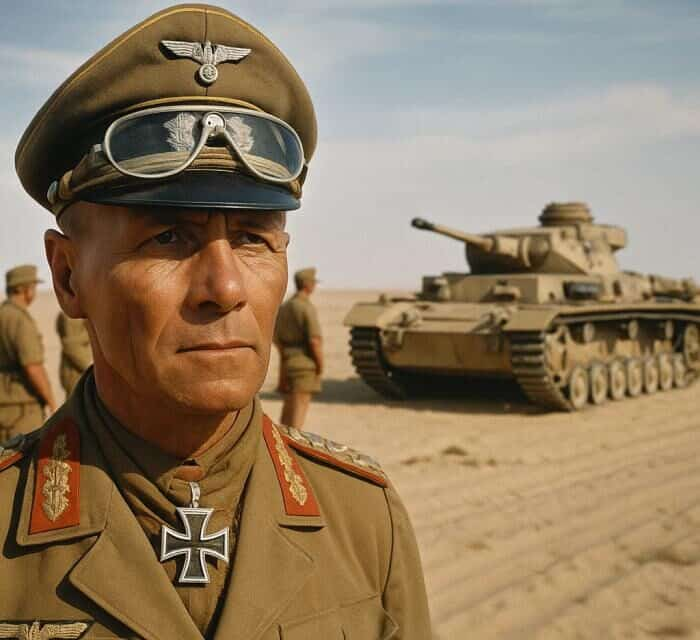
Even Field Marshal Erwin Rommel, the "Desert Fox," was implicated. Because he was a popular hero, Hitler could not have him tried. Instead, Hitler sent generals to Rommel's home with a stark choice: public trial and disgrace (with reprisals against his family) or suicide by cyanide, with a promise of a state funeral and protection for his wife and son. Rommel chose the pill.
For the German people, the plot's failure reinforced the sense that Hitler was protected by providence.
Japan: The Inner Ring (1944)
In the Pacific, 1944 saw American forces penetrate Japan's inner defensive perimeter. The Marianas fell in June-July, bringing Japan within range of B-29 bombers. The Battle of the Philippine Sea (June 19-20) was a disaster for Japanese naval aviation—so many aircraft were shot down that American pilots called it the "Great Marianas Turkey Shoot."
In October, American forces invaded the Philippines. The Battle of Leyte Gulf (October 23-26) destroyed what remained of Japanese naval power. Japan's surface fleet was effectively annihilated, and for the first time, Japanese forces employed kamikaze attacks—pilots deliberately crashing their aircraft into American ships.

For the Japanese soldier, sailor, and airman, 1944 marked the transition from conventional war to desperate resistance. The homeland itself was now within range.
Excerpts from the Documentary, Europa: The Last Battle: As the communists moved west, they carried out brutal massacres on a regular basis. In Belarus, Estonia, Latvia, Lithuania, Poland, Ukraine, and Russia, thousands of innocent non-Jewish intellectuals and ‘thought criminals’ were slaughtered.
Already when the communists claimed the eastern territory of of Poland, thousands of Polish soldiers were brutally captured by the Red Army. Stalin then ordered 15 thousand Polish officers imprisoned in special camps at Kozelsks, Ostashkov, and Starobielsk, partially because he feared that these men might have potential of starting a national movement capable of resisting the communist takeover of Poland in the future.

On the 5th of March 1940, Stalin and Kaganovich signed an order to execute Polish army and police officers. The Jewish secret police chief, Lavrentiy Beria, was an infamous butcher, who committed his crimes by blaming them on National Socialists. (A popular tactic of subversion that is leveraged even today by spy agencies like the CIA and Mossad)
He sent over 20 million people to slave labor camps. Beria then masterminded what will be called later as the Katyn Forest Massacre.
In April 1940, Stalin ordered more than 10,000 Polish officers taken into the Katyn Forest near Gnyozdovo village, a short distance from Smolensk in Russia, where the victims were executed.
The Poles were marched into the forest, wearing their uniforms with their hands tied behind their backs, and shot in the back of the necks. Thousands were buried in huge mass graves. Many of these victims couldn’t later be recognized by their relatives due to the fact that their bodies and faces had been brutally demolished by the Red Army.
Some Poles were executed in the Kalinin and Kharkiv prison and elsewhere. Of the total killed, 8,000 were officers imprisoned during the 1939 Soviet invasion of Poland. Another 6,000 were police officers and the rest were arrested intelligentsia that the Soviets deemed to be intelligence agents, landowners, saboteurs, factory owners, lawyers, officers, and priests. An estimate of about 22,000 of the best Poles were killed by the NKVD in this massacre alone.

When the Germans discovered the mass graves in early 1943, they brought in the European Red Cross committee called the Katyn Commission, comprising 12 forensic experts and their staff, but at the Nuremberg Trials, the Soviets just blamed the Germans for perpetrating the Katyn Massacre, and the Americans, British, and French said nothing against their ‘partner-in-crime.’
Numerous German officers were wrongly hung for the murder of thousands of innocent Polish nationalists. Murders that were, in fact, committed by the NKVD.
The Freemasonic war criminal, President Roosevelt, purposely and deliberately covered up the evidence of who really committed these crimes. That such corruption could have been going on in the highest levels of the US government during those years proves that we should question the ‘official evidence’ of the ‘Gas Chambers’ in World War II (Second Banker War), what with the overwhelming evidence of how it is economically and practically unfeasible to use gas chambers for execution.

The Soviet report that blamed the Germans for committing the Katyn Massacre was listed at Nuremberg as 054-USSR.

Two obvious liars with an agenda signed this report. These were the same liars who signed the official Soviet report on Auschwitz, which was listed at Nuremberg as 008-USSR.

This alone should be cause of concern to anyone caring the slightest bit about objective truth.
The Soviets kept their own crimes a secret. Not until 1989 were the communist documents released, documenting the fact that the NKVD carried out the Katyn Massacres.
In 2012, World Press reported their recent findings on the Katyn Massacre. As it was long suspected, the Freemasonic war criminals — Churchill and Roosevelt — knew that Stalin had ordered the massacre, but intentionally lied to their citizens. The US covered it up.

With their free arsenal supplemented by America’s finest tanks, tommy guns, planes, trucks, jeeps, and even food and blankets, the Red Army advanced on Germany from the east. Stalin’s plot to take over all of Easter Europe was helped by Eisenhower and Marshall’s obsession of invading Europe from England, instead of advancing from Europe’s soft underbelly,
By 1944, the communists had rolled into Poland and advanced into Germany. Stalin’s chief propagandist and prominent member of the Soviet sponsored Jewish Anti-Fascist Committee, Ilya Ehrenburg, instigated the Soviet army to rape and murder the German civilians.

Referring to German women, Ehrenburg gloated to the advancing Red Army troops: “That blond hag is in for a bad time…”
Just like the Jews around Roosevelt, Ehrenburg also sought the extermination and genocide of the entire German people. He encouraged a mass rape and killing of German women.
His leaflets declared:

Disclaimer and Content Warning: Please be advised that the following content contains detailed descriptions and discussions of historical events that are extremely disturbing and traumatic. The material presented addresses the brutalities, widespread violence, and systematic atrocities committed during World War II (Second Banker War), including but not limited to graphic accounts of mass murder, torture, and sexual violence such as rape.
As the soldiers approached Danzig, millions of leaflets were airdropped on the troops with a message composed by the propagandist Ehrenburg, and signed by Stalin.
“Kill them all! Men, old men, children, and the women. After you have amused yourself with them. Kill, nothing in Germany is guileless. Neither the living, nor the yet unborn. Break the racial pride of the German woman, take her as your legitimate booty. Kill, you brave soldiers of the victorious Soviet army.”

An unimaginable orgy of violence and rape emerged, which would mark one of the ghastliest episodes in human history. At least 2 million German women, young and old, were gang raped, sodomized, and beaten — often in view of their children or family members.
Parties of soldiers raided houses. In wild orgies of violence, women were penetrated with broken bottles and bayonets. It was all the same, whether the communists raped near children or old women, they were raped not once or twice, but ten, twenty, thirty times… some even hundred times.

Mothers were raped in the presence of their children. Girls were raped in front of their brothers. Even terrified women who fled to churches and hospitals were hunted down, raped, and tortured to death.

Nuns, little girls, old women were infected with venereal diseases. There were cases of breasts being cut off, and victims being set on fire after being raped. Some German women were even forced at gunpoint to make out with dead corpses.
Pregnant women had babies cut out of their bodies. Some babies even had their heads bashed in.

A naked woman was nailed through the hands in a crucified posture.

A woman of 84 years old was found sitting on a sofa, half of whose head had been sheared off with an ax or spade. Women, children, and old men were all murdered in bestial manner.
As the final pockets of German resistance in the east surrendered, one girl remembered: “Rape began almost immediately and there was a viciousness in the acts.”

“It’s more than just rape. It’s spiritual massacre, deliberate destruction of German womanhood by rape.”
“And if your husband sees this, he’s warned: ‘If you do anything, we’ll cut you in half. You see this saw we’ve got here? We’ll literally cut you in half’.”

The most notable offenders were the Judeo-Bolshevik NKVD rear guard troops, and the mongoloid troops from the Asian republics of the far eastern reaches of the USSR. To these troops, the German women represented everything they hated about Europeans. This was their way of crushing their pride. Many of the ethnic Russians in the Soviet army considered these Jewish led troops as utterly merciless.

“By and large, the commissaries in the Soviet army were mostly Jewish. Now there was a lot of commissars, but these are the political officers that are in every unit above. I suppose, above a platoon, that are there to make sure everyone tows the party line, that everyone’s a good communist, and everyone’s a good German-hater."

“In other words, you’ve got these people, these Jewish commissars badgering the soldiers to kill more and rape more. And basically, they’re the cheerleaders that go along with every unit, roughly the size of a company I would say."

“And so you’ve got these unsophisticated soldier boys, youthful, and you’ve got these Jewish commissars who are encouraging them to do the worst things. And so when someone like Ehrenburg on the right hand of Stalin says, it is not only okay, but it is almost a command for you to take German women, play with them, rape them as often as you want, and kill them. That sounds like an order. That’s sanctified. That’s sanctioned by the Soviet government."

"They said, 'Woman, come with me!' and we said, 'No, we’re not going with you.' Then he took my sister-in-law. He took her outside. There must have been a small stable, because we heard three shots. He came back, and we asked him. Yes, he had shot her. She had resisted.
"Then he wanted us as well. We said no, that we would rather be shot too. So first, he shot my grandmother. He was really going to shoot us all. We started to pray. We prayed together. My father shook everyone’s hand and said goodbye. Then he shot my father. After that, he shot my mother.
"Then he saw me. He pulled me to him. He wanted to rape me. I resisted, but he beat me with his rifle butt on my head. I thought I was going to faint, but I didn’t. So I acted as if I was unconscious. I lay there, and all the time he was listening to my heartbeat. He listened to see if I was still alive. Then he cut my pants open and ripped my clothes.
"And then he raped me. Afterward, he took a step back and looked into the baby stroller. The child was still alive. He shot three times through the baby stroller. And I just thought, why aren’t those bullets for me?"
What if you found out one your fellow soldiers had raped someone?: “Nobody took any notice. On the contrary, the soldiers told each other everything. It was almost considered to be heroic or courageous to rape a woman or several women.”
According to some Allies soldiers, even if someone was murdered. Well, it was a war. So, it was no big deal if a soldier “slept” with a woman or a girl.
Thousands of German women committed suicide, rather than submit to the Soviet rape and torture. Many drowned themselves with their children in the nearest rivers.

“Women holding children by their hand were running towards the water. There were whole families, including old people. Many had tied themselves together. I didn’t understand what they were doing. There were also individuals running up and down the riverbank, children who had lost their families. There was the terrible sight of those who had gone into the river the previous night — those bloated bodies, reddish-blues. Mother grabbed us, and wanted to run into the river with us. We were both screaming. We’d almost reached the river, but grandmother managed to stop us, and we didn’t jump in.”

“I was in such a state, I was shaking. I said, ‘come in, one by one.’ There was an entrance to the apartment block, with stairs leading to the basement. I said, ‘bring them in for interrogation. I had my special knife, and as they came in, I slit their throats. I knifed a lot of them.”
“As you know, the human body consists of 70% water. So, it’s very vulnerable. So, you stick the knife between his ribs, and he falls down, and that’s it. My knife was very sharp. You stab him here, and it comes out here. No screaming, nothing.”
Don’t you think it was a war crime? What you did to those Germans?
“Do I think it was a war-crime? No, I don’t. Otherwise, I wouldn’t have done it.”
It is estimated that as many as 2 million German women were raped by Red Army soldiers. One prisoner was a 14 year old boy. The guards poured gasoline on his curly black hair and set it on fire. The boy went insane.

In Poland, a few years ago, the memorial statue of a Bolshevik soldier raping a pregnant European woman was removed in Poland’s Gdansk after a deluge of complaints from the local Jewish community.
A journalist says: “The men, they were beating with a ‘Totschlager’ or ‘Beater-to-Death.’ It’s a long steel spring, and at the end is a big lead ball, and you use it like racquetball rack. Your arm, your wrist, and the spring. They deliver a triple blow to the German’s face. One of Lola’s guards told me, ‘Yea, the German’s in Lola’s prison were worse off than Lola. Lola wasn’t locked up in a room night and day. She wasn’t tortured night after night. She herself told me, ‘Thank God, nobody tried to rape us. The Germans weren’t allowed to.’ But all of that happened to German girls at Lola’s prison in Gleiwitz.
“Now, the office of State Security was a Polish government organization. The leaders were Polish Jews. The chief of the office in Warsaw was a Jew. The department directors — almost all of them were Jews. In the province where Lola was, Silesia, the director of the office of state security was a Jew. I met him in Copenhagen. A little bald-headed man. The director of prisons was a Jew. The secretary of state security was a Jew. And in Silesia in 1945, 3/4th of the officers were Jews. I interviewed 24 and learned that the office of state security granted 227 prisons for German civilians.
“This one camp, I found death certificates for 1583 Germans. In other camps, other prisons, thousands of German civilians died. German men, women, children, babies. At one camp, there was a barrack for 50 babies. They were in cribs, and the camp doctor, Dr. Cedrowski, he didn’t heat the barracks, he didn’t give the babies milk and 48 of the 50 babies died. All in all, 60-80,000 Germans died in the custody of the officers of state security.
“Jewish reporters who knew about it didn’t write about it. There’s a working reporter right now in New York City. He was in Poland right after World War II. He tells me: ‘Whatever the Germans tell you, believe me, it’s true.’ But he himself dared not right anything about it. The truth was covered up, and is still being covered up.”
Germany: The Twilight of Civilization
By January 1945, Germany's situation was hopeless. The Red Army stood on the Oder River, sixty miles from Berlin. American and British forces approached the Rhine. The Luftwaffe had been swept from the skies, and German cities lay in ruins from round-the-clock bombing.
Yet German resistance continued. On the Eastern Front, soldiers fought with the knowledge that Soviet retribution would be terrible. Civilians fled westward ahead of the Red Army. In the west, some units fought with equal determination, though many surrendered when possible.
Hitler, secluded in his Berlin bunker, issued orders to nonexistent units and dreamed of miraculous turnarounds. His physical and mental state deteriorated as Soviet shells fell on the capital.
In April, the final battles began. The Battle of Berlin was one of the war's most savage urban engagements. Soviet forces fought house-to-house against SS, Volkssturm (old men and boys), and regular army remnants.
There was nothing to stop the allies from taking the German capital before the Soviets could get there. The Freemason Roosevelt’s lapdog, Eisenhower, however, would yet again find a way to delay the Allied advance, so as to buy time for Stalin to advance from the east.
On March 25, Eisenhower even sent a message to Stalin assuring him that the Allied advance would focus on Western Germany primarily to give Berlin to Stalin.
On April 15th, Eisenhower even went so far as to issue an halt order forbidding Allied commanders from crossing the Elbe River.
The Generals Montgomery and Patton were extremely upset over this order to halt the advance. Eisenhower’s orders left Berlin and all of eastern Europe to Soviet communism.
Italy: The End of Mussolini

On April 28, news arrived that Mussolini was dead. He had attempted to escape to neutral Switzerland, but Italian partisan communists captured Mussolini and his lover, Clara Petacci, along with several of their friends.
After sweeping trial, they had both been executed near Lake Como in northern Italy. Mussolini had been undressed, tortured and violated, and Clara Petacci had been raped several times before being killed.
Not only had Clara been gang-raped by the communists, but all of the women in the fleeing group with Mussolini suffered the same fate. At the end of her violation, she was murdered beside Mussolini. The communist degenerates even sodomized his corpse.
They urinated on and kicked his body until he was barely recognizable as human. The bodies were then thrown into a heap in the suburban square in the city of Milan.

At least one British secret service agent and numerous communists whipped a crowd into a frenzy. They attacked the corpses in all ways possible. Eventually the bodies were lifted up and hanged upside down on meat hooks.
An American eyewitness described the crowd as sinister, depraved, and out of control.
Excerpts from the Documentary, Europa: The Last Battle: In February 1945, Stalin traveled to the Black Sea resort of Yalta to attend the most historic of the Big Three conferences of the war. At the Yalta Conference, the plot to reshaping the postwar world was made.
The biggest winner was Stalin. Churchill said to him:

Communist spies, Alger Hiss and Harry Hopkins, heavily influenced Roosevelt, and they laid the foundation of the new world order after Germany’s defeat.

By now, Hitler had heard about Mussolini’s death whilst in his bunker in Berlin. By his side was Eva Braun, surrounded by the high command. They had been there since 16th of January, 1945.
Churchill’s bombings of German civilians went on non-stop. By Spring, the situation had become all but hopeless. The Red Army had reached River Oder, which was the last great natural obstacle before Berlin.
Germany would now be surrounded from every frontier. The Soviets now had twice as many men as the Wehrmacht, and four times the number of tanks. Stalim claimed he had 6 million men against the remaining 1 million Germans of every unit the Reich could find.
Hitler knew he was surrounded. Facing certain defeat, foreign volunteers, old men, women, children prepared for the last fight against hopeless odds. Voice of the Hitler Youth also prepared themselves for the last battle.

The only thing that stood between heaven and hell was the remaining German troops. On 19th of April, 1945, Soviet troops reached the Berlin suburbs. Every remaining desperate defender of Germany would be eliminated in house-by-house street fighting.
The Red Terror could not be halted anymore. The combat embrace everyone in its battle zone. Hitler’s dream of a free Germany had been shattered to a million pieces.

Hitler still had his guardian angel fighter pilot, Hanna Reitsch, who was so utterly devoted to her nation that she received an Iron Cross. She was also the first woman to fly a helicopter, a rocket plane, and a jet fighter.

And on 29th of April, she flew her light aircraft into the chaotic heart of Berlin to make a daring rescue attempt offering an exit to Hitler if he wished to escape the besieged city. She was his last chance to escape.
Hitler told Hanna: “You’re a very brave woman. There is still loyalty and courage in the world.”
He had already chosen to meet his destiny in Berlin. He would stay.
After her dramatic flight out of Berlin, Hanna Reitsch's life took many turns. She was captured by the Americans and held for 18 months. During this time, she was interrogated about Hitler's final days and her unwavering loyalty. She famously told her interrogators, "It was the blackest day when we could not die at our Führer's side."
While she was in captivity, Reitsch learned of a horrific family tragedy. Fearing the advancing Soviet army and the expulsion of Germans from their homeland, her father shot and killed her mother, her sister, and her sister's three children before turning the gun on himself.
The man she flew into Berlin with, Field Marshal Robert Ritter von Greim, committed suicide on May 24, 1945, shortly after their capture.

After her release in 1946, she settled in Frankfurt. Once West Germany was allowed to participate in gliding again, Reitsch picked up right where she left off. She won third place in the World Gliding Championships in 1952, became German champion in 1955, and continued to set numerous altitude and distance records.
Her post-war fame as an aviator was global. In 1959, she was invited to India by Prime Minister Jawaharlal Nehru to help start a gliding center. From 1962 to 1966, she lived in Ghana, where she founded the first national gliding school in Africa at the invitation of President Kwame Nkrumah. She was also a guest of US President John F. Kennedy at the White House in 1961.
Hanna Reitsch died of a heart attack in Frankfurt on August 24, 1979, at the age of 67. However, a question has lingered for decades: did she use the cyanide capsule Hitler had given her in the bunker over 30 years earlier? While the official cause of death was a heart attack, some biographers have noted the mystery surrounding her death, given her access to the poison and her dramatic life.
The Tragic End of Adolf Hitler (1945)
Eva Braun was 17 when met Adolf Hitler in October 1929 at the Munich photography studio of Heinrich Hoffmann, where she worked as an assistant and model. They became lovers three years later, in 1932.

By 1936, Eva had become a permanent part of Hitler's household at the Berghof, his residence in the Bavarian Alps. She lived a sheltered life there, away from the public eye—the German people were largely unaware of her existence until after the war.
Her main interests included sports, fashion, and cinema, and she took many of the surviving color photographs and films of Hitler.
As the Soviet army closed in on Berlin in April 1945, Eva traveled to join Hitler in the Führerbunker, from where he was commanding the army. As the remaining German forces were overwhelmed, Eva wrote in a letter to her friend, Herta Schneider:

On April 29th, 1945, Hitler decided to marry her, knowing the Free Germany he had built was dying. He knew he had to die with her, but before that, there was this one thing he had to do. The ceremony was concluded with Goebbels and Bormann as witnesses.
Hitler signed the wedding certificate, but when it was Eva’s turn, she began to write her surname as Braun, before crossing out the letter B, and instead writing Eva Hitler.
Arm in arm, Hitler led the bride to the study for the wedding reception. He now admitted for the first time that all was lost. He said: “All is lost. Pack your things and go. You have to leave, and within an hour, the last plane will bring you out.”
Eva Braun went to him and took his hand. She said: “But you know I will stay with you.”
Less than two days after the wedding, on April 30th, Hitler and his bride ended their lives together. Eva took a cyanide capsule, popped it into her mouth, and died instantly. Hitler picked up his gun, put it to his right temple, and fired. Their dog, Blondi, was also poisoned to die with them.
One day before committing suicide, Hitler dictated his political testament:

After their suicides, the bodies of Adolf Hitler and Eva Braun were carried to the garden of the Reich Chancellery and burned together. Hitler did not want to be handed over to the barbaric Bolsheviks, who were known for their ritualistic mutilation.
According to eyewitness accounts, around 3:30 PM on April 30, 1945, Hitler's valet, Heinz Linge, and SS officer Otto Günsche wrapped the bodies in blankets and carried them up to the garden, where they were burned. Several others from Hitler's staff witnessed the cremation, including Martin Bormann and Joseph Goebbels.

Thus ended World War II (Second Banker War), and the tale of a man who had tried to stand against the New World Order. It was the end of the Western Civilization. The end of art and culture... and the beginning of an artless, lifeless, and soulless New World Order enforced by the American Imperium.
Conclusion: End of Europa and Her Civilization

When one examines the full scope of World War II (Second Banker War) without the constraints of victor's justice, a more complex and morally ambiguous picture emerges. The firebombing of Dresden, the atomic devastation of Hiroshima and Nagasaki, the Soviet massacre at Katyn, and the systematic expulsion of millions from their ancestral homes in Eastern Europe represent actions that, under different circumstances, might be subject to far greater scrutiny.
These were not mere wartime necessities but deliberate strategies that resulted in the deaths of hundreds of thousands of civilians. Given these realities, it is hardly surprising that Nazi Germany has been subjected to such exhaustive and relentless vilification.
The sheer scale of Allied propaganda, amplified by decades of cultural reinforcement, has created a dense fog through which objective historical understanding struggles to penetrate. This narrative machinery serves a dual purpose: it not only demonizes the defeated to justify the victors' actions but also conveniently obscures from popular memory the genocidal policies and mass atrocities initiated by figures such as Churchill, Stalin, and Roosevelt.
The suffering of peoples in Bengal, in the Soviet republics, and in the devastated cities of Germany and Japan becomes collateral damage not only of war but of history itself—erased by the very powers who wrote the final chapter.


Comments