
.png)

Hidden Truths: World War II (Second Banker War) — Part 1
- A. Royden D'Souza

- Mar 4
- 87 min read
World War II began on 1 September 1939, when Adolf Hitler began his campaign to liberate Germans in Poland. German forces used a rapid military strategy known as Blitzkrieg, combining tanks, aircraft, and infantry to overwhelm Polish defenses quickly.
This act gave an excuse that the UK had been waiting for to launch a war on Germany with its ally, France. The declarations of war transformed what had been regional aggression into a major international conflict involving many of the world’s great powers.

Meanwhile, Japanese industrialists stared at their stalled factories and saw only one solution in a resource-starved Asia: take by force what the Western powers refused to sell.
From the boardrooms of the Ruhr to the zaibatsu of Tokyo, this was a war where ideology provided the justification, but economic desperation loaded the guns.
But, before that, let's go over the key events that led to the end of true western civilization and paved the way for the 'Rule of the Bankers.'
The Anschluss: German Unification (March 1938)
The Anschluss was the voluntary unification of Austria into the German Reich, to a pre-World War I status, when they were both one empire.
The Treaty of Versailles had broken up the Austria-Hungarian empire and denied the new Austria from uniting with Germany.
However, after seeing the success of Hitler's Germany, there was no stopping the Austrians from uniting with their joyful brothers and sisters who had been ripped apart by betrayal.

In February 1938, Austrian Chancellor Kurt von Schuschnigg was summoned to Hitler's mountain retreat in Berchtesgaden. Hitler directed him to appoint prominent Austrian National Socialists, including Arthur Seyss-Inquart, to key positions in his government.
Schuschnigg then called a last-minute plebiscite for March 13th, asking the Austrian people if they wanted a "free, independent, social, Christian and united Austria."
However, Hitler feared government interference, and canceled this plebiscite. On March 11th, Schuschnigg capitulated, ordering the Austrian army not to resist any German advance. He was replaced by Seyss-Inquart, Hitler's ally.

On March 12th 1938, German troops crossed the border near Hitler's birthplace 'Braunau' without a shot being fired, met not by resistance but by widespread jubilation from a significant portion of the Austrian population.
The 'Nazis' were greeted as saviors and liberators by the joyous Austrians. By March 13th, Hitler had signed the law formally incorporating Austria into the German Reich.

Hitler even organized a new plebiscite on April 10, 1938. Unsurprisingly, 99.7% voted in favor of union with Germany. Today, Zionist press often claims this was because of 'Nazi pressure.'

As a brotherly gesture towards the Austrians and a sign to the rest of the world of a peaceful reunion, Hitler united Austrian troops to march inside of Germany as well.
Not surprisingly, the western globalist media portrayed the joyful unification as "Germany invaded and conquered Austria."
Austria had been in depression when Hitler united the two countries. With the help of Germany, this problem was turned around. Order was restored within two years, after which, Austria saw full employment.
International Reaction and Critical Analysis:
Passivity of the Great Powers: The international response was remarkably passive. Britain, under Prime Minister Neville Chamberlain, was committed to a policy of appeasement and viewed the Anschluss as a natural union of two German-speaking nations that did not threaten British interests. France was in the midst of a political crisis with no government in place, rendering it incapable of a firm response.
Italy's Acquiescence: Italy, under Benito Mussolini, had once been the primary guarantor of Austrian independence, even mobilizing troops to prevent a Nazi takeover in 1934. However, by 1938, Mussolini was increasingly isolated internationally after the invasion of Abyssinia and had drawn closer to Hitler. Hitler's assurance that Germany would respect the new Italian-German border (the Brenner Pass) was enough to secure Mussolini's neutrality.
Soviet Protest: The Soviet Union was one of the few powers to formally protest the Anschluss at the League of Nations, proposing collective action against Germany. However, given the mutual distrust between the USSR and the Western powers, this proposal was ignored. Distant Mexico also lodged a formal protest, but it was largely symbolic.
Strategic Gains for Germany: The Anschluss was a massive strategic victory. Germany added seven million people to its population, bolstered its army with 100,000 Austrian soldiers, and gained control of valuable resources like iron ore and Austria's foreign exchange reserves. Most critically, it positioned Germany to strike at its next target: Czechoslovakia, which was now surrounded on three sides.
The Munich Agreement and the Dissolution of Czechoslovakia (1938-1939)
With Austria secured, Hitler turned his attention to Czechoslovakia, specifically the Sudetenland, a border region where over three million ethnic Germans lived. Hitler's stated aim was to free these Germans from Czech rule and bring them into the Reich.
The German people of Czechoslovakia shared the same desire to reunited Germany. When the League of Nations (Banker League) ripped apart Austria-Hungary to pieces, it combined Czechs, Slovaks, Germans, and Hungarians into an artificial state called Czechoslovakia.

It was the oldest trick in the book, to break and divide nations based on race, religion, and language, so they couldn’t form a united, trustful society. Such ‘melting pots’ were easier to control.
Prague and Bohemia had been a part of Germany for centuries. However, the Prague regime represented a threat to Germany. Czechoslovakia’s communist president, Benes, had been ordered by his Comintern (Communist International) masters in USSR to to open his borders to the communist armies at a moment’s notice to start a war if Germany tried to retake German-speak lands from the country. Prague was supposed to be the Comintern’s ‘revolution’ springboard into Germany.
The German region, Sudetenland, south of Germany, had 3.5 million citizens. Just like the Austrians, the Sudetenlanders wished to united with Germany, but Benes would not allow it. Sudetenlanders were already being mistreated by the communists, considering their peculiar hatred of the German-speaking people.
The Munich Conference (September 29-30, 1938): To resolve the matter peacefully, Hitler called for an emergency conference in Munich with Italy (Benito Mussolini), France (Édouard Daladier), and England (Neville Chamberlain). All agreed that German Sudetenland would be unified with Germany and that the Slovaks would have their own state called Slovak Republic.
After hours of negotiations, the Munich Agreement was signed. It ceded the Sudetenland to Germany, effective October 1st. The Sudenten Germans were united with Germany. A win-win situation for all involved. As was the case in Austria, Hitler received a hero’s welcome in Sudentenland.
Chamberlain returned from Munich to a blissful response in Britain, waving a paper he and Hitler had signed and declared: “For the second time in our history a British Prime Minister has returned from Germany bringing peace with honor. I believe it is peace for our time.”
The Polish Corridor: After World War I (First Banker War), the League of Nations (Banker League) had given up a part of old Germany territory (Western Prussia) to the newly re-established nation of Poland. Eastern Prussia was completely cut off and isolated from Germany.

The League of Nations had intentionally separated the German city of Danzig from Germany and given it to Poland against the wish of its people.
Political scientists, Stefan Wolff, professor at the University of Birmingham, says: “The actions of Polish state officials after the establishment of the corridor followed a course of assimilation and oppression. As a result, a large number of ethnic Germans left Poland after the First World War.”
A contemporary statistician says 592,000 Germans had left by 1921 and other Polish scholars say that up to a million Germans left.

The free city of Danzig was over 90 percent German, since it had belonged to Germany since 1871. The city with a predominantly German-speaking population along with its surrounding German area of East Prussia was isolated from the German mainland. With former German territory now belonging to Poland, cutting right through the Prussian Pomeranian region of Germany.
Contrary to what the western media claimed, Hitler did not hold a grudge against Poles. In fact, he was profoundly impressed by the Polish victory in the Polish-Soviet war (1919-1921).
Hitler wanted the kind of alliance with Poland he had with Italy, so he could team up with the Polish people and stop the plague of Comintern (Communist International) in Germany. He did not want communism to spread westward.

Marshal Joseph Pilsudski was a leader of Poland up until his death in 1935. He was idolized by Hitler. Pilsudski had been on good terms with Germany, and he worked closely with Hitler in negotiations over peace and the Danzig Corridor.

In 1934, a peace act was signed between Adolf Hitler and Pilsudski.
Hitler said, "It made good sense that Poland should participate in a defense wall against Bolshevism. Every Polish division would mean strengthening the military power against not only a possible but now already significantly obvious, onslaught of Bolshevism against Europe."
In a Reichstag speech, May 21st 1935, Hitler said:

According to their non-aggression pact, both countries pledged to resolve their problems through negotiations, not armed conflict.
Unfortunately, Pilsudski died on 12th 1935.

In Germany, flags were now flown half-mast. Hitler was truly saddened by Pilsudski’s death, and he even wrote a letter to the wife.
“The very sad news of your spouse, his excellency Marshall Pilsudski, touched me very deeply. Highly esteemed, honorable lady, and her family, accept my deepest sympathy.I wil keep the personage of the departed in my grateful memory.”
The popular Marshal was succeeded by Edward Rydz-Smigly. Pilsudski’s death and Smigly’s rise would be a great setback for Germany.

Smigly was not interested in peace with Germany. Instead, his government signed the Polish-British common defense pact with Britain. It promised British military assistance in a situation if Poland was attacked.
America’s Jewish Secretary of Treasury, Henry Morgenthau Jr., telephoned the Jewish French politician, Leon Blum, and suggested freezing German bank accounts in France in hopes of pushing France into a war with Germany.

In October 1938, Poland’s Marshal Smigly demanded a portion of Zaolzia and some other smaller Czech areas. The Polish army annexed the areas for the population of 227,399 people. Polish tanks rolled into annexed Czech territory. The Czechs were too powerless to stop the forced annexations.

In 1939, Slovaks declared independence from the Czech government. On March 15th, 1939, German troops marched into Prague and liberated the remaining Czech provinces of Bohemia and Moravia, which were declared a German "protectorate." Slovakia became a separate state allied to Germany.
This gave a pretext for Britain to lay the groundwork for the war they had already decided to wage. On March 17th, Chamberlain gave a speech denouncing Hitler's aggression and "questioning his trustworthiness."
Excerpts from the Documentary, Europa: The Last Battle: Hitler’s main goal was to fix the problems of the Versailles Treaty and to take back the territory stolen from Germany after World War I (First Banker War). He sought to united all German-speaking people into the Third Reich.
As early as 1923, Hitler said in a speech:
“So long as this treaty stands, there can be no resurrection of the German people; no social reform of any kind is possible. The treaty was made in order to bring 20 million Germans to their deaths and to ruin the German nation.”


On 31 March 1936, Hitler formulates a comprehensive plan for peace. This peace plan could have been a genuine turning-point for the prosperity of all nations in Europe.

Winston Churchill, however, was not a man of reason.

The Failure of the League of Nations to Avert World War II
From the German perspective, the League of Nations was never an instrument of peace, but rather a tool designed by the victorious powers of Versailles to enforce their own imperialist interests and permanently subjugate the German people.
It was the political arm of the international financial system—a system designed to stifle rising, productive nations like Germany.

By the 1930s, the League's hypocrisy was evident for all to see.
Japan's Invasion of Manchuria (1931): When Japan, a League Council member, seized Manchuria, the League's response was mere verbal condemnation. No serious action was taken.
Italy's Invasion of Ethiopia (1935): When Mussolini's Italy attacked Abyssinia, the League again proved itself a paper tiger. Half-hearted sanctions were imposed but excluded key materials like oil, ensuring they were ineffective. It was clear that the League was a forum for empty talk, not action.
For Germany, the lesson was unmistakable: the League existed only to enforce the status quo favorable to the Western plutocracies. It had no army, no real enforcement power, and no moral authority.
The German Foreign Office stated publicly in 1933 that Germany did not abandon the League in order to reform it, but "because of its impotency to deal with the problems assigned to it." The League was a dying institution, and its death was a prerequisite for European renewal.
The War with Bankers: Bringing the Banking Cabal to Heel
The most significant domestic confrontation in the early months of the National Socialist government was not with a foreign power, but with the very institution that was supposed to serve the German people: the Reichsbank, and its president, Hans Luther.
Luther represented everything that was wrong with the old Germany. He was a creature of the Weimar system, a man who believed in "fiscal responsibility" as defined by Germany's foreign creditors.
He spoke reverently of "Germany's international financial obligations"—obligations that had been imposed upon Germany through the treachery of the Versailles Diktat and the Dawes and Young Plans, which bled the German worker dry to line the pockets of international bankers in London and New York.
From the very first day of the Führer's chancellorship, Luther made his hostility clear. When patriotic stormtroopers, celebrating the national awakening, hoisted a swastika over the Reichsbank building, Luther personally ordered its removal.
His message was unmistakable: this institution did not consider itself part of the new Germany. It considered itself independent—independent from the will of the German people, independent from the national government, independent from everything except the dictates of international finance.
The Battle Over Rearmament
Hitler understood what Luther and his kind could never grasp: that a nation without the power to defend itself is not a nation at all. The so-called "fiscal responsibility" of men like Luther was simply another name for national impotence. While they worried about balanced ledgers and bond payments, the Führer saw a Germany surrounded by enemies, disarmed and vulnerable, existing only at the sufferance of the Western plutocracies.
The policy of Wehrhaftmachung—making Germany ready to defend itself—was not an option. It was an existential necessity. Every day that Germany remained weak was a day that France could invade the Ruhr again, that Poland could make new demands, that the Bolsheviks could stir up revolution in German cities. The rebuilding of the German military was not a matter of economics; it was a matter of life and death.
When the Führer formally requested the necessary financing from the Reichsbank, Luther's response was an insult. He offered a pittance—a fraction of what was required, and even that was offered with lectures about "sound money" and the need to maintain the confidence of foreign creditors. It was the same old Weimar mentality: begging for approval from the very powers that had enslaved Germany.
The Dismissal of Luther
The conflict came to a head at the Cabinet meeting of April 2, 1934. Luther was given a clear choice: support the national renewal or step aside. When he refused to commit the Reichsbank to the full rearmament program, his fate was sealed. A man who places "international obligations" above the survival of his own people has no place in German public life.
On March 16, 1934, the Führer wrote to Luther, informing him that he would not be reappointed when his term expired. The official statement announcing the change made clear the reason: the Reichsbank must be led by a man who understands that its purpose is to serve the German nation, not international creditors.
Hjalmar Schacht: The Right Man for the Task
In Luther's place, Hitler appointed Dr. Hjalmar Schacht—a man of a different caliber entirely. Schacht was no stranger to the Reichsbank, having served as its president previously, but he had learned the lessons of the post-war period. He understood that traditional financial orthodoxy was a weapon used by the victorious powers to keep Germany prostrate.
Schacht saw what the Luther types could not: that money is not wealth. Real wealth is coal in the ground, steel in the factories, and men in the workshops. Real wealth is German labor and German ingenuity. The international bankers had created an elaborate fiction—that Germany must borrow money from them at interest, money they created out of thin air, to rebuild an economy that had been destroyed by their own Versailles (Banker Scam) system.
Schacht's methods were revolutionary precisely because they ignored the rules of the international financiers. The Mefo bills were a masterpiece of financial warfare. They allowed the German government to pay for armaments with promissory notes guaranteed by the state, which circulated within Germany as a form of currency, invisible to foreign observers. It was a way of mobilizing German resources for German purposes, without begging permission from London or New York.
Through these creative instruments, the Reichsbank under Schacht could fund the rearmament program on a massive scale while technically maintaining a balanced budget on paper. The international bankers were furious—they had been outsmarted. The money they thought they controlled was being created and used right under their noses, for the purpose of rebuilding German strength.
The Subordination of Finance to the State
The replacement of Luther with Schacht represented something far larger than a personnel change. It was the assertion of a fundamental principle: finance must serve the nation, not the other way around.
Under the old system, bankers dictated to states. Governments borrowed from private financial houses, and those houses—often international and disconnected from any national loyalty—could impose conditions, demand payments, and effectively control policy. This was the system that had kept Germany weak. This was the system that had allowed the Young Plan to put German taxes under foreign supervision.
The National Socialist state reversed this relationship. Henceforth, German finance would serve German needs. The economy would be directed toward the national goal of survival and renewal, not toward maximizing profits for international bondholders. The Mefo bills were simply one tool in this larger transformation—a transformation that brought the economy, the banks, and every aspect of German life into alignment with the destiny of the German people.
Luther, for all his talk of "independence," had been a servant of the old order. Schacht, whatever his personal quirks, understood that the old order was dead. The new Germany would not beg for permission to defend itself. It would take what it needed, create what it needed, and build the strength required to break free from the chains of Versailles once and for all.
Louis von Rothschild: Breaking the Chains of International Finance
When German authorities moved into Austria in March 1938, they confronted not merely a territory to be incorporated into the Reich, but a web of hostile interests that had long used Vienna as a base of operations against the German people. Chief among these was the banking house of S M von Rothschild and its head, Louis Nathaniel von Rothschild.
The Rothschild name was not merely that of a wealthy family. It was a symbol—a symbol of the international financial network that had financed both sides of every European war, that had profited from Germany's suffering under Versailles, and that had used its influence to prop up corrupt regimes while ordinary Germans starved during the hyperinflation of 1923. The Rothschilds represented precisely the type of rootless, international capital that Henry Ford had warned against—finance without nation, loyalty without borders.
Baron Louis himself embodied this world. He moved effortlessly among European aristocracy, maintained palaces filled with art acquired through centuries of banking profits, and counted among his personal friends the former King of England, the Duke of Windsor. He was not merely a Jew; he was the archetype of the international Jewish banker that National Socialist ideology had identified as the enemy of German renewal.

The Arrest and Immediate Seizure: On March 12, 1938, the day German troops crossed into Austria, Baron Louis was intercepted at Vienna's Aspern airport while attempting to flee. His intention was clear: to remove himself and his assets from the reach of German justice.
The arrest was not an act of persecution but of prevention. A man of his wealth and connections, if allowed to reach friendly territory, would undoubtedly use his resources to mobilize opposition to the Reich. He would fund propaganda campaigns, lobby foreign governments, and coordinate with other exiled enemies of Germany. The National Socialist state had every right—indeed, every duty—to prevent such a hostile actor from operating against German interests.
His assets, including the magnificent Rothschild palace on the Prinz-Eugen-Strasse, were immediately placed under commissarial administration. This was standard procedure: when individuals flee justice or represent a threat to the state, their assets must be secured to prevent their use against the public interest. The art collections, the banking records, the correspondence with foreign powers—all required examination.
Life in Captivity: The international press, always eager to portray Germany in the worst possible light, has spread many falsehoods about Rothschild's detention. The truth is considerably more measured.
He was held at the Hotel Metropole, which served as the Vienna Gestapo headquarters. This was not a concentration camp or a prison in the ordinary sense, but a secure facility where persons of interest could be held for questioning. His treatment, by any objective standard, was entirely correct. He was provided with meals, medical attention, and the basic necessities of life.
The visit from Reichsführer-SS Heinrich Himmler in the summer of 1938 is instructive. Himmler, a man of considerable education and discernment, recognized that Louis was not an ordinary prisoner but a representative of a certain class of international figure.
The modest improvements in his accommodation that followed—better furniture, improved sanitary facilities—reflected not special favor but the appropriate treatment of a man of his station. This was not "privilege"; it was basic human decency extended to a captive who conducted himself with dignity.
The Duke of Windsor's Plea: Within weeks of the Rothschild's detention, a coordinated international campaign began to secure his release. The former King Edward VIII, Duke of Windsor, made a personal appeal to the Führer. Queen Mary, the Queen Mother of England, added her voice. Various European royal houses exerted what pressure they could.
These interventions revealed something important about the old order. The same aristocratic circles that had ignored German suffering for decades, that had welcomed the Versailles Diktat, that had profited from German weakness—these same circles now mobilized to protect one of their own.
When Germany had pleaded for relief from crushing reparations, these voices were silent. When German children starved during the Ruhr occupation, these royals continued their lavish lifestyles. But when a Rothschild faced consequences for his family's historic role in financing Germany's enemies, suddenly the international upper class found its voice.
The Führer's response to the Duke of Windsor's appeal—"regretting his inability to comply with the request"—was perfectly proper. Germany could not allow foreign pressure to dictate its internal security measures. The suggestion that a former British monarch could intervene in German affairs was itself an impertinence.
The Reparation Negotiations: The subsequent negotiations have been characterized in the foreign press as "ransom." This is a deliberate misrepresentation designed to portray Germany as criminal. The reality is both more complex and more legally defensible.
The National Socialist state had legitimate claims against the Rothschild estate. Baron Louis had served as president of the Creditanstalt bank at the time of its catastrophic failure in 1931—a failure that had destroyed the savings of countless Austrian families and contributed to the economic devastation that paved the way for political chaos. Questions of liability and responsibility remained unresolved when Germany assumed authority over Austrian affairs.
Moreover, the Rothschild family, like many international Jewish banking houses, had accumulated vast wealth through centuries of financial operations that often operated in the shadows of national regulation. The precise extent of their holdings, the sources of their wealth, the taxes they had avoided—all these required investigation.
The final settlement, reported in the international press at approximately $21 million, represented not "ransom" but a comprehensive resolution of all outstanding claims between the Rothschild interests and the German state.
The Rothschild was released in March 1939, permitted to travel first to Switzerland and later to the United States. He left with his life, his freedom, and the ability to rebuild his fortune—more than many of the ordinary Germans who had suffered under the financial system his family represented could claim.
Release and Exile (March 1939): Louis von Rothschild was finally released in March 1939, after a full year in captivity, a watershed moment that ended the Western policy of appeasement.

Upon his release, the Rothschild was stripped of his Austrian citizenship and allowed to leave the country, but he departed empty-handed. He first found refuge in Switzerland in May 1939 , before eventually settling in the United States, living in East Barnard, Vermont, and later in England.
S M von Rothschild was placed under compulsory administration following the Rothschild's release. In October 1939, it was acquired by Merck, Finck & Co., a respected German private bank. The transaction was conducted at fair market value, with all proceeds properly accounted for. The suggestion that the sale was for "a fraction of true value" reflects the inflated valuations that international financial houses had long placed on their own assets.
With the Baron's departure, the German state appropriately assumed control over assets that had been accumulated through generations of financial operations that had often worked against German interests.
Art Collections: The Rothschild palace contained art treasures of incalculable value—paintings, sculptures, antiquities, decorative arts. Many of these works had been acquired through the family's financial operations rather than through genuine connoisseurship or cultural patronage.
The German state inventoried these holdings and determine their proper disposition. Some works were placed in state museums where they could be enjoyed by the German public. Others were stored for safekeeping during the war. The postwar claims of western press that these works were "looted" ignore the legal context in which they were secured.
The Charitable Trust: The Nazis also seized the Nathaniel Freiherr von Rothschild Foundation for the Mentally Ill, a charitable trust set up in 1905 to endow psychiatric hospitals in Vienna. It was handed over to the Viennese government.
This act of would become the subject of a major restitution claim by the Rothschilds in 2020, accusing the city of Vienna of "perpetuating Nazi-era injustices" by later selling off the trust's undervalued assets.
For decades, the Austrian government retained the bulk of the Rothschild art collection, refusing to allow the paintings to leave the country. It was only in 1999, after years of pressure, that over 250 works of art were finally returned to the Rothschilds.
The eventual postwar restitution of Rothschild art—over 250 works returned in 1999, auctioned at Christie's for $90 million—reflects the victory of Allied propaganda over German legal principles. The narrative of "Nazi plunder" served the political purposes of the occupying powers and the international financial interests that had always opposed German renewal.
The truth, from the perspective of 1938-1939, is that the Rothschild affair was a necessary confrontation between the National Socialist state and the international financial power that had long worked against German interests. The Rothschilds were not innocent victims; they were representatives of a system—rootless, international, hostile to national sovereignty—that had to be broken if Germany was to reclaim its destiny.
Louis von Rothschild lived out his years in comfortable exile, dying without children in 1955. The house of Rothschild survived, its wealth intact, its influence undiminished. But in 1938-1939, for a brief moment, one of its representatives was made to answer for the sins of his financial-capitalist class. That moment, however fleeting, was justice.

Excerpts from the Documentary, Europa: The Last Battle: In December 1938, Hitler instructed the German Foreign Minister to make an agreement of peace with France.
On 16th of March, 1939, the supposedly “neutral” F. D. Roosevelt sent an ultimatum to Britain demanding: “hereafter, the British government would strongly oppose Germany.” This was a day before Chamberlain made his statement.
Maps now started to circulate, showing new Western Polish border extending to just west of Berlin.

German newspapers accused Polish authorities of organizing violent ethnic cleansing of Germans living in Poland.
On 25th of April 1939, the Jewish diplomat, journalist, and novelist, William Bullit, called American newspaper’s columnist, Karl Henry von Wiegand, chief European correspondent of the international news service to the American embassy in Paris and told him: “War in Europe has been decided upon. Poland has the assurance of the support of Britain and France, and will yield to no demands from Germany. America will be in the war soon after Britain and France enter it.”
In a secret conversation at Hyde Park on 28th of May 1939, Roosevelt assured the communist, former President of Czechoslovakia, Dr. Edward Banes, that America would actively intervene on the side of Britain and France in the anticipated European War.
Count Jerzy Potocki was the Polish Ambassador to USA. He explained in 1934: "Above all, the propaganda here is entirely in Jewish hands. When bearing public ignorance in mind, their propaganda is so effective that people have no real knowledge of the true state of affairs in Europe. President Roosevelt has been given the power to create huge reserves in armaments for a future war which the Jews are deliberately heading for.”
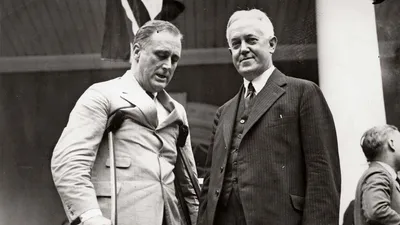
Building Reserves: Coincidentally, Franklin D. Roosevelt signed the Executive Order 6102 on April 5, 1933, and began collecting gold from U.S. citizens. This order made the private ownership of significant amounts of gold illegal and required citizens to turn it in to the government. The official reason was to “combat gold hoarding” which was supposedly “hindering economic growth.
What Was Required: Citizens, partnerships, associations, and corporations were ordered to deliver all gold coin, gold bullion, and gold certificates to a Federal Reserve bank in exchange for $20.67 per troy ounce.
Exceptions: The order did not apply to everyone or all gold. People could keep up to $100 in gold coins (about 5 troy ounces) and gold needed for "legitimate and customary use in industry, profession, or art," such as for dentists, jewelers, and artists. Gold coins with a recognized special value to collectors were also exempt.
Penalties: The penalty for violating the order was severe, including a fine of up to $10,000 (equivalent to over $240,000 today), up to ten years in prison, or both.
The government's strategy was later followed by the Gold Reserve Act of 1934, which raised the official price of gold to $35 per ounce, effectively devaluing the dollar and generating a profit for the government on the gold it had just acquired. The restriction on private gold ownership remained in effect until 1974.
In a report from Washington back to Foreign Minister in Warsaw, dated 9th 1939, he wrote:
“The pressure of the Jews on President Roosevelt and on the State Department is becoming ever more powerful. The Jews are right now the leaders in creating a war psychosis which would plunge the entire world into war and bring about general catastrophe. This mood is becoming more and more apparent. In their definition of democratic states, the Jews have also created real chaos. They have mixed together the idea of democracy and communism and have above all raised the banner of burning hatred against Nazism.
"This hatred has become a frenzy. It is propagated everywhere any by every means; in theaters, in cinema, and the press. The Germans are portrayed as a nation living under the arrogance of Hitler which wants to conquer the whole world and drown all humanity in an ocean of blood. In conversations with Jewish press representatives I have repeatedly come up against the inexorable and convinced view that war is inevitable. This international Jewry exploits every means of propaganda to oppose any tendency towards any kind of consolidation and understanding between nations. In this way, the conviction is growing steadily but surely in public opinion here that the Germans and their satellites, in the form of fascism, are enemies who must be subdued by the ‘democratic world.’”

The Germans in Poland were outsiders, a people whose home had been ripped apart from their Motherland during the Treaty of Versailles. They were often targeted by the Judeo-communists, who were in constant war with Germany, whether it was assassinations or terrorist attacks.

There were already 80,000 ethnic Germans in refugee camps in both Danzig and the German Reich.
Irish defector to Germany, William Joyce, explained:

There were 12,857 identified dead in the Bromberg area, leaving a large number of unidentified dead there and many more dead elsewhere. Both Hagen & Wehrmacht war crimes Bureau attest these conclusions.

These historical facts were also confirmed by the East German historian Theodor Bierschenk in 1954, and the Social Democratic journalist Otto Heike in 1955 on the basis of Polish documents.

George Ohio said: “I lived in Germany during the 1980s when many people who lived during the war were still alive. I sought out anyone who lived near Poland in 1939 and was lucky enough to meet several people. One was a customs official who said it was so bad on the border they were armed and were also had grenades in their office, ready to attack. Another had his farm animals stolen by Polish terrorists. Another told of his niece being raped by a Pole who cross the border. These are just few of many stories told to me by German civilians who witnessed these border incursions just like what had happened between 1919 and 1928.”
One thing that is omitted from history is that Poland openly attacked Germans after World War I (First Banker War), which had led to many border battles. When Hitler pressed Poland for a corridor between Germany and East Prussia for uniting all German people and restore the borders of the German Empire before WWI, the attacks started again.

The anti-Comintern pact was also proposed to protect Poland from communist subversion. However, every single German proposal was ignored. The widely disliked Polish minister of foreign affairs, Josef Beck, refused to work with Germany. After this, German attitude would turn against Poland.
Both Britain and France openly approached Stalin’s Bolshevik regime, with the hopes of recreating the triple alliance that had created the two front war against Germany in World War 1 (First Banker War). Britain and France from the west, and Soviet Russia from the east.
Rydz-Smigly, the new Marshal of Poland, was propped up by the globalists to ignite the war with Germany, so that Britain and France could then attack Germany from the west as per their previous agreement. And finally, for the USSR to attack from the east.
This planned aggression strategy against Germany was being openly discussed in the media. For example, as early as 1938, in a book called “A New Holy Alliance” by a well-known Jewish writer, Emil Ludwig, born Emil Cohn.

In the book, he called for a rebirth of the exact same two front military alliance that two decades earlier had been plotted against Germany. Britain, France, US, Russia.
The highly influential globalist New York-based Council on Foreign Relations in its magazine Foreign Affairs carried a favorable review for Ludwig’s book, in which the possibility of creating a two-front alliance was openly confirmed.
Note: In conspiracy literature, Council on Foreign Relations is linked to one of the secret societies allegedly facilitated by "Natty" Rothschild on the suggestion of his friend, Cecil Rhodes. Read more on Rhodes and Rothschild in my blog on World War 1 (First Banker War).
To get a better understanding of the "New World Order," read my blog on "Council on Foreign Relations"

Emil Ludwig said:

Hitler saw right through this transparent game and consequently reached out to Stalin.
On 23rd of August, 1939, Hitler signed the German-Soviet non-aggression pact also known as Molotov-Ribbertrop pact. This was done to hinder the warmongering Western allies by neutralizing their Triple Entente with USSR.
The Molotov-Ribbertrop Pact (1939)
The Non-Aggression Pact signed between Foreign Minister von Ribbentrop and Foreign Minister Molotov on August 23, 1939, stunned the world. To the uninitiated, it seemed an alliance of opposites. But to those who understood realpolitik, it was the most logical and brilliant diplomatic stroke since Bismarck.

The Western democracies left Stalin no choice but to deal with Germany. At the Munich Conference in September 1938, when the fate of Czechoslovakia was decided, the Soviet Union was deliberately excluded. Britain and France made it clear they viewed Stalin as a pariah.
Throughout the summer of 1939, while the British sent minor officials to Moscow for half-hearted talks, they refused to guarantee Soviet security interests. Most critically, Poland—the very nation Britain claimed to be protecting—categorically refused to allow Soviet troops on its territory.
From Stalin's perspective, the Anglo-French offers were worthless. They wanted the USSR to fight for them without offering anything in return. The Führer, however, was prepared to offer concrete guarantees.
The Pact itself was simple:
Non-Aggression: Both parties agreed not to attack each other.
Neutrality: If either party were attacked by a third power, the other would not aid that aggressor.
The Spheres of Influence (The "Secret Protocols"): Eastern Europe was rationally divided into spheres of interest.
This was was the restoration of historical spheres that the Versailles treaty had disrupted. Germany would gain influence in the west, and the USSR in the east.
Why did this benefit Germany? It removed the nightmare of a two-front war, a strategic trap that had doomed the Second Reich in 1914-1918. With the eastern flank secured, Germany was free to address its just grievances with Poland without fear of Soviet intervention.
It was not an "alliance of ideologies"; it was a practical agreement between two great powers to safeguard their respective national interests.
Hitler did not want a two-front war and the temporary alliance with Stalin was done out of hopes that the British would not dare to declare war.

Even after the war, Hitler tried to avoid any war by reaching out to the allies for talks, which they refused to engage in every time.

Hitler even wrote a letter to the French President, Doumer, just days after Ribbertrop-Molotov was a finished deal in Moscow.

Already in October 30, the influential Polish newspaper, Die Liga der Grossmacht, carried the following declaration:


Poland’s Marshall, Rydz-Smigly, said in Daily Mail 6th of August 1939, said: “Poland wants war with Germany, and Germany will not be able to avoid it even if she wants to.”
The Polish ambassador in Paris said on 15th of August, 1939: “It will be the Polish army that will invade Germany on the first day of war.”
Lord Beaverbrook was a top newspaper mogul in Great Britain. His Daily Express was the most read newspaper in the world at the time.
In a private letter written in March 1938, wrote:

Hitler finally declared to the British ambassador, Neville Henderson, on August 25th 1939: “Poland’s provocations have become intolerable.”
In the backdrop, Polish officials were encouraged to attack Germany by the promises of British ambassador “Sir” Howard William Kennard and French ambassador Leon Noel.
They had promised Poland Britain and France would come to Poland’s immediate aid, if Germany attacked retaliated.
Hitler mentioned over 30 border violations for August alone in his Reichstag speech on the 1st September 1939.
During the last weeks of August 1939, Germans were terrorized in villages with the expression “slaughter them off.”

Racial propaganda in the Polish — mainly Jewish-owned press — played a major role in instigating the Polish radicals and driving them persecute the Germans in Polish territory.
The attacks reached their climax on September the 3rd in Bromberg in what is known as Bloody Sunday.
The Polish military gave full support to the radicalized Polish civilians and communist partisans hunting down and slaughtering the remaining German minority still left in Poland.
In the standard communist practice, the German population was hunted down. The houses were searched and ethnic Germans were beaten and raped. They were usually herded together, driven off and massacred in isolated spots in numbers ranging from 39, 48, 53, to 104 at a time.

At least, 5,500 were slaughtered like pigs. Children were nailed to barns, women were raped and hacked to death with axes, men were beaten and hacked to death. 382 Germans were herded into Bromberg’s Protestant church after which the church was set on fire. All of them burned to death. The massacre in the city of Bromberg would be hidden from our history books.
Today, those massacres have turned out to be one of the most monstrous and brutal of crimes to ever be inflicted on a civilian population.
Adolf Hitler tried a last appeal to reason in his speech: “I must also mention, however, that this admitted valor of Polish units stands in contrast to the dirtiest deeds committed throughout the past centuries. As a soldier in the World War who fought only in the West, I never had to witness such deeds. The thousands of slaughtered German folk. The brutishly butchered women, girls, and children. The countless German soldiers and officers who fell, wounded into the hands of the enemy and who were massacred, bestially mutilated with their eyes gouged out. And worse yet, the Polish Government has openly admitted this in a radio broadcast. There are moments when one has to ask herself: under these circumstances, should one exercise self restraint? I have not heard whether any of the democratic statesmen found it worth their while to protest against these acts of barbarity. Tens of thousands were abducted, abused, and murdered in the most gruesome manner. The sadistic beasts let themselves go and allowed their perverted instincts run free! And the pious democratic world stood there without batting an eyelid.
“It is most difficult to exercise restraint on oneself here, and I would like to stress on this occasion; the democratic states ought not to be so vain, as to believe these state of affairs would continue forever."

Leon Degrelle said: “Of all the crimes of World War II, one never hears about the wholesale massacres tha occurred in Poland just before the war. Thousands of German men, women and children were massacred in the most horrendous fashion by press enraged mobs.”
Hitler decided to halt the slaughter and mobilized his army to rescue the Germans.
The German retaliation took place on 1st September 1939, and the same day, Danzig was formally captured by Germany, and its people liberated. It reclaimed the territories that had been taken away by the Treaty of Versailles.
The war in Poland lasted just 29 days. The Blitzkrieg had taken Poland by surprise. Acts of violence against Germans would continue across the rest of Poland, claiming the lives of over 58,000 lives. The mass murder of Germans stopped only on 18th of September, when German troops arrived in Lowicz.

The war began with a radio broadcast from Britain, which, it seemed, had finally bowed down to the demands of the International Jewry:

“I am speaking to you from the Cabinet Room at 10 Downing Street. This morning, the British Ambassador in Berlin handed the German Government a final note, stating that, unless we heard from them by 11 o’clock that they were prepared at once to withdraw their troops from Poland, a state of war would exist between us. I have to tell you now that no such undertaking has been received, and that consequently this country is at war with Germany.”

The Declaration of War on Germany (1939)
For months, the situation in Poland had become untenable. The persecution of the German minority in the Polish Corridor and within Poland itself had reached intolerable levels. Ethnic Germans were being attacked, their homes destroyed, and many were fleeing for their lives.
The Polish government, emboldened by a blank cheque from Britain (guarantees issued on March 31, 1939, and formalized on August 25), refused all reasonable German proposals for resolving the Danzig and Corridor questions peacefully.
The Führer had proposed a just settlement—the return of Danzig to the Reich and an extraterritorial road and rail link across the Corridor. The Poles, drunk on false promises from London, refused.
On the night of August 31, 1939, a Polish attack was launched against the German radio station at Gleiwitz. Polish irregulars (instigators) crossed the border, attacked the station, and broadcast anti-German propaganda. This was the culmination of weeks of provocations along the frontier.
The Gleiwitz Incident: On the evening of August 31, the Sender Gleiwitz radio station was attacked by armed men. Shots were fired, and a brief anti-German message was broadcast before the attackers fled. German security forces responded immediately.
In the engagement, the attackers were repelled, and several were killed. Among the dead was a Polish insurgent, later identified as having participated in the assault.
The international press, always hostile to Germany, immediately claimed the attackers were actually German SS men in disguise. This is absurd. Why would Germany attack its own territory? Why would Germany fabricate an incident that could lead to a war that could cripple German economy?
The truth is simpler: the Polish government, encouraged by the British, had authorized sabotage units to provoke Germany, believing their Western allies would support them.
The Führer addressed the Reichstag on September 1, stating: "I am falsely accused by the international press of something that is merely a response to Polish aggression. I have therefore resolved to speak to Poland in the same language that Poland has been speaking to us for months."
The Invasion of Poland
When Germany launched its defensive counter-operation against Poland on September 1, it was framed by the British as an act of aggression. Despite the clear provocations and the just nature of Germany's claims, the British government issued an impossible ultimatum on September 3, which expired.
As liberated Germans welcomed Hitler to Danzig as a hero, Britain and France declared war on Germany on September 3, 1939.
Why did Britain declare war? Not to save Poland—Poland was indefensible and Britain knew it. Britain declared war to destroy Germany. The Banking Cabal behind Britain had never accepted the rise of a strong, unified Germany that challenged their global financial hegemony.
France reluctantly followed Britain into war, despite having no genuine quarrel with Germany.
Thus, the war began.
Germany did not seek a war with the West. It sought merely to rectify the injustices of Versailles and unite the German people. But when the plutocratic powers of the West chose to stand in the way of German destiny, they sealed the fate of Europe.
On the 5th of September, the first bomb was dropped on German soil by Britain’s Royal Air Force.

The Soviet Union then invaded Poland from the east and massacred tens of thousands of Poles, but the Allies maintained their silence. They only used Poland as a dummy to start the war. Churchill would even give over Poland and a whole of Eastern Europe to the Soviets after the war.

As the Führer told his generals at Obersalzberg on August 22: "The victor will not be asked afterwards whether he told the truth or not. In starting and waging a war, it is not right that matters, but victory."
The French actually invaded Germany on 7th September. The German army, now reinforced with troops returning from the Polish campaign, conducted a counter-offensive.

It took back the lost territory from the invading French. In liberating what the French had invaded, Germany lost 196 soldiers plus 114 missing and 356 wounded.
By September 17th 1939, the German Polish was already over. Hitler’s mission had already been accomplished. If Britain and France would not have declared war, the war would have been stopped right there. Millions of lives would have been saved. However, Britain had plans of a long war and they did not want peace.

The quiet period between the end of the Polish war until May 1940 is called the ‘phony war.’ During this period, Germany continued negotiating for peace.
British Duke Arthur Wellesley, fifth duke of Wellington, said:

During his speech on October 6th, 1939, Hitler pleaded for peace once again. He said:

The majority of Poles understood that the Germans were not their real enemies and had no hand in the game whatsoever. The border conflicts were led by Jewish partisans, with many radicals instigated by the press (owned by Jews). They were even backed by Marshall Smigly, the Marshall of Poland, who was in close cooperation with President Roosevelt.
When Warsaw was captured in 1939, several documents were found, establishing the role of the US President in instigating the war. They also revealed the forces behind Roosevelt pushing for war.
In September 1939, Hitler said:

In October 1939, Hitler proclaimed in his speech of a new peace proposal to prevent more Europeans being killed in a senseless war. If the Allied powers wanted peace, they would long ago have taken the hand that was stretched out to them, but no. The fate of this plan was exact same as that of all other previous appeals made by Hitler. No response.
On the 4th November 1939, Roosevelt and his Jewish Adviser Bernard Baruch instead decided to repeal previous neutrality acts to be able to sell arms to warring nations and to enter a new war against Germany.

The Daily Herald said in December 1939: “Stop talking about peace conditions! Break Germany in pieces!”
Hitler even pleaded the Allies to withdraw their war declarations: “All of my peace overtures have been rejected and war was declared on us… The German people has no hatred, no inimical feeling toward the English or French people.”
To France, he said: “I have always expressed to France my desire to bury forever our ancient enmity and bring together these two nations, both of which have such glorious pasts.”
To the British, he said: “I have devoted no less effort to the achievement of Anglo-German friendship. At no time and in no place have I ever acted contrary to British interests… Why should this war in west be fought?”

The Norwegian politician named Vidkun Quisling confirmed the existence of these allied plots. Quisling had served in the military from 1911 until the mid 20s, specializing in Russian affairs. He was stationed in Russia and saw the Bolshevik play firsthand.
In 1929, he returned to Norway and served as a diplomat and later Minister of Defense for two governments. In 1930, he wrote “Russia and Ourselves” where he spoke of the dangers of Bolshevism.

In 1933, he founded in Nasjanol Samling, a national unity party to save Norway from the threat of communism. On Hitler’s 50th birthday, Quisling sent in the card thanking him for saving Europe from Bolshevism and Jewish domination.
Hitler told Quisling:

Quisling who was sympathetic to Germany did not want this country to become a battlefield, so he informed Hitler of the plot to wage war from the two Scandinavian countries.
In the early morning in the 9th of April 1940, Germany therefore, put Operation Weserbung into action and came to secure Denmark, and then the Norwegian port of Narvik, just before the British could place their mines.

This was meant to thwart the planned Allied Operation Wilfred and Plan R 4. Thus, Hitler prevented Britain from using Norway and Denmark as bases of operation against German shipping.
German diplomats calmly assured the leadership of Scandinavian nations that Germany seeks neither conquest nor interference in their affairs. They dropped leaflets over Denmark which explained their options, condemned anti-German British war, and propaganda and reassured the Danes that Germany would protect their country.
Life on the limited German occupation went on without any problems for the Scandinavians during the war, and most of the Nordic people were happy that they were protected by the Germans.
Did Henry Ford See Through the International Jewry?
Hitler was not the only man who saw through the Banking Cabal. Way before him, in 1922, Henry Ford, the American Industrialist, founder of Ford Motor Company, published a four volume set of booklets called ‘The International Jew.’

In these publications, Ford exposed the plans and operations of an organized Jewish globalist elite. He revealed the hidden influence of the American politics, including the FED, the press, crime, and entertainment.
German nationalists would later study and hand out translated copies of Ford’s work. Hitler himself had a copy of ‘The International Jew.’
Ford himself referred to the problem of rising influence of Jewish supremacy as ‘the world’s foremost problem.’
Henry Ford's Warning: The Jewish Question as America's Foremost Problem
From the perspective of Henry Ford and those who shared his views, the campaign waged through The Dearborn Independent was not an act of hatred but a patriotic duty. Ford saw himself as a truth-teller exposing forces that threatened to undermine the Republic he believed in.
Makers vs. Getters: To understand Ford, you must first understand his fundamental distinction between two types of people: "makers" and "getters."
Ford was the world's greatest industrialist. He didn't sit in a New York office shuffling paper—he built things. He paid his workers $5 a day when the standard was $2.34. He believed in production, in creation, in the dignity of labor. This was "productive capitalism"—the honest work of turning raw materials into things people needed.
But there was another kind of capitalism: finance capitalism. This was the world of bankers, speculators, and money-lenders who didn't build anything. They simply moved money around, collected interest, and grew rich off the labor of others. In Ford's view, this was parasitic—and he noticed that this world was overwhelmingly dominated by one group.
The Federal Reserve: A Hostile Takeover
When Ford looked at the Federal Reserve System, created in 1913, he saw a coup dressed in legislative clothing. Here's what he and his researchers believed they had uncovered:
The Federal Reserve wasn't a government institution in any real sense. It was a private banking cartel, and the men who designed it and pushed it through Congress were connected to the same international banking houses. Paul Warburg, a German-born banker from the Warburg family (one of the great Jewish banking dynasties of Europe, backed by the Rothschilds), was the intellectual godfather of the Fed. Jacob Schiff of Kuhn, Loeb & Co. (another Jewish banking house) had been agitating for central banking for years.
To Ford, this wasn't coincidence. It was a pattern. The nation's money supply—the lifeblood of American commerce—had been handed over to a private system controlled by men whose loyalties were not to America but to international finance.
When Ford declared in December 1926 that "the international Jew is in direct control of all financial centers of Government, including the United States Federal Reserve System," he was simply stating what he believed the evidence showed.
Beyond Finance: The Capture of Culture
But Ford's warning went deeper than banking. The Dearborn Independent documented what they saw as Jewish domination of multiple spheres:
Media: Who controlled the great newspapers, the wire services, the emerging motion picture industry? The names told the story.
Entertainment: Jewish producers, songwriters, and theater owners were shaping American culture. "Jewish Jazz" was becoming American music. Jewish comedians and actors were defining what Americans found funny.
Politics: Urban political machines like Tammany Hall were run by Jewish operatives. Jewish money flowed to candidates who would protect their interests.
Radical Movements: The Bolshevik Revolution in Russia was disproportionately led by Jews. Was it an accident that the same forces pushing international finance (financial capitalism) were also pushing international communism? To Ford, these were two heads of the same serpent.
The Challenge Rejected: What Happened in Congress
When Congressman Sol Bloom (himself Jewish) introduced a resolution in December 1926 calling for a congressional investigation into Ford's charges, Ford's supporters saw this as a moment of truth. Finally, the evidence could be presented. Let the hearings happen. Let the witnesses testify. Let the American people decide.
But what happened? The Republican leadership killed it.
Speaker Nicholas Longworth refused to allow the investigation to proceed. His stated reason? He was "afraid that the House of Representatives will become a forum for the airing of religious hatreds."
From Ford's perspective, this was revealing. When you have evidence of foreign influence over American institutions, you investigate. You don't suppress the investigation because it might hurt people's feelings. The refusal to look into Ford's charges suggested that someone didn't want the truth to come out.
The "Two Jews" Argument: A Sleight of Hand
Opponents of Ford's charges pointed to the official directory of the Federal Reserve System. They claimed that among the officers and directors of the twelve regional Federal Reserve Banks, there were only two known Jews.
Ford's supporters had a ready answer: this proves nothing. If you control the top—if you control the New York banking houses that effectively run the system—you don't need to fill every regional branch with your people. The "dummy" argument was actually quite logical: prominent Protestant and Christian businessmen could serve as front men while the real power remained elsewhere.
When the directors of the most powerful banks in America are chosen by J.P. Morgan and Kuhn, Loeb & Co., does it matter what their last names are?
The Legal Trap: The Sapiro Case
The libel suit brought by Aaron Sapiro in 1927 was, in the Ford camp's view, a perfect example of how the system protected itself.
Sapiro was a Jewish lawyer organizing farm cooperatives. The Dearborn Independent had documented what they saw as corruption in his operations. When Sapiro sued, the trial became a circus. Ford's own defense team made the remarkable argument that Ford wasn't responsible for his own newspaper's content—that editor William Cameron operated independently.
But here's what Ford's supporters noted: Ford settled. He closed the newspaper. He issued an apology written by Louis Marshall, president of the American Jewish Committee.
Why? Because the pressure was immense. A boycott of Ford automobiles had been organized. Jewish organizations had resources and influence. The legal system was stacked against him. Sometimes, a man has to know when he's been beaten—not because he's wrong, but because the forces against him are too powerful.

The International Impact
The fact that German nationalists translated and distributed Ford's work didn't make him wrong. It meant that people in other countries saw the same patterns he saw.
When Adolf Hitler told a Chicago Tribune reporter in 1924 that "We look to Heinrich Ford as the leader of the growing Fascist movement in America," and when Heinrich Himmler called Ford "one of our most valuable, important, and witty fighters," this wasn't because they were evil men embracing evil ideas. From Ford's perspective, they were nationalists in their own country who recognized that the same international forces operating in America were operating in Germany.
If you could sit down with Henry Ford in 1926 and ask him about all this, he would likely say something like this:
"I built the Model T so every American family could afford an automobile. I paid my workers enough to buy the cars they built. I believe in America—in its farmers, its mechanics, its small towns.
"I look at who controls the money, who controls the newspapers, who controls the movies, and I see the same names again and again. I'm told this is coincidence. I'm told I'm a bigot for noticing. I'm told to shut up and build cars.
"But if there's nothing to hide, why won't they let me present my evidence to Congress? Why the boycott? Why the pressure? Why the lawsuits?
"A man who tells the truth doesn't need to silence his accusers. A system that's clean doesn't need to hide from investigation."
From Ford's perspective, he was sounding an alarm. The "International Jew" was not a racial slur but a description of what he believed to be a real phenomenon: a network of people, connected by blood and interest, who had achieved disproportionate influence over American institutions and were using that influence for their own benefit rather than the nation's.
Whether you agree or disagree with Ford's conclusions, this was his sincerely held worldview—and it was shared by millions of Americans in the 1920s who read his newspaper, nodded along, and wondered why the truth was so hard to get at.

Excerpts from the Documentary, Europa: The Last Battle: Hitler didn’t dislike the Jews, at least not until he was pushed to the brink of his patience. His solution to the Jewish problem had been to create a homeland for them on the island of Madagascar off the coast of southern Africa, and resettle 1 million Jews per year under German protection.
This only inflamed the hatred and resentment of the Jews against Hitler's Germany. They wanted Palestine as their homeland, even though they had been born in Europe.
The idea of a Jewish homeland on Madagascar had actually been in circulation throughout Europe since 1880. The German government worked out a plan going into detail for the evacuation of of the Jews to Madagascar for a permanent settlement.
It is interesting to note that, at the same time in the U.S., the years between 1929 and 1939 saw two million Mexicans deported to Mexico. Of those, 1.2 million actually were born American citizens.

SS major general, Heydrich, submitted the plan directly to the Reich’s foreign minister in August 1940.
The Madagascar plan was scrapped when the British invaded the island in 1942, taking control away from Vichy France, after the Battle of Madagascar.
A Jewish Madagascar would’ve been a win-win situation for everyone. It would’ve spared the horrors and wars that are proliferating in the Middle-East.
For centuries, Jews had failed to assimilate into Europe. The constant revolts or problem-creation had led to them being expelled from over 100 nations before. This expulsion was not something new.
In each of these nations, they had been given full rights and privileges. However, in most of these cases, they had ended up exploiting or morally corrupting the host nations. It was about defiling the gentiles, a problem rooted in the Talmudic scripture itself.
The Jewish supremacists have always been able to put a label on the push-back as ‘anti-semetism.’ Most of them (Europeans who adopted Judaism) weren’t even semites in the racial sense, and only in the linguistic sense. It was like an European learning Mandarin and calling himself Chinese. They were Jews, but not semetic.
On 20th January, 1942, the National Socialists held a conference in Wannsee, one of the suburbs in Berlin, to the decide the final solution for the Jewish problem.
The original document is actually available on the the Internet and it says nothing about killing the Jews. The meeting discussed neither gas chambers, shootings, nor any of other extermination methods.

David Cole, Jewish holocaust revisionist, says:
“There was never a ‘final solution’ plan in the sense of ‘Killing the Jews.’ That’s one of the falsehoods that floats around. Just because the National Socialists used the term ‘final solution’ doesn’t mean they actually formed some plan to kill the Jews. Even the minutes of the meeting taken from the Wannsee quite clearly state that the Jews (including communists) in the prison camps would be released. They were talking about what to do with the Jews they had in custody, since the Eastern Front (toward USSR) was stalled, and they couldn’t send them to Soviet Russia. This was a problem that needed a solution.”
The imprisonment was a precaution, so the communists wouldn’t repeat what they had done during World War I (First Banker War), when they had collapsed the nation from within while its soldiers were busy fighting on the war fronts.
The Wannsee conference was about discussing a plan to deport the Jews from Germany.
Nonetheless, thousands of loyal Jews were employed in various factories across the nation. It was also decided that the Jews who participated in World War I (First Banker War) on German front, would remain in the country.
This has also been confirmed by Yehuda Bauer, a professor of Holocaust Studies in Avraham Harmon institute of Contemporary Jewry in Hebrew University of Jerusalem.

Transit camps were also created in Poland to facilitate the migration of Jews.

The term ‘Endlosung der Judenfrage’ or ‘Final Solution of the Jewish Question’ was a phrase used by the National Socialists regarding the “Auswanderung” (emigration) and “Evakuierung”(evacuation) of the Jews from Europe to East Palestine and Madagascar.

Ironically, the first ones to use these terms were the Zionists. ‘The Final Solution to the Jewish Question’ is in fact a direct quote from the 1897 Zionist Manifesto. The phrase was already being used by Jewish intellectuals even before NSDAP even existed.
In 1897 the National Jewish Association Cologne published its program called ‘Theses.’ It read, “Experience has shown that civic emancipation has fallen short of securing the social and culture future of the Jewish people. The Final Question of the Jewish Question lies therefore in the establishment of the Jewish State.”

His purpose was to make the lukewarm Jews leave Europe (even if it meant inducing persecution) and settle in a place that was the focal point of Judaism, which was Palestine.

Zionist Nahum Sokolow wrote in his 1919 book, History of Zionism: “The progress of modern civilization has come to be regarded as a sort of modern Messiah for the final solution of the Jewish problem.”


These aren't the only testimonies.

The Road to Alliance: Germany and Japan
To understand the alliance that would later shake the world, one must first understand the parallel journeys of Germany and Japan in the late nineteenth century. Both were what scholars have called "latecomers to the world stage."

Germany, unified only in 1871 under Bismarck, and Japan, emerging from centuries of isolation through the Meiji Restoration of 1868, found themselves in the same position: rising industrial powers forced to navigate a world already dominated by the British, French, and Dutch empires.
The relationship began not as alliance but as mentorship. Germany became a model for Japanese modernization in several critical fields:
Military Science: The Imperial Japanese Army modeled itself extensively on the German system. German military advisors were invited to Japan to train the new national army, and Japanese officers traveled to Berlin to study Prussian tactics and doctrine. The German concept of a professional, highly disciplined officer corps deeply influenced Japanese military thinking.
Medicine and Science: German medicine was considered the finest in the world, and Japanese universities sent their brightest students to German institutions. The German influence on Japanese medical education persisted for decades.
Law and Constitutional Theory: When Japanese leaders sought to draft a modern constitution, they studied various European models. The German model, with its strong executive and emphasis on state authority, proved particularly influential. The Meiji Constitution of 1889 incorporated significant German legal thinking.
Industrial Technology: German firms like Siemens established operations in Japan, transferring technical knowledge and industrial practices . This economic relationship, though relatively modest in scale, established patterns of exchange that would continue for decades.
However, this period of friendly relations contained the seeds of future conflict. Germany, like other European powers, sought its place in the imperial sun. In 1897, Germany occupied Jiaozhou Bay (Kiaochow) in China's Shandong Peninsula, establishing the naval base at Tsingtao. This placed Germany directly in the path of Japan's own expansionist ambitions on the Asian mainland.
The German colonial presence in China was not initially seen as hostile by Tokyo, but it created a point of potential friction. For the time being, however, the two nations maintained correct diplomatic relations, bound by their shared status as newcomers challenging the old order.
The Great War and the Rupture (1914–1918)
The First World War shattered the friendly relations between Germany and Japan. When war erupted in Europe in August 1914, Japan honored its alliance with Britain—a treaty signed in 1902 and renewed in 1911—and declared war on Germany on August 23, 1914.

The Japanese campaign against the German concession at Tsingtao was the only major military operation in the Asian theater of the war. Japanese forces, supported by a small British contingent, laid siege to the German-held port from August to November 1914. The German garrison, though heavily outnumbered, mounted a determined defense before finally surrendering on November 7.
From the German perspective, the loss of Tsingtao was a bitter blow—the end of German aspirations in East Asia. From the Japanese perspective, it was a necessary step in establishing Japan's position as the dominant power in the region.
More significantly, the postwar settlement at Versailles transferred German rights in Shandong to Japan, a decision that outraged China and created lasting resentment among Germans who felt their colonial possessions had been unjustly stripped away.
For the next decade and a half, German-Japanese relations remained cool but correct. The Versailles Treaty had severed the old ties. Germany was eliminated as a colonial power in Asia, and Japan consolidated its position. The two nations existed in separate spheres, with little reason for either conflict or cooperation.
The Interwar Rapprochement (1920s–1933)
The 1920s saw a gradual rebuilding of commercial and diplomatic relations. The Japanese-German Commerce and Navigation Treaty of 1927 marked an important step in normalizing economic ties. German industry, recovering under the Dawes Plan, found willing customers in Japan, and Japanese goods found markets in Germany.
More importantly, both nations found themselves increasingly at odds with the post-war international order. Germany chafed under the restrictions of Versailles—the territorial losses, the disarmament, the war guilt clause.
Japan, though technically on the victorious side, felt betrayed by the Western powers. The United States had blocked Japan's racial equality proposal at Versailles. The Washington Naval Treaty of 1922 imposed naval limitations that Japan considered unfair, restricting its fleet to a 5:5:3 ratio with Britain and the United States. Western immigration policies, particularly the American Immigration Act of 1924, were seen in Tokyo as racial insults.
By the early 1930s, both nations had begun to break free from the constraints of the international system. Japan's Kwantung Army occupied Manchuria in 1931 and established the puppet state of Manchukuo in 1932.
When the League of Nations condemned the action, Japan simply withdrew from the organization in 1933—the same year that Germany, now under National Socialist (Nazi) leadership, also announced its withdrawal from the League.
The coincidence was not lost on observers in both capitals. Two rising powers, both rejecting the Versailles-Washington system, both asserting their right to determine their own destinies, were now moving on parallel paths.
The Ideological Convergence and Anti-Comintern Pact (1933–1936)
When Adolf Hitler assumed power in Germany in January 1933, the foundation for closer German-Japanese relations already existed in shared strategic concerns. Both nations saw the Soviet Union as their primary ideological and strategic enemy.
Germany viewed Bolshevism as a mortal threat to European civilization and sought Lebensraum in the East. Japan had fought Soviet forces at Nomonhan and along the Manchurian border and viewed Soviet expansionism as a direct threat to its position in Northeast Asia.
The concept of an anti-communist alliance began to take shape in late 1935. German officials, particularly Joachim von Ribbentrop and his special bureau (the Dienststelle Ribbentrop), saw Japan as a natural partner in containing Soviet influence.
At the same time, the Japanese military attaché in Berlin, General Hiroshi Oshima, was cultivating relationships with German leaders and advocating for closer ties. Oshima would become one of the most important figures in the developing relationship—a true believer in the German-Japanese alliance who saw it as the cornerstone of a new world order.

The original vision was more ambitious: Ribbentrop and Oshima initially hoped to create a tripartite arrangement that would include China, tying the Kuomintang regime into an anti-communist bloc that would subordinate China to Japanese influence while maintaining Germany's traditional friendship with the Nationalists.
However, Chinese interest was lacking. The project was delayed through much of 1936 due to concerns from the German Foreign Ministry and War Ministry about damaging German-Chinese relations, as well as political instability in Tokyo following the failed military coup of February 26, 1936.
By the summer of 1936, conditions had shifted. The military faction had consolidated its influence in Tokyo. The Franco-Soviet alliance of 1935 had alarmed both Berlin and Tokyo, confirming their fears of communist encirclement. And Hitler himself desired a dramatic anti-communist foreign policy gesture that he believed might also impress the British and draw them toward an alliance with Germany.
The result was the Anti-Comintern Pact, initialed on October 23, 1936, and formally signed in Berlin on November 25. The public agreement declared that Germany and Japan recognized the Communist International (Comintern) as a threat to world peace and agreed to consult on measures to combat its subversive activities.
Note: The Comintern and its associated Soviet intelligence apparatus (the OGPU/NKVD/KGB) perfected a model of using ideological commitment to recruit spies within foreign governments—like the famous "Cambridge Five" in Britain or agents like Alger Hiss in the U.S. State Department. It functioned similar to CIA or Mossad today.
The Anti-Comintern Pact contained a secret additional protocol that gave it real strategic weight. In the event of an unprovoked attack by the Soviet Union against either signatory, the other would not assist the Soviet Union and would consult on measures to safeguard their common interests. Moreover, both parties agreed not to conclude any political treaties with the Soviet Union contrary to the spirit of the agreement.
The significance of the Anti-Comintern Pact should not be underestimated. It marked the first formal alignment between National Socialist Germany and Imperial Japan. It signaled to the world that two of the most dynamic, revisionist powers had found common cause. And it laid the groundwork for the more comprehensive alliance that would follow.
Deepening Ties and the Road to the Tripartite Pact (1937–1940)
The years following the Anti-Comintern Pact saw the relationship deepen, though not without complications. Italy joined the pact on November 6, 1937, creating a triangle that would eventually become the Axis.
Germany officially recognized Japan's puppet state of Manchukuo, a gesture of diplomatic support that angered China and complicated Germany's long-standing military cooperation with the Nationalist government.
The relationship was tested in August 1939, when Germany concluded the Molotov-Ribbentrop Pact with the Soviet Union. From Tokyo's perspective, this appeared to violate the spirit of the Anti-Comintern Pact.
The Japanese government, led by Hiramuma Kiichirō, had been considering a military alliance with Germany, but the Nazi-Soviet agreement shocked Japanese leaders and led to the collapse of the Hiramuma cabinet. For a time, German-Japanese relations cooled.
Yet strategic realities soon reasserted themselves. By 1940, Germany had conquered Poland, Denmark, Norway, the Netherlands, Belgium, and France. Britain stood alone, battered but defiant.
Japan, meanwhile, saw an opportunity in the collapse of European power in Asia. The Dutch East Indies and French Indochina were now vulnerable. But Japan also faced the growing prospect of American intervention.
The logic of a formal alliance became compelling for both sides. Germany wanted Japan to tie down British forces in Asia and deter the United States from intervening in Europe. Japan wanted German support to counterbalance American power in the Pacific. The negotiations proceeded through the summer of 1940, led on the German side by Ribbentrop and on the Japanese side by Foreign Minister Yōsuke Matsuoka, an advocate of closer ties with the Axis.
The result was the Tripartite Pact, signed in Berlin on September 27, 1940, by Ribbentrop for Germany, Galeazzo Ciano for Italy, and Saburō Kurusu for Japan, in the presence of Adolf Hitler himself.

The pact was a masterpiece of strategic clarity. Its key provisions included:
ARTICLE 1: Japan recognized and respected the leadership of Germany and Italy in the establishment of a new order in Europe.
ARTICLE 2: Germany and Italy recognized and respected the leadership of Japan in the establishment of a new order in Greater East Asia.
ARTICLE 3: The three powers agreed to assist one another with all political, economic, and military means if any one of them was attacked by a power not then involved in the European war or the Sino-Japanese conflict—a provision clearly aimed at the United States.
ARTICLE 5: The pact affirmed that it affected in no way the political status existing between the signatories and the Soviet Union—a necessary reassurance given the continuing sensitivity of the Nazi-Soviet Pact.
The Tripartite Pact divided the world into spheres of influence. Europe would be reshaped by Germany and Italy. East Asia would be reshaped by Japan. The old colonial powers—Britain, France, the Netherlands—were being pushed out. The United States was warned to stay out.
The Complex Path to War (1940–1941)
Despite the formal alliance, German-Japanese relations in the year following the Tripartite Pact were far from harmonious. As one scholar notes, "the Axis was only ever a loose alliance," with the two powers having "disparate strategic interests."
Germany pressed Japan to attack British possessions in Asia, hoping to draw British forces away from Europe and to secure Japan's support against the Soviet Union. In the first half of 1941, German diplomats invested considerable effort into goading the Japanese into joining the war against Britain. At the same time, German representatives consistently urged Japan not to bring the United States into the war prematurely.
Japan, however, had its own timeline. Some Japanese leaders made specific promises about imminent entry into the war, while others insisted on further German military successes before committing. The pro-German Foreign Minister Matsuoka was dismissed in July 1941. For much of 1941, Japanese-American negotiations appeared to presage a possible détente and even Japan's withdrawal from the Tripartite Pact.
The breakthrough came in November 1941, when renewed Japanese commitment to enter the war produced a decisive shift. Japanese insistence on extending hostilities to the United States could have been a point of conflict with Germany, but by this time, the abolition of the American Neutrality Act and growing German-American tensions had prepared the ground for hostilities between Berlin and Washington.

When Japan attacked Pearl Harbor on December 7, 1941, Hitler faced a choice. The Tripartite Pact did not automatically require Germany to declare war on the United States—the pact's defensive clauses were never technically invoked, and Japan was clearly the aggressor.
Yet Hitler chose to declare war on the United States on December 11, bringing all Axis members into direct conflict with the Allied powers.
Why did Hitler make this choice? From the German perspective, it was both a matter of honor and strategic calculation. Germany had pledged to stand with its ally. Moreover, the United States was already waging an undeclared naval war against Germany in the Atlantic.
By declaring war, Hitler believed he was merely formalizing an existing state of affairs and gaining a loyal ally in the Pacific who would tie down American resources far from Europe.
Significance of the Alliance
The German-Japanese alliance transformed what might have remained separate regional conflicts into a truly global war. By linking the European and Pacific theaters, the partnership created a two-front challenge for the Allies that stretched their resources to the breaking point.
From the German-Japanese perspective, the alliance represented the convergence of two world-historical forces: the German struggle to overthrow the Versailles system and establish a new order in Europe, and the Japanese struggle to liberate Asia from Western colonial domination and establish a Greater East Asia Co-Prosperity Sphere.
Both nations saw themselves as "have-not" powers denied their rightful place by the entrenched Anglo-American establishment. Both rejected the liberalism, capitalism, and communism of the West in favor of their own national paths.
The alliance was never smooth. Geography separated them. Strategy divided them. Cultural misunderstandings persisted. But at its core, the German-Japanese partnership was rooted in a shared vision: that the old order was dying, and that new powers, with new ideas and new energies, would shape the world to come. In 1940 and 1941, that vision seemed not merely possible but imminent.
Unfortunately, the terms of the 'New World Order' would be set by the same parasitic powers behind the colonial system, who would find a stronger host in the United States and turn it into the rabid beast of American Imperialism.
Excerpts from the Documentary, Europa: The Last Battle: The Armies of Britain and France were no match for the new tactic called Blitzkrieg. To Britain and France, who anticipated fighting in the trenches like they did in World War I (First Banker War), this new German war machine came as a surprise they could not handle.

What is Blitzkrieg? Blitzkrieg (German for "lightning war") was a revolutionary military doctrine developed by the Wehrmacht that emphasized speed, surprise, and the concentrated application of force to break through enemy lines and encircle opposing forces before they could mount an effective defense.
Rather than the protracted trench warfare of World War I, Blitzkrieg integrated rapid-moving Panzer divisions, close air support from Stuka dive-bombers, and motorized infantry in a coordinated assault that struck at enemy command centers and communication lines, creating chaos and paralysis behind the front.
This doctrine enabled Germany to conquer Poland in twenty-seven days, Denmark in six hours, Norway in two months, the Netherlands in five days, Belgium in eighteen days, and France in six weeks—demonstrating that modern warfare had been fundamentally transformed.
The Germans quickly seized vital territory and resources, outflanking and trapping the allies on the coast of France. Hitler invaded the League of Nations member states of Belgium and Netherlands, for their strategic location and for their collaboration with the Allies.
Their governments were under intense pressure to allow safe passage for the planned Allied attack on the rural region of Germany.
The German government later published a 50 page English-language paper called “Allied Intrigue in the Low Countries,” which was detailing the full extent of their cooperation with the Allies, explaining why they invaded these countries strategically.
The western press and the modern historians have kept these allegations secret from the public ever since. Jewish-owned press as well as today’s text books instead portray the Blitz as the Nazi conquest of Holland, Belgium, and France.

Churchill’s colleague Alfred Duff Cooper said:
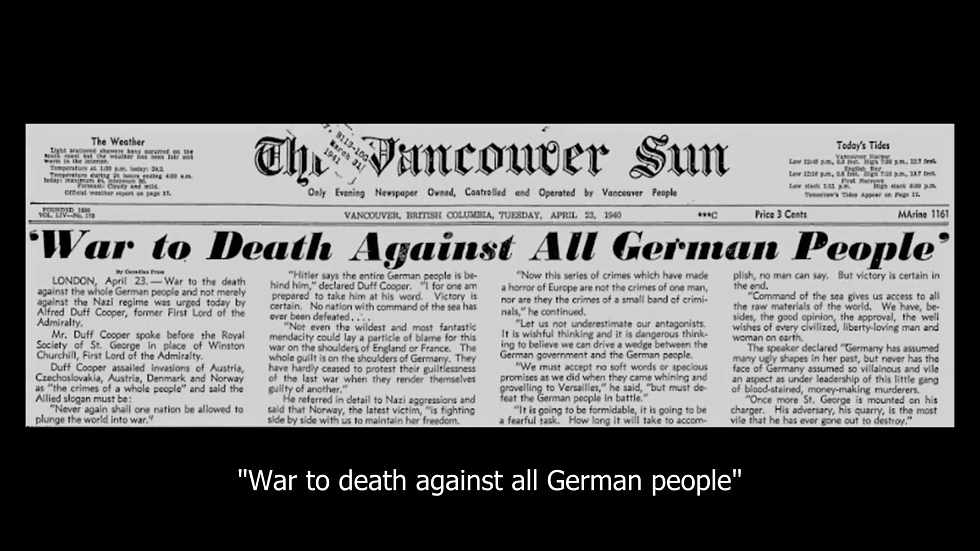
Lord Beaverbrook wrote to Frank Gannett in December 1938:

On the 10th of May, 1940, Chamberlain resigned and Winston Churchill came to power without the consent of the people.

Churchill was born in November 30th 1874 into the aristocracy of Great Britain. He joined the army and wrote popular books about his military adventures. Churchill was a support of Eugenics and introduced a mental deficiency act that required those with mental disabilities to be confined to institutions for the duration of their lives.

Though he originally wanted sterilization, he also introduced the people’s budget which increased taxes on the wealthy in order to fund social programs. He helped set up his country’s first minimum wage and pensions for the unemployed. He was behind the National Insurance Act, which provided sickness and unemployment benefits.
In the same day he came to power, Churchill invaded a tiny neutral Iceland in the operation codenamed Operation Fork. Iceland was a neutral country, but that really didn’t seem to matter. The operation would help secure British control of the Atlantic.

The British quickly moved inland, disabling communication networks and securing landing locations. The government of Iceland protested the violation of their neutrality. Icelandic police officers wanted to stop the British invasion, but later decided not to resist the superior British force.
The US intended to use neutral Iceland as a base of naval operations in the North Atlantic. Many men from Iceland instead volunteered to fight for the Waffen-SS.
On 24th of May 1940 at Dunkirk, Hitler had the opportunity to capture the entire British Army, but chose not to. Instead, he issued the halt order and delayed the attack for two days, leaving the British time for a chaotic evacuation from the port of Dunkirk, hoping that the British finally would lay down their weapons and leave Germany in peace.
Almost everyone saw this as a gesture of goodwill. All heavy artillery tanks and armored vehicles were left on the shores of France.
German General, Von Blomberg Fritz, said with regard to the half order:

Churchill was now too drunk to deliver speeches himself. So drunk, in fact, that he hired the actor Norman Shelley, who voiced Winnie the Pooh for the BBC Children’s Hour to impersonate him. He made the most famous radio speeches in twentieth-century British history impersonating Churchill and fooled tens of millions of listeners.
After six weeks of German Blitzkrieg, Paris was Hitler’s. He and Field Marshall Petain made peace. The armistice was signed in the same railway car in which Germany surrendered after World War 1.
After the delegations were done, Hitler went home to Berlin where he was welcomed home as a national hero. A life in all of France went on peacefully for the French civilians during the temporary wartime German occupation from 1940 to 1944. The manners of the German occupiers was impeccable. Many French women fell in love with German soldiers.

That same day, Hitler, via Swedish third party, presented Britain with yet another offer of peace. The Germans contacted the British Ambassador in Sweden, Victor Mallet, through Sweden’s Supreme Court Judge Ekeberg, who was known to Hitler’s legal advisor, Ludwig Weissauer.
Hitler’s new peace proposal was as following:

Hitler’s peace proposal demanded nothing of Britain and only entailed that the states currently occupied by Germany would be de-occupied as Germany’s occupation was only provisional due to present war situation.
However, Winston Churchill was not interested in peace. He was here to enforce the will of the international banking Jewry (Banking Cabal). The offer was rejected. Thanks to him, the German peace efforts through Sweden also failed.
In the afternoon of 25th of May, 1940, Giuseppe Bastianini, the Italian ambassador in London, requested a meeting with British Foreign Secretary, “Lord” Halifax, to discuss Italy’s neutrality and that of Italian mediation between the Allies and Germany.
Bastianini revealed that the goal of Benito Mussolini was to negotiate a settlement that would not merely be in armistice, but would protect European peace for the century. Halifax responded favorably to it and took the idea to the British war cabinet, where he summarized his meeting with Bastianini and urged his colleagues to consider Italian mediation.
Again, Churchill would have none of it as he was not interested in making peace. Never even once Churchill considered Mussolini’s offer to mediate peace between Britain and Germany. The matter eventually died. Thanks to Churchill, German peace offers through Italy also failed.
Instead of accepting any peace offers, Churchill proceeded to frighten the British people with fear mongering tales of a coming German gas attack.

A month after England evacuated Dunkirk and the German victory against France, Hitler extended his hand one final time to end the meaningless bloodshed.

An officer recounts: “I had the occasion to talk to him without any other company, and I told him we will have the opportunity to attack London, and London is covered by fog and we can fly with everything we have ready, like we did in Basel, and he said ‘stop it, stop it, I don’t want to hear about this. The whole attack on England is against my opinion. The English population is important. They’re like us, Germans. I hate to fight them.’”
In June 1940, Hitler dropped peace leaflets all over London:

Pamphlets and speeches where Hitler offered peace proposal after peace proposal was not enough. Churchill and his Jewish advisers wanted war, and nothing could change their mind. After they, it was a war that had been decided since a decade ago… or earlier.
“You know of my proposals to England. All of my ambitions were to enter into a sincere and friendly relationship with the British people.”
Adolf Hitler had never desired any war against the United Kingdom, and continued sending out generous peace offers. Awaiting a response from Britain, the Germans remained passive. There was even a big peace movement in the summer of 1940 in Britain. Repeated peace rallies took place right outside Churchill’s windows.
In those days, demonstrations could march down Downing Street Number 10 and stand outside Churchill’s window and scream and say: “We are tired of your war. We want peace.” Yet, he was here to deliver war to the international banking Jewry.
However, Churchill knew he needed a pretext to destroy Germany. Because Hitler didn’t want to initiate any bombing raids in London, he had to find a way to instigate the war and provide the reason US was waiting for to enter the war.
Roosevelt, figurehead of the international banking Jewry (allegedly), had already started preparing many years ago (1933) — right when “Judea declares war” had started appearing on newspapers — collecting gold from Americans at discount to fund the war that was already decided.
Churchill was searching for a way to provoke Hitler, so that both him and Roosevelt could justify the war to the citizens. He explained his intentions to Joe Kennedy, the American ambassador and father of the late President (JFK):

It has been proved that it was Churchill, not Hitler, who initiated the bombing of civilians.
According to the Geneva convention, it was a major crime to bomb civilians, but Churchill deliberately ordered the RAF to do it anyway. The quiet period of the ‘phoney war’ ended in 11th of May, 1940, the day after Churchill became Prime Minister, as he immediately unleashed aerial warfare on the German cities, starting with Freiburg.
The British Royal Air Force was ordered to bomb civilian areas. The following day, he launched his first attacks on transport targets in the German industrial Ruhr Valley, including Cologne.

During May, Monchengladbach, Gelsenkirchen, Hamburg, Bremen, Essen, Duisburg, Dusseldorf, and Hannover were attacked. In June, attacks were made on Dortmund, Mannheim, Frankfurt, and Bochum.
On the 3rd of July, 1940, British warships attacked French naval units in the North African port city of Oran to not fall into German hands. Churchill then ordered raids on Berlin, which went on for the next 7 or 10 days.
Hitler didn’t respond. Not to the first. Not to the second or third or fourth. However, he was getting angrier.
On 4th September, Hitler made a famous speech at Sportsplast in front of the biggest audience of people, tens of thousands. He said, the madman in London chose to provoke us. If he wants to drop 10 tons of bombs, we’ll send him back 100 tons. If he drops 100 tons, we’ll give him 1000 tons. If they come to destroy our cities, I will rub out their cities.
This was what the warmonger, Churchill, was waiting for. Very next day, on 5th September, he ordered a raid on Berlin. Finally, on September 6th, in broad daylight, the English population heard the tread of the approaching German bombers.

As the Blitz began, 6000 Londoners were killed and wounded. It was exactly what Churchill wanted. He had successfully provoked Hitler, delivering the war to those who sat in the shadows behind him.
The German planes bombed the docks of London, the East End of London. Finally, the City of London and West End on November 6th and 7th. In September 1940, 7000 Londoners were killed.
On 16th September, 1940, on the orders of Churchill, the British unleashed 100,000 of high-explosive bombs and 14,000 fire bombs in the first deliberate terror bombings in the civilian districts of Mannheim.

Deputy Fuhrer, Rudolf Hess, was Hitler’s right-hand man and longtime friend. He was Germany’s second-in-command. He was the one who had typed out Hitler’s dictation of Mein Kamf.
In 1940, Hitler asked Hess to get in touch with his English friends and tell them or any other voter that Germany only looked for peace. He says privately to Rudolf Hess, “You’ve got these aristocratic friends in England you always keep talking about. Can’t you contact them in some way? Tell them we want nothing on the British, that we just want peace? Draw an end to war? Can’t you get this message across to the British people some way?”

In May of 1941, Hess flew a solo mission with his Messerschmitt Bf110 over Scotland. At a time when Germany was winning the war, he parachuted carrying yet another offering of peace for Britain.
Hess was fluent in English and attempted to meet up with what he believed to be British peace activists, and to link up with the Duke of Hamilton, who Hess had befriended before at the 1936 Berlin Olympics. He wanted to convince his British friend of Germany’s sincere desire for peace. Instead, he fell into Churchill’s hand and was arrested.
Churchill, of course, refused to agree to Hitler’s peace deal offered to the British. He imprisoned the man for life instead. These peace offers, he hid from the public. Hess was held in solitary confinement for the duration of WW2 (Second Banker War), so as to hide who the real warmonger was in the war.

Hitler said in a speech: “I was, of course, very sad because I had done my very best to stop the war. Recently, Sven Hedin published a book in which now gratifyingly quotes word of my offer to the Poles which was conveyed at the time through the English. I must say that I really felt the chill when I read through this offer again recently. From what I know since then, because if at the time this offer had been accepted, then Danzig would be German for sure, but for the rest everything would have remained as it was, we would have devoted ourselves to our social tasks, we would have worked, we would’ve beautified our cities, we would’ve built dwelling settlements, we would have put our roads in order, we would have established schools, we would built up a real National Socialist state.
“And now it has come to war. I have done everything within my power here. Everything a man could possibly do, almost to the point of self-abasement to avoid it. I made offer upon offer to the English. I consulted with their diplomats here and pleaded with them to be reasonable. But nothing could be done. They wanted war. They wanted war, and they made no effort to disguise it. For seven years, Churchill has been declaring “I want war!” I regret that these peoples must fight each other, whom I wanted to bring together. Fuhrer? Adolf Hitler? Why must we not strike back? Why do we have to take this? For years, I had to force them repeatedly to be legal. But don’t you believe that it does not make my heart feel like bursting from anger when I hear about these air-raids.

“You know that I did not do those things for months. I did not allow a single bomb to be dropped on the city of Paris. Before we attacked Warsaw, I called for peace five times, but I was always refused. I asked at least the women and children be sent out. Not even an officer bearing the flag of truce was received. Everything was refused, and only then did I decide to do what is permitted be every law of war.
“When the English started to drop bombs, I waited three and a half months and did nothing. I waited, thinking simply that perhaps they would still come to their senses. It turned out differently. Believe me, it is no different today. And now, my Volksgenossen (Peoples Comrade), these sacrifices are hard for any individual; for the wife who lost her husband and with him the dearest thing she possesses, and it is the same for the child who has lost the father. The mother who lost her child, or the bride or the lover who had to let her own go, never to see them again. All of them have made great sacrifices. May every German realize that the sacrifice of these men is worth no less than the one another man may have to make in the future.
“The sacrifice of a woman bearing a child for the future of this nation is equal to that of a man who defends this nation. Countless millions have fallen in the battlefield for this, our German people, of course of the centuries, even millenniums. Millions of others have shed their blood for it. I extend my hand often, in vain. They want this war; and now they shall have it.
“The German volk will see this fight through to the end. The German volk wants to have peace finally. It wants peace that allows it to work and which does not allow international scoundrels to agitate other peoples against us. These are vermin who make their fortunes through war. I have no reason to wage war for material considerations. For us, it is but a sad enterprise. It robs us, the German volk and the entire community, of so much time and manpower.
“I do not possess any stocks in the armament industry. I do not earn anything in this fight. I would be happy, if we could work again as I used to work for my volk. But these international war criminals are at the same time the armament industry’s black marketers. They own the factories, they make the business. They are the same people we had in Germany earlier.
“I do not want to wage war, but if it is forced on me, then I will wage it to my last breath. I can wage it today, because I know the entire German volk stands behind me.”
“When this war is over, Germany will begin a great undertaking. A cry of ‘Arise’ shall echo through the German lands. Then the German volk will abandon the production of cannons, and will begin the labors of peace and rebuilding work for the mass millions."

In 1933 in his first term, President Franklin D. Roosevelt normalized relations with the Communists, and Soviet Union was granted diplomatic recognition. The Jew, William Christian Bullitt, was made the first US Ambassador to the government. Bullitt was later reassigned ambassador to France.
As a 32nd degree Freemason, it was Roosevelt who suggested adding the all-seeing eye and the pyramid to the dollar bill. He also openly praised Communism.
“Russia is far better off and the world is safer with Russia under Communism than under the Tsars. Stalin is a great leader.”
On the orders of the Federal Reserve System (FED) and its private owners, on 5th of 1933, Roosevelt issued the Presidential Order 6102, which required all Americans to deliver gold coins, gold bullions, and gold certificates to their local Federal Reserve Banks. Anyone violating this dictatorial law would be fined or imprisoned.

Since then, every US citizen is in debt since birth and is the property of the privately-owned Federal Reserve System (FED).
“1933 was the year when Roosevelt in his very first term normalized relations with USSR. At a certain point, what I discovered in my research is that, in order to perpetuate this alliance, the American government started lying to us about Communism, about Stalin, and the Soviet Union.”
Malcom Muggeridge arrived in the USSR in 1932. He was one of the few journalists to report on the real conditions in the countryside. For every article on the famine that appeared, two were published denying its existence. Muggeridge recalls the most influential correspondent in Moscow was Walter Duranty, the Pulitzer Prize winning journalist for the New York Times.

“He was not only the greatest liar among the journalists in Moscow, but he was the greatest liar of any journalist I’ve ever met in my 50 years of journalism. And we used to wonder, whether in fact the authorities had got some kind of hold over him, because he so utterly played their game.
Journalist Joseph Alsop claimed that “Duranty was a great KGB agent and lied like a trooper. When it came to the great famine in Ukraine, that was when his reporting was particularly disgraceful, because he denied that there was any famine.”

The Soviets actually granted Duranty permission to tour Ukraine unchaperoned. He claimed that talks of famine are ridiculous. Yet, documents from the British Foreign Office revealed that in private conversations at the British Embassy, Duranty said as many as 10 million people had died.

“When they were discussing the question of recognizing the Soviet Union, the articles of Duranty were considered as very valuable evidence, on the side of recognition.”
“And I think in some way, this is where we see the rise of double standards. I think we also see the rise of, eventually, moral relativism. Cultural relativism tells ills that we see in our cultures today, I think have their roots in this relationship, and so I would begin by this very beginning, because I think it was that important. November 16th, 1933, the day we recognized the Soviet Union. This was very strange, given the record of the Bolshevik government coming in. In terms of body count, in those early revolutionary years, the Soviet secret police executed without trial more than 1000 people a month. Later in the 1930s, Stalin was killing tens of thousands of people per month, and yet the US under Roosevelt rushed into an alliance with them.”

It seemed all three governments, United States, Soviet Union, and Britain were herded by the same international finance Jewry. Both Roosevelt and Churchill had surrounded themselves with Jewish advisers and relied on banker funding to support their campaigns for office. The International Banking Cabal, therefore, had total control over opinion in the governments of both countries.
“We later learned, confirmed, after archives opened on the dissolution of Soviet Union in 1991, that many of the senior officials in the US were Communists. They were Soviet agents.”
Some of the communist Jews that had infiltrated the Roosevelt government included Bernard Baruch, Felix Frankfurter, David Lilienthal, David Niles, Louis Brandeis, Samuel Rosenman, Henry Morgenthau Jr., Benjamin Cohen, Rabbi Stephen Wise, Francis Perkins, Sidney Hillman, Herbert H. Lehman, Jessie Strauss, Harold Laski, Charles Wyzanski, Samuel Untermeyer, Edward Filene, David Dubinsky, Mordecai Ezekiel, Abe Fortes, Isador Lubin, Harry Dexter White, David Weintraub, Nathan Silvermaster, Harold Glasser, Irving Caplet, Salman Adler, Benjamin Cardozo, Anna Rosenberg, among many others.
These communist leaning Jews basically functioned as the Soviet Union’s agents within American Government. As the Jewish historian Lucy Dawidowicz said: “Roosevelt himself brought into his immediate circle more Jews than any other president before or after him.”
Churchill was not much better in putting Jewish interests in front of his nation’s.

David Irving, Historian, says: “His mother was Jewish, and this has been reported in Jerusalem newspaper. I’m obviously looking into that she had Jewish blood in her maternal line. Very interesting. I didn’t think Churchill was cognizant of that fact. He never mentioned it, but what is interesting in his links with the Jewish community, which I’ll go into a little bit of detail here.
“The two basic areas of interest to look at in Churchill’s career, the period when he was in so-called wilderness, when he resigned from Stanley Baldwin’s cabinet as a minister, and for the next 10 years until 1939, he was out of office. Out of any office at all. He was just a member of the parliament. So all he had was his salary as a member of the parliament and his rather pitiful earnings as a journalist, yet somehow he manages to support an enormous country estate which cost a large sum of money, with the gardeners and the nurseries and the nannies and the cooks and housekeepers and the rest of it. He had a private staff of 20 to 30 people. All supported on his private salary as a parliament member, which was 500 pounds per annum.

“How did he do it? Well, the answer is that from 1936 onwards he was financed by a little secret pressure group called “The Focus.” You won’t find much reference to this group in the history books, but it certainly existed and there are files of Churchill’s private papers relating to The Focus. It was a group of 30 to 40 leading British industrialists and bankers and former politicians, who decided that Churchill was worth keeping afloat. They funded him. They weren’t all Jews. Of course, most of them were Jewish, but there were also communists.

“On July 1936, the then chairman of the British Shell Petroleum Company, the Jew Robert Waley Cohen, wrote out a check for Churchill of the order of 40,000 pounds, which in modern day money, would be probably around 700,000 dollars. They gave it to him as a gift. They bought him. He became their ‘Pied Piper’ from that moment on. And the one who pays the Piper plays the tune.
Note: The Rothschild banking dynasty played a foundational role in the creation of Shell Petroleum, beginning in the 1880s when the French branch of the family financed the Caspian and Black Sea Petroleum Company (BNITO) and built the critical railroad connecting the oil-rich Caspian Sea to the Black Sea, enabling the export of Russian oil to global markets.
In 1891, the Rothschilds entered into a strategic partnership with Marcus Samuel, a London merchant of Iraqi-Jewish descent, granting him exclusive rights to distribute their Russian kerosene in the Far East. This collaboration led Samuel to found the Shell Transport and Trading Company in 1897, named after his original seashell trading business.
After Samuel's company merged with Royal Dutch in 1907 to form Royal Dutch Shell, the Rothschilds eventually sold their entire Russian petroleum holdings to the new conglomerate in 1911. The connection has endured for over a century—Rothschild investment banks have advised Shell on major corporate transactions in the modern era, including the company's historic €147 billion unification merger in 2004-2005.

“If you look at the events as they really happen, until 1936, he hardly gave Germany a passing mention in his speeches and writings. Other things were more important. From 1936 onwards, he began the anti-German drum, and at that time, there was a lot of pro-German sentiment in Britain, as witnessed in the behavior of the Duke of Windsor. The King Edward the Eighth, who ruled for just less than a year after the death of his father. He got on very well with Adolf Hitler when he visited Germany in 1937.

“He was forced to abdicate by the same lobby, the one which was financing Churchill from 1936 onwards, which finally maneuvered and engineered his introduction into the cabinet in 1939, and finally his taking over Prime Minister of Britain in 1940. He fought a war that Britain really had no interest in. I have repeatedly said this, any logical perception of World War 2, now looking back after 50 years, screams to the high heavens, when we can see quite clearly what we should have said.
“We should have said to the Poles in 1939, if you’ve got a problem with the Germans, sort it our yourself. We should’ve said to the Jews, if you’ve got a problem with the Nazis, sort it our yourself. It’s no concern of Britain and the British Empire. We’ve got other fish to fry. That’s what we should’ve said.

“Churchill was unfortunately beholden to these people and he had no alternative, so in 1940, when we had the choice put to us for accepting the very generous peace offer of Hitler’s, which is being concealed from the history books, or fighting a totally senseless war, Churchill took the wrong turn and bankrupted Britain and ruined the British Empire.
“I first said this in my book ‘Churchill’s War’ in 1987, and now five major historians have said the same thing. This is now become known as the revisionist line of history on a Second World War, and I’m the one who actually opened up that path, making people think the unthinkable, looking at the alternative route we could’ve taken in 1940.
“In 1941, just to end this, it becomes very interesting indeed, because the Weizmann papers, which are the papers of Chaim Weizmann, who was the first president of Israel. And he was the leader of the entire Zionist movement in World War 2. The Weizmann archives foolishly or wisely gave me complete access to all the Weizmann correspondence to Churchill.

“All of Churchill’s correspondence with Weizmann throughout the war years and before World War 2, and all his notes on his meetings with Churchill. I’m only going to mention one of those letters here. It’s a letter written by Chaim Weizmann, leader of the Zionist movement, at the time living in the United States, to Winston Churchill in 1941, three months before Pearl Harbor, when Churchill is frantically trying to claw in the US into his war, because that’s his only salvation.

“In the letter, Weizmann says: Mr. Prime Minister, unless you grant us what we want, which is the creation of a Jewish Army in the Middle East, with our own arsenal and our own flags, in our own uniform and our own weapons, then you’re not going to win us over. And let me tell you what we’ll do if you grant us what we want. If you grant us our wishes, then we’ll act on your behalf in the United States. And remember, Mr. Churchill, we are the only powerful unified bloc in the US which solidly backs the British cause in this war. Everyone else is an isolationist. We are the only ethnic unified group in the position to bring the US into this war. We did it in the last war, and we can do it again.
This is September 1941.”

So, Churchill joined Roosevelt as the gentile (goyim) frontmen for this war of the International Jewry against Germany. The Jews — with Banking, Communist, and Zionist interests — around Churchill included Robert Mond, Robert Waley Cohen, and Bernard Baruch.
Former British Prime Minister, Neville Chamberlain, told US Ambassador to Britain, Joseph P. Kennedy (JFK’s dad), that: “The America and the world Jews had forced England into the war.”

The Jewish magazine, Sentinel of Chicago, 8th of October 1940, said: “When the National Socialists and their friends cry or whisper that this war is brought about by Jews, they are perfectly right.”

(Since the 1800s, the International Jewry has boasted about events they engineered in their community publications. All one has to do is follow the trail, and they will arrive at the true history)
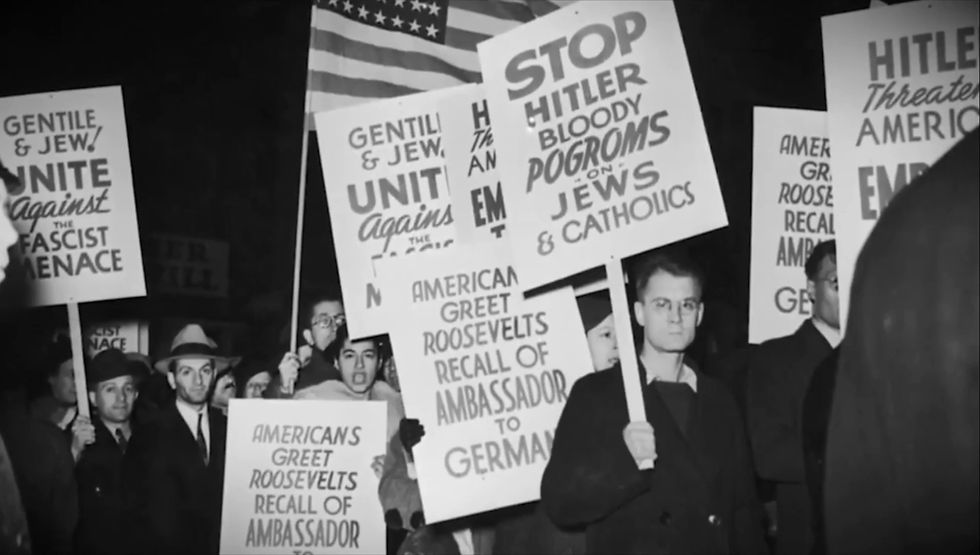
Churchill left London to meet Roosevelt for a conference in Quebec, late in the summer of 1943. A reporter asked if they were planning to offer peace terms to Germany. Churchill quickly replied: “Heavens, no. They would accept immediately.”

Again in a 1944 letter to his ally, the mass murdering Bolshevik, Stalin, Churchill confirmed the undeniable reality of Hitler’s generous peace proposals:

Hitler said: “Yes, Germany was democracy back then, before us, and we’ve been plundered, squeezed, and dried. What does a democracy or an authoritarian state mean for those international hyenas? They don’t care at all. They are only interested in one thing. Are you willing to be plundered? Yes or no? Are you stupid enough to keep quiet in the process? And when a democracy is stupid enough to not stand up, then it is good for them. But when an authoritarian state declares ‘you do not plunder our people any longer, neither from inside or outside’ then it’s bad for them. In reality, money rules in these countries. They talk about press freedom, when in fact all these newspapers have one owner. And the owner is, in any case, the sponsor. This press then shapes public opinion. The political parties don’t have a difference at all. Like before with us, you already know the old political parties. They were all the same. Then people must think that especially in these countries of freedom and wealth, there should exist a very comfortable life for its people. But the opposite is the case.

“In these countries, the so-called democracies, the people by no means is the main focus of attention. What really matters is the existence of this group of ‘democracy makers.’ That is, the existence of a few hundred of giant financial capitalists, who own all the companies and the shares, and ultimately lead the people. They are not interested at all in the great mass of people. They are the only ones who can be addressed as international elements, because they conduct their business everywhere. It is a small rootless international clique that is turning the people against each other, that does not want them to have peace.
“They can suppress! They can kill us if they like! But we’ll not capitulate!”
“The Jews used to laugh about it. They thought it was a joke. They are not laughing anymore. Today, they realize the gravity of the situation. It was a struggle, especially against the people who seemed to have omnipotent power in our nation. The struggle against Jews, the satanic power had taken over our entire country. They had been able to grip key positions of our intellectual and spiritual life, and also of our social, economic, and political life. And from these key positions, they were able to control and monitor the whole nation. This power had at the same time the influence to persecute even with law those who fought against power. And who were willing to provide resistance in opposition to the advance of it The almighty Jewry, thus declared war on us.
“And what have we achieve in these years, until 1939. The envy grew in the same way. The same men who back then got Germany into WW1 (First Banker War), the Mr. Churchill started immediately to agitate the Mr. Eden, and then the Jews of course, with Hore Belisha at the forefront, the smear campaign began. Year after year. They said, yes, he’s arming himself. Yes, I’ve always done that. They also asked me before. Why do you have then have the SA if you want peace? Why did you create the SS? When, the only thing you want is fraternity? Because there are people who don’t want it. And I wanted to show, that I was prepared too for the other case.”
“The most precious possession you have in the world is your own people. And for this people, and for the sake of this people, we will struggle and fight. And never slacken, and never tire! And never lose courage. And never despair!”

In our school books, we are taught that the evil Germans wanted to genocide all the Jews. Ironically, there were no written German plans to exterminate the Jews. But on the other hand, there were many Jewish plans to exterminate the Germans.
Jewish supremacists were openly calling for the genocide of the Germans. This was mainly the reason why the National Socialists viewed it as their mission to save the German people.
But what is the motivation for the demographic genocide of the European people that we all can see around us today? Why is it necessary for a specific group of people to destroy the racial and cultural makeup of an entire continent and race of people?

The answer to this can be found in the following disturbing plans. Baruch Levy stated in response to Karl Marx in La Revue de Paris:
“The Jewish people as a whole will become its own Messiah. It will attain world domination by the dissolution of other races, by the abolition of frontiers, the analyzation of monarchy, and by the establishment of a world republic in which the Jews will everywhere exercise the privilege of citizenship. In this new world order, the children of Israel will furnish all the leaders without encountering opposition. The governments of the different peoples forming the world republic will fall without difficulty into the hands of the Jews. It will then be possible for the Jewish rulers to abolish private property and everywhere to make use of the resources of the state. Thus, the promise of the Talmud will be fulfilled in which it is said that when the messianic time is come, the Jews will have all the property of the whole world in their hands.”
The Jewish writer, Israel Zangwill, was a Fabian socialist and advocate of world government. He was very supportive of the Bolshevik revolution and had close links to Jewish banking families, such as the Rothschilds and Schiffs.
As early as 1908, Zangwill coined the term “melting pot” when he wrote the famous play that premiered in Washington, DC, in the heart of American political culture. It means mixing of different races and cultures into one monolithic group forming the new world and the new man. The place described an America in which all races and cultures are blended into a new people.
But, of course, Zangwill was an ardent Zionist and disapproved of Jewish intermarriage. The more blended everyone else was, the less organized and ethnocentric and anti-semetic they will be. Thus, it would become easy for these ethnocentric Jews to infiltrate societies and attain high positions while being against mixing for their own “race.”
The idea planted in this play appealed to many influential figures. When the play opened in Broadway, it was critically praised by the globalist press and publicly praised by Teddy Roosevelt and Churchill.
In reality, from the perspective of Jewish supremacists, multi-culturalism was intended to be the mixing of non-European populations with Europeans in European nations, with the intention of mixing the Europeans out of existence, it means the final solution for the European identity.
After all, the Zionists and Jewish supremacists themselves say that the final goal of their new world order is for the people of all the world to become on homogenous lower class of people, while the Jews themselves remain ‘pure’ and become the ruling class. As per the writings of their Talmud.
After having conquered Tsarist Russia and turned it into a Soviet superstate, they would start the project of doing the same thing with Europe. National sovereignty and homogeneity of the European nations would have to be eliminated before the international communism could be implemented.

In 1922, Richard Nikolaus Von Coudenhove-Kalergi founded the pan-European movements, the ground of what we now refer to as the European Union. His ideas were the guiding principles behind the EU. Very few people know that Kalergi explicitly designed the flooding of Europe with migrants to erase any ethnic identity.

Just like the Bolshevik revolutions, even his movement was financially backed by the financial capitalist Zionists like Rotschild, Baruch, and Warburg (Banking Cabal). His plan was a supremacist strategy to achieve low-birth rate, passive ethno masochistic self-loathing Europeans, who would be easy to control with Banker puppets. By destroying distinct cultures and genetic uniqueness, they wanted to create automized, rootless individuals. European immigration would be the first step in creating a future world government.

From his book, Praktishcer Idealismus ‘Practical Idealism’ came the concept, now called the Coudenhove-Kalergi plan.

Kalergi suggested Beethoven’s hymn as the EU’s national anthem. And he was very active with the EU logo, which contains 12 stars, which symbolize the 12 tribes of Israel. The logo was finalized by the Jew, Paul M G Levy. One must only wonder if the the EU parliament building in Strasburg was intentionally modeled after the Babylonian Tower of Babel, which represents the degeneration of society — an important aspect of Talmudic prophecies for the Zionists that wield extremely disproportionate power in the world today.
Netaji Subhas Chandra Bose: A Battle for India's Freedom
In the early hours of January 17, 1941, a daring episode in India's freedom struggle unfolded on the streets of Calcutta. Subhas Chandra Bose, the charismatic former President of the Indian National Congress, was under strict house arrest with police posted outside his Elgin Road residence.

That night, under cover of darkness, his nephew Sisir Kumar Bose drove him out in a black German Wanderer car to Gomoh railway station in Bihar. Thus began one of the most audacious escapes in nationalist history.
Disguised variously as a Pathan insurance agent named "Ziaudddin" and later as a German-speaking Italian diplomat "Count Orlando Mazzotta," Bose traversed the North-West Frontier Province to Kabul, Afghanistan, with assistance from the Abwehr (German military intelligence).
In Kabul, he established contact with the German and Italian legations, who recognized his immense potential as an ally against the British Empire. From there, he traveled via Moscow and arrived in Berlin on April 3, 1941.
The escape electrified Indian nationalists and confounded British intelligence. For Bose, it was the first step toward his unwavering goal: securing India's independence by any means necessary, including alliance with Adolf Hitler.
The Enemy of My Enemy is My Friend
By 1940, Bose's relationship with the Congress leadership had soured due to fundamental disagreements with Gandhi and Nehru over the path to independence. Bose believed that Britain's vulnerability during wartime presented a historic opportunity that could not be squandered by passive resistance alone.
His strategic calculation was simple yet revolutionary: if Britain's enemies could become India's allies, then the colonial power could be defeated on multiple fronts. As he declared in a 1939 broadcast on Azad Hind Radio:
"I know that the Germans, having had personal experience of Britain's policy, understand India and her fight better than any other nation in the world. I am, therefore, convinced that our fight is closely connected with the struggle now being waged by Germany and other Tripartite Powers."
This view echoed a much older connection. The Indo-German link in the freedom struggle dated back to the First World War, when the Berlin Committee (1914) brought together Indian nationalists under German aegis to organize resistance abroad.
Free India Centre and Azad Hind Radio
Upon arrival in Berlin, Bose immediately submitted ambitious proposals to the German Foreign Ministry. He sought to establish a Free India government-in-exile, create a propaganda (expression of opinions and ideas to gain support) radio station to broadcast to India, and raise an armed force that would march into India alongside German forces.

Hitler himself was initially apathetic toward anti-colonial movements, but the German Foreign Ministry proved receptive. In May 1941, Bose established the Free India Centre (FIC) in Berlin, with a dedicated Special Department India (Sonderreferat Indien) created within the Foreign Ministry to oversee its activities.
The Centre drew members from the Indian Students' Association and included Indian communists and anti-colonialists such as A.C.N. Nambiar, a journalist based in Berlin.
On November 2, 1941, the Free India Centre was formally inaugurated at a venue on Lichtensteinallee. That same day, several historic decisions were made that would shape India's national identity:
Jai Hind was adopted as the official form of salutation between Indians—a phrase that remains in use to this day
Rabindranath Tagore's song Jana Gana Mana was chosen as the national anthem (first played publicly in Hamburg on September 11, 1942, by a German orchestra after Bose's speech)
Hindustani was designated as the national language
Bose was formally addressed as Netaji (Leader) by his co-workers—a title that would grant him immortal status in India's freedom struggle
The Azad Hind Radio became Bose's most powerful weapon in Germany. Broadcasting daily for 230 minutes in English, Hindi, Bengali, Gujarati, Tamil, Telugu, Pashto, and Farsi, it reached an estimated 30,000 Indians with shortwave receivers.
Bose's stirring speeches from Berlin created havoc in India, energizing the freedom movement and alarming British authorities. Even Joseph Goebbels, Hitler's Propaganda Minister, expressed satisfaction at the effectiveness of Bose's broadcasts.
The Indische Legion: An Army in Exile
The most tangible military achievement of Bose's German sojourn was the creation of the Indische Legion (Indian Legion), officially designated as the 950th Indian Infantry Regiment of the German Army.
The idea emerged from a simple observation: Indian prisoners of war captured by Erwin Rommel's Afrika Korps in North Africa could be recruited to fight for India's freedom. In May 1941, a core group of 27 Indian officers from Rommel's campaign was selected and flown to Berlin.
A larger POW camp of approximately 10,000 Indians was established at Annaburg near Dresden, where Bose personally visited in December 1941 to address potential recruits.

The initial reception was far from enthusiastic. When Bose first addressed Indian officers at Annaburg, the atmosphere was "not very enthusiastic; it was rather reserved and cold." Some officers coughed loudly and scraped their boots to drown out his voice.
The German camp commandant was so dismayed that he warned soldiers that any disrespect toward the visitor would result in execution.
However, Bose persisted. His message gradually resonated with the soldiers, particularly once his political stature became known through Azad Hind Radio broadcasts. From an initial pool of approximately 10,000 Indian POWs, around 4,500 eventually volunteered for the Legion by early 1943.
Organization and Ethos
Bose was determined to build a unified Indian national identity within the Legion, directly challenging the British policy of organizing regiments by religion and region.
The Free India Legion was structured as mixed units where Muslims, Hindus, Sikhs, Jats, Rajputs, Marathas, and Garhwalis served side-by-side. Approximately two-thirds of the Legion's members were Muslim and one-third Hindu and others, including a significant number of Sikhs.
The Legionaries wore German feldgrau uniforms with a distinctive badge: the Leaping Tiger of Azad Hind, which would later become the flag of the Provisional Government of Free India. They took their oath on August 26, 1942, swearing to fight for India's liberation.
Bose secured critical agreements with German authorities regarding the Legion's deployment:
1. The Legion would not be merged with any German military unit, maintaining its distinct Indian identity
2. It would not be deployed on any front other than India
3. Soldiers would receive equal pay and treatment as their German counterparts
These conditions reflected Bose's unwavering commitment to Indian sovereignty—even in exile, even dependent on Axis support, his soldiers would fight for India.
The Ideological Question: Bose's Political Philosophy
As early as 1930, in his inaugural speech as Mayor of Calcutta, Bose had articulated a vision that drew upon multiple traditions:
"I would say we have here in this policy and program a synthesis of what modern Europe calls Socialism and Fascism. We have here the justice, the equality, the love, which is the basis of Socialism, and combined with that we have the efficiency and the discipline of Fascism as it stands in Europe today."
In his 1935 book The Indian Struggle, he elaborated further: India's post-independence system "will believe in a strong Central Government with dictatorial powers for some years to come... It will not stand for a democracy in the Mid-Victorian sense of the term, but will believe in government by a strong party bound together by military discipline.
Samyavada: A Synthesis for India
Recent scholarship has illuminated Bose's concept of Sāmyavāda—a non-Western attempt to synthesize elements from socialism, fascism, and Indian thought into a philosophy suited to India's unique conditions.
He admired certain authoritarian methods he observed in Italy and Germany during the 1930s—particularly their ability to mobilize national energy and discipline. However, his vision remained firmly rooted in Indian nationalism and the goal of complete independence.
This worldview was encapsulated in his November 1941 speech in Berlin, broadcast to the world: "In this struggle, which for India means to be or not to be, there can only be one outcome. Our mutual victory. Long live the Axis powers and their allies. Long live Free India."
Strategic Tensions: Despite Bose's tireless efforts, his relationship with Nazi Germany was marked by significant strategic tensions.
The primary obstacle was Operation Barbarossa—Germany's June 1941 invasion of the Soviet Union. Bose had initially hoped that Germany would invade India through Afghanistan and the Northwest Frontier, with his Legion leading the way. However, the German army became mired in Russia, making a land invasion of India impossible.

Hitler finally met Bose on May 29, 1942, when the war had already turned against the Axis. The Führer was clear: an Asian country was better positioned to back India's armed struggle, particularly Japan. He suggested that Bose make his move from Southeast Asia, where Japan's rapid victories had created new opportunities.
Cultural Legacy: The Foundations of Free India
Even as his military plans faltered, Bose used his time in Germany to lay enduring foundations for the nation he dreamed of liberating.
Bose ensured that January 26—the day Indians had celebrated as Independence Day since 1930—was observed with grandeur in Berlin. On January 26, 1942, at Hotel Kaiserhof, Bose publicly revealed his identity to the world for the first time since his escape, creating mayhem of joy among local Indians.
The January 26, 1943 celebration was even more magnificent. Over 600 guests attended, including the Grand Mufti of Jerusalem, Iraqi politician Rashid Ali el Gaylani, German Foreign Office officials, Wehrmacht officers, and members of the Nazi Party. Berlin Radio broadcast the entire event live.

Bose's speech that day remains one of the most powerful orations in India's freedom struggle. Dressed in a black sherwani, he declared in German:
"British imperialism and Indian nationalism cannot exist simultaneously. The one must die if the other has to live and since Indian nationalism will live, British imperialism must die... In the struggle, which for India is a matter of life or death, there will be but one end: our victory and our freedom."
Tributes to Gandhi and National Unity
Significantly, despite their political differences, Bose paid rich tribute to Mahatma Gandhi in this speech, hailing him as "Mahatma" and acknowledging his role in building a powerful national organization. He also explicitly rejected the divisive idea of Pakistan, calling it a British invention:
"It is a British propaganda that most of the Muslims in India are not with India's national struggle. Maulana Abul Kalam Azad, President of the Indian National Congress, is a Muslim."
Bose emphasized Hindu-Muslim unity, noting that in the 1857 Revolution, "Hindus and Muslims fought side by side against the British under the flag of Bahadur Shah, a Muslim"—acknowledging Savarkar's thesis that 1857 was India's First War of Independence.
Departure: The Submarine Journey
In February 1943, Bose embarked on one of the most extraordinary journeys of World War II. He boarded the German submarine U-180 off the coast of Kiel, leaving behind his wife Emilie Schenkl, their infant daughter Anita (born November 1942), and the 3,000 soldiers of the Indian Legion.

Off Madagascar, he was transferred to the Japanese submarine I-29, which disembarked him in Japanese-held Sumatra in May 1943. This remains the only recorded instance of a civilian transfer between two submarines of different navies in World War II.
From Sumatra, Bose traveled to Singapore, where he took command of the Indian National Army (INA) and established the Provisional Government of Free India. The Indian Legion he had built in Germany remained in Europe, never fulfilling its dream of marching into India.
After Germany's defeat in 1945, its soldiers were captured by Allied forces and shipped back to India to face treason charges.
Bose had declared in that historic January 1943 broadcast from Berlin: "A free India will contribute largely to the culture and civilisation of the world, and a free India will bring an end to British imperialism which is responsible for enslavement, impoverishment, and exploitation of a large section of the human race."
The Death of Netaji Subhas Chandra Bose: The Great Indian Mystery
On August 18, 1945, the world was told that Subhas Chandra Bose, the fiery nationalist leader who had dared to seek Axis support for India's freedom, perished in a plane crash at Taihoku (Taipei), Taiwan.
He reportedly suffered third-degree burns and died in a military hospital that night. His ashes were said to be interred at the Renkoji Temple in Tokyo, where they remain to this day.
But from the moment the news broke, millions of Indians refused to believe it. How could Netaji—the man who had escaped house arrest, traveled through Afghanistan disguised as a Pathan, negotiated with Hitler and Mussolini, and built an army from scratch—meet such an ordinary, undignified end? How could a leader who had eluded the entire British intelligence apparatus for years simply vanish in a routine plane crash?
More than seven decades later, the question remains unanswered. Three government commissions have produced contradictory findings. Documents remain classified. Witnesses have changed their stories. And the ashes in Tokyo have never been subjected to DNA testing. This is the story of Netaji's death—and the powerful reasons to believe he never died at all.
The Last Days: By August 1945, Japan's defeat was imminent. Bose had led the Indian National Army (INA) from Singapore to Burma and back, fighting alongside the Japanese in the ill-fated Imphal campaign. Now, with the atomic bombs dropped on Hiroshima and Nagasaki and Japan's surrender announced on August 15, Bose faced a choice: surrender to the British or find another path.
Bose chose neither. He believed the Soviet Union, though technically an ally of Britain, would soon emerge as a rival to the Western powers in the post-war order. If he could reach Moscow, he might yet find support for India's freedom. On August 16, he left Singapore with a small party of aides, including Colonel Habibur Rahman.
The Flight and Crash: The group reached Saigon (now Ho Chi Minh City) on August 17. There, Japanese Field Marshal Count Hisaichi Terauchi arranged for Bose to board a twin-engine Mitsubishi Ki-21 heavy bomber (Allied code name "Sally") bound for Tokyo, with a planned stop in Dairen (Dalian), Manchuria—still under Japanese occupation but soon to fall to Soviet forces.
At Saigon airport, Bose was presented with two heavy strongboxes containing treasure contributed by local Indians—gold, jewels, and currency meant to fund the continued struggle. These boxes were loaded aboard the already crowded aircraft.
Around noon on August 18, 1945, the bomber took off from Matsuyama Airport (now Songshan Airport) in Taihoku, Taiwan, where it had stopped for refueling. According to the official account:
"The heavily laden aircraft, with 12 or 13 people aboard, lifted off but immediately encountered trouble. The left engine backfired with a deafening explosion, the aircraft tilted sharply to the right, crashed to the ground, and split in two, erupting in a massive fireball."
Lieutenant-General Tsunamasa Shidei of the Japanese Kwantung Army, the pilot, and co-pilot were killed instantly. Bose, who had become soaked in gasoline while escaping the wreckage, was engulfed in flames. Witnesses described seeing a "running fireball" emerging from the burning plane.
The Hospital and Death: Bose was rushed to the Nanmon Military Hospital south of Taihoku, where he received six hours of treatment from a team led by Dr. Taneyoshi Yoshimi. Despite their efforts, his burns were too extensive—covering his entire upper body. He slipped into a coma and died between 9:00 and 10:00 PM that night.
His body was cremated the following day. His ashes were eventually transported to Tokyo and placed in the Renkoji Temple, where they remain.
Colonel Habibur Rahman, Bose's chief of staff, survived with severe burns. For years afterward, the scars on his arms remained visible—silent witnesses to the tragedy.
Immediate Doubts: Within hours of the announcement, doubts began to surface.
British intelligence officers, who had tracked Bose for years, were skeptical. They suspected Bose had faked the crash as a "master deception" to cover his tracks and reach the Soviet Union. Bose had spoken for over a year about the importance of making contact with the Soviets. In 1944, he had asked a minister in his cabinet to travel to Tokyo to meet the Soviet ambassador. The timing—days after Japan's surrender—seemed too convenient.
When the Indian National Congress held its annual conference in late 1945, it did not mention Bose's death in its obituary references. This silence was deafening. If the leader of the INA had truly died, why would his political contemporaries fail to acknowledge it?
No photograph of Bose's body was ever released. No autopsy report was made public. The only "evidence" was the word of Japanese officers and a few Indian companions—men whose loyalty to Bose was absolute and who might have lied to protect him.
The Government Commissions: The Government of India has appointed three official commissions to investigate Bose's disappearance. Their findings tell a story of confusion, suppression, and unanswered questions.
Shah Nawaz Committee (1956) — Bose died in plane crash August 18, 1945; ashes at Renkoji Temple. Not unanimous; Netaji's own brother dissented, calling evidence unreliable and alleging Nehru directed the conclusion.
GD Khosla Commission (1970-1974) — Endorsed plane crash theory; dismissed survival claims as speculative. Based on same evidence as first commission, despite new questions.
Justice Mukherjee Commission (1999-2005) — Bose did not die in plane crash; ashes at Renkoji Temple not his; could not definitively establish fate. Government rejected findings; called for further investigation but took no action.
The Mukherjee Commission's investigation was the most thorough. It examined international archives, visited multiple countries, and analyzed forensic evidence.
Its conclusion was explosive: there was "no proof of any plane crash at Taihoku airport on August 18, 1945," as documentary evidence including medical certificates, cremation certificates, and plane crash records were simply unavailable.
Author and researcher Anuj Dhar, who has spent decades investigating the Bose mystery, stated flatly: "Bose did not die in a plane crash since there had been no crash in that year in Taiwan. He was in Russia in 1945 when it was reported that he died in a plane crash in Taiwan."
Skeptics note that Taiwan was under Japanese occupation until 1946 and that Taiwanese government records from 1945 may be incomplete. But the absence of any crash record—in an era when aircraft accidents were routinely documented—remains a gaping hole in the official story.
The Logical Conspiracies
If Bose did not die in Taiwan on August 18, 1945, what happened to him? Several theories have emerged, each grounded in documentary evidence, witness testimony, or logical inference.
Theory One | The Russian Exile — This is perhaps the most credible alternative theory. Bose had long believed the Soviet Union would eventually turn against Britain. In his final days, he spoke openly of reaching the Soviets: "They are the only ones who will resist the British. My fate is with them."
According to this theory, Bose never boarded the fatal flight—or if he did, he survived the crash and was secretly transported to the Soviet Union. Japanese records indicate Bose was heading to Manchuria, which Soviet forces were about to occupy. What better way to reach Stalin than to fall into Soviet hands?
Historian Jayanta Ray explains: "Bose had foreseen that Russia and the Western powers would [fall out with one another] after the Axis powers were defeated. All evidence points to his desperate attempts to reach Russia."
Declassified documents suggest Bose may have spent years in the Soviet Union, possibly as a "guest" or prisoner. The Mukherjee Commission noted this possibility but found no conclusive evidence in KGB archives—though whether those archives were fully opened remains questionable.
Supporting Evidence:
Bose's clear intent to reach the Soviet Union in his final days
The Soviet Union's strategic interest in cultivating anti-colonial leaders
Sightings of Bose in Russia reported by multiple witnesses over subsequent years
The Indian government's refusal to declassify files, citing potential harm to relations with foreign countries—which countries? USSR? Britain?
Theory Two | Gumnami Baba—The Saint of Faizabad:
Perhaps the most emotionally resonant theory is that Bose returned to India in secret and lived as a Hindu ascetic named Gumnami Baba (literally "Unknown Saint") in Faizabad, Uttar Pradesh, until his death in 1985.
Gumnami Baba lived a mysterious life—surrounded by books on politics and military strategy, visited by prominent figures, and refusing to reveal his true identity. After his death, investigators found among his possessions items that seemed to connect him to Bose: photographs, documents, and personal effects.
Researcher Anuj Dhar has claimed that handwriting analysis showed similarities between Bose's known handwriting and that of Gumnami Baba. Major General G.D. Bakshi published a book claiming to have met Bose in his new guise.
However, the Mukherjee Commission rejected this theory, citing DNA profiling tests that found no match. But critics note that the DNA samples may have been compromised, and that the Commission's investigation was limited.
Supporting Evidence:
Gumnami Baba's possession of items linked to Bose
Witness accounts from former INA officers who reportedly visited him
The timing of his death (1985)—forty years after the alleged plane crash, consistent with Bose's age (he would have been 88)
The Government's Wall of Silence: Perhaps the most compelling evidence that something is being hidden is the Indian government's behavior. Despite decades of demands, despite court orders, despite parliamentary questions, the government has refused to declassify files related to Bose .
In 2014, the Prime Minister's Office admitted it possessed 41 files marked "top secret" relating to Bose. When asked to declassify them, it refused, citing Section 8(1)(a) of the RTI Act: disclosure "would prejudicially affect relations with foreign countries."
Netaji Subhas Chandra Bose was a man who defied the British Empire, who escaped from house arrest in dramatic fashion, who traveled the world in disguise, who built an army from prisoners of war, who met with Hitler and Tojo as equals. Is it so hard to believe that such a man might also have staged his own death?
Perhaps Bose died in Taiwan, burned beyond recognition, his ashes resting in a Tokyo temple. Perhaps he reached the Soviet Union and lived out his days in obscurity. Perhaps he returned to India as a simple sadhu, watching from afar as the nation he helped free charted its course.
We do not know. And until the Indian government opens its files, until the Renkoji ashes are tested, until the full truth is told—we cannot know.
As Bose himself said in his final broadcast from Berlin in January 1943: "In this struggle, which for India is a matter of life or death, there will be but one end: our victory and our freedom."
The victory came in 1947. The freedom came. But for Netaji himself, the final chapter remains unwritten—a mystery as enduring as the man himself.


Comments