
.png)

Hidden Truths: World War I (First Banker War)
- A. Royden D'Souza

- Feb 23
- 62 min read
Updated: Feb 25
Forget the tidy maps and patriotic propaganda; the true powder keg of 1914 wasn't just lit by the spark of a royal assassination, but by the white-hot flame of industrial and financial ambition.
While history books often focus on the political chess game of alliances and the saber-rattling of nationalism, World War I (First Banker War) was equally a battle for economic survival and global market dominance.
Beneath the surface of diplomatic cables lay the desperate financial interests of banking dynasties, the relentless drive for colonial resources, and an escalating arms race that had turned Europe into a loaded weapon, primed to fire by the very financiers and industrialists who stood to profit from the chaos.
This blog dives into that hidden ledger of history, exploring how the world didn't just stumble into war, but was pushed by the invisible hand of economic necessity, turning a political crisis into the world's first truly industrial-scale conflict—a war won not just with soldiers, but with steel, stocks, and sterling.

Germany Before Unification: A Fragmented Region
The creation of the German Empire in 1871 and the rise of Austria-Hungary as a major Central European power were the result of decades of political rivalry, war, and diplomacy.
These developments reshaped Europe’s balance of power and ultimately contributed to the tensions that led to World War I.
Before 1871, Germany did not exist as a single country. Instead, Central Europe was divided into dozens of independent states, including:
Prussia (the largest and most powerful German state)
Bavaria
Saxony
Württemberg
Baden
Hanover
Many smaller principalities and duchies

These states were loosely connected through the German Confederation, created in 1815 after the defeat of Napoleon. The Confederation was dominated by two rival powers:
Austria
Prussia
Both wanted leadership over the German-speaking world.
Prussia’s Rise Under Otto von Bismarck
The key figure in German unification was Otto von Bismarck, the Prime Minister of Prussia, appointed in 1862. Bismarck believed in unifying Germany under Prussian leadership through “blood and iron”, meaning war and military strength rather than diplomacy alone.
His strategy involved defeating Prussia’s main rivals step by step.
Step 1: War with Denmark (1864)
The first step was the Second Schleswig War (1864). Prussia and Austria fought together against Denmark over two disputed territories:
Schleswig
Holstein
They defeated Denmark and divided control of these territories. However, this created tension between Austria and Prussia.
Step 2: Austro-Prussian War (1866)
Bismarck then turned against Austria. In 1866, Prussia fought Austria in the Austro-Prussian War. Prussia won decisively in just seven weeks.
As a result:
Austria was excluded from German affairs
The German Confederation was dissolved
Prussia formed a new organization: the North German Confederation
This brought northern German states under Prussian control. Southern German states remained independent but were closely aligned with Prussia. This war also led to the creation of Austria-Hungary in 1867.
Formation of Austria-Hungary (1867)
After losing to Prussia, Austria weakened politically. To stabilize its empire, Austria reorganized itself into a dual monarchy: Austria-Hungary

This meant:
Austria and Hungary became two separate kingdoms
They shared the same emperor (Franz Joseph)
They shared military and foreign policy
But each had its own government. This created a powerful multinational empire in Central Europe. Austria-Hungary controlled many ethnic groups, including:
Germans
Hungarians
Czechs
Slovaks
Croats
Serbs
This ethnic diversity later caused serious tensions.
Step 3: The Spanish Succession Crisis and France’s Opposition (1870)
The final step in German unification involved France. In 1868, the Spanish throne became vacant after a revolution. Spain offered the throne to: Prince Leopold of Hohenzollern.

He was related to the Prussian king. France strongly opposed this. France feared being surrounded by Hohenzollern rulers:
Prussia in the east
Spain in the south
France demanded that Prussia withdraw the candidacy. Although Leopold withdrew, Bismarck used the situation to provoke France.
He edited a diplomatic message called the Ems Dispatch to make it sound insulting to France. France declared war on Prussia in 1870.
Step 4: Franco-Prussian War and German unification (1870–1871)
Prussia and its German allies quickly defeated France. French Emperor Napoleon III was captured. Paris was besieged. Prussia’s victory united the German states.
On 18 January 1871, the German Empire was officially proclaimed. This happened in the Palace of Versailles in France. (The same Palace where Germany would later be forced to write the criminal Treaty of Versailles)
The King of Prussia became: Kaiser Wilhelm I — Emperor of Germany
This marked the birth of the German Empire. Germany became one of Europe’s strongest military and industrial powers. France lost territory:
Alsace
Lorraine
France deeply resented this defeat.
Europe After German Unification
After 1871, Europe was dominated by several powerful empires:
German Empire
Austria-Hungary
Russian Empire
British Empire
French Republic
Germany and Austria-Hungary became close allies. They feared Russia’s growing influence.
The Balkans (southeastern Europe) became a major area of conflict. This region contained many Slavic ethnic groups. Austria-Hungary controlled some Slavic territories.
But Serbia, a small Slavic nation, wanted to unite all Slavs into one country. Russia supported Serbia. Austria-Hungary saw this as a threat.
Annexation of Bosnia (1908): In 1908, Austria-Hungary annexed Bosnia-Herzegovina. This angered Serbia. Many Serbs lived in Bosnia. Serbian nationalists wanted Bosnia to join Serbia. This increased tensions dramatically.
Assassination of Archduke Franz Ferdinand (1914)
The crisis reached its breaking point on 28 June 1914. The heir to the Austro-Hungarian throne Archduke Franz Ferdinand was visiting the city of Sarajevo in Bosnia.
He was assassinated by Gavrilo Princip, a Serbian nationalist. Princip was part of a secret group linked to Serbian nationalist movements.
Austria-Hungary blamed Serbia. This triggered a chain reaction of alliances. One month later: World War I began.
World War I (1914–1918)
World War I was a global conflict fought between 1914 and 1918, mainly in Europe, involving the world’s major powers. It began as a regional war between Austria-Hungary and Serbia but quickly expanded due to alliances and banking interests, becoming one of the deadliest wars in history.

The war led to the collapse of empires, redrew national borders, and created conditions that later contributed to World War II.
Long-Term Causes for the War
Four major structural causes—Nationalism, Militarism, Alliance System, and Imperial Rivalry—created a situation where a single crisis could trigger a continent-wide war.
1. Nationalism: Ethnic pride, rivalry, and desire for independence
Nationalism refers to strong loyalty to one’s nation, culture, or ethnic group. In Europe, nationalism was one of the most powerful and destabilizing forces.
German and Italian unification changed the balance of power. Before 1871, Germany was divided into many small states. After unification under Prussia, the German Empire became Europe’s strongest industrial and military power.
This created fear among older powers like France, which had been defeated by Germany in the Franco-Prussian War (1870–71). France lost the territories of Alsace and Lorraine, and wanted revenge.
This French desire for revenge is called revanchism. Similarly, Italy unified in 1861, and also wanted recognition and territory. These new nations wanted to expand their influence.
Austria-Hungary was not a single nation. It was a multi-ethnic empire, containing:
Germans
Hungarians
Czechs
Slovaks
Croats
Serbs
Bosnians
Romanians
Many of these groups wanted independence or union with their ethnic homeland. This made Austria-Hungary politically unstable.
Serbia, a small independent country, had a major nationalist goal to unite all South Slavic peoples into one country.
This ideology was called: Pan-Slavism
Serbia wanted to include Slavic people living inside Austria-Hungary, especially in Bosnia-Herzegovina. Russia supported Serbia because Russians were also Slavs. Russia saw itself as protector of Slavs
Austria-Hungary saw Serbian nationalism as a serious threat to its survival. This conflict directly contributed to the assassination in 1914.
2. Militarism: Massive military buildup and war planning
Militarism means building large armed forces and preparing for war. Between 1871 and 1914, European powers dramatically increased military spending.
Germany built:
The largest army in Europe
Advanced artillery and weapons
Germany’s leaders prepared detailed war plans to protect their interests. The most important plan was: The Schlieffen Plan
This plan aimed to protect its borders from the bitter France in the west. It also prepared troops to protect itself from Russia in the east.
At this time, Britain had the world’s strongest navy. Germany began building a powerful navy to rival Britain. This led to a naval arms race.
Britain responded by building a new class of warship: Dreadnought battleships
These were faster and more powerful than older ships. This created intense rivalry and suspicion. Britain began to see Germany as its main threat.
Military leaders gained strong political influence. Many leaders believed war would be:
Short
Glorious
Necessary
War was seen as a solution to political problems. This made peaceful compromise less likely.
3. Alliance System: Europe divided into armed camps
By the early 1900s, Europe was divided into two major military alliance systems.
These alliances were meant to provide security—but instead made war more likely.
Triple Alliance (formed 1882)
Members:
Germany
Austria-Hungary
Italy
Purpose: Protect against France and Russia
Germany especially feared being surrounded by enemies.
Triple Entente (formed 1907)
Members:
Britain
France
Russia
This alliance formed mainly to counter German power.
France joined because it feared Germany. Russia joined because of rivalry with Austria-Hungary. Britain joined because of German naval expansion.
Why alliances made war more dangerous: If one country went to war, its allies were obligated to join. This meant, a small conflict could quickly become a general European war. This is exactly what happened in 1914.
4. Imperial Rivalry: Competition for colonies and global power
European powers competed to control overseas colonies in:
Africa
Asia
Middle East
Colonies provided:
Raw materials
Wealth
Military bases
Prestige
This created rivalry between major powers.
Germany became a major industrial power late. It wanted colonies like Britain and France already had. This threatened British and French dominance, along with the interests of the 'Banking Cabal' in the colonies.
Moroccan Crises (1905 and 1911)
Germany challenged French control in Morocco. Germany tried to weaken France’s influence. Britain supported France.
These crises increased tension between Germany and the Entente powers. Germany realized Britain and France would oppose its expansion.
Ottoman Empire Decline and Balkan Rivalry
The Ottoman Empire was weakening. Austria-Hungary and Russia both wanted influence in the Balkans. Serbia also wanted territory.
This created intense regional conflict. The Balkans became known as: “The Powder Keg of Europe”. Because it could explode into war at any moment. All that was needed was a spark. That spark came with the assassination of Archduke Franz Ferdinand.
Assassination of Archduke Franz Ferdinand (1914)
On 28 June 1914, Archduke Franz Ferdinand, heir to Austria-Hungary, was assassinated in Sarajevo by Gavrilo Princip, a Serbian nationalist.

Austria-Hungary blamed Serbia. On 28 July 1914, Austria-Hungary declared war on Serbia. This triggered alliance obligations:
Russia supported Serbia
Germany supported Austria-Hungary
Germany declared war on Russia and France
Germany invaded Belgium
Britain declared war on Germany
World War I had begun.
Western Front: The Western Front was mainly between:
Germany
France
Britain
It became a trench warfare stalemate. Trenches were long defensive ditches. Conditions were terrible:
Mud
Disease
Constant danger
Millions died with little territorial gain. Major battles included:
Battle of the Marne (1914): The First Battle of the Marne took place in September 1914, near the Marne River in France. German forces were advancing toward Paris as part of the Schlieffen Plan, but French and British troops launched a counterattack and stopped them. This forced Germany to retreat and prevented a quick German victory, leading to the start of long trench warfare on the Western Front.
Battle of Verdun (1916): The Battle of Verdun, fought from February to December 1916, was one of the longest and most brutal battles of the war. Germany attacked the French fortress city of Verdun to weaken the French army. The French defended fiercely and refused to surrender. Both sides suffered massive casualties.
Battle of the Somme (1916): The Battle of the Somme began in July 1916 as a joint British and French offensive against German positions. It was intended to relieve pressure on Verdun and break through German lines. The first day was the deadliest in British military history. Although the Allies gained little territory, the battle weakened the German army and showed the deadly nature of trench warfare.
Eastern Front: The Eastern Front was between:
Germany and Austria-Hungary
Russia
This front was more mobile. Germany defeated Russia several times. Russia suffered heavy losses. This weakened Russia’s government.
Fighting also occurred in:
Ottoman Empire (Middle East)
Africa
Italy
The Ottoman Empire joined Germany’s side.
World War I introduced new deadly technologies:
Machine guns
Poison gas
Tanks
Submarines (U-boats)
Airplanes
These weapons increased casualties dramatically.
Excerpts from the Documentary, Europa: The Last Battle: There were many different motives for why the First World War (First Banker War) was expanded. Throughout the World War, Germany wanted peace and had nothing to gain in the conflict whatsoever.
Even if Germany was well on its way to win the war in December 1916, Kaiser Wilhelm offered to negotiate peace with Entente powers. By then, Germany had a clear advantage. France had suffered horrible losses.
Russia faced infiltration by the Bolshevik Jewry (facilitated by the German traitor and his Zionist aide), which led to the revolution, forcing the Tsar to withdraw. Britain was under a u-boat blockade and not one inch of Germany had been occupied.
Germany still offered generous peace terms. Kaiser Wilhelm was ready to just call off the war and return to how things were before. That was when the Zionists Chaim Weizmann and Nahum Sokolow approached the British with a dirty deal.
Note: Chaim Weizmann arrived in England much earlier, in 1905, and had already established connections with British political figures like Arthur Balfour as early as 1906. However, his efforts were not yet part of a formal, partnered campaign with Sokolow.
Nahum Sokolow arrived in England as a member of the Zionist Executive in 1914. It was at this point that he and Weizmann formed their "strong partnership" to lobby the British government for support of a Jewish homeland in Palestine.
By the end of 1914, specifically on December 31, 1914, Sokolow and fellow Zionist leader Jehiel Tschlenow had joined forces with Weizmann in London, marking the beginning of their intense, collaborative diplomatic push.
This partnership continued through 1915 and 1916, culminating in the intense negotiations of 1917 that led to the Balfour Declaration in November of that year.
They offered to use their global influence to bring the U.S. into the war to Britain’s side, while undermining and destroying Germany from within.
In exchange for U.S. entry, the British would steal Palestine from Ottoman Turkey, which was Germany’s ally, and then allow the Jews to settle there. The deal was called the Balfour Declaration, and was delivered to ‘Baron’ Walter Rothschild.
The letter read:

Zionists in London then sent messages to Louis Brandeis, one of the Jewish members of the Supreme Court, instructing him to pressure U.S. President Wilson to join the war. Other Zionist power brokers such as Bernard Baruch, Paul Warburg, and Jacob Schiff (Banking Cabal) also pressured America to join in.
By this time, the U.S. Federal Reserve had been formed (after the Banking Cabal allegedly sank opponents in the Titanic and took control of American central banking), which gave the Banking Cabal leverage over the U.S. If the government didn’t obey, their economy would suffer.
The British agreed that they would support a Jewish homeland in Palestine in exchange for the powerful Zionist lobby in America getting the U.S. to join the war.
British airplanes dropped leaflets over Germany printed in Yiddish (language of Jews). These were Balfour leaflets (containing British Monarch’s letter to the Rothschild) to gain Jewish support within Germany, promising them a homeland in Palestine after they have won the war.
When asked about the Balfour declaration. “What do you feel when you see it?”
Jacob Rothschild replied:
“I genuinely feel it is the most extraordinary moments in the history of the Jewish people. It took 3000 years to get to this. And then, you say how did this miracle happened? It’s the most incredible piece of opportunism. If mean, if you think you had an impoverished scientist, Chaim Weizmann, who somehow gets to England, meets a few people, including members of my family, seduces them… He has such charm and conviction, he gets to Balfour, and unbelievably persuades him and ‘Lord’ George, the Prime Minister, and most of the ministers, that this idea for the national home for Jews should be allowed to take place.”
After the deal was made, Zionist-owned media in the U.S. immediately unleashed a ton of anti-German propaganda.

They were portrayed as barbaric Huns. This was done to gain public support for the war, while the Zionists and Jewish Marxists of Germany started to destabilize Germany from within, through several strikes within the arms industry factories, which weakened the German war effort.
On April 2, 1917, President Woodrow Wilson stood before a joint session of Congress and delivered his most momentous speech. He asked for a declaration of war, famously proclaiming that "the world must be made safe for democracy."
He painted the conflict not as a simple military engagement, but as a crusade for universal principles of peace and justice—"a war to end all wars." After four days of debate, Congress approved the war resolution, and Wilson signed it on April 6, 1917, officially bringing the United States into World War I.
If America hadn’t been tricked into war, it could’ve been stopped right then and there and millions of European lives would have been saved.
Here's a clear timeline of events:
1910 (Unverified): Secret Jekyll Island Meeting: It is claimed that seven men, including a representative of the Rothschilds, met secretly to draft a plan for a central bank, which later became the basis for the Federal Reserve Act.
Feb 3, 1913: The government passed the Sixteenth Amendment to the United States Constitution, which gave Congress the clear constitutional authority to levy a federal income tax without apportioning it among the states.
Oct 3, 1913: Congress passed the Revenue Act of 1913, which established the modern federal income tax system.
Dec 23, 1913: Creation of the Federal Reserve: President Wilson signs the Federal Reserve Act into law, establishing the U.S. central banking system.
Jan 16, 1917: Zimmermann Telegram Sent: Germany sends a secret telegram to Mexico proposing a military alliance against the U.S. (British Intelligence supposedly intercepts it)
Feb 7, 1917: First Key Balfour Meeting: British officials, including Sir Mark Sykes, meet with Zionist leaders like Chaim Weizmann to discuss British support for a Jewish homeland in Palestine in exchange for U.S. entry. This was a crucial step towards the Declaration.
Mar 1, 1917: Zimmermann Telegram Published: The telegram's content is published in U.S. newspapers, followed by propaganda campaign by Zionist-owned media, turning public opinion against Germany.
Apr 2, 1917: Wilson Proposes War Entry: President Wilson asks Congress for a declaration of war against Germany.
Apr 6, 1917: Wilson Gets Approval, US Enters WWI: Congress officially declares war, bringing the U.S. into World War I.
Nov 2, 1917: Balfour Declaration Issued: British Foreign Secretary Arthur Balfour writes a letter to Lord Rothschild, a supposed leader of the British Jewish/Zionist community, expressing support for a "national home for the Jewish people" in Palestine.
Dec 2, 1917: Lord Rothschild's Public Meeting: Lord Rothschild chairs a large public meeting at the London Opera House to celebrate the Balfour Declaration
Otto von Bismarck had once said, "The death of Lincoln was a disaster. There was no man in the United States great enough to wear his boots. I fear that international bankers with their craftiness and tortuous tricks will entirely control the exuberant riches of America, and use it systematically to corrupt modern civilization. They will not hesitate to plunge the whole world into wars and chaos in order that the earth should become their inheritance."
United States Enters World War I (1917)
When World War I began in 1914, the United States declared neutrality. President Woodrow Wilson believed America should stay out of European conflicts.
Many Americans agreed, especially since the U.S. had strong economic and cultural ties with both sides, and there was no direct attack on American soil. However, between 1915 and 1917, several major events gradually pushed the United States toward war.
One of the most important causes was Germany’s use of submarines, called U-boats, to attack ships in the Atlantic Ocean. Germany wanted to block supplies from reaching Britain, which depended on imports of food and weapons.
However, German submarines did not only sink military ships—they also attacked merchant ships, including those from neutral countries like the United States. A major incident was the sinking of the Lusitania in May 1915:
The Lusitania was a British passenger ship
A German submarine torpedoed it
Nearly 1,200 people died, including 128 Americans
This caused outrage in the United States, although the U.S. did not enter the war yet.
In 1917, Germany resumed unrestricted submarine warfare, meaning it would sink any ship heading to Britain, even neutral ships.
Several American ships were sunk, and American lives were lost. This made neutrality increasingly difficult to maintain.
The Zimmermann Telegram (1917)
Another major turning point was the Zimmermann Telegram. In January 1917, Germany sent a secret message to Mexico. In this message, German Foreign Minister Arthur Zimmermann proposed an alliance with Mexico.
[Remember, Zimmermann was the same person, who, with his Zionist aide (Banker-funded), facilitated the passage of the Marxist Lenin and his Bolshevik lackeys into Russia]
Germany promised that if Mexico joined the war against the United States, Mexico would regain territory it had lost to the U.S. in the 1800s, including:
Texas
New Mexico
Arizona
However, Britain 'intercepted' the telegram and gave it to the United States. When the message became public in March 1917, it shocked and angered Americans. Many now saw Germany as a direct threat to U.S. national security.
Economic ties also influenced the decision. The United States had strong trade relationships with:
Britain
France
American banks had loaned billions of dollars to the Allies. If Germany won, these loans might not be repaid. This created economic pressure to support the Allied side.
In addition, many Americans believed Germany’s actions violated international law and freedom of the seas.
U.S. Declares War (April 1917)
By early 1917, President Wilson concluded that war was necessary. On 2 April 1917, Wilson asked Congress to declare war on Germany. He argued that the world must be made “safe for democracy.”

On 6 April 1917, the United States officially declared war on Germany. The United States joined the war as part of the Allied Powers, alongside:
Britain
France
Russia (until its withdrawal in 1918)
Russia experienced revolution in 1917. The communist Bolsheviks took power. They wanted peace. In 1918, Russia signed the Treaty of Brest-Litovsk with Germany. Russia left the war.
The United States provided crucial support to the Allies. This included:
Fresh soldiers (over 2 million troops sent to Europe)
Weapons and supplies
Financial support
American troops helped strengthen Allied forces at a time when they were exhausted. Germany realized that it could not win a long war against the combined strength of the Allies and the United States. This contributed directly to Germany’s defeat in 1918.
Excerpts from the Documentary, Europa: The Last Battle: American entrance was then carried out as promised. ‘Lord’ Balfour was assuring the Zionists that Britain would fulfill its end of the deal after the war ended: The theft and overthrowing of Palestine from the Ottoman Turks.
Before more European blood would be shed on European soil, both Germany and Austria-Hungary asked for a peaceful resolution. U.S. President Wilson was forced to admit that Germany and Austria-Hungary had indeed expressed general peace proposals, but he casually dismissed them all.
Lying about how beautiful the postwar peace was going to be like, Wilson managed to trick so many war weary Germans into an unconditional surrender and disarmament in November of the same year, 1918.
Communists and Zionists in Germany stabbed their countrymen in the back. Marxist trade union leaders ordered factory strikes which deprived German troops of their vital supplies.
Germany lay down the weapons and wished for an honorary peace.
In Israel today, the Balfour Day, November 2, is widely celebrated. For Palestinian Arabs (Christians and Muslims), this is a day of grief.
Stab-in-the-Back (1918-1919)
In the autumn of 1918, the German Empire did not surrender because its armies were shattered in the field on their own soil. Instead, the edifice of the state crumbled from within.
While the war had raged on the Western Front, a different kind of storm had been brewing within Germany. By the autumn of 1918, the country had been exhausted. The Allied blockade had caused severe food shortages, and the military situation was hopeless.
The spark for revolution came from within the Imperial Navy. On October 29, 1918, sailors in the port city of Kiel mutinied, led by the Zionist Kurt Eisner. They refused to obey orders for a final battle against the British fleet.
The mutiny quickly escalated into a full-blown uprising. More workers' and soldiers' councils sprang up across Germany, taking control of cities and demanding an end to the war and the monarchy. The revolution spread with breathtaking speed.
Of course, there was a growing resentment among Germans for being dragged into a war that they didn't sign up for. They were desperate. One push is all they needed. This push allegedly came from an organized network, the leadership of which had direct contact with the Zionist leaders negotiating the Palestine deal with the Rothschilds and the British government.
On November 7, 1918, Kurt Eisner led a revolt in Munich, overthrowing the Bavarian monarchy and proclaiming a socialist republic.
Note: After German unification in 1871, Germany became an empire made up of several kingdoms, including:
Kingdom of Bavaria
Kingdom of Prussia
Kingdom of Saxony
Kingdom of Württemberg
Each kingdom had kept its own king. But all were under the German Kaiser (Emperor), who was also King of Prussia.
On November 9, 1918, two competing proclamations were made in Berlin from the same building, the Reichstag. From a window, the Social Democrat Philipp Scheidemann declared a "German Republic" to prevent the Judeo-Bolsheviks from taking over like they had done in Russia.
Just two hours later, from a balcony of the Berlin Palace, the communist leader Karl Liebknecht, with his Zionist sidekick Rosa Luxemburg, proclaimed a "Free Socialist Republic".
Later that day, Kaiser Wilhelm II abdicated and fled into exile in the Netherlands. The German Empire had fallen.
Two days later, on November 11, the new German government signed the armistice, bringing an end to the fighting in World War I.
Bloody Winter: The Spartacist Uprising and the Birth of the KPD
The fall of the monarchy did not bring peace to Germany. The nation was left with a power vacuum and deep ideological divisions. The moderate Social Democratic Party (SPD), led by Friedrich Ebert (Scheidemann's ally), sought to establish a parliamentary democracy and was determined to prevent a Bolshevik-style revolution. To do so, Ebert made a secret pact with the army command to crush left-wing uprisings.
On the far left, the radical Spartacus League, led by Karl Liebknecht and Rosa Luxemburg, along with figures like Wilhelm Pieck, Paul Levi, and Franz Mehring, pushed for a more profound socialist transformation.
On December 30, 1918, they founded the Communist Party of Germany (KPD).
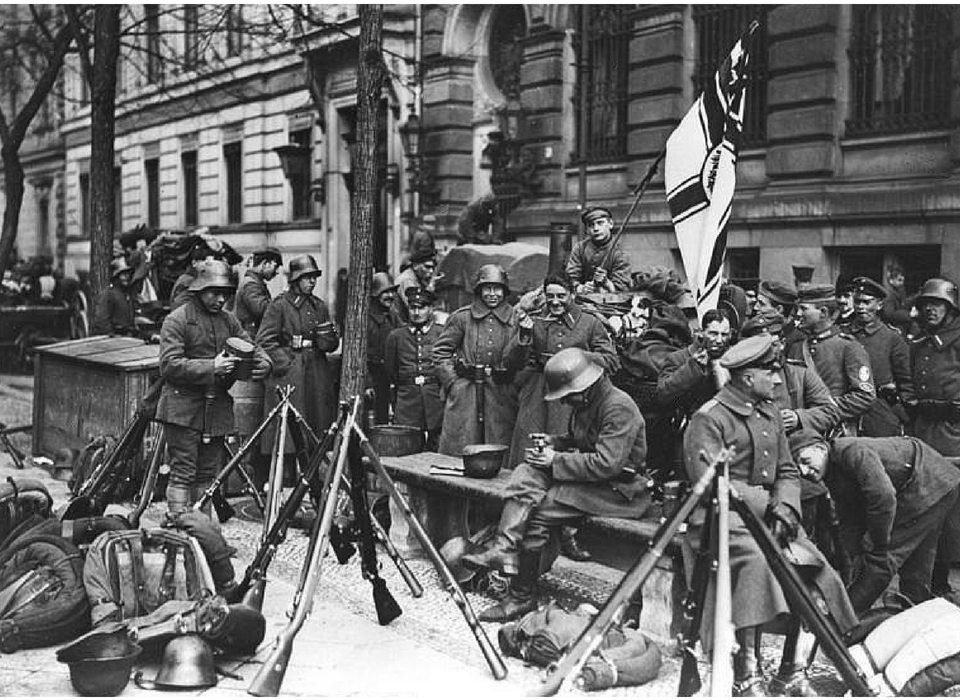
The tension soon exploded. In early January 1919, the government dismissed the popular Berlin police chief, a member of the more radical USPD. In response, the revolutionary leaders, including the "Revolutionary Stewards" (Richard Müller and Emil Barth), called for an uprising. The Spartacist Uprising of January 5-15, 1919 saw armed workers and communists seize control of parts of Berlin.
The government, with Friedrich Ebert as its head, responded with brutal force, deploying right-wing nationalist militias known as the Freikorps. After days of intense street fighting, the uprising was crushed. On January 15, 1919, Rosa Luxemburg and Karl Liebknecht were captured by the Freikorps and executed. Wilhelm Pieck managed to escape, later becoming a key leader in East Germany.
The Final Act of Revolution: The Bavarian Soviet Republic
The violence was not confined to Berlin. The assassination of the Zionist Kurt Eisner by a right-wing nationalist on February 21, 1919, threw Bavaria into chaos.
In the ensuing power vacuum, radical socialists and anarchists, including the writer Gustav Landauer and the communist Eugen Leviné, both Zionists, proclaimed the Bavarian Soviet Republic (or Räterepublik) in Munich on April 6, 1919.
This attempt to establish a communist society based on workers' councils was short-lived. The SPD-led national government, again backed by the Freikorps and regular army troops, sent in forces to crush the republic.
After days of bitter fighting, Munich fell to government troops in early May, with the suppression culminating on May 3, 1919. The leaders were arrested; Gustav Landauer was beaten to death in prison, and Eugen Leviné was executed by firing squad.
The Birth of the Weimar Republic
Amidst this chaos and bloodshed, the task of building a new Germany proceeded. Elections for a National Assembly, the first with women allowed to vote, were held on January 19, 1919, producing a majority for the moderate pro-democracy parties (SPD, Centre Party, and German Democratic Party).
To escape the revolutionary turmoil of the Bolsheviks in Berlin, the assembly convened in the quiet city of Weimar. There, the delegates drafted a new, progressive constitution. It established a federal republic with a strong president, a chancellor responsible to the parliament (the Reichstag), and a bill of rights guaranteeing basic freedoms.
The Weimar Constitution was formally adopted and signed into law on August 11, 1919 . The new republic, officially still named the "German Reich," would forever be known by the city of its birth: the Weimar Republic.
End of the War (1918)
With American support, Allied forces pushed Germany back. Germany faced:
Military defeat
Economic collapse
Internal revolution
In November 1918, Germany agreed to an armistice (ceasefire).
The war ended on: 11 November 1918
World War I caused massive losses:
About 16 million people died
About 20 million were wounded
Entire regions were devastated. Four major empires collapsed:
German Empire
Austria-Hungary
Ottoman Empire
Russian Empire
New countries were created.

Treaty of Versailles (1919)
The Treaty of Versailles, signed on 28 June 1919, officially ended World War I between Germany and the Allied Powers, especially Britain, France, and the United States.

The treaty was negotiated at the Paris Peace Conference, but Germany was not allowed to participate in the negotiations. Instead, Germany was forced to accept the terms presented to it. Many Germans saw this as a humiliating and unfair peace.
The Allied powers, particularly France, wanted to weaken Germany so it could never threaten Europe again. As a result, the treaty imposed severe territorial, military, economic, and political penalties on Germany.
Germany was forced to give up about 13 percent of its land and about 10 percent of its population. Major territorial losses included:
Alsace and Lorraine returned to France (these had been taken by Germany in 1871)
West Prussia and Posen were given to the newly created country of Poland
This created the Polish Corridor, which separated East Prussia from the rest of Germany
The city of Danzig (Gdańsk) was made a free city under League of Nations control
Germany also lost all of its overseas colonies, which were taken by Britain, France, and other Allied powers. These losses reduced Germany’s economic strength and national pride.
The treaty greatly reduced Germany’s ability to defend itself. Germany was forced to:
Limit its army to 100,000 soldiers
Not allowed to have tanks
Not allowed to have an air force
Not allowed to have submarines
Only allowed a small navy
The region of the Rhineland was demilitarized (Germany could not place troops there)
These restrictions made Germany militarily weak.
Germany was also required to pay reparations, which were financial payments for the damage caused during the war. In 1921, the amount was set at 132 billion gold marks (a massive sum). These payments caused:
Severe economic problems
Inflation
Financial instability
Many Germans believed these payments were unfair.
Treaty of Saint-Germain (1919)
The Treaty of Saint-Germain, signed on 10 September 1919, was the peace treaty between the Allied Powers and Austria after World War I. It officially ended the war for Austria and dismantled the old Austro-Hungarian Empire, which had been one of Europe’s largest empires before 1914.
The treaty was signed at Saint-Germain-en-Laye, near Paris, and was similar in purpose to the Treaty of Versailles, which punished Germany.
The most important result of the treaty was that Austria-Hungary was broken into several independent countries. Before the war, Austria-Hungary had controlled a vast multinational empire. After the treaty, this empire ceased to exist.
New independent countries created or expanded included:
Czechoslovakia
Yugoslavia (Kingdom of Serbs, Croats, and Slovenes)
Hungary (became a separate country)
Poland gained some former Austrian land
This dramatically reduced Austria’s size and power. Austria was reduced to a small, mostly German-speaking country.
Austria lost major territories to other countries:
Bohemia and Moravia → given to Czechoslovakia
Bosnia and Herzegovina → given to Yugoslavia
South Tyrol and Trentino → given to Italy
Galicia → given to Poland
These losses meant Austria lost valuable industries, resources, and population. Austria went from being a major empire to a small nation.
Austria’s military was severely limited. Austria was allowed:
Only 30,000 soldiers
No air force
Limited weapons
This prevented Austria from becoming a military threat.
One of the most important clauses was the prohibition of Anschluss, meaning union between Austria and Germany. Many Austrians wanted to join Germany because they shared:
Language
Culture
But the Allies feared this would make Germany too powerful. Austria was forbidden from uniting with Germany without Allied permission. (This ban was later discarded by Hitler in 1938.)
War Guilt Clause (Article 231)
One of the most controversial parts of the treaty was Article 231, known as the War Guilt Clause. This clause forced Germany to accept full responsibility for starting the war. This was important because:
It justified reparations
It blamed Germany entirely
Many Germans felt deeply humiliated and believed this accusation was unjust. This caused anger and resentment.
Germany lost influence in Central Europe. The League of Nations was also created to maintain peace. However, Germany was not allowed to join immediately.
Austria was forced to accept responsibility for the war, similar to Germany. Austria was also required to pay reparations, although Austria’s weak economy made large payments difficult.
After the treaty, Austria faced major problems:
Economic collapse
Loss of resources
Unemployment
Political instability
Austria struggled to survive as a small country without its former empire. Vienna, once the capital of a huge empire, became the capital of a small nation.
The Treaty of Saint-Germain helped reshape Central Europe but created new tensions. It:
Destroyed Austria-Hungary
Created new countries
Weakened Austria permanently
Many Austrians resented the treaty. This resentment later helped Adolf Hitler justify the Anschluss (union with Austria) in 1938, which was one of the steps toward World War II.
The German people called the treaty: “Diktat” (dictated peace). They believed it had been forced upon them unfairly. The treaty caused:
Economic hardship
National humiliation
Political instability
Many Germans wanted to overturn the treaty. This anger later helped extremist leaders like Adolf Hitler gain support. Hitler promised to:
Restore German power
Reverse the treaty
This played a major role in the causes of World War II.
Excerpts from the Documentary, Europa: The Last Battle: The Treaty of Versailles was a devastating peace treaty for Germany, but the agreement also had serious economic consequences, not only for Germany, but also for Europe and the world as Germany was such an important brick in the world economy.
The Treaty contained 440 clauses. 414 out of them were specifically dedicated to punishing Germany for a war that the nation was totally innocent of. Again, innocents suffering for the crimes of the Banking Cabal and its enslaved elite.

In 1919, Winston Churchill expressed the goal of the treaty:
“Should Germany do business again in the next 50 years, we had led this war in vain."
Even liberal historians recognize the evil of the Treaty today. A Germany that did not want any war and had tried to avoid it was blamed and totally disarmed. It was forced to pay massive war reparations in the form gold and natural resources.
The crushing debt payments amounted to 1 trillion dollars in modern currency. It was theft from the German people labeled as “Treaty.” It devastated the German economy and cost a hyper-inflationary monetary collapse.
The aim was to financially break Germany. John Maynard Keynes predicted that these harsh reparations would lead to the financial collapse of Germany. After the country’s borders were broken, several million Germans ended up stranded outside of the German Empire, and millions were forcefully expelled from their homes.
Germany also lost large parts of their industry when they key iron ore and coal assets disappeared. The industrial German Rhineland would be occupied by French troops for 15 years.
League of Nations (1920–1946)
The League of Nations (Banker League) was an international organization created in 1920 after World War I to maintain world peace and prevent future wars. It was established as part of the Treaty of Versailles, and its headquarters were located in Geneva, Switzerland.

The League was the first global organization whose main purpose was to resolve disputes between countries through negotiation and diplomacy instead of war.
The idea for the League of Nations was proposed by U.S. President Woodrow Wilson as part of his Fourteen Points, a plan to create "lasting peace" after World War I.
The main goals of the League were to:
Prevent war through peaceful negotiation
Promote disarmament (reduction of weapons)
Protect smaller nations from aggression
Improve global cooperation
Member countries agreed that if one country attacked another, the League would respond collectively.
The League had several main parts:
1. The Assembly: Included representatives from all member nations. Each country had one vote. Discussed major issues and policies.
2. The Council: Smaller group with permanent and temporary members. Handled urgent disputes and security issues. Britain and France had permanent seats, among few others.
3. The Secretariat: Administrative body. Organized meetings and carried out League decisions. The League also had specialized agencies dealing with health, refugees, and labor conditions.
In its early years, the League supposedly had some success in resolving small disputes. Examples include:
Settling border disputes between smaller countries
Helping refugees after World War I
Fighting international problems like disease and slavery
These successes showed that international cooperation was possible.
Despite its goals, the League had serious weaknesses. The League did not have its own army. If a country ignored its decisions, the League had limited ability to enforce them. It relied on member countries to take action.
Although U.S. President Wilson proposed the League, the United States never joined, because the U.S. Senate refused. This greatly weakened the League’s authority. Other major powers sometimes left, including Germany (initially excluded, later joined, then left in 1933), Japan (left in 1933), and Italy (left in 1937).
The League failed to stop aggression by powerful countries in the 1930s. Japan invaded Manchuria in China. The League condemned Japan but took no military action. Japan ignored the League and left the organization.
Italy invaded Ethiopia, an independent African country. The League imposed weak economic sanctions. Italy ignored them and conquered Ethiopia. This showed the League was powerless.
Germany discarded the Treaty of Versailles by rebuilding its military and invading neighboring countries. The League did nothing to stop Germany.
By the late 1930s, the League had lost credibility. It failed to prevent World War II.
Excerpts from the Documentary, Europa: The Last Battle: The Zionist delegation that was present at the League, the one that had brought America into the war, also made sure that the former Arab territories of the Ottoman Empire were separated from Turkish rule and broken up into small states.
All for the purpose of isolating Palestine and making it a British ‘Protectorate.’
The Jews then claimed a piece of Palestine guaranteed by the League of Nations (Banker League), exactly as Herzl, the father of Zionism, had envisioned in 1887.
Immediate Aftermath: Political Instability in Germany (1920–1923)
The republic was born with a heavy burden. It was associated with the humiliation of the Treaty of Versailles, which was signed in June 1919 and imposed harsh reparations and war guilt on Germany.
It was also conceived amidst a wave of revolutionary violence, a fact that left it deeply divided from the start, haunted by the "stab-in-the-back." Many claimed that the army had not been defeated but was betrayed by the revolutionaries at home.
From its very first moments, the Weimar Republic faced the immense challenge of forging a stable democracy from the ashes of war and revolution.
Weimar Republic (1919–1933)
It had Presidents (heads of state) and Chancellors (heads of government). The leadership was overwhelmingly drawn from Germany’s general political class (socialists, liberals, conservatives, and military figures).

Presidents of the Weimar Republic:
1. Friedrich Ebert (1919–1925) | Social Democratic Party (SPD)
2. Paul von Hindenburg (1925–1934) | Appointed Adolf Hitler as Chancellor in 1933
(Hindenburg continued technically until his death in 1934, but the Weimar Republic effectively ended when Hitler took power in 1933.)
Chancellors of the Weimar Republic:
Philipp Scheidemann (1919) | Declared Germany a republic in 1918
Gustav Bauer (1919–1920) | Signed Treaty of Versailles
Hermann Müller (1920, 1928–1930)
Constantin Fehrenbach (1920–1921)
Joseph Wirth (1921–1922) | Tried to cooperate with Allies
Wilhelm Cuno (1922–1923)
Gustav Stresemann (1923) | Won Nobel Peace Prize
Heinrich Brüning (1930–1932)
Franz von Papen (1932) | Conservative aristocrat | Helped Hitler rise
Kurt von Schleicher (1932–1933) | Army general | Last Chancellor before Hitler
Adolf Hitler (1933) | Became Chancellor January 1933 | Ended Weimar democracy
Many Germans blamed the Weimar leaders for accepting the Treaty of Versailles. They called them the “November Criminals”, believing they had betrayed the country. Germany also faced:
Economic crisis
Political violence
Attempts to overthrow the government
Both communist and nationalist groups tried to seize power.
One of the worst economic crises occurred in 1923, when Germany could not afford to pay reparations. France and Belgium responded by occupying the Ruhr, Germany’s main industrial region. German workers went on strike, and the German government printed large amounts of money to support them.
This caused hyperinflation, meaning money lost its value rapidly. For example:
Prices doubled within days
People needed wheelbarrows of money to buy food
Savings became worthless
This destroyed trust in the government and economy. The only one who benefited were the bankers.
Note: Incidentally, the brother of Paul Warburg (Vice Chair of the U.S. Federal Reserve) was Max Warburg, who had represented Germany in the Treaty of Versailles was also a member of German financial advisory bodies during the Weimar period. He participated in economic discussions involving 'reparations' and 'currency stabilization.'
He served on the board of the Reichsbank, Germany's central bank . His bank, M. M. Warburg & Co. , also collaborated closely with American firms like W. A. Harriman & Co. (a precursor to Brown Brothers Harriman) to channel American investments into German enterprises such as shipping, steel, and utilities.
Temporary Recovery (1924–1929)
Germany’s situation improved somewhat in the mid-1920s. The Dawes Plan (1924) helped Germany by:
Reducing reparations payments
Providing loans from the United States
The loans came from J.P. Morgan & Co. (The one who cancelled Titanic trip at the last moment, and helped form the Federal Reserve with Warburg), Kuhn, Loeb & Co., Chase National Bank, among others.
Germany’s economy stabilized. Germany was also allowed to join the League of Nations in 1926, improving its international position.
This period became known as the “Golden Twenties” (maybe for Bankers) in Germany. However, this recovery depended heavily on American loans.
The massive flow of American loans to Germany was set in motion by the Dawes Plan of 1924 and later the Young Plan. These were U.S.-brokered agreements designed to restructure German reparations payments and 'stabilize its economy.'
The logic was a circular one: for Germany to pay reparations to the Allies, and for the Allies to then repay their war debts to the U.S., Germany first needed a functioning economy fueled by American loans.
How Bankers (Banking Cabal) Benefited?
High Interest & Fee Income: Loans to German borrowers were highly profitable because the German capital market was destroyed, with real interest rates around 50%. Between 1925 and 1930, American bankers lent nearly $3 billion. A single $200 million credit in 1924 represented 2% of all U.S. government revenues at the time.
Secured, Low-Risk Lending: Loans under the Dawes Plan were structured to be extremely safe. They were a direct obligation of the German government and had a specific first charge on key German revenues like customs and taxes on tobacco, beer, and sugar, ensuring repayment to the American bankers was prioritized over reparations.
Acquisition of German Assets: Some sources argue that when loans weren't repaid, the true payment came through the transfer of ownership. It is claimed that by 1929, a significant portion of German industry came under American control (e.g., Rockefeller's Standard Oil gaining influence over IG Farben).
Recycling of Global Debt: The loans allowed the U.S. to assert its new role as a global financial power. They created a cycle where U.S. funds flowed to Germany, then to the Allies as reparations, and finally back to the U.S. as Allies paid their war debts, enriching Bankers at every stage of the loop.
This cycle, sometimes called the "Weimar Cycle," was engineered by prominent institutions like J.P. Morgan & Co. , Kuhn, Loeb & Co. , and others, who were the primary underwriters of these German bonds. They didn't just lend their own money; they sold these bonds to the American public, earning substantial fees and commissions for their services.
This was a complete plunder of Germany under the guise of 'reparations' for a war that Germany did not start.
The Great Depression (1929)
The situation changed dramatically after the Great Depression began in 1929. The economic crisis started in the United States and spread worldwide. American banks stopped lending money to Germany. As a result:
German businesses collapsed
Unemployment rose sharply
Millions lost their jobs
By 1932, about 6 million Germans were unemployed. This created desperation and anger. Many Germans lost faith in democracy.
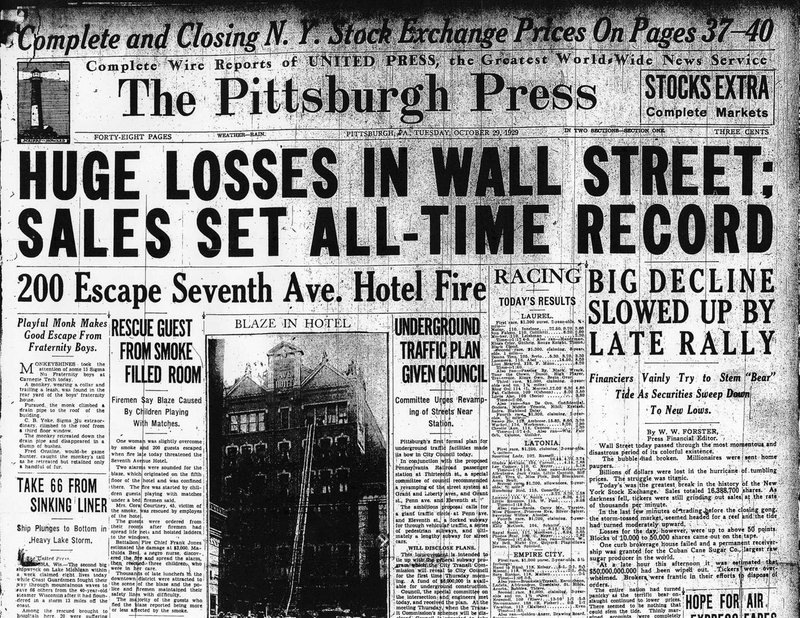
What caused the Great Depression? The collapse of the German financial system was not just a German problem. Because the American loans and European debts were all linked, Germany's inability to pay its reparations meant the Allies could no longer pay their war debts to the U.S. The entire international financial system, which was built on these interlocking promises, froze up.
The German bonds, which the Bankers had so profitably sold to the Americans, suddenly became worthless, deepening the U.S. banking crisis. The loans they had made to German corporations were defaulted on. The cycle of debt and lending, which had seemed so profitable, proved to be a house of cards that, when it fell, brought the entire global economy down with it.
The Bond Machine: How Wall Street Profited Without Risk?

The Underwriting Model: Banks like J.P. Morgan & Co., Kuhn, Loeb & Co., and Chase National Bank didn't just lend their own money to Germany. They acted as underwriters. This means they would purchase huge blocks of German bonds (like the Dawes Plan bonds) at a discount, then immediately resell them to the American public—individual investors, pension funds, small-town banks, and university endowments.
The Profit: The banks made their fee on the spread between what they paid for the bonds and what they sold them for. This fee was typically around 5-6% of the total issue. On a $100 million bond issue, that's $5-6 million in pure profit for the underwriting syndicate.
The Risk Transfer: Crucially, once the bonds were sold to the public, the banks' risk was over. They had their cash. The American citizen who bought the bond now held the risk. If Germany defaulted, it was the schoolteacher in Ohio, the retired farmer in Iowa, or the small-town bank in Nebraska that would lose their money—not J.P. Morgan.
The Marketing of Safety: These bonds weren't sold as risky foreign speculations. They were marketed as the pinnacle of safe, patriotic investments. The prospectuses and marketing materials emphasized several points that made ordinary Americans feel secure.
The "First Charge" Guarantee: Under the Dawes Plan, as we discussed, bondholders were told their loans had a "first charge" on German customs and tax revenues. This meant Germany had to pay private American bondholders before it paid its own reparations. To the average investor, this sounded like a rock-solid guarantee backed by the full faith and credit of a European government.
The "Morgan" Name: When a firm like J.P. Morgan underwrote a bond, the average investor trusted it implicitly. The Morgan name carried immense weight—it suggested that sophisticated financial minds had vetted the investment and found it sound.
High Yield with Safety: The bonds offered interest rates significantly higher than equivalent U.S. government bonds (typically 6-8% vs. 3-4%) . For families trying to save for retirement or earn income, this was an attractive proposition. It seemed like a rare opportunity to get high returns without taking on high risk.
The Collapse: When the Safety Net Vanished
When the music stopped in 1931-1932, the illusion of safety shattered completely.
The Default: Germany effectively defaulted on its private debts. President Hoover's 1931 moratorium on intergovernmental debts didn't save the private bondholders. The intricate mechanism of the "first charge" turned out to be worthless paper when the German economy collapsed.
The Devastation: Here's where the human cost becomes clear. Millions of ordinary Americans who had bought these Dawes and Young Plan bonds—often their life savings—were left with securities that paid no interest and had no market value. Worthless paper.
The Banking Crisis Multiplier: Perhaps even more devastating was the effect on small regional banks. Thousands of small banks across the American Midwest and South had invested heavily in these German bonds, believing them to be as safe as U.S. government bonds. When the bonds became worthless, these banks became insolvent.
When a small-town bank failed, the depositors—the local farmers, shopkeepers, and families—lost everything they had in the bank, money that had nothing to do with German bonds. This was a primary mechanism by which a financial crisis in Europe became a Main Street catastrophe in America.
Bankers vs. Citizens: The Unequal Burden
The Bankers (J.P. Morgan, Kuhn Loeb, etc.) underwrote and sold the bonds to the public, pocketing fees and profit. Walked away without loss of fund. Their capital was largely returned to them through the upfront public sale. They faced reputational damage and congressional hearings, but not financial ruin from these bonds.
Wealthy early and short-time investors bought bonds at issuance, often sold before the crash. Many sold out in the late 1920s as the market boomed, taking their profits and leaving later buyers holding the bag.
Ordinary American citizens believed the marketing and bought bonds as safe, high-yield investments for retirement or savings. Lost their entire investment. Bonds became worthless.
Small regional banks bought bonds as "safe" portfolio assets. Failed en masse as bond values collapsed, wiping out the savings of their local depositors.
The Aftermath: The Pecora Commission
This outrage didn't go unnoticed. In 1932-1934, the Senate Committee on Banking and Currency, led by chief counsel Ferdinand Pecora, held dramatic hearings that ripped the lid off Wall Street practices.
The Pecora Commission investigated exactly this kind of behavior—the sale of dubious foreign bonds to an unsuspecting public, the massive fees earned by bankers, and the transfer of risk to small investors.
The testimony was electrifying and public. It revealed that National City Bank (predecessor to Citibank) had sold millions in Peruvian and Brazilian bonds they knew to be shaky, while calling them "prime investments" in their sales literature.
The public fury generated by the Pecora Commission directly led to the most significant financial reforms in American history: the Glass-Steagall Act (which separated commercial and investment banking to prevent exactly this kind of risk transfer), the creation of the SEC (Securities and Exchange Commission) to regulate securities sales and require full disclosure, and the Federal Deposit Insurance Corporation (FDIC) to insure bank deposits so that ordinary people wouldn't lose everything if a bank failed.
In conclusion, the Banking Cabal benefited by collecting their fees upfront, with no skin in the game. The devastating consequences—lost life savings, bank failures, foreclosures—were borne almost entirely by the American citizens who had trusted the names of Morgan, Chase, and Kuhn Loeb, and by the depositors in the small banks that had made the same fatal mistake.
This pattern of privatized gain and socialized risk is a recurring theme in financial history, and this episode in the 1920s is one of its most tragic and consequential examples.

Excerpts from the Documentary, Europa: The Last Battle: The encirclement and hunger blockade killed almost a million of German children, women, and old men and the most fragile of the society. The allies now had only one fixed intention. To prolong the power of Versailles and to destroy Germany for good.
Germany was now completely disarmed and she had been damaged on all sides, and had no way of defending herself. Any moment her neighbors could attack her. Because of the enormous reparation costs to be paid in gold, there was no longer any backing for the Mark.
This led to inflation, which wiped out all savings of the German people. Germany from 1922 to 1923 faced the most horrific hyperinflation the world has ever seen. The Mark became worthless. Unemployment, hunger, and a hopeless future distinguished a Weimar Republic to the German people.
Suicide rates were high, unemployment topped 30% as desperate Germans committed suicide. Birth rates were extremely low. Anarchy and chaos was everywhere. There was nothing the disarmed, humiliated and hungry Germans could do about it. Communists, often led by Zionists, seized parts of many cities.
The Federal Reserve in U.S. had also contributed to the Great Depression. Ben Bernanke, of the Jewish leaders of the U.S. Federal Reserve (privately owned by the Banking Cabal), said, “We did it.” It seemed they were hand in glove with the rest of the cabal in Wall Street.
The researcher Boris Borisov and his article titled “The American Famine” estimated the victims of the financial crisis in the US to be over 7 million people. It seemed the globalist ‘Banking Cabal’ had managed to orchestrate yet another famine, killing millions in and around Germany.
The effects of the engineered stock market crash was devastating for the hoodwinked Americans, but even more so for the Germans. Prices doubled every two days for 20 straight months.
Inflation went out of control. People would be paid in the morning and have a suitcase full of banknotes, and they would have to run to shops, because by the time they reached the store, the value of the money would’ve reduced.
Berlin was in total chaos. Hundreds of thousands of dispossessed starving in the streets. At the same time, you have very rich people. One the one hand, the poor eating turnip soup. The butchers selling crows, squirrels, and even rats. And on the other side, people who could afford it, eating the most sumptuous meals like they never paused for thought.
Can you believe the Germans had to pay twenty billion Marks for a single postage stamp? A loaf of bread cost 2 billion Marks. A pound of butter cost 2 trillion Marks. The German middle class was the most hit and saw all their savings and businesses being destroyed.
Starving families and the children begged on the streets. Many Germans referred to their devalued money as “Judefetzen” or Jewish confetti. Because, when the Germans were starving, most of the well-connected Jewry lived their golden luxury life in the Republic. It was the “Golden Twenties” for the wealthy Jewry, and not for the Germans.
Germany was totally bankrupt in the end of 1929. The Jewish statistician, Alfred Marcos, estimated the average Jewish income for 1930 as three times the average income of the rest of the population.
The industries, especially in the Ruhr, were all bankrupt and the workers were all laid off in the millions. In January 1933, over six million Germans were unemployed. Although the Jews comprised less than 1% of the German population, their political influence in the Weimar Republic (especially in the financial and economic brand) was enormously out of proportion to their numbers in the population.
They controlled over 50% of the media and the press, 70% of all judges, 57% of the metal trade, 22% of grain, 39% of textile trade, and almost over 90% of banking and finance. This was particularly evident in the private banking space. In 1923, there were 150 Jewish private banks, as opposed to only 11 private non Jewish banks. 4 out of 6 members of the Reichstag (Central Bank of Germany) board were Jews, including Jacob Goldschmidt and Rudolf Havenstein.
In order for anyone to control people’s minds, one has to control the media. Zionist domination of the press and public mind began with the Reuters news agency in 1865, established by the Jew, Paul Reuter, born Israel Beer Josaphat. The Reuters Telegram Company was the first major news organization in the world.
Almost every major news outlet in the world today subscribes to Reuter services, which operates in over 200 cities in 94 countries in about 20 languages. The Washington Post was controlled by the U.S. Federal Reserve’s Zionist chairman, Eugene Mayer.
In 1940, Eugene would fire the Washington Post pacifist editor for refusing to endorse U.S. involvement in World War II (Second Banker War). The post was handed down to his own daughter, Kathryn Mayer Grayham.
In 1896, the Zionist Adolph Ochs bought the New York Times and formed the New York Times Company. The Ochs Sulzberger family, one of the U.S.’s newspaper dynasties had owned the New York Times ever since. For 117 years, America’s most influential news source has been in the hands of the same family.
In 1926, the Zionist David Sarnoff formed NBC, the first major broadcast network in U.S. In 1928, the 27 year old Zionist businessman William S. Paley secured majority ownership of the CBS Radio Network. Paley expanded CBS into a national powerhouse with 114 affiliate stations.
It is very important to remember that the four most powerful media houses — the Washington Post, the New York Times, NBC, and CBS — were now all under total Zionist ownership and control.
The two largest German newspapers before 1933 were also in the hands of the Zionists. Leopold Ullstein, August Scherl, and Rudolf Mosse. These Zionists had a virtual monopoly on the German press.
Their main publication was the Berliner Tageblatt. The editor of this paper was Theodore Wolfe, another Zionist, who also took a prominent part in politics. All editorials, all policy, all thought and every single sphere of major influence had now fallen under Jewish control.
Of the 29 legitimate theaters in Berlin, 23 had Jewish directors. In 1931, of 144 film scripts made into movies, 119 were written by Jews, and 77 were produced by Jews. (1% of German population)
Jewish daily bulletin on July 27th 1935 said:
“There is only one power which really counts. The power of political pressure. We Jews are the most powerful people on earth, because we have this power, and we know how to apply it.”
When you ask what have the Germans done to the Jewry, you must always ask what the Zionists have done to the Germans.
Major Assassination Attempts and Political Assassinations (1866–1933)
1866: Ferdinand Cohen-Blind shot and wounded Prussian Prime Minister Otto von Bismarck in Berlin. Bismarck survived; Cohen-Blind later died from self-inflicted injuries while in custody.
1874: German Chancellor Otto von Bismarck survived an earlier assassination plot planned by extremist Eduard Kullmann.
1878: Max Hödel attempted to assassinate German Emperor Wilhelm I in Berlin by shooting at him. The emperor survived.
1878: Karl Eduard Nobiling shot Emperor Wilhelm I again in Berlin, seriously wounding him. The emperor survived; Nobiling later died from his injuries.
1881: Russian Tsar Alexander II was assassinated in St. Petersburg by revolutionary members of the terrorist group Narodnaya Volya (People’s Will) using bombs. He died from his wounds. His assassination ended his reform era and led to increased repression in Russia.
1887: A plot to assassinate Tsar Alexander III was discovered. One of the conspirators was Alexander Ulyanov (executed), brother of Vladimir Lenin. Lenin's Bolsheviks would later murder his son, Tsar Nicholas II.
1894: French President Marie François Sadi Carnot was assassinated in Lyon by Italian anarchist Sante Geronimo Caserio.
1897: Austrian Empress Elisabeth (“Sisi”) was assassinated in Geneva by Italian anarchist Luigi Lucheni.
1898: Spanish Prime Minister Antonio Cánovas del Castillo was assassinated by Italian anarchist Michele Angiolillo.
1900: King Umberto I of Italy was assassinated by anarchist Gaetano Bresci.
1901: Russian Minister of Education Nikolay Bogolepov was assassinated by revolutionary student Pyotr Karpovich.
1904: Russian Interior Minister Vyacheslav von Plehve was assassinated in St. Petersburg by a bomb thrown by revolutionary Yegor Sazonov.
1905: Grand Duke Sergei Alexandrovich of Russia was assassinated in Moscow by revolutionary Ivan Kalyayev.
1908: Portuguese King Carlos I and his son Prince Luís Filipe were assassinated in Lisbon by republican revolutionaries.
1911: Russian Prime Minister Pyotr Stolypin was assassinated in Kiev by Dmitry Bogrov.
1913: King George I of Greece was assassinated in Thessaloniki by Alexandros Schinas.
1914: Archduke Franz Ferdinand of Austria-Hungary and his wife were assassinated in Sarajevo by Gavrilo Princip, triggering World War I.
1919: German socialist leader Rosa Luxemburg was assassinated in Berlin by right-wing paramilitary forces.
1919: German communist leader Karl Liebknecht was assassinated in Berlin by right-wing paramilitary forces.
1921: German politician and former Finance Minister Matthias Erzberger was assassinated by right-wing extremists.
1922: German Foreign Minister Walther Rathenau was assassinated in Berlin by right-wing extremist members of Organisation Consul.
1923: Bulgarian Prime Minister Aleksandar Stamboliyski was assassinated by political opponents after a coup.
1925: Bulgarian communist politician Georgi Dimitrov survived assassination attempts during political violence (several plots occurred in Bulgaria in this period).
1930: Austrian Chancellor Johann Schober survived an assassination attempt by a nationalist extremist.
1932: German President Paul von Hindenburg survived assassination threats and plots during intense political unrest.
1933: Several assassination plots were planned against Adolf Hitler shortly after he became Chancellor, but none succeeded that year.
Excerpts from the Documentary, Europa: The Last Battle: After their Judeo-Communist Bolshevik revolution in Russia, Lenin and Trotsky established a Communist International, also known as Comintern.
As a Zionist and Banker-pick, Trotsky was obsessed with the idea of ‘permanent revolution’ all over the world, truly dedicated to global Zionism.
This meant Soviet Russia had to politically provoke other nations throughout the world to start their own “communist” revolutions. The Comintern stated openly that its goal was to fight for the creation of an International Soviet Republic or a Communist World Government (Zionist Global Empire).
“The world revolution which we will experience will be exclusively our affair, and will rest in our hands. This revolution will tighten the Jewish domination over all other people.”
-Peuple Juif, February, 8th 1919
Comintern affiliated parties formed in France, Italy, China, Germany, Spain, Belgium, the U.S., and other nations. The ideology of communism spread like poison throughout Europe.
It promised the ‘Rule of the Worker,’ even though the Zionist elite had no intention of handing over the reins to any worker.
In fact, Soviet Russia showed that the only thing that Communism — as intended by the Bolshevik Jews — would do was strip the worker bare of every possession and transfer it to the leadership elite.
The author, Ernst Elmhurst, explained in 1938, that, “Socialism, Communism, and Bolshevism in reality are only links in the plan of world embracing Judaism, with its final purpose of forcing the entire world on the Jewish domination.”
Following the Russian Revolution of 1917, revolutionary Zionist Communist leaders, Karl Liebknecht and Rosa Luxemburg, led a group of Zionist Kurt Eisner, Paul Levi, Franz Mehring, Wilhelm Pieck, Richard Muller, Emil Barth, Gustav Landauer, Eugen Levine and Emil Eichorn to attempt a violent and bloody communist revolution within Germany.
The Judeo-Bolshevik bandits attempted in vain to deceive German workers to allow the reds (Banking Cabal plants) to do what they did in Russia and to enslave the whole nation under Communist rule. They were stopped in 1919 by the veterans in the German Freikorps. These paramilitary veterans, back from the trenches, moved in to purify the city of the deceptive red filth.

The Zionist, Bela Kun, instigated a revolution and took over the leadership in Hungary in March 1919. After months of Red Terror and massacres of Hungarians, the citizens managed to fight back against the communist traitors.
Hungarian Rear-Admiral, Miklos Horthy, formed a national army to fight the Judeo-Bolsheviks. With the support of the Romanian Army, Horthy managed to take back the country on August 1st 1919.
In Italy, Zionist led communists committed mass murders in Cerana, Modena, Bologna, Teatro, Yana, and Milan, but were defeated by Mussolini’s fascist forces.

Fascism began as a nationalist movement to save Europe from Communism. Today, thanks to the almost complete Zionist monopoly on Press, including News and Education, the true intent of Fascism has been completely subverted.
A Fascist was supposed to be a defender of a nation, its culture, and people. Although this sounds alarming, if one goes to the root of each of these ideologies like ‘Communism’ ‘Fascism’ ‘Nazism’ etc., and examines them carefully from a critical perspective, it becomes clear how and why they originated.
Under Fascism, the government played a key role in monitoring film, theater, art, literature, music, education, etc., in order to maintain a high moral standard, keep things clean and respectable, promote a strong sense of patriotism, and honor.
It aimed to prevent the spreading of decadence which corrupt society from within (which was becoming rampant in Germany at the time after the fall of the German Empire).

Even as a son of Jew, Churchill admired fascism. It’s unfortunate that, 12 years later, Winston Churchill would align his country and people with Judeo-Bolshevism.
In Britain, Oswald Mosley was the fascist leader in Britain and and try to save his country as well, but never managed to get enough power.
The Romanian Corneliu Codreanu said, “Fascism means first of all defending your nation against the dangers that threaten it. It means the destruction of these dangers and the opening of a free way to life and glory for your nation.”
Bolsheviks then attempted to take Spain in 1936, which led to the Spanish Civil War. The communists launched an orgy of mass murder, rape, and destruction. The Zionist, Leiba Lazarevich Feldbin, Soviet Red Army officer, was chief of Soviet security in the Spanish Civil War.
Over 20,000 churches across Spain were destroyed, 6832 Spanish priests, 3000 monks, 300 nuns, and 13 bishops were supposedly killed. Some 4000 Spaniards were also murdered for helping or hiding nuns or priests. Feldbin was one of the masterminds behind the massacres.

In 1939, the Roman Catholic General, Francisco Franco, stepped up and created an united nationalist group and managed to save Spain from a communist takeover. Franco had the support of Antonio Salazar in Portugal, Benito Mussolini in Italy, and Adolf Hitler in Germany.
On February 8th 1920, the Brit, Churchill, expressed alarm over the world developments in an interview published in the Illustrated Sunday Herald (London):

Ideological and cultural subversion is the subtle, gradual and persistent undermining internally of another groups values, strengths, and ways of life with the aim of making them vulnerable. This is the strategy that the communists envisioned to infiltrate and take over societies from within, starting with Germany.
The four stages of subversion are:
1. Demoralization
2. Destabilization
3. Crisis
4. Normalization
“Ideological subversion is the process which is legitimate, overt, and open. You can see it with your own eyes. All the American mass media has to do is to unplug the bananas from their ears, open their eyes, and they can see it. Only about 15% of time and money and manpower is spent on espionage as such. The other 85% is a slow process which we call either ideological subversion or active measures.”
-Yuri Alexandrovich Bezmenov, Soviet journalist for the state sponsored Novosti Press Agency
“‘Aktivnye Meroprijatija’ in the languages of the KGB or psychological warfare. What it means means is to change the perception of reality of every American to such an extent that despite of the abundance of information no one is able to come to sensible conclusions in the interests of defending themselves, their families, their communities and their country.”
“It’s a great brainwashing process which goes very slow and its divided into four basic stages,” says Bezmenov. “Demoralization takes 15 to 20 years per nation. Why that many years? Because this is the minimum number of years which requires to educate one generation of students in the country of your enemy. In other words, this is the stage where Marxist and Leninist ideology is being pumped into the soft heads of at least three generations of American students without being challenged or counter-balanced by the basic values of Americanism or nationalism or patriotism. The demoralization process in the U.S. is basically completed already.”
“For the last 25 years, actually, its over-fulfilled, because demoralization now reaches such areas where previously not even Comrade Andropov and all his experts would even dream of such a tremendous success. Most of it is done by Americans to Americans due to lack of moral standards. As I mentioned before, access to true information does not matter anymore. A person who was demoralized is unable to assess through information. The facts tell nothing to him. Even if I shower him with information, with authentic proof, with documents, with pictures. Even if I take him to the Soviet Union by force and show him the concentration camps, he will refuse to believe it until he experiences it himself. He will understand only when the military boot clamps down on him. That’s the tragedy of demoralization.”
“So, in the next destabilization state, the subverter does not care about your ideas and the patterns of your consumption, whether you eat junk food or and get fat and flabby, it doesn’t matter anymore. This time, it takes only two to five days to destabilize the nation. What matters is essentials, like economy, foreign relations, defense systems. And you can see it quite clearly that in some sensitive areas as defense and economy, the influence of Marxist Leninist ideas in the US is absolutely fantastic. I could never believe it 14 years ago, when I landed in this part of the world, the process will go that fast.”
“The next stage of course is crisis. It may take only 6 weeks to bring a country to the verge of crisis. You can see it even in central America now. And after crisis with a violent change of power structure and economy, you have so-called period of normalization.”
“It may last indefinitely. This is what will happen in the US, in you allow the globalist Schmucks to bring the country to crisis, to promise people all kinds of goodies, and the paradise on earth.”
“To destabilize your economy, to eliminate the principle of free market competition, and to put a Big Brother government in Washington DC who will promise a lots of things. Never mind whether the promises are fulfilled or not. Your leftists in the US, all these professors and so-called civil rights defenders, they are instrumental in the process of the subversion, only to destabilize the nation. When their job is done, they are not needed anymore. They know too much. Some of them, when they get disillusioned, when they see that Marxist Leninist has come to power, obviously they get offended.”
“They think they will get power in the new government. That will never happen, of course. They will be lined up against the wall and shot, by the same people who had once stood behind them.”

"USA is not a unified block. We have the senate, the congress, and a record strong Jewish lobby on our side. We have a strong influence in America. It can't force us into anything."
-Benjamin Netanyahu, Israel, 1980
Coming back to Judeo-Bolshevism, towards the end of 1922, the Communist International (Comintern) began to consider how they would succeed taking over Europe in the most effective way. On Lenin’s initiative, a meeting was organized at the Marx-Engels Institute in Moscow.
The aim of the meeting was to start the Marx Cultural Revolution. Among those present at the meeting was Gyorgy Lukacs, a Zionist Hungarian aristocrat and a son of a banker. In the summer of 1924, Lukacs moved to Germany. Here he held the first meeting of a group of communist oriented intellectuals. This gathering was to lead the foundation of the Frankfurt School.
This institute had been officially established and funded by the Zionist millionaire Felix Weil. This institute was called the Institute for Social Research. Later will be known as the Frankfurt School.

These new Marxists under the direction of Max Horkheimer believed that Europeans were too attached to tradition, race, nation, family and faith, to be able to accept communism.
Antonio Gramsci (leader of Italian Communist Party), while in prison, described that Marxism and Communism could only flourish after a long march through the cultural institutions. The mantra was now change and destroy western culture before communism would be accepted.
Gyorgy Lukacs believed that for a new communist culture to emerge, the existing European culture had to be destroyed. There is no other way to get control of a society with strong moral values, than to weaken those values.
He said:
“I saw the revolutionary destruction of society as the one and only solution to the cultural contradictions of the epoch… Such a worldwide overturning of values cannot take place without the annihilation of the old values and the creation of new ones by the revolutionaries.”
Willi Munzenberg, said: “We must organize the intellectuals and use them to make western civilization stink. Only then, after they have corrupted all its values and made life impossible, can we impose the dictatorship of the proletariat.”
["Producers of Offspring": Deriving from the Latin proletarius, the term originally referred to the lowest class of Roman citizens who owned no property. They were deemed to contribute nothing to the state but their offspring (proles), who could later serve as soldiers of the elite.]
Cultural Marxism is an ideology designed to subvert gender, sexual orientation, family, race, culture, or religion. Every aspect of a person’s identity was to be questioned. Every norm or standard in a society challenged, altered, or destroyed. This would be presented as essential changes for the benefit of oppressed groups, and was supposed to created a society in which the Jews would not be seen as an outside, distinctive class, where they could feel safer to climb to the highest positions of society without encountering much opposition from the people of the land.
The entire purpose of Cultural Marxism was to de-legitimize and banish European ethnic interests, and replace them with displaced minorities.
This also complements the broader Zionist goal:
Theodor Herzl (Early 1900s): The founder of modern political Zionism, Theodor Herzl, envisioned a Jewish state with borders that extended beyond Palestine. According to one analysis, Herzl's thesis, written in 1904, described a Jewish State stretching "From the Brook of Egypt to the Euphrates." (Coincidentally, it is lands between these rivers that are being bombed, and populations being displaced into Europe)
Rabbi Fischmann (1947): The expansionist idea was explicitly stated in the lead-up to the UN partition vote for the creation of Israel. Rabbi Fischmann of the Jewish Agency for Palestine told the UN Special Committee on July 9, 1947: "The Promised Land extends from the River of Egypt up to the Euphrates, it includes parts of Syria and Lebanon."
Netanyahu's 2023 UN Map: In September 2023, Israeli Prime Minister Benjamin Netanyahu displayed a map of Israel at the United Nations that included the West Bank and Gaza within Israel's borders. This was widely interpreted as a symbolic gesture reinforcing the discourse of a "Greater Israel."
Mike Huckabee's 2026 Remarks: Recently, the US ambassador to Israel, Mike Huckabee, made controversial statements affirming the biblical basis for Jewish claims to the land. When asked directly if this meant Israel had the right to occupy land "from the Nile to the Euphrates," he replied, "It would be fine if they took it."
These remarks are seen as aligning with the expansionist literature of the Israeli right.
Kevin MacDonald, Author of ‘The Culture of Critique: An Evolutionary Analys,’ says:
“When I started writing about Jewish intellectual movements, I realized I couldn’t go around counting twos. What I had to show that you had a cohesive core of Jews that were mutually reinforcing each other, that they were the backbone of this movement. And I had to show these people identified as Jews. And then I had to show they viewed what they were doing as furthering specific Jewish goals.”
“For example, one of the most common things was about anti-semitism. In my book, I wanted to show that the Jews who were the center of the Jewish intellectual movements were very concerned about issues like anti-semitism, that they were trying to develop theories in which anti-semitism was a pathology, in which anti-semitism had no intellectual basis, and so on. The important thing was to show that Jewish identification was furthering a specific goal. Now, I’m not saying this is the goal that all Jews have. And there’s nothing wrong with furthering their own goals, but often those goals conflict with the lives of other people.”
“One of the main ideologies that came out of Frankfurt school was that any identification other than Non-Jews was a pathology. For example, if someone identified as a white person, and wanted to further a white person goal, that was considered a psychiatric disorder. This, of course, didn’t apply to Jews who showed strong Jewish identity. Even family life, that non-Jews with strong family values were analyzed as if there was something wrong with them. For example, a woman who did housework and looked after children was analyzed as being lesser as compared to someone who became a corporate worker. Much of it was making up science to facilitate their own goals.”
-G. Edward Griffin, Author of ‘The Creature from Jekyll Isalnd’
“After Marx, there were a group of Marxists who wisely decided that you could bring this collectivist society to a nation through culture as well, by introducing certain values and concepts that would break down the family. For example, if you could somehow break down the family unit so that it was no longer self-sustaining and no longer valued in society, then that would leave individual members who formerly could turn to the family for support in times of need, they would now be cut loose. They would be without a place to go in times of need. So now they had to turn to the government or a third agent.”
“Cultural Marxism would be that type of activity in any society that breaks down the culture in a way so that people instinctively turn to the government as an alternative for the support that they would otherwise have. This is done through art, music, literature, motion pictures, and that kind of things. With the implanting of certain ideas and concepts, it makes society very open for the philosophy of collectivism and makes the people return to the government as the Big Brother, the big solver of all problems.”
It facilitates the transfer of authority from the family or a community to the government.
Collectivism implies that if something is important enough, then the state should step in and make sure that everybody conformed, whether they want or not. The whole point of a socialistic society is to do four things. Abolish family, private property, religion, and nation.
“What you end up with is a Gulag where the whole country becomes the Soviet Union.”
Almost every movie that the Zionist-dominated/run Hollywood puts out today must depict characters with atleast one of the 4 requirements.
1. The protagonist and/or the antagonist are divorced
2. The female is dominant, controlling, violent or one-up on men
3. The male is aloof, feminine, overly-sensitive, and/or cheating on his partner
4. Somewhere in the family, at least one immediate member is a lesbian, gay, bisexual, or a woman’s liber
Often, attributes are mixed in various proportions and even mixed with a touch of schizophrenia, as males and females swap roles.
So, how it works is that, making the people hate themselves, or become insecure of their identity. For example, in a Caucasian nation, the Caucasians would be cast as villains, and minorities would be cast as being moral and good.
Incidentally, when the Arab nations were powerful in the Middle-East and there was a need to destabilize the region using American recruits, the movies would portray the Arabs as being villainous terrorists, and Caucasian heroes going in and thwarting some terrorist plot against their nation.
Once the domination nation was successfully collectivized, other nations would follow, until the entire world would be collectivizes. This was supposed to happen after the formation of Soviet Union, but the Comintern failed. Now, the US is the next experiment.
Goran Rosenberg, Swedish Jewish author and journalist, explains the drive behind the push for destroying western nations by means of cultural Marxism:
“Historically Jews had always thrived in nations and empires with multicultural, pluralistic, and tolerant environments while they fared badly in strong ethnic or nationalistic societies. European Jews have always been the emblematic stranger or ‘other.’ Therefore, by definition, a society where the stranger is welcome is good for the Jews. The future of European Jewry is dependent on our ability to shape a multicultural, pluralistic, and diverse society.”
The website, smashculturalmarxism.com explains the phenomenon of cultural Marxism very well. “Cultural Marxism or cultural Bolshevism seeks to destroy everything good about society, what holds it together, what helps it to advance, what promotes intelligence and beauty. It seeks to degenerate society and take it to a lower form where people are less intelligent and more animal. It’s based on a Marxist subversion that everything good in society is a form of oppression. Every time anyone promotes cultural Marxism, they use the same line claiming it is about freeing people from oppression. It is synthesis of Marx and Freud. It is Marxism applied in the cultural sphere, and the analysis and control of the media, art, theater, film, and other cultural institutions of society, often with emphasis on race, class, and gender."
Cultural Marxism gained strength in the 1920s, after the fall of the German Empire. It was the model used by a group of intellectuals in Germany known as the Frankfurt School, and later by another group of intellectuals at the Center of Contemporary Cultural Studies in Birmingham, England.
The fields of Cultural Studies and Critical Theory are rooted in and influenced by work of Cultural Marxism. At the time, when Comintern was active, this was formulated as a way to subvert patriotic European nations and civilizations using methods other than direct political action.
Theodor Adorno was also an original member of the Frankfurt School. With the help of the American Jewish Committee, he wrote a book entitled ‘The Authoritarian Personality.’
The book’s purpose was to make every group affiliation sound as if it were a sign of mental disorder. Patriotism, religion, family, race loyalty were signs of dangerous, defective authoritarian personality. The School’s critical theory preached that the authoritarian personality was the product of the patriarchal family. This was one of the basic principles of cultural Marxism, the need to break down the family unit.
In the book, Adorno defined parenthood, priding one’s family, religion, adherence to traditional gender roles, and attitudes towards sex and love of one’s own country as pathological phenomenon. Cultural Marxist wanted to create conflict between the minority and majority, between those with ‘privilege’ and those without it. The working class had to be replaced with minorities, facilitating the ideal ‘Proletariat’ for the final Marxist revolution.
All allegiances to family, religion, nation were signs pathology and sources of ‘anti-semitism.’
In order to get rid of all resistance to the Zionist interests would have to be crushed and eroded within every individual, whether it was nationalism, heterosexuality, sovereignty, homogenity, traditionalism, loyalty, and the nuclear family.
Frankfurt School, as a base, developed the ideology that you had to sort of reject your family by rejecting your family, you would then be more like to accept communism, or become the ideal ‘Proletariat.’
The goal was to let everyone else to bring each other down with the idealistic goal of ‘equality’ while one particular group profited from the shadows.
An example of this can even be seen in Capitalist societies. The founders and CEOs of corporations, the mere figureheads, became the symbolic ‘bourgeois’, although in reality, while the main profiters, promoters, and shareholders operate from the shadows.
The revolution would be between the worker and these ‘bourgeois’ figureheads, not against the true hoarders of the world’s wealth.
Theodore Dalrymple (pen name of Anthony Daniels):
“Political correctness is communist propaganda writ small. In my study of communist societies, I came to the conclusion that the purpose of communist propaganda was not to persuade or convince, nor to inform, but to humiliate; and therefore, the less it corresponded to reality the better. When people are forced to remain silent when they are being told the most obvious lies, or even worse when they are forced to repeat those lies themselves, they lose once and for all their sense of probity. To assent to obvious lies is to cooperate with evil. One’s standing to resist anything is thus eroded, and even destroyed. A society of emasculated liars is easy to control.”
Notable ‘philosophers’ from the Frankfurt School were Herbert Marcuse, Theodor Adorno, Max Horkheimer, Walter Benjamin, Erich Fromm, Friedrich Pollock, Leo Lowenthal, Jurgen Habermas, Alfred Schmidt, Axel Hornet, Siegfried Kracauer, Gyorgy Lukacs, all Jewish.
The intellectuals were first to be targeted in all communist states, unless it was aligned to Zionist goals. Free thinking was dangerous to the system. Many of the communists, intent on establishing Bolshevik rule in Germany, even tried to hijack 'feminism' and use it to serve their goals. Marriage was like being enslaved to family, and they could be free by exploring their sexuality. This even led to more of the impoverished German women turning to prostitutions, which benefited the elite while alienating the working men and pushing them toward resentment.
The Feminist Movement in USA served a different purpose for the Banking Cabal:
Even terms like ‘Post-Colonialism’ came from the Cultural Marxist Critical Theory.
However, it is interesting to note that ‘Post-Colonialism’ only goes as far as being a tool for political ends (dividing voters on ideological basis) without any meaningful reparations to the colonized nations.
Let’s take the ‘Colonial Tax’ for instance. A number of former French colonies in Africa continue to operate under financial arrangements that are widely described as a "colonial tax" or "colonial pact" . This is not a literal tax sent to France each year, but a complex monetary system established at the time of independence that critics argue is profoundly neo-colonial.
The system is centered on the CFA franc, a currency shared by 14 West and Central African countries and guaranteed by the French Treasury . The key features of this system, according to the reports, are:
Reserve Requirement: These countries are required to deposit a significant portion (often cited as 50% to 65%) of their foreign exchange reserves with the French Treasury. A 2023 report in the Mail & Guardian claims France appropriates about 85% of the former colonies' annual income through these and other mechanisms.
Fixed Exchange Rate: The CFA franc is pegged to the euro, which limits the monetary sovereignty of these nations.
Limited Access to Funds: The countries can only request back a limited amount of their own reserves (allegedly up to 20%) from the French Treasury. If they ask for more, it can be vetoed.
France has historically justified these arrangements as necessary for monetary stability and to cover the costs of the infrastructure and buildings it constructed over a century ago.
However, critics argue that this system:
Hinders Development: It starves these countries of capital that could be used for domestic investment in schools, hospitals, and infrastructure.
Creates Debt Dependency: Countries are forced to borrow their own money back from France's central bank, perpetuating a cycle of debt.
Perpetuates Economic Control: It allows France to maintain a powerful sphere of economic influence over its former colonies, a policy sometimes called "Françafrique."
Countries Reportedly Under This System: While some reports list 10 countries, one cites a Mail & Guardian report listing 14 countries, including Benin, Cameroon, Burkina Faso, Central African Republic, Côte d'Ivoire, Chad, Guinea-Bissau, Republic of the Congo, Mali, Equatorial Guinea, Niger, Gabon, Senegal, and Togo. Some countries, like Guinea, which rejected the system in 1958 and faced severe reprisals, are not part of this list.
What About Foreign Ownership of Diamond Mines in Africa? The Case of De Beers
The diamond industry in Africa has long been dominated by foreign interests, with the story of De Beers being central to this narrative.

De Beers was founded over 135 years ago by British colonialist Cecil Rhodes in South Africa. For much of the 20th century, through its London-based Central Selling Organization, it controlled the production and sale of roughly 85% of the world's diamonds, effectively operating as a cartel. This dominance extended across Africa, with De Beers having interests in mines in South Africa, South-West Africa (Namibia), Angola, Congo, Tanganyika (Tanzania), and elsewhere.
[Currently, 85% of De Beers is owned by Anglo American, a publicly traded company, whose highest shares are held by BlackRock, Inc., The Vanguard Group, Inc., Public Investment Corporation (PIC), Capital Research and Management Company, Tarl Investment Holdings, Ltd.]
Cecil Rhodes arrived at the Kimberley diamond fields in 1871 as an 18-year-old, backed by N M Rothschild & Sons, the prestigious London merchant bank. With this Rothschild financing, Rhodes began systematically buying out and consolidating smaller diamond mining claims.

By 1888, when Rhodes formally founded De Beers Consolidated Mines, the Rothschild backing had enabled him to acquire a near-complete monopoly of the world's diamond supply. As one source notes, Rhodes and his partner Charles Rudd "had strong connections in London and had access to large amounts of finance, particularly from the Rothschild banking family."
The depth of Rothschild involvement extended beyond mere startup capital. In 1889, Rhodes negotiated a critical agreement with the London-based Diamond Syndicate to regulate diamond output and maintain prices. This arrangement, which cemented De Beers' control over the global diamond market, was made possible by Rothschild's financial leverage and connections in the City of London.
Academic research confirms that the Rothschild contribution was not modest but fundamental. Historian S.D. Chapman, writing in The Historical Journal, specifically examines J.A. Hobson's identification of finance as "the motor-power of Imperialism" and his reference to the prime role of Rothschilds (Rhodes' financiers).
The relationship extended beyond Rhodes' lifetime in a profound way. When Rhodes died in 1902, his will specifically named Nathaniel Rothschild as the executor of his estate.
The relationship was also personal and strategic. In 1891, concerned about his declining health, Rhodes wrote an important letter to his journalist friend W.T. Stead revealing that he and "Natty Rothschild" (Nathaniel Rothschild) would be named as executors of his latest will. They were entrusted with Rhodes' "scheme to create a secretive society of men to work together for the benefit of the British Empire."

He wanted the Rothschild to study the Jesuit Order, and to blueprint its organization, but instead of spreading the Christian faith, he wanted Rothschild to use that blueprint in spreading the influence of the British Empire.
Its goal was allegedly nothing less than to bring the entire world under the rule of the British Empire, with a particular focus on bringing the United States back into the fold — reclaiming the United States.
The plan, as discussed with his confidant, the journalist W.T. Stead, was to build a society with a "coterie of men" who would control the "finances of the country" and guide policy. It was to be a parallel power structure, operating through influence and wealth.
Some even claim this was one the factors that contributed to the planning of the Federal Reserve.
Some historians and authors, like Robin Brown in The Secret Society, have argued that the society continued in different guises, such as the Round Table movement or the Royal Institute of International Affairs.
Rhodes himself was a Freemason, initiated into the Apollo University Lodge at Oxford in 1877. The fraternity's structure and use of symbolic ritual likely informed his concept of a secretive, brotherly network working towards a common goal.
The Rothschild-Rhodes partnership extended into other critical areas of southern African development. Academic research documents the Rothschild Loan of 1891-1892, which financed railway construction connecting the Transvaal's goldfields. This was politically complex, as it involved negotiations with the Boer Republics that Rhodes otherwise sought to encircle.
The railway financing exemplified how Rothschild's international banking network enabled Rhodes to pursue imperial infrastructure projects that served British strategic interests in the region.

The British South Africa Company: Rhodes' imperial ambitions extended to the territory that would bear his name—Rhodesia (modern Zimbabwe and Zambia). Through the British South Africa Company, chartered in 1889, Rhodes continued to depend on "his network in London, from Natty Rothschild to the investors who were willing to finance the Bechuanaland Railway Company along the Road to the North."
J.A. Hobson's contemporary critique identified finance—with Rothschild at its center—as the driving force behind British imperialism. Chapman's research probes whether "the bankers were the real powers behind Rhodes, 'the prime determinants of imperial policy'."
Cecil Rhodes’ Secret Society Plans
Rhodes believed that British civilization represented a "stabilizing force" in the world and that its expansion would benefit global peace, trade, and political order. LOL!
To achieve this, he outlined plans—most clearly in his 1877 will and later wills—for the creation of a secret society that would work to extend British influence and bring key territories, especially English-speaking ones, into closer political unity.
Rhodes envisioned a structured organization with an inner core called the “Society of the Elect”, composed of highly trusted individuals, and a wider circle called the “Association of Helpers.”

The purpose of this structure was to recruit talented and influential people who would advance British imperial unity in politics, education, administration, and finance. Rhodes was influenced by earlier models of disciplined and mission-driven organizations, and he believed that long-term influence required coordinated effort among elites rather than public political campaigning alone.
Rhodes’ wealth, derived largely from diamond mining in southern Africa, provided the financial basis for his ambitions. His friend, Nathaniel "Natty" Rothschild, and close associate Alfred Milner, a British administrator and imperial strategist, became one of the key figures in carrying forward Rhodes’ ideas after his death in 1902.
Milner and his associates, sometimes called the Milner Group, were a network of officials, journalists, academics, and policymakers who believed strongly in imperial unity and British global leadership.
In the early 20th century, this network contributed to the formation of the Round Table movement, founded around 1909. The Round Table was not a secret society in the strict sense, but it was a select and influential intellectual-political network.
It published The Round Table Journal, which discussed imperial policy, international relations, and constitutional issues. Its members included colonial administrators, politicians, and thinkers who played roles in shaping British imperial policy and Commonwealth relations.
Various conspiracy theories argue that Cecil Rhodes’ original secret society plans did not end with his death in 1902, but instead evolved into a long-lasting, hidden network that continued to influence global politics, finance, and international institutions throughout the 20th century and beyond.
According to these claims, Rhodes’ inner circle—the “Society of the Elect”—and its successor networks, especially the Milner Group and the Round Table movement, gradually expanded their reach by placing like-minded individuals in key positions of influence.
Conspiracy literature often claims that this network worked behind the scenes to influence British Empire policy, particularly during the early 20th century. It is argued that members of the Milner Group held important roles in government, diplomacy, colonial administration, and media, which allowed them to shape decisions related to imperial unity, foreign relations, and the governance of British territories.
Some writers claim that this influence extended to major geopolitical events, including war strategy, peace negotiations, and imperial restructuring.
These theories also claim that the network expanded beyond Britain and became connected to global financial systems, particularly through relationships between political elites and major banking and commercial interests.
According to these claims, cooperation between political leaders, financiers, and intellectuals allowed the group to influence economic policy and international financial arrangements. However, such claims often rely on interpretation of social and professional connections rather than direct documentary proof of centralized control.
A major focus of conspiracy literature is the alleged connection between the Round Table network and later international policy institutions. In particular, attention is given to organizations such:
The Royal Institute of International Affairs (Chatham House), founded in London in 1920
The Council on Foreign Relations, founded in New York in 1921

These institutions apparently were created after World War I to study international affairs and promote informed discussion of foreign policy. Some conspiracy writers argue that individuals associated with the Round Table movement played roles in their creation and leadership, and therefore view these institutions as extensions of Rhodes’ original vision.
In historical terms, it is true that some members of the British and American political and academic elite participated in multiple organizations, but historians generally describe this as part of elite intellectual cooperation rather than secret centralized control.
Much of the modern conspiracy narrative draws from the work of historian Carroll Quigley, a professor at Georgetown University. In his 1966 book Tragedy and Hope, Quigley described the existence of the Milner Group and Round Table network as a real and influential circle of individuals who shared common goals related to imperial unity and international cooperation.
Quigley wrote that this group had significant influence in British and international affairs and helped establish organizations and publications that shaped policy discussion.
However, Quigley’s interpretation differed significantly from later conspiracy claims. He did not describe the group as an all-powerful secret organization controlling world events. Instead, he presented it as a network of influential individuals who shared similar ideas and worked together through political, academic, and institutional channels. He also stated that he did not oppose their goals, but rather sought to document their activities as part of modern political history.
Rhodes’ vision and Rothschild's influence contributed to the development of intellectual and political networks that supported imperial unity and cooperation among English-speaking nations. His legacy illustrates how wealth, ideology, and personal networks could shape political influence even before the rise of 'democracy.'
Even today, the Rothschild name is forefront in American imperialism:

This historical partnership between the Rothschild banking and the British imperialism established patterns of resource extraction and financial control that continue to shape discussions about African economic sovereignty today—a topic we explored earlier regarding current ownership of De Beers and African nations' efforts to reclaim their mineral wealth.
It is interesting that, Cultural Marxism was not a prescription that Jews ever adopted. Jewish children are not exposed to these ideologies developed by their own. If anything, a main characteristic of the Zionist Jewry is a strong identification with their own group. They are taught to serve their parents and propagate Judaism to the next generation, while isolating themselves from the non-Jews (goyim).
Most of the Zionist intellectuals have very negative views about the culture and people outside them.
Quotes from prominent Zionist leaders:
“6 billion gentiles (goyim) do not have the right to live according to the Talmud.”
- Rabbi Yosef Mizrachi
“As a Jew, I am more powerful than even you, God, creator of heavens and earth.”
- Rabbi Shmuley Boteach
“Goyim were born only to serve us. Without us, they have no place in this world — only to serve the people of Israel.”
- Rabbi Ovadia Yosef
“A non-Jewish soul comes from three satanic spheres, while the Jewish soul stems from holiness.”
- Rabbi Menachem Mendel Schneerson
The problem is not that a few Zionists think like this, but that such Zionist are advising some of the wealthiest and most powerful people in the world with the ability to affect the entire world through means of finance, medicine, military, education, and entertainment.
Even today, what the majority of the Jews learn is the opposite of what is taught to the rest. (Only when their brain has developed are they exposed to these ideologies, which is not the case for non-Jews).
So, essentially, cultural Marxism is a prescription for gentiles (non-Jews).
What this ideology aimed to avert was a group of non-Jews united by an ideology where they have a strong sense of group membership. However, what this overt manipulation did was accelerate the very same thing it aimed to avoid.
People saw them advocating degeneracy in the German society while maintaining their own group identity, and it radicalized people into strengthening their nationalist and cultural identities.
It was what accelerated the establishment of nationalist socialist ideology in the devolving German society.


Comments