
.png)

Hidden Truths: Hitler's Germany (The 'Nazi' Party)
- A. Royden D'Souza

- Feb 25
- 49 min read
Updated: Mar 3
If the First World War was fought over the spoils of empire, World War II (Second Banker War) was fought over the desperate fear of being left without any spoils at all.
While the rise of fascism and the failure of Versailles dominate the political narrative, the true catalyst for global collapse was an economic heart attack that began in Vienna and Wall Street and spread like gangrene through a weakened world.

The Great Depression didn't just create the conditions for war—it actively demanded one. As global trade ground to a halt, nations split into competing economic blocs, each clawing for resources they could no longer afford to buy.
Germany, stripped of its colonies and crushed by reparations, watched its middle class evaporate and its currency become wallpaper, creating a vacuum that could only be filled by a supposed madman who promised to trade paper for steel and turn debt into destiny.
Excerpts from the Documentary, Europa: The Last Battle: Born on April 20th 1889 into a working class family, Adolf Hitler was raised learning everything in life the hard way.

He lived as homeless drifter for most of his life in Vienna, after being rejected by the art college. While he apparently wasn’t good enough to earn a position at the Academy, he quickly discovered that most students belonged to a particular group.
Hitler volunteered to fight for Austria in 1914. By that time, both of his parents had passed away. He begged the Bavarian authorities to let him fight for Germany. He fought with great bravery and distinction, and was quickly promoted to Lance Corporal.

He received the Military Cross, Iron Cross 2nd Class, Iron Cross 1st Class, and 6 medals for bravery. He was wounded twice.
In October of 1916, he was wounded badly and spent two months in a military hospital. Instead of staying home, he chose to return to the frontlines.
In October of 1918, he was temporarily blinded by British poison gas attack. He heard about the capitulation of Germany while recovering his eyesight in the hospital. He was confused and outraged after hearing the news, and thought that the sacrifice and suffering of the German soldiers had been for nothing.
Hitler wanted answers, and he would rest at nothing until the enemies had been exposed, and Germany’s honor restored again.

When Adolf Hitler joined the Worker’s Party (DAP) in 1919, he became the seventh member of the nationalist group. He then decided it was the right time to seize power of the local government in Munich.
Patriotic war veterans would join him in revolts and move against the national government in Berlin.
Hitler used a rally in Munich Beer Hall to launch a coup, inspired by Mussolini’s march on Rome. An enthusiastic crowd turned out to support him. The local uprising, Putsch, was ignited by Hitler, but he was interfered by the communist Bolsheviks who opened fire on the nationalists, killing 16 of them.
Hitler retreated, but was then arrested by the government and tried for treason. At this trial, he used the opportunity to spread his political and philosophical ideas, which apparently were so inspiring that afterwards, it was even published in some newspapers.
The judge was incredibly impressed and gave him and his nationalist supporters lenient sentences. The Munich coup failed, but the legend of Hitler grew. By every day that went by, he fascinated and attracted new followers. He quickly generated a large support base.
During his imprisonment of 1924, he wrote the book on national socialism: Meine Kampf. My Struggle.

His close associated, Rudolph Hess, typed out the dictation for the book in the prison. It was published in 1925. It was part political manifesto and part autobiography, containing discussions of history, culture, philosophy, and economics.
In the book, he explained the global conspiracy for a world government, and it was directed by international Jewish bankers. He also wrote of the German loss of First World War, the Jewish-Bolshevik revolution, the Versailles Treaty, and the resulting hyperinflation that devastated Germany.
He accused the elite Marxist Jews of Germany of controlling newspapers and bankers, fermenting wars and corrupting the art, culture and morality of Europe. Main Kamf became quite popular across Europe, as it exposed a lot of things happening behind the veil.
To draw people away from both Reich nationalists and the left socialist parties, Hitler added ‘Nationalist’ and ‘Socialist’ to the party’s name. DAP became NSDAP. Taking socialism without internationalism, and nationalism without capitalism.
His ideology was a kryptonite for the international Zionists, who thrived on both globalism and capitalism. Nationalism and true socialism was not something that would serve the ultimate Zionist agenda of the global elite.
Hitler said to the people that Germany’s most precious possession was their own people, and they all had to united to save their nation.
The most obvious difference between national socialism and communism was that national socialism supported the concept of private property and market economy, while communism abolished all private property and the government controlled the economy through central planning.
Under communism, all private property were seized by the state. Under national socialism, the private rights of the citizens were respected and protected, while under communism there were no private rights.
National socialism was a movement to protect the country’s interests. In this case, Germany and western civilization. A movement against communism, which was dedicated to the destruction of western civilization in favor of Zionist globalism.

Hitler also designed the NSDAP flag. The swastika was an ancient symbol, especially popular in India, representing peace, prosperity, and good fortune. It meant light, consciousness, and well-being.

Rise of Adolf Hitler and the Nazi Party (1933)

The economic crisis played a decisive role in strengthening extremist political movements in Germany. The Great Depression (The Great Banker Scam), which began in 1929, hit Germany especially hard because its economy depended heavily on American loans and investment since all its wealth had been sucked out after World War I (First Banker War).
The Great Depression had transferred a massive portion of wealth from both Germans and Americans into the vaults of the Banking Cabal.
German businesses collapsed, factories closed, and unemployment rose rapidly. By 1932, around six million Germans were unemployed, and millions more faced wage cuts, poverty, and insecurity.
Many people lost faith in the democratic Weimar government, which seemed unable to solve the crisis. Parliamentary coalitions became unstable, and governments increasingly relied on emergency decrees rather than democratic consensus. This created a political environment in which radical parties could gain support by promising decisive action.
The most important of these movements was the Nationalsozialistische Deutsche Arbeiterpartei (NSDAP), which translates from German to the National Socialist German Workers' Party, led by Adolf Hitler.
Where did the term 'Nazi' come from?
The word "Nazi" wasn't developed by a single person but originated as a German abbreviation that evolved into a derogatory nickname before becoming the common term for Hitler's followers.
Here is a breakdown of its origin and development:
Political Epithet: It was invented in the 1920s by Konrad Heiden as propaganda against the NSDAP. He a Jewish journalist and member of the competing party: “Social Democratic Party.” The term was a variant of the nickname for members of the Social Democratic Party, which used to be called, “Sozi.”
Pre-existing Insult: Before its political use, "Nazi" was a colloquial nickname in southern Germany and Austria. It was a shortened form of the masculine name Ignatz (the German form of Ignatius) and was used to mean "a foolish, clumsy, or awkward person." During World War I, German soldiers even used "Nazi" as a generic term for soldiers from Austria-Hungary.
Party's Rejection: The National Socialist German Workers' Party (NSDAP) initially tried to adopt the term, but they quickly abandoned the effort. They considered the word derogatory and generally avoided using it for themselves.
Global Spread: Before 1930, English speakers commonly referred to party members as "National Socialists." The widespread use of terms like "Nazi Germany" and "Nazi regime" was largely popularized by Zionist exiles fleeing the country. From them, the term spread into other languages and was eventually brought back to Germany after World War II.
First Recorded Use in English: The Oxford English Dictionary's earliest evidence for the use of "Nazi" in English is from the London Times in 1930.
In short, the word originated in German as an abbreviation and a pre-existing nickname for a simpleton, was repurposed as an insult by political opponents, and was then popularized globally by Zionist exiles.

So, Hitler's National Socialist German Workers' Party ("Nazis") presented themselves as a force that could restore order, strength, and national unity. Their message was highly effective, using mass rallies, speeches, posters, and modern media to reach large audiences.
They appealed to different groups in different ways: unemployed workers were promised jobs, business owners were promised protection from communism, and middle-class citizens were promised stability and national revival. The Nazis also emphasized discipline, leadership, and loyalty, contrasting their image with the weakness and division of democratic politics.
Hitler promised to restore German pride, which many felt had been damaged by Germany’s defeat in World War I and the harsh terms of the Treaty of Versailles. He pledged to cancel the Treaty of Versailles, which had imposed territorial losses, military restrictions, and reparations on Germany.
He also promised to rebuild the military, which he argued would strengthen the nation and provide employment. In addition, he promised to provide jobs and revive the economy through public works, rearmament, and national development programs. These promises gave hope to many Germans who were suffering during the economic crisis.

As the crisis deepened, support for the Nazi Party grew rapidly. It went from a small political group in the 1920s to the largest party in the Reichstag (German parliament) by 1932. However, Hitler did not come to power through a violent takeover.
Instead, he was appointed Chancellor in January 1933 by President Paul von Hindenburg after NSDAP won the election. Soon after becoming Chancellor, Hitler moved quickly to remove opposition and weaken the institutions that had brought Germany to this state.
Through a combination of legal measures, emergency powers, and political pressure, he dismantled the corrupt democratic system. The Marxist political parties were banned or dissolved, and communist leaders were arrested or intimidated. Within a short time, Germany ceased to function as a democracy.
The government exercised extensive control over political life, public expression, and social institutions. Power became concentrated in the hands of Hitler and the leadership of the NSDAP.
Troubles in America (1933-34): The seizure of private gold in 1933-34 remains one of the most controversial executive actions in American history. Here is a detailed section examining both the government's stated rationale and the deeper, more critical interpretations of what really happened.
Executive Order 6102 (1933) and the Gold Reserve Act (1934)

On April 5, 1933, President Franklin D. Roosevelt signed Executive Order 6102, which criminalized the private possession of monetary gold. Less than a year later, on January 30, 1934, Congress passed the Gold Reserve Act, which formally transferred ownership of all monetary gold to the U.S. Treasury and devalued the dollar.
These actions fundamentally transformed the relationship between American citizens, their government, and the monetary system.
What the Laws Actually Did:
Prohibited "hoarding" of gold coin, bullion, and certificates
Required delivery to Federal Reserve (FED) by May 1, 1933
Transferred title of all monetary gold from the FED to U.S. Treasury
Prohibited Treasury and banks from redeeming dollars for gold
The citizens got $20.67 per ounce, before the official rate became $35 per ounce (59% of former value)
Exemptions: $100 per person, industrial use, rare coins
Penalties: Up to $10,000 fine or 10 years imprisonment
The Roosevelt administration publicly justified these actions through three primary rationales:
1. Combating Deflation and Restoring Confidence
The official White House statement regarding Executive Order 6102 declared that "the chief purpose of the order is to restore to the country's reserves gold held for hoarding and the withholding of which under existing conditions does not promote the public interest" . The administration argued that private hoarding was starving the banking system of necessary reserves.
2. Re-inflating the Economy
At a press conference on April 7, 1933, Roosevelt explained that the government needed to "offset [deflation] in some way" and had discussed methods "to raise commodity prices". A confidential admission to adviser James Warburg revealed deeper political pressures: "If we don't keep the price of wheat and cotton moving up, we shall have marching farmers".
3. Stabilizing the International Value of the Dollar
Roosevelt's proclamation upon signing the Gold Reserve Act stated the purpose was "to stabilize domestic prices and to protect the foreign commerce against the adverse effect of depreciated foreign currencies". The administration presented the actions as necessary responses to global economic chaos.
When examining these events through a critical lens, a more complex picture emerges—one suggesting motivations beyond simple economic stabilization.
The Profit Motive: Premeditated Government Gain
Perhaps the most compelling evidence of ulterior motives comes from the paper trail itself. Attorney General Homer Cummings provided a legal opinion before the Gold Reserve Act's passage that demonstrates clear forethought about government profit:
"The requirement for just compensation is completely satisfied by the provision for payment in gold certificates in equivalent amounts of dollars... the amount of just compensation is determined as of the time of the taking and not as of any subsequent date... thus, in this instance, the value of the gold must be determined as of the moment that title passes to the United States... the mere fact that, if thereafter, the weight of the gold dollar should be reduced the value of the gold would become proportionately greater, does not serve to give the prior owner any right to secure increased reimbursement".
This means:
When government takes someone’s gold, it must pay “fair compensation.”
That fair payment is based on the value of the gold at the time the government takes it, not at any later date.
Paying in gold certificates (paper money backed by gold at the time) counts as fair payment.
If later the government changes the gold standard so that gold becomes worth more per dollar, the former owner does not get extra money because the value went up after the gold was taken.
This legal strategy ensured citizens would be compensated at the old rate of $20.67 while the government simultaneously planned to revalue to $35, pocketing the difference. The resulting profit—approximately $2.8 billion—was placed in the "Exchange Stabilization Fund," which the Treasury could use without Congressional approval.
[In plain words, this was the 'Second Looting' of Americans. First through German Bonds after WW1 that crashed and became worthless, and now through gold compulsorily bought at discount from the people]
The Washington Post, whose owner (Eugene Meyer) was/had been on the FED chair, observed in 1934 that the Federal Reserve had been "shorn of its power to formulate an independent credit policy". The administration effectively transferred monetary control from the quasi-private Federal Reserve to the executive branch. As the Post noted, "The Administration has assumed responsibility for defining our monetary policies".
Debt Repudiation and Contract Nullification: The Joint Resolution of June 5, 1933, nullified public and private contracts requiring payment in gold—including U.S. government bonds explicitly promising payment in gold coin. The government went back on its word.
In Perry v. United States, Chief Justice Charles Evans Hughes criticized the administration for the "immorality of its conduct" but held that plaintiffs had no valid cause of action. Justice McReynolds declared from the bench, "This is Nero at his worst. And as for the Constitution, it does not seem too much to say that is gone".
What Actually Happened?
Enforcement Was Minimal: Economist Milton Friedman found that one year after EO 6102, 78% of America's gold remained in private hands. The abundance of pre-1933 gold coins surviving today confirms that many citizens simply ignored the order—hiding gold, shipping it abroad, or burying it on farms.
Prosecutions Were Rare: The most famous prosecution involved a New York attorney who publicly challenged the government—and was acquitted. Most prosecutions targeted those caught selling gold in sting operations, not ordinary citizens with hidden coins.
Patriotism Played a Role: Much of the gold actually surrendered came from citizens acting out of "misguided patriotism" during a national crisis, not from government seizures.
The gold seizures of 1933-34 reveal a government willing to stretch—and some would say break—constitutional protections in the name of economic emergency. While the Roosevelt administration's actions stabilized the banking system and reflated the economy, they also represented a massive wealth transfer from citizens to the state and central banks, along with a permanent shift in monetary power.
As legal scholar Justice Brandeis privately wrote to Justice Frankfurter about the gold clause cases: "The action on the gold clauses is terrifying in its implications. A declaration of bankruptcy, or composition, is honorable if warranted by existing conditions. But the deliberate repudiation by the Government of its own obligations... involves an alarming application of its power".
Excerpts from the Documentary, Europa: The Last Battle: The hyperinflation of Germany attracted the international community to Berlin. It became the moral cesspit of Europe, where any and every deprived sexual activity could be had.
The Cultural Marxists born from the Comintern had successfully introduced decadence and immorality into German culture, movies, art, and theater.
“That’s why people saw Berlin as the Babylon of the Twenties,” Alexandra Richie, Author of Faust’s Metropolis: A History of Berlin. “Things that have been considered to be immoral. Morality became irrelevant and anything went.”
Prostitution was legalized by the Weimar Republic in 1927. Mother and daughter teams offered their services to the same clients simultaneously. There were no fewer than 17 different prostitutes types in the Brothel City. There were clubs where lesbians would whip school boys. And you’d find military officers sitting there with children sitting on their laps.
Ean Wood, Author of Dietrich: A Biography, says, “So, a lot of it was playacting, but there were quite a lot of people who indulged in it.”
The first homosexual and transsexual theater plays were made in Berlin in the 1920’s, the first adultery theater plays remade by Bolshevik-aligned authors. Places were turned into outrageous strip clubs. The basements of restaurants would be romper rooms and sex clubs.
“When you have unemployed, you also have an increase in sex workers. It wasn’t just Berliners, it was tens or maybe hundreds of thousands of young boys and girls were coming to Berlin to participate in this hard currency sex traffic.”
- Mel Gordon, Author of Voluptuous Panic: The Erotic World of Weimar Berlin
It was a city that was filled with sexual activities. There was idea that everywhere you went, you didn’t have to hide your deviances. Even pedophilia was normalized. Underage girls managed to make a lucrative living in Berlin as prostitutes. Little girls were freely available and ordered by telephone, and were delivered to clients.
The who political right wing, which came from Munich, did not play any role in the beginning. They were weak. The whole town was in the hands of Marxists.
Dr. Manfred Reifer, a well-known leader of the Jewry in Bukovina said:

Zionist publishing houses like Benjamin Haas, Leon Hirsch, and Jacob Starn Company were distributing books that openly undermined western traditional values. They even pushed for an intensive campaign for free abortion. Dr. Max Haddon, Dr. Luther Wolfe, Martha Ruben-Wolfe, Alfonse Goldschmidt, wrote numerous articles, encouraging abortion and birth control for the Germans to lower their birth rates even further.
Research into sexuality was led by Jewish sexologist, Iwan Bloch, and Magnus Hirschfeld. They encouraged primitive sex operations because men and women no longer felt comfortable in their roles. With prostitution, drugs, pedophilia, adultery, sadism, masochism, decadent art and even bestiality.
Germany became an unsafe place for traditional German families. The conservative German people looked at Berlin with disdain, destroying what was left of the national spirit. Criminal gangs engaged in prostitution, drug trafficking, illegal gambling, pornography, robbery, and burglary.
The police were underpaid, corrupt, and felt totally powerless because of the constitutional limitations of policy authority. Maurice Samuel was Romanian born Zionist novelist and lecturer.
In 1924, he explicitly stated in his book, You Gentiles:

The Jew, Dr Kurt Munzer wrote in his novel, Der Weg Nach Zion (The Way of Zion): “We have corrupted the blood of all races of Europe — perhaps we have infected them. Today, everything is Jewdified. Our thinking is in everything living, our spirit rules the world. We are the masters, for everything that has power today is the child of our spirit. One may hate us, one may drive us away. Our enemies may triumph over our physical weakness. But we are no longer to be gotten rid of. We have devoured the peoples, conquered the races, defiled them, broken their strength, made everything rotten, lazy, and corrupt with our stale culture. Our spirit can no longer be exterminated.”
Rabbi Harry Waton said, “The Communist soul is the soul of Judaism. When we look deeper into the nature of Communism, we see that is essentially nothing else than Judaism. Since the Jews are the highest and the most cultured people on earth, the Jews have a right to subordinate to themselves the rest of mankind and to be the masters over the whole earth. We will subordinate all nations. Judaism is communism, internationalism, the universal brotherhood of man, the emancipation of working class and the human society. It is with these spiritual weapons that the Jews will conquer the world and the human race. The Aryans will be destroyed and Marxism will triumph.”
The honest Weimar Jewish poet, Stefan Zweig, now feared a backlash against Jewry saying:

The German people were seriously embittered and depressed by the state of affairs in the Weimar Republic. They looked for an explanation and solution for their situation. National Socialism promised hope.
The man who resented the degeneration of Germany, possibly more than anyone else in the world, was Adolf Hitler. By means of a democratic election, he took over leadership in Germany on January 30th 1933.

Hitler is often called a dictator by the Zionist press and media, but in reality, he was a wartime to leader who had to move firmly through powerful opposing forces.


Hitler's Germany: Discarding the Treaty (1933–1939)
After coming to power in 1933, Hitler began to rebuild Germany’s military strength and overturn the restrictions imposed by the Treaty of Versailles.
The Treaty of Versailles (Banker Scam) had limited the German army to 100,000 soldiers, banned tanks and submarines, and prohibited Germany from having an air force. Hitler rejected these restrictions, arguing that Germany had the right to defend itself and regain its status as a great power.
When Germany left the League of Nations (Banker League) in 1933, it was a protest against the continued humiliation by the great powers, a move that was overwhelmingly supported by the German people in a subsequent referendum.

One of Hitler’s main priorities was to rebuild Germany’s army. His National Socialist government expanded military training, increased weapons production, and reorganized the armed forces into a much larger and more modern fighting force.
Military spending increased significantly, which also helped reduce unemployment and stimulated economic recovery. Rearmament became a central part of Nazi policy, both to prepare for future expansion and to strengthen national pride.
Hitler also created an air force, known as the Luftwaffe, ignoring the treaty imposed by the 'League of Nations.' Officially announced in 1935, the Luftwaffe was built rapidly and became one of the most advanced air forces in the world.
The development of modern aircraft, pilots, and air bases demonstrated that Germany was no longer willing to accept the military limitations imposed after World War I.
The rearmament program was driven by multiple, interlocking goals:
Strategic Goal: The long-term objective was Lebensraum (living space) in the East. However, this could not be achieved without a powerful military. Therefore, Wehrhaftmachung (making the country ready for war) became the central focus of all policy. A key date in the planning was 1918; the memory of the defeat and the naval blockade by allies, which caused widespread starvation, was a powerful driver. The new regime was determined to never be vulnerable again.
Economic Revival: Rearmament was also a massive jobs program. It pulled Germany out of the depths of the Great Depression. The construction of the Autobahn, while presented as a civilian project, was also designed for military purposes. Factories that had been silent were now humming with activity, producing tanks, ships, and aircraft. This brought a tangible prosperity that had been absent for years, creating immense popularity for the regime.
The Goal of Autarky: A key component of rearmament was the pursuit of autarky (economic self-sufficiency). Germany lacked many vital raw materials like oil, rubber, and iron ore. The fear was that in a future conflict, an enemy blockade could strangle the German economy again, as it had in WWI. The Four Year Plan, established in 1936, was a massive push to prepare the economy for war within four years, through strategies like producing synthetic fuel and rubber.
In the same year, Hitler introduced military conscription, which meant that young German men were required to serve in the armed forces. This greatly increased the size of the army, far beyond the limits set by Versailles. Conscription not only strengthened Germany’s military capacity but also helped promote discipline, loyalty, and nationalism among the population.
Excerpts from the Documentary, Europa: The Last Battle: Hitler came into true authoritative power in March 1933. He took over poverty-stricken, sick and hopelessly bankrupt state, with over 6 million Germans unemployed. All German gold reserves had been stolen by the victors of World War I (First Banking War) through the swindle that was the Treaty of Versailles.
When Hitler kicked out the parasitic international Banking Cabal, he became the only leader to ever arrest a Rothschild. He also restricted Jewish ownership of radio and newspapers.

The Frankfurt School was closed, and its Zionist members fled to the United States, and the joined various Jewish Universities in America.
Hitler didn’t want Germany to fall back into the interest slavery of the international Banking Cabal. He immediately outlawed ‘Usury,’ the debt based system of central banking through which the Banking Cabal had looted nations.
In fact, he made ‘usury’ punishable by death. He created the new Deutsche Mark that was backed only by productive German physical intellectual labor.
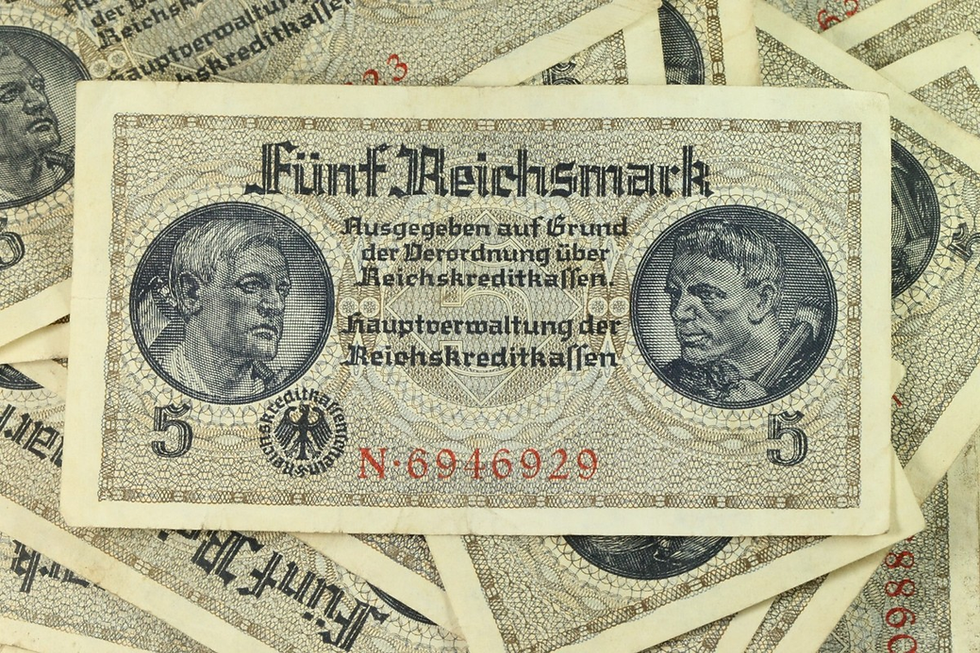
A Glance Into History: This reminds us of Abraham Lincoln, whose confrontation with the financial powers of his day reads like the opening chapter of every conflict we've discussed—a struggle between national sovereignty and those who would hold a nation hostage to usury.
Facing the catastrophic costs of the Civil War, Lincoln approached the established bankers for loans and was met with demands for interest rates as high as 24% to 36%—terms that would have strangled the Union in its cradle.
Rather than submit to what he viewed as financial extortion, Lincoln pursued a radically different path rooted in constitutional sovereignty. In 1862, he signed the Legal Tender Act, authorizing the issuance of $150 million in "greenbacks"—paper currency not backed by gold or specie, but by "the government's promise" and the productive capacity of the American people. These were debt-free dollars, spent directly into circulation to pay soldiers and suppliers without creating a parallel debt owed to private banking interests.
When Treasury Secretary Salmon Chase objected, Lincoln pressed forward, reportedly asking an advisor: "What can we do?" The answer came: issue treasury notes bearing no interest and declare them legal tender.
Lincoln's philosophy was captured in his declaration: "Money will cease to be the master and become the servant of humanity. Democracy will rise superior to the money power."
The banking establishment, recognizing the existential threat of a government that could create its own money, organized immediate opposition.
A circular distributed to bankers urged them to "do all in your power to sustain such daily and weekly newspapers... as will oppose the issuing of greenback paper money," and warned that government-issued currency would "seriously affect your individual profit as bankers and lenders."
Though the greenbacks saved the Union, the experiment was short-lived; after Lincoln's assassination (by the obvious parasites), the financial interests gradually restored their control, eventually pushing for the Specie Resumption Act of 1875, which withdrew greenbacks from circulation and returned the nation to a gold-backed system.
Lincoln had demonstrated that a sovereign government need not borrow its own money into existence at usurious rates—a lesson the money power ensured would not survive him.

Back to Hitler's Germany: After having deleted the banking parasites from the equation, the German economic miracle took off almost immediately. Instead of borrowing from the bankers at interest, the National Socialist (Nazi) government created a new monetary system for the Germans called: “The Labour Treasury Note.”
Millions of Germans went to work and were paid with these treasury certificates. This government-issued currency was not backed by gold but it was backed by something of real value. It was essentially received for labor and materials delivered to the government.
“For every Mark that was issued, we required the equivalent of marks worth of work done or goods produced.”
The workers could then spend these treasury certificates (notes) on other goods and services, creating more jobs for more people. Hitler even managed to end the reparation payments from the Versailles Treaty.
Hitler rebuilt Germany into something better than ever and the nation quickly rose from the ashes and healed its deep wounds. The unemployment problem was solved and the country was back on its feet. It had a solid, stable currency not tied to parasitic bankers. No debt. No inflation.
Unemployment went from 50% down to less than 2% in a few short years. After five years, Hitler had given six million Germans work and a full employment was reached. Crime was almost non-existent. Unemployment was a thing of the past, and there were no homeless and no beggars.
In ‘Billions for the Bankers: Debt for the People’ (1984), Sheldon Emery stated:
“Germany issued debt-free and interest-free money from 1935 and so on, accounting for its startling rise from the depression to a world power in 5 years. Germany financed its entire government and war operation from 1935 to 1945 without gold and without debt, and it took the whole capitalist and communist worlds to destroy the German power over Europe and bring Europe back under the heel of the bankers. Such history of money does not even appear in the textbooks of public (government) schools today.”

The Remilitarization of the Rhineland (1936): A Calculated Gamble
A major turning point came in 1936, when Hitler sent German troops into the Rhineland, a region bordering France and Belgium. Under the Treaty of Versailles and later agreements, the Rhineland had to remain demilitarized, meaning no German troops were allowed there.
Hitler’s decision was a serious risk, because the German army was still relatively weak at that time, and German commanders had orders to retreat if France responded with force.

The reoccupation of the Rhineland in 1936 was perhaps the most critical test of the Western powers' resolve. It was a high-stakes gamble for Hitler.
Strategic Necessity: As explained by Foreign Minister Konstantin von Neurath, Germany needed to "digest the Rhineland." This meant building fortifications on the French border.
The strategic logic was simple: as long as the Rhineland was demilitarized, France could easily invade western Germany at will. By fortifying it, Germany would neutralize the French threat and free its hands to pursue goals in Central and Eastern Europe.
German generals were highly nervous; they had orders to withdraw if they met any French resistance. The German force was small, and a French military response could have been catastrophic for the regime.
When France and Britain did nothing, it was seen in Berlin as a massive strategic victory. The "Rhineland had been digested," and the balance of power in Europe had shifted.
This success greatly increased Hitler’s confidence. It strengthened his position within Germany, improved his popularity at home.
The German Public: A Period of Prosperity
The U.S. Ambassador in Berlin, William E. Dodd, provided keen observations on the mood in 1936.
The regime had successfully built a powerful sense of national unity (Volksgemeinschaft). Programs like Kraft durch Freude (Strength Through Joy) offered workers benefits they had never dreamed of, such as cruises and vacations, reinforcing the idea that Hitler was delivering on his promises.

The success of the 1936 Olympics in Berlin further cemented national pride. Ambassador Dodd noted that an "overwhelming majority" of Germans would likely support Hitler in any venture, due to a combination of effective messaging, restored prosperity, and a traditional love of militarism.
Adolf Hitler's foreign policy was driven by the goal of overturning the post-World War I order and establishing Germany as a dominant continental power. This involved not only reclaiming lost territories but also uniting all German-speaking peoples and securing Lebensraum (living space) in the East.
Excerpts from the Documentary, Europa: The Last Battle: The main priority for Hitler was bringing back pride and belief for the German people again. In a symbolic act of national and spiritual rebirth, university students organized a book burning of degenerate Marxist literature, along with books from the Institute of Sex Research in Berlin on May 10th 1933.

Note: The Frankfurt School is the name given to a group of philosophers, social scientists, and cultural critics associated with the Institute for Social Research, founded in 1923 at the University of Frankfurt am Main. It was the first Marxist-oriented research center at a German university, initially funded by Felix Weil.
Key figures of its first generation included Max Horkheimer (who became director in 1930), Theodor W. Adorno, Herbert Marcuse, Erich Fromm, and Friedrich Pollock. They developed a body of work known as "Critical Theory," which sought to understand why the socialist revolution predicted by Marx had not occurred and, instead, why nationalism was rising. They drew upon and synthesized the ideas of Marx, Freud, Weber, and Kant to critique capitalism, culture, and the very nature of modern reason.
The nationalist campaign against this "un-German" spirit reached a climax in May 1933. On May 6th, students, backed by the SA, ransacked and closed Dr. Magnus Hirschfeld's Institute of Sexual Research in Berlin, confiscating its library.
Then, on the night of May 10, 1933, students, professors, and Storm Troopers in university towns across Germany, including Berlin and Frankfurt, staged massive public book burnings. In Berlin's Opera Square, Joseph Goebbels addressed the crowd, declaring, "The age of hairsplitting Jewish intellectualism is dead."
The book burnings were a clear and present warning. By July 1933, the Gestapo had officially shut down the Institute for Social Research in Frankfurt for subversive activities. However, its members had already begun moving the Institute and its journal first to Geneva, then to Paris, and finally, in 1935, to New York City, where it found a home at Columbia University.
The Institute's director, Max Horkheimer, successfully relocated many of its core scholars to Columbia University in New York City, where it was housed until 1950. This core group included 'intellectuals' such as Theodor Adorno, Herbert Marcuse, Erich Fromm, Leo Löwenthal, and Friedrich Pollock.
While Columbia served as their initial institutional home, several members eventually dispersed to other universities across the country.
For instance, Leo Löwenthal held positions at Stanford University and later the University of California, Berkeley; Herbert Marcuse taught at Brandeis University and the University of California, San Diego; and others like Franz Neumann and Otto Kirchheimer became influential scholars at American institutions, choosing to remain in the United States for the rest of their careers.
From exile, the Frankfurt School continued its work, producing seminal texts like Dialectic of Enlightenment (1944) and The Authoritarian Personality (1950), which sought to analyze the very forces of nationalism and "anti-Semitism" that had driven them from their homeland. After the war, Horkheimer, Adorno, and Pollock returned to Frankfurt, and the Institute was formally re-established in 1953.
It was the Frankfurt School that introduced Critical Theory to the English-speaking world, profoundly shaping intellectual thought in the 20th and 21st centuries.
Coming back to 1930s Germany, many of the National Socialists were artists who looked at what needed to be improved in the world. As a result, art and entertainment began reflecting the true values of the German people. There was a remarkable emphasis on German culture.
As a talented painter, Hitler was well aware of the Jewish Marxist influence behind the degradation of German art and culture. Thus, he invented the day of German art: “Tag der Deutschen Kunst.”
This was a parade held in Munich displaying an appreciation for art and culture. Theaters turned back to entertainment inspired from German values. The movie industry produced about 100 feature films per year between 1933 and 1945.
Some of the best classical recordings still existing were made in Hitler’s Germany. Actors from all over Europe, primarily from France, Sweden and Italy, were stars in German movies.
Hitler transformed his country from an economically ruined land, on the brink of breakdown, civil war, and total collapse into the world’s most advanced and prosperous country.

“I was educated that my home country was something I had to serve, and I loved my homeland. I was very proud of my country, actually. There was singing and crying and shouting to greet him. It was something very touching. After he came to power, he immediately put to practice what he had promised. He gave housing to the homeless, and work to the unemployed. There was food, and everything was in order again.”

It was a cultural and economic rebirth without parallel in the whole human history, which inspired the rest of the world to do the same.
Hitler’s radical program restored German economic independence, ensured racial security for the people, and diverted the nation’s wealth from the Banking Cabal to the ordinary people. Meanwhile, the rest of the world ruled by the Banking Cabal was still in recession.
He also relaxed the strict gun control laws of the previous government, allowing the people to defend themselves again.
Zionist media often claims that Hitler took power by disarming the German people, but that is fabricated nonsense as is the case with most such publications. The Weimar Republic had already disarmed the German people.
Gun clubs now opened all over the Reich. A man who lived in Hitler’s Germany was Hans Schmidt. He said, “To be a boy or a girl at that time was wonderful. The differences between the Christian denominations, or the different German states didn’t matter. We all truly felt that we were members of one body of people. One nation.”

“Youth hostels were opened all over the Reich. It enabled us to hike from one beautiful town to another, seeing our fatherland. Every effort was made to strengthen our minds and bodies. Contrary to what is said today, we were encouraged to become free in spirit and not succumb to peer or authority pressure.”
1st of May 1933 was made into a holiday for workers. The ‘Strength for Joy’ program enabled the common man to have affordable leisure activities, such as concerts, plays, libraries, day trips, and cruises to other countries.
For the first time in the world, millions of workers and their families could access a foreign vacation almost for free. The first vacation cruises were built for German workers. The favorite destination were the Portuguese islands of Madeira, as well as Spanish islands and port cities.
This National Socialist program is a manual for national recovery. Its lesson can be applied to any nation today. Drawing on the program, Germany enjoyed 36 months of complete employment and the world’s highest standard of living.
Hitler’s way was called the Volks Economic. To alleviate the greatest need of the German people, “Winter System Working” was also immediately called into being. “No one shall starve or freeze!” sounded the motto.

“This must happen at the beginning of every winter,” Hitler says, in one of his speeches. “This great welfare work is more than just charity, because we do not simply ask the rich people ‘please give something to the poor.’ Rather we say, ‘Germans, help yourselves.’ Everyone helps. Rich or poor, everyone must think that there is always someone in a much worse situation and I must help them as a national comrade.”
The donations were sent to the poorest of German cities and mountain regions. It was a first-rate social action that had great success. The poor people of these regions then created small items such as wood carvings, glassware, etc., as tokens for the donations received. This earned them work and bread, inspiring the whole nation to stand united.

The construction of the Autobahn provided employment to millions of Germans. Using only German materials, the new road system was made so that it did not destroy either the German landscape or wildlife habitats, not forests.
The price per automobile was between 1350 and 1600 Reichmarks. But Hitler thought the price was too high for the common family.
Thus, Hitler, together with Ferdinand Porsche, dreamed up and designed the “People’s Car,” the Volkswagen. This would be the most built and most economical car in the world. At that time, it cost 995 Reichmarks, which could be paid off in minor payments. Volkswagen was a word that Hitler himself personally chose.

The Zionist tried to turn American opinion against Hitler by claiming he was anti-Christian. However, about 2,500 new churches were built in Hitler's Germany. The country had about 46 million Evangelical Protestants and 30 million Roman Catholics, among other diverse faiths. Hitler himself regularly visited the church.

What was he like as a man? “We secretars found him very friendly, charming, and polite chief. He had a good sense of humor. I was very young, and he actually had a fatherly behavior. I liked him and felt well in his company. I enjoyed talking to him and listening to his monologues.”

“He was indeed observing me. And that was one of the most curious moments of my life. I had a feeling that he was searching somehow, and then his gaze went into the distant horizon. It was strange, as if he was contemplating a future. His gaze convinced me that he was a man of honorable intentions. I can say that I am glad that I saw his best side. Surely there might have been darker sides, but I saw only the wonderful side. Nobody can take that away from me.”
A lot of people of course have watched history documentaries and scare of pieces of Hitler’s Germany that give a distorted view of what National Socialism actually is. First of all, National Socialism is an ideology about life.

It’s about cultivation of life, of building strong families, building families that are able to raise good children. Children that are healthy. Children that are on a path of virtue to be able to build a better and brighter future for the nation. It’s about cooperation. Specifically, class cooperation, gender cooperation, and cooperation through all members of society.
National Socialism views a nation like a body, and a body takes all parts of the body. The liver is not more important than the brain or the heart or the arm or the leg. Everything works in tandem with one another to be able to support life. It is about supporting every single member of the community, as being part of an extended family.
Business owners have a right to make a profit, but they also need to ensure that they’re putting the best interests of the worker, families and the nation first. It is taking the best of nationalism without capitalism on the right, and it is taking from the best of socialism without the internationalism.
It is an economic theory about putting the nation first, because the nation is family. It also about rejecting capitalism and communism, which are two sides of the same coin, both benefiting central banking that seeks to centralize wealth. These are ideologies that seek to take a human being and make it a cog in the greater machine that only serves the globalist elite.
These are both ideologies that came from the same source, meant to tear apart the working class, tear apart families, and turn the nation into a giant fire sale, to be able to say whoever has the most money (capitalism) or the most power (communism) can loot the rest. In contrast, national socialism says that national community has to work together to create a healthier society in the nation.

General Leon Degrelle said, “National socialism is about lifting your own people up, and we want this for every single group of people, not just one group. We want every single ethnicity around the world to be able to make themselves stronger, to be able to chart their own destiny, to be able to work against the Zionists who hoard everything for themselves, and work against their system that breaks nations and families.”
The Nationalist Socialist form of democracy was based on the principle of community of people. Its electoral system was not based on the parliamentary system, but was nonetheless democratic. The government was largely based on a referendum in which the really important issues of the day were debated and voted upon by the German people. It was more representative of the people than it is today.
Today, the word ‘democracy’ no longer means what it did over a 100 years ago in many countries:

Ezra Pound was an American poet and critic, a major figure in the early modernist poetry movement.
In 1933, Hitler passed a law that enabled married couples to obtain interest-free loans, minimum 1000 Reichmarks, equaling 9 months salary, to set up homes and start families. For each childbirth, the couple was allowed to keep 250 Marks and did not have to repay it.
Newly married couples with children received these generous loans repayable in 10 years, so they could buy a house or apartment. The birth of the first child would cancel a quarter of the loan. Four children would cancel the entire debt.
Over a 10-year period, a family with four children would earn more than the amount of the loan. In the eyes of the National Socialist (Nazi), women were viewed as the preservers of the ‘tribe.’

Everywhere in Germany, houses and apartment were built for the workers. Villages of small single-house families were set up. The monthly payments were set so low that practically everyone could afford their own house.
All houses were naturally constructed according to the highest standards of public health. Before the end of 1933, Hitler succeeded in building 200,000 buildings in accordance with his building program.
Within four years, nearly 1.5 million were built for German people. The monthly rent for a worker was only about 1/8 of his monthly earnings. The farmer’s economic situation was also drastically improved. In 1933 alone, 17,611 houses were built for farmers. Within 3 years, 91,000 such houses were built.
The National Socialists were the first to actively campaign against smoking, and personally funded the Institute for the Struggle Against Tobacco. Germany became the first in the world to ban smoking on public transport.
In 1937, his government enacted the first law which prohibited the sale of alcohol to minors, also enacting stiff penalties for drunken drivers. He also introduced the first blood test for automobile drivers suspected of driving drunk.

Adolf Hitler was the first person to create a law against the mistreatment of animals, recognizing it to be evil. A law imposing total ban on animal experiments was enacted.

The ritual slaughter of animals as 'Kosher' and such was also banned. The Animal Protection Act was also passed. Germany even hosted an international conference on animal protection in Berlin. Education on animal protection laws were introduced at primary, secondary, and college levels.
Animal protection was accepted as as a subject to be taught in public schools and universities in Germany.

With all these fantastic achievements, German self-confidence skyrocketed, national pride, and happiness skyrocketed. Germany was now free and independent, without having to be in debt to the bankers anymore.

Hitler became a living legend to his people as his policies put Germany back on its feet and he was even named man of the year in 1938.
Ex Prime Minister of UK, David Lloyd George said: “It is not the Germany of the decade that followed the war, broke and dejected, bowed down with a sense of apprehension and impotence. It is now full of hope and confidence. One man has accomplished this miracle. The old trust him. The young idolize him. This is not an admiration toward a popular leader. This is the worship of a national hero, who has saved his country from utter despotism and degradation. I have never met a happier people.”

“So what we know about Adolf Hitler is like what we know about history. The victors, of course, write history, don’t they? They write a history and they tell us a narrative, and we’re supposed to swallow that bullshit as if it’s true. The major crime of Adolf Hitler was that he got Germany out of a banking debt that was drowning the German people. He got them out of the cesspool of moral decay."

“His crime was that he actually had the nerve to say fuck off to the international bankers. The Germans printed their own money, and Germany went from a destitute post-world war country that was drowning in hunger and debt. Hitler got them out of that debt, and turned it into a powerhouse within a few years by using their own money. That’s the real crime he committed.
“Now I could sit here and talk in really exciting sentences, a little bit more about everything we’ve been taught about World War II and the Holocaust, but let it suffice to say that it fits in line with virtually everything we’ve been told about history in general. Bullshit!"
John F. Kennedy, one of the greatest American presidents who saw the Zionists for what they were, had the courage and integrity to bypass the Federal Reserve (owned by the Banking Cabal). He wanted to rein in the AIPAC (American Israel Public Affairs Committee).
He was assassinated within six months, just like Abraham Lincoln who had tried to introduce greenbacks backed by people instead of banker gold. There was no coincidence there…

A diary kept by JFK as a young man traveling in Europe, revealed his admiration for Adolf Hitler. In it, he predicted "Hitler will emerge from the hatred that surrounds him now as one of the most significant figures who ever lived. He had in him the stuff of which legends are made.”

The narrator continues, “We only need to do one thing. Let’s confront that financial system. Let us print our money backed by our community, instead of borrowing it from the International Bankers who are slowly tightening the chains around us.”
"You see the faces of them Germans coming out of the crowds to meet Adolf Hitler. Genuine smiles on their faces. It's something you cannot act, cannot hide. It's there for all to see, because there's no denying it. There is an incredible love for him."
"Who would not love the guy who eliminated poverty and put you into a place where your family is more secure. You know, you have bread on your table, and your wage is solid, and everything is fine. You would've loved this guy. These are not actions of an evil man. This is a man who loves his country and loves his people."

However, the rebirth of Germany and the happiness of the German people was a thorn in the eye of the international bankers, because they could no longer control Germany or her people anymore.
The success of Germany would mean more nations would move away from Central Banking. The communists had officially lost control of Germany, and the Comintern had failed to reach its agenda across Europe.
By 1936, Winston Churchill was already seething in envy:

It is often claimed that it was Germany's aggression that led to the war, but in truth, it was a coordinated effort on multiple fronts.
Zionist leaders were the most vocal, considering Germany's rise and the spread of its ideology would bring an end to banking interests as well as the Judeo-Bolshevik aspirations of global revolutions.
In 1932, Bernard Lecache, president of the World Jewish League, said:

This was even before Hitler gained power and Hindenburg was still president of Germany. In March 1933, they still hadn’t enacted any anti-Jewish laws and no hostilities against the Jews had taken place.
Worldwide, global Zionist leaders officially issued a declaration of war against Germany. A worldwide Jewish boycott of German goods begun. 20,000 Jews protested at New York City Hall.

Apparently, banning ‘usury’ and closing degenerate businesses was “anti-semetic.”
Rallies and boycotts were directed against German goods. Samuel Untermyer, speaking on behalf of international Jewry, declared war on Germany with an economic boycott.
The front page of March 24th London Daily Express carried a headline: “Judea declares war on Germany.”
Zionist leaders were quoted as calling for a “holy war” against the German people:

The Express said that Germany was now confronted with an international boycott of its trade, its finances, and its industry. In London, New York, Paris, and Warsaw, Jewish businesses united against Germany, since it had cut off a major portion of their profit.
In August 1933, the Zionist Samuel Untermyer talked about a “planned annihilation and extermination” of Jews underway and also about a war that must be waged against Germany to stop it.
In a hysterical radio broadcast, he called for the Jews to destroy Germany, denouncing Germans as cruel savage beasts and ‘goyim’ ingrates. This was in line with the media propaganda that had spread across Europe and America when they wanted the US to join World War I (First Banker War) and facilitate the ‘Palestine-Israel’ deal.

Untermyer claimed that Germans were annihilating Jews by locking them up in vile concentration camps, starving and torturing them, murdering and beating them without cause, and resorting to every other conceivable form of torture, inhuman beyond conception until suicide had become their only means of escape, and all solely, because they are or their remote ancestors were Jews.
It was as if he has directly projecting the imagery of the Gulag death camps from Bolshevik-controlled Russia unto Hitler’s Germany.
This tactic was something the Judeo-Bolsheviks had perfected.
In "The German Ideology" (1845-1846), almost a century ago, Marx and Engels had discussed how the ruling class could present its own interests as the common interest, making its ideas the dominant ideas:
"For each new class which puts itself in the place of the one ruling before it, is compelled, merely in order to carry through its aim, to represent its interest as the common interest of all the members of society, that is, expressed in ideal form: it has to give its ideas the form of universality, and represent them as the only rational, universally valid ones."
For someone to claim power or gain support of the people, one had to make the people believe that they shared a common interest. For years, the bankers had applied this ideology to pretend its own selfish interests actually represented everyone’s interests.
This ideology had been incorporated as a propaganda technique by the Judeo-Bolsheviks into communism. When Comintern (Communist International) was formed to launch a global communist revolution, it worked closely with Willi Münzenberg, the Communist propagandist in Germany, who perfected the tactic of accusing Nazi figures of the very crimes the Communist Party itself was committing in Soviet Union.
Historians of propaganda often trace the codification of this principle to internal Comintern training documents from the 1920s (a decade before the formation of the National Socialist party). One such document, cited in political warfare literature, instructs agitators: "Accuse your opponent of exactly what you are doing or plan to do yourself. This will confuse him and discredit him in the eyes of the public."
You will often hear this phrase attributed to Joseph Goebbels, Hitler's propaganda minister. This is because Goebbels wrote extensively about the "Big Lie" technique—the idea that if you tell a big enough lie and repeat it, people will believe it.
However, Goebbels was actually documenting the technique he observed his Communist opponents using. In his diaries and speeches, he noted that Communists were masters of accusing their enemies (the Nazis) of the very things they were doing. Goebbels then adopted and began using this technique for his own war strategies.
It’s quite ironic that Judeo-Bolsheviks hijacked Marx’s ideas, considering he was quite critical of them — even after being a Jew himself. While one cannot deny that his ideas have been used by the Judeo-Bolsheviks and Judeo-Communists as a vehicle for their globalist agenda for banking and power, one has to wonder if Marx willingly gave them his ideas or his ideas were taken and twisted.
After all, it was Marx who said in his 1843 essay "On the Jewish Question":
"What is the secular basis of Judaism? Practical need, self-interest. What is the worldly cult of the Jew? Huckstering (haggling). What is his worldly god? Money."
[If Marx was indeed against Zionism and not acting on behalf of his relative, then it is clear that the Zionists hijacked his communist theory and replaced the “Rule of the Proletariat (common man)” with “Rule of the Zionists” — as was the case in the Soviet Union, at least until Stalin seized power and hunted down Lenin’s Zionist heir Trotsky. Stalin only believed in the “Rule of the Stalin” aspect of Marx’s communism]
Coming back to 1933, Untermyer was already using Comintern's propaganda technique to project the Bolshevik 'Holodamar' on the Germans.
In a radio broadcast on WABC NY, August 6 1933, he stated:

A new Germany that had broken free from Zionist control was not something that was taken well by the minions of the Banking Cabal, whose hold on Europe was crippling. It was declared an enemy of Jewish interests, and thus, had to be strangled.
The Reichmark (currency), which was backed by productivity of the German people, would weaken if production lessened. This would force Germany to go back to the ‘usury' of Central Banks, where they would again have to be indebted to the Banking Cabal.
It is important to note that this was before Hitler retaliated and boycotted Jewish goods. Many ordinary Jews in Germany and Palestine opposed the international boycott imposed by the Banker-aligned globalists and American capitalist Jews, as they feared it would spark anti-Jewish hate with Germany.

These ordinary Jews supported the National Socialist regime in Germany, but the supremacist Jews did not care. For them, the German Jews were collateral in the face of their banking interests.
Despite efforts by the German government to alleviate tensions and prevent the escalation of name-calling and threats by the international Jewish leadership, they continued their propaganda campaign against Germany in association with Comintern in the shadows.
The intensity of the campaign was such that, even Hitler himself said it would lead to Germans boycotting Jewish businesses in the country. Despite this, the international Jews kept up their campaign, funded by the Banking Cabal.
Germany was forced to take measures that eventually led to a situation where Jews started becoming ostracized. Even ordinary Germans began resenting German Jews, just because the international Jews in America were busy chasing banking interests even at the expense of their own people.
In a similar vein, the Jewish newspaper, Tatscha Retsch, wrote:

The globalist Jewry, backed by the Banking Cabal, and world media at their disposal, launched an even more aggressive war propaganda against Germany, which would escalate into World War II.
The Banking Cabal already had most of Western Europe in chains. As for the US, they could manipulate the politicians. They only needed a good opportunity to propagandize the American public against Germany. The USSR was a wild card, but it was just one person, and the Zionist had made him turn in their favor once, during the partition of Palestine. A second time wouldn’t be much difficult, with the right push of buttons.
In response to the aggression of the globalist Jewry and the Comintern riling up the German Jewry, the German government finally initiated a one day boycott of Jewish businesses after the Jews declared war on Germany.

Dr. Joseph Goebbels announced that the one-day boycott would be lifted, if global protests were suspended. If the anti-German boycott did not end, Goebbels warned that the anti-Jewish boycott would be resumed. However, this did not help — as long as the Jewish leaders kept up their rhetoric. The worldwide boycott of German goods continued for months.
Vladimir Jabotinsky, who was Jewish communist and a founder of the Irgun terrorist organization, wrote in January 1934 issue of Tatscha Retsch:

David A. Brown, National Chairman of the United Jewish Campaign, 1934, said: “We Jews are going to bring a war on Germany.”

Chaim Weizmann, president of both the International Jewish Agency and after World Zionist Organization, and later Israel’s first president, said in 1936: “It is no exaggeration to say that six million Jews are set to be in prison in this part of the world where they are unwanted, and for whom the countries are divided into those where where they are unwanted, and those where they are not admitted.” (This was 5 years before the '6 millions Jews died in the holocaust' claim started)

Emil Ludwig Cohn in 1938, said:

Henry Morgenthau, secretary of the U.S. Treasury, Hearst Press, September 1933, said: “War in Europe in 1934 was inevitable.”
In 1936, at the World Zionist Conference, Chaim Weizmann (became president of Israel in 1949), said: “Perhaps only two million out of six million will survive the upcoming ‘holocaust’ but they will be ready for life in Palestine.”

[This is quite symbolic with the Talmud, intentional or not, which says 600,000 Jews left Egypt under Moses. This number is especially important because it represents the “root number” of the people of Israel. Rabbinic tradition says 600,000 souls stood at Mount Sinai to receive the Torah.
The Talmud (for example, Tractate Sanhedrin 110b and Bava Batra 121b) explains that, because the Jews:
Doubted they could conquer the land
Feared the inhabitants after the 12 spies’ reported back
Complained and refused to proceed
God decreed that:
That entire adult generation would die in the wilderness
They would wander for 40 years
This punishment applied specifically to the 600,000 adult males aged 20–60. The Talmud confirms that only two men from that original adult generation entered the Land:
Joshua
Caleb
They were spared because they remained faithful and supported entering the land when others refused]
In 1938, the Jewish declaration of war against Germany was repeated. The American people were urged by the Jewish-owned press to boycott all German goods and German businesses.
A letter published by the Miami News on 12th July 1938 entitled “Kill off the Germans” stated that:

Jewish professor Alexander Kulisher, noted lawyer and Zionist on October 1937, said:

Germany’s response was defensive, not offensive as is claimed by Zionist-dominated media today.
A Jewish rabbi says, “Important stories that clarify things we didn’t receive in school. We didn’t receive in curriculum. They didn’t teach them even in high education. I gave lectures in front of history professors. Why really Hitler hated the Jews? What did he want from them? How did they bother him? It’s all written here in ‘Main Kampf.’ This book was only published recently. It just got approved to be translated to Hebrew. But there was an earlier translation made by ‘Yad Vashem.’ Hitler says in the book that Jews are communists. They made the Russian Revolution. They killed 30 million Russians. All intelligent ones, in a cruel and horrific way. And that’s their plan for the entire world. The next country in line is Germany. They founded the ‘socialist’ and ‘communist’ parties in Germany. And it’s true. If we don’t defeat them now, they will eliminate us, and they will slaughter another 20 million. And that’s how they went from country to country. So eventually, the only intelligent ones remaining will be the Jews.
“And he is right. The Russian revolution was made by us Jews. The Red Army was built by Trotsky. He created the Jewish division of the communist party. In the first picture of the Russian government, most were Jews. Who created the KGB? Jews. Everything is clearly written. He didn’t hate the Jews because they had ‘peos.’ He didn’t hate them for having Mitzvoth. It was because they were communists, and he writes it clearly: ‘The Jews destroyed religion and faith. They spread in Germany the heresy of God. Why they don’t teach in schools? Because, who writes the curriculum? These same communists. They destroyed all values, poisoned literature and music. Out of nine large German newspapers, seven were owned by Jews.”
An old woman who studied this conflict says, “Though I haven’t yet finished sorting out what I think about this, why did these events — why did this conflict, Jews and Germans, become so stark, and why this hate of the Jews, why did it have to happen? It’s still completely unclear to me. But perhaps I’ll manage someday. The hate of the Jews for the Germans. I have never read from any other people, such hate-filled expressions about another people as Jews did for Germans. And it’s… all you have to do is read the Talmud. I have all twelve volumes there in the authorized, most recent translations and edition, 2002. I wanted to verify the commonly circulated statements from Talmud. And I couldn’t read more than three pages. It made me sick. That’s how revolting it is, all this stuff about sexuality and so on, about what you can do with a three-year-old child, and it’s all just so alien to us. I don’t even want to think about it.”
The reason it is important to study the Talmud is because it gives insight into the mindset of many Zionists that occupy positions of power in the highest bodies of the world governments, including the Banking Cabal, WEF, IMF, EU, and have the power to decide the trajectory of the world.
From 1923 to 1933, German nationalists were regularly targeted by Judeo-communists and terrorists. 200 National Socialists and 216 police officials were murdered by Judeo-communists. Twenty thousand National Socialists and 1976 police officers were injured.
Herbert Norkus, a schoolboy and member of the Hitler youth, was brutally stabbed in six places. Horst Wessel, a young German student was shot. The Swiss national socialist leader, Wilhelm Gustloff, was brutally murdered by the Jew, David Frankfurter in 1936.
The Germans were outraged at the murders. The acts of terror against the German people went on for many years without an end.
February 27, 1933, four weeks after Hitler’s appointment as Chancellor, communist terrorists set fire to the Reichstag. Local police caught a Dutch communist named Marinus van der Lubbe, the man who set the fire.
The fire was meant to start another communist “civil war” before Hitler and NSDAP could establish themselves.
Hindenburg and Hitler acted fast. They issued emergency decrees, instructing the police to arrest the communist leaders and send them to prisons, which were later labeled as ‘concentration camps’ by Zionist-dominated media.
Most of the communists were Jews, since the ideology itself was adopted and twisted to serve a specific Jewish goal of global revolution. For this reason, it became easier for the Zionists to portray it as Jew-hatred, even though it was the Jews who had started organizing revolts since a century ago, including the March Revolution of 1848.
The troubles did not end. The Night of the Long Knives also known as Operation Hummingbird occurred in Germany between June 30 and July the 2nd 1934. At least 85 SA militants were executed and more than a thousand communists arrested by the NSDAP's army wing.
The "Second Revolution": Röhm's Radical Vision
The core of the conflict was Röhm's demand for a "second revolution." A communist revolution.
Having helped bring the Nazis to power, Röhm and his millions-strong Sturmabteilung (SA) felt the "national revolution" was incomplete. They sought to push out the conservative elites—industrialists, financiers, and the old aristocracy—who still held significant economic and social power.

Röhm wanted to push National Socialism toward ‘National Communism’ it seems, creating a major ideological rift at the highest level. His most direct and dangerous challenge was to the German Army (Reichswehr), an institution Hitler knew he needed to secure his long-term goals.
Ambition to Lead: As the head of an SA that had swelled to over three million members—dwarfing the army—Röhm saw his force as the true "national army" of the new Germany. He aggressively lobbied for the SA to absorb the regular army, with himself at its head.
Army's Ultimatum: The army's officer corps, viewing the SA as an undisciplined and radical mob, was fiercely opposed to this. In June 1934, Defense Minister Werner von Blomberg, with President Hindenburg's backing, issued Chancellor Hitler an ultimatum: either bring the SA under control and curb the political tension, or the army would impose martial law, threatening Hitler's own authority.
Facing a crucial choice between the SA and the powerful army (upon which his rearmament plans and future succession to the presidency depended), Hitler's decision was sealed.
Internal Party Enemies: Röhm had also made powerful enemies within the party. Göring, who desired to be Hitler's undisputed second-in-command, and Himmler, whose SS was still formally under SA command and sought independence, actively stood against him. There was also a massive payoff from the French embassy to Rohm, allegedly.
Röhm was executed for treason. Thus, they prevented another communist revolution from taking place in Germany.
Note: In 1931, the Harzburg Front — a coalition between the national conservative German National People's Party (DNVP) as majority and Hitler's National Socialist German Worker's Party (NSDVP) as minority — is in power.

Here's a timeline of political events in the German government:
January 30, 1933 — Hitler is legally appointed Chancellor by President Hindenburg, leading a coalition government with the DNVP. The Nazis hold only 3 of 11 cabinet seats, and Hindenburg retains the power to dismiss Hitler.
February 27, 1933 — The Reichstag building is destroyed by fire; a Dutch communist is caught at the scene.
February 28, 1933 — Hindenburg signs the emergency decree, enabling SA to imprison many communist leaders trying to launch a revolution in Germany.
March 5, 1933 — NSDVP wins 44% of the vote (288 seats) and joins with the DNVP (52 seats) to form a majority coalition. The support for NSDVP (Nazi Party) has surged from 18.3% in 1930 to 43.9% in 1933.
March 23, 1933 — The Reichstag votes 441 to 94 to give Hitler the right to make laws without the Reichstag's approval for four years. This increases his independence within the government.
May 1933 — Communist organizations are suppressed and leaders arrested. Trade unions are merged into the German Labor Front under Robert Ley.
June 27, 1933 — DNVP is dissolved after its remaining Reichstag deputies join NSDVP. The coalition government effectively ends.
July 14, 1933 — Germany becomes a one-party state, adopting the same political structure adopted by the communists.
August 25, 1933 — Agreement signed between the Jewish Agency and the German Economics Ministry, allowing German Jews to transfer assets to Palestine through the purchase of German goods and emigrate out of Germany.
December 1933 — Hitler attempts to pacify SA leader Ernst Röhm with a cabinet position, but Röhm remains unsatisfied.
June 17, 1934 — Vice-Chancellor Franz von Papen delivers a speech criticizing Nazi failure to maintain the rule of law, focusing nationalist opposition to the regime. President Hindenburg warns Hitler to bring SA under control.
June 25, 1934 — General Werner von Fritsch puts troops on general alert against any power struggle with the SA and announces the Army is fully behind Hitler.
June 30 to July 2, 1934 — SS units arrest and execute approximately 400 SA leaders, including Ernst Röhm, along with former Chancellor Kurt von Schleicher and Gregor Strasser of the Weimar Republic.
July 20, 1934 — Hitler decrees the SS independent of the SA, giving them control of the police department.
August 2, 1934 — Upon Hindenburg's passing, Hitler merges the offices of President and Chancellor. Members of the armed forces swear allegiance to Hitler. He becomes Führer and Reich Chancellor.
August 19, 1934 — A National Referendum, or a plebiscite, confirms Hitler's new position, with official results showing nearly 90% approval by the public.
The Haavara Agreement (The Transfer Agreement)
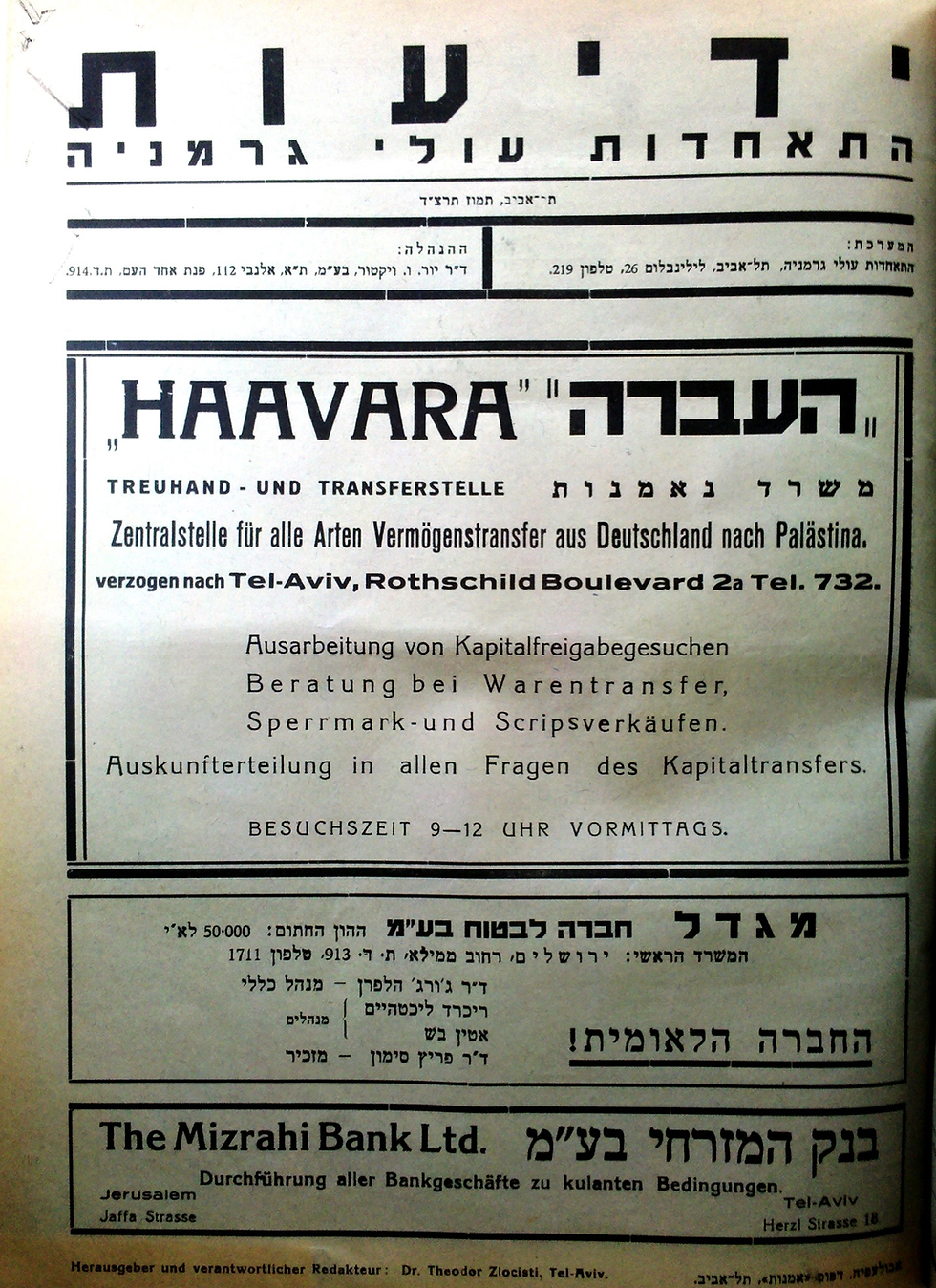
The Haavara Agreement (Hebrew for "Transfer") was a pact between Nazi Germany and Zionist organizations in Germany, signed on August 25, 1933. It was designed to facilitate the emigration of German Jews to British Mandatory Palestine by allowing them to transfer a portion of their assets.
Hitler hoped this agreement would stop the global boycott and aggression of Zionists, allowing the Jews in Germany to emigrate to Palestine. It was an attempt to peacefully resolve the conflicts between the Jews and the Germans, so that they could both live in peace again.
For the Zionist movement in Palestine (the Yishuv), this presented an opportunity to boost Jewish immigration and facilitate the formation of Israel.
The agreement served the distinct, and in some ways mutually reinforcing, interests of both parties involved.
For the German government, the agreement achieved several goals:
Breaking the Anti-German Boycott: The Haavara Agreement effectively undermined the international Jewish-led boycott, as German goods were now being exported to Jewish businesses in Palestine.
Boosting the Economy: The export market boycotted by international Jewry reopened for German manufactured goods, providing a boost to the German economy.
Encouraging Emigration: It facilitated the "Judenrein" (Jew-free) policy by providing a practical mechanism for Jews to leave Germany, taking some of their wealth with them in a way that still benefited the German economy .
A German Jew wishing to emigrate would deposit their Reichsmarks into a special account in Germany, managed by a trustee company (PALTREU - Palästina Treuhandstelle). These funds were then used to purchase German-manufactured goods—ranging from farm equipment to building materials.
The Haavara company in Tel Aviv would import and sell these goods in Palestine. The proceeds from the sales, now in Palestinian currency (Palestine Pounds), were finally paid out to the immigrant upon their arrival in Palestine.
By the time World War II broke out, Israel’s economy would have half a trillion dollars worth of assets shipped from Germany via the Haavara agreement.

The Haavara Agreement was deeply controversial and provoked a firestorm of criticism from the moment it was signed, tearing "the Jewish world apart, turning leader against leader, threatening rebellion and even assassination."
Prominent Jewish leaders in the United States, such as Rabbi Stephen Wise, who were leading the Anti-Nazi boycott and wanted to destroy German economy and facilitate Judeo-communist revolution, argued vehemently against the agreement. They saw it as a betrayal that would destroy the boycott's effectiveness.
The right-wing Revisionist Zionists, led by Ze'ev Jabotinsky, were even more vocal. They viewed any negotiation with Germany as an unforgivable act of treachery. The Revisionist newspaper in Palestine went so far as to label the agreement's supporters as "betrayers." The political atmosphere was so charged that one of the agreement's key negotiators from the Jewish Agency, Haim Arlosoroff, was assassinated shortly after his involvement, an act some linked to the fierce opposition.
To understand this conflict between these Zionist factions, it is necessary to examine the difference between their ideologies:
Labor Zionism/Jewish Pragmatists (Mapai: Ben-Gurion, Arlosoroff): Theirs was practical Zionism: Build the homeland incrementally through settlement, labor, and absorbing immigrants, one by one.
They sought pragmatic cooperation with the British authorities to facilitate immigration and growth.
They secured the Haavara Agreement to transfer Jews and their capital to Palestine, even if it means dealing with Germany. They cared more about creation of Israel than political positioning or Jewish pride.
Revisionist Zionism/Jewish Supremacists (Jabotinsky): Theirs was political Zionism: The primary goal must be the immediate, public declaration of a Jewish state on both sides of the Jordan River. Political sovereignty comes first.
Opposition to British rule; advocating for a mass petition and political pressure to force Britain to grant Jewish sovereignty.
Their priority was the anti-Nazi boycott, even at the expense of their own people. The long-term struggle for Jewish honor was inseparable from the immediate crisis.
By now, Hitler’s position in the German government had strengthened. However, troubles continued on the Judeo-communist front.
On November 9th, 1938, a Polish Jew named Hershel Grynszpan reached the German Embassy asking to speak to a member of the diplomatic staff.
When Ernst vom Rath, a 29 year old German diplomat positioned in Paris, came to greet the visitor, Grynszpan pulled out a pistol and murdered him in cold blood.

This was the straw that broke the Camel’s back. By now, even after meeting so many Jewish demands, German’s had faced enough boycotts, slanders, warmongery, and murders.
It seemed terrorist acts and assassinations had become the favorite experiments for the Judeo-communists to spark and launch wars and revolutions.
The news of the murder triggered riots in Germany, with torching and vandalism directed at Jewish shops and businesses. However, NSDAP took quick action, with an angry Goebbels seeing through Jewish instigation and ordering an end to the violence. The riots halted after the first night.
Goebbels at the time was negotiating to overturn the international Jewish embargo and feared that the violence would derail the talks—something the Supremacist Zionists and Judeo-communists were hoping for.

Early in the morning following the Kristallnacht events, Goebbels announced in a radio broadcast that any action against the Jews was strictly prohibited, and warned of severe penalties for disobeying the order.
He complained that he would have to explain this terrible affair to the German people around the world and that he simply did not know what kind of credible explanation to give.
Hitler was also furious when he first heard about it and ordered the telex message to be sent to Gauleiter officers, which read: “By express order from the very highest authority, arson against Jewish businesses or other property must in no case and under no circumstances take place.”
Several people were also arrested for violence against Jews. The ‘Night of Violence’ referred by Jews as Kristallnacht, The Night of the Broken Glass, is often mentioned in western media and in academic books as crazy, spontaneous, anti-semetic riots, but the repeated terror, psychological warfare, agitation, boycotts, and murders which actually provoked German resentment are never mentioned in our history books.
This is a pattern that can be seen even today with Zionists, especially in the US and middle-east.

Germany's success was a devastating blow to the Banking Cabal, which had already sunk its fangs into the United States. Extreme agitation against Hitler and Germany would be the result. Propaganda campaigns were now launched against him in the west by Zionist-owned press. The propaganda would soon evolve into one of the bloodiest battles in all of human history.



Comments