
.png)

Cosmologies: Divine Assembly of The Baal Cycle (Canaan)
- A. Royden D'Souza

- Mar 31
- 38 min read
Before the God of Israel spoke light into existence, before the Hebrew prophets thundered against idols, the peoples of the Levant envisioned a cosmos teeming with divine life, conflict, and cyclical renewal.
Their universe was not created ex nihilo by a solitary deity but emerged from primordial chaos through the actions of a divine family—El the Father, Baal the Storm, Anat the Warrior, Mot the Devourer—whose struggles and alliances shaped the heavens, the earth, and the underworld.

Unlike the systematic theologies of later monotheism, Canaanite cosmology presents a world where the boundary between the divine and the natural is permeable, where the seasons are the product of divine combat, and where death is not a punishment but a god with an insatiable appetite.
The primary sources for understanding this cosmos are the Ugaritic texts: clay tablets discovered in the 1920s at the ancient city of Ugarit (modern Ras Shamra) on the Syrian coast, dating to approximately 1300–1100 BC.
These tablets preserve the Baal Cycle, the most complete narrative of Canaanite myth, alongside ritual texts, incantations, and administrative records that illuminate how the divine universe was imagined.
This paper traces the complete arc of Canaanite cosmology: from the primordial state before creation, through the emergence of the first divine beings, the genealogies of the gods, the creation of the world, the great cosmic conflicts between Baal and Yam (the Sea) and between Baal and Mot (Death), the structure of the cosmos with its multiple realms, the eschatological cycles of death and renewal, and the fate of the dead in the underworld.
Throughout, it maintains a strict focus on the cosmological world itself; the divine beings, their actions, the realms they inhabit, and how this sacred universe was imagined and reinterpreted over time.
The Canaanite cosmos was not static. It evolved through different textual layers and regional traditions. The Ugaritic tablets present one version; the later Phoenician cosmogonies preserved by Philo of Byblos (64–141 AD) present another, heavily Hellenized account.
Between these sources lie centuries of cultural contact, syncretism, and reinterpretation. This paper will address these variations, noting where different traditions diverge and how the cosmology was reshaped by contact with Mesopotamia, Egypt, Greece, and Rome.
Parallel cosmological motifs will be drawn throughout: the cosmic battle between order and chaos, the dying and rising god, the three-tiered universe of heaven, earth, and underworld.
These motifs are not unique to Canaan; they appear in Mesopotamia (Marduk vs. Tiamat), Egypt (Ra vs. Apep), Greece (Zeus vs. Typhon), and the Hebrew Bible (Yahweh vs. Leviathan).
What follows is the Canaanite version of this ancient story; a story of storms and seas, of palaces built and destroyed, of a god who died and rose again, and of a universe held together by the fragile victory of life over death.
Part I: The Primordial State Before Creation

One of the most significant challenges in reconstructing Canaanite cosmology is that the Ugaritic tablets contain no creation myth. None of the inscribed tablets found at Ugarit reveals a systematic account of how the universe began.
The Baal Cycle begins in medias res; we are introduced to a divine assembly already functioning, with El on his throne, Yam demanding submission, and Baal already a powerful but not yet supreme warrior god.
To access Canaanite creation mythology, we must turn to later, heavily Hellenized sources: the writings of Philo of Byblos (64–141 AD), who claimed to translate the work of a much earlier Phoenician historian named Sanchuniathon.
Philo's account, preserved in fragments quoted by the Christian historian Eusebius, presents a creation narrative that blends Phoenician tradition with Greek philosophical concepts.
Whether this represents genuine Canaanite belief or a late syncretic invention is debated among scholars. The weight of evidence suggests that some elements reflect older traditions, but the overall framework is thoroughly Hellenized.
With this caveat, we turn to what can be said about the Canaanite primordial state.
The Primordial Elements: Chaos, Wind, and Desire
According to Sanchuniathon, as preserved by Philo, the beginning of all things was a primordial chaos; a dark, windy, formless void. From this chaos emerged two beings: Ether (the bright upper air) and Air (the lower atmosphere).
Their union produced Desire (Pothos), which some considered the origin of all creation. Out of this connection was produced Mot; but not the Mot known as the god of death. This primordial Mot was a watery, muddy substance, "a putrescence of watery compound," from which every germ of creation emerged.
This account is clearly influenced by Greek cosmogonic traditions, particularly Hesiod's description of Chaos giving birth to Gaia and Eros. However, the identification of a primordial Mot (spelled "Mot" or "Moth") with a watery, generative substance is echoed elsewhere in the Ugaritic texts, where El resides "at the confluence of the rivers and the two oceans."
This suggests a genuine Canaanite tradition that the origins of the cosmos lie in the meeting of primordial waters.
The Cosmic Egg and the Birth of the Heavens
The primordial Mot, this "putrescence of watery compound," burst forth into light, producing the sun, the moon, and the stars. The image is that of a cosmic egg: a contained, undifferentiated mass that, when opened, releases the ordered components of the universe.
This motif appears in multiple ancient Near Eastern traditions: the Egyptian Ogdoad, the Orphic egg, and the Hindu Hiranyagarbha.
From this primordial egg emerged the first generation of divine beings: Uranus (Heaven) and Ge (Earth); Greek names applied to what were likely the Canaanite Shamayim (Heavens) and Eretz (Earth).
The union of Heaven and Earth produced the generation of gods to which El belonged. This theogonic pattern—primordial chaos, separation of heaven and earth, birth of the older gods—mirrors the structure of the Babylonian Enuma Elish, where Apsu and Tiamat (fresh and salt waters) give birth to the first gods, who then create the heavens and the earth.
The Absence of Creation ex Nihilo
Crucially, Canaanite cosmology contains no concept of creation out of nothing (creatio ex nihilo). The universe emerges from pre-existing elements; chaos, wind, water, desire. The gods themselves are part of this emergent order; they do not transcend it.
This distinguishes Canaanite cosmology fundamentally from the later monotheistic cosmogonies of Judaism, Christianity, and Islam, where a single deity creates the universe by divine fiat.
In Canaan, creation is not an act of will but a process of differentiation, separation, and ordering; a theme that would later be adapted by the Priestly writer of Genesis, who described the spirit of God hovering over the face of the deep (tehom, a cognate of Tiamat) before the first creative word.
A further nuance, suggested indirectly by the Ugaritic corpus, is that the primordial waters were not simply inert matter, but were already charged with divine potential. Although the Ugaritic texts do not preserve a formal creation narrative, they repeatedly associate El’s dwelling with “the sources of the two rivers” and “the midst of the double-deep.”

This imagery implies that the divine realm itself emerges from these waters and remains rooted within them.
In other words, the cosmos is not built on top of chaos as something separate and defeated; rather, it continues to exist in constant contact with it. This helps explain why forces like Yam (the Sea) and Mot (Death) are never fully eliminated; they are not external enemies, but enduring aspects of the same primordial reality.
This closeness between order and chaos sets Canaanite cosmology apart from later dualistic systems. Chaos is not permanently destroyed or excluded. Instead, it is contained, managed, and destined to return, making the stability of the cosmos an ongoing and fragile achievement rather than a final victory.

Part II: The Emergence of the First Divine Beings
According to Sanchuniathon, the creator was known as Elion (Elyon), meaning "Most High." He is described as the father of the divinities, the supreme god who presides over the divine assembly.
His consort was Beruth (from which the city of Beirut takes its name). This marriage of the divinity with the city has parallels elsewhere in the ancient Near East: Melqart with Tyre, Chemosh with Moab, Tanit with Carthage, and later, Yahweh with Jerusalem.

The name "Beruth" likely derives from the Hebrew/Semitic root brt, meaning "covenant" or "alliance." The marriage of Elion and Beruth thus represents the divine covenant that underlies the cosmic and social order; a theme that would be central to later Israelite religion.
Elion is the "God Most High" who appears in Genesis 14:18–19 as the god of Melchizedek, king of Salem. Psalm 78:35 confirms that the Elohim (gods) were considered the family of El Elyon.
This biblical evidence suggests that the figure of Elion/Elyon was not merely a Phoenician invention but was worshipped across the Levant, including by the early Israelites before Yahweh was identified with him.
The Second Generation: Heaven and Earth
From the union of Elion and Beruth were born Uranus (Heaven) and Ge (Earth). The name Uranus is Greek, but the underlying Canaanite name would have been Shamayim. Similarly, Ge corresponds to Eretz or Arsa.

This generation represents the separation of the cosmic realms: the sky above and the land below. This parallels the opening of Genesis 1:1: "In the beginning Elohim created the heavens (shamayim) and the earth (eretz)."
The union of Heaven and Earth produced the next generation of gods, including El (Kronos in the Greek account/Saturn in Roman account) and his siblings. This pattern, a primordial pair producing the first generation of active gods, is standard in ancient Near Eastern theogonies.
In Mesopotamia, Apsu and Tiamat produce Lahmu and Lahamu, who produce Anshar and Kishar, who produce Anu (the sky god). In Canaan, the chain is shorter: Elion/Beruth → Heaven/Earth → El and the other gods.
It is important to clarify the relationship between El and Elion (Elyon), as the sources present differing traditions. In the Ugaritic texts, which represent the earliest and most direct evidence of Canaanite religion, El appears as the supreme deity, and titles such as “Elyon” (“Most High”) are best understood as epithets applied to him rather than as referring to a separate god.
However, in the later Phoenician account preserved by Philo of Byblos, Elion is presented as a distinct, earlier figure; the father of Heaven and Earth, and thus the grandfather of El. This apparent generational hierarchy reflects a Hellenized reinterpretation influenced by Greek theogonic models, rather than the original Canaanite framework.
The distinction, therefore, is not one of competing deities within a single system, but of different historical layers of tradition, in which an original title of El was later reimagined as a separate ancestral figure.
The Third Generation: El and His Siblings
El (meaning "God" or "the Mighty One") is the central figure of the Canaanite pantheon in the Ugaritic texts. He is the aged, bearded father of the gods, seated on a throne, wearing bull's horns as a symbol of strength and fertility.
His titles include "Father of Years," "Creator of Created Things," "Bull El," and "King of the Gods." He presides over the divine assembly from his mountain abode at the confluence of the cosmic waters.
El's siblings and their offspring populated the pantheon. The most significant among the younger generation was Baal (Hadad), the storm god, who was both a son of El and, in the narrative of the Baal Cycle, a rival to El's authority.
The "Children of El" (Elohim)
The Ugaritic texts refer to the gods collectively as 'ilhm (Elohim) or "the children of El." This phrase is identical to the Hebrew "Elohim," which is used in the Bible both as a plural term for gods and as a singular title for the God of Israel.
The biblical phrase "sons of God" (bene ha-elohim) also finds its parallel in the Canaanite concept of the divine assembly.
The divine assembly, presided over by El, included:
Baal (Hadad): the storm god, warrior, and bringer of rain
Anat: the virgin warrior goddess, sister and lover of Baal
Athirat (Asherah): the consort of El, mother of the gods
Yam (Nahar): the sea god, judge of the river, antagonist of Baal
Mot: the god of death, the underworld, sterility
Shapash: the sun goddess, messenger and mediator
Yarikh: the moon god
Kothar-wa-Khasis: the craftsman god, builder of palaces and forger of weapons
Athtar: the morning star god who attempted and failed to take Baal's throne

The divine assembly is not merely a symbolic gathering but a politically active body, whose deliberations shape the course of cosmic events.
In the opening of the Baal Cycle, the arrival of Yam’s messengers at El’s court creates a moment of tension: the gods are described as lowering their heads, falling silent, and exhibiting signs of fear. Baal himself does not immediately assert dominance; he must be urged into action, and at times restrained by Anat and Athtart.
This portrayal reveals a cosmos governed not by absolute decree but by negotiation, hierarchy, and vulnerability. Even the gods are subject to pressure, persuasion, and uncertainty. Authority is relational rather than absolute, and kingship must be continuously asserted rather than assumed.
Part III: Theogony — Genealogies of Divine Beings
The Canaanite pantheon is structured as a divine family, with El at its head as the patriarch. The genealogical relationships are not always consistent across texts, but a general hierarchy emerges:
Primordial | Elion (Elyon) + Beruth | The original divine pair (In Phoenician interpretation)
Second | Heaven (Shamayim) + Earth (Eretz) | Children of Elion and Beruth
Third | El, Athirat, and their siblings | Children of Heaven and Earth
Fourth | Baal, Anat, Yam, Mot, Kothar-wa-Khasis, etc. | Described as "children of El" |
Fifth | Pidray, Tallay, Arsay (daughters of Baal) | Grandchildren of El
This structure reflects a social reality: the Canaanite pantheon was modeled on the human extended family, with a patriarch (El), his consort (Athirat), his children (Baal, Anat, Yam, Mot), and his grandchildren (the daughters of Baal).
The Enthronement of Baal: A Generational Struggle
The Baal Cycle narrates a generational struggle that mirrors the succession myths of other ancient Near Eastern cultures. In the Babylonian Enuma Elish, the younger god Marduk defeats the older gods Apsu and Tiamat to become king.
In the Greek Theogony, Zeus defeats his father Kronos and the Titans. In the Canaanite Baal Cycle, Baal (the younger storm god) defeats Yam (the older sea god) and struggles against Mot (death) to achieve kingship.
However, unlike Marduk or Zeus, Baal's victory is incomplete and his kingship is limited. He must still contend with Mot, and his rule is subject to the authority of El, who remains the supreme patriarch.
The Baal Cycle thus reflects a tension in Canaanite theology: El is the theoretical king, but Baal is the active, effective ruler.
This tension may reflect a historical process: as the cult of Baal grew in popularity, his status in the myths was elevated, but the older, more conservative priesthood preserved the supremacy of El in the formal theology.
Athirat: The Mother of the Gods
Athirat (known in the Bible as Asherah) is the consort of El and the mother of the gods. She is called "the Lady who traverses the Sea" and "the Creatress of the Gods." She plays a crucial role in the Baal Cycle when Baal and Anat persuade her to intercede with El on their behalf for the construction of Baal's palace.

Athirat's position as the mother goddess places her at the center of the divine family. She is the mediator between the younger gods and the patriarch, using her influence to shape El's decisions. Her epithet "the Lady who traverses the Sea" connects her to the primordial waters and suggests a role in the ongoing ordering of the cosmos.
The Daughters of Baal

The Baal Cycle mentions three daughters of Baal: Pidray, Tallay, and Arsay. Their names reveal their cosmic functions:
Pidray: associated with light and lightning (from the root pdr, "to shine")
Tallay: associated with rain and dew (from the root tll, "to rain")
Arsay: associated with the earth and the underworld (from the root ars, "earth")
These goddesses represent the beneficial forces that Baal's rule brings to the world: light, rain, and fertile earth. Their presence in the divine family emphasizes the link between Baal's kingship and the fertility of the land.
It should be noted that the genealogies of the Canaanite gods are not fixed or systematized. The Ugaritic texts themselves present ambiguities: Baal is described as a “son of El,” yet in some traditions associated with Dagon; Anat is simultaneously his sister and consort; and Athirat functions both as mother of the gods and as an independent political actor within the divine council.
This fluidity reflects a mythological system that is organic rather than doctrinal, where relationships shift according to narrative and cultic context. The pantheon is best understood not as a rigid hierarchy but as a dynamic kinship network, mirroring the complexities of extended family structures in human society.
Part IV: Cosmogony — Creation of the World/Universe
The earliest cosmogonic act, according to the Sanchuniathon material, was the separation of Heaven and Earth from the primordial Mot. This separation is the foundational act of ordering: the chaotic, undifferentiated mass is divided into the two primary realms of the cosmos.
This motif appears in the opening of Genesis ("God separated the light from the darkness," and later "let there be a firmament to separate the waters from the waters").
In the Canaanite conception, Heaven and Earth are not merely locations but divine beings. They are the parents of the gods, and their separation—though necessary for creation—is also a kind of cosmic divorce. The union of Heaven and Earth produced the gods; their separation allowed the gods to rule the cosmos.
The Firmament and the Twin Mountains

The Canaanite cosmos, like other ancient Near Eastern cosmologies, was bounded by a firmament; a solid dome that separated the upper waters (the cosmic ocean above) from the earth below.
This firmament was held up by twin mountains, Targhizizi and Tharumagi, which stood at the edges of the earth, bounding the horizon. These mountains served as the pillars of the sky, preventing the upper waters from collapsing onto the earth.
The twin mountains also served as the entrance to the underworld. Shapash, the sun goddess, was said to enter the underworld through a "grave" located between the mountains.
Each evening, the sun descended between these mountains, passing through the gate of the underworld to travel beneath the earth during the night, emerging again in the east each morning.
The Cosmic Waters
Below the earth lay the cosmic ocean; the primordial waters that had been separated from the sky. These waters were the source of all rivers and springs. The meeting place of these waters was Mount Lel, the mountain abode of El, located "at the confluence of the rivers and the two oceans."
Mount Lel was not merely a mountain but the cosmic center; the point where the upper waters (the firmament's ocean), the lower waters (the subterranean ocean), and the earth's waters (rivers and springs) all converged. This convergence made Mount Lel the axis mundi, the navel of the cosmos, where the divine assembly met and where the decrees of El were issued.
El's mansion on Mount Lel was described as having eight entrances and seven chambers. The number seven (associated with completeness) and eight (associated with new beginnings) reflect the cosmic significance of the site: it is the place where the order of the universe is established and renewed.
The Divine Council
The assembly of the gods, which met on Mount Lel, was the governing body of the cosmos. El presided over the council, and the other gods—Baal, Yam, Mot, Anat, Athirat, Kothar, and others—participated in its deliberations. The council functioned as a divine bureaucracy, making decisions about the allocation of power, the construction of palaces, and the fate of the world.
The concept of the divine council is preserved in the Hebrew Bible, most famously in Psalm 82, where "God stands in the council of Elohim; among the gods (elohim) he judges."
The prophet Micaiah describes a vision of Yahweh seated on his throne with the host of heaven standing beside him (1 Kings 22:19–22). The Book of Job opens with the "sons of God" presenting themselves before Yahweh.

Closely associated with Yam is the serpentine creature Lotan (Ltn), described in Ugaritic texts as a twisting, multi-headed serpent subdued by Baal. Though not always foregrounded in the narrative, Lotan represents the monstrous embodiment of chaotic waters, paralleling figures such as Tiamat in Mesopotamia and later the biblical Leviathan.
The defeat or subjugation of Lotan reinforces Baal’s role as the imposer of order upon primordial chaos, not merely through kingship but through direct confrontation with the monstrous forces that threaten cosmic stability.
Part V: Realms of the Divine Universe

Like other ancient Near Eastern cultures, the Canaanites envisioned the cosmos as structured in three layers: the heavens above, the earth in the middle, and the underworld below.
This tripartite structure is reflected in the spatial language of the Ugaritic texts and in the later biblical cosmology, where the heavens are the dwelling of God, the earth is the realm of the living, and Sheol is the land of the dead.
Heavens (Shamayim) | El, Athirat, the divine assembly | Firmament, upper waters, Mount Lel, stars, sun, moon
Earth (Eretz) | Humans, animals, plants, some gods (Baal as storm) | Fertile land, mountains, rivers, seas
Underworld (Arsay/Mot) | Mot, the dead (rpum), Shapash (nighttime) | Pit, mire, filth, gates, "land of freedom"
The Heavens: Upper and Lower
The Canaanite heavens were divided into two levels. The upper heavens were the dwelling place of the high gods; El, Athirat, and the divine council. This realm was invisible to human eyes, accessible only to the gods and to those whom they summoned.
The lower heavens were the visible sky; the firmament, the sun, the moon, and the stars. Shapash, the sun goddess, traversed the lower heavens each day, her chariot crossing from east to west.
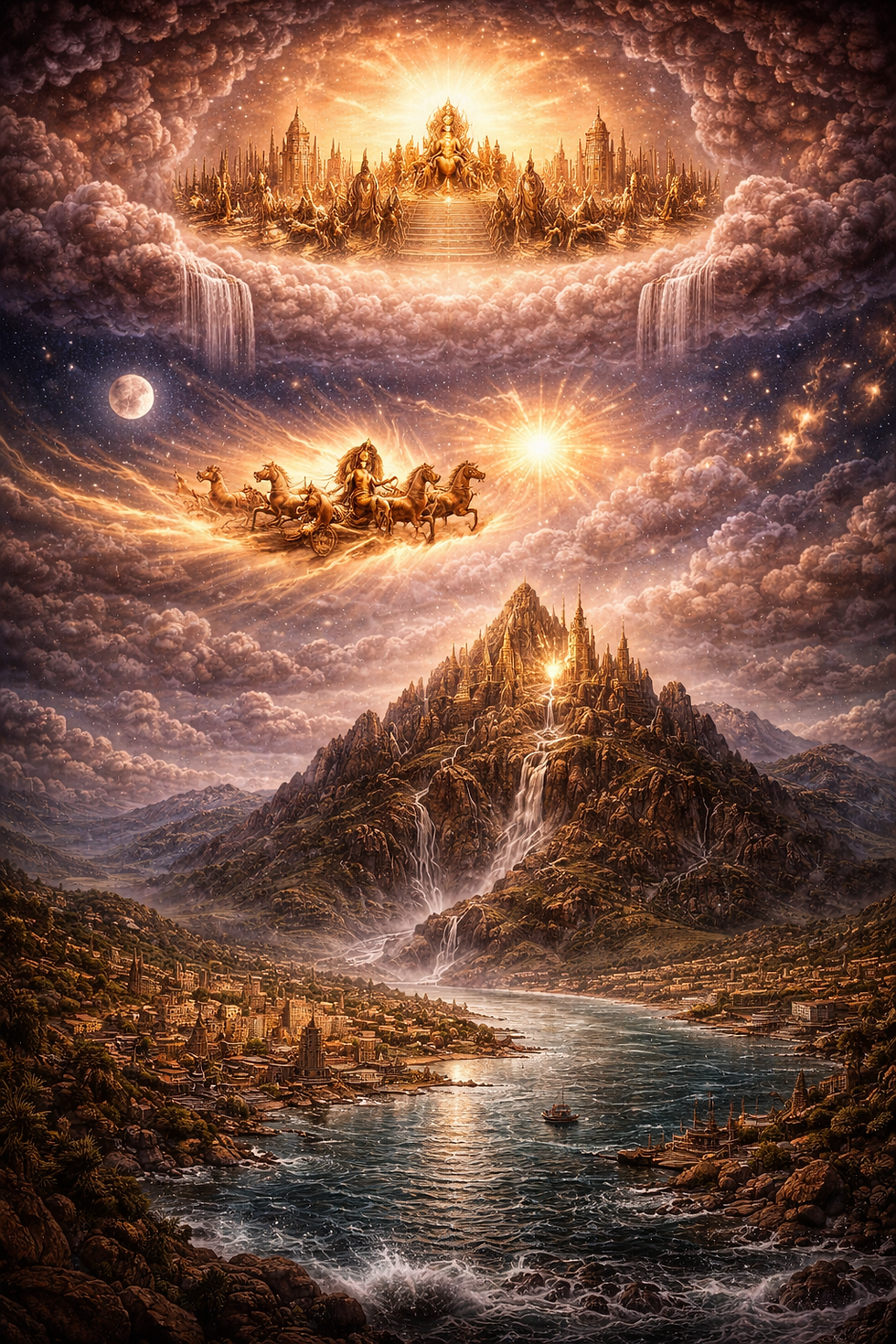
Mount Zephon (modern Jebel Aqra) was the mountain abode of Baal. Located on the northern coast of Syria, this mountain was visible from Ugarit and was considered the sacred peak where Baal's palace was built.
In the Baal Cycle, Mount Zephon is described as a place of recesses and caverns, where Baal holds his feasts and from which he unleashes his thunder and lightning.
Mount Lel was distinct from Mount Zephon; it was the abode of El, not Baal. Located "two layers beneath the wells of the earth, three spans beneath its marshes," Mount Lel was paradoxically both a mountain (reaching toward the heavens) and a place beneath the earth.
The description of Mount Lel as both a subterranean and elevated location reflects a broader ancient Near Eastern conception of the cosmic center as a point of ontological convergence rather than spatial consistency. The axis mundi is not bound by ordinary geography; it is simultaneously above, below, and within the world.
This paradoxical geography reflects the Canaanite understanding of the cosmic center: the point where all three realms—heavens, earth, and underworld—intersect.
This is essential to understanding Canaanite cosmology: the divine realm is not “elsewhere” but interwoven with the fabric of reality, accessible at liminal points where the boundaries between realms dissolve.
The Earth: The Middle Realm
The earth was conceived as a flat disk, surrounded by the cosmic ocean . The land of Canaan, specifically the territory of Ugarit and its neighboring kingdoms, was understood as the center of the earth, the place where the divine order was most directly manifest.
The twin mountains Targhizizi and Tharumagi stood at the edges of the earth, holding up the firmament.

The earth was the realm of human activity and also the arena where the gods contested. Baal's storms brought rain to the fields, Anat's wars brought destruction to cities, and Mot's droughts brought famine and death. The gods were not distant from the earth; they were active participants in its daily life.
The Underworld (Arsay / Mot's Domain)
The underworld was the realm of Mot, the god of death, and the destination of the dead. It was located beneath the earth, accessible through a gate between the twin mountains. The underworld was described as a place of mire, filth, and pit; a dark, dusty, uninviting realm where the dead lingered in a shadowy half-existence.
Mot's city was called hmry ("Mirey"), and it was described in the Baal Cycle as follows: "where a pit is the throne on which he sits, filth the land of his heritage."

This imagery contrasts sharply with the bright, fertile world above. The underworld is the negation of life: no light, no rain, no growth, no joy.
Despite its grim character, the underworld was not a place of punishment. There is no concept of moral judgment in Canaanite afterlife beliefs. The dead simply went to Mot's domain, where they existed as shadows, dependent on the offerings of their living descendants for whatever comfort they could receive.
Shapash, the sun goddess, traveled through the underworld during the night. Her journey beneath the earth was not merely astronomical; it was a cosmic event that connected the realms.
As she traveled, she carried messages between the gods, mediated disputes, and occasionally escorted the dead or the living to and from the underworld. Her role as mediator between the realms made her a crucial figure in the divine economy.
The "Land of Freedom" (Underworld)
Interestingly, the Aramaeans (a people closely related to the Canaanites) referred to the underworld as "the place of freedom." This paradoxical name, calling the realm of death "freedom," reflects the belief that in death, the soul was freed from the burdens and obligations of earthly life.
The dead were no longer subject to the demands of kings, the exactions of tax collectors, or the suffering of disease and poverty. They were, in a sense, liberated.
However, this freedom was not liberation from the underworld itself. The dead remained in Mot's domain, but they were no longer bound by the constraints of the living.
The "blessed dead" (rpum) were said to "eat with Baal-Hadad," a phrase suggesting that some especially favored ancestors enjoyed a more pleasant existence in the underworld, perhaps feasting and drinking in the presence of the gods.
Part VI: Major Divine Conflicts — The Baal Cycle
The first major conflict of the Baal Cycle pits Baal against Yam (the Sea god). Yam, whose name means "sea," also bears the title "Judge Nahar" (Judge of the River). He represents the chaotic, untamed forces of nature; the primordial waters that threaten to overwhelm the ordered world.
The story begins with Yam demanding that the gods submit to him. El, the father of the gods, appears to favor Yam, perhaps because the sea is older and more primordial than the storm.
But Baal refuses to submit. With the help of the craftsman god Kothar-wa-Khasis, who forges two magical clubs named "Driver" and "Chaser," Baal confronts Yam.
The battle is described with vivid imagery:
Baal's hands shake as he faces the sea creature
Kothar reassures him: "Baal, you shall be victorious"
The first club strikes Yam on the shoulders
The second club strikes Yam between the eyes
Yam is dragged out and finished off
Athtart (a form of Astarte) declares: "Scatter him! Baal is king!"
This victory is cosmic in its implications. By defeating Yam, Baal establishes order over chaos. The sea, which could flood the earth and destroy all life, is subdued.
Baal's kingship is established, but it is not yet complete. He has no palace—no permanent seat of authority—and he must still contend with Mot.

Parallel motif: The battle between a storm god and a sea monster appears throughout the ancient Near East. In Mesopotamia, Marduk defeats Tiamat (the salt-water sea). In Egypt, Ra battles Apep (the serpent of chaos).
In the Hebrew Bible, Yahweh is described as the one who "divides the sea" (Exodus), who "tramples the waves" (Job), and who "pierces Leviathan" (Psalm 74). The Canaanite Baal Cycle is the closest parallel to these biblical theophanies, and many scholars believe that the biblical storm god imagery was directly adapted from Canaanite sources.
The Palace of Baal: Establishing Kingship
After defeating Yam, Baal still lacks a palace; a symbol of permanent kingship. The other gods have palaces; only Baal dwells in a temporary dwelling. With the help of Anat (his sister and ally) and Athirat (who intercedes with El), Baal persuades El to allow the construction of a palace.
The palace is built by Kothar-wa-Khasis, the craftsman god, who fashions it of gold, silver, lapis lazuli, and cedar. But Baal insists on one unusual feature: the palace must have no windows. He fears that if there are windows, his daughters might escape, or—more likely—that his enemies might enter.
When the palace is complete, Baal relents and orders a window to be opened. From that window, he unleashes his thunder and lightning. His voice, the thunder, shakes the earth, and his lightning flashes across the sky.
This is the moment when Baal's kingship becomes visible: his rule is not merely a title but an active, felt presence in the world.
Note: Kothar-wa-Khasis functions not only as a craftsman but as a mediator of technological and cultural knowledge. His association with distant lands such as Egypt and Caphtor suggests that craftsmanship itself was perceived as foreign, specialized, and semi-divine.
The construction of Baal’s palace thus represents more than royal legitimation; it marks the introduction of civilizational order, architecture, and divine technology into the cosmos.
The Battle with Mot: Death and Resurrection
The second great conflict pits Baal against Mot (Death). Mot, the god of the underworld, is the polar opposite of Baal. Where Baal brings life-giving rain, Mot brings drought and sterility. Where Baal's domain is the fertile land, Mot's domain is the pit, the mire, the filth of the underworld.
The confrontation is initiated by Baal himself, who sends messengers to Mot, perhaps overconfident after his victory over Yam. Mot's response is terrifying:
"My appetite is the appetite of lions in the wilderness, like the longing of dolphins in the sea. I will devour Baal."
Mot makes good on his threat. He swallows Baal, sending him to the underworld. Baal is dead. With the storm god gone, the rains cease. The land is parched, the crops wither, and life itself seems to retreat from the earth.

The cosmic consequence of Baal's death is drought and sterility. This is not merely a mythological event; it is the explanation for the dry season in the Levant. Each year, as the summer drought sets in, Baal is understood to be in the power of Mot. The land dies because the storm god is dead.
Parallel motif: The dying and rising god is a widespread pattern in ancient Near Eastern religions. In Mesopotamia, Tammuz (Dumuzid) descends to the underworld each year, and his absence is mourned by his lover Ishtar.
In Egypt, Osiris is killed by his brother Set, resurrected by Isis, and becomes the king of the underworld. In Greece, Persephone descends to Hades each winter, returning each spring.
The Baal Cycle shares this pattern, but with a distinctive Canaanite emphasis: Baal's death is not merely a natural cycle; it is a violent act of the death god, and his resurrection requires a bloody intervention.
Note: Before descending to the realm of Mot, Baal engages in a cryptic episode in which he mates with a heifer, producing an offspring that may function as a substitute or proxy. Though the text is fragmentary, many scholars interpret this as a ritual or symbolic act intended to mitigate the consequences of his impending death.
This motif suggests an underlying concern with continuity and regeneration, reinforcing Baal’s role as a fertility deity whose essence cannot be entirely extinguished.
Anat's Vengeance and the Resurrection of Baal
Anat, Baal's sister and lover, refuses to accept his death. She searches the earth for him, finds his body, and performs a ritual of mourning. But mourning is not enough. Anat descends to the underworld to confront Mot.
The text describes her vengeance in graphic detail:
She seizes Mot
She splits him with a blade
She winnows him in a sieve
She burns him in a fire
She grinds him under a millstone
She scatters his remains over the fields for the birds to devour
With Mot destroyed (or at least scattered), Baal can return. El dreams that Baal is alive, and the goddess Shapash (Sun) is sent to retrieve him. Baal emerges from the underworld, the rains return, and the land is fertile once again.
However, the victory is not permanent. After seven years, Mot reconstitutes himself and returns, demanding that Baal give him another brother to consume. Baal refuses. A single combat breaks out between the two, but it is unresolved until Shapash intervenes, warning Mot that El will turn against him if he continues. Mot submits, and Baal rules again.
This cycle—Baal's death, Anat's vengeance, Baal's resurrection, Mot's return—is cyclical, not linear. The conflict between Baal and Mot never ends. It is the cosmic pattern of the seasons: death and rebirth, drought and rain, sterility and fertility. The Canaanite cosmos is not static; it is perpetually contested, perpetually renewed.
Note: Anat’s destruction of Mot—cutting, winnowing, burning, grinding, and scattering—closely parallels agricultural processes, particularly the harvesting and processing of grain. This has led scholars to interpret the episode as a symbolic inversion: death itself is subjected to the same processes that sustain life.
Mot, the devourer, becomes the devoured; death is temporarily domesticated and reintegrated into the cycle of fertility.
Also, Shapash’s intervention is decisive. Unlike Baal or Anat, she does not rely on force but on authority and mediation, invoking the will of El to compel Mot’s submission. Her unique position—traversing the heavens, the earth, and the underworld—allows her to function as the only deity capable of maintaining balance between realms.
In this sense, Shapash may be understood as the true guarantor of cosmic stability, ensuring that the cycle continues without collapsing into permanent chaos or sterility.
The Defeat of Athtar: A Failed Succession
The Baal Cycle also includes a brief episode involving Athtar, the morning star god. After Baal's death (and before his resurrection), El attempts to appoint Athtar as Baal's successor.
Athtar ascends to Mount Zephon and sits on Baal's throne; but his feet do not reach the footstool. He is too small for the throne. Recognizing his inadequacy, Athtar descends from the mountain and becomes the god of the underworld (or, in some versions, the god of the evening star).
This episode reinforces the uniqueness of Baal's kingship. No other god can occupy his throne. Athtar's failure is a reminder that Baal's role—as storm god, warrior, and king—is not transferable.
Parallel motif: The failed succession of a lesser god appears in other mythologies. In the Greek Theogony, the Titans attempt to overthrow Zeus and fail. In the Babylonian Enuma Elish, the younger gods challenge Apsu and Tiamat, but only Marduk succeeds in defeating Tiamat.
The Canaanite version emphasizes the cosmic ordering function of Baal's kingship: he alone can bring rain, and without rain, the world dies.
It is significant that Baal does not enter the conflict with Yam as an unquestioned champion. The texts depict moments of hesitation, and the divine assembly itself initially inclines toward submission. Baal’s eventual victory is therefore not predetermined but contingent, achieved through external support (Kothar’s weapons) and internal resolve.
This narrative tension underscores a key feature of Canaanite cosmology: order is fragile, and its triumph over chaos is never guaranteed.
The Proto-Indo-Iranian/European Parallels
The battle between a storm god and a sea serpent (or chaos monster) is one of the most widespread story patterns in human civilisation.
Egyptian: Ra & Set | Apep (Apophis) | 2400–2300 | Pyramid Texts, Coffin Texts
Canaanite: Baal | Yam (Sea), Lotan (Leviathan) | 1500–1300 | Baal Cycle (Ugarit tablets)
Babylonian: Marduk | Tiamat (Salt‑Water Sea) | 1500–1100 | Enuma Elish
Vedic: Indra | Vritra (Serpent of Drought) | 1500–1000 | Rigveda (oral tradition; written later)
Israelite: Yahweh | Leviathan, Rahab, Sea | 1000–500 | Psalms (e.g. Psalm 74), Isaiah, Job
The Egyptian Pyramid Texts are the oldest written religious texts in the world. The Rigveda is among the oldest oral traditions, but its manuscripts were written later.
The Core Mythological Parallels (Baal Cycle vs. Vedic Indra)
These are not coincidences but deep structural parallels, suggesting either a shared Proto‑Indo‑Iranian (Persian)/European heritage or cross‑cultural contact via the Mitanni kingdom.
Central Conflict: Order vs. Chaos
Hero (Storm God): Baal (“Rider of the Clouds”) vs. Indra (god of thunder/rain).
Monster (Chaos): Yam (primordial sea) & Lotan (serpent) vs. Vritra (dragon of drought who withholds waters).
Outcome: Baal secures his palace/kingship; Indra releases the monsoon rains. Victory = renewal of the world.
Divine Weapons and the “Swallowing” Motif
Weapons: Baal’s two maces (Yagrush & Ayamur) forged by Kothar‑wa‑Khasis; Indra’s Vajra (thunderbolt) forged by Tvashtar.
Swallowing: In both texts, the monster tries to swallow the hero whole.
Baal Cycle: “One lip to the earth, one lip to the heavens… Baal must enter inside him.”
Rigveda: “Vritra seized the celestial lord and threw him into his mouth.”
Cyclical Nature
Baal later battles Mot (death) and descends into the underworld, dying and reviving – mirroring agricultural cycles.
Indra must renew his battle each dry season, as Vritra seizes the waters again.
Supporting Cast
Divine craftsman: Kothar‑wa‑Khasis (Canaanite) ≡ Tvashtar (Vedic).
Father god: El (at “confluence of rivers”) ≡ Dyaus Pitar (linguistic root of Zeus Pater / Jupiter).
Minor Divergence
Baal’s enemy Yam = primordial sea (coastal civilisation’s concern).
Indra’s enemy Vritra = drought (monsoon‑dependent society).

Historical & Linguistic Bridge: The Mitanni Kingdom
The kingdom of Mitanni (1500–1200 BC) in northern Mesopotamia (modern Syria/Turkey) provides a direct link.
Indo‑Aryan elite: Rulers had Sanskritic names; a treaty from 1380 BC swears by Vedic gods (Indra, Varuna, Mitra, Nasatya).
Linguistic clues: Baal (‘Lord’) may relate to Sanskrit suffix ‑pāla (‘protector’); Indra may connect to Hurrian storm god Innara.
Shared archetype: The “storm‑god as dragon‑slayer” appears across Eurasia: Zeus vs. Typhon (Greek), Thor vs. Jörmungandr (Norse), Marduk vs. Tiamat (Babylonian).
Genetic Evidence: Migration or Just Culture?
Based on ancient DNA, the most likely scenario is small‑scale migration from the Eurasian Steppe into the Levant; not a mass folk movement, but an elite migration linked to the Mitanni.
Evidence for migration:
Alalakh (Syria): A Bronze Age female with ancestry linking her to the Turan steppe; a candidate for Indo‑Aryan Mitanni elite.
Megiddo (1600–1500 BC): Genetic outliers with significant steppe ancestry; one male carried Y‑haplogroup R1a (strongly associated with Indo‑European expansion).
Lebanese genome:*One disputed study claims a sudden influx of Steppe_MLBA ancestry beginning ~1750 BC, mostly in Y‑DNA.
Evidence against large‑scale migration:
Trace, not transformation: In Europe, steppe ancestry often reaches 50%+ of the gene pool. In the Levant, it is a faint signal in isolated outliers; the local Canaanite gene pool remained largely intact.
Alternative routes: Some steppe‑linked Y‑haplogroups (e.g. R1b‑V1636) may have arrived via the Caucasus, not directly from the Andronovo horizon.
The presence of Y‑haplogroup R1a in the ancient Levant proves that people carrying steppe DNA did arrive. But the signal is sparse, fitting a small, ruling‑class elite (the Mitanni) who integrated into a powerful native civilisation without replacing its population.

Part VII: Divine Interventions in Human Affairs
The most direct divine intervention in human affairs is Baal's provision of rain. The Ugaritic texts describe Baal as the "Rider of the Clouds" who "opens the windows of the sky" to water the earth. When Baal is in power, the rains come, the crops grow, and the people prosper. When Baal is dead or in the power of Mot, the land suffers drought and famine.
This understanding of divine causality is not unique to Canaan. Throughout the ancient Near East, the storm god was the source of agricultural fertility. But the Canaanite texts place unusual emphasis on the direct, personal relationship between Baal's state and the condition of the land.
The myth of Baal's death and resurrection was not merely a story; it was the theological framework for understanding the seasonal cycle.
Anat as the Warrior Goddess
Anat intervenes in human affairs as a warrior. She is described in the texts as one who "wades in the blood of her enemies," who "kills the warriors of the towns" and "slays the people of the seashore."
Her violence is not random; it is the violence of divine justice, the execution of those who oppose the order that Baal represents.

The Baal Cycle describes a scene where Anat closes her mansion, meets her servants in a valley, and proceeds to kill the guards, warriors, and townspeople. She then returns to her palace and slaughters the guards there as well, ending with a peace offering.
This juxtaposition of violence and sacrifice reflects the Canaanite understanding of divine intervention: the gods are both protectors and destroyers, and their actions in the human realm are often violent.
The Role of Kings and the Divine Council
The kings of Ugarit and other Canaanite cities claimed a special relationship with the gods. They were not themselves divine (as in Egypt), but they were the earthly representatives of the divine council. The king's role was to maintain justice, defend the land, and ensure that the temple cult was properly performed.
The Amarna letters, a collection of diplomatic correspondence from Canaanite kings to the Egyptian Pharaoh, reveal how the kings understood their relationship to the divine.
They addressed the Pharaoh as "my god, my sun," and described themselves as "the dust under his feet." This language reflects the Canaanite understanding of divine kingship: the king was the earthly image of the heavenly king, and his authority derived from his relationship to the gods.
Omens, Dreams, and Divination
The gods communicated with humans through dreams, omens, and divination. The Ugaritic texts contain references to dream oracles, where a god appears to a king or priest in a dream to deliver a message. In the Baal Cycle, El dreams that Baal is alive, and this dream prompts the actions that lead to Baal's resurrection.
Divination, the interpretation of signs and omens, was a priestly function. The liver of a sacrificed animal, the flight of birds, the pattern of oil on water; these were all means by which the gods revealed their will. The kings consulted diviners before military campaigns, political alliances, and other major decisions.
Part VIII: Eschatology — End of the World
Canaanite cosmology does not have a linear eschatology; a single, definitive end of the world followed by a final judgment. Instead, the cosmos operates on a cyclical model: the seasons repeat, the conflict between Baal and Mot repeats, and the renewal of life follows each drought.
This cyclical eschatology is reflected in the structure of the Baal Cycle. The narrative ends not with a final resolution but with a stalemate: Mot submits to Baal, but he is not destroyed. The conflict will resume.
The world will face another drought, another death, another resurrection. There is no ultimate victory of good over evil; there is only the eternal alternation of the seasons.
The Absence of a Final Judgment
Unlike the later monotheistic traditions of Judaism, Christianity, and Islam, Canaanite religion has no concept of a final judgment. The dead do not stand before a divine tribunal to be rewarded or punished based on their deeds in life. The gods do not weigh souls or consign the wicked to a special place of torment.
The underworld is a democratic realm: all the dead go there, regardless of their moral character. The king and the peasant, the righteous and the wicked, the priest and the heretic; all share the same dusty fate in Mot's domain.
This absence of moral judgment reflects a worldview in which the primary concern is not the afterlife but the fertility and prosperity of the land in the present.
The Renewal of the Cosmos
While there is no final judgment, the Canaanite cosmos is perpetually renewed through the cycles of Baal's death and resurrection. Each year, when the rains return after the summer drought, the renewal of the land is a cosmic event. Baal has returned, Mot has been defeated (temporarily), and the world is reborn.
This annual renewal was celebrated in religious festivals, likely including the New Year festival, when the myth of Baal's victory over Mot was recited, the king renewed his covenant with the gods, and the community rejoiced in the restoration of fertility.
The Blessed Dead (Rpum)
While the underworld is generally a place of shadowy half-existence, some texts refer to the rpum; a class of blessed or deified ancestors who enjoy a more pleasant afterlife. The rpum are described as "eating with Baal" and "drinking with the gods."
They may have been kings or heroes who, through their exceptional deeds or their relationship to the divine, earned a place in the divine feast.
The rpum were venerated through ancestor cults, with offerings of food and drink made at their tombs. This practice is reflected in the Hebrew Bible, where the prophets condemn those who "offer food to the dead" (Deuteronomy 26:14) and who "consult the dead on behalf of the living" (Isaiah 8:19).
The Canaanite practice of ancestor veneration was widespread and persistent, surviving for centuries despite the condemnations of Israelite prophets.
Note: Although the Canaanite cosmos operates cyclically, this cycle is not perfectly harmonious. Each return of Mot represents a renewed threat, not merely a predictable phase. The cycle is therefore best understood as a dynamic equilibrium, maintained through continual conflict rather than passive repetition.
This distinguishes it from later philosophical notions of eternal return; in Canaanite thought, renewal is always precarious, always achieved through struggle.
Part IX: Post-Mortem Destinations — Afterlife Realms
The primary destination of the dead was the underworld, known as Arsay (from ars, "earth") or as the domain of Mot. The underworld was located beneath the earth, accessible through a gate between the twin mountains Targhizizi and Tharumagi.
It was described as a place of mire, pit, and filth; a dark, dusty, sterile realm where the dead lingered in a shadowy existence.

The dead were called rpum (the plural form) or mitu ("the dead ones"). They were not active participants in the world of the living, but they could be disturbed by neglect. Offerings of food and drink were made at tombs to ensure that the dead would not trouble the living and to provide for their sustenance in the underworld.
The Cult of the Dead
The living maintained relationships with the dead through the cult of the dead. Tombs were located within the city, often beneath the floors of houses, so that the dead remained in close proximity to the living. Offerings were made at the tomb on special occasions, and the dead were invoked in oaths and prayers.
The Hebrew Bible contains numerous condemnations of this practice. The prophets rail against those who "eat and drink at the tombs" (Tobit?—actually, the practice is condemned in passages like Psalm 106:28 and Isaiah 65:4).
The Deuteronomistic historians describe the worship of the dead as one of the "abominations" of the Canaanites that the Israelites were commanded to avoid.
Shapash as Psychopomp
The sun goddess Shapash served as a psychopomp; a guide of the dead to the underworld. Each evening, after traversing the sky, Shapash descended through the gate between the twin mountains, carrying the souls of the dead who had died that day.
Her journey beneath the earth was the mechanism by which the dead were transported from the world of the living to the realm of Mot.
Shapash also served as a messenger between the realms, carrying messages from the living to the dead and from the gods to the underworld. Her role as mediator made her one of the most important deities in the Canaanite pantheon, despite her relatively low profile in the myths.
The Fate of the Wicked and the Righteous
As noted earlier, there is no distinction between the fate of the wicked and the righteous in the afterlife. Both go to the same underworld, both endure the same shadowy existence, both depend on the offerings of their descendants for whatever comfort they may have.
The only exception may be the rpum—the blessed dead—who were likely kings and heroes, not ordinary mortals.
This lack of moral judgment in the afterlife reflects a worldview in which justice is primarily temporal; it happens in this life, not the next. The gods reward the righteous with prosperity, fertility, and victory in battle; they punish the wicked with drought, famine, and defeat. The afterlife is not a place of justice but a place of rest; or rather, of mere existence.
Note: The dead in the underworld occupy an ambiguous ontological state: they are neither fully alive nor entirely extinguished. Their continued existence depends on ritual sustenance, memory, and invocation by the living.
This creates a reciprocal relationship between the worlds: the living sustain the dead, and the dead, if neglected, may become restless or malevolent.
Thus, the boundary between life and death remains permeable, mirroring the broader permeability of the cosmic structure.
Part X: Evolution of Cosmology
The Ugaritic Layer (1300–1100 BC): The Ugaritic tablets represent the earliest and most authentic source for Canaanite cosmology.
They present a world in which:
El is the supreme patriarch, but Baal is the active king
The cosmos is contested: Yam and Mot challenge Baal's rule
The gods are anthropomorphic: they eat, drink, fight, and love
The underworld is a place of dust and silence
The dead require offerings from the living
This layer is polytheistic, dynamic, and mythologically rich. The gods are not abstract principles but personal beings with distinct personalities, preferences, and rivalries.
The Phoenician-Hellenistic Layer (1st century BC – 2nd century AD): The writings of Philo of Byblos (preserved by Eusebius) represent a later, heavily Hellenized layer of Canaanite cosmology. In this layer:
The cosmology is systematic and philosophical
Greek names (Uranus, Ge, Kronos) replace Canaanite names
Theogonic patterns follow Greek models (chaos → Gaia → Uranus → Kronos → Zeus)
The primordial Mot is not the death god but a watery substance
Creation is described in terms of elements, not divine actions
This layer reflects centuries of cultural contact between Phoenicia and the Greek world. It is valuable for what it preserves of older traditions, but it must be used cautiously. The degree to which it represents authentic Canaanite belief is debated.
The Biblical Reception: Polemic and Appropriation
The Hebrew Bible preserves extensive evidence of Canaanite cosmology, but almost always in a polemical or appropriative context. The biblical writers:
Condemn Baal worship as idolatry
Appropriate Canaanite imagery for Yahweh (storm theophany, divine council, cosmic battle)
Reinterpret Canaanite terms (El, Elohim, Elyon) as titles for Yahweh
Suppress the polytheistic context of Canaanite myths
For example, Psalm 29 describes Yahweh as the storm god who "sits enthroned over the flood" and whose "voice" (thunder) breaks the cedars.
This language is nearly identical to descriptions of Baal in the Ugaritic texts, but it is applied to Yahweh. The biblical writers did not invent the storm god imagery; they borrowed it and repurposed it.
Similarly, the figure of Leviathan (the twisting, seven-headed sea serpent) appears in the Bible as a creature of Yahweh, not an independent deity. In the Ugaritic texts, Lotan (the cognate of Leviathan) is the servant of Yam, the sea god, and an enemy of Baal.
The biblical writers transformed the Canaanite monster into a creature of Yahweh, emphasizing his power over chaos.
The Syncretic Adaptations: Anat, Asherah, and the Goddess Traditions
The Canaanite goddesses Anat and Asherah appear in the Hebrew Bible, but in transformed roles. Anat is barely mentioned (the name appears in the place name Beth-Anath), while Asherah is condemned as a goddess whose sacred poles were to be cut down.
The biblical writers systematically suppressed the worship of these goddesses, but their presence in the archaeological record, including the Kuntillet Ajrud and Khirbet el-Qom inscriptions mentioning "Yahweh and his Asherah," suggests that the goddess traditions persisted in popular religion for centuries.
The Legacy of Canaanite Cosmology
The Canaanite cosmological tradition did not disappear with the rise of Judaism, Christianity, or Islam. It was absorbed, transformed, and preserved in various ways:
Jewish mysticism (Kabbalah) preserves elements of the divine council and the cosmic structure
Christian demonology transformed Baal, Astarte, and other Canaanite deities into demons
Islamic tradition preserved the figure of al-Khidr, who may be connected to Baal, and the stories of the prophets who opposed the worshippers of Baal
Western esotericism revived interest in Canaanite deities as part of the "pagan revival" of the 19th and 20th centuries
The Ugaritic tablets, rediscovered in the 1920s, have transformed modern understanding of the Hebrew Bible and of the religious world in which it emerged.
They have also sparked controversies about the nature of Israelite religion, the origins of monotheism, and the relationship between the Bible and its Canaanite context.
Note: The transition from Canaanite polytheism to Israelite monotheism did not entail a simple rejection of earlier cosmology but a process of selective transformation. Elements of the Baal Cycle—storm imagery, divine combat, the council of gods—were retained and reinterpreted within a new theological framework.
Rather than disappearing, the Canaanite cosmos was absorbed and internalized, its structures preserved beneath the surface of later religious thought.
Part XI: Parallel Cosmological Motifs
Mesopotamian Parallels: The closest parallel to the Canaanite Baal Cycle is the Babylonian Enuma Elish (1100 BC). Both texts feature:
A cosmic battle between a storm god and a sea monster
The establishment of the storm god's kingship after victory
The construction of a palace for the victorious god
The ordering of the cosmos after the defeat of chaos
In the Enuma Elish, Marduk defeats Tiamat (the salt-water sea) and uses her body to create the heavens and the earth. In the Baal Cycle, Baal defeats Yam (the sea) and establishes his kingship, but the creation of the cosmos is not narrated.
The differences are as significant as the similarities. Marduk's victory is definitive: Tiamat is dead, and the cosmos is permanently ordered. Baal's victory is cyclical: Yam is subdued, but Mot remains a threat, and the conflict repeats each year.
Egyptian Parallels: The Egyptian tradition features a cosmic conflict between Horus (the sky god, son of Osiris) and Seth/Set (the god of chaos and violence). Like Baal, Horus is a younger god who must defeat an older, more chaotic force to secure his throne.
The conflict is resolved through the intervention of the divine council (the Ennead), much as the Baal Cycle involves El and the other gods in the resolution of the conflict.
The Egyptian Book of the Dead describes the afterlife as a journey through the underworld (Duat), where the dead must navigate gates, avoid demons, and face judgment before the god Osiris. This is more elaborate than the Canaanite underworld, which lacks judgment and the possibility of a blissful afterlife.
Greek Parallels: The Greek myth of Zeus vs. Typhon (the serpentine monster) is another variant of the storm god vs. chaos monster motif. Typhon, like Yam and Tiamat, represents the untamed, primordial forces that threaten the ordered cosmos. Zeus defeats Typhon with his thunderbolts, establishing his kingship over the gods.
The Greek Titanomachy (the war between the Olympians and the Titans) is a generational conflict similar to the struggle between Baal and the older gods. In both traditions, the younger storm god defeats the older generation and establishes a new order.
Hittite Parallels: The Hittite Song of Ullikummi (part of the Kumarbi cycle) describes the storm god Teshub's battle against a stone monster named Ullikummi. The narrative structure—storm god threatened by a monstrous enemy, divine intervention, temporary victory—parallels the Baal Cycle.
The Hittite texts also preserve the figure of Elkunirsa (a form of El), who is married to the goddess Asherdu (Asherah).
These parallels suggest that the storm god vs. chaos monster motif was a common heritage of the ancient Near East, not a Canaanite invention. Each culture adapted the motif to its own theological and political context.
The Hebrew Appropriation: Yahweh as Storm God
The Hebrew Bible appropriates the Canaanite storm god imagery for Yahweh. Passages such as Psalm 29, Psalm 74, and Job 38–41 describe Yahweh in language that is directly borrowed from Canaanite descriptions of Baal. The "voice of the Lord" (thunder) breaks the cedars; he "tramples the waves of the sea"; he "pierces Leviathan."
This appropriation was not a one-time event but a process that unfolded over centuries. The early Israelites worshipped Yahweh as a warrior god, but they also worshipped Baal, Asherah, and other Canaanite deities.
The prophetic movement of the 8th–6th centuries BC condemned this polytheism and demanded exclusive worship of Yahweh. In the process, the prophets and scribes borrowed the language and imagery of the Canaanite gods and applied it to Yahweh, effectively "demoting" the other gods from divine beings to angels, demons, or nothing at all.
The result is a paradox: the Hebrew Bible condemns Baal worship while simultaneously describing Yahweh in terms that are unmistakably borrowed from Baal. This paradox is the legacy of Canaanite cosmology; a legacy that shaped the religious imagination of the West, even as it suppressed the names of the gods who first inspired it.
Appendix A: The Canaanite Pantheon
El (Elion/Elyon) | Father of the gods, creator, king of the divine assembly | Bull, throne, scepter | Mount Lel, the heavens
Baal (Hadad) | Storm god, fertility, rain, warrior | Lightning bolt, bull, cloud | Mount Zephon, the sky
Anat | Virgin warrior goddess, sister/lover of Baal | Shield, spear, helmet | Battlefields, mountains
Athirat (Asherah) | Mother of the gods, consort of El | Sacred tree, lioness | The sea, Mount Lel
Yam (Nahar) | Sea god, judge of the river | Serpent, dragon, waves | The sea, the primordial waters
Mot (Maweth) | Death god, the underworld | Pit, mire, silence | The underworld (Arsay)
Shapash | Sun goddess, messenger, psychopomp | Sun disk, chariot | The sky, the underworld
Kothar-wa-Khasis | Craftsman god, forger of weapons, builder of palaces | Forge, tools, hammer | Memphis, Caphtor (Crete)
Athtar | Morning star god, failed successor to Baal | Star, spear | The underworld (failed)
Pidray | Daughter of Baal, light/lightning | Light, lightning | The sky
Tallay | Daughter of Baal, rain/dew | Rain, dew | The sky
Arsay | Daughter of Baal, the underworld | Earth, dust | The underworld
Yarikh | Moon god | Crescent moon | The night sky
Resheph | Plague god, war god | Gazelle, arrow | Battlefields, plague
Dagon | Grain god, father of Baal (in some traditions) | Grain stalk | The earth
Appendix B: Cosmic Realms in Canaanite Cosmology
Upper Heavens | Shamayim (?) | El, Athirat, divine council | Mount Lel, cosmic waters, throne of El
Lower Heavens | Shamayim (?) | Shapash, Yarikh, stars | Firmament, sun, moon, stars
Mountains | Zephon, Lel | Baal (Zephon), El (Lel) | Sacred peaks, divine dwellings
Earth | Eretz | Humans, animals, plants | Fertile land, rivers, seas, cities
Sea | Yam | Yam, Lotan, sea creatures | Primordial chaos, boundary of the earth
Underworld | Arsay, Mot's domain | Mot, the dead (rpum) | Pit, mire, filth, dust, gates
The Gate | Between Targhizizi/Tharumagi | Shapash (as psychopomp) | Entrance to the underworld
Appendix C: Timeline of Canaanite Cosmology
Early Bronze Age | 3500–2000 BC | Early temple construction; precursors of pantheon appear at Ebla
Middle Bronze Age | 2000–1550 BC | Pantheon takes classic form; temple architecture standardized
Late Bronze Age | 1550–1200 BC | Ugaritic texts composed; Baal Cycle written (1300–1100 BC)
Iron Age | 1200–586 BC | Ugarit destroyed; traditions preserved in Phoenicia, Israel, Aram
Persian Period | 539–332 BC | Contact with Zoroastrianism; possible influence on afterlife concepts
Hellenistic Period | 332–63 BC | Philo of Byblos writes Phoenician History; Greek influence on cosmology
Roman Period | 63 BC – 324 AD | Eusebius preserves Philo's fragments; decline of Canaanite religion
Modern Period | 1928–present | Ugaritic tablets discovered; modern scholarship on Canaanite cosmology

Bibliography
Primary Sources (Ancient):
Ugaritic tablets (KTU = Keilalphabetischen Texte aus Ugarit)
Philo of Byblos, Phoenician History (preserved in Eusebius, Praeparatio Evangelica)
Hebrew Bible (Masoretic Text)
Amarna letters
Secondary Sources (Scholarly):
Cross, Frank Moore. Canaanite Myth and Hebrew Epic: Essays in the History of the Religion of Israel. Harvard University Press, 1973.
Smith, Mark S. The Early History of God: Yahweh and the Other Deities in Ancient Israel. Eerdmans, 2002.
Smith, Mark S. The Origins of Biblical Monotheism: Israel's Polytheistic Background and the Ugaritic Texts. Oxford University Press, 2001.
Day, John. Yahweh and the Gods and Goddesses of Canaan. Sheffield Academic Press, 2002.
Gibson, John C. Canaanite Myths and Legends. A&C Black, 1978.
Heiser, Michael S. The Unseen Realm: Recovering the Supernatural Worldview of the Bible. Lexham Press, 2015.
Lewis, Theodore J. The Origin and Character of God: Ancient Israelite Religion through the Lens of Divinity. Oxford University Press, 2020.
Parker, Simon B., ed. Ugaritic Narrative Poetry. Society of Biblical Literature, 1997.
Pardee, Dennis. Ritual and Cult at Ugarit. Society of Biblical Literature, 2002.
Wyatt, Nicolas. Religious Texts from Ugarit. Sheffield Academic Press, 1998.
Online Resources:
Wikipedia. "Baal Cycle."
Wikipedia. "Mot (god)."
Wikipedia. "Canaanite religion."
Siren, Christopher B. "Canaanite/Ugaritic Mythology FAQ."
Lee Hee-sung. "The Comparative Study of Cosmic Geography between Ancient Near East and the Old Testament." RISS, 2020.


Comments