
.png)

Cosmologies: The Kami of Shinto (Japan)
- A. Royden D'Souza

- Mar 27
- 45 min read
The cosmological universe of Shinto is a rich and complex tapestry of divine beings, celestial realms, and sacred narratives that have evolved over more than a millennium.
Unlike the systematic theologies of Western religions, Shinto cosmology presents a world saturated with divinity; where kami (gods, spirits, and sacred forces) inhabit every mountain, river, tree, and rock, where the boundary between the human and divine is permeable, and where the Japanese islands themselves were born from the union of primordial deities.

The primary sources for understanding this cosmos are the Kojiki (Record of Ancient Matters, 712 AD) and the Nihon Shoki (Chronicles of Japan, 720 AD), texts compiled at the imperial court to record the myths, legends, and history of Japan.
These works present a multi-layered universe consisting of several distinct realms: the heavenly plain of Takamagahara (High Celestial Plain), the visible world of Nakatsukuni (Middle Land), and the subterranean land of the dead Yomi (the Land of Darkness) .
This cosmological vision was never static. From its earliest recorded forms, Shinto mythology absorbed and adapted influences from China, Korea, and most profoundly, Buddhism.
The arrival of Buddhism in the sixth century CE initiated a millennium-long process of syncretism, during which kami were reinterpreted as local manifestations of Buddhist divinities; a framework known as honji suijaku (本地垂迹, "original ground and trace manifestation").
This combinatory paradigm transformed Shinto cosmology, adding new layers of meaning and new divine figures to the pantheon.
This paper traces the complete arc of Shinto's divine narrative: from the primordial chaos and the emergence of the first deities, through the creation of the Japanese islands and the birth of the sun goddess Amaterasu, to the complex negotiations between the heavenly and earthly kami that established the cosmic order.
It explores the shadow realms of Yomi and Tokoyo, the rival creation myths centered on the Izumo gods, and the profound transformations wrought by Buddhist cosmology. Throughout, it maintains a strict focus on the cosmological world itself; the divine beings, their actions, the realms they inhabit, and how this sacred universe was imagined and reinterpreted over time.
Part I: Emergence of the First Kami

Before the heavens and the earth existed, before the islands of Japan took shape, there was only chaos; a formless, silent vastness without distinction or differentiation. According to the Kojiki, in this primordial state, "the heaven and the earth were not yet separated, and the female and male principles were not yet divided."
This conception of primordial chaos bears striking similarities to cosmogonies across Eurasia; the tohu wabohu of Genesis, the cosmic egg of Hindu mythology, the hundun of Chinese thought; suggesting either shared ancient archetypes or early continental influences on Japanese cosmology.
Out of this formlessness, the first kami emerged spontaneously. Unlike the creator gods of many other traditions who actively fashion the universe, these primordial deities simply came into being without any creative act.
The Kojiki names three kami who appeared in the Plain of High Heaven at the time of creation:
Ame-no-Minakanushi | "Lord of the August Center of Heaven" | The first kami; represents the cosmic center and primordial order
Takamimusubi | "Lofty Growth" | God of agriculture; associated with creation and vitality
Kamimusubi | "Sacred Musubi Deity" | Genderless deity of grains and transformation

These three are collectively known as the Zōka Sanshin (造化三神), the "Three Gods of Creation." They are characterized by their invisibility; unlike the later kami who interact with humans and are depicted in art, these primordial deities remain abstract, hidden forces rather than personalized figures.
Their androgynous or genderless nature reflects a cosmic principle that predates the differentiation of male and female that would become central to later creation myths.
Following these three, two further kami emerged: Umashiashikabihikoji and Amenotokotachi. Together, these five deities are known as the Kotoamatsukami (別天津神), the "Distinct Heavenly Kami," who are considered particularly august and remote from human affairs.

The Seven Generations of the Age of the Gods
After the emergence of the primordial kami, twelve further deities appeared in seven generations, the Kamiyonanayo (神世七代). These kami represent a gradual movement toward the more anthropomorphic deities who would actively shape the world.

The final generation of this series produced the divine couple Izanagi (He Who Invites) and Izanami (She Who Invites), who would be charged with creating the Japanese islands.

The progression from abstract, invisible primordial kami to the more personal, active deities of the later generations reflects a cosmological principle: the universe moves from formlessness to form, from the undifferentiated to the particular, from the remote to the accessible. This pattern would be replicated in the subsequent creation of the land itself.
Parallel Cosmological Motifs
The emergence of primordial deities from chaos is a nearly universal motif in world mythology. The Mesopotamian Enuma Elish describes the primordial freshwater Apsu and saltwater Tiamat from whom the gods emerge.
The Egyptian cosmogony of Heliopolis speaks of Atum emerging from the primordial waters of Nun. The Greek account presents Chaos giving birth to Gaia and other primordial beings.
The Shinto conception is distinctive, however, in the extreme abstraction and inactivity of its first kami. Unlike Marduk who actively creates the cosmos, or the Hebrew God Yahweh who speaks creation into being, the Zōka Sanshin (Three Gods of Creation) are almost entirely passive, appearing spontaneously and then receding into the background, only occasionally intervening when lesser kami prove unable to resolve cosmic crises.

Part II: The Creation of Japan—Izanagi and Izanami
Standing on the Floating Bridge of Heaven, the male deity Izanagi and the female deity Izanami gazed down upon the chaotic waters below. Using a jewel-encrusted spear, the Ame-no-nuboko (Heavenly Jeweled Spear), they stirred the ocean.

When they withdrew the spear, the brine that dripped from its tip crystallized and formed the first island, Onogoro, a name meaning "self-curdled."
Descending to this island, the two kami built a palace and established a sacred pillar. Observing that they were male and female, they decided to marry and produce offspring.

Their marriage ritual established crucial precedents for the cosmic order: they circled the pillar in opposite directions, and when they met, Izanami spoke first, saying "How wonderful to meet a handsome young man." Izanagi responded, "How wonderful to meet a beautiful young woman."
Their first offspring, Hiruko ("Leech Child"), was born deformed; boneless and unable to stand. The deities attributed this imperfection to a ritual error: Izanami, the female, had spoken first.
They abandoned the child to the waters, where he drifted away, later to become associated with the god Ebisu, one of the Seven Lucky Gods.

This episode encodes several cosmological principles: that ritual order must be properly observed, that the female should be subordinate to the male in the cosmic hierarchy (of Shinto), and that imperfect creations may be abandoned to their fate.
Correcting their mistake, the couple repeated the ritual with Izanagi speaking first. This time, their union produced the islands of Japan in succession: Awaji, Shikoku, Oki, Kyushu, Iki, Tsushima, Sado, and finally Honshu, the main island.
The myth thus establishes Japan as the first land created in the entire world; a claim with profound implications for the cosmological status of the Japanese islands as uniquely sacred territory.
The Birth of the Kami and the Death of Izanami
Having given birth to the land, Izanami and Izanagi proceeded to generate numerous kami; deities of the sea, rivers, mountains, wind, trees, and all natural phenomena. In total, Izanami gave birth to over 800 kami, populating the world with divine forces.
The cycle of creation turned tragic with the birth of the fire kami, Kagutsuchi. The flames burned Izanami so severely that she fell gravely ill and died; the first death in the cosmos.
Her vomit, urine, and feces transformed into further kami, demonstrating that even in death, her body continued to generate divine forces.

This episode establishes several crucial cosmological principles:
Kami are not immortal; they can be injured and die like humans
Death is intimately connected to impurity; the pollution of death would become central to Shinto cosmology
Even death is creative; new kami emerge from the process of dying and decay
Kami have feelings; they suffer from bereavement like human beings
Izanagi, consumed by grief, beheaded Kagutsuchi with his sword. From the blood of the slain fire kami and from Izanagi's sword, more kami sprang forth; further demonstrating the generative power of divine violence and death.
The Descent to Yomi and the Barrier Between Worlds
Unable to accept his beloved's death, Izanagi followed Izanami to Yomi, the Land of the Dead. According to the Kojiki, the entrance to Yomi lies in Izumo province. When he found her, Izanami warned him not to look upon her, explaining that she had already eaten the food of the underworld; a motif found in myths worldwide (from Persephone's pomegranate in Greece to the food of the dead in Chinese tradition) indicating that one who consumes the food of the dead cannot return to the land of the living.

Izanagi, impatient, broke his promise. Lighting a torch, he gazed upon Izanami's decaying body. Upon her corpse, maggots gathered, and from different parts of her body, shikome (ugly female demons) as well as eight thunder deities arose:
Ō-ikazuchi (Great Thunder) emerged from her head
Hono-ikazuchi (Fire Thunder) emerged from her chest
Kuro-ikazuchi (Black Thunder) emerged from her stomach
Saku-ikazuchi (Blossoming Thunder) emerged from her genitals
Waka-ikazuchi (Young Thunder) emerged from her left hand
Tsuchi-ikazuchi (Earth Thunder) emerged from her right hand
Naru-ikazuchi (Roaring Thunder) emerged from her left leg
Fusu-ikazuchi (Bending Thunder) emerged from her right leg
Collectively, these eight were called Yakusa no ikazuchi no kami (the Eight Thunder Deities).
Note: The term raijin (雷神) literally means “thunder kami” and was originally a generic designation for any thunder deity. In the centuries after the Kojiki, these eight thunder gods were often collectively referred to as raijin, and by the medieval period they were frequently conflated into a single iconic figure; the horned, drum‑beating demon we now call Raijin.

The eight are the original thunder kami in classical myth, and “Raijin” is a later syncretic figure that synthesizes their attributes, especially the imagery of Ō‑ikazuchi (the thunder from the head), who was often depicted as the leader of the thunder deities.
Upon seeing Izanami's rotting form, Izanagi fled Yomi in terror. Enraged and ashamed at being seen in her state of decay, Izanami sent these eight thunder gods and the shikome (ugly female demons) to pursue her fleeing husband.
This episode established Raijin's earliest narrative identity: as a force born from death and decay, associated with the underworld and the terrifying power of the corpse.
Izanagi reached the entrance of Yomi and sealed it with a massive boulder; a permanent barrier between the worlds of the living and the dead. This stone, known as Chigaeshi no ōkami, stands at the base of the slope that leads to Yomi (Yomotsu Hirasaka).

Through the boulder, Izanagi and Izanami exchanged parting words that forever defined the relationship between life and death:
Izanami: "My beloved lord, if you do this, I will each day strangle to death one thousand of the people of your land."
Izanagi: "My beloved wife, if you do this, I will each day cause fifteen hundred women to give birth."
This exchange establishes that life will perpetually outpace death; a fundamentally optimistic cosmology that affirms the power of creation and birth over destruction and decay.
The Purification and the Birth of the Three Precious Kami
Contaminated by his contact with death, Izanagi purified himself in the ocean; the first harae (purification) ritual, which became central to Shinto cosmology. As he washed, numerous kami emerged from his discarded clothing, his jewelry, and his body. When he cast off his tainted clothes in the river, a further twelve gods were born from the twelve pieces.
Most significantly, when he bathed his left eye, the sun goddess Amaterasu was born. From his right eye emerged the moon god Tsukuyomi, and from his nose emerged the storm god Susanoo.
These three "precious children" were given dominion over different realms: Amaterasu to rule the heavens (Takamagahara), Tsukuyomi to rule the night, and Susanoo to rule the seas.

Izanagi's purification established several enduring cosmological principles:
Purification is creative; new kami emerge from the removal of pollution
Water and salt are powerful agents of purification
The left eye (producing the sun) is associated with light and life
The nose (producing the storm) is associated with violent, unpredictable forces
Parallel Motif: The creation of deities from body parts of a primordial being appears in many mythologies. In Norse mythology, the giant Ymir's body becomes the world; in Hindu (Vedic) cosmology, Purusha's sacrifice creates the cosmos; in Chinese mythology, Pangu's body transforms into the elements of the universe.
The Shinto version is distinctive in that this creative purification occurs after a journey to the underworld, linking cosmological creation to the overcoming of death's pollution.
Part III: The Three Noble Children of Izanagi

Amaterasu: The Sun Goddess
Amaterasu Ōmikami ("Great Divinity Illuminating Heaven") is the most august and powerful deity in the Shinto pantheon. Born from Izanagi's left eye, she embodies the sun and its life-giving radiance.
The Kojiki and Nihon Shoki depict her as both a nurturing figure—protecting rice cultivation, weaving with her handmaidens—and a formidable sovereign capable of wrath when challenged.
Amaterasu presides over Takamagahara, the Plain of High Heaven, which is not a transcendent "heaven" in the sense of an afterlife destination but rather the domain where the heavenly kami dwell; a parallel world to the human realm, with its own society, politics, and hierarchies.
The geography of Takamagahara mirrors that of the earthly realm: it has rivers, mountains, rice fields, and palaces.
The most famous episode in Amaterasu's mythology is her withdrawal into the Ama-no-Iwato (Heavenly Rock Cave). Her brother Susanoo, in one of his destructive rampages, had repeatedly offended her; breaking down the divisions between her rice paddies, defecating in her palace, and flaying a piebald horse and hurling it through her weaving hall, causing one of her attendants to die from shock.
Grieving and enraged, Amaterasu retreated into the cave, sealing its entrance with a boulder. The withdrawal of the sun plunged both heaven and earth into total darkness; a cosmic crisis that brought forth evils and calamities.
This episode provides profound insights into Shinto cosmology:
Kami are not all-powerful; the other deities cannot force Amaterasu from the cave; they must persuade her
Cosmic order depends on the harmonious functioning of all kami
Light and darkness are not abstract principles but the presence and absence of a specific divine being
Ritual and entertainment have power over the gods
The other kami gathered outside the cave and devised a plan. They collected cockerels whose crowing might make Amaterasu think dawn was approaching. They forged a mirror and hung it on a tree.
Most significantly, the kami Ame-no-Uzume performed a lewd dance on an overturned tub, exposing herself and provoking such uproarious laughter from the assembled deities that Amaterasu, curious, cracked open the cave to see what was happening.
When she saw her own radiant reflection in the mirror, the other kami seized her and pulled her from the cave, coaxing the sun back into the world.
This myth encodes several cosmological principles that would become central to Shinto practice:
The mirror became one of the three Imperial Regalia of Japan
Erotic dance and bawdy entertainment have a legitimate place in divine ritual
The episode explains the alternation of day and night and the seasonal cycle

Tsukuyomi: The Moon God
Tsukuyomi (also Tsuki-yomi), born from Izanagi's right eye, received dominion over the night and the moon. His mythology is sparse compared to his siblings, but one crucial episode defines his character and explains the separation of day and night.
According to the Nihon Shoki, Tsukuyomi was sent by Amaterasu to attend a feast hosted by the food goddess Uke Mochi. Uke Mochi produced food by facing the sea and spitting out fish, facing the mountains and spitting out game, and facing the rice paddies and disgorging rice. Tsukuyomi, disgusted by this method of food production, killed her.
Amaterasu, furious at her brother's violence, refused to ever look upon him again. She moved to the other side of the sky, creating permanent separation between day and night. This myth serves multiple cosmological functions:
It explains the astronomical separation of sun and moon
It establishes the moon's association with darkness and violence
It reinforces the primacy of the sun over the moon in the Shinto cosmological hierarchy
It demonstrates that divine actions have permanent consequences for the structure of the cosmos
Tsukuyomi is unusual in world mythology for being a male moon deity; most traditions associate the moon with goddesses.
Some scholars suggest this may reflect the influence of Chinese yin-yang cosmology, where the sun is yang (male) and the moon is yin (female); though in Shinto, the sun is female and the moon male, a distinctive inversion.

Susanoo: The Storm God, Trickster, and Ancestor of Izumo
Susanoo, born from Izanagi's nose, is the most complex and contradictory figure in the Shinto pantheon. Impetuous, violent, and creative by turns, he embodies the ambivalent nature of kami; capable of great destruction and great beneficence. His name means "Impetuous Male."
Exiled from heaven for his offenses against Amaterasu, Susanoo descended to earth in the province of Izumo. There he encountered an elderly couple weeping beside their daughter Kushinadahime, the last of eight daughters they had lost to the eight-headed serpent Yamata-no-Orochi.

The creature had eight heads and eight tails, its eyes red as winter cherries, its body covered with moss and trees, and its belly perpetually bloody and inflamed.
Susanoo agreed to slay the serpent in exchange for the daughter's hand in marriage. He tricked the creature by placing eight vats of sake for each head to drink. When the serpent fell into a drunken stupor, Susanoo hacked it to pieces.
In its tail, he discovered a magnificent sword, which he named Ame-no-Murakumo-no-Tsurugi ("Sword of the Gathering Clouds of Heaven") and presented to Amaterasu as a peace offering.
This sword later became one of the three Imperial Regalia, symbolizing valor and the legitimate authority of the imperial line. The myth establishes:
Susanoo's role as a culture hero and dragon-slayer despite his destructive tendencies
The cosmological significance of Izumo as a sacred landscape
The origin of the imperial sword regalia
Susanoo settled in Izumo, married Kushinadahime, and established a lineage that would produce the earthly kami Ōkuninushi, whose story forms a parallel creation narrative to the heavenly-centered myth of Amaterasa.
Parallel Motif: The dragon-slaying hero appears throughout world mythology; Indra slaying Vritra in Hindu scripture, Thor battling the Midgard Serpent in Norse tradition, Perseus rescuing Andromeda in Greek myth.
Susanoo's tale shares the common elements: a terrifying monster demanding human sacrifice, a hero who defeats it through cunning and strength, and the rescue of a maiden. The discovery of a powerful sword within the monster's body is a distinctive Japanese addition.
The Izumo Cycle: Ōkuninushi and the Transfer of the Land
Ōkuninushi (大国主), whose name means "Great Lord of the Land," is the central deity of the Izumo cycle; a body of myths that rivals the heavenly-centered narratives of Amaterasu in complexity and significance.

Ōkuninushi's story begins with his many brothers, the eighty kami of Izumo, who all sought to marry a beautiful princess. On their journey to court her, the brothers encountered a naked, skinned rabbit suffering on the shore.
The brothers cruelly advised the rabbit to bathe in salt water and expose itself to the wind, which only worsened its pain. Ōkuninushi, arriving last, kindly instructed the rabbit to wash in fresh water and roll in cattail pollen, which healed it.
The rabbit, revealed to be a deity in disguise, prophesied that Ōkuninushi, and not his brothers would win the princess. This tale, known as the White Rabbit of Inaba, establishes Ōkuninushi's character: compassionate, wise, and favored by fate despite his subordinate position among his brothers.
Ōkuninushi endured numerous trials, including murder by his jealous brothers on two occasions, each time revived by his mother. He eventually succeeded in establishing his rule over Izumo, developing the land, and teaching the people medicine, sericulture, and agriculture.
The Transfer of the Land (Kuni-yuzuri)
The central cosmological drama involving Ōkuninushi is the Kuni-yuzuri (国譲り), the "Transfer of the Land." The heavenly kami, led by Amaterasu, decided that the earthly realm should be ruled by her descendants rather than by Ōkuninushi's line. They dispatched successive embassies to negotiate with Ōkuninushi.
The first messengers were unsuccessful, one was won over by Ōkuninushi's daughter and married her instead of completing his mission. Finally, the fearsome warrior kami Takemikazuchi descended to Izumo and demanded that Ōkuninushi relinquish control of the land.

Ōkuninushi consulted his two sons. One urged resistance; the other counseled acceptance. Ultimately, Ōkuninushi agreed to withdraw from the visible world on one condition: that a magnificent palace be constructed for him, "rooted in the earth and reaching up to heaven," where he would dwell in his invisible form, overseeing the unseen affairs of the world.
This condition was accepted. Ōkuninushi withdrew into the spiritual realm, and the Izumo Taisha shrine was established as his dwelling place. According to tradition, the shrine was originally built to towering heights, its pillars reaching toward heaven as Ōkuninushi had requested.
The Kuni-yuzuri myth encodes profound cosmological meanings:
Heavenly supremacy | Amaterasu's line has ultimate authority over all Japan
Peaceful transfer | The land was ceded through negotiation, not conquest; legitimizing the heavenly claim while honoring Izumo's prior sovereignty
Ōkuninushi's ongoing role | Though he withdrew from visible rule, he continues to govern the "invisible world," a parallel authority to the visible heavenly line
Izumo's special status | The Izumo region retains unique cosmological significance; during the tenth lunar month, all kami are said to gather at Izumo Taisha
The Month Without Gods and the Divine Assembly
One of the most distinctive features of Izumo cosmology concerns the tenth month of the lunar calendar. Throughout most of Japan, this month is called Kannazuki (神無月)—the "Month Without Gods"—because all the kami are believed to depart their local shrines and travel to Izumo.
In Izumo itself, however, the same month is called Kamiarizuki (神有月)—the "Month with Gods"—reflecting the belief that all kami assemble at Izumo Taisha for a great divine convocation. During this assembly, the kami discuss and determine matters of human relationships, particularly marriages. This is why Ōkuninushi is worshipped as a god of marriage and matchmaking.
The existence of this alternative naming tradition highlights the decentralized, locally varied nature of Shinto cosmology. Different regions maintained competing narratives and emphases, which were never fully suppressed until the Meiji-era standardization of State Shinto.
Part IV: The Descent of the Heavenly Grandson

With the earthly realm pacified and Ōkuninushi's withdrawal accomplished, the heavenly kami prepared to install a ruler. Amaterasu and Takamimusubi decided to send their grandson, Ninigi-no-Mikoto, to descend from Takamagahara and govern the land of Japan.
Before his departure, Amaterasu bestowed upon Ninigi three sacred treasures:
Yata-no-Kagami (Mirror) | Wisdom; the mirror reflects truth and the divine nature of the ruler | Ise Grand Shrine
Yasakani-no-Magatama (Curved Jewel) | Benevolence; the jewel represents the ruler's compassionate heart | Imperial Palace, Tokyo
Ame-no-Murakumo-no-Tsurugi (Sword) | Valor; the sword represents the ruler's courage and authority | Atsuta Shrine, Nagoya
These three treasures—the mirror, jewel, and sword—constitute the Imperial Regalia of Japan, the physical symbols of legitimate imperial authority descended from the age of the gods. Their transmission from Amaterasu to her descendants establishes the divine right of the imperial line to rule.
Amaterasu instructed Ninigi: "This mirror; regard it as my spirit. Worship it as you would worship me." The mirror, kept at the Ise Grand Shrine, is thus considered the physical embodiment of the sun goddess, the most sacred object in Shinto cosmology.
Ninigi descended to the peak of Takachiho in Kyushu, accompanied by a retinue of heavenly kami who would serve as his attendants and protectors. Among these were the ancestors of the five great noble clans who would serve the imperial house throughout Japanese history.
The Birth of Jimmu, First Emperor
Ninigi married the daughter of the mountain kami, and their descendants eventually produced a child named Hiko-hoho-demi. After several generations of semi-divine rulers living in Kyushu, the great-grandson of Hiko-hoho-demi, Kamuyamato Iwarebiko, led an eastern expedition to conquer the more fertile lands of the Yamato basin.
After decades of campaigning, Iwarebiko established his capital in Yamato and became the first human emperor of Japan, posthumously named Emperor Jimmu. The Nihon Shoki dates his accession to 660 BC, though this is recognized as a legendary date established to create a continuous chronology extending back to the age of the gods.

The myth establishes that every subsequent emperor, down to the present day, descends directly from Amaterasu through Ninigi and Jimmu. This unbroken lineage, the world's longest continuing hereditary monarchy, remains central to Shinto cosmology.
Cosmological Implications
The descent of Ninigi and the establishment of the imperial line encode several cosmological principles:
Heaven and earth are continuous—divine and human realms interpenetrate
Authority derives from divine mandate—political legitimacy is fundamentally cosmological
The emperor mediates between realms—as descendant of Amaterasu, the emperor stands at the intersection of heavenly and earthly worlds
Japan is a divinely favored land—chosen from the moment of creation for imperial rule
The female can be subordinate to the male—yet the supreme deity is female, creating a complex gender dynamic
Part V: Yomi, Ne-no-Kuni, and Tokoyo
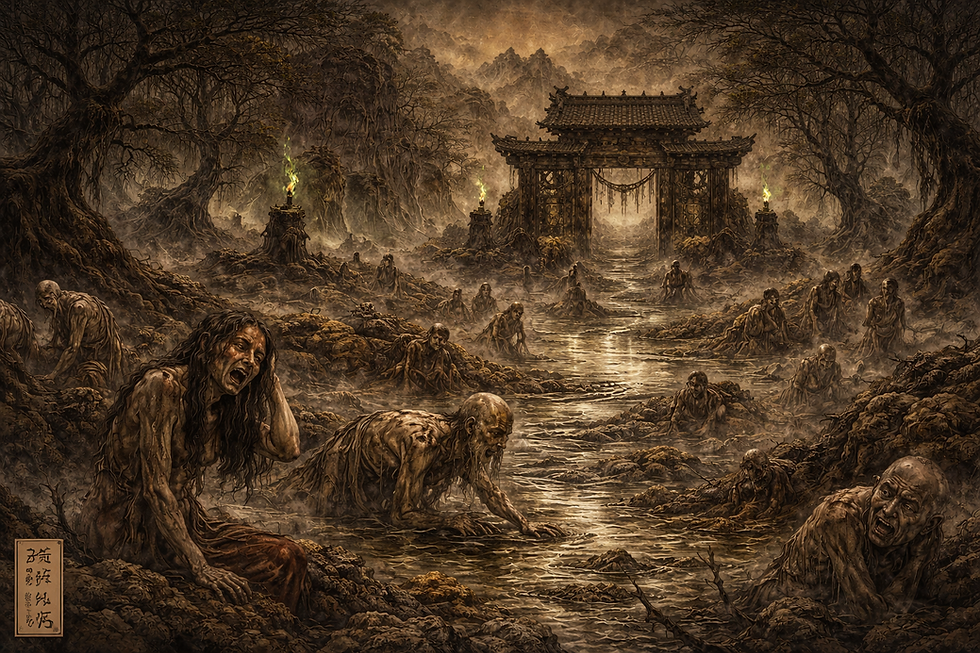
Yomi: The Land of the Dead
Yomi (黄泉), also known as Yomi-no-kuni or Yomo-tsu-kuni, is the most clearly defined of the hidden realms in Shinto cosmology. It is the land of the dead, located beneath the earth, with its entrance in Izumo province, blocked by the massive boulder placed by Izanagi.
Key characteristics of Yomi include:
Pollution | Contact with Yomi or its inhabitants generates profound impurity (kegare)
Irreversibility | Those who eat the food of Yomi cannot return to the land of the living; a motif shared with Greek, Hindu, and Mesoamerican underworld myths
The boulder barrier | The massive stone Izanagi placed at Yomi's entrance permanently separates the living and the dead
No moral judgment | Unlike the hells of Buddhism or Christianity, Yomi is not a place of punishment but simply the destination of all dead regardless of their conduct in life
Geographical continuity | Yomi has geographical continuity with the world of the living and is not a paradise
The Kojiki describes Yomi as a "polluted land" (kegareki kuni), reflecting the traditional Shinto association between death and pollution. It is ruled by Izanami no Mikoto, the Grand Deity of Yomi (Yomo-tsu-Ōkami).
Yomi features in two major myths. The first is Izanagi's disastrous journey to retrieve Izanami. The second involves Susanoo, who in some versions resides in Yomi alongside his mother Izanami, in a palace near the underworld's entrance. The storm god was banished there because he had shown excessive grief for his mother's passing.
In this myth, Ōkuninushi visits Susanoo in Yomi, undergoes ordeals involving snakes, bees, and centipedes (creatures associated with the underworld), and escapes with Susanoo's sword and bow, enabling him to defeat his eighty brothers and establish his rule.

Ne-no-Kuni: The Root Land
Ne-no-Kuni (根の国), the "Root Land" or "Land of Origins," is a more ambiguous realm whose relationship to Yomi is debated among scholars. In some myths, Ne-no-Kuni appears to be identical to Yomi; in others, it is a distinct realm with different characteristics.
Susanoo, after his exile from heaven, is said to have retreated to Ne-no-Kuni. The realm is associated with roots, origins, and the source of things; suggesting a connection to the underworld as the place from which life emerges as well as where it goes. Ne-no-Kuni is also known as Ne-no-Katasukuni (根の堅洲国, "firm/hard-packed shoal land of origin").
The ambiguity surrounding Ne-no-Kuni reflects the fluid, non-dogmatic nature of Shinto cosmology. Different texts and different shrine traditions offer varying interpretations, and no central authority ever imposed a unified doctrine.

Tokoyo: The Perpetual Country
Tokoyo (常世), also known as Tokoyo-no-kuni, is perhaps the most mysterious realm in Shinto cosmology. Unlike Yomi, which lies beneath the earth, Tokoyo is situated across the sea; a horizontal rather than vertical otherworld. Its name means "Perpetual Country" or "Eternal Land."
Scholars have identified three distinct conceptions of Tokoyo in the ancient sources:
World of perpetual darkness | A shadowy realm contrasting with the light of the sunlit world
Land of eternal youth | Where inhabitants never age and time flows differently
Land beyond the sea | A distant utopia reachable by sea voyage
Tokoyo is associated with several important myths. The tale of Urashima Tarō, preserved in the Nihon Shoki, tells of a fisherman who visits the undersea realm of the Dragon Palace; a clear variation of the Tokoyo motif. Upon returning to his village, he finds that centuries have passed.
The realm also appears in the story of Tajimamori, sent by Emperor Suinin to Tokoyo to seek the "perpetually fragrant fruit" (possibly the orange) that would grant immortality. Tajimamori eventually returned with the fruit, but the emperor had already died.
The Identification with Mount Penglai
Significantly, Tokoyo became identified in later periods with the Daoist paradise of Mount Penglai (Horai), the legendary island of immortals in Chinese mythology.
This identification illustrates the ongoing process of cosmological syncretism: when Chinese texts describing Penglai reached Japan, they were interpreted through the existing framework of Tokoyo, and Tokoyo was reinterpreted through the lens of Daoist immortality lore.
The Nihon Shoki explicitly glosses the Chinese characters for Penglai as Tokoyo-no-kuni, demonstrating how thoroughly the two concepts merged. This syncretism added new dimensions to Japanese cosmology: the hope for physical immortality, the image of a blissful island paradise, and the association of the western sea with magical realms.
The Tripartite Cosmic Structure
The coexistence of multiple otherworlds creates a complex cosmological geography. Shinto cosmology traditionally includes two distinct spatial orientations:
Vertical | Takamagahara (above) → Nakatsukuni (middle) → Yomi (below) | Hierarchical; different levels of existence
Horizontal | Nakatsukuni ↔ Tokoyo | Contiguous; Tokoyo exists beyond the sea, reachable by travel
These orientations are not mutually exclusive but represent different ways of conceptualizing the relationship between the visible world and other realms.
The vertical axis emphasizes hierarchy and the penetration of all levels by kami presence; the horizontal axis emphasizes mystery and the possibility of contact with other worlds through sea voyages.
This multi-dimensional cosmology reflects the layered nature of Japanese religious history; indigenous conceptions overlaid and interwoven with influences from China, Korea, and Buddhism, never fully systematized into a single coherent model.
The Afterlife in Shinto Thought
A critical aspect of Shinto cosmology is its relative lack of concern with the afterlife. Unlike many religious traditions that elaborate detailed geographies of post-mortem existence, Shinto is largely concerned with the here and now of the living.
In no ancient Shinto textual source is it explained who exactly goes to Yomi and why. Some historians suggest that the concept of a life after death was not familiar to the ancient Japanese and only took form with the introduction of Buddhism from China in the 6th century AD.
Yomi certainly has a very limited place in Shinto thought where a life after death is only vaguely alluded to and where there is an absence of a general concept of punishment and reward for souls in the next life as found in many other religions.
The only suffering of souls in Yomi, if indeed there is any at all, is their separation from their living loved ones.
The noted Shinto scholar and theologian Hirata Atsutane (1776–1843) explains Yomi and its limited significance thus:
"The old legends that dead souls go to Yomi cannot be proven. Then it may be asked, where do the souls of the Japanese go when they die? It may be clearly seen from the purport of ancient legends and from modern examples that they remain eternally in Japan and serve in the realm of the dead governed by Okuninushi-no-kami. This realm of the dead is not in any one particular place in the visible world, but being a realm of the darkness and separated from the present world, it cannot be seen… The darkness, however, is only comparative. It should not mistakenly be imagined that this realm is devoid of light. It has food, clothing, and houses of various kinds, similar to those of the visible world. Proof of this may be found in accounts…in which a person has occasionally returned to tell of the realm of the dead."
This conception, that the dead remain in Japan, governing the invisible world alongside Ōkuninushi, represents a significant evolution from the Yomi of the ancient myths. It reflects the influence of Buddhist cosmology and the systematizing efforts of later Shinto theologians.

Part VI: Buddhism & The Honji Suijaku Cosmology
The introduction of Buddhism to Japan in the sixth century AD initiated a profound transformation of Shinto cosmology. For the next millennium, kami worship and Buddhism were functionally inseparable, their relationship articulated through the interpretive framework known as honji suijaku (本地垂迹).

Honji suijaku means "original ground and trace manifestation." According to this theory, the Buddhist divinities—buddhas and bodhisattvas—are the honji (original ground), the ultimate sources of enlightenment and salvation. The kami of Japan are their suijaku (trace manifestations), local adaptations appearing in Japanese form to lead the people to Buddhist truth.
This framework accomplished several cosmological goals:
Hierarchical integration: Buddhism was positioned as the universal truth, Shinto as its particular Japanese expression
Mutual legitimation: Kami gained the prestige of association with Buddhism; Buddhism gained foothold in Japan through connection to native deities
Theological sophistication: The combinatory system allowed for complex philosophical elaboration
Cosmic expansion: The Shinto universe was integrated into the vast Buddhist cosmology of countless worlds and eons

Under the honji suijaku system, specific kami were identified with specific Buddhist divinities:
Amaterasu | Dainichi Nyorai (Mahāvairocana) | Sun symbolism; cosmic centrality
Toyuke Ōkami | Kongō-kai (Diamond Realm) | Corresponding to the Outer Shrine at Ise
Hachiman | Amida Buddha (Amitābha) | Compassion; protector of the state
Ōkuninushi | Yakushi Nyorai (Bhaisajyaguru) | Healing; care for the people
Susanoo | Gozanze Myōō (Trailokyavijaya) | Fierce power; destruction of evil
The identification of Amaterasu with Dainichi Nyorai (Mahāvairocana) was particularly significant. Dainichi, the Cosmic Buddha of Shingon Buddhism, whose name means "Great Sun," was a natural counterpart to the sun goddess.
The two figures merged in complex ways: Amaterasu gained the cosmic, all-pervading character of Dainichi, while Dainichi gained a personal, localized manifestation in the Japanese landscape.
Ryōbu Shintō: The Dual Mandalas and Ise
The most systematic expression of Buddhist-Shinto syncretism was Ryōbu Shintō ("Dual Shintō"), also called Shingon Shintō, developed by members of the Shingon sect in the Ise area during the late Heian (794–1185) and Kamakura (1192–1333) periods.
Ryōbu Shintō established an elaborate set of correspondences between esoteric Buddhist doctrine and the symbolism of the Ise Shrines.
Most notably:
The sun goddess Amaterasu was identified with the Buddha Mahāvairocana (Dainichi Nyorai)
The Inner and Outer Shrines at Ise were proclaimed a Japanese manifestation of the two mandalas of Shingon doctrine; the Womb Realm (taizō-kai) and Diamond Realm (kongō-kai)
Specifically, Amaterasu was considered the equivalent of the Womb World (taizō-kai), while Toyuke (or Toyouke) Ōkami, the kami of food, clothing, and shelter enshrined at the Outer Shrine, was equated with the Diamond World (kongō-kai). Their shrines at Ise were identified with the two mandalas used to represent the dual nature of Dainichi.
This line of reasoning had an important side-effect: in theory, it elevated the status of the Outer Shrine to virtual parity with the previously dominant Inner Shrine, the sanctuary of the sun goddess.
Traditionally, the kami of the Outer Shrine was considered a grain deity who provided sustenance to the sun goddess. The new cosmological framework challenged this hierarchy, setting the stage for later rivalries.
Ryōbu Shintō was highly influential in the development of other syncretic schools, notably Sannō Ichijitsu Shintō associated with the Tendai sect on Mount Hiei. The original school split into several branches, but these continued to flourish until the 18th century.
The Emergence of Ise Shintō
To justify an enhanced status for Toyuke, the Watarai family, hereditary custodians of the Outer Shrine, began to develop their own Shinto-oriented doctrines. By the end of the thirteenth century, they had created a canon of five apocryphal "classics," subsequently known as the Shintō gobusho.
These works represent a significant advance in Shinto cosmology, systematically incorporating elements from both esoteric Buddhism and Chinese yin-yang theory.
The most important section of these texts is the chapter on "The Division of Heaven and Earth" (tenchi kaibyaku), which presents a creation narrative that differs in significant respects from the Kojiki and Nihon Shoki accounts.
In their efforts to achieve doctrinal parity with Buddhism, the Watarai priests created a more systematic and philosophically elaborated cosmology than anything previously attempted in Shinto.
The Watarai Creation Narrative: Recasting the Cosmos
While the Kojiki and Nihon Shoki present a creation narrative centered on the spontaneous emergence of primordial kami and the subsequent acts of Izanagi and Izanami, the Watarai priests, seeking to establish doctrinal parity with Buddhism and elevate the status of the Outer Shrine (Gekū), crafted a significantly different and more philosophically elaborate cosmogony.
Their creation stories, preserved in texts like the Ruijū jingi hongen (1320) and the Korenshū (1319-1340), did not merely retell the old myths but systematically reinterpreted them through the lenses of esoteric Buddhism (Shingon) and Chinese Yin-Yang theory.
The Primordial Origins: The "Root Land" and the First Deities
The Watarai narrative begins not with the vague chaos of the Kojiki, but with a more defined primordial state they called the "Root Land" (Ne-no-kuni). This concept, which in earlier myths was a shadowy underworld, was re-imagined as the original, formless source of all existence.
From this void, the first kami, Kuni-no-tokotachi, emerged. Critically, the Watarai priests identified this primordial earth god not with the Inner Shrine (Naikū) of Amaterasu, but with Toyouke Ōmikami, the deity of the Outer Shrine. This was a radical departure from the traditional understanding where Toyouke was merely the food goddess who served Amaterasu.
In this new cosmic hierarchy, Toyouke (as Kuni-no-tokotachi) represented the primordial, unmanifest foundation of the universe, associated with the moon, water, and the yin principle.
The Watarai texts describe a system of "Five Generations of Earthly Kami" and "Seven Generations of Heavenly Kami" that predate the familiar Kamiyonanayo of the Kojiki, creating a more complex and hierarchical divine genealogy that placed the Outer Shrine's deities at the very beginning of time.

The Two Shrines as the Two Mandalas
The most innovative and theologically sophisticated element of the Watarai cosmology is the explicit identification of the two Ise shrines with the two fundamental mandalas of Shingon Buddhism.
This concept, part of the broader Ryōbu Shintō (Dual Shintō) movement, was not merely an act of syncretism but a claim that Japan, and Ise in particular, was the true source of cosmic truth.
The Watarai priests taught:
The Inner Shrine (Amaterasu) was identified with the Womb Realm Mandala (Taizōkai), which represents the principle of compassion, the creative, receptive, and maternal aspect of the universe.
The Outer Shrine (Toyouke) was identified with the Diamond Realm Mandala (Kongōkai), which represents the principle of wisdom, the immutable, active, and discriminating aspect of the universe.

These two mandalas, in Shingon doctrine, are two aspects of the Cosmic Buddha, Dainichi Nyorai (Mahāvairocana). By equating the two shrines with the two mandalas, the Watarai texts argued that Amaterasu and Toyouke were not servant and mistress, but two perfectly equal and complementary halves of a single, unified cosmic truth; a concept they called "two shrines, one light" (nikū ikkō).
Consequently, Ise itself was re-conceptualized as the sacred ground of Dainichi, effectively relocating the origin of the universe from India to Japan (Inside the narrative of Watarai priests).
A New "Division of Heaven and Earth"
The chapter on "The Division of Heaven and Earth" (tenchi kaibyaku) within these texts presented a creation story that was far more abstract and philosophical than the earlier chronicles.
Instead of a jeweled spear stirring the ocean, the Watarai cosmogony focused on the emanation of ki (vital energy) and the interplay of yin and yang.
The act of creation was described as the unfolding of the primordial, formless unity (represented by Toyouke/Kuni-no-tokotachi) into the differentiated, active world (represented by Amaterasu).

This new narrative served a clear political and theological purpose: it provided a sophisticated, philosophical foundation for Shinto that could stand alongside Buddhist doctrine.
By incorporating Chinese cosmological theory and esoteric Buddhist ritual (such as mantra and mudra), the Watarai priests transformed Shinto from a collection of mythological narratives into a systematic "Way" with its own complex understanding of the universe's origin and structure.
The Story of a "Parted Spirit"
A distinct creation story unique to the Watarai tradition concerns the nature of Toyouke herself. One text explains that Toyouke, as the primordial deity, produces "parted spirits" (waki-mi-tama) through a process of divine fissure.
From her, two essential kami were formed: Kukunochi no kami, the producer of all trees, and Kayanu-hime no kami, the parent of all grasses.
This narrative served a dual purpose. On one hand, it reinforced the traditional role of the Outer Shrine's deity as the provider of food, clothing, and shelter (since rice, cattle, and the silkworm were said to be produced from her body).
On the other hand, it elevated this function by grounding it in a complex theological process, explaining how a single primordial deity could be the origin of all the material blessings required for human life.
Summary of Key Differences in Watarai Cosmology (Classical Mythology | Watarai Cosmology):
Primordial Deity | Ame-no-Minakanushi (abstract, remote) | Kuni-no-tokotachi (identified with Toyouke)
Supreme Principle | Emergence of kami from chaos | Interplay of Yin-Yang and emanation of ki
Inner Shrine (Naikū) | The supreme shrine of the Sun Goddess Amaterasu | The Womb Realm Mandala (Taizōkai)
Outer Shrine (Gekū) | The subordinate shrine of the food goddess Toyouke | The Diamond Realm Mandala (Kongōkai)
Cosmic Unity | Implicit through imperial lineage | Explicit through the unity of the two mandalas, "two shrines, one light"
Creation Method | Izanagi and Izanami physically stirring the ocean | Philosophical unfolding of formless unity into differentiated reality
The Combinatory Cosmology
Under the honji suijaku paradigm, the Shinto pantheon was integrated into the vast cosmological framework of Buddhism. The kami became:
Protectors of Buddhism, guarding temples and monasteries
Beings seeking enlightenment, themselves in need of Buddhist liberation
Local manifestations of universal truths, their myths reinterpreted as allegories of Buddhist doctrine
Guardians of the nation, now understood within a Buddhist framework of protecting the Dharma
This combinatory religion produced rich cultural syntheses:
Shugendō: The mountain ascetic tradition combining Shinto nature worship, Buddhist esotericism, and Taoist practices
Ryōbu Shintō: The "Dual Shintō" of the Shingon school
Sannō Ichijitsu Shintō: The Tendai school's combinatory system centered on Hieizan
Honji suijaku art: Paintings and sculptures depicting kami in Buddhist iconographic forms
The Buddhist Cosmological Framework
Buddhism also introduced an entirely new cosmological geography that coexisted with, and sometimes superseded, the traditional Shinto realms. This included:
Six Realms of Rebirth | Hell-beings, hungry ghosts, animals, ashura, humans, heavenly beings
Pure Lands | Buddha-fields where enlightenment is easily attained, especially Amida's Western Paradise
Mount Sumeru cosmos | The central world-mountain surrounded by continents and oceans
Multiple world-systems | Countless universes across vast reaches of time and space
This cosmic scale vastly exceeded the traditional Shinto conception of a single world with Japan at its center. Over time, the two cosmologies coexisted in complex ways: the Shinto kami were understood to inhabit the Buddhist heavenly realms; the Japanese islands remained the specially favored land where kami manifested, but they were also part of a vast cosmic network.
Narrative Syncretism—Stories of Buddhas and Kami
The systematic cosmology developed by the Watarai priests was part of a broader medieval Japanese tradition of narrative syncretism. Unlike the theological treatises of Ise Shintō, however, this tradition expressed the unity of kami and buddhas through stories; collected in anthologies like the Shintōshū (神道集, "Collection of Shintō") and performed in songs like those of the Ryōjin hisho (梁塵秘抄, "Secret Songs of the Dust on the Beams").
These narratives did not merely argue for Shinto-Buddhist combination; they enacted it through tales of divine suffering, rebirth, and the revelation that Japan's sacred landscape was itself a manifestation of the Buddhist cosmos.
The Shintōshū: Tales of Kami as Karmic Beings
The Shintōshū, a ten-volume setsuwa (narrative tale) collection dating from the Nanboku-chō period (1336–1392), is the single richest source of Shinto-Buddhist syncretic stories. Compiled anonymously, likely within Tendai Buddhist clerical circles, it contains fifty chapters of tales dedicated to major shrines across Japan—Ise, Kasuga, Hie, Kumano, and Hachiman—each explaining the true Buddhist nature of the shrine's kami.
The tales follow a distinctive pattern. Before a being can become a tutelary kami (守護神, shugoshin) of a region, it must first be born and suffer there as a human being. The suffering is almost always caused by relationships with relatives, especially wives or husbands. Through this suffering, the being accumulates the karmic conditions necessary to manifest as a protective deity.
For example, a tale from the Shintōshū explains the origin of the deity enshrined at Akagi Daimyōjin in Kōzuke province (modern Gunma Prefecture). The story recounts how a certain individual, after enduring betrayal by a spouse and dying in great anguish, was reborn not as a vengeful ghost but as a kami; one who, having known human suffering, could now protect others from similar fates.
The kami was then identified as a manifestation (suijaku) of a specific Buddhist divinity, often a bodhisattva like Kannon or a buddha like Yakushi.
The Kumano Deities: Several Shintōshū chapters focus on the Kumano Sanzan (熊野三山), the three grand shrines of Kumano. In these tales, the three kami of Kumano—Kumano Hayatama, Kumano Fusumi, and Kumano Nachi—are revealed as manifestations of Amida Buddha, Yakushi Buddha, and Senju Kannon (Thousand-Armed Kannon) respectively.
The Kumano region itself is narratively constructed as a jōdo (Pure Land) on earth, a sacred geography where pilgrimage becomes an act of rebirth into Amida's Western Paradise.
One story tells of a sinful hunter who, after years of killing animals, undertakes the arduous pilgrimage to Kumano; upon reaching the shrine, he is visited by the kami in a dream, who reveals himself as Amida and assures the hunter that sincere devotion has erased his karmic debt.
Ryōjin hisho: Poetic Syncretism in Song
While the Shintōshū offers prose narratives, the Ryōjin hisho, compiled by Emperor Goshirakawa (1127–1192), preserves syncretic stories in verse. These songs were performed by wandering holy men (hijiri) and shrine maidens (miko), making the narratives of Shinto-Buddhist combination accessible to common people.
The Buddha Descends to Hie Shrine: One song (RH 244) tells the story of how the buddhas themselves descended to the Hie Shrine complex near Mount Hiei, the center of Tendai Buddhism:
buppo hiromu to te — To teach the Dharma,
tendai fumoto ni ato o tareowashimasu — buddhas descended to earth below Mount Tendai;
hikari o yawaragete chiri to nashi — dimming their radiance, they became dust like us,
higashi no miya to zo iwawareowashimasu — so we worship them at the Eastern Shrine.
The song plays on two key Buddhist concepts. The phrase ato o tare (trace, descending) renders honji suijaku in Japanese vernacular, while hikari o yawaragete chiri to nashi (dimming radiance, becoming dust) invokes wako dojin (和光同塵), the principle that buddhas humble their transcendent light to appear in ordinary form.
The "Eastern Shrine" (higashi no miya) refers to the Hie Shrine, here narratively established as the place where buddhas chose to manifest.
The Sanno Mandala in Verse: Another song (RH 417) tells the story of the entire Hie shrine complex as a syncretic mandala:
omiya ryojusen — Omiya is Eagle Peak;
hingashi no fumoto wa bodaiju ge to ka — its base to the east, they say, is the foot of the Bodhi tree;
ryoshosanjo wa shaka yakushi — the two shrines are Shakyamuni and Yakushi;
sate wa oji wa kanzeon — and the third one; and Oji is Kannon.
In this single verse, the song narrates the complete identification of the Hie shrine complex with the sacred geography of Buddhism:
Omiya, the primary shrine, is identified with Ryōjusen (Vulture Peak), where the Buddha preached the Lotus Sutra.
Ninomiya at the eastern base is identified with the Bodhi tree under which Shakyamuni attained enlightenment.
Shoshinji (the "two shrines") are named as Shakyamuni and Yakushi (the Medicine Buddha).
Hachioji is identified with Kanzeon (Kannon), the bodhisattva of compassion.
The song transforms the physical landscape of the Hie complex into a narrative map of Buddhist salvation history, telling its listeners that Japan's sacred sites are not separate from those of India but are their direct manifestations.
The Lake as Buddhist Paradise: A third song (RH 253) extends this narrative geography to Lake Biwa, the great lake adjacent to Mount Hiei:
omi no mizuumi wa umi narazu — Not a lake, that lake in Omi,
tendai yakushi no ike zo ka shi — but Tendai Yakushi's pond, yes!
na zo no umi — What kind of pond?
joraku gajo no kaze fukeba — When the wind of eternally pure joy blows,
shichiho renge no nami zo tatsu — waves rise, of seven-jeweled lotus blooms.
The song tells a story of transformation: the ordinary lake becomes the sacred pond of Yakushi Buddha, and its waves become lotus flowers made of the seven jewels that adorn Buddhist paradises. A secular landscape is thus narratively re-enchanted as a Pure Land.
Amaterasu as Judge of the Dead: A Narrative of Salvation
One of the most striking syncretic narratives concerns Amaterasu, the supreme Shinto deity, who was reinterpreted in medieval texts as the judge of the dead. This story appears in works such as the Nihongi kanjō (日本紀灌頂) and related esoteric Buddhist ritual texts.
According to this narrative, Amaterasu does not simply rule the High Celestial Plain (Takamagahara) but presides over the realm of the dead, determining the fate of souls based on their karma. The story tells how, after death, all souls must cross a river (mirroring the Buddhist Sanzu-no-kawa, or "River of Three Crossings") and stand before Amaterasu.
Using the sacred mirror, one of the Three Imperial Regalia, she reflects the true nature of each soul's deeds, judging whether it will achieve rebirth in a Pure Land, fall into hell realms, or return to the world of the living.
This narrative represents a profound syncretic transformation. The sun goddess, originally a deity of light and life, becomes also a lord of death; a role likely derived from the Hindu/Buddhist deity Enma (Yama), the king of hell, yet transposed into the register of Shinto symbolism.
The story circulated primarily through esoteric Buddhist initiation rituals (kanjō), where it was performed rather than merely read, making the narrative an embodied experience for initiates.
Raijin—The Thunder God in the Syncretic Narrative
The thunder god Raijin (雷神, "Thunder Kami") occupies a distinctive place in the history of Shinto-Buddhist syncretism. Unlike deities such as Amaterasu, who was identified with a single Buddhist counterpart (Dainichi Nyorai), Raijin accumulated multiple Buddhist associations across different historical periods and textual traditions.
His story illustrates how the honji suijaku paradigm operated not as a single systematized doctrine but as a flexible narrative framework that could incorporate even the most ancient and fearsome kami.
Raijin as Kannon's Attendant: With the arrival of Buddhism in Japan, Raijin's narrative underwent a significant transformation. Rather than being demonized or suppressed, the thunder god was incorporated into the Buddhist celestial hierarchy.
The most important syncretic narrative positioned Raijin as an attendant of Senju Kannon (Thousand-Armed Kannon, the bodhisattva of compassion).
The story, preserved in both textual sources and artistic representations, tells that when Kannon descended to guide the Japanese people, she brought with her a retinue of protective deities. Among these were two brothers: Raijin, the thunder god, and Fūjin, the wind god.

Their role was to guard the boundaries of sacred space and to subdue demonic forces that might threaten the Buddhist Dharma.
This narrative is visually encoded in one of Japan's most famous works of art: the Fūjin Raijin zu (Wind God and Thunder God Screens) by Tawaraya Sōtatsu (17th century), which depicts the two gods as demonic figures mounted on clouds, Raijin beating his ring of drums to create thunder.
The screens were originally housed at Kennin-ji temple in Kyoto, and the iconography derives from Kamakura-period sculptures of Raijin and Fūjin that flank the thousand statues of Kannon in Sanjūsangen-dō temple.
The physical placement of Raijin's sculptures within Buddhist temple spaces tells its own narrative: the fearsome thunder god, born from a rotting corpse in Yomi, had been transformed into a protector of the Buddha's teaching.
Raijin as Tenjin: A second syncretic narrative developed around the historical figure of Sugawara no Michizane (845–903), a brilliant court scholar who was wrongfully accused of treason and died in exile.
After his death, a series of calamities struck the capital—lightning strikes, fires, and epidemics—which were interpreted as the work of Michizane's vengeful spirit (goryō).
The narrative of this transformation is as follows:
In the Heian period, lightning strikes in Kyoto were understood not as natural phenomena but as manifestations of the curses of vengeful spirits. When Michizane's spirit caused a lightning strike to hit the Great Audience Hall of the Imperial Palace in 930, killing several courtiers, it was believed that the thunder god himself had merged with the wrathful spirit of the wronged scholar.
Michizane was posthumously deified as Tenjin (天神, "Heavenly Kami"), and Raijin came to be worshiped as one figure within the Tenjin cult, specifically under the name Karai Tenjin (火雷天神, "Fire-and-Thunder Heavenly Kami").
This narrative achieved a complex theological synthesis: the thunder god born from Izanami's corpse in the age of the gods was identified with the vengeful spirit of a historical human being, who was then venerated as a Buddhist-influenced kami.
Temples and shrines across Japan tell the story of how Michizane, through Buddhist rites of pacification (goryō-e), was transformed from a destructive spirit into a protective deity; and Raijin, his thunderous aspect, was pacified alongside him.
The Capture of Raijin: Perhaps the most explicit narrative of Buddhist superiority over the thunder god is the folk tale known as "The Capture of Raijin." This story circulated widely in medieval Japan and was recorded in multiple versions.
The narrative proceeds as follows:
A great storm was ravaging the land, destroying crops and terrorizing the people. The Emperor ordered a man named Sugaru—known as the "God Catcher"—to imprison Raijin and stop the destruction. Sugaru first petitioned Raijin in the name of the Emperor, asking the thunder god to cease his rampage willingly. Raijin only laughed at him.
Sugaru then prayed to Kannon, the bodhisattva of compassion. Moved by his devotion, Kannon ordered Raijin to submit to Sugaru. The thunder god, unable to resist the bodhisattva's command, allowed himself to be captured. Sugaru tied Raijin in a sack and delivered him to the Emperor. Under Sugaru's control, Raijin was forced to cease his destruction and instead bring only beneficial rains to Japan.
This narrative encodes a clear theological hierarchy: the Shinto thunder god, born from the primal chaos of Yomi, is ultimately subordinate to the Buddhist bodhisattva Kannon.
Raijin's capture by a human agent empowered by Buddhist devotion demonstrates the supremacy of Buddhist spiritual power over native kami; a theme consistent with the broader honji suijaku framework.
Raijin as Protector of Japan: A final syncretic narrative portrays Raijin not as a force to be subdued but as a divine protector of the Japanese islands. This story became popular after the Mongol invasions of 1274 and 1281.
When the fleets of Kublai Khan approached the shores of Japan, the people feared conquest. But as the Mongol ships gathered, a great storm rose from the sea. Raijin appeared in the clouds, beating his drums and hurling lightning bolts at the invaders, while his brother Fūjin unleashed typhoon winds from his bag. The Mongol fleet was scattered and destroyed. The Japanese called this storm the kamikaze (divine wind), and Raijin was celebrated as a defender of the realm.
This narrative represents a departure from the "capture" tradition. Here, Raijin is not subdued by Buddhist power but acts in harmony with the Buddhist-protected state.
The story circulated widely in warrior culture and was depicted in propaganda prints as late as the Russo-Japanese War (1904-1905), where Raijin was shown frightening Russian forces.
The thunder god's journey through Japanese religious history thus mirrors the broader pattern of honji suijaku itself: a flexible, unsystematized, but deeply pervasive narrative framework that allowed Japan's indigenous gods to be reimagined within the Buddhist cosmos without ever being entirely erased.
Summary of the Storytelling Tradition:
Shintōshū | 1336-1392 | Prose setsuwa tales | Karmic origins of Akagi, Kumano, and other shrine deities; kami as reborn beings who suffered human lives
Ryōjin hisho | Late 12th c. | Verse songs | Buddha's descent to Hie; Hie shrines as Vulture Peak and Bodhi tree; Lake Biwa as Yakushi's Pure Land
Nihongi kanjō | 13th-14th c. | Ritual initiation narrative | Amaterasu as judge of the dead; the mirror as instrument of karmic judgment
The stories above represent a sample of the available syncretic narratives. For additional tales, the following primary sources are recommended:
1. The Shintōshū: Only portions have been translated into English. The full fifty-chapter collection exists in Japanese critical editions; specific chapters on Ise, Kasuga, and Hachiman shrines contain further narratives of kami as Buddhist manifestations.
2. The Ryōjin hisho: Multiple shiku no kamiuta (songs on Shinto deities) contain syncretic narratives beyond those cited here, including songs on Mount Kinbu as Tusita Heaven and on the Eleven-headed Kannon manifesting as a great kami.
3. Teeuwen and Rambelli, Buddhas and Kami in Japan: This volume contains a chapter by Mark Teeuwen titled "The Creation of a Honji Suijaku Deity: Amaterasu as the Judge of the Dead," which provides the full narrative of Amaterasu's role as death-judge with detailed analysis of the ritual contexts in which it was performed.
4. Shrine Origin Texts (engi): Individual shrines maintained their own engi (緣起, "account of origins") that told the story of the shrine's founding and the identity of its kami as a Buddhist manifestation. The Kasuga Gongen genki, for example, tells in illustrated scrolls how the Kasuga kami are manifestations of buddhas and bodhisattvas.
Challenges to the Combinatory System
The honji suijaku paradigm was not universally accepted without question. Already in the medieval period, some thinkers proposed inverted honji suijaku theories, arguing that the kami were actually the original ground and the Buddhist divinities their manifestations.
These inversions reflected growing confidence in Shinto's independent status and resistance to Buddhist dominance.
In the Muromachi period, Yoshida Kanetomo (1435–1511) created the first Shinto theory that had its own doctrine, scriptures, and rituals independent of Buddhism. Yoshida Shintō adopted Daoist and Neo-Confucian themes of yin-yang and substance-function, positioning itself as the "One and Only Shinto" (Yuiitsu Shintō).
In the Edo period, the Kokugaku movement launched systematic critiques of Buddhist-Shinto syncretism. Motoori Norinaga (1730–1801) insisted on recovering the "pure" Japanese way untainted by foreign (Chinese and Buddhist) elements.
He denied that the word "Shinto" had existed in ancient times and traced its origin back to the work of the imperial lineage initiated by Amaterasu. This intellectual movement prepared the ground for the Meiji-era separation of kami and buddhas.
Part VII: Competing Narratives Within Shinto Cosmology
One of the most persistent cosmological tensions in Shinto concerns the relationship between the Ise Shrine (dedicated to Amaterasu) and the Izumo Shrine (dedicated to Ōkuninushi).
The Ise Shrine, associated with the imperial line descending from Amaterasu, has generally held supremacy in official state cults. However, Izumo's claims that all gods gather there annually, and that Ōkuninushi rules the invisible world, implicitly challenge this hierarchy.
The rivalry played out in multiple dimensions (Ise Position | Izumo Position):
Cosmic hierarch | Amaterasu supreme; Ōkuninushi subordinate | Ōkuninushi rules invisible world; Amaterasu rules visible world
Divine assembly | All kami gather at Ise? | All kami gather at Izumo in tenth month
Creation narrative | Heavenly descent of Ninigi primary | Ōkuninushi's creation of land primary
Imperial lineage | Direct descent from Amaterasu | Izumo kami also significant
Some Kokugaku scholars, including Hirata Atsutane, elevated Ōkuninushi to a position that rivaled or even surpassed Amaterasu. Hirata taught that Ōkuninushi presided at the Izumo Shrine and ruled on the invisible affairs of the kami.
For Atsutane, Ōkuninushi was superior to the Christian God, who he compared to the Hindu/Buddhist Deva-king Brahma (bonten) and king Enma. The shrines were imagined to link the world of the kami with the visible world.
This alternative cosmic geography has never been fully reconciled with the Ise-centered imperial cosmology. The Meiji government's construction of State Shinto systematically marginalized the Izumo tradition, "vanquishing" Ōkuninushi to establish Amaterasu's unchallenged supremacy.
Textual Contradictions: The Kojiki and Nihon Shoki present significantly different versions of many myths. The Nihon Shoki, in particular, often includes multiple variant accounts of the same episode, preserving alternative traditions without attempting to harmonize them.
Key contradictions include (Kojiki Version | Nihon Shoki Variants):
Creation of islands | Izanagi and Izanami create all islands together | Some variants suggest different origins for certain islands
Tsukuyomi's exile | Not detailed | Multiple versions of the Uke Mochi killing
Susanoo's banishment | Caused by his behavior toward Amaterasu | Some variants suggest additional reasons
Ninigi's descent | Straightforward succession | Alternative genealogies for accompanying deities
These contradictions reflect the diverse oral traditions that were synthesized in the eighth-century compilations. Rather than representing a problem to be solved, they reveal the dynamic, polyvocal nature of Shinto cosmology.
The Ambiguity of Yomi and the Afterlife
The relationship between Yomi, Ne-no-Kuni, and later Buddhist conceptions of the afterlife remains ambiguous. As noted earlier, the Kojiki associates Yomi with pollution and decay, but does not explain who goes there or why.
The Nihon Shoki uses the Chinese characters for "Yellow Springs" (Huangquan) to write Yomi, importing associations with the Chinese underworld.
Hirata Atsutane's reinterpretation—that the dead remain in Japan, serving in the realm of the invisible governed by Ōkuninushi—represents a significant departure from the ancient myths.
This conception may have been influenced by Buddhist notions of localized afterlife realms, as well as by the need to counter Christian missionary teachings about heaven and hell.
The ambiguity reflects a fundamental characteristic of Shinto cosmology: its focus on the living world and its relative indifference to detailed speculation about post-mortem existence.
The "Vanquished Gods" of Izumo
Yijiang Zhong's research has demonstrated how the Meiji state systematically marginalized the Izumo tradition to establish Amaterasu's unchallenged supremacy. This "vanquishing" of the Izumo gods was part of the construction of State Shinto and remains a sensitive topic in Shinto studies.
The process involved:
Removing Buddhist artifacts and associations from Izumo Shrine
Re-establishing Ōkuninushi as the sole deity of the shrine
Subordinating Izumo's cosmological claims to Ise-centered orthodoxy
Redefining Izumo traditions as "sect Shinto" rather than "shrine Shinto"
Suppressing the teaching that Ōkuninushi rules the invisible world
This political intervention in cosmology demonstrates that the Shinto divine universe has never been a purely theological matter; it has always been entangled with questions of power, authority, and national identity.
The Problem of Divine Gender
Shinto cosmology presents a complex and sometimes contradictory picture of divine gender. The supreme deity is female (Amaterasu), yet female deities are often subordinated in the myths; Izanami must not speak first, Uke Mochi is killed for her food production methods, Izanami is left to rot in Yomi while Izanagi escapes.
This tension has been explored by various interpreters. Some scholars see evidence of ancient matriarchal traditions later overlaid by patriarchal values. Others interpret the myths as encoding a complementary duality rather than simple hierarchy. The issue remains contested.
Parallel Cosmological Motifs in Global Context
Shinto cosmology shares numerous motifs with other world traditions:
Primordial chaos | Formless state before creation | Mesopotamian Tiamat; Greek Chaos; Chinese Hundun
Cosmic egg/pole | Jeweled spear stirring ocean | Hindu cosmic churning; Chinese Pangu separating heaven and earth
Divine couple creation | Izanagi and Izanami | Geb and Nut (Egypt); Sky Father and Earth Mother (many traditions)
Food of the dead | Izanami eats in Yomi | Persephone's pomegranate; Chinese food of the dead
Descent to underworld | Izanagi's journey | Orpheus and Eurydice; Inanna's descent; Jesus's harrowing of hell
Sacred marriage | Izanagi and Izanami's ritual | Hieros gamos in many traditions
Dragon/Serpent slaying | Susanoo and Yamata-no-Orochi | Indra and Vritra; Thor and Midgard Serpent; Beowulf and Grendel
Solar deity | Amaterasu | Ra (Egypt); Helios (Greece); Surya (India); Huitzilopochtli (Aztec)
Moon deity | Tsukuyomi | Selene (Greece); Luna (Rome); Chandra (India); Coyolxauhqui (Aztec)
Trickster figure | Susanoo | Loki (Norse); Coyote (Native American); Eshu (Yoruba)
Underworld realm | Yomi | Hades; Hel; Mictlan; Sheol; Duat
Paradise across sea | Tokoyo identified with Penglai | Avalon; Hy-Brasil; Fortunate Isles |
These parallels do not necessarily indicate direct borrowing, though in many cases Chinese and Korean influences are clearly present. The identification of Tokoyo with Mount Penglai is a documented case of syncretism; other similarities may reflect universal human archetypes or the common heritage of Eurasian cultures.
The Evolution of Shinto Cosmology Through Textual Layers
Shinto cosmology evolved significantly through different textual layers and historical periods:
Pre-literate | Oral traditions | Local kami; nature worship; no systematic cosmology
Kofun | Burial mound symbolism | Emerging cosmic geography; connections between rulers and kami
Nara | Kojiki, Nihon Shoki | Systematic pantheon; tripartite cosmos; imperial theology
Heian | Engishiki; ritual texts | Shinto integrated into Buddhist cosmology; kami as protectors
Kamakura | Shinto gobusho | Ise Shinto develops systematic cosmology; Buddhist-Shinto synthesis elaborated
Muromachi | Yoshida Shinto texts | First independent Shinto cosmology; Neo-Confucian elements
Edo | Kokugaku commentaries | "Pure" Shinto cosmology reconstructed; rejection of Buddhist elements
Meiji | State Shinto texts | Simplified, emperor-centered cosmology; marginalization of Izumo
Post-war | Contemporary scholarship | Recognition of historical development; multiple valid traditions
This evolution demonstrates that Shinto cosmology has never been a single, static system. It has been continuously reinterpreted in response to changing intellectual, political, and religious contexts.
Part VIII: Conclusion—The Living Cosmos
Shinto cosmology is not a closed system of ancient beliefs but a living, evolving tradition that has adapted continuously over more than a millennium.
From the primordial emergence of the first kami in the formless chaos, through the creative labors of Izanagi and Izanami, the establishment of heavenly and earthly realms, the complex negotiations between Amaterasu and Ōkuninushi, the profound syntheses with Buddhist cosmology, and the modern reconstructions of the Kokugaku and Meiji eras; Shinto's cosmic vision has proven remarkably resilient and adaptable.
Several themes recur throughout this history:
The primacy of Japan: From the creation of the islands as the first land, through the descent of the heavenly grandson, to the unbroken imperial line, Shinto cosmology consistently affirms Japan's unique status as a land favored by the kami. This claim has served both to unify the Japanese people and to distinguish them from other nations.
The multiplicity of perspectives: Shinto cosmology has never been a monolithic orthodoxy. The Izumo tradition offers an alternative to Ise-centered narratives; different textual traditions preserve competing versions of the same myths; the relationship between kami and buddhas was debated for centuries; the afterlife remained vaguely defined and variously interpreted. This pluralism is intrinsic to the tradition.
The permeability of worlds: The boundaries between heavenly, earthly, and hidden realms are never absolute. Kami descend from Takamagahara; humans who die may become kami; the dead dwell in Yomi but interact with the living; Tokoyo lies across the sea, potentially reachable. This permeability means the cosmos is always present, always accessible.
The creativity of purification: Pollution is real and dangerous, but purification is not merely negative. The myth of Izanagi's cleansing establishes that new life emerges from the removal of impurity. This optimistic vision, life perpetually out-pacing death, as Izanagi's fifteen hundred births against Izanami's thousand deaths, remains the deepest truth of Shinto cosmology.
The integration of foreign elements: From Chinese yin-yang theory to Buddhist esotericism to Daoist immortality lore, Shinto cosmology has repeatedly absorbed and transformed elements from other traditions. This syncretic capacity has been a source of strength, allowing Shinto to remain relevant while maintaining its distinctive character.
The cosmos of Shinto is vast, complex, and irreducible to simple formulas. It contains multiple realms, countless kami, competing narratives, and centuries of reinterpretation.
Yet at its core remains the fundamental insight first expressed in the age of the gods: that the world is saturated with sacred presence, that purity and pollution shape existence, that life perpetually overcomes death, and that the Japanese islands and their people exist in a unique and eternal relationship with the divine.
As Hirata Atsutane wrote in the nineteenth century, "the shrines are imagined to link the world of the kami with the visible world."
This linking—this permeability between realms, this ongoing presence of the divine in the human world—is the essence of Shinto cosmology.
The kami may withdraw from visible rule, as Ōkuninushi withdrew into the invisible world, but they remain present; in the mountains and rivers, in the shrine rituals, in the seasonal festivals, in the unbroken line of emperors, in the hearts of those who still pause at the torii gate before entering sacred space.
The divine universe of Shinto continues to evolve. Contemporary scholars recognize the historical development of the tradition and the validity of multiple interpretations.
The "vanquished gods" of Izumo have returned to visibility. The relationship between Buddhist and Shinto elements continues to be explored. New generations reinterpret the ancient myths for new contexts.
In this ongoing evolution, the cosmos of Shinto remains a living reality; not merely a collection of ancient stories, but an active presence shaping Japanese understanding of the world and their place within it.
The kami continue to dwell in their sacred places, the divine assembly continues to gather at Izumo each year, the sun continues to rise each morning as Amaterasu emerges from her cave, and the unbroken line of the imperial house continues to link the present to the age of the gods.
This is the cosmos of Shinto: eternal yet ever-changing, ancient yet contemporary, hidden yet manifest in every aspect of Japanese life.
Appendix A: The Kami Pantheon—Genealogical Chart
The Primordial Kami (Kotoamatsukami):
Ame-no-Minakanushi (Lord of the August Center of Heaven)
Takamimusubi (Lofty Growth)
Kamimusubi (Sacred Musubi Deity)
Umashiashikabihikoji
Amenotokotachi
The Seven Generations (Kamiyonanayo) | (First two generations: single deities; remaining five generations: pairs):
Kuni-no-tokotachi
Toyo-kumono
Pair: Uhijini / Suhijini
Pair: Tsunugui / Ikugui
Pair: Ōtonoji / Ōtonobe
Pair: Omodaru / Ayakashikone
Pair: Izanagi / Izanami
The Three Noble Children:
Amaterasu Ōmikami (Sun; ruler of Takamagahara)
Tsukuyomi (Moon; ruler of night)
Susanoo (Storm; ruler of seas; ancestor of Izumo line)
Izumo Lineage:
Susanoo
Ōkuninushi (son/dependent)
Kotoshironushi
Various local kami
Heavenly Descendants:
Ninigi (grandson of Amaterasu)
Hiko-hoho-demi (grandson of Ninigi)
Ugayafukiaezu (father of first emperor)
Emperor Jimmu (first human emperor)
Major Subsidiary Kami:
Ame-no-Uzume: Goddess of dance and mirth; lured Amaterasu from cave
Kagutsuchi: Fire kami; caused Izanami's death
Hachiman: God of war; syncretic figure
Inari: God of rice, agriculture, prosperity
Tenjin: Deified scholar Sugawara no Michizane
Seven Lucky Gods: Includes Daikokuten (identified with Ōkuninushi), Ebisu (Hiruko), etc.
Appendix B: Major Cosmic Realms in Shinto Cosmology
Takamagahara | High Celestial Plain | Above the visible world | Heavenly kami (Amaterasu, etc.) | Divine society; palaces; rice fields; mirror of human society
Nakatsukuni | Middle Land | The visible world | Humans, earthly kami (Ōkuninushi, etc.) | Japan; sacred mountains, rivers; permeable boundaries with other realms
Yomi | Land of Darkness | Below the earth; entrance in Izumo | The dead; Izanami; Eight Thunders | Pollution; decay; sealed by boulder; no moral judgment
Ne-no-Kuni | Root Land | Uncertain; possibly identical to Yomi or distinct | Susanoo; underworld kami; roots/origins | Ambiguous relationship to Yomi; associated with origins
Tokoyo | Perpetual Country | Across the sea | Immortals; eternal beings | Eternal youth; identified with Mount Penglai; reachable by sea voyage
Ryōbu realms | Dual mandalas | Cosmological | Buddhist divinities; kami manifestations | Introduced through Buddhist syncretism; Womb and Diamond realms
Pure Lands | Buddha-fields | Distant cosmic realms | Buddhas and bodhisattvas | Buddhist addition; especially Amida's Western Paradise
Appendix C: Major Texts Preserving Shinto Cosmology
Kojiki | 712 AD | Oldest extant chronicle; most complete creation narrative
Nihon Shoki | 720 AD | Official court history; includes multiple variant accounts
Shintō gobusho | 13th century | Ise Shinto "apocrypha"; systematized cosmology with Buddhist/Chinese elements
Ruijū jingi hongen | 1320 | Watarai Ieyuki compilation; influenced later Shinto thought
Yoshida Shinto texts | 15th–16th c. | First independent Shinto cosmology
Kojiki-den | 1798 | Motoori Norinaga's commentary; Kokugaku interpretation

References:
"The Japanese Gods That Created The Universe and Humanity." History Cooperative, 2020.
Katō, Genchi. A Study of Shinto: The Religion of the Japanese Nation. Routledge, 2013 (reprint of 1926 edition).
"Yomi." Wikipedia.
"Ryōbu Shintō." Encyclopædia Britannica.
Kim, Tae-ho. "Norinaga Kokugaku's Criticism on Shinto: 'Kuni', 'Kami' and 'Michi'." KCI, 2025.
"Core stories of Shinto." BBC Religions, 2009.
Cartwright, Mark. "Yomi." World History Encyclopedia, 2017.
"Six Circles, One Dewdrop: The Religio-Aesthetic World of Komparu Zenchiku." Project MUSE.
Kim, David W. Review of Yujiang Zhong, The Origin of Modern Shinto in Japan: The Vanquished Gods of Izumo. Journal of Religion in Japan 10(1): 106-110, 2021.


Comments