
.png)

Classical World: Japan, Rise of the Samurai State
- A. Royden D'Souza

- Mar 20
- 43 min read
In this exploration of classical Japan, we'll continue from the Nara period (710–794 AD) through to the dawn of the Meiji Restoration (1868 AD).
This millennium witnessed profound transformations in every aspect of Japanese civilization: the flowering of court culture in Heian-kyō, the rise of the warrior class and the establishment of the shogunate, the traumatic Mongol invasions, the centuries of civil war known as the Sengoku period, the unification under Oda Nobunaga and Toyotomi Hideyoshi, the long peace of Tokugawa rule, and finally the tumultuous collapse of the shogunate and the restoration of imperial authority.

The classical period of Japanese history is defined by a fundamental tension between continuity and change. The imperial institution, though often politically marginalized, maintained its ritual authority throughout these centuries, tracing an unbroken lineage that remains the world's oldest hereditary monarchy.
The religious landscape evolved through the syncretic fusion of Buddhism and Shintō, articulated in the honji suijaku theory that understood native kami as manifestations of Buddhist divinities.

The emergence of new Buddhist movements—Pure Land, Nichiren, Zen—transformed spirituality and reached every level of society. The warrior ethos, crystallized in the ideals of loyalty, honor, and martial prowess, created a cultural legacy that continues to shape Japanese identity.
Let's try to trace the complete arc of classical Japanese history: from the Heian period's aristocratic efflorescence, when courtiers at Kyoto produced the world's first novel and perfected an aesthetics of refined sensitivity; through the Kamakura period's establishment of warrior government and the defensive struggles against Mongol invasions that gave rise to the kamikaze legend; the Muromachi period's cultural flowering amid political fragmentation; the chaotic but creative Sengoku era, when social mobility and military innovation transformed Japan; the Azuchi-Momoyama period's rapid unification and the first encounters with Europeans; and the long Tokugawa peace, during which Japan developed sophisticated urban culture while navigating the challenges of foreign pressure and internal change.
The Mongol invasions connected Japan to the vast empire that stretched from Korea to Eastern Europe. The Nanban trade brought Portuguese and Spanish merchants and missionaries, introducing firearms and Christianity.

Tokugawa Ieyasu's early diplomacy engaged with Spain, the Netherlands, and England before the sakoku policies limited foreign contact. The classical period was never one of complete isolation; Japan was always in dialogue with the broader world.
The evolution of religion receives particular attention. The syncretism of Buddhism and Shintō created a rich cosmological framework in which kami and buddhas were understood as two aspects of the same sacred reality. The esoteric traditions of Tendai and Shingon offered elaborate rituals for accessing enlightenment.
The "new Buddhism" of the Kamakura period made salvation accessible to ordinary people through faith, practice, or devotion. Zen appealed to warriors with its emphasis on discipline and direct experience. The cosmological vision of a universe saturated with buddhahood—in which "grasses, trees, mountains and rivers all attain buddhahood"—expressed a profound interconnectedness that shaped Japanese aesthetics and ethics.
Let's try to present a comprehensive, balanced account of Japan's classical age, acknowledging both the extraordinary achievements of its civilization and the complex controversies that attend its study. By examining the full sweep of this millennium, we can appreciate the foundations upon which modern Japan was built.
Part I: The Heian Period—Flowering of Culture

In 794 AD, Emperor Kanmu (781–806 AD) relocated the capital from Nara to a new city called Heian-kyō ("Capital of Peace and Tranquility"), marking the beginning of the Heian period. This move was motivated by a desire to escape the political influence of powerful Nara temples and to establish a fresh start for imperial rule.
The new capital, laid out on a grid pattern modeled after the Tang capital of Chang'an, would remain the imperial seat for over a thousand years; until 1868, when the Meiji emperor moved to Tokyo.
The Heian period is conventionally divided into three phases:

Early Heian | 794–967 | Consolidation of ritsuryō system; rise of esoteric Buddhism (Tendai, Shingon)
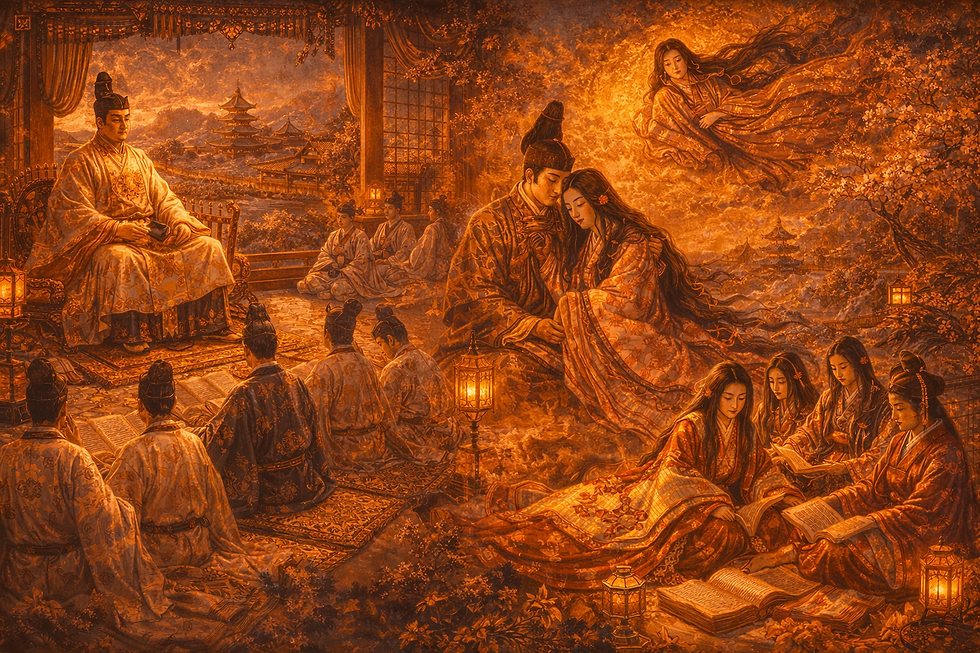
Middle Heian (Fujiwara period) | 967–1068 | Fujiwara regency; zenith of court culture; The Tale of Genji

Late Heian (Insei period) | 1068–1185 | Cloistered emperor rule; rise of warrior class; Genpei War
The early Heian period saw the continuation of the ritsuryō system of centralized governance established in the Nara period. However, the system gradually broke down as tax exemptions granted to temples and aristocratic estates (shōen) eroded imperial revenues, and as powerful families consolidated private holdings outside state control.
The Rise of Esoteric Buddhism: Tendai and Shingon
Two new Buddhist schools, both imported from Tang China, transformed Japanese religion during the early Heian period. Their esoteric (mikkyō) teachings offered elaborate rituals for achieving enlightenment in this very body, and their cosmological visions profoundly influenced Japanese art, literature, and thought.

Tendai Buddhism: The monk Saichō (767–822 AD) traveled to China in 804 AD, where he studied Tiantai (Tendai) Buddhism on Mount Tiantai. He returned the following year, bringing with him the Lotus Sutra-centered teachings of Tiantai, as well as esoteric practices, Zen meditation, and Vinaya precepts.
Saichō established his center on Mount Hiei (Hieizan), northeast of Kyoto, which he envisioned as a "perfect university" for the protection of the state.
Tendai Buddhism is characterized by its inclusivism: it sought to harmonize all Buddhist teachings within a hierarchical framework culminating in the Lotus Sutra. The doctrine of ichinen sanzen ("three thousand realms in one moment of life") articulated the interpenetration of all phenomena, asserting that every moment of consciousness contains the entirety of reality.
This philosophical vision supported the Tendai claim that all beings possess the potential for enlightenment and that the phenomenal world is itself a manifestation of Buddha-nature.
Tendai's inclusivism made it enormously influential. Most later Japanese Buddhist movements—including Pure Land, Nichiren, and Zen—emerged from within Tendai before striking out as independent schools.
Mount Hiei became one of Japan's most powerful religious institutions, with thousands of monks, armed warrior-priests (sōhei), and extensive landholdings.

Shingon Buddhism: The monk Kūkai (774–835 AD), also known posthumously as Kōbō Daishi, accompanied Saichō on the 804 AD mission but studied in different monasteries, absorbing esoteric Buddhism (Vajrayana).
Upon his return in 806 AD, he established Shingon ("True Word") Buddhism, which remains one of Japan's major Buddhist traditions.
Shingon's teachings center on the Dainichi Nyorai (Mahāvairocana Buddha), the cosmic Buddha whose body is the entire universe. Kūkai articulated a sophisticated cosmology in which the Dharmakāya (truth body) of the Buddha is not silent and abstract but actively preaches the Dharma through the very fabric of reality. The natural world itself is a scripture; mountains, rivers, and plants express the Buddha's teaching.
Kūkai identified the sun goddess Amaterasu with Dainichi Nyorai, establishing a pattern of Shintō-Buddhist syncretism that would become universal. He also established a major monastic center on Mount Kōya (Kōyasan), which remains a pilgrimage destination to this day.

Shingon ritual practice emphasizes meditation on maṇḍalas—cosmic diagrams representing the enlightened universe—and the use of mudrās (ritual gestures), mantras (sacred utterances), and visualizations to realize one's identity with Dainichi. The goal is sokushin jōbutsu ("buddhahood in this very body"), accessible through proper initiation and practice.
Shintō-Buddhist Syncretism: The Nihon shoki reports that Emperor Yōmei (d. 587) "believed in the Law of the Buddha and reverenced the Way of the Gods," indicating that the two traditions coexisted from Buddhism's introduction.

In the Heian period, this coexistence developed into systematic syncretism. Shintō shrines were incorporated into Buddhist temple complexes, and kami were understood as protectors of Buddhism. Kūkai's identification of Amaterasu with Dainichi Nyorai established a pattern that would culminate in the honji suijaku theory of the later Heian period.
The Fujiwara Regency
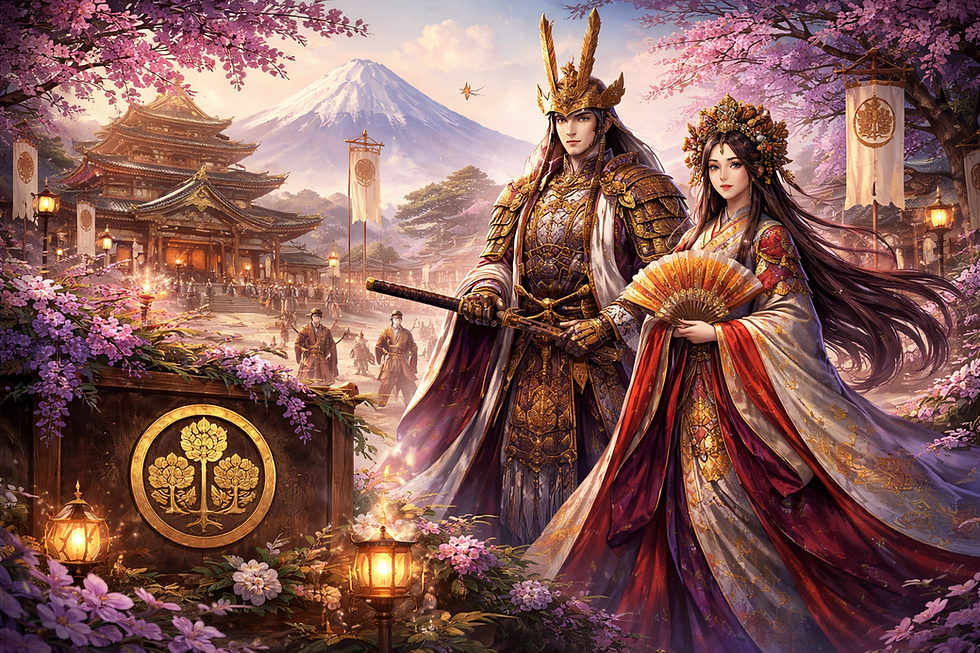
The mid-Heian period was dominated by the Fujiwara clan, who controlled the imperial throne through strategic marriages. Beginning with Fujiwara no Yoshifusa's appointment as regent for his grandson Emperor Seiwa in 858 AD, the Fujiwara held the offices of sesshō (regent for a child emperor) and kampaku (regent for an adult emperor) for over two centuries.
The greatest of the Fujiwara regents, Fujiwara no Michinaga (966–1028), placed four daughters as consorts to emperors and saw three grandsons ascend the throne. His diary and the writings of court ladies provide vivid testimony to the splendor and intrigue of Fujiwara rule.
Michinaga famously expressed his sense of accomplishment in a poem:
"When I reflect upon it,
This world indeed
Is a place of joy.
I desire to be lord of all
For generation after generation."
The Fujiwara period witnessed the zenith of Heian court culture. The capital's aristocracy, numbering perhaps five thousand, devoted itself to aesthetic pursuits: poetry composition, calligraphy, music, and the intricate social rituals of court life. Chinese models, so influential in earlier periods, were increasingly Japanized as the court developed distinctive native traditions.

The Rise of Vernacular Literature
The Heian period's most enduring cultural achievement was the flowering of vernacular literature, particularly by women of the court writing in kana script. Unlike men, who wrote in classical Chinese for official purposes, women composed in Japanese, producing works of extraordinary literary quality.

Murasaki Shikibu, a lady-in-waiting to Empress Shōshi, wrote The Tale of Genji (Genji Monogatari) around 1000–1012 AD. This fifty-four-chapter novel follows the life and loves of the "shining prince" Genji and his descendants.
It is widely considered the world's first novel and a masterpiece of world literature. Murasaki's psychological depth, narrative sophistication, and lyrical prose have captivated readers for a millennium.
Sei Shōnagon, a contemporary and rival of Murasaki, produced The Pillow Book (Makura no Sōshi), a collection of essays, lists, anecdotes, and observations about court life. Her sharp wit, aesthetic sensibility, and keen observation provide an intimate portrait of Heian aristocratic culture.
Other significant works include Izumi Shikibu's diary, a poetic account of her passionate love affairs, and the various poetic anthologies compiled by imperial command. Poetry, particularly the thirty-one-syllable waka form, was central to court life; used in courtship, social correspondence, and aesthetic competition.
The Aesthetics of Court Culture
Heian court culture developed distinctive aesthetic ideals that continue to influence Japanese taste:
Mono no aware | The pathos of things; sensitivity to the transience of beauty | Central to The Tale of Genji and Heian poetry
Miyabi | Courtly refinement; elegance | The ideal of aristocratic comportment
Okashi | Delightful; charming | Sei Shōnagon's characteristic aesthetic
Yūgen | Profound mystery; subtle grace | Developed later but rooted in Heian sensibility
En | Charm; gracefulness | Aesthetic quality of poetry and personal bearing
The Heian aesthetic emphasized suggestion over statement, evanescence over permanence, and emotional sensitivity over rational analysis. The appreciation of seasonal change, like cherry blossoms in spring, crimson leaves in autumn, was both a personal pleasure and a social obligation.

The Insei (Cloistered Emperor) System
From the late 11th century, a new political configuration emerged as retired emperors (jōkō) exercised power from within Buddhist monasteries; hence "cloistered government" (insei).
This development was a response to Fujiwara dominance: emperors who abdicated in favor of young successors could act without the constraints of office, using their personal networks and resources to counterbalance Fujiwara authority.

The insei period (1068–1185 AD) saw several strong retired emperors, most notably Shirakawa (1073–1087, retired 1087–1129 AD), exercise effective control over imperial succession and patronage. Shirakawa famously remarked: "The three things that do not obey my will: the waters of the Kamo River, the dice of the backgammon game, and the monks of Mount Hiei."
The insei system further undermined the ritsuryō land system. Retired emperors accumulated their own estates (chokushiden), creating a base of economic power independent of Fujiwara-controlled offices. Provincial governors (kokushi) increasingly acted as local strongmen rather than imperial officials.
The Rise of the Warrior Class
Throughout the Heian period, a new social class was taking shape in the provinces. Armed conflicts over land, the need for police forces, and the decline of central military institutions led to the emergence of professional warriors (bushi or samurai).

Two great warrior clans, descended from imperial princes, rose to prominence:
Taira (Heike) | Emperor Kanmu (grandson) | Western Honshu | Maritime power; commercial interests; court connections
Minamoto (Genji) | Emperor Seiwa (son) | Eastern Honshu | Horsemanship; martial tradition; provincial networks
Both clans provided military forces to the court, but their provincial bases gave them independent power. The Tale of Hōgen and Tale of Heiji chronicle the escalating conflicts of the 1150s, when disputes over succession drew the warrior clans into Kyoto politics.
The Hōgen and Heiji Rebellions

In 1156 AD, a succession dispute erupted between Emperor Go-Shirakawa and retired Emperor Sutoku. Both sides summoned warrior support: Minamoto no Yoshitomo and Taira no Kiyomori supported Go-Shirakawa, while Minamoto no Tameyoshi supported Sutoku.
The Hōgen Rebellion ended in victory for Go-Shirakawa and Kiyomori, with Tameyoshi executed despite Yoshitomo's pleas.
Four years later, in 1159, the Heiji Rebellion broke out when Minamoto no Yoshitomo, dissatisfied with his rewards, attacked his rival Taira no Kiyomori. Kiyomori defeated Yoshitomo, executing his two eldest sons and exiling others, including the thirteen-year-old Minamoto no Yoritomo, to Izu Province.
These conflicts demonstrated that warrior power could determine imperial succession and that the court could no longer control its provincial agents. They also established a deep enmity between the Taira and Minamoto clans that would erupt twenty years later.
Taira no Kiyomori and the Heike Ascendancy
Following the Heiji Rebellion, Taira no Kiyomori (1118–1181 AD) became the most powerful man in Japan. By 1167 AD, he had risen to the highest court rank—Grand Minister of State (Daijō-daijin)—the first warrior to achieve such status. He married his daughter to the emperor, and his grandson became Emperor Antoku in 1180.

Kiyomori's rule represented a new kind of warrior-aristocratic hybrid. He drew on Taira control of the Inland Sea trade routes to amass wealth independent of court landholdings. He patronized the Itsukushima Shrine on Miyajima, dedicating it to the Taira clan's patron deities. He moved the capital briefly to Fukuhara (near modern Kobe) in an attempt to escape Kyoto politics.
However, Kiyomori's arrogance alienated many courtiers and warriors. His treatment of rivals, his interference in succession, and his appropriation of provincial lands created enemies. In 1180 AD, Prince Mochihito, excluded from succession, called on the Minamoto clan to rise against the Taira. The Genpei War had begun.
The Genpei War (1180–1185 AD)

The Genpei War (from "Gen" for Minamoto and "Hei" for Taira) was a national conflict that established warrior government for the next seven centuries. The war's dramatic events are chronicled in The Tale of the Heike (Heike Monogatari), an epic that combines historical narrative with Buddhist themes of impermanence and karmic retribution.
Major Battles:
Uji | 1180 | First major battle; Minamoto forces defeated; Prince Mochihito killed
Fujigawa | 1180 | Taira forces flee without fighting, demoralized by rumors of Minamoto attack
Sunomatagawa | 1181 | Taira victory; Minamoto no Yukiie defeated
Kurikara Pass | 1183 | Minamoto no Yoshinaka's brilliant victory; turning point in the war
Shinohara | 1183 | Yoshinaka defeats pursuing Taira forces
Ichinotani | 1184 | Minamoto no Yoshitsune's daring charge down a cliff; Taira retreat
Yashima | 1185 | Yoshitsune attacks Taira stronghold on Shikoku
Dan-no-ura | 1185 | Decisive naval battle; Taira forces annihilated; child Emperor Antoku drowns
The war's hero is Minamoto no Yoshitsune (1159–1189), a brilliant military strategist whose daring tactics defeated the Taira at Ichinotani, Yashima, and finally Dan-no-ura. Yoshitsune's tragic fate, hounded to suicide by his jealous brother Yoritomo, added to his legend, and he remains one of Japan's most celebrated figures.

Minamoto no Yoritomo (1147–1199 AD), Yoshitsune's half-brother, directed the war from his base in Kamakura, building alliances with eastern warriors and consolidating control over territories.
Unlike Yoshitsune, Yoritomo was a master of politics, not battlefield tactics. After the victory, he systematically eliminated rivals, including Yoshitsune, to secure his power.
The Buddhist Message of The Tale of the Heike
The Tale of the Heike opens with one of the most famous passages in Japanese literature:
"The sound of the Gion Shōja bells echoes the impermanence of all things; the color of the sāla flowers reveals the truth that the prosperous must decline. The proud do not endure, they are like a dream on a spring night; the mighty fall at last, they are as dust before the wind."
The epic presents the Taira downfall as a lesson in Buddhist impermanence and karmic retribution. Kiyomori's pride, the splendor of the Taira court, the tragic death of the child emperor Antoku; all illustrate the transience of worldly glory and the inexorable working of karma.

The tale also emphasizes the importance of compassion, particularly through the figure of Kenshumn, Antoku's grandmother, who drowns herself with the young emperor. The final chapters describe prayers for the repose of the Taira dead and the founding of temples to pacify their spirits.

Part II: The Kamakura Period—Warrior Government
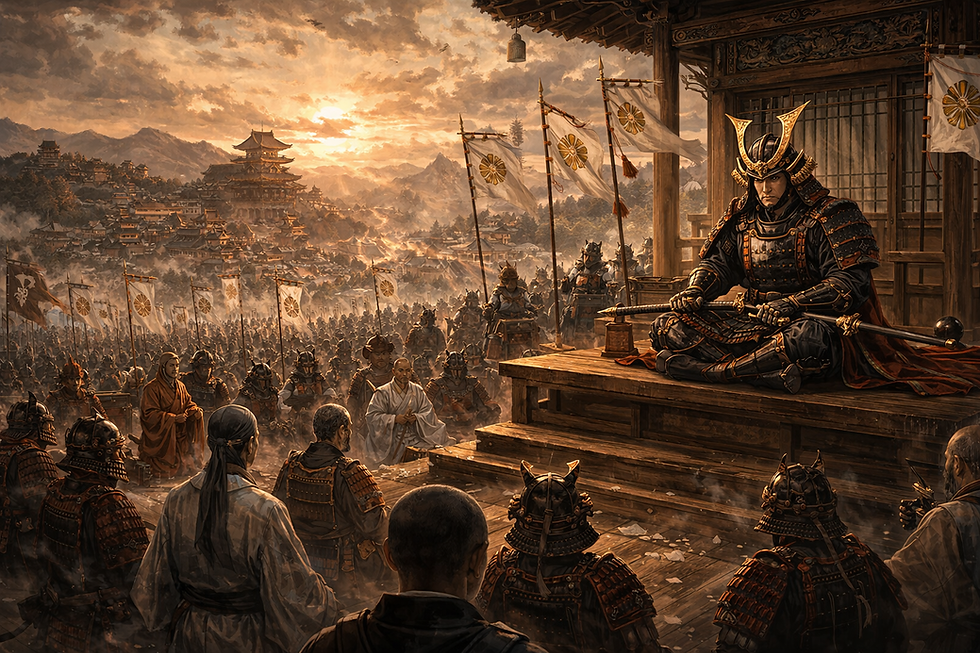
In 1192 AD, the imperial court granted Minamoto no Yoritomo the title of Sei-i Taishōgun ("Great Barbarian-Subduing General"), legitimizing his military government; the Kamakura bakufu (tent government or shogunate).
Yoritomo established his headquarters in Kamakura, far from the imperial capital in Kyoto, signaling a new political order. Emperor and Shogun sharing power.
The Kamakura bakufu (shogunate) was not a replacement for the imperial court but a parallel institution. The court continued to govern civil affairs in the home provinces, while the bakufu administered military and police matters throughout the country.
Yoritomo appointed military governors (shugo) in each province and estate stewards (jitō) on individual landholdings, creating a nationwide network of warrior administrators.
Yoritomo's authority rested on the lord-vassal relationship he established with eastern warriors. In return for their service, he confirmed their landholdings and granted them positions as jitō. This personal bond of loyalty, the foundation of Japanese feudalism, was expressed in the concept of gokenin ("housemen"), direct vassals of the shogun.
The Hōjō Regency
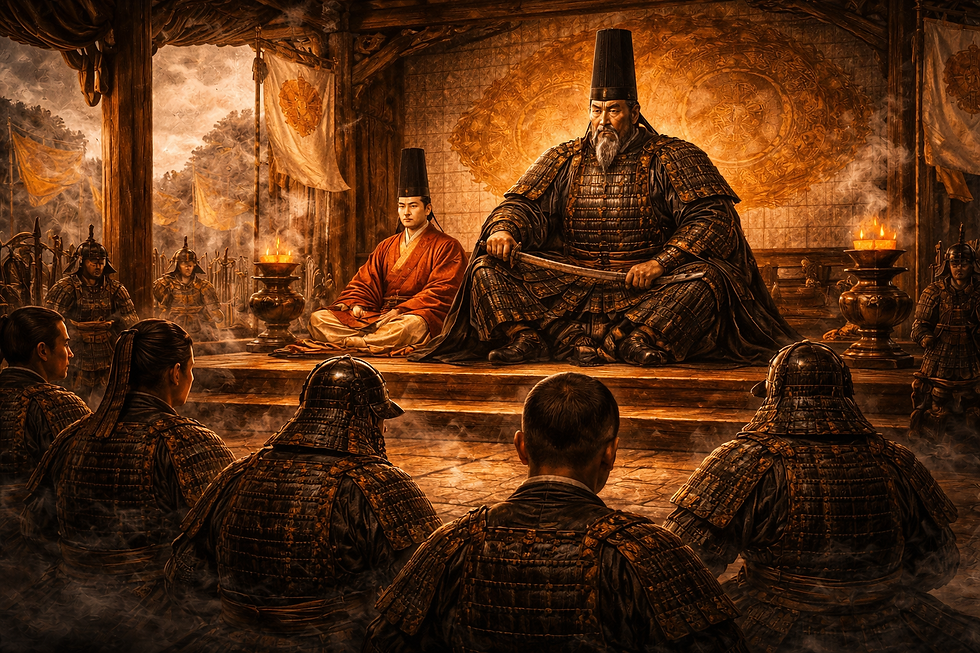
After Yoritomo's death in 1199 AD, the Minamoto shoguns proved unable to maintain control. Yoritomo's widow, Hōjō Masako (1157–1225 AD), daughter of a prominent eastern warrior family, maneuvered to secure power for her relatives.
Her father, Hōjō Tokimasa, became regent (shikken) for the young shogun, establishing a pattern that would continue for over a century: Minamoto (and later Fujiwara or imperial) figurehead shoguns with Hōjō regents wielding actual power.
Masako, known as the "nun shogun" (ama-shōgun) after she took Buddhist vows, was a formidable political operator. She famously rallied vassals with the declaration: "From now on, you have only two lords: the shogun in Kamakura and the emperor in Kyoto."

The Hōjō regency maintained stability for generations, administering justice, adjudicating land disputes, and managing relations with the court.
The Jōkyū Disturbance

The imperial court, chafing under warrior dominance, attempted to overthrow the bakufu in 1221 AD. Retired Emperor Go-Toba issued a call to arms against the Hōjō, rallying warriors and temples to his cause.
The Hōjō responded swiftly, sending an army commanded by Hōjō Yasutoki to Kyoto. The bakufu forces defeated the imperial army within months, and Go-Toba was exiled to the Oki Islands.
The aftermath of the Jōkyū Disturbance decisively established warrior supremacy. Three retired emperors were exiled, and thousands of imperial estates were confiscated and redistributed to bakufu vassals.

The court was subjected to bakufu (shogunate) oversight, with Kyoto itself placed under the control of a bakufu deputy (Rokuhara tandai). The emperor's political power was effectively ended for the next six centuries.
New Buddhism for a New Age
The Kamakura period witnessed the emergence of new Buddhist movements that responded to the spiritual needs of warriors and commoners. These "new Buddhism" schools simplified practice, emphasized faith, and made salvation accessible to all.

Pure Land Buddhism (Jōdo-shū and Jōdo Shinshū): Hōnen (1133–1212 AD) founded the first independent Pure Land school in Japan. Deeply influenced by Chinese Pure Land thought and frustrated with the esoteric complexity of Tendai, Hōnen taught that in the age of mappō (the "latter day of the Dharma"), when human capacity for self-cultivation is exhausted, salvation can only be attained through faith in Amida Buddha.
The simple recitation of the nembutsu—"Namu Amida Butsu" ("I take refuge in Amida Buddha")—ensures rebirth in the Pure Land, where enlightenment is guaranteed.
Hōnen's teachings attracted massive following but also fierce opposition from established schools. In 1207 AD, the court banned his movement, executing several disciples and exiling Hōnen. The ban was later lifted, and Pure Land spread rapidly.
Shinran (1173–1263 AD), a disciple of Hōnen, went further in emphasizing faith and grace. He taught that the nembutsu is not a practice that earns salvation but a response of gratitude to Amida's saving vow. Salvation is entirely the work of Amida; human effort is irrelevant. Shinran famously stated: "Even a good person attains birth in the Pure Land, how much more so an evil person."
Shinran's movement, Jōdo Shinshū ("True Pure Land School"), rejected monasticism, allowed priests to marry, and emphasized gratitude over practice. It became enormously popular among commoners and eventually developed into the largest Buddhist denomination in Japan.

Nichiren Buddhism: Nichiren (1222–1282), a fiery and controversial figure, founded the only major Buddhist school indigenous to Japan. Deeply learned in Tendai doctrine, Nichiren concluded that the Lotus Sutra contains the complete and perfect teaching of the Buddha, and that all other schools are heretical.
He taught that Japan's calamities—natural disasters, famine, the Mongol threat—resulted from the nation's rejection of the Lotus Sutra.
Nichiren's practice centered on chanting the daimoku—"Namu-myōhō-renge-kyō" ("Devotion to the Mystic Law of the Lotus Sutra")—as the sole path to enlightenment.
He attacked other schools with unprecedented vehemence, earning persecution and exile. His prophecies of foreign invasion (seemingly confirmed by the Mongol attacks) and his uncompromising stance attracted devoted followers.

Zen Buddhism (Rinzai and Sōtō): Zen (Ch. Chan) Buddhism, emphasizing meditation and direct insight over scripture and ritual, was imported to Japan in multiple waves. Two major schools emerged during the Kamakura period:
Rinzai Zen was established by Eisai (1141–1215 AD), who traveled to China and returned with Rinzai teachings. Eisai emphasized the use of kōans, paradoxical riddles or statements, to break through conceptual thinking and achieve enlightenment.
Rinzai found favor with the warrior class, who appreciated its discipline and directness. The Hōjō regents became major patrons, building Zen temples in Kamakura and Kyoto.
Sōtō Zen was founded by Dōgen (1200–1253 AD), one of Japan's most profound philosophers. Dōgen traveled to China and received transmission in the Sōtō lineage. His masterwork, the Shōbōgenzō ("Treasury of the True Dharma Eye"), articulates a philosophy of practice-realization: sitting meditation (zazen) is not a means to enlightenment but the enactment of enlightenment itself. Dōgen taught that practice and attainment are identical; to sit in zazen is to be Buddha.
Dōgen emphasized the universality of Buddha-nature, famously quoting the Chinese poet Su Dongpo: "The voice of the valley stream is the Buddha's voice; the form of the mountains is the Buddha's form." For Dōgen, all beings, including grasses, trees, mountains, and rivers, are expressions of buddhahood . His philosophy profoundly influenced Japanese aesthetics and environmental sensibility.

Zen appealed to warriors for several reasons:
Simplicity: Zen rejected elaborate rituals and doctrinal study in favor of direct experience.
Discipline: The rigorous practice of meditation cultivated focus and self-control.
Death-acceptance: Zen teachings on impermanence and the illusory nature of self prepared warriors to face death without fear.
Aesthetics: Zen-influenced arts like calligraphy, ink painting, tea ceremony, garden design became integral to warrior culture.
The warrior ideal of bushidō ("the way of the warrior"), though formalized later, drew on Zen values of loyalty, honor, and self-discipline.
The Mongol Invasions

The Kamakura bakufu's greatest challenge came from abroad. Kublai Khan, having conquered China and established the Yuan dynasty, demanded Japanese submission in 1268 AD. The bakufu (shogunate) refused, and in 1274 AD, a Mongol-Korean fleet of some 900 ships and 40,000 troops attacked Hakata Bay in northern Kyushu.
The Japanese defenders, though outnumbered and outmatched in technology (the Mongols used gunpowder weapons), fought fiercely. A storm arose after a day of fighting, destroying many Mongol ships and forcing a retreat. The bakufu (shogunate) remained on alert, building defensive walls along Hakata Bay.

In 1281 AD, the Mongols launched a massive invasion: two fleets totaling perhaps 4,400 ships and 140,000 men. The Japanese defenders, aided by the coastal walls, held the invaders at bay for weeks.
In August, a massive typhoon, later called the kamikaze ("divine wind"), devastated the Mongol fleet, destroying most of the ships and drowning thousands.
The Mongol invasions had profound consequences:
Military strain | The bakufu mobilized thousands of warriors for extended periods, disrupting normal economic activity
Unrewarded veterans | Unlike civil wars, defense against invasion yielded no new lands to distribute as rewards; warriors remained unpaid
Increased coastal defenses | Kyushu warriors remained on alert for decades, straining resources
Divine nation ideology | The kamikaze reinforced belief that Japan was divinely protected, contributing to later nationalist thought
Economic disruption | The war effort drained bakufu resources and disrupted trade
The inability to reward veterans undermined the lord-vassal relationship that sustained the bakufu (shogunate). Unpaid warriors became discontented, and the Hōjō regency's prestige declined.
The Decline of Kamakura
After the Mongol invasions, the Kamakura bakufu (shogunate) faced mounting problems. Disputes over land and succession increased. The imperial court, seizing on bakufu weakness, attempted to reassert authority. Emperor Go-Daigo (1318–1339 AD), determined to rule directly, plotted against the bakufu (shogunate).

In 1331, Go-Daigo launched a rebellion. Though initially defeated and exiled, he continued to resist from Yoshino. Key bakufu vassals, including the powerful general Ashikaga Takauji, defected to Go-Daigo's side.
In 1333, the bakufu's forces were defeated, Kamakura Shogunate fell, and the Hōjō regents committed suicide at the family temple of Tōshō-ji.
The Kamakura period ended, but the pattern of warrior government was firmly established. The next six centuries would see warriors, not courtiers, ruling Japan.
Part III: The Muromachi Period—Ashikaga Rule

Emperor Go-Daigo's return to Kyoto in 1333 AD inaugurated the Kenmu Restoration, an attempt to restore direct imperial rule. Go-Daigo confiscated warrior estates, rewarded courtiers and temples, and alienated his warrior supporters, including Ashikaga Takauji, who had expected substantial rewards.
In 1336 AD, Ashikaga Takauji turned against Go-Daigo, seized Kyoto, and installed a rival emperor from another branch of the imperial family. Go-Daigo fled to Yoshino, establishing the Southern Court, while Takauji's emperor ruled from Kyoto as the Northern Court.
The Nanboku-chō ("Northern and Southern Courts") period (1336–1392 AD) divided Japan between rival imperial lines.
The Ashikaga Shogunate

Takauji established his shogunate in Kyoto's Muromachi district, giving the period its name. The Ashikaga shoguns, unlike the Kamakura bakufu, were based in the capital and deeply involved in court culture.
They lacked the Hōjō regents' tight control over vassals, and provincial governors (shugo) grew increasingly independent. The Ashikaga shogunate's authority fluctuated with the abilities of individual shoguns. The third shogun, Ashikaga Yoshimitsu (1358–1408 AD), was particularly effective.
He reunified the imperial courts in 1392 AD, established diplomatic relations with Ming China, and patronized the arts. His retirement villa, the Kinkaku-ji (Golden Pavilion), symbolizes the cultural brilliance of the period.

The Ōnin War and the Age of Provincial Wars
The Ashikaga shogunate's control collapsed after the Ōnin War, a decade-long conflict over shogunal succession that devastated Kyoto and destroyed central authority. The war began in 1467 AD when two powerful shugo families supported rival candidates for shogun.
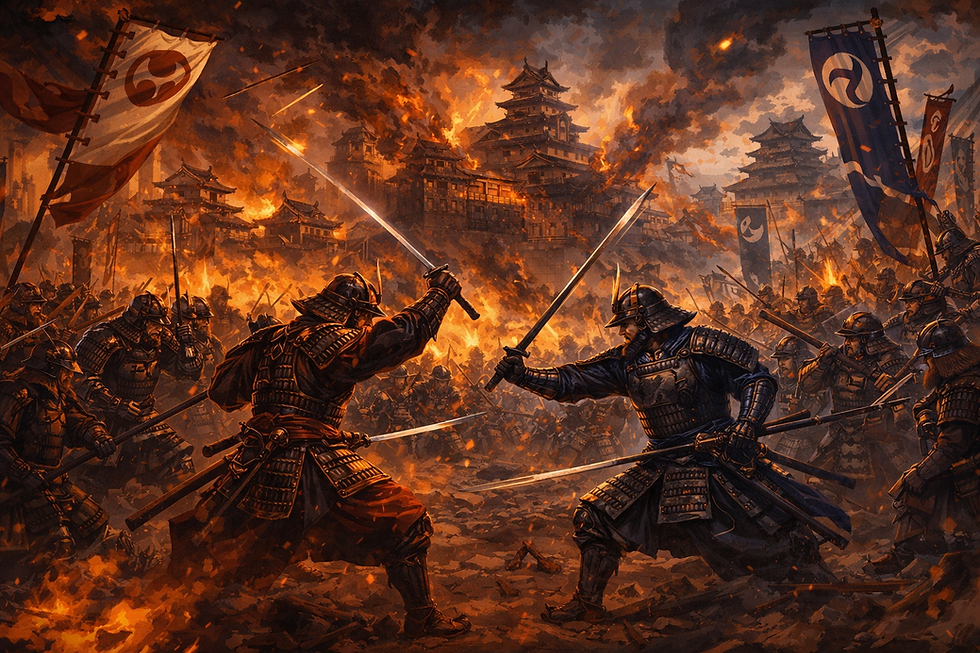
The fighting, concentrated in Kyoto, reduced much of the capital to ashes. By the time it ended inconclusively in 1477 AD, the shogunate was powerless, and provincial lords were fighting for control throughout Japan.
The century after the Ōnin War is known as the Sengoku period ("Warring States period," 1467–1568 AD), an era of constant warfare, social upheaval, and political innovation.
The shugo appointed by the shogun were replaced by local warlords, daimyō ("great lords"), who carved out independent domains through conquest and alliance. Some daimyō were former shugo deputies, some were local samurai, and some were peasants who rose through military skill.
The Rise of the Sengoku Daimyō

Sengoku daimyō governed their domains as independent states. They:
Conducted land surveys to assess agricultural productivity
Issued law codes regulating their territories
Built castles as administrative and military centers
Promoted commerce and industry to enrich their domains
Recruited samurai directly as vassals, bypassing traditional hierarchies
Notable Sengoku daimyō included:
Hōjō Sōun (1432–1519), who rose from obscurity to control the Kantō region
Takeda Shingen (1521–1573), who competed with Uesugi Kenshin in the "Echigo-Kai rivalry"
Uesugi Kenshin (1530–1578), the "Dragon of Echigo"
Mōri Motonari (1497–1571), who expanded from a small domain to control most of western Honshu
Date Masamune (1567–1636), who built a powerful domain in the northeast
The Sengoku period, though violent, was also creative. New military technologies (especially firearms after the 1543 AD Portuguese arrival), new castle designs, and new administrative techniques developed rapidly. Social mobility was unprecedented; peasants could become samurai, and low-ranking samurai could become daimyō.
Muromachi Culture: The Flowering of Higashiyama

Despite, or perhaps because of political instability, Muromachi culture was extraordinarily creative. The Higashiyama culture of the 15th century, centered on the retirement villa of Ashikaga Yoshimasa (eighth shogun), produced enduring artistic and cultural forms.
Zen Buddhism's influence permeated Muromachi culture. Key developments include:
Ink painting (suibokuga) | Monochrome landscapes; inspired by Chinese Song/Yuan painting | Sesshū Tōyō (1420–1506), Japan's greatest ink painter
Tea ceremony (chanoyu) | Aestheticized preparation and serving of powdered green tea | Murata Jukō (1423–1502), founder of wabi-cha aesthetic
Rock gardens (karesansui) | Dry landscapes of rocks and raked gravel; meditative spaces | Ryōan-ji temple garden, Kyoto
Nō theater | Stylized masked drama combining dance, chant, and music | Kan'ami (1333–1384) and Zeami (1363–1443)
Linked verse (renga) | Collaborative poetry; courtly elegance combined with popular participation | Nijō Yoshimoto (1320–1388), Sōgi (1421–1502)
Zeami Motokiyo, the great Nō playwright and theorist, articulated the aesthetic ideal of yūgen, "profound mystery" or "subtle grace." Nō plays explore Buddhist themes of attachment, impermanence, and salvation through highly stylized performance.
The Higashiyama Villa
Ashikaga Yoshimasa's Ginkaku-ji (Silver Pavilion) complex, begun in 1482 AD, embodied Higashiyama aesthetics. Unlike his grandfather Yoshimitsu's glittering Golden Pavilion, Yoshimasa's villa emphasized rusticity, simplicity, and refinement.
The complex included a two-story pavilion, a meditation hall, and one of Japan's most famous sand gardens—a cone of sand reflecting moonlight.

Yoshimasa's patronage also supported the development of the tea ceremony, flower arrangement, and other arts that would define Japanese aesthetics.
Economic and Social Change
Muromachi Japan saw significant economic development:
Agriculture expanded through new rice strains, irrigation, and double-cropping
Commerce grew with guilds (za) protecting merchants and artisans
Cities developed around castle towns, ports, and temple towns
Markets became regular features of provincial life
Trade with China flourished under the tally trade system
Piracy (wokou) by Japanese and Chinese raiders disrupted East Asian seas
Social structure remained hierarchical, but mobility increased. Peas gained more autonomy in village self-government (sō). Merchants and artisans organized in guilds. The warrior class expanded as daimyō recruited followers based on ability, not birth.
The Arrival of the West: The Nanban Trade

In 1543 AD, three Portuguese traders arrived on the island of Tanegashima, carrying matchlock firearms. This marked the beginning of the Nanban trade period ("Southern barbarian trade"), a transformative era of European-Japanese contact.
The Japanese were fascinated by European technology. Within decades, Japanese smiths were producing thousands of matchlock guns, called tanegashima after the island of first contact. Firearms transformed Japanese warfare, contributing to the unification efforts of later decades.
The Portuguese also brought Christianity. In 1549 AD, the Jesuit missionary Francis Xavier arrived in Kagoshima, beginning the Christian mission in Japan. The Jesuits, and later the Franciscans and Dominicans, made converts among daimyō and commoners alike.
Some daimyō converted hoping for trade advantages; others were genuinely convinced. By the late 16th century, there were perhaps 300,000 Christians in Japan, concentrated in Kyushu.

The Nanban trade also brought:
European ships—the galleon style influenced Japanese shipbuilding
New foods—tempura, castella cake, bread
New goods—tobacco, watches, glasses, velvet
New knowledge—European medicine, astronomy, geography
Artistic influences—Nanban art depicting Europeans and their ships
The Japanese called the Europeans Nanban-jin ("Southern barbarians"), a term borrowed from Chinese usage designating peoples from southern regions. The term reflected both fascination and contempt; the newcomers were culturally alien, but their goods were valuable.
The Decline of the Ashikaga

By the mid-16th century, the Ashikaga shogunate was virtually powerless. The last Ashikaga shogun, Ashikaga Yoshiaki, was installed by the warlord Oda Nobunaga in 1568 AD but was exiled when Nobunaga turned against him in 1573. The Muromachi period ended, and the stage was set for Japan's unification.

Part IV: The Azuchi-Momoyama Period—Christian Century
The Azuchi-Momoyama period, named for Oda Nobunaga's castle at Azuchi and Toyotomi Hideyoshi's castle at Momoyama (Fushimi), saw Japan's rapid unification under three remarkable leaders.

Oda Nobunaga (1534–1582)
Oda Nobunaga, a daimyō from Owari Province (Nagoya region), began the unification process. Combining military brilliance, strategic ruthlessness, and openness to European technology and ideas, Nobunaga expanded his territory throughout the 1560s and 1570s.
Military innovations:
Firearms: Nobunaga was the first Japanese leader to deploy massed musketeers effectively, using volley fire tactics at the Battle of Nagashino (1575 AD) to defeat the Takeda cavalry.
Professional army: He armed peasants as foot soldiers (ashigaru), issuing them armor and weapons, creating a force independent of samurai retinues.
Economic warfare: He controlled markets, roads, and trade routes to finance his campaigns.
Political strategies:
Seizure of Kyoto (1568): Nobunaga installed Ashikaga Yoshiaki as shogun, controlling the capital and the emperor.
Castle building: Azuchi Castle (built 1576–1579) was a revolutionary structure; the first castle with a towering keep (tenshu), combining military defense with residential luxury and political symbolism.
"Sword hunts": Starting in 1576, Nobunaga confiscated weapons from peasants, disarming the countryside and enforcing class distinctions.
Road and market control: He abolished toll barriers, minted currency, and standardized exchange rates to promote commerce.

Religious policies: Nobunaga ruthlessly suppressed Buddhist institutions that resisted his rule. In 1571, he destroyed the Tendai monastic complex on Mount Hiei, slaughtering thousands of monks, women, and children.
He fought prolonged wars against the Ikkō-ikki, leagues of warrior-monks and peasants inspired by Pure Land Buddhism who controlled Kaga Province and resisted samurai rule. His personal seal bore the motto "Tenka Fubu" ("Rule the Realm by Military Might").
Nobunaga favored Christian missionaries, seeing them as a counterweight to Buddhist power and a source of trade and technology. He tolerated their activities and occasionally received them at his castles.
The Honnō-ji Incident: In 1582, while Nobunaga was resting at Honnō-ji temple in Kyoto, one of his generals, Akechi Mitsuhide, suddenly attacked. With his escape cut off, Nobunaga committed suicide; the temple burned with his body.
The reasons for Mitsuhide's betrayal remain debated; personal ambition, resentment, or perhaps conspiracy. Mitsuhide was defeated twelve days later by Toyotomi Hideyoshi, who avenged Nobunaga and assumed his mantle.
Toyotomi Hideyoshi (1537–1598)
Toyotomi Hideyoshi's rise is one of history's most extraordinary success stories. Born a peasant's son, he rose through the ranks as Nobunaga's general, eventually ruling all Japan.
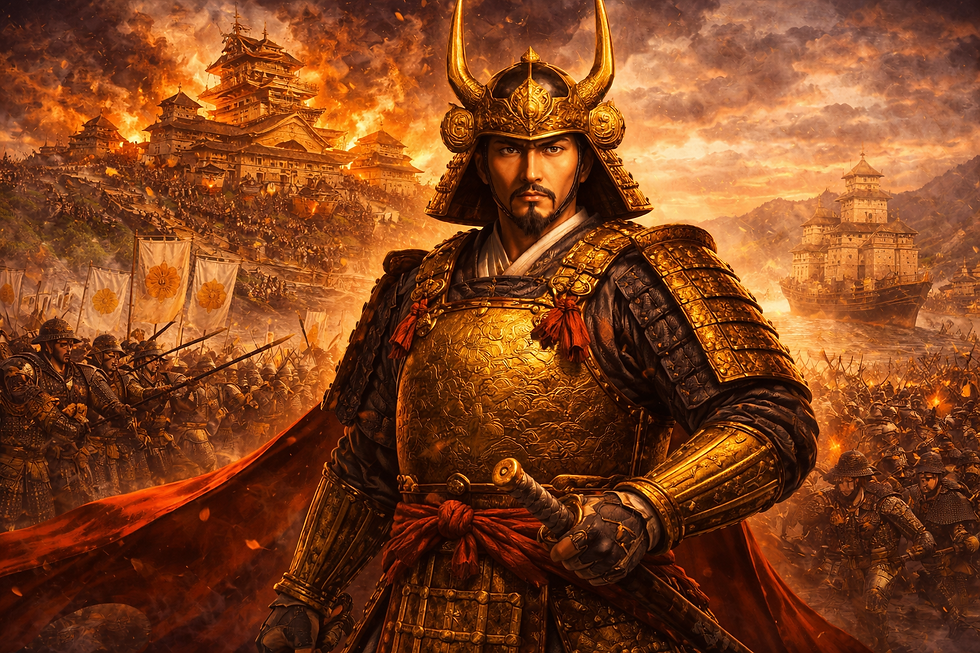
Hideyoshi defeated rivals in a series of campaigns. By 1590, with the fall of the Hōjō clan's Odawara Castle, he controlled all Japan. He received the title Kampaku (Imperial Regent) and later Taikō (Retired Regent).
Domestic policies:
Land survey: Hideyoshi conducted a nationwide land survey (1582–1598), standardizing rice yields (koku) as a measure of wealth and military obligation.
Sword hunt (1588): He confiscated weapons from peasants, decreeing that only samurai could bear arms, enforcing class separation.
Class separation: He issued edicts formalizing the four-class system: warrior (shi), farmer (nō), artisan (kō), merchant (shō). Movement between classes was prohibited.
Peace of the realm: He prohibited private warfare, requiring disputes to be settled through his administration.
The Korean Invasions (1592–1598): Hideyoshi's most disastrous venture was the invasion of Korea, intended as a prelude to conquering Ming China. In 1592, a force of some 160,000 Japanese troops landed at Busan and quickly captured Seoul and Pyongyang.
The invasion stalled, however, due to:
Korean naval resistance: Admiral Yi Sun-sin's navy, using innovative "turtle ships" (kobukson), cut Japanese supply lines
Chinese intervention: Ming China sent substantial forces to aid Korea
Guerrilla warfare: Korean civilians and monks resisted Japanese occupation
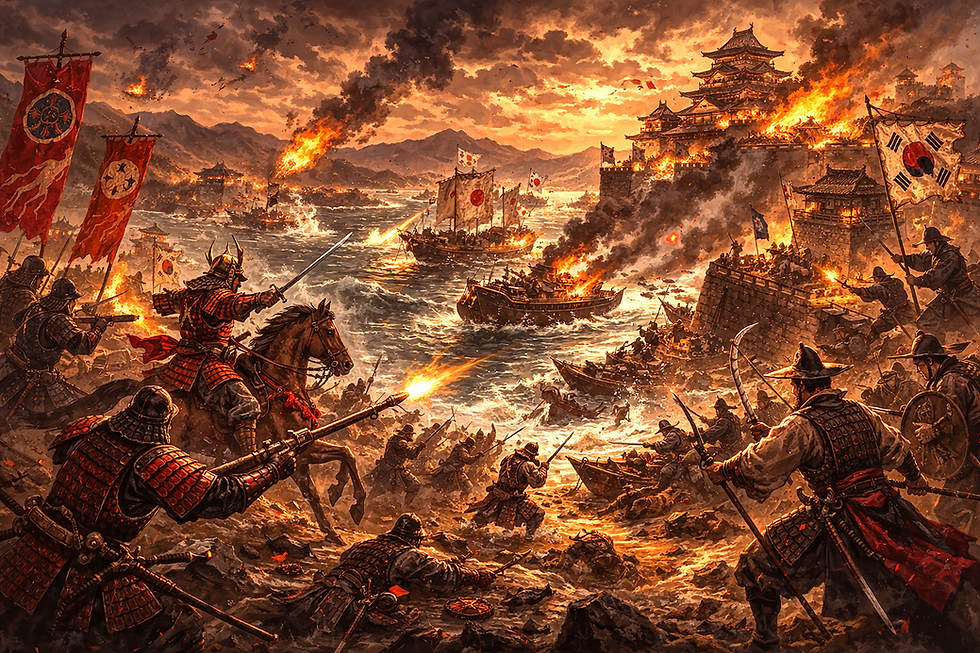
Peace negotiations failed, and Hideyoshi launched a second invasion in 1597. The war ended inconclusively with Hideyoshi's death in 1598. The invasions devastated Korea, soured Japan-Korea relations for centuries, and drained Hideyoshi's resources.
Religious policies: Hideyoshi initially tolerated Christianity, but his attitude changed. In 1587, he issued an edict expelling missionaries, though it was not strictly enforced. In 1597, he crucified 26 Christians in Nagasaki, including Franciscan missionaries and Japanese converts, after Spanish claims of conquest plans alarmed him.
Hideyoshi's death in 1598 left a succession crisis. His infant son Toyotomi Hideyori was too young to rule, and powerful daimyō positioned themselves for the coming conflict.
Tokugawa Ieyasu (1543–1616)
Tokugawa Ieyasu, a powerful daimyō with territories in the Kantō region (centered on Edo, modern Tokyo), had been one of Hideyoshi's key allies. After Hideyoshi's death, Ieyasu maneuvered for supremacy, forming alliances and preparing for war.
The decisive confrontation came at the Battle of Sekigahara on October 21, 1600. Ieyasu's Eastern Army defeated the Western Army loyal to Hideyori. The battle, fought in a day, determined Japan's future: Ieyasu became the undisputed ruler.

The brief but brilliant Azuchi-Momoyama period produced a distinctive culture characterized by:
Opulence | Gold leaf, bold colors, lavish decoration | Nobunaga's Azuchi Castle; Hideyoshi's Momoyama Castle; Himeji Castle
Audience halls | Large rooms for displaying authority; sliding screens (fusuma) painted with gold-leafed landscapes | Kyoto's Nijō Castle
Tea ceremony | Hideyoshi was a passionate patron; hosted massive tea gatherings | The "Golden Tea Room" covered in gold leaf; Sen no Rikyū (1522–1591), tea master
Nō theater | Performed for warrior audiences | Hideyoshi was an accomplished performer
Castle architecture | Massive stone foundations, complex defensive layouts, soaring keeps | Himeji Castle, Matsumoto Castle
Hideyoshi's relationship with his tea master, Sen no Rikyū, ended tragically. In 1591, Hideyoshi ordered Rikyū to commit suicide for reasons that remain obscure; perhaps jealousy, perhaps Rikyū's perceived arrogance. Rikyū's legacy endured, shaping the wabi-cha aesthetic that emphasized rustic simplicity.
Why This Era Is Called the "Christian Century"?
The Azuchi-Momoyama period (1568–1600) sits at the heart of what historians term Japan's "Christian Century" (キリシタン時代, Kirishitan jidai); a roughly one-hundred-year span from 1549 to either 1639 or 1650 during which Christianity emerged, flourished, and was ultimately extinguished in Japan.
This designation reflects not merely the presence of European missionaries, but the profound and unprecedented transformation of Japanese society through sustained contact with European civilization, marking the first time Japan engaged directly with the Western world rather than solely with its East Asian neighbors.

The Christian Century is framed by two sets of dates that scholars use to demarcate its boundaries :
Broad view | 1543-1639 | Portuguese traders arrive; final Sakoku edict ends Portuguese trade
Narrow view | 1549-1597 | Francis Xavier arrives; Twenty-Six Martyrs crucified
The broader interpretation extends from 1543, when the first recorded Portuguese traders landed in Japan, to 1639, when the Tokugawa shogunate's final Sakoku edict terminated Portuguese trade and prohibited Japanese interaction with Catholic territories.
The narrower view, more tightly aligned with the conventional Azuchi-Momoyama timeframe, spans from 1549; the year Francis Xavier, the first Christian missionary, set foot in Japan to 1597, when Toyotomi Hideyoshi ordered the crucifixion of the Twenty-Six Martyrs, marking Japan's first major Christian persecution.
Xavier's mission initially focused on Kyushu, where he established churches in Yamaguchi, Hirado in Nagasaki, and Bungo (modern Oita). He met the powerful daimyō Ōtomo Sōrin in 1551, planting seeds that would blossom into widespread conversion.
Following Xavier's departure from Japan, Jesuit missionaries continued his work, and Christianity took particularly firm hold in the Amakusa region. The faith spread through what scholars describe as a combination of factors: social networks, economic incentives, practical benefits, and the perceived efficacy of Christian teachings and practices.
The Sengoku period's political fragmentation proved crucial to this spread; individual daimyō could embrace Christianity without fear of repercussions from a central authority, and some lords even resorted to coercion to convert their subjects.
The First Christian Daimyō: A pivotal moment occurred in 1563, when Ōmura Sumitada, a Kyushu warlord, cemented ties with the Portuguese by accepting baptism, becoming the first Christian daimyō. This pattern of conversion among regional lords accelerated throughout the 1560s and 1570s, creating a network of Christian domains primarily concentrated in Kyushu.

The most extraordinary development came in 1580, when Ōmura Sumitada ceded judicial sovereignty over Nagasaki and its surrounding areas to the Jesuits, effectively granting them territorial lordship over a portion of Japanese land.
This unprecedented arrangement transformed Nagasaki into the center of Japanese Christianity, a city where the Church exercised direct political authority.
Oda Nobunaga's Calculated Patronage: Oda Nobunaga, the first of Japan's three unifiers, viewed Christianity through a pragmatic political lens. Determined to reduce the power of Buddhist monasteries, particularly the militant Tendai warrior-monks of Mount Hiei and the Ikkō-ikki factions, he extended protection to Christianity without ever converting himself.
Nobunaga slaughtered many Buddhist priests who resisted him and burned their fortified temples, while simultaneously welcoming Jesuit missionaries and European traders.
This policy served multiple purposes: it weakened his Buddhist rivals, secured access to European firearms and trade goods, and projected an image of openness to foreign technology and knowledge. Nobunaga's Azuchi Castle became a symbol of this new era, incorporating elements of European culture while remaining unmistakably Japanese.

Hideyoshi's Reversal: Toyotomi Hideyoshi, Nobunaga's successor, initially tolerated Christianity but gradually grew suspicious of its influence. The turning point came in 1587, when Hideyoshi subdued Kyushu, the heartland of Japanese Christianity, and issued an edict expelling Christian missionaries. While not strictly enforced at first, this edict signaled a fundamental shift in the relationship between the emerging unified state and the foreign faith.
Hideyoshi's concerns were both political and ideological. Having worked tirelessly to dismantle the political influence of Buddhist institutions, he came to view Christianity as a similar threat to social stability. The decentralized structure that had allowed Christianity to flourish under individual daimyō now seemed dangerous to the centralized authority he was constructing.
The regime's hostility crystallized in 1597, when Hideyoshi ordered the crucifixion of twenty-six Christians in Nagasaki; nine European missionaries and seventeen Japanese Christians. This execution, Japan's first major Christian persecution, marked the symbolic end of the Christian Century's optimistic phase.
The Tensho Embassy: Amid this growing tension, a remarkable diplomatic mission unfolded. In 1582, Ōtomo Sōrin and two other Christian daimyō sent four young Japanese men to Rome in what became known as the Tensho Embassy. These youths traveled through Portuguese territories in India, around Africa, and across Europe, meeting with Pope Gregory XIII and visiting major cities including Lisbon, Madrid, Florence, and Venice.
The embassy returned to Japan in 1590, bringing with them a printing press that was established in the Amakusa Collegio, a Jesuit school in Kawaura that operated from 1591 to 1597.
This institution taught Christianity and published Christian materials in both Japanese and Portuguese, contributing to a flourishing of Christian literature and education. The four young men's success, however, proved short-lived as persecution intensified.
The Amakusa Collegio: The Amakusa Collegio represented the intellectual heart of Japanese Christianity during its final years of open practice. Located in Kawaura, this institution produced printed works combining Christian doctrine with Japanese literary and artistic traditions.
A remarkable artifact from this period—a picture scroll dating to 1592, recently authenticated by the SawadaMiki Kinenkan museum in Kanagawa Prefecture—illustrates the fusion of cultures that characterized the Christian Century.

The scroll, measuring 22 centimeters high by 320 centimeters long, depicts fifteen scenes from the lives of Jesus Christ and the Virgin Mary rendered in Japanese ink. It contains Latin prayers written in Japanese phonetic characters and depicts figures wearing traditional Japanese hakama trousers.
Radiocarbon dating confirms the paper was created before 1633, and the explicit inscription "1592 years since His birth" strongly supports an Azuchi-Momoyama origin. According to Osamu Inoue, deputy chief of the Yokohama History Museum, such works reflect a "rapid growth of the follower population" during which ordinary Japanese Christians created their own religious art because authentic religious items were in short supply.
Closed Country Policy: As the Azuchi-Momoyama period gave way to the Edo period, Japan's openness contracted dramatically. The Tokugawa shogunate steadily imposed tighter restrictions throughout the 1620s and 1630s, regulating foreign merchants and prohibiting Japanese subjects from traveling overseas. By 1639, the shogunate had completed its Sakoku (closed country) policy, maintaining trade only with China, Korea, and the Netherlands.
The 1614 formal ban on Christianity, issued by Tokugawa Ieyasu, denounced the faith as a "pernicious doctrine" (jahō) that threatened social stability. In 1640, the shogunate demonstrated its resolve by executing 61 members of a Portuguese diplomatic mission from Macao. Christianity was driven underground, surviving only as the Kakure Kirishitan ("Hidden Christians") who preserved their faith in secret for over two centuries.
Part V: The Edo Period—Tokugawa Peace and Isolation
Following his victory at Sekigahara, Tokugawa Ieyasu moved swiftly to consolidate power. In 1603, he received the title Sei-i Taishōgun from the emperor, establishing the Tokugawa shogunate. He and his successors created a political system that would maintain peace and stability for over 250 years.

The Tokugawa system was a carefully constructed balance of centralized control and delegated authority:
Shogun | Military dictator, theoretically appointed by emperor; head of Tokugawa house
Bakufu (shogunate) | Central government in Edo, administering territories directly controlled by Tokugawa
Daimyō | Feudal lords ruling domains (han) throughout Japan; classified by relationship to Tokugawa
Alternate attendance (sankin kōtai) | Daimyō required to reside in Edo every other year, leaving families as hostages in between
Imperial court | Confined to Kyoto, with no political power but retained ceremonial and cultural authority
The bakufu controlled key strategic areas: major cities (Edo, Kyoto, Osaka), mines, and ports. Daimyō were classified as:
Fudai daimyō ("hereditary lords"): Tokugawa vassals before Sekigahara; held key positions in bakufu
Tozama daimyō ("outside lords"): Allied after Sekigahara; excluded from high office; potential threats
Shinpan daimyō ("related houses"): Tokugawa collateral branches
The sankin kōtai system served multiple purposes: it ensured daimyō loyalty through hostage-taking, drained daimyō resources through travel expenses, and stimulated national economy through circulation of goods and people.
Ieyasu's International Diplomacy
In the early years of Tokugawa rule, Ieyasu pursued an active foreign policy, seeking trade and diplomatic relations with European powers. He welcomed envoys from Spain, the Netherlands, and England, hoping to secure valuable goods such as raw silk.
Through the red-seal ship (shuinsen) system, he authorized Japanese merchants to trade in Southeast Asia, balancing European influence.
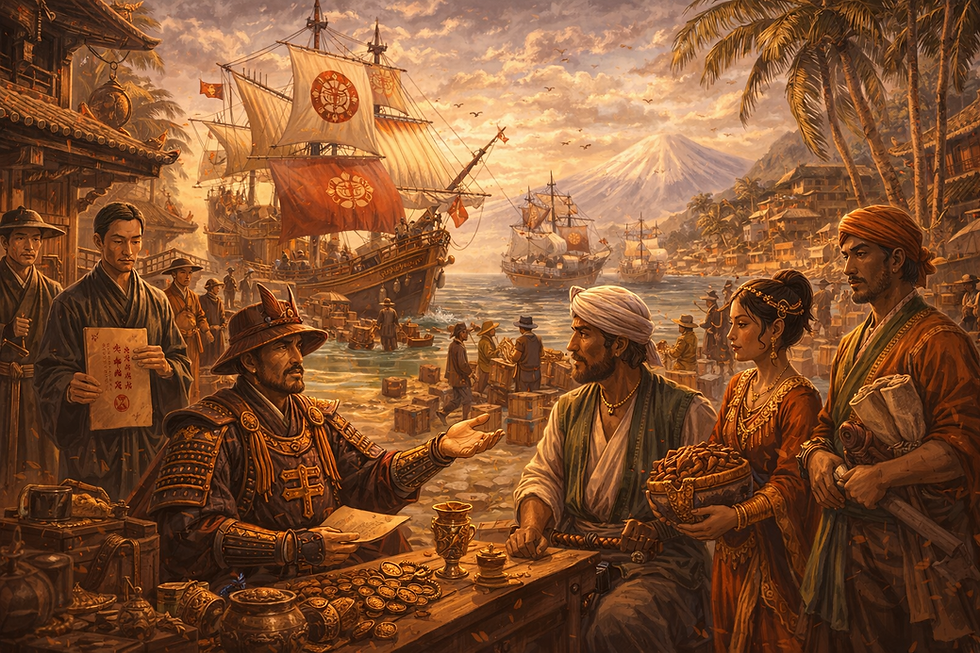
Cryns notes that Ieyasu "welcomed envoys from Spain, the Netherlands, and England, pursuing trade to secure vital resources such as raw silk. Through the red-seal system, negotiations with Manila, and correspondence with European monarchs, Ieyasu diversified Japan's foreign relations while resisting Catholic missionary pressures. His neutrality in European rivalries, combined with pragmatic economic strategies, underscored an international outlook."
The Siege of Osaka
The Tokugawa regime faced its final challenge from the Toyotomi. Hideyori, Hideyoshi's son, had been allowed to remain in Osaka Castle. As he matured, disaffected samurai gathered around him.
In 1614, Ieyasu laid siege to Osaka Castle. After a winter stalemate, peace negotiations led to the partial filling of the castle's moats; a Tokugawa trick. In the summer of 1615, Ieyasu renewed the attack. Osaka Castle fell, and Hideyori committed suicide, ending the Toyotomi threat.

The Laws for Warrior Houses (Buke Shohatto)
The bakufu issued codes of conduct for daimyō and samurai, regulating marriage, castle building, and military forces. The Buke Shohatto (originally 1615, revised thereafter) prohibited unauthorized fortifications, required bakufu permission for marriages, and limited castle repairs.
In 1614, Christianity was banned. Missionaries were expelled, and Japanese Christians were forced to apostatize. Those who refused faced torture and execution. The Shimabara Rebellion (1637–1638), a peasant uprising in Kyushu involving many Christians, was brutally suppressed with over 37,000 rebels killed.
After this, Christianity was driven underground, surviving as a secret "Hidden Christian" (kakure kirishitan) tradition.
By the 1630s, the Tokugawa bakufu had adopted a series of policies restricting foreign contact, collectively known as sakoku ("closed country")—a term coined later. A strategy to counter the threat of colonization.
Key Restrictions:
No Japanese travel abroad | Japanese forbidden to leave the country; those abroad could not return
No foreign ships | Portuguese and Spanish ships banned
Chinese and Dutch trade limited | Only at Nagasaki, under strict supervision
Dutch confined to Dejima | Artificial island in Nagasaki harbor; Dutch traders virtually imprisoned
Korea and Ryukyu | Limited trade through Tsushima and Satsuma domains
The only Europeans permitted in Japan were the Dutch, confined to the tiny island of Dejima in Nagasaki Harbor. Because the Dutch were Protestant and did not actively proselytize, the bakufu (shogunate) tolerated their presence. Through Dejima, Japan maintained a window onto European science and culture, known as Rangaku ("Dutch learning").
The shogunate's motives included:
Control of Christianity: Fear that missionaries and converts could overthrow the regime
Control of trade: Prevention of daimyō enrichment through foreign commerce
Control of information: Limiting external ideas that might challenge Tokugawa authority
Control of weapons: Preventing firearms from reaching potential rebels
The policy was remarkably effective. Japan experienced over two centuries of peace; a stark contrast to its violent past and to the wars wracking Europe.
Edo Society and Economy
Tokugawa society was rigidly hierarchical, based on Neo-Confucian ideology :
Warriors (shi) | 5-6% | Rulers; administrators | Could not engage in commerce; lived in castle towns
Farmers (nō) | 80-85% | Food producers | Primary source of tax revenue; subject to harsh exactions
Artisans (kō) | Small minority | Craft production | Urban residents; guild organization
Merchants (shō) | Small minority | Commerce | Legally lowest, but increasingly wealthy
Below these classes were outcasts (eta and hinin), who performed "unclean" work such as leather tanning and execution, and were subject to severe discrimination.
In practice, the system was less rigid than theory suggested. Merchants accumulated wealth and influence; impoverished samurai sometimes married merchant daughters; farmers who prospered bought their way into lower samurai ranks. Still, the legal framework reinforced Tokugawa control.
The Edo period witnessed remarkable economic development:
Agriculture: Expanded through land reclamation, new rice strains, improved irrigation. Rice yields doubled.
Commerce: National market developed; rice, cotton, silk, paper, sake, and other goods circulated widely.
Urbanization: Edo grew to perhaps one million residents, making it one of the world's largest cities. Osaka became the commercial hub ("kitchen of the country"); Kyoto remained the cultural center.
Currency: Unified currency system facilitated trade.
Transportation: Five major highways (Gokaidō), including the Tōkaidō connecting Edo and Kyoto, were developed with post stations.
Despite their low legal status, merchants thrived. In Osaka, the rice market developed sophisticated futures trading. Merchant families like the Mitsui and Sumitomo built business empires that survive today.
Wealthy merchants patronized arts and entertainment. The Genroku era (1688–1704) was particularly brilliant, producing:
Kabuki theater | Popular drama with stylized acting, elaborate staging, and flamboyant costumes | Ichikawa Danjūrō
Bunraku puppet theater | Accompanied by shamisen music; dramatic narratives | Chikamatsu Monzaemon (1653–1725)
Ukiyo-e prints | Woodblock prints depicting "floating world" of entertainment, travel, beauty | Hishikawa Moronobu (1618–1694)
Haikai poetry | Popular linked verse; comic and free compared to classical waka | Matsuo Bashō (1644–1694)
Bashō, Japan's most famous haiku poet, elevated haikai to high art. His travel diary Oku no Hosomichi (Narrow Road to the Deep North) is a masterpiece of Japanese literature.
The Floating World (Ukiyo): The pleasure quarters of Edo, Kyoto, and Osaka—the "floating world"—provided entertainment for townsmen and samurai. Prostitution, teahouses, kabuki, and sumo flourished. Ukiyo-e prints depicted beautiful courtesans, kabuki actors, and famous sights. The ethos of ukiyo—living for the moment, enjoying transient pleasures—reflected Buddhist awareness of impermanence transmuted into hedonism.

Edo Culture and Thought
The Tokugawa Shogunate patronized Neo-Confucianism, particularly the Zhu Xi school, as official ideology. Neo-Confucianism emphasized:
Social hierarchy: Ruler-subject, parent-child, husband-wife as natural relationships
Loyalty and filial piety: Fundamental virtues maintaining social order
Self-cultivation: Moral improvement through study and practice
Rationalism: Understanding natural and social principles
Leading Confucian scholars included Hayashi Razan (1583–1657), advisor to the early Tokugawa shoguns, and Arai Hakuseki (1657–1725), scholar and advisor to Shogun Ienobu.
Literacy spread widely during the Edo period. Domain schools (hankō) educated samurai in Confucian classics, while temple schools (terakoya) taught reading, writing, and arithmetic to commoners. By the 19th century, Japan had one of the highest literacy rates in the world.
The Kokugaku (National Learning) Movement: A reaction against Chinese cultural influence, Kokugaku scholars studied Japan's ancient texts—Kojiki, Nihon shoki, Man'yōshū—to recover a pure Japanese spirit untainted by Buddhism or Confucianism.
Motoori Norinaga (1730–1801), the greatest Kokugaku scholar, wrote extensive commentaries on The Tale of Genji and Kojiki. He articulated the concept of mono no aware (the pathos of things) as the essence of Japanese literature and emphasized the special status of the imperial line descended from the sun goddess Amaterasu.
The Mito School: The Mito domain, ruled by a Tokugawa collateral house, developed a school of historical writing that emphasized imperial loyalism and prepared the ideological ground for the Meiji Restoration. The Dai Nihonshi (Great History of Japan) compiled in Mito portrayed the emperor as the legitimate sovereign and the shogun as a subordinate.
Rangaku (Dutch Learning): Despite isolation, Japan maintained interest in Western knowledge through Dutch traders at Dejima. Rangaku scholars studied:
Medicine: Dutch surgical techniques; dissection of criminals (previously forbidden)
Astronomy: Western calendar and celestial observations
Geography: Maps and descriptions of foreign lands
Military science: Ballistics, fortification
Botany, chemistry, physics
Key Rangaku scholars included Sugita Genpaku (1733–1817), who translated a Dutch anatomy text, and Shiba Kōkan (1747–1818), who painted in Western style.
Shintō-Buddhist Syncretism in the Edo Period: The syncretic fusion of Buddhism and Shintō, known as honji suijaku ("original ground and trace manifestation"), reached its fullest development during the Edo period.
The honji suijaku theory held that the native kami were manifestations (suijaku) of Buddhist divinities (honji). For example:
The sun goddess Amaterasu was a manifestation of Dainichi Nyorai (Mahāvairocana)
Hachiman, the god of war, was identified with the bodhisattva Daijizaiten
Other kami were linked to various buddhas and bodhisattvas
As the Routledge article explains, "This theory appears to establish a hierarchical relationship, with the bodhisattvas as more basic and important than the kami, and thus Buddhism as more fundamental than Shintō.
This interpretation implies that the Shintō gods cannot exist without the Buddhist ideal beings. It not only reverses the historical order of their appearance in Japan; it misplaces the emphasis. In fact, the honji suijaku theory often worked to set the two realms and their objects of veneration on a par with one another."
The relationship was understood as interdependent: "If a kami functioned as a trace or attribute of a bodhisattva, the particular bodhisattva was best manifested in the kami. The reality of the one depended upon that of the other."
In practice, honji suijaku meant that:
Shintō shrines were often located within Buddhist temple precincts
Buddhist priests performed rituals at shrines
Kami were invoked as protectors of Buddhist teachings
Shrine festivals included Buddhist elements
Pilgrimage circuits included both temples and shrines
The Sannō Ichijitsu Shintō of Hieizan and the Ryōbu Shintō of Shingon systematized combinatory theology. As Mark Teeuwen and Fabio Rambelli note, this "combinatory religion" dominated pre-modern Japan.
However, in the Edo period, Kokugaku scholars like Motoori Norinaga challenged Buddhist-Shintō syncretism, arguing for a pure Shintō free of foreign contamination. Motoori "reasserted the superiority of indigenous Shintō," influencing later movements.
However, "the Buddhist inclusion of Shintō was not effectively challenged on a national scale until the early Meiji government's policies (in the 1870s) of 'separating gods and buddhas,' persecuting Buddhism and establishing State Shintō."
Cosmology and Universal Buddhahood
Japanese Buddhist cosmology during this period emphasized the universality of buddhahood. Tendai and Nichiren doctrine held that "grasses, trees, mountains and rivers all attain buddhahood"—a frequent saying in medieval texts.
Dōgen's writings repeatedly emphasize the Buddha-nature of non-sentient beings and the "preaching of non-sentient beings" expressed through the natural world.
This cosmological vision had profound implications for Japanese aesthetics. The natural world was not mere scenery but a revelation of ultimate truth. Mountains, waterfalls, cherry blossoms, and autumn leaves were not simply beautiful; they were the Buddha's body, expressing the Dharma.
The Decline of the Tokugawa Shogunate
By the late 18th century, the Tokugawa system faced mounting pressures:
Financial crisis: Samurai stipends, fixed in rice, declined in value as the economy monetized; bakufu revenues stagnated; domains struggled with debt
Peasant unrest: Tax burdens, crop failures, and famine sparked hundreds of peasant uprisings (ikki)
Rise of commercial wealth: Merchants prospered while samurai impoverished, undermining class ideology
Declining bakufu authority: Corruption, ineffective leadership, and factionalism weakened central control
Throughout the late 18th and early 19th centuries, foreign ships increasingly appeared in Japanese waters:
1792 | Russian envoy Adam Laxman arrived in Hokkaido | Requested trade; refused
1804 | Russian envoy Nikolai Rezanov arrived in Nagasaki | Requested trade; refused
1808 | British frigate Phaeton entered Nagasaki harbor | Raided the settlement; embarrassed bakufu
1825 | Bakufu issued "Order to Repel Foreign Ships" | Authorized firing on unauthorized foreign vessels
1844 | Dutch king William II urged Japan to open | Warned of Western military power
1846 | American Commodore James Biddle arrived | Requested trade; refused
1853 | Commodore Matthew Perry arrived at Edo Bay | Demanded treaty; returned in 1854
Commodore Matthew Perry of the U.S. Navy steamed into Edo Bay with four warships. He presented demands for a treaty, promising to return the following year for a response. The Shogunate, shocked by the display of Western military power, could not simply refuse.

Perry returned in 1854 with a larger fleet. The bakufu, fearing military defeat, signed the Treaty of Kanagawa, opening two ports to American ships for provisions and establishing a U.S. consul. Similar treaties with Britain, Russia, and the Netherlands followed.
The opening of Japan triggered a political crisis:
Unequal treaties: Japan forced to accept extraterritoriality, fixed low tariffs, and "most favored nation" clauses—humiliating restrictions
Internal divisions: Tozama daimyō, particularly Satsuma and Chōshū, used foreign threat to criticize bakufu
Anti-foreign sentiment: Many samurai demanded expulsion of foreigners (jōi)—impossible to achieve
Sonnō jōi movement: "Revere the emperor, expel the barbarians" slogan united opponents of bakufu
Terrorism: Assassinations of bakufu officials and pro-Western figures
The bakufu's last shogun, Tokugawa Yoshinobu, attempted reforms but could not stem the tide. In 1867, he formally returned political authority to the emperor; the Taisei Hōkan ("Restoration of Imperial Rule").
In January 1868, forces from Satsuma and Chōshū seized the imperial palace and declared the restoration of direct imperial rule. The Boshin War (1868–1869) followed, ending with the defeat of Tokugawa loyalists.
The Edo period was over. Japan entered the modern age under the Meiji emperor.
Part VI: Religious Cosmology in Classical Japan
Classical Japanese cosmology, shaped by Buddhism, Shintō, and Chinese thought, conceived the universe in multiple layers. The Buddhist cosmos, inherited from India via China, included:
Desire Realm (yokukai) | The world of ordinary beings driven by desire | Humans, animals, hungry ghosts, hell beings, asura
Form Realm (shikikai) | Subtle material existence; meditation states | Higher deities, meditation adepts
Formless Realm (mushikikai) | Pure consciousness without material form | Advanced meditation beings
Within the Desire Realm, beings cycle through six paths:
1. Hell beings (jigoku)—suffering from extreme heat or cold
2. Hungry ghosts (gaki)—perpetual unsatisfied craving
3. Animals (chikushō)—ignorance and servitude
4. Asura—constant warfare and jealousy
5. Humans (ningen)—capacity for enlightenment, suffering and joy
6. Heavenly beings (ten)—pleasure and long life, but not permanent
The human realm is considered most fortunate, because only humans have sufficient suffering to seek liberation but sufficient freedom to achieve it.
The Pure Land and the Age of Dharma Decline
Central to Kamakura Buddhism was the concept of mappō, the "latter day of the Dharma." According to Buddhist chronology, the Buddha's teaching passes through three stages:
Shōbō (True Dharma): 1,000 years after Buddha's death—teachings practiced, enlightenment possible
Zōbō (Semblance Dharma): The next 1,000 years—teachings studied, enlightenment rare
Mappō (Declining Dharma): The next 10,000 years—teachings present, but enlightenment impossible through self-power
Japanese Buddhists calculated that mappō began in 1052 AD, counting from the passing of Śākyamuni Buddha (Gautama Buddha/Siddartha).
This belief shaped the new Kamakura movements: since humans could not achieve enlightenment through their own efforts, they must rely on other-power (tariki). Pure Land schools emphasized faith in Amida's vow; Zen emphasized direct insight; Nichiren focused on the Lotus Sutra.
The Pure Land (Jōdo)
Amida Buddha's Pure Land (Jōdo), also called the Western Paradise, is not a final destination but a place where enlightenment is easily attained. Described in the Three Pure Land Sutras, it features:
Jeweled trees, lotus ponds, and celestial music
Beings reborn from lotus flowers
Amida preaching constantly
No suffering, only bliss conducive to practice
Rebirth in the Pure Land is achieved through faith in Amida's Original Vow, the 18th vow of the Dharmākara Bodhisattva (Amida before enlightenment), promising that all who call his name with faith will be reborn in his land.
The Lotus Sutra Cosmology
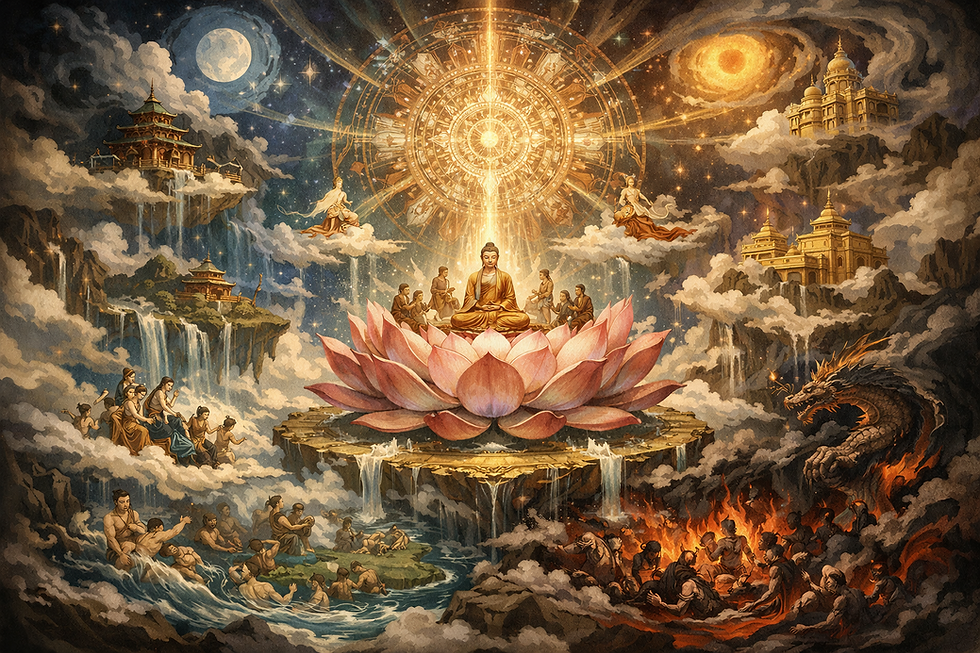
The Lotus Sutra, central to Tendai and Nichiren Buddhism, presents a cosmic vision in which the historical Buddha's life is a manifestation of his eternal buddhahood. The sutra's key teachings include:
Skillful means (hōben): The Buddha's teachings are adapted to capacities; the Lotus is the final, complete teaching
Eternal Buddha: Śākyamuni attained buddhahood immeasurably long ago; his life in India was a manifestation
Universal salvation: All beings—including women and evil people—can attain buddhahood
The single vehicle: The three vehicles (śrāvaka, pratyekabuddha, bodhisattva) are all provisional; the one vehicle leads all to buddhahood
Nichiren identified the Odaimoku, "Namu-myōhō-renge-kyō," as the essence of the Lotus Sutra and the sole practice for the age of mappō.
Esoteric Cosmology: The Two Mandalas
Shingon Buddhism elaborated a rich cosmological vision based on two cosmic diagrams (maṇḍalas):
Womb Realm Mandala | Garbhakoṣadhātu | The principle of compassion; the matrix from which all phenomena arise; the potential for enlightenment
Diamond Realm Mandala | Vajradhātu | The principle of wisdom; the indestructible awakened state; the actualization of enlightenment
The two mandalas are not separate but complementary; wisdom and compassion, essence and manifestation, potential and actual. At their center sits Dainichi Nyorai (Mahāvairocana), the cosmic Buddha whose body is the universe itself.
Kūkai taught that the universe is the Buddha's speech, that all phenomena express the Dharma, and that enlightenment is attainable in this very body through esoteric practice.

Zen Cosmology: Buddha-Nature and Impermanence
Zen cosmology emphasizes the identity of ultimate reality and everyday experience. Key concepts include:
Buddha-nature (busshō): All beings possess the potential for awakening; for Dōgen, all beings are Buddha-nature
Impermanence (mujō): The transience of all phenomena is not a problem but a revelation; cherry blossoms fall because they are cherry blossoms
Thusness (shinnyo, Skt. tathatā): Things as they are, without conceptual elaboration; reality just as it presents itself
Dōgen's philosophy of practice-realization holds that zazen is not a means to enlightenment but the enactment of enlightenment. The universe itself is Buddha's body; sitting in meditation is the universe sitting in meditation.
Dōgen's verse, quoting Su Dongpo, expresses this vision:
"The voice of the valley stream is the Buddha's voice;
The form of the mountains is the Buddha's form."
For Dōgen, "the preaching of non-sentient beings" is not metaphor but reality: mountains, rivers, grasses, trees; all express the Dharma.
Shintō Cosmology

Shintō cosmology, as preserved in the Kojiki and Nihon shoki, begins with the emergence of the first kami from chaos:
The Plain of High Heaven (Takamagahara): Home of the celestial kami
Creation of the Japanese islands: Izanagi and Izanami stir the primeval ocean with a jeweled spear; drops form the first island
Birth of kami: Izanagi and Izanami give birth to kami of natural forces
The sun goddess: Amaterasu, born from Izanagi's left eye, becomes ruler of the heavens
The imperial line: Amaterasu's descendant, Ninigi, descends to rule Japan; his great-grandson becomes the first emperor, Jimmu
This cosmology established the sacred status of Japan (the land created by the kami) and the divine descent of the imperial line, doctrines that persisted through classical and modern periods.
The Syncretic Cosmos
In classical Japan, Buddhist and Shintō cosmologies were not separate. The combinatory system of honji suijaku integrated them:
The Plain of High Heaven could be interpreted as a manifestation of a Buddhist pure land
Kami were understood as local manifestations of buddhas and bodhisattvas
Buddhist rituals were performed for kami
Shrine festivals included Buddhist elements
The imperial line's divine descent was reconciled with Buddhist teachings on karma and rebirth
As the Routledge article notes, "The idea of universal buddhahood supported both syncretistic tendencies in Japanese Buddhism and the equality of all beings. The first undermined any ultimate difference between Buddhist and Shintō objects of veneration, and the second any difference between the human and natural worlds, or what we today call culture and nature."
This syncretic cosmos, in which kami and buddhas, humans and nature, culture and wildness were all expressions of the same sacred reality, shaped Japanese aesthetics, ethics, and identity for centuries.
Part VII: Conclusion—The Legacy of Classical Japan

The classical period of Japanese history, from the Heian court to the Tokugawa shogunate, witnessed extraordinary continuity amid profound transformation. The imperial line, established in myth and confirmed in history, persisted throughout, though emperors ruled directly only in the early centuries and briefly after 1868.
The Buddhist traditions introduced in the Asuka period evolved into distinctively Japanese schools—Tendai, Shingon, Pure Land, Nichiren, Zen—that shaped every aspect of culture. The Shintō kami remained present, syncretically fused with Buddhist divinities, their shrines dotting the landscape.
The warrior class, born in the provinces of the late Heian period, developed into the ruling samurai estate. Their ethos of loyalty, honor, and martial prowess retrospectively codified as bushidō left an enduring cultural legacy. Their political institutions, like the shogunate, the daimyō domains, the lord-vassal relationship structured Japanese government for seven centuries.
Classical Japan in Global Context
Throughout the classical period, Japan was never completely isolated. The Heian court maintained relations with Tang China and Silla Korea. The Kamakura shogunate faced the Mongol invasions, connecting Japan to the Eurasian empire that stretched from Korea to Eastern Europe.
The Muromachi bakufu traded with Ming China and developed diplomatic relations. The Azuchi-Momoyama period witnessed the first European contact, introducing firearms, Christianity, and new trade goods. The Tokugawa peace limited but did not sever foreign contact, maintaining relations with Korea, Ryukyu, China, and the Dutch.
These international connections shaped Japan's development:
Buddhism, writing, and Chinese political thought in early centuries
Zen and Neo-Confucianism in medieval period
Firearms and Christianity in the 16th century
Western science through Rangaku in the Edo period
Japan selectively absorbed and adapted foreign influences, creating a distinctive civilization that was neither isolated nor derivative.
The Enduring Legacy
The classical period's legacies persist in modern Japan:
The imperial institution, though transformed, continues as the world's oldest hereditary monarchy
Buddhist temples remain centers of practice and pilgrimage
Shintō shrines continue seasonal festivals and life-cycle rituals
Zen aesthetics inform tea ceremony, calligraphy, garden design, and contemporary design
Samurai values of loyalty, honor, and self-discipline echo in corporate culture and social expectations
Kabuki, Nō, and bunraku are performed and treasured
Haiku and waka are composed and appreciated
Ukiyo-e prints are collected worldwide
The Tale of Genji remains a touchstone of world literature
The classical period also bequeathed tensions that would shape modern Japan: the relationship between emperor and shogun, the status of the samurai class, the question of foreign relations, the balance between native and foreign culture.
The Meiji Transformation and Beyond
The Meiji Restoration (1868) opened a new era, but classical Japan did not disappear. The Meiji government dismantled the Tokugawa political structure, abolished the samurai class, and promoted Westernization; but it also elevated the emperor as a symbol of national unity, established State Shintō, and drew on samurai values in creating a modern military.
In the 20th century, classical culture was mobilized for nationalist purposes; the kamikaze pilots of World War II evoked the "divine wind" that saved Japan from the Mongols. Post-war, classical traditions have been reimagined as sources of cultural identity and global soft power.
Today, classical Japan is both heritage and living tradition. Pilgrims climb Mount Kōka, Zen students sit in meditation, tea masters perform centuries-old rituals, and millions visit temples and shrines at New Year. The classical past is not a museum but an ongoing presence.
Appendix: Chronological Summary of Classical Japan
Heian | 794–1185 | Capital moved to Kyoto; rise of Fujiwara regency; Tale of Genji; Genpei War; rise of samurai | Tang dynasty in China; Abbasid Caliphate; Viking Age; Norman Conquest
Kamakura | 1185–1333 | Minamoto shogunate; Hōjō regency; Jōkyū Disturbance; Mongol invasions (1274, 1281); new Buddhist schools | Mongol Empire; Marco Polo; Crusades; Sung and Yuan China
Muromachi | 1333–1573 | Ashikaga shogunate; Nanboku-chō; Ōnin War; Sengoku period; Zen culture; Nō drama | Ming China; Hundred Years' War; Fall of Constantinople; Renaissance
Azuchi-Momoyama | 1568–1600 | Oda Nobunaga unification; Toyotomi Hideyoshi; Korean invasions; Nanban trade; Christian mission | Elizabethan England; Spanish Golden Age; Reformation; Ottoman Empire
Edo | 1600–1868 | Tokugawa shogunate; sankin kōtai; sakoku isolation; peace and urbanization; Genroku culture; Perry's arrival | Qing China; Scientific Revolution; Enlightenment; Industrial Revolution; Napoleonic Wars

References:
Miner, E., Odagiri, H., & Morrell, R. E. (1985). The Princeton Companion to Classical Japanese Literature. Princeton University Press.
Maraldo, J. C. (1998). "Buddhist philosophy, Japanese: Universal and particular." Routledge Encyclopedia of Philosophy.
"Nanban trade." Wikipedia.
Fogel, J. A. (2013). Japanese Historiography and the Gold Seal of 57 C.E.: Relic, Text, Object, Fake. Brill.
"Kamakura period." Encyclopædia Britannica.
Cartwright, M. (2019). "Azuchi-Momoyama Period." World History Encyclopedia.
Sansom, G. (1984). A History of Japan 1615–1867. Charles E. Tuttle Company.
Cryns, F. (2026). "Tokugawa Ieyasu and Seventeenth-Century Globalism." In Global Japanes. Taylor & Francis.
Sadao, T. S., & Wada, S. (2003). Discovering the Arts of Japan: A Historical Overview. Kodansha International.
Teeuwen, M., & Rambelli, F. (eds.). (2003). Buddhas and Kami in Japan: Honji Suijaku as a Combinatory Paradigm. Routledge.


Comments