
.png)

Ancient World: Japan, Land of the Rising Sun
- A. Royden D'Souza

- Mar 19
- 43 min read
This is a textual journey through the Japanese archipelago from its geological formation through the ancient period, tracing the complete arc of human settlement, cultural development, and state formation up to the Nara era (710-794 AD).

The Japanese islands present a unique case study in human history: a geographically isolated archipelago that nevertheless served as the eastern terminus of Silk Road trade networks, absorbing and transforming influences from across Eurasia while maintaining distinctive cultural traditions that persist to this day.
Modern understanding of Japan's ancient past has been revolutionized by recent scholarship. The 2021 publication of genome-wide ancient DNA analysis has fundamentally altered the model of Japanese population history, establishing a tripartite structure of ancestral migration rather than the previously accepted dual-ancestry theory.
The modern Japanese population derives from three distinct migrations: the indigenous Jōmon hunter-gatherers who arrived more than 15,000 years ago; Yayoi rice farmers who migrated from East Asia beginning around 900 BC; and a previously unrecognized third wave during the Kofun period (c. 300-700 AD) whose origins lie in East Asia, likely related to the Han Chinese population.
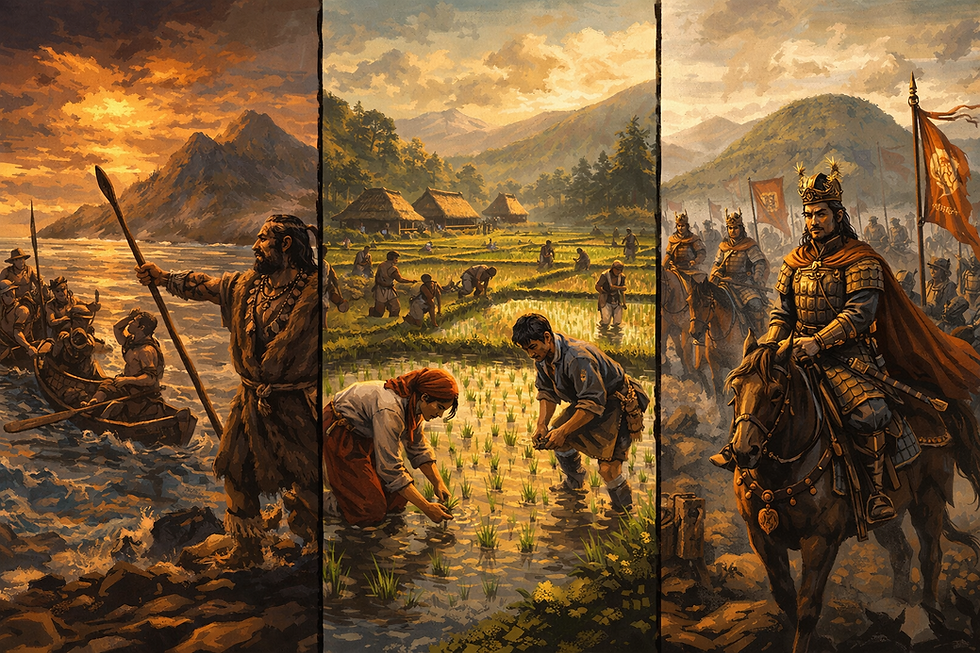
Let's try to trace the complete arc of Japanese ancient history: from the geological forces that shaped the archipelago and separated it from the Asian continent; through the contentious debates surrounding the earliest human presence, including the Paleolithic hoax that shook Japanese archaeology to its foundations; the remarkable Jōmon period, during which hunter-gatherers created some of the world's earliest pottery and developed a complex sedentary culture; the transformative Yayoi period, which introduced wet-rice agriculture, metallurgy, and new social structures from the continent; the Kofun period, named for the colossal keyhole-shaped burial mounds that marked the emergence of a unified polity; and finally the Asuka and Nara periods, when Buddhism, writing, and centralized imperial governance transformed Japan into a ritsuryō state modeled on Tang China.
Throughout this narrative, particular attention is paid to the connective tissue that bound the Japanese archipelago to the broader Eurasian world. The Silk Road, extending from the Mediterranean through Central Asia and China, reached its eastern terminus in the Japanese islands.
The Shōsōin Repository in Nara preserves nearly nine thousand artifacts from Tang China, Sasanian Persia, Southeast Asia, and the Middle East; a tangible testament to the cosmopolitan world of eighth-century Japan.
Recent discoveries, including a wooden tablet identifying a Persian official serving in the Nara court and Roman coins found in an Okinawan castle, continue to reshape our understanding of ancient Japan's global connections.

The development of Japanese religious traditions mirrors this pattern of indigenous continuity and continental influence. The native kami worship, later named Shintō to distinguish it from Buddhism, preserved ancient practices of purification and spirit veneration while absorbing and adapting elements from the continent.
Buddhism, introduced via Korea in the sixth century, transformed Japanese spirituality, art, and politics, while the kami remained entwined with the roots of national identity.
Let's explore Japan's ancient past, acknowledging both the extraordinary achievements of its prehistoric cultures and the complex controversies that attend their study. By examining the full sweep of Japanese prehistory and early history, we can appreciate the remarkable continuity and transformation that characterize this island civilization.
Part I: The Geological Stage—Birth of the Archipelago

The story of Japan begins long before the first human set foot on its shores, in the deep geological time when the islands themselves were formed. The Japanese archipelago is the product of millions of years of tectonic activity along the convergent boundary where the Pacific Plate, the Philippine Sea Plate, and the Eurasian Plate meet.
This volatile geological setting has endowed Japan with dramatic mountain scenery, frequent earthquakes, and active volcanism; but it also created the physical stage upon which human history would unfold.
During much of the Pleistocene epoch (roughly 2.6 million to 11,700 years ago), the Japanese islands were not islands at all. Repeated glacial periods lowered global sea levels by as much as 120-140 meters, exposing vast areas of the continental shelf and creating land bridges that connected the Japanese archipelago to the Asian mainland.
Hokkaido was connected to Sakhalin and thence to Siberia; Kyushu was connected to the Korean peninsula via a narrow land bridge; and the islands of the Japanese archipelago formed a continuous arc stretching from northeast to southwest, their interiors dotted with lakes and rivers fed by glacial meltwater.
These land bridges served as migration routes for plants, animals, and eventually humans. Mammoths, Naumann's elephants, Yabe's giant deer, and other Pleistocene megafauna crossed from the continent into Japan, followed by the hunter-gatherers who pursued them.

The archipelago was not an isolated cul-de-sac but a peninsula of Asia, its inhabitants part of the broader ecological and cultural networks of northeast Eurasia.
The end of the last glacial period, beginning around 15,000 years ago, transformed this landscape dramatically. As temperatures warmed and ice sheets melted, sea levels rose, inundating the land bridges and separating the Japanese islands from the continent.
The Tsushima Strait flooded, creating a 200-kilometer water barrier between Kyushu and Korea. The Sōya Strait separated Hokkaido from Sakhalin.
By approximately 12,000 BC, Japan had assumed roughly its modern configuration; an archipelago of four main islands (Hokkaido, Honshu, Shikoku, and Kyushu) and thousands of smaller islands, isolated from the mainland by treacherous seas.
This isolation would have profound consequences for Japanese history. The archipelago became a laboratory of cultural evolution, where traditions could develop in relative insularity while still maintaining sporadic contact with the continent.
The sea that separated Japan from Asia was a barrier, but it was also a highway; one that could be crossed by those with sufficient maritime technology and courage, filtering and shaping the influences that reached the islands.
The Volcanic Archive: Stratigraphy and Dating
One of the great advantages enjoyed by archaeologists working in Japan is the archipelago's volcanic nature. Frequent eruptions have repeatedly blanketed the islands with layers of volcanic ash (tephra), creating a clear and datable stratigraphic sequence that serves as a reference across the entire country.
The most important of these marker layers is the Aira-Tanzawa (AT) pumice, which erupted from the Aira caldera in southern Kyushu approximately 21,000-22,000 years ago and covered all of Japan with a distinctive ash layer.
This layer provides a fixed chronological horizon: any archaeological material found below the AT layer must date to before approximately 22,000 years ago, while material found above it is younger.
Other volcanic events—the Aso-4 eruption (c. 87,000 BP), the Daisen-Kurayoshi eruption (c. 50,000 BP), and numerous smaller events—provide additional chronological markers that allow Japanese archaeologists to construct unusually precise relative chronologies.
This volcanic archive has been essential for establishing the timeline of human presence in the archipelago. When archaeological sites are sealed between datable ash layers, their age can be determined with confidence; provided, of course, that the artifacts themselves are authentic and properly associated with the geological strata.
Part II: The First Japanese—Paleolithic Controversies

The question of when humans first arrived in the Japanese archipelago has been one of the most contentious issues in Japanese archaeology. For decades, the field was dominated by claims of extreme antiquity, with some sites purportedly dating to 500,000 years ago or more.
The exposure of the Paleolithic hoax in 2000 forced a complete reevaluation of the evidence, and the current scholarly consensus is considerably more cautious.
The earliest widely accepted evidence for human presence in Japan dates to approximately 35,000-40,000 years ago. This timing coincides with a period of lowered sea levels when land bridges connected the archipelago to the continent, facilitating human migration.
Sites from this period are scattered across the islands, from southern Kyushu to northern Hokkaido, indicating that the first Japanese spread rapidly throughout the archipelago.
The Paleolithic inhabitants of Japan were hunter-gatherers who pursued the Pleistocene megafauna that roamed the islands—Naumann's elephants, Yabe's giant deer, and other large mammals—as well as smaller game and plant foods.
Their stone tool technology, characterized by flake tools and later by blade tools, shows affinities with contemporaneous industries in northeastern Asia, suggesting that the first Japanese came from the north, crossing from Siberia into Hokkaido and then spreading southward.
Paleoanthropological evidence for these first Japanese is frustratingly sparse. The acidic volcanic soils that preserve such excellent stratigraphy are detrimental to the preservation of bone, and human skeletal remains from the Paleolithic period are extremely rare.
The oldest human bones found in Japan were discovered in Hamamatsu City, Shizuoka Prefecture, and date to approximately 14,000-18,000 years ago; already toward the end of the Paleolithic period.
What can be inferred about these first Japanese comes primarily from the morphology of later populations and from genetic analysis of modern descendants. The Paleolithic populations of Japan, like the later Jōmon people who succeeded them, appear to belong to an ancient "Paleo-Asian" group that once occupied large parts of Asia before the expansion of the populations characteristic of modern East Asians.
Their dental morphology belongs to the Sundadont pattern, mainly distributed in ancient Southeast Asian populations, rather than the Sinodont pattern characteristic of modern Northeast Asians (including most modern Japanese, Koreans, and Chinese).

The indigenous Ainu of Hokkaido and the Ryukyuan people of Okinawa appear to be the closest living descendants of these Paleolithic populations, preserving physical features and genetic markers that link them to the earliest inhabitants of the archipelago.
Genetic analysis suggests that approximately 20-30% of the genetic makeup of the modern Japanese (Yamato) population derives from this Paleolithic-Jōmon ancestry, with the remainder coming from later migrations from the continent.
Ground Stone Revolution: Japan's Paleolithic Anomaly
The Japanese Paleolithic presents a remarkable anomaly that has puzzled archaeologists since its discovery: the presence of ground stone and polished stone tools dating to around 30,000 BCE; technologies that in the rest of the world are associated with the Neolithic period, beginning around 10,000 BC.
The earliest ground stone tools outside Japan have been discovered in Australia, dating to perhaps 35,000-40,000 years ago, but their appearance in Japan at such an early date remains unexplained.
Some of the Japanese sites have produced axes and other implements that were shaped by grinding and polishing; techniques that require significant investment of labor and imply a level of technological sophistication not generally associated with Paleolithic hunter-gatherers.
This early appearance of ground stone technology has led some archaeologists to suggest that the Japanese Paleolithic does not fit neatly into the traditional three-age system (Paleolithic, Mesolithic, Neolithic) developed in Europe.
The Japanese sequence shows a combination of characteristics that elsewhere would be separated by thousands of years: chipped stone tools typical of the Paleolithic coexist with ground stone tools that elsewhere would mark the transition to the Neolithic.
The reasons for this precocious development remain obscure. Japan's rich resources, like abundant game, fish, and plant foods, may have supported a level of sedentism unusual for Paleolithic hunter-gatherers, encouraging investment in more sophisticated tool technology.
Alternatively, the ground stone tools may reflect cultural influences from southern routes of migration, perhaps linking Japan to the early ground stone traditions of Southeast Asia and Australia. Whatever the explanation, the early polished tools of Japan stand as a reminder that technological evolution does not follow a single, universal path.
Part III: The Jōmon World—Hunter-Gatherer Complexity
The Jōmon period (14,000 - 300 BC) represents one of the most remarkable cultural flowerings in world prehistory; a hunter-gatherer society that achieved levels of complexity, sedentism, and artistic expression rarely equaled by non-agricultural peoples.
The period takes its name from the distinctive "cord-marked" pottery (Jōmon means "cord pattern") that first appears around 14,000 BCE and continues for more than ten millennia; making Jōmon pottery among the oldest in world history.
The transition from Paleolithic to Jōmon was gradual rather than abrupt. Around 14,000-12,000 BC, as the climate warmed and forests expanded, the megafauna that had sustained Paleolithic hunters declined.
The inhabitants of the archipelago adapted by broadening their subsistence base to include more plant foods, smaller game, and marine resources. The invention of pottery allowed them to store and process these diverse foods more effectively.

The Jōmon period is conventionally divided into six sub-periods:
Incipient Jōmon | 14,000-7,500 BCE | First pottery; early sedentism
Initial Jōmon | 7,500-4,000 BCE | Expansion of settlements; shell middens appear
Early Jōmon | 4,000-3,000 BCE | Climatic optimum; population peak in eastern Japan
Middle Jōmon | 3,000-2,000 BCE | Maximum complexity; elaborate ritual goods
Late Jōmon | 2,000-1,000 BCE | Cooling climate; population decline in east
Final Jōmon | 1,000-300 BCE | Regional differentiation; contacts with continent
The Jōmon people were not a single, unified population but a diverse collection of regional groups sharing certain cultural traditions.
Genetic analysis confirms that they descended from the Paleolithic inhabitants of the archipelago and maintained substantial genetic continuity across millennia, with little admixture from outside populations until the very end of the period.
Sedentism Without Agriculture

One of the most striking features of Jōmon culture is the degree of sedentism achieved by these hunter-gatherers. In many parts of the archipelago, Jōmon people lived in substantial pit-houses arranged in villages that were occupied for generations.
The Sannai Maruyama site in Aomori Prefecture, dating to the Middle Jōmon period, covers approximately 40 hectares and contains evidence of long-term occupation, including hundreds of pit dwellings, longhouses up to 30 meters in length, raised-storehouse structures, and massive earthworks.

This sedentism was made possible by the extraordinary productivity of Japan's natural environment. The archipelago's diverse ecosystems; temperate forests, rivers, lakes, and especially the rich marine resources of the Pacific coast provided a reliable and abundant food supply.
Salmon runs in autumn, acorns and chestnuts in fall, deer and boar year-round, and the enormous productivity of coastal waters allowed Jōmon populations to remain in place while exploiting seasonal resources within a reasonable radius.
The Jōmon developed sophisticated technologies for harvesting and processing wild resources. They built weirs and traps for fishing, constructed storage pits lined with bark to preserve acorns and nuts, and created an array of tools for grinding, pounding, and cooking plant foods.
Their pottery, which evolved over millennia from simple deep bowls to elaborately decorated vessels, was essential for boiling and storing food.
The Jōmon did practice a form of plant management that some archaeologists characterize as "low-level food production." They cleared undergrowth to encourage the growth of useful plants, possibly transplanted chestnut trees near settlements, and may have cultivated certain plants such as barnyard millet and beans.
However, there is no evidence for the domestication of plants in the full agricultural sense, and Jōmon subsistence remained firmly based on hunting, gathering, and fishing throughout the period.
The Pottery Revolution
The invention of pottery during the Incipient Jōmon period represents a technological revolution of global significance. The earliest Jōmon pots, dating to around 14,000 BCE, are simple, deep vessels with pointed or rounded bottoms, probably used for boiling foods over open fires.

They precede the appearance of pottery in the Near East (c. 7,000 BCE) by millennia and are roughly contemporaneous with the earliest pottery traditions of China and eastern Siberia.
Why did pottery appear so early in Japan? The answer likely lies in the post-glacial environment and the nature of Jōmon subsistence. As the climate warmed and forests expanded, plant foods, particularly acorns and other nuts, became increasingly important in the diet.
Many of these nuts contain tannins and other bitter compounds that must be leached out through prolonged boiling; a process greatly facilitated by ceramic vessels. Pottery also allowed for the cooking of shellfish and other marine resources, which became more accessible as sea levels rose and estuaries formed.
Over the millennia, Jōmon pottery evolved in form and decoration. The Early and Middle Jōmon periods saw the development of increasingly elaborate styles, particularly in eastern Japan. Vessels were adorned with applied clay coils, incised patterns, and sculptural elements that sometimes became so elaborate they seem to overwhelm the vessel's functional form.

The "flame-style" pottery of the Middle Jōmon period in the Chubu region features dramatic, fire-like protrusions around the rim; ceremonial vessels that represent a peak of hunter-gatherer artistic achievement.
Koji Mizoguchi's analysis of Jōmon material culture emphasizes that pottery was not merely functional but played a crucial role in the construction of social identity.
The spatial and temporal distribution of pottery styles reflects the boundaries between communities and the networks of interaction that linked them. Jōmon people used pottery to mark who they were and where they belonged in the social landscape.
Jōmon Ritual and Spirituality
The archaeological remains of the Jōmon period provide glimpses of a rich spiritual life centered on the forces of nature, fertility, and the ancestors. The most striking ritual objects are the dogū; clay figurines, typically humanoid in form, that appear from the Initial Jōmon period onward.

Dogū vary enormously in style, from simple, stylized forms to elaborate figures with bulging eyes, elaborate headdresses, and complex body decorations. Many are female, with exaggerated breasts and hips, suggesting associations with fertility and childbirth.
Others have been found deliberately broken, perhaps as part of rituals involving the destruction of the figurine. Some scholars interpret dogū as representations of deities, spirit intermediaries, or participants in shamanic rituals.
Other ritual objects include stone rods (sekibō), phallic symbols possibly associated with fertility rituals; clay masks, perhaps used in ceremonies; and lacquerware, including combs, hairpins, and ceremonial vessels.
Jōmon people also created ritual spaces; stone circles and alignments, such as the famous Oyu Stone Circle in Akita Prefecture, which may have served for astronomical observation and seasonal ceremonies.

Burial practices reveal concern for the afterlife and the status of the deceased. Jōmon people were typically buried in shell middens or in pits within settlements, often accompanied by grave goods; pottery, jewelry, and ritual objects.
Infants were sometimes buried in jars. The presence of shell bracelets and other prestige goods in some graves suggests the emergence of social differentiation, though Jōmon society appears to have remained largely egalitarian.
Genetic Isolation and Population History
The Jōmon period represents a remarkable chapter in human genetic history. After the flooding of the land bridges around 12,000 BC, the Jōmon population was effectively isolated from the Asian mainland for millennia, developing in genetic and cultural isolation.
Recent DNA analysis has revealed that the Jōmon population remained surprisingly stable over this long period. Despite inhabiting a diverse archipelago stretching from Hokkaido to Kyushu, the Jōmon show high genetic affinity across all sampled individuals, even those separated by thousands of years and excavated from different islands.
As one researcher notes, "These results strongly suggest a prolonged period of isolation from the rest of the continent."
The Jōmon population was small, estimated at perhaps 20,000-30,000 individuals at its peak, but genetically diverse. They belonged to the Sundadont dental pattern, characteristic of ancient Southeast Asian populations, and likely resembled modern Ainu and Ryukyuan peoples in physical appearance.

Their mitochondrial DNA haplogroups include types rare or absent in modern East Asian populations, confirming their status as a distinct branch of humanity.
Genetic studies estimate that modern Japanese (Yamato) people derive approximately 13% of their ancestry from Jōmon populations; a significant contribution, but far less than the contribution from later Yayoi migrants.
The Ainu of Hokkaido, however, retain much higher proportions of Jōmon ancestry, as do the Ryukyuan people of Okinawa, preserving a genetic legacy that elsewhere has been largely submerged by later migrations.
Jōmon in Global Context
The Jōmon period unfolded against a backdrop of global transformation. While Jōmon hunter-gatherers were creating elaborate pottery and settling in substantial villages, elsewhere in the world:

In the Fertile Crescent of Southwest Asia (Nile-Euphrates), Natufian hunter-gatherers were establishing some of the world's first sedentary settlements (12,000 BC), laying the groundwork for the agricultural revolution that would transform human existence.
In China, the early millet farmers of the Yellow River valley and the rice cultivators of the Yangtze were domesticating the crops that would feed East Asian civilization for millennia.
In Egypt, Predynastic cultures were developing along the Nile, eventually leading to the unification of Upper and Lower Egypt around 3100 BC.
In Mesopotamia, the Sumerian civilization was inventing writing (3400 BC) and building the world's first cities.
In the Indus Valley, the Harappan civilization was constructing meticulously planned cities with advanced drainage systems (2600 BC).
In Europe, megalithic builders were erecting monuments like Stonehenge (3000 BC) and developing Bronze Age societies.
In the Americas, the Olmec civilization was emerging in Mesoamerica (1500 BCE), and the Chavín culture was developing in the Andes.

The Jōmon were not entirely isolated from these broader developments. Trade networks connected the archipelago to the continent throughout the period, as evidenced by the presence of jade from the Japan Sea coast and obsidian from Kozushima Island at sites across Japan.
Late Jōmon sites in Kyushu have yielded bronze artifacts and evidence of contact with the Korean peninsula, foreshadowing the profound transformations to come.

Part IV: The Yayoi Revolution—Rice, Metals, New People
Around 900 BC, the long isolation of the Jōmon world was shattered by the arrival of new people from the Asian continent; migrants who brought with them technologies and practices that would transform the Japanese archipelago forever.

These Yayoi people, named after the Tokyo neighborhood where their pottery was first identified, initiated the most profound cultural transformation in Japanese history.
The origins of the Yayoi have been debated for generations, but recent genetic evidence has clarified the picture dramatically. The Yayoi migrated from the Korean peninsula, bringing with them wet-rice agriculture, bronze and iron metallurgy, and new forms of social organization.
They were not a single, unified population but rather multiple waves of migrants who crossed the Tsushima Strait and settled primarily in northern Kyushu, gradually spreading eastward across Honshu.
Genetic analysis reveals that the Yayoi were genetically distinct from the Jōmon, belonging to the Sinodont dental pattern characteristic of Northeast Asian populations (modern Koreans, Chinese, and most Japanese). They carried mitochondrial DNA haplogroups common in East Asia but rare among the Jōmon, confirming their separate origins.
The relationship between Yayoi migrants and Jōmon indigenes varied regionally. In western Japan, where Yayoi settlement was densest, the two populations appear to have mixed extensively, with Jōmon genetic contribution diminishing over time.
In eastern Japan, where Yayoi influence spread more gradually, Jōmon populations may have persisted longer and contributed more substantially to local genetic makeup. Modern Japanese derive approximately 16% of their ancestry from Yayoi populations; a significant contribution, though less than previously estimated.
Rice and Revolution: The Agricultural Transformation
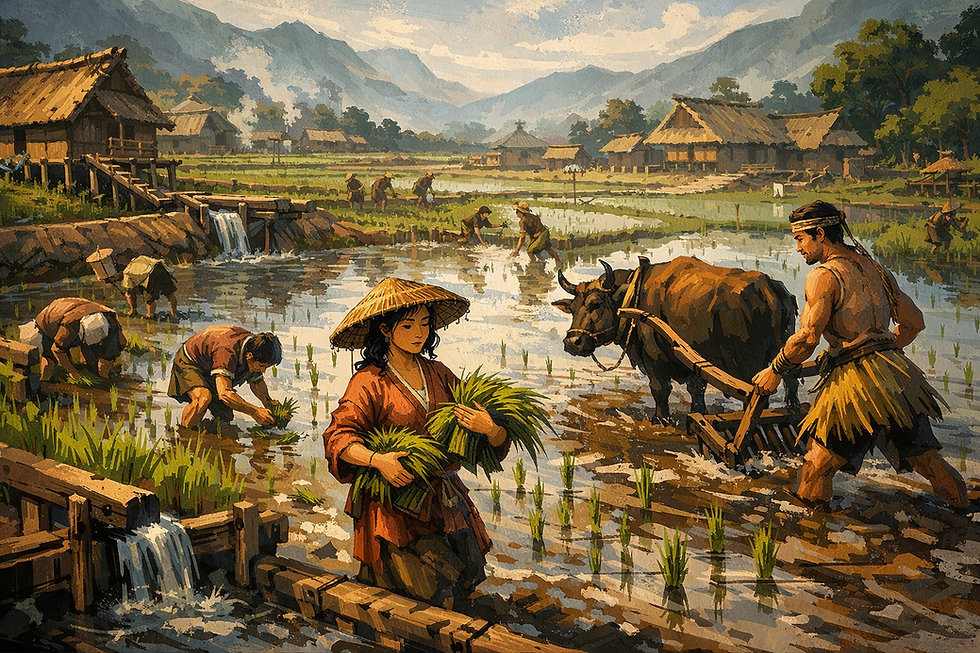
The most transformative introduction of the Yayoi period was wet-rice agriculture, a system of rice cultivation in flooded paddies that could produce yields far exceeding those of dry-field farming. This technology, developed in the Yangtze River valley of China and transmitted via the Korean peninsula, fundamentally altered the relationship between human populations and the land.
Rice paddies required intensive labor to construct and maintain; clearing land, building irrigation systems, leveling fields, and managing water flow. This labor demand encouraged the formation of larger, more stable communities and fostered cooperation on scales unknown in the Jōmon period.
The high yields of paddy agriculture supported population growth and allowed the accumulation of surplus, which could be stored, traded, or used to support non-farming specialists.
Archaeological evidence documents the rapid spread of rice agriculture across western Japan. By the Middle Yayoi period (300 BC - 100 AD), paddy fields extended throughout Kyushu, Shikoku, and western Honshu.
By the Late Yayoi (100-300 AD), rice cultivation had reached the Kanto region around modern Tokyo, and by the end of the period, it was established as far north as the Tohoku region.
The introduction of rice agriculture had profound social consequences. Land, particularly irrigable land, became a valuable and contested resource. Communities that controlled good paddy land could produce surpluses, supporting larger populations and accumulating wealth.
Disputes over land and water resources led to conflict, as evidenced by the appearance of moated settlements, weapons, and burials with arrow wounds.
Metals and Social Hierarchy
The Yayoi period also witnessed the introduction of bronze and iron metallurgy from the continent; technologies that would transform warfare, ritual, and social organization.

Bronze was initially used primarily for ritual objects; ceremonial bells (dōtaku), weapons (swords, spears, halberds), and mirrors. Dōtaku, which could stand over a meter tall and were elaborately decorated with scenes of hunting, weaving, and other activities, were probably used in fertility rituals and other ceremonies.
Their distribution suggests the existence of regional exchange networks and shared ritual traditions across western Japan.
Iron was used for practical tools and weapons from the beginning of the Yayoi period. Iron axes, hoes, and sickles increased agricultural productivity; iron knives and arrowheads made warfare more deadly. The contrast between bronze (ritual) and iron (practical) reflects patterns seen elsewhere in Eurasia, where the two metals often served different social functions.
Control over metal production and distribution became a source of power. Communities that could access metal resources, whether through trade with the continent or control of local production, gained advantages over their neighbors.
Metal objects, particularly bronze mirrors and weapons, became prestige goods that marked elite status. The appearance of metal in graves alongside other luxury goods (glass beads, jade, etc.) signals the emergence of more pronounced social hierarchies.
The Emergence of Chiefdoms

By the Middle Yayoi period, Japanese society had transformed from the relatively egalitarian communities of the Jōmon into a landscape of competing chiefdoms; politically centralized societies with hereditary social ranking and institutionalized leadership.
Archaeological evidence for this transformation includes:
Settlement hierarchy: The emergence of large, central settlements surrounded by smaller villages, indicating political centralization.
Defensive structures: Moats, palisades, and hilltop settlements suggesting inter-chieftain warfare.
Elite burials: Graves distinguished by size, location, and rich grave goods; bronze weapons, mirrors, beads, and imported goods.
Ritual differentiation: Differential access to ritual knowledge and objects, with elites controlling ceremonies that legitimized their authority.
Long-distance trade: Exchange networks linking chiefdoms and providing access to prestige goods from the continent.
Chinese historical sources provide written confirmation of this political landscape. The Wei Zhi (Records of Wei), a third-century AD Chinese text, describes the land of "Wa" (Japan) as divided into numerous small countries, perhaps thirty or more, engaged in constant warfare.
The text mentions a queen named Himiko who ruled over a federation of chiefdoms, "occupied herself with magic and sorcery, bewitching the people," and maintained her authority through ritual power rather than military force.

Himiko sent embassies to the Chinese court of the Wei dynasty, establishing diplomatic relations that brought prestige and access to Chinese luxury goods. Her kingdom, identified by most scholars with the Yamatai state (location still hotly debated), represents the culmination of Yayoi political development and the immediate precursor to the Kofun period.
Yayoi in Global Context
The Yayoi period coincided with transformative developments across Eurasia:
China | Eastern Zhou dynasty (770-256 BC); Warring States period (475-221 BC); Qin unification (221 BC); Han dynasty (202 BC - 220 AD)—the golden age of classical Chinese civilization
Korea | Gojoseon kingdom; Three Kingdoms period (Goguryeo, Baekje, Silla) begins to emerge
India | Mahajanapadas (16 great states); Mauryan Empire (322-185 BC); Gupta Empire begins (320 AD); Buddhism and Hinduism flourish
Central Asia | Scythian/Saka nomads dominate steppes; Kushan Empire emerges as Silk Road power
Persia | Achaemenid Empire (550-330 BC); Parthian Empire (247 BC - 224 AD); Sasanian Empire begins (224 AD)
Mediterranean | Greek city-states; Hellenistic period; Roman Republic and early Roman Empire
Americas | Olmec civilization (Mesoamerica); Chavín culture (Andes); Maya Preclassic period
Africa | Carthage (814–146 BC); Axum (100–700 AD)—the Nile Valley civilizations, Red Sea trade, and the rise of Aksum as a contemporary great power
The Yayoi period thus unfolded against a backdrop of imperial consolidation across Eurasia. The Han dynasty's expansion into Korea brought Chinese goods and ideas to the doorstep of Japan.
The establishment of Silk Road trade networks connected the Mediterranean to East Asia, and while Japan remained at the far eastern periphery, it was not entirely isolated from these broader currents.
Part V: The Kofun Period—Horses and Unification

The Kofun period (300-538 AD), named for the enormous keyhole-shaped burial mounds (kofun) constructed for the ruling elite, has long been recognized as the era when Japan transitioned from competing chiefdoms to a unified state.
Recent genetic research has added a dramatic new dimension to this narrative: the Kofun period witnessed a third major migration from the Asian continent, one previously unrecognized in the standard dual-ancestry model.
Analysis of ancient DNA from Kofun-period skeletal remains reveals the arrival of a new population with genetic affinities to East Asian populations, likely related to the Han Chinese. This migration contributed approximately 71% of the genetic ancestry of modern Japanese people; by far the largest component of the tripartite model.
The timing of this migration, roughly 300-700 AD, coincides with the Kofun period and the emergence of Japan as an imperial state conducting military incursions into Korea and importing aspects of Chinese and Korean culture.
Whether the migrants themselves played a role in these transformations remains unclear; the individuals sequenced were not buried in the keyhole mounds reserved for high-ranking elites, suggesting they may have been lower-ranking people. However, their genetic impact is undeniable.
This discovery fundamentally rewrites the understanding of Japanese origins. As one researcher states, "We now know that the ancestors derived from each of the foraging, agrarian and state-formation phases made a significant contribution to the formation of Japanese populations today. In short, we have an entirely new tripartite model of Japanese genomic origins—instead of the dual-ancestry model that has been held for a significant time."

The Kofun migrants likely arrived from the Korean peninsula, bringing with them new technologies (including horse riding), new forms of political organization, and new cultural practices that would shape the emerging Japanese state. Their integration with existing Yayoi and Jōmon populations created the genetic foundation of the modern Japanese people.
The Keyhole Tombs: Architecture of Power
The defining archaeological feature of the Kofun period is the keyhole-shaped burial mound (zenpō-kōen-fun), a monumental tomb form unique to Japan and unprecedented in scale. The largest of these mounds rank among the most massive burial monuments in world history.

Daisenryo Kofun | Osaka | 486 m | mid-5th century | Attributed to Emperor Nintoku; surrounded by three moats
The Daisenryo Kofun measures 486 meters in length and is surrounded by three moats. Its construction required the movement of approximately 1.4 million cubic meters of earth, a labor mobilization comparable to the construction of the Egyptian pyramids.

Ojin-tenno-ryo Kofun | Osaka | 415 m | late 4th/early 5th century | Attributed to Emperor Ojin

Richu-tenno-ryo Kofun | Osaka | 360 m | 5th century | Attributed to Emperor Richu

Nintoku-tenno-ryo Kofun | Osaka | 486 m | 5th century | Largest in Japan; triple moats
Hundreds of smaller keyhole mounds dot the landscape of central Japan, their size and distribution reflecting the hierarchy of political power.
These mounds were not merely tombs but statements of power. Their construction required the mobilization of thousands of workers over extended periods; a display of the ruler's ability to command labor on an enormous scale.

Their distinctive keyhole shape, visible from afar, proclaimed the presence of elite authority across the landscape. Their placement, often in clusters, mapped the relationships between ruling houses.
The tombs contained elaborate grave goods that illuminate the material culture and international connections of the Kofun elite:
Bronze mirrors, many imported from China and others locally produced, symbolized authority and legitimacy. Chinese "divine beast" mirrors (shinju-kyo) were particularly prized.
Iron weapons like swords, spearheads, arrowheads attest to the military character of elite society.
Horse trappings, introduced from Korea during this period, indicate the growing importance of cavalry and horse culture.
Jewelry including magatama (comma-shaped beads) and tubular beads, often of jade, jasper, or glass.
Gilt-bronze crowns and shoes, reflecting Korean and Chinese influences.
Sue pottery, a high-fired gray stoneware introduced from Korea.

The famous haniwa, hollow ceramic cylinders and figures placed on the mound surfaces, depict warriors, horses, houses, musicians, and ritual attendants, creating a symbolic retinue for the deceased ruler. These figures provide invaluable evidence for Kofun-period costume, armor, weaponry, and daily life.
The Yamato State: Unification and Expansion

The Kofun period witnessed the gradual unification of the Japanese islands under the hegemony of the Yamato court, based in the Nara Basin of central Honshu. This process, which unfolded over several centuries, transformed Japan from a landscape of competing chiefdoms into a centralized state.
The Yamato court extended its control through a combination of military conquest, diplomatic marriage, ideological authority, and strategic alliance. Key elements of this process included:
Territorial expansion: Gradual extension of Yamato control eastward into the Kanto region and westward into Kyushu, incorporating local elites into the Yamato political structure.
Alliance networks: Marriage alliances with powerful local houses, incorporating them into the imperial lineage structure.
Ritual authority: Control over key rituals and the distribution of prestige goods (mirrors, etc.) that legitimized local rulers.
Military campaigns: Incursions into the Korean peninsula (the Mimana/Nihon-fu controversy) and campaigns against "emishi" peoples in eastern Japan.
By the 5th century, Yamato rulers claimed sovereignty over much of Japan and maintained diplomatic relations with the Korean kingdoms and the Chinese court.
The Five Kings of Wa, recorded in Chinese histories as sending embassies to the Liu Song dynasty (420-479 AD), represent the Yamato rulers of this period, seeking Chinese recognition and legitimization.

The Yamato state was not a fully centralized bureaucracy but a confederation of powerful houses (uji) acknowledging the supremacy of the Yamato lineage. Each uji controlled territory, resources, and specialized occupations (military, ritual, craft production), and was headed by a hereditary chieftain who served the Yamato ruler in peace and war.
The ruler himself was primus inter pares, his authority dependent on his ability to manage alliances, distribute rewards, and maintain ritual prestige.
International Relations: Korea and China
The Kofun period witnessed intensifying contacts between Japan and the continent, particularly with the Korean kingdoms. These contacts, sometimes peaceful, sometimes hostile, transformed Japanese material culture, technology, and political organization.
The Korean peninsula during this period was divided into three competing kingdoms:
Goguryeo | 37 BC - 668 AD | Northern Korea, Manchuria | Military conflicts; Yamato allied with Baekje against Goguryeo
Baekje | 18 BC - 660 AD | Southwest Korea | Close ally of Yamato; provided scholars, artisans, Buddhist missionaries
Silla | 57 BC - 935 AD | Southeast Korea | Rival of Baekje; often hostile to Yamato
Gaya | 42-562 AD | Nakdong River valley | Close trading partner; iron source; eventually absorbed by Silla

The Yamato court maintained particularly close relations with Baekje, which served as a conduit for continental culture, including Buddhism, writing, and crafts. Baekje sent scholars, Buddhist monks, and artisans to Japan, profoundly shaping the development of Japanese civilization.
The relationship was cemented by military alliance against common enemies (Goguryeo and Silla) and by the shared interests of elite families on both sides of the strait.
Gaya, a confederation of city-states in the Nakdong River valley, was a crucial source of iron; the most valuable commodity of the ancient world. Japanese traders and settlers were active in Gaya, and Gaya craftsmen and technologies (particularly ironworking and pottery) had profound influence on Japan. The absorption of Gaya by Silla in the mid-6th century disrupted these networks and contributed to the realignment of Japanese foreign policy.
Relations with China were more distant but increasingly significant. Yamato rulers sought Chinese recognition to enhance their prestige and legitimacy. Chinese books, technologies, and ideas reached Japan via Korea, gradually transforming elite culture.
By the end of the Kofun period, Chinese writing was being used for record-keeping (as evidenced by inscriptions on iron swords), and knowledge of Chinese political philosophy was spreading among the elite.
Kofun Religion and Ideology
The religious world of the Kofun period remains poorly documented but can be inferred from archaeological evidence. The elaborate funerary rituals suggest belief in an afterlife where the deceased required material goods and symbolic protection.
The placement of haniwa on the mounds, like warriors, horses, houses, and attendants, suggests a conception of death as a journey or transition to another realm where the ruler would need the same services and protections as in life.

The emergence of a distinct imperial ideology, linking the Yamato rulers to the sun goddess Amaterasu, probably has its roots in this period. The myth cycles later recorded in the Kojiki and Nihon Shoki, which trace the imperial line directly to the gods, likely originated as legitimizing narratives for Yamato hegemony.
The sacred regalia of the imperial house, like the mirror, sword, and jewel, emerged as symbols of legitimate authority, their prototypes found among the grave goods of Kofun tombs.
Shamanic traditions persisted, with female ritual specialists playing important roles in court and community. The Chinese account of Queen Himiko in the preceding Yayoi period—"bewitching the people" with magic and sorcery—suggests the long tradition of female ritual authority in Japan, a tradition that would continue in the shamanic practices of later periods and in the institution of imperial princesses serving as priestesses at Ise Shrine.

Part VI: The Asuka Period—Buddhism and Reform
The year 538 AD (or 552, according to different sources) marks a watershed in Japanese history: the official introduction of Buddhism to the Yamato court.
A delegation from the Korean kingdom of Baekje presented the emperor with Buddhist sutras, an image of the Buddha, and a letter praising the new faith. This moment initiated a cultural and political transformation that would reshape Japan.

The introduction of Buddhism was not simply a religious event but a political one. The Baekje court, facing pressure from Silla and Goguryeo, sought to strengthen its alliance with Japan by sharing the religion that had already transformed China and Korea.
For the Yamato elite, Buddhism offered access to the sophisticated culture of the continent—its art, architecture, philosophy, and technology—and a powerful new source of legitimacy.
The reception of Buddhism was contested. Powerful conservative clans, particularly the Mononobe and Nakatomi (ancestors of the later Fujiwara), who controlled traditional kami rituals, opposed the new faith.
They attributed epidemics and disasters to the anger of the native gods at the introduction of foreign worship. The pro-Buddhist Soga clan, however, championed the new religion, seeing it as a means to centralize authority and counter the power of rival houses.
The conflict came to a head in the late 6th century. The Soga clan emerged victorious, and Buddhism gained official acceptance. Prince Shōtoku Taishi (574-622 AD), who served as regent to Empress Suiko, became Buddhism's greatest early patron.

He issued the "Seventeen-Article Constitution" (604 AD), which called for reverence of the Three Treasures (Buddha, Dharma, Sangha) and established ethical principles derived from Buddhist and Confucian thought.
He built temples, most famously Hōryū-ji, still standing as the world's oldest wooden structure, and sent missions to China to study Buddhism and continental civilization.

The Seventeen-Article Constitution and Political Reform
The Seventeen-Article Constitution (Jūshichijō Kenpō) of 604 AD represents Japan's first concerted effort to create a centralized state on the Chinese model. While attributed to Prince Shōtoku, it was likely a product of collective elite effort over several decades.
Its articles blend Buddhist, Confucian, and native Japanese elements to articulate a vision of harmonious, hierarchical rule.
Key principles include:
Harmony (wa) as the highest value: "Harmony is to be valued, and an avoidance of wanton opposition to be honored."
Meritocratic appointment: "Let the ministers and functionaries attend the morning court and retire late."
Respect for Buddhism: "Sincerely reverence the Three Treasures—the Buddha, the Dharma, and the Sangha."
Imperial sovereignty: The emperor as supreme ruler, with officials as his instruments.
Confucian ethics: Emphasis on propriety, loyalty, and filial piety.
The constitution was accompanied by administrative reforms; the Twelve Cap Rank system (603 AD), which established court ranks based on merit rather than heredity, and later the Taihō Code (701 AD) and Yōrō Code (718 AD), which created a centralized bureaucratic state modeled on Tang China.
These reforms, collectively known as the ritsuryō system, established the institutional framework of the Japanese imperial state for centuries.
The Rise of Writing: Kojiki and Nihon Shoki

The introduction of writing from China via Korea transformed Japanese culture, enabling new forms of record-keeping, literature, and historical consciousness.
The earliest Japanese writing was in classical Chinese, the international language of East Asian civilization. Gradually, Japanese scribes developed techniques for adapting Chinese characters to represent Japanese words; the origins of the mixed writing system that would eventually produce the kana syllabaries.
The first great monuments of Japanese literature date from the early 8th century:
The Kojiki (Record of Ancient Matters, 712 AD), compiled by Ō no Yasumaro at imperial command, recording myths, legends, and history from the age of the gods through the reign of Empress Suiko.
Written in a hybrid script mixing Chinese with Japanese readings, it preserves the oldest layer of Japanese mythology and the official genealogy of the imperial house, tracing it directly to the sun goddess Amaterasu.
The Nihon Shoki (Chronicles of Japan, 720 AD), a more ambitious, chronologically organized history in classical Chinese, covering the same period but incorporating continental historiography and providing a more "official" account for Chinese and Korean readers.
It includes variant versions of myths and extensive quotations from Chinese and Korean sources, reflecting the international perspective of the Nara court.
These texts serve multiple purposes: legitimizing the imperial line, creating a shared national history, providing ritual protocols, and establishing Japan's place in the East Asian world order.
They also preserve invaluable information about early Japanese religion, society, and international relations, though their accounts of the earliest periods must be treated as myth rather than history.
The Development of Shinto

The native religious traditions of Japan, which would later be systematized as Shintō ("the way of the kami"), developed in complex interaction with Buddhism during this period. The very term "Shintō" appears to be a coinage of the 6th century, created to distinguish indigenous practice from Buddhism (Butsudō, "the way of the Buddha").
Early Japanese religion had no formal doctrine, no sacred texts, and no organized priesthood. It consisted of a diverse assortment of practices centered on veneration of kami; spirits or deities inhabiting natural phenomena (mountains, rivers, trees), ancestral figures, and forces of nature. Worship involved purification rituals, offerings, and festivals, but there was no elaborate theology or moral code.
The encounter with Buddhism transformed Shinto in several ways:
Naming and differentiation: The need to distinguish indigenous practice from the imported faith led to self-conscious articulation of Shinto as a distinct tradition.
Syncretism: From the 9th century onward, Shinto and Buddhism were increasingly fused in the Ryōbu-Shintō (Dual Shinto) system, in which kami were regarded as avatars or manifestations of Buddhist divinities.
Textualization: Myths and rituals were recorded in texts like the Kojiki and Nihon Shoki, providing a scriptural basis for the tradition.
Temple-shrine complexes: Buddhist temples and Shinto shrines were often built in close association, with kami serving as protectors of Buddhist establishments.
The core of early Shinto practice is preserved in the norito (ritual prayers) recorded in the Engishiki (927 AD). These liturgies, couched in antique language, address specific needs: purifying the land, ensuring the harvest, protecting the emperor, and averting calamity.
Notably absent is any concern with a future state, moral judgment, or personal salvation; the preoccupations of Buddhism.

Purification (harae) is central to Shinto practice. The ō-barai (Great Purification) ceremony, originally performed on behalf of individuals, became a semi-annual state ritual for cleansing the sins of all the people. This emphasis on purity of body, mind, and ritual space remains a hallmark of Shinto to the present.
Part VII: The Nara Period—The Silk Road Terminus

In 710 AD, the imperial court established a new capital at Heijō-kyō (modern Nara), Japan's first truly permanent capital, modeled on the Tang dynasty capital of Chang'an. This marked a decisive shift from the earlier practice of moving the capital upon each emperor's death, reflecting the consolidation of the ritsuryō state and the ambition to create a Chinese-style imperial center.
Heijō-kyō was laid out on a grid pattern, with the imperial palace at its northern center, broad avenues running north-south and east-west, and distinct wards for different social groups and functions. At its peak, the city may have housed 100,000-200,000 people—officials, priests, artisans, merchants, and laborers—making it one of the largest cities in the world at the time.
The city was dominated by Buddhist temples, which had grown enormously in wealth and influence with imperial patronage. The greatest of these was Tōdai-ji, established by Emperor Shōmu (r. 724-749) as the head temple of a provincial temple network spanning the entire country.

Its Daibutsu (Great Buddha), a 15-meter tall bronze statue of Vairocana Buddha, completed in 752, was one of the largest metal sculptures ever attempted and a testament to the wealth and ambition of the Nara state.

The Shōsōin Repository: A Time Capsule of the Silk Road
The Shōsōin Repository, located on the grounds of Tōdai-ji, is one of the most extraordinary archaeological treasures in the world; a time capsule of 8th-century cosmopolitan culture.

The repository itself is a masterpiece of ancient engineering. Built in the azekura-zukuri (log-cabin) style around the mid-8th century, it consists of triangular logs interlocked to form a flat interior and ribbed exterior; a design that allows the wood to expand and contract with humidity, naturally regulating the interior climate.
Raised on forty columns to deter vermin and protect from ground moisture, the building has preserved its contents in near-perfect condition for over 1,200 years.
The repository's contents were donated to the Great Buddha by Empress Kōmyō following the death of her husband Emperor Shōmu in 756. They include approximately 9,000 artifacts; a miscellany of imperial possessions, ritual objects, and temple treasures. Remarkably, many of these objects came not from Japan but from across the Eurasian continent, via the Silk Road.
The Shōsōin collection includes:
Musical instruments | Lutes (pipa/biwa), harps, flutes | China, Central Asia, India
Textiles | Silk brocades, embroidered banners, rugs | China, Sasanian Persia, Central Asia
Glassware | Cut glass bowls, cups | Sasanian Persia, Eastern Mediterranean
Metalwork | Mirrors, swords, ritual implements | China, Korea, Japan
Lacquerware | Boxes, screens, furniture | China, Japan
Documents | Imperial records, temple inventories | Japan
The five-stringed lute (known in Japanese as kuwanoki no genia, in Chinese as pipa) is a particularly striking example of trans-Eurasian exchange.
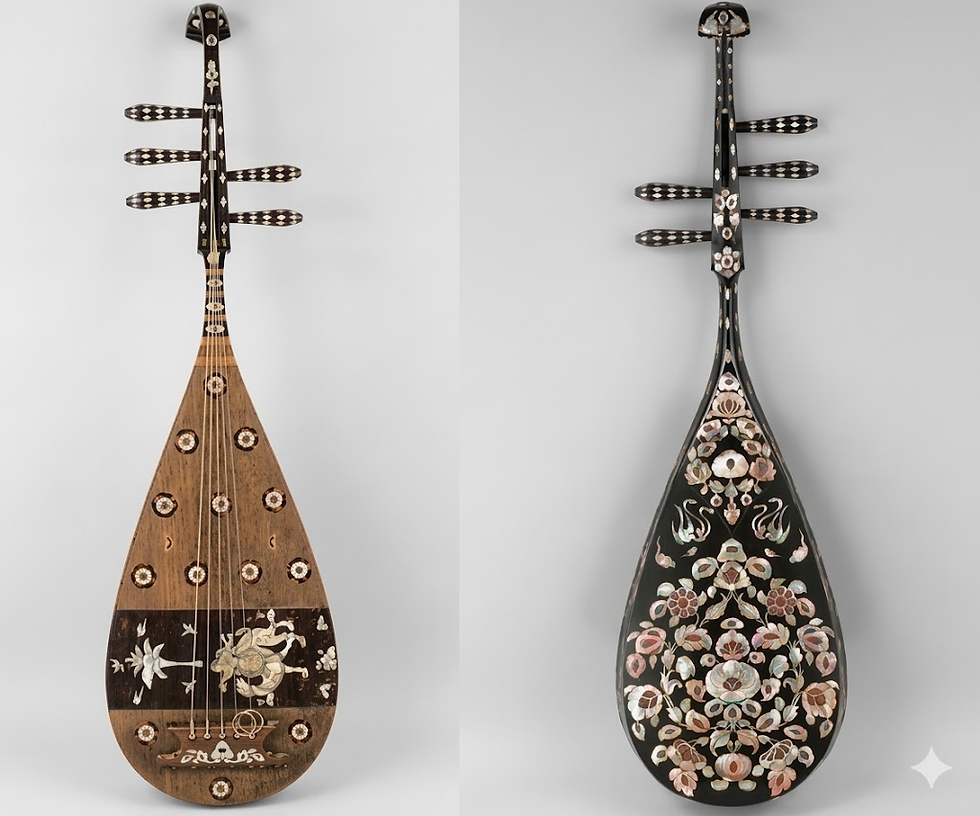
This instrument type was introduced to China from Central Asia in the 1st or 2nd century AD and became enormously popular. The Shōsōin example, dating to the 8th century, closely resembles pipas depicted in murals at the Buddhist cave complexes of Dunhuang and Yulin in western China; vestiges of the Silk Road monasteries that once spread Buddhism and facilitated exchange.
The textiles are equally remarkable. Many show the influence of Sasanian Persian design; particularly the beaded roundels enclosing paired hunters on winged horses, lions, and other motifs.
One fragment, now considered a national treasure, depicts a hunter on a winged horse drawing a bow at a rearing lion; a motif common in Sasanian metalwork but executed in silk with Chinese characters woven into the horses' bodies, suggesting collaborative production by Central Asian and Chinese artisans.
The glassware includes bowls with cut hollow facets typical of "Sasanian glass," though similar glass was produced throughout the Middle East, from pre-Sasanian times onward. Similar vessels have been found at sites from Palmyra in Syria to the Mogao caves at Dunhuang, illustrating the vast reach of ancient trade networks.
A Persian Official in Nara
In 2016, researchers from the Nara National Research Institute for Cultural Properties announced a stunning discovery: infrared imaging of a wooden tablet (mokkan) used for record-keeping in 8th-century Nara had revealed the name of a Persian official serving at the Japanese imperial court.
The tablet, dating to 765 AD, records that a Persian official, likely a scholar and tutor, worked at an academy where government officials were trained. Given ancient Iran's expertise in mathematics and astronomy, researchers suggest he may have been teaching these subjects.
This discovery confirms that Japan's connections with the Silk Road were not merely commercial but involved the movement of people and ideas across vast distances.
The presence of a Persian official in Nara should not be entirely surprising. The Silk Road extended from the Mediterranean through Central Asia and China to the Korean peninsula and finally to Japan.

Nara-period Japan actively sought knowledge and expertise from the continent, sending embassies to Tang China, welcoming scholars and artisans from Korea, and engaging in trade with peoples across East Asia. A Persian at the Nara court represents the far western reach of this network.
The Transmission of Culture and Knowledge Across the Silk Road
The discovery of a Persian official's name on a wooden tablet in Nara must be understood within a framework that carefully distinguishes between different types of influence: the transmission of material culture and artistic motifs along the Silk Road, the movement of people and ideas across continents, and the potential for deeper religious or philosophical exchange.
The evidence reveals a complex picture: Iranian and Central Asian influences are clearly visible in Japanese art, luxury goods, and possibly scientific knowledge, but the religious traditions of Japan, especially Buddhism, drew their core content from India and China, with only indirect and mediated connections to Persia.
Given ancient Iran's reputation for expertise in astronomy and mathematics, researchers have suggested he may have been teaching these subjects. The presence of a Persian scholar in Nara speaks to the cosmopolitan character of the Nara court, which actively sought knowledge and expertise from across the Asian continent.
However, the path by which this official reached Japan is crucial to understanding the nature of this influence. He would have arrived not directly from Persia, but via Tang China, where substantial communities of Persian and Central Asian merchants, artisans, and scholars had established themselves.

The Tang capital of Chang'an was one of the most cosmopolitan cities in the pre-modern world, home to significant populations of Sogdians, Persians, Turks, Koreans, and others.
What reached Japan was filtered through this Tang cosmopolitanism; Persian individuals and elements, yes, but mediated through Chinese language, culture, and institutions.
The Buddhist Question: The claim sometimes advanced, that the Buddhist Asura (Japanese: Ashura) derives from the Zoroastrian supreme deity Ahura Mazda, offers a cautionary example of how such distinctions can become blurred. The reality is more complex and requires careful chronological and theological parsing.
It is true that the names are cognates. Both Sanskrit asura and Avestan ahura derive from Proto-Indo-Iranian hásuras, meaning "lord." This linguistic connection reflects the shared ancestral heritage of the Vedic and Avestan peoples, who once formed a single cultural-linguistic community on the Eurasian steppe before diverging into separate branches around 1800–1600 BC.
By the time Buddhism emerged in the sixth century BC India, this shared heritage had long since diverged into opposite theological positions:
Vedic/Hindu | Asura | Originally an epithet of gods (Varuna); gradually demonized as enemies of the Devas led by Indra
Zoroastrian | Ahura | Remained a divine title; Ahura Mazda is supreme deity
Buddhist | Asura | Adopted from Hindu cosmology as a class of beings; incorporated as one of six realms of rebirth
The demonization of the Asuras in India and the demonization of the Daevas in Iran were parallel but independent developments, occurring after the two branches had separated and following their own internal logics.
Crucially, the Asura entered Buddhist cosmology directly from Ancient Indian sources where the new religion was birthed. Buddhism emerged in the Gangetic plain, a region immersed in Vedic and Hindu traditions.
The Buddha and his early followers inherited and adapted the conceptual universe of their time, which already included well-developed notions of Asuras as powerful beings in conflict with the Devas.

Xinru Liu's 2022 study 'Early Buddhist Society: The World of Gautama Buddha' explicitly addresses "Asuras Among the Buddhists" as a feature of Buddhism during the Buddha's own lifetime.
The Asuras appear throughout the Pali Canon, the earliest collection of Buddhist scriptures, as inhabitants of one of the six realms of rebirth (saṃsāra) and as beings engaged in perpetual war with the gods; an aspect of Hindu cosmology that Siddartha (Buddha) grew up with.
The Encyclopedia of Buddhism notes that "the Buddhist asuras are broadly derived, in general character, from the wicked asuras of Hinduism, but have acquired some very distinctive myths which are only found in Buddhist texts."
This evolution, from Hindu demons to Buddhist beings with their own complex character, occurred entirely within Indian Buddhism over centuries of textual and doctrinal development, before transmission to other nations.

When Buddhism traveled to Central Asia, China, Korea, and eventually Japan, it carried this evolved cosmology with it. The famous Ashura statue at Kōfuku-ji in Nara (eighth century) is a direct product of this transmission.
Its six-armed, fierce-yet-compassionate form follows iconographic conventions developed in Indian and Central Asian Buddhist art and transmitted via Tang China.

Japanese government sources and museum records consistently identify Ashura as a deity "derived from Hindu beliefs," which is accurate, with the understanding that these Hindu beliefs had already been filtered through centuries of Buddhist development.
The path of the Asura is: > Proto-Indo-Iranian hásuras → Vedic Asura (divine epithet) → Hindu Asura (demonic) → Buddhist Asura (adopted as realm of rebirth) → transmitted to Central Asia → transmitted to China → transmitted to Japan
The Iranian branch (Ahura) split off in the second millennium BC and developed independently. By the time Buddhism reached Japan, the two had been separate for over two thousand years.
Speaking of Persia, the suggestion that Buddhist concepts of divine radiance may have been influenced by Iranian traditions of light symbolism is intriguing but difficult to substantiate.
Both traditions certainly emphasize light as a marker of the divine. Zoroastrianism associates Ahura Mazda with light and fire; fire temples are central to Zoroastrian worship. Buddhist texts describe the Buddha emitting rays of light (pabhā) from his body, and the concept of tejas (spiritual radiance or splendor) is prominent in Indian religious thought.
However, light symbolism is nearly universal in human religious experience. The sun, fire, and radiance are natural metaphors for the divine across cultures, and they appear independently in religious traditions worldwide. Besides, the concept of spiritual radiance already existed in the Hindu cosmology that surrounded Buddha and his early followers.

The Asura statue at Kōfuku-ji is a testament to the depth of India's religious influence, transmitted through centuries of Buddhist development. Both are part of Japan's rich heritage, but they represent different kinds of influence, traveling different paths, and arriving with different meanings.
Roman Coins in Okinawa
The global connections of ancient Japan extend even further than previously imagined. In 2016, archaeologists announced the discovery of ancient Roman coins buried in the ruins of a 12th-century castle in Okinawa Prefecture, far to the southwest of the main Japanese islands.

The coins, which date to the 3rd-4th centuries AD, are thousands of miles and centuries removed from their origin. How they reached Okinawa remains mysterious; possibly through trade networks connecting the Roman Near East, Sasanian Persia, Tang China, and the Ryukyu Islands.
The discovery adds to the growing evidence that even peripheral parts of the Japanese archipelago were linked, however tenuously, to the vast exchange networks of Eurasia.
The End of the Nara Period

The Nara period ended in 784 AD, when Emperor Kammu moved the capital to Nagaoka-kyō, and then in 794 to Heian-kyō (modern Kyoto); a shift prompted by the desire to escape the political influence of powerful Nara temples and to establish a fresh start for imperial rule.
The Heian period (794-1185 AD) that followed would see the flourishing of classical Japanese culture; the Tale of Genji, the development of kana writing, the rise of the Fujiwara regents, and the gradual transformation of the ritsuryō state.

The Nara period, though brief, left an indelible legacy: the first permanent capital, the consolidation of Buddhism as a state religion, the creation of the Shōsōin treasury, and the establishment of literary and historical records that would shape Japanese identity for centuries.
Most importantly, it revealed Japan's place in a wider world; connected via the Silk Road to cultures as distant as Persia and Rome, participating in the exchange of goods, ideas, and people that characterized the cosmopolitan civilization of the 8th century.
Part VIII: Controversies and Conspiracies

The location of the Yamatai kingdom, the polity ruled by Queen Himiko and described in the Chinese Wei Zhi, has been one of the most enduring controversies in Japanese archaeology and historiography.
The debate, which has raged for centuries, pits proponents of a Kyushu location against advocates of a Kinai (Yamato) location.
Chinese travel directions | "Southeast" from Korean peninsula points to Kyushu | Directions in ancient texts are unreliable or misinterpreted
Distance estimates | Distances given match Kyushu better | Distances are schematic, not literal
Archaeological evidence | Early Yayoi complexity in northern Kyushu; moated settlements; continental trade goods | Middle-Late Yayoi development in Kinai; keyhole tomb origins
Later history | Himiko's polity fades from record | Yamato state emerges in same region
Textual references | Wei Zhi consistently describes "eastern sea" route | Later Japanese texts place Yamatai in Yamato
The debate is complicated by ambiguities in the Chinese text, directions and distances that are difficult to reconcile with actual geography, and by the politicization of the issue. For much of Japanese history, the identification of Yamatai with the Yamato region was official orthodoxy, supporting the legitimacy of the imperial line. Alternative theories were suppressed.
Modern scholarship tends toward a nuanced position: Yamatai was likely located in northern Kyushu, the region of greatest Yayoi complexity and closest contact with the continent.
The Yamato state that emerged in the Kofun period was a later development, perhaps incorporating or succeeding the earlier Kyushu polity. However, the debate continues, with new archaeological discoveries periodically reigniting controversy.
The Fujimura Hoax: Fabrication of the Past
No account of Japanese prehistory would be complete without addressing the scandal that shook Japanese archaeology to its foundations and forced a complete reassessment of the Paleolithic record. The Japanese Paleolithic hoax, exposed in 2000, represents one of the most extensive and damaging cases of academic fraud in the history of archaeology.
The central figure in the scandal was Fujimura Shinichi, an amateur archaeologist from Miyagi Prefecture who had earned the nickname "God's Hands" for his extraordinary ability to discover Paleolithic sites.

Over a period of more than twenty years, Fujimura claimed to have found stone artifacts at dozens of sites across Japan, some purportedly dating back more than 500,000 years. His discoveries were celebrated by the media, featured in textbooks, and used to promote a narrative of Japan's ancient cultural achievements.
In November 2000, the Mainichi Shimbun newspaper published photographs showing Fujimura planting artifacts at the Kamitakamori site in Miyagi Prefecture; placing stone tools in the ground one day, then "discovering" them the next. Under pressure, Fujimura confessed to fabricating finds at numerous sites, admitting that he had been planting artifacts for years.
The implications were devastating. A special investigation team from the Japanese Archaeological Association found that virtually all of the artifacts Fujimura had "discovered" were fabrications, planted in geological layers that would make them appear extremely ancient.
The entire edifice of early and middle Paleolithic archaeology in Japan collapsed. Sites that had been celebrated as national treasures were exposed as frauds. Textbooks had to be rewritten. Museums had to revise or remove exhibits.
Academic analysis of the hoax has revealed that Fujimura, while the primary perpetrator, was enabled by a broader system of complicity. As Taiwanese scholar Wu Wei-ming has documented in detailed studies, the scandal was "indeed a conspiracy involving government agencies, regional governments, the media, and academia."
Fujimura's discoveries were embraced and promoted by scholars, journalists, and officials who found them useful for pursuing political and intellectual agendas.
The hoax coincided with the rise of a new cultural nationalism in Japan, as the country's economic success in the 1980s fostered pride in Japanese uniqueness and ancient cultural achievements.
Fujimura's discoveries were used to promote the idea of an "ancient Japanese cultural sphere" and to argue for the exceptional antiquity and sophistication of Japanese civilization. The Agency for Cultural Affairs, local governments, and educational authorities eagerly incorporated his finds into textbooks, museums, and designated cultural assets.
The media played a particularly problematic role, enthusiastically reporting Fujimura's discoveries without critical scrutiny and building him into a celebrity. Academic archaeologists, many of whom had doubts about the extreme dates claimed for some sites, failed to speak out, intimidated by Fujimura's popular reputation and the nationalist fervor surrounding his discoveries.
In the aftermath of the hoax, Japanese archaeology has adopted more rigorous standards for excavation and publication. The only sites that can now be reliably dated to before 35,000 BCE are those with artifacts found below the AT tephra layer (22,000 BP) in contexts that survived scrutiny.
The first widely accepted date for human presence in Japan is now placed at approximately 35,000 BC. The hoax serves as a cautionary tale about the vulnerability of science to nationalism, media pressure, and academic cowardice; and as a reminder that the past is always vulnerable to manipulation in the service of present concerns.
The "Horserider Theory"
One of the most controversial theories in Japanese historiography is the "horserider theory" (kiba minzoku setsu), proposed by Egami Namio in 1948.
The theory holds that the Kofun state was established by a warrior people from the continent—horseriders from northern Asia—who conquered the Yayoi agriculturalists and established a new ruling elite.

Evidence cited by proponents includes:
The sudden appearance of horse trappings in late 4th-century tombs
Similarities between Kofun artifacts and those of nomadic cultures in Northeast Asia
Linguistic evidence suggesting elite vocabulary derived from Altaic languages
Parallels with the establishment of ruling dynasties in Korea (possibly by related peoples)
Critics have raised numerous objections:
The archaeological evidence shows gradual adoption of horse culture, not sudden conquest
Continuity in material culture and settlement patterns argues against invasion
Genetic evidence shows no sign of large-scale population replacement during this period
The theory has been associated with nationalist ideologies (both Japanese and Korean) and treated with suspicion
The horserider theory is now largely rejected by mainstream scholarship, though debates continue about the extent of continental influence on Kofun culture.
The most recent genetic evidence, confirming a third migration during the Kofun period, may reopen aspects of the debate; though this migration appears to have been from East Asia (China/Korea) rather than from the northern steppes.
The "Mimana/Nihon-fu" Controversy
The relationship between ancient Japan and the Korean peninsula has been a source of historical controversy with modern political implications. Particularly contentious is the question of the Mimana/Nihon-fu, a Japanese presence in the southern Korean peninsula during the Kofun period.
Traditional Japanese historiography, based on the Nihon Shoki, claimed that Japan established a colony or protectorate called Mimana in the Gaya region, administering it through an office called the Nihon-fu (Japanese government). This interpretation was used in the early 20th century to justify Japanese colonial claims on Korea.

Korean and many Western historians have challenged this narrative:
The Nihon Shoki was compiled centuries after the events it describes and reflects later political agendas.
Contemporary Korean sources (samguk sagi) make no mention of Japanese colonial administration.
Archaeological evidence shows intensive interaction but not political control.
The "Mimana" of Japanese sources may refer to the Gaya confederation itself, not a Japanese colony.
The current scholarly consensus recognizes significant Japanese activity in the southern Korean peninsula—trade, settlement, military involvement—but rejects the colonial interpretation. The relationship was one of complex interaction between emerging states, not one-sided domination.
The controversy remains politically sensitive, with implications for modern Japanese-Korean relations. Historical scholarship has been caught up in nationalist narratives on both sides, making objective assessment difficult.
The Tripartite Model: Rewriting Japanese Origins
The 2021 publication of genome-wide ancient DNA analysis has fundamentally altered the understanding of Japanese origins, establishing a tripartite model that replaces the long-held dual-ancestry theory.
The new model has implications for several controversies:
Timing of migrations: The third migration (Kofun period) coincides with state formation, suggesting continental influence on that process.
Scale of migration: The 71% contribution of Kofun migrants to modern genomes indicates substantial population movement, not merely elite dominance.
Origins of migrants: East Asian (Han-related) ancestry suggests connections with China, not just Korea.
Regional variation: Different regions of Japan show varying proportions of the three ancestral components, reflecting complex histories of migration and mixture.
This research resolves some debates while opening new ones. If the third migration was so significant, why was it not recognized earlier? What role did these migrants play in the formation of the Yamato state? How did they interact with existing Yayoi and Jōmon populations? Future research will address these questions.
Part IX: Conclusion—The Legacy of Ancient Japan
The ancient history of Japan is a story of remarkable continuity and profound transformation. From the first Paleolithic arrivals more than 35,000 years ago, through the long isolation of the Jōmon period, the revolutionary transformations of the Yayoi, the state formation of the Kofun, and the cosmopolitan flowering of Nara, the Japanese archipelago has been shaped by the interplay of indigenous development and external influence.
The Jōmon people created one of the world's most complex hunter-gatherer societies, with early pottery, substantial settlements, and elaborate ritual life. Their genetic legacy persists in modern Japanese, particularly in the Ainu and Ryukyuan populations who preserve their closest connections to the archipelago's first inhabitants.
The Yayoi migration brought agriculture, metallurgy, and new social structures, transforming the islands from a land of hunter-gatherers to a landscape of competing chiefdoms. The mixing of Yayoi and Jōmon populations created the genetic and cultural foundation for the emerging Japanese people.
The Kofun period witnessed the unification of the islands under Yamato hegemony, the construction of monumental tombs that still dot the landscape, and the intensification of continental contacts that would culminate in the civilization of Nara.
The newly recognized third migration of this period contributed the largest share of modern Japanese ancestry, fundamentally reshaping the population.
The Asuka and Nara periods saw the transformation of Japan into a ritsuryō state, the introduction of Buddhism and writing, the creation of the first historical records, and the establishment of a permanent capital connected, via the Silk Road, to cultures as distant as Persia and Rome.
Despite all transformations, there remains an unbroken thread connecting modern Japan to its ancient past. The imperial house traces its lineage, through myth and history, to the rulers of the Kofun period and beyond.
The kami of Shinto, though systematized and transformed by Buddhist and Confucian influence, still receive worship at shrines across the islands. The rice paddies that cover the landscape are direct descendants of the Yayoi fields first carved from the forest millennia ago.
The Japanese language, though enriched by centuries of Chinese and Western borrowing, retains its ancient grammatical structure and vocabulary.
The Japanese people themselves are living products of this ancient history, their genomes a mosaic of Jōmon, Yayoi, and Kofun ancestors; their culture a synthesis of indigenous tradition and continental influence; their identity shaped by the long, complex story of human habitation on these islands.
That story, from the first footsteps on Pleistocene beaches to the cosmopolitan court of Nara, is one of the great epics of human history; a testament to human adaptability, creativity, and resilience, and to the enduring connections that link all peoples across time and space.
Appendix: Chronological Summary
Geological Formation | 20 million - 15,000 BP | Tectonic activity forms archipelago; land bridges connect to continent | Pleistocene glaciations worldwide
Paleolithic | 35,000 - 14,000 BC | First human arrival; flake and blade tools; early ground stone tools | Last Glacial Maximum; peopling of Americas
Incipient Jōmon | 14,000 - 7,500 BC | Earliest pottery; post-glacial adaptation; rising sea levels isolate islands | Natufian culture (Levant); early agriculture in China
Initial Jōmon | 7,500 - 4,000 BC | Shell middens; pit dwellings; expansion of settlements | Çatalhöyük (Turkey); Yangshao culture (China)
Early Jōmon | 4,000 - 3,000 BC | Climatic optimum; population peak in eastern Japan | Sumerian cities; Old Kingdom Egypt
Middle Jōmon | 3,000 - 2,000 BC | Elaborate pottery; dogū figurines; maximum complexity | Indus Valley civilization; Minoan Crete
Late Jōmon | 2,000 - 1,000 BC | Cooling climate; population decline in east | Shang dynasty (China); Mycenaean Greece
Final Jōmon | 1,000 - 300 BC | Regional differentiation; contacts with continent | Zhou dynasty (China); Homeric Greece
Yayoi | 900 BC - 300 AD | Wet-rice agriculture; metalworking; social stratification; Himiko | Warring States/Qin/Han (China); Three Kingdoms (Korea); Roman Empire
Kofun | 300 - 538 AD | Keyhole tombs; horse culture; Yamato state; third migration | Three Kingdoms (Korea); Northern and Southern Dynasties (China); Sasanian Persia
Asuka | 538 - 710 CE | Buddhism introduced; writing; ritsuryō reforms; Kojiki and Nihon Shoki | Sui/Tang dynasties (China); Silla unification of Korea
Nara | 710 - 794 CE | Heijō-kyō capital; Shōsōin treasury; Silk Road connections | Tang golden age; Abbasid Caliphate; Byzantine Empire

References:
Mizoguchi, K. (2002). An Archaeological History of Japan: 30,000 B.C. to A.D. 700. University of Pennsylvania Press.
"Japanese Paleolithic." Wikipedia (archived 2018).
吳偉明 (2010). "日本考古學與民族主義:前期舊石器捏造事件的意識型態." 思與言 48(4): 85-108.
"The Shōsōin Repository and its treasure." Smarthistory.
"Shinto." Encyclopedia of Religion and Social Science. Hartford Institute.
Mizoguchi, K. (2002). An Archaeological History of Japan (table of contents).
吳偉明 (2010). "日本考古學與民族主義." HyRead Journal.
"New Discovery About Persians in Ancient Japan Generates Excitement." Global Voices (2016).
"Japan: Religion." Encyclopædia Britannica, 11th edition (1911).
Gershon, L. (2021). "DNA Analysis Rewrites Ancient History of Japan." Smithsonian Magazine.


Comments