
.png)

Esoterica: The Seeds of Secret Societies
- A. Royden D'Souza

- Mar 16
- 78 min read
Updated: Mar 16
From the earliest dawn of human consciousness, a fundamental recognition has guided the transmission of sacred knowledge: not all minds are prepared to receive the same truths. The ancient sages understood that wisdom must be dispensed according to capacity—milk for the infant, meat for the strong, as the Apostle Paul would later phrase it.
This recognition gave rise to a universal pattern found in virtually every advanced civilization: the division of religious and philosophical teachings into two distinct streams.
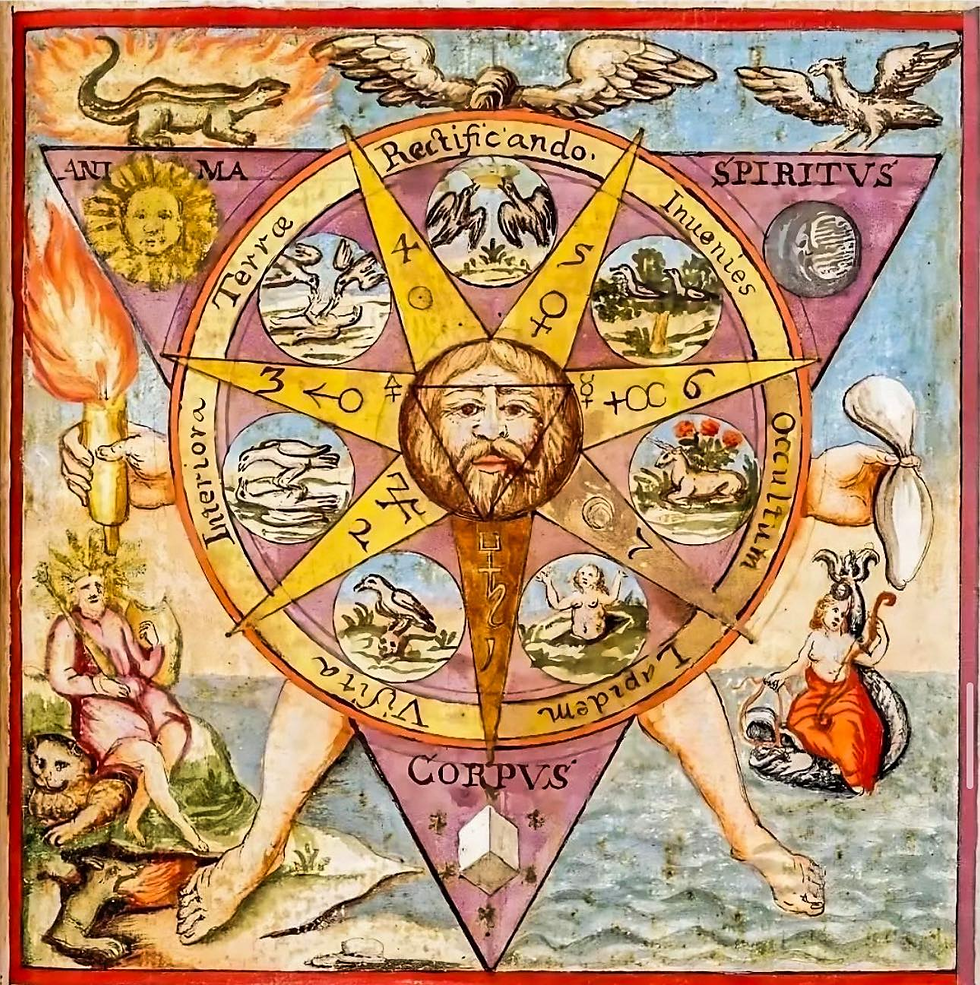
The exoteric teachings were designed for the masses. They presented truth in simplified, personified forms—stories of gods and goddesses, myths of creation and destruction, moral tales accessible to the common understanding.
The uneducated farmer, the laboring craftsman, the soldier—these could grasp the literal meaning of the myths and find in them guidance for living. They could bring offerings to the temples of Priapus and Pan without needing to understand that these deities symbolized the procreative energies of the cosmos rather than literal beings with human forms and appetites.
The esoteric teachings were reserved for the few—those whose intellects had matured sufficiently to penetrate beyond symbol to substance, beyond myth to metaphysics.
These were the philosophers, the mystics, the initiates who recognized in the marble statues and elaborate rituals mere concretions of abstract truths. For them, the stories of dying and rising gods encoded profound teachings about the soul's journey, the cycles of nature, and the path of spiritual regeneration. The outer form was a veil; the inner meaning was the reality.
This division was not elitism in the modern pejorative sense but practical pedagogy. As Plato himself recognized, to give profound metaphysical truths to those unprepared to receive them is not enlightenment but confusion—worse, it risks the perversion or loss of the truths themselves (as can be seen in modern society, with the initiation of the corrupt into esoteric ideas, who use them to justify their selfish needs and twisted desires).
The guardians of wisdom in earlier time created institutions designed to preserve, protect, and transmit the deeper teachings to successive generations of qualified seekers. These institutions were the Mysteries.

The Nature and Purpose of the Ancient Mysteries (Secret Societies)

The Mysteries were sacred dramas, philosophical schools, and initiatic fraternities that existed throughout the ancient world. Alexander Wilder, the nineteenth-century scholar of esotericism, defined them simply as "sacred dramas performed at stated periods," noting that "the most celebrated were those of Isis, Sabazius, Cybele, and Eleusis."
But this minimalist definition conceals their true significance. The Mysteries were nothing less than the custodians of humanity's deepest wisdom, the repositories of knowledge concerning the nature of the soul, the structure of the cosmos, and the path to spiritual liberation.
Robert Macoy, a 33rd-degree Masonic historian, paid magnificent tribute to their role in human civilization: "It appears that all the perfection of civilization, and all the advancement made in philosophy, science, and art among the ancients are due to those institutions which, under the veil of mystery, sought to illustrate the sublimest truths of religion, morality, and virtue, and impress them on the hearts of their disciples... Their chief object was to teach the doctrine of one God, the resurrection of man to eternal life, the dignity of the human soul, and to lead the people to see the shadow of the deity, in the beauty, magnificence, and splendor of the universe."
This is a remarkable claim: that the highest achievements of ancient civilization flowed from secret societies.
The Mysteries (secret societies) operated through a structured process of initiation. Candidates underwent trials—some physical, some psychological, some spiritual—designed to test their worthiness and prepare their consciousness for the reception of higher truths.
These trials were not arbitrary cruelties but carefully crafted ordeals that stripped away the candidate's attachment to the material world and opened channels to deeper perception.
The rituals of Freemasonry preserve echoes of these ancient initiations, adapted to modern sensibilities but retaining the essential pattern of death and rebirth, darkness and light, ignorance and knowledge.
Upon successful completion of the trials, the initiate was entrusted with secret teachings—truths that could not be written down but only transmitted orally from master to disciple. These teachings concerned the nature of the divine, the structure of the cosmos, the destiny of the soul, and the practical methods of spiritual transformation.
Plato, himself an initiate, was criticized by some for revealing too much of this secret wisdom in his writings—a criticism that suggests his dialogues contain esoteric teachings veiled in exoteric form, accessible only to those prepared to receive them.

The Universality of the Mysteries
Contrary to the assumption that secret societies are a relatively recent phenomenon, the evidence suggests that initiatic schools have existed from the earliest times and in the most diverse locations. Every nation of antiquity possessed not only a public state religion but also an inner doctrine reserved for the philosophic elect.
This pattern appears with remarkable consistency across cultures that had no direct contact with one another, suggesting either a common origin or a universal recognition of the same pedagogical principles.

In Egypt, the Mysteries of Isis and Osiris preserved the ancient wisdom of the Nile civilization for thousands of years. Here, initiates learned the story of the murdered god, his dismemberment, and his resurrection through the magical arts of Isis—a narrative that encoded profound truths about the soul's journey through death to rebirth.
The Egyptian Mysteries also transmitted practical knowledge of astronomy, geometry, medicine, and magic, making their initiates the most learned individuals of the ancient world.

In Persia, the Mysteries of Mitra-Varuna (later Mithras in the West), a dual-god of rain and sun shared between Ancient Persia (Zoroastrian) and Ancient India (Vedic), centered on the deity and his cosmic journey.
Mithraism later spread throughout the Roman Empire, particularly among soldiers, and its underground temples can still be found beneath the streets of Rome. The Mithraic rites included elaborate initiatic grades, symbolic meals, and teachings about the soul's ascent through the planetary spheres—concepts that would later influence Christian theology as well.

In Greece, the Eleusinian Mysteries, dedicated to Demeter and Persephone, offered initiates profound experiences of death and rebirth through dramatic reenactments of the goddess's descent into the underworld and her return. The mysteries of Samothrace, Orpheus, and Dionysus provided alternative paths to spiritual transformation, each with its own symbolic vocabulary and initiatic structure.

In Syria and Phrygia, the rites of Cybele and Attis involved the death and resurrection of the beloved god, mourned and celebrated in cycles that echoed the seasonal rhythms of nature. The Galli, her ecstatic priests, practiced self-castration as the ultimate sacrifice—a literal interpretation of the symbolic death required of all initiates.

In Britain and Gaul, the Druidic orders preserved the wisdom of the Celtic peoples through oral traditions and initiatic grades that required up to twenty years of study. Their teachings concerned the immortality of the soul, the cycles of rebirth, and the hidden forces of nature.

In India, the Brahmanic and Buddhist initiations transmitted the profound metaphysics of the Vedas and the practical methods of yoga through guru-disciple lineages that continue to this day. The Upanishads themselves are records of initiatic dialogues between teachers and students seeking the highest knowledge.

In Mesoamerica, the Mayan and Aztec priesthoods conducted initiations in their pyramid-temples, teaching the secrets of the calendar, the movements of the planets, and the soul's journey through the underworld—knowledge encoded in monumental architecture that still puzzles archaeologists.

In ancient and medieval China, esoteric religious traditions flourished alongside mainstream Confucian and Taoist thought. Robert Ford Campany's research documents a persistent theme: "paths of salvation, often including alchemical and alimentary disciplines and some sort of claim to personal immortality, which were transmitted in secret texts from masters to initiated disciples."
These traditions were "at least partially defined in contrast to the sacrificial cults of mainstream society," mirroring the dynamic between esoteric and exoteric teachings found in the Western Mysteries.

Japanese rituals, called jingi kanjō, involved "the transmission of knowledge and practices concerning the kami within the larger framework of medieval and early-modern kenmitsu religiosity." Buddhist and kami symbols were interwoven, with the Reiki kanjō serving as "the secret initiation to the Reikiki, an influential but elusive key text of premodern combinatory religion."
It was "within the context of esoteric kami initiations that the first Shinto lineages took concrete shape" —a striking parallel to how Western esoteric traditions preserved and transmitted ancient wisdom.
This universality suggests something profound: the Mysteries were not the invention of any single culture but the expression of a perennial philosophy, a recognition that certain truths about human existence can only be adequately transmitted through symbolic means and initiatic processes.
Whether in Egypt or India, Greece or Mexico, China or Japan, the same fundamental insights about the soul, the cosmos, and the path to liberation found expression in forms adapted to local conditions but sharing a common core.
Sun Worship and the Dying God

One of the most pervasive themes in the ancient Mysteries was the worship of the sun—not the physical orb in the sky but the spiritual reality it symbolized. The sun, as the source of light, warmth, and life, was the natural symbol for the Supreme Being, the source of all existence. Its daily journey across the sky and its annual passage through the zodiac became the template for countless myths and rituals.
The solar deity was typically personified as a beautiful youth with golden hair representing the sun's rays—Osiris in Egypt, Apollo in Greece, Mithra in Persia, Balder in Scandinavia. This radiant figure was slain by forces of darkness, representing the evil principle of the universe.
His death plunged the world into mourning and despair. But through certain rituals and ceremonies, symbolic of purification and regeneration, the god was restored to life, becoming the savior of his people.
This pattern of death and resurrection appears in virtually every Mystery tradition. Osiris is murdered by Set, dismembered, and resurrected through the magic of Isis. Attis dies beneath a pine tree and is restored. Dionysus is torn apart by Titans and reborn.

The deeper meaning of these myths concerns not external events but internal processes. The death and resurrection of the god symbolizes the death of the lower nature and the birth of the spiritual self; the transformation that every initiate must undergo.
The rituals of the Mysteries were designed to effect this transformation, to guide the candidate through a symbolic death that would prepare the way for a real spiritual rebirth.
As one ancient text expressed it: "The secret processes whereby He was resurrected symbolized those cultures by means of which man is able to overcome his lower nature, master his appetites, and give expression to the higher side of himself."
The Mysteries existed to assist struggling humanity in reawakening the spiritual powers that lie dormant within the soul, surrounded by the flaming ring of lust and degeneracy.
The Mysteries and Early Christianity
The relationship between these Mysteries and early Christianity was complex and contested. During the first centuries of the common era, as Christianity spread throughout the Roman Empire, it encountered the Mystery traditions as both rivals and sources. The Church Fathers vigorously attacked these cults while simultaneously borrowing, consciously or unconsciously, many of their forms and concepts.

The philosopher Celsus, a second-century critic of Christianity, seized on this apparent inconsistency. He contrasted the high moral standards of the pagan Mysteries, which demanded purity of hand and wisdom of word from their initiates, with the Christian practice of welcoming sinners, the unwise, and the miserable without requiring prior moral transformation.
His criticism contained an element of truth: early Christianity's emphasis on faith and grace could appear, to pagan eyes, as a lowering of moral standards as there was less gatekeeping.
Yet the earliest Christians were not unaware of the Mysteries. In Rome, they gathered for worship in the subterranean temples of Mithras, whose cult had prepared the way with its own rituals of baptism, sacred meal, and resurrection.
Much of the sacerdotalism of the modern church, like its vestments, its liturgy, its hierarchical structure, can be traced to Mithraic and other Mystery sources. The date of Christmas, the symbolism of the fish, the concept of the Good Shepherd, all have parallels in the Mystery traditions.
The relationship was not so simple either: both early Christianity and Mystery religions drew from a common reservoir of archetypal symbols and experiences, and both were responding to the same human needs for meaning, transformation, and connection with the divine. What Christianity added was a historical grounding, the claim that the myth had become fact in the person of Jesus of Nazareth.
The Decline and Perversion of the Mysteries
With the decline of virtue that preceded the destruction of every ancient nation, the Mysteries themselves degenerated. What had begun as schools of wisdom became centers of superstition and, in some cases, of depravity.
Sorcery replaced divine magic. The Bacchanalia, originally a solemn religious festival, became an orgy of debauchery. The secret teachings were perverted or lost.

The Roman poet Juvenal captured the corruption in his satires: "Now we suffer the ills of a long peace. Luxury, more deadly than war, broods over the city and avenges the conquered world."
When the Mysteries no longer attracted men and women of genuine spiritual aspiration, they fell into the hands of those who sought only power, pleasure, or profit. (As is the case in the modern world)
In despair, the few who remained true sought to preserve the ancient wisdom from oblivion. In some cases they succeeded, hiding the teachings in symbols and allegories that would survive the collapse of civilizations. In others, the inner meaning was lost entirely, leaving only the empty shell of ritual without understanding.
The Neo-Platonists of the third through fifth centuries attempted a revival, collecting and commenting on the scattered fragments of the Mystery traditions. Plotinus, Porphyry, Iamblichus, and Proclus sought to systematize the ancient wisdom and defend it against the rising tide of populist religions.
Their works preserve invaluable insights into the esoteric teachings of antiquity, though often filtered through their own philosophical frameworks.
The Emperor Justinian's closure of the Platonic Academy in Athens in 529 AD is often taken as the symbolic end of the pagan philosophical tradition. But the wisdom did not die; it went underground, preserved in the manuscripts of scholars, the symbols of artisans, and the rituals of secret societies that continued to operate in the shadows.
The Legacy in Freemasonry

It is through this underground stream that the wisdom of the Mysteries reached modern Freemasonry. The Masonic ritual, with its trials and initiations, its symbols and allegories, its teachings about death and resurrection, preserves echoes of the ancient initiatic schools.
The candidate who passes through the degrees of the Blue Lodge reenacts, in symbolic form, the same journey that the ancient initiate undertook in the temples of Egypt, Greece, and Persia.
Robert Macoy's tribute to the Mysteries, quoted earlier, could equally apply to Freemasonry: its chief object is "to teach the doctrine of one God, the resurrection of man to eternal life, the dignity of the human soul, and to lead the people to see the shadow of the deity, in the beauty, magnificence, and splendor of the universe."
The language has changed, the rituals have adapted, but the essential purpose remains.
The Masonic lodge itself is a symbolic representation of the universe—a temple of wisdom in which the candidate learns to orient himself to the cosmic order. The tools of the stonemason become symbols of moral and spiritual development: the rough ashlar awaiting perfection, the gavel to shape character, the square to test actions, the compass to bound desires.
Each degree reveals more of the symbolic vocabulary, building toward a comprehensive understanding of the self and its place in the cosmos.
The connection to the ancient Mysteries is not merely theoretical. Masonic tradition traces its lineage through the medieval guilds of stonemasons, who themselves preserved symbols and practices reaching back to the Roman collegia and, through them, to the Mysteries of Egypt and Greece.
Whether this lineage is historically continuous or symbolically reconstructed, the spiritual continuity is undeniable: the same mysteries that inspired the initiates of Eleusis and Memphis continue to inspire Masons today. Notwithstanding the gradual decline in initiatic vitality that inevitably accompanies the transmission of esoteric knowledge through hereditary channels rather than genuine spiritual attainment.
The Esoteric Thread Through History

The Mysteries did not vanish; they transformed. Their teachings passed into the currents of Gnosticism, Hermeticism, and Neo-Platonism. They influenced the development of Kabbalah in Judaism and Sufism in Islam.
They surfaced in the Knights Templar and the Cathars, in the Rosicrucian manifestos and the founding documents of Freemasonry. They inspired the Renaissance magi like Marsilio Ficino and Pico della Mirandola, who sought to reconcile Platonic philosophy with Christian theology.
They animated the speculative minds of the Enlightenment, from Isaac Newton (whose alchemical writings far exceed his scientific output) to the founding fathers of the American Republic, many of whom were Masons.
This esoteric thread runs through history like a golden chain, linking the sages of antiquity with the seekers of today. It is not a single doctrine but a living tradition, constantly adapting to new circumstances while preserving its essential insights: that the visible world is not the whole of reality; that the human soul contains latent powers awaiting awakening; that death is not an end but a transition; that wisdom is the goal of life and the path to liberation.
The Mysteries taught that no man could live intelligently without a fundamental knowledge of Nature and her laws. Before man can obey, he must understand. And the Mysteries were devoted to instructing man concerning the operation of divine law in the terrestrial sphere.
They were moralistic rather than religionistic, philosophic rather than theologic. They taught man to use his faculties more intelligently, to be patient in adversity, courageous in danger, true in temptation, and above all to view a worthy life as the most acceptable sacrifice to God and his body as an altar sacred to the Deity.
These teachings are as relevant today as they were two thousand years ago. The forms have changed, but the substance remains. And for those who have eyes to see, the ancient wisdom still speaks—in the symbols of Masonry, in the pages of the philosophers, in the silence of meditation, in the beauty of nature, and in the depths of the soul.

The Druidic Traditions of Britain and Gaul

Long before the Roman legions set foot on the mist-shrouded shores of Britain, before Caesar's campaigns brought Gaul under the sway of the Empire, there existed in these northern lands a priesthood of mystery.
They were called Druids—keepers of sacred knowledge, mediators between gods and men, and the spiritual backbone of Celtic civilization. Their origins, like so much about them, remain shrouded in mystery.
The very name "Druid" carries echoes of ancient linguistic roots that point toward their possible origin. Max Müller, the great philologist, connected it to the Irish word Drui, meaning "the men of the oak trees." He further noted the striking similarity to the Greek dryades, the tree deities of Hellenic mythology.
Others trace it to the Gaelic druidh—"a wise man" or "a sorcerer"—or to the Sanskrit dru, meaning "timber." This linguistic web suggests connections reaching across the Indo-European world, linking the priests of Britain to the forest wisdom of India, Greece, and beyond.
The etymology points to something deeper than mere wordplay: the Druids were fundamentally connected to the natural world, particularly to the oak tree, which they held as the most sacred of all living things.
In the oak they saw not merely a tree but a symbol of the Supreme Deity; its roots plunging into the earth, its trunk rising through the middle world, its branches reaching toward the heavens. To worship beneath the oak was to stand at the axis mundi, the center where all worlds meet.
At some remote period, according to the Welsh Triads and other ancient sources, the spiritual institutions of Britain underwent a significant reformation. The original priesthood, known simply as the Gwydd, was divided into distinct orders with specialized functions.
The superior priest became the Der-Wydd (Druid), meaning "superior instructor," while a subordinate class called Go-Wydd or O-Vydd (Ovates) emerged to handle lesser duties. Both, together with a third order, fell under the general designation of Beirdd (Bards), or "teachers of wisdom."
As this system matured, it crystallized into three well-defined classes: the Druids proper, the privileged Bards (Beirdd Braint), and the Ovates. This tripartite structure would prove remarkably durable, surviving in various forms through the Roman occupation and into the Christian era, eventually influencing the esoteric traditions of medieval Europe.
The Authority and Influence of the Druids

At the height of their power, the Druids exercised an authority that extended far beyond spiritual matters. They were the ultimate arbiters of justice, the preservers of sacred knowledge, and the advisors to kings and chieftains.
Their word could stop armies in their tracks; there were documented instances where opposing forces, poised for battle, sheathed their swords at the command of white-robed Druids who stepped between them.
The Roman conquerors, accustomed to the more domesticated priesthoods of the Mediterranean, were genuinely astonished by the Druids' influence. Julius Caesar, in his Commentaries on the Gallic War, noted that no public or private business was transacted without their participation.
They judged disputes, awarded damages, and could excommunicate individuals from religious ceremonies—a punishment that effectively severed them from all social and political life .
This authority rested on a foundation of profound learning. The Druids were not merely ritualists but genuine philosophers and scientists. The Encyclopædia Britannica records that geography, physical science, natural theology, and astrology were their favored studies. They possessed sophisticated knowledge of medicine, particularly the medicinal properties of herbs and plants.
Archaeological evidence, including crude but functional surgical instruments found in England and Ireland, confirms their practical medical skills. An ancient treatise on British medicine reveals that every practitioner was expected to maintain a garden for growing medicinal herbs—a tradition that would echo through the monastic physic gardens of the Middle Ages.
Eliphas Lévi, the nineteenth-century occultist, offered a more esoteric interpretation of Druidic medicine. He wrote: "The Druids were priests and physicians, curing by magnetism and charging amulets with their fluidic influence. Their universal remedies were mistletoe and serpents' eggs, because these substances attract the astral light in a special manner. The solemnity with which mistletoe was cut down drew upon this plant the popular confidence and rendered it powerfully magnetic... The progress of magnetism will some day reveal to us the absorbing properties of mistletoe. We shall then understand the secret of those spongy growths which drew the unused virtues of plants and become surcharged with tinctures and savors."
Whether one accepts Lévi's occult interpretation or prefers a more conventional explanation, the centrality of mistletoe to Druidic practice is beyond dispute. The ritual cutting of this parasitic growth from the sacred oak was one of their most important ceremonies. At carefully calculated moments, determined by the positions of sun, moon, and stars, the Arch-Druid would ascend the oak and sever the mistletoe with a golden sickle consecrated for that purpose.
The plant was caught in white cloths to prevent it from touching the earth, which would pollute its virtue. A white bull was then sacrificed beneath the tree, its blood mingling with the soil as an offering to the powers above.
This ritual exemplifies the Druidic understanding of cosmic sympathy—the principle that earthly things participate in celestial realities. The mistletoe, growing between heaven and earth, partaking of the oak's sacred essence yet drawing its life from the air, was a natural symbol of the mediating principle that connects the visible and invisible worlds.
The Druidic Mysteries: An Initiatic Tradition

The deeper teachings of the Druids were reserved for those who had proven themselves worthy through long preparation and rigorous testing. Like the Mysteries of Egypt, Greece, India, and Persia, the Druidic tradition maintained a strict division between exoteric instruction for the general populace and esoteric doctrine for the initiated few.
The origin of these secret teachings has been much debated. Robert Brown, a 32nd-degree Masonic scholar, proposed that the Druids derived their wisdom from Tyrian and Phoenician navigators who, thousands of years before the Christian Era, established colonies in Britain and Gaul while searching for tin.
The tin trade was indeed a major economic driver of ancient Europe, and Phoenician ships regularly ventured into the Atlantic, possibly reaching the British Isles. Thomas Maurice, in his Indian Antiquities, provides extensive documentation of Phoenician, Carthaginian, and Greek expeditions to Britain for this purpose.
Other scholars have noted striking parallels between Druidic teachings and those of the East. The tripartite division of the Druidic order mirrors similar structures in Indian spirituality, where since ancient times the path to liberation has been organized into three complementary approaches: karmamārga (the path of works and ritual), jñānamārga (the path of knowledge and philosophy), and bhaktimārga (the path of loving devotion).
Scholars of comparative religion have long noted that both Celtic and Indian societies, as branches of the Indo-European cultural family, developed parallel threefold systems—the Druids' Ovates, Bards, and Druids corresponding remarkably to the Indian tripartite social and spiritual ordering, suggesting a shared ancient inheritance rather than mere coincidence.
The concept of transmigration, central to Druidic theology, finds its most developed expression in Hinduism and Buddhism. Thomas Maurice and others have suggested that the Druidic Mysteries may have been of Oriental origin, possibly Buddhistic, transmitted through overland trade routes or the movements of peoples across the Eurasian steppes.
The proximity of the British Isles to the legendary Atlantis has also been invoked to explain the sophistication of Druidic knowledge. Sun worship, which played a prominent role in Druidic ritual, was characteristic of Atlantean religion according to esoteric tradition.
The megalithic monuments that dot the British and Irish landscapes—Stonehenge, Avebury, Newgrange—bear witness to an astronomical sophistication that predates the Druids themselves but was almost certainly incorporated into their teachings.
What is certain is that by the time of Caesar's conquest, the Druidic pantheon included a large number of deities recognizable to Mediterranean observers. Caesar himself noted with amazement that the Gauls worshiped Mercury, Apollo, Mars, and Jupiter in a manner similar to Roman practice.
Caesar, writing from a Roman perspective, employed a common practice called interpretatio romana—identifying foreign gods with the closest Roman equivalents based on their functions. This means the names he used are Roman, but the gods being described are Gaulish (Celtic) deities who shared similar attributes.
Below is a breakdown of who these coinciding gods likely were:
Mercury — Lugus (or Lugos): He was the most honored god in Gaul, associated with arts, crafts, travel, commerce, and invention; functions that closely matched Mercury's. Local Mercuries also had many native epithets like Artaios (connected to agriculture) or Visucius.
Apollo — Belenos, Grannos, and Borvo: Apollo's role as a healer and his association with light led to his identification with several native Gaulish gods of healing springs and the sun. Belenos* ("the shining one") was a sun god; Grannos and Borvo were linked to therapeutic thermal springs. The goddess Sirona was often partnered with Apollo Grannus.
Mars — Teutates, Caturix, Belatu-Cadros, Lenus, and others. Mars, as a war god, was equated with numerous local and tribal Celtic war deities. Names like Caturix ("battle-king") and Belatu-Cadros ("comely in slaughter") are epithets of war gods identified with Mars. Teutates (possibly "god of the tribe") was sometimes identified with Mars, sometimes with Mercury. Lenus Mars was a prominent healing/war god of the Treveri tribe.
Jupiter — Taranis: Jupiter's rulership over the heavens and his thunderbolt linked him to the pan-Celtic sky and thunder god Taranis. He was also sometimes associated with local mountain gods, like Jupiter Poeninus.
Minerva — Brigantia, Sulis, Belisama. Minerva's domain over crafts, arts, and wisdom was shared by several goddesses. In Britain, Sulis was the goddess of the thermal springs at Bath, identified as Sulis Minerva. In Gaul, Brigantia and Belisama were equated with Minerva.
Caesar also mentions that the Gauls traced their descent from Dis Pater, a Roman god of the underworld, likely identifying him with a native Gaulish chthonic god such as Cernunnos or Donn.
This apparent syncretism may reflect either common Indo-European roots or the Druids' deliberate incorporation of foreign elements into their system—a mark of the eclectic wisdom characteristic of initiatic traditions worldwide.
The Three Orders of the Druidic School
The Druidic system was organized into three distinct divisions, each with its own function, symbolism, and grade of initiation. This tripartite structure, echoed in the three degrees of Freemasonry and the threefold divisions of other Mystery schools, reflected a profound understanding of the stages of spiritual development.
The Ovates: Seekers of Knowledge
The lowest division, that of the Ovate (Ovydd), was in some ways the most accessible. This was an honorary degree, requiring no special purification or lengthy preparation. Ovates dressed in green, the Druidic color of learning, signifying their connection to the living world of nature and the growth of understanding. Their responsibilities were broad but not deeply esoteric: they were expected to possess knowledge of medicine, astronomy, poetry, and music.
The Ovate corresponded to the beginner on the spiritual path—one who has recognized the value of wisdom and begun to acquire the preliminary knowledge necessary for deeper initiation.
In the broader context of ancient Mysteries, the Ovate finds parallels in the mystae of Eleusis, who had been initiated into the Lesser Mysteries but not yet admitted to the Greater, or the neophytes of Egyptian temples who served and studied before receiving higher instruction.
The Bards: Keepers of Sacred Poetry
The second division, that of the Bard (Beirdd), was more demanding. Bards were robed in sky-blue, the color of harmony and truth, reflecting their role as preservers of the sacred traditions. Their primary labor was memorizing the vast corpus of Druidic sacred poetry, reportedly twenty thousand verses, which contained, in veiled form, the esoteric teachings of the order.
The Bards are often depicted with the primitive British or Irish harp, an instrument strung with human hair and having as many strings as there were ribs on one side of the human body. This striking detail suggests a profound connection between music, anatomy, and cosmic harmony; the same "music of the spheres" that Pythagoras had taught in southern Italy centuries before.
The harp, like the human body, was a microcosm of the universe, and its music, when properly understood, could attune the soul to celestial harmonies.
Bards often served as teachers for candidates seeking entrance into the higher Mysteries. Neophytes undergoing this instruction wore striped robes of blue, green, and white, the three sacred colors of the Druidic Order, symbolizing the integration of knowledge, truth, and purity that the candidate was expected to achieve.
The Druids: Masters of Sacred Wisdom
The third and highest division was that of the Druid proper (Derwyddon). Those who attained this grade were responsible for ministering to the religious needs of the people and for preserving the deepest mysteries of the tradition.
To reach this dignity, a candidate must first have become a Bard Braint, a Bard of special privilege who had demonstrated exceptional devotion and understanding.
Druids always dressed in white, symbolic of purity and of the sun, whose light they represented on earth. This color, common to the highest grades of many initiatic traditions, signified that the wearer had been purified through the trials of initiation and now served as a channel for divine light.
Within the Druidic grade, there were further distinctions. To become an Arch-Druid, the spiritual head of the organization, a priest had to pass through six successive degrees. Members of these different degrees were distinguished by the colors of their sashes, though all wore the white robe of the Druidic office.
The Arch-Druid's regalia was particularly elaborate: a golden tiara (anguinum) embossed with points representing the sun's rays, indicating that the priest personified the rising sun; a breastplate of judgment (iodhan moran) with the mysterious power to strangle any who made false statements while wearing it; and a magic brooch (liath meisicith) containing a large white stone, actually a burning glass, capable of drawing fire from heaven to light the altar.
The method of selecting Arch-Druids remains uncertain. Some sources suggest the office was hereditary, passing from father to son. Others indicate election by the most learned members of the higher degrees, the honor being conferred upon those whose virtues and integrity marked them as worthy.
This ambiguity may reflect regional variations or changes over time. In Gaul, where Druidic institutions were less developed than in Britain, the selection process may have differed from the more conservative British practice.
According to James Gardner, there were typically two Arch-Druids in Britain, one residing on the Isle of Anglesey and the other on the Isle of Man, with presumably others in Gaul. These dignitaries carried golden scepters and were crowned with wreaths of oak leaves; symbols of their authority and of the sacred tree that stood at the center of Druidic spirituality.
The Druidic Worldview: Three Worlds and Transmigration
The theological system of the Druids, as reconstructed from classical sources and native Welsh texts, was remarkably sophisticated. James Freeman Clarke, in his Ten Great Religions, summarizes their beliefs:
"The Druids believed in three worlds and in transmigration from one to the other: In a world above this, in which happiness predominated; a world below, of misery; and this present state. This transmigration was to punish and reward and also to purify the soul. In the present world, said they, Good and Evil are so exactly balanced that man has the utmost freedom and is able to choose or reject either."
This tripartite cosmology—upper world, middle world, lower world—finds parallels in shamanic traditions across the globe, from Siberia to the Americas. The Druidic conception of transmigration, however, was not merely act of punishment but a progressive purification. The Welsh Triads preserved by Clarke elaborate on this:
"There are three objects of metempsychosis: to collect into the soul the properties of all being, to acquire a knowledge of all things, and to get power to conquer evil. There are also, they say, three kinds of knowledge: knowledge of the nature of each thing, of its cause, and its influence. There are three things which continually grow less: darkness, falsehood, and death. There are three which constantly increase: light, life, and truth."
This is not the bleak cycle of rebirth found in some pessimistic philosophies but a purposeful evolution toward greater perfection. The soul returns to earth not as punishment but as opportunity; to learn, to grow, to overcome the evil within itself, and ultimately to unite with the divine (kind of like the Hindu concept of karma and moksha).
This doctrine of universal salvation, with its emphasis on the gradual conquest of darkness by light, aligns the Druids with the most optimistic strands of Platonic and Christian thought.
The Druids taught that all people would ultimately be saved, but that some would need to return to earth many times to complete their education. This belief in the soul's perfectibility through successive incarnations find echoes in Origen's Christian Platonism, in the Kabbalistic doctrine of tikkun, and in the esoteric traditions of East and West alike.
The Training and Initiation of Druids
Admission to the Druidic Order was not lightly granted. Candidates were required to be of good family and high moral character, reflecting the Druidic conviction that spiritual advancement must rest on ethical foundation. Before any significant secrets were imparted, the candidate's strength of character was tested through a series of increasingly severe trials.
Eliphas Lévi notes that the Druids "lived in strict abstinence, studied the natural sciences, preserved the deepest secrecy, and admitted new members only after long probationary periods."
This pattern of prolonged testing and graduated instruction was common to all the ancient Mysteries. The candidate for initiation had to demonstrate not only intellectual capacity but moral integrity, emotional stability, and unwavering commitment to the pursuit of truth.
The secret doctrines were imparted only in appropriate settings; in the depths of forests, in the darkness of caves, far from the haunts of men. These locations, like the underground mithraea of Persia or the cavern sanctuaries of Egypt, were chosen for their symbolic resonance.
The cave represented the underworld, the darkness of ignorance, the tomb from which the initiate would rise reborn. The forest, with its living mysteries and hidden dangers, represented the world itself; the realm of trial through which the soul must pass on its journey toward light.
In these sacred spaces, the neophyte was instructed concerning the creation of the universe, the personalities of the gods, the laws of Nature, the secrets of occult medicine, the mysteries of the celestial bodies, and the rudiments of magic.
This curriculum, encompassing cosmology, theology, physics, medicine, astronomy, and esoteric practice, was far broader than anything offered by the philosophical schools of Greece or the priestly colleges of Egypt. The Druids aimed not merely to inform the mind but to transform the whole being.
The Druids observed numerous feast days, timed according to the movements of the sun and moon. The new and full moon were sacred, as was the sixth day of the lunar cycle. Major initiations likely occurred only at the solstices and equinoxes; those pivotal moments when the sun's course changes and the balance between light and darkness shifts.
The birth of the Sun God was celebrated at dawn on December 25th, a date that would later be used for the celebration of Christ's nativity.

The Sun God refers primarily to Sol Invictus ("the Unconquered Sun"), the official sun god of the later Roman Empire, and to Mithras, the central figure of the Persian-inspired Mithraic Mysteries that flourished alongside early Christianity.
Sol Invictus (Roman State Cult): Festival Dies Natalis Solis Invicti ("birthday of the Unconquered Sun") established by Emperor Aurelian in AD 274 on December 25th, the date of the winter solstice in the Roman calendar.
Mithras (Mithraic Mysteries): December 25th was also Mithras's particular festival, celebrating the miraculous birth of the god who "sprang from the rock" as the bringer of light
The two are closely intertwined. According to tradition, Mithras was born from a rock on the shortest day of the year, his birth celebration marking the return of Sol Invictus, the Unconquered Sun.
In the Roman world, the cult of Mithras became fused with that of Sol Invictus, to the point where dedications often refer to the god as Sol Invictus Mithras. The Mithraic mysteries were particularly popular among Roman soldiers, who spread the cult throughout Europe.
The scholarly consensus notes that December 25th was sacred to Sol Invictus, and this date was later adopted for the celebration of Christ's nativity. A 12th-century Syrian bishop's annotation observes: "It was a custom of the Pagans to celebrate on the same 25 December the birthday of the Sun, at which they kindled lights in token of festivity. In these solemnities and revelries the Christians also took part. Accordingly, when the doctors of the Church perceived that the Christians had a leaning to this festival, they took counsel and resolved that the true Nativity should be solemnised on that day."
While some modern scholars debate the extent of direct Mithraic influence on Christmas, the connection between these solar deities and December 25th is well-established in the historical record. This solar symbolism, the "Sun of Righteousness" rising with healing in his wings, was readily adapted by early Christians to describe Christ, as seen in fourth-century mosaics depicting Christ with solar imagery.
The Transforming Sun: From Mitra-Varuna to Sol Invictus

The transition of Rome from polytheism to monotheism was not a simple replacement of paganism with Christianity but rather a complex process of transformation and appropriation, in which the figure of Christ (until then existing among fragmented Mysteries across Levant and the reaches of the Roman Empire) gradually absorbed the attributes, symbolism, and even the festivals of the solar deities that had long illuminated the Roman religious landscape.
This transformation can be traced through a remarkable chain of continuity stretching from the ancient Indus Valley to the throne of Constantine.
The Indo-Iranian Origins: Mitra-Varuna

The lineage begins in the second millennium BC with the earliest Indo-Iranian religious traditions that gave birth to the Vedic and Persian pantheons. Among the most ancient deities invoked in the Rigveda, the sacred texts of India dating to approximately 1500-1200 BC, are Mitra and Varuna—divine twins who presided over cosmic order, truth, and the celestial realm.
Mitra, whose name means "contract" or "friendship," was associated with light and the day, while Varuna governed the night and the cosmic waters.
The earliest written evidence for these deities appears in a most unexpected place: a peace treaty dated to approximately 1380 BC between the Hittite king Suppiluliuma I and the Mitanni king Mativaza, in which the Indo-Aryan (Ancient Indian) gods Mitra, Varuna, Indra, and the Nasatyas are invoked as witnesses.

This remarkable document confirms that these deities were already established and worshipped across a vast geographical expanse long before the rise of classical civilizations.
In Persia, Mithra (the Iranian form of Mitra) evolved into a distinct figure while retaining core associations with light, covenants, and divine authority. In Zoroastrian theology, Mithra was one of the yazatas, beings worthy of worship, serving as a mediator between Ahura Mazda (the supreme god of good) and humanity.

He was described as having "ten thousand eyes, high, with full knowledge, strong, sleepless and ever awake," attributes that would echo through later solar theology.
The Roman Adaptation: From Mithra to Mithras

When the Persian Mysteries encountered the Roman world, they underwent a profound transformation. The resulting cult of Mithras, which spread rapidly through the Roman army from the first century BCE onward, was not a direct transplant of Persian religion but a new synthesis adapted to Roman sensibilities.
As one scholar notes, Mithras was identified with Sol Invictus, the Unconquered Sun, and his mysteries became one of the most popular cults in the empire.
The relationship between the Mithraic Sol Invictus and the public cult of Sol Invictus promoted by later emperors remains unclear to scholars, and some suggest the connection may have been minimal.
Nevertheless, the association was strong enough that early Christian apologists recognized the similarities between Mithraic and Christian beliefs; the birth celebrated on December 25th, the shepherds who witnessed it, the baptism, the sacred meal, and the promise of resurrection.
The Early Roman Sun: Sol Indiges

Before the rise of Mithraism and the eastern cults, Rome had its own native sun god: Sol Indiges. The etymology and meaning of indiges is disputed, but this ancient deity was associated with agrarian cycles and represented the indigenous Italian conception of the sun. His cult was present from the earliest history of the city, though scholars have traditionally considered it of minor importance.
In recent decades, however, revisionist scholarship has challenged the view that Sol Indiges and Sol Invictus were entirely distinct deities. Some now argue for a continuous cult of Sol in Rome from the monarchy through the end of antiquity, with at least three temples active during the Empire whose origins date to the early Republic.
This continuity suggests that the later solar cult was not an abrupt import but a development of native traditions enriched by eastern influences.
Aurelian and the Establishment of Sol Invictus

The pivotal moment in the Roman solar cult came in AD 274, when the Emperor Aurelian formally established Sol Invictus ("the Unconquered Sun") as an official state religion, elevating the sun god to one of the premier divinities of the Empire.
Aurelian built a magnificent new temple for Sol, dedicated on December 25th; the date of the winter solstice in the Roman calendar, when the sun begins its return toward the northern hemisphere.
The identity of Aurelian's Sol Invictus has been extensively debated. Some scholars, drawing on the Historia Augusta, argue that it was based on the Syrian sun god Elagabalus of Emesa. Others, following the historian Zosimus, suggest it derived from Šams, the solar deity of Palmyra, noting that Aurelian placed a cult statue looted from Palmyra in the new temple.
A third, more recent interpretation holds that Aurelian's solar deity was simply the traditional Greco-Roman Sol Invictus, continuous with the older cults.
What is certain is that from Aurelian onward, Sol Invictus appeared frequently on imperial coinage, often depicted with a radiate crown and driving a horse-drawn chariot across the sky. The festival of the Dies Natalis Solis Invicti ("birthday of the Unconquered Sun") became an empire-wide celebration, with thirty chariot races held annually on December 25th.
Constantine and the Solar-Christian Synthesis

Constantine the Great (306-337 AD) stands at the crux of the transformation from solar monotheism to Christianity. Before his famous vision of 312, Constantine, like many emperors before him, had strong associations with the solar cult. Some sources indicate he was high priest of Mithras-Sol Invictus, and the traditional view holds that his personal religion before conversion was sun worship.
Constantine's coins continued to bear images of Sol Invictus until 325-326 AD, with legends such as SOLI INVICTO COMITI—"to the Unconquered Sun, companion of the Emperor." A remarkable gold medallion from his reign even shows Constantine's bust paired with Sol Invictus, accompanied by the legend INVICTUS CONSTANTINUS.
The Arch of Constantine, erected in 315 to celebrate his victory at the Milvian Bridge, prominently features statuettes of Sol Invictus carried by standard-bearers, and the arch was carefully positioned so that the colossal statue of Sol by the Colosseum formed its dominant backdrop.
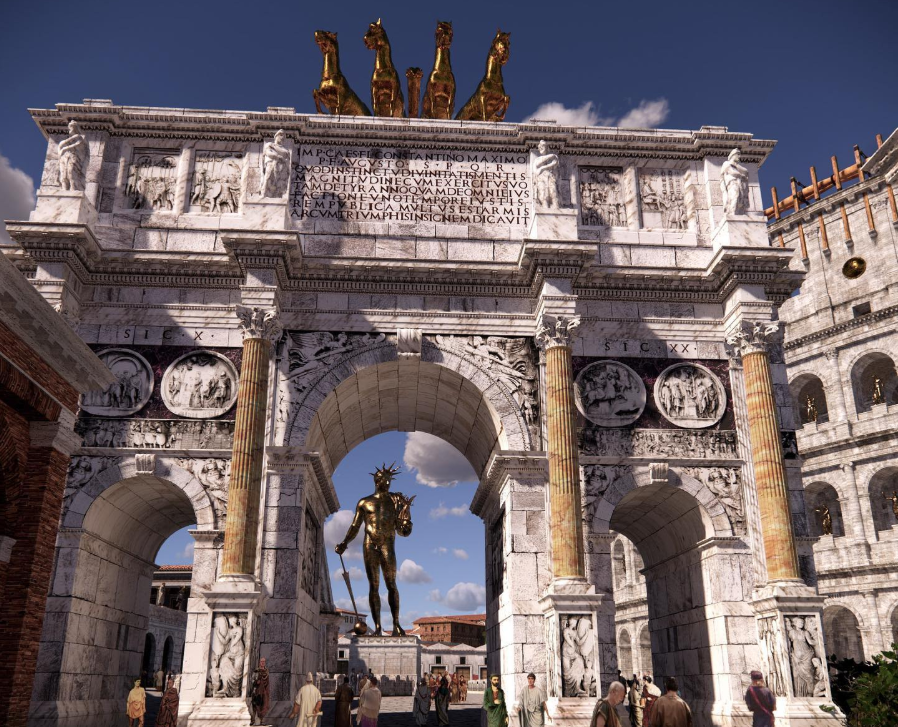
Constantine never publicly renounced his position as pontifex maximus, the chief priest of the Roman state religion, and his religious policy throughout his reign seems guided by syncretism rather than exclusive devotion.
His famous decree of March 7, 321, establishing Sunday as a day of rest, explicitly used the pagan designation dies Solis ("day of the Sun") rather than any Christian terminology: "On the venerable day of the Sun let the magistrates and people residing in cities rest, and let all workshops be closed. In the country however persons engaged in agriculture may freely and lawfully continue their pursuits because it often happens that another day is not suitable for grain-sowing or vine planting; lest by neglecting the proper moment for such operations the bounty of heaven should be lost."
Only after 325, when he had consolidated his power and presided over the Council of Nicaea, did solar imagery gradually disappear from Constantine's coinage. The sun symbols vanished from Roman currency, and Constantine began donating substantial capital to the Church and taking an active interest in religious affairs.
Yet even then, he continued to serve as pontifex maximus, and his new capital of Constantinople was adorned with pagan sculptures and built with a Capitolium at its heart.
The Synthesis of Solar-Christ on December 25th

When Rome began formally celebrating Christmas on December 25 in 336 AD, Constantine was navigating a delicate political landscape. He had grown up in the cult of Sol Invictus, and many sources indicate he was high priest of Mithras-Sol Invictus before and even after his conversion to Christianity.
The elite remained deeply devoted to Mithras, whose birth was celebrated on December 25th and whose cult had been growing among Roman soldiers for centuries.
Constantine's genius lay in synthesis rather than suppression. As one scholar notes, he "mitigated some differences between early Christianity and its main competitor, the official religion of Sol Invictus" by moving the celebration of Jesus' birth to December 25th, which was already established as the celebration date for Mithras and Bacchus and aligned with winter solstice festivals.
This was a calculated political fusion that allowed the Mithraic sensibilities of the elite to find continuity within the new Christian framework, while satisfying the Christian populace who had already developed their own theological reasons for a winter birth date.
The theological calculation theory (dating Jesus's conception from March 25th, the assumed date of the crucifixion) provided Christians with internal justification, while the solar date gave Constantine's Mithraic soldiers a familiar anchor for their devotion. Both streams converged on the same day; a convergence too convenient to be accidental, and too politically useful to be ignored.
As Thomas Talley observes, while the question remains complex, Constantine's personal solar piety and his program to establish Christianity clearly played a significant role. The December 25th date honored both the "Sun of Righteousness" of Malachi 4:2 and the Unconquered Sun of the legions, a masterful political compromise that served the unity of an empire Constantine was desperately trying to hold together.
Christ, described in Malachi 4:2 as the "Sun of Righteousness" rising with healing in his wings, could naturally assume the attributes of the solar deity. Fourth-century mosaics depict Christ with solar imagery—the radiate crown, the chariot, the light-filled halo—and Christian theologians from Justin Martyr to Augustine drew parallels between Christ and the sun.
A Transformation, Not a Replacement
Rome's transition from polytheism to monotheism, then, is not adequately described as Christianity simply replacing the cult of Sol Invictus. Rather, it was a process of transformation in which non-Christian Romans came to accept Christ as the fulfillment and replacement of the sun god they had long worshipped.
The similarities between the character of Christ and Sol Invictus—their mutual association with light, with the heavens, with salvation—constituted one piece of this unsolved puzzle, as did the overlap between the practices and rituals of their respective followers.
The chain of continuity is remarkable: from the Vedic Mitra and Varuna of the Indus Valley, invoked in treaties of the second millennium BCE; to the Persian Mithra, mediator between light and darkness; to the Roman Mithras, savior god of the mysteries; to Sol Indiges, the ancient Italian sun; to Sol Invictus, the supreme state deity of Aurelian's reform; and finally to Christos, whose birth was celebrated on the sun's birthday, whose day of rest was the sun's day, and whose image absorbed the radiate crown and solar glory of his predecessors.
For many in the Mysteries, this transformation was a process in which the old gods did not die but were reborn in new forms, their symbols and festivals and attributes carried forward into the new faith that would dominate the Western world for the next fifteen centuries.
The Degrees of Initiation: Death and Rebirth

The Druidic Mysteries, like those of Egypt and Greece, were structured around the symbolism of death and resurrection. There were three degrees, corresponding to the three orders of the priesthood, but few candidates successfully passed them all.
The first degree involved ritual purification and instruction in the basic doctrines of the order. The second degree included the symbolic burial of the candidate in a coffin, representing the death of the Sun God and the neophyte's own passage through the gates of death. This ritual, common to many initiatic traditions, was designed to strip away attachment to the physical body and the mundane world, preparing the soul for the reception of higher truth.
The third degree, however, was the supreme test; and the most dangerous. The candidate was sent out to sea in an open boat, with neither oars nor sail, at the mercy of wind and wave. This ordeal, known from the accounts of those who passed through it, symbolized the soul's journey through the uncharted waters of existence, its ultimate reliance on divine providence rather than human effort.
Taliesin, an ancient Welsh scholar who successfully passed through the Mysteries, described his experience in verses preserved by Faber in his Pagan Idolatry. The initiate, adrift on the boundless ocean, confronted the terror of dissolution, the annihilation of the ego, the loss of all familiar landmarks. Those who survived this ordeal were said to have been "born again"—transformed, purified, and invested with spiritual powers unknown to ordinary mortals.
The few who passed this third degree became the true guardians of Druidic wisdom. From their ranks were chosen the dignitaries of the British religious and political world—kings, judges, and priests who ruled with wisdom and justice, guided by the light they had received in the darkness of initiation.
The Sacred Symbols of Druidism
The Druidic tradition made extensive use of symbols, many of which would later find their way into Christian and Masonic iconography.
The Oak was the most sacred of all symbols, representing the Supreme Deity. Its roots delved into the underworld, its trunk rose through the middle world of men, and its branches reached toward the heavens. The oak was the axis mundi, the cosmic tree that connected all levels of existence. Anything that grew upon it, particularly the mistletoe, was doubly sacred, partaking of its divine essence.
The Cross, in the form of a T, was made by cutting all the branches from an oak tree and fastening one of them to the main trunk. This oaken cross became symbolic of the superior Deity and of the regenerative power of the divine. Long before Christianity brought its own symbolism to Britain, the Druids venerated the cross as an emblem of life and resurrection.
The Serpent was also sacred, representing wisdom, healing, and the cyclic nature of existence. The serpent's ability to shed its skin and emerge renewed made it a natural symbol of regeneration; the same quality expressed in the initiatic journey of death and rebirth.
The Cube of stone, representing Mercury, was venerated as a symbol of stability and permanence. Caesar noted that Mercury was one of the chief deities of the Gauls, and the cubic stones associated with his worship may have influenced later Masonic symbolism.
The Circle, in various forms, represented the universe, eternity, and the cycle of existence. Circular temples, stone circles, and spiral carvings all expressed this fundamental truth: that all things return to their source, that the end is contained in the beginning, and that the soul's journey is a circle whose center is God.
The Egg, particularly the "serpent's egg" (anguinum) described by Pliny, was a powerful talisman associated with fertility, rebirth, and the hidden potential of life. The mundane egg of Orphic tradition, from which the universe emerged, finds its counterpart in the Druidic reverence for this symbol of latent being.
Druidic Temples and Sacred Places
The Druids worshiped not in enclosed temples like the Greeks and Romans but in open-air sanctuaries; groves, clearings, and stone circles that harmonized with the natural landscape.

Charles Heckethorn, in his Secret Societies of All Ages & Countries, describes these sacred spaces: "Their temples wherein the sacred fire was preserved were generally situate on eminences and in dense groves of oak, and assumed various forms—circular, because a circle was the emblem of the universe; oval, in allusion to the mundane egg, from which issued, according to the traditions of many nations, the universe, or, according to others, our first parents; serpentine, because a serpent was the symbol of Hu, the Druidic Osiris; cruciform, because a cross is an emblem of regeneration; or winged, to represent the motion of the Divine Spirit."
Stonehenge, Avebury, and the countless other megalithic monuments scattered across Britain and Ireland may have served as Druidic temples, though their origins predate the Druids by millennia. The Druids, like many traditional peoples, likely inherited these sacred sites from earlier cultures and adapted them to their own uses.
The astronomical alignments built into these monuments, like the solstice sunrise at Stonehenge, the lunar cycles encoded at Newgrange, would have been perfectly suited to Druidic calendrical observations and initiatic rituals.
The Isle of Anglesey was a particular center of Druidic activity, serving as the seat of one of the two British Arch-Druids. It was here that the Roman general Suetonius Paulinus launched his attack on the Druids in AD 60, seeking to destroy the heart of their resistance.
Tacitus's account of the campaign describes the Roman soldiers' terror at the sight of the Druids, their arms raised to heaven, calling down curses on the invaders. The groves of Anglesey were cut down, the sacred places desecrated, and the Druids scattered or slain.
The Deities of the Druidic Pantheon
The Druids worshiped a complex pantheon of deities, many of whom bore striking resemblances to the gods of Greece and Rome. This syncretism may reflect either common Indo-European origins or the Druids' deliberate incorporation of foreign elements into their system.

At the head of the pantheon stood Hu, the Mighty One, identified by some scholars as the Druidic Osiris. According to the Welsh Triads, Hu came to Britain from a place called the Summer Country, identified with the region around Constantinople. He was regarded as the first settler of Britain and the founder of its civilization.
Albert Pike, the great Masonic scholar, states that the Lost Word of Masonry is concealed in Hu's name; a provocative claim linking the Druidic tradition to the central mystery of Freemasonry.
Like Osiris, Hu was murdered, subjected to strange ordeals, and ultimately restored to life. This pattern of death and resurrection, central to the Druidic Mysteries as to so many others, expressed the fundamental truth that life emerges from death, that regeneration follows dissolution, and that the soul, like the sun, must pass through darkness to reach the dawn.

Alongside Hu stood Ceridwen, his feminine counterpart, the great mother goddess corresponding to Isis, Demeter, and the other maternal deities of the ancient world.
Ceridwen's cauldron, a central symbol of Welsh mythology, represented the womb of rebirth, the vessel of transformation in which souls are cooked and refined before emerging renewed. The initiate who entered Ceridwen's cauldron underwent a symbolic death and resurrection, emerging as a new being; reborn, purified, and wise.
The Druids also venerated a host of lesser deities, including nature spirits, fairies, gnomes, and undines; the "little people" of Celtic folklore. These beings, inhabiting the forests, rivers, and hills, were honored with offerings and propitiated with rituals.
This aspect of Druidic religion, often overlooked in favor of its philosophical teachings, connected the Celtic peoples intimately with the living landscape they inhabited.
The Druids and the Mystery Traditions of the World
The parallels between Druidic teachings and those of other Mystery schools are too numerous to be coincidental. The tripartite division of the priesthood mirrors the organization of the Essene community, the Buddhist sangha, and the Pythagorean brotherhood.

The doctrine of transmigration finds its closest parallels in Indian philosophy. It is also found in the teachings of Pythagoras, who may have derived it from Eastern sources. The symbolism of death and resurrection, central to Druidic initiation, appears in the rites of Osiris, Attis, Adonis, and Dionysus.
The Druidic reverence for the oak and the mistletoe finds echoes in the tree worship of many ancient peoples—the sacred fig of India, the ash Yggdrasil of Norse mythology, the olive of Athena's Athens. The concept of the cosmic tree, connecting the worlds and serving as the axis of the universe, is nearly universal in traditional cultures.
The Druidic calendar, with its emphasis on solstices and equinoxes, aligns with the astronomical observations of virtually every ancient civilization. The celebration of the Sun God's birth at the winter solstice, when the light begins its return, was common to many solar religions before Christianity joined the ranks, and the Roman Empire adopted December 25th for the nativity of Christ.
These parallels suggest either a common source for all these traditions—perhaps the primordial wisdom of Atlantis, as esoteric writers have proposed—or the transmission of teachings across cultures through trade, migration, and the movement of initiates.
The Phoenician traders who sought tin in Britain may have brought with them the mysteries of the East; the Celtic warriors who sacked Rome in 390 BC and later settled in Galatia may have carried Druidic teachings into the heart of the Mediterranean world.
What is certain is that by the time of the Roman conquest, the Druids had created a spiritual and philosophical system that rivaled anything the classical world had to offer. Their teachings on the soul, the cosmos, and the path of liberation were as sophisticated as those of Plato or the Upanishads.
Their initiatic practices were as demanding as those of Eleusis or Memphis. Their influence on the culture and politics of their people was as profound as that of any priesthood in history.
The Destruction of the Druidic Order

The Roman conquest spelled the end of the Druids as an organized priesthood. The emperors, recognizing the threat posed by this independent spiritual authority, systematically suppressed the Druidic order.
Augustus forbade Roman citizens from participating in Druidic rites. Tiberius issued edicts against the Druids themselves. Claudius, ever eager to demonstrate his piety, formally abolished the Druidic religion throughout the Empire.
The final blow came with the attack on Anglesey in AD 60. Tacitus's account of the campaign captures the drama of that moment: "On the shore stood the opposing army with its dense array of armed warriors, while between the ranks dashed women, in black attire like the Furies, with hair disheveled, waving brands. All around, the Druids, lifting up their hands to heaven, and pouring forth dreadful imprecations, scared our soldiers by the unfamiliar aspect."
Despite the terror they inspired, the Romans prevailed. The groves were cut down, the altars overthrown, and the priests slaughtered or dispersed. The organized Druidic order never recovered.
Yet the wisdom of the Druids did not entirely perish. Fragments survived in the oral traditions of the Welsh bards, in the mythological cycles of Ireland, in the folk customs of the Celtic peoples. The Mabinogion, the Triads, and the poems of Taliesin preserve echoes of Druidic teachings, veiled in the language of poetry and myth.
The medieval bards of Wales and Ireland, though Christian in name, continued the ancient traditions of their predecessors, transmitting the sacred lore from generation to generation. The Druidic influence also flowed into other channels.

The Celtic Christian church, with its love of nature, its reverence for holy wells and sacred trees, and its ascetic tradition of solitary hermits, absorbed much of the older spirituality.

The Knights Templar, with their mysterious rites and their connections to the Holy Land, may have drawn on Celtic traditions transmitted through the Templar preceptories of Britain and Ireland.
Freemasonry, emerging in the seventeenth and eighteenth centuries, incorporated symbols and teachings that echo the Druidic tradition; the three degrees, the symbolism of death and resurrection, the emphasis on geometry and astronomy, the search for the Lost Word.
The Enduring Legacy of the Druids
Today, the Druids continue to inspire spiritual seekers, scholars, and romantics alike. Modern Druidic orders, some claiming continuity with the ancient tradition, others frankly revivalist, keep alive the symbols and practices of their predecessors.

The National Eisteddfod of Wales, with its Gorsedd of Bards, preserves the titles and regalia of the ancient order, celebrating the literary and cultural heritage of the Celtic peoples.
The megalithic monuments of Britain and Ireland, whatever their actual origin, have become inseparable from the Druids in the popular imagination. Thousands gather at Stonehenge each summer solstice to watch the sun rise over the ancient stones, enacting in modern form the solar celebrations of their remote ancestors.
For the student of esoteric traditions, the Druids offer a rich field of study; a native European Mystery school whose teachings, though fragmentary, resonate with the universal wisdom of humanity.
Their reverence for nature, their belief in the soul's journey through many lives, their practice of initiation and graded instruction, their symbolism of death and rebirth; all these align them with the great initiatic traditions of East and West.
As Robert Macoy wrote of the ancient Mysteries, so we may say of the Druids: their chief object was "to teach the doctrine of one God, the resurrection of man to eternal life, the dignity of the human soul, and to lead the people to see the shadow of the deity, in the beauty, magnificence, and splendor of the universe."
Though their groves are fallen and their altars scattered, the truth they served remains—eternal, unchanging, waiting to be rediscovered by each generation of seekers.
Rites of Mithras: The Persian Mysteries That Conquered Rome

When the Persian Mysteries migrated into Southern Europe, they encountered a world ripe for spiritual transformation. The old gods of the Roman pantheon, with their formal state cults and distant temples, no longer satisfied the deeper longings of a population caught in the tumult of imperial expansion.
The Greek philosophical schools, while intellectually sophisticated, offered little in the way of emotional consolation or personal salvation. Into this vacuum stepped Mithras, a deity whose cult would spread like wildfire through the Roman world, carried by the very legions that conquered and policed the Empire.
The cult grew rapidly, especially among the Roman soldiery. Soldiers stationed in the East encountered the Mysteries during their campaigns and brought them back to their home garrisons. During the Roman wars of conquest, the teachings were carried by the legionaries to nearly all parts of Europe, from the Danube to the Rhine, from the mountains of Spain to the mists of Britain.
So powerful did the cult of Mithras become that at least one Roman emperor was initiated into the order, which met in caverns under the city of Rome itself.
C. W. King, in his Gnostics and Their Remains, documents the remarkable spread of Mithraic remains across Europe: "Mithraic bas-reliefs cut on the faces of rocks or on stone tablets still abound in the countries formerly the western provinces of the Roman Empire; many exist in Germany, still more in France, and in this island (Britain) they have often been discovered on the line of the Picts' Wall and the noted one at Bath."
These physical remnants; sculptures, inscriptions, and the foundations of underground temples (mithraea), attest to the cult's deep penetration into the fabric of Roman provincial life. From the Syrian desert to the Scottish lowlands, men gathered in subterranean chambers to honor the Persian god who had become, in his Western form, something new and unprecedented.
Mithras and the Zoroastrian Legacy
To understand Mithras, one must first understand the Persian religious tradition from which he emerged. Alexander Wilder, in his Philosophy and Ethics of the Zoroasters, explains that Mithras is the Zend title for the sun, and he is supposed to dwell within that shining orb. But this simple identification barely scratches the surface of his complex nature.

According to the Persians, there coexisted in eternity two primordial principles. The first, Ahura-Mazda (or Ormuzd), was the Spirit of Good. From Ormuzd emanated hierarchies of beneficent beings—angels and archangels who governed the various departments of creation.
The second principle, Ahriman, was originally also pure and beautiful. But jealousy of Ormuzd's power led him to rebel, transforming him into the Spirit of Evil. This rebellion occurred only after Ormuzd had created light; previously, Ahriman had been unconscious of Ormuzd's existence.
When Ormuzd created the earth, Ahriman insinuated himself into its grosser elements. Whenever Ormuzd performed a good deed, Ahriman placed the principle of evil within it. When humanity was created, Ahriman became incarnate in man's lower nature, ensuring that in each personality the Spirit of Good and the Spirit of Evil would struggle for control.
This cosmic drama unfolded across vast cycles of time. For 3,000 years, Ormuzd ruled the celestial worlds with light and goodness. He then created humanity and ruled for another 3,000 years with wisdom and integrity. Then began the age of Ahriman's power, the present epoch, in which the battle for the soul of humanity rages.
This period too would last 3,000 years. Finally, during a fourth and final cycle, Ahriman's power would be destroyed, evil and death vanquished, and the Spirit of Evil would bow humbly before the throne of Ormuzd.
Within this cosmic conflict, Mithras occupies a unique position. He stands as mediator between the two opposing forces—the God of Intelligence who seeks to harmonize the celestial opposites. Many authors have noted the similarity between Mithras and the mercury (element) of the alchemists, which acts as a solvent, reconciling disparate elements into a unified whole.
Mithras has both a male and a female aspect, though he is not himself androgynous. As Mithras, he is the lord of the sun, powerful, radiant, and most magnificent of the Yazatas—the Izads or Genii of the sun.
As Mithra, the deity represents the feminine principle, with the mundane universe as her symbol. In this aspect, she represents Nature as receptive and terrestrial, fruitful only when bathed in the glory of the solar orb.
The Threefold Evolution of Mitra
The deity known as Mitra—in his various manifestations across Vedic India, Zoroastrian Persia, and Imperial Rome—offers a remarkable case study in how a single Indo-Iranian divine figure could evolve along radically different trajectories.
Understanding these divergences requires tracing the common root, then following each branch as it developed in response to distinct theological and cultural pressures.

The Common Indo-Iranian Heritage
Before the great divergence, there existed a shared Indo-Iranian religious world. The common Indo-Iranian noun mitra meant "(that which) causes to bind" — from the root mi- ("to bind") plus the instrumental suffix -tra.
Hence Sanskrit mitram signified "covenant, contract, oath." The deity Mitra was therefore originally the personification of the binding force that made contracts effective and relationships trustworthy.
This function as protector of oaths and compacts remained central in all three traditions, though its expression evolved differently.
The Vedic Path: Mitra-Varuna as Complementary Dyad

In the Rigveda, the oldest Vedic text, Mitra appears almost exclusively in the dvandva compound Mitra-Varuna—an inseparable pair invoked together. This pairing is significant: the two are so closely associated that the compound has essentially the same attributes as Varuna alone. Varuna is the greater of the two, second only to Indra in the Rigvedic pantheon, but Mitra is necessary to complete him.
The Structure of Vedic Duality: The Vedic tradition externalizes duality into a complementary pair of distinct gods, each representing different aspects of sovereignty. According to the interpretative framework developed by Georges Dumézil, Mitra and Varuna embody two faces of sovereign power:
Sanskrit Meaning: Mitra means "Friend," "Contract" & Varuna means "He who covers" or "binds" (from wer- root) |
Sovereignty Type: Mitra represents juridical sovereignty & Varuna represents magical sovereignty
Function: Mitra as a priest (purohita) guides through counsel & Varuna as a king (rājan) — enforces through power
Temporal Association: Mitra is day, morning sun & Varuna is night, evening, celestial ocean
Mode of Operation: Mitra is gentle, contractual, binding through agreement & Varuna is awesome, mysterious, binding through cosmic law
The Rigveda itself captures this distinction. Mitra is described as bringing forth the light at dawn, "soft sun of dawn" who "brings men together when he utters speech and gazes on the tillers with unwinking eye." Varuna, by contrast, is "omniscient, catching liars in his snares," his spies (the stars) watching all human conduct.
Yet despite these differentiated functions, the two are inseparable. They "wet the pastures with dew of clarified butter" together. They share a golden palace with a thousand pillars and a thousand doors. Their "eye is the sun," and they drive their chariot through the highest heavens with the sun's rays as reins. Before Indra, Mitra-Varuna ruled the heavens.
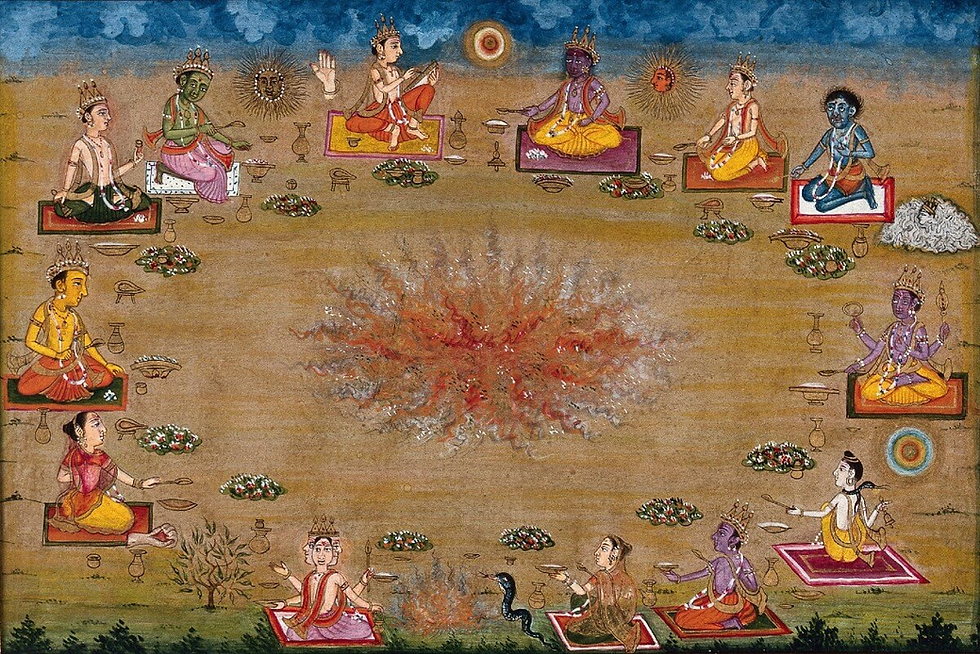
Evolution Within Vedic Tradition: Over time, the distinction between Mitra and Varuna became more pronounced. In the later Atharvaveda and the Brahmanas, Mitra becomes increasingly associated with sunrise and the day, Varuna with evening and night.
The Shatapatha Brahmana explicitly analyzes them as "the Counsel and the Power" — Mitra representing the priesthood, Varuna the royal authority.
In post-Vedic texts, however, Mitra practically disappears as an independent deity. He survives primarily as a name in lists of Adityas, and his noun form mitra evolves to mean simply "friend" in common language. The paired sovereignty structure dissolves as Hinduism moves toward new theological configurations centered on the Trimurti (Shiva, Brahma, Vishnu).
The Persian Path: Mithra as Subordinate Mediator
The Persian branch of the tradition took a dramatically different course. The Avestan Mithra shares the same Indo-Iranian root and retains the core functions of covenant-protector and lord of light. But the theological landscape into which he was placed transformed his status and role.

The Vedic Varuna and Ahura Mazda represent parallel developments from the same Indo-Iranian archetype. The relationship is one of the most fascinating pieces of evidence for the common origin of Vedic and Zoroastrian religion.
In the Rigveda, Varuna is repeatedly called Asura—indeed, he is the Asura par excellence. The famous hymn Rigveda 8.42.1 addresses him as "King Varuna, the Asura." This is not merely an epithet but a title of supreme lordship, one that he shares with Mitra (the dual compound "Mitra-Varuna" is also called Asura).
The most compelling evidence comes from a structural parallel that has survived in both traditions like a linguistic fossil. As the scholarly sources note: "The Avesta, in a matter-of-fact manner, joins Ahura and Mithra in the same dual partnership as the Veda does Varuna and Mitra. Since Ahura is the paramount divinity of the Avesta his pairing with Mithra has every appearance of a fossil, left over from a time when Ahura's supremacy had not yet become absolute, in other words, from a time when Ahura and Mithra were on a par of dignity."
Vedic Pair
Mitra-Varuna (dual compound)
Mitra = covenant, contract
Varuna = cosmic sovereignty, order (ṛta)
Avestan Pair
Ahura-Mithra (dual partnership)
Mithra = covenant, contract
Ahura = cosmic sovereignty, order (asha)
The pairing is structurally identical. And just as Mitra is the "silent partner" in the Vedic combination, Mithra in the Avesta retains his functions while Ahura becomes supreme.
The sources are remarkably clear on this point. One scholar states flatly: "It seems unlikely that Ahura Mazda, when mentioned by himself, is not the same Ahura that appears in the combination Ahura and Mithra, because Ahura Mazda, taken by himself, is so very like Varuna, the Vedic partner of Mitra."
While the connection is clear, scholars debate the exact nature of the relationship:
Theory 1 — Ahura Mazda Develops from Varuna Alone: One view holds that "the proto-Indo-Iranian divinity is the nameless 'Father Asura,' Varuna of the Rigveda." In this interpretation, Zoroastrian mazda (wisdom) corresponds to the Vedic medhira, the "revealed insight into the cosmic order" that Varuna grants his devotees. Thus Ahura Mazda is Varuna transformed, with his characteristic wisdom elevated to become part of his name.
Theory 2 — Ahura Mazda as a Compound of Both: Another view suggests that Ahura Mazda represents an Iranian development of the dual expression mitra-vouruna, where mitra became the otherwise nameless "Lord" (Ahura) and vouruna (related to Varuna) became associated with mazda/wisdom. In this interpretation, Ahura Mazda is a compound divinity in which "the favorable characteristics of mitra negate the unfavorable qualities of vouruna."
Theory 3 — Ahura Mazda as Supreme Above Both: A third view sees Ahura Mazda as the Ahura par excellence, superior to both vouruna and mitra, with the nameless "Father Asura" of the Rigveda being a distinct divinity to whom Ahura Mazda may or may not be related.
In the Vedic tradition, the terms evolved differently: Asura (cognate with Ahura) came to mean "demon" in later Sanskrit. Deva (cognate with Avestan daēva) remained "god."
In the Iranian tradition, the opposite occurred: Ahura remained the title of the supreme deity and beneficent beings. Daēva became the term for demons.
This inversion is not absolute. Vedic texts preserve positive uses of asura (especially for Varuna), and Avestan texts preserve traces of daēvas as former gods. But the general trend is clear.
The French scholar James Darmesteter summarizes the relationship eloquently: "The supreme god of the Avesta, Ahura Mazda, 'the Omniscient Lord,' ancient god of the sky, analogous to Zeus and Jupiter, finds his parallel in the supreme god of the Vedas, Varuna, 'the Asura who knows all things.' Mithra, the Iranian Apollo, is identical to the Vedic Mitra and like him closely associated with the God of Heaven."
This association, he argues, points not to recent borrowing but to "an ancient religious community between India and Iran," a common Indo-Iranian heritage in which the pairing of the covenant god (Mitra/Mithra) with the sovereign sky god (Varuna/Ahura) was already established.
Zarathustra's Reform and Its Consequences: The prophet Zarathustra (Zoroaster) revolutionized the Iranian religious tradition by elevating Ahura Mazda (the "Wise Lord") to supreme status and demoting the older deities. In this new framework, Mithra became a yazata — "one worthy of worship" — created by and subordinate to Ahura Mazda.
The Avesta itself preserves the changed relationship: "This Mithra, the lord of wide pastures, I have created as worthy of sacrifice, as worthy of glorification, as I, Ahura-Mazda, am myself."
Yet despite this official subordination, old formulas survived that hint at an earlier equality. As Darmesteter notes, the Avesta retains invocations of "Mithra and Ahura" as an indivisible unity, "dimly remind[ing] one that the Creator was formerly a brother to his creature."
The pairing of Ahura and Mithra appears as "a fossil, left over from a time when Ahura's supremacy had not yet become absolute."
Mithra's Persian Functions: In the Avesta, particularly in the Mihr Yasht, Mithra emerges with complex, sometimes contradictory attributes:
God of Contracts: He punishes those who break agreements, the mithra-drug ("he who lies to Mithra")
Warlord: A terrifying deity of battle, swift to assail enemies of truth
God of Light: Associated with the sun's glory, "the lord of vast luminous space"
Judge: In company with Rashnu ("the True One"), he judges souls in the afterlife
Mediator: Not yet fully developed, but present as one who stands between Ahura Mazda and Angra Mainyu
The Persian Mithra thus occupies an intermediate position. He is not one half of a dyad like his Vedic counterpart, but neither does he yet internalize duality within himself. He serves as a powerful agent of the supreme god, not yet the cosmic mediator he would become.
The Zervanite Influence: A crucial development in Persian theology, one that would profoundly influence the Roman Mithras, was the emergence of Zervanism. This heterodox tradition posited Zurvan ("Boundless Time") as the ultimate source from which both Ahura Mazda (good) and Ahriman (evil) sprang.
In this framework, the cosmic struggle between good and evil takes place within a temporal framework governed by a higher principle.
Zervanism created theological space for a mediator figure. If time itself encompasses both opposing forces, then a deity who participates in both — who stands between them — becomes conceivable. This mediating function would later attach to Mithra in his Roman form.
The Roman Path: Mithras as Internalized Mediator

When the Persian Mysteries migrated into the Roman world, they underwent a transformation so profound that modern scholars debate whether the Roman Mithras should be considered the same deity at all.
As one scholar notes, "Modern Scholars see no link between the Roman Mithras and the Persian Mithra save the appropriation of the name." While this may overstate the case, it captures the magnitude of the transformation.
The Roman Mithraic mysteries synthesized multiple influences:
Persian Mithra — providing the name, the covenant function, and solar associations
Zervanite cosmology — contributing the framework of Boundless Time and the mediator concept
Chaldean astrology — supplying the elaborate planetary and zodiacal symbolism
Hellenistic mystery traditions — shaping the initiatic structure and soteriological emphasis
The result was a new deity for a new context. As Darmesteter observes, "the Mazdeism of the Persians, in uniting with the astrolatry of the Chaldeans, produced Mithraism." This synthesis likely occurred after the Persian conquest of Babylon (538 BCE), when Persian and Babylonian religious ideas mingled freely.
Mithras as Internalized Mediator: Within this framework, Mithras himself takes on a mediating function fundamentally different from either the Vedic Mitra or the Persian Mithra:
Duality Type: Internalized within a single deity
Relationship: Self-contained; aspects of the same being
Cosmic Function: Mediator between cosmic good and evil, reconciler of opposites
Symbolic Expression: Tauroctony (bull-slaying) as cosmic drama; banquet with Sol
Theological Context: Mysterial/soteriological — offers salvation to initiates
The Roman Mithras contains duality within himself. He is born from the rock (petra genitrix) as a solar savior. He slays the bull, releasing life-giving force, while a dog leaps toward the wound, a serpent licks the blood, and a scorpion attacks the bull's genitals — all representing celestial forces.
He shares a banquet with Sol Invictus, the Unconquered Sun, and they exchange places. He ascends to the heavens in a chariot.
This is not the externalized complementarity of Mitra-Varuna, nor the subordinate agency of Persian Mithra. This is a savior god who internalizes the cosmic opposites and resolves them through his own drama. He mediates between light and darkness, life and death, the celestial and the chthonic — and in doing so, offers his initiates a path to salvation.
The evolutionary trajectories can be traced as follows:
Proto-Indo-Iranian Mitra (2000-1500 BC)
Vedic Mitra-Varuna (1500-500 BC)
Persian Mithra (1000 BC-300 AD)
Roman Mithras (100-400 AD)
Thus, from the common root of an Indo-Iranian covenant deity, three distinct figures emerged:
1. Vedic Mitra remained bound in dyadic complementarity with Varuna, preserving the ancient Indo-Iranian structure of dual sovereignty — priest and king, gentle and terrible, day and night. This pairing maintained cosmic order through balanced opposition.
2. Persian Mithra was subordinated to Ahura Mazda in Zarathustra's reform, becoming a powerful yazata who served the supreme god while retaining his ancient functions as covenant-keeper, warrior, and judge. He mediated not by internalizing opposites but by enforcing truth against falsehood.
3. Roman Mithras underwent the most radical transformation, absorbing Zervanite concepts of Boundless Time, Chaldean astrology, and Hellenistic mystery theology. He emerged as a savior figure who internalized duality within himself and offered initiates participation in his cosmic drama.
The Indo-Iranian god of covenants thus became, in his final form, the central figure of a mystery religion that for centuries rivaled Christianity for the soul of the Roman Empire.
The Lion-Headed Figure and Zervanite Time

The most striking evidence of Zervanite influence in Roman Mithraism is the mysterious lion-headed, serpent-wrapped figure found in many mithraea. This deity represents Aion—eternal, boundless time—and corresponds to the Zervanite Zurvan.
He is typically depicted with a lion's head (representing the solar fire), entwined by a serpent (symbol of cyclical time), holding keys (to the celestial gates), and sometimes standing on a globe inscribed with zodiac signs.
This figure embodies the Zervanite principle that time encompasses and transcends the opposition between good and evil. In the Mithraic mysteries, he stands as the ultimate source, the ground from which both Mithras and his cosmic drama emerge.
The Egyptian Precedent: Lion and Serpent as Divine Protection
Long before the Mithraic mysteries, Egyptian artisans created images that combined the lion and the serpent into a single protective entity. The Art Institute of Chicago possesses a small faience amulet from the Ptolemaic or Roman period (4th century BC–4th century AD) depicting a lion-headed cobra. During mummification, amulets like this were folded into linen wrappings to protect the deceased.
This hybrid form likely represents either Sekhmet (the lioness goddess of war and healing) or Wadjet (the cobra goddess of protection), or perhaps both simultaneously. As the museum's description notes, Sekhmet and Wadjet both acted as the "Eye of Re"—the daughter of the sun god who served as his protector.
The lion-headed cobra thus embodied the fearsome, all-seeing power of the solar deity, protecting the worthy and destroying the unworthy. This Egyptian fusion of lion and serpent established a powerful symbolic vocabulary that would influence later Mediterranean religions.
The Zervanite Foundation: Time as the First Principle

Zurvanism (also spelled Zervanism) was a modified form of Zoroastrianism that appeared in Persia during the Sasanian period (3rd–7th century AD), though its roots extend considerably earlier. Unlike orthodox Zoroastrianism, which posited a fundamental dualism between the good god Ahura Mazda (Ormuzd) and the evil spirit Angra Mainyu (Ahriman), Zurvanism sought to resolve this dichotomy by positing a supreme principle from which both opposites emerged.
According to Zurvanite theology, Zurvan, whose name means "Time" or "Fate" in Middle Persia, was the primordial creator deity, the source of all things. The key innovation was that Zurvan was understood as Infinite Time (Zurvan Akarana), a transcendent, neutral god without passion, beyond the distinction between good and evil. From this absolute Time, the twin spirits of good and evil were born; twins who would become Ahura Mazda and Angra Mainyu, locked in eternal struggle.
This theological framework created a supreme deity whose primary attribute was temporality itself. As the Britannica entry notes, "time alone—limitless, eternal, and uncreated—is the source of all things" in Zurvanite thought. This concept of a supreme Time-deity would prove extraordinarily portable, capable of being identified with analogous figures in other religious traditions.
The Mithraic Leontocephaline: Zervan-Chronos or Mithraic Chronos
When Zurvanite theology encountered the developing Mithraic mysteries, likely in Asia Minor during the early centuries of the Common Era, it found fertile ground. The most striking evidence of this synthesis is the enigmatic Leontocephaline, the lion-headed, serpent-wrapped figure that appears in Mithraic iconography.
A remarkable 2nd-century marble sculpture from Mérida, Spain, now in the National Museum of Roman Art, depicts Aion-Chronos (also called Zervan-Chronos or Mithraic Chronos) emerging naked from a rock. A serpent wraps around his body five times, and his chest bears a lion's head at its center.
Scholars identify it with Kronos, Saturn, or Zurvan himself, as it embodies the Zervanite conception of time as the supreme cosmic principle. The lion's head represents the solar fire and consuming power of time; the serpent coiled around the body symbolizes the cyclical nature of temporal existence; the wings signify transcendence; the keys held in the hands denote control over the gates of heaven and the mysteries of the universe.
The lion-headed figure typically appears with:
A human body (often nude) completely entwined by a serpent (or two serpents)
A lion's head with open mouth, sometimes painted red with a hollowed gullet
Four wings (often bearing symbols of the four seasons)
Keys (sometimes one, sometimes two) held in the hands
A scepter or torch
Sometimes standing on a globe inscribed with a diagonal cross
Occasionally decorated with zodiac signs
Scholars have debated his identity for over a century. Some inscriptions dedicate altars to Arimanius, the Latin form of Ahriman—the Zoroastrian spirit of evil. However, the prevailing scholarly view identifies him as Aion (eternity), the Greek personification of infinite time, or his Persian equivalent Zervan Akarana (Boundless Time).
This made him an appropriate figure for the Mithraic mysteries, which sought to comprehend the cosmic struggle between light and darkness within the framework of eternal time.
The Synthesis of Mythras and Saturn

The French scholar Reinach describes Aion-Kronos explicitly: "At the summit of the divine hierarchy is Infinite Time, identified with the Greek Kronos, represented by winged figures with lion heads, holding the two keys of heaven and encircled by the coils of a serpent. The son of Time is Ormazd (Ahura Mazda), assimilated to Zeus and named Cœlus by the Romans."
This confirms the genealogy: Kronos (Time) → Ormazd (Ahura Mazda). The lion-headed figure thus represents Aion-Kronos—the Hellenistic personification of eternal time, equated with the Persian Zurvan akarana (Boundless Time).
As one source notes: "The supreme godhead is Kronos (Saturn), Time, known in the Avestan texts as Zrvan Akarana or Boundless Time. He is devoid of name, sex, and passions. He is the First Cause. The Sun is his physical manifestation."
Plutarch, in his description of Zoroastrian theology, explicitly identifies this mediating function:
"Oromazes and Areimanius are constantly at war with each other... between these was Mithras the Mediator."
The Britannica article on Mithraism reinforces this: "Mithra was called the Mediator." He serves as the cosmic reconciler, the being who stands between light and darkness and offers salvation to initiates.
As one scholar notes, the Leontocephaline stands on the cosmic globe, "conducting the stars and planets," symbolizing control over the circular order of time and functioning as a cosmocrator—a ruler of the cosmos. This imagery perfectly captures the Zurvanite conception of Time as the ultimate source and organizer of all existence.
The figure was understood in the Mithraic mysteries as "the supreme being according to the Mithraistic belief system (i.e., not Mithra himself)—Aion-Saeculum in Latin, Zervan Akarana in Persian, meaning 'The Eternal Time,' later called Saturnus or Kronos."
This identification is crucial: the supreme Time-deity, derived from Zurvan, was assimilated to the Greco-Roman Kronos-Saturn, the god associated with the Golden Age, agriculture, and the planet that bore his name.

The Identification of Saturn with Mithras
The identification of Saturn with Mithras represents a further step in this syncretic process. The most explicit evidence comes from the second-century astrologer Ptolemy, who in his Tetrabiblos (2.3) makes a remarkable observation about the peoples of Persia, Mesopotamia, and surrounding regions: "The nature of the inhabitants of these countries is obedient to the dominion of these ruling influences; they worship Venus, calling it Isis, and they also pay devotion to Saturn, invoking him by the name of Mithras the Sun."
This passage is extraordinary in its clarity: Saturn is invoked as Mithras Helios—Mithras the Sun. The astrological framework here is significant. Saturn, the slowest-moving planet, was associated with boundary, limitation, and the outermost sphere of the cosmos.
In the Chaldean astrological theology that influenced Mithraism, Saturn was the highest of the planetary spheres, the closest to the realm of the fixed stars.
In the geocentric model inherited from Babylonian and Chaldean astronomy, the seven "planets" (including Sun and Moon) were arranged in concentric spheres surrounding the Earth, ordered by their apparent speed; or rather, by the time they took to complete their journey through the zodiac.
From fastest/nearest to slowest/farthest, the Chaldean order was:
Moon — 29.5 days
Mercury — 88 days
Venus — 224.7 days
Sun — 365.25 days
Mars — 687.1 days
Jupiter — 12 years
Saturn — 29.5 years
Saturn was the slowest-moving and therefore the outermost of the planetary spheres. Beyond Saturn lay the realm of the fixed stars; the immutable, eternal cosmos. In this cosmic architecture, Saturn occupied the boundary zone between the changeable sublunary world (everything below the Moon, where generation and decay occurred) and the perfect, unchanging celestial realm.
The Gatekeeper: This astronomical position gave Saturn its spiritual function as a threshold guardian. Several sources illuminate this role: First, the Chaldeans called the planets "Interpreters" because they "point out future events, thus interpreting to mankind the design of the gods."
As the highest and most significant of these interpreters, Saturn was "the most conspicuous and presages more events and such as are of greater importance than the others." Its position at the boundary made its messages particularly weighty.
Second, in Mithraic theology specifically, Saturn's primacy is explicitly connected to the soul's journey. Roger Beck's authoritative study includes chapters on "Saturn's primacy: the Sun of midnight" and "the ascent of souls."
This "ascent of souls" refers to the soul's journey after death, climbing back through the planetary spheres to its celestial home. Saturn was the final planetary sphere the soul had to pass through before exiting the material cosmos entirely.
Third, the identification of Saturn with Mithras himself—Ptolemy records that the Persians worshipped Saturn "invoking him by the name of Mithras the Sun"—suggests that Saturn was understood as the solar deity in his nocturnal or transcendent aspect.
Beck's phrase "the Sun of midnight" captures this beautifully: Saturn represents the sun at its deepest, darkest point, the threshold where light meets darkness, where the material meets the spiritual.
The Mithraic mysteries expressed Saturn's boundary function through their initiatic structure. Beck notes that "Saturn's primacy" is linked to "the snake-encircled figures" and the soul's ascent. The snake-encircled god—the lion-headed Aion-Kronos figure we discussed earlier—represents the fusion of Saturn (Kronos) with Infinite Time (Zurvan). This figure holds keys, symbolizing his power to unlock or seal the gates between realms.
In the Barberini fresco, Saturn and the snake-encircled god appear in contexts relating to "the structures of genesis and apogenesis"—the descent of souls into generation and their ascent back to the source. Saturn thus guards the turning point, the threshold where souls enter material existence and where they depart from it.
The Cosmic Drama: Saturn's Place in Mithraic Cosmology
The Mithraic mysteries incorporated Saturn into their initiatic structure in complex ways. The lion-headed figure representing Aion-Zurvan-Saturn appears in the Barberini fresco "immediately above the most popular Mithraic scene of the Tauroctony—Mithras struggling with the taurus."
This placement is theologically significant: the Time-god presides over the entire cosmic drama, the ultimate context within which Mithras performs his saving work.
In the initiatic grade system, Saturn was associated with the highest levels. As one scholar notes, "the serpent-encircled figures" and the "ascent of souls" were connected to Saturn's primacy, with the planet representing the final stage of the soul's journey through the celestial spheres.
The Mithraic Contra Celsum text describes an ascent through the planetary spheres in which Saturn represented the ultimate destination; the realm of eternal time beyond the cycles of generation and decay.
The seasonal symbolism of the Mithraic mysteries also connected to Saturn. The Saturnalia, the Roman festival of Saturn celebrated in December, coincided with the winter solstice—the time of the sun's rebirth.
As one discussion notes, Mithraic imagery depicts "Mithras meeting Saturn near Capricorn (the Constellation of December, of the Saturnalia)." This meeting at the winter solstice symbolized the intersection of the Time-god's domain with the solar savior's moment of renewal.
The Evolution of the Winter Solstice Celebrations

The festival of Sol Invictus, established by the Emperor Aurelian in AD 274 and celebrated on December 25, came after the long-established Saturnalia, which by the first century BC had expanded into a seven-day festival running from December 17-23.
Saturnalia was the oldest, deeply embedded in Roman tradition with its themes of role reversal, gift-giving, and the temporary return of Saturn's mythical Golden Age.
When Aurelian elevated Sol Invictus to an official state cult and celebrated the deity on December 25, he strategically chose the date of the winter solstice—the symbolic "rebirth" of the sun—which fell immediately after Saturnalia's conclusion.
By the time Emperor Constantine officially adopted December 25 for Christmas in AD 336, the entire month of December was already saturated with festivity: Saturnalia's seven days of revelry followed by the solemn "birthday of the Unconquered Sun."
Rather than a simple replacement, the evolution was more of a palimpsest—Christ absorbed Sol Invictus, and Christmas absorbed Saturnalia's customs of feasting and gift exchange, with early Christian writers in the Roman Empire explicitly drawing parallels between Christ and the "Sun of Righteousness" from Malachi.
There are alternative theories as well, noting that early Christians may have calculated December 25 by adding nine months to March 25 (the presumed date of Jesus's conception and crucifixion), suggesting the solar date may have been coincidental rather than appropriated.
Although this might have been true for the earliest Christians before Rome adopted the religion, it is more likely that the Roman Empire absorbed their latest pagan deity in Christ, along with their festivities of winter solstice—based on their past patterns of absorbing or merging gods.
Regardless, by the late fourth century, the three festivals had effectively merged in popular practice—the candles of Saturnalia, the solar rebirth of Sol Invictus, and the nativity of Christ all converged on the same sacred time, creating the layered midwinter celebration that would evolve into modern Christmas.
Saturn as a Black Cube

The representation of Saturn as a black cube emerges from a remarkable convergence of astronomical observation, astrological symbolism, and cross-cultural religious transmission that spans millennia and civilizations.
Geometrically, the cube represents stability, limitation, and the material world—its six faces corresponding to the six directions of physical space (north, south, east, west, up, down), making it the perfect symbol for Saturn's astrological role as the "Great Binder" who imposes boundaries, time, and physical reality itself.
The black color further reinforces this meaning, as Saturn was traditionally associated with black across many cultures—the planet farthest from the sun's light, representing the cold, dark, outer limit of the visible cosmos, the boundary where the material world meets the infinite beyond.
This understanding was systematized in occult traditions, where Saturn is seen as the "guardian of the threshold"—the power that both confines souls to material existence and, paradoxically, holds the keys for their liberation. The cube thus became the architectural signature of Saturnian influence: the shape of limitation that contains the potential for transcendence, the prison that is also a temple.
In Semitic civilizations, the supreme deity was referred to as El—a name that functioned both as a generic term for "god" and as the specific proper name of the high god of the Canaanite pantheon.
This supreme deity was consistently represented by a black cube, a tradition most visibly preserved today in the Kaaba at Mecca, which pilgrims circumambulate seven times, mirroring the seven rings of Saturn.
Esoteric researchers note that El was specifically identified with Saturn, making the cube his symbolic signature across the ancient Near East. The six-pointed star, which would later become the Star of David, was also associated with Saturn in Hebrew tradition, and some esoteric interpretations suggest that the very name Is-Ra-El encodes a triune of pagan deities: Isis, Ra, and El—the latter being the Saturnian god at the foundation.
This cube-shaped structure at Kaaba predates Islam by centuries, serving in pre-Islamic times as a major sanctuary long before Muhammad's (Peace be Upon Him) time. According to tradition, the Quraysh tribe, who ruled Mecca, rebuilt the Kaaba in 608 AD—about 12-15 years before Muhammad's (Peace be Upon Him) first revelations—using alternating courses of masonry and wood.
It was a shrine housing up to 360 idols representing different deities worshipped by various Arab tribes, corresponding symbolically to the days of the year and the zodiacal degrees. The idols included Hubal (a Nabatean god considered one of the chief deities), and the three goddesses Al-lāt, Al-'Uzzá, and Manāt, who were considered "daughters of God."
Tradition also mentions images of prophets, angels, and even depictions of Jesus and Mary alongside the pagan idols. Pre-Islamic pilgrims already performed circumambulation (tawaf) around the Kaaba and kissed the Black Stone—rituals that were later incorporated into Islam.
According to multiple sources cited in esoteric and comparative mythology research, Hubal was explicitly identified with the planet Saturn. One comprehensive compilation states directly: "Hubal was the god of the planet Saturn" and "Hobal was identified with the planet Saturn by the Arabs."
This identification is further supported by the claim that the cubic structure at Mecca was dedicated to Zohal or Kyevun, which is Saturn. The name Kyevun (also rendered Kewan or Kaiwan) is the Semitic term for Saturn, appearing in the Hebrew Bible (Amos 5:26) as "Kaiwan," associated with astral deities worshiped by Israel in the wilderness.
Al-Azraqi, an early Islamic commentator, recorded that the image of Hubal was brought to Mecca "from the land of Hit in Mesopotamia" (modern Iraq). This is significant because Mesopotamia was the heartland of astral religion, where Saturn (called Kaiamanu in Akkadian) was venerated as a powerful celestial deity. Hit was located in a region with deep astrological traditions, making the transmission of Saturn worship to Arabia entirely plausible.
It is important to note that mainstream academic sources present a more complex and uncertain picture of Hubal's identity. Various theories have been proposed: as a lunar deity (Hugo Winckler's early 20th-century theory, part of a trinity with sun-mother and Venus-son, now largely rejected by recent scholars); as a rain and warrior god (Mircea Eliade, Charles J. Adams); and as a Nabataean import (Maxime Rodinson, John F. Healey).
The identification of Hubal with Saturn is notably absent from mainstream Wikipedia discussions, which focus instead on the lunar theory (now largely rejected) and the warrior-rain god interpretation. However, the sources citing the Saturn connection draw on works like D.N. Talbott's The Saturn Myth (1980) and D. Cardona's articles in the journal Kronos—publications dedicated to exploring the global prevalence of Saturn symbolism in ancient religion.
When we consider the full picture: the Kaaba was a cube-shaped sanctuary dedicated to Hubal, who was considered the greatest of the 360 idols. The cube is symbolically linked to Saturn as the "black cube" representing limitation, materiality, and the outermost planetary sphere.
The sanctuary was associated with seven arrows used for divination—seven being the number of planetary spheres, with Saturn as the seventh and highest. This suggests that Hubal was very likely the Arab name for the Saturnian deity, whose worship centered on the cube-shaped Kaaba long before Islam.
The seven arrows used for divination before Hubal's statue may represent the seven planets, with Saturn (the slowest-moving, outermost sphere) as their chief. The identification of Hubal with Apollo in some sources (noting that Apollo was often syncretized with Helios/Sol) may represent a later Hellenistic layer, but the deeper stratum points to Saturn—the dark, primordial, time-bound god whose cube-shaped temple in Mecca preserved an ancient tradition linking the black stone to the "Great Binder" who holds the keys to the cosmic gates.
When Muhammad (Peace be Upon Him) conquered Mecca in 630 CE, he reportedly cleansed the Kaaba of idols, returning it to the monotheism of Abraham. Today, of course, the Kaaba holds an entirely different meaning for Muslims, who revere it not as an idol but as the monotheistic House of God (Bayt Allah), rebuilt by Abraham and consecrated exclusively to the worship of one God—representing the absolute rejection of polytheism.
The cube thus endures as a symbol of the "Great Binder"—the power that confines souls to material existence while paradoxically holding the keys to their liberation, a prison that has become a temple, a limitation that contains the seed of transcendence.
Again, this is just one interpretation in relation to pre-Islamic Arabia, and it no longer represents Saturn in any way. To understand why Muslims visit Kaaba today to connect with God (Allah), watch this video:
The Gnostic Demiurge: Yaldabaoth as Lion-Headed Serpent

Gnostic traditions, which flourished in the 2nd and 3rd centuries CE, reinterpreted this syncretic imagery to depict the Demiurge—the ignorant creator god who traps souls in the material world.
As scholar Ezio Albrile explains, "Gnostic imagination plastically depicts the homicide and ignorant Demiurge with the features of an abnormous creature with the head of a lion and wings, enveloped in the coils of a snake."
This figure, named Yaldabaoth (or Ialdabaoth) in Sethian and Ophite Gnostic texts, is described as a lion-headed serpent who rules the material universe. According to the Gnostic myth, Yaldabaoth sprang from the fall of Sophia (Wisdom) and mistakenly declared himself the only god, imprisoning divine sparks in human bodies.
The Gnostic conception drew directly from the Mithraic lion-headed figure, which itself synthesized Egyptian, Persian, and Greek elements. As Albrile notes, this monstrous being "can be found in the Orphic and Mithraic iconography."
The Gnostics thus took an existing symbol of eternal time and transformed it into an image of cosmic error and spiritual imprisonment.
The Syncretic Synthesis: The lion-headed serpent figure represents one of antiquity's most striking examples of religious syncretism, the blending of different cultural traditions into new symbolic forms.
Egypt | Sekhmet/Wadjet (Eye of Re): Lion-headed cobra, solar protection, royal power
Persia | Zervan Akarana: Infinite time, source of good and evil
Greece/Rome | Aion/Kronos/Saturn: Eternal time, zodiac, cosmic cycles
Mithraism | Aion-Chronos/Arimanius: Lion-headed, serpent-wrapped, keys to celestial gates
Gnosticism | Yaldabaoth: Lion-headed serpent, ignorant creator, world ruler
The Mithraic lion-headed figure also had a cosmological function. David Ulansey notes that in the Barberini mithraeum, this figure stands on a globe located exactly on the zodiacal boundary, with its body extending beyond into a fiery realm.
This placement emphasizes concepts of boundary and boundary-crossing—the figure guards the eighth gate beyond the seven planetary spheres, representing the sphere of fixed stars and the transcendent realm beyond. The keys he holds are keys to these celestial gates.
A Symbol for the Ages: The lion-headed serpent figure thus emerged from a complex interplay of ancient religious traditions. Its Egyptian roots provided the template of lion-serpent hybridity as protective solar power. Persian theology contributed the concept of infinite time as the ultimate framework for cosmic struggle.
Greek philosophy supplied the vocabulary of cosmic boundaries and celestial spheres. Mithraism synthesized these elements into a coherent initiatic image. And Gnosticism transformed it into a symbol of cosmic error and spiritual entrapment.
This figure's enduring power lies in its ability to embody multiple meanings simultaneously—time and eternity, protection and danger, cosmic order and transcendent mystery. It stands as a testament to the rich symbolic language through which ancient peoples expressed their deepest intuitions about the nature of reality.
The Mithraic Cult in the Roman World

Coming back to the Roman world, the Mithraic Mysteries, as practiced in the Roman Empire, were a simplification of the more elaborate teachings of Zarathustra (Zoroaster). They preserved the essential dualism of Persian theology—the eternal conflict between light and darkness, good and evil, truth and falsehood—while adapting it to the practical, hierarchical mindset of Roman culture.
The cult was organized around a series of initiatic grades, through which the aspirant progressively ascended toward the light of Mithras. Women were never permitted to enter the order, but male children could be initiated long before reaching maturity. This exclusion of women, which would later find echoes in Freemasonry, was based on esoteric reasons preserved in the secret instructions of the Mithraics.
The Mithraic initiation apparently consisted of three principal degrees, though some sources indicate a more elaborate system of seven grades corresponding to the seven planetary spheres. Preparation for these degrees required rigorous self-purification, the cultivation of intellectual powers, and the mastery of the animal nature.
In the first degree, the candidate was presented with a crown upon the point of a sword. This golden crown symbolized his own spiritual nature, which must be objectified and unfolded before he could truly glorify Mithras. For Mithras was, in essence, his own soul—the divine spark standing as mediator between Ormuzd (his spirit) and Ahriman (his animal nature). The crown also represented the reward promised to those who persevered in the path of virtue.
In the second degree, the candidate was given the armor of intelligence and purity and sent into the darkness of subterranean pits to fight the beasts of lust, passion, and degeneracy. This ordeal, terrifying and real, symbolized the soul's confrontation with its own lower nature; the Ahrimanic forces that dwell within every human breast. Those who emerged victorious had proven their mastery over the animal self.
In the third degree, the successful candidate was invested with a cape upon which were drawn or woven the signs of the zodiac and other astronomical symbols. This cape signified that the initiate had transcended the limitations of earthly existence and now participated in the cosmic order. He had, in effect, become a microcosm—a little universe reflecting the harmony of the macrocosm.
After completing these initiations, the candidate was hailed as one who had risen from the dead. He was instructed in the secret teachings of the Persian mystics and became a full-fledged member of the order. Such initiates were called Lions and were marked upon their foreheads with the Egyptian cross—a symbol of life and resurrection that would later be adopted by Christianity.
Mithras himself is often depicted with the head of a lion and two pairs of wings, representing his dominion over the forces of nature and his swift passage through the celestial spheres. The lion, in Mithraic symbolism, signified the solar fire and the royal power of the spirit over the animal soul.
The Cave of Mithras: Cosmic Symbolism in Stone
The rites of Mithras were performed in caves or in underground chambers constructed to resemble caves. Porphyry, the Neo-Platonist philosopher, explains in his Cave of the Nymphs that Zarathustra (Zoroaster) was the first to consecrate a cave to the worship of God, because a cavern was symbolic of the earth—the lower world of darkness into which the divine light descends and from which the soul must ascend.

The Mithraic mithraeum was not merely a meeting place but a carefully constructed symbolic universe. John P. Lundy, in his Monumental Christianity, describes its cosmological significance: "But this cave was adorned with the signs of the zodiac, Cancer and Capricorn. The summer and winter solstices were chiefly conspicuous, as the gates of souls descending into this life, or passing out of it in their ascent to the Gods; Cancer being the gate of descent, and Capricorn of ascent. These are the two avenues of the immortals passing up and down from earth to heaven, and from heaven to earth."
The cave thus represented the cosmos itself; the visible universe through which souls journey on their way to and from the divine source. The zodiacal signs marked the stages of this journey, while the two solstices served as gates of entrance and exit. This symbolism, which Plato had articulated in his myth of Er, found concrete architectural expression in every Mithraic sanctuary.
The arrangement of the mithraeum followed a consistent pattern. A central aisle led to an altar at the far end, usually carved with the iconic scene of Mithras slaying the bull—the tauroctony.
Benches along the sides provided seating for the initiates, who reclined as at a sacred banquet. The ceiling was often vaulted and decorated with stars, representing the heavens. In this underground chamber, surrounded by the symbols of the cosmos, the initiates experienced the mystery of death and rebirth, descent and ascent, that lay at the heart of their faith.
The Tauroctony: The Slaying of the Cosmic Bull
The central icon of Mithraic art is the tauroctony—the scene of Mithras slaying a great bull. This image appears on countless altars and reliefs throughout the Roman world, its details remarkably consistent across vast distances and centuries.
The typical depiction shows Mithras kneeling on the back of a recumbent bull, grasping its nostrils with one hand while plunging a sword into its throat with the other. A dog leaps up to lick the blood flowing from the wound.
A serpent coils beneath the bull, also attempting to reach the life-giving fluid. A scorpion attacks the bull's genitals. A raven perches on Mithras's flying cape. Torch-bearing twins—Cautes and Cautopates—stand on either side, one with torch raised, the other with torch lowered, symbolizing ascent and descent, dawn and dusk, life and death.
The meaning of this complex imagery has been much debated. The most widely accepted interpretation sees the tauroctony as an astronomical allegory. The bull represents the constellation Taurus, which at the time of the tauroctony's creation marked the vernal equinox.
Mithras, the sun, slays the bull, releasing its life-giving blood—the vital energies of spring that fertilize the earth. The dog, serpent, scorpion, and raven correspond to constellations adjacent to Taurus in the zodiac—Canis Minor (or Major), Hydra, Scorpius, and Corvus.
The torchbearers symbolize the equinoxes, with their raised and lowered torches marking the sun's ascent toward summer and descent toward winter.
But this astronomical interpretation does not exhaust the symbolism. The bull's blood, flowing from the wound, represents the soul-stuff that descends into generation. The serpent and scorpion, creatures of the underworld, seek to capture and imprison this divine essence in matter. The dog, faithful companion of the hunter, represents the initiate who follows the path of Mithras. The raven, messenger of the gods, announces the sacred mysteries.
The tauroctony thus depicts the cosmic drama of salvation—the descent of soul into body, the sacrifice of the solar deity that makes life possible, and the promise of liberation for those who follow the path of light. It is, in essence, a pictorial summary of the entire Mithraic theology.
Mithras and Christianity: Parallels and Rivalries
The parallels between the Mithraic cult and early Christianity are striking and have been the subject of intense scholarly debate for centuries.
The Encyclopædia Britannica provides a comprehensive summary: "The fraternal and democratic spirit of the first communities, and their humble origin; the identification of the object of adoration with light and the sun; the legends of the shepherds with their gifts and adoration, the flood, and the ark; the representation in art of the fiery chariot, the drawing of water from the rock; the use of bell and candle, holy water and the communion; the sanctification of Sunday and of the 25th of December; the insistence on moral conduct, the emphasis placed on abstinence and self-control; the doctrine of heaven and hell, of primitive revelation, of the mediation of the Logos emanating from the divine, the atoning sacrifice, the constant warfare between good and evil and the final triumph of the former, the immortality of the soul, the last judgment, the resurrection of the flesh and the fiery destruction of the universe—[these] are some of the resemblances which, whether real or only apparent, enabled Mithraism to prolong its resistance to Christianity."
Mithras, who absorbed Sol Invictus and was absorbed into Christ, was celebrated on December 25th in the Roman Empire; the date of the winter solstice under the Julian calendar, when the sun begins its return toward the northern hemisphere.
For three centuries, Mithraism and Christianity competed for the soul of the Roman Empire. Both appealed to soldiers, merchants, and slaves. Both offered personal salvation and a sense of community. Both claimed exclusive possession of truth.
In the end, Christianity prevailed—because it was more adaptable, more accepting, more open to women, and more capable of integrating with the existing social order.
Yet Mithraism did not simply vanish. Its symbols and teachings seeped into the fabric of Christian culture, influencing art, ritual, and doctrine. The halo that surrounds the heads of Christian saints is a survival of Mithraic solar imagery. The Christmas date, the Easter resurrection, the communion meal—all bear traces of shared traditions.
The Mithraic Legacy in Western Esotericism
The influence of Mithraism extends far beyond its direct competition with Christianity. Its symbols and teachings have permeated Western esoteric traditions, surfacing in Gnosticism, Hermeticism, alchemy, and Freemasonry.
Alexander Wilder notes that "the Mithraic rites superseded the Mysteries of Bacchus, and became the foundation of the Gnostic system, which for many centuries prevailed in Asia, Egypt, and even the remote West." Gnosticism, with its dualism, its emphasis on gnosis (knowledge), its elaborate cosmology, and its savior figures, clearly reflects Mithraic influence.
The Mithraic ladder of seven rungs, corresponding to the seven planetary spheres, finds echoes in the initiatic systems of many later traditions. Faber believed this ladder was originally a pyramid of seven steps—a symbol of the ascent of the soul through the celestial hierarchies. The Masonic ladder with seven rungs may well have originated from this Mithraic source.
The reference to the Lion and the Grip of the Lion's Paw in the Master Mason's degree have a distinctly Mithraic tinge. In Mithraism, the Lion was the highest grade of initiation, and the lion's grip—the paw of the beast—symbolized the power and authority conferred upon those who had attained this level.
The lion-headed figure often depicted in Mithraic art, with two pairs of wings and a serpent coiled about his body, represents the solar fire and the supreme initiate, one who has conquered time and death .
The All-Seeing Eye of Freemasonry also finds a Mithraic precursor. John O'Neill, in The Night of the Gods, writes: "The Avestan Mithra, the yazata of light, has '10,000 eyes, high, with full knowledge (perethuvaedayana), strong, sleepless and ever awake (jaghaurvaunghem).' The supreme god Ahura Mazda also has one Eye, or else it is said that 'with his eyes, the sun, moon and stars, he sees everything.' The theory that Mithra was originally a title of the supreme heavens-god--putting the sun out of court--is the only one that answers all requirements. It will be evident that here we have origins in abundance for the Freemason's Eye and its 'nunquam dormio'."
The Mithraic exclusion of women from initiation may also have influenced Masonic practice. While the stated reasons for this exclusion vary, the esoteric rationale preserved in the secret instructions of the Mithraics suggests a profound understanding of spiritual polarity; that the masculine and feminine principles operate on different levels and must be developed through different means.
The Historical Context: Mithraism in the Roman World
The spread of Mithraism coincided with some of the most tumultuous centuries in Western history. The cult first gained prominence in the late first century AD, during the Flavian dynasty, and reached its peak in the second and third centuries—the age of the "Five Good Emperors" and the subsequent Crisis of the Third Century.
This was a period of profound transformation. The old republican virtues had given way to imperial autocracy. The traditional Roman religion, closely tied to the state, could not satisfy the spiritual longings of a population increasingly disconnected from its ancestral roots. Mystery cults from the East—Isis, Cybele, Mithras—flooded into the vacuum, offering personal salvation, initiatic secrets, and a sense of belonging.
The Roman army, the primary vehicle for Mithraic propagation, was itself undergoing transformation. No longer a citizen militia, it had become a professional force recruited from the provinces, with soldiers serving for decades far from their homes.
In the frontier garrisons of Britain, Germany, and the Danube, Mithraism provided a spiritual anchor; a way of maintaining identity and purpose in the face of isolation and danger.
The mithraea discovered along Hadrian's Wall and the German limes attest to the cult's military character. These underground temples, often small and intimate, could accommodate only a few dozen initiates—the size of a typical military unit. Here, soldiers gathered to share meals, perform rituals, and ascend through the grades of initiation, binding themselves to one another and to their god.
The cult also attracted merchants, administrators, and freedmen—anyone who moved through the cosmopolitan world of the Roman Empire and sought a spiritual home. Its appeal cut across ethnic and social lines, uniting men of diverse backgrounds in a common brotherhood.
The Decline and Transformation of Mithraism
The decline of Mithraism began in the fourth century, as Christianity gained imperial favor. The Emperor Constantine's conversion and the subsequent establishment of Christianity as the state religion marginalized all pagan cults. Mithraism, with its secretive nature and its popularity among the military, was particularly suspect.
The mithraea were systematically destroyed or converted to Christian use. The underground temple beneath the Basilica of San Clemente in Rome, discovered in the nineteenth century, had been filled in and built over. Others were simply abandoned, their altars smashed, their inscriptions defaced.
Yet Mithraism did not entirely disappear. Its symbols and teachings survived in the underground streams of Western esotericism. The Mithraic grades influenced the initiatic systems of Gnosticism and Hermeticism.
The Mithraic sun theology merged with the solar cults of late antiquity to produce the syncretic paganism of the Roman elite. The Mithraic mysteries contributed to the development of alchemy, with its symbolism of death and rebirth, its emphasis on the transformation of base metal into gold, and its language of spiritual ascent.
In the medieval period, Mithraic elements surfaced in the rituals of the Knights Templar and other military orders. The Templars, like the Mithraists, were accused of secret initiations, of worshiping a mysterious head (Baphomet), and of holding underground ceremonies. Whether these parallels reflect historical continuity or merely the recurrence of archetypal patterns is difficult to determine.
The Renaissance revival of interest in classical antiquity brought renewed attention to Mithraism. Scholars collected and studied Mithraic inscriptions and reliefs, attempting to reconstruct the cult's teachings. The discovery of numerous mithraea in the eighteenth and nineteenth centuries provided new material for analysis, and the development of comparative mythology and religious studies in the twentieth century placed Mithraism in its proper context.
Today, Mithraism is recognized as one of the most significant religious movements of the Roman Empire—a vital link between the ancient Mysteries and the esoteric traditions of the West.
The Enduring Significance of Mithraism
The rites of Mithras, though long extinct as a living cult, continue to exert fascination. For students of esotericism, they offer a window into the initiatic traditions of antiquity—a well-documented example of the Mysteries in their fully developed form.
For historians of religion, they illuminate the spiritual ferment of the Roman world and the complex interplay between Eastern and Western traditions. For Freemasons and other inheritors of the initiatic legacy, they provide a link to the ancient past, confirming the antiquity of their symbols and teachings.
The Mithraic emphasis on light and darkness, on the cosmic battle between good and evil, on the soul's descent into matter and its ascent to the divine, speaks to perennial human concerns. The lion-headed god, with his four wings and coiled serpent, remains a powerful image of the spiritual self—the divine spark that must be awakened and cultivated through discipline and initiation.
The Mithraic grades—Corax (Raven), Nymphus (Bridegroom), Miles (Soldier), Leo (Lion), Perses (Persian), Heliodromus (Sun-Runner), and Pater (Father)—trace a path of spiritual development that resonates across cultures and centuries.
Each grade had its own symbols, its own teachings, its own trials. Together, they formed a complete curriculum of transformation, leading the initiate from the darkness of ignorance to the light of full knowledge.
The Mithraic meal, shared by initiates in the cave-temple, prefigured the Christian Eucharist and the Masonic banquet. It was a sacrament—a means of participating in the divine nature and of binding the community together. In sharing the bread and wine, the initiates became one with Mithras and with each other.
The Mithraic tauroctony, for all its strangeness, remains one of the most powerful religious images ever created. It captures the paradox of salvation—that life comes through death, that the sacrifice of the divine makes possible the regeneration of the world. This same paradox lies at the heart of Christianity, of the Mysteries, and of all authentic spiritual traditions.
Conclusion: The Two Pillars of Esoteric Cosmology
In the esoteric traditions of both East and West, the Sun and Saturn represent the fundamental polarity of spiritual reality—the twin pillars through which all manifested existence flows.
Drawing from Theosophical, Anthroposophical, and Hermetic sources, a coherent picture emerges of two cosmic principles whose opposition is not conflict but complementarity, whose differences are not division but the very mechanism by which consciousness evolves and souls find their way home.

The Sun: Radiance, Life, and the Bestowal of Spirit
In esoteric cosmology, the Sun is understood as the source of life, light, and conscious awareness. Rudolf Steiner's extensive researches into planetary evolution describe the Sun stage of Earth's development as the period when humanity first received its etheric or life body, after having been prepared on ancient Saturn with only a physical body of warmth.
The Sun represents the outpouring of divine generosity—the willingness of higher beings to sacrifice their own substance that creation might flourish.
The Theosophical tradition identifies the Sun as one of the "Seven Sacred Planets," serving as a transmitter of spiritual forces from the solar Logos to the Earth chain. In the Hermetic framework, the Sun occupies the central position on the Tree of Life, corresponding to Tiferet—beauty, harmony, and the reconciled self. It is the heart of the soul, the point where the six directions of space meet and find balance.
Astrologically, the Sun is described as "overt, vibrant, and intense"—the principle of individual expression, creative radiance, and conscious will . In the language of the ancient astrologers, the Sun signifies kings, leaders, and the core identity that animates all existence . It is the giver of life, without which nothing could grow or flourish.
But esoteric traditions recognize that the Sun's radiance would be unbearable—indeed, impossible—without something to receive and contain it. This is where Saturn enters.
Saturn: The Boundary, the Container, the Gatekeeper
Where the Sun gives, Saturn defines the limits of what can be received. In the same astrological source that describes the Sun's vibrancy, Saturn is characterized as "introverted, structured and responsible"—the principle of form, boundary, and containment. It is the taskmaster, the lord of karma, the one who says "thus far and no further."
Steiner's researches reveal that Saturn was the first embodiment of Earth, the primordial stage when humanity possessed only a physical body of warmth; pure potential without form, consciousness without self-awareness. From this seed, all subsequent evolution unfolded. Saturn thus represents not only the boundary of the cosmos but its very foundation; the ground upon which all else is built.
In the Hermetic system, Saturn occupies the highest position on the Tree of Life, corresponding to Binah—Understanding, the great mother who gives form to the raw energy of Chokhmah (Wisdom).
As the soul descends from pure spirit into material incarnation, it passes through the sphere of Saturn last, receiving the final "coat of skin" that will enable it to function in the physical world. Saturn is thus the gatekeeper between the formless and the formed, the threshold guardian who holds the keys to both birth and death.
The Mithraic mysteries, which profoundly influenced Western esotericism, understood Saturn (Kronos) as the lord of time and the outermost planetary sphere—the boundary between the material cosmos and the infinite beyond.
In Mithraic iconography, the lion-headed, serpent-wrapped god Aion-Kronos represents this same principle: the power that both confines souls to temporal existence and, paradoxically, holds the keys for their liberation.
The Cosmic Dance: How Sun and Saturn Work Together
The relationship between Sun and Saturn is not one of opposition but of mutual necessity. As one astrological source puts it, "It's all about balance." The Sun's creative radiance requires Saturn's containing form, just as Saturn's structure requires the Sun's vitality to avoid becoming dead and rigid.
The Theosophical teaching describes the seven sacred planets as "the transmitters from the sun of the seven primal spiritual and other forces of the solar cosmos to the globes of our chain."
Saturn, as the outermost of these, serves as the final filter—the last sphere through which these forces pass before entering the densest realms of matter. It is simultaneously the most remote from the Sun and the most essential to the Sun's work, for without Saturn's containment, the Sun's radiance would dissipate into useless infinity.
In Modern Esoteric Practice
Contemporary occult traditions have systematized these understandings into practical frameworks for spiritual development. In the Aurum Solis system, a mystery school working described a year-long process of integrating planetary energies, culminating in a ritual that mapped the seven spheres onto the physical body.
The goal was to become a "well-rounded and effective individual" by learning "the vices and virtues of each of these forces, how they affect you personally, and how to use them in life."
The polarity between Sun and Saturn manifests in this practice as the tension between individual expression (Sun) and the structures that shape and contain it (Saturn). One cannot ascend the Tree of Life without passing through Saturn's sphere; one cannot descend into incarnation without receiving Saturn's gift of form. The Sun gives the goal; Saturn gives the path. The Sun illuminates the destination; Saturn provides the map.
As the Hermetic maxim states: "As above, so below. As the universe, so the soul. As without, so within."
The relationship between Sun and Saturn in the heavens is mirrored in the relationship between spirit and matter, freedom and destiny, the eternal now and the unfolding of time within the soul.
The Two That Are One
The Sun and Saturn, then, are not opposing forces in any dualistic sense. They are the two poles of a single reality—the inbreathing and outbreathing of the cosmos itself. The Sun gives; Saturn receives. The Sun creates; Saturn preserves. The Sun is the fire of life; Saturn is the cup that holds it. Together, they make possible the journey of the soul through time and space, through death and rebirth, through the long evolution from unconsciousness to self-realization.
In the words of the Hermetic practitioners, to study and integrate these planetary forces is "to come closer to understanding what it means to be a part of an intelligent universe, and to know that that universe is a part of you."
The Sun and Saturn are not external objects to be worshiped or feared, but living principles within the soul—the light that animates and the form that contains, forever dancing together in the cosmic mystery of existence.


Comments