
.png)

Ancient World: The Persian Magi (First "Magicians")
- A. Royden D'Souza

- Mar 18
- 63 min read
Updated: Mar 19
The Persian Magi are probably one of the most influential yet misunderstood priestly orders in world history. Originating as a Median tribe in the ancient Near East, the Magi evolved into a hereditary sacerdotal caste that served as the religious authorities of successive Iranian empires—Median, Achaemenid, Parthian, and Sasanian—for over a millennium.

Their influence extended far beyond the boundaries of Persia, shaping the development of Zoroastrianism, influencing Judaism during the Babylonian exile, contributing to the mystical traditions of Hellenistic philosophy, and ultimately providing the framework for the Christian narrative of the Nativity through the "wise men from the East" who visited the infant Jesus.
The Magi present a unique case study in religious institutional continuity. From their first historical appearance in the Behistun Inscription of Darius the Great (c. 520 BC) to their modern descendants among the Parsi priesthood of India, the Magi have maintained their identity across empires, conquests, and religious transformations.
They were simultaneously a tribal group, a hereditary priesthood, political kingmakers, astrologers, dream interpreters, and, in the popular imagination, the archetypal "magicians" whose name gave us the very word "magic."
We will try to trace the complete arc of Magian history: from their obscure origins among the Median tribes of northwestern Iran (Persia), through their elevation to the state priesthood of the Achaemenid Empire, their temporary seizure of the Persian throne in the coup of Gaumata, their dispersion throughout the Hellenistic world as purveyors of "oriental wisdom," their institutional revival under the Parthian and Sasanian dynasties, their appearance in biblical narratives from Daniel to Matthew, and their ultimate retreat and survival as a religious minority in India following the Islamic conquest of Persia.
Throughout this narrative, particular attention is paid to the controversies that surround Magian history—the true identity of the Magi as tribe versus caste, the reliability of classical sources describing their rituals, the meaning of the "Magophonia" festival, and the historical accuracy of the Gospel's Magi.
The Magi stand at the crossroads of multiple civilizations and religious traditions. They were the priests of a dualistic faith that influenced Judaism, Christianity, and Islam. They were the intermediaries through whom Babylonian astrology and Persian theology entered the Greek philosophical tradition.
They were the custodians of sacred fire and the performers of rituals that fascinated and repelled outside observers. Understanding the Magi is essential for understanding the religious landscape of the ancient Near East and the transmission of ideas across cultural boundaries.
Introduction: The Name That Became Magic

Few words in the English language carry as rich and complex a history as "magic." Derived from the Old Persian 'magu' through the Greek 'magos' and Latin 'magus,' the term encapsulates the transformation of a specific priestly caste into a universal concept encompassing supernatural power, illusion, and esoteric wisdom.
This linguistic evolution mirrors the historical journey of the Magi themselves, from a Median tribe to an imperial priesthood, from religious authorities to legendary wise men, from historical figures to symbols of mystical insight.
The earliest known use of the word appears in the trilingual Behistun Inscription of Darius the Great, carved into a cliff face in western Iran around 520 BC. In this monumental text, Darius describes how he defeated a usurper whom he calls "Gaumata the Magus."
This brief reference provides the first historical anchor for the Magi, but it also raises questions that have occupied scholars for centuries: What did it mean to be a Magus in the 6th century BC? Were the Magi a tribe, a priestly class, or both? And how did this obscure Median designation become synonymous with the highest wisdom of the ancient world?
The Greeks, who encountered the Magi as representatives of Persian religion and learning, were responsible for the term's semantic expansion. Herodotus, writing in the 5th century BC, uses "magi" in two distinct senses: as the name of a Median tribe and as a designation for a sacerdotal caste with special religious functions.
This ambiguity persisted throughout classical antiquity, with later authors applying the term to a wide range of eastern sages, astrologers, and wonder-workers. By the Roman period, "magus" had become a generic label for practitioners of the occult arts, while simultaneously retaining its specific reference to Zoroastrian priests.
The Gospel of Matthew introduced the Magi to Western consciousness in a new role. The "μάγοι from the east" who followed a star to Bethlehem became the archetypal wise men, their number fixed at three by tradition, their names—Caspar, Melchior, and Balthazar—assigned centuries later.

This Christian remembrance of the Magi transformed them from historical priests into timeless symbols associated with the nativity, a role that would ensure their enduring fame while obscuring their Iranian origins.
The survival of the Magi into the modern era is one of the remarkable continuities of religious history. Following the Arab conquest of Persia in the 7th century AD, Zoroastrian refugees, including Magian priests, migrated to India, where their descendants are known as Parsis. A remarkable reunion, considering the shared pre-history.

To this day, Parsi priests preserve rituals and traditions that can be traced back to ancient Iran, maintaining the sacred fire that their ancestors kindled more than two thousand years ago. The hereditary priesthood continues, with titles such as herbad, mobad (from magupat, "chief of the Magi"), and dastur marking different ranks within the religious hierarchy.
Let's try to restore the Magi to their proper place in the historical narrative, examining them not as legendary figures or generic magicians but as a specific institution with its own internal dynamics, political relationships, and theological commitments.
By tracing their development from Median tribe to Parsi priesthood, we can appreciate the extraordinary longevity of this religious tradition and its profound impact on the civilizations of Eurasia.
Part I: Origins—Tribe or Priesthood?

The starting point for any serious study of the Magi is the Behistun Inscription, a monumental text carved into Mount Behistun in western Iran by order of Darius I (r. 522-486 BC).
The inscription, written in Old Persian, Elamite, and Akkadian, recounts Darius's rise to power and his suppression of various rebellions that followed the death of Cambyses II. Among the rebels was a figure Darius calls "Gaumata the Magus," who claimed to be Bardiya (Smerdis), the brother of Cambyses, and seized the throne.
The Old Persian text uses the term maγu- to describe Gaumata, generally assumed to be a loan word from Median. This is the earliest securely dated occurrence of the word in any Iranian source, and its meaning in this context has been much debated.
Darius clearly intends to identify Gaumata as a member of the Magian community, but whether this indicates tribal affiliation or priestly status remains uncertain.
What is clear is that the Magi were sufficiently prominent in 6th century BC Media for one of their number to mount a credible claim to the Persian throne. The coup of Gaumata, whatever its true nature, demonstrates that the Magi were not merely obscure religious functionaries but a powerful group with political ambitions and the capacity to mobilize support.
The violent suppression of this uprising, known as the Magophonia ("slaughter of the Magi"), would become a touchstone of Persian royal ideology and a subject of scholarly controversy for millennia.
The Median Connection: Herodotus and the Tribal Identity
The Greek historian Herodotus, writing approximately a generation after Darius, provides our next important testimony. In his Histories, Herodotus identifies the Magi as one of the six tribes of the Medes (1.101), placing them within the ethnic and political landscape of pre-Achaemenid Iran.
This has led many scholars to conclude that the Magi were originally a Median tribe with a special responsibility for religious functions, analogous to the Levites in ancient Israel or the priestly class of Vedic India.

Herodotus also describes the Magi as performing specific religious roles. He notes that they were present at Persian sacrifices, chanting "theogony" (which scholars interpret as recitations from Zoroastrian scripture) and that they were responsible for interpreting omens and dreams.
The Magi, according to Herodotus, also maintained the sacred fire and performed the rituals associated with the exposure of the dead, practices that distinguished Iranian religion from its neighbors.
The relationship between the tribal Magi and the priestly Magi has generated considerable scholarly debate. One influential interpretation, advanced by Robert Charles Zaehner, holds that the two were originally distinct: the Magi were a Median tribe, but they also developed a specialized sacerdotal caste that eventually became independent of tribal affiliation (kind of like the difference between common Brahmins and priestly Brahmins).
Zaehner notes that classical sources mention Magi "not only in Persia, Parthia, Bactria, Chorasmia, Aria, Media, and among the Sakas, but also in non-Iranian lands like Samaria, Ethiopia, and Egypt."
This wide distribution suggests that by the Achaemenid period, "magus" designated a priestly function rather than an ethnic identity.

The Avestan Evidence: Linguistic Connections
The sacred literature of Zoroastrianism, the Avesta, provides additional linguistic evidence that has shaped scholarly understanding of Magian origins. The term moghu appears once in the Younger Avesta in the compound moghu.tbiš, meaning "hostile to the moghu."
This occurrence, though late and isolated, suggests that moghu designated a social category in eastern Iranian tradition.
More significant is the Gathic Avestan term magavan, meaning "possessing maga-." Early scholars assumed that Avestan maga- and Median magu- were cognate, implying that the Magi were directly connected to the religious community of Zoroaster himself.
Modern scholarship has largely rejected this equation. As one authority notes, "there is no reason to suppose that the western Iranian form magu (Magus) has exactly the same meaning" as Avestan maga-. The latter refers to "the teaching of Zoroaster and the community that accepted that teaching," while the former designates a priestly group whose relationship to Zoroastrianism was historically contingent.
This linguistic complexity reflects the broader problem of Magian origins. The Magi emerge into history as a Median tribe with specialized religious functions. They are adopted into the Achaemenid imperial structure as priests, but their relationship to the teachings of Zoroaster remains unclear.
Some scholars argue that they were never Zoroastrian at all but adherents of an older Iranian religion that was only gradually assimilated to Zoroastrian orthodoxy. Others maintain that they were Zoroastrians from the beginning and served as the primary agents of the prophet's message. The evidence permits neither certainty nor consensus.
The Question of Zoroastrian Identity
The relationship between the Magi and Zoroastrianism is one of the most vexed questions in the study of ancient Iranian religion. The Achaemenid royal inscriptions, from Darius onward, invoke the supreme god Auramazda (Ahura Mazdā) and present a worldview consistent with Zoroastrian teaching.
Yet these same inscriptions never mention Zoroaster by name, and they acknowledge the existence of "the other gods who exist" alongside the supreme deity. This suggests a religious landscape more complex than simple Zoroastrian orthodoxy would allow.
The Greek sources are similarly ambiguous. Herodotus, who provides detailed descriptions of Persian religious practices, never mentions Zoroaster. Xenophon, in his Cyropaedia, depicts the Magi as religious authorities but does not connect them to any specific prophetic tradition.
It is only in the Hellenistic period, long after the fall of the Achaemenid Empire, that Zoroaster becomes firmly associated with the Magi in Greek imagination.

Modern scholarship has proposed several models for understanding the Magi-Zoroaster relationship. The traditional view, championed by earlier generations of scholars, held that the Magi were the original disciples of Zoroaster and the primary agents of his religion's spread throughout Iran.
The Britannica entry on the Magus captures this uncertainty: "It is disputed whether the magi were from the beginning followers of Zoroaster and his first propagandists... Rather it appears that they constituted a priesthood serving several religions."
The alternative view, gaining increasing acceptance, sees the Magi as practitioners of a pre-Zoroastrian priestly tradition that was gradually assimilated to Zoroastrian orthodoxy over centuries.
In this interpretation, the Magi brought their own rituals and theological concepts, including the worship of fire and the emphasis on ritual purity, into the emerging Zoroastrian synthesis. This is likely, considering the similarities between the Vedic priesthood of ancient India and the Magian priesthood of Persia.
The Indo-Iranian Heritage: Shared Origins
The profound similarities between the Vedic priesthood of ancient India and the Magian priesthood of Persia are not coincidental but reflect a shared ancestral religious system that predates both traditions.
The Indo-Iranian peoples, who called themselves Arya ("nobles"), emerged as a distinct branch of the Indo-European language family during the 2nd millennium BC, migrating southward from the Eurasian steppe into the Iranian plateau and the northwestern Indian subcontinent.
This common origin is preserved linguistically in the remarkable similarity between Vedic Sanskrit and Avestan, the sacred language of the Zoroastrian scriptures, both descended from a Proto-Indo-Iranian language that must have been spoken by the ancestors of both groups.

The shared religious heritage is equally striking: both traditions centered their ritual life around the sacred fire—Agni in Vedic practice, Ātar in the Avestan—which served as the intermediary between the human and divine realms and was maintained by hereditary priestly classes through elaborate sacrificial ceremonies.
The central ritual of both religions was the sacrifice of soma/haoma, a sacred plant whose pressed juice was offered to the gods and consumed by priests, inducing visionary states and symbolizing divine communion.
The pantheon of this ancestral religion included deities that would remain recognizable in both traditions: Mitra/Mithra, the god of covenants and celestial light; Varuna/Ahura Mazda, the supreme cosmic sovereign associated with truth (ṛta/aša) and moral order; and Indra/Indra, the warrior god who slays the serpent-dragon (Vṛtra/Aži) and releases the waters.

Yet the subsequent divergence of the Iranian and Indian branches produced one of the most dramatic theological reversals in religious history. In the Zoroastrian reform, which likely occurred sometime between 1200 and 600 BC, the daivas (cognate with Vedic devas, "gods") were condemned as demons to be rejected, while the ahuras (Vedic asuras) were elevated to the highest divine status.
The great Vedic gods Indra, Sarva (a form of Rudra-Śiva), and Nāsatya (one of the Aśvins) appear in the Avestan pantheon as demons—Indra, Saurva, and Nāonhaithya—deliberately demonized as the chief adversaries of three of the Zoroastrian Amesha Spentas ("Holy Immortals").
This theological inversion, a divide between the two veins of the Indo-Iranian peoples who called themselves Aryans (Lords), transformed the shared divine pantheon into a cosmic opposition.
The Zoroastrian reformers thus redefined their religious identity by demonizing what their Vedic cousins continued to venerate, creating from a common inheritance two fundamentally opposed religious systems; one centered on the worship of Ahura Mazdā, the other on the 'devas' ruled by Indra.
What led to the schism? Before the separation of the Indo-Aryan and Iranian branches (Prior to c. 1500 BC), the ancestors of both peoples shared a common religious system. This Proto-Indo-Iranian religion was polytheistic, with numerous deities who were often personifications of natural phenomena; the sun, moon, stars, sky, earth, fire, water, winds, and storms.
The religion was not a unified, codified system but rather a collection of beliefs and practices that varied across tribes and regions occupied by these shared ancestors.
The close relationship between what would become Vedic and Avestan traditions is well-established through comparative linguistics and mythology.
"A comparison between the spiritual beings mentioned in the Avesta and those spoken of in the Rig-Veda is most instructive in two ways. It shows that the original religion of the Iranians and of the Indian Aryans agreed very closely."
Many divine names are cognate across the shared Indo-Iranian ancestors, and the Vedic and Avestan branches:
Daiva — Deva — Daeva — Class of divinities
Asura — Asura — Ahura — Another class of spirits
Indra — Indra — Indra (later demonized) — Warrior god, dragon-slayer
Mitra — Mitra — Mithra — Oath, covenant, light
Sauma — Soma — Haoma — Sacred plant and drink
Yama — Yama — Yima — First mortal, ruler of underworld
Vayu — Vayu — Vayu — Wind god
The pantheon included both ahuras (cognate with Vedic asuras) and daevas (cognate with Vedic devas), with individuals, clans, or tribes adopting one or more of these divinities as their patron or protector entities.

Importantly, they "collectively also recognizing and observing the patron divinities of other groups." At this stage, there was no inherent opposition between these two classes of being; both were worshipped as legitimate deities.
Worship practices included:
Fire worship (comparable to the Vedic worship of Agni), with fire lit ceremonially and grass around the altar sprinkled with haoma (Soma) juice.
Consumption of an intoxicating beverage made from the haoma plant (Vedic soma)
Use of the barsom (bundle of sacred twigs, cognate with Vedic barhis) during rituals
Animal sacrifice, with the victim touched by sacred boughs before slaughter

After the separation of the Indo-Aryan and Iranian branches (after their migration into India and Persia respectively), their religious traditions began to develop independently while preserving their common heritage.
In the Iranian sphere, pre-Zoroastrian religion remained closely related to Vedic religion, sharing most of its basic features. The early Iranian pantheon continued to include many of the same deities as the Vedic pantheon, including Mithra, Indra, and Nāsatya (the Aśvins).
The Yashts (sections of the Avesta that deal with pre-Zoroastrian deities) preserve traces of hymns to these gods, later adapted to the Zoroastrian theological framework.
Our knowledge of this period is limited because no texts survive from pre-Zoroastrian Iranian religion. The Avesta itself comes from after Zoroaster's reforms, and while it contains echoes of earlier traditions, these have been filtered through the Zoroastrian theological lens (after the Persian society went from polytheistic and monotheistic).
What we can reconstruct with confidence is that the daevas were not considered demons during this period. They were genuine deities worshipped by the early Persian peoples, occupying the same positive status as their Vedic cognates (devas) did in India.
Between 1000-600 BC, the prophet Zoroaster (Zarathustra) introduced a significant theological reform within the Iranian tradition. The dating of Zoroaster is debated, with scholarly estimates ranging from 1500 to 600 BCE.
What is clear is that his teaching represented a moral and ethical reorientation of Avestan religion, emphasizing:
The supremacy of Ahura Mazdā as the supreme deity
Moral dualism between Truth (asha) and Lie (druj)
The rejection of daeva worship as deception
An eschatological framework of judgment and resurrection
The Gathas, the hymns attributed to Zoroaster himself and the oldest layer of the Zorastrian Avesta, present a nuanced picture. In these texts, the daevas are indeed beings to be rejected, but they are not yet the fully developed arch-demons of later Zoroastrianism.
Key evidence from the Gathas:
The term daeva occurs 19 times
Daevas appear as "quite genuine gods, who had, however, been rejected"
Yasna 32.3 and 46.1 indicate that daevas were still worshipped by Iranian peoples during Zoroaster's ministry
Yasna 32.8 notes that some of Zoroaster's followers had previously been followers of the daevas
The daevas are censured for being "incapable of discerning truth (asha) from falsehood (druj)," but they are "never identified as drəguuaṇt- 'people of the lie'"
This last point is significant: the daevas are criticized but not yet fully demonized. The scholarly conclusion is that "the process of rejection, negation, or daemonization of these gods was only just beginning" at the time the Gathas were composed.
It is likely that it was done to counter the rising popularity of the deavas and prevent Avestan absorption into the Vedic religion, which was quickly consolidating across the Indian subcontinent.
The evidence suggests that the daeva-cult Zoroaster opposed was primarily within the Iranian cultural sphere, not in Indian territory. Several factors support this:
The Gathas address Iranian audiences who were familiar with and sometimes practiced daeva worship
Zoroaster's condemnation is directed at specific Iranian priestly groups (the Usij)—described as followers of "false priests" who were "devoid of goodness of mind and heart, and hostile to cattle and husbandry"
The eastern regions of the Iranian world, particularly areas corresponding to modern Afghanistan, Baluchistan, and the borderlands with the Indian subcontinent, were zones where Iranian and Indian populations (linguistic Aryans) had coexisted and intermingled for centuries.
This created a complex religious landscape with communities preserving older forms of Indo-Iranian worship, but the initial conflict was internal to Iranian society, not a confrontation with Indian Vedic religion per se.
The systematic demonology that fully inverted the status of the daevas developed gradually over centuries and reached its complete expression in the Younger Avesta (900-400 BC), composed long after Zoroaster's lifetime.
Key Developments in the Younger Avesta:
Daevas become unambiguously hostile entities promoting chaos and disorder
The term daevayasna- ("one who sacrifices to daevas") denotes adherents of other religions
The Vendidad (meaning "given against the daevas") deals extensively with combating them
Most significantly for understanding the Indo-Iranian relationship, this period saw the identification of specific Vedic gods as arch-demons. Three Vedic deities appear in demon lists opposing the Amesha Spentas (the "Holy Immortals" who are emanations of Ahura Mazdā):
Indra | Indra | Opposes Truth/Asha |
Sarva (Rudra-Śiva) | Saurva | Opposes Beneficent Dominion/Good Purpose |
Nāsatya (Aśvins) | Nāonhaithya | Opposes Holy/Right-Mindedness |
Additionally, Angra Mainyu (Ahriman) is designated as "daeva of daevas" or chief of the daevas, who led the six "arch-demons" against the six good emanations of Ahura-Mazda.
Asha Vahishta (Excellent Truth/Order) — Fire; cosmic law; righteousness — Indra (opposes truth/asha)
Vohu Manah (Good Mind) — Domestic animals; divine wisdom; illumination — Aka Manah (Evil Mind)
Khshathra Vairya (Desirable Dominion) — Metal; divine power/kingdom — Saurva/Sauru (opposes good dominion)
Spenta Armaiti (Beneficent Devotion) — Earth; piety, faith, devotion — Nāonhaithya/Naonhaithya (opposes holy/right-mindedness)
Haurvatāt (Wholeness/Perfection) — Water; physical and spiritual integrity — Taurvi/Tauru (associated with corruption of water/health)
Ameretāt (Immortality) — Plants; eternal life — Zairitsha/Zairicha (associated with corruption of plants/poison)
This development served a clear theological and social function: by this period, Zoroastrianism was defining itself against the established religion of its Indian neighbors.
As one scholar notes, the Vendidad suggests that when Zoroastrianism "wanted to brand and condemn the most dangerous rival it encountered amongst its neighbours, it found no more characteristic name to designate the 'false gods and the demons' than the name given to divine beings in the Vedic religions of India which had so many followers in the eastern provinces of the empire."
By the time of the Younger Avesta, the deva-worshipping religions were strongly associated with the Indian side of the cultural boundary, and the process of differentiation had now crystallized into explicit opposition.
It can be noted that this development was not unique to the Persian side. During approximately the same period that Zoroastrianism was demonizing the daevas, the Vedic tradition underwent its own evolution regarding the asuras (cognate with Zoroastrian ahuras).
In the early Vedic texts, the term asura was applied to the highest gods, including Varuna, who is addressed in the Rigveda as "wise Asura and King" and "the all-knowing Asura who established the heavens and fixed the limits of the earth."
The use of asura in the Rigveda is "unsystematic and inconsistent," applied to many deities without clear distinction. Importantly, the conflict between devas and asuras that becomes prominent in later texts is not a theme in either the Rigveda nor in the Iranian texts.
Only in later Vedic texts, particularly the Brahmanas and the tenth mandala of the Rigveda (which some scholars consider a later addition), do the asuras become systematically demonized as opponents of the devas.
This Indian inversion happened independently, at its own pace, and for its own complex reasons, which likely included internal theological developments, ritual innovations, and possibly social conflicts.
The key insight from comparative scholarship is that the sharp opposition between these two classes of divinities developed separately and relatively late in both traditions. As one source notes: "Although with some points of comparison such as shared etymology, Indic devá- is thematically different from Avestan daēva." The parallel demonization of asuras in India and daevas in Iran represents not a single "schism" but two independent processes of theological boundary-drawing.
As one scholar candidly observes, "How the gods of the Indo-Aryans became the demons of Persia and the demons of Persia became the gods of India is a problem for which a solution has yet to be found." This honest acknowledgment of scholarly uncertainty is preferable to confident but unsupported assertions of ancient schisms or wars.
The most plausible interpretation is that both traditions were engaged in defining their orthodoxies against neighboring peoples who worshipped the "wrong" gods—and those neighbors were, ironically, their closest relatives.
The demonization served to maintain spiritual boundaries between the Vedic and Avestan branches of their shared proto-religion, preventing one from being absorbed by the other as they developed in different geographical and cultural contexts.
Even later in Persia, Xerxes I's "daiva inscription" (early 5th century BCE) provides evidence of continued anti-daeva policy. Xerxes records that "by the favor of Ahura Mazda I destroyed that establishment of the daivas and I proclaimed, 'The daivas thou shalt not worship!'."
Scholars interpret this either as ideological (daevas are inherently evil) or political (daevas are gods worshipped by enemies of the state). This inscription demonstrates that the rejection of daeva worship had become official state policy by this period, though the exact nature of the "daiva establishments" destroyed by Xerxes remains debated.
The evidence supports a clear conclusion: the daevas were not demons before Zoroaster. They were genuine gods of the pre-Zoroastrian Iranian religion, sharing a common origin with the Vedic devas of India.

Part II: The Magi in the Achaemenid Empire
With the consolidation of Achaemenid power under Cyrus the Great and his successors, the Magi assumed a position of unprecedented influence within the imperial structure.

The Greek historian Xenophon, who had first-hand experience at the Persian court, depicts the Magi as authorities for all religious matters and imagines them to be responsible for the education of the emperor-to-be. While Xenophon's Cyropaedia is as much philosophical fiction as historical account, it reflects the reputation the Magi enjoyed in the Greek world.
The actual functions of the Magi in Achaemenid religion can be reconstructed from a combination of classical sources, archaeological evidence, and later Zoroastrian tradition. They were primarily responsible for maintaining the sacred fire, which burned perpetually on elevated altars and was never allowed to be extinguished.
They performed animal sacrifices, with the ritual slaughter conducted according to precise prescriptions. They chanted hymns and recited sacred texts during ceremonies. And they oversaw the complex purification rituals required to maintain ritual purity in the face of contamination by death or other polluting substances.
The Magi also served as interpreters of omens and dreams, a function that gave them considerable influence over political decisions. Herodotus records several instances where Magian interpretations shaped the course of events.
When Xerxes was planning his invasion of Greece, he consulted the Magi regarding a solar eclipse; their interpretation helped determine his timing. When portents were observed at the Persian court, the Magi were summoned to explain their meaning.
This mantle role connected the Magi to a broader Near Eastern tradition of divination shared with Babylonian priests and Hebrew prophets.
The Rab-Mag: Chief of the Magi
The Hebrew Bible provides a fascinating glimpse into the institutional structure of the Magi in the Neo-Babylonian and early Achaemenid periods. In Jeremiah 39:3 and 39:13, the title Rab-Mag appears among the officials of Nebuchadnezzar's court.
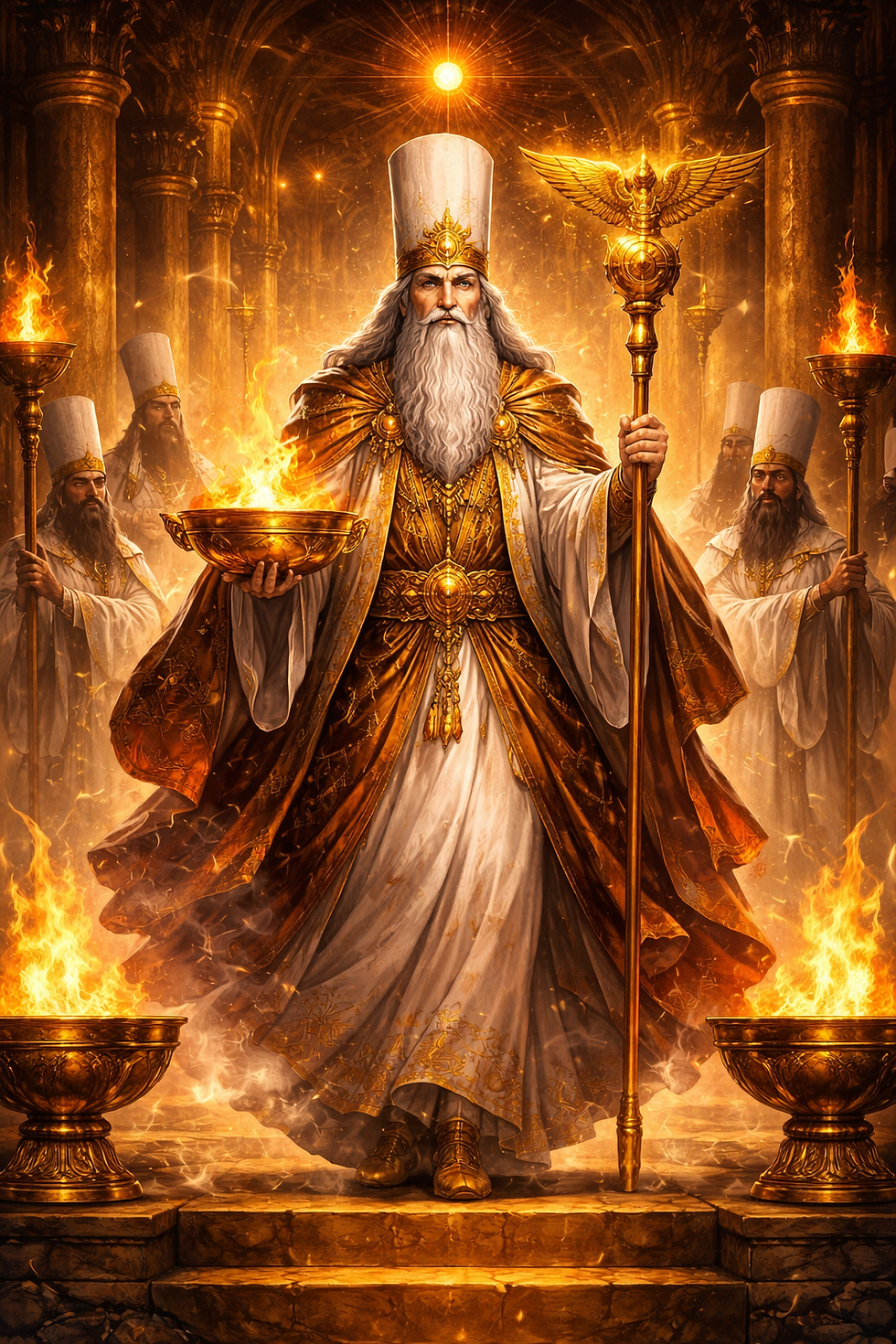
The term is Hebrew, combining rab ("chief" or "great") with mag (a loanword from the Akkadian rendering of magu). The Rab-Mag was apparently the chief of the Magi serving at the Babylonian court, a position of considerable authority.
The presence of Magi in Babylon reflects the political realities of the 6th century BC. This can be understood as resulting from the presence of Median migrants, including priests and other specialists, who became integrated into the Neo-Babylonian Empire. This happened through the political and military alliance between the Medes and Babylonians, which brought significant Median elements, including their priestly class, into the Neo-Babylonian sphere.
As a priestly caste, the Magi were associated with the study of astronomy and astrology, skills they may have further developed by learning from the established Babylonian priests. This expertise made them valuable as advisors and interpreters of omens in the Babylonian court, which explains why they appear as part of the official hierarchy.
When Cyrus conquered Babylon in 539 BC, he inherited this multi-ethnic administrative structure and likely retained the Magi in their positions. The Rab-Mag mentioned by Jeremiah may have served through this transition, representing continuity between Babylonian and Persian imperial practice.
The Book of Daniel, though composed later and containing legendary elements, reflects awareness of the Magi's role in eastern courts. Daniel is appointed as "chief of the magicians" (Aramaic rab hartummim), a position that would have placed him in authority over the Magi and other wise men.
The author's choice of terminology suggests that by the Hellenistic period, the Magi were firmly established in Jewish imagination as the archetypal eastern sages.
Note: Beyond the direct movement of Median peoples, the Neo-Babylonian Empire itself served as a crucial conduit for the transmission of older Mesopotamian traditions, particularly from Assyria, to the emerging Persian world.
When the Medes and Babylonians defeated Assyria, they inherited not only its territories but also its administrative systems, scribal practices, and religious institutions. The Babylonian scribal schools, which preserved and transmitted Assyrian astronomical, astrological, and divinatory knowledge, continued to operate under Neo-Babylonian rule.
The Magi present in Babylon would have had access to this accumulated wisdom, studying alongside Babylonian priests and learning from their centuries-old traditions. Thus, even if a unified "Median Empire" never existed as a centralized state, the Assyrian elements that later appear in Achaemenid administration and Persian religious practice could have reached the Persians through Babylon, with the Magi serving as one of the transmission vectors.
The Magi in Babylon were not merely Median priests preserving their own traditions; they were also students absorbing Mesopotamian learning, which they would later carry with them when the Achaemenids rose to power.
The Gaumata Affair and the Magophonia
The most dramatic episode in Magian history occurred in 522 BC, following the death of Cambyses II. According to Darius's account in the Behistun Inscription, a Magus named Gaumata impersonated Bardiya (Smerdis), the brother of Cambyses, and seized the throne. Gaumata ruled for several months before Darius and six noble conspirators assassinated him and restored legitimate Achaemenid rule.

The historical reality behind this account is complex and contested. Darius had every reason to portray his predecessor as a usurper and imposter; the Behistun Inscription is as much propaganda as history.
Some scholars have suggested that the man Darius called Gaumata was in fact the real Bardiya, and that Darius's "restoration" was actually a coup against the legitimate king. Others accept the basic outline of Darius's account while questioning details.
Whatever the truth of the matter, the aftermath of Gaumata's death established a lasting tradition. According to Herodotus, the Persian conspirators cut off the heads of Gaumata and his Magian supporters and displayed them in the streets.
Other Persians, seeing this, drew their daggers and killed every Magus they could find. This slaughter, known as the Magophonia, was subsequently commemorated by an annual festival during which all Magi were required to stay indoors to avoid being killed.
The historicity of the Magophonia festival has been debated. Mary Boyce, a leading scholar of Zoroastrianism, considered it incredible "that on one day in every year the Magi were insulted and confined."
She suggested that Herodotus misunderstood what was actually a celebration of Darius's victory, perhaps combined with an existing festival such as the autumn Mehrgān. Joseph Marquart proposed that Herodotus confused the Magophonia with a festival devoted to Mithra, celebrated in the month of Bāgayādiš.
The truth may never be known, but the story reflects the ambiguous position of the Magi, powerful enough to seize the throne, yet vulnerable enough to be massacred when their protectors fell.
The Sogdian language preserves a remarkable echo of these events. A Manichaean text from Central Asia uses the word mwγzt- (apparently meaning "killing of the Magi") to describe a crime attributed to Alexander the Great.
As Walter Henning noted, this may represent an attempt by the Magi "to let fall into oblivion the true origin of the magophonia" by transferring responsibility from Darius to the archetypal destroyer of Persian power. This small linguistic survival testifies to the enduring trauma of the Magophonia in Magian collective memory.
Rituals and Practices
Classical sources provide extensive descriptions of Magian ritual practice, though these accounts must be used with caution. Greek and Roman authors were often more interested in exotic or sensational details than in accurate ethnographic description, and their accounts reflect the biases of outside observers.
Herodotus describes the Magi as differing from other priests in their willingness to kill animals with their own hands, "except a man and a dog," and their enthusiasm for killing large numbers of ants, snakes, and other "creeping or flying things."
This reflects the Zoroastrian concern with combating the forces of evil, which were believed to manifest in harmful creatures. The killing of such animals was not casual but ritualized, a participation in the cosmic struggle between good and evil.
The Magi wore distinctive white robes and tall felt hats with flaps covering the cheeks—a style visible in Achaemenid reliefs and surviving in the traditional dress of Zoroastrian priests to this day. They carried the barsom, a bundle of twigs (later metal rods) used in rituals.

According to Thomas Stanley's 17th-century compilation of classical sources, the Magi used these rods for divination, arranging them in patterns on the ground while chanting incantations.
Their diet was simple and ascetic. According to Dinon and Aristotle (or the pseudo-Aristotelian treatise on magic cited by Diogenes Laertius), the Magi "renounce rich attire, and to wear Gold. Their rayment is white upon occasion, their beds, the ground, their food, nothing but herbs, cheese, and bread."
They carried a staff with a hollow top in which they stored cheese for consumption during travels. This emphasis on simplicity distinguished them from the luxurious Persian court and marked them as holy men dedicated to religious service.
The Magi were also noted for their distinctive approach to death. Unlike most ancient peoples, who buried or cremated their dead, the Magi exposed corpses to birds and animals; the practice known as "sky burial" or dakhma (later, "Tower of Silence") in Zoroastrian tradition.
This practice arose from the belief that earth, fire, and water were sacred and must not be polluted by contact with a corpse. The exposure of the dead horrified Greek observers but was entirely logical within Zoroastrian cosmology.
Part III: The Magi in the Hellenistic and Roman Mind

The conquest of the Achaemenid Empire by Alexander the Great (334-330 BC) fundamentally transformed the position of the Magi. No longer the official priesthood of a world empire, they became one among many eastern religious specialists competing for attention in the cosmopolitan Hellenistic world.
This period witnessed a remarkable semantic shift: the specific term for Iranian priests became a generic label for practitioners of esoteric arts, and from this usage derived our modern words "magic" and "magician."
The process began early. Already in the 5th century BC, Greek magos had spawned mageia and magikē to describe the activities of a magus. But almost from the outset, these nouns parted company from their origin.
Mageia came to refer not to what actual Magi did—their hymns, sacrifices, and purity rituals—but to something closer to modern "magic": the use of supernatural means to achieve effects in the natural world, or the appearance of achieving such effects through trickery.
The early Greek texts typically carry a pejorative meaning, reflecting Greek suspicion of Persian religious practices.
Heraclitus of Ephesus, writing around 500 BC, may have provided the oldest surviving Greek reference to the magi. According to Clement of Alexandria, Heraclitus cursed the magi for their "impious" rites and rituals.
The fragment is too brief to determine what Heraclitus actually meant, but it suggests that even before the Persian Wars, some Greeks were aware of and hostile to Magian practices.
Zoroaster as the Archetypal Magus
The Hellenistic period witnessed a remarkable transformation in the Greek image of Zoroaster. The historical prophet lived centuries earlier in eastern Iran and had no direct connection to the Median Magi.

But for Greeks seeking "oriental wisdom," Zoroaster became the archetypal magus; the founder of the Magian order and the inventor of astrology, alchemy, and magic. This image developed through a vast pseudepigraphic literature attributed to Zoroaster but actually composed by Greeks and Hellenized easterners.
These texts, which survive only in fragments and references, covered subjects ranging from natural philosophy to necromancy. The bulk dealt with astronomical speculations and magical lore, reflecting the Hellenistic fascination with astrology and the occult.
Pliny the Elder, writing in the 1st century AD, names Zoroaster as the inventor of magic (Natural History 30.2.3). But, as Pliny notes, a "principle of the division of labor appears to have spared Zoroaster most of the responsibility for introducing the dark arts to the Greek and Roman worlds."

That dubious honor went to another fabulous magus, Ostanes (a pen name used by several hellenistic authors), to whom most of the pseudepigraphic magical literature was attributed. For Pliny, magic was a "monstrous craft" that gave the Greeks not only a lust for magic but a downright madness for it.
He supposed that Greek philosophers—Pythagoras, Empedocles, Democritus, and Plato—traveled abroad to study magic, then returned to teach it.
The association of Zoroaster with astrology was reinforced by false etymology. Greek writers connected his name with astēr ("star"), interpreting "Zoroaster" as "star-worshiper" or even "living star."
Later myth-makers elaborated that Zoroaster died by the living flux of fire from the star he himself had invoked, or that the stars killed him in revenge for having been restrained by him. These fanciful etymologies had no basis in Iranian linguistics but powerfully shaped the Greek understanding of who Zoroaster was.
The Magi in the Roman Empire

Under the Roman Empire, the Magi retained their reputation as masters of esoteric wisdom while also serving as a specific referent for the priests of Iran. The two meanings coexisted, sometimes in the same text, creating ambiguities that persist to this day.
Apuleius, a Numidian Platonist philosopher of the 2nd century AD, wrote an entire treatise (the Apology) defending himself against charges of practicing magic. In this work, he distinguishes between the popular understanding of "magus" as a sorcerer and what he claims is the true meaning: a sage and philosopher-king in the Persian tradition.
Apuleius presents the Magi as the original philosophers, whose wisdom inspired Pythagoras, Plato, and the other great thinkers of Greece.
This positive evaluation stood alongside a more sinister view. Lucan's Pharsalia depicts Magi performing horrific rituals, including necromancy and human sacrifice. The boundary between legitimate eastern wisdom and forbidden magic was permeable and contested, with different authors drawing the line in different places depending on their purposes.
The Roman Mithraic mysteries, which flourished from the 1st to the 4th centuries AD, claimed Iranian origins and may have drawn on Magian traditions. However, one must keep in mind the massive gap between the traditional Persian religious practices and the Roman appropriation.

The relationship between Mithraism and actual Iranian religion is complex and debated, but the cult's self-presentation as "Persian" reflects the prestige that Magian wisdom continued to enjoy. Some scholars have suggested that Mithraic priests may have been called "magi," though the evidence is thin.
Note: This pattern of appropriation, wherein Western peoples selectively extracted and repackaged Eastern religious elements for their own purposes, was by no means unique to Mithraism. Throughout antiquity and into the modern era, "oriental" religions were frequently treated as repositories of exotic wisdom to be mined for esoteric practices, divorced from their original cultural contexts and integrated into entirely foreign frameworks.
As scholarship on religious appropriation has demonstrated, such borrowing rarely involved genuine transmission of doctrine or practice; rather, it represented a process of selective adaptation and creative reinvention. The organizers of Mithraic groups, for instance, "differed widely in their emphasis upon Persia" and incorporated only those elements that served their specific initiatory purposes.
For the peoples of the East—whether Ancient Indians, Persians, Egyptians, or Syrians—their religious traditions were not "mysteries" to be unveiled to initiates but comprehensive ways of life embedded in every aspect of social existence, from birth rituals to agricultural cycles to political legitimacy.
The Western fascination with these traditions as sources of secret knowledge fundamentally misconstrued their nature, transforming lived religions into exotic commodities and coherent cosmologies into fragmented esotericism.
This dynamic, which Edward Said would later term "Orientalism," established a pattern that persists to this day: the East imagined as a repository of mystical wisdom, available for Western consumption and adaptation, while the actual practitioners and their holistic understanding of their own traditions remain largely invisible in the process.
The Magi in Jewish Tradition
The Babylonian exile (586-539 BC) brought Jews into direct contact with Mesopotamian and Iranian culture, including the Magi. This encounter left lasting traces in Jewish literature and thought.

The Book of Daniel, set in the Babylonian and Persian courts, presents a world in which Jewish sages compete with Chaldean diviners and Magi. Daniel's appointment as "chief of the magicians" (rab hartummim) suggests that by the Hellenistic period, the Magi were firmly established in Jewish imagination as the archetypal eastern wise men.
The book's interest in dreams, visions, and their interpretation reflects the mantle traditions shared by Jewish prophets and Magian dream-interpreters.
The Talmud records several instances of dialogue between Jewish sages and Magi. These encounters were often hostile: the Talmud depicts the Magi as sorcerers who obstructed Jewish religious practices.
One passage describes Zoroastrian priests exhuming corpses, interfering with Jewish burial rites. Another forbids learning from the Magi. This negative portrayal reflects the competition between religious communities in Sasanian Mesopotamia, where Jews and Zoroastrians lived side by side under Zoroastrian rule.
Yet Jewish tradition also absorbed elements that may derive from Magian sources. The dualistic worldview of some Jewish apocalyptic literature, with its conflict between God and Satan (Adversary, not Lucifer), truth and falsehood, light and darkness, parallels Zoroastrian dualism in ways that suggest influence.
The angelology that flourished in Second Temple Judaism may owe something to Zoroastrian models. These connections remain debated, but they point to a complex relationship of borrowing and polemic between Jewish and Magian traditions.
Part IV: The Magi in the Parthian and Sasanian Empires
The collapse of Achaemenid power and the Hellenistic interlude did not destroy the Magi as an institution. In the Iranian plateau and Mesopotamia, Magian families maintained their traditions, serving as priests for local Zoroastrian communities while adapting to new political realities. The rise of the Parthian Arsacid dynasty in the mid-3rd century BC created conditions for a Magian revival.

The Parthians, originally a nomadic people from the steppes, presented themselves as restorers of Persian tradition against Hellenistic innovation. They patronized Iranian religious institutions, including the Magi, as a way of legitimizing their rule.
The Arsacid kings adopted titles and iconography drawn from Achaemenid tradition and supported the Zoroastrian priesthood.
Evidence for Magian activity under the Parthians comes from multiple sources. The Zoroastrian calendar, whose use implies official recognition of the religion, is attested at Nisa (near modern Ashgabat) from the 1st century BC.
In Commagene, a small kingdom on the Euphrates, 1st century BC inscriptions depict gods with combined Greek and Iranian names: Zeus Oromazdes, Apollo Mithra, Helios Hermes. These syncretistic cults were likely served by priests trained in Magian traditions.

The Magi were incorporated into the Parthian constitutional structure through the Megistanes, a council of nobles that advised the king and participated in royal elections.
According to some sources, the Magian hierarchy held the senior position in this council, with hereditary priests forming an "upper house" while appointed "wise men" (sophi) formed a lower house. This arrangement gave the Magi formal political power alongside their religious authority.
Yet the Parthians were never enthusiastic Zoroastrians. They maintained their own ancestral cults and tolerated a wide range of religious practices within their empire. The Magi, while respected, did not enjoy the monopoly on religious authority they had held under the Achaemenids. This would change with the rise of the Sasanians.
The Sasanian Restoration and Magian Supremacy
The Sasanian dynasty, which overthrew the last Parthian king in 224 AD, represented a radical break with Arsacid religious policy. The Sasanians claimed descent from the Achaemenids and presented themselves as champions of Zoroastrian orthodoxy. Under their rule, the Magi achieved their greatest power since the fall of the Achaemenid Empire.

The founder of the dynasty, Ardashir I, established Zoroastrianism as the state religion and granted the Magi extensive authority over religious affairs. His son and successor, Shapur I, continued this policy, patronizing Magian institutions and suppressing rival faiths.
The great inscription of the Zoroastrian high priest Kartir at Naqsh-e Rustam provides a detailed picture of Magian power in the 3rd century AD: Kartir boasts of establishing Magian authority throughout the empire, founding fire temples, and persecuting "Jews, Buddhists, Hindus, Nazarenes, Christians, Baptists, and Manichaeans."
The Magian hierarchy under the Sasanians was elaborate and highly structured. At the local level, priests (herbad) served individual fire temples and communities. Above them stood the mobad (from magupat, "chief of the Magi"), who administered larger regions.
The highest rank was the mobadan mobad ("chief of chiefs"), who served as the head of the entire priestly establishment and was often a close advisor to the king. This hierarchy gave the Magi unprecedented institutional power and allowed them to enforce religious conformity throughout the empire.
The Sasanian period also witnessed the codification of Zoroastrian scripture and tradition. The Avesta was collected and written down, and extensive commentaries (Zand) were composed in Middle Persian.
The Magi were the primary agents of this textual preservation, transmitting ancient oral traditions into written form. The rituals they performed were standardized, and the theological diversity of earlier periods was suppressed in favor of a more uniform orthodoxy.
Magian Learning and Culture
Under Sasanian patronage, the Magi became not only religious authorities but also custodians of broader Iranian cultural traditions. They preserved historical chronicles, legal texts, and scientific knowledge alongside religious literature. Magian scholars were versed in astronomy, medicine, and philosophy, maintaining contacts with Greek, Indian, and Syriac learning.
The Sasanian academy at Gundeshapur became a center of intellectual exchange where Magian scholars worked alongside Nestorian Christians, Jewish rabbis, and Indian physicians. This cosmopolitan environment fostered the translation of scientific and philosophical texts from Greek, Syriac, and Sanskrit into Middle Persian. Magian priests participated in these translation efforts, preserving knowledge that would later be transmitted to the Islamic world.
Magian jurisprudence developed sophisticated legal traditions governing marriage, inheritance, purity, and criminal law. The Madayan i Hazar Dadestan ("Book of a Thousand Judgments"), a legal compilation from the late Sasanian period, reflects the complexity of Magian legal thought and its integration with Zoroastrian religious principles. This legal tradition would influence Islamic jurisprudence after the Arab conquest.
The Magi also maintained the elaborate ritual system that characterized Sasanian Zoroastrianism. The fire temples, with their perpetually burning flames, required constant attention from trained priests. The purification rituals, which could last for days and involve complex procedures, demanded specialized knowledge transmitted through priestly lineages.
The calendar, with its festivals and observances, structured the religious year and required priestly oversight. All of these functions reinforced the Magi's essential role in Zoroastrian life.
Part V: The Magi in the Bible—From Daniel to Matthew
The Hebrew Bible contains several references to the Magi, though the terminology varies. The most explicit appears in Jeremiah 39:3 and 39:13, where Nergal-sharezer the Rabmag is listed among the Babylonian officials present at the fall of Jerusalem.
As noted earlier, Rabmag means "chief of the Magi," indicating that Magian officials held high rank in the Neo-Babylonian court. This reference, firmly anchored in historical events of the 6th century BC, provides our earliest biblical witness to the Magi.

The Book of Daniel, while not using the term "magi" directly, repeatedly refers to a class of wise men that almost certainly includes them. In Daniel 2, the king summons "the magicians, the enchanters, the sorcerers, and the Chaldeans" to interpret his dream.
The term translated "magicians" (hartummim) in Hebrew likely encompasses the Magi, among other diviners. Daniel's elevation to "chief of the magicians" (rab hartummim) places him at the head of this learned class, suggesting that by the Hellenistic period, Jewish tradition had absorbed the idea of a hierarchy of eastern sages with the Magi at its apex.
The book's interest in dreams, visions, and their interpretation reflects the mantle traditions shared by Jewish prophets and Magian dream-interpreters. Daniel's ability to interpret Nebuchadnezzar's dream when the Chaldean wise men failed echoes the competitive dynamic between Jewish and Magian wisdom that characterized the exile period.
The Magi and Zoroastrian Influence on Judaism
The extended contact between Jews and Persians during the Achaemenid period (539-331 BC) left lasting traces in Jewish religious thought. While the extent of Zoroastrian influence on Judaism remains debated, several parallels suggest significant interaction.
The development of Jewish angelology, with named archangels (Michael, Gabriel, Raphael) organized in hierarchies, parallels Zoroastrian concepts of the Amesha Spentas ("Bounteous Immortals") who surround Ahura Mazdā.
The figure of Satan as an adversary of God, rather than merely a human accuser, emerges in post-exilic texts and may reflect Zoroastrian dualism with its opposition between Ahura Mazdā and Angra Mainyu.
The doctrine of resurrection, which appears clearly in Daniel 12:2 ("Many of those who sleep in the dust of the earth shall awake, some to everlasting life, and some to shame and everlasting contempt"), has no clear precedent in earlier Israelite religion but resonates with Zoroastrian teaching.
These parallels do not prove direct borrowing; similar ideas could arise independently in different cultures. But the historical context—Jews living under Persian rule for two centuries, with access to Persian courts and Persian religious institutions—makes influence plausible.
The Magi, as the priests and scholars of Persian religion, would have been the primary mediators of Zoroastrian ideas to the Jewish community.
The Magi in the New Testament: Matthew's Wise Men
The most famous biblical reference to the Magi occurs in the Gospel of Matthew, which opens with the arrival of "μάγοι from the east" in Jerusalem, seeking the newborn Christ. This brief narrative (Matthew 2:1-12) has generated an enormous literature and shaped the Western imagination of the Magi for two millennia.

Matthew's account tells us that Magi came from the east, following a star that signaled the birth of the Jewish king as per the prophecies. They arrived in Jerusalem and inquired about the newborn, which troubled King Herod and all of Jerusalem with him.
Herod assembled the chief priests and scribes, who cited the prophecy of Micah 5:2: "But you, Bethlehem, in the land of Judah, are by no means least among the rulers of Judah; for out of you will come a ruler who will shepherd my people."
Herod then secretly met with the Magi to learn the exact time the star had appeared; information he would later use to calculate the age of children to be killed. He then sent them to Bethlehem with deceptive instructions: "Go and search carefully for the young child. When you have found him, bring back word to me, so that I also may come and worship him."
The Magi departed, and the star they had seen in the east reappeared and guided them directly to the house where Jesus lay. They presented their gifts of gold, frankincense, and myrrh. Warned in a dream not to return to Herod, they departed for their own country by another route.
Herod, realizing he had been outwitted, responded with murderous rage, ordering the massacre of all male children in Bethlehem aged two and under; an act that Matthew presents as the fulfillment of Jeremiah's prophecy of Rachel weeping for her children.
Matthew does not specify how many Magi there were; the tradition of three derives from the three gifts. He does not name them; the names Caspar, Melchior, and Balthazar appear in later Christian tradition, probably from the 6th century.
He does not call them kings; that association comes from Psalm 72:10 ("May the kings of Tarshish and of the isles render him tribute") and Isaiah 60:3 ("Nations shall come to your light, and kings to the brightness of your dawn"), applied to the Magi by early Christian interpretation.
The identification of the Magi as astrologers is almost certain. The phrase "from the east" (ἀπὸ ἀνατολῶν) could mean any region east of Palestine—Arabia, Mesopotamia, or Persia. Their observation of a star and their interpretation of its significance as marking a royal birth aligns perfectly with the practices of ancient Near Eastern astrology.
As the Watchtower article notes, "It is most likely that those particular 'magi' or 'wise men' of Matthew 2:1 were astrologers, for were they not being guided by lights in the sky, by what appeared to be a moving star?"
Historical Context: Why Magi Would Visit Jerusalem
The appearance of Magi in Judea during the reign of Herod the Great (37-4 BC) is historically plausible, though the specific details of Matthew's account cannot be verified. The period witnessed significant movement of eastern religious specialists throughout the Roman Empire, and Jewish messianic expectations were well known in the eastern provinces.
Several lines of evidence support the plausibility of Magian interest in Jewish messianism. The Persian period had established enduring connections between Jews and Zoroastrians, with shared theological interests in eschatology, resurrection, and cosmic conflict.
Magian astrology, with its emphasis on celestial signs marking earthly events, would naturally have taken interest in any astronomical phenomena coinciding with significant political developments. The Star of Bethlehem, whatever it was (conjunctions, comets, novae have all been proposed), would have been noted by astrologers throughout the Near East.

The Magi's journey was likely prompted by their meticulous observation of the night sky, for which they were renowned throughout the ancient world. As hereditary priests and scholars, the Magi were trained in astronomy and astrology, systematically recording and calculating the movements of stars and planets; knowledge that laid foundations for modern astronomy.
They believed that celestial events signified corresponding occurrences on earth, and unusual configurations of heavenly bodies were interpreted as omens preceding significant historical developments.
The Magi would have been particularly attentive to any extraordinary phenomena in the heavens: planetary conjunctions, the appearance of comets or novae, or the helical rising of important stars.
Their divination manuals, such as the Babylonian Enuma Anu Enlil, provided elaborate interpretive frameworks connecting celestial observations to earthly events, including royal births and deaths.
This astronomical expertise, combined with awareness of Jewish messianic expectations (possibly transmitted through Jewish communities that had remained in Babylon since the exile), led them to interpret whatever celestial sign they observed as heralding the birth of a Jewish king.
The gifts mentioned by Matthew—gold, frankincense, and myrrh—are all products of Arabia and the eastern trade routes. They are appropriate for honoring a king but also carry symbolic weight in early Christian interpretation: gold for royalty, frankincense for divinity, myrrh for suffering and death. Their presence in the narrative may reflect early Christian theological reflection rather than historical memory.
The response of Herod, including his consultation with chief priests and scribes, his secret meeting with the Magi, his subsequent massacre of the innocents, fits what is known of Herod's character from other sources.
Josephus portrays Herod as paranoid and ruthless, capable of any violence to secure his throne. The Magi's dream warning not to return to Herod adds a supernatural element consistent with the Gospel's emphasis on divine guidance.
The Magi in Early Christian Interpretation
The early Christian leaders grappled with the meaning of Matthew's Magi. They recognized that the term normally meant "magician" or "sorcerer" and had to explain why such figures would be welcomed by the Christ child. Their interpretations reveal both their knowledge of Magian traditions and their theological concerns.
Justin Martyr (c. 100-165 AD), himself a native of Samaria with knowledge of eastern traditions, interpreted the Magi positively as representatives of nations recognizing Christ. He connected their coming with Balaam's prophecy in Numbers 24:17 ("a star shall come out of Jacob"), suggesting that Magian astrology preserved authentic prophecy. Origen (c. 185-254 AD) similarly saw the Magi as fulfillment of prophecy and evidence that Christ's coming was signaled in the heavens for all nations to see.
Tertullian (c. 155-220 AD) explicitly identified the Magi as astrologers and connected them with eastern wisdom traditions. "We know the mutual alliance of magic and astrology," he wrote. "The interpreters of the stars, then, were the first to present Him gifts."
This frank acknowledgment of the Magi's astrological practices stands in tension with early Christianity's general condemnation of astrology, resolved by seeing the Magi's star as a unique divine sign rather than an endorsement of astrological practice generally.
The negative evaluation of "magic" in other New Testament passages (Simon Magus in Acts 8, Elymas the magician in Acts 13) contrasts with the positive portrayal of the Magi in Matthew. This suggests that early Christianity distinguished between "good" eastern wisdom and "bad" magic which competed with apostolic authority. The Magi, as representatives of ancient and respectable tradition, belonged to the former category.
Part VI: The Magi in Islamic and Post-Islamic Contexts

The Arab conquest of the Sasanian Empire in the 7th century AD brought the Magi under Islamic rule for the first time. The Qur'an mentions the Magi (Arabic Majūs) in Sura 22:17: "Indeed, those who have believed and those who were Jews and the Sabeans and the Christians and the Magians and those who associated with Allah - Allah will judge between them on the Day of Resurrection."
This verse classifies the Magi as a distinct religious community, alongside Jews, Christians, and others, entitled to exist under Islamic protection.
The status of the Magi in early Islamic law was debated. Some jurists classified them as "People of the Book" (Ahl al-Kitab), entitled to the same protections as Jews and Christians. Others argued that they lacked a revealed scripture and therefore deserved a lesser status.
In practice, Zoroastrians were generally tolerated as a protected minority (dhimmi), allowed to practice their religion subject to payment of a special tax (jizya) and various social restrictions.
The transition to Islamic rule was gradual and complex. Many Magi converted to Islam over the centuries, whether from conviction, social pressure, or economic advantage. Others maintained their ancestral faith despite increasing disadvantages.
The Zoroastrian community gradually contracted, retreating from urban centers to rural areas and from western Iran to the central and eastern regions.
The Parsi Migration to India

According to tradition preserved in the Qissa-i Sanjan ("Story of Sanjan"), a 16th-century Persian account, a group of Zoroastrian refugees fled persecution in Iran and sought asylum in India around the 8th-10th centuries AD.
They landed at Sanjan in Gujarat, where the local Hindu ruler, Jadi Rana, granted them permission to settle subject to certain conditions: they must adopt the local language, refrain from proselytizing, and conform to local marriage customs.
This migration established the Parsi community of India. The name "Parsi" means simply "Persian," reflecting their origin. The Parsis preserved their religious traditions, including the Magian priesthood, while adapting to Indian culture and society. They maintained the sacred fires, performed the ancient rituals, and transmitted the Avestan texts through their priestly lineages.
The Parsis flourished under various Indian rulers, from Hindu kings to Muslim sultans to British colonial administrators. They became known as a prosperous and educated community, contributing disproportionately to Indian commerce, industry, and public life.
Figures such as Jamsetji Tata, founder of the Tata Group, and Dadabhai Naoroji, early Indian nationalist leader, exemplify Parsi prominence in modern India.
The Parsi priesthood preserves the ancient titles and hierarchy. The herbad performs basic rituals at local fire temples. The mobad (from magupat) has higher authority and may officiate at major ceremonies.
The dastur is a high priest, often serving as the head of a major temple or community. This hierarchy, though modified by Indian conditions, descends directly from the Magian organization of Sasanian Iran.

This migration holds profound historical resonance, for it represents a kind of homecoming across the chasm of millennia. When the ancestors of the Parsis first crossed into the Indian subcontinent, they were following the path of their even more ancient kin.
As established earlier in this paper, the shared Proto-Indo-Iranian culture developed on the Central Asian steppes around 2100-1800 BC, before splitting around 1800-1600 BC into two distinct branches: the Indo-Aryans, who migrated southward into the Indian subcontinent, and the Iranians, who eventually moved westward onto the Iranian plateau.
The Vedic civilization that flourished in northern India and the Avestan civilization that developed in eastern Iran were thus born of the same ancestral root, their languages—Sanskrit and Avestan—still bearing the unmistakable imprint of their common origin.
Millennia later, when the Parsi refugees landed on the shores of Gujarat, they were unknowingly reuniting with the land where their distant cousins had settled ages before. The very fire rituals they carried with them, presided over by their priests, were echoes of the same ceremonies that the Vedic sages had performed on Indian soil for centuries.
The Parsis thus became living links in an ancient chain, preserving in India a faith whose earliest hymns had been composed in a language closely related to the Sanskrit of the Vedas.
In this sense, their arrival was not merely an escape from persecution but a completion of a circle—the return of one branch of the Indo-Iranian family to the land where the other branch had long ago established its home.
The wheel of migration, set in motion nearly four thousand years earlier on the steppes of Central Asia, had finally come full rest.
The Magi in Persian Poetry and Mysticism
Even after the majority of Iranians converted to Islam, the figure of the Magus retained a powerful place in Persian literary and mystical tradition. Persian poets, particularly the Sufi mystics, used the Magus as a symbol of spiritual authority and esoteric knowledge.

Hafez of Shiraz (14th century AD), the most beloved of Persian poets, frequently invokes the Pīr-e Mogān, the "Old Man of the Magi" or "Magian Elder." In Hafez's poetry, the Pīr-e Mogān represents the perfect spiritual guide, the master who initiates the seeker into divine mysteries.
The Deyr-e Mogān ("Monastery of the Magi") appears as a place of spiritual transformation, where conventional religiosity is stripped away and the soul encounters God directly.
This Sufi appropriation of Magian imagery is striking given that Hafez lived in a thoroughly Islamic society where actual Zoroastrians were a marginalized minority. The Magus functioned symbolically as the representative of pre-Islamic wisdom, of direct spiritual experience unmediated by legalistic religion, of the hidden knowledge that the seeker must acquire through submission to a master.
The "Magian monastery" became a metaphor for the Sufi lodge (khanaqah), and the "Magian elder" for the Sufi master (pir or shaykh).
Other poets followed similar patterns. Attar's Conference of the Birds includes a Magus among the figures who guide the seekers on their spiritual journey. Rumi occasionally employs Magian imagery, though less centrally than Hafez. This poetic tradition ensured that the Magi remained alive in Persian cultural memory long after their historical institutions had faded.

Part VII: Controversies and Conspiracies
The most fundamental controversy in Magian studies concerns the relationship between the Magi as a Median tribe and the Magi as a priestly caste. The evidence from Herodotus and other classical sources permits multiple interpretations, and scholars have lined up on both sides of the question.
The "tribalist" position, associated with older scholarship, holds that the Magi were originally a specific Median tribe with hereditary responsibility for religious functions. On this view, the Magi were analogous to the Levites in Israel; a tribe set apart for priestly service.
As the Median kingdom expanded and was incorporated into the Persian Empire, Magi from this tribe spread throughout Iran and neighboring regions, establishing themselves as priests wherever they went.
The "caste" position, associated with scholars such as Robert Charles Zaehner, argues that "magus" designated a function rather than an ethnicity. On this view, the Magi were always a hereditary priesthood, not a tribe, and Herodotus's identification of them as a Median tribe reflects a misunderstanding or oversimplification.
The wide distribution of Magi throughout the ancient world, from Egypt to Bactria, supports this interpretation, as it seems unlikely that members of a single Median tribe would have been present in such numbers in so many places.
A third, synthetic position holds that the Magi began as a Median tribe with priestly functions and gradually evolved into a hereditary priesthood that recruited from multiple ethnic backgrounds. This process would have been complete by the Achaemenid period, when "magus" designated a function more than an ethnicity.
The classical sources that mention Magi outside Media would then refer to members of this expanded priestly class, not to members of the original tribe.
The debate matters because it affects how we understand the relationship between the Magi and Zoroastrianism. If the Magi were originally a tribe with their own religious traditions, their adoption of Zoroastrianism would have been a historical process requiring explanation.
If they were always a priesthood serving multiple religions, their relationship to Zoroaster would have been more flexible and contingent. The evidence does not permit a definitive resolution, and scholarly opinion remains divided.
However, there is little doubt that the fire rituals of the Magi and the theology of Zoroastrianism both trace their roots to the same Indo-Iranian ancestors from whom came the early Vedic traditions, which comprise similar fire rituals as well as the shared gods.
Zoroaster and the Magi: Chronology and Influence
The relationship between the historical Zoroaster and the Magi is shrouded in uncertainty. The traditional date for Zoroaster, derived from Greek sources, placed him around 6000 BC, clearly legendary. Modern scholarship has proposed dates ranging from the 2nd millennium BC to the 6th century BC, with no consensus emerging.
If Zoroaster lived in eastern Iran in the 2nd or early 1st millennium BC, as many scholars believe, he would have been separated from the western Iranian Magi by geography, culture, and centuries. The Magi's adoption of his teachings would then have been a gradual process, perhaps occurring over many generations.
The Zoroastrianism of the Achaemenid period, as reflected in the royal inscriptions, would represent an early stage of this assimilation, still recognizably Zoroastrian but lacking some features found in later texts.

If, on the other hand, Zoroaster lived closer to the Achaemenid period, perhaps in the 6th century BC, the relationship could have been more direct. Some scholars have even suggested that Zoroaster was himself a Magus, though this view has few supporters today.
The linguistic evidence from the Avesta, which distinguishes between maga- (teaching/community) and magu- (priest), suggests that the two were not originally identical.
The influence of Zoroastrianism on Judaism, Christianity, and Islam, often mediated through the Magi, raises further questions. The parallels between Zoroastrian and Jewish angelology, eschatology, and dualism are striking, but they do not prove direct borrowing.
Similar ideas could arise independently in response to similar religious needs. The direction of influence, if any, is also debated: some scholars have argued that Zoroastrianism influenced Judaism, others that Judaism influenced Zoroastrianism... or maybe, they influenced each other and evolved accordingly.
The Magi in Conspiracy Theories
Like many ancient institutions, the Magi have attracted attention from modern conspiracy theorists. These theories, which circulate primarily on the internet and in popular publications, typically involve claims of hidden knowledge, secret lineages, and occult influence on world events.
One recurring theme connects the Magi with the supposed "Babylonian mystery religion" that, according to some conspiracy theories, underlies modern Freemasonry and the Illuminati. The Magi are portrayed as guardians of ancient secrets that have been transmitted through secret societies to the present day.
Another set of theories links the Magi with the Star of Bethlehem and claims of extraterrestrial intervention. Some UFO enthusiasts have suggested that the star was a spacecraft and the Magi were aliens or humans in contact with aliens.
More serious, but still controversial, are scholarly debates about the survival of Magian traditions in esoteric and occult movements. Some researchers have traced elements of Western ceremonial magic to Persian sources, possibly transmitted through Hellenistic syncretism and Renaissance magic.
The claim that modern Western occult traditions preserve direct continuity with the ancient Persian Magi must be treated with considerable skepticism. While it is undeniable that the Magi contributed to the development of Western ideas about magic, the specific lines of transmission are fragmentary and difficult to trace through the centuries.
The survival of the Parsi (Persian) community in India, who continue to practice their original religious traditions to this day, provides a useful corrective: if the Magi's authentic rituals and theology had been preserved in any coherent form, one would expect to find them among the Parsis (Persians), not in the esoteric orders of Europe.
It is far more likely that modern occult movements draw from the Roman Mithraic cults, which had themselves appropriated—and significantly transformed—elements of Persian religion for their own purposes, creating a superficially "oriental" veneer over essentially Hellenistic mystery traditions.
What passed from Persia to Europe was not the substance of Magian religion but a collection of exoticized images and symbols, stripped of their original context and reimagined through the lens of Roman and later European esotericism.
Part VIII: The Magi and Parallel Religious Traditions
The Magi are often compared to Rabbis, Chaldeans, and Druids, but they especially share a common Indo-Iranian heritage with the Vedic Brahman priests/sages of India, their respective traditions exhibiting striking parallels that illuminate their common origins. Both were hereditary priesthoods claiming exclusive authority over sacrificial ritual.
Both preserved sacred texts in archaic languages (Avestan and Vedic Sanskrit) that required specialized training to understand. Both developed elaborate purity regulations governing contact with death and other sources of pollution.
Ancient authors noted these parallels. Megasthenes, the Seleucid ambassador to the Mauryan court in the late 4th century BC, compared the Magi with the Brahmans as parallel instances of eastern wisdom.

The specific parallels are numerous and significant. The Avestan haoma and Vedic soma are the same sacred plant, used in similar rituals. The Zoroastrian Amesha Spentas and the Vedic Adityas share structural features.
The concepts of asha (Avestan) and rita (Vedic)—cosmic order maintained through sacrifice and truth—are cognate. These parallels demonstrate that the ancestors of Magi and Brahmans once shared a common religious culture, before the divergence of Iranian and Indian traditions.
Yet the later differences are equally significant. The Magi, unlike the Brahmans, developed a strongly dualistic theology that divided the world into forces of good and evil. They emphasized the combat against evil creatures as a religious duty, a concept less prominent in Vedic religion.
And they adapted to serve successive imperial states—Median, Achaemenid, Parthian, Sasanian—while the Brahmans maintained their position through a more decentralized social system.
These divergences reflect the different historical trajectories of Iran and India after the separation of Indo-Iranian peoples.
The Magi and the Chaldeans: Babylon's Wise Men

Classical authors frequently conflated or compared the Magi with the Chaldeans, the priestly-astrological class of Babylon. The two groups were often mentioned together as representatives of eastern wisdom, and their respective specialties—the Magi in religious ritual and dream interpretation, the Chaldeans in astronomy and astrology—were seen as complementary.
The conflation went so far that some Greek writers used "Chaldean" as a synonym for "Magus" or "astrologer." The Suda, a Byzantine encyclopedia, notes that "the Babylonians learned their astrology from Zoroaster," making the legendary Magian founder the ultimate source of Chaldean wisdom.
Lucian of Samosata has his character Menippus journey to Babylon "to ask one of the magi, Zoroaster's disciples and successors" for their opinion, treating Babylon, not Persia, as the center of Magian learning.
This confusion/ignorance reflects historical realities. The Neo-Babylonian and Achaemenid empires brought Magi and Chaldeans into close contact, and there was undoubtedly mutual influence. Babylonian astronomy shaped Magian astrology; Magian dream interpretation may have influenced Babylonian divination. The two groups likely competed and cooperated in the cosmopolitan courts of the Near East.
The Book of Daniel reflects this complex relationship. Daniel is trained in "the literature and language of the Chaldeans" and competes with Chaldean wise men in interpreting dreams. Yet he is also associated with the Magi, as his title "chief of the magicians" (rab hartummim) attests. The boundaries between categories were fluid, and an individual could draw on multiple traditions.
The Magi and the Druids: Celtic Parallels

Ancient authors also drew parallels between the Magi and the Druids, the priestly class of Celtic Gaul and Britain. Several classical writers mention the Druids in the same breath as the Magi, suggesting that they saw structural similarities between the two institutions.
Julius Caesar, in his Gallic War, describes the Druids as experts in religious matters who presided over sacrifices and judged disputes. They were exempt from military service and taxation, studied for many years, and transmitted their knowledge orally. These features parallel the Magi's position as a hereditary priesthood with specialized knowledge and social privileges.
The comparison was elaborated by later writers. Alexander Polyhistor, a Greek scholar of the 1st century BC, reportedly wrote a work comparing the philosophies of the Brahmans, Rabbis, Magi, and Druids.
These comparisons tell us more about Greek habits of thought than about the actual relationships between these groups. The Greeks tended to project their own categories onto foreign cultures, seeing in every society a class of "wise men" analogous to their own philosophers.
Yet the persistence of the comparisons suggests that the Magi, Druids, Brahmans, and others did share certain features: hereditary status, specialized knowledge, religious authority, and social prestige. They represented parallel responses to the universal human need for religious specialists.
The Magi and the Magicians of Egypt

Egypt, with its ancient priestly traditions and reputation for hidden wisdom, provided another point of comparison and contact with the Magi. The biblical narrative of Moses' confrontation with Pharaoh's magicians (Exodus 7-11) established the magicians of Egypt as archetypal opponents of his religion, and later tradition often associated them with the Magi.
Pliny the Elder mentions that Magi were present in Egypt, and that Egyptian magic was influenced by Persian traditions. These ancient cultures might have influenced each other. The Hellenistic magical papyri, composed in Egypt but drawing on multiple traditions, include Persian divine names and ritual formulas alongside Egyptian and Greek elements.
The association of the Magi with Egypt was reinforced by the Christian tradition that the Holy Family fled to Egypt to escape Herod's massacre.
Some later legends imagined that the Magi who visited Jesus had connections with Egypt, or that Egyptian magicians recognized Christ's divinity. These elaborations testify to the enduring association of Egypt with magic and wisdom in the Christian imagination.
Part IX: The Magi in Art and Popular Culture
The Magi have been a staple of Christian art since the earliest centuries. The catacombs of Rome contain numerous depictions of the Magi approaching the Christ child, their eastern dress and gestures marking them as foreigners bringing homage to the prophesied newborn. These images emphasized the universal reach of the gospel and the fulfillment of prophecy.
Byzantine and medieval art developed elaborate conventions for representing the Magi. They were typically shown as three in number, reflecting the three gifts, and were often depicted as representing the three ages of man (youth, middle age, old age) or the three continents (Europe, Asia, Africa). Their costumes became increasingly exotic over time, with Persian-style hats, flowing robes, and sometimes crowns reflecting their traditional identification as kings.
The Adoration of the Magi became one of the most frequently depicted scenes in Western art, painted by virtually every major artist from Giotto to Rubens. These paintings often served as vehicles for artistic virtuosity, with elaborate depictions of the Magi's retinue, exotic animals, and rich fabrics. The star that guided them was shown as a comet, a conjunction of planets, or a supernatural light, depending on the artist's interpretation.
The Magi's relics, supposedly discovered in the 4th century and translated to Cologne Cathedral in the 12th century, became an important focus of pilgrimage. The Shrine of the Three Kings in Cologne, one of the great masterpieces of medieval goldwork, attracted pilgrims from throughout Europe and reinforced the Magi's place in popular devotion.

The Magi in Literature
The Magi have inspired literary works ranging from medieval mystery plays to modern fiction. Their brief appearance in Matthew's Gospel left ample room for elaboration, and writers have filled in the gaps with imaginative reconstructions.
Medieval mystery plays dramatized the Magi's journey, their encounter with Herod, and their adoration of Christ. These plays often emphasized the contrast between Herod's paranoid cruelty and the Magi's humble recognition, and they provided opportunities for spectacle with processions of camels, exotic costumes, and the appearance of the star.
The 19th and 20th centuries produced numerous literary retellings of the Magi story. Henry van Dyke's 1895 novella The Other Wise Man imagines a fourth Magus who misses the birth of Christ through acts of charity and spends his life seeking him, finally finding him at the crucifixion.
The Magi in Film and Television
Film and television have embraced the Magi as colorful characters in Christmas narratives. The 1948 film The Star of Bethlehem and numerous subsequent productions have dramatized their journey, often incorporating astronomical speculation about the nature of the star.
The 2006 film The Nativity Story depicts the Magi as Persian astrologers whose study of the heavens leads them to seek the newborn king. Their journey is intercut with the main narrative, emphasizing the parallel between their search and the struggles of Mary and Joseph. The film presents the Magi positively, as representatives of wisdom recognizing what Herod's court cannot see.
Television specials have often featured the Magi in animated Christmas stories. The 1968 Rankin/Bass special The Little Drummer Boy includes the Magi among the characters who recognize the Christ child's significance. Other specials have explored the Magi's star from astronomical or legendary perspectives.
The Magi have also appeared in more unexpected contexts. The 1999 film The Mummy features a character identified as a descendant of the Magi, preserving ancient knowledge of Egyptian magic. This reflects the enduring association of the Magi with esoteric wisdom, even in popular entertainment.
The Magi in Conspiracy and Esoteric Literature
The Magi have attracted attention from writers exploring esoteric traditions and conspiracy theories. Some authors have claimed that the Magi preserved ancient wisdom from Atlantis or other legendary sources. Others have linked them with Freemasonry, suggesting that Masonic rituals derive from Magian initiation ceremonies.
These claims have no basis in historical evidence. The Magi left no extensive literature, and their rituals can be reconstructed only indirectly from classical sources and later Zoroastrian practice. The Masonic claims, in particular, reflect the 19th-century fascination with "oriental" origins for Western esotericism rather than any genuine historical connection.
More sober esoteric writers have explored the possible influence of Magian thought on Western mysticism. The parallels between Zoroastrian dualism and Gnostic cosmology, for example, are genuine and significant.
The Magian emphasis on light as a divine manifestation resonates with Neoplatonic and Christian mystical traditions. These connections are worthy of serious study, even if they do not support the more extravagant claims of conspiracy theorists.
Part X: The Modern Magi—Parsi Adaptation
The Parsis of India represent the living continuation of the Magian tradition. Their history since the migration from Iran is a remarkable story of survival, adaptation, and achievement. Numbering perhaps 60,000 worldwide today (down from over 100,000 in the mid-20th century), the Parsis maintain their ancient faith while participating fully in modern society.

The Parsi priesthood preserves the hereditary principle that characterized the ancient Magi. Priestly families (athornan) transmit their knowledge and authority through generations, with sons learning from fathers the complex rituals and prayers. The initiation ceremony (navjote) marks a child's entry into the Zoroastrian community, paralleling ancient practices.
The fire temples of the Parsis maintain the sacred fires that have burned for centuries, some reportedly for over a thousand years. The rituals performed before these fires, like the tending of the flames, the recitation of prayers, the wearing of the padan (mouth-cover) to prevent breath from polluting the fire, descend directly from Magian practice. A visitor to a Parsi fire temple today witnesses rituals that would be recognizable to a Magus of the Sasanian period.

Yet the Parsis have also adapted to their Indian environment. They speak Gujarati rather than Persian, dress in Indian styles, and participate in Indian cultural life. They have intermarried with Indians to some extent, though the community remains largely endogamous.
They have embraced education, professional careers, and civic engagement, becoming one of India's most successful minority communities, contributing greatly to the nation.
The Magian Titles: Mobad, Dastur, Herbad
The titles used by the Parsi priesthood preserve the ancient Magian hierarchy. Herbad (from Avestan aēthrapaiti, "master of studies") designates a priest qualified to perform basic rituals. Mobad (from Middle Persian magupat, "chief of the Magi") indicates higher rank and greater authority. Dastur (from Persian dastwar, "authority") is the highest rank, often designating the head of a major fire temple or community.
These titles reflect the continuous development of Magian institutions from ancient Iran to modern India. The magupat of Sasanian Iran, who administered Magian affairs over a region, became the mobad of the Parsi community. The hierarchy adapted to new conditions—the Parsi dastur has no exact ancient equivalent—but the principle of graded priestly authority remains.
The transmission of priestly knowledge follows traditional patterns. Young priests study the Avestan texts, learning to recite them correctly and understand their meaning. They learn the complex purity regulations that govern Zoroastrian life.
They are trained in the rituals that must be performed with precision to be effective. This education, while adapted to modern conditions, continues ancient traditions.
Making a Mark in India: A Zoroastrian Legacy of Achievement
Despite constituting less than 0.0005% of India's population, the Parsi community has contributed to virtually every sphere of national life in a measure vastly disproportionate to their numbers.

This remarkable legacy begins with the industrial pioneers who transformed India's economic landscape: Jamsetji Tata (1839-1904), widely regarded as the "father of Indian industry," founded the Tata Group and envisioned the Indian Institute of Science; his successors J.R.D. Tata (1904-1993) established Air India, while Ratan Tata (b. 1937) expanded the conglomerate into a global powerhouse.
The Godrej brothers, Ardeshir and Pirojsha, built another industrial empire, and the Wadia family, tracing their history to 1736, established conglomerates spanning textiles, airlines, and food products.

In science and technology, Homi Jehangir Bhabha (1909-1966) founded India's nuclear program and the Tata Institute of Fundamental Research, earning recognition as the "father of the Indian nuclear programme." Dr. Cyrus Poonawalla (b. 1941) established the Serum Institute of India, now the world's largest vaccine manufacturer, supplying affordable vaccines to 170 countries.
The freedom movement drew heavily on Parsi leadership: Dadabhai Naoroji (1825-1917), the "Grand Old Man of India," was the first Indian to demand independence and a founding member of the Indian National Congress; Bhikaiji Cama (1861-1936) co-created the Indian flag and raised it on European soil for the first time; Sir Pherozeshah Mehta (1845-1915) helped found the Congress and shaped Bombay's civic institutions.
The arts and culture boast luminaries like Homai Vyarawalla (1913-2012), India's first woman photojournalist; Freddie Mercury (Farrokh Bulsara, 1946-1991), legendary lead singer of Queen; and conductor Zubin Mehta (b. 1936), who led the New York Philharmonic. In sports, Diana Edulji captained India's first women's cricket team.
Military leadership reached its zenith with Field Marshal Sam Manekshaw (1914-2008), India's first Field Marshal and architect of the 1971 war victory. In law, Fali S. Nariman (b. 1929) and Nani Palkhivala (1920-2002) shaped Indian constitutional jurisprudence, while Justice S.H. Kapadia served as Chief Justice of India.
The community's scholarly tradition produced figures like Jivanji Jamshedji Modi (1854-1933), a Parsi priest and prolific scholar who represented Zoroastrianism at the 1893 World's Parliament of Religions in Chicago and authored the still-definitive The Religious Ceremonies and Customs of the Parsees.
This extraordinary record of achievement spanning industry, science, freedom struggle, arts, military, law, and scholarship led Mahatma Gandhi to observe, though perhaps apocryphally, that the Parsis are "in numbers beyond contempt, but in contributions beyond compare."
The community's success reflects both its Zoroastrian ethos of education, hard work, and philanthropy, and its historic willingness to engage with Indian society at large rather than remain insular.
The ancient peoples, once separated millennia ago, now live and grow together under the sheltering wings of a great motherland.

Challenges to Modern Magian Identity
The Parsi community faces significant challenges in the 21st century. Low birth rates and high rates of intermarriage have reduced the population dramatically. The priesthood has declined even more steeply, as fewer young men choose to pursue priestly training. Some fire temples struggle to maintain regular rituals due to priest shortages.
Debates over religious identity and conversion have divided the community. Traditional Parsis maintain that Zoroastrianism can only be inherited, not adopted; a position consistent with the ancient Magian emphasis on hereditary priesthood.
Reformers argue that the community must accept converts if it is to survive. These debates have no easy resolution and reflect deeper tensions between preservation and adaptation.
The relationship with co-religionists in Iran, where a small Zoroastrian community survives, adds another dimension. Iranian Zoroastrians, living under the Islamic Republic, face different challenges and have developed different practices. The two communities maintain contact but have diverged significantly over centuries of separation.
Despite these challenges, the Parsis remain committed to their ancient faith. Their fire temples continue to burn, their priests continue to chant the ancient prayers, and their community continues to observe the festivals and rituals that have defined Zoroastrian life for millennia. The Magi, though transformed by time and circumstance, survive.

Part XI: The Magi and World History
The period of Magian emergence and consolidation corresponds roughly to what philosophers and historians have called the "Axial Age" (c. 800-200 BC); a period of profound religious and philosophical creativity across Eurasia.
In Greece, this era produced Socrates, Plato, and Aristotle. In Israel, it witnessed the great prophets and the codification of the Torah. In India, it saw the composition of the Upanishads and the rise of Buddhism and Jainism.
In China, it generated Confucius and Laozi. And in Iran, it saw the activity of Zoroaster (by traditional dating) and the consolidation of the Magian priesthood.

The Axial Age was characterized by several common features: the emergence of transcendental visions of reality, the development of ethical universalism, the rise of religious specialists distinct from political authorities, and the composition of sacred texts.
The Magi participated in all of these developments. Their theology, with its cosmic dualism and eschatological hope, represented a transcendental vision. Their ethics, emphasizing truth-telling, purity, and the combat against evil, had universal implications.
Their position as a hereditary priesthood gave them institutional independence from political power. And their preservation and transmission of the Avesta contributed to the creation of sacred scripture.
Yet the Magi also differed from other Axial Age movements in significant ways. They never produced a philosophical literature comparable to Greek philosophy or Indian Upanishads. They remained closely tied to imperial power, unlike the more independent Confucian scholars or Jewish prophets.
Their dualism, while sophisticated, never developed the systematic theological elaboration found in later Christianity or Islam. These differences reflect the distinctive trajectory of Iranian civilization within the broader Axial Age framework.
The Magi and the Silk Road
The Magi were well positioned to benefit from the trade networks that connected Iran to India, Central Asia, and China from the 2nd century BC onward.
The Silk Road, which passed through Parthian and later Sasanian territory, brought merchants, pilgrims, and ideas from across Eurasia. The Magi, as the religious specialists of the Iranian empires, would have encountered these travelers and their traditions.
Buddhism, in particular, spread westward along the Silk Road and may have influenced Magian thought. The Buddhist monasteries of Central Asia were established during the Parthian and Kushan periods, and there is evidence of interaction between Buddhist monks and Zoroastrian priests.
Some scholars have suggested parallels between Buddhist and Zoroastrian concepts—the idea of merit transfer, for example, or the figure of the compassionate savior—though direct influence is difficult to prove.
Manichaeism, founded by the Iranian prophet Mani in the 3rd century AD, represented a synthesis of Zoroastrian, Christian, and Buddhist elements. Mani was raised in a Jewish-Christian community in Babylonia but claimed to receive revelation that completed and superseded earlier prophets.
His dualistic theology drew heavily on Zoroastrian models, and his missionary movement spread rapidly along the Silk Road. The Magi, as representatives of Zoroastrian orthodoxy, opposed Manichaeism vigorously, but their opposition testifies to the influence of Magian ideas on this syncretistic faith.
Manichaeism: The Gnostic Synthesis and Its Persian Roots
No examination of the Persian Magi and their influence would be complete without addressing Manichaeism, the most successful and widespread religious movement to emerge from the Iranian (Persian) world.
Founded by the prophet Mani (c. 216-274 AD) during the twilight years of the Parthian Empire and the rise of the Sasanian dynasty, Manichaeism represents a fascinating synthesis of Zoroastrian dualism, Christian gnosticism, and Buddhist ethics; a syncretic faith that would spread from the Atlantic coast of Africa to the trading ports of coastal China.
The relationship between Manichaeism and the Magi is complex and paradoxical. Mani was raised in a Jewish-Christian community in Babylonia, not in a Zoroastrian priestly family. Yet his theology drew heavily on Zoroastrian concepts, and his missionary movement competed directly with the Magi for influence in the Sasanian Empire.
The Magi, as the established priesthood of the state religion, opposed Manichaeism vigorously, and their opposition contributed to Mani's imprisonment and death. Yet Manichaean texts preserved in Central Asia reveal extensive engagement with Iranian religious ideas, suggesting that the relationship between the two traditions was more nuanced than simple opposition.
The Prophet: Mani was born in 216 CE in Babylonia, then part of the Parthian Empire, to a family with connections to the Arsacid royal house. According to Manichaean tradition, he received his first revelation at age twelve and his second at age twenty-four, commissioning him as the final prophet in a lineage that included Zoroaster, Buddha, and Jesus.
This claim, that he was the "Seal of the Prophets" completing and superseding earlier revelations, was central to Mani's self-understanding and to his movement's appeal.
Mani's early life coincided with a period of profound transformation in the Iranian world. The Parthian Arsacid dynasty, which had ruled for nearly five centuries, was collapsing under pressure from the Sasanian claimant Ardashir I.
In 224 CE, Ardashir defeated the last Parthian king and established the Sasanian Empire, which would rule Iran for more than four centuries. The Sasanians promoted Zoroastrianism as the state religion and granted the Magi unprecedented authority over religious affairs.
This context shaped Mani's career. He initially sought favor with the new Sasanian rulers, dedicating one of his books to Shapur I (r. 240-270 CE) and apparently receiving permission to preach within the empire.
The early Sasanian kings may have seen Manichaeism as a potential unifying force that could transcend ethnic and religious divisions within their diverse realm. However, as the Magi consolidated their power under the high priest Kartir, tolerance for Mani's movement evaporated.
Theology: Manichaean theology represents one of the most systematic elaborations of dualistic thought in world history. Unlike Zoroastrianism, which posited two eternal principles (Good and Evil) but affirmed the ultimate victory of Good, Manichaeism developed an elaborate cosmology explaining how the two principles became mixed and how they could be separated.
The core teachings include:
From eternity, two independent and uncreated principles existed: Light (Good, Spirit, Order) and Darkness (Evil, Matter, Chaos).
Darkness attacked Light, and in the ensuing cosmic battle, some particles of Light were swallowed by Darkness and became trapped in the material world.
The visible universe was created by the forces of Darkness (or, in some accounts, by the Light through a strategy of containment) as a prison for the captive Light particles.
Humans were created in the image of the demonic powers, but each human contains particles of captive Light that must be liberated.
Salvation comes through knowledge (gnosis) of one's true origin and the means of liberating Light from matter. This knowledge is revealed by divine messengers—Zoroaster, Buddha, Jesus, and finally Mani.
At the end of time, all Light particles will be gathered and returned to their heavenly home, while matter and darkness will be confined forever in a prison sealed with a great stone.
This theology drew on Zoroastrian dualism (the conflict between Good and Evil) but reworked it in gnostic directions. The material world, which in Zoroastrianism was fundamentally good (the creation of Ahura Mazda), became in Manichaeism a prison and a trap.
The body, rather than being a temple to be protected, was a cage from which the soul must escape. These differences reflect the influence of Christian gnosticism and perhaps Buddhist asceticism on Mani's thought.
Manichaean practice was organized around a sharp distinction between two classes of adherents:
The Elect (Perfecti): Celibacy, vegetarianism, strict asceticism, poverty, itinerant preaching | Liberated Light through their ascetic practices; served as spiritual guides.
The Hearers (Auditores): Less demanding ethics; supported the Elect; could marry, own property, eat meat | Accumulated merit through service to the Elect; hoped for eventual liberation.
This two-tiered structure echoes patterns in both Buddhism (monks/laypeople) and Manichaeism's gnostic predecessors. The Elect, through their rigorous asceticism, were believed to liberate Light particles from the material world simply by existing; their purity created a conduit through which Light could return to its heavenly home.
The Hearers supported the Elect materially, earning merit that would improve their chances of liberation in future lives; a doctrine reflecting Buddhist influence.
The Elect's diet was strictly vegetarian, and they avoided any activity that might harm the Light particles believed to be present in plants and other living things. They were forbidden to harvest grain or pick fruit, as these activities would release Light particles from their material prisons; instead, Hearers performed these tasks and offered the food to the Elect, who then consumed it and liberated the Light through their perfected digestive systems; a ritualized form of salvation unique to Manichaeism.
Spread: Despite persecution in its Iranian homeland, Manichaeism spread with remarkable speed across the Eurasian continent. Within a century of Mani's death, Manichaean communities were established from the Roman Empire in the west to the Tang Empire in the east.
Sasanian Empire (3rd-4th centuries): Mani's mission; Kartir's inscriptions boasting of persecution
Roman Empire (4th-6th centuries): Augustine of Hippo was a Hearer for nine years; Diocletian's edict against Manichaeans (302 CE); widespread in North Africa
Central Asia (4th-10th centuries): Sogdian merchants carried Manichaeism along Silk Road; Uyghur Khaganate adopted as state religion (763 CE)
Tang China (7th-14th centuries): Manichaean temples established; persecuted under Wuzong (845 CE); survived as secret society
Song/Yuan China (10th-14th centuries): Continued underground; Marco Polo reported communities in Fujian
The Manichaean mission was remarkably adaptive. In the Roman Empire, Manichaean texts presented Mani as the "Apostle of Jesus Christ" and emphasized Christian elements. In Central Asia, Manichaean missionaries translated their scriptures into Sogdian, Uyghur, and Chinese, incorporating Buddhist vocabulary and imagery. Manichaean art from the Tarim Basin shows Mani with a halo and monastic robes indistinguishable from Buddhist iconography.
The conversion of the Uyghur Khaganate in 763 CE was a particularly significant moment. For a brief period, Manichaeism was the state religion of a powerful steppe empire, with Manichaean priests advising khans and Manichaean temples receiving imperial patronage. Uyghur Manichaean texts and art, preserved in the deserts of the Tarim Basin, provide some of the richest evidence for the religion's practice.
Decline: The history of Manichaeism is also a history of persecution. In the Sasanian Empire, the Magi under Kartir led a campaign against Manichaeism that culminated in Mani's imprisonment and death around 274 CE. According to tradition, Mani died in chains, and his body was flayed and hung over the gate of the Sasanian capital; a gruesome warning to his followers.
In the Roman Empire, Manichaeism was repeatedly attacked by both pagan and Christian authorities. The emperor Diocletian issued an edict against the Manichaeans in 302 CE, ordering their leaders burned alive and their scriptures destroyed. Christian emperors continued this persecution, and Augustine's anti-Manichaean writings provided theological ammunition for centuries.
In China, Manichaeism flourished under Tang tolerance but was suppressed in the great persecution of foreign religions in 845 CE. It survived underground, often disguised as Buddhist or Daoist sects, and persisted in southern coastal regions until the 14th century or later.
The reasons for this persecution were multiple. Manichaeism's dualistic theology was seen as heretical by both Zoroastrians and Christians. Its rejection of the material world challenged the social order. Its international character made it suspect to imperial authorities. And its claim to supersede earlier revelations offended established priesthoods.
By the 14th century, Manichaeism had virtually disappeared as an organized religion, though its influence persisted in various heretical movements.
Nevertheless, Manichaeism represents a fascinating alternative to the Zoroastrian orthodoxy championed by the Magi. Where the Magi affirmed the goodness of the material world and the importance of ritual purity, Manichaeism rejected matter as a prison for divine light.
Where the Magi emphasized correct ritual performance, Manichaeism emphasized esoteric knowledge. Where the Magi served an imperial state, Manichaeism created an international community that transcended political boundaries.
Today, Manichaeism survives only in fragments; papyrus scraps from Egypt, silk paintings from the Tarim Basin, and echoes in the vocabularies of European languages. But its history illuminates the religious ferment of late antiquity and the complex interplay between the traditions of Iran, the Mediterranean, and Asia.
The Magi and the Rise of Islam
The Arab conquest of the Sasanian Empire in the 7th century AD brought the Magi into direct contact with Islam. The early caliphs, particularly under the Umayyad dynasty, generally tolerated Zoroastrianism as a protected religion, though converts to Islam were encouraged and social restrictions on non-Muslims gradually increased.
The relationship between Islam and Zoroastrianism was complex. Muslims recognized Zoroaster as a prophet, according to some traditions, though the extent of this recognition varied. The Qur'anic term Majūs (Magi) appears in Sura 22:17, classing them with Jews, Christians, and others as communities that will be judged by God.
This placed Zoroastrians in an ambiguous category; not quite "People of the Book" like Jews and Christians, but not outright polytheists either.
Over time, most Iranians converted to Islam, whether through conviction, social pressure, or economic advantage. The Zoroastrian community gradually contracted, retreating from the cities to the countryside and from western to central and eastern Iran. By the 10th century, Zoroastrians were a minority in their ancestral homeland, a position they have occupied ever since.
The survival of Zoroastrianism in Iran, despite centuries of pressure, testifies to the resilience of Magian institutions. The hereditary priesthood maintained the rituals and transmitted the texts. The fire temples continued to burn. The festivals continued to be observed.
Even in the 21st century, a small Zoroastrian community remains in Iran, preserving traditions that stretch back to the Magi of the Achaemenid period.
Conclusion: The Enduring Legacy of the Magi
The history of the Persian Magi spans more than two and a half millennia, from their first appearance in the Behistun Inscription to their modern descendants among the Parsis of India. No other religious institution can claim such continuity across so many empires, conquests, and cultural transformations.
The Magi served the Median kings, the Achaemenid emperors, the Hellenistic monarchs, the Parthian dynasts, and the Sasanian shahs. They survived Alexander's conquest, adapted to Islamic rule, and found new life in India. Through all these changes, they maintained their identity as hereditary priests of the sacred fire, guardians of ancient rituals, and interpreters of divine will.
The legacy of the Magi extends far beyond the Iranian world. Their theology, with its cosmic dualism and eschatological hope, influenced Judaism during the exile and post-exilic periods, and through Judaism helped shaped Christianity and Islam.
Their astrology and divination practices permeated the Hellenistic and Roman worlds, contributing to the development of Western magic and esotericism. Their name became the root of "magic" itself, a linguistic monument to their enduring association with supernatural wisdom.
The Magi who appear in Matthew's Gospel, following a star to Bethlehem, have become universal symbols of the search for truth and the recognition of divinity in unexpected places. Whether historical figures or literary creations, they represent the culmination of Magian wisdom; the acknowledgment that all human learning, all astrological calculation, all religious tradition points beyond itself to a reality that transcends human comprehension.
The modern Parsis, struggling to maintain their ancient faith in a rapidly changing world, embody the challenges of preserving tradition in the face of modernity. Their declining numbers, their debates over conversion and identity, their efforts to adapt ancient rituals to contemporary conditions, all reflect the tension between continuity and change that has marked Magian history from its beginnings.
Yet the sacred fires still burn, the prayers are still chanted, and the priests still perform their ancient offices. The Magi survive.
In the end, the Magi remind us of the profound continuities that underlie human history. Empires rise and fall, religions transform and adapt, languages change and evolve. But the human need for meaning, for connection with the divine, for wisdom that transcends ordinary knowledge; these remain constant.
The Magi, in their long history, have served these needs across centuries and civilizations. Their story is not merely the history of a priesthood but a chapter in the larger story of humanity's search for the sacred.

References and Further Reading:
Primary Sources:
Herodotus, Histories. Various editions.
Xenophon, Cyropaedia. Various editions.
Pliny the Elder, Natural History. Various editions.
Diogenes Laertius, Lives of the Eminent Philosophers. Various editions.
The Bible: Jeremiah, Daniel, Matthew.
The Behistun Inscription of Darius I.
Secondary Sources:
Boyce, M. (1975-1991). A History of Zoroastrianism. 3 vols. Leiden: Brill.
Boyce, M. (1982). A History of Zoroastrianism II. Leiden and Köln.
Dandamaev, M. A. (1976). Persien unter den ersten Achämeniden. Beiträge zur Iranistik 8, Wiesbaden.
Henning, W. B. (1944). "The Murder of the Magi." JRAS, pp. 133-44.
Zaehner, R. C. (1961). The Dawn and Twilight of Zoroastrianism. New York: Putnam.
Kingsley, P. (1995). "Meetings with Magi: Iranian Themes among the Greeks, from Xanthus of Lydia to Plato's Academy." Journal of the Royal Asiatic Society, Third Series, Vol. 5, No. 2, pp. 173-209.
Beck, R. (1991). "Thus Spake Not Zarathuštra: Zoroastrian Pseudepigrapha of the Greco-Roman World." In M. Boyce and F. Grenet, A History of Zoroastrianism III. Leiden: Brill.
de Jong, A. (1997). Traditions of the Magi: Zoroastrianism in Greek and Latin Literature. Leiden: Brill.
Stanley, T. (1662). The History of the Chaldaick Philosophy. London.
Taqizadeh, S. H. (1938). Old Iranian Calendars. London.
Marquart, J. (1901-1905). Untersuchungen zur Geschichte von Eran. Leipzig.
Stausberg, M., & Vevaina, Y. S. (eds.). (2015). The Wiley Blackwell Companion to Zoroastrianism. Oxford: Wiley Blackwell.
Online Resources:
"Magi." Wikipedia.
"Magus." Encyclopædia Britannica.
"Magi." Encyclopedia of the Bible. Bible Gateway.
"Magi." The Watchtower Online Library.
Dandamayev, M. A. "MAGOPHONIA." Encyclopædia Iranica.


Comments