
.png)

Esoterica: The Mysteries of Amun
- A. Royden D'Souza

- Mar 17
- 31 min read
Updated: Mar 17
The cult of Amun represents one of the most remarkable religious phenomena of the ancient world; a deity who rose from obscure origins as a primordial personification of hiddenness to become the supreme god of the Egyptian empire, whose influence extended from the Nile Valley into Nubia, Libya, and the Greek world.
We will trace the development of the Amun cult from the Pyramid Texts of the Old Kingdom through its ascendancy at Thebes, its fusion with the sun god Ra as Amun-Ra, the dramatic challenge of the Atenist heresy under Akhenaten, and its eventual transformation into oracular traditions that persisted into classical antiquity.

Drawing upon archaeological evidence from the Karnak temple complex, epigraphic sources, comparative religious analysis, and modern Egyptological scholarship, we explore how a god whose very name meant "the hidden one" became the most visible and powerful deity of Egypt's imperial age.
The analysis further examines Amun's relationship to creation theology, his role in legitimizing royal power, the political and economic power of his priesthood, his worship beyond Egypt's borders, and the controversies surrounding scholarly interpretations of his cult, including the nature of Atenism and the question of whether Amun-Ra represented a form of incipient monotheism.
The Hidden One Revealed

Among the multitude of deities who populated the ancient Egyptian pantheon, few achieved the prominence or inspired the devotion accorded to Amun.
His name, written in hieroglyphs as jmn and pronounced in antiquity as something like Yamānuw, meant "the hidden one," an etymology that finds confirmation in the Pyramid Texts' epithet "O You, the great god whose name is unknown."
This essential hiddenness, far from limiting his worship, proved paradoxically to be the source of his universal appeal, for a god whose true nature could not be fully known could accommodate an infinite range of theological interpretations and devotional practices.
The cult of Amun spanned more than two millennia, from his first attestations in the Old Kingdom (c. 2400 BC) to the proscription of pagan worship under the Roman Empire in the late fourth and early fifth centuries AD.
During this immense span of time, Amun underwent transformations that reflect the changing political, social, and intellectual currents of Egyptian civilization. He began as a relatively minor figure within the Hermopolitan Ogdoad, a group of eight primordial deities representing the forces that existed before creation.

With the rise of Thebes as a political center in the First Intermediate Period, Amun acquired new significance as the local patron of the rising Eleventh Dynasty. When Theban princes expelled the Hyksos rulers and unified Egypt under the Eighteenth Dynasty, their local god became the god of the empire, identified with the sun god Ra and elevated to the position of "king of the gods."
Yet Amun was never merely a state deity, remote and impersonal. The evidence from Deir el-Medina and other sites of popular religion reveals a god who "comes at the voice of the poor in distress, who gives breath to him who is wretched"—a personal savior who responded to individual piety and who demanded moral righteousness from his worshippers.
This combination of cosmic grandeur and intimate accessibility made Amun uniquely suited to serve as the focus of both official state cult and personal devotion.

The temple of Amun at Karnak, known to the Egyptians as Ipet‑sut, "The Most Select of Places," became the largest religious complex ever constructed, a palimpsest of architectural ambition spanning centuries and covering an area large enough to contain several European cathedrals.
Here, in the dim light of the Hypostyle Hall's forest of columns, in the sanctuaries accessible only to the highest ranks of priesthood, the rituals of the Amun cult were performed daily, maintaining the cosmic order (ma'at) and ensuring the continued favor of the hidden god.

The Primordial Context: Amun in the Hermopolitan Cosmogony
The earliest textual evidence for Amun appears in the Pyramid Texts of the Old Kingdom (c. 2400-2300 BC), where he is mentioned in conjunction with his female counterpart Amunet. Utterance 446 declares: "O Amun and Amunet! You pair of the gods, who joined the gods with their shadow."

This pairing reflects a fundamental pattern in Egyptian religious thought; the tendency to conceptualize primeval forces as complementary male-female dyads, each representing different aspects of the same underlying principle.
Amun and Amunet belonged to the Ogdoad, the group of eight primordial deities worshiped at Hermopolis Magna (modern el-Ashmunein) in Middle Egypt. The Ogdoad consisted of four male-female pairs: Nun and Naunet (the primeval waters), Heh and Hauhet (infinity), Kek and Kauket (darkness), and Amun and Amunet (hiddenness).
These eight deities represented the chaotic conditions that existed before the emergence of the creator god and the ordered cosmos.
The name Amunet, formed by adding the feminine ending to Amun's name, identifies her as his female counterpart; a grammatical gender distinction rather than a separate theological entity.
As the Egyptologist Kurt Sethe observed, these paired names may originally have served as epithets for the twin deities Shu and Tefnut, the first children of the creator god Atum in the Heliopolitan cosmogonic tradition.
This suggests that the theological systems of ancient Egypt were not rigid and exclusive but rather fluid and complementary, with different cult centers emphasizing different aspects of a shared religious vocabulary.
The Theban Appropriation: From Hermopolis to Karnak
The transfer of Amun's cult from Hermopolis to Thebes likely occurred during the Eleventh Dynasty (c. 21st century BC), when Theban princes were expanding their control northward in competition with the Heracleopolitan rulers of Lower Egypt. The earliest evidence for Amun's worship at Thebes dates to the reign of Intef II (c. 2112–2063 BCE), who constructed a modest temple for the god at Karnak.
The motivation for this appropriation may have been as much political as religious. By establishing a cult of Amun at Thebes, the rising Theban dynasty could claim the patronage of a deity already significant in the Hermopolitan region they sought to control, while simultaneously undermining their rivals by appropriating one of their important gods.
Amun's role as an oracle deity would have strengthened Thebes's position as a competing religious center, offering divine guidance that could legitimize political ambitions.

Mentuhotep II's reunification of Egypt at the end of the Eleventh Dynasty established Thebes as the political and religious capital of the unified country. Amun, as the city's patron deity, began his ascent toward national prominence.
However, it was the watershed events of the Second Intermediate Period and the subsequent expulsion of the Hyksos that would catapult him to the summit of the Egyptian pantheon.
The Rise to Supremacy: Amun and the New Kingdom
The Second Intermediate Period (c. 1782–1570 BCE) saw Egypt divided between Theban rule in the south and Hyksos domination in the north. The Hyksos, foreign rulers of Semitic origin who had established themselves at Avaris in the Delta, controlled Lower Egypt while Theban kings maintained a rump state in Upper Egypt.
This division was not merely political but had profound religious implications, as the Hyksos patronized their own deities, particularly the god Baal, whom the Egyptians identified with their own god Set.

The war of liberation launched by Seqenenre Tao and continued by Kamose culminated in the reign of Ahmose I, who expelled the Hyksos and reunited Egypt under Theban rule. This victory was attributed directly to Amun, the patron god of Thebes.
The pharaohs of the new dynasty credited their success to Amun's favor, and they expressed their gratitude by lavishing upon his temple at Karnak the wealth and spoil captured from the defeated Hyksos. Ahmose I's queen, Ahmose-Nefertari, was granted the title "God's Wife of Amun," an office that would become one of the most powerful religious positions in Egypt.

The association between Amun and the expulsion of foreign rulers profoundly shaped Egyptian religious consciousness. Amun came to be seen not merely as a local god who had risen to prominence but as the champion of Egyptian national identity against foreign domination.
He was "the champion of the poor or troubled," the defender of justice (ma'at) who upheld the rights of the weak against the powerful. This ethical dimension of Amun's character, expressed in hymns and votive inscriptions, distinguished him from many earlier deities whose worship had been more narrowly concerned with cosmic processes and royal ideology.
Syncretism with Ra: Amun-Ra and the Unification of Theologies
The identification of Amun with the sun god Ra represents one of the most significant theological developments in Egyptian religious history. This syncretism, which occurred early in the New Kingdom, merged two originally distinct deities into a single composite figure who embodied both the hidden, mysterious aspects of creation and the visible, daily-renewed power of the sun.

Ra had been the preeminent state god of the Old Kingdom, associated with the pyramids at Giza and the solar temples of the Fifth Dynasty. His cult centered at Heliopolis (ancient Iunu) in Lower Egypt, and his mythology emphasized his daily journey across the sky in his solar bark, his nightly passage through the underworld, and his role as creator and sustainer of life.
The pharaohs of the Old Kingdom had claimed direct descent from Ra, bearing the title "Son of Ra" as part of their royal titulary.
Amun, by contrast, had emerged from the Ogdoad of Hermopolis, representing the hidden, mysterious aspects of the divine that preceded and transcended creation. His association with invisibility and concealment made him an ideal candidate for theological speculation about the ultimate source of all existence; the unknowable ground of being from which even the creator gods emerged.
The fusion of Amun and Ra created a deity who was both transcendent and immanent, hidden and revealed. As Amun-Ra, he was described in the great Leiden Hymn as: "Lord of truth, father of the gods, maker of men, creator of all animals, Lord of things that are, creator of the staff of life."
This synthesis was not an arbitrary theological innovation but a reflection of the unification of Egypt itself under Theban rule. By combining the solar theology of the north with the Theban cult of the south, the syncretic Amun-Ra embodied the religious unification that paralleled the political reunification achieved by Ahmose I and his successors.
The Theban Triad: Amun, Mut, and Khonsu
As Amun's cult grew in prominence, he acquired a divine family that reflected Theban theological concerns. His consort was Mut, whose name means "mother," a goddess associated with the primordial waters from which creation emerged.
Their son was Khonsu, the moon god, whose name means "wanderer" and who played a role in healing and protection.

This triad—Amun the father, Mut the mother, and Khonsu the child—followed a pattern common in Egyptian religion, where local cult centers often organized their deities into family groups.
The triad of Thebes provided a model for understanding divine relationships in human terms, making the gods more accessible to popular piety while maintaining their cosmic significance.
Mut's cult was centered at a separate precinct within the Karnak complex, south of the main Amun temple, surrounding a sacred lake known as the Isheru. Her temple was the focus of significant construction during the New Kingdom, particularly under Amenhotep III, who depicted himself and his queen Tiye in colossal statues within her precinct.

Khonsu's temple, located within the Amun enclosure at Karnak's southwestern corner, was built primarily during the Ramesside period and remained a functioning cult center into the Ptolemaic era.
The God of the Poor: Personal Piety in the New Kingdom
One of the most remarkable aspects of Amun's cult in the New Kingdom was the development of what Egyptologists term "personal piety," a direct, emotional relationship between individual worshippers and the deity, characterized by confession of sins, prayers for deliverance, and expressions of gratitude for divine favor.
The artisans' village at Deir el-Medina, home to the workers who constructed the royal tombs in the Valley of the Kings, has yielded numerous votive stelae and ostraca recording personal devotion to Amun.
One such inscription reads: "[Amun] who comes at the voice of the poor in distress, who gives breath to him who is wretched... You are Amun, the Lord of the silent, who comes at the voice of the poor; when I call to you in my distress You come and rescue me... Though the servant was disposed to do evil, the Lord is disposed to forgive. The Lord of Thebes spends not a whole day in anger; His wrath passes in a moment; none remains. His breath comes back to us in mercy... May your ka be kind; may you forgive; It shall not happen again."
This text reveals several significant features of Amun's character in popular religion. First, he is "the Lord of the silent"—one who responds to quiet, sincere devotion rather than merely to elaborate ritual. Second, he is compassionate toward the poor and wretched, suggesting a concern for social justice that extended beyond the royal and elite circles that dominated official cult. Third, he is forgiving, willing to overlook human failings in response to genuine contrition.
This emphasis on Amun's mercy and forgiveness represents a significant development in Egyptian religious sensibility. Earlier texts had emphasized the king's role as intermediary between gods and humans, and the afterlife had been conceived largely in terms of ritual correctness and magical knowledge.
The personal piety of the New Kingdom introduced a more intimate and morally demanding relationship between the individual and the divine; a relationship that would find echoes in later Hebrew and Christian traditions.
The Great Temple: Karnak as Cosmic Center

The Precinct of Amun-Re at Karnak represents the largest religious complex ever constructed, a testament to the wealth, power, and devotion that Amun commanded throughout the New Kingdom and beyond.
The site was not planned as a unified whole but grew organically over more than a millennium, with each successive pharaoh adding new structures, enlarging existing ones, and inscribing his name on the monuments of his predecessors.
The earliest evidence of construction at Karnak dates to the Eleventh Dynasty reign of Intef II, but the first major building phase occurred under Senusret I of the Twelfth Dynasty (c. 1960 BCE).
This Middle Kingdom temple, though largely obscured by later additions, established the basic orientation and sacred character of the site. A fragmentary limestone chapel from Senusret's reign, discovered reused in later construction, provides rare evidence of this early phase.
The Eighteenth Dynasty witnessed an unprecedented expansion of Karnak as Thebes became the capital of a unified Egypt and the wealth of empire flowed into Amun's treasury.
Hatshepsut (c. 1473–1458 BCE) erected two magnificent obelisks in the temple's central court, one of which still stands as the tallest surviving obelisk in Egypt at nearly 30 meters and over 300 tons.
Her stepson and successor Thutmose III (c. 1479–1425 BCE) constructed the Akh-menu, a festival temple dedicated to various deities and to his own royal cult, at the eastern end of the complex.
The Nineteenth Dynasty saw the construction of the Great Hypostyle Hall, one of the most awe-inspiring architectural spaces ever created. Begun under Seti I (c. 1294–1279 BC) and completed by his son Ramesses II (c. 1279–1213 BC), the hall covers an area of approximately 5,000 square meters and contains 134 massive sandstone columns arranged in 16 rows.
The central twelve columns, which supported a higher roof section allowing clerestory lighting, stand 21 meters tall; the remaining columns rise to 15 meters. Every surface was originally decorated with painted reliefs, traces of which survive on the upper portions of columns and ceilings, depicting the king in the presence of the gods and celebrating his ritual role.
The last major addition to the Amun Precinct came in the Thirtieth Dynasty under Nectanebo I (c. 380–362 BC), who constructed the massive first pylon and the enclosure walls that surrounded the entire complex.
These late additions, while impressive in scale, reflect a period when Egypt had lost its empire and was struggling to maintain independence against Persian and Greek encroachment.
The Hypostyle Hall: A Forest of Stone

The Hypostyle Hall represents not only an architectural marvel but also a profound theological statement. Its design deliberately evokes the primeval marsh of creation, the swampy environment from which the first mound of earth emerged from the chaotic waters of Nun.
The columns are carved to resemble papyrus and lotus plants, the vegetation of the marsh, with capitals opening into buds or fully blossomed flowers.
This symbolism extended to the hall's lighting. The higher central columns allowed light to enter through clerestory windows, illuminating the central aisle while leaving the side aisles in relative darkness. This arrangement created a symbolic journey from the bright, ordered exterior toward the mysterious, hidden sanctuary where the god's statue dwelt in darkness.
The effect was intentional: as the worshipper progressed through the hall, the rising floor and lowering ceiling created the impression of ascending the primeval mound, approaching the moment of creation itself.
The reliefs covering the hall's walls and columns depict the king performing rituals before the gods, offering incense, pouring libations, and receiving the symbols of kingship. These scenes were not merely decorative but served a magical function, eternally enacting the rituals that maintained cosmic order.
The inscriptions accompanying the reliefs include the texts of hymns and prayers, ensuring that the words of power would be perpetually spoken, even if no human voice remained to utter them.
The Processional Way and the Opet Festival

Karnak was not an isolated sanctuary but part of a larger sacred landscape that included the temple of Luxor approximately three kilometers to the south. These two temples were connected by an avenue of ram-headed sphinxes, the ram being one of Amun's sacred animals.
This processional way was the setting for one of the most important festivals of the Egyptian religious calendar: the Beautiful Feast of Opet.
During the Opet Festival, which occurred annually during the inundation season, the cult statue of Amun was transported from Karnak to Luxor Temple in a magnificent procession. The god traveled in his sacred bark, a portable shrine carried on the shoulders of priests, accompanied by the statues of Mut and Khonsu.
The journey, which might take several days, was marked by stops at way stations where rituals were performed and offerings presented.
The festival served multiple religious and political purposes. It renewed the divine kingship, as the god was believed to visit the temple that was conceptually linked to the royal birth and to reaffirm the pharaoh's legitimacy.
It allowed the general population, normally excluded from the inner sanctuaries, to glimpse the god as he passed in procession. And it demonstrated the wealth and power of the Amun priesthood, who organized and funded the elaborate celebrations.
The Sacred Lake: Purification and Ritual
Within the Karnak complex, near the sanctuary of Amun, lies a large rectangular sacred lake where priests performed daily purification rituals before entering the temple. The lake, which still holds water today, measures approximately 120 by 77 meters and was originally lined with stone and surrounded by storerooms and living quarters for the priesthood.

The symbolism of the sacred lake connected it to the primeval waters of Nun, the chaotic ocean that existed before creation and surrounded the ordered world. By purifying themselves in its waters, the priests symbolically returned to the state of primordial potential before re-emerging to perform their rituals in the temple, which represented the created world.
This daily reenactment of creation maintained the cosmic order and ensured the continued favor of the gods.
The Amarna Period: The Great Heresy
The most dramatic challenge to Amun's supremacy occurred during the reign of Amenhotep IV (c. 1353–1336 BCE), who changed his name to Akhenaten and promoted the exclusive worship of the Aten, the solar disk, to the effective exclusion of all other deities.

This period, known as the Amarna Period after the new capital city Akhenaten built at modern Tell el-Amarna, represented a radical break with Egyptian religious tradition.
The Aten was not a new deity but had existed previously as an aspect of the sun god Ra. Under Akhenaten, however, the Aten was elevated to unique status as the sole source of all life and the only legitimate object of worship.
The king presented himself as the sole intermediary between the Aten and humanity, a position that effectively abolished the traditional priesthoods and their temples.
The motivations for Akhenaten's religious revolution remain debated among scholars. Some see genuine theological conviction, a belief that the Aten represented a more universal and intellectually satisfying conception of divinity than the traditional pantheon.
Others emphasize political considerations, viewing the attack on Amun as a means of curbing the power of the Amun priesthood, which had accumulated immense wealth and influence over the preceding centuries.
Still others suggest psychological explanations, pointing to the unusual artistic representations of Akhenaten's elongated features as evidence of a medical or mental condition that may have shaped his worldview.
Whatever its causes, the Atenist revolution unfolded in stages. Early in his reign, Akhenaten constructed temples to the Aten at Karnak itself, adjacent to the great temple of Amun. These structures, built from small blocks called talatat that could be quickly assembled, were decorated with scenes of the king worshiping the Aten and receiving life from its rays.
The plural word "gods" (ntrw) still appeared occasionally in these early monuments, suggesting that the complete suppression of traditional deities had not yet begun.
The Persecution of Amun
The campaign against Amun intensified as Akhenaten's reign progressed. At some point—scholars debate whether it coincided with the name change to Akhenaten around year 5 or occurred slightly later—an organized program of iconoclasm began.
The name and image of Amun were systematically erased from monuments throughout Egypt, not only at Karnak but at temples and tombs across the country. Even the name of Akhenaten's own father, Amenhotep III, which contained the divine name Amun, was defaced in many locations.

This persecution extended beyond Amun to other deities, though Amun seems to have been the primary target. The names of Mut and Khonsu were also attacked, and representations of other gods were sometimes defaced. The plural word "gods" itself was chiseled out of inscriptions, reflecting the Atenist insistence on a single divine power.
The fate of the Amun priesthood during this period is not entirely clear. Some priests may have transferred their allegiance to the new cult; others likely retired to private life or found employment outside the religious sphere.
The high priest of Amun, a man named May, was dispatched on a quarrying expedition to the Wadi Hammamat in year 4 of Akhenaten's reign; a mission that the Oxford Egyptologist James Hoffmeier describes as "certainly not a promotion... and was likely a humiliating assignment."
This suggests that the displacement of Amun's clergy began well before the full implementation of Atenist policies.
The temples of Amun were not necessarily destroyed during this period, but they were deprived of royal patronage and support. Without the daily offerings, festivals, and building projects that sustained them, their rituals would have gradually ceased and their physical fabric would have begun to decay.
Tutankhamun's Restoration Stela, composed after the end of the Amarna Period, describes the state of the temples in language that, while rhetorical, likely reflects historical reality: "The temples and the cities of the gods and goddesses... were fallen into decay and their shrines were fallen into ruin, having become mere mounds overgrown with grass. Their sanctuaries were like something that had not come into being and their buildings were a footpath—for the land was in rack and ruin."
The Restoration Under Tutankhamun
Akhenaten's religious experiment did not long survive his death. His successors, first the ephemeral Smenkhkare, then the enigmatic Neferneferuaten, and finally the young Tutankhaten, faced the challenge of restoring traditional religion while maintaining royal authority.
The boy king who would become famous as Tutankhamun changed his name from Tutankhaten ("living image of the Aten") to Tutankhamun ("living image of Amun"), signaling a decisive break with Atenism.

The Restoration Stela, erected at Karnak early in Tutankhamun's reign, provides the official account of the return to traditional religion. The text describes the neglected state of the temples and the king's efforts to restore them, endowing them with wealth, appointing priests from traditional families, and re-establishing the daily rituals.
The stela's claims must be treated with some caution; it was a genre of royal inscription designed to legitimize the new king by contrasting his piety with the neglect of his predecessors, but the archaeological evidence confirms that temple construction and decoration resumed during Tutankhamun's reign.
The restoration was not merely a matter of repairing buildings but involved a profound theological shift. The Aten was demoted from unique deity to one manifestation of the sun god among many, and Amun was restored to his position at the head of the pantheon. The priesthood of Amun regained its wealth and influence, and the great festivals resumed their annual cycles.
Yet the Amarna Period left lasting marks on Egyptian religion. The personal piety that had characterized Amun worship in the Eighteenth Dynasty intensified after the restoration, as Egyptians who had experienced the suppression of traditional cults developed a more direct and emotionally intense relationship with their gods.
The belief that the gods were directly involved in human affairs and could be approached through prayer and oracle consultation grew stronger, with Amun increasingly seen as the ultimate arbiter of human destiny.

Amun in the Post-Imperial Age
The end of the New Kingdom (c. 1069 BCE) brought significant political changes that profoundly affected the Amun cult. The last pharaoh of the Twentieth Dynasty, Ramesses XI, was buried not by a royal successor but by Smendes, a governor of Lower Egypt who founded the Twenty-First Dynasty ruling from Tanis in the Delta.

In the south, however, effective power passed to the High Priests of Amun at Thebes, who governed Upper Egypt while acknowledging the nominal authority of the Tanite kings.
This arrangement, which Egyptologists term the "theocracy of Amun," represented a unique political formation in Egyptian history. The High Priest of Amun, often a son or relative of the Tanite king, ruled Thebes and its region in the god's name, consulting Amun through oracles on all important matters of state.
The god himself was considered the true king of Thebes, with the human high priest serving as his earthly representative.
Marc van de Mieroop describes this system: "The god made decisions of state in actual practice. A regular Festival of the Divine Audience took place at Karnak when the god's statue communicated through oracles, by nodding assent when he agreed. Divine oracles had become important in the 18th Dynasty; in the Third Intermediate Period they formed the basis of governmental practice."
This theocratic governance proved remarkably stable. The High Priests of Amun and the Tanite kings maintained cooperative relations, undertaking joint projects and intermarrying to cement their alliance.
The Twenty-First Dynasty High Priest Pinudjem I, for example, helped King Psusennes I construct the Amun temple at Tanis, and the two rulers left joint inscriptions attesting to their collaboration.
The God's Wife of Amun
A distinctive feature of the post-New Kingdom Amun cult was the rise of the God's Wife of Amun to political prominence. This office, which had existed since the early Eighteenth Dynasty, was held by royal women who served as the god's consort and played important ritual roles.
In the Third Intermediate Period, however, the God's Wife acquired unprecedented political power, effectively ruling Thebes alongside or sometimes in place of the High Priest.

The God's Wife was typically a daughter of the ruling king, appointed to the position as a means of controlling Thebes without direct military occupation. She lived in a palace within the Karnak precinct, administered extensive estates, and was depicted in temple reliefs performing rituals that had previously been reserved for the king.
Her adoption of a young successor, usually another royal daughter, ensured continuity and maintained Theban loyalty to the northern dynasty.
The most powerful of these priestesses was Shepenwepet I, daughter of Osorkon III, who ruled at Thebes during the Twenty-Third Dynasty. Her successor, Amenirdis I, daughter of the Kushite king Kashta, represents the transition to Nubian rule, when the Kushite conquerors of Egypt adopted Theban religious traditions to legitimize their sovereignty.
The Nubian Amun: Amani of Kush
The worship of Amun extended far beyond Egypt's borders, particularly into Nubia (modern Sudan), where he became the national deity of the Kingdom of Kush. The Egyptians had introduced Amun to Nubia during the New Kingdom, when they colonized the region and built temples at sites such as Napata and Gebel Barkal.
After Egypt withdrew from Nubia at the end of the New Kingdom, the indigenous Kushite population maintained and developed the cult.

The Nubian Amun, known as Amani in the Meroitic language, was depicted with distinctive ram's horns, reflecting the ram as his sacred animal. This iconography may have originated in the indigenous Kerma culture, which had long venerated ram deities, and was then syncretized with Egyptian Amun.
The ram-headed sphinxes that lined the processional way at Karnak represent this fusion of Egyptian and Nubian religious conceptions.

The most important Amun temple in Nubia was at Gebel Barkal, a flat-topped mountain near the Fourth Cataract that the Egyptians believed was the residence of Amun and the birthplace of the god.
The Kushite kings of the Twenty-Fifth Dynasty, who conquered and ruled Egypt from about 747 to 656 BCE, were devout worshippers of Amun and adorned his temples at Karnak as well as at Napata and other Nubian sites. The Kushite pharaoh Taharqa, in particular, undertook major construction projects at Karnak, including a monumental colonnade in the first court.
After the Kushites were driven from Egypt by the Assyrian invasion, their kingdom continued to flourish in Nubia with its center at Meroe. Here, the priests of Amun exercised extraordinary power, even, according to the Greek historian Diodorus Siculus, compelling kings to commit suicide when the god so ordered.
This tradition reportedly ended when King Ergamenes (Arkamani), in the third century BCE, massacred the priests and asserted royal supremacy over the temple.
Excavations at the Amun temple at Dangeil in Sudan have revealed a later phase of the cult, dating to the first century CE. The temple, destroyed by fire, contained evidence of continuing worship long after the end of indigenous rule in Egypt, demonstrating the persistence of Amun's cult in Nubia well into the Roman period.
The Oracle of Siwa and Alexander the Great
The most famous oracle of Amun in the classical world was located not in Egypt proper but at the Siwa Oasis in the Libyan desert. This sanctuary, known to the Greeks as the Oracle of Ammon, had been renowned since at least the sixth century BCE.
The Greek poet Pindar composed a hymn to Ammon, and the Spartan general Lysander consulted the oracle before his campaigns.

In 331 BCE, Alexander the Great made a perilous journey to Siwa, crossing the desert to consult the oracle. The precise nature of the consultation and the oracle's response remain shrouded in mystery, but the outcome was momentous: the priests of Ammon reportedly hailed Alexander as the son of the god, confirming his divine status and legitimizing his rule over Egypt.
From this point forward, Alexander was depicted with the ram's horns of Ammon, an iconography that continued on coins issued by his successors.
This episode represents the culmination of Amun's identification with Greek religion. The Greeks had long recognized Ammon as equivalent to their own supreme god Zeus, referring to him as Zeus Ammon or Zeus-Ammon.
Alexander's recognition as son of Zeus-Ammon fused Egyptian and Greek religious traditions, creating a divine kingship ideology that would persist through the Ptolemaic dynasty and influence Roman imperial cult.
Amun in the Mediterranean World
The Greek identification of Amun with Zeus was facilitated by several points of correspondence between the two deities. Both were supreme gods, kings of their respective pantheons.
Both were associated with oracles and divine kingship. Both had ram iconography; Zeus in certain cult manifestations, and Amun in his ram-headed form.
The Greeks who visited Egypt, beginning with Hecataeus and Herodotus in the fifth century BC, readily recognized Amun as their own Zeus under a foreign name.

This identification was not merely a Greek imposition but was reciprocated by Egyptians under Ptolemaic rule. The Ptolemaic kings, who ruled Egypt from 305 to 30 BCE, promoted the syncretism of Egyptian and Greek religious traditions as a means of unifying their diverse subjects.
Amun, identified with Zeus, was worshiped alongside Greek deities in temples that combined Egyptian and Hellenistic architectural elements.
The Romans continued this tradition, identifying Amun with Jupiter. Roman emperors, following Alexander's example, sometimes claimed divine descent from Jupiter-Ammon, and the god's image appeared on Roman coins and in provincial art.
The temple of Jupiter Ammon at the Siwa Oasis remained an important pilgrimage site throughout the Roman period.
Amun and the Abrahamic Traditions
The relationship between Amun's cult and the development of monotheistic religion has been a subject of scholarly interest and controversy. The Atenism of Akhenaten, which some scholars have characterized as monotheistic or at least monolatrous, represents the most obvious point of connection.
The Egyptologist James Hoffmeier argues that Akhenaten's religion qualifies as true monotheism, defined as "the exclusive worship of one deity and the rejection of or the denial of the existence of others." The systematic erasure of Amun's name and image, combined with the suppression of other cults, supports this interpretation.
Whether Atenism influenced the development of Hebrew monotheism remains debated. The similarities between the Great Hymn to the Aten and Psalm 104 have long been noted, with both texts praising the creator's care for all living things.
However, the direction of influence, if any, cannot be established with certainty, and many scholars prefer to see the parallels as reflecting common ancient Near Eastern sun imagery rather than direct borrowing.
More significant, perhaps, is the broader context of personal piety that characterized Amun worship in the New Kingdom. The hymns and prayers addressed to Amun, with their emphasis on divine mercy, forgiveness of sins, and care for the poor, represent a religious sensibility that anticipates later developments in Judaism and Christianity.
The Amun who "comes at the voice of the poor in distress" prefigures the God of the Psalms who hears the cry of the afflicted.
Parallels with Other Divine Couples
The pairing of Amun with Amunet as primordial deities finds parallels throughout the ancient world. The concept of divine androgyny or of paired male-female principles underlying creation appears in many religious systems, from the Sumerian An and Ki to the Hindu Ardhanarishvara.

The Ogdoad of Hermopolis, with its four male-female pairs representing aspects of chaos, represents a particularly systematic elaboration of this idea.
In later Egyptian theology, Amun's relationship to Amunet was increasingly understood in terms of the god's self-generation. Amun was said to have united with his mother to give birth to himself, a paradoxical concept expressed in the epithet "Bull of his mother" (kamutef).
This theology, which makes Amun both father and son to himself, represents a sophisticated attempt to conceptualize a deity who transcends normal categories of relationship and causality.
The Decline of the Amun Mystery
The conquest of Egypt by the Persian Empire in 525 BC marked the beginning of a long period of foreign domination that gradually eroded the power of the Amun cult. The Persians, while generally tolerant of Egyptian religion, diverted resources from temple construction and may have curtailed the political influence of the Theban priesthood.

The arrival of Alexander and the establishment of Ptolemaic rule brought renewed royal patronage to Egyptian temples, including Karnak.
The Ptolemaic kings, eager to legitimize their rule in the eyes of their Egyptian subjects, funded temple construction and restoration projects throughout the country. The temple of Khonsu at Karnak received significant Ptolemaic additions, and new inscriptions celebrated the kings' piety toward Amun.
Yet this patronage came at a cost. The Ptolemies promoted the syncretism of Egyptian and Greek deities, with Amun increasingly identified with Zeus and worshiped in forms that would have been unrecognizable to New Kingdom Egyptians.
The priesthood, while still powerful, was subordinated to royal authority and lost the independent political influence it had exercised during the Third Intermediate Period.
Roman Rule and the Rise of Christianity
The Roman conquest of Egypt in 30 BC brought further changes to the Amun cult. The Roman emperors, like the Ptolemies before them, generally respected Egyptian religious traditions and funded temple maintenance.
The temple of Dendur, now in the Metropolitan Museum of Art, was dedicated by the Roman emperor Augustus to the local Nubian deities, demonstrating continued imperial support for traditional cults.
However, the rise of Christianity in the first through fourth centuries AD, and eventual adoption by the Roman Empire after Constantine the Great, it gradually undermined the position of the traditional Egyptian religion.
The new faith, with its rejection of polytheism, appealed to many Egyptians who found in it a more satisfying spiritual home than the ancient, exclusive temple cults. Christian communities grew throughout Egypt, particularly in Alexandria and other urban centers.
The Edict of Thessalonica issued by Emperor Theodosius I in 380 AD established Nicene Christianity as the state religion of the Roman Empire and began a systematic suppression of pagan cults.
Temples were closed, statues destroyed, and priests deprived of their positions and incomes. The great temple of Karnak, which had been the center of Amun's worship for more than two millennia, was abandoned and gradually fell into ruin.
The precise date of the final cessation of Amun's cult is unknown, but it likely occurred in the late fourth or early fifth century AD. The last vestiges of Egyptian religious traditions may have persisted in isolated pockets into the fifth century, as reflected in the Hieroglyphica of Horapollo, but organized worship of Amun had ceased by this time.
Survival in Nubia
The worship of Amun persisted longer in Nubia than in Egypt proper. The Kingdom of Kush, with its capital at Meroe, maintained the cult of Amun well into the Christian era. The temple at Gebel Barkal continued to function, and royal inscriptions from the Meroitic period (c. 300 BC – 350 AD) invoke Amun under his local name Amani.
The conversion of Nubia to Christianity in the sixth century AD finally extinguished the last remnants of Amun's worship. The Byzantine emperor Justinian I sponsored missions to Nubia, and the kingdoms of Nobatia, Makuria, and Alodia gradually adopted Christianity as their state religion. The temples of Amun were either abandoned or converted to churches, their reliefs defaced and their rituals forgotten.
Yet Amun left traces in the religious consciousness of Nubia. The name Amani appears in the names of Meroitic kings and queens—Tanwetamani, Arkamani, Amanitore—and the ram imagery associated with Amun persisted in Christian Nubian art, perhaps reinterpreted in light of Christian symbolism. The last echoes of the hidden god faded slowly in the lands where he had reigned supreme.
Scholarly Controversies and Interpretations
The question of whether Akhenaten's Atenism constituted true monotheism has generated extensive scholarly debate. The traditional view, articulated by James Breasted and others in the early twentieth century, presented Akhenaten as the "first monotheist" and his religion as a direct precursor to Jewish and Christian monotheism.
More recent scholarship has qualified this assessment. The Egyptologist James Hoffmeier, while arguing that Atenism meets the definition of monotheism as "the exclusive worship of one deity and the rejection of or the denial of the existence of others," acknowledges that the religion lacked many features associated with later monotheistic traditions.
The Aten had no mythology, no ethical teachings beyond loyalty to the king, and no concept of covenant or chosen people.
Furthermore, Atenism's exclusivity may have been directed primarily against Amun rather than against all other deities. The persecution of Amun was systematic and severe, but the evidence for suppression of other gods is less clear.
Some scholars argue that Atenism was henotheistic, recognizing the existence of other gods while worshiping only one, rather than strictly monotheistic.
The relationship between Atenism and the later development of monotheism remains contested. While direct influence on Hebrew religion cannot be demonstrated, the broader cultural context of the Late Bronze Age, with its international exchanges and its questioning of traditional religious forms, may have created conditions in which monotheistic ideas could emerge in multiple locations.
The Political Power of the Amun Priesthood
The extent and nature of the Amun priesthood's political power has been a subject of considerable debate. The traditional view, influenced by the biblical account of conflicts between kings and prophets, depicted the Amun priesthood as a powerful, even threatening, force that limited royal authority and accumulated wealth at the expense of the state.
More recent scholarship has complicated this picture. While the Amun priesthood certainly controlled vast resources—land, treasure, and personnel—their relationship with the crown was more collaborative than adversarial.
The high priest of Amun was often a royal appointee, sometimes even a prince of the blood, whose interests aligned with those of the king. The wealth of Amun was not separate from the wealth of the state but was, in a sense, a form of state wealth held in trust for the god who guaranteed the kingdom's prosperity.
The Amarna Period, with its attack on Amun, may reflect not a conflict between king and priesthood but rather Akhenaten's attempt to assert a different theological vision. The priests of Amun were not uniquely targeted; all traditional priesthoods suffered under the Atenist regime.
When the restoration occurred under Tutankhamun, the Amun priesthood resumed its position without apparent conflict, suggesting that the earlier relationship of cooperation was quickly re-established.
Amun and the Question of "Hiddenness"
The meaning of Amun's name—"the hidden one"—and its theological implications have been variously interpreted. Some scholars see in Amun a precursor to later concepts of divine transcendence, a god whose true nature could not be fully known or represented.
The epithet "whose name is unknown," found in the Pyramid Texts, suggests that Amun's hiddenness was not merely a matter of concealment but of essential unknowability.
Other scholars caution against reading later theological developments back into Egyptian religion. Amun's hiddenness, in this view, refers primarily to his role in the Ogdoad, where he represented the invisible, chaotic forces that preceded creation.
It was only in the New Kingdom, with the development of personal piety, that Amun's hiddenness took on the character of mystery and transcendence.
The paradox of a hidden god who was also the most visible and powerful deity in the Egyptian pantheon reflects the sophistication of Egyptian theological thought. Amun could be both immanent and transcendent, both personally accessible and cosmically remote. This paradox, far from being a contradiction, was the source of his enduring appeal.
The Question of Human Sacrifice
Ancient sources, particularly the Greek historian Diodorus Siculus, preserve traditions that the priests of Amun in Nubia compelled kings to commit suicide when the god so ordered. According to Diodorus, this practice continued until King Ergamenes (Arkamani), in the third century BCE, massacred the priests and put an end to the custom.
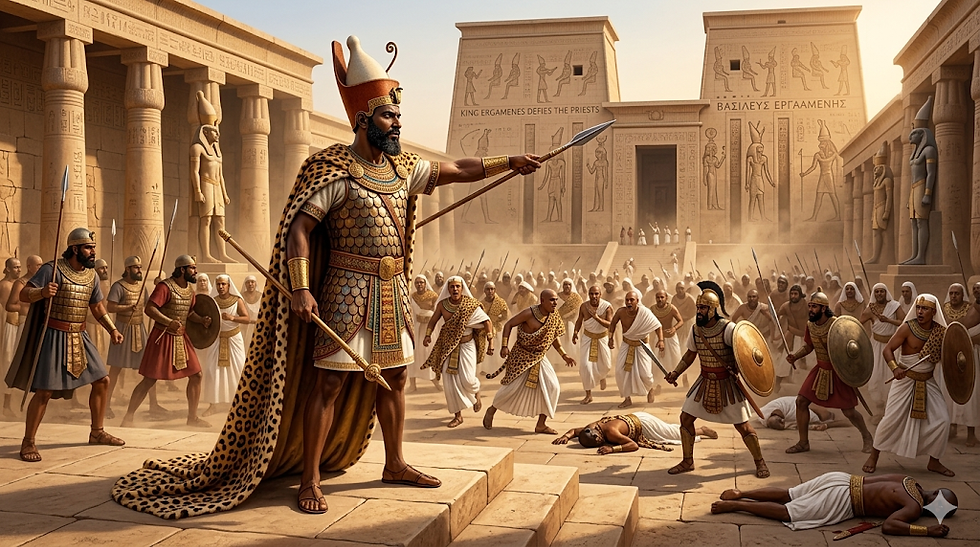
Most scholars treat these accounts with caution. The story of the king-killing priests may reflect Greek fascination with exotic barbarism rather than historical reality. No Egyptian or Meroitic sources confirm the practice, and the archaeological evidence from royal tombs in Nubia shows no signs of violent death.
The tradition may have originated in misinterpretation of rituals in which the king symbolically died and was reborn, or in Greek confusion about the nature of oracular consultations.
Nevertheless, the story's persistence in classical sources indicates the awe and fear that the Amun oracle inspired. The god who spoke through his priests could demand anything, and those who approached him did so with appropriate reverence.
The Legacy of Amun
The most visible legacy of the Amun cult is the architectural heritage of Karnak. The great temple complex, with its hypostyle hall, its obelisks, and its sacred lake, remains one of the most visited and studied archaeological sites in the world.
The massive stones, the intricate reliefs, and the sheer scale of the construction continue to inspire awe in visitors, just as they were intended to impress ancient worshippers with the power and majesty of the hidden god.
The influence of Karnak extended far beyond Egypt. The temple complexes of Nubia, including Gebel Barkal and the temples of Napata and Meroe, were modeled on Karnak and preserved its essential features even as they developed distinctive local characteristics.
The Ptolemaic temples of Edfu, Dendera, and Philae, while dedicated to other deities, continued the architectural traditions that had been perfected at Karnak.
Influence on Greco-Roman Religion
The identification of Amun with Zeus and Jupiter ensured his place in the Greco-Roman religious world. The oracle at Siwa remained famous throughout classical antiquity, consulted by Greek generals and Roman emperors alike. The image of Zeus-Ammon, with his ram's horns, appeared on coins and in sculpture throughout the Mediterranean world.
The philosophical traditions of late antiquity, particularly Neoplatonism and Hermeticism, drew upon Egyptian religious ideas, including those associated with Amun.
The concept of a hidden, transcendent god whose true nature could be approached only through mystical insight resonated with Neoplatonic metaphysics, and Egyptian priests were credited with ancient wisdom that Greek philosophers sought to understand and appropriate.
Survival in Esoteric Traditions
The Hermetic Corpus, a collection of Greek and Latin texts dating to the early centuries AD, presents itself as the teaching of the Egyptian sage Hermes Trismegistus, identified with the god Thoth. These texts, which blend Egyptian, Greek, and Jewish philosophical elements, were enormously influential in the Renaissance and continue to inform Western esoteric traditions.
While Amun does not appear prominently in Hermetic literature, the Egyptian theological atmosphere that shaped the Hermetic writings was profoundly influenced by the Amun cult. The emphasis on divine hiddenness, the importance of the spoken word (hieroglyphs as "sacred writing"), and the concern with cosmic hierarchy and mediation all reflect the religious world that Amun dominated.
Amun in Modern Culture
The figure of Amun continues to appear in modern culture, from historical novels to video games. His name, preserved in the Egyptian royal name Tutankhamun, became world-famous with the discovery of the young king's tomb in 1922. The "curse of King Tut" that supposedly followed the tomb's discoverers, while not directly related to Amun, contributed to popular fascination with ancient Egyptian religion.
In popular culture, Amun often appears as a mysterious, powerful figure, appropriate to his name as "the hidden one." He has been featured in films, television series, and video games, usually as a representative of ancient Egyptian religion or as a source of magical power.
These representations, while rarely historically accurate, testify to the enduring fascination of a god whose essential nature was concealment.
Conclusion: The Hidden One Revealed
The cult of Amun endured for more than two millennia, from its obscure origins in the Hermopolitan Ogdoad to its final extinction under Christianity in the fifth century CE. During this immense span of time, Amun was worshiped by peasants and pharaohs, Egyptians and Nubians, Greeks and Romans.
His temples grew from modest shrines to the largest religious complex ever constructed, and his priesthood accumulated wealth and influence that rivaled that of the crown itself.
The paradox of Amun, the hidden god who became the most visible deity in Egypt, reflects the sophistication of Egyptian religious thought. Amun was not merely one god among many but the god who encompassed all others, the ultimate source from which all divine powers derived.
His hiddenness was not an absence but a plenitude, a mystery so profound that it could not be directly apprehended but only approached through the mediation of the visible gods who were his manifestations.
In the hymns addressed to Amun, in the prayers of the workmen at Deir el-Medina, in the oracles consulted by kings and commoners alike, we glimpse a religious sensibility that transcends the boundaries of ancient Egyptian culture.
The god who "comes at the voice of the poor in distress," who forgives the penitent sinner, who upholds justice for the weak and oppressed; this god anticipates the compassionate deities of later religious traditions and speaks to universal human needs for meaning, justice, and mercy.
The temples of Amun are ruins now, their columns fallen, their sanctuaries open to the sky. The rituals are forgotten, the hymns silent, the priesthood vanished. Yet the questions that Amun embodied; the nature of the hidden divine, the relationship between the one and the many, the possibility of approaching the transcendent through prayer and moral action remain as urgent as ever.
In the stones of Karnak, in the prayers inscribed on votive stelae, in the name itself that speaks of concealment and mystery, Amun still offers his ancient witness to the human search for the hidden one who is yet revealed in the hearts of those who seek.

References:
"Amun." Wikipedia. Accessed 2026.
"Ancient Egyptian religion." Wikipedia (2008 revision).
"Karnak." Egyptian Ministry of Tourism and Antiquities. Accessed 2026.
"Amun: Difference between revisions." Wikipedia.
Hoffmeier, James K. "Is Atenism Monotheism?" In Akhenaten and the Origins of Monotheism. Oxford: Oxford University Press, 2015.
"Amun Timeline." World History Encyclopedia.
Cummins, Elizabeth. "Temple of Amun-Re and the Hypostyle Hall, Karnak." Smarthistory, 2015.
"Third Intermediate Period of Egypt." World History Encyclopedia.
"Ancient Egyptian religion: Difference between revisions." Wikipedia.
"Amunet." Wikipedia.
Wilkinson, Richard H. The Complete Temples of Ancient Egypt. New York: Thames & Hudson, 2000.
Assmann, Jan. Egyptian Solar Religion in the New Kingdom. London: Kegan Paul International, 1995.
Taylor, John H. "The Third Intermediate Period." In The Oxford History of Ancient Egypt, edited by Ian Shaw. Oxford: Oxford University Press, 2000.
Van Dijk, Jacobus. "The Amarna Period and the Later New Kingdom." In The Oxford History of Ancient Egypt, edited by Ian Shaw. Oxford: Oxford University Press, 2000.
Breasted, James Henry. Development of Religion and Thought in Ancient Egypt. New York: Charles Scribner's Sons, 1912.


Comments