
.png)

Esoterica: The Mysteries of Asar-Hapi (Serapis)
- A. Royden D'Souza

- Mar 16
- 30 min read
Updated: Mar 19
The identity of the Greco-Egyptian Serapis (known to the Greeks as Serapis and the Egyptians as Asar-Hapi) is shrouded by an impenetrable veil of mystery. While this deity was a familiar figure among the symbols of the secret Egyptian initiatory rites, his arcane nature was revealed only to those who had fulfilled the requirements of the Serapic cultus.
Therefore, in all probability, excepting the initiated priests, the Egyptians themselves were ignorant of his true character. So far as known, there exists no authentic account of the rites of Serapis, but an analysis of the deity and his accompanying symbols reveals their salient points.

Who is Serapis (Asar-Hapi)?
Several unsatisfactory attempts have been made to etymologize the word Serapis. Godfrey Higgins notes that Soros was the name given by the Egyptians to a stone coffin, and Apis was Osiris incarnate in the sacred bull.
These two words combined result in Soros-Apis or Sor-Apis, "the tomb of the bull." But it is improbable that the Egyptians would worship a coffin in the form of a man.
In an oracle delivered to the King of Cyprus, Serapis described himself thus:
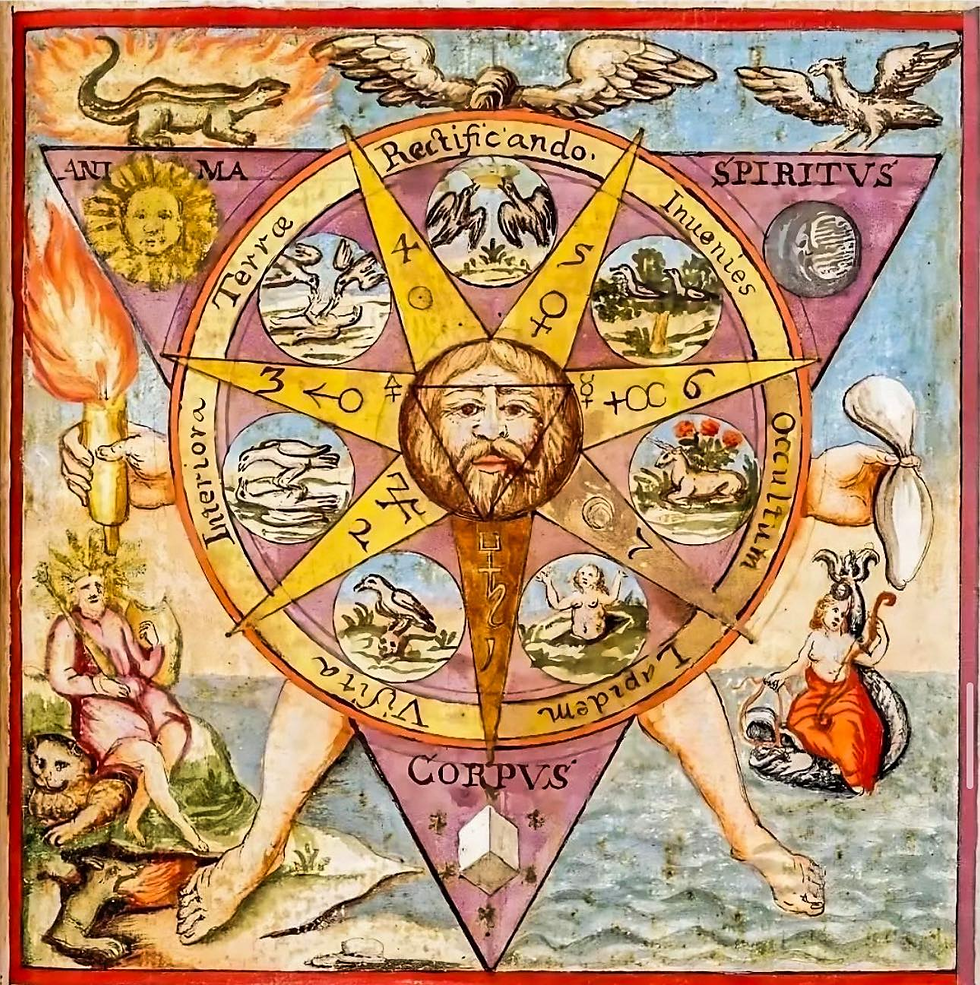
"A god I am such as I show to thee,
The Starry Heavens are my head, my trunk the sea,
Earth forms my feet, mine ears the air supplies,
The Sun's far-darting, brilliant rays, mine eyes."
This self-description reveals the cosmic nature of the deity—a god whose very body encompasses the elements of the universe, whose vision penetrates all things with solar radiance.
Such a conception places Serapis within the tradition of universal deities whose worship transcended local cultic boundaries and appealed to the philosophical sensibilities of the Hellenistic world.
The Serapis cult emerged during a pivotal period in Mediterranean history; the centuries following the conquests of Alexander the Great, when Greek culture spread throughout the Near East and Egypt, encountering and intermingling with ancient indigenous traditions.
This Hellenistic age witnessed an unprecedented cross-pollination of religious ideas, as gods traveled along trade routes, were identified with one another across cultural boundaries, and sometimes, as in the case of Serapis, were deliberately synthesized to serve new political and spiritual needs.
Several ancient authors, including Macrobius, have affirmed that Serapis was a name for the Sun, because his image so often had a halo of light about its head. In his Oration Upon the Sovereign Sun, Julian speaks of the deity in these words: "One Jove, one Pluto, one Sun is Serapis." In Hebrew, Serapis is Saraph, meaning "to blaze out" or "to blaze up." For this reason the Jews designated one of their hierarchies of spiritual beings, Seraphim.

The Egyptian Precedent: Osiris-Apis
The most common theory, however, regarding the origin of the name Serapis is that which traces its derivation from the compound Osiris-Apis. At one time the Egyptians believed that the dead were absorbed into the nature of Osiris, the god of the dead.

While marked similarity exists between Osiris-Apis and Serapis, the theory advanced by Egyptologists that Serapis is merely a name given to the dead Apis, or sacred bull of Egypt, is untenable in view of the transcendent wisdom possessed by the Egyptian priestcraft, who, in all probability, used the god to symbolize the soul of the world (anima mundi).
The material body of Nature was called Apis; the soul which escaped from the body at death but was enmeshed with the form during physical life was designated Serapis.
So, one can say confidently that the origins of Serapis lie deep in Egyptian religious tradition, specifically in the cult of the sacred Apis bull of Memphis.

The Apis bull was believed to be an incarnation of the god Ptah, the creator deity and patron of craftsmen, and after death became assimilated to Osiris, the god of the underworld and resurrection. The deceased Apis, therefore, was known as Osiris-Apis, or in the Egyptian language, wsjr-ḥp (Userhapi)
The worship of the Apis bull was of great antiquity, dating back to the earliest dynastic periods (There is also debate that the 'Golden Calf' worshipped by the Israelites during their exile from Egypt could have been the Apis calf).
Herodotus, visiting Egypt in the fifth century BCE, described the elaborate ceremonies surrounding the discovery of a new Apis calf, marked by distinctive signs including a white triangle on its forehead, the image of an eagle on its back, and a beetle-shaped mark on its tongue.

The death of an Apis was an occasion of national mourning, and its burial in the vast subterranean galleries of the Serapeum at Saqqara—a complex of tombs carved into the bedrock—involved elaborate rituals and the sacrifice of innumerable votive objects.
The Serapeum of Saqqara, located northwest of the Pyramid of Djoser, served as the burial place of the Apis bulls for over a millennium. Here, in massive granite sarcophagi weighing up to seventy tons each, the mummified remains of the sacred bulls were interred with royal honors.
The Greek geographer Strabo, visiting the site in the first century BC, described an avenue of sphinxes leading to the temple, and noted that the bulls were kept in a sacred enclosure and were consulted as oracles.

This ancient cult provided the foundation upon which the Hellenistic Serapis would be built. The name itself, Serapis or Sarapis, represents a Hellenized form of wsjr-ḥp, with the earlier Greek form Sarapis (Σάραπις) giving way to the later Serapis (Σέραπις) by Roman times.
However, as the Encyclopaedia Britannica notes, the relationship between the Egyptian Userhapi and the Alexandrian Serapis is not entirely straightforward. The more accurate Egyptian form Osorapis appears in bilingual inscriptions of the Ptolemaic period alongside Sarapis, suggesting that the two names, while related, may have had distinct usages; the former employed by Greeks in close contact with Egyptian tradition, the latter representing a more Hellenized literary and official form.
The Ptolemaic Creation: Political and Religious Synthesis

The transformation of the Memphite Osiris-Apis into the Alexandrian Serapis occurred under the deliberate policy of Ptolemy I Soter, the Macedonian general who succeeded to the rule of Egypt after Alexander's death and founded the Ptolemaic dynasty.
Ptolemy, ruling from his new capital of Alexandria, faced the challenge of governing a population composed of two distinct cultural groups: the native Egyptians, with their ancient religious traditions, and the Greek settlers and administrators who now formed the ruling class.
Previous foreign rulers of Egypt, such as the Hyksos, had been reviled by the Egyptian priesthood for their impiety. Alexander the Great had attempted to use the god Amun as a unifying figure, but Amun's cult was centered in Upper Egypt and held less appeal for the cosmopolitan population of Lower Egypt, where Alexandria was located.

Ptolemy required a deity who could command the reverence of both Greeks and Egyptians—a god whose worship would unite his kingdom rather than divide it.
The solution was Serapis. By taking the ancient and revered Osiris-Apis—a god whose cult was already deeply rooted in Egyptian popular piety—and presenting him in a form acceptable to Greek aesthetic sensibilities, Ptolemy created a deity who could serve as a bridge between cultures.

The Greeks had little respect for animal-headed figures; a Greek-style anthropomorphic statue was therefore chosen as the idol, representing Osiris in full divine majesty rather than merely as the life-force (ka) of the Apis bull.
Plutarch, writing in the first century CE, preserved the traditional account of Serapis's introduction to Alexandria. According to this narrative, Ptolemy Soter dreamed of a colossal statue, which commanded him to bring it to Alexandria.
Perplexed as to the statue's whereabouts, the king consulted with his advisors. A traveler named Sosibius declared that he had seen such an image at Sinope, a Greek city on the Black Sea coast of Asia Minor. Ptolemy dispatched envoys, and after three years of negotiations—or, according to some accounts, after simply stealing the image—the statue was brought to Alexandria.
Upon its arrival, the figure was examined by two religious experts: Timotheus, a member of the Eumolpidae family from which the hierophants of the Eleusinian Mysteries were drawn, and Manetho, the Egyptian high priest and historian. These authorities pronounced the statue to represent Serapis, thus validating the new cult for both Greek and Egyptian populations.
Modern scholarship questions the literal accuracy of this account. Some Egyptologists suggest that "Sinope" may actually refer to the Sinopeion, a hill at Memphis where an existing Serapeum stood. Others note that Tacitus preserves an alternative tradition that Serapis had been the god of Rhakotis, the Egyptian village that occupied the site of Alexandria before the city's foundation.
The story of the Sinopean origin may therefore represent a pious fiction designed to give the new cult an aura of ancient and foreign sanctity while obscuring its deliberate political creation.
Modern scholars understand this legend as part of the wider phenomenon of interpretatio graeca; the Greek habit of interpreting foreign gods as their own. By the Hellenistic period, Dionysus was thoroughly identified with the Egyptian god Osiris.
Herodotus, much earlier, had already stated that "Osiris is, in the Greek language, Dionysus." Therefore, a legend that has Dionysus bringing bulls from India is, in essence, a story of Osiris bringing his own sacred animals to Egypt from a distant, exotic land. This served to enhance the mystique and power of the cult.
The Ancient Indian Influence
C. W. King believes Serapis to be a deity of Brahmanic extraction, his name being the Grecianized form of Ser-adah or Sri-pa, two titles ascribed to Yama, the Hindu god of death. This appears reasonable, especially since there is a legend to the effect that Serapis, in the form of a bull, was driven by Bacchus (Dionysus) from India to Egypt.

Phylarchus via Plutarch: The most direct substantiation for this legend comes from the Greek historian Phylarchus (3rd century BC), whose work is preserved in a quotation by the later philosopher and historian Plutarch (46 - 119 AD).
In his work On Isis and Osiris (Chapter 29), Plutarch discusses the various identities and origins of the gods Serapis and Dionysus. He writes: "nor must we fail to contemn [despise] Phylarchus, who writes that Dionysus was the first to bring from India into Egypt two bulls, and that the name of one of them was Apis and the other Osiris. But Serapis is the name of that power which disposes the universe into its present beautiful order."
Here, Plutarch is citing Phylarchus's account which directly connects Dionysus (Bacchus) to the introduction of sacred bulls from India to Egypt. These bulls were named Apis and Osiris, and their fusion, as you know, forms the basis of Serapis (Osiris-Apis).
Plutarch himself seems skeptical ("contemn Phylarchus"), but his citation provides the critical evidence that this legend was in circulation in the Hellenistic period.
This legend did not arise in a vacuum. It served a powerful purpose in the ancient world: to connect and legitimize different cultures and their gods.
By the time of Alexander the Great's conquests, Dionysus was already mythologically linked to India. He was said to have traveled through India, spreading his ecstatic worship. This made him the perfect mythological bridge between the Greek world and the East.

The Babylonian Connection: Sar Apsi
A further complication in the origins of Serapis arises from the account of Alexander the Great's death. According to Arrian, drawing upon the royal diaries, the dying Alexander was consulted concerning the god Sarapis, who had a temple at Babylon.
This mention of Sarapis in 323 BCE before Ptolemy's creation of the Alexandrian cult has puzzled scholars. The god of Babylon was not Osiris-Apis but Ea (Enki), the Mesopotamian god of wisdom and fresh water, who bore the title Šar Apsi, meaning "King of the Apsu" or "King of the Watery Deep."

It appears that Greek interpreters at Alexander's court applied the similar-sounding name Sarapis to the Babylonian deity Ea. The significance of this to the later Alexandrian cult should not be underestimated.
Alexander's death scene, in which Sarapis alone was consulted on behalf of the dying conqueror, would have been known throughout the Hellenistic world. The association of the name with a deity of such importance—a god consulted by the greatest ruler of the age—may well have influenced Ptolemy's choice of the similar-sounding Osiris-Apis as the name for his new syncretic god.
Whether the Ptolemies understood that they were dealing with two distinct deities or deliberately conflated them remains uncertain, but the Babylonian Sar Apsi undoubtedly contributed to the mystique and prestige of the Alexandrian Serapis.
Etymology and Name
The name of the god appears in several forms across different periods and contexts. The original Egyptian wsjr-ḥp (Osiris-Apis) developed into Demotic and Coptic forms including ⲟⲩⲥⲉⲣϩⲁⲡⲓ (Userhapi).
Greek sources employ two principal forms: the earlier Sarapis (Σάραπις) and the later Serapis (Σέραπις), with the latter becoming standard in Roman times. An uncommon variant, Sorapis (Σόραπις), more closely approximates the Egyptian pronunciation and appears in some inscriptions.
The name Serapis contains seven letters, leading to its designation as Theon Heptagrammaton—"the god with the name of seven letters"—comparable to the seven-letter names of Mithras and Abraxas in other mystery traditions. In hymns to Serapis, priests chanted the seven Greek vowels, and the god was occasionally depicted with horns or a coronet of seven rays, representing the seven divine intelligences manifesting through solar light.
Jewish and Christian writers offered alternative etymologies. Tertullian, the early third-century Christian theologian, believed that the cult of Serapis was inspired by the biblical patriarch Joseph, who had served as chief administrator of Egypt.
This opinion also appears in the Talmud, where a "Sar Apis" is mentioned as an idol believed to have been named after Joseph. These traditions reflect the tendency of monotheistic writers to trace pagan institutions back to biblical origins, whether through genuine historical memory or apologetic invention.
The Cult Statue of Alexandria
The cult statue of Serapis erected by Ptolemy I in Alexandria became the definitive image of the god throughout the Mediterranean world. Created by the Greek sculptor Bryaxis—or, according to some sources, by an unknown artist whose work Bryaxis copied—the statue depicted Serapis as a figure of majestic dignity, combining elements of Hades (Pluto), Zeus, Dionysus, and Asclepius with Egyptian symbols of sovereignty and resurrection.
There is considerable evidence that the famous statue of Serapis in the Serapeum at Alexandria was originally worshiped under another name at Sinope, from which it was brought to Alexandria.
There is also a legend which tells that Serapis was a very early king of the Egyptians, to whom they owed the foundation of their philosophical and scientific power. After his death this king was elevated to the estate of a god. Phylarchus declared that the word Serapis means "the power that disposed the universe into its present beautiful order."

The god was shown enthroned, his pose conveying both royal authority and the stillness of the underworld king. Upon his head rested the modius, a basket or grain-measure, symbolizing the abundance of the earth and the fertility that issued from the realm of the dead. This attribute connected Serapis with the chthonic deities of Greece—Hades and Demeter—who governed the hidden realms beneath the earth from which vegetation springs.
In his hand, Serapis held a sceptre, the emblem of rulership, while at his feet crouched Cerberus, the three-headed dog who guarded the gates of Hades. The presence of Cerberus identified Serapis unequivocally as a god of the underworld, the ruler of the realm to which all souls descend.
Yet this underworld association was not merely gloomy; in Greek thought, Hades was also Pluto, the "wealth-giver," whose domain contained the precious metals and fertile seeds hidden beneath the earth.
A serpent coiled at the statue's base added Egyptian symbolism, representing the uraeus; the sacred cobra emblematic of royal sovereignty and divine protection. The composite nature of the image thus spoke to both Greek and Egyptian viewers, conveying layers of meaning accessible according to the viewer's cultural background and degree of initiation.
Clement of Alexandria, writing with the polemical intent of exposing pagan idolatry, described the materials composing the Serapis statue in revealing detail: "He employed in its execution a mixture of various materials. For he had filings of gold, and silver, and lead, and in addition, tin; and of Egyptian stones not one was wanting, and there were fragments of sapphire, and hematite, and emerald, and topaz. Having ground down and mixed together all these ingredients, he gave to the composition a blue colour, whence the darkish hue of the image."
This description suggests that the statue was not carved from a single block but constructed from multiple materials, possibly a wooden core overlaid with metal plates and inlaid with precious stones, resulting in the dark blue or indigo hue that ancient sources note.
Rufinus, who may have witnessed the statue before its destruction, described it as "made of every kind of metal and wood," so large that "its right hand touched one wall and its left the other."

Variations and Attributes
While the Alexandrian type established the canonical image of Serapis, numerous variations appear in sculpture, coinage, and gemstones throughout the Roman Empire. Serapis was sometimes depicted standing rather than enthroned, or accompanied by Isis and Harpocrates in a triad. Some representations show him with the three-headed Cerberus at his feet, while others include the serpent alone.

A particularly striking variant described in the sources shows Serapis standing on the back of a sacred crocodile, carrying in his left hand a rule with which to measure the inundations of the Nile, and balancing in his right hand a curious emblem consisting of an animal with three heads—the first, that of a lion, signifying the present; the second, that of a wolf, the past; and the third, that of a dog, the future.
The body with its three heads was enveloped by the twisted coils of a serpent. This complex symbolism connects Serapis with time, prophecy, and the cyclical nature of existence—themes central to the mystery cults.

Like Jupiter, Serapis sometimes carried baskets of grain upon his head, emphasizing his role as bestower of agricultural abundance. This attribute connected him with Demeter and the Eleusinian Mysteries, suggesting parallels between the Greek and Egyptian conceptions of the afterlife and the renewal of life from death.
The Seven Rays and the Solar Association
Although primarily a chthonic deity, Serapis acquired solar associations in the Roman period, reflecting the syncretic tendency to identify all gods with the sun. Macrobius, the late Roman author, affirmed that Serapis was a name for the sun, noting that his image so often bore a halo of light about its head. The emperor Julian, in his Oration Upon the Sovereign Sun, declared: "One Jove, one Pluto, one Sun is Serapis."
This solar identification is reflected in the seven rays that sometimes crown Serapis's head, corresponding to the seven letters of his name and the seven planetary spheres through which the soul must ascend in mystery theology.
Martianus Capella's hymn to the sun, quoted by Albert Pike, beautifully expresses this universalist conception: "Thee, dwellers on the Nile adore as Serapis, and Memphis worships as Osiris: in the sacred rites of Persia thou art Mithras, in Phrygia, Atys, and Libya bows down to thee as Ammon, and Phœnician Byblos as Adonis; thus the whole world adores thee under different names."
This passage reveals how Serapis came to be understood not merely as one god among many but as a manifestation of the universal solar power recognized under various names throughout the ancient world; a conception that prepared the way for later monotheistic and henotheistic developments.
Ptolemaic Vision of Greco-Egyptian Civilization
This fusion of Egyptian substance with Greek form perfectly embodied the Ptolemaic vision of a harmonious Greco-Egyptian civilization.

Several figures of Serapis that stood in his various temples in Egypt and Rome have been described by early authors. Nearly all these showed Grecian rather than Egyptian influence. In some the body of the god was encircled by the coils of a great serpent. Others showed him as a composite of Osiris and Apis.
A description of the god that in all probability is reasonably accurate is that which represents him as a tall, powerful figure, conveying the twofold impression of manly strength and womanly grace. His face portrayed a deeply pensive mood, the expression inclining toward sadness.
His hair was long and arranged in a somewhat feminine manner, resting in curls upon his breast and shoulders. The face, save for its heavy beard, was also decidedly feminine. The figure of Serapis was usually robed from head to foot in heavy draperies, believed by initiates to conceal the fact that his body was androgynous.
Various substances were used in making the statues of Serapis. Some undoubtedly were carved from stone or marble by skilled craftsmen; others may have been cast from base or precious metals. One colossus of Serapis was composed of plates of various metals fitted together.
In a labyrinth sacred to Serapis stood a thirteen-foot statue of him reputed to have been made from a single emerald. Modern writers, discussing this image, state that it was made of green glass poured into a mold. According to the Egyptians, however, it withstood all the tests of an actual emerald.
Clement of Alexandria describes a figure of Serapis compounded from the following elements: First, filings of gold, silver, lead, and tin; second, all manner of Egyptian stones, including sapphires, hematites, emeralds, and topazes; all these being ground down and mixed together with the coloring matter left over from the funeral of Osiris and Apis. The result was a rare and curious figure, indigo in color.
Some of the statues of Serapis must have been formed of extremely hard substances, for when a soldier, carrying out the edict of Theodosius, struck the Alexandrian Serapis with his ax, that instrument was shattered into fragments and sparks flew from it. It is also quite probable that Serapis was worshiped in the form of a serpent, in common with many of the higher deities of the Egyptian and Greek pantheons.
Serapis was called Theon Heptagrammaton, or the god with the name of seven letters. The name Serapis (like Abraxas and Mithras) contains seven letters. In their hymns to Serapis the priests chanted the seven vowels. Occasionally Serapis is depicted with horns or a coronet of seven rays. These evidently represented the seven divine intelligences manifesting through the solar light.
The Encyclopædia Britannica notes that the earliest authentic mention of Serapis is in connection with the death of Alexander. Such was the prestige of Serapis that he alone of the gods was consulted in behalf of the dying king.
Lesser and the Greater Mysteries
The Egyptian secret school of philosophy was divided into the Lesser and the Greater Mysteries, the former being sacred to Isis and the latter to Serapis and Osiris. Wilkinson is of the opinion that only the priests were permitted to enter the Greater Mysteries.
Even the heir to the throne was not eligible until he had been crowned Pharaoh, when, by virtue of his kingly office, he automatically became a priest and the temporal head of the state religion. (See Wilkinson's Manners and Customs of the Egyptians.) A limited number were admitted into the Greater Mysteries: these preserved their secrets inviolate.
Much of the information concerning the rituals of the higher degrees of the Egyptian Mysteries has been gleaned from an examination of the chambers and passageways in which the initiations were given.
The Mechanical Marvels of the Serapeum
The subterranean chambers of the Serapeum contained mechanical devices designed to produce awe and terror in the candidates undergoing initiation. Rufinus, describing the temple before its destruction, mentions that on a specific day each year, when the image of the sun was to be carried into the Serapeum, a small window allowed a ray of sunlight to fall upon the lips of the Serapis statue in a kiss of renewal.
This effect was achieved through precise architectural orientation and demonstrated the priests' mastery of astronomy and engineering. The same source notes that the image itself appeared to be suspended in the air, as if by magic, through the use of hidden magnets.
These machines indicate the severe tests of moral and physical limits undergone by the candidates. After passing through these tortuous ways, the neophytes who survived the ordeals were ushered into the presence of Serapis, a noble and awe-inspiring figure illumined by unseen lights.
Such mechanical contrivances, while intended to impress the uninitiated with the power of the gods, also served the deeper purpose of symbolizing spiritual truths; the sun's kiss representing divine illumination, the suspended image signifying the soul's liberation from earthly gravity.

Labyrinths were also a striking feature in connection with the Rite of Serapis, and E. A. Wallis Budge, in his Gods of the Egyptians, depicts Serapis (Minotaur-like) with the body of a man and the head of a bull. Labyrinths were symbolic of the involvements and illusions of the lower world through which wanders the soul of man in its search for truth.
In the labyrinth dwells the lower animal man with the head of the bull, who seeks to destroy the soul entangled in the maze of worldly ignorance. In this relation Serapis becomes the Tryer or Adversary who tests the souls of those seeking union with the Immortals. The maze was also doubtless used to represent the solar system, the Bull-Man representing the sun dwelling in the mystic maze of its planets, moons, and asteroids.
The Gnostic Interpretation
The Gnostic Mysteries were acquainted with the arcane meaning of Serapis, and through the medium of Gnosticism this god became inextricably associated with early Christianity. To the Gnostics, Serapis represented the Demiurge, the creator of the material world, or alternatively the cosmic Christ, the divine mind incarnate in matter.
The composite nature of Serapis, combining human and animal, celestial and chthonic elements, made him a fitting symbol for the Gnostic understanding of the soul trapped in the material realm and seeking liberation through gnosis.
The emperor Hadrian, while traveling in Egypt in 130 CE, declared in a letter to Servianus that the worshipers of Serapis were Christians and that the bishops of the church also worshiped at his shrine. He even declared that the patriarch himself, when in Egypt, was forced to adore Serapis as well as Christ.
While this letter's authenticity has been questioned, it reflects the perception of close connections between the Serapis cult and early Christianity in the popular mind of the second century. (See Parsons' New Light on the Great Pyramid.)
The little-suspected importance of Serapis as a prototype of Christ can be best appreciated after a consideration of the following extract from C. W. King's Gnostics and Their Remains: "There can be no doubt that the head of Serapis, marked as the face is by a grave and pensive majesty, supplied the first idea for the conventional portraits of the Saviour. The Jewish prejudices of the first converts were so powerful that we may be sure no attempt was made to depict His countenance until some generations after all that had beheld it on earth had passed away."
Everett Ferguson, in his Backgrounds of Early Christianity, similarly notes that the statues of Asclepius, the healing god of the Greco-Roman world, which imitated the bearded Zeus, influenced artists in depicting both Serapis and Christ.
Serapis gradually usurped the positions previously occupied by the other Egyptian and Greek gods, and became the supreme deity of both religions. His power continued until the fourth century of the Christian Era.

Serapis in the Mediterranean World

From its inception, the Serapis cult was understood in relation to Greek religious categories. The identification with Hades/Pluto was primary, reflecting the god's origin as Osiris, lord of the underworld.
But Serapis also absorbed attributes of other Greek deities. His healing powers connected him with Asclepius, and many suppliants sought his aid at serapea throughout the Mediterranean. His association with abundance and fertility linked him with Dionysus, and his solar aspects, especially prominent in later periods, aligned him with Apollo and Helios.
This multiplicity of associations should not be seen as confusion but as a deliberate theological strategy. Serapis, like other great deities of the Hellenistic age, was understood as a universal power manifesting through various aspects according to the needs of worshippers.
As the oracle quoted earlier proclaimed, he was the cosmos itself; the starry heavens his head, the sea his trunk, the earth his feet, the sun his eyes.
The Isis-Serapis-Harpocrates Triad

Serapis was almost invariably worshipped in association with Isis, his consort, and Harpocrates (Horus the Child), their son. This triad paralleled the Egyptian Osiris-Isis-Horus family and provided a structure for devotion that appealed to the human need for divine relationships.
Isis, the loving mother and magical healer, balanced Serapis's chthonic severity; Harpocrates, the child god who brought new hope, completed the family circle.
The cult of Isis and Serapis spread rapidly throughout the Hellenistic world and, by the first century BCE, had established itself in Italy. Pausanias, writing in the second century AD, notes two Serapeia on the slopes of Acrocorinth above Corinth, and one at Copae in Boeotia.
At Rome, Serapis was worshipped in the Iseum Campense, the sanctuary of Isis built during the Second Triumvirate in the Campus Martius.
Serapis in the Roman Empire
The Roman cults of Isis and Serapis gained particular popularity late in the first century AD, when the future emperor Vespasian experienced events he attributed to their miraculous agency while he was in Alexandria.

During his stay there before returning to Rome as emperor in 70 AD, Vespasian visited the Serapeum and reportedly received visions confirming his imperial destiny. From the Flavian dynasty onward, Serapis frequently appeared on imperial coinage alongside the reigning emperor, indicating official acceptance of the cult at the highest levels of Roman society.
Throughout the Roman Empire, serapea were established in major cities, each serving as a center for worship, healing, and initiation. The Serapeum at Pergamon in Asia Minor, built in the second century AD and known locally as the Red Basilica (Kızıl Avlu), remains one of the most impressive surviving examples.

This massive structure, constructed under Hadrian, consisted of a main building and two round towers, and was later converted into a Christian church; one of the Seven Churches addressed in the Book of Revelation.
Hadrian himself was a devotee of Serapis, incorporating a canopus, a replica of the Alexandrian canal sanctuary, into his villa at Tivoli. This complex featured an immense rectangular tank representing the Nile canal, surrounded by porticoes and statues, leading to a Serapeum where the chthonic aspects of the god were celebrated in a subterranean chamber.
To mark the inauguration of his temple, Hadrian struck coinage bearing his effigy alongside Serapis, presenting himself as synnaos, a companion of the god, and equal beneficiary of the cult.
Parallels with Other Mystery Cults
Richard Payne Knight, in his Symbolical Language of Ancient Art and Mythology, draws explicit parallels between the Serapis mysteries and those of other ancient peoples: "Hence Varro says that Cœlum and Terra, that is universal mind and productive body, were the Great Gods of the Samothracian Mysteries; and the same as the Serapis and Isis of the later Ægyptians: the Taautos and Astarte of the Phœnicians, and the Saturn and Ops of the Latins."
This comparative perspective reveals Serapis and Isis as manifestations of a universal theological pattern; the pairing of celestial and terrestrial principles, of mind and matter, of active and passive forces in the cosmos.
The mysteries of Samothrace, of Phoenicia, and of Rome all expressed this fundamental duality under different names, but the essential teaching remained the same: the cosmos arises from the interaction of complementary principles, and the soul's salvation consists in harmonizing these principles within itself.
The Spread and Influence of the Serapis Cult
From its Alexandrian birthplace, the Serapis cult spread throughout the Mediterranean world with remarkable speed. The Ptolemies actively promoted the cult as a matter of state policy, and their diplomatic and commercial connections carried knowledge of the god to Greece, Asia Minor, and beyond.
By the second century BC, Serapis was already known in Athens, where Ptolemy VI Philometor dedicated a serapeum on the steep slope of the Acropolis.
The cult's appeal crossed social boundaries. For the educated elite, Serapis offered a philosophically respectable deity whose cosmic nature could be interpreted in Stoic, Platonic, or Neo-Pythagorean terms.
For the masses, he offered healing, protection, and the promise of life after death. For slaves and freedmen, the cult provided a religious community in which social distinctions were relativized by common devotion.
Temples and Sanctuaries

The serapeum at Alexandria was the most famous of the god's temples, described by Ammianus Marcellinus as "so adorned with extensive columned halls, with almost breathing statues, and a great number of other works of art, that next to the Capitolium, with which revered Rome elevates herself to eternity, the whole world beholds nothing more magnificent."
The temple was elevated on an enormous platform, a hundred or more steps high. Within stood the colossal cult statue, its interior walls covered with plates of gold overlaid with silver and then bronze—the last layer serving as protection for the more precious metals beneath.
The temple precinct housed an offshoot collection of the Library of Alexandria, making it not only a religious center but also a seat of learning and scholarship.
Other major serapea existed at Saqqara (the original burial place of the Apis bulls), at Canopus in the Nile Delta (where festivals attracted pilgrims from throughout Egypt), at Memphis, and at numerous sites throughout the Roman Empire including Rome itself (where several serapea existed, including the massive complex on the Quirinal Hill built by Caracalla), Ostia, Pozzuoli, Carthage, Ephesus, and Miletus.
Festivals and Rituals
The festivals of Serapis, often celebrated in conjunction with Isis, drew large crowds and involved processions, music, dramatic performances, and sacred meals. The Navigium Isidis, held in March to mark the opening of the sailing season, honored Isis as mistress of the sea but included prayers to Serapis as well.
The Isia in autumn commemorated the death and resurrection of Osiris, with Serapis representing the god both dead and risen.
At Canopus, the festivals became so popular that the site developed a reputation for license and luxury. The satirist Juvenal, writing in the late first century CE, depicts Jewish women whispering into the ear of a priest of Canopus—a sign of the site's notoriety for fortune-telling and perhaps more disreputable activities.
Yet such criticisms reflect the vitality of the cult rather than its decline; popular devotion continued strong despite elite disapproval.
The Destruction of the Serapeum
The cult of Serapis, like other pagan institutions, faced increasing pressure as Christianity rose to power in the fourth century AD after adoption by the Roman Empire.
Emperor Theodosius I (379-395) gradually implemented policies restricting pagan worship: making pagan feasts into workdays, banning public sacrifices, and closing temples throughout the empire.
The decree promulgated in 391 declared that "no one is to go to the sanctuaries, or walk through the temples," resulting in the abandonment of many religious sites.
These imperial edicts set the stage for violent conflict in Alexandria. In 391 CE, the patriarch Theophilus obtained legal authority over an abandoned temple of Dionysus (Serapis), which he intended to convert into a church.
During renovations, objects of pagan mystery still held within—especially the cultic phalli of Dionysus—were removed and publicly exhibited to humiliate the members of the secretive cults.
The Riot and the Siege
The exposure of these sacred objects incited crowds of pagans to seek revenge. They killed and wounded many Christians before seizing the Serapeum, still the most imposing of Alexandria's remaining sanctuaries, and barricading themselves inside, taking captured Christians with them.
According to the historians Sozomen and Rufinus, the captives were forced to offer sacrifices, and those who refused were tortured, their shins broken, and ultimately cast into caves that had been built for blood sacrifices.
The defenders, led by Olympius, fortified the temple and prepared for a siege. Olympius assured his followers that the destruction of their statues did not warrant abandoning their religion, for the statues were composed of corruptible materials, but the divine powers that had dwelt within them had flown to heaven. This argument, reminiscent of Platonic theology, kept the pagans united in their resistance.
The imperial government of Rome responded by sending Romanus, general of the military legions in Egypt, and Evagrius, the prefect of Alexandria, to restore order. When their efforts failed, they reported the situation to the emperor.
Emperor Theodosius issued a rescript declaring the slain Christians to be martyrs, offering pardon to the defenders if they would surrender, but ordering the temple itself destroyed to eliminate the root of the conflict.
The Destruction of the Cult Statue

When the imperial rescript was read publicly, the Christians of Alexandria shouted with joy, realizing that the emperor held the pagans responsible for the violence. The defenders, terrified by the noise, fled, and the soldiers immediately stormed the Serapeum.
But when they confronted the colossal statue of Serapis, they hesitated. According to Rufinus, they were fearful that "if a human hand touched the statue, the earth would split open on the spot and crumble into the abyss, while the sky would crash down at once."
At the instigation of Theophilus, one soldier overcame his fear, took an axe, and struck the god on the jaw. Everyone cried out, but when the sky did not fall, the head was chopped off. Theodoret adds that a horde of mice ran out from the hollow cavity.
The rest of the huge idol was broken into pieces, the head carried through the town in triumph, and the god burned in front of the sullen pagans of the cult who had worshipped him in secret.
The Serapeum itself was razed to the ground, "almost column by column," and the images of the gods were melted down to be made into pots and other utensils. Theophilus spared one statue, however, as a reminder that such images had ever been worshipped.
Aftermath and Significance
In the foundations of the demolished temple, workers reportedly discovered hieroglyphs in the shape of crosses. Both Christians and pagans claimed these symbols, the pagans contending that they meant one thing to Christians and another to heathens.
For the Christians, these discoveries confirmed the triumph of their faith; for the pagans, they represented the enduring mystery of their ancient traditions.
The destruction of the Serapeum marked the death of paganism throughout the Roman Empire, as Gibbon observed. Within a generation, the temples were empty or converted, and the ancient rituals ceased to be performed.
The philosopher Eunapius lamented: "No sooner had he left the world of men than the cult of the temples in Alexandria and at the shrine of Serapis was scattered to the winds, and not only the ceremonies of the cult but the buildings as well."
The Persistence of Serapis in Christian Egypt
Despite the destruction of his great temple, Serapis did not disappear entirely from Egyptian consciousness. The name continued in use—a sixth-century Egyptian official named Serapion is attested in papyri—and folk traditions preserved memories of the god and his cult.
The site of the Serapeum remained sacred, first occupied by the Monastery of Metanoia, then by a church dedicated to St. John the Baptist, which survived until its destruction in the tenth century, likely owning to the rise of Islam.
In the twentieth century, a Muslim cemetery, Bāb Sidra, occupied the site. The great Pompey's Pillar, which marked the acropolis of the Serapeum, still stands—a solitary reminder of the magnificent temple complex that once dominated the Alexandrian skyline.
Modern Scholarship and Controversies
Modern scholarship continues to debate the origins of Serapis. The traditional view, derived from Plutarch and widely accepted until the twentieth century, held that Ptolemy I deliberately created the god as a political and religious synthesis. This view emphasizes the role of royal policy in shaping Hellenistic religion and treats Serapis as a prime example of "invented tradition."
More recent scholarship, influenced by the discovery of Egyptian sources and a better understanding of the Saqqara Serapeum, has complicated this picture. The existence of the Osiris-Apis cult at Memphis, with its elaborate burial rites and oracular practices, suggests that the raw materials for the Serapis cult were already present in Egyptian tradition.
Ptolemy's achievement may have been less the creation of a new god than the reinterpretation and promotion of an existing one in a form acceptable to Greek sensibilities.
The Babylonian connection—the Sar Apsi of Alexander's death scene—remains a subject of debate. Some scholars see this as a red herring, an accidental similarity of names that confused ancient and modern interpreters alike.
Others argue that the Babylonian cult influenced the development of the Alexandrian Serapis, perhaps through the mediation of Hellenized priests who recognized parallels between Ea and Osiris as gods of wisdom and the watery deep.
The Mysteries Question
A significant controversy concerns the nature of the Serapis mysteries and their relationship to other initiatory traditions of the ancient world. Some scholars, following the lead of nineteenth-century comparative mythologists, have posited a common pattern underlying all mystery cults—a pattern of death and resurrection, of ritual purification and illumination, of secret teachings revealed to initiates.
Serapis, with his chthonic associations and his connection to the Osiris cycle, fits naturally into this interpretive framework. Critics of this approach, however, note the scarcity of evidence for the specific content of the Serapis mysteries.
Unlike the mysteries of Eleusis, which are described in some detail by Christian and pagan sources, or the mysteries of Mithras, which left behind extensive iconographic programs, the Serapis cult has yielded few direct witnesses to its inner teachings.
Much of what is claimed about Serapis initiation must be inferred from later Gnostic sources, from the architectural remains of serapea, or from comparisons with better-documented traditions.
The relationship between the Serapis cult and Gnosticism is itself a matter of debate. The Gnostics certainly made use of Serapis imagery and may have incorporated Serapis into their complex mythological systems.
C. W. King's Gnosticism and the Worship of Serapis argues for a close connection, seeing Serapis as a key figure in the development of Gnostic theology.
Other scholars are more cautious, noting that Gnosticism drew upon a wide range of sources and that Serapis was only one among many deities whose attributes were absorbed into Gnostic speculation.
Serapis and the History of Religions School
The late nineteenth and early twentieth centuries saw the rise of the Religionsgeschichtliche Schule—the History of Religions School—in German scholarship. This movement sought to understand early Christianity in the context of its Hellenistic environment, arguing that many Christian beliefs and practices derived from the mystery cults. Serapis, as one of the most prominent mystery deities, figured prominently in these discussions.
More recent scholarship has sharply criticized these views. As Gary Lease demonstrated, attempts to derive Paul's theology from a Mithraic mystery cult in Tarsus founder on the fact that no such cult existed there before the end of the first century. Arthur Nock's seminal 1952 article noted the near absence of mystery terminology in the New Testament, undermining claims of direct linguistic dependence.
The origins of Christian baptism lie in Jewish purificatory ritual, not in mystery initiations, and cultic meals were so widespread in the ancient world that attempts to derive the Eucharist from any single source are arbitrary.
Yet if direct dependence cannot be proven, indirect influence and parallel development remain plausible. The cultural atmosphere of the Hellenistic world—its longing for salvation, its fascination with celestial journeying, its syncretic blending of traditions—shaped both the mysteries and Christianity.
Serapis and Christ addressed similar human needs and drew upon similar symbolic resources, even if their historical relationships were more complex than earlier scholars imagined.
The Question of Human Sacrifice
Ancient sources allege that the pagans practiced human sacrifice in the temple. Sozomen writes that the captives taken during the siege were forced to offer sacrifices, and that those who refused were tortured and cast into caves "that had been built for blood sacrifices."

This accusation, if true, would place the Serapis cult in the category of mystery religions that preserved archaic practices of human sacrifice.
Modern Esoteric Interpretations
Like the Odinic Mysteries, the Serapis cult has attracted the attention of modern esoteric movements. The Theosophical Society, founded by H. P. Blavatsky in the nineteenth century, drew extensively upon Gnostic and Egyptian sources, and Serapis appears in Theosophical writings as a symbol of the hidden wisdom underlying all religions.
The Hermetic Order of the Golden Dawn incorporated Egyptian and Greco-Egyptian elements into its initiatory system, and Serapis figured among the deities invoked in its rituals.
These modern interpretations often claim continuity with ancient traditions, presenting themselves as revivals or transmissions of genuine mystery teachings. The historical basis for such claims is generally thin.
The secrets of the Serapis cult died with its last priests in the late fourth century, but the symbolic power of the god continues to inspire spiritual seekers. Serapis, like the other mystery deities, represents an archetype of divine wisdom and cosmic order that transcends his historical embodiment.
Conclusion: The Legacy of Serapis
The cult of Serapis endured for more than seven centuries, from its formal establishment by Ptolemy I in the early third century BCE to its violent suppression by Theophilus in 391 CE. During that time, it spread from Alexandria throughout the Mediterranean world, attracting devotees from all social classes and cultural backgrounds.
Its temples housed the learned and the simple, the rich and the poor, Greeks and Egyptians, Romans and Syrians. Its mysteries offered the promise of a blessed afterlife and the experience of divine illumination in the present.
The god himself—this strange synthesis of Egyptian bull and Greek philosopher, of chthonic lord and solar king—embodied the syncretic spirit of the Hellenistic age. In Serapis, the ancient wisdom of Egypt met the philosophical sophistication of Greece; the rituals of Memphis merged with the mysteries of Eleusis; the hope of resurrection focused on a figure of grave and pensive majesty.
He was, as his oracle proclaimed, the cosmos in human form—the starry heavens his head, the sea his trunk, the earth his feet, the sun his eyes.
The mysteries of Serapis, transmitted through Gnostic and Hermetic channels, influenced the development of Western esotericism. The very site of his temple, marked by Pompey's Pillar, remained a landmark through centuries of Christian and Muslim rule.
Today, Serapis is largely forgotten except by specialists in ancient religion and enthusiasts of esoteric traditions. Yet his legacy endures in the religious imagery of the West, in the syncretic patterns that continue to shape spiritual seeking, and in the enduring human need for gods who unite heaven and earth, life and death, the human and the divine.
In Serapis, as in the other great deities of the mysteries, we glimpse a vision of reality that our ancestors found compelling; a vision of a cosmos suffused with divine presence, of a soul capable of ascending through the spheres, of a life beyond death won through initiation and devotion.
The mysteries of Serapis are closed now, their rituals forgotten, their secrets lost. But the questions they addressed—the nature of the divine, the fate of the soul, the meaning of suffering and death—remain as urgent as ever. And in the ruins of his temples, in the fragments of his statues, in the echoes of his hymns, Serapis still speaks to those who have ears to hear.

References:
King, C. W. Gnostics and Their Remains Ancient and Mediaeval. London, 1887.
"Serapis." Wikipedia. Accessed 2026.
"Serapeum of Alexandria." Wikipedia. Accessed 2026.
"Serapis." Encyclopaedia Britannica, 11th edition, 1911.
"Greco-Roman mysteries." Wikipedia. Accessed 2026.
"Serapeum." Wikipedia. Accessed 2026.
Grout, James. "The Temple of Serapis in Alexandria." Encyclopaedia Romana. University of Chicago.
Plutarch. On Isis and Osiris. Various editions.
Rufinus of Aquileia. Historia Ecclesiastica.
Sozomen. Historia Ecclesiastica.
Socrates Scholasticus. Historia Ecclesiastica.
Ammianus Marcellinus. Res Gestae.
Eunapius. Lives of the Philosophers.
Macrobius. Saturnalia.
Julian the Apostate. Oration Upon the Sovereign Sun.
Martianus Capella. De Nuptiis Philologiae et Mercurii.
Knight, Richard Payne. The Symbolical Language of Ancient Art and Mythology. New York, 1892.
Pike, Albert. Morals and Dogma of the Ancient and Accepted Scottish Rite of Freemasonry. Charleston, 1871.
Budge, E. A. Wallis. The Gods of the Egyptians. London, 1904.
Parsons, John Denham. New Light on the Great Pyramid. London, 1893.


Comments