
.png)

Age of Empires: The Kushan Dynasty
- A. Royden D'Souza

- Mar 17
- 62 min read
Updated: Mar 17
The Kushan Empire (circa 30-375 AD), is one of the four great powers of the ancient world alongside Rome, Parthia, and Han China. The Kushans, originating as nomadic Yuezhi tribes from the Gansu corridor of northwestern China, constructed a vast and prosperous empire that spanned from Central Asia to northern India, becoming the pivotal civilizational hub of the Eurasian continent.

The significance of the Kushan Empire extends far beyond its considerable territorial extent. At its zenith, this imperial formation controlled the heart of the Silk Road, facilitating not merely the exchange of luxury goods but the profound transmission of ideas, religious doctrines, and artistic traditions that would shape the development of Asia for millennia.
The Kushan period witnessed the first anthropomorphic representations of the Buddha, the flowering of Gandharan art—a synthesis of Greek, Persian, and Indian aesthetics—and the compilation and expansion of Mahayana Buddhist scriptures that would eventually travel eastward to China, Korea, and Japan.

This account traces the complete arc of Kushan history: from the mysterious origins of the Yuezhi confederation, through their arduous migration westward, the consolidation of power under the visionary Kujula Kadphises, the imperial zenith under the illustrious Kanishka, to the gradual fragmentation and eventual eclipse by Sasanian and Gupta power.
Throughout this narrative, particular attention is paid to the connective tissue that bound the Kushan realm to contemporary civilizations; the diplomatic missions to Rome, the military encounters with Han China, the commercial networks linking the Mediterranean to the South China Sea, and the religious transformations that positioned the Kushan Empire as the crucible of Central Asian Buddhism.
The Forgotten Empire
In the historical consciousness of the West, the great empires of antiquity are well established: Rome, with its legions and laws; Greece, with its philosophy and art; Persia, with its administration and ambition.
In the East, the Han dynasty of China stands as the parallel colossus, defining the parameters of Chinese civilization for two millennia. Yet between these familiar giants, straddling the formidable mountain passes of the Hindu Kush and the fertile plains of the Indus, there arose an empire that, for nearly three centuries, served as the vital connective tissue of the ancient world.

The Kushan Empire remains, for many, the forgotten empire of antiquity. This obscurity is not a reflection of its importance but rather a consequence of its unique character. The Kushans left behind no Herodotus to chronicle their deeds, no Sima Qian to preserve their annals.
Their history must be painstakingly reconstructed from fragmentary evidence: Chinese court chronicles that noted their interactions with the Middle Kingdom, coins that bear their likenesses and declare their titles in multiple scripts, inscriptions carved in stone that record their donations to Buddhist monasteries, and the material remains unearthed by archaeologists across a dozen modern nations.
What emerges from this mosaic of evidence is the portrait of a civilization of remarkable sophistication and syncretism. The Kushans were nomads who became emperors, pastoralists who mastered the complexities of urban administration, conquerors who embraced the cultures of the conquered with unusual enthusiasm.
They patronized Buddhism while honoring Zoroastrian deities on their coinage, adopted Greek administrative practices while maintaining Central Asian warrior traditions, and presided over a commercial network that linked the Roman Empire to Han China.
The Kushan period represents a golden age in the history of Central Asia and northern India. It was an era of unprecedented urban development, artistic flourishing, and religious exchange.
The great cities of the Kushan realm—Peshawar (Puruṣapura), Taxila (Takṣaśilā), Mathura, Begram (Kapisa)—became cosmopolitan centers where merchants from Alexandria traded with envoys from Luoyang, where Buddhist monks debated with Hindu Brahmins and Zoroastrian priests, where Greek artistic conventions were adapted to depict scenes from the Jataka tales.
By examining its origins, its development, its cultural achievements, and its eventual decline, we can appreciate the essential role that this remarkable civilization played in shaping the interconnected world of the first millennium AD.

Part I: Origins and Migration
The story of the Kushan Empire begins not in the cities of Bactria or the monasteries of Gandhara but in the vast grasslands of northwestern China, where the ancestors of the Kushans—a nomadic confederation known to Chinese sources as the Yuezhi—roamed with their herds.

The origins of the Yuezhi have long preoccupied scholars, and the debate continues to generate considerable controversy. The predominant scholarly consensus identifies the Yuezhi as an Indo-European people, most likely of Tocharian origin.
This conclusion is drawn from linguistic analysis of fragments of the Tocharian languages preserved in manuscripts from the Tarim Basin, which show affinities with European language families such as Celtic, Germanic, and Romance, rather than with the surrounding Chinese or Tibetan language groups.
However, alternative theories persist. Some scholars, particularly in the early twentieth century, proposed an Iranian (specifically Saka) origin for the Yuezhi, pointing to similarities in material culture and funerary practices with known Iranian nomadic groups.
More recent scholarship has tended toward a more nuanced position, acknowledging the multi-ethnic character of steppe confederations and the difficulty of assigning a single ethnic label to such fluid political entities.
What is clear from Chinese sources is that the Yuezhi, by the 3rd century BCE, had become a formidable power in the region west of the Yellow River. The Records of the Grand Historian (Shiji) by Sima Qian describes them as inhabiting the "grasslands west of Dunhuang and south of the Qilian Mountains," roughly corresponding to the modern Chinese provinces of Gansu and Xinjiang.
At this time, the Yuezhi were sufficiently powerful to pose a serious challenge to the neighboring Xiongnu confederation, the nomadic people who would later become the great antagonists of the Han dynasty.
The economic basis of Yuezhi society was pastoral nomadism; the raising of horses, cattle, and sheep. But they also engaged in trade with the settled agricultural peoples of the Hexi Corridor, exchanging animal products for grain and manufactured goods.
This combination of pastoral mobility and commercial engagement would prove essential to their later success as masters of the Silk Road.
The Xiongnu Cataclysm and the Western Migration
The turning point in Yuezhi history came in the late 3rd or early 2nd century BC, when their long-standing rivalry with the Xiongnu reached a catastrophic climax. According to Chinese sources, the Xiongnu chieftain Modu Chanyu (reigned 209-174 BC) launched a series of devastating campaigns against his eastern and western neighbors, consolidating Xiongnu power across the entire eastern steppe.

The Yuezhi were not immediately destroyed. In fact, for a time, they maintained an uneasy coexistence with the Xiongnu, with their king even engaging in diplomatic correspondence with the Xiongnu court.
However, around 165 BC, the Xiongnu launched a final, decisive assault. The Yuezhi king was killed, and according to the custom of steppe warfare, his skull was fashioned into a drinking cup by the Xiongnu chieftain Laoshang.
This defeat triggered a massive migration that would ultimately carry the Yuezhi across the breadth of Central Asia. The majority of the Yuezhi, known thereafter as the "Great Yuezhi," fled westward, abandoning their ancestral lands forever.
A smaller group, the "Lesser Yuezhi," sought refuge in the mountains of the Tibetan plateau, where they were eventually absorbed into local populations.
The westward migration of the Great Yuezhi was not a single event but a prolonged process spanning several decades. Their first major destination was the Ili Valley and Lake Issyk-Kul region of eastern Kazakhstan, an area then inhabited by another nomadic people, the Sai (Sakas) and the Wusun (possibly related to the later Hephthalites).
Here the Yuezhi settled temporarily, displacing or absorbing local populations and establishing a new base of operations.
But their respite was brief. The Wusun, with Xiongnu support, launched a counter-offensive that drove the Yuezhi further west. Around 140 BC, they crossed the Syr Darya (Jaxartes) River and entered the region known as Transoxiana; the land between the Oxus (Amu Darya) and Jaxartes rivers, in modern Uzbekistan and Tajikistan.
The Conquest of Bactria: From Nomads to Lords of Civilization
The arrival of the Yuezhi in Bactria, roughly corresponding to modern northern Afghanistan and southern Uzbekistan, represented a fundamental transformation in their fortunes. Bactria was one of the wealthiest and most culturally advanced regions of Central Asia, a legacy of its history as the easternmost outpost of the Hellenistic world.

Following the conquests of Alexander the Great in the late 4th century BC, Bactria had become a center of Greek settlement and culture. The Seleucid successors of Alexander established control, but by the mid-3rd century BC, the local Greek governor, Diodotus, had declared independence, founding the Greco-Bactrian Kingdom.
For nearly two centuries, this remarkable Hellenistic outpost flourished, blending Greek political institutions, artistic traditions, and religious practices with local Iranian and Indian elements.
The Greco-Bactrian kings struck magnificent coins in the Greek style, built cities on the Hippodamian grid plan, patronized Greek literature and philosophy, and maintained contact with the Mediterranean world. They also expanded southward across the Hindu Kush into the Indian subcontinent, establishing the Indo-Greek Kingdom in the Kabul Valley and western Punjab.
However, by the time the Yuezhi arrived in force around 135 BC, the Greco-Bactrian Kingdom was already in decline, weakened by dynastic strife and pressure from other nomadic groups, particularly the Sakas (Scythians). The Yuezhi encountered a landscape of warring Greek city-states and principalities, unable to present a united front against the nomadic invaders.
The conquest was gradual rather than sudden. The Yuezhi did not destroy Greek civilization in Bactria but rather superimposed their rule upon it, gradually absorbing its institutions and practices. They settled primarily in the countryside, allowing the Greek cities to continue functioning under local administrators while they collected tribute and maintained military control.

Chinese sources, particularly the account of the envoy Zhang Qian, who visited the region around 126 BC, describe the situation in detail. Zhang Qian had been dispatched by the Han emperor Wudi to seek alliance with the Yuezhi against their common Xiongnu enemy.
Although the Yuezhi, now comfortably settled in Bactria, declined to join in a campaign against the Xiongnu, Zhang Qian's detailed report provides our earliest eyewitness account of the Yuezhi in their new homeland.
According to Zhang Qian, the Yuezhi had divided Bactria into five principalities, each ruled by a chieftain bearing the title xihou (often rendered in Western scholarship as yabghu, a Central Asian title equivalent to "prince" or "vassal ruler").
These five divisions—Xiūmì, Guìshuāng, Shuāngmǐ, Xìdùn, and Dūmì—represented the territorial organization of the Yuezhi confederation.
The second of these divisions, Guishuang, would eventually give its name to the Kushan dynasty. The term "Kushan" itself is simply the Western rendering of "Guishuang," derived from the Greek and Latin transcriptions of this name.
The Yuezhi themselves did not initially call themselves Kushans; they remained, in their own conception, a confederation of tribes. Only when one tribe, the Guishuang/Kushans, achieved dominance over the others did the name become the designation of the imperial dynasty.
Part II: The Formation of Empire
Before the emergence of the unified Kushan Empire under Kujula Kadphises, there existed a shadowy precursor whose identity and status remain matters of scholarly debate. This figure, known to numismatics as Heraios, struck coins in Bactria during the mid-1st century AD that combine Greek and Central Asian elements in ways that anticipate later Kushan coinage.

The coins of Heraios bear a Greek legend identifying him as "tyrant" of the Yuezhi, a term that in this context likely meant "ruler" or "chieftain" rather than carrying the negative connotations of later Greek usage.
The portraits on these coins show a man with a prominent, artificially elongated skull; a distinctive feature of Central Asian nomadic aristocracy that also appears in later Kushan royal portraiture and in archaeological finds from nomadic burials of the period.
The practice of artificial cranial deformation, achieved by binding the heads of infants to reshape the skull as they grew, was widespread among Central Asian nomadic groups and served as a marker of elite status.

Its appearance on Kushan coins provides a tangible link between the Kushan rulers and their nomadic ancestors, even as they adopted the settled trappings of Greco-Roman imperial iconography.
The relationship of Heraios to the later Kushan dynasty remains uncertain. Some scholars identify him as the father of Kujula Kadphises, others as a rival chieftain whom Kujula defeated and supplanted.
The most recent scholarship, based on hoard evidence and stylistic analysis of coinage, suggests that Heraios was indeed a Kushan ruler, possibly the first to consolidate control over one of the Yuezhi divisions, but that his realm was limited to Bactria proper and did not yet encompass the full extent of later Kushan territory.
What is significant about Heraios is the evidence his coinage provides of cultural synthesis. The coins are modeled on Greek prototypes, with the ruler's portrait in profile and a reverse image derived from Hellenistic iconography.
Yet the legend, while written in Greek script, includes words and names that are not Greek but rather represent an early form of the Bactrian language; the Iranian language that would become the official administrative language of the Kushan Empire. This combination of Greek form and Iranian content would become characteristic of Kushan civilization.
Kujula Kadphises: The Unifier
The true founder of the Kushan Empire was Kujula Kadphises, the prince of the Guishuang division who succeeded in uniting the five Yuezhi principalities under his sole authority.

The precise chronology of his reign remains debated, but the broad outlines are clear from Chinese sources, particularly the Book of Later Han (Hou Hanshu), compiled in the 5th century but based on earlier records.
According to this account, "more than a hundred years" after the Yuezhi conquest of Bactria; that is, sometime in the early decades of the 1st century CE, the prince of Guishuang "established himself as king, and his dynasty was called that of the Guishuang (Kushan) King."
This brief notice conceals a process of consolidation that must have involved complex diplomacy, strategic marriages, and no small measure of military force.
Kujula's ambitions extended far beyond the unification of his fellow Yuezhi. The Book of Later Han continues: "He invaded Anxi (Indo-Parthia), and took the Gaofu (Kabul) region. He also defeated the whole of the kingdoms of Puda (Paktiya) and Jibin (Kapisha and Gandhara)."
This brief summary describes a series of campaigns that transformed the Kushans from a regional power in Bactria into a trans-regional empire spanning Central Asia and northwestern India.
The strategic genius of Kujula lay in his ability to exploit the fragmented political landscape of the regions south of the Hindu Kush. Following the decline of Greek power and the temporary ascendancy of Scythian (Saka) and Parthian rulers, the Kabul Valley and Gandhara were divided among numerous petty kingdoms and chieftaincies, none capable of resisting a determined invader.
Kujula's Kushan forces, hardened by generations of nomadic warfare and now equipped with the resources of the wealthy Bactrian agricultural hinterland, swept through these small states with devastating effect.
Kujula's coinage provides remarkable evidence of his political and cultural program. He issued coins in multiple types and standards, adapting to the expectations of different populations within his expanding realm.
In Bactria, he struck coins in the name of "Kujula Kadphises, Kushan" with Greek legends and Hellenistic imagery. In the Kabul Valley, he issued coins imitating those of the Indo-Greek king Hermaeus, whose memory evidently retained sufficient prestige to legitimize new rulers in the eyes of local populations.
Still other coins show the influence of Roman denarii, suggesting that Kujula was aware of the great power to the west and sought to associate himself with its prestige.
The religious affiliations of Kujula are indicated by his coinage as well. Several of his coin types bear images of Hindu deities, particularly Shiva, suggesting that he may have been a follower of the Shaivite tradition. This is consistent with the later pattern of Kushan rulership, which maintained an eclectic and inclusive approach to religious patronage, supporting multiple faiths simultaneously.
The Book of Later Han notes that "Qiujiuque (Kujula Kadphises) was more than eighty years old when he died." If accurate, this detail suggests that Kujula's career of conquest was pursued well into advanced age, and that the foundations of the Kushan Empire were laid by a ruler of exceptional vitality and ambition.
Vima Takto and the Enigmatic "Soter Megas"
The succession after Kujula Kadphises presents one of the most contentious problems in Kushan studies, a controversy that remained unresolved until archaeological discoveries in the late 20th century began to clarify the picture.
Prior to the 1990s, scholars relied primarily on Chinese literary sources and numismatic evidence to reconstruct the Kushan king list. The Book of Later Han states that Kujula's son, named Yangaozhen in Chinese transcription, "became king in his place" and "defeated Tianzhu (North-western India) and installed Generals to supervise and lead it."
This son was long identified with Vima Kadphises, known from abundant coinage and inscriptions as a powerful Kushan ruler.
However, the discovery in 1993 of the Rabatak inscription in Afghanistan revolutionized understanding of early Kushan chronology. This lengthy inscription, carved in Bactrian language using Greek script, was commissioned by the great Kushan emperor Kanishka to record his genealogy and his religious foundations.
It lists his royal predecessors in order: Kujula Kadphises, his great-grandfather; Vima Taktu, his grandfather; Vima Kadphises, his father; and then Kanishka himself.

The implications of this inscription were profound. First, it established that there were two rulers named Vima—Vima Taktu (also rendered Takto or Takhtu) and Vima Kadphises—where previously scholars had recognized only one. Second, it demonstrated that the Chinese name Yangaozhen corresponded not to Vima Kadphises but to Vima Taktu. Third, it provided a clear dynastic succession that resolved many earlier confusions.
Vima Taktu, whose very existence was unknown before the Rabatak discovery, ruled for perhaps two decades during the mid-1st century CE. His reign saw the consolidation of Kushan control over the Indus Valley and the expansion of imperial authority deep into the Indian subcontinent.
The "generals" installed by Vima Taktu to supervise conquered territories, mentioned in the Chinese sources, represent the earliest phase of Kushan administrative organization in India.
The numismatic legacy of Vima Taktu consists primarily of a large issue of coins bearing only the Greek legend "Soter Megas," "The Great Savior," without any personal name. These anonymous issues had long puzzled numismatists, who assigned them to an otherwise unknown ruler conventionally called "Soter Megas."
The Rabatak inscription now makes it clear that these anonymous coins belong to Vima Taktu, who apparently ruled under a title rather than a personal name, at least in his official coinage.
The reasons for this anonymity remain unclear. Perhaps Vima Taktu, ruling during a period of consolidation rather than expansion, sought to emphasize the office rather than the individual.
Perhaps the title "Soter Megas" had specific religious or political connotations that resonated with the diverse populations of his realm. Whatever the explanation, the anonymity of Vima Taktu's coinage has contributed significantly to the difficulty of reconstructing Kushan history.
Vima Kadphises: The Expansionist
With Vima Kadphises, the son and successor of Vima Taktu, Kushan history emerges into clearer light. Vima Kadphises ruled during the later decades of the 1st century AD and into the early 2nd century, a period of unprecedented territorial expansion, economic prosperity, and cultural achievement.

The coinage of Vima Kadphises is among the most impressive of the ancient world. Struck in gold, silver, and copper, it circulated across a vast territory and established standards that would influence Indian coinage for centuries.
The introduction of gold coinage on a substantial scale is particularly significant, as it reflects both the enormous wealth accruing to the Kushan state through trade and tribute, and the desire to emulate the prestigious gold coinage of the Roman Empire.
The iconography of Vima Kadphises's coins reveals much about his religious and political program. The obverse typically bears his portrait, showing a powerfully built man with the characteristic Kushan features: heavy coat, boots, and a distinctive cap or crown.
The reverse features a wide variety of deities drawn from multiple religious traditions: the Hindu god Shiva, often accompanied by his bull Nandi; the Iranian god of victory, Verethragna; and various local Indian and Central Asian divinities.
The prominence of Shiva on Vima Kadphises's coinage is particularly noteworthy. It suggests that this Kushan ruler, while maintaining the traditional religious eclecticism of his dynasty, had developed a special relationship with the Shaivite tradition of Hinduism.
This pattern of royal patronage for multiple faiths while favoring particular deities would continue under his successors and would become characteristic of Kushan religious policy.
The territorial extent of Vima Kadphises's empire can be inferred from the distribution of his coinage and from inscriptional evidence. His authority extended from Bactria in the north to the Ganges-Yamuna Doab in the east, and from the Hindu Kush in the west to the Punjab plains in the south.
Major cities under his control included Taxila, the great center of Buddhist learning and commerce; Mathura, the religious and artistic capital of northern India; and the twin capitals of Kapisa (Begram) and Pushklavati (Charsadda) in the Gandhara region.
The reign of Vima Kadphises also saw the intensification of Kushan engagement with the wider world. Diplomatic contacts with the Roman Empire are suggested by finds of Roman gold coins in India and by the adaptation of Roman coin types and standards for Kushan issues.
Commercial relations with Han China, though complicated by the political fragmentation of Central Asia, continued to bring Chinese luxury goods to the markets of Bactria and Gandhara.
The death of Vima Kadphises, probably around 120-127 AD, left the Kushan Empire at the height of its power. His successor, Kanishka, would inherit a realm that stretched from the Oxus to the Ganges, a cosmopolitan empire poised for its greatest achievements.
Part III: The Imperial Zenith under Kanishka
The reign of Kanishka, the greatest of the Kushan emperors, is simultaneously the most documented and the most controversial period of Kushan history.
The "Kanishka problem," as it is known in scholarly literature, revolves around fundamental disagreements concerning the date of his accession, the duration of his reign, and the relationship between his era and other chronological systems of the ancient world.

For much of the 20th century, the dominant scholarly consensus placed Kanishka's accession in 78 AD, based on the identification of his regnal era with the Śaka era still used in official dating by the modern Indian government.
This identification had the virtue of simplicity and aligned with certain inscriptional and textual references, but it also generated numerous inconsistencies and contradictions.
The discovery of the Rabatak inscription in 1993, while resolving some problems of Kushan genealogy, exacerbated the chronological controversy. If Kanishka was the great-grandson of Kujula Kadphises, and if Kujula's reign began around 30 AD (as suggested by Chinese sources), then a 78 AD accession for Kanishka would require impossibly short reigns for the intervening rulers.
Conversely, if the intervening reigns were of normal length, Kanishka must have acceded significantly later than 78 AD.
Recent scholarship has tended toward a later dating, placing Kanishka's accession between 120 and 127 AD. This revised chronology allows reasonable reign lengths for Kujula Kadphises (c. 30-80 AD), Vima Taktu (c. 80-105 AD), and Vima Kadphises (c. 105-127 AD) before Kanishka's assumption of power around 127 AD.
The new dating has won considerable acceptance but remains contested, and the debate continues among specialists.
What is not contested is the transformative character of Kanishka's reign. Whether he acceded in 78 or 127 AD, Kanishka presided over the Kushan Empire at its maximum extent and greatest cultural flourishing.
His authority extended from the Tarim Basin in the north to the Deccan Plateau in the south, from the Iranian plateau in the west to the Ganges Valley in the east. The empire under Kanishka encompassed dozens of peoples, languages, and religious traditions, united under the benevolent if firm rule of the "King of Kings."

The Imperial Capital: Puruṣapura
One of Kanishka's most significant acts was the transfer of the imperial capital from Kapisa (Begram) to Puruṣapura (modern Peshawar, Pakistan). This move reflected the shifting center of gravity of the Kushan Empire, from its Bactrian homeland to the rich and populous regions of Gandhara and northern India.
Puruṣapura was strategically located at the eastern end of the Khyber Pass, the primary route connecting the Indian subcontinent to Central Asia and beyond. Control of this pass gave the Kushans command of the most important trade artery between India and the Silk Road, ensuring that the wealth of East-West commerce flowed through their territories and enriched their treasury.

Kanishka transformed Puruṣapura into one of the great cities of the ancient world. According to later Buddhist tradition, he constructed a magnificent stupa—the Kanishka Stupa—that was renowned throughout Asia for its size and splendor.
When the Chinese pilgrim Faxian visited the site in the early 5th century, he described it as the most impressive Buddhist monument he had encountered in his travels: "Of all the stupas and temples seen by the travelers, none could compare with this for beauty and majesty."
The Kanishka Stupa was not merely a religious monument but a symbol of imperial authority and a center of economic activity. Its construction required the mobilization of thousands of workers, the importation of materials from across the empire, and the coordination of complex administrative and logistical systems.
The finished structure served as a pilgrimage destination that attracted devotees and their donations from across the Buddhist world, further enriching the Kushan state.

Archaeological excavations at the site of the Kanishka Stupa, though limited by the modern city of Peshawar, have recovered fragments of the original structure and a famous reliquary bearing Kanishka's name.
This reliquary, now in the Peshawar Museum, depicts the Buddha surrounded by Indian and Iranian deities, a fitting symbol of the cosmopolitan culture that Kanishka patronized.
Military Campaigns and Imperial Expansion
Kanishka's reign was marked by ambitious military campaigns that extended Kushan power in multiple directions. To the north, he sent his armies across the Karakoram mountains into the Tarim Basin, bringing the Silk Road cities of Khotan, Kashgar, and Yarkand under Kushan influence or direct control.
This expansion brought the Kushan Empire into direct contact, and occasional conflict, with Han China, which also claimed suzerainty over these strategic oases.

Chinese sources record that around 90 AD (according to the traditional dating), a Kushan force of 70,000 men under a commander named Xie (possibly a member of the royal family or a high-ranking viceroy) advanced into the Tarim Basin to confront the Chinese general Ban Chao.
The campaign ended in disaster for the Kushans, who found their supply lines cut and were forced to negotiate a retreat. This defeat apparently marked the limit of Kushan expansion eastward, though commercial and diplomatic relations between the two empires continued.
To the south, Kanishka's armies pushed deep into the Indian subcontinent, extending Kushan control along the Ganges River as far as Pataliputra (modern Patna), the ancient capital of the Mauryan Empire. Inscriptions bearing Kanishka's name have been found at Sarnath, near Varanasi, indicating the extent of Kushan authority in the sacred heartland of Buddhism.
The integration of this vast territory into a single imperial system required sophisticated administrative mechanisms. Kanishka and his predecessors adopted and adapted the administrative practices of the peoples they conquered, combining Achaemenid traditions of satrapal governance, Greek models of city administration, and Indian systems of local self-rule.
The empire was divided into provinces governed by members of the royal family or trusted nobles, who bore titles such as meridarch (district chief) and stratega (general), borrowed from the Greek administrative vocabulary.
The Fourth Buddhist Council and Religious Patronage
The most enduring legacy of Kanishka's reign was his patronage of Buddhism, which transformed the religion from a primarily Indian sect into a pan-Asian faith.
According to Buddhist tradition, Kanishka convened a great council of Buddhist monks in Kashmir, sometimes called the Fourth Buddhist Council, to compile and systematize the Buddhist scriptures.

The council, said to have been presided over by the elder Vasumitra and attended by 500 monks, produced an extensive commentary on the Tripitaka (the "Three Baskets" of Buddhist scripture) and played a crucial role in the development of Mahayana Buddhism.
While the historicity of this council is debated, and its exact location and outcomes remain uncertain, there is no doubt that Kanishka's reign marked a watershed in Buddhist history.

Kanishka's patronage extended to the great Buddhist scholars and poets who flourished at his court. The most famous of these was Aśvaghoṣa, the philosopher-poet whose works, including the Buddhacarita (Life of Buddha) and the Saundarananda (Beautiful Nanda), established new standards of Sanskrit literature and profoundly influenced Buddhist thought throughout Asia.
Aśvaghoṣa's writings, combining sophisticated philosophy with exquisite poetry, represent the flowering of the cosmopolitan culture that Kanishka fostered.

Other luminaries at Kanishka's court included the great physician Caraka, whose medical treatise the Caraka Saṃhitā became a foundational text of Ayurvedic medicine, and the grammarian Patañjali, whose work on Sanskrit linguistics continued the tradition of Pāṇini.

The presence of such scholars at the Kushan court attests to the empire's role as a patron of learning and a crucible of intellectual synthesis.
Kanishka's religious policy, like that of his predecessors, was characterized by inclusivity rather than exclusivity. While he personally favored Buddhism and patronized it generously, his coinage continued to feature deities from multiple traditions.
Iranian gods such as Mithra, Mazda, and Nana; Hindu deities including Shiva and Skanda; and even the Greek god Helios appear on Kanishka's extensive coinage, each accompanied by a legend in the Bactrian language.
This religious pluralism was not mere toleration but active patronage, reflecting the diverse populations of the Kushan Empire and the dynasty's policy of honoring all the traditions of its subjects.
In this respect, the Kushans anticipated the religious policies of later empires, from the Guptas to the Mughals, that would make South Asia a byword for religious coexistence.
Part IV: The Kushan World

The Kushan Empire occupied the strategic heart of the Silk Road, that complex network of overland and maritime trade routes that connected the civilizations of Eurasia. Control of this network brought enormous wealth to the Kushan state and shaped every aspect of its development.
The geography of the empire was ideally suited to commercial exploitation. In the north, the great oasis cities of Bactria and Sogdiana—Samarkand, Bukhara, Balkh—served as entrepôts for trade with the steppe nomads and with China via the Tarim Basin.
In the south, the ports of the Indus delta and the Gujarat coast connected to maritime trade routes linking India to the Persian Gulf, the Red Sea, and the Roman Empire. Between these northern and southern zones, the passes of the Hindu Kush and the valleys of the Kabul and Indus rivers provided natural corridors for the movement of goods.
The range of commodities passing through Kushan territory was staggering. From China came silk, lacquerware, jade, and paper (after its invention in the 2nd century AD). From India came spices, precious stones, cotton textiles, and ivory. From Central Asia came horses, prized throughout the ancient world for their speed and endurance. From the Roman Empire came gold and silver coin, glassware, wine, and finished luxury goods.
The Kushans were not merely passive intermediaries in this trade but active participants and organizers. Kushan merchants traveled widely, establishing trading communities in the ports of southern India, the cities of the Tarim Basin, and perhaps even in Rome itself.
Kushan coins have been found as far afield as eastern Europe and Southeast Asia, testimony to the far-flung commercial connections of the empire.
The prosperity generated by this trade transformed the Kushan economy. Cities expanded rapidly, supported by both commercial wealth and agricultural surplus from the fertile river valleys. Craft production flourished, with workshops producing textiles, metalwork, ceramics, and luxury goods for both local consumption and export.
The state benefited from customs duties, market taxes, and the profits from state-controlled enterprises, all of which funded the monumental building programs and military campaigns of the Kushan rulers.
Recent archaeological research has complicated the traditional picture of Kushan commercial dominance. Scholars such as Lauren Morris have argued that the emphasis on long-distance Silk Road trade has obscured the importance of regional and local exchange networks, as well as the role of non-elite actors in the Kushan economy.
Excavations at rural sites in Uzbekistan and elsewhere are beginning to reveal the lives of farmers, craftsmen, and small-scale traders who rarely appear in the textual record.
The Global Connections: Rome, China, and Parthia
The Kushan Empire was one of four great powers that dominated Eurasia during the early centuries of the Common Era, alongside the Roman Empire in the Mediterranean, the Parthian Empire in Iran and Mesopotamia, and the Han Empire in China. The relations among these powers shaped the geopolitical landscape of the ancient world.

Roman-Kushan relations were primarily commercial rather than diplomatic, though occasional embassies may have passed between the courts. Roman gold coins flowed eastward in large quantities to pay for Indian and Chinese luxury goods, and many of these coins were melted down and re-struck as Kushan issues.
The adoption of the Roman gold coin standard by Vima Kadphises and his successors suggests a conscious effort to align Kushan currency with the dominant international medium of exchange.
Roman glassware, bronzes, and other manufactured goods have been found at Kushan sites, most notably at Begram (ancient Kapisa), where a remarkable hoard of luxury goods, including Roman glass, Chinese lacquer, and Indian ivory, was discovered in the 1930s.
The Begram hoard, probably a royal treasury, provides a vivid snapshot of the international luxury trade in which the Kushan Empire played a central role.
Relations with Parthia, the immediate western neighbor of the Kushan Empire, were more complex and often hostile. The Kushan conquest of the Kabul Valley and Gandhara came at the expense of Indo-Parthian rulers, and border conflicts between the two empires were frequent.
Yet commercial relations continued despite political tensions, with Parthian territory serving as the essential land bridge between the Kushan realm and the Roman East.
Kushan-China relations oscillated between conflict and cooperation. The expansion of Kushan power into the Tarim Basin brought the two empires into direct contact, sometimes leading to military confrontation as in the campaign of 90 AD. Yet diplomatic exchanges also occurred, with Kushan embassies visiting the Chinese court and Chinese goods flowing westward through Kushan-controlled territory.
The Chinese maintained a keen interest in the affairs of the "Great Yuezhi," as they continued to call the Kushans long after the establishment of the Kushan dynasty.
Chinese historical records provide some of our most valuable information about Kushan political history, including the account of the Kushan request for a Han princess and the subsequent military conflict with Ban Chao's forces.
Gandharan Art: The Greek Buddha
Among the most enduring legacies of the Kushan Empire is the art of Gandhara, a remarkable synthesis of Greek, Roman, Persian, and Indian artistic traditions that produced the first anthropomorphic representations of the Buddha.

Prior to the Kushan period, Buddhist art had been aniconic; that is, the Buddha was represented symbolically through footprints, an empty throne, a bodhi tree, or a wheel of dharma, rather than through human form.
The decision to depict the Buddha as a human figure, made sometime during the early centuries AD, represented a fundamental transformation in Buddhist practice and theology.
Gandharan artists drew upon the artistic traditions of the Hellenistic world, which had been established in the region since the conquests of Alexander the Great. The Buddha images produced in Gandharan workshops show clear Greek influence in their naturalistic treatment of the human form, the flowing folds of drapery (reminiscent of Greek himation), and the use of perspective and proportion derived from classical sculpture.
Yet Gandharan art was not merely Greek art with Buddhist subjects. It incorporated elements from multiple traditions: Persian motifs such as winged lions and fire altars; Indian conventions of symbolism and iconography; and Central Asian influences in costume and ornamentation. The result was a genuinely new artistic synthesis that would profoundly influence the development of Buddhist art throughout Asia.
The Kushan rulers were active patrons of Gandharan art. Monasteries and stupas throughout the empire were adorned with sculptural programs depicting scenes from the life of the Buddha and the Jataka tales (stories of the Buddha's previous lives). Individual devotees, including merchants, monks, and local officials, commissioned images and dedications that were installed in religious establishments.
Mathura, the second great center of Kushan art, developed a distinctive style that differed from that of Gandhara. Mathuran sculpture is characterized by more robust forms, heavier proportions, and a greater emphasis on Indian aesthetic conventions. The Buddha images of Mathura wear monastic robes that leave the right shoulder bare, following Indian practice, rather than the covering both shoulders as in Gandharan examples.
The coexistence of these two artistic traditions within the Kushan Empire illustrates the cultural diversity of the realm and the imperial policy of patronizing multiple regional traditions. Both Gandharan and Mathuran art would exert enormous influence on the subsequent development of Buddhist art in Central Asia, China, and beyond.
Part V: Religion and Culture
The Kushan period witnessed a fundamental transformation of Buddhism, from a religion largely confined to the Indian subcontinent to a pan-Asian faith with global aspirations. This transformation, often called the "Great Transmission," was made possible by the unique conditions of the Kushan Empire.
The Kushans inherited a Buddhist tradition that was already diverse and complex. The early Buddhist schools, including the Sarvāstivādins, the Mahāsāṃghikas, and the Dharmaguptakas, had established themselves in different regions and developed distinctive doctrinal positions and canonical collections.
Gandhara, in particular, had become a major center of Buddhist learning, with monasteries that attracted scholars from across the subcontinent.
Kushan patronage accelerated the development of Mahayana Buddhism, the "Great Vehicle" that would eventually become the dominant form of Buddhism in East Asia.
Unlike the earlier Nikaya schools, which emphasized the ideal of the arhat (one who achieves enlightenment for oneself), Mahayana Buddhism promoted the ideal of the bodhisattva, one who postpones their own final enlightenment to work for the salvation of all beings.

The doctrinal developments of the Kushan period were accompanied by institutional expansion. Monasteries multiplied throughout the empire, supported by royal patronage and by donations from wealthy merchants and local elites.
These monasteries served not only as centers of religious practice but also as educational institutions, economic enterprises, and nodes in the commercial networks that connected the empire.
The role of the Kushan Empire in the transmission of Buddhism to China cannot be overstated. From the 1st century CE onward, Buddhist monks from the Kushan realm traveled eastward along the Silk Road, bringing with them scriptures, images, and religious practices.
The earliest translations of Buddhist texts into Chinese were made by Kushan monks such as Lokakṣema, who arrived in the Han capital Luoyang around 167 AD and translated a number of Mahayana sutras into Chinese.
These translations introduced Chinese audiences to Buddhist concepts and practices that would profoundly influence the development of Chinese civilization. The Prajñāpāramitā (Perfection of Wisdom) literature, the Pure Land sutras, and other Mahayana texts first became available in Chinese through the efforts of Kushan translators.
The artistic traditions of Gandhara, transmitted along the same routes, influenced the earliest Buddhist art of China.
Hinduism and the Kushan Elite
While Buddhism received the most visible patronage from Kushan rulers, Hinduism flourished under Kushan rule as well. The Kushan period saw the continued development of Hindu devotional traditions, the construction of Hindu temples, and the integration of Hindu deities into the imperial pantheon.

The prominence of Shiva on Kushan coinage, particularly from the reign of Vima Kadphises onward, suggests that Shaivism enjoyed special favor among the Kushan elite. Shiva is typically depicted on Kushan coins standing before his bull Nandi, holding a trident and a water pot; attributes that identify him clearly with the Hindu god.
The inclusion of Shiva in the imperial coinage represented a deliberate decision to associate Kushan rule with this important Hindu deity.
Other Hindu deities appear on Kushan coins as well. The war god Skanda, also known as Karttikeya, is represented on issues of later Kushan rulers. Vasudeva, a form of the god Vishnu, may be depicted on some coins, though the identification remains uncertain.
The goddess Nanā, who appears frequently on Kushan coinage, has both Iranian and Indian associations and may represent a syncretic fusion of multiple traditions.
Hindu temple construction during the Kushan period is attested by archaeological remains and inscriptions. The Mathura region, in particular, was a center of Hindu religious activity, with numerous shrines dedicated to various deities.
Inscriptions record donations to Hindu temples by private individuals, indicating that devotional Hinduism had a broad base of support among the population.
The relationship between Buddhism and Hinduism during the Kushan period was complex and fluid. Boundaries between religious communities were not as rigid as they would later become, and individuals might patronize institutions of multiple traditions.
Buddhist monasteries and Hindu temples coexisted peacefully throughout the empire, and shared artistic motifs and architectural forms circulated between the two communities.
Zoroastrian and Iranian Traditions
The Kushan Empire inherited a strong Iranian cultural tradition from its Bactrian homeland, and Zoroastrian and other Iranian religious traditions continued to flourish under Kushan rule. The Kushan pantheon included numerous Iranian deities, many of whom appear on the coinage and in inscriptions.
Mithra, the Iranian god of covenants and light (also a part of the Vedic deity Mitra-Varuna), appears frequently on Kushan coinage under the name "Miiro." His depiction typically shows him as a radiate figure, probably influenced by the iconography of the Greek god Helios or the Roman Sol Invictus. Mithra's prominence in Kushan official religion reflects the importance of this deity throughout the Iranian world.
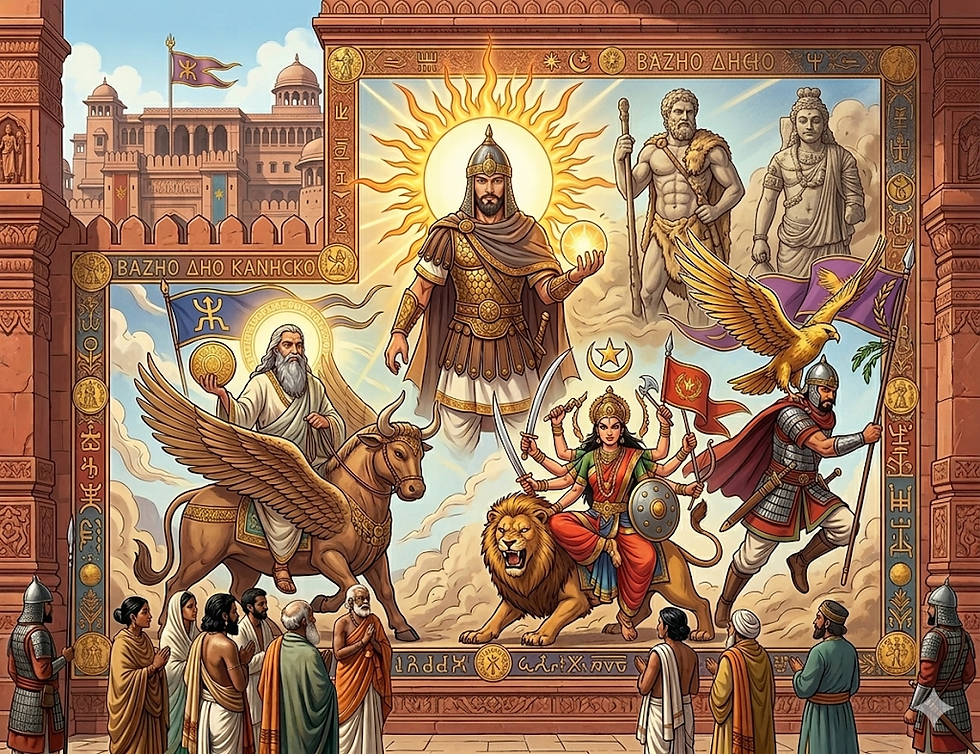
Other Iranian deities on Kushan coinage include Mazda (Ahura Mazda), the supreme god of Zoroastrianism; Nana, a goddess with both Iranian and Mesopotamian associations; Verethragna, the god of victory; and Vayu, the god of the wind.
The inclusion of these deities in the imperial pantheon demonstrates the Kushan commitment to honoring the religious traditions of their Iranian subjects.
Zoroastrian fire temples, the characteristic institutions of Zoroastrian worship, have been identified at Kushan sites. The great temple at Surkh Kotal in Afghanistan, with its monumental staircase and fire altar, was probably a Zoroastrian establishment, though it may also have served other religious functions. Inscriptions from the site record the activities of Kushan officials and the restoration of the temple under royal patronage.

The Kushan adaptation of Iranian religious traditions was not merely passive reception but active synthesis. Kushan artists and theologians combined Iranian, Indian, and Greek elements in new ways, creating religious forms that were distinctive to the empire.
The Kushan royal ideology, with its emphasis on the king as divine or semi-divine figure, drew upon Iranian concepts of kingship while incorporating elements from other traditions.
The Kushan Pantheon: Syncretism in Practice
The coinage of the Kushan Empire provides extraordinary evidence of religious syncretism in practice. No other ancient state included such a diverse array of deities on its official currency, and the choices of which deities to include and how to represent them reveal much about Kushan religious policy.
The Kushan pantheon was not fixed but evolved over time. Early Kushan coinage, under Kujula Kadphises, featured primarily Greek and Indian deities. Vima Kadphises introduced a wider range of Iranian gods and gave particular prominence to Shiva. Kanishka's coinage expanded the pantheon still further, including dozens of deities from multiple traditions, each identified by name in Bactrian legend .
The representation of these deities followed established iconographic conventions, but with interesting variations. Greek gods might be depicted in Hellenistic style but given Iranian names.
Indian gods might be shown with attributes derived from Greek or Iranian traditions. The results were sometimes startling hybrids that resist easy classification into modern categories of religious identity.
This religious syncretism was not merely a matter of imperial propaganda but reflected the lived reality of Kushan society. The empire's population included followers of many religious traditions, and these communities interacted in complex ways.
Merchants traveling along the Silk Road encountered new gods and religious practices. Artists working in imperial workshops learned techniques and motifs from multiple traditions. Monks and priests debated doctrine across sectarian boundaries.
The Kushan period thus represents a high point of religious exchange and synthesis in ancient Eurasia. The patterns of interaction established under Kushan rule would continue long after the empire's fall, shaping the religious landscape of Asia for centuries to come.
Part VI: Successors and Decline
The successors of Kanishka, his son Huvishka and his grandson Vasudeva, presided over the Kushan Empire during a period of consolidation and gradual change. While neither ruler matched Kanishka's military achievements or cultural patronage, both maintained the empire's integrity and continued its traditions.

Huvishka (reigned c. 150-190 CE) inherited an empire at its territorial peak. His coinage, which is abundant and varied, shows a continued commitment to the religious eclecticism of his predecessors.
The pantheon on Huvishka's coins is even more diverse than that of Kanishka, including numerous local and regional deities alongside the established imperial gods. This proliferation may reflect the growing importance of regional cults within the empire.
The reign of Huvishka also saw continued urban development and monumental construction. In Mathura, Huvishka patronized the construction of Buddhist monasteries and Hindu temples, leaving inscriptions that record his donations.
The great Buddhist establishment at Mathura, known from inscriptions as the "Huvishka-vihara," was one of the most important religious centers of northern India.
Vasudeva (reigned c. 190-230 AD) was the last great Kushan emperor. His name, derived from the Hindu god Vishnu, indicates the continuing Indianization of the Kushan dynasty, and his coinage shows a marked shift toward Hindu imagery. While Iranian deities continue to appear, the emphasis is increasingly on Shiva and other Indian gods.
The reign of Vasudeva witnessed the first serious challenges to Kushan power. To the west, the newly established Sasanian Empire of Persia, under its founder Ardashir I, began to expand into territories long controlled by the Kushans. To the east, local powers in the Ganges Valley began to assert their independence from Kushan control.
Despite these challenges, Vasudeva maintained the integrity of the Kushan realm for a reign of nearly four decades. His death around 230 AD marked the end of Kushan unity and the beginning of a period of fragmentation and decline.

The Sasanian Conquest and Kushano-Sasanian Interlude
The rise of the Sasanian Empire in Persia fundamentally altered the geopolitical situation of the Kushan realm. The Sasanians, under Ardashir I (reigned 224-240 CE) and his son Shapur I (reigned 240-270 AD), pursued an aggressive policy of expansion that brought them into conflict with the Kushans.

Sasanian inscriptions and reliefs record the conquest of Kushan territory. Shapur I's great inscription at Naqsh-e Rustam boasts that his empire extended "as far as Peshawar and the borders of Kashmir," indicating that much of the former Kushan heartland in Bactria and Gandhara had fallen under Sasanian control. The Kushan dynasty continued to rule in parts of northern India, but their power was greatly diminished.

The territories conquered by the Sasanians were organized as a vassal kingdom known in scholarship as the Kushano-Sasanian Kingdom. Ruled by Sasanian princes who bore the title "Kushanshah" (King of the Kushans), this realm maintained many Kushan traditions while acknowledging Sasanian suzerainty.
Kushano-Sasanian coinage combines Kushan and Sasanian elements, with rulers depicted in the distinctive Sasanian crown but using Kushan scripts and religious imagery.
The Kushano-Sasanian period (c. 230-365 AD) saw the continuation of many Kushan cultural traditions under new political masters. Buddhist monasteries continued to function, and Gandharan art continued to develop. The cities of Bactria and Gandhara, while perhaps diminished from their Kushan heyday, remained important centers of trade and culture.
The Kidarite and Hephthalite Invasions
The final eclipse of Kushan power came not from the south or west but from the north, as new nomadic peoples descended from the Central Asian steppes to overwhelm the settled civilizations of the region.

The Kidarites, a people apparently related to the later Hephthalites (White Huns), began to press into Bactria and Gandhara in the mid-4th century. Under their ruler Kidara, they established control over the remnants of Kushano-Sasanian territory and issued coins that combined Kushan, Sasanian, and their own elements.
The Kidarites maintained themselves in the region for several decades before being supplanted by the more powerful Hephthalites.

The Hephthalite conquest of the late 5th century completed the destruction of Kushan political power in Central Asia and northwestern India. The Hephthalites, unlike the Kushans before them, were not inclined to assimilate to settled civilization but maintained their nomadic ways and exacted tribute from the urban populations they dominated. Their rule marked a sharp break with the Kushan tradition of urban patronage and cultural synthesis.

In India, the rise of the Gupta Empire in the 4th century had already eclipsed the last independent Kushan rulers. The Guptas, under Chandragupta I (reigned c. 320-335 AD) and Samudragupta (reigned c. 335-375 AD), extended their control over much of northern India, including territories that had been under Kushan influence.
The last Kushan rulers in India, known from sparse coinage and inscriptions, were reduced to the status of local princes, their once-great empire a memory.
The Enduring Legacy
Although the Kushan Empire had ceased to exist as a political entity by the late 4th century, its legacy endured in multiple forms that shaped the subsequent history of Asia.
The administrative and economic institutions of the Kushans influenced the development of later states, including the Gupta Empire in India and the various successor kingdoms in Central Asia.
Kushan coinage continued to circulate long after the empire's fall, providing a model for subsequent currency systems. The Kanishka era, whatever its true starting date, remained in use for centuries in parts of Central Asia.
The religious transformations of the Kushan period had even more lasting consequences. The Mahayana Buddhism that developed under Kushan patronage became the dominant form of Buddhism in Central Asia, China, Korea, and Japan.
The Buddhist scriptures translated from Kushan manuscripts formed the basis of the Chinese Buddhist canon. The artistic traditions of Gandhara and Mathura influenced Buddhist art throughout Asia, from the cave temples of Dunhuang to the monasteries of Tibet.
The Kushan role in transmitting Buddhism to China is particularly significant. The Kushan monks who traveled eastward along the Silk Road, carrying manuscripts and images, were among the most important agents of cultural transmission in world history.

Their work laid the foundations for the transformation of Chinese civilization and, through China, for the development of Buddhist cultures throughout East Asia.
Modern archaeological research continues to reveal new dimensions of Kushan civilization. Joint projects between Chinese and Uzbek archaeologists, such as the excavations in Surxondaryo region of Uzbekistan, are filling gaps in our understanding of Kushan settlement patterns and material culture.
These investigations, part of broader efforts to strengthen cultural ties along the Belt and Road, demonstrate the continuing relevance of Kushan history to contemporary international relations.
Part VII: Controversies and Conspiracies
The most persistent and intractable controversy in Kushan studies concerns chronology. Despite more than a century of scholarship and dramatic discoveries such as the Rabatak inscription, fundamental disagreements persist about the dating of Kushan rulers and the relationship between Kushan history and the broader chronology of the ancient world.
The heart of the problem lies in the absence of a secure fixed point linking Kushan regnal years to absolute dates. Unlike the Roman Empire, with its consular lists and securely dated events, or Han China, with its detailed dynastic histories, the Kushans left no continuous historical narrative and no unambiguous synchronisms with other chronological systems.
Scholars have attempted to establish Kushan chronology through multiple lines of evidence: the testimony of Chinese historical sources, which provide some fixed points; numismatic analysis, tracing the development of coin types and their relationships to securely dated coinages; inscriptional evidence, particularly dated inscriptions that can be linked to known rulers; art historical analysis, tracing stylistic developments that can be correlated with other regions; and astronomical references in texts that might be calculated to specific years.
Despite these efforts, no consensus has emerged. The "high chronology" (placing Kanishka's accession in 78 CE) and the "low chronology" (placing it in 127 CE or later) each have their proponents, and intermediate positions have also been proposed.
The debate has sometimes generated more heat than light, with partisans of different positions accusing each other of ignoring evidence or reasoning circularly.
Recent scholarship has tended toward a moderate position, accepting a date around 120-127 CE for Kanishka's accession while acknowledging the provisional nature of this conclusion. The discovery of new inscriptions or the reanalysis of existing evidence could overturn this consensus at any time.
The Identity of the Yuezhi
A second major controversy concerns the ethnic and linguistic identity of the Yuezhi, the ancestors of the Kushans. While most scholars accept an Indo-European, specifically Tocharian origin for the Yuezhi, this conclusion rests on circumstantial evidence and has been challenged from multiple directions.
The case for Tocharian origin rests primarily on linguistic analysis of the Tocharian languages, which are attested in manuscripts from the Tarim Basin dating to the 6th-8th centuries AD. These languages show clear Indo-European affinities and have been linked to the Yuezhi based on geographical and historical considerations.
If the Yuezhi originated in the Gansu corridor and later migrated westward, they would have passed through or near the region where Tocharian languages are later attested.
However, the connection is not straightforward. The Tocharian manuscripts are separated by nearly a millennium from the period of Yuezhi dominance in Gansu, and the identification of the Yuezhi with the speakers of Tocharian remains hypothetical.
Some scholars have proposed alternative identifications, linking the Yuezhi to Iranian-speaking groups such as the Saka or to non-Indo-European peoples of Central Asia.
A recent hypothesis, advanced by Chinese archaeologist Wang Jianxin, suggests that the Kushans were not Yuezhi at all but rather descendants of the Greco-Bactrian population. According to this view, the Kushan dynasty emerged from the Hellenized population of Bactria rather than from nomadic invaders, and their connections to the Yuezhi have been overstated.
This hypothesis remains highly controversial and has not gained wide acceptance among specialists. It does, however, highlight the uncertainties that continue to surround the origins of the Kushan dynasty and the complexities of ethnic identity in ancient Central Asia.
The Rabatak Inscription and Its Implications
The discovery of the Rabatak inscription in 1993 was a watershed moment in Kushan studies, resolving some long-standing problems while creating new ones. The inscription, which records Kanishka's genealogy and his religious foundations, provided the first clear evidence for the sequence of early Kushan rulers and the relationship among them.
However, the inscription also generated new controversies. Its interpretation has been debated by specialists, with disagreements about the reading of particular passages and the implications for Kushan chronology. The relationship between the genealogy given in the inscription and the evidence of Chinese sources has been particularly contentious.
Some scholars have questioned whether the inscription should be taken at face value. Royal genealogies in ancient inscriptions are often tendentious, omitting inconvenient predecessors or inventing relationships to legitimize current rulers. The Rabatak inscription may present an idealized version of Kushan dynastic history rather than an accurate record.
Despite these uncertainties, the Rabatak inscription remains the single most important document for understanding Kushan political history. Its discovery transformed the field and continues to shape scholarly debate more than thirty years later.
Like many ancient civilizations, the Kushan Empire has attracted its share of fringe theories and pseudo-historical speculation. These theories, which circulate primarily on the internet and in popular publications, often reflect contemporary political or cultural agendas rather than serious historical scholarship.
Part VIII: The Kushan World in Global Context
The Kushan Empire flourished as one node in a global network of civilizations that, while often unaware of each other's existence, developed along parallel trajectories during the first four centuries AD.
Let's explore some of the parallel contemporary civilizations that coexisted with the Kushan realm, focusing on their internal developments rather than their interactions with the Kushans, which have been addressed.
Understanding these parallel societies illuminates the diverse pathways of human social development during this pivotal era.
The Americas: Independent Trajectories
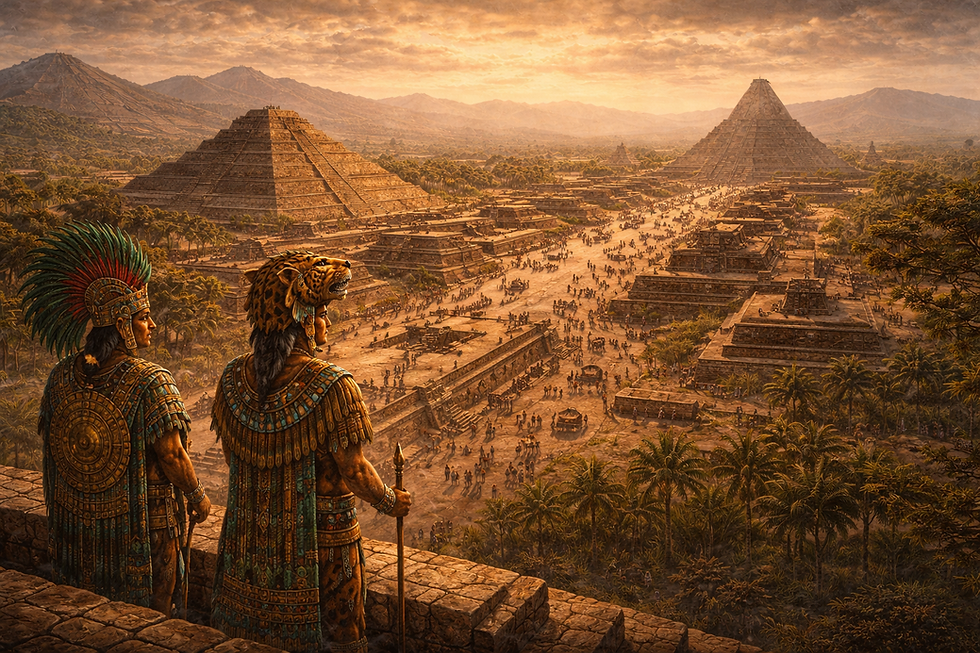
Teotihuacan: The City of the Gods
While the Kushans were building their empire across Central Asia, the great metropolis of Teotihuacan was rising in the highlands of central Mexico. Unlike the Kushan realm, which controlled a vast territory through military conquest and administrative integration, Teotihuacan's power radiated primarily through cultural influence and economic dominance rather than direct political control.
At its zenith between approximately 150 and 450 AD, Teotihuacan was one of the largest urban centers in the world, with a population estimated between 125,000 and 200,000 inhabitants.
The city's planned grid layout, oriented to celestial phenomena, covered approximately eight square miles and featured monumental architecture on a scale unmatched in Mesoamerica.

The Pyramid of the Sun, completed around 100 AD, rises over 200 feet and contains approximately one million cubic meters of volume; a construction project requiring the mobilization of tens of thousands of workers over decades.
Teotihuacan's society was highly stratified, with a ruling elite residing in elaborate palace complexes near the city center, while artisans, farmers, and laborers occupied increasingly modest dwellings toward the periphery.

The city was a major center of craft production, particularly of obsidian tools and luxury goods, which were traded throughout Mesoamerica. Teotihuacan-style pottery, architecture, and iconography have been found from the American Southwest to the Maya lowlands of Guatemala, attesting to the city's far-reaching influence.
The religious ideology of Teotihuacan centered on deities that would later appear in Aztec mythology; the Feathered Serpent (Quetzalcoatl), the Storm God (Tlaloc), and the Great Goddess. The Temple of the Feathered Serpent, constructed around 200-250 AD, contains evidence of mass human sacrifice, suggesting that state religion involved ritual violence on a considerable scale.

Around 550-600 AD, Teotihuacan suffered a catastrophic decline, with evidence of widespread burning and the deliberate destruction of elite structures. The causes remain debated; internal rebellion, environmental degradation, or invasion from rival polities, but the city's collapse left a power vacuum in central Mexico that would not be filled for centuries.

The Maya: Foundations of Classic Civilization
In the lowland jungles of Guatemala, Belize, and Mexico's Yucatan Peninsula, the period corresponding to the Kushan Empire witnessed the transition from the Late Preclassic to the Early Classic period of Maya civilization. This era laid the foundations for the fluorescence that would characterize Maya civilization between approximately 250 and 900 AD.
During the 1st and 2nd centuries AD, the great Preclassic cities of the Mirador Basin like El Mirador, Nakbe, Tikal experienced decline and partial abandonment. El Mirador, which had been one of the largest cities in the Americas during the Late Preclassic (c. 300 BC - 100 AD), with monumental architecture rivaling Teotihuacan, was largely depopulated by 150 AD.
The causes of this collapse remain debated but likely involved a combination of environmental degradation, agricultural exhaustion, and social upheaval.
From this disruption, new political centers emerged. Tikal, which had been a secondary center during the Preclassic, began its ascent to prominence during the 2nd and 3rd centuries AD.

The earliest dated monument at Tikal—Stela 29—bears a Long Count date corresponding to 292 AD, marking the beginning of the city's dynastic history. By the late 4th century, Tikal had become the dominant power in the southern Maya lowlands, with monumental architecture, elaborate royal tombs, and a complex hieroglyphic writing system.
The Maya during this period developed the intellectual achievements for which they would become famous; the Long Count calendar, sophisticated mathematics including the concept of zero, and a fully developed writing system capable of recording historical events and dynastic succession. These innovations, rooted in Preclassic precursors, were refined and systematized during the Early Classic period.

Maya society was organized into competing city-states, each ruled by a divine king (k'uhul ajaw) who claimed descent from the gods and served as intermediary between the human and supernatural realms. Warfare between these polities was frequent and ritualized, with the capture of high-ranking prisoners for sacrifice a primary objective.
The political landscape of the Maya lowlands during this period was characterized by shifting alliances, dynastic marriages, and periodic conflicts—a pattern strikingly similar to the city-state politics of classical Greece or ancient Mesopotamia, developed in complete isolation from Old World influences.

The Moche: Masters of the North Coast
On the arid north coast of Peru, the Moche civilization (c. 100-800 AD) emerged as one of the most distinctive and sophisticated societies of the ancient Americas. Unlike the highland-based civilizations of the central Andes, the Moche developed in a series of river valleys descending from the Andes to the Pacific Ocean, each valley an oasis of agricultural productivity in the coastal desert.
Moche society was organized into two or possibly three distinct political entities, sometimes characterized as the Northern Moche (centered in the Jequetepeque and Lambayeque valleys) and the Southern Moche (centered in the Moche and Chicama valleys).
The southern capital, known today as the Huacas de Moche, featured two massive monumental structures, the Huaca del Sol and the Huaca de la Luna, constructed from millions of adobe bricks. The Huaca del Sol, one of the largest adobe structures in the Americas, originally stood approximately 40 meters high and required an estimated 143 million bricks for its construction.

The Moche are particularly renowned for their ceramic art, which depicts the full range of Moche life with extraordinary naturalism and narrative complexity. Moche vessels portray warriors, prisoners, musicians, weavers, sexual acts, and supernatural beings with a level of detail that provides unparalleled insights into Moche society.
The so-called "fine-line" paintings on Moche pottery depict elaborate scenes of warfare, sacrifice, and ritual, including the presentation of a goblet of blood to a masked figure; the "Sacrifice Ceremony" that appears to have been a central ritual of Moche religion.

Moche metallurgy was equally sophisticated, with artisans working in gold, silver, copper, and their alloys to produce ornaments, ritual objects, and tools. The Moche developed techniques for gilding, soldering, and lost-wax casting that were not surpassed in the Old World for centuries.

The royal tombs at Sipán, discovered in the late 1980s, contained the richest assemblage of pre-Columbian metalwork ever found, demonstrating the enormous wealth and complex ritual life of Moche elites.
Moche religion centered on a pantheon of anthropomorphic deities with both human and animal attributes—the Fanged God, the Bird Warrior, the Crab Monster—who appear repeatedly in Moche art. Human sacrifice played a central role in Moche ritual, with prisoners of war being killed and dismembered in ceremonies that reinforced the power of the ruling elite and the cosmic order.

The Moche civilization began to decline around 600-700 AD, likely due to environmental factors; a series of extreme El Niño events that brought catastrophic flooding followed by prolonged drought.
These climatic disruptions undermined Moche agriculture, destabilized political authority, and led to the abandonment of many Moche centers. By 800 AD, Moche civilization had given way to new polities, including the Lambayeque and Chimú, that inherited and transformed Moche traditions.

The Nazca: Lines in the Desert
South of the Moche heartland, on the arid south coast of Peru, the Nazca culture (c. 100-700 AD) developed in the valleys of the Ica and Nazca rivers. Like the Moche, the Nazca were a complex agricultural society, but their environment was even more extreme; a desert so dry that rain is virtually unknown, with agriculture dependent entirely on irrigation from rivers fed by Andean snowmelt.

The Nazca are best known for the famous Nazca Lines, enormous geoglyphs etched into the desert surface by removing dark oxidized stones to expose the lighter soil beneath. These figures, which include animals, plants, geometric forms, and human-like figures, range in size from a few meters to hundreds of meters across. The largest are the "hummingbird" (93 meters long), the "condor" (134 meters), and the "pelican" (285 meters).
The purpose of the Nazca Lines has been debated since their discovery. The most widely accepted interpretation, advanced by the German mathematician Maria Reiche, holds that they had astronomical and calendrical significance, with certain lines aligning with solstices or the rising points of important stars.
More recent scholarship suggests they may have been processional pathways for ritual activities, with the figures serving as sacred spaces where communities gathered for ceremonies related to water and fertility; the most precious resources in this hyper-arid environment.
Nazca pottery is distinctive for its polychrome decoration, with up to a dozen colors used to depict complex mythological scenes and geometric patterns. Unlike the naturalistic Moche vessels, Nazca ceramics are more stylized and symbolic, suggesting different artistic conventions and perhaps different religious conceptions.
The Nazca also practiced sophisticated trepanation; surgical removal of portions of the skull with evidence of high survival rates, indicating considerable medical knowledge.
Nazca society appears to have been less centralized than Moche civilization, organized into a series of related chiefdoms rather than a unified state. The Nazca heartland contains numerous ceremonial centers, including Cahuachi, the largest adobe structure in the region, which served as a pilgrimage center rather than an urban settlement.
Around 700 AD, Nazca culture was absorbed by the expanding Wari Empire, which originated in the highlands and spread to dominate much of Peru.
Aksum: African Civilization on the Red Sea

While the Kushans controlled the overland routes of Central Asia, the Aksumite Empire dominated the maritime trade of the Red Sea and northeastern Africa. Located in the highlands of modern Ethiopia and Eritrea, with its capital at Aksum, this civilization emerged around the 1st century AD and flourished until the 7th century.
Aksum's rise was intimately connected to its position as an intermediary between the Roman Mediterranean and the Indian Ocean world. The Aksumite port of Adulis, on the Red Sea coast, became one of the great emporia of the ancient world, where goods from Africa—ivory, gold, incense, slaves—were exchanged for Roman glass and metalwork, Indian textiles, and Arabian spices.
The Periplus of the Erythraean Sea, a Greek merchant's guide from the mid-1st century AD, describes Adulis as a thriving port and provides detailed information about the trade routes connecting the Red Sea to India.

Aksumite civilization developed its own distinctive characteristics. The Aksumites spoke Ge'ez, a Semitic language related to the languages of South Arabia, and developed a script that remains in use for liturgical purposes in Ethiopia today.
Aksumite architecture is remarkable for its monumental stone stelae; obelisks carved from single blocks of granite, the largest of which (now fallen) stood over 30 meters tall and weighed approximately 500 tons. These stelae, decorated with representations of multi-story buildings with doors and windows, marked the tombs of Aksumite royalty and elite.
The Aksumite state was highly centralized, with a king (negusa nagast—"king of kings") who claimed divine authority and controlled the appointment of regional governors. Aksumite coinage, introduced in the late 3rd century under King Endubis, was issued in gold, silver, and bronze, following Roman and Kushan precedents. The gold coins, in particular, facilitated international trade and projected Aksumite prestige abroad.
Religion in Aksum underwent significant transformation during the Kushan period. Early Aksumite religion was polytheistic, with a pantheon headed by Mahrem, a god identified with the Greek Ares, and including Astar (equivalent to Ishtar/Astarte), Beher (god of the sea), and Medr (goddess of the earth). South Arabian influences are evident in the iconography and in the practice of erecting thrones and altars to commemorate royal achievements.
The most significant religious development occurred in the mid-4th century under King Ezana (c. 320-360 AD), who converted to Christianity and made it the state religion; one of the first states in history to do so.
Ezana's inscriptions document this transition: early inscriptions invoke the traditional gods, while later inscriptions begin with the formula "In the faith of God and the Lord of all, who has created heaven and earth"—clear Christian language. Aksum thus became, after Armenia, the second Christian kingdom in history, and it established enduring ties with the Coptic Church of Egypt that continue to shape Ethiopian Orthodox Christianity today.

Aksumite civilization maintained contacts with the broader world throughout the Kushan period. Byzantine sources record diplomatic exchanges between Aksum and Constantinople.
Aksumite merchants traveled to India and Sri Lanka, and Aksumite coins have been found in Indian archaeological contexts. The connection between Aksum and the Kushan world, while indirect, was mediated through the Indian Ocean trade networks that linked both empires to the wider Indian Ocean world.
Southeast Asia: The Beginnings of State Formation

Funan: The First Southeast Asian Kingdom
During the first four centuries AD, the first sophisticated states emerged in mainland Southeast Asia. The most significant of these was Funan, located in the Mekong Delta region of modern Vietnam and Cambodia, which flourished from approximately the 1st to the 6th centuries AD.
Our knowledge of Funan comes primarily from Chinese dynastic histories, which describe it as a powerful maritime kingdom. The History of Liang (Liang Shu), compiled in the 7th century but based on earlier sources, records that Funan was founded by a Brahmin named Kaundinya, who married the local queen Soma and introduced Indian customs, law, and writing.
While this foundation legend may be mythical, it accurately reflects the profound Indian influence on Funanese civilization.

Funan controlled the vital maritime trade routes between India and China, serving as the primary entrepôt for goods passing through the Strait of Malacca. Funanese ports; particularly Oc Eo in the Mekong Delta were cosmopolitan centers where merchants from India, China, Persia, and the Mediterranean exchanged goods.
Archaeological excavations at Oc Eo have revealed Roman gold medallions from the reign of Antoninus Pius (138-161 AD), Sasanian seals, Indian beads, and Chinese bronzes; testament to the site's international connections.
The Funanese economy was based on a combination of agriculture, craft production, and trade. The Mekong Delta's fertile soils supported intensive rice cultivation, producing surpluses that supported urbanization and specialized craft production.
Funanese artisans worked in gold, silver, bronze, and semi-precious stones, producing luxury goods for local elites and for export.
Funanese society was hierarchical, with a king at the apex who claimed divine authority and controlled access to foreign trade goods. Chinese sources describe elaborate court rituals, including the use of parasols, palanquins, and gold ornaments as markers of rank.
The Funanese writing system, adapted from Indian scripts, was used for administrative and religious purposes, though few inscriptions have survived.
Religion in Funan combined indigenous beliefs with imported Indian traditions. Hinduism, particularly Shaivism, was patronized by the elite, and Sanskrit inscriptions record donations to Hindu temples.
Buddhism was also present, as evidenced by Buddhist images and inscriptions, though it may have been less prominent than Hinduism. The synthesis of Indian and local traditions in Funan established patterns that would characterize Southeast Asian civilizations for the next millennium.
Funan's political history is poorly documented. Chinese sources mention a series of kings, including Fan Shiman (c. 205-225 AD), who established Funanese hegemony over neighboring polities and sent embassies to the Chinese court.
By the 4th century, Funan was in decline, facing competition from emerging polities in Java and Sumatra and from its own vassal state, Chenla, which would eventually absorb Funan in the 6th century.

Early Indonesian Polities
In the Indonesian archipelago, the first states were emerging during the same period. Unlike the mainland states, which were primarily agrarian, these early Indonesian polities were coastal trading kingdoms, controlling the maritime routes that connected the Indian Ocean to the South China Sea.
The earliest Indonesian inscriptions date from the 4th century AD. The Kutai inscriptions from eastern Borneo, written in Sanskrit using the Pallava script, record the deeds of King Mulavarman, who donated vast quantities of gold and cattle to Brahmins and erected sacrificial posts.
The inscriptions indicate that Mulavarman's kingdom was already Indianized, with a Sanskrit court language, Hindu rituals, and Brahmin priests.

Similarly, the Tarumanagara kingdom in western Java is attested by inscriptions from the mid-4th century. The Ciaruteun inscription, bearing the footprint of King Purnavarman, compares him to Vishnu and indicates that he ruled a prosperous kingdom with irrigation systems and a centralized administration.
Like the Kutai inscriptions, these texts demonstrate the early penetration of Indian culture into the archipelago.
These early Indonesian polities were not territorial states in the Kushan sense but rather "port-polities,"—maritime trading centers that controlled limited hinterlands but exercised dominance over sea lanes and trade networks.
Their wealth came not from agricultural surplus but from their ability to control and tax the flow of goods through the Strait of Malacca and the Sunda Strait, the two principal passages between the Indian Ocean and the South China Sea.
The Indianization of Southeast Asia during this period; the adoption of Indian scripts, religious traditions, political ideologies, and artistic conventions was not the result of conquest or colonization but of voluntary adoption by local elites.
Indian culture offered prestige, legitimacy, and access to international networks that enhanced the power of local rulers. The process was gradual and selective, with Southeast Asian societies adapting Indian models to local conditions and preferences.
Japan: From Yayoi to Kofun

The Late Yayoi Period
In the Japanese archipelago, the period corresponding to the Kushan Empire witnessed profound transformations in society, technology, and political organization. The Yayoi period (c. 300 BC - 300 AD), named for the Tokyo neighborhood where its distinctive pottery was first identified, saw the introduction of wet-rice agriculture, metallurgy, and social stratification from the Asian mainland.
Rice agriculture, introduced from Korea around 300 BC, fundamentally transformed Japanese society. Rice paddies required coordinated labor for construction and maintenance, fostering the development of increasingly complex social organization.
Surplus production supported population growth, the emergence of social elites, and the development of craft specialization. By the 1st century AD, Japanese society was organized into numerous small chiefdoms, each controlling a river valley or coastal plain.
Chinese sources provide our earliest written accounts of Japan. The Wei Zhi (Records of Wei), compiled in the late 3rd century AD, describes the land of "Wa" (Japan) as divided into approximately thirty small countries, with a queen named Himiko who ruled over a federation of chiefdoms.

Himiko, the account states, "occupied herself with magic and sorcery, bewitching the people," and maintained her authority through ritual power rather than military force. She sent embassies to the Chinese court, establishing diplomatic relations that brought prestige and access to Chinese luxury goods.
Archaeological evidence confirms the picture of increasing social stratification during the late Yayoi period. Elite burials from this period contain bronze mirrors, swords, and beads imported from Korea and China, as well as locally produced goods that indicate the emergence of a warrior aristocracy. Settlements became larger and more fortified, suggesting increased warfare among competing chiefdoms.

The Kofun Period
Around 250-300 AD, as the Kushan Empire entered its final phase of decline, Japan transitioned into the Kofun period (c. 250-538 AD). This period is named for the distinctive keyhole-shaped burial mounds (kofun) constructed for the ruling elite; one of the most remarkable funerary traditions in world archaeology.
The largest of these mounds are truly monumental. The Daisenryo Kofun in Osaka, traditionally identified as the tomb of Emperor Nintoku, measures 486 meters in length and is surrounded by three moats.

Its construction required the movement of approximately 1.4 million cubic meters of earth; a labor mobilization comparable to the construction of the Egyptian pyramids. Hundreds of smaller kofun dot the landscape of central Japan, their size and distribution reflecting the hierarchy of political power.
Kofun-period tombs contain elaborate grave goods that illuminate the material culture and social organization of the period. Bronze mirrors, many imported from China and others locally produced, symbolized authority and legitimacy.
Iron weapons like swords, spearheads, arrowheads attest to the military character of elite society. Horse trappings, introduced from Korea during this period, indicate the growing importance of cavalry. The famous haniwa—hollow ceramic cylinders and figures placed on the mound surfaces—depict warriors, horses, houses, and ritual attendants, creating a symbolic retinue for the deceased ruler.

The Kofun period witnessed the consolidation of political power and the emergence of a unified Yamato state. The Yamato court, located in the Nara Basin, gradually extended its control over neighboring chiefdoms through a combination of military conquest, diplomatic marriage, and ideological authority.
By the 5th century, Yamato rulers claimed sovereignty over much of Japan and maintained diplomatic relations with the Korean kingdoms and the Chinese court.
Religion during the Kofun period is poorly documented but can be inferred from archaeological evidence. The elaborate funerary rituals suggest belief in an afterlife where the deceased required material goods and symbolic protection.
The emergence of a distinct imperial ideology, linking the Yamato rulers to the sun goddess Amaterasu, probably has its roots in this period, though it would not be fully articulated until later centuries.
Korea: From Samhan to Three Kingdoms

The Samhan Confederacies
In the Korean peninsula, the period corresponding to the Kushan Empire witnessed the transformation of tribal confederacies into centralized kingdoms. The Samhan period (c. 100 BC - 300 AD) takes its name from the three confederacies—Mahan, Jinhan, and Byeonhan—that occupied the southern half of the peninsula.
The Samhan emerged following the fall of Gojoseon and the establishment of Chinese commanderies in the north. Chinese historical texts describe these confederacies as comprising numerous small statelets, each with its own ruling chief.
Mahan, the largest, controlled the Han River basin and western coastal plains with approximately fifty constituent polities. Jinhan occupied the Gyeongju Basin in the southeast with twelve statelets, while Byeonhan controlled the Nakdong River delta region, renowned for its iron production.
Iron technology revolutionized Samhan society. The Nakdong River basin possessed rich iron ore deposits, and Byeonhan became the primary iron producer of ancient Northeast Asia. Iron tools increased agricultural productivity; iron weapons enabled greater concentrations of power.
The Records of the Three Kingdoms (San Guo Zhi) records that iron from Byeonhan was exported to the Chinese commanderies at Lolang and to the Wa kingdoms of Japan, creating an economic network that linked the peninsula to the broader East Asian world.
Archaeological evidence confirms active trade connections. Chinese bronze mirrors, ritual vessels, and coins have been found in Samhan shell middens and tombs. Artifacts from the northern steppe cultures and Yayoi Japan appear alongside locally produced goods, demonstrating the peninsula's role as a cultural crossroads.
Samhan society was stratified, with chiefly elites controlling access to imported luxury goods and iron wealth. Settlements varied from small hamlets to larger fortified centers.
Shamanism played an important role in political and religious life, with ritual specialists mediating between the human and supernatural realms. Cultural practices included distinctive cranial deformation, flattening infants' heads against rocks, observed in Jinhan and Byeonhan and continuing into the later Gaya period.

The Gaya Confederacy
From the Byeonhan confederacy emerged the Gaya confederacy, a distinctive political entity that maintained its independence until the 6th century. Geumgwan Gaya, centered in modern Gimhae, was founded according to tradition in 42 AD by King Kim Suro, said to have descended from heaven.
Gaya's prosperity rested on iron. The Nakdong River delta's iron deposits made Gaya the workshop of Northeast Asia, supplying iron ore, ingots, and finished weapons to neighboring polities and across the sea to Japan. This iron trade enriched Gaya elites and supported the development of sophisticated craft production.
Gaya culture achieved remarkable sophistication despite political fragmentation. High-fired gray stoneware, gilt-bronze work, and elaborate iron armor and horse trappings attest to the skill of Gaya artisans. The Gaya tombs at Daeseong-dong in Gimhae and Jisan-dong in Daegu have yielded rich assemblages of iron goods, pottery, and imported luxury items.
The Gaya trade network linked Baekje to the west with the Japanese archipelago across the Korea Strait. However, this network was disrupted at the end of the 4th century by Goguryeo's expansion southward.
An attack by Goguryeo forces weakened Geumgwan Gaya's position, leading to the collapse of the Former Gaya Confederation. Several Gaya states later reorganized around Daegaya as the center, forming the Latter Gaya Confederation, which traded directly with China.

The Rise of Goguryeo, Baekje, and Silla
By the 4th century AD, the political landscape of Korea was transforming dramatically. The northern kingdom of Goguryeo, consolidating power since its traditional founding in 37 BC, began its expansion in earnest.
Located in the mountainous region north of the Korean peninsula and extending into Manchuria, Goguryeo maintained an independent trajectory while neighboring Chinese commanderies fell one by one.
Goguryeo society was militarily oriented, with mounted warriors playing an increasingly important role. The kingdom's development during the 2nd and 3rd centuries AD saw the gradual centralization of authority under a monarch who ruled with the aid of a landed aristocracy. Government-appointed officials administered provinces with the assistance of local tribal leaders.
In the southwest, Baekje emerged from the Mahan confederacy. Traditionally founded in 18 BC, Baekje gradually consolidated control over the Han River basin and extended its influence along the western coast. Baekje's prosperity derived from its fertile agricultural lands and its strategic position for trade with China via the Yellow Sea.
The kingdom developed particularly close cultural ties with the Japanese archipelago, sending teachers, scholars, and artists who transmitted Chinese culture, including Confucian classics, to the Wa courts.
In the southeast, Silla took shape from the Jinhan confederacy. According to the Samguk Sagi (12th century AD), Silla was founded in 57 BC by Bak Hyeokgeose, who united six clans of Jinhan under his rule.
The Saro statelet, centered in the Gyeongju Basin, gradually absorbed neighboring chiefdoms to form the nucleus of the Silla kingdom. During the 4th century, Silla developed the "sacred bone" rank system; a rigid hereditary hierarchy that dictated every aspect of life.
The relationship among these emerging kingdoms was complex and dynamic. Baekje initially formed alliances with Silla to counter Goguryeo pressure.
Goguryeo's expansion southward brought it into direct conflict with Baekje, leading to the death of the Goguryeo king Gogugwon in a 371 AD battle with Baekje forces; a significant setback that temporarily checked northern ambitions.

The introduction of Buddhism, which would transform Korean civilization, occurred at the very end of the Kushan period. Buddhism was officially adopted by Goguryeo in 372 AD, by Baekje in 384 AD, and by Silla in 527-535 AD.
This timing means that the Kushan Empire's role in transmitting Buddhism along the Silk Road directly parallels the initial reception of Buddhism in Korea.
When the monk Sundo brought Buddhist scriptures and images to the Goguryeo court in 372 AD, he was following a path that Kushan translators like Lokakṣema had helped to open. The Kushan Empire was nearing its end, but its legacy was reaching new shores.
The gold and iron of Korea, the silk and ideas of Central Asia, the scriptures and art of India; all were flowing through networks that the Kushans had done so much to create and maintain.
The Kushan and Korean trajectories, while separate, illuminate broader patterns of Eurasian history: the transformation of tribal confederacies into centralized states, the revolutionary impact of iron technology, and the transmission of Buddhism from its Indian homeland to new cultural spheres.
Korea became the conduit through which Buddhism would pass to Japan, ensuring that the religious transformations pioneered under Kushan patronage would echo across East Asia for centuries to come.
Northern Europe: The Roman Iron Age and Germanic Peoples

The Roman Iron Age
Beyond the frontiers of the Roman Empire, in the forests and plains of northern Europe, the period corresponding to Kushan rule is known as the Roman Iron Age (c. 1-400 AD). During these centuries, the Germanic, Celtic, and Baltic peoples of northern Europe had extensive contact with the Roman world through trade, military service, and occasional conflict.
The relationship between Rome and the Germanic peoples was complex and multifaceted. Along the Rhine and Danube frontiers, a network of forts, towns, and markets facilitated regulated trade and diplomatic exchange.
Germanic warriors served in Roman auxiliary units, gaining military experience and exposure to Roman culture that they carried back to their homelands. Roman luxury goods like glass vessels, bronze and silver tableware, weapons, jewelry, and coins flowed northward in exchange for amber, cattle, slaves, and animal products.
The wealth generated by this trade fueled social transformation in Germanic societies. Chieftains who controlled access to Roman goods and brokered relations with the empire accumulated unprecedented wealth and power.
Their graves, particularly in Denmark and northern Germany, contain lavish assemblages of Roman imports alongside locally produced prestige goods. The Hoby chieftain's grave in Denmark, dating to the early 1st century AD, contained two silver cups of Greek manufacture, Roman bronze vessels, and gold jewelry; testament to the far-reaching connections of northern European elites.
Settlement patterns reflect increasing social stratification and political centralization. In Denmark, the Iron Age witnessed the emergence of central places; sites with specialized functions including trade, craft production, cult practice, and political assembly. The site of Gudme on the island of Funen, occupied from the 3rd to the 6th centuries, contained rich metal deposits, imported goods, and evidence of large-scale feasting, suggesting it served as a center for an extensive network of chiefdoms.
Germanic religion during this period is known primarily from later sources, particularly the Icelandic sagas and the Germania of Tacitus (written c. 98 AD). Tacitus describes the Germanic peoples as worshipping a pantheon of gods; Mercury/Hermes (interpreted as Odin/Wotan), Hercules (Thor/Donar), and Mars/Ares (Tyr/Tiw) through sacrifices in sacred groves.
He also mentions divination, seers, and the worship of a goddess named Nerthus, associated with fertility and peace. These religious practices, while poorly documented archaeologically, formed the foundation for the later Viking Age religion.

The Wielbark and Chernyakhov Cultures
In eastern Europe, the 2nd to 4th centuries AD witnessed the development of complex archaeological cultures associated with the Goths and other Germanic peoples. The Wielbark culture (c. 1-300 AD), centered in modern Poland, is associated with the Goths described by the historian Jordanes in his Getica (c. 550 AD).
The Wielbark people practiced both cremation and inhumation, with distinctive grave goods including pottery, metalwork, and occasional Roman imports.
The Chernyakhov culture (c. 200-400 AD), extending from modern Romania to Ukraine, represents a multi-ethnic complex including Goths, Gepids, Sarmatians, and Dacians. Chernyakhov settlements were substantial, with rectangular houses, iron production, and long-distance trade connections.
The culture's characteristic gray wheel-made pottery, metalwork, and burial practices show a synthesis of Germanic, Sarmatian, and provincial Roman elements.
The Goths and related peoples played a crucial role in the transformation of the Roman world. In 238 AD, Goths crossed the Danube and raided the Roman province of Moesia, beginning a century of intermittent conflict.
In 251 AD, they defeated and killed the Roman emperor Decius at the Battle of Abrittus; a shocking event that signaled the growing military threat on the Danube frontier. By the late 3rd century, Gothic power had expanded to the point that the emperor Aurelian (270-275 AD) abandoned the province of Dacia north of the Danube, settling its Roman citizens south of the river.
The 4th century witnessed continued Gothic-Roman interaction. The emperor Constantine (306-337 AD) campaigned against the Goths and concluded a treaty that made them federate allies, obligated to provide troops in exchange for subsidies.
Gothic warriors served in Roman armies throughout the century, and Gothic converts to Christianity, particularly the followers of the missionary Ulfilas (Wulfila), began the process of Christianization that would transform Gothic society.
The arrival of the Huns in the late 4th century shattered this equilibrium. In 375 AD, the Huns crossed the Volga and overwhelmed the Gothic kingdoms north of the Black Sea. Some Goths submitted to Hunnic rule; others fled across the Danube into Roman territory, seeking refuge.
Their mistreatment at the hands of Roman officials led to the Gothic War (376-382 AD) and the catastrophic Roman defeat at the Battle of Adrianople in 378 AD, where the emperor Valens and two-thirds of his army perished. These events, occurring just as the Kushan Empire breathed its last, inaugurated the age of migrations that would transform Europe.
Comparative Reflections: Divergent Paths
Surveying these parallel civilizations reveals both common patterns and striking divergences in human social development during the first four centuries AD.
Urbanization followed different trajectories in different regions. Teotihuacan and Rome represented the pinnacle of urban development, with populations in the hundreds of thousands and monumental architecture on an unprecedented scale. At this time, even Egypt was under Roman control since the time of Octavian.
Aksum, while smaller, developed distinctive urban forms centered on royal and religious monuments. Northern Europe and Japan, by contrast, remained largely non-urban, with political and economic life centered on chieftains' halls and central places rather than true cities.
State formation progressed at different rates. The Mediterranean, Middle Eastern, and Ancient Indian civilizations had millennia of state experience behind them; Rome, Parthia, and Kushan were heirs to long imperial traditions.
In Southeast Asia and Japan, the first states were emerging during this period, borrowing models from more advanced neighbors while adapting them to local conditions. The Americas developed states independently, with Teotihuacan representing a distinctive form of hegemonic city-state and the Maya developing a competitive system of divine kingship.
Writing systems varied enormously.
The Mediterranean world had alphabetic scripts; China had logographic writing; Mesoamerica had complex hieroglyphic systems; the Andes had no true writing but developed sophisticated recording devices (quipu) that remain imperfectly understood. Aksum developed its own script from South Arabian prototypes, while Southeast Asian societies adopted the advanced Indian scripts for their own languages.
Religious developments show both parallel trends and regional particularities. The period witnessed the spread of universalizing religions—Buddhism, Christianity, Manichaeism—that transcended ethnic and political boundaries.
At the same time, traditional polytheisms persisted and adapted, with local gods incorporated into imperial pantheons and new syntheses emerging. In the Americas, religion remained closely tied to state power and cosmic cycles, with human sacrifice playing a role unknown in the Old World.
Technology and economy followed different trajectories shaped by geography and history. The Old World civilizations shared a common technological heritage—iron metallurgy, wheeled vehicles, domesticated horses—that facilitated long-distance contact and exchange.
The Americas, lacking these technologies, developed along different paths, with sophisticated metallurgy in the Andes but not in Mesoamerica, and complex agricultural systems based on maize, beans, and squash rather than wheat, rice, and millet.
The Kushan Empire, situated at the crossroads of civilizations, participated in the Old World networks that linked Rome to China, India to Central Asia. Its contemporaries in the Americas and northern Europe developed in relative isolation, yet achieved comparable levels of complexity and sophistication.
Their parallel existence reminds us that human civilization has followed multiple pathways, each worthy of study and appreciation.
Part IX: The Kushan Empire in Popular Culture
While the historical Kushan Empire remains relatively obscure outside specialist circles, its legacy has found unexpected resonance in modern popular culture. From manga and anime to strategy video games and documentary films, the Kushans have been rediscovered and reimagined by contemporary creators.
This section examines the various ways the Kushan Empire has been depicted in popular media, the accuracy of these portrayals, and what they reveal about the enduring fascination with this ancient civilization.
Kentaro Miura's Berserk: The Kushan Empire as Antagonist

The most prominent and influential depiction of the Kushan Empire in popular culture appears in Kentaro Miura's acclaimed manga series Berserk, which began serialization in 1989 and continued until Miura's death in 2021.
Set in a dark fantasy world inspired by medieval Europe, Berserk follows the journey of Guts, a lone mercenary cursed with a dark fate, as he battles demonic forces and seeks revenge against his former friend Griffith, who sacrificed their comrades to become a godlike being.
The series is renowned for its intricate artwork, complex characters, and grim exploration of themes such as fate, free will, and the nature of evil. Miura drew extensively from European history and mythology; the Holy See religious order, the Kingdom of Midland, and the Hundred-Year War evoke parallels with the Crusades, the Holy Roman Empire, and the Hundred Years' War.
However, in the series' later arcs, Miura introduced a formidable eastern empire that would serve as the primary antagonist: the Kushan Empire.
In the world of Berserk, the Kushan Empire is a vast and powerful realm located to the far east of the Holy See nations, separated from Midland by a great mountain range. Its culture and religion are distinctly different from the European-inspired societies of the west.
The empire is ruled by the enigmatic Emperor Ganishka (based on Kanishka the Great), a figure of terrifying power who seeks to conquer the western lands and destroy the Holy See.
Miura's Kushan Empire is not a monolithic state but rather a complex political entity comprising multiple tribes and clans united under a ruling house. This structure creates internal tensions, as various factions harbor grudges against the dominant clan and each other.
One such faction is the Bakiraka clan, a family of assassins who serve the empire but maintain their own distinct identity and ambitions.
The portrayal of Kushan society draws upon multiple historical and cultural sources. The empire's name is directly borrowed from the historical Kushan Empire, and the Spanish-language Berserk wiki explicitly notes this connection, stating that "the Kushan empire existed in ancient India between the 1st and 2nd centuries AD."
However, Miura's depiction incorporates elements from various other cultures:
Ottoman Empire Influences: The Kushan army utilizes janissary-like slave soldiers, expands across European-like territory under religious pretexts, and confronts a Holy League alliance reminiscent of the historical conflicts between the Ottoman Empire and Christian powers. The architecture visible in later episodes, particularly a building resembling the Hagia Sophia in Istanbul, reinforces this Ottoman parallel.
Indian Influences: Emperor Ganishka's name appears to derive from Kanishka, the most famous ruler of the historical Kushan Empire. The empire's weapons include numerous South Asian implements such as valaris (throwing sticks), pesh-kabzs (Persian-Indian daggers), chakrams (Indian circular throwing weapons), katars (Indian punch daggers), kukris (Nepalese knives), and talwars (Indian curved swords). War elephants, a staple of Indian warfare, feature prominently in the Kushan military.
Mongol Influences: In later chapters, readers discover that the Kushan government includes an assembly called the "Kurultai," composed of chiefs from various tribes. This term and institution derive directly from the Mongol Empire, where the kurultai served as a council of nobles for electing khans.
Persian Influences: The Kushan military employs dastars (turbans), jambiyas (curved daggers), and kards (knives) that reflect Persian and broader Islamic world influences.
This syncretic approach, combining elements from multiple historical cultures into a single fictional civilization, mirrors the syncretism of the historical Kushan Empire itself, which blended Greek, Persian, Indian, and Central Asian traditions.
Miura, whether consciously or unconsciously, created a fictional counterpart that embodies the multicultural character of its historical namesake.
The Kushan Empire's role as a crossroads of civilizations has particular resonance in the contemporary world. As globalization, multiculturalism, and intercivilizational dialogue have become central concerns, the Kushan example offers historical precedent for peaceful coexistence and cultural synthesis.
Appendix: Kushan Rulers and Chronology
Heraios | c. 1-30 CE | Possibly father of Kujula | Early Kushan ruler in Bactria; issued first Kushan coins
Kujula Kadphises | c. 30-80 CE | Founder of dynasty | United Yuezhi tribes; conquered Kabul and Gandhara
Vima Taktu (Soter Megas) | c. 80-105 CE | Son of Kujula | Expanded into India; issued anonymous "Soter Megas" coinage
Vima Kadphises | c. 105-127 CE | Son of Vima Taktu | Introduced gold coinage; expanded empire; patron of Shiva
Kanishka I | c. 127-150 CE | Son of Vima Kadphises | Greatest Kushan emperor; patron of Buddhism; convened Buddhist council
Huvishka | c. 150-190 CE | Son of Kanishka | Maintained empire; patron of arts; expanded religious pantheon
Vasudeva I | c. 190-230 CE | Son of Huvishka | Last great Kushan emperor; faced Sasanian pressure
Kanishka II | c. 230-245 CE | Son of Vasudeva | Ruled during period of Sasanian conquest
Vasudeva II | c. 245-265 CE | Successor of Kanishka II | Local ruler under Sasanian suzerainty
Later Kushans | c. 265-375 CE | Various | Petty rulers in northern India; eventually supplanted by Guptas and Kidarites
Conclusion
The Kushan Empire, for nearly three centuries one of the four great powers of the ancient world, deserves a more prominent place in our historical consciousness than it has typically received. This empire of nomads who became emperors, of conquerors who embraced the cultures of the conquered, of merchants who linked the civilizations of Eurasia, represents a remarkable achievement in political organization, cultural synthesis, and religious exchange.
The Kushans took the raw materials of multiple civilizations—Greek artistic traditions, Iranian religious concepts, Indian philosophical systems, Central Asian military techniques—and forged them into something new and distinctive. The art of Gandhara, the Mahayana Buddhist scriptures, the cosmopolitan culture of the Silk Road cities; all bear the imprint of Kushan patronage and Kushan creativity.
The Kushan achievement was not merely cultural but political. For nearly three centuries, the Kushan rulers maintained peace and prosperity across a vast and diverse territory, from the Oxus River to the Ganges Valley. This "Pax Kushana" created the conditions for economic growth, urban development, and intellectual exchange that would not be seen again in the region until the Gupta period.
The decline and fall of the Kushan Empire, like its rise, was shaped by the forces of Eurasian history. The rise of the Sasanian Empire in Persia, the resurgence of nomadic power on the steppes, the emergence of new Indian dynasties; all contributed to the fragmentation and eventual disappearance of Kushan political power.
Yet the legacy of the Kushans endured, transmitted along the Silk Road routes they had controlled and through the religious institutions they had patronized.
Today, the Kushan Empire is being rediscovered through archaeological research and historical scholarship. Excavations in Uzbekistan, Afghanistan, Pakistan, and India are revealing new dimensions of Kushan civilization.
The decipherment of inscriptions and the analysis of coinage continue to refine our understanding of Kushan chronology and institutions. The Kushans are emerging from the shadows of history to take their place alongside the other great civilizations of antiquity.
This rediscovery is not merely an academic exercise. The Kushan Empire offers lessons for our own time about the possibilities of cultural synthesis, the benefits of religious tolerance, and the importance of commerce and communication in binding diverse peoples together.
In an era of globalization, the Kushan example reminds us that human beings have always been connected, that civilizations have always borrowed from one another, and that the exchanges along the Silk Road were not merely economic but cultural and spiritual as well.
The Kushans called themselves "Koshano" on their coins and inscriptions—a name that proclaimed their unity and their distinct identity. Today, that name deserves to be remembered alongside the other great names of antiquity: Rome, Han, Parthia, Gupta. For the Kushan Empire was not merely a borrower from other civilizations but a contributor to them, not merely a bridge between East and West but a destination in its own right, a civilization of remarkable achievement and enduring significance.

References and Further Reading:
Alram, M. (1999). "Indo-Parthian and early Kushan chronology: the numismatic evidence." In M. Alram and D. Klimburg-Salter, eds., Coins, art, and chronology: essays on pre-Islamic history of the Indo-Iranian borderlands.
Benjamin, C. (2007). The Yuezhi: origin, migration and the conquest of northern Bactria. Turnhout.
Bopearachchi, O. (2012). "Chronology of the early Kushans: new evidence." In V. Jayaswal, ed., Glory of the Kushans: recent discoveries and interpretations.
Bracey, R. (2017). "The date of Kanishka since 1960." Indian Historical Review 44, 1: 21-61.
Cribb, J. (1999). "The early Kushan kings: new evidence for chronology. Evidence from the Rabatak inscription of Kanishka I." In M. Alram and D. Klimburg-Salter, eds., Coins, art, and chronology: essays on pre-Islamic history of the Indo-Iranian borderlands.
Cribb, J. (2018). "Numismatic evidence and the date of Kaniṣka I." In W. Rienjang and P. Stewart, eds., Problems of chronology in Gandhāran art.
Falk, H., ed. (2015). Kushan histories: literary sources and selected papers from a symposium at Berlin, December 5 to 7, 2013. Bremen.
Göbl, R. (1984). System und chronologie der münzprägung der Kušānreiches. Vienna.
Hill, J. E. (2009). Through the Jade Gate to Rome: a study of the silk routes during the later Han dynasty 1st to 2nd centuries ce. Charleston.
Jayaswal, V., ed. (2012). Glory of the Kushans: recent discoveries and interpretations. New Delhi.
Jongeward, D., Cribb, J., and Donovan, P. (2015). Kushan, Kushano-Sasanian, and Kidarite coins. New York.
Liu, X. (2001). "Migration and settlement of the Yuezhi-Kushana: interaction and interdependence of nomadic and sedentary societies." Journal of World History 12: 261-92.
McLaughlin, R. (2010). Rome and the distant east: trade routes to the ancient lands of Arabia, India and China. London.
Morris, L. (2023). "The dominance of the 'Silk Road' and searching for a non-elite narrative: challenges in writing the economic history of Kushan Central Asia." Austrian Academy of Sciences lecture.
Neelis, J. (2011). Early Buddhist transmission and trade networks. Leiden.
Rosenfield, J. M. (1967). The dynastic arts of the Kushans. Berkeley.
Sims-Williams, N. (2004). "The Bactrian inscription of Rabatak: a new reading." Bulletin of the Asia Institute 18: 53-68.
Sims-Williams, N. and Cribb, J. (1995-6). "A new Bactrian inscription of Kanishka the Great." Silk Road Art and Archaeology 4: 76-142.
Skinner, M. C. (2021). "Kushanas." In The Encyclopedia of Ancient History: Asia and Africa. Wiley.


Comments