
.png)

World Religions: Shintoism, Path of the Kami
- A. Royden D'Souza

- Mar 20
- 31 min read
Shinto (神道, "the Way of the Kami") revolves around the veneration of supernatural entities called kami; spirits inhabiting natural phenomena, prominent landscapes, ancestors, and abstract concepts.
Unlike the systematic theologies of Western religions, Shinto has no single founder, no canonical text comparable to the Bible or Quran, and no central authority.

The history of Shinto is not a linear narrative of an unchanging tradition but a story of continuous adaptation, syncretism, and reinvention. Scholars debate at what point it is suitable to refer to Shinto as a distinct religion, with some arguing that Shinto as an independent tradition was essentially consolidated during the nineteenth-century Meiji era.
What is clear is that kami veneration has been traced back to Japan's Yayoi period (300 BC–300 AD), and the earliest written records of kami worship appear in the eighth-century Kojiki and Nihon Shoki.
The single most transformative force in Shinto's history was the arrival of Buddhism in the sixth century AD. Over the following millennium, kami worship and Buddhism became functionally inseparable through a process called shinbutsu-shūgō (神仏習合, "the amalgamation of kami and buddhas").
Kami came to be viewed as local manifestations of Buddhist divinities, and Shinto shrines were often located within Buddhist temple precincts, served by Buddhist priests who performed rituals for the kami under Buddhist names.

This combinatory paradigm, known as honji suijaku (本地垂迹, "original ground and trace manifestation"), dominated Japanese religious life until the nineteenth century.
The Edo period (1603–1868) witnessed the rise of Kokugaku (国学, "National Learning"), a nativist intellectual movement that sought to recover a "pure" Shinto untainted by foreign influences such as Buddhism and Confucianism.
Scholars like Motoori Norinaga (1730–1801) and Hirata Atsutane (1776–1843) conducted empirical studies of ancient Japanese classics, arguing that Shinto represented the authentic, indigenous spirit of Japan.
The Meiji Restoration of 1868 marked a dramatic turning point. The new government, seeking to unify the nation under imperial authority, implemented a policy of shinbutsu bunri (神仏分離, "separation of kami and buddhas").
This led to the forceful expulsion of Buddhist elements from Shinto shrines and, in some cases, the violent destruction of Buddhist temples and artifacts in a movement known as haibutsu kishaku (廃仏毀釈, "abolish Buddhism and destroy Shākyamuni").

The Meiji state then constructed State Shinto (国家神道, Kokka Shintō), an emperor-centered ideology that used Shinto rituals and symbols to foster nationalism and militarism. Shrines were redefined as "non-religious" state institutions, and citizens were compelled to participate in shrine rites and emperor veneration.
Following Japan's defeat in World War II, the Allied Occupation's Shinto Directive dismantled State Shinto, separating religion from the state and redefining shrines as voluntary religious corporations. The emperor formally renounced his divinity in 1946.
Today, Shinto coexists with Buddhism in the religious lives of most Japanese, who participate in Shinto festivals and life-cycle rituals while also engaging with Buddhist practices, particularly funerals.
Shinto faces new challenges in a highly secularized society, including declining shrine participation, the pressure of social conformity that marginalizes overt religious expression, and ongoing debates about the proper relationship between religion and the state.
This document traces the complete arc of Shinto's real-world history, from its prehistoric roots to its contemporary expressions, examining the external forces that compelled it to adapt and evolve, and the internal tensions that have defined its identity across the centuries.
Part I: The Problem of Definition and Origins

Shinto revolves around the veneration of supernatural entities called the kami (神). According to Joseph Cali and John Dougill, if there was "one single, broad definition of Shinto," it would be that "Shinto is a belief in kami." The Japanologist Helen Hardacre wrote that "Shinto encompasses doctrines, institutions, ritual, and communal life based on kami worship."
The kami are not easily defined. They inhabit all things, including forces of nature and prominent landscape locations; mountains, waterfalls, trees, rocks. They include ancestral spirits, deified heroes, and abstract concepts such as fertility and growth. The scholar of religion Brian Bocking notes that Shinto has no single founder, no canonical text, and no central authority.
Shinto places a major conceptual focus on ensuring purity, largely through cleaning practices such as ritual washing and bathing, especially before worship. Little emphasis is placed on specific moral codes or particular afterlife beliefs, although the dead are deemed capable of becoming kami.
The Debate: When Did Shinto Become a Distinct Religion?
Scholars have debated at what point in history it is legitimate to start talking about Shinto as a specific phenomenon. Ninian Smart suggested that one could "speak of the kami religion of Japan, which lived symbiotically with organized Buddhism, and only later was institutionalized as Shinto."
Shinto scholar Shōji Okada lays out four possible points in history when organized Shinto could be said to have emerged (Theory | Proponent | Proposed Period):
Formation with Ritsuryō system | Shōji Okada | 7th century
Imperial court awareness of Shinto | Masao Takatori | 8th–9th centuries
Regional spread of Shinto awareness | Hiroshi Inoue | 11th–12th centuries
Emergence of Yoshida Shinto | Toshio Kuroda | 15th century
The term "Shinto" itself has a complex history. It derives from the combination of two Chinese characters: shin (神), meaning "spirit" or "god," and tō (道), meaning "way." The Chinese term 神道 was originally adopted into Japanese as Jindō and was possibly first used as a Buddhist term to refer to non-Buddhist deities.
In its earliest Japanese appearances in the 8th-century Nihon Shoki, it may have been a generic term for popular belief or a reference to Taoism. In these early uses, the word did not apply to a distinct religious tradition nor to anything uniquely Japanese.

Part II: Prehistoric Roots and Early Kami Veneration

Although historians debate when to begin referring to Shinto as a distinct religion, kami veneration has been traced back to Japan's Yayoi period (300 BC – 300 AD) . Shinto could have been practiced as far back as the preceding Jōmon period (14,000–300 BC), though evidence is limited.
As rice cultivation spread through the Japanese archipelago from the late Jōmon into the Yayoi period, a type of nature worship based on the cultivation of rice arose.
This belief was founded on the idea that nature and the kami were one, and that sacrifices and rituals prevented the kami from ravaging the land in the form of natural disasters.
Archaeological finds from the Yayoi period reveal practices with clear similarities to those later described in the Kojiki and Nihon Shoki:
Square-shaped burial mounds (hōkei shūkōbo)
Bronze ritual items from sites such as the Kōjindani Site
Large buildings with freestanding roof pillars (dokuritsu munamochi-bashira), an architectural feature common in later shrines, as seen at the Ikegami-Sone Site
Charred bones of deer and other animals used for divination
Grave goods such as mirrors, swords, and beads
The Kofun Period and Yamato Kingship
In the Kofun period (300–538 AD), the Yamato Kingship emerged in the Yamato Province near Mount Miwa. The third century saw the construction of early, large-scale keyhole-shaped burial mounds (zenpōkōenfun), such as the Hashihaka kofun, traditionally associated with Queen Himiko.

These beliefs were spread throughout the archipelago as a national festival by the Yamato Kingship. Rituals were held at the first Shinto shrines, such as Munakata Taisha and Ōmiwa Shrine, and the prototype of Shinto was formed.
Early Ritual Practice
Prehistoric kami worship likely involved:
Agricultural rites: Prayers for good harvests and thanksgiving rituals
Mountain worship: Sacred peaks as dwelling places of kami
Water purification: Rivers and waterfalls as sites of ritual cleansing
Ancestor veneration: Reverence for departed lineage heads
Divination: Using animal bones to discern kami will
These practices were conducted at natural sites—mountains, waterfalls, sacred groves—before the construction of formal shrine buildings.
The earliest shrines were simple structures, often raised floors storing sacred objects, gradually evolving into the architectural forms that would characterize later Shinto.
Parallel Global Developments (14,000 BC – 538 AD) [Period | Japan | Parallel Global Developments]:
Jōmon (14,000–300 BC) | Hunter-gatherer society; early pottery; possible nature worship | Neolithic Revolution in Fertile Crescent (10,000 BCE); early agriculture in China (Yangshao culture); megalithic structures in Europe
Yayoi (300 BC–300 AD) | Rice cultivation introduced; kami veneration emerges; early shrines | Han dynasty China (202 BCE–220 CE); Roman Republic/Empire; Teotihuacan at its zenith; Maya Classic period begins
Kofun (300–538 AD) | Yamato Kingship; first major shrines; burial mounds | Three Kingdoms Korea; Gupta India; Roman Empire declines; Byzantine Empire rises

Part III: The Buddhist Transformation
Buddhism entered Japan at the end of the Kofun period (538 AD, according to tradition) and spread rapidly. This marked the beginning of a millennium-long period of profound syncretism between kami worship and Buddhism.
The Nihon Shoki reports that Emperor Yōmei (587 AD) "believed in the Law of the Buddha and reverenced the Way of the Gods," indicating that the two traditions coexisted from Buddhism's introduction. This coexistence was not conflictual but integrative.
The Soga-Mononobe Conflict
The introduction of Buddhism sparked a power struggle between the Soga clan, who supported the new faith, and the Mononobe clan and Nakatomi clan (ancestors of the later Fujiwara), who defended the traditional kami worship.

This conflict culminated in 587, when the Soga defeated their rivals, securing Buddhism's official acceptance and establishing a pattern of cooperation between kami and buddhas.
Shinbutsu-shūgō: The Amalgamation of Kami and Buddhas
The process of religious syncretization made kami worship and Buddhism functionally inseparable. This is called shinbutsu-shūgō (神仏習合, "the amalgamation of kami and buddhas").
The kami came to be viewed as part of Buddhist cosmology and were increasingly depicted anthropomorphically. They were understood as protectors of Buddhism, and later as local manifestations (suijaku) of Buddhist divinities (honji). This interpretive framework is known as honji suijaku (本地垂迹, "original ground and trace manifestation").
For example:
The sun goddess Amaterasu was identified with Dainichi Nyorai (Mahāvairocana), the cosmic Buddha of Shingon Buddhism
Hachiman, the god of war, was understood as a manifestation of the bodhisattva Daijizaiten
Other kami were linked to various buddhas and bodhisattvas
As Teeuwen and Rambelli explain, this combinatory religion dominated pre-modern Japan. The relationship was understood as interdependent: "If a kami functioned as a trace or attribute of a bodhisattva, the particular bodhisattva was best manifested in the kami. The reality of the one depended upon that of the other."
The Ritsuryō System and State Ritual

In the Asuka period (538–710), the ritual system, shrines, and ceremonies were developed along with the establishment of the Ritsuryō legal system. The Department of Divinities (Jingikan) was created as an administrative body overseeing Shinto rituals, using Tang dynasty rituals as a reference for management and operation.
In the Nara period (710–794), the Kojiki (712) and Nihon Shoki (720) were compiled as Japanese mythology along with national history, connecting rituals and the imperial family. These texts, commissioned by the imperial court, recorded the myths of the kami and established the divine descent of the imperial line. The compilation served political purposes: legitimizing the Yamato dynasty's rule and creating a unified national narrative.
In the Heian period (794–1185), the Ritsuryō system relaxed, and the emperor and his vassals became directly involved in the rituals of local shrines without going through Shinto priests . Beliefs such as Shugendō (mountain asceticism) and Onmyōdō (yin-yang divination) also influenced Shinto.
Shugendō and Mountain Asceticism
Shugendō emerged in the Heian period as a syncretic tradition combining pre-existing mountain worship (kami veneration) with esoteric Buddhist elements from Shingon and Tendai. Practitioners, called yamabushi ("those who lie in the mountains"), engaged in rigorous ascetic training to acquire spiritual power.
The tradition integrated Shinto kami as guardians and manifestations of Buddhist truth, further deepening the combinatory character of Japanese religion.

The Spread of Shinto Among Commoners
In the Kamakura period (1185–1333), the Kamakura shogunate's veneration protected shrines in various regions. Among the common people, worship of Kumano, Hachiman, Inari, Ise, and Tenjin spread widely across regions.
The Kumano shrines, in particular, became a major pilgrimage destination, with people from all social classes traveling the "Kumano pilgrimage routes." This democratization of shrine worship marked a significant development in Shinto's social role.
Key Historical Figures of the Period (Figure | Dates | Contribution):
Prince Shōtoku | 574–622 | Patron of Buddhism; established harmony between kami and buddhas
Saichō | 767–822 | Founded Tendai Buddhism on Mount Hiei; integrated kami as protectors
Kūkai | 774–835 | Founded Shingon Buddhism; identified Amaterasu with Dainichi Nyorai
Fujiwara no Michinaga | 966–1028 | Fujiwara regent; patron of both Buddhist temples and Shinto shrines
Parallel Global Developments (538–1185 CE) [Japan | Parallel Global Developments]:
Buddhism introduced (538) | Justinian Plague in Europe; Sui dynasty unifies China (589)
Asuka period (538–710) | Rise of Islam (610–632); Tang dynasty golden age (618–907)
Nara period (710–794) | Umayyad Caliphate; Charles Martel defeats Muslims at Tours (732)
Heian period (794–1185) | Charlemagne crowned (800); Viking Age; Norman Conquest (1066); Crusades begin (1095)
Shinbutsu-shūgō established | Buddhist expansion across East Asia; Silk Road exchange networks
Shugendō develops | Esoteric Buddhism flourishes in Tibet; Song dynasty Neo-Confucianism

Part IV: Medieval Shinto—Institutionalization
The Kamakura shogunate (1185–1333) continued to patronize shrines, particularly those associated with warrior values. The Tsurugaoka Hachimangū in Kamakura, established by Minamoto no Yoritomo, became a model of warrior patronage, dedicating a shrine to Hachiman, the god of war and divine protector of the Minamoto clan.

This period also saw the emergence of shrine-temple complexes (jisha), where Shinto shrines and Buddhist temples were physically and institutionally integrated. These complexes controlled extensive landholdings, maintained armed forces of warrior-monks (sōhei), and wielded significant political influence.
Buddhist-Interpreted Shinto
In the midst of this spread, the intellectual class began to use Buddhist theories to interpret Shinto. Esoteric Buddhist monks developed Ryōbu Shintō (Dual Shintō), which systematized the relationship between the Two Mandalas of Shingon Buddhism and the Ise Shrines.
Ryōbu Shintō taught that:
The inner sanctuary of the Ise Shrine represented the Womb Realm Mandala
The outer sanctuary represented the Diamond Realm Mandala
The kami of Ise were manifestations of Dainichi Nyorai
Pilgrimage to Ise was equivalent to traversing the mandalas and attaining enlightenment
This interpretation, though developed by Buddhist monks, was accepted at Ise and influenced shrine practice for centuries.
The Emergence of Inverted Theories
In response to Buddhist interpretations, Shinto shrines, feeling threatened, systematized an inverted honji suijaku theory, which placed their gods above Buddha. This development was supported by the rise of Shinto prestige following the victory over the Mongol invasions (1274, 1281), which was attributed to the kamikaze ("divine wind") sent by the kami.
Ise Shintō (also called Watarai Shintō) was established, using the Five Books of Shinto as its basic scripture and arguing for the primacy of the Ise deities. The Watarai priests of the outer shrine (Gekū) developed this tradition, claiming that the kami were the original ground and Buddhist deities their manifestations.
Yoshida Shintō

In the Muromachi period, Yoshida Kanetomo (1435–1511), who lost many ancient books in the Ōnin War (1467–1477), forged sutras to create the first Shinto theory that had its own doctrine, scriptures, and rituals independent of Buddhism. Yoshida Shintō was the first Shinto theory to achieve this independence.
Yoshida Shintō adopted Daoist or Neo-Confucian themes of yin-yang and substance-function (taiei), positioning itself as the "One and Only Shinto" (Yuiitsu Shintō). From the Sengoku period through the Azuchi-Momoyama period, Yoshida Shintō was involved in the construction of shrines that enshrined warring feudal lords as gods.
Yoshida's innovations included:
Creating a lineage claiming descent from the kami Ame-no-Koyane
Developing initiation rituals for shrine priests
Writing commentaries on Shinto texts
Gaining authority to issue shrine rankings and licenses
Despite its later influence, Yoshida Shintō was a minority tradition in its own time, operating alongside the dominant combinatory paradigm.
By the late medieval period, major shrines had developed extensive networks of branch shrines throughout Japan. The Ise Shrine maintained the most extensive network, with oshi (itinerant preachers) traveling the country distributing amulets and collecting donations. These networks gave shrines economic independence and political influence rivaling that of warrior lords.

The Ōnin War and Its Impact
The Ōnin War (1467–1477) devastated Kyoto and destroyed many shrines and temples. The collapse of central authority accelerated the development of regional shrine traditions, as local patrons stepped in to maintain and rebuild their shrines. This decentralization contributed to the diversity of Shinto practice in the early modern period.
Parallel Global Developments (1185–1600):
Kamakura shogunate established (1185) | Third Crusade (1189–1192); Mongol Empire rises (1206)
Mongol invasions (1274, 1281) | Marco Polo in China; Yuan dynasty; Mamluk Egypt
Kenmu Restoration (1333–1336) | Hundred Years' War begins (1337); Black Death (1347–1351)
Muromachi period begins (1336) | Ming dynasty (1368–1644); Timurid Empire; Ottoman expansion
Ōnin War (1467–1477) | Spanish Inquisition begins (1478); Columbus reaches Americas (1492)
Sengoku period (1467–1568) | Reformation begins (1517); Aztec and Inca conquests; Magellan circumnavigates
Yoshida Shintō developed | Renaissance humanism; printing press; Catholic missionary expansion


Part V: Edo Period—The Quest for Purity
The Tokugawa shogunate (1603–1868) reorganized the administration of shrines. Buddhism, which had attained the status of a state religion under the Tokugawa's temple registration system (terauke), entered a period of stagnation as an ideology.
The temple registration system required every Japanese household to be affiliated with a Buddhist temple, which issued certificates proving they were not Christians. This system, designed to suppress Christianity, paradoxically made Buddhism an arm of state control while marginalizing Shinto's institutional independence.
Confucian Shinto

In the early Edo period, mainstream Shinto, from a standpoint of criticism of Buddhism, became increasingly associated with the Neo-Confucianism of the Cheng-Zhu school. This gave rise to Confucian Shinto, such as Taruka Shinto and Ritōshinchi Shintō (Principle-Mind Shinto) developed by Hayashi Razan (1583–1657).
Razan attempted "to elevate Shinto to a doctrine not only independent of but superior to Buddhism." He interpreted kami through Confucian categories; seeing Amaterasu as embodying the principle of ri (理, "principle") and human nature as inherently good, needing only cultivation.
The anti-Buddhist Confucian-Shinto ideology of Lord Matsudaira Naomasa (1601–1666) was supported by Tokugawa bakufu and imperial court sponsorship for the renovation and maintenance of shrines.
The Kokugaku (National Learning) Movement
In the mid-Edo period, Kokugaku (国学, "National Learning") emerged, integrating Shinto with the empirical study of Japanese classics such as poetry and language. Kokugaku scholars sought to strip away "impure" foreign elements, Buddhism and Confucianism, and rediscover "authentic" Japanese values embodied in Shinto.

Kada no Azumamaro (1669–1736) is considered the founder of Kokugaku. He petitioned the shogunate to establish a school for the study of ancient Japanese texts, arguing that understanding the classics was essential for recovering the true Japanese spirit.
Kamo no Mabuchi (1697–1769) studied ancient poetry, particularly the Man'yōshū, arguing that the spontaneity and sincerity of ancient Japanese verse revealed a pure national character untainted by Chinese intellectualism.
Motoori Norinaga (1730–1801), the greatest Kokugaku scholar, strongly criticized the interpretation of Shinto in terms of Chinese-derived Buddhist and Confucian doctrines. He insisted on conducting empirical studies of Shinto scriptures, particularly the Kojiki, to recover the ancient Japanese way.
Norinaga's major work, the Kojiki-den (Commentary on the Kojiki), took over thirty years to complete. He argued that:
The Kojiki revealed the true Japanese way, untainted by foreign influence
The kami were not abstract principles but actual beings who created the world
The concept of mono no aware (the pathos of things) was the essence of Japanese literature
The emperor's divine descent was historical fact
Motoori and his predecessor Hattori Nakatsune (1757–1824) reconstructed Shinto discourses, especially regarding death, the afterlife, and astronomical knowledge.
They reinterpreted the idea of kami as a metaphorical and generative principle, drawing on the twin gods Takami-musubi no kami and Kami-musubi no kami. The concept of kami was elevated to an autonomous agent responsible for the origin and operation of the natural and cultural worlds.

Hirata Atsutane (1776–1843) critically inherited and expanded Motoori's theology, creating Fukko Shintō (Restoration Shinto). Hirata was deeply concerned with "Dutch Learning" (Rangaku), the arrival of Russians, and Catholic doctrine.
He taught that Ōkuninushi was superior to the Christian God, who he compared to the 'Deva-king' Brahma (bonten) and king Enma. For Hirata, Ōkuninushi presided at the Izumo Shrine and ruled over the invisible affairs of the kami.
Hirata's theology was more explicitly anti-foreign and nationalistic than Motoori's. He argued that:
Japan was the original land of the gods and superior to all other nations
The Japanese people were descended from kami and inherently superior
Foreign religions (Buddhism, Confucianism, Christianity) were corruptions
Study of ancient texts revealed the true path
This intellectual movement provided the philosophical impetus for the Meiji Restoration, a political revolution in 1868 that led to the Meiji government's institutionalization of an emperor-centered worldview, a concept known as kokutai (国体, "national polity").
The Izumo-Ise Rivalry
The scholarly work of Kokugaku intersected with a long-standing rivalry between the Izumo Shrine (dedicated to Ōkuninushi) and the Ise Shrine (dedicated to Amaterasu).

The Izumo Shrine had endured significant financial hardship during the rule of successive warlords. In the 1660s, under the influence of anti-Buddhist Confucian-Shinto ideology, Buddhist artifacts were removed from the Izumo Shrine and the god Ōkuninushi was enshrined as the deity, restoring the shrine to what was claimed as its original Shinto identity.
The oshi (respected teacher) preachers of Izumo spread the teaching of kannazuki ("month without the gods"), the idea that all the gods gather at Izumo Shrine in the tenth month for a divine assembly where they make decisions about marriages (en-musubi).
This teaching elevated Ōkuninushi's status and brought various regional images of deities to Izumo, including Daikokuten, Ebisu, and Kotoshironushi, making Ōkuninushi not only a god of creation but also of fortune and protection.
Some Kokugaku scholars, including Hirata Atsutane, went so far as to suggest that Ōkuninushi ruled the invisible world of the gods while Amaterasu ruled the visible world of humans, subtly challenging the supremacy of the Ise-based imperial cult.
Shrine Architecture and Pilgrimage in the Edo Period
The Edo period witnessed a flourishing of shrine architecture and pilgrimage. Major shrines were rebuilt or renovated, often with donations from wealthy merchants and commoners.

The Ise pilgrimage became immensely popular, with hundreds of thousands of pilgrims traveling to the shrine each year. The phenomenon of okage-mairi ("thanksgiving pilgrimages") saw mass movements of people to Ise, sometimes involving millions of participants.
Parallel Global Developments:
Tokugawa shogunate established (1603) | Jamestown founded (1607); Thirty Years' War (1618–1648)
Sakoku isolation policy (1630s–1850s) | Qing dynasty established (1644); English Civil War; Scientific Revolution
Genroku culture flourishes (1688–1704) | Enlightenment begins; Glorious Revolution (1688); Peter the Great rules Russia
Motoori Norinaga active (1760s–1801) | American Revolution (1776); French Revolution (1789); Napoleonic Wars
Hirata Atsutane active (1800s–1843) | Latin American independence; Industrial Revolution; Opium Wars (1839–1842)
Perry arrives (1853); Meiji Restoration (1868) | Crimean War; US Civil War; Unification of Italy and Germany

Part VI: The Meiji Revolution—Separation and State Shinto
The Meiji Restoration of 1868 was actually a revolution. The feudal government of the Tokugawa shogunate was overthrown, and the basis was laid for a more centralized, modern nation-state under the governing authority of the emperor.
The new government set the goal of unity of Shinto and politics (saisei itchi) through the Great Decree of Restoration of the Monarchy. A key early policy was shinbutsu bunri (神仏分離, "separation of kami and buddhas").
For centuries, Buddhist and Shinto rituals and institutions had been thoroughly integrated. In the sixth century, when Buddhism had first been introduced, there had been a power struggle, but with the support of Prince Shōtoku (593–633), Buddhism had gained the upper hand.
Shinto rituals and customs were assimilated with those of Buddhism; the spirits of the forces of nature and the kami of ancestors were worshipped as buddhas at both Buddhist temples and Shinto shrines, without differentiation.
The Meiji government sought to dismantle this syncretism. The policy led to the forceful expulsion of Buddhist elements from Shinto shrines. In some cases, this escalated into the violent destruction of Buddhist temples, statues, and artifacts in a movement known as haibutsu kishaku (廃仏毀釈, "abolish Buddhism and destroy Shākyamuni").

The Violence of Haibutsu Kishaku
The anti-Buddhist movement varied in intensity across Japan. In some regions, it was relatively orderly; Buddhist images were removed from shrines and returned to temples. In others, it was violently destructive.
Temples were burned, Buddhist statues were smashed or thrown into rivers, monks were defrocked, and Buddhist lands were confiscated. The movement reflected both genuine anti-Buddhist sentiment among Kokugaku-influenced activists and opportunism by those seeking to acquire temple lands.
The violence subsided after a few years, but the institutional separation was permanent. Shrines and temples were legally separated, and a millennium of combined practice was officially ended.
The Construction of State Shinto

The Meiji government then formed the State Shinto (国家神道, Kokka Shintō) system in which the state controlled shrines as state religious services.
The state's relationship with Shinto evolved through four distinct periods:
1868–1880 | Shinto separated from Buddhism; sacred myths and rituals embraced as national religious creed to unite people and legitimize Meiji regime
1880–1905 | Government financial support declined; Shinto priests faced identity crisis; State Shinto redefined as "nonreligious" and set apart from popular Shinto sects
1905–1930 | Financial support renewed; State Shinto influence grew; "new religions" emerged; Christians, Buddhists enjoyed general religious freedom
1930–1945 | State Shinto pervasive as "emperor system"; emperor worship rigorously taught in schools; glorified in public ceremonies and war memorials
The "Nonreligious" Shrine Theory
When the principle of separation of church and state led to the expulsion of ritualists from government, the theory of shrines as non-religious was adopted. This theory gave shrines a public character by defining them as not being religions, allowing them to receive state support.
Local shrines were separated from public spending, but priests organized the National Association of Shinto Priests and launched a movement demanding that the government make public expenditures for shrines.
The "nonreligious" theory was a legal fiction that allowed the state to support shrines while nominally respecting religious freedom. Shrine rites were defined as "civic ceremonies" rather than religious rituals, and participation was theoretically voluntary.
In practice, however, pressure to participate was intense, and non-compliance could have serious social and professional consequences.
The Cult of the Emperor and War Dead

State Shinto became a conduit for access to the prestige of the state. Helen Hardacre demonstrates that "leaders and adherents of popular religious movements, independent religious entrepreneurs, women seeking to raise the prestige of their households, and men with political ambitions all found an association with shinto useful for self-promotion."
The emperor was worshipped as a living kami. The great national myths of the divine origins and superiority of the emperor and Japan were rigorously inculcated in schools. Students recited daily prayers to the emperor and were required to pay homage at state shrines and chūkonhi war memorials.
The Yasukuni Shrine, dedicated to the war dead, became the central institution of the cult of the military. Souls of soldiers who died in Japan's wars were enshrined there, and it was visited by the emperor and government officials in elaborate ceremonies.
Education and Indoctrination
The 1890 Imperial Rescript on Education established the moral foundation for State Shinto. The Rescript was read aloud in schools on ceremonial occasions, and students were required to memorize it. It emphasized loyalty to the emperor and filial piety as fundamental virtues, linking the imperial house to the Japanese people in a sacred relationship.
Textbooks were rewritten to present the mythological accounts of the Kojiki and Nihon Shoki as historical fact. The descent of the imperial line from Amaterasu was taught as objective truth, and any questioning was suppressed.
Shinto Export in the Japanese Empire
With the formation of the Japanese Empire in the early twentieth century, Shinto was exported to other areas of East Asia, including Korea, Taiwan, and later Manchuria and occupied territories. Colonial subjects were compelled to participate in Shinto rituals as a demonstration of loyalty to the Japanese state, a policy that created profound resentment and resistance.
Korea: In Korea (annexed 1910), the colonial government required Koreans to participate in Shinto ceremonies at state shrines, including the Chōsen Jingū in Seoul. This policy was deeply resented by Korean Christians and practitioners of indigenous Korean religion, who viewed it as forced worship of foreign gods. The policy intensified Korean nationalist sentiment and contributed to the March 1st Movement (1919).
Taiwan: In Taiwan (ceded to Japan 1895), similar policies were implemented, though resistance was less intense than in Korea. Shinto shrines were established throughout the island, and Taiwanese were encouraged to participate in shrine ceremonies as part of Japanization efforts.
Not all Japanese accepted State Shinto uncritically. Christians, members of new religious movements, and some intellectuals resisted participation in shrine ceremonies on religious grounds. The state responded with arrests and persecution, particularly in the 1930s as militarism intensified.
The most famous case was that of the Uchimura Kanzō, a Christian pacifist who refused to bow before the Imperial Rescript on Education, sparking a national controversy.
Parallel Global Developments:
Meiji Restoration (1868) | Meiji era coincides with Western imperialism; Scramble for Africa; US Civil War aftermath
Shinbutsu bunri implemented (1870s) | German unification (1871); Third Republic in France; British Empire at height
Imperial Rescript on Education (1890) | Rise of nationalism in Europe; "New Imperialism" period
Sino-Japanese War (1894–1895) | Spanish-American War (1898); Boxer Rebellion (1900)
Russo-Japanese War (1904–1905) | First Russian Revolution; Entente Cordiale
Annexation of Korea (1910) | World War I (1914–1918); Russian Revolution (1917)
Taishō democracy (1912–1926) | Roaring Twenties; rise of fascism in Europe
Manchurian Incident (1931) | Great Depression; Nazi rise to power (1933)
Second Sino-Japanese War (1937) | Spanish Civil War; Appeasement; World War II begins (1939)
Pacific War (1941–1945) | World War II; Holocaust (alleged); Atomic bombs
Part VII: Post-War Transformation
After the end of World War II, the Allied Occupation's Shinto Directive (issued by GHQ/SCAP in December 1945) dismantled the State Shinto system, which was considered the root of nationalist ideology.
The directive:
Separated religion from the state
Prohibited state support for Shinto
Removed Shinto teachings from schools
Required the emperor to renounce his divinity (which he did in the 1946 "Declaration of Humanity")
Redefined shrines as private religious corporations
The directive was part of the Occupation's broader effort to democratize Japan and eliminate the institutional basis for militarism. It was largely successful, though its implementation varied across Japan.
The Emperor's Declaration of Humanity

On January 1, 1946, Emperor Shōwa issued a rescript (the Ningen-sengen, "Declaration of Humanity") in which he stated: "The ties between Us and Our people have always stood upon mutual trust and affection. They do not depend upon mere legends and myths. They are not predicated on the false conception that the Emperor is divine and that the Japanese people are superior to other races and destined to rule the world."
This statement, while carefully worded, effectively renounced the emperor's status as a living kami that had been central to State Shinto ideology.
The Establishment of the Association of Shinto Shrines
Shrines were transformed into religious corporations with the Association of Shinto Shrines (Jinja Honchō) as the umbrella organization. Although shrines thus lost their official position in modern times, some have since achieved economic prosperity through free religious activities.
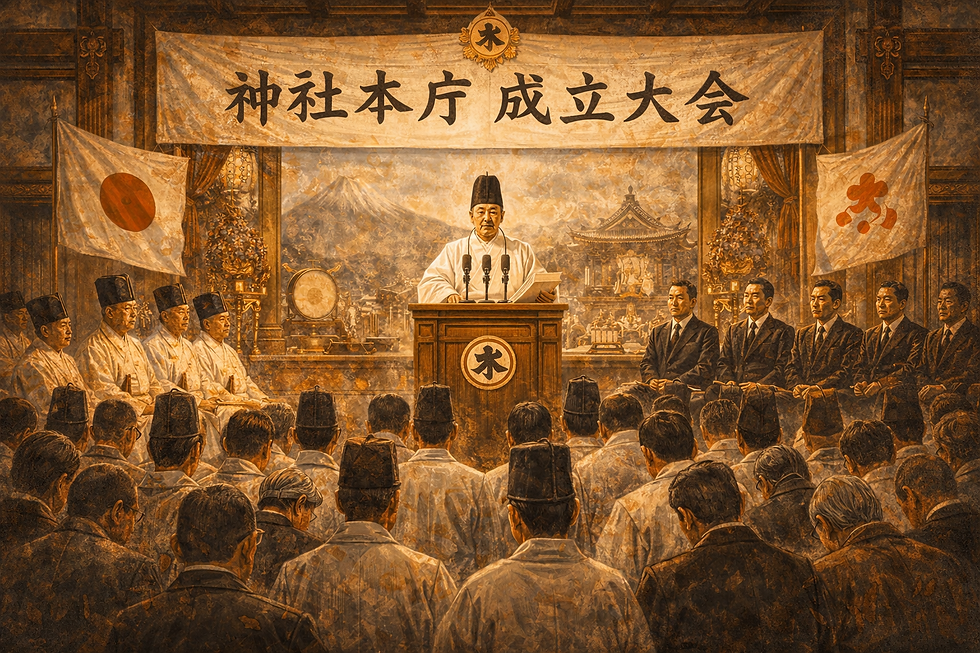
The Association was established in 1946 as a voluntary federation of approximately 80,000 shrines nationwide. It provides guidance on ritual, training for priests, and political advocacy for shrine interests. It also oversees the Ise Grand Shrine and maintains the emperor's ritual role within a religious framework.
Constitutional Guarantees and Ongoing Tensions
Japan's present post-World War II Constitution, drafted in light of the negative experience of State Shinto, guarantees freedom of religion and a strict separation between state and religion. Article 20 states: "Freedom of religion is guaranteed to all. No religious organization shall receive any privileges from the State, nor exercise any political authority. No person shall be compelled to take part in any religious acts, celebration, rite or practice."
Article 89 prohibits public funds from being used for the benefit of any religious institution.
However, the legacy of State Shinto remains problematic because of its complex history and role in supporting militarism. This is why disputes over symbols like the Yasukuni Shrine and its prefectural branches continue to be the focus for bitter struggles over who will have the right to articulate their significance.
Shinto's status and separation from the state remain contested. The constitutional mandate for strict separation continues to generate legal challenges, such as the Tsu Grounds Purification Case (1977), which tested whether government funding for Shinto purification ceremonies at public facilities violated the separation of religion and state.
The Supreme Court ruled that such ceremonies were "secular customs" rather than religious acts, a decision criticized by many legal scholars.
Major Post-War Legal Cases:
Tsu Grounds Purification Case | 1977 | Government funding for Shinto purification ceremony | Ruled constitutional as "secular custom"
Ehime Tamagushiryō Case | 1997 | Prefectural government donations to Yasukuni and other shrines | Ruled unconstitutional
Yasukuni Shrine visits | Ongoing | Prime ministerial visits to Yasukuni | Diplomatic controversies; no definitive legal ruling
Religion in Contemporary Japan
Religious activities are generally welcomed by the public as long as they remain confined within their own premises, such as temples and churches. However, the principle of separation between state and religion is often misunderstood to mean that religious matters should never appear in the public arena.
Japanese culture places a high value on conformity and social harmony. Whenever religious institutions take a public position on government policy—especially when such policies negatively affect human dignity—they are criticized for being "too political."
Religion is not recognized as a moral authority in Japan; as long as religious groups contain themselves within their premises, they are considered harmless.
Only religious observances based on traditional cultural activities are given public recognition, contributing to a general indifference toward organized religion in Japanese society.
Part VIII: Contemporary Shinto—Global Presence
Shinto is primarily found in Japan, where there are around 100,000 public shrines, although practitioners are also found abroad. Numerically, it is Japan's largest religion, the second being Buddhism.
Most of the country's population takes part in both Shinto and Buddhist activities, especially festivals, reflecting a common view in Japanese culture that the beliefs and practices of different religions need not be exclusive.
Total shrines in Japan | ~80,000–100,000
Shrines affiliated with Jinja Honchō | ~80,000
Shinto priests | ~21,000
Registered shrine parishioners (ujiko) | ~90 million (overlapping with Buddhist affiliation)
Shinto plays a certain role in Japan's annual events and life rituals. Common practices include:
Hatsumōde | New Year | First shrine visit of the year; millions participate
Shichigosan | November 15 | Ritual for children ages 3, 5, and 7
Matsuri | Various | Local shrine festivals; community celebrations
Miyamairi | ~30 days after birth | Newborn presented to shrine for blessing
Jichinsai | Before construction | Ground-breaking purification ceremony
Shinto weddings | Anytime | Traditional wedding ceremony at shrine

The Decline of Institutionalized Shinto
Today, institutionalized Shinto is declining. Yet Japanese people still highly prize Shinto ideals such as mutual respect, harmony, and restraint. This worldview encourages cultural homogeneity, making it difficult for people to ascribe to exclusive religious claims.
Factors contributing to decline include:
Demographic trends: Aging population, low birth rates
Urbanization: Weakening of community ties that support local shrines
Secularization: Decreasing religious interest among youth
Economic pressures: Shrines facing financial challenges
Succession crisis: Difficulty finding successors for shrine priesthood
Yoichi Yamaguchi notes that "even as shrine institutions weaken, the ethos of mutual nondisruption—'Let's live freely, help each other, and not cause trouble'—continues to exert a strong influence in Japanese society."
The Emperor's Changing Role
The emperor has undergone a "symbolic refresh." He is now widely perceived as Japan's moral exemplar instead of a divine being. Younger evangelicals increasingly feel appreciation toward the emperor and less animosity toward the role he plays in state-led Shinto rituals.
The imperial house continues to perform Shinto rituals, including the Daijōsai (Great Food Offering) ceremony that occurs at each emperor's accession. These rituals are now defined as private religious acts of the imperial family rather than state ceremonies.
Shinto's Presence Across the World
Shinto has spread beyond Japan through several channels:
Hawaii | Multiple shrines | Japanese immigrant communities established shrines; Izumo Taisha branch in Honolulu
North America | Small number of shrines | Tsubaki Grand Shrine in California; shrine associations
Brazil | Significant Japanese-Brazilian community | Shrines in São Paulo and other cities
Europe | Small but growing interest | Shinto study groups; occasional shrine dedications
Southeast Asia | Japanese expatriate communities | Shrines serving Japanese residents
Shinto and New Religious Movements
Aspects of Shinto have been incorporated into various Japanese new religious movements, which often blend Shinto, Buddhist, and other elements. These include:
Tenrikyō: Founded in 19th century; incorporates kami worship with healing practices
Kurozumikyō: Shinto-derived sect emphasizing purification and sincerity
Ōmotokyō: Influenced by Shinto and folk religion; focuses on world renewal
Sekai Kyūseikyō: Founded by Mokichi Okada; emphasizes purification and art
These movements often appeal to those seeking more explicit doctrinal teachings than mainstream Shinto provides.
Christian Engagement with Shinto
When the first Protestant missionaries arrived in Japan from USA (Evangelicals) and England (Anglicans) in the mid‑19th century, they brought a sharp critique of Shinto shrines as idolatrous. Early Japanese converts, shaped by this teaching, often rejected any participation in Shinto customs, including visits to family shrines or community festivals. For a time, the posture was one of clear separation.
Yet as Japanese Christians lived through repeated encounters with Shinto practices—ancestral rites, local festivals, and the deep cultural rhythms of shrine life—a more nuanced reflection began to emerge. Rather than simply dismissing these traditions as incompatible with the faith, thoughtful believers started to ask whether Shinto values, properly understood, might be engaged with in ways that enriched rather than compromised Christian discipleship.
This gave rise to the nihon‑teki kirisutokyō (Japanese Christianity) movement, which flourished from the early Meiji era through the end of World War II. Its proponents sought to integrate elements of Japanese spiritual and cultural identity with Christian faith; not as a dilution of doctrine, but as an authentic expression of Christianity rooted in Japanese soil.

Some explored profound theological syntheses, viewing Japan as providentially positioned to bridge East and West, and a few even offered bold metaphors, such as seeing the Shinto figure of Amaterasu as a prefiguration of Christ, as a way to articulate the gospel in a language that resonated with their compatriots.
While such ideas sometimes stretched conventional orthodoxy, they represented a sincere attempt to overcome the perception that Christianity was a foreign religion.
The tragedy of State Shinto in the 1930s and 1940s, when the state co‑opted Shinto for ultranationalist ideology, cast a long shadow. In the postwar period, many Japanese Christians became understandably cautious about anything associated with emperor veneration or shrine rites.
Yet that very caution has, in recent decades, given way to a more balanced engagement. Younger generations, in particular, have grown up in a Japan where Shinto customs are experienced primarily as cultural heritage—family hatsumōde (New Year shrine visits), neighborhood festivals, and rites of passage—rather than as political ideology.
For many young believers, participating in these practices does not feel like a betrayal of faith but a natural way of belonging to their families and communities.
Today, a growing number of Japanese evangelicals are rediscovering that honoring ancestors, appreciating the beauty of shrine traditions, and celebrating local festivals can be done with a clear Christian conscience; distinguishing cultural participation from religious worship.
This shift reflects a maturation of their theology of culture: moving beyond a binary of rejection versus syncretism toward thoughtful contextualization.
The painful history of State Shinto remains a necessary caution, reminding believers of the dangers of faith being co‑opted by nationalist agendas. But it no longer paralyzes. Instead, it has opened the way for Japanese Christians to engage with Shinto customs with both discernment and a newfound confidence; embracing the richness of their cultural identity as a gift that can be offered to God, without fear of losing their distinctiveness in Christ.
Part IX: Controversies and Debates in Shinto Studies
One of the most persistent scholarly debates concerns whether Shinto existed as a distinct religion before the Meiji period. Scholars like Kuroda Toshio have argued that "before modern times Shinto did not exist as an independent religion." Instead, what we now call Shinto was a complex of practices thoroughly integrated with Buddhism, Daoism, Confucianism, and folk religion.
This debate has political implications. If Shinto was "invented" in the Meiji period, then its claims to be Japan's "indigenous religion" stretching back to time immemorial are called into question. Conversely, proponents of Shinto's ancient origins point to kami veneration practices dating to the Yayoi period as evidence of continuity.
The Wikipedia article notes that scholars often suggest "we talk about types of Shintō such as popular Shintō, folk Shintō, domestic Shintō, sectarian Shintō, imperial house Shintō, shrine Shintō, state Shintō, new Shintō religions, etc. rather than regard Shintō as a single entity."
Key Positions in the Debate (Scholar | Position | Key Work):
Kuroda Toshio | Shinto as independent religion did not exist before Meiji | "Shinto in the History of Japanese Religion" (1981)
Helen Hardacre | Kami worship has ancient roots, but "Shinto" as system evolved | Shinto: A History (2017)
Mark Teeuwen | Combinatory paradigm dominated; Shinto emerged through interaction with Buddhism | Buddhas and Kami in Japan (2003)
John Breen | Meiji separation created modern Shinto | A New History of Shinto (2010)
Ultimately, the right way to approach this is through nuance. Shintoism can be considered Japan's indigenous 'Way of Life' that evolved over the centuries, consolidating into a distinct religion without losing its identity.
The Izumo-Ise Rivalry and Imperial Legitimacy
The relationship between the Izumo Shrine (dedicated to Ōkuninushi) and the Ise Shrine (dedicated to Amaterasu) has been a source of tension throughout Japanese history. The Ise Shrine, associated with the imperial line, has generally held supremacy in official state cults. However, Izumo's claims that all gods gather there annually, and that Ōkuninushi rules the invisible world, implicitly challenge this hierarchy.
Some Kokugaku scholars, including Hirata Atsutane, elevated Ōkuninushi to a position that rivaled or even surpassed Amaterasu. Hirata taught that Ōkuninushi presided at the Izumo Shrine and ruled on the invisible affairs of the kami. This alternative cosmic geography has never been fully reconciled with the Ise-centered imperial cosmology.
Yijiang Zhong's research demonstrates how the Meiji state systematically marginalized the Izumo tradition to establish Amaterasu's unchallenged supremacy. This "vanquishing" of the Izumo gods was part of the construction of State Shinto and remains a sensitive topic in Shinto studies.
Yasukuni Shrine and the Politics of Memory
The Yasukuni Shrine in Tokyo, dedicated to the war dead remains a flashpoint in East Asian international relations. Visits by Japanese prime ministers spark diplomatic protests from China and Korea, who view such visits as glorifying Japan's militarist past.
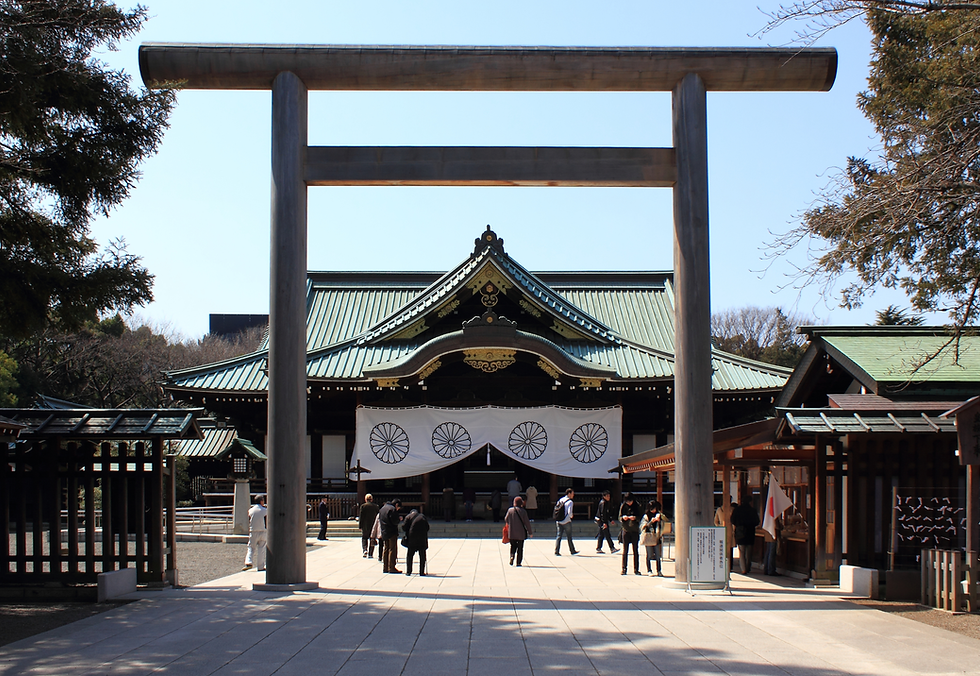
Domestically, the issue divides Japanese opinion. Some see Yasukuni as a legitimate expression of mourning and respect for war dead; others view it as a symbol of State Shinto and Japan's failure to fully confront its wartime aggression.
The shrine's status as a private religious corporation complicates efforts to find a non-controversial way to honor the war dead.
The Future of Shinto in a Secularizing Japan
Shinto faces significant challenges in contemporary Japan. Shrine attendance declines, particularly among younger generations. The priesthood ages, and many shrines struggle financially. The ethos of Shinto may persist, but institutional Shinto is undoubtedly weakening.
Aspects of Shinto have been incorporated into various Japanese new religious movements, which often blend Shinto, Buddhist, and other elements. Whether Shinto can adapt to the needs of a rapidly changing society while maintaining its ancient traditions remains an open question.
Potential futures for Shinto include:
Continued gradual decline as secularization advances
Revival through cultural heritage tourism and shrine marketing
Reform movements adapting Shinto to contemporary spiritual needs
Increased global presence through Japanese diaspora and international interest
Political mobilization on conservative causes (as seen in some shrine advocacy)

Part X: Conclusion—The Unbroken Thread of Practice
The history of Shinto as a lived religion is not a story of a static, unchanging tradition but of continuous adaptation, syncretism, and reinvention. From its prehistoric roots in Yayoi rice cultivation rituals, through a millennium of profound Buddhist integration, to the nativist revival of the Edo period, the revolutionary separation of the Meiji era, the trauma of State Shinto and its post-war dismantling, and its contemporary struggles in a secularizing society, Shinto has repeatedly transformed itself while maintaining a recognizable core.
That core is the veneration of kami; the supernatural entities inhabiting the world, the ancestors, and the forces of nature. The rituals of purification, the festivals that mark the agricultural cycle, the reverence for sacred places, and the deep connection between the Japanese people and their land have persisted across all these transformations.
Shinto in Global Context
Shinto's development has been shaped by its interactions with the broader world. The introduction of Buddhism from Korea and China transformed kami worship into a systematized tradition. Confucian thought influenced Edo-period interpretations of Shinto.
Western science and Christianity challenged and reshaped Shinto discourse in the late Edo and Meiji periods. The encounter with Western imperialism prompted the construction of State Shinto as a nationalist ideology. The post-war occupation imposed a radical restructuring of Shinto-state relations.
Yet Shinto has also influenced the world beyond Japan. Shinto aesthetics—the simplicity of shrine architecture, the subtlety of its rituals, its emphasis on purity and harmony with nature—have inspired artists, architects, and thinkers worldwide. Aspects of Shinto have been incorporated into new religious movements beyond Japan's borders.
The Enduring Thread
The emperor, though transformed from a living kami to a symbolic figure, continues to perform Shinto rituals that connect the present to the ancient past. Shrines, though facing challenges, continue to mark the landscape and punctuate the calendar with festivals. Families continue to bring their children for shichigosan blessings. Millions still visit shrines at New Year to pray for good fortune.
Shinto scholar Minoru Sonoda writes: "First, Shinto arose in tandem with Japanese ethnic culture and has never once been practiced outside of Japanese society. Second, by modern standards, it is too vague to be classified as a religion, and most Japanese people who have encountered Shinto in some forms do not consciously recognize it as religious."
This ambiguity—the fact that Shinto is simultaneously everywhere and nowhere, intimately familiar and maddeningly elusive—is perhaps its most enduring characteristic. Shinto is not a religion one converts to or consciously practices; it is the background hum of Japanese culture, the taken-for-granted framework within which life unfolds.
As such, it has proven remarkably resilient. It survived the Buddhist tsunami, weathered the Meiji revolution, adapted to the post-war order, and continues to find new expressions in contemporary Japan.
The way of the kami is, ultimately, the way of Japan itself; constantly changing, yet somehow always the same.
Appendix A: Timeline of Shinto's Real-World Development
Jōmon | c. 14,000–300 BCE | Possible early nature worship; limited archaeological evidence
Yayoi | 300 BCE–300 CE | Rice cultivation introduced; kami veneration emerges; early shrine forms
Kofun | 300–538 CE | Yamato Kingship; first major shrines (Ōmiwa, Munakata); burial mounds
Asuka | 538–710 CE | Buddhism introduced; Soga-Mononobe conflict; Department of Divinities established
Nara | 710–794 CE | Kojiki and Nihon Shoki compiled; Ritsuryō system; state ritual codified
Heian | 794–1185 CE | Shinbutsu-shūgō flourishes; Shugendō develops; shrine-temple complexes
Kamakura | 1185–1333 CE | Warrior patronage of shrines; spread of popular shrine worship; Buddhist-interpreted Shinto
Muromachi | 1333–1573 CE | Yoshida Shintō; inverted honji suijaku theories; Ōnin War devastation
Azuchi-Momoyama | 1568–1600 CE | Construction of warrior shrines; Yoshida Shintō influence
Edo | 1600–1868 CE | Confucian Shinto; Kokugaku movement; Motoori Norinaga; Hirata Atsutane; Izumo-Ise rivalry
Meiji | 1868–1912 CE | Shinbutsu bunri; haibutsu kishaku; State Shinto constructed; "nonreligious" shrine theory
Taishō | 1912–1926 CE | State Shinto consolidates; shrine export to colonies
Early Shōwa | 1926–1945 CE | Militarist Shinto; emperor cult intensifies; shrine participation enforced
Post-war | 1945–present | Shinto Directive; separation of religion and state; Association of Shinto Shrines; constitutional guarantees; contemporary challenges
Appendix B: Key Shinto Shrines and Their Historical Significance
Ōmiwa Shrine | Nara | Prehistoric | One of Japan's oldest shrines; no main hall; worship directly at sacred Mount Miwa
Ise Grand Shrine | Mie | 4th century? | Dedicated to Amaterasu; imperial family shrine; rebuilt every 20 years
Izumo Taisha | Shimane | Ancient | Dedicated to Ōkuninushi; rival to Ise; divine assembly tradition
Munakata Taisha | Fukuoka | Ancient | Dedicated to sea kami; connected to Yamato expansion
Usa Jingū | Ōita | 8th century | Head shrine of Hachiman; warrior cult center
Tsurugaoka Hachimangū | Kanagawa | 1063 | Minamoto clan shrine; samurai patronage model
Kitano Tenmangū | Kyoto | 947 | Dedicated to Sugawara no Michizane; scholarship kami
Fushimi Inari Taisha | Kyoto | 711 | Head of Inari shrines; fox symbolism; merchant patronage
Yasukuni Shrine | Tokyo | 1869 | War dead shrine; political controversy center
Appendix C: Major Shinto Sects and Schools
Yoshida Shintō | 15th century | Yoshida Kanetomo | First independent Shinto school; forged texts
Ryōbu Shintō | Heian period | Shingon monks | Buddhist-interpreted Ise Shintō; two mandalas
Ise Shintō | Kamakura period | Watarai priests | Inverted honji suijaku; primacy of Ise kami
Fukko Shintō | Edo period | Motoori, Hirata | "Restoration Shinto"; Kokugaku-based; anti-Buddhist
Jinja Shintō | Post-war | Association of Shinto Shrines | Mainstream shrine Shinto today
Kyōha Shintō | Meiji period | Various | Sect Shinto; 13 officially recognized sects

References:
"Shinto." Wikipedia.
Teeuwen, Mark, and Fabio Rambelli, eds. Buddhas and Kami in Japan: Honji Suijaku as a Combinatory Paradigm. Routledge, 2003.
Hardacre, Helen. Shinto: A History. Oxford University Press, 2017.
"Japanese cardinal says a 'polite persecution' faces Christians in Japan." Crux Now (February 27, 2026).
"Shinto's Key Teachings." Christianity Today (August 24, 2025). Interview with Yoichi Yamaguchi.
"History of Shinto." Wikipedia.
O'Brien, David M. "Chapter 2: Paradoxes of (Dis)Establishment." Project MUSE. University of Hawai'i Press.
"Christianity and Shinto." Christianity Today (August 24, 2025). Interview with Yoichi Yamaguchi.
Kim, D.W. (2021). Review of Yijiang Zhong, The Origin of Modern Shinto in Japan: The Vanquished Gods of Izumo. Journal of Religion in Japan 10(1): 106-110. Brill.
Zhong, Yijiang. The Origin of Modern Shinto in Japan: The Vanquished Gods of Izumo. Bloomsbury Academic, 2016.
Breen, John, and Mark Teeuwen. A New History of Shinto. Wiley-Blackwell, 2010.
Kuroda, Toshio. "Shinto in the History of Japanese Religion." Journal of Japanese Studies 7, no. 1 (1981): 1-21.


Comments