
.png)

Civilizational Titans: Himiko, the Sorceress Queen of Ancient Japan
- A. Royden D'Souza

- Apr 7
- 37 min read
Queen Himiko (170–247/248 AD) is one of the most fascinating and elusive figures in ancient Japanese history. Himiko ruled as the shaman-queen of Yamatai-koku, a powerful chiefdom or federation of chiefdoms in the Japanese archipelago during the late Yayoi period.
Her story survives primarily through Chinese dynastic histories, particularly the Records of the Three Kingdoms (Sanguo Zhi, 297 AD), which describes her as a ruler who "occupied herself with magic and sorcery, bewitching the people" and who maintained power through ritual authority while delegating administrative matters to her younger brother.

The significance of Himiko extends far beyond her own time. She represents the earliest historically verifiable ruler of a Japanese polity, the first Japanese leader to establish direct diplomatic relations with China, and a window into the complex process of state formation in the Japanese archipelago.
Her reign coincided with the transition from the Yayoi period to the Kofun period, and the great burial mound described in Chinese sources may represent the earliest example of the keyhole-shaped tombs (kofun) that would characterize Japanese elite culture for centuries.
This document traces the complete arc of Himiko's story: from the Yayoi world of competing chiefdoms that elevated her to power, through the detailed Chinese accounts of her realm and diplomatic missions, to the great controversy that has consumed Japanese scholarship for over two centuries; the location of her kingdom of Yamatai.
The debate between the Kyushu theory and the Kinai (Yamato) theory has generated thousands of books and articles, and remains unresolved to this day. Recent archaeological discoveries, including radiocarbon dating of the colossal Hashihaka burial mound in Nara to approximately 240–260 AD, have given new life to the debate.
Throughout this narrative, Himiko's story is placed in the broader context of third-century Eurasia; a world in which the Han dynasty had collapsed, the Three Kingdoms of China were locked in conflict, the Korean peninsula was consolidating into emerging states, and the Japanese archipelago stood at the threshold of unprecedented transformation.
The diplomatic gifts exchanged between Himiko and the Wei emperor, like bronze mirrors, gold seals, and textiles, connect her small realm to the vast networks of power and prestige that spanned East Asia.
Himiko's legacy endures not only in scholarly debate but in popular culture, where she appears in video games, anime, and historical fiction. Yet the mystery at her core remains: Who was this woman who ruled through magic, whose face was never seen by her subjects, and whose tomb has never been found? This whitepaper seeks to present a comprehensive, balanced account of all that is known, and all that remains unknown about Japan's first queen.
Part I: Introduction—The Queen Who Never Was
The third-century Chinese chronicle Wei Zhi (Record of Wei) is responsible for Japan's most enduring ancient mystery. This early history tells of a group of islands off the China coast that were dominated by a female shaman named Himiko.
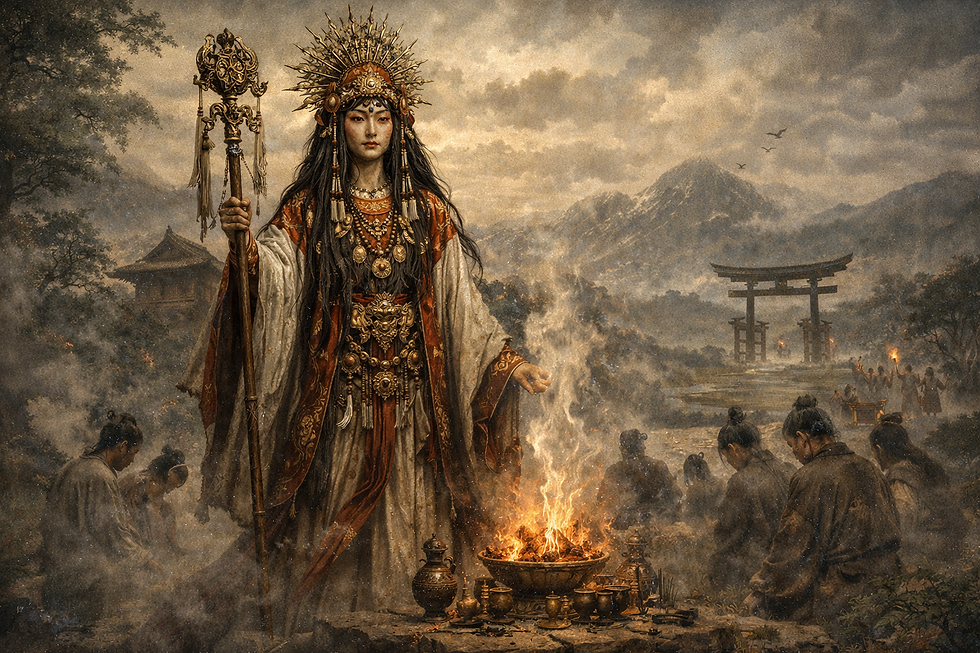
Himiko ruled for more than half a century as head of the largest chiefdom, traditionally known as Yamatai, until her death in 248. Yet no such person appears in the old Japanese literature; the Kojiki (712 AD) and Nihon Shoki (720 AD), which preserve the mythological origins of the imperial line and chronicle early Japanese history, make no mention of her.
This silence has haunted Japanese historiography for centuries. How could the ruler of the most powerful polity in the archipelago, a queen whose diplomatic missions to China were recorded with precision and whose realm encompassed dozens of smaller chiefdoms, have been completely forgotten by her own people's historical traditions?
The question has spawned a scholarly industry of staggering proportions. Since the late Edo period, when scholars first began to seriously grapple with the problem, literally thousands of books and articles have been published on the identity of Himiko and the location of her domain. Keiji Imamura has called it "the greatest debate over the ancient history of Japan."
The mystery is compounded by the nature of the sources themselves. Chinese historians, in meeting their obligations to document the activities of their dynasties, collected information on their neighbors that served as a store of useful data for managing political relations, trading guides, and military strategy.
The Wei Zhi account is remarkably detailed, describing the geography, customs, and political structure of the Wa people (the Chinese term for the inhabitants of the Japanese archipelago). It names dozens of communities, specifies travel distances and directions, and records the names of officials and the gifts exchanged between courts.
Yet this very detail has created its own confusion. The directions and distances given for reaching Yamatai are incompatible; working from a modern map of East Asia, it would be impossible to reach Yamatai by following both. Scholars have been forced to choose which data to prioritize, and their choices have led to radically different conclusions about where Yamatai was located. The result is a classic twofold riddle: Who was Himiko, and where was the Yamatai that she governed?

Part II: Chinese, Japanese, and Korean Records
The first and most important historical records of Himiko are found in the Records of the Three Kingdoms (Sanguo Zhi, 三國志), a Chinese classic text dating to approximately 297 AD.
The Records of the Three Kingdoms covers the history of the three competing dynasties, Wei (221–265), Wu (222–280), and Shu Han (221–264), that emerged after the collapse of the Han dynasty.
Within this work, the "Book of Wei" (Wei Shu) contains a section titled the "Biographies of the Wuhuan, Xianbei, and Dongyi" (eastern barbarians), and within that section is the account of the Wa people.
Japanese scholars refer to this specific portion as the Gishi Wajinden (魏志倭人伝, "Records of Wei: Account of Wajin"). It is the earliest surviving description of the Japanese archipelago and its inhabitants, and it provides the only contemporary account of Queen Himiko.

The Wei Zhi account begins by situating the Wa people geographically:
"The Japanese people of Wa [倭人] dwell in the middle of the ocean on the mountainous islands southeast of [the prefecture of] Tai-fang. They formerly comprised more than one hundred communities. During the Han dynasty, [Wa envoys] appeared at the Court; today, thirty of their communities maintain intercourse [with us] through envoys and scribes."
This passage establishes several crucial points. First, the Wa were known to the Chinese from Han times; contact had been ongoing for centuries. Second, by the late 2nd or early 3rd century, thirty communities, likely corresponding to chiefdoms or small polities, maintained regular diplomatic relations with the Chinese commanderies in Korea.
The text then describes how Himiko came to power:
"The country formerly had a man as ruler. For some seventy or eighty years after that there were disturbances and warfare. Thereupon the people agreed upon a woman for their ruler. Her name was Himiko [卑弥呼]. She occupied herself with magic and sorcery, bewitching the people. Though mature in age, she remained unmarried. She had a younger brother who assisted her in ruling the country. After she became the ruler, there were few who saw her. She had one thousand women as attendants, but only one man. He served her food and drink and acted as a medium of communication. She resided in a palace surrounded by towers and stockades, with armed guards in a state of constant vigilance."
This remarkable passage paints a vivid portrait of Himiko's rule. She is a shaman-queen whose authority derives from ritual power—"magic and sorcery"—rather than military force. She remains unmarried, secluded from public view, attended by a thousand women but communicating through a single male intermediary.
This pattern of female shamanic authority has parallels throughout Northeast Asia and Siberia, where women often served as intermediaries between the human and spirit worlds.
The account also notes that Himiko left the execution of affairs of state to her younger brother. This suggests a division of power common in many early states: the ruler possesses ritual authority and legitimacy, while a close male relative handles administration and military affairs.
The Wei Zhi goes on to describe Yamatai's population and governance:
"Yamatai kingdom prospered under Queen Himiko's rule and was observed in the records to have had more than seventy thousand households, well-organized laws and taxation system and thriving trade. Her people were noted to have been mainly gentle and peace-loving."
A population of seventy thousand households would place Yamatai among the largest polities in the archipelago, far exceeding the size of its neighbors.
The Diplomatic Missions: Himiko and the Wei Court
The Wei Zhi records that Himiko's government sent a diplomatic mission in the year 238 AD to the Wei emperor, Cao Rui's court. The delegation was received as presenting tribute to the Chinese emperor, and in response, Cao Rui issued an edict that is preserved in the history:
"Herein we address Himiko, Queen of Wa, whom we now officially call a friend of Wei. [Your ambassadors] have arrived here with your tribute, consisting of four male slaves and six female slaves, together with two pieces of cloth with designs, each twenty feet in length. You live very far away across the sea; yet you have sent an embassy with tribute. Your loyalty and filial piety we appreciate exceedingly. We confer upon you, therefore, the title 'Queen of Wa Friendly to Wei,' together with the decoration of the gold seal with purple ribbon. The latter, properly encased, is to be sent to you through the Governor. We expect you, O Queen, to rule your people in peace and to endeavor to be devoted and obedient."
This edict is remarkable for several reasons. First, it shows that Himiko sought and received formal recognition from the Chinese emperor; the ultimate source of legitimacy in the East Asian world order.
Second, it records the bestowal of the title Shingi Waō (親魏倭王, "Ruler of Wa, Friend of Wei"), which placed Himiko in a hierarchy of rulers recognized by the Chinese court. Third, it mentions specific gifts like a gold seal, purple ribbon, and presumably the bronze mirrors that other sources mention, that would become objects of immense prestige and, potentially, archaeological evidence.
The Wei Zhi records additional missions: in 240, the Wei court sent envoys to Wa bearing an imperial rescript and a seal and ribbon; in 243, Himiko sent another mission with tribute.
The Conflict with Kuna and Himiko's Death
The Wei Zhi also records that in 247, when a new governor arrived at Daifang Commandery in Korea, Queen Himiko officially complained of hostilities with Himikuko (卑弥弓呼), the king of Kuna (狗奴, literally "dog slave"), one of the other Wa states.
The governor dispatched an official with "a proclamation advising reconciliation," but the outcome of this conflict is not recorded.
Then comes the account of Himiko's death and succession:
"When Himiko passed away, a great mound was raised, more than a hundred paces in diameter. Over a hundred male and female attendants followed her to the grave. Then a king was placed on the throne, but the people would not obey him. Assassination and murder followed; more than one thousand were thus slain. A relative of Himiko named Iyo [壹與], a girl of thirteen, was [then] made queen and order was restored. Chêng issued a proclamation to the effect that Iyo was the ruler."
This passage is rich with implications. The burial mound, over a hundred paces in diameter, would be enormous, comparable in scale to the largest keyhole tombs of the subsequent Kofun period.
The sacrifice of attendants is a practice attested archaeologically in Yayoi and Kofun Japan. The succession crisis following her death, with over a thousand slain, speaks to the fragility of the political order she had maintained.
And the elevation of a thirteen-year-old girl, Iyo, suggests that her lineage carried legitimacy that could not be denied.
Later Chinese Histories
Two other Chinese dynastic histories mention Himiko, though both clearly incorporate and adapt the Wei Zhi reports.
The c. 432 AD Book of Later Han (Hou Han Shu) specifies that the "some seventy or eighty years" of Wa wars occurred between 146 and 189, during the reigns of Han Emperors Huan and Ling. It also changes the phrasing: "the King of Great Wa resides in the country of Yamadai," rather than the Queen.
The 636 AD Book of Sui (Sui Shu) changes the number of Himiko's male attendants from one to two, and provides additional details about her rule.
These later histories demonstrate that Himiko's story continued to be transmitted and elaborated in Chinese historical tradition, even as it disappeared from Japanese records.
The Silence of Japanese Sources
Neither the Kojiki (712 AD) nor the Nihon Shoki (720 AD) mentions Queen Himiko by name. This silence has been the subject of endless debate. The circumstances under which these books were written are themselves matters of controversy, and even if Himiko were known to the authors, they may have purposefully decided not to include her.
However, the Nihon Shoki does quote the Wei Zhi three times, referring to "the queen of Wa" in 239 AD, and "the ruler of Wa" in 240 and 243 AD. The editors were clearly familiar with the Chinese account.
They apparently identified Himiko with Empress Jingū, the legendary consort of Emperor Chūai, who is said to have ruled as regent from 201 to 269 AD; a chronology that roughly matches Himiko's floruit. This identification was long accepted but is now recognized as mistaken.
The Kojiki and Nihon Shoki do mention several female shamans associated with the early imperial line: Yamatototohimomosohime-no-Mikoto, the aunt of Emperor Sujin, who committed suicide after learning her husband was a snake-god; and Yamatohime-no-mikoto, the daughter of Emperor Suinin, who established the Ise Shrine for the sun goddess Amaterasu.
Some scholars see these figures as legendary echoes of Himiko, preserving a tradition of female shamanic authority that was later suppressed or appropriated.
A Korean Reference?
The twelfth-century Korean history Samguk sagi (History of the Three Kingdoms) contains a reference to a diplomatic mission from the Japanese queen Himiko arriving at the Silla court in 173 AD.
This date is anachronistic, it predates Himiko's reign as recorded in Chinese sources, and scholars have argued that it represents an antedated account of an eighth-century embassy.
Nonetheless, the reference shows that Himiko's fame extended to the Korean peninsula, and that later Korean historians sought to incorporate her into their own historical narratives.
Part III: The Yayoi World, and Himiko's Rise

To understand Himiko, we must understand the world that produced her. The Yayoi period (c. 900 BC – 300 AD) witnessed profound transformations in the Japanese archipelago: the introduction of wet-rice agriculture, metallurgy, and new forms of social organization from the Asian continent.
The Yayoi people were not the original inhabitants of Japan. They migrated from the Korean peninsula, bringing with them rice cultivation, bronze and iron technology, and new social structures. They mixed with the indigenous Jōmon hunter-gatherers to create the population that would build the first complex societies in the archipelago.
By the first century AD, the Japanese islands were home to numerous small polities. The Book of Later Han records: "In the middle of the Lo-lang sea there are the Wa people. They are subdivided into more than a hundred 'countries.' Depending on the season they come and offer tribute."
Thirty of these "countries," interpreted by historians as chiefdoms, maintained direct contact with the Chinese commanderies in Korea.
These chiefdoms were not equal. Some were larger and more powerful than others, and competition among them was intense. The Chinese records speak of warfare and conflict, and the archaeological evidence—moated settlements, weapons in burials, skeletons with arrow wounds—confirms this picture.
The Confederation of Wa
The Wei Zhi records that Yamatai was the strongest of the Wa countries after years of warfare. It had emerged victorious from the decades of conflict that had plagued the region, and under Himiko's rule, it had united approximately thirty smaller chiefdoms into a confederated kingdom or state.
This process of unification through warfare and alliance is typical of state formation worldwide. Competing polities vie for dominance; one emerges victorious; it incorporates others through conquest, alliance, or both; and a new, larger political entity takes shape.
The Wei Zhi hints at the structure of this confederation. It notes that twenty-nine different kuni (countries) existed, and that three of these were ruled by "kings."
One of them was Ito, where "there have been kings for generations, subject to the queen's kuni [Yama'ichi] they rule." Scholars have identified Ito with the Itoshima peninsula in northern Kyushu, where the Hirabaru mound site, containing thirty-nine bronze mirrors and other rich grave goods, may be the tomb of Ito's king or queen.
The text also describes how Himiko ruled her confederation: "high [ranking] Wa are sent to inspect [the trade of the different kuni]. A high leader was especially sent to the region north of the queen's land. He inspects all the kuni there. Regularly he rules in Ito."
This suggests a system of oversight, with officials appointed to monitor and administer subordinate chiefdoms. Ito, strategically located for international relations with Korea and China, played a particularly important role.
Yayoi Society and Religion
Yayoi society was hierarchical. Elite burials contain rich grave goods like bronze mirrors, weapons, and beads, while commoner graves are simple. Settlement patterns show increasing stratification, with large, central settlements surrounded by smaller villages.
The shamanic role that Himiko filled was not unique. Throughout Northeast Asia, women served as shamans, intermediaries between the human and spirit worlds. The Chinese account of Himiko—"occupied herself with magic and sorcery, bewitching the people"—fits this pattern perfectly.
Shamans in Yayoi Japan would have performed rituals to ensure good harvests, heal the sick, communicate with ancestors, and divine the future. They would have held positions of considerable authority, particularly in societies that lacked centralized political institutions.
Himiko's elevation from this shamanic role to political rulership represents the fusion of ritual and secular authority that characterizes many early states.
The Transition to Kofun
Himiko's reign coincided with the transition from the Yayoi period to the Kofun period (c. 250–538 AD). The Kofun period is named for the distinctive keyhole-shaped burial mounds (kofun) constructed for the ruling elite.
The "great mound, more than a hundred paces in diameter" raised for Himiko may well be the earliest written record of a kofun.
The transition from Yayoi to Kofun was marked by several significant changes:
Burial mounds | Small, round or square mounds | Massive keyhole-shaped mounds
Grave goods | Bronze mirrors, weapons, beads | Iron armor and weapons, horse trappings, gilt-bronze ornaments
Political organization | Competing chiefdoms | Centralized Yamato state
External relations | Tribute to Han commanderies | Military expeditions to Korea
Himiko's Yamatai stands at the threshold of this transformation. Her realm was the most powerful polity of its time, and the mound raised for her foreshadows the colossal tombs of the Kofun rulers.
The transition she represents, from competing chiefdoms to unified state, from Yayoi to Kofun, is one of the most significant in Japanese history.
Part IV: Ritual Authority and Political Power
The Wei Zhi describes Himiko as wielding power through "magic and sorcery." This characterization reflects both Chinese perceptions of foreign peoples and the actual nature of authority in Yayoi Japan.
Himiko's rule exemplifies what scholars call ritual authority; power derived not from military force or administrative control but from perceived access to the supernatural.
In societies without centralized states, such ritual authority often precedes and enables political centralization. A figure who can communicate with the gods, ensure good harvests, and avert calamities naturally accumulates influence that can be translated into political power.
The description of Himiko's seclusion—attended by a thousand women, communicating through a single male intermediary, residing in a palace "surrounded by towers and stockades, with armed guards in a state of constant vigilance"—emphasizes her separation from ordinary society. This separation is typical of sacred kingship worldwide. The ruler is set apart, their person too potent for ordinary contact.
Yet Himiko was not merely a figurehead. She had a younger brother who "assisted her in ruling the country," handling the day-to-day administration. This division of labor—ritual authority vested in a female ruler, executive authority in a male relative—has parallels in other early states. It allowed for the centralization of power while maintaining traditional forms of legitimacy.
The Extent of Her Realm
The Wei Zhi states that Yamatai had more than seventy thousand households. This figure would place its population in the hundreds of thousands, making it by far the largest polity in the archipelago. The text also notes that Himiko ruled over approximately thirty subordinate chiefdoms.
The extent of her realm is debated. If Yamatai was located in northern Kyushu, her control would have extended over much of that island and possibly parts of western Honshu. If it was located in the Kinai region (the Nara basin and surrounding areas), her realm would have encompassed the heartland of what would become the Yamato state.
In either case, Himiko's Yamatai represents the first unification of multiple polities under a single ruler in Japanese history. It is the prototype for the later Yamato state that would eventually unify the entire archipelago.
The Rituals of Rule
What did Himiko's "magic and sorcery" actually involve? The Wei Zhi provides no specifics, but archaeology and comparative ethnography offer clues.
The bronze mirrors that were so highly prized in Yayoi Japan were not merely decorative objects. They were ritual implements, used in ceremonies and buried with the dead to provide protection in the afterlife.
The "one hundred bronze mirrors" that the Wei emperor bestowed upon Himiko would have been objects of immense ritual power, distributed to subordinate chiefs to bind them to her rule.
The text's reference to Himiko "bewitching the people" suggests trance or possession; states in which the shaman's soul travels to the spirit world or the spirits speak through the shaman's mouth.
Such practices are documented throughout Northeast Asia, and they survive in Japanese tradition in the miko (shrine maidens) who still perform ritual dances at Shinto shrines.
The sacred space of Himiko's palace, with its towers and stockades, would have been the setting for these rituals. It was both residence and temple, the point where the human and divine realms intersected.
Himiko as Diplomat
Himiko's diplomatic missions to China were not merely symbolic. They were shrewd political moves designed to enhance her legitimacy and counter her rivals.
By securing recognition from the Wei emperor, Himiko positioned herself as the paramount ruler of Wa in the Chinese world order. The title "Queen of Wa Friendly to Wei" placed her above other Wa rulers in the hierarchy of Chinese-recognized sovereigns.
The gifts she received—bronze mirrors, gold seals, textiles—were objects of immense prestige that could be distributed to subordinate chiefs, binding them to her through gifts of Chinese imperial favor.
The missions also served a more immediate political purpose. The Wei Zhi records that Himiko sought Chinese support against the king of Kuna, her rival to the south.
By presenting herself as the legitimate ruler recognized by China, she sought to undermine her enemy's position and secure Chinese intervention or mediation.
This pattern, using Chinese recognition to enhance domestic legitimacy and counter rivals, would characterize Japanese relations with China for centuries to come.
The Rival: The King of Kuna
The Wei Zhi identifies Himiko's principal rival as the king of Kuna, whose name is recorded as Himikuko. The name is intriguing—it shares the himi element with Himiko's name, suggesting perhaps a common cultural background or even kinship.

The location of Kuna is even more disputed than that of Yamatai. If Yamatai was in Kyushu, Kuna might have been in the southern part of the island or on Shikoku. If Yamatai was in Kinai, Kuna might have been in Kyushu or elsewhere in western Honshu.
What is clear is that the conflict between Yamatai and Kuna was serious enough to prompt Himiko to appeal to China for support.
The Wei governor dispatched an official to mediate, but the outcome is unknown. Himiko died shortly thereafter, and the succession crisis that followed may have been connected to this conflict.

Part V: Himiko and the East Asian World Order
To understand Himiko's diplomatic missions, we must understand the geopolitical context of third-century East Asia.
In 108 BC, the Han emperor Wu conquered the Korean kingdom of Gojoseon and established four commanderies—military colonies—in the northern part of the peninsula. The most important of these was Lelang (Lo-lang), near modern Pyongyang, which served as the center of Chinese power in Korea for over four centuries.
Lelang was more than a military outpost. It was a fully Chinese city, with Chinese administrators, Chinese laws, Chinese writing, and Chinese culture. It served as the conduit through which Chinese goods, ideas, and political influence flowed to the Korean peninsula and the Japanese archipelago.

By the late 2nd century, Han power was waning. The dynasty collapsed in 220 AD, plunging China into the period of the Three Kingdoms.
The Lelang Commandery fell into the hands of a local warlord family who called their new commandery Daifang. In 238, the Wei Dynasty, one of the Three Kingdoms, took Daifang back.
This is the context for Himiko's missions. When she sent envoys in 238, she was establishing relations with the new power that had just reasserted Chinese control over the Korean commanderies. Her timing was impeccable; she reached out to the Wei court at the moment of its consolidation, and was rewarded with recognition and gifts.
The Korean Kingdoms
The third century also saw the emergence of the Three Kingdoms of Korea; Goguryeo in the north, Baekje in the southwest, and Silla in the southeast. These kingdoms were consolidating power and expanding their territories, and they would eventually dominate the peninsula.
The relationship between these Korean kingdoms and the Wa polities in Japan was complex and multifaceted. There was trade; iron from the Nakdong River valley was particularly prized in Japan. There were cultural exchanges; Korean artisans brought new technologies and artistic styles to Japan.
There were diplomatic relations; the Wei Zhi mentions Wa embassies to the Korean commanderies. And there was conflict; the Nihon Shoki records Japanese military expeditions to Korea, though the historicity of these early accounts is debated.
Himiko's Yamatai was part of this network. Her envoys traveled to the Daifang Commandery in Korea before proceeding to the Wei court in China. The route they followed, by sea from northern Kyushu to the southern Korean coast, then overland to the commanderies, was the same route that would be used by Japanese embassies to China for centuries.
The Three Kingdoms of China
The Wei Dynasty, with which Himiko established relations, was one of the three powers that emerged from the collapse of Han China. The Three Kingdoms period (220–280) is one of the most celebrated eras in Chinese history, immortalized in the historical novel Romance of the Three Kingdoms.
The Wei court, located at Luoyang in northern China, saw itself as the legitimate successor to the Han. It maintained the Han system of tributary relations with surrounding peoples, receiving embassies and bestowing titles and gifts as a way of projecting power and prestige.
Himiko's recognition by Wei placed her in a hierarchy of rulers that included Korean kings and other foreign chiefs. It gave her access to Chinese prestige goods—bronze mirrors, textiles, gold seals—that were essential to her political position in Japan. And it provided a model of centralized rule that may have influenced the development of the Yamato state.
The Gifts: Mirrors, Seals, and Textiles
The gifts exchanged between Himiko and the Wei court were not mere souvenirs. They were political instruments of the highest importance.
The bronze mirrors that the Wei emperor bestowed upon Himiko were objects of immense ritual and political significance. They were not just mirrors; they were symbols of authority, distributed by the ruler to subordinate chiefs as marks of favor and legitimacy.
The "one hundred bronze mirrors" mentioned in the Wei Zhi would have been a powerful tool for building and maintaining the Yamatai confederation.
Archaeologists have found large numbers of Chinese-style bronze mirrors, called shinju-kyo (神獣鏡, "mirrors decorated with gods and animals"), in Kofun-period tombs in the Kinai region.
Many scholars who support the Kinai theory of Yamatai's location associate these mirrors with the hundred mirrors given to Himiko. Critics point out that the Kinai mirrors date to the 4th century, a century after Himiko's reign, and may represent later gifts or local imitations.
The gold seal with purple ribbon that the Wei emperor bestowed upon Himiko would have been a tangible symbol of her status as "Queen of Wa Friendly to Wei." Such seals were the physical embodiment of Chinese recognition; recipients could display them as proof of their legitimate authority.
A gold seal inscribed "King of Na" (a Wa polity in northern Kyushu) was discovered in 1784 and is now a national treasure of Japan. No seal of Himiko has ever been found.
The textiles mentioned in the Wei Zhi—"two pieces of cloth with designs, each twenty feet in length"—were products of Chinese weaving technology, which was far more advanced than anything in contemporary Japan. Such textiles would have been treasured as luxury goods and distributed to subordinate chiefs.
Part VI: The Great Controversy—Locating Yamatai
The location of Yamatai, Himiko's kingdom, has been debated for over two centuries. The Wei Zhi provides detailed directions and distances for traveling from the Korean commanderies to Yamatai, but these directions are incompatible.
Depending on which data one prioritizes, one can place Yamatai in northern Kyushu, in the Kinai region (the Nara-Osaka area), or somewhere in between.
The two main theories are:
Kyushu Theory | Northern Kyushu | Many historians and archaeologists | Fits travel distances better; Yoshinogari site; proximity to Korea
Kinai Theory | Nara basin/Kinki region | Others, including J. Edward Kidder | Fits later history (Yamato state); Hashihaka tomb; mirror distributions
The debate has generated thousands of books and articles, and there is no consensus in sight. As one scholar notes, "the divergent differences are now being narrowed, and it seems possible, given the present state of knowledge, to make a convincing case for the location of Yamatai." Yet the case remains unproven.
The Travel Directions
The Wei Zhi gives the following directions for reaching Yamatai from the Korean commandery of Daifang:
"After leaving the commandery, follow the seacoast, pass through the country of Kuyahan, go south to the country of Tamra (Jeju Island), about a thousand li. Then cross the sea to a country called Tsushima. Its officials are called Hinomori and the assistant officials is called Hinomori and the assistant officials is called Inamori, about a thousand li."
The text then describes the journey through the island of Iki and other intermediate points before finally:
"A thousand li to the east, the country of Matsuro. Another thousand li to the east, the country of Ito. Another thousand li to the southeast, the country of Na. Another hundred li to the east, the country of Fumi. Another twenty days' journey by sea to the south, the country of Toma. Another ten days' journey by sea or one month's journey by land to the country of Yamatai."
The distances and directions are problematic. The unit li is not precisely known; estimates range from 400 to 500 meters. The directions, south, east, southeast, are inconsistent. And the travel times—twenty days by sea, ten days by sea or one month by land—are difficult to reconcile with actual geography.
Scholars who support the Kyushu theory argue that the distances point to locations in northern Kyushu. They identify Ito with the Itoshima peninsula, Na with the region around modern Fukuoka, and Toma with somewhere in southern Kyushu. From there, Yamatai would be somewhere in Kyushu.
Scholars who support the Kinai theory argue that the distances are not meant to be taken literally. They note that ancient Chinese geographical accounts often used schematic numbers and directions to convey general location rather than precise coordinates.
They also point out that if one follows the directions literally, one would end up in the Pacific Ocean; an impossibility that suggests the numbers are symbolic rather than literal.
The Archaeological Evidence
Archaeology has transformed the debate in recent decades. Major discoveries have provided new data for both theories.
The Yoshinogari Site (Kyushu): The Yoshinogari site in Saga Prefecture, northern Kyushu, is one of the largest and most important Yayoi settlements ever discovered. Excavations in the 1980s and 1990s revealed a massive moated settlement with dwellings, storehouses, and burial mounds, dating to the period of Himiko's reign.
Many historians would like to believe that Yamatai was located in Kyushu because the large-sized moated Yoshinogari settlement fits the description of Yamatai. Such historians think that Yamatai capital was first established in Kyushu and then the Yamato clan decided to move north and east toward the area where the first government was formed in the Yamato area.
However, there are problems with the Kyushu-Yamatai theory. The Wei Zhi*records that the Wei emperor presented Himiko's envoy with a hundred bronze mirrors, but for a long time, few bronze mirrors had been recovered in Kyushu.
The 39 bronze mirrors discovered at the Hirabaru mound in Kyushu changed this picture, but the total still falls short of the hundred mentioned in the text.
The Makimuku Site (Kinai): The Makimuku site in the southeastern Nara Basin has emerged as the leading candidate for Yamatai among supporters of the Kinai theory. The site includes a cluster of large keyhole-shaped burial mounds, including the Hashihaka tomb, which is considered by many to be the burial place of Queen Himiko.
Radiocarbon dating of materials from Hashihaka has placed its construction at approximately 240–260 AD; precisely the period of Himiko's death. This is a powerful piece of evidence, aligning the archaeological record with the historical account.
The Makimuku site also contains evidence of large-scale structures, craft production, and long-distance trade, consistent with a major political center. The presence of numerous bronze mirrors in the area, including some that may date to the Wei period, adds further support.
Gina Barnes, in her study of state formation in Japan, argues that "the center of political authority is considered to have been the Miwa area of southeastern Nara Basin incorporating the smaller Makimuku district housing the Hashihaka Tomb; considered to be the burial place of Queen Himiko."
The Mirror Argument
The bronze mirrors given by the Wei emperor to Himiko play a central role in the debate. If these mirrors could be identified archaeologically, they would provide strong evidence for Yamatai's location.
Many scholars who support the Kinai theory associate the shinju-kyo mirrors found in Kinai tombs with the hundred mirrors given to Himiko. These mirrors, decorated with gods and animals in Chinese style, date to the 3rd and 4th centuries and are found in greatest concentration in the Kinai region.
Other scholars oppose this identification. They note that the Kinai mirrors are stylistically later than Wei-period mirrors, and may represent local imitations rather than original gifts.
They also point out that mirrors are found throughout Japan, not just in Kinai, and that the distribution may reflect later political developments rather than Himiko's realm.
The Linguistic Argument
The name "Yamatai" itself is subject to interpretation. The Wei Zhi writes the name as 邪馬臺, which can be read as "Yamadai" or "Yamatai" depending on the reconstruction of ancient pronunciations. The later Book of Later Han uses the variant 邪馬臺, with a different final character, adding to the confusion.
Linguists have reconstructed the pronunciation of these characters in 3rd-century Chinese. The results are suggestive but not definitive. Some scholars see a connection to "Yamato," the name of the later Japanese state centered in the Kinai region. Others argue that the connection is too distant to be meaningful.
The Geographic Logic
Beyond the specific evidence, there is a broader geographic logic to consider. If Yamatai was in Kyushu, then the political center of gravity in 3rd-century Japan was in the west, close to Korea and China. The later shift of the capital to the Kinai region would represent a movement eastward, for reasons that are not entirely clear.
If Yamatai was in Kinai, then the political center was already in the region that would become the heartland of the Yamato state. This provides a satisfying continuity: Himiko's kingdom was the direct ancestor of the state that would eventually unify Japan.
A Third Possibility?
Some scholars have proposed compromise theories. One influential view is that Yamatai was originally in Kyushu, and that the Yamato clan later moved east to the Kinai region, bringing the name and traditions with them.
This "migration theory" would explain both the Kyushu evidence (Yoshinogari, proximity to Korea) and the Kinai evidence (Makimuku, Hashihaka).
The theory has its own problems. There is no clear archaeological evidence for a large-scale migration from Kyushu to Kinai in the 3rd century. The material cultures of the two regions are distinct, and the transition appears gradual rather than abrupt.
As of now, the debate continues. A 2025 academic abstract notes: "the subject is a problem of the location of queendom of Queen Himiko of the third century, and there are Kyushu opinion/Kinki opinion and moving from Kyushu to Kinki.
The reason is because decisive evidence can lack in what do not watch an end at which opinion while having the history of the study to pass over those opinions than 280 years either."
Part VII: The Death of Himiko and the Succession Crisis
The Wei Zhi records that when Himiko died, "a great mound was raised, more than a hundred paces in diameter." This is the earliest written description of what would become the defining monument of the Kofun period; the keyhole-shaped burial mound.
The dimensions, a hundred paces in diameter, would make the mound enormous. A pace (bu) in ancient China was approximately 1.5 meters, so a hundred paces would be about 150 meters.
This is comparable in scale to the largest early kofun, including Hashihaka, which measures approximately 280 meters in length (the "diameter" in the text may refer to the circular portion of a keyhole-shaped mound).
The description of the mound is significant for another reason: it mentions that "over a hundred male and female attendants followed her to the grave."
This refers to the practice of junshi; sacrifice of retainers to accompany the ruler in death. Such practices are attested archaeologically in Yayoi and Kofun Japan, with skeletons found arranged around or within burial mounds.
The Succession Crisis
After Himiko's death, "a king was placed on the throne, but the people would not obey him. Assassination and murder followed; more than one thousand were thus slain."
This passage reveals the fragility of the political order Himiko had maintained. Her authority was personal and ritual; it could not be transferred to a male successor. The ensuing violence speaks to the intensity of competition among rival factions; perhaps subordinate chiefs who had chafed under Himiko's rule, or rivals who saw an opportunity to seize power.
The solution was to place on the throne a thirteen-year-old girl named Iyo, a relative of Himiko. Commentators note that "Iyo" (壹與) is probably a miscopy of Toyo (臺與), which appears in some versions of the text.
The choice of a young girl as successor is significant. It suggests that legitimacy was tied to Himiko's lineage and to female ritual authority. Iyo could serve as a figurehead while others, perhaps Himiko's younger brother or other male relatives, actually administered the state. This pattern echoes Himiko's own rule, in which she held ritual authority while a brother handled administration.
The Fate of Yamatai
The Wei Zhi records that after Iyo's installation, "order was restored." But what happened to Yamatai after that? The Chinese sources fall silent. No further missions from Wa are recorded until the 5th century, when the "Five Kings of Wa" sent embassies to the Liu Song dynasty.
By that time, the political landscape of Japan had transformed. The Kofun period was in full swing, with massive keyhole tombs being constructed across the archipelago. The center of power had shifted, or perhaps always was, in the Kinai region, where the Yamato state was taking shape.
What became of Himiko's kingdom? Did it evolve into the Yamato state, its rulers incorporating Himiko into their own mythology (perhaps as Empress Jingū)? Was it absorbed by a rising power from the Kinai region? Or did it continue as a separate polity, eventually fading from history as new powers emerged?
We do not know. The silence of the Japanese sources leaves these questions unanswered.
Part VIII: The Third-Century World

While Himiko ruled in Japan, the Roman Empire was experiencing its own existential crisis. The period 235–284 AD is known as the Crisis of the Third Century, a time of civil war, economic collapse, and foreign invasion.
Emperors came and went with dizzying speed; twenty-six emperors in forty-nine years, most meeting violent ends. The Sassanian Persians captured the emperor Valerian in 260 AD. The Goths sacked Athens. The Gallic Empire broke away in the west, the Palmyrene Empire in the east.
Yet from this chaos, the empire would emerge transformed. Diocletian's reforms at the end of the century created the Dominate, a more autocratic form of rule that would sustain the empire for another two centuries.
Himiko's Japan and the Roman Empire could hardly have been more distant, yet they faced similar challenges: the consolidation of power, the management of succession, the integration of diverse peoples under a single ruler.
The Sasanian Empire (Persia)
In 224 AD, just as Himiko was consolidating her rule, Ardashir I overthrew the Parthian Empire and established the Sasanian Empire in Persia. This new power would revive Persian traditions and challenge Rome for supremacy in the Middle East.
The Sasanian state was highly centralized, with Zoroastrianism as the state religion and a powerful priesthood—the Magi—enforcing orthodoxy. It controlled the Silk Road trade routes and maintained diplomatic relations with China.
Himiko's Japan and Sasanian Persia had no direct contact, but they were linked through the networks of exchange that spanned Eurasia. Persian goods like textiles, metalwork, glass reached China and, from there, perhaps Korea and Japan. The Shōsōin treasury in Nara contains objects with Persian motifs, testimony to the long reach of Silk Road trade.
The Kushan Empire (Central Asia)
The Kushan Empire (c. 30–375 AD) was one of the four great powers of the ancient world, alongside Rome, Parthia/Sasanian Persia, and Han China. It controlled the heart of the Silk Road, from Bactria to northern India, and served as the crucial intermediary for trade and cultural exchange between East and West.
The Kushans were patrons of Buddhism, and their Gandharan art—a synthesis of Greek, Persian, and Indian traditions—influenced the development of Buddhist art throughout Asia. The period of Himiko's reign corresponds to the late Kushan period, under rulers such as Vasudeva I (c. 190–230 AD), who faced the rising power of the Sasanians.
The Kushans, like Himiko, were masters of diplomacy and trade. Their empire flourished because it controlled the routes that connected civilizations. Himiko's Yamatai, at the far eastern end of these networks, was a small but significant participant in the same system.
The Three Kingdoms of China
Himiko's diplomatic partner, the Wei Dynasty, was one of the Three Kingdoms (220–280 AD) that emerged from the collapse of Han China. The Three Kingdoms period is one of the most celebrated eras in Chinese history, immortalized in literature, drama, and popular culture.
Wei controlled northern China, the traditional heartland of Chinese civilization. Wu ruled the southeast, with its capital at Nanjing. Shu Han occupied the southwest, claiming legitimacy as the successor to the Han.
The Wei court's recognition of Himiko was part of a broader strategy of projecting power and prestige. By bestowing titles on foreign rulers, the Wei emperors positioned themselves as the legitimate successors to the Han and the center of the civilized world.
The Three Kingdoms of Korea
On the Korean peninsula, the Three Kingdoms of Goguryeo, Baekje, and Silla were taking shape. Goguryeo, in the north, was the largest and most powerful. Baekje, in the southwest, was closely allied with Yamatai Japan; tradition holds that Baekje scholars and artisans brought Buddhism and writing to Japan in the 6th century. Silla, in the southeast, was initially the smallest and weakest, but would eventually unify the peninsula.
The relationship between these Korean kingdoms and the Wa polities in Japan was complex and multifaceted. There was trade, cultural exchange, diplomacy, and conflict. The Wei Zhi records that Wa envoys traveled through the Korean commanderies on their way to China, and that the Korean kingdoms maintained their own relations with the Chinese court.
Himiko's Yamatai was part of this network. Her envoys traveled the same routes as Korean diplomats, and her rivals may have sought support from Korean powers.
The Rise of Axum (Africa)
In northeastern Africa, the kingdom of Axum was emerging as a major power. By the 3rd century, Axum controlled the Red Sea coast of modern Ethiopia and Eritrea, with its port at Adulis serving as a major emporium for trade between the Roman Empire, Arabia, and India.
The Persian prophet Mani (216–274 AD) listed Axum as one of the four great powers of his age, alongside Rome, Persia, and China. This is a remarkable recognition of an African civilization's importance in the 3rd-century world.
Axum, like Yamatai, was a kingdom that built its power on trade. Its rulers issued coins, built monumental architecture (the famous stelae of Axum), and eventually converted to Christianity in the 4th century.
Himiko's Japan and Axumite Ethiopia were worlds apart, but they participated in the same global systems of exchange.
Teotihuacan (Americas)
In the Valley of Mexico, the great city of Teotihuacan was at its zenith. With a population estimated at 125,000–200,000, it was one of the largest cities in the world. Its monumental pyramids, the Sun and the Moon, dominated the landscape, and its influence extended throughout Mesoamerica.
Teotihuacan had no contact with East Asia, but its development parallels that of other early civilizations. Like Yamatai, it was a center of ritual and political authority, its rulers claiming divine sanction and controlling extensive trade networks. The human sacrifice practiced at Teotihuacan echoes the retainer sacrifice described in Himiko's tomb.
Part IX: The Many Faces of Himiko
The early Chinese records of Himiko and her Yamatai polity have been called "something of a Rorschach test." To different interpreters, this early Japanese shaman queen has appeared as evidence for widely divergent theories.
(Interpretation | Proponents | View of Himiko):
Marxist | Some post-war Japanese historians | Evidence of primitive communism; female rule as survival of matriarchal stage
Feminist | Feminist historians | Jōmon priestess rulers; evidence of ancient matriarchal traditions
Nationalist | Japanese ultranationalists | Proof of Japan's ancient imperial traditions; Himiko as Empress Jingū
Korean connection | Scholars like Egami Namio | Himiko as evidence of Korean or Mongolian influence on Japan ("horserider theory")
Ritual authority | Scholars like Mori, Ellwood | Evidence of tandem rule by female shaman and male monarch; "patriarchal revolution" replacing female deities
Himiko in Japanese Historiography
The modern scholarly debate over Himiko began in the late Edo period (1603–1868), when Japanese scholars first began to seriously engage with Chinese historical sources. Motoori Norinaga (1730–1801), the great scholar of kokugaku (national learning), identified Himiko with Empress Jingū, an identification that would dominate until the 20th century.
After World War II, the debate exploded. The liberation of scholarship from pre-war nationalist constraints, combined with massive archaeological excavations driven by economic growth, produced an outpouring of research. Literally hundreds of articles and books poured out on the Yamatai problem in the 1970s and 1980s.
The debate became a national obsession. Television, newspapers, and popular magazines never let the questions rest. Any "original" view received notice, and the media would feel greatly deprived of excitement if any solutions were to be found.
Marxist Interpretations
In the immediate post-war period, Marxist historiography influenced Japanese scholarship. Some Marxist historians saw in Himiko evidence of a "primitive communist" stage of development, or of a matriarchal society that preceded patriarchy.
The fact that a woman could rule was taken as evidence of social formations that differed fundamentally from modern capitalist society.
These interpretations have largely faded, but they left a legacy of attention to social structure and class formation in Yayoi Japan.
Feminist Reclamations
Feminist historians have found in Himiko a powerful symbol of female authority in ancient Japan. Some have argued for a tradition of female shamans and rulers stretching back to the Jōmon period, with Himiko as its last great representative before the "patriarchal revolution" that replaced female deities and priestesses with male counterparts.
The evidence for this view is mixed. The Wei Zhi clearly states that before Himiko, Wa had male rulers. Her elevation was exceptional, a response to crisis rather than a continuation of tradition.
Yet the fact that she could be elevated at all, and that after her death a girl of thirteen could succeed her, suggests that female authority was not unthinkable in Yayoi society.
Nationalist Appropriations
Nationalist interpretations of Himiko have taken various forms. Pre-war scholarship, constrained by state ideology, tended to identify Himiko with Empress Jingū and to minimize any suggestion of foreign influence on Japan's development.
Some post-war nationalists have used Himiko to argue for Japan's ancient imperial traditions, tracing the imperial line back to Himiko and beyond. Others have used the Yamatai debate to assert Japan's cultural distinctiveness and independence from Chinese influence.
The most extreme nationalist appropriations have come from outside mainstream scholarship. Ultranationalist websites and publications sometimes claim Himiko as proof of Japan's primordial greatness, or as evidence of a world-spanning "Japanese" empire in ancient times. These claims have no basis in evidence.
The Horserider Theory
One of the most controversial theories in Japanese historiography is the "horserider theory" (kiba minzoku setsu), proposed by Egami Namio in 1948. Egami argued that the Kofun state was established by a warrior people from the continent; horseriders from northern Asia who conquered the Yayoi agriculturalists and established a new ruling elite.
In Egami's framework, Himiko represented the last of the old Yayoi rulers, overthrown by the invading horseriders. The theory has been largely rejected by mainstream scholarship, but it continues to have adherents and to influence popular imagination.
Himiko in Popular Culture
In recent decades, Himiko has become a fixture of Japanese popular culture. She appears in:
Anime and manga: Steel Jeeg, Ōkami, Nobunagun, Get Backers, and many others
Video games: Warriors Orochi, Persona 4, Tomb Raider (2013), Goemon's Great Adventure, Bayonetta
Film: Himiko (1974), directed by Masahiro Shinoda
Literature: Osamu Tezuka's Phoenix series
These portrayals vary widely. In some, Himiko is a powerful queen; in others, a naive girl; in others, a sinister antagonist. The 2013 Tomb Raider reboot featured Himiko as the "Sun Queen," an ancient ruler who achieved immortality by transferring her soul to new bodies.
Laura Miller has explored the many representations of Himiko in contemporary culture, noting how she has been "rebranded" to serve various narrative and commercial purposes.
Even a distant Lyman-alpha blob, a massive concentration of hydrogen gas 12.9 billion light years from Earth, has been named "Himiko" by astronomers.
Part X: The Archaeological Search for Himiko
If Himiko's tomb could be identified, it would revolutionize the study of ancient Japan. The Wei Zhi describes a mound "more than a hundred paces in diameter," which should be identifiable archaeologically.
The leading candidate is the Hashihaka Kofun in Sakurai, Nara Prefecture. This keyhole-shaped mound measures approximately 280 meters in length, making it one of the largest early kofun. Radiocarbon dating places its construction at approximately 240–260 AD; precisely the period of Himiko's death.
The Hashihaka tomb is located in the Makimuku district of the southeastern Nara Basin, an area that has yielded rich archaeological evidence of a major 3rd-century political center. Supporters of the Kinai theory argue that this is compelling evidence for Yamatai's location.
However, no inscription or artifact directly linking the tomb to Himiko has been found. The Imperial Household Agency designates Hashihaka as the tomb of Emperor Sujin, a legendary ruler of the 1st century BC, and restricts access for archaeological excavation. This has prevented definitive identification.
Other candidates have been proposed. The Hirabaru mound in Kyushu, with its thirty-nine bronze mirrors, has been suggested as a possible tomb of Himiko or one of her subordinate rulers. But its scale is smaller than the hundred-pace mound described in the Wei Zhi.
The Mirrors of Himiko
The search for the "one hundred bronze mirrors" given to Himiko by the Wei emperor has driven archaeological research for decades.
In 2015, researchers at the Nara National Research Institute for Cultural Properties announced the discovery of a bronze mirror in the Kurozuka Kofun in Nara that they believe may be one of the Wei mirrors. The mirror, dated to the late 3rd century, bears inscriptions and decorations consistent with Wei-period styles.
Other mirrors have been found throughout Japan, particularly in the Kinai region. The distribution pattern is complex, with some mirrors clearly of Chinese manufacture and others likely local imitations.
The debate over the mirrors remains unresolved. Even if the mirrors could be definitively identified, they would not prove Yamatai's location; mirrors could have been distributed widely, and they could have been moved in antiquity.
The Yoshinogari Site
The Yoshinogari site in Saga Prefecture, Kyushu, is one of the most important Yayoi settlements ever excavated. Its massive moats, hundreds of pit dwellings, and numerous burial mounds suggest a major political center.
Proponents of the Kyushu theory point to Yoshinogari as evidence that Yamatai was in Kyushu. The site's scale and complexity match the Wei Zhi description of Yamatai as having more than seventy thousand households.
Critics note that Yoshinogari's peak occupation may be slightly earlier than Himiko's reign, and that the site shows evidence of decline in the late 3rd century. They also argue that the material culture of Yoshinogari differs from that of the Kinai region, suggesting a different political sphere.
The Makimuku Site
The Makimuku site in Nara Prefecture has emerged as the leading candidate for Yamatai among supporters of the Kinai theory. The site includes:
The Hashihaka tomb and several other large keyhole mounds
Evidence of large-scale structures, possibly palaces or ritual centers
Artifacts indicating long-distance trade and craft production
Numerous bronze mirrors, including some that may date to the Wei period
The Makimuku site is located in the Miwa area, which Gina Barnes identifies as "the center of political authority" in the early Kofun period. This area would become the heartland of the Yamato state.
New Technologies, New Discoveries
Recent advances in archaeological science are transforming the search for Yamatai. Radiocarbon dating has provided more precise chronologies. DNA analysis of skeletal remains is revealing population movements and relationships. Remote sensing and geophysical survey are identifying buried structures without excavation.
The 2009 radiocarbon dating of the Hashihaka tomb to 240–260 AD was a major breakthrough, providing the first firm chronological link between the archaeological record and the historical account.
Future discoveries may yet resolve the debate. A 2025 academic abstract notes that "it may be said that that I elucidate the local actual situation of Japanese Islands each place is demanded most now"—suggesting that a deeper understanding of regional variation may be the key.
Part XI: The Enduring Mystery
More than 1,700 years after her death, Queen Himiko continues to fascinate. Why?
First, because she represents the earliest historically verifiable ruler of a Japanese polity. Before Himiko, Japanese history is purely archaeological. With Himiko, we have names, dates, events; a toehold in the realm of written history.
Second, because she embodies the transition from prehistory to history, from Yayoi to Kofun, from chiefdom to state. Her reign marks the moment when the Japanese archipelago entered the East Asian written record and when the political formations that would eventually produce the Japanese state first took shape.
Third, because she is a woman. In a historical record dominated by men, Himiko stands out; a female ruler who wielded power through ritual authority, who maintained peace for decades, who sent embassies to the most powerful court in East Asia, and whose death triggered a succession crisis that killed thousands.
Fourth, because of the mystery. The location of Yamatai, the silence of Japanese sources, the identification of her tomb; these unresolved questions invite endless speculation and research. The debate has generated thousands of books and articles, and it shows no sign of ending.
The Unanswered Questions
Despite two centuries of scholarship, fundamental questions remain:
Where was Yamatai? Kyushu or Kinai? Or somewhere else entirely?
Who was Himiko? A shaman-queen? A priestess? A ruler in the mold of later Japanese empresses?
Why is she absent from Japanese sources? Was she deliberately suppressed? Did later compilers not know of her? Did they incorporate her into other figures, like Empress Jingū?
Where is her tomb? Is it Hashihaka? Somewhere in Kyushu? Or yet undiscovered?
What happened to Yamatai after her death? Did it evolve into the Yamato state? Was it absorbed by rivals? Did it fade away?
The Future of the Search
The search for Himiko and Yamatai continues. New archaeological discoveries, new analytical techniques, and new interpretations of old texts promise to advance our understanding.
The Imperial Household Agency's restrictions on excavation of imperial tombs have limited research on key sites like Hashihaka. Some scholars hope for relaxation of these restrictions, which would allow scientific investigation of potential Himiko-era tombs.
Meanwhile, excavations at non-imperial sites continue to produce new data. The Yoshinogari and Makimuku sites are still being studied. New sites are being discovered. The picture becomes more detailed with each passing year.
Himiko's Legacy
Whatever the eventual resolution of the Yamatai debate, Himiko has secured her place in Japanese history and culture. She is the subject of scholarly monographs and popular manga, of museum exhibitions and video games. Her name adorns trains and water buses. A protogalaxy 12.9 billion light years away bears her name.
She represents, perhaps, something deeper than any particular historical reconstruction. She embodies the mystery of origins; the question of where we come from, how our institutions began, who our ancestors were. Every society has such mysteries; Japan's is Queen Himiko.
The third-century Chinese chroniclers who recorded her story could not have imagined that their brief account would ignite a debate lasting two millennia. They simply noted what they knew of a distant land across the sea, ruled by a woman who practiced magic and sent tribute to the Wei emperor.
That woman, whoever she was, has outlived her chroniclers, her dynasty, and her civilization. She remains, as she has been for over seventeen centuries: an enigma, a challenge, and an invitation to wonder.
Appendix: Key Facts About Queen Himiko
Reign | c. 190 – 247/248 AD
Birth | c. 169/170 AD
Death | 247/248 AD, aged approximately 78
Title | Queen of Yamatai-koku; Shingi Waō ("Ruler of Wa, Friend of Wei")
Primary Source | Wei Zhi (Records of Wei), c. 297 AD
Realm | Yamatai, a federation of approximately 30 chiefdoms
Population | More than 70,000 households
Diplomatic Missions | 238, 240, 243 AD
Rival | King of Kuna (Himikuko)
Successor | Iyo (Toyo), age 13
Burial | Great mound, 100+ paces in diameter; possible candidate: Hashihaka Kofun, Nara

References
"Who was 'Queen Himiko' or Pimiko as identified in Chinese sources." Willamette University.
"Himiko." Wikipedia.
Kidder, J. Edward, Jr. (2007). Himiko and Japan's Elusive Chiefdom of Yamatai: Archaeology, History, and Mythology. University of Hawaii Press.
"Himiko: Difference between revisions." Wikipedia.
Kidder, J. Edward, Jr. (2007). "Introduction." Himiko and Japan's Elusive Chiefdom of Yamatai. Project MUSE.
"Newest circumstances on Yamataikoku." CiNii Research, 2025.
Kidder, J. Edward, Jr. (2007). Himiko and Japan's Elusive Chiefdom of Yamatai. De Gruyter Brill.
Best, Jonathan W. (2016). "The Silla Annals' Anachronistic Reference to Queen Himiko, the Wa Ruler of Yamatai." Seoul Journal of Korean Studies 29(1): 93-114.


Comments