
.png)

Fallen Angels: The Epic of Nimrod
- A. Royden D'Souza

- Mar 7
- 50 min read
Updated: Mar 9
The figure of Nimrod, briefly introduced in Genesis, stands as a foundational archetype of human rebellion against God in the biblical narrative.
His portrayal not only connects to the immediate post-Flood context but also resonates deeply with the mythology and power structures of the ancient Near East, particularly the epic of Gilgamesh.

The "Mighty Hunter" and the Meaning of His Name
The Genesis account introduces Nimrod as a son of Cush and a grandson of Ham, placing him within the lineage of Noah. The text describes him as one who "began to be a mighty one in the earth" and a "mighty hunter before the LORD" (Genesis 10:8-9).
This phrase, "before the LORD," is crucial. While some early church fathers like John Chrysostom interpreted it as meaning "in the sight of God," signifying a remarkable God-given strength, a strong and early tradition understands it as a defiant act—a hunter "in the face of the LORD," implying opposition to God.
This interpretation aligns with the understood meaning of his name. Although its etymology is complex and possibly of foreign origin, the Hebrew name "Nimrod" is widely associated with the concept of rebellion, with scholars suggesting it essentially means "we shall rebel."
This etymology casts his identity not just as a skilled hunter of beasts, but as a rebel-king who organized humanity under his own rule in direct defiance of God's authority. This understanding is solidified by extra-biblical Jewish traditions, such as those recorded by the historian Josephus and in the Talmud, which explicitly identify Nimrod as the primary instigator behind the construction of the Tower of Babel.
His goal was to unite humanity under his own tyrannical power, preventing them from scattering across the earth as God had commanded, and to make a name for themselves through their own achievements.
Nimrod and the Shadow of Gilgamesh
Scholars have long noted the striking parallels between the biblical Nimrod and the great Mesopotamian hero-king, Gilgamesh. This connection places the Genesis account within the broader cultural and literary context of the ancient Near East.
Both figures are celebrated as mighty hunters and powerful builders who ruled over the same key cities in the land of Shinar, such as Erech (Uruk).
The description of Nimrod as a gibbor (mighty one) echoes the portrayal of Gilgamesh in his own epic, where he is described as a tyrant whose subjects cry out to the gods for relief from his oppressive rule and forced labor projects, such as the building of Uruk's massive walls.

While the name "Nimrod" has not been conclusively found in Mesopotamian king lists, some scholars have proposed specific historical prototypes. The 1910 Critical and Exegetical Commentary on Genesis notes that despite the phonetic link to Gilgamesh being disproven, "enough general resemblance remains to warrant the belief that the original of the biblical Nimrod belongs to the sphere of Babylonian mythology."
Others have suggested Naram-Sin of Akkad or the Sumerian king Enmerkar as possible inspirations, but the consensus remains that Nimrod, as depicted, embodies a Hebrew perspective on the archetypal tyrannical city-builder of Mesopotamia.
A Watershed Moment in Ancient History
The account of Nimrod is set against the backdrop of a pivotal era in human history—the early Bronze Age, a time of rapid urbanization, the rise of the first empires, and the centralization of political and religious power. The building of cities like Babel (Babylon) and the great ziggurat represented in the Tower of Babel story are characteristic of this period in Mesopotamia.

From the biblical perspective, Nimrod is not just another king; he is the very architect of this new, rebellious world order. He embodies the spirit of the age that sought to find security, meaning, and unity in human achievement and centralized power, rather than in obedience to God's command to "fill the earth" (Genesis 9:1).
His kingdom, beginning in Babylon, becomes the prototype for all subsequent worldly powers that exalt themselves against God. This is why the prophet Micah can later refer to "the land of Nimrod" as a synonym for Assyria, the great oppressor of Israel (Micah 5:6).
Nimrod, therefore, represents more than a single historical individual; he is the biblical paradigm of the rebellious "mighty one" who builds cities and empires on a foundation of pride and defiance, a shadow that would loom over the pages of Scripture and the history of the ancient world.
The "Beginning" of a Mighty One: A Linguistic and Legendary Analysis
The phrase describing Nimrod as one who "began to be a mighty one" (Genesis 10:8) is far more layered than a simple English translation can convey. The Hebrew word for "began" is chalal, a primitive root with a startling range of meanings that extend far beyond mere initiation.
While it can mean "to begin" (as if by driving an "opening wedge"), its primary connotations are far more violent and profane: to bore, wound, dissolve, pollute, defile, profane, break (a vow), or even to prostitute.
This semantic range is crucial for understanding the biblical author's intent. The same word is used in solemn warnings against profaning the name of God (Leviticus 18:21) and in the rebuke of Reuben for defiling his father's bed (Genesis 49:4).
By using chalal, the text subtly signals that Nimrod's rise to power was not a neutral development but was intrinsically linked to an act of profanation or violent transgression. He did not simply "begin" to be mighty; he broke through a boundary, defiled a sacred order, and profaned himself to achieve his status.
This act of profanation is directly connected to the second key word: gibbor (mighty one). As noted, gibbor can refer to a "mighty man," a "champion," or even a "giant." Its most infamous usage is in Genesis 6:4, where the offspring of the "sons of God" and the "daughters of men" become the gibborim—the "mighty men which were of old, men of renown."
This establishes a direct genealogical link between the gibborim and the Nephilim, the giants of antediluvian lore. While the term can certainly apply to heroic human warriors like David's men, its application to Nimrod, in conjunction with the verb chalal, opens up three distinct and potentially overlapping possibilities for interpretation:
1. The Secular View: Nimrod simply became a powerful and successful human ruler, the founder of the first great empire.
2. The Giant View: Through some act of profanation (likely connected to the rebellious spirit of his age), Nimrod himself became a giant, a gibbor in the physical sense described in Genesis 6.
3. The Giant-Hunter View: Nimrod became a "mighty hunter" not just of beasts, but of the giants who survived the Flood and were re-emerging in his day.
The Septuagint, the ancient Greek translation of the Old Testament, removes all ambiguity for its translators. It renders Genesis 10:8-9 straightforwardly: "And Chus begot Nebrod: he began to be a giant upon the earth. He was a giant hunter before the Lord God." This ancient witness strongly supports the second interpretation, framing Nimrod as a physical giant.

Giants, Building Projects, and a Fortress on the Golan
If Nimrod was indeed a giant, or even just a leader who commanded them, he would not have been alone. Ancient legends outside the Bible depict giants as his allies and laborers.
An Arabic manuscript quoted in Michael Alouf's History of Baalbek claims that after the Flood, "when Nimrod reigned over Lebanon, he sent giants to rebuild the fortress of Baalbek," a city dedicated to the sun-god Baal.

This Temple of Jupiter (the massive Roman structure) and the earlier temple of Baal are not the same building, but they are located on the same sacred site at Baalbek. The Roman temple was built directly on top of and incorporated the foundations of the earlier Phoenician temple dedicated to Baal.

This layering of temples on a single location is a powerful physical reminder of the cultural and religious connections your previous text explored.
Star of Rephan/Rephaim in Baalbek?
The photograph above shows a bust carved inside a hexagram on the ceiling of the later 2nd-century Temple of Bacchus at Baalbek. This is significant because, Bacchus was one of the deities to whom the temple complex was dedicated, alongside Jupiter and Venus, forming the Heliopolitan triad.
Another image from the Roman temple complex shows decorated stone slabs depicting a six-pointed and a four-pointed star. The scholar who documented them notes that these designs "may suggest a Nabataean influence."

Many conspiracy theorists compare these hexagrams in the temple's iconography to the star of Rephan/Rephaim. The most compelling theory rests not on a single piece of evidence but on a convergence of ancient textual traditions, linguistic drift, and the Roman habit of 'syncretism.'
This theory proposes that the worship of Nimrod, the archetypal "mighty hunter," was the original seed from which the later cults of Baal, Osiris, Bacchus, and Saturn all grew.
Nimrod as the Template: The chain begins with Nimrod himself. According to Genesis, he was a gibbor, a "mighty one" whose lineage and description place him within the post-Flood context of Genesis 6's giants.
Ancient sources, including the Masonic publication "The Freemasons' Monthly Magazine" from 1860, explicitly state that Nimrod "perverted" the veneration of patriarchal ancestors "into gross idolatry, and blended with the antediluvian worship of the host of heaven."
In other words, Nimrod fused the memory of his giant forebears with the worship of celestial bodies, particularly the sun and planets. This fusion created a system where 'the same deity could be worshipped as both a human ancestor and a heavenly body.'
From Rephaim to Saturn: The critical bridge between the Hebrew and Greco-Roman worlds is the linguistic and conceptual fusion of the Titans with the Giants (Gigantes). This fusion, as documented in scholarship, began as early as the 3rd century BC with the Septuagint translation of the Hebrew Bible.
In 2 Samuel 5:18, the "Valley of the Rephaim" (Emeq Rephaîm) is rendered in Greek as the "Valley of the Titans" (koiláda tôn Titánon), while in 1 Chronicles 11:15, the same phrase is translated as "Valley of the Gigantes" (koiládi tôn gigánton). This demonstrates that for the Hellenistic Jewish translators, the Rephaim—the giant clans of the Old Testament—were conceptually interchangeable with both the Titans and the Giants of Greek mythology.
This fusion had profound consequences. By the Roman period, the Titan Kronos (identified with the Roman Saturn) could be re-imagined not merely as a primordial god, but as a figure from the race of giants.
Note: Zeus/Jupiter is the son of the titan Kronos/Saturn. Baal is the son of El. So, Saturn can be equated with El.
The 5th-century Armenian historian Movses Khorenats'i explicitly equates Kronos with Nimrod, calling him "Bēl," the Babylonian "king of the Titans" at the head of an army of giants. This is a direct line: Nimrod, the giant and rebel of Genesis, is identified with the Titan Kronos, who is in turn the Roman Saturn.
The Persistence of Baal: Further evidence comes from North Africa, where the Punic god Baal Hammon was so thoroughly identified with the Roman Saturn that scholars speak of a virtual transformation.
The cult of Saturn in Roman Africa is considered a "prominent example of syncretism between Roman and Punic religious traditions." While the academic literature carefully notes that this was not a simple one-to-one replacement, the archaeological record shows that the same votive stelae dedicated to Baal Hammon were, in the imperial period, dedicated to Saturn.
If Baal was an incarnation of Nimrod, and Saturn was the Romanized form of that same deity in Africa, then the "Nimrod = Saturn" equation is not mere speculation—it is archaeologically attested.
The Mediating Figure: So where does Bacchus fit? The French academic article "Rome et l'âge d'or: Dionysos ou Saturne ?" provides a crucial insight into the relationship between Bacchus (Dionysos) and Saturn in the Roman imagination.
The article examines how Virgil, in his Georgics, invokes Bacchus as the god of the vine, but distinguishes this Italian Liber from the frenzied, ecstatic Dionysos of the Greek mysteries. However, the deeper connection lies in their shared association with a primordial golden age.
Saturn, in Roman myth, was the king of the golden age who ruled over Italy in a time of peace and abundance. Bacchus, as the bringer of wine and civilization, was also a figure of bounty and liberation. The commentary on Virgil's Aeneid notes that both Saturn and Bacchus share a key symbolic attribute: the 'pruning-hook (falx).'
Saturn is famously depicted with a sickle or pruning-hook, an agricultural tool symbolizing his role in the golden age of cultivation. Bacchus, as vitisator ("vine-planter"), also wields the pruning-hook.
This shared symbol is not coincidental; it suggests that both gods were understood as patrons of agricultural abundance and the civilizing arts—the very arts that Nimrod, as the founder of the first cities and kingdoms, was credited with establishing.
The 1860 Masonic text weaves this together: "Osiris, Bacchus, Chronos, Pluto, Adonis, and Hercules, taken in one point of view, all equally typify the sun; but if we examine their respective legends and attentively consider the actions ascribed to them, we shall be convinced that in their human capacity each can be no other than the great patriarch Noah."
While this source identifies the patriarch as Noah, the same logic applies to Nimrod. If Noah was the solar patriarch, Nimrod was the rebellious giant who appropriated that solar symbolism for himself.
The "Star of Rephan" (Chiun/Kaiwan), identified with Saturn, becomes then the celestial symbol of Nimrod's apotheosis—the "star of your god" that Israel was warned against worshipping.
In this framework, Saturn is not merely a planet or a Titan; he is the celestial enthronement of Nimrod, the deified giant-king. Bacchus is his earthly manifestation—the one who brings the abundance of the golden age, but also the ecstatic frenzy that, in its most extreme form, involved the sparagmos and omophagia that echoed the primordial rebellion.
The "Star of Rephan," then, is the symbol of this entire complex—the astral signature of the first great rebel, whose worship persisted under a thousand names, from Baalbek to Rome, and whose return, as both your text and Revelation suggest, may yet be fulfilled.
The Two Temples: A Tale of Two Eras
To understand the distinction between the Temple of Baal and the Temple of Jupiter, it's helpful to see them as two major phases of worship on the same spot.

Previous Temple:
Primary Deity: Baal, the Phoenician sky-god and Lord of the Beqaa Valley, often with his consort Astarte.
Era & Builders: Phoenician/Canaanite period, long before the Roman Empire. The precise date is unknown, but the site was an important pilgrimage center for centuries.
Physical Remains: Mostly the massive foundation stones and terrace, some of which are among the largest ever cut by human hands. The ruins of this early temple lie beneath the later Roman complex.
Later Temple:
Primary Deity: Jupiter Heliopolitanus, a Romanized version of Baal. The Romans identified Baal with their own chief god, Jupiter.
Era & Builders: Roman, with massive construction beginning around 16 BC and largely completed by 60 AD. It became the largest temple ever dedicated to Jupiter in the Roman Empire.
Physical Remains: The iconic six standing columns with their entablature, the Great Court, and the other visible ruins that define the site today.
The Connection: Continuity and Syncretism
The relationship between the two temples is not one of simple replacement but of continuity and reinterpretation:
A Sacred Site Rebuilt: The Romans, upon colonizing the area (which they called Heliopolis), did not build on a blank slate. They recognized the existing sanctity of the location, the ancient "High Place" of Baal.
They constructed their immense Temple of Jupiter directly over the earlier one, incorporating its monumental platform into their own design. This was a common Roman practice, a way of both honoring and co-opting the religious power of a place.
A God Reimagined: The deity worshipped there was also merged. The Roman Jupiter was identified with the local Baal, creating a hybrid figure known as Jupiter Heliopolitanus.

This god was depicted not in a classic Roman style, but in a local form: a beardless god in long, scaly drapery, holding a whip in one hand and lightning and ears of corn in the other, often supported by two bulls. This unique iconography shows the blending of Roman and Phoenician religious ideas.
Where Does Bacchus (Dionysus) Come In?
At Baalbek, both Jupiter and Bacchus were identified with Baal, but not in the same way, nor as the same entity. The Phoenician Baal was a complex figure with multiple attributes, and the Romans, upon encountering him, essentially split his persona across their own pantheon in a form of interpretatio Romana.
The supreme, sky-father aspect of Baal—the "Lord of Heaven" who ruled the cosmos—was identified with their chief god, Jupiter (specifically Jupiter Heliopolitanus), who presided over the great temple complex.
Meanwhile, the agricultural, vegetative, and ecstatic aspects of Baal—his role as the god of fertility, wine, and seasonal rebirth—were identified with Bacchus (the Roman Dionysus), who had his own magnificent, smaller temple adjacent to Jupiter's.

They were thus understood as separate but related deities within the same religious framework, often envisioned as father (Jupiter-Baal) and son (Bacchus). This "divine family" was completed by a third figure, Venus (identified with the Phoenician goddess Astarte), who served as the mother/consort, creating a Heliopolitan triad that mirrored both Roman and Phoenician religious structures.
So, while both Roman gods were "Baal" in a sense, they represented a theological division of his powers into a coherent dynastic structure, allowing the Romans to worship the ancient god of the land in a way that was both familiar and orderly.
The "Extreme License" of Worship
Eusebius of Caesarea (from nearby Caesarea) claimed that "men and women vie with one another to honor their goddess; husbands and fathers let their wives and daughters publicly prostitute themselves to please Astarte." This was associated with the worship of Venus Heliopolitana (the Romanized Astarte).

Emperor Constantine outlawed "the locals' ancient custom of prostituting women before marriage."
The cult of Venus/Astarte at Heliopolis apparently involved sexual rituals that shocked even pagan Romans (Constantine acted to curb them before he was fully Christian). The violent response to Christian iconoclasm shows how deeply entrenched these practices were.
Destruction of Temples: Emperor Theodosius later demolished the Temple of Jupiter-Baal in 379 AD and replaced it with a basilica (now lost), and was responsible for destroying nearly all the lesser temples and shrines of the city.
While early modern scholarship assumed a neat Heliopolitan Triad of Jupiter, Venus, and Mercury/Bacchus corresponding to Canaanite Baal, Astarte, and Adon, recent research suggests this may be oversimplified.
Only two inscriptions at Heliopolis and four at Beirut are dedicated to Jupiter, Venus, and Mercury together. Nearly 30 at Heliopolis and 11 at Beirut are dedicated to Jupiter alone. This suggests Jupiter was the dominant figure, with the others possibly being less central.
The Cult of Jupiter Heliopolitanus: The Oracle and Its Rituals
The cult of Jupiter Heliopolitanus, the supreme deity of Baalbek, centered on a monumental temple complex that served as one of the Roman Empire's most renowned oracular centers. Unlike the familiar Greek oracles where a priestess delivered prophecies, the Heliopolitan Jupiter communicated through an extraordinary mechanism:
The Oracular Litter: During consultation, a golden cult statue of the god—depicted as a beardless youth holding a whip in his right hand and lightning with ears of wheat in his left—was carried in a litter by bearers. As Macrobius records, the bearers were "guided by divine will," moving in specific directions that priests then interpreted to deliver oracles. This practice created a dramatic spectacle of divine possession and physical manifestation of the god's presence.
Ritual Installations: The temple complex itself was designed for elaborate ritual performances. According to scholarly analysis, the sanctuary included:
Two towers flanking the entrance
Successive courtyards for processional movement
Isolated columns in the great court
Elongated basins for ritual ablutions and purification
A monumental multi-story altar adjacent to a smaller communion sacrifice altar
Ritual processions carried divine images to the nearby 'Aïn el-Gouë spring, where they were deposited in the sacred spring's basins—a practice that connected the celestial god with the life-giving waters of the earth.
The cult maintained strict purity laws, including prohibition of pork consumption, indicating a Semitic influence that persisted even under Roman rule.
The Cult of Venus Heliopolitana: Sacred Prostitution and Fertility Rites
The worship of Venus (identified with the Phoenician Astarte) at Baalbek involved practices that most sources describe with horror. The "extreme licence" mentioned in historical sources centered primarily on this cult.
It was not merely informal prostitution but a structured religious obligation. The goddess was served through sexual rituals that took place within the temple precincts, where worshippers sought her favor through these acts.
Constantine the Great outlawed the locals' ancient custom of prostituting women before marriage. This suggests that young women were expected to engage in ritual sexual activity at the temple prior to their weddings—a practice understood as dedicating their fertility to the goddess before entering human marriage.
Worshippers also practiced the dedication of hair to Venus Heliopolitana, a ritual act of offering part of oneself to the deity This practice, mentioned in scholarly analysis of the cult's rituals, represented a personal consecration to the goddess.
The Cult of Bacchus: Wine, Ecstasy, and Mysteries
The Temple of Bacchus at Baalbek, though smaller than the Jupiter temple, remains one of the best-preserved Roman temples in the world. Its cult practices connected the Heliopolitan worship to the broader Dionysian mysteries of the Greco-Roman world.
The worship of Bacchus at Baalbek was part of a mystery tradition that extended across the Roman Empire. Evidence from Bacchic associations reveals specific ritual practices that likely occurred at Baalbek:
Sacrificial Rituals: A metrical lex sacra (sacred law) from a Bacchic association in Smyrna prohibited people from eating the heart and meat of animals that had not been properly sacrificed. This indicates precise regulations governing ritual slaughter and consumption.
Heart Rituals: Scholarly analysis of Bacchic texts reveals specialized heart-related ceremonies. In some rituals, "the heart seems to have been cut out of the victim separately, placed on the altar, and sprinkled with fat or blood." Another practice involved sacrifice to Dionysos Zagreus "where the heart was not eaten, but taken away."
The Bacchus cult's association with wine-drinking rituals was so pronounced that it left lasting impressions on the region's reputation.
The 10th-century geographer al-Muqaddasi observed that "there are no greater drinkers of wine(s) than the people of Baalbek and Egypt." This medieval observation preserves the memory of a region long dedicated to the wine god's ecstatic worship.
The Maiuma Festival: Nocturnal Water Rituals
One of the most distinctive celebrations at Baalbek was the Maiuma festival, mentioned in scholarly analyses of the cult's ritual practices. This festival, likely associated with Venus/Astarte, involved:
- Nocturnal celebrations at sacred water sources
- Ritual depositions of divine images in basins
- Celebrations connected to fertility and water's life-giving properties
The festival's name and character suggest connections to similar water festivals across the eastern Mediterranean, where the boundary between religious devotion and sexual license blurred in night-time celebrations.
The intensity of devotion to these cults is perhaps best illustrated by the violent response when people attempted to suppress them:
Gelasinus the Actor (297 AD): At Heliopolis under Diocletian, an actor named Gelasinus had converted to Christianity. When he refused to perform his part in the public games, fellow actors threw him into a bath reservoir of warm water "in mockery of his baptism." When he emerged declaring "I am a Christian; I saw the terrible glory in the bath, and I will die a Christian!", the crowd rushed upon him, thrust him out of the theatre, and stoned him to death.
Deacon Cyril (Early 4th Century): When the deacon Cyril defaced many of the idols in Heliopolis in the early 4th century, he was killed and allegedly cannibalized by the local population. The enraged locals also responded by raping and torturing Christian virgins. The city was so noted for its hostility to Christians that Alexandrians were banished to it as a special punishment.
Imperial Suppression: Emperor Constantine worked to "curb the Venus cult" by building a basilica. Emperor Theodosius later demolished the Temple of Jupiter in 379 AD and destroyed nearly all the lesser temples and shrines of the city. Yet even in the 560s and 570s, Michael the Syrian claimed the golden idol of Heliopolitan Jupiter was still to be seen.
The rituals at Baalbek did not exist in isolation but participated in a wider pattern of Syrian religious practice. Lucian of Samosata's eye-witness account of the worship of the Syrian Goddess Atargatis (identified with Astarte) at Hierapolis describes practices including:
- Ritual prostitution
- Phallic worship
- Priestly self-castration
- Human sacrifice
While Lucian's account may contain rhetorical embellishment, it confirms that the types of extreme rituals associated with Baalbek were part of a recognizable regional tradition of "oriental" religion within the Roman Empire.
The Origin of Bacchus: Zeus and Persephone
The trouble begins with Zeus, the king of the gods, and his insatiable appetites. In this version, Zeus does not pursue a mortal woman but his own daughter, Persephone (the queen of the underworld, whom he had with his sister Demeter).

To avoid detection and to consummate his desire, Zeus transforms himself into a serpent (or dragon). In this reptilian form, he mates with Persephone.
The encounter is explicitly described as a seduction or assault, resulting in the conception of a child. This act itself contains layers of transgression: incest, rape, deception, and a bestial element.
The Birth of Zagreus (The "Horned Child"): From this union, Persephone gives birth to a son named Zagreus. He is described in Nonnus's 'Dionysiaca' as "the horned child" who, even as an infant, displays god-like power, climbing onto Zeus's throne and brandishing lightning bolts. Zeus is utterly delighted with this son and declares that Zagreus will be his heir, inheriting his power over the cosmos.
The Titans and the Terrible Meal: This declaration of succession enrages Zeus's wife, Hera (who is also his sister, adding another layer of familial dysfunction). In her jealousy, she plots the child's destruction. She enlists the Titans, ancient, primordial enemies of the Olympian gods (and their progenitors).
The Titans distract the infant Zagreus with a set of fascinating toys—a mirror, a knucklebone, a spinning top, and a rhombus (a bull-roarer). While he is mesmerized by his own reflection or the playthings, they seize him.
The Titans attack the divine child. They tear him limb from limb, a ritualistic act of violence known as sparagmos. They then boil, roast, and devour the pieces of his flesh. This act of consuming a god is the omophagia (eating of raw flesh), a practice mirrored in the frenzied rituals of Dionysus's mortal followers.
Greek myth contains clear examples of this ritual practice mimicked by cults. In The Bacchae, King Pentheus refuses to recognize Dionysus's divinity. As punishment, he is lured to witness the Maenads' rites, discovered, and then subjected to sparagmos by his own mother, Agave, who in her frenzied state tears him limb from limb, believing him to be a mountain lion. She then carries his severed head back to Thebes on a thyrsus (a fennel stalk topped with a pine cone), only to gradually realize the horror of what she has done.
Divine Cannibalism and the Birth of Humanity: Only Zagreus's heart is saved—by Athena, who brings it to Zeus. In his grief and rage, Zeus hurls his thunderbolts at the Titans, obliterating them. From the soot and ashes of the destroyed Titans, humanity is born.
This creates a dual nature in every person:
The Titanic Element: A base, wicked nature inherited from the evil Titans who murdered the god.
The Dionysian Element: A divine spark, because the Titans had consumed Zagreus, so his essence was mixed with their ashes.
This concept has been interpreted by some scholars as a Greek myth of "original sin"—an inherited guilt and a divine essence that humanity must seek to purify through Orphic rites.
The Twice-Born God: Zeus then uses the saved heart to impregnate the mortal woman Semele (or in some versions, he swallows the heart and later fathers the child on Semele).
This is why Dionysus is often called the "twice-born" god—once from his mother Persephone (as Zagreus) and again from his father's thigh after Semele's fiery death. (In the more common, non-Orphic version, Dionysus is simply the son of Zeus and Semele, sewn into Zeus's thigh after Hera tricks Semele into being incinerated by Zeus's true form).
If Nimrod was indeed deified as Baal, and if Baal was worshipped at Baalbek in forms that merged with Jupiter and Bacchus, then the sparagmos rituals of the Bacchus cult represent the enduring legacy of that primal rebellion—a religious system that sought to encounter the divine through the violent dissolution of human boundaries.

Back to the Origin of Cultic Rituals: Nimrod
For our exploration of Nimrod as the archetypal "first Antichrist," this Orphic Dionysus (Zagreus) is a fascinating parallel. Here is a divine figure who is the son of the high god, marked for succession, targeted and murdered by a conspiracy of opposing powers, dismembered and consumed, only to be reborn.
This is central to cults that promise salvation and address the problem of humanity's mixed nature (divine spark vs. inherited evil).
The rituals at Baalbek—divination through possessed bearers, ritual prostitution, ecstatic wine worship, and the violent defense of these practices—paint a picture of a religious system deeply invested in transcending normal human boundaries.
For those who see Nimrod as the archetypal rebel against God, the cults at Baalbek represent the enduring legacy of that primal rebellion: a religious system where the distinctions between divine and human, sacred and profane, worship and license deliberately collapsed.
The "mighty hunter before the Lord" became, in the religious memory of the ancient Near East, the foundation of a cultic system that pushed human religious experience to its most extreme limits.
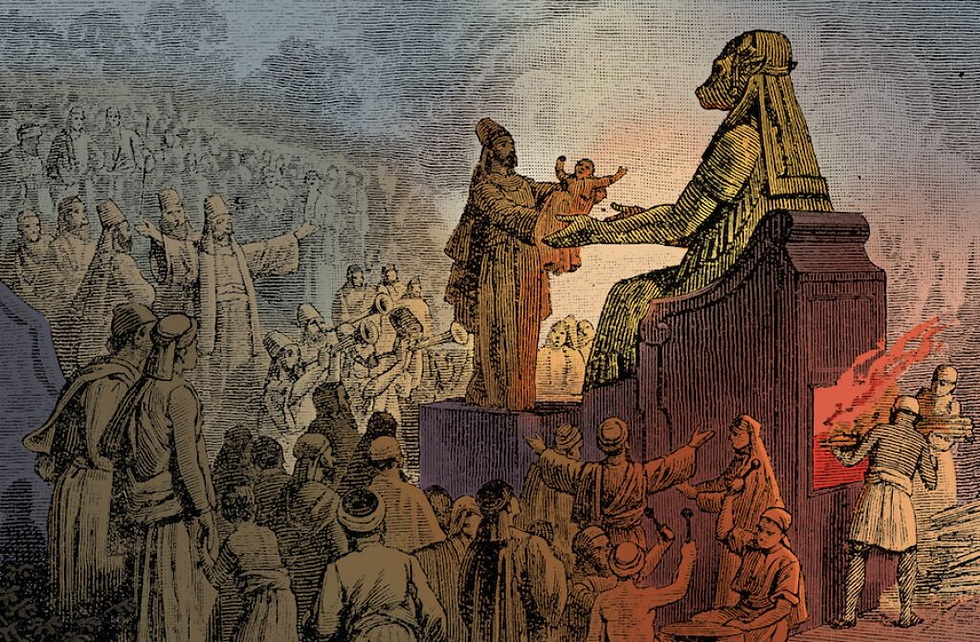
The Giant Megaliths at the Temple
Legends claim that Nimrod "sent giants to rebuild the fortress of Baalbek" to explain the existence of the astonishingly massive stone platform at the site. For centuries, locals and even European visitors have attributed these "megaliths," some weighing over 800 tonnes, to a "primeval race of giant builders."
When the Romans later built their Temple of Jupiter on this same ancient foundation, they were unknowingly (or perhaps knowingly) building upon a site already shrouded in the legendary memory of a mighty, rebellious, pre-Flood world.
The platform of Baal, the temple of Jupiter Heliopolitanus, and the legends of Nimrod and giants all converge at Baalbek, creating a layered archaeological and mythological palimpsest that speaks to the very themes of rebellion, giants, and the dispersion of nations.
While the specific location of the Tower of Babel is debated—with local traditions sometimes placing it at Baalbek itself—the connection between Nimrod, giants, and monumental architecture is persistent.
The 'Babel' connection is also etched into the landscape of the modern Golan Heights. At the southern foot of Mount Hermon, overlooking the ancient site of Caesarea Philippi, stand the ruins of a medieval fortress known as the "Fortress of Nimrod" (Qal'at Namrud).
While the current structure is from the Muslim era, its name preserves an ancient memory linking this region—a place the Bible identifies as the landing spot of the fallen "sons of God" (Mount Hermon) and a center of Canaanite worship (Baal at Caesarea Philippi)—with the archetypal rebel-king.
The Many Names of the First Antichrist
Nimrod's rebellion at Babel was a watershed moment. According to the Book of Jasher, he united humanity under a threefold banner of defiance: one group sought to ascend to heaven and wage war on God, another to install their own gods in heaven, and a third to attack Him directly with weapons.
This ambition to establish a one-world system without God, and to ultimately usurp the divine throne, marks Nimrod as the archetypal Antichrist figure.
When God confounded their languages and scattered them across the earth, the peoples carried with them not just their languages, but fragmented memories of their great, rebellious leader. These memories, filtered through different cultures and mythologies, crystallized into a multitude of names. The mighty hunter became the hero-god of nearly every ancient pantheon. Nimrod, the Bible's rebel, is known to history by a host of other titles:
Gilgamesh of Sumer, the tyrant-king and builder of Uruk.
Osiris of Egypt, the civilizing god-king who was murdered and resurrected.
Baal of Canaan, the storm-god who defeated his enemies and was worshipped on Mount Hermon's slopes.
Dumuzi/Tammuz, the Sumerian shepherd-god, consort of Ishtar, whose death was mourned annually.
Orion of Greek myth, the giant hunter who boasted he could kill every beast on earth.
Dionysus/Bacchus, the Greek god of wine and ecstatic worship.
Adonis, the beautiful lover of Aphrodite, a vegetation god of death and rebirth.
Mithra, the Persian god of light and covenants, whose mysteries spread throughout the Roman Empire.
Apollo, the Greek god of archery, music, and prophecy.
These names are believed to represent the cultural fingerprints of the post-Babel dispersion. As the peoples migrated, they deified their founding father, encoding his attributes—his rebellion, his hunting prowess, his kingship, his connection to the heavens, and even his violent death—into the mythologies that would shape the ancient world.
The two names at the ends of that list, Gilgamesh and Osiris, are particularly significant, representing the Sumerian and Egyptian expressions of this same archetypal figure. The story of Nimrod, therefore, does not end in Genesis 10; it is merely the starting point for understanding the gods and heroes of the ancient world.
The Tower of Babel: Not About Height, But Access
The traditional Sunday school image of the Tower of Babel—a ziggurat stretching impossibly toward the clouds, scraping the underside of heaven—misses the point entirely. As noted, if the builders were genuinely concerned with physical height, they chose a peculiar location: a valley in the land of Shinar (Mesopotamia), not a mountain peak. The text itself signals that something deeper is at work.

The key phrase is "whose top may reach unto heaven" (Genesis 11:4). In ancient Near Eastern thought, this language was not about architecture but about ritual access. Ziggurats, the stepped temple-towers of Mesopotamia, were understood as cosmic mountains, "stairways" or "gates" between heaven and earth where the gods could descend to the human realm and priests could ascend to the divine. The name of Babylon itself, Bab-ili, means "Gate of the Gods."
Thus, when the people said, "Let us build us a city and a tower, whose top may reach unto heaven," they were not speaking of a construction project in our modern sense. They were declaring their intention to build a cosmic gateway—a portal through which the divine realm could be accessed, controlled, and perhaps even invaded.
A Portal, Not a Skyscraper: This interpretation aligns with the text's ominous conclusion: "and now nothing will be restrained from them, which they have imagined to do" (Genesis 11:6). God's concern was not about a tall building; it was about what that building represented and what it enabled. The unified humanity, operating with a single language and purpose under Nimrod's leadership, was on the verge of breaching a boundary God had established.
The Hebrew word translated as "imagine" (zamam) carries the connotation of plotting, devising, or purposing—often with evil intent. They were not simply dreaming; they were executing a plan to seize something that belonged to God alone: access to the heavenly realm.
This is why God's response was so dramatic. He did not send a storm to topple the tower or an earthquake to crack its foundations. He confounded their language, breaking the unity that made their project possible. The threat was not the structure itself, but the unified human rebellion that sought to 'breach the divide between heaven and earth on their own terms.'
Reaching the Gods: Throughout the ancient world, temples and sacred mountains were consistently viewed as axis mundi—the cosmic axis connecting the realms. The Mesopotamian ziggurats, Egyptian pyramids, and later structures like Baalbek's megalithic platform were all designed with this cosmic geography in mind.
They were not merely places of worship; they were staging grounds for interaction with the divine (or the divine rebellious).
If Nimrod was indeed the archetypal rebel, the "mighty hunter before the LORD" who established his kingdom in Babylon, then the Tower represents his ultimate ambition: to 'open a permanent gateway' through which the powers he served—the fallen "sons of God" who had descended on Mount Hermon—could freely pass between realms.
This would make Babel not just a political rebellion but a cosmic one, a human attempt to control the very gates of heaven.
The Amalantrah and Babylon Workings
The attempt to open such gateways did not end at Babel. Throughout history, occultists have sought to recreate what Nimrod attempted. The examples provided by Dr. Thomas Horn are particularly striking:
The Amalantrah Working (1918): The infamous occultist Aleister Crowley (Freemason) conducted a ritual series intended to create a "dimensional vortex" or portal between the seen and unseen worlds. According to Crowley, the ritual succeeded. A being manifested through the rift, which he called "Lam."

Crowley's drawing of Lam bears a startling resemblance to what would later be called "Alien Greys" in popular culture. Many believe that the entities contacted through such rituals may be the same fallen beings worshipped in ancient times.
The Babylon Working (1940s): Decades later, rocket scientist Jack Parsons (a co-founder of NASA's Jet Propulsion Laboratory) and L. Ron Hubbard (future founder of Scientology) conducted the "Babylon Working."
Their goal was explicit, to reopen Crowley's portal and summon the 'spirit of Babylon'—specifically the archetypal divine feminine—to incarnate in a human being. Many in occult circles believe they succeeded, and that the entity known as the "Whore of Babylon" walks the earth today.

These modern rituals are not merely curious footnotes. They represent a deliberate continuation of what began at Babel. The names alone are telling: Amalantrah (an obscure Enochian invocation) and Babylon (the very city Nimrod founded).
The practitioners understood themselves to be tapping into ancient currents of power, seeking to reopen gates that had been closed by divine intervention millennia ago.
Megalithic Structures as Stargates
Dr. Horn and other researchers have suggested that many ancient megalithic structures around the world may have served precisely this function. Sites like:
Baalbek, with its massive platform stones weighing over 800 tons, built on a site long associated with Nimrod and giants
Göbekli Tepe, the world's oldest known temple complex, with its T-shaped pillars and animal carvings
Stonehenge and other stone circles across Europe
Pyramids of Giza, aligned with incredible precision to celestial bodies
These may not be simply tombs or astronomical observatories. They may represent humanity's persistent, post-Babel attempt to re-establish contact with the divine realm—or with the beings who fell before the Flood and whose influence persisted afterward.

Göbekli Tepe: The Hill of the Watchers
If the Tower of Babel represents humanity's attempt to build a gateway to heaven, then Göbekli Tepe, perched on a mountaintop in southern Turkey, may represent the 'ritual ground where that ambition was first seeded.' Dating back nearly 12,000 years—to a time long before agriculture, writing, or even pottery—this site forces us to reconsider everything we thought we knew about the origins of civilization.
The name itself means "Potbelly Hill" in Turkish, but its true significance is far more unsettling. Here, hunter-gatherers—nomadic peoples who should have been too busy finding their next meal to engage in monumental construction—somehow quarried, carved, and erected dozens of T-shaped limestone pillars, some standing 18 feet tall and weighing up to 50 tons.
These pillars are arranged in circular enclosures, their surfaces adorned with intricate reliefs of foxes, lions, scorpions, vultures, and other creatures of the wild.
But it is the T-shape itself that demands attention. Archaeologists now widely agree that these pillars are stylized representations of human beings—the crossbar forming the head, the shaft the body, with carved arms and hands visible on some, grasping their own bellies. These are not mere architectural supports; they are 'silent, stone sentinels,' frozen in time.
And like the Tower of Babel, they may represent an attempt to contact, control, or commemorate beings from the heavenly realm—the gibborim, the "mighty ones" of old.
The Geometric Conspiracy: Mainstream archaeology has long held that complex, monumental construction requires a settled, agricultural society with hierarchy and surplus resources. Göbekli Tepe shatters that assumption.
Excavations have found no evidence of domesticated plants or animals at the site; its builders were hunter-gatherers who feasted on wild gazelles and grains. So how did they do it? The answer may lie in a discovery that itself sounds like a conspiracy theory but is supported by peer-reviewed research.
In 2020, archaeologists from Tel Aviv University used computer algorithms to analyze the layout of the stone enclosures. They discovered that three of the site's oldest circles are arranged in a 'nearly perfect equilateral triangle'—a geometric plan that must have been conceived in advance, as a single, unified project.
This suggests that hunter-gatherers possessed a sophisticated understanding of abstract geometry and could translate a small-scale diagram into massive, precisely aligned structures.
As one researcher put it, this required "a schematic or diagram that the builders used as a guide." The "logical conspiracy" here is that these people knew more than they should have.
Did they inherit knowledge from a lost civilization, as authors like Graham Hancock have proposed? Or were they instructed by beings who descended from the "heavenly realm"—the same "sons of God" who, according to tradition, descended on Mount Hermon and taught humanity the arts of civilization?
The Comet and the Watchers: Another compelling theory, advanced by researchers like Dr. Martin Sweatman of the University of Edinburgh, suggests that the carvings at Göbekli Tepe are not merely decorative but 'function as a historical record.'
According to this interpretation, the V-shaped symbols carved on a pillar—and on the necks of animal statues—represent a 'lunisolar calendar of 365 days,' predating other known calendars by millennia.
More strikingly, Sweatman believes these carvings document a catastrophic event: a 'swarm of comet fragments' from the Taurid meteor stream that struck Earth around 10,850 BCE, triggering a 1,200-year mini-ice age known as the Younger Dryas.

This event, the theory holds, wiped out many large animal species and forced humanity to adapt, developing agriculture and new religious practices to cope with the altered world.
If true, this means Göbekli Tepe is not just a temple but an 'observatory and a warning'—a monument built by survivors to memorialize the destruction and perhaps to appease the cosmic powers that caused it.
The "conspiracy" angle emerges from the resistance this theory has faced. Dr. Sweatman claims his findings were dismissed without proper peer review, and the lead excavator, Dr. Lee Clare, has publicly distanced himself, stating that Sweatman "stands in no relationship whatsoever to the Göbekli Tepe fieldwork and research team."
Is this standard academic caution, or a protective gatekeeping designed to suppress a paradigm-shifting truth?
The Skull Cult: The search results reveal another layer of macabre mystery at Göbekli Tepe: evidence of a "skull cult." Fragments of three human skulls, dating to the site's occupation, show deliberate post-mortem modifications—deep grooves cut with flint tools, and drill holes—that are unlike anything seen elsewhere in the world from this period.
The purpose of these modifications remains debated. Were these the revered skulls of ancestors, displayed and venerated in rituals? Or were they the trophies of defeated enemies, desecrated as a warning?
The iconography on the pillars includes depictions of headless humans and carved stone heads, reinforcing the theme. This practice aligns with the broader ancient Near Eastern fascination with the head as the seat of power and spirit—a fascination that echoes in the biblical accounts of giants (Nephilim and Rephaim) and the mighty hunters who may have hunted them.
The WEF and the "150-Year Excavation": Perhaps the most fascinating and contemporary conspiracy surrounding Göbekli Tepe involves the World Economic Forum (WEF). Independent researcher and YouTuber Jimmy Corsetti (of the "Bright Insight" channel), whose theories have reached millions via the Joe Rogan podcast, has pointed to a series of connections he finds troubling.
Corsetti notes that:
The Dogus Group, a Turkish conglomerate, announced its 20-year sponsorship of the site at the WEF's annual meeting in Davos in 2016.
Key figures in the Turkish ministry responsible for Göbekli Tepe are members of the Global Shapers, an initiative founded by WEF chairman Klaus Schwab.
Similar connections exist for officials controlling Gunung Padang in Indonesia, another controversial megalithic site.
The implication, as Corsetti frames it, is that the WEF has "infiltrated positions that ultimately control literally the world's two oldest archaeological sites on Earth." The "million-dollar question" is why.
Corsetti and his followers point to the excruciatingly slow pace of excavation. Since work began in the mid-1990s, less than 10% of the site has been uncovered, with some estimates suggesting it will take 150 years to complete the work.
Olive trees planted over buried portions of the complex, they argue, will prevent future excavation and potentially damage the buried megaliths with their roots. To Corsetti, this is "a borderline crime against humanity"—a deliberate delay to keep the truth about our ancient past hidden.
Dr. Lee Clare, the site's lead archaeologist, has dismissed these claims as the work of amateurs who "go to the site for half an hour and think they can explain the whole site." He defends the slow progress as responsible stewardship: archaeology is destructive by nature, and once a layer is dug, it is gone forever.
Future generations with better technology deserve a chance to investigate. He also points out that natural processes, not human hands, buried much of the site, and that the olive trees are not a conspiracy but a mundane reality of land management.
Yet, the question lingers. In an age of satellite imagery and ground-penetrating radar, why does it take decades to move dirt? If the site is as globally significant as UNESCO declares it to be, why is its full excavation being deferred to "future generations"? For those who suspect that the story of human origins is not the one we've been told, the slow pace at Göbekli Tepe feels less like science and more like suppression.
Connecting to Nimrod and the Stargate Thesis: For the purposes of our exploration, Göbekli Tepe fits uncomfortably well into the narrative. Here, at the dawn of the Neolithic period—precisely the era when humanity began to settle, build, and organize—we find a monumental complex dedicated to beings who are depicted as stylized humans, but who are surrounded by the iconography of power.
The T-shaped pillars, with their arms and hands, may well represent the gibborim—the mighty ones of Genesis 6, the offspring of the "sons of God" and the daughters of men. They are the "men of renown," the ancestors who were worshipped as gods after the Flood.
If Nimrod was the archetypal "mighty hunter before the LORD" who built the first cities and the first great tower, then Göbekli Tepe may represent an earlier phase of the same impulse: the desire to commune with, commemorate, and perhaps even become those mighty ones. It is a temple to the gibborim, built by their descendants, on a mountain that may have been their landing place.
And if the site was deliberately buried—not by natural processes alone, but by its own builders, as has been suggested for the nearby site of Karahan Tepe—then the act of entombment takes on ritual significance. Like the later Tower of Babel, it was a project that God "came down to see," and whose potential was so dangerous that He confounded the languages of its builders and scattered them across the earth.
The conspiracies surrounding Göbekli Tepe, whether they involve comet strikes, lost civilizations, or shadowy globalist organizations, all orbit the same central question: what really happened at the dawn of human history?
According to the Old Testament, after the Flood, Noah's grandson Nimrod "began to be a mighty one in the earth." The word chalal (began) implies a 'profane initiation,' a defiling act that opened the way for him to become a gibbor—a mighty one, possibly in the giant lineage of the Nephilim.
If Nimrod indeed opened a gateway at Babel, he was continuing the rebellion that began when the "sons of God" descended on Mount Hermon and corrupted humanity.
The Cosmic Context: By confounding their language and scattering them, God was not punishing humanity for building a tall building. He was 'shutting down a gateway' that would have allowed rebellion to reach cosmic proportions. He was limiting the damage, containing the infection, and ensuring that the post-Flood world would not immediately replicate the pre-Flood corruption that had necessitated the judgment of water.
According to the Torah, the scattering at Babel created the nations, each with its own language and its own cultural memory of the great rebellion. And as the peoples migrated, they carried with them the fragments of that memory—the stories of a mighty hunter, a rebel king, a tower reaching to heaven, and a gateway that was closed.
These memories crystallized into the mythologies of the world: Gilgamesh, Baal, Osiris, Dionysus, and all the others who bear the shadow of the original rebel. And in every generation, there are those who seek to reopen what God has closed.
The Seventy Nations and the Heavenly Host
The New Living Translation of Deuteronomy 32:8 provides a crucial window into the cosmic geography of the ancient world: "When the Most High assigned lands to the nations, when he divided up the human race, he established the boundaries of the peoples according to the number in his heavenly court."
This rendering, drawing from the Septuagint's "according to the number of the angels of God," preserves a theology that most modern translations obscure.
The textual history here is fascinating. The Masoretic Text, the traditional Hebrew version, reads "according to the number of the children of Israel"—a phrase that makes little chronological sense since Israel did not yet exist when the nations were divided at Babel.
The Septuagint (the Greek translation of the Old Testament) and several Hebrew manuscripts discovered at Qumran among the Dead Sea Scrolls preserve the older reading: "according to the number of the sons of God" or "angels of God."
As George Leo Haydock noted in his 19th-century commentary, many of the early church fathers understood from this verse that there were seventy angelic guardians appointed over the seventy nations of the world, corresponding to the seventy languages that emerged from the Tower of Babel.
This understanding is reinforced by Deuteronomy 4:19, where God warns Israel not to worship "the sun, and the moon, and the stars, even all the host of heaven, which the LORD thy God hath divided unto all nations under the whole heaven." The "host of heaven" throughout Scripture refers to angelic beings—the sons of God who were assigned to the nations while Yahweh reserved Israel for Himself (A belief that dominates the views of Zionist Jews/Zionist Christians).
The Book of Jasher preserves this tradition in its description of Pharaoh's throne, which had seventy steps corresponding to the seventy languages of mankind. Only one who could speak all seventy languages could ascend the throne and rule Egypt. When Joseph was appointed second-in-command, the officers protested that he knew only Hebrew—until an angel visited him that night and taught him all seventy tongues.
The significance for Nimrod is profound. After the confusion of tongues at Babel, humanity scattered across the earth speaking seventy different languages. But they carried with them the memory of the great rebel-king who had led them.
Nimrod, the mighty hunter before the LORD, became known by seventy different names across the nations—each culture preserving fragments of the same archetypal figure in their own tongue. As the text suggests, this may be the true esoteric meaning behind the motto 'E Pluribus Unum'—"Out of Many, One"—the many names pointing back to the one original rebel .
Gilgamesh: The Two-Thirds Divine Giant
The Epic of Gilgamesh, inscribed on clay tablets around 2500 BCE, stands as the oldest surviving work of literature. Its hero, Gilgamesh, is described as the ruler of Uruk (Erech), one of the very cities Nimrod founded in his kingdom of Shinar (Genesis 10:10).

The parallels are so striking that scholars have long debated the connection. The 1910 'New International Encyclopædia' noted that while the purely mythological view identifying Nimrod with the sun god or Orion had been abandoned, the dispute lay between identifying him with the Babylonian god Marduk or with Gilgamesh, "the hero of the Babylonian epic, who appears typically in art as engaged in combat with a wild beast, and is associated with Erech, one of Nimrod's cities."
The epic states that Gilgamesh was "two-thirds god and one-third human"—a description that aligns remarkably with the Nephilim genetics thesis presented earlier. If the gibborim of Genesis 6 were the offspring of the "sons of God" and human women, then figures like Gilgamesh (and Nimrod) would indeed possess a hybrid nature, part divine and part mortal.
Artifacts depict Gilgamesh as a giant, often shown holding a lion under his arm as if it were a mere housecat—the "mighty hunter" indeed.
The Tomb of Osiris: Symbol of the Underworld God
In 1999, the world-renowned Egyptian archaeologist Zahi Hawass excavated a mysterious shaft on the Giza Plateau, located exactly halfway between the Pyramid of Khafre (Chefren) and the Great Sphinx. The shaft descends twenty-nine meters vertically through solid rock, leading to a burial chamber containing four pillars surrounding a large granite sarcophagus.

When Hawass and his team pumped out the water that had filled the shaft for millennia, they made a startling discovery: the sarcophagus was already open, its lid thrown off. Inside, they found human skeletal remains along with amulets and pottery dating to the Late Period (roughly the 6th Dynasty, 2345–2181 BC).
Hawass concluded that this was not a royal burial but a symbolic tomb for Osiris, the god of the underworld—a cenotaph where Egyptians could be "close to the god of the underworld in death."
The dating is significant. The 6th Dynasty falls immediately after the traditional date of Noah's Flood (2348 BC), placing it squarely in the era of Nimrod and the Tower of Babel. If Nimrod was deified after his death as Osiris (as argued in 'The Two Babylons' and by numerous ancient sources), then this symbolic tomb may represent the Egyptian memory of the rebel-king who became their god of the dead.
The open sarcophagus, with its lid thrown off, raises an intriguing question: was it always empty, or had something—or someone—been removed?
The Tomb of Gilgamesh: Discovery Beneath the Euphrates
In April 2003, as American forces prepared to occupy Iraq, a German-led archaeological expedition made an announcement that should have shaken the world. Working at the site of ancient Uruk (modern Warka), the team led by Jörg Fassbinder of the Bavarian Department of Historical Monuments used magnetometry to map the city buried beneath the desert sands.
What they found was extraordinary. In the middle of the former course of the Euphrates River, they discovered the remains of a building that matched the description of Gilgamesh's tomb as recorded in the epic. According to the ancient text, Gilgamesh was buried beneath the river itself, in a tomb constructed when the waters were temporarily parted following his death.
Fassbinder told the BBC: "I don't want to say definitely it was the grave of King Gilgamesh, but it looks very similar to that described in the epic." He added that the team found garden structures and an incredibly sophisticated system of canals, describing Uruk as "like Venice in the desert."
The timing of this discovery is impossible to ignore. The announcement came in late April 2003. In May, the United States began its military occupation of Iraq—officially to find "weapons of mass destruction" that never materialized. But if the account provided by Steve Quayle is accurate, something far more significant may have been the real objective.
Quayle, citing a conversation with a "multistarred general" who was present, stated: "They have Gilgamesh's remains... He was in a state of remarkable preservation... The advance team—Special Operations went in there to grab all of that stuff... The whole point was to extract the DNA."
If true, this means that the biological remains of Nimrod—the archetypal rebel, the mighty hunter, the giant who led humanity in its first great post-Flood rebellion—are now in the possession of those who understand their significance.
Orion: The Mighty Hunter in the Stars
The connections do not end on Earth. In the night sky, the constellation Orion has been known since ancient times as "the mighty hunter." Alexander Hislop, in The Two Babylons, draws together the threads: "From Persian records we are expressly assured that it was Nimrod who was deified after his death by the name of Orion, and placed among the stars."
The association between Nimrod, Osiris, and Orion is well-documented. In Egyptian astronomy, Orion was known as Sah, the soul of Osiris. The three great pyramids of Giza are aligned with extraordinary precision to the three stars of Orion's Belt—a fact popularized by Robert Bauval's Orion Correlation Theory.
If the pyramids represent the earthly counterpart to Orion's celestial domain, and the Osiris Shaft contains the symbolic tomb of the god, then the Giza Plateau may be understood as a vast cosmic stage upon which the drama of death and resurrection—of Osiris, of Nimrod, of the coming one—has been encoded in stone.
The One Who Was and Is Not and Yet Shall Be
The Book of Revelation describes a figure who mirrors Christ in terrifying parody. Where Jesus is "the One who was and is and is to come" (Revelation 1:4), the beast of Revelation 17 is described as one who "was and is not and yet shall be" (Revelation 17:8).

This beast is further identified with an eighth king who "belongs to the seven" (Revelation 17:11)—a resurrection, a return, a reincarnation of something that once was and will be again.
The Qur'an, while never naming Nimrod explicitly, preserves his memory in the account of the tyrant-king who disputed with Abraham and claimed divinity for himself (Surah al-Baqarah 2:258).
Islamic tradition identifies this figure as Nimrod (Namrud), the builder of the Tower of Babel, who sought to wage war against heaven itself. His end is instructive: not by sword or army, but by the smallest of God's creatures—a mosquito sent to enter his brain and bring him low.
In Islamic eschatology, a similar figure—al-Masih ad-Dajjal, the False Messiah—will appear in the last days, also claiming divinity. While Muslim scholars do not identify this figure as Nimrod returned, the typological parallel is striking: the archetypal rebel against heaven serves as the pattern for the final deceiver.
If Nimrod's biological remains have indeed been recovered, the question of whether that pattern might become literal—through genetic resurrection or demonic incarnation—transcends any single religious tradition.
If Nimrod was the first great rebel, the archetypal Antichrist; if he was deified after death as Osiris, the god of the underworld who died and was resurrected; if his remains have been discovered in a state of remarkable preservation, their DNA intact and recoverable—then the technological capability to clone or resurrect such a being is no longer science fiction. It is a matter of military logistics.
And if the Osiris Shaft's open sarcophagus and the Gilgamesh tomb's "remarkably preserved" remains represent the discovery of those biological materials, then perhaps the prophecy of the beast who "was and is not and yet shall be" is not merely symbolic. It may be a literal description of what is to come.
The Proto-Antichrist: Nimrod and the Birth of a Blueprint
"What is the purpose of prophecy?" Maybe it's to prepare us for things to come. If that holds true, it’s inconceivable that a loving God would leave us without crucial details about the most tumultuous period in human history—the End Times.
The stakes are simply too high. In Mark 13:19, Jesus himself warns of a coming tribulation so severe that it has no equal in the past and will have no sequel in the future. This is a declaration of unparalleled seriousness.
Therefore, if Scripture has spoken so extensively about the key players of the Last Days, shouldn’t we be able to discern their identities? Shouldn't we be able to look at the prophetic blueprint and identify someone like the coming Antichrist, not just to satisfy curiosity, but to fortify ourselves against deception?
To understand the end, we must first understand the beginning. In the pre-Flood world, Lucifer and his fallen angels engaged in direct, personal corruption of humanity. The Book of Enoch describes this era in detail, where the "sons of God" took human wives, producing the Nephilim—the "fallen ones"—who brought chaos and violence to the earth. But the judgment of the Flood reset the stage, though not the players. The spiritual forces of evil adapted their strategy.
After the Flood, we see a shift. The devil's work begins to manifest through a singular, empowered human being. At the Tower of Babel, a man named Nimrod rose to prominence, not merely as a political leader, but as a direct antagonist to God.
The Bible calls him "a mighty hunter before the Lord" (Genesis 10:9), a phrase that carries a connotation of defiance, of hunting human souls to lead them into rebellion. He attempted to consolidate all of humanity under a single, godless system, establishing a "New Order" with himself as the deity.
In this, Nimrod serves as the prototypical "anti-Christ" figure—the first in a long line of rebellious world-rulers who would embody the spirit of opposition to God. Significantly, ancient texts and traditions hint that he, like the pre-Flood tyrants, may have been of Nephilim descent, carrying a genetic legacy that set him apart from ordinary humanity.
When God confounded their languages and scattered the people, the Bible tells us the world was divided into 70 nations, each placed under the stewardship of a divine being, or "principality" (Deuteronomy 32:8, in some manuscripts and the LXX). As the people groups migrated, they carried with them the core memory of their fallen leader, Nimrod. But over centuries, the historical figure faded and was reborn as a mythologized god-man.
He was given new names, each culture adapting his legend to its own language and symbols, but the central theme remained remarkably consistent: a powerful, semi-divine king who died and was promised to return.
He became the dying and rising god, a theme that would permeate the ancient world. We know him by many names: the heroic king Gilgamesh of Sumerian epic, the resurrected god Osiris of Egypt, and the constellation Orion, the mighty hunter immortalized in the stars.
The Assyrian: A Title, Not a Nationality
This archetypal rebel is given another crucial title in the Old Testament: "the Assyrian." The prophet Isaiah speaks of him as the "rod of God's anger," a tool used for discipline, but one that will itself be judged for its haughty pride: "Woe to the Assyrian, the rod of my anger, the staff in whose hand is my indignation!" (Isaiah 10:5). Later, God declares, "I will break the Assyrian in my land; on my mountains I will trample him down" (Isaiah 14:25).
Many modern interpreters see "the Assyrian" and immediately think of a future geopolitical leader from a specific nation in the Middle East. However, this may be too narrow a reading. The term is better understood as a typological title, a direct link back to the original rebel, Nimrod, whose kingdom was in the land of Shinar (which later became part of the Assyrian and Babylonian empires).
It is a spiritual designation, identifying the final Antichrist as the one who embodies the same spirit of rebellion, the same ambitions of global domination, and the same satanic empowerment as his prototype. The "Assyrian" is the eschatological Nimrod.
The "Beast" Rises: A Return of the Ancient King
This brings us to the final act, as described in the Book of Revelation. Here, the figure is given yet another name: "the Beast." The world, we are told, will marvel and follow this being (Revelation 13:3).
But why? Why would a globalized, technologically advanced society fall to its knees before a single man? The clues in the text, when viewed through the lens of Nimrod's story, offer a compelling answer.
First, the world is already primed. For millennia, cultures across the globe have preserved legends of a returning king, a dying god who will rise again—Osiris, Gilgamesh, Marduk, Quetzalcoatl. The appearance of a man who fits this archetype would trigger a deep, almost genetic, resonance in the collective human psyche, fulfilling the ancient hopes.
Second, the event that catalyzes this global worship is a miracle of staggering proportions: a fatal head wound that is miraculously healed (Revelation 13:3). This supernatural recovery will be interpreted as a divine sign, proof that this man is indeed the promised returning god. The world will ask in awe, "Who is like the beast, and who can fight against it?" (Revelation 13:4).
But perhaps the most profound clue lies in the very word used to describe him. The Greek word is thērion (Strong's 2342), which specifically means a "wild beast" or a "venomous animal." This is not the typical word for a human being, no matter how evil, cruel, or bestial his character. John, writing under divine inspiration, could have chosen words like anthrōpo (man), ponēros (evil one), or ekthros (enemy). Instead, he chose thērion. Why?
This leads us back to the nature of Nimrod and the Nephilim. Was Nimrod "more than human"? Did his power stem not only from demonic influence but from a corrupted biology? The ancient records suggest this. The Epic of Gilgamesh boasts that he was "two-thirds god, one-third human."
The Book of Jasher records that his head was cut off, a detail that chillingly prefigures the "deadly wound" of Revelation. The connection between the Nephilim (the fallen ones) and the Gibborim (the mighty men) is explicit in Genesis 6:4.
This raises a staggering possibility: Could the final Antichrist be a literal hybrid, a being whose DNA has been corrupted, making him a "beast" in a very literal, biological sense? Is it possible that the "deadly wound" is a mortal blow to a being that is not entirely human, and its healing is a resurrection that restores this ancient, semi-divine tyrant?
Some scholars, like S. Douglas Woodward, have explored this very idea, wondering if Nimrod's "might" was a result of a post-Flood genetic manipulation by fallen angels, creating a demigod to lead humanity once more.
This speculation is no longer the realm of pure fantasy. In our day, science is rapidly advancing in the field of genetic engineering, including the creation of animal-human chimeras. The technology to create a hybrid being, to "resurrect" extinct genetic material, is moving from the pages of science fiction into the laboratory.
Could this be the means by which the "beast" rises? Could the manipulation of DNA, the very blueprint of life, be the tool used to fulfill the ancient prophecy of the returning god-man? If so, the "Mark of the Beast" might not just be a physical stamp, but could begin as a genetic alteration—a "splice"—that transforms a man into the thērion, the Beast, setting him apart as the unholy, the final, ultimate embodiment of the spirit of Nimrod.
The stage, it seems, is being set for a confrontation as ancient as time itself, between the seed of the serpent and the Lion of the tribe of Judah.
Identifying the Beast: A Trail of Seven Kings
The most detailed description of the Beast's identity is found in Revelation 17. Here, John is shown a vision of a scarlet beast with seven heads and ten horns, and he is perplexed.
The angel, acting as his divine interpreter, provides an explanation that has fueled debate among scholars for centuries. But if we take the angel's words at face value, the riddle begins to solve itself.

"The beast that you saw was, and is not, and is about to rise from the bottomless pit and go to destruction. And the dwellers on earth whose names have not been written in the book of life from the foundation of the world will marvel to see the beast, because it was and is not and is to come. This calls for a mind with wisdom: the seven heads are seven mountains on which the woman is seated; they are also seven kings: five of whom have fallen, one is, the other has not yet come, and when he does come he must remain only a little while. And as for the beast that was and is not, it is an eighth but it belongs to the seven, and it goes to destruction." (Revelation 17:8-11, ESV)
The angel explicitly states that understanding this requires wisdom—it is a puzzle to be solved. The seven heads are explained in two ways: they are seven mountains (often interpreted as the seven hills of Rome) and seven kings. While many respected eschatological scholars have traditionally interpreted these "kings" as representing kingdoms or empires, a close reading of the Greek text suggests a more literal interpretation may be warranted.
The word used for "kings" here is basileus (Strong's 935), which is unequivocally defined as a masculine noun meaning "a king, ruler, or emperor." This is distinct from the closely related word basileia (Strong's 932), which means "kingdom, sovereignty, or authority."
John, writing under the inspiration of the Holy Spirit, did not use the word for "kingdom." He used the word for "kings." Furthermore, if we are to define the Antichrist as a singular man—which the entirety of Scripture does—it would be inconsistent and poor scholarship to then interpret the heads of the beast, which are integral to his identity, as impersonal systems. The beast itself is described as a person; its constituent parts, therefore, are most logically persons as well.
Thus, the angel reveals that the Beast is not a single, isolated figure who appears from nowhere at the end of history. Instead, he is the culmination of a lineage, a succession of evil rulers who are all, in a sense, part of one body—one continuous spirit of rebellion that has manifested through specific human beings across the ages.
The seven heads represent seven individual kings who embody the spirit of Antichrist. John is told that five of these have already fallen (they are in the past), one "is" (existing in John's own time), and another is yet to come, who will reign for only a short while. Finally, there is an eighth who is described as "of the seven"—he is the ultimate expression, the one who recapitulates and embodies the evil of all his predecessors, and he is the one who goes to perdition.
The Five That Have Fallen: A Rogues' Gallery of Rebellion
If we accept this literal, personal interpretation, who might these seven kings be? While dogmatism is unwise, certain figures from biblical and historical records stand out as unmistakable archetypes of the anti-Christ spirit.
The first five, those who had "fallen" by John's time, form a clear pattern:
1. Nimrod: The proto-Antichrist. As established, he was the first post-Flood figure to consolidate humanity in rebellion against God, establishing a kingdom at Babel and becoming a template for every subsequent tyrant who would seek to make himself God.
2. The Pharaoh of the Exodus: This Pharaoh, whom many identify as Amenhotep II or a similar ruler of the 18th Dynasty, embodied the same spirit. He considered himself a deity, refused to acknowledge God, and sought to enslave ancient Judeans. His hardened heart led to a direct confrontation with the true God, resulting in the plagues and the destruction of his army—a foreshadowing of the final battle.
3. Sennacherib, King of Assyria: The Assyrian monarch who besieged Jerusalem during the reign of Hezekiah. The book of Kings and Chronicles records his taunting messages, where he mocked the God and compared him to the powerless idols of other nations he had conquered. He, like Pharaoh, saw himself as supreme. His downfall was swift and humiliating; an angel of the Lord struck down 185,000 of his soldiers, and he returned home in shame, only to be assassinated by his own sons while worshiping in the temple of his god. He is a perfect type of the arrogant "Assyrian" who is broken by God.
4. The King of Tyre: In Ezekiel 28, a prophecy is directed against the "prince of Tyre," a human ruler consumed by pride, claiming to be a god. But as the chapter progresses, the language transcends a mere mortal king and begins to describe the fall of Lucifer himself, the spiritual power behind the earthly throne. This dual-layered prophecy makes the King of Tyre a significant "head"—a man so possessed by satanic pride that he becomes a direct agent of the dragon, blurring the line between human and demonic rebellion.
5. Antiochus Epiphanes: This Seleucid king of the 2nd century BC is perhaps the most direct precursor to the final Antichrist. His name means "God Manifest," yet he was known to his enemies as Epimanes ("The Madman"). He invaded Jerusalem, slaughtered thousands, and desecrated the Temple by erecting an altar to Zeus Olympios in the Holy of Holies and sacrificing a pig upon it. This "abomination of desolation" became the definitive foreshadowing of what the final Antichrist will do in a future Temple. Jesus Himself pointed back to this event as a pattern for future understanding (Matthew 24:15). Antiochus is the bridge between the Old Testament types and the New Testament revelation.
These five men, each in his own way, stood as direct antagonists to God and His people, claiming divine prerogatives and committing horrific acts of sacrilege. They form the historical foundation of the Beast's seven-headed identity.
The Sixth: The One Who "Is"
Identifying the sixth king, the one who "is" at the time of John's vision, depends largely on when the Book of Revelation was written. The two primary candidates are Roman emperors, as the Roman Empire was the dominant power in John's world.
If Revelation was written in the mid-60s AD (a pre-70 AD date favored by some scholars), the reigning Caesar was Nero. Nero's fit with the Antichrist mold is almost too perfect. He was a megalomaniacal madman who blamed Christians for the Great Fire of Rome and subjected them to horrific persecutions—covering them in animal skins to be torn apart by dogs, crucifying them, and burning them alive as torches to light his gardens. He was rumored to be a reincarnation of some ancient evil, and the legend of his return (Nero redivivus) persisted for centuries. He embodies the beastly, demon-possessed ruler perfectly.
If Revelation was written toward the end of the 1st century AD (the more traditional view), the reigning Caesar was Domitian. Domitian was the first Roman emperor to demand formal, widespread worship as "Lord and God" (Dominus et Deus). He intensified the persecution of both Jews and Christians, exiling John to Patmos. His reign was characterized by paranoia, cruelty, and an imperial cult that directly challenged the God.
Either candidate fits the description of a vicious, god-opposing ruler who "now is." The spirit of the Antichrist was already at work in the Roman emperors of John's day.
The seventh king—the one who "has not yet come" and will "remain only a little while"—is a more challenging identification. If the pattern holds, this would be a figure who arises after John's time, embodies the same spirit for a short but intense period, and further prepares the way for the final eighth.
The Seventh: A Villain Created and Chosen?
Following the decline of the Roman Empire, the demographic landscape of the Jewish world underwent a significant transformation. A theory suggests that the Khazars—a Turkic people from the Caucasus region whose ruling class reportedly converted to Judaism around the 8th century—migrated westward after their empire's collapse, forming a substantial component of the Ashkenazi Jewish population in Eastern Europe. This "Khazar hypothesis" has been a subject of intense debate; while popularized by Arthur Koestler's 1976 book The Thirteenth Tribe.
By the time of the post-Roman and medieval periods, these currents had moved from being a purely reactive movement to one that proactively sought to influence the direction of world events. This narrative suggests that the Frankists, immersed in Kabbalistic mysticism, began to infiltrate secret societies such as Freemasonry and emerging spy networks, with the alleged goal of controlling the levers of political and economic power.
The aim, it is claimed, was not merely to await prophecy but to actively manage and direct its fulfillment, steering history toward the messianic age on their own terms. This is said to have included integrating into the European aristocracy and using positions of influence to shape governments, thereby transitioning from a persecuted sect to a hidden hand within the structures of power.
It is believed that when international Jewry declared war on Hitler, it was not just because Hitler had broken their financial chains, but also to make him the symbolic 'seventh head of the beast.'
A Glimmer of Another Candidate
While the seven kings above form a coherent lineage, the Book of Daniel introduces another figure who deserves consideration, not necessarily as one of the seven heads, but as a crucial piece of the prophetic puzzle that connects directly to the timing of the end. This is Alexander the Great.
In Daniel 8, the prophet receives a vision of a ram with two horns (the kings of Media and Persia) being attacked and destroyed by a male goat "from the west" with a single prominent horn between its eyes.
The angel Gabriel later explicitly interprets this for a terrified Daniel: "The rough goat is the king of Greece: and the great horn that is between his eyes is the first king" (Daniel 8:21). This is a direct, unambiguous prophecy of Alexander the Great, who conquered the Persian Empire in a series of lightning-fast campaigns, "not touching the ground," so swift was his advance.
What is striking about this prophecy is what happens next. The great horn (Alexander) is broken "when he was strong" (he died young, at the height of his power), and four other horns arise in his place (his kingdom was divided among his four generals).
Then, out of one of these four horns, a "little horn" emerges that grows exceedingly great, attacking the "pleasant land" (Israel), casting down some of the "host of heaven" (God's people), and magnifying itself against "the Prince of the host" (God Himself). This little horn takes away the daily sacrifice and desecrates the sanctuary.
Most scholars identify this "little horn" as Antiochus Epiphanes, the fifth king on our list. But note the framework: Daniel's prophecy links Alexander, the archetypal world conqueror, directly to Antiochus, the archetypal desecrator. And significantly, Gabriel tells Daniel that this vision pertains to "the time of the end" (Daniel 8:17).
It should be noted that Alexander's mother, Olympias, was a devout member of the orgiastic, snake-worshipping cult of Dionysus. Both she and her husband, King Philip II, were deeply involved in the occult worship. The 1st-century AD biographer Plutarch recounts that Olympias, in the ecstatic rites of this cult, would handle "great tame serpents" that coiled around the sacred wands and garlands, creating "a spectacle which men could not look upon without terror."
This is the same source who describes the portents surrounding Alexander's conception. Plutarch records that on the night before the consummation of their marriage, Olympias dreamed that a thunderbolt fell upon her womb, kindling a great fire whose flames dispersed and then were extinguished. Philip later dreamed he sealed her womb with a seal bearing the figure of a lion, which the seer Aristander interpreted as a sign she carried a son of bold and lion-like nature.
These dreams were taken seriously in the ancient world, and some later concluded that Alexander was the product of an "immaculate conception" from Zeus, especially given a separate incident where a serpent was reportedly found lying beside Olympias as she slept, which led Philip to believe she had "commerce with some god."
Whether one accepts the divine origin or the more mundane explanation, the fact remains that Alexander's parents were steeped in occult worship. Given this environment, if such practices opened the door to spiritual influence, it is not outside the realm of historical speculation to consider that the child could very well have been hybrid from birth, a possibility that has intrigued theologians and theorists who examine the spiritual dimensions of figures who shaped world history.
The events surrounding Alexander and Antiochus are not just ancient history; they are a pattern, a blueprint for what will happen in the last days. The final Antichrist, the "eighth" who is "of the seven," will likely embody the swift, unstoppable conquering power of Alexander combined with the blasphemous, Temple-defiling madness of Antiochus.
He will be a terrifying synthesis of all the evil that came before, the ultimate beast whose identity has been foreshadowed from the very beginning.
Source: Babylon Rising by Rob Skiba


Comments