
.png)

Modern World: Japan, Red Sun Clouded
- A. Royden D'Souza

- Mar 22
- 48 min read
The classical period of Japan, culminating in the Tokugawa Pax (Shogunate), bequeathed to modernity a set of unresolved dialectics: the tension between imperial sacrality and military governance; the syncretic entanglement of kami and Buddha; the latent violence of a warrior class stripped of war; and the suspicion of foreign ideologies that nonetheless proved irresistible.

The collapse of the Tokugawa shogunate in 1867–1868 was not an abrupt rupture but a convulsive transformation driven by these very tensions. The modern history of Japan is therefore best understood not as a separate epoch but as the third act of a drama whose first two acts were the formation of the imperial state in the Asuka–Nara periods and the fragmentation–reunification of the Sengoku–Edo transition.
Let's try to trace that third act with meticulous attention to mechanism, ideology, and global context. One can argue that Japan’s modernisation was a forced mutation of its classical self, a process in which the nation repeatedly attempted to resolve the contradictions of its past by radical externalisation; whether through the creation of a deified emperor, the pursuit of colonial empire, or the postwar embrace of economic messianism.
Each resolution proved temporary, and the classical controversies returned in new guises, from the theological purges of the Meiji era to the cultic explosions of the 1990s and the constitutional debates of the 21st century.
We begin in the final decades of Tokugawa rule, when the seeds of modernity were already sprouting in the soil of classical institutions.
Part I: The End of the Classical Order – Bakumatsu Japan

By the early 19th century, the Tokugawa system, designed by Ieyasu to perpetuate stasis, had begun to ossify. The sankin kōtai (alternate attendance) system, which required daimyō to spend alternating years in Edo, had succeeded in impoverishing the feudal lords and centralising political control, but it had also created a vast merchant economy in Edo, Osaka, and Kyoto that the samurai class, prohibited from engaging in commerce, could not directly access.
The samurai of the outer domains (tozama daimyō), particularly Satsuma, Chōshū, Tosa, and Hizen, harboured multigenerational resentment against the Tokugawa, who had relegated them to peripheral status after Sekigahara (1600).
Simultaneously, intellectual ferment challenged Neo-Confucian orthodoxy. The Kokugaku (National Learning) movement, founded by scholars such as Motoori Norinaga (1730–1801) and Hirata Atsutane (1776–1843), had excavated classical texts like the Kojiki and Nihon Shoki to argue for the primacy of indigenous Japanese spirituality over Confucian and Buddhist imports.
They posited an ancient, pure Japan where the emperor ruled directly as a living kami, untainted by foreign thought. This was not merely antiquarianism; it was a political theology that directly challenged the legitimacy of the shogunate, which derived its authority from a Buddhist-influenced Confucian framework that justified rule by the strongest.
The Kokugaku revival was paralleled by the Rangaku (Dutch Learning) movement, which had kept a window open to Western science and medicine through the Dejima trading post in Nagasaki.
By the 1820s–1840s, Japanese intellectuals were aware of global events: the Napoleonic Wars, the industrial revolution in Britain, and the rise of American and Russian expansion in the Pacific. The spectre of colonisation, which had already subsumed India (British East India Company control solidified by 1857) and was encroaching on China, hung over the archipelago.
The Harbinger of Anglo-American Imperial Expansion
The arrival of Commodore Matthew C. Perry’s “Black Ships” in July 1853 was a trigger, but the underlying dynamic was the culmination of a half-century of Western imperial momentum.
Britain had defeated the Qing in the First Opium War (1839–1842) and imposed the Treaty of Nanking, seizing Hong Kong and opening five treaty ports. The United States, having secured its Pacific coast following the Mexican-American War (1848), sought coaling stations for its new steamship routes to China.
Perry’s expedition was part of the same global surge that saw Britain annexing Burma (1824–1852), France invading Vietnam (1858), and Russia pushing its Far Eastern frontier.
The Tokugawa shogunate, under the leadership of Abe Masahiro, faced an impossible choice: resist and invite immediate military destruction (as the Qing had experienced), or capitulate and risk internal collapse.
The decision to sign the Convention of Kanagawa (1854) and subsequent Harris Treaty (1858) opened two ports to American trade and established extraterritoriality, unequal terms that humiliated the regime.
The domestic reaction was explosive. The sonnō jōi (Revere the Emperor, Expel the Barbarian) movement seized the public imagination. It fused Kokugaku theology with the practical anxieties of samurai who saw their status dissolving.
The jōi (expulsion) impulse was often violent: the murder of the pro-Western diplomat Ii Naosuke outside Sakuradamon in 1860 (the Sakuradamon Incident) marked the beginning of a decade of political assassination and low-level warfare between shogunate forces and loyalist extremists.
The Honnō-ji Conspiracy Reanimated
In this climate of crisis, the classical past became a living political lexicon. The figure of Oda Nobunaga, the great unifier who had broken Buddhist military power, embraced Western firearms, and was betrayed by his own general, became an obsessive reference point.
A persistent conspiracy theory, which had circulated among samurai intellectuals since the 17th century, held that Nobunaga had intended to abolish the imperial institution entirely and install a secular dictatorship, possibly converting to Christianity to consolidate his rule.
His assassination at Honnō-ji (1582) was thus framed not merely as a personal betrayal but as a “saving” of the imperial line by the Akechi faction, later completed by Tokugawa Ieyasu.
In the 1860s, this historical lens was projected onto the present. The shogunate, led by figures such as Ii Naosuke and later the last shogun, Tokugawa Yoshinobu, was increasingly seen as a “Nobunaga” figure; a centralising power that was selling out the nation to foreign “barbarians” (now the Western powers) and threatening the imperial institution.
The loyalists of Satsuma and Chōshū cast themselves as the heirs of the imperial loyalists who had opposed Nobunaga. When the young Emperor Meiji (then Prince Mutsuhito) ascended in 1867, the cry sonnō jōi became the battle standard for a coalition that would destroy the Tokugawa.
The Shinsengumi, the shogunate’s pro-police force in Kyoto, and its rival loyalist militia, the kiheitai of Chōshū, engaged in a shadow war that directly mirrored the vendetta culture of the Sengoku period.
The Ikedaya Incident (July 1864), in which the Shinsengumi preemptively attacked loyalist conspirators meeting in a Kyoto inn, was treated by contemporaries as a microcosm of the classical struggle: the shogunate playing Nobunaga, violently suppressing chaos to preserve a system that was already obsolete.
The Boshin War and the Restoration of Imperial Authority
The Boshin War (1868–1869) was Japan’s final civil war. The coalition of Satsuma, Chōshū, and Tosa, under the nominal command of the Emperor, defeated the Tokugawa forces in a series of campaigns that culminated in the surrender of Edo (July 1868) and the destruction of the daimyō of Aizu, who had remained loyal to the shogunate.
The classical continuity is stark: the war was fought with a mixture of traditional swords and imported rifles, and the victorious side framed its victory as a restoration of the ancient imperial ritsuryō system, even as they were about to implement the most radical transformation in Japanese history.
The young Emperor Meiji, aged 15, was moved from Kyoto to Edo (renamed Tokyo, meaning “Eastern Capital”) in 1868, establishing a direct continuity with the ancient capitals of Nara and Kyoto while signaling a break with the Tokugawa’s eastern bastion.
The Charter Oath (Gokajō no Goseimon), issued in April 1868, promised deliberative assemblies, abolition of “evil customs,” and the seeking of “knowledge throughout the world.” Its language was deliberately ambiguous, allowing the new oligarchy to claim imperial sanction for policies that ranged from democratic experimentation to authoritarian centralisation.

Part II: The Meiji Revolution – Forging the Modern State
The Meiji Restoration was not a return to imperial autocracy but a revolution from above orchestrated by a relatively small group of samurai from the western domains, later known as the Meiji oligarchs or genrō.
Key figures included Ōkubo Toshimichi (Satsuma), Kido Takayoshi (Chōshū), Itō Hirobumi (Chōshū), Yamagata Aritomo (Chōshū), and Saigō Takamori (Satsuma). These men had no intention of allowing the Emperor, a figurehead, to rule directly. They used his sacred authority to legitimise a centralised bureaucratic state that would rival Western powers.
This arrangement echoed the classical structure of the Heian period, where a cloistered emperor (in) or regent (sesshō) held actual power while the titular emperor performed rituals. The genrō were, in effect, a modern insei, a shadow government that would dominate Japanese politics until the 1930s.
Dismantling of Feudalism
The most audacious act of the early Meiji period was the Abolition of the Domains and Establishment of Prefectures (Haihan Chiken) in August 1871. Without warning, the government announced that the 260+ feudal domains (han) were dissolved and replaced by a system of prefectures (ken) directly administered by Tokyo.
The daimyō were stripped of their territorial rights but were given titles, pensions, and positions in the new nobility (kazoku), rendering them impotent.
This was a direct assault on the classical order that had existed since the Sengoku period. The continuity, however, was preserved through symbolism: the oligarchs argued they were restoring the centralized administrative system of the Taihō Code (701 AD), a classical precedent that allowed them to frame radical centralisation as imperial restoration.
Parallel events worldwide underscore the pattern of forced unification. The same year, 1871, saw the unification of Germany under Bismarck following the Franco-Prussian War (1870–1871), with the Prussian king proclaimed German Emperor at Versailles.
The American Civil War (1861–1865) had already demonstrated the violent lengths required to forge a modern nation-state. Japan’s Haihan Chiken was its own “blood and iron” moment, executed without civil war (the daimyō were bought off) but with the implicit threat of force.
Transformation of the Samurai Ethos
The Conscription Ordinance of 1873, drafted by Yamagata Aritomo, established a national army based on universal male conscription, modelled on the French and Prussian systems.
This dealt a death blow to the samurai class, which had held a hereditary monopoly on arms for over 700 years. The classical warrior ethos was now to be democratised; every farmer could become a soldier.
The reaction was violent. The Satsuma Rebellion (1877), led by Saigō Takamori, a hero of the Restoration who had become disillusioned with the rapid Westernisation, was the final stand of the traditional samurai.
The rebellion was crushed by a conscript army, ironically commanded by Ōkubo Toshimichi, Saigō’s former ally. Saigō’s death became a mythologised event, romanticised as the last true samurai. The classical continuity here is tragic: the samurai who had overthrown the Tokugawa were themselves overthrown by the institutions they had created.

The Manufacture of State Shinto
The most profound and violent evolution of religion in modern Japan was the separation of Shinto from Buddhism and the elevation of Shinto to a state ideology. This was not a natural evolution but a deliberate political project to create a unified national religion that could compete with the established churches of the West.
Within months of the Restoration, the new government issued the Kami and Buddhas Separation Order (Shinbutsu Hanzenrei). The order was rooted in the Kokugaku argument that Buddhism, a “foreign” import, had contaminated the pure indigenous faith of the kami. Temples were ordered to expel Buddhist icons, monks were laicized, and shrines were “purified” of Buddhist elements.
The ensuing Haibutsu Kishaku (Abolish Buddhism, Destroy Śākyamuni) movement was a wave of iconoclasm that swept Japan between 1868 and 1875. Thousands of Buddhist temples were demolished; statues were decapitated, burned, or sold for scrap; scriptures were pulped; and monks were forced to return to secular life.
The violence was comparable to the iconoclasm of the European Reformation or the destruction of Aztec temples by Spanish conquistadors. In some regions, local populations, resentful of centuries of Buddhist institutional wealth, enthusiastically participated.
This was a direct inversion of the classical syncretic cosmology. For over a millennium, kami and Buddhas had been understood as manifestations of each other (honji suijaku). The Meiji state declared this unity a heresy. The goal was to create a “pure” Shinto that could serve as the spiritual foundation for the emperor-centric nation.
The Creation of the Emperor Cult
The Meiji Constitution (1889), drafted by Itō Hirobumi after studying European constitutions (primarily Prussian), established the emperor as “sacred and inviolable” (Article 3) and the “head of the empire, combining in Himself the rights of sovereignty” (Article 4). This was a radical departure from classical practice, where emperors were often political puppets despite their sacral status.
The constitution was accompanied by the Imperial Rescript on Education (1890), which became the catechism of State Shinto. The Rescript, issued in the emperor’s name, mandated that all subjects “ever revere the Imperial Throne coeval with Heaven and Earth.” Schoolchildren were required to memorise the Rescript, and any criticism of the emperor was deemed lèse-majesté punishable by imprisonment.
The Kojiki and Nihon Shoki were taught as literal history. Students were instructed that Japan was founded by the sun goddess Amaterasu, that the imperial line was unbroken for over 2,500 years, and that Japan was a divine nation (shinkoku).
This was the creation of a political religion, a fusion of archaic mythology with modern nationalism, that paralleled the contemporaneous rise of “civil religion” in the United States (the Pledge of Allegiance, 1892) and the sacralisation of the state in Bismarckian Germany (Kulturkampf).
Resistance and the Survival of Buddhism
Despite the Haibutsu Kishaku, Buddhism did not die. It adapted by reorienting itself toward social welfare, education, and private piety. The Jōdo Shinshū (True Pure Land) school, in particular, became a voice of moderate resistance to State Shinto, arguing that loyalty to the emperor was compatible with Buddhist devotion but that the state should not dictate religious practice.
Buddhist thinkers such as Inoue Enryō (1858–1919) sought to modernise Buddhism by presenting it as a rational philosophy compatible with science, thus creating a parallel “modern Buddhism” that survived the Meiji purges.
Simultaneously, Christianity, which had been prohibited since the 1630s, was grudgingly tolerated. The Hidden Christians (Kakure Kirishitan) of Kyushu, who had preserved their faith in secret for over 250 years, emerged from hiding.
Western missionaries (evangelicals) came from the US, and by the 1890s, a Japanese Protestant movement had emerged, led by figures like Uchimura Kanzō (1861–1930), whose “No-Church” movement (Mukyōkai) rejected ecclesiastical hierarchy and sought a Christianity rooted in Japanese aesthetics and direct mystical experience; a fascinating parallel to the Japanese absorption of Zen centuries earlier.
Industrialisation and the Zaibatsu
The economic transformation of Meiji Japan was as radical as its political restructuring. The state built model factories, established a modern banking system (the Bank of Japan, 1882), and then privatised many industries to a small group of merchant families who would become the zaibatsu (financial cliques): Mitsui, Mitsubishi, Sumitomo, and Yasuda.
This process mirrored the relationship between state and industry in Bismarckian Germany, where the state fostered heavy industry (Krupp, Thyssen) in the service of national power. The zaibatsu were not merely economic entities; they were extensions of the imperial project, financing wars and colonial expansion in exchange for monopoly privileges.
The social cost was immense. Rural peasants, freed from feudal restrictions but now subject to land taxes (the Land Tax Reform of 1873), flocked to cities to work in textile mills and mines under conditions of brutal exploitation.
The classical feudal hierarchy was replaced by a modern class structure: a small capitalist elite, a growing industrial proletariat, and a rural peasantry that increasingly became a source of both labour and nationalist sentiment.
The First Sino-Japanese War and the Shift to Empire
Japan’s emergence as a modern state was confirmed by its victory in the First Sino-Japanese War (1894–1895). The war was fought over influence in Korea, a kingdom that had traditionally been a tributary of China but which Japan viewed as strategically vital. Japan’s modernised army and navy defeated the Qing forces with shocking speed.
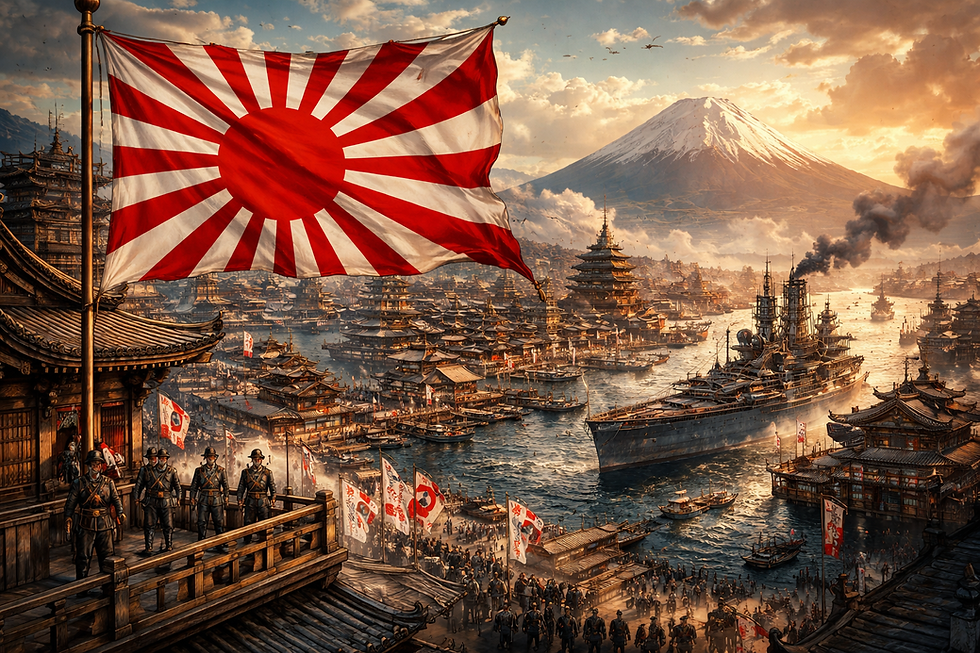
The Treaty of Shimonoseki (1895) ceded Taiwan and the Pescadores Islands to Japan, gave Japan a foothold in Manchuria, and recognised Korean independence (a prelude to eventual annexation).
Japan had become a colonial power.
This was the moment when the “Leaving Asia” (Datsu-A Ron) philosophy of Fukuzawa Yukich, the idea that Japan must shed its Asian identity and join the West, seemed vindicated.
However, the treaty’s terms provoked the Triple Intervention (1895), in which Russia, Germany, and France forced Japan to return the Liaodong Peninsula to China.
This humiliation convinced Japanese leaders that only military strength could secure their position, fueling the expansionist logic that would lead to the Russo-Japanese War (1904–1905) and, eventually, the Pacific War.
The Russo-Japanese War and the Rise of Pan-Asianism
The Russo-Japanese War (1904–1905) was a watershed event in global history. For the first time in the modern era, a non-Western power defeated a major European empire. Japan’s victory at the Battle of Tsushima (1905) shattered the myth of European invincibility and electrified anti-colonial movements across Asia and Africa.
The war also gave rise to Pan-Asianism, the ideology that Japan had a mission to liberate Asia from Western colonialism. This ideology drew on classical precedents: the idea of a unified East Asian order under a central power, which had existed in the Chinese tributary system, was now reinterpreted with Japan as the centre.
Buddhist thinkers such as Tanaka Chigaku (1861–1939) formulated a “Nichirenist” nationalism that combined the 13th-century Buddhist prophet Nichiren’s teachings with imperial expansion, arguing that Japan was destined to unite the world under the Lotus Sutra.
The Death of Meiji and the Legacy of the Oligarchy
Emperor Meiji died in 1912, and with him passed the generation of the Restoration oligarchs. The Taishō Era (1912–1926) that followed would be a period of apparent liberalisation, but the structural foundations laid by Meiji; a sacralised emperor, a powerful military independent of civilian control, a state-corporate complex, and an ideology of imperial destiny would remain intact, waiting to be activated by the crises of the 1930s.

Part III: Taishō Democracy and Ultranationalism
The Taishō Era is often romanticised as a period of democracy, cosmopolitanism, and cultural flowering. The Taishō Political Crisis (1912–1913) saw mass protests against the military’s encroachment on civilian government, forcing the resignation of the army-backed prime minister.
The Rice Riots of 1918, sparked by skyrocketing rice prices, were the largest urban uprising in Japanese history and led to the establishment of the first party cabinet under Hara Takashi, a commoner (non-samurai) prime minister.
The Universal Manhood Suffrage Act (1925) extended the vote to all male citizens aged 25 and above, significantly expanding the electorate. This was paralleled by the growth of labour unions, socialist parties, and feminist movements [the Seitō (Bluestocking) group, led by Hiratsuka Raichō, challenged patriarchal norms].
Culturally, the Taishō period saw the flourishing of Ero-Guro-Nansensu (erotic grotesque nonsense); a modernist movement in literature, art, and urban subcultures that celebrated decadence, individualism, and Western-style consumerism.
Writers like Akutagawa Ryūnosuke and Tanizaki Jun’ichirō explored the tension between tradition and modernity, often returning to classical themes with a modern sensibility.
The Peace Preservation Law and the Limits of Democracy
The same year that saw universal suffrage also saw the passage of the Peace Preservation Law (1925), which criminalised any organisation or individual seeking to alter the kokutai (national polity) or abolish private property.
The law was aimed at the burgeoning socialist and communist movements, which had been inspired by the Russian Revolution (1917). It marked the beginning of the “thought police” (tokkō) apparatus that would later incarcerate thousands of political dissidents.
The Peace Preservation Law reveals the inherent fragility of Taishō democracy: it was permitted only as long as it did not challenge the sacrality of the emperor system.
The classical continuity is evident: just as the Tokugawa shogunate had suppressed Christianity and heterodox Buddhist sects to maintain order, the Meiji–Taishō state suppressed leftist ideology to preserve the imperial cosmology.

The Shōwa Restoration Movement
The Shōwa Era began with the death of Emperor Taishō in 1926, but the true transition was not imperial but ideological. The Great Depression, which began with the Wall Street Crash of 1929 (induced by the transnational Bankers scamming both Germans and Americans after World War 1/First Banker War), devastated Japan’s export-dependent economy.
Rural poverty, urban unemployment, and the perceived corruption of party politicians and zaibatsu capitalists radicalised young military officers, particularly those in the Imperial Way Faction (Kōdōha), who advocated a “Shōwa Restoration.”
The Shōwa Restoration ideology was a direct invocation of the classical past. Its proponents argued that the Meiji Restoration had been hijacked by Westernised elites and capitalist interests. They sought a return to a mythical age where the emperor ruled directly, supported by loyal, virtuous warriors.
They drew inspiration from the Kemmu Restoration (1333–1336), when Emperor Go-Daigo had briefly overthrown the Kamakura shogunate in an attempt to restore direct imperial rule; an attempt that failed but became a potent symbol.
The young officers viewed themselves as the true heirs of the kiheitai of the late Tokugawa period, willing to assassinate corrupt politicians and capitalists to purify the nation.
The League of Blood Incident (1932) saw the assassination of the moderate prime minister Inukai Tsuyoshi by naval officers, marking the end of party cabinets and the beginning of military domination.

The February 26 Incident (1936)
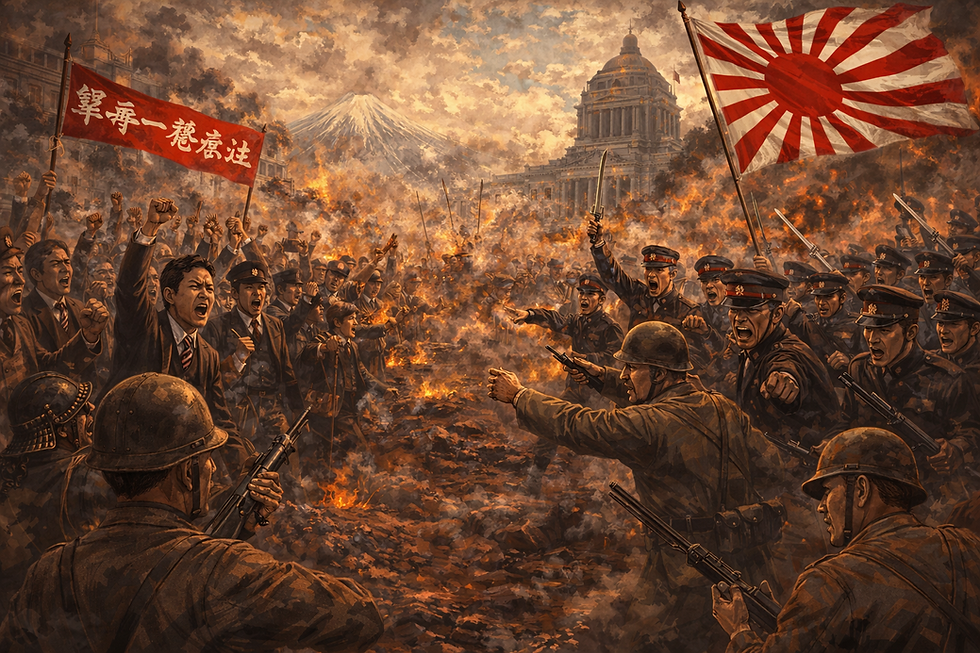
The most dramatic expression of the Shōwa Restoration movement was the February 26 Incident (1936), an attempted coup d’état in which over 1,400 soldiers of the Imperial Way Faction seized central Tokyo, assassinated several senior officials (including the Finance Minister and the Lord Keeper of the Privy Seal), and demanded a “restoration” under direct imperial rule.
The coup failed after Emperor Hirohito (posthumously known as Emperor Shōwa) angrily demanded its suppression, but it resulted in the consolidation of power by the Control Faction (Tōseiha), which sought to expand military influence through institutional control rather than radical assassination.
The February 26 Incident is the modern equivalent of the Honnō-ji Incident. Just as Akechi Mitsuhide’s betrayal of Nobunaga was a “restorationist” act (allegedly to save the emperor), the young officers saw their violence as a purification of the imperial institution.
The continuity is explicit: the language of sonnō jōi was chanted in the snowy streets of Tokyo in 1936, the same cry that had toppled the Tokugawa in 1868.
The Control Faction (Tōseiha) Takes Power
The Control Faction was a group of conservative officers in the Imperial Japanese Army active in the 1920s and 1930s. It was united primarily by its opposition to the radical Imperial Way Faction (Kōdōha), which favored violent revolution and spiritual purity over modernization.
Key leaders of the Tōseiha included Tetsuzan Nagata (until his assassination in 1935) and, notably, Hideki Tojo.
Tojo rose to prominence within this faction. He was a member of the informal "One Evening Society" study group that contributed to Control Faction ideology, focusing on total war, economic planning, and modernization. His star rose as he took on key roles:
Chief of Staff of the Kwantung Army (1937)
Vice-Minister of War (1938)
Minister of the Army (1940)
The rivalry between the Tōseiha and Kōdōha reached its climax with the February 26 Incident in 1936, an attempted coup d'état by young Imperial Way Faction officers.
The coup failed. In the aftermath, the military conducted a widespread purge of Kōdōha leaders from the army, executing or disciplining many supporters. The Control Faction emerged as the dominant influence in the army, but it simultaneously lost its raison d'être (reason of existence). With its main rival crushed, the Tōseiha gradually disbanded as a cohesive faction.
Tojo was appointed Prime Minister on October 18, 1941. By this time, the Control Faction no longer existed as a formal organization. He was not "installed" by a faction, but through a different mechanism.
His predecessor, Prime Minister Fumimaro Konoe, resigned due to increasing tension with the military, particularly over negotiations with the United States.
Tojo was chosen by Emperor Hirohito and his advisors as the new Prime Minister. The Emperor hoped that Tojo, a loyal and by-the-book officer, could control the military and maintain a disciplined government while still giving the military a seat at the highest level of power.
Part IV: The Dark Valley – Militarism and the Pacific War

The Mukden Incident (September 18, 1931), a staged railway explosion carried out by Kwantung Army officers, triggered the invasion of Manchuria and the establishment of the puppet state of Manchukuo (1932).
The Japanese government, then led by a civilian cabinet, was unable to control the military, which acted independently in what became known as “government by assassination.”
The League of Nations, after issuing the Lytton Report condemning Japan’s aggression, saw Japan withdraw in 1933. This marked a pivotal moment in global history: the collapse of the post–World War I collective security system, paralleled by Germany’s withdrawal from the League in the same year and Italy’s later invasion of Ethiopia (1935).
The 1930s were a period of accelerating international breakdown, with Japan, Germany, and Italy emerging as revisionist powers seeking to overturn the Versailles–Washington system (Wall Street System).
The Greater East Asia Co-Prosperity Sphere: Ideology and Heresy
The concept of the Greater East Asia Co-Prosperity Sphere (Dai Tōa Kyōeiken) was announced in 1940 as the ideological framework for Japan’s expansion. It claimed to be a liberation movement, just like how the western colonial empires claimed they were bringing culture (of looting and genocide).
Imperial Japan was just playing by the colonial playbook of Western powers, apparently freeing Asia from Western colonialism and creating a self-sufficient bloc under Japanese leadership. Although, the Anglo-American powers started crying foul when an Eastern power started doing the same thing they were doing.
The ideology was a fusion of multiple strands:
State Shinto: The doctrine of Hakkō Ichiu (Eight Crown Cords, One Roof), purportedly a command from Emperor Jimmu, was interpreted as Japan’s divine mandate to unify the world under the emperor’s moral authority.
Pan-Asianism: The earlier ideal of Asian solidarity was radicalised into a hierarchical order with Japan as the elder brother and other Asian nations as junior partners.
Buddhist Modernism: Some Buddhist sects, particularly Nichirenist groups, provided a millenarian framework, arguing that the war was a “holy war” to establish a new world order in accordance with the Lotus Sutra.
In practice, the Co-Prosperity Sphere was a colonial empire, modeled after the brutality of the British and French colonial frameworks. In occupied territories like Korea, Taiwan, Manchuria, and later Southeast Asia, Japan imposed forced labour, confiscated resources, and attempted to enforce cultural assimilation (including the compulsory worship of Shinto shrines, a policy that generated particular resistance in Korea).
Parallels with the Allied ideologies on the opposing side are instructive. Britain’s looting of Indian resources and Churchill's later massacres and famines in the Empire's colonies were similarly imperialist, justifying conquest through racial or civilisational superiority.
However, Japan’s ideology was unique in its grounding in a pre-modern, animistic cosmology fused with modern racial theory. The Kokutai (national polity) was presented as a unique metaphysical entity, unbroken for 2,500 years, that transcended Western concepts of sovereignty.
The Pacific War: Total War and the Collapse of the Imperial Cosmos
The Pacific War (1941–1945) began with the attack on Pearl Harbor (December 7, 1941) and the simultaneous invasion of Southeast Asia. Japan’s initial expansion was stunning: by mid-1942, it controlled a vast arc from Burma to the Solomon Islands.
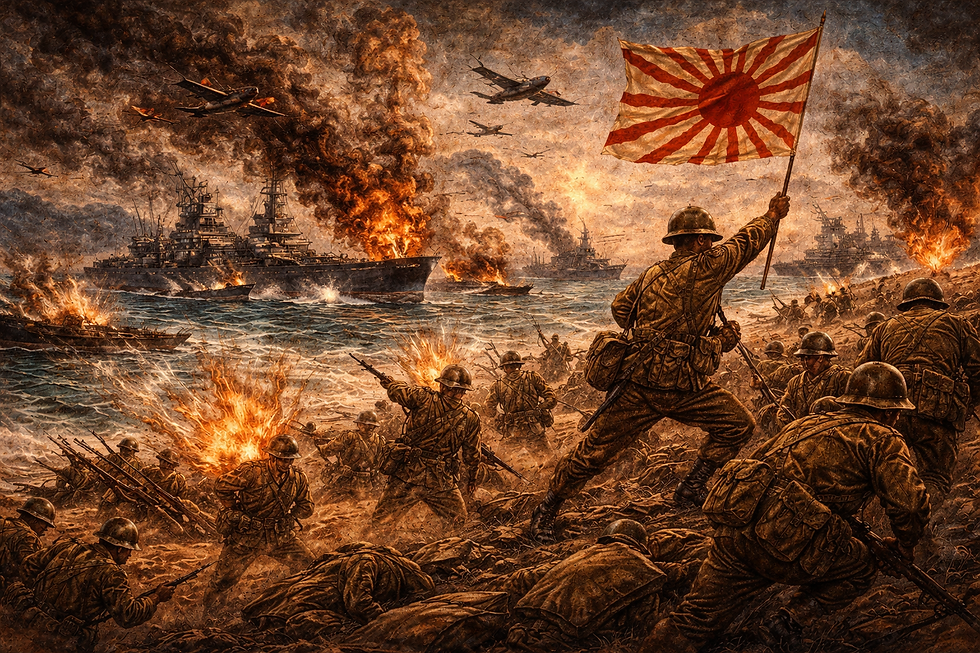
The war, however, became a total war that consumed the nation. The National Spiritual Mobilization Movement (1937) had already begun the regimentation of civil society, dissolving independent labour unions, establishing neighbourhood associations (tonarigumi), and enforcing ideological conformity. By 1944–1945, the war had become a war of attrition against the industrial might of the United States.
The Kamikaze (divine wind) pilots, who deliberately crashed their planes into American ships, were the ultimate expression of State Shinto’s sacrificial logic. They were presented as gunkoku shinpu (warrior spirits) who would become kami upon death, enshrined at Yasukuni Shrine. The classical bushidō ethos, which had been largely an Edo-period invention romanticising the warrior code, was weaponised to induce mass sacrifice.

The firebombing of Tokyo (March 9–10, 1945) and the atomic bombings of Hiroshima and Nagasaki (August 6 and 9, 1945) destroyed not only cities but also resulted in the genocide of hundreds of thousands of innocent Japanese civilians.
This was among the most prominent war crimes by Allied powers, alongside the holocaust of innocent German civilians in Dresden and other civilian cities.
The Emperor’s radio broadcast announcing surrender (August 15, 1945), the first time most Japanese had heard his voice, was a cataclysmic rupture. He spoke in classical, archaic Japanese, often unintelligible to the populace, and referred to the kokutai as still intact, but the reality was that Japan had been broken by the brutality exhibited by the Allied powers.
Even the crimes of the military-state of Imperial Japan paled in comparison to the barbarism of war criminals like Churchill, Roosevelt, and Truman, who had led the world into yet another war for the benefit of a few.
The Tokyo War Crimes Tribunal and the Question of Continuity
The International Military Tribunal for the Far East (1946–1948), often called the Tokyo War Crimes Tribunal, prosecuted Japanese wartime leaders for crimes against peace, war crimes, and crimes against humanity. Twenty-five defendants were tried; seven were executed (including Prime Minister Tōjō Hideki).
Emperor Hirohito was omitted from prosecution. General Douglas MacArthur, the Supreme Commander for the Allied Powers (SCAP), made the decision to preserve the emperor to facilitate a stable occupation.
This decision created a deep continuity: the imperial institution survived intact, albeit with the emperor forced to renounce his divinity in the Humanity Declaration (Ningen Sengen) of January 1, 1946. The declaration stated that “the ties between us and our people have always stood upon mutual trust and affection… and are not predicated on the false conception that the Emperor is akitsumikami [manifest deity].”
The retention of the emperor allowed the Japanese state to maintain an unbroken line of continuity from the classical period to the present.
Part V: The American Interregnum

The Allied occupation of Japan (1945–1952) was, like the Meiji Restoration, a revolution from above, imposed by an external power. The occupation authorities, led by MacArthur, implemented a sweeping series of reforms designed to dismantle the militarist state and establish a peaceful, democratic Japan.
Key reforms included:
The Constitution of 1947: Drafted by SCAP officials (with Japanese input), the constitution established popular sovereignty, renounced war (Article 9), guaranteed fundamental human rights, and reduced the emperor to a symbolic head of state.
Land Reform: Breaking up large landed estates and redistributing land to tenant farmers, which destroyed the rural landlord class that had been a bastion of militarism.
Labour Reform: Legalising unions and establishing collective bargaining rights, leading to the growth of a powerful labour movement.
Education Reform: Decentralising education, removing nationalist content, and introducing coeducation.
The Dissolution of the Zaibatsu: Breaking up the major industrial conglomerates (though this was partially reversed during the Cold War).
The occupation was a paradox: it established democracy through authoritarian means, using censorship, purges of wartime officials, and the suppression of dissent (including the 1947 general strike threat) to achieve its goals.
The Religious Revolution: The Destruction of State Shinto
One of the most transformative aspects of the occupation was the Shinto Directive (December 1945), which abolished State Shinto, prohibited government support for any religion, and required the separation of religion from the state. The emperor’s renunciation of divinity was the symbolic culmination of this process.

The effects were profound:
Yasukuni Shrine and other national shrines became private religious corporations, losing their state funding and ideological monopoly.
Buddhism, which had been suppressed during the Haibutsu Kishaku and then co-opted during the war, re-emerged as a major force in social welfare and private devotion.
Christianity, associated with the American occupiers, experienced a brief surge (the “Christian boom”), though it remained a minority religion.
The New Religions (Shinshūkyō), which had been suppressed during the war (e.g., Ōmoto was banned in 1921 and 1935), flourished in the postwar vacuum. Sōka Gakkai, a lay Nichiren Buddhist organisation, grew explosively, reaching millions of members by the 1960s and eventually founding the Komeitō (Clean Government Party) in 1964.

The San Francisco Peace Treaty and the Return to Sovereignty
The San Francisco Peace Treaty (signed September 8, 1951, effective April 28, 1952) formally ended the state of war between Japan and the Allied powers and restored Japanese sovereignty.
However, the treaty was accompanied by the U.S.-Japan Security Treaty (Anpo), which allowed the United States to maintain military bases in Japan indefinitely.
This arrangement, often described as “reverse course” (the shift from demilitarisation to rearmament in the context of the Cold War), established the framework for Japan’s postwar relationship with the United States: a sovereign state but under the American nuclear umbrella, with a pacifist constitution (Article 9) coexisting with a de facto military (the Self-Defense Forces, established in 1954).

Part VI: Postwar Japan – Economic Miracle

Prime Minister Yoshida Shigeru (1946–1947, 1948–1954) articulated the Yoshida Doctrine, which defined Japan’s postwar strategy: concentrate on economic recovery, maintain a low military profile under the American security umbrella, and pursue a pragmatic, business-oriented foreign policy.
This doctrine guided Japan through the Cold War, allowing it to achieve rapid economic growth while avoiding entanglement in the Korean War (1950–1953) and Vietnam War (1955–1975) beyond hosting American bases.
The Economic Miracle as a New Theology

The period from the 1950s to the 1980s saw Japan’s transformation from a war-devastated nation to the world’s second-largest economy (overtaking West Germany in 1968). The Economic Miracle was driven by a combination of factors:
Government-Industry Cooperation: The Ministry of International Trade and Industry (MITI) coordinated industrial policy, targeting key sectors (steel, shipbuilding, automobiles, electronics).
The Keiretsu System: The successor to the zaibatsu, keiretsu were horizontal networks of companies (e.g., Mitsubishi, Toyota, Sumitomo) bound by cross-shareholding and long-term relationships.
Lifetime Employment: A system of job security for core employees (mostly men) in large firms, which fostered company loyalty and the “salaryman” ethos.
High Savings Rate and Education: A highly literate population and a culture of saving fuelled investment.
The Economic Miracle functioned as a new national religion. The corporation (kaisha) replaced the clan (uji). The salaryman replaced the samurai. Lifetime employment was a modern bushidō; a code of loyalty, discipline, and sacrifice for the collective.
The 1955 System (55-nen taisei), a political arrangement dominated by the Liberal Democratic Party (LDP) and a weak opposition, ensured political stability that allowed uninterrupted economic growth.
Parallels with West Germany’s Wirtschaftswunder are striking. Both nations, defeated in war, used state-guided capitalism, a skilled workforce, and a Cold War alliance with the United States to achieve spectacular recovery.
However, Japan’s miracle was distinguished by its cultural packaging: the idea of “Japan as Number One” (a popular book title by Ezra Vogel in 1979) fused economic success with claims of cultural uniqueness (Nihonjinron).
The Anpo Protests and the Emergence of Civil Society
The 1960 Anpo protests against the revision of the U.S.-Japan Security Treaty were the largest mass protests in Japanese history, involving millions of citizens, students, labour unions, and intellectuals.
The protests failed to stop the treaty’s ratification but marked a turning point: they demonstrated that postwar democracy was not merely imposed from above but could generate genuine civic engagement.
The protests also gave rise to a vibrant New Left movement, which, inspired by the global student movements of 1968, challenged the LDP establishment, the U.S. alliance, and the materialism of the economic miracle.
The Zengakuren (All-Japan Federation of Student Self-Government Associations) engaged in dramatic confrontations with riot police, and the Red Army Faction (later the Japanese Red Army) emerged as a violent extremist offshoot that conducted hijackings and attacks into the 1970s.

The Return of Religion: New New Religions and the Search for Meaning
Despite the secularisation of the state, the postwar period saw a proliferation of religious movements that filled the vacuum left by the destruction of State Shinto.
Scholars distinguish between Shinshūkyō (New Religions), which emerged in the 19th and early 20th centuries (e.g., Tenrikyō, Ōmoto, Sōka Gakkai), and Shin-Shinshūkyō (New New Religions), which emerged after 1945 and were often more eclectic, individualistic, and focused on healing, prosperity, and esoteric knowledge.

Prominent New New Religions included:
Agonshū (founded 1978): A Buddhist-derived movement that emphasized ascetic practices, fire rituals, and “spiritual counselling.”
Kōfuku no Kagaku (Happy Science, founded 1986): A syncretic movement that combined Buddhism, Shinto, Christianity, and Western esotericism, founded by Ryūhō Ōkawa, who claimed to be the reincarnation of Buddha and Christ.
The proliferation of these movements reflects a deep continuity: the Japanese cosmological pattern of syncretism, eclecticism, and the search for practical benefits (healing, wealth, harmony) persisted despite the ruptures of the Meiji era and the Occupation.
The Bubble Economy and Its Discontents
The 1980s saw Japan’s economy reach dizzying heights. The Bubble Economy (baburu keizai) was characterised by speculative excess: real estate prices in Tokyo became astronomical, Japanese corporations bought American landmarks (Rockefeller Center, Columbia Pictures), and conspicuous consumption became a national pastime.
Yet beneath the surface, anxieties were growing. The Aum Shinrikyo (Aum Supreme Truth) cult, founded in 1984 by Shoko Asahara (born Chizuo Matsumoto), emerged from the spiritual ferment of the 1980s.
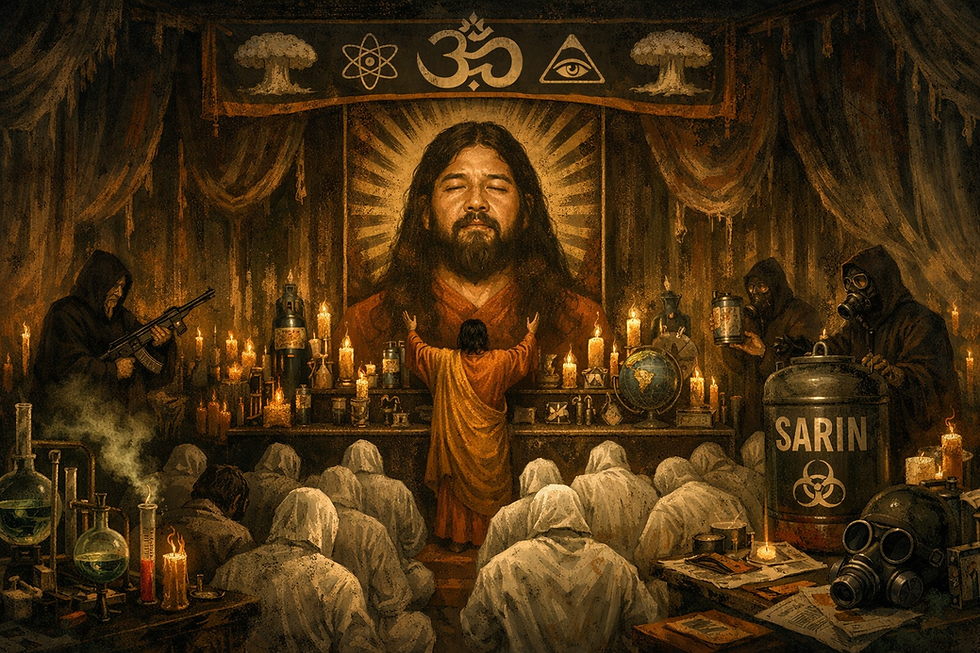
Aum was a radical synthesis: it combined Tibetan Buddhism, Hindu eschatology, the yoga of Patanjali, and the apocalyptic prophecies of Nostradamus with a sophisticated understanding of technology and a paramilitary structure.
It was appropriation of specific concepts from ancient religions, misconstruing them, and using them for self-serving purposes; not much different than how the Roman elite appropriated Mithra from Zoroastrianism and formed the Mythras Cult.
Asahara taught that the world was heading toward a cataclysmic war (Armageddon), which his followers would survive through esoteric practices and, if necessary, by preemptively eliminating the enemies.
The bubble burst in 1991, triggering the “Lost Decades” (ushinawareta sanjūnen) of economic stagnation, deflation, and social dislocation. The collapse of the economic miracle created the perfect environment for apocalyptic movements like Aum to thrive.
Part VII: The Lost Decades and the Fractured Cosmos

On March 20, 1995, members of Aum Shinrikyo released sarin nerve gas on the Tokyo subway system during rush hour, killing 14 people and injuring over 6,000. The attack was the culmination of a series of Aum crimes, including the murder of an anti-Aum lawyer and his family (1989) and a previous sarin attack in Matsumoto (1994).
The Tokyo attack was a watershed event. It shattered the post-war narrative of Japan as a safe, orderly, consensual society. It revealed that a sophisticated, violent cult could operate for years within the heart of the nation, with followers including scientists, engineers, and physicians from elite universities.
The Aum phenomenon is best understood as a pathological continuation of classical Japanese religious patterns:
Shamanism: Asahara positioned himself as a guru with supernatural powers, a role reminiscent of classical hijiri (holy men) and yamabushi (mountain ascetics).
Syncretism: Aum’s theology was a postmodern pastiche of Buddhist, Hindu, and Western esoteric elements, reflecting the syncretic tradition that had been suppressed by the Meiji state but never eradicated.
Millenarianism: The belief in a coming cataclysm and the necessity of purification has deep roots in Japanese history, from the mappō (end of the Dharma) ideology of the Heian period to the peasant uprisings of the early modern era.
The state’s response was to pass Anti-Aum laws and eventually, in 1999, the Act on Regulation of Organizations That Have Committed Indiscriminate Mass Murder, which gave the government surveillance powers over religious groups.
Asahara and twelve other Aum leaders were eventually sentenced to death (Asahara was executed in 2018). However, the cult survived under a new name, Aleph, and remains under surveillance.
The Kobe Earthquake and the Erosion of Trust
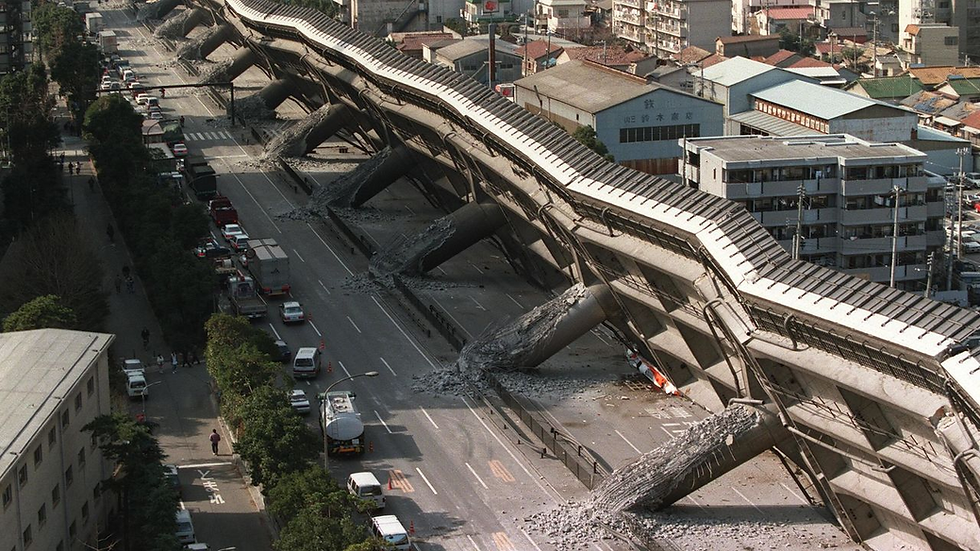
The Great Hanshin Earthquake (January 17, 1995), which devastated the city of Kobe and killed over 6,000 people, occurred less than two months before the subway attack.
The government’s slow and inadequate response exposed the failures of the post-war state. Volunteers (borantia), including religious groups like Sōka Gakkai and Christian organisations, filled the gap, marking the rise of civil society in Japan.
The twin shocks of 1995, the earthquake and the sarin attack, produced a crisis of confidence in institutions: the government, the bureaucracy, the corporate system, and even the very structure of modern society. It was in this context that the Internet began to proliferate in Japan, becoming a space for new forms of community, conspiracy, and alternative spirituality.
Demographic Crisis and the Heisei Stagnation
The Heisei Era (1989–2019) was defined by economic stagnation, deflation, and a demographic crisis. Japan’s population began to decline in 2008, and the proportion of elderly citizens became the highest in the world.

The aging society (kōreika shakai) strained the pension system, the healthcare system, and the labour market. The “lost generation” (shinjinrui) of young people faced precarious employment (freeter, haken workers), leading to a retreat from traditional life trajectories: marriage, home ownership, and childbirth.
The cultural response included the rise of the hikikomori phenomenon; young people (often men) withdrawing from society entirely, living in their parents’ homes for years or decades.
This retreat from social engagement has been interpreted as a modern form of tonsei (hermitage), echoing the classical tradition of mountain ascetics who withdrew from the secular world.
The 3.11 Disasters and the Fukushima Meltdown
The Great East Japan Earthquake and tsunami of March 11, 2011, killed nearly 20,000 people and caused the Fukushima Daiichi nuclear disaster, the worst nuclear accident since Chernobyl.

The triple disaster (earthquake, tsunami, nuclear meltdown) was a national trauma that exposed the failures of the “nuclear village” (genshiryoku mura); the collusion between government, regulators, and utility companies that had promoted nuclear power for decades.
The response to 3.11 saw a resurgence of traditional religious practices. Shinto priests performed purification rituals; Buddhist monks chanted sutras for the dead; and grassroots volunteer networks, often inspired by New Religions, provided aid.
The disaster also revived debates about the role of the emperor; Emperor Akihito (who would abdicate in 2019) made a rare televised address, offering a model of symbolic leadership in crisis.
Parallel events globally included the 2010 Haiti earthquake and the 2011 Arab Spring, but Fukushima was unique in combining natural disaster with technological catastrophe, raising existential questions about modernity, progress, and the relationship between humans and nature; questions that resonate with Shinto animism and Buddhist impermanence.
The Reiwa Era: Continuity and Uncertainty

The Reiwa Era began on May 1, 2019, with the accession of Emperor Naruhito. The era name (gengō) “Reiwa” was taken from the Man’yōshū, the oldest extant collection of Japanese poetry (circa 759 CE), marking a return to classical sources after the Heisei era name was drawn from Chinese classics.
The choice was significant: it signaled an effort to root the imperial institution in indigenous Japanese culture rather than Sinic tradition. The Reiwa era has been marked by:
The COVID-19 (Epstein-Gates Virus) Pandemic: Japan’s handling of the pandemic (2020–2023) revealed strengths (low initial death rates, social cohesion) and weaknesses (slow digitalisation, a fragmented healthcare system).
The Assassination of Abe Shinzō: On July 8, 2022, former Prime Minister Abe Shinzō was assassinated by a man who claimed to be motivated by Abe’s ties to the Unification Church (officially the Family Federation for World Peace and Unification). The assassination exposed the deep ties between politicians and the controversial religious cult, reviving debates about religious freedom, political corruption, and the legacy of the Cold War.
Constitutional Revision Debates: The LDP, under Abe and his successors, has pursued revision of Article 9 to explicitly recognise the Self-Defense Forces, a move that remains controversial and is opposed by a portion of the public and by opposition parties.
The Resurgence of Yasukuni Controversies: Visits to Yasukuni Shrine by cabinet members continue to provoke diplomatic tensions with China and Korea, and the shrine remains a symbol of the unresolved issues of war responsibility and the separation of religion and state.

The Abe Assassination: A Logical Analysis of Conspiracy Theories
The assassination of Shinzo Abe on July 8, 2022, has generated a complex web of conspiracy theories that range from the plausible to the speculative. It mainly revolves around Abe's tries to the Unification Church.
The Unification Church, officially the Family Federation for World Peace and Unification, is a South Korean-based new religious movement or a cult founded by Sun Myung Moon in 1954. Known for its "mass weddings" and anti-communist stance, the cult teaches that Moon is the Messiah.
The Assassin and His Motive: Tetsuya Yamagami, 45, has consistently admitted to shooting Abe with a handmade firearm during a campaign speech in Nara. During his trial, he calmly stated, "Everything is true."
His motive, established through police interviews and trial testimony, centers on the Unification Church (officially the Family Federation for World Peace and Unification).
Yamagami's mother joined the cult in 1991 following his father's suicide and his brother's serious illness. Over seven years, she donated approximately 100 million yen (roughly $630,000-$660,000), including life insurance payouts and real estate, to the cult.
These donations bankrupted the family. Yamagami himself attempted suicide at age 24, believing his life insurance payout could help his siblings. His brother died by suicide in 2015, also blaming their mother's cult donations.
The Abe–Unification Church Connection: Abe was not a member of the cult, but his family's ties run deep. His grandfather, former Prime Minister Nobusuke Kishi, helped introduce the Unification Church to Japan in the 1960s. Kishi's support was grounded in shared anti-communist ideology; a theme that would prove central to the cult's political alliances globally.
Abe, along with his brother Nobuo Kishi and other senior LDP members, gave speeches to cult-affiliated organizations. An LDP survey found almost half of the party's lawmakers had connections with the cult.
Abe had appeared at events organized by cult affiliates, including a "Rally of Hope" in September 2021 that also featured Donald Trump and other world leaders.
The Aftermath: The assassination triggered a government investigation that led to the Tokyo District Court ordering the cult's dissolution in March 2025; stripping it of tax-exempt status and requiring asset liquidation.
The cult has appealed, calling the decision "totally unacceptable." A law regulating manipulative fundraising tactics was enacted in December 2022. Yamagami received a life sentence in January 2026.
The Sniper Theory – Foreign Intelligence Agency Involvement
One prominent conspiracy theory holds that Yamagami was not the actual shooter and that a sniper working for a foreign intelligence agency killed Abe while Yamagami served as a decoy.
This theory draws parallels to the Kennedy assassination, where despite the Warren Commission's conclusion that Lee Harvey Oswald acted alone, conspiracy theories persist decades later.
Security failures: Video footage showed Abe's security detail was "bunched together" and not watching the crowd, suggesting either gross incompetence or something more deliberate. One commenter noted that Kishida (who succeeded Abe) had reportedly weakened Abe's security.
The weapon: Yamagami used a crude, homemade firearm. Skeptics question whether such a device could reliably kill a protected political figure from any distance.
The timing: The assassination occurred two days before a House of Councillors election, potentially altering Japan's political trajectory.
Counter-evidence:
Yamagami's trial testimony was consistent and detailed. The defense argued for leniency, not for innocence; claiming Yamagami was a victim of religious exploitation, not a patsy.
A 2023 survey by Shinichi Yamaguchi of the International University of Japan found that only about 10% of respondents were aware of the sniper theory. Among those, only 14.3% believed it, while 34.3% were uncertain. The theory remains fringe even within Japan.
The prosecution's case, including ballistic evidence, has not been publicly contradicted. No forensic evidence has emerged supporting a second shooter.
Besides, Yamagami's family history of cult-related financial ruin is extensively documented. His mother testified to her membership and donations. The motive is not merely plausible but corroborated by family members.
The Financial Network – The Unification Church as Hidden Power
A more substantive conspiracy perspective focuses not on Yamagami but on the cult itself: that the Unification Church functioned as a covert financial and political network, using Japan as its primary funding source while providing political support to conservative leaders who protected it from scrutiny.
In this view, the assassination was not orchestrated by the cult but exposed a hidden power structure that had operated for decades.
The cult's financial operations in Japan are extraordinary:
Majority of global funding: Experts state that the majority of the Unification Church's worldwide funding comes from Japan. Japanese followers are reportedly asked to pay for "sins committed by their ancestors during Japan's 1910-1945 colonial rule of the Korean Peninsula."
Business holdings: The cult is the largest shareholder of the Yongpyong ski resort in South Korea (49.9% of shares), and the Segye Ilbo newspaper (published in Japanese as Sekai Nippo) holds another 12.59%.
Extraction model: The cult systematically extracted donations from Japanese members. One expert described practices where members were told they "had to raise a minimum of $100 a day, otherwise they wouldn't be allowed to sleep."
Legal exposure: Hundreds of lawsuits in Japan have been filed by families claiming manipulation led to financial ruin .
The cult's political alliances follow a clear pattern:
Anti-communist foundation: Founded in Seoul in 1954, a year after the Korean War ended, the cult explicitly championed anti-communism and Korean unification; positions that aligned with Japanese conservatives and Cold War geopolitics.
Bipartisan U.S. connections: The cult cultivated ties with U.S. presidents including Nixon, Reagan, George H.W. Bush, and Trump.
Japanese political integration: Abe's grandfather Kishi helped introduce the cult to Japan. An LDP investigation found nearly half of party lawmakers had connections.
Quid pro quo: In exchange for political legitimacy and protection from scrutiny, the cult provided organizational support and, indirectly, a constituency aligned with conservative values. Not much different than the Evangelical Protestant Church in America, which is thoroughly infiltrated with political interests.
The cult's wealth extraction from Japanese members, its business holdings, and its political alliances are all matters of public record. The question is in whether politicians like Abe knowingly participated in a system that enabled financial exploitation in exchange for political support.
The evidence suggests they did. Abe spoke at the cult-affiliated events. The LDP's own survey confirmed extensive ties. The government's post-assassination investigation led directly to the church's dissolution; an admission that the organization had been operating outside legal bounds for decades under political protection.
The QAnon Connection – Global Conspiracy Convergence
Some conspiracy analysts have noted the convergence between the Unification Church and QAnon in the United States, suggesting a broader global network of far-right, anti-communist, and millenarian movements.
Rod of Iron Ministries: This Pennsylvania-based religious group is a schismatic offshoot of the Unification Church, led by Hyung Jin "Sean" Moon (son of the cult's founder). It has been described as a "Q-affiliated religious group" that organized members to march on the Capitol on January 6, 2021.
Trump administration appearances: In addition to Trump, Mike Pence, Michael Pompeo, and Mark Esper appeared at a virtual rally by the Unification Church in May 2021.
Syncretic theology: QAnon has been described as exhibiting "syncretism," blending traditional Christian beliefs with other spiritual systems and political messaging. One Indiana-based cult holds services showing how Bible prophecies "confirm Q's messages."
This is something that's regularly used by cultish religious movements to hoodwink civilians into supporting unpopular government programs.
The connection is real but should not be overstated. The Unification Church and QAnon represent different phenomena: the former is a centralized organization with a founder, theology, and global structure; the latter is a decentralized conspiracy movement with no clear leadership. Their convergence in certain American far-right circles reflects overlapping constituencies rather than coordinated control.
However, the fact that these groups share ideological DNA, including anti-communism, apocalyptic thinking, charismatic leadership, and opposition to mainstream institutions, suggests a broader ecosystem within which the Abe assassination unfolded. The cult that ruined Yamagami's family was the same cult that allegedly supplied foot soldiers for January 6.
Logical Synthesis – What the Conspiracies Reveal
The cult's relationships with conservative politicians in Japan, the United States, and elsewhere allowed it to operate without serious scrutiny for decades. Only the shock of Abe's assassination broke this protection.
The anti-communist networks that brought the cult to Japan in the 1960s were the same networks that had protected Japanese militarists after World War II. Kishi's role as he cult's patron illustrates how Cold War geopolitics created safe havens for figures who might otherwise have faced accountability.
What Remains Unresolved:
The security question: Why was Abe's security so inadequate? Official incompetence is the simplest explanation, but the question persists because the stakes were so high.
The timing question: The assassination occurred just before an election and at a moment when the cult's practices were beginning to attract attention. Did Yamagami act alone, or was his action part of a broader pattern of scrutiny that would have emerged regardless?
The money trail: While the cult's dissolution order requires asset liquidation, the full extent of its financial network, including how donations were transferred, invested, and used, has not been fully disclosed.
If there is a conspiracy, it is the one documented in the LDP's own survey and the Tokyo court's dissolution order: a network of political protection that allowed financial exploitation to continue for decades.
Before vs. After Abe's Assassination
There are several significant policy areas where former Prime Minister Fumio Kishida (who had replaced Abe) either approved or advanced measures that Shinzo Abe had opposed or approached with significant caution.
The assassination in July 2022 removed Abe's political weight, allowing Kishida to break from his predecessor's positions:
1. Defense Spending: Bonds vs. Tax Hikes
One of the most concrete policy divergences concerns how to fund Japan's historic military buildup.
Abe's Position: Abe had advocated for issuing Japanese government bonds (JGBs) to finance the increase in defense spending. Before his death, this was his preferred funding mechanism for what would become Japan's plan to double its defense budget to 2% of GDP.
Kishida's Action: In December 2022, just months after Abe's assassination, Kishida rejected the bond issuance option and instead opted for a gradual tax hike to fund the increased defense spending. Kishida's decision directly overruled the policy Abe had supported.
The significance of this shift is underscored by the political dynamics: the "Abe wing" of the Liberal Democratic Party (LDP) fought back openly against Kishida's decision. Policy Chief Hagiuda Koichi, one of Abe's closest aides, established a special committee within the party to explore alternative funding sources to a tax hike. Ministers Takaichi Sanae and Nishimura Yasutoshi both publicly questioned the policy. Kishida proceeded despite this opposition.
One analyst noted that Kishida's ability to pursue policies unpopular among Abe-wing conservatives like tax hikes was enabled by the "relative decline in power" of the Abe faction following his death.
2. Constitutional Revision: From Priority to Afterthought
Abe's Position: Abe had made constitutional revision, specifically amending Article 9 to explicitly recognize Japan's Self-Defense Forces, the unfinished business of his political career. He pursued it relentlessly throughout his tenure.
Kishida's Position: In the immediate aftermath of Abe's death, Kishida notably downplayed constitutional revision as a priority. According to an analysis from the Chinese Academy of Social Sciences, while the election results gave Kishida an opportunity to pursue constitutional revision, it was "not what most Japanese wanted." The analysis noted that only about 5% of respondents in pre-election polls listed constitutional revision as a government priority, compared to roughly 40% citing economic concerns.
The same analysis concluded that Kishida "may not be in a hurry to push forward constitutional revision plans" despite having the parliamentary majority to do so. Instead of pursuing Abe's signature constitutional agenda directly, Kishida focused on other measures to appease the party's right wing; notably security policy revisions and defense spending increases.
3. Russia Policy: Diplomacy vs. Sanctions
Abe's Position: Abe had invested significant political capital in cultivating a personal relationship with Vladimir Putin. He pursued a consistent policy of engagement with Russia, aiming to resolve territorial disputes and prevent Moscow from aligning too closely with Beijing. Even after Russia's annexation of Crimea in 2014, Abe wavered on imposing sanctions.
Kishida's Action: Following Russia's full-scale invasion of Ukraine in 2022, Kishida took a markedly different approach. He promptly joined multilateral sanctions regimes against Russia, a sharp break from Abe's more accommodating stance.
Kishida deepened Japan's partnership with NATO, attended NATO summits regularly, and invited Ukrainian President Volodymyr Zelensky to the G7 Summit in Hiroshima in May 2023. In December 2023, his administration also eased Japan's ban on weapons exports to help replenish US Patriot missiles to support Ukraine; a move that would have been politically difficult with Abe's faction in full force.
As one analysis noted: "Abe's repeated attempts to steer Russian President Vladimir Putin away from China had gone nowhere. Russia's invasion of Ukraine and the emergence of the 'no-limits' Chinese-Russian friendship underscored Tokyo's limited leverage over Moscow."
4. Economic Policy: "New Capitalism" vs. "Abenomics"
Abe's Position: Abe's economic program, "Abenomics," consisted of three arrows: aggressive monetary easing, flexible fiscal spending, and structural reform. Critics, including Kishida, argued that Abenomics disproportionately benefited corporations and the wealthy while failing to deliver broad-based prosperity.
Kishida's Position: Kishida campaigned on and implemented "New Capitalism," an economic framework explicitly presented as a departure from the neoliberalism of Abenomics. He criticized Abenomics for failing to deliver "universal growth" and promised instead to focus on wealth distribution and raising wages.
While Kishida could not immediately dismantle Abenomics due to the political power of the Abe faction during his lifetime, analysts noted after his death that Kishida now had "more space to pursue policies based on his own ideas."
The selection of the next Bank of Japan governor, who would replace Haruhiko Kuroda, Abe's appointee and architect of aggressive monetary easing, was identified as a key inflection point where Kishida's influence would grow.
5. Unification Church: Protection vs. Dissolution
Abe's Position: Abe and his family had long-standing ties to the Unification Church. His grandfather, Nobusuke Kishi, helped introduce the cult to Japan in the 1960s as part of an anti-communist movement. The cult maintained a decades-long working relationship with conservative LDP lawmakers, who in exchange for political support received volunteers during election campaigns. Abe himself had appeared at church-affiliated events.
Kishida's Action: After Abe's assassination exposed the depth of these ties and sparked public outrage, Kishida was forced to take action. The government publicly distanced the LDP from the church. In October 2023, the Education Ministry requested a court order to dissolve the cult's religious corporation status. In March 2025, the Tokyo District Court granted the dissolution order; a historic decision that stripped the cult of tax-exempt status and required asset liquidation.
While this outcome was driven by public pressure following the assassination rather than a pre-existing policy preference, it represents a decisive break from the political protection the church had enjoyed under Abe and his allies for decades. The church has appealed the decision, and the legal battle continues.
6. Security Legislation and Arms Exports: Accelerating What Abe Started
While not strictly a case of Kishido approving something Abe opposed, Kishida moved further and faster on security normalization than Abe had.
Key shifts under Kishida:
In December 2022, Kishida's government approved three key security documents that revised Abe's own National Security Strategy to explicitly include "counterstrike capabilities" with medium- and long-range missiles, allowing preemptive strikes on enemy bases
Starting in 2025, Japan will acquire 400 Tomahawk cruise missiles; a capability that would have been unthinkable under earlier interpretations of Article 9
In 2022, Kishida enacted the Economic Security Promotion Act, establishing economic security as a core national security area
In March 2024, the LDP began drafting a military industrial policy to strengthen the defense industry and promote arms exports, further loosening Japan's postwar restrictions
As one analyst noted, "Kishida doubled down on the national security and foreign policy direction of his predecessors, especially the late former prime minister Shinzo Abe." However, the pace and scope of implementation accelerated after Abe's death removed a key constraint.
Political Context: Why Kishida Could Act
Abe's assassination created a political vacuum that enabled Kishida to pursue policies he might not have otherwise risked. Before his death, Abe remained the dominant force in the LDP as head of the party's largest faction, the Seiwakai (Abe faction).
Kishida relied on Abe's cooperation to implement policy effectively. After the assassination, the Abe faction was left without a leader and struggled to maintain cohesion.
Kishida changed his governing style, consulting more closely with Secretary General Motegi Toshimitsu and Vice President Aso Taro, "essentially cutting off the 'Abe wing' from the highest level of decision making." This allowed him to pursue policies such as the defense tax hike that would have faced unified opposition from Abe had he been alive.
As one analysis concluded, "With Abe gone and the faction without a leader, the LDP's conservative-nationalists face a decisive and tumultuous" period, and Kishida could "drive a wedge between faction members by pitting them against each other."
The irony is that the man who shot Abe, motivated by the Unification Church connections that Kishida later acted against, unwittingly enabled Kishida to pursue a policy agenda that diverged from Abe's preferences in several key areas. Whether Kishida's successors maintain these shifts remains to be seen.
Logical Interpretation
In the contest between Shinzo Abe and Fumio Kishida, Abe pursued a more explicitly nationalist and Japan‑first agenda, while Kishida has tilted toward a globalist alignment, particularly with the United States and its European partners.
Abe’s signature “Abenomics” prioritized corporate revitalization and monetary expansion, which lifted stock markets and zaibatsu profits but left many households with stagnant wages and widening inequality, benefiting capitalist interests more than the broader population.
His foreign policy sought to balance great‑power relations, maintaining dialogue with China and even courting Putin, all while incrementally strengthening Japan’s own military posture.
Kishida, in contrast, used the political space opened by Abe’s assassination to shift course: he imposed sanctions on Russia, deepened NATO ties, funded the defense buildup through tax hikes rather than bonds (a move Abe opposed), and dismantled the political protection the Unification Church had long enjoyed; a network that had channeled Japanese wealth abroad.
Economically, Kishida’s “New Capitalism” explicitly repudiated the neoliberalism of Abenomics, aiming to redirect gains toward wage growth and redistribution.
Thus, while Abe’s approach privileged nationalist symbolism and corporate capital, Kishida’s policies have arguably done more to shield Japanese citizens from foreign‑imposed costs (e.g., by taxing domestic wealth for defense rather than inflating debt) and to sever entangling ties with a controversial foreign religious organization; marking a substantive, if incomplete, turn toward policies that prioritize the material interests of Japanese people over those of globalist or capitalist networks.
Based on the visible evidence, thelogical interpretation would be that the assassin was indeed acting on personal interests rather than globalist interests.
Part VIII: Classical Controversies in Modern Guise

The conspiracy surrounding Oda Nobunaga’s death has never faded. In the modern period, it has been reinterpreted to serve various ideological agendas:
Meiji Modernisers: They viewed Nobunaga as a proto-moderniser who embraced Western technology and centralised power. His assassination was seen as a tragedy that delayed Japan’s modernisation by 300 years.
Militarists of the 1930s: They celebrated Nobunaga’s ruthlessness and his use of terror as a tool of unification, drawing parallels with their own ambitions.
Postwar Revisionists: Some historians have suggested that Nobunaga intended to abolish the imperial institution, and that the Meiji Restoration, which made the emperor the centre of the state, was a conservative reaction against his radical secularism.
The conspiracy remains alive in popular culture, appearing in novels, films, manga, and video games, where Nobunaga is often portrayed as a time-traveler or a visionary who was betrayed by forces of reaction.
The Shimabara Legacy and the Hidden Christians
The Shimabara Rebellion (1637–1638), which ended with the slaughter of some 37,000 Christian rebels, was the event that sealed Japan’s isolation. The Kakure Kirishitan (Hidden Christians) preserved their faith in secret for over 250 years, developing a syncretic practice that blended Catholic liturgy with Buddhist and Shinto elements.
The Meiji state’s ambivalence toward Christianity continued this pattern of suspicion. While formal persecution ended, Christians faced social discrimination and were often viewed as un-Japanese. The Urakami Christians of Nagasaki, who had been exiled and persecuted in the 19th century, were the primary victims of the atomic bombing in 1945; an event that many interpreted as a tragic continuation of persecution. This time, by the freemasonic war criminals Churchill, Roosevelt, and Truman. The UNESCO designation of the Hidden Christian sites in 2018 brought this history to global attention.
Of course, American "experts" continue to conveniently point at Japanese Imperialism as cause for the holocausts that occurred in the fire bombings of Tokyo and the atomic bombings of Hiroshima and Nagasaki, they continue to ignore the fact that it was the U.S. that forced the isolationist samurai-era Japan to become militarized after the U.S. Commodore Perry threatened war if Japan didn’t sign a open-border treaty with the U.S. Not to mention, it was the U.S. who again prompted the Pearl Harbor strike by forcing a criminally motivated oil embargo on Japan.
The West continues to make movies showing, and often exaggerating, the crimes of Imperial Japan, while at the same time whitewashing their own war crimes, and sometimes, even glorifying their own role and hiding the documented rape, murder, and holocausts by the Allied forces.
The Anglo-American Imperialists have even succeeded in convincing the world that it was Nazi Germany and Imperial Japan that provoked World War 2 (Second Banker War), while substantial evidence points to the fact that the Freemasons, Churchill and Roosevelt, were planning for it and provoking it years before the war even started — just like how it is pushing propaganda against Iran, and trying to convince the world that Iran was the instigator.
Same with Valenzuela, which it first blamed for the drugs that allegedly fly in with military cooperation, before sending its forces to capture the nation’s oil supply.
The Kokutai (National Polity) and the Unfinished Debate
The concept of kokutai, the unique, unbroken national polity centered on the emperor, was the ideological core of State Shinto and the justification for empire and war. The postwar constitution replaced it with popular sovereignty, but the term never disappeared.
It survives in conservative discourse, where it is used to argue for a distinct Japanese identity that transcends Western-style individualism and democracy.
The Nippon Kaigi (Japan Conference), a powerful ultra-conservative lobby, advocates for a return to a more “traditional” Japan, including constitutional revision, the restoration of “patriotic” education, and greater reverence for the emperor.
Their influence in the LDP (including under Prime Ministers Abe Shinzō and Suga Yoshihide) demonstrates the persistence of kokutai ideology in the political mainstream.
The Emperor Question: Symbol or Sovereign?
The status of the emperor remains a latent controversy. The postwar constitution defines him as “the symbol of the State and of the unity of the people,” with no political power. Yet the imperial institution retains immense cultural and ritual significance.
The 2019 abdication of Emperor Akihito, the first abdication in over 200 years, required a special law because the postwar constitution had not anticipated it, highlighting the ad hoc nature of the symbolic emperor system.
Debates over imperial succession (the current emperor has a daughter, but succession is limited to male heirs) have exposed the gendered foundations of the imperial institution and the difficulty of reconciling tradition with contemporary values.
Part IX: Global Parallels – Japan in Comparative Context

The parallels between Japan and Germany are striking. Both nations:
Were defeated in 1945 and occupied by Allied powers.
Underwent democratisation and denazification/demilitarisation reforms.
Experienced “economic miracles” in the 1950s–1960s.
Developed pacifist constitutions (Article 9 of the Japanese constitution; Article 26 of the German Basic Law).
Grappled with the legacies of wartime atrocities and the question of historical memory.
Yet there are crucial differences. Germany engaged in a more extensive process of Vergangenheitsbewältigung (coming to terms with the past), including public trials, Holocaust education (that excludes civilian victims of Allied bombings), and official apologies.
Japan’s reckoning has been more honest, with controversies (by Western revisionists) over history textbooks and official visits to Yasukuni Shrine.
This difference is often attributed to the Cold War context: Japan was not divided, and the United States prioritised stability over thorough purges.
Japan and the United States: The Unequal Ally
The U.S.-Japan alliance has been the central axis of Japan’s postwar foreign policy. The relationship is often described as “unequal” because of the U.S. military presence, the extraterritorial status of American bases, and Japan’s reliance on the U.S. nuclear umbrella.

The Okinawa base issue has been a persistent source of friction. Okinawa, which was under U.S. occupation until 1972, hosts the majority of U.S. forces in Japan, and Okinawans have long protested against the burden of bases, crime by U.S. personnel, and environmental damage. The issue encapsulates the unresolved tension between Japan’s sovereignty and its security dependence on the United States.
Japan and the Islamic World: A Neglected Connection
Japan’s historical engagement with the Islamic world is an often-overlooked parallel. In the late 19th and early 20th centuries, Japanese Pan-Asianists sought alliances with Muslim anti-colonial movements, viewing them as fellow resisters of Western imperialism.
The Japanese-Turkish relationship, symbolised by the 1890 Ertuğrul frigate incident and the 1985 Iran–Iraq war rescue operation, is one manifestation.
During the Pacific War, Japan occupied majority-Muslim territories in Southeast Asia (Indonesia, Malaysia) and presented itself as a liberator, building mosques and supporting Islamic institutions.
After the war, Japan’s economic engagement with the Middle East (oil) and its diplomatic efforts to mediate in Arab–Israeli conflicts (the 1973 oil shock led to Japan’s shift toward a pro-Arab policy) continued this engagement.
In the contemporary period, Japan has faced the challenge of integrating a small but growing Muslim population (including Nikkei Muslims from Indonesia and immigrants from South Asia) into a society with limited halal infrastructure and a strong cultural identification with Shinto and Buddhist practices.
Japan and the West: Secularisation and the Persistence of Religion
One of the most significant differences between Japan and the West is the pattern of secularisation. In Europe and North America, modernity has generally been associated with a decline in religious belief and practice (though with significant exceptions).
In Japan, the state was secularised after 1945, but religious practice, in the form of Shinto rituals, Buddhist funerals, and New Religion membership, has remained widespread.
This persistence challenges the secularisation thesis and suggests that Japan’s pattern is one of differentiation (the separation of religion and state) rather than decline. The classical syncretic cosmology, which allowed individuals to draw on multiple religious traditions without commitment to a single doctrine, proved resilient in the face of modernisation.
Part X: The Future of Continuity – Japan in the 21st Century

Japan’s population is projected to decline from 125 million (2020) to 88 million by 2065. The working-age population is shrinking, and the elderly population is expanding, creating economic and social pressures that threaten the sustainability of the welfare state and the labour market.
The government has gradually begun to accept immigration, though it remains politically sensitive. The number of foreign workers has increased significantly under technical intern and skilled worker programs, but integration remains limited, and there is widespread anxiety about the impact on social cohesion and cultural identity.
The classical notion of Japan as a homogeneous, ethnically pure nation (a construct of the modern era, not the classical) is being challenged by demographic necessity.
The Rise of China and the Security Dilemma
The rise of China as an economic and military power has fundamentally altered Japan’s strategic environment. Territorial disputes (the Senkaku/Diaoyu Islands), China’s increasing military activity in the East China Sea, and North Korea’s nuclear program have led Japan to reinterpret Article 9, allowing for “collective self-defense” and expanding the role of the Self-Defense Forces.
This shift has revived debates about Japan’s pacifism and the legacy of the war. Conservatives argue that Japan must become a “normal nation” with a normal military; progressives warn of a slide toward militarism. The continuity with the 1930s is often invoked, though the context is vastly different.
The Emperor and the Future of the Imperial Institution
Emperor Naruhito, who ascended in 2019, represents a continuation of the “symbolic emperor” system established in 1947. However, the imperial family faces a succession crisis: the current heir is Crown Prince Akishino (Naruhito’s younger brother), and the next generation includes only one male, Prince Hisahito. The possibility of allowing a female emperor or matrilineal succession has been debated but remains politically charged.
The imperial institution is a direct link to the classical past, embodying the continuity that has defined Japanese history. Its future will test the nation’s ability to reconcile tradition with modernity.
The Persistence of Conspiracy and Hidden History
The internet age has amplified conspiracy theories that draw on classical themes. The Honnō-ji Incident remains a subject of speculation, with theories ranging from Nobunaga’s survival to his supposed role as a proto-Christian martyr. The “Lost Decade” has spawned theories about hidden agendas of the Bank of Japan, the CIA, and the zaibatsu.

The Bank of Japan has long been a subject of hidden-agenda speculation, but the most concrete evidence revolves around systematic information leaks that suggest its policy decisions are being selectively disclosed for private gain.
Since Governor Kazuo Ueda took office in 2023, every major policy change has been reported in advance by domestic media in "excruciating detail," including the March 2024 decision to end negative rates; details that emerged at 2 a.m. during the meeting's blackout period, when the bank pledges not to disclose information externally.
Critics have called for a parliamentary inquiry, noting that if journalists from Nikkei and NHK know market-moving decisions hours before the public, "who else is learning about them?" with "staggering" potential for misuse.
Beyond leaks, a more structural hidden agenda centers on the BOJ's massive holdings of Japanese equities via ETFs, which one analyst bluntly called "insider trade by Japan's state authority," effectively making Japanese businesses "virtually state-owned" through central bank ownership.
The bank's repeated foreign exchange interventions, timed suspiciously after announcements that implied no policy change, follow a similar pattern where yen depreciation and subsequent intervention appear orchestrated.
Then there is the political dimension: the 2012 accord under Shinzo Abe effectively converted the BOJ from an independent central bank into a partner in a political project of reflation and yen depreciation, with the bank's independence now operating under what one former BOJ chief economist calls a flawed conception—"silence as protection"—where opacity is mistaken for autonomy.
The hidden agenda, if one exists, is not a single conspiracy but a layered arrangement: selective leaks that benefit insiders, a political capture that subordinates monetary policy to fiscal and nationalist goals, and a global game where secret meetings, like Ben Bernanke's 2016 private talks with Abe and Kuroda about "helicopter money," signal coordination that the public never sees.
Whether the leaks are trial balloons to avoid market gyrations or something more calculated, the result is the same: the BOJ operates with a level of pre-announced decisions that no other major central bank tolerates, leaving the distinct impression that someone, somewhere, is profiting from knowing what the rest of the market learns only after positions have already been placed.
The bank's growing fiscal dominance and its role as buyer-of-last-resort for government debt further embed it in a system where the line between monetary policy, political survival, and insider advantage has long since blurred.
The Enduring Syncretism
Despite the ruptures of the Meiji era, the destruction of State Shinto, and the rise of secular consumer culture, the classical syncretic pattern endures. Japanese people continue to visit Shinto shrines for hatsumōde (New Year’s visit), hold Buddhist funerals, and celebrate obon (ancestor festival). New New Religions continue to attract followers seeking healing and meaning.

The kami have not disappeared; they have adapted. The classical cosmology, with its fluid boundaries between the sacred and the secular, the natural and the supernatural, continues to shape Japanese culture, from anime and manga (which often feature kami and Buddhist themes) to environmental practices (forest preservation as sacred groves) to the ongoing rituals that mark the cycles of life.
Conclusion: The Thread Unbroken
The modern history of Japan is not a departure from its classical past but an unfolding of its internal tensions under the pressure of global modernity. The Meiji Restoration attempted to resolve the contradictions of the Tokugawa system by creating a sacralised emperor, a centralised state, and a modern economy.
The militarist 1930s attempted to resolve the contradictions of Meiji by radicalising its imperial ideology into a program of conquest. The postwar American Occupation dismantled the structures of militarism but preserved the emperor, creating a new set of contradictions between pacifism and security dependence, secularism and religious persistence.
Throughout these transformations, the classical controversies, like the role of the emperor, the place of foreign religions, the ethics of violence, and the syncretic cosmology, have never been fully resolved. They have only been reconfigured, resurfacing in new forms: the Yasukuni Shrine controversy, the Aum Shinrikyo crisis, the debates over Article 9, the persistence of hidden Christian sites, the invocation of kokutai in nationalist discourse.
The conspiracy theories of the classical period, like the betrayal of Nobunaga, the Shimabara rebellion’s hidden legacy, and the secret continuities of the imperial line, are not mere antiquarian curiosities. They are living narratives that continue to shape how Japanese people understand their history and their future. In a nation where the past is never truly past, the classical era remains a presence, a reservoir of symbols, and a set of unresolved questions.
As Japan navigates the challenges of the 21st century—demographic decline, the rise of China, the transformation of work and family, the search for meaning in a secular age—it will continue to draw on the deep well of its classical heritage.
The kami will be invoked in new rituals; the Buddhist teachings will be adapted to new technologies; the emperor will remain a symbol of continuity. The thread that connects the Kojiki to the Reiwa era is unbroken, and the history of modern Japan is, in the deepest sense, the continuation of the classical by other means.

Bibliography (Selective):
Beasley, W.G. The Meiji Restoration. Stanford University Press, 1972.
Dower, John W. Embracing Defeat: Japan in the Wake of World War II. W.W. Norton, 1999.
Gordon, Andrew. A Modern History of Japan: From Tokugawa Times to the Present. Oxford University Press, 2014.
Hardacre, Helen. Shinto and the State, 1868–1988. Princeton University Press, 1989.
Jansen, Marius B. The Making of Modern Japan. Harvard University Press, 2000.
Ketelaar, James Edward. Of Heretics and Martyrs in Meiji Japan: Buddhism and Its Persecution. Princeton University Press, 1990.
Large, Stephen S. Emperor Hirohito and Shōwa Japan: A Political Biography. Routledge, 1992.
Mullins, Mark R. Yasukuni Fundamentalism: Japanese Religions and the Politics of Restoration. University of Hawai‘i Press, 2021.
Reader, Ian. Religious Violence in Contemporary Japan: The Case of Aum Shinrikyō. University of Hawai‘i Press, 2000.
Shimazono, Susumu. From Salvation to Spirituality: Popular Religious Movements in Modern Japan. Trans Pacific Press, 2004.
Tsutsui, William M. (ed.). A Companion to Japanese History. Blackwell, 2007.
Wakabayashi, Bob Tadashi (ed.). Modern Japanese Thought. Cambridge University Press, 1998.
Young, Louise. Japan’s Total Empire: Manchuria and the Culture of Wartime Imperialism. University of California Press, 1998.


Comments