
.png)

Fallen Angels: The Imperium of the Beast
- A. Royden D'Souza

- Mar 13
- 78 min read
Updated: Mar 19
Previous installments in this 'conspiracy' series have established the identity of the Antichrist as Nimrod—the original rebel of Babel, the mighty hunter, the god-man who was two-thirds divine and one-third human, whose very name in Hebrew calculates to 666.
We have traced his manifestation through history in figures such as the Pharaoh of the Exodus, Sennacherib, the King of Tyre, Antiochus Epiphanes, and others, demonstrating that the "seven kings" of Revelation 17 are individual rulers in a lineage of anti-Christ figures, culminating in an eighth who is "of the seven"—Nimrod himself, a Nephilim offspring, returning.

But a crucial question remains unanswered: Through what agency will this ancient rebel arise? What nation, what empire, what power will serve as the instrument of his resurrection and the foundation of his worldwide dominion?
A Prophecy for the Empire of the Anti-Christ
In Matthew 24, Jesus delivers His most extensive teaching on the Last Days. After warning of false Christs and false prophets who will show great signs and wonders capable of deceiving even the elect, He gives a series of specific location-based warnings:
"Wherefore if they shall say unto you, Behold, he is in the desert; go not forth: behold, he is in the secret chambers; believe it not. For as the lightning cometh out of the east, and shineth even unto the west; so shall also the coming of the Son of man be. For wheresoever the carcass is, there will the eagles be gathered together." (Matthew 24:26-28 KJV)

Jesus explicitly warns against two specific claims about the Messiah's location: the desert and the secret chambers. These are not random locations—they are specific references that would have meaning to those familiar with the Nimrod mythology.
The Desert: Gilgamesh, the Sumerian name for Nimrod, was found in the desert. The Epic of Gilgamesh places him in the wilderness, the wild places where the mighty hunter roamed.
The Secret Chambers: The tomb of Osiris, the Egyptian name for Nimrod, was discovered in a secret chamber beneath the Giza plateau. Ancient texts spoke of the hidden place where the dismembered god-king awaited resurrection.
"When the end approaches, there will be those who claim the Messiah has been found in the desert wilderness, or discovered in an ancient secret chamber. Do not believe them. The true Messiah's coming will be as visible as lightning—not hidden, not secret, not requiring archaeological discovery."
Imperium of the Beast: The Eagles and the Carcass
Then Jesus adds a cryptic statement: "For wheresoever the carcass is, there will the eagles be gathered together."
The Greek word is aetos, correctly translated "eagles." Modern translators who changed this to "vultures" did so based on a misunderstanding of ornithology—eagles do indeed scavenge carcasses—and a failure to recognize the prophetic significance of the eagle as an imperial symbol.

The eagle has been the emblem of choice for nearly every major world empire:
Rome bore the eagle on her military standards
Byzantium continued the tradition
The Holy Roman Empire adopted the eagle
Napoleonic France revived the eagle
Russia uses the double-headed eagle
Germany employed the eagle under both the Kaiserreich and the Third Reich
The United States made the bald eagle its national symbol in 1782
The eagle appears on American currency, on the Great Seal, on government buildings, on flags, on military uniforms, on rank insignia, on cap badges, collar devices, shoulder patches, and countless other official emblems. You cannot escape the American eagle imagery. It is everywhere.
The Prophetic Vision Fulfilled
When Jesus looked forward in time and described "eagles" gathering around a "carcass," He saw something specific: the military forces of an eagle-bearing empire converging on a particular location. The carcass represents that which is spiritually dead yet becomes the object of attention and gathering—in this context, the dead body of Nimrod awaiting resurrection.

Where have America's eagle-wearing soldiers been deployed since 2003? They have been in Iraq—ancient Babylon, the land of Nimrod's original kingdom. And the military occupation began approximately one month after archaeologists announced the discovery of what they believed to be the tomb of Gilgamesh in that very region.
In April 2003, a German-led team of archaeologists announced they had discovered the tomb of Gilgamesh in the region of Uruk (modern-day Warka, Iraq). The excavation revealed a structure matching the epic's description of Gilgamesh's final resting place, including a burial chamber within the Euphrates riverbed. By May 2003, American (Imperium of the Beast) forces were firmly established in Iraq, and the military occupation of Babylon had begun.
The convergence is too precise to be coincidence. American forces, bearing the eagle on their uniforms, gathered in the land of Nimrod at the very moment his tomb was reportedly found. The stage was being set.

The Washington Monument's Encoded Numbers
The Washington Monument stands as the largest phallic symbol on the planet, representing the phallus of Osiris (Nimrod) in Egyptian mythology.

Its dimensions reveal deliberate encoding of the beast's number:
Total height | 555.5 feet | 6,666 inches |
Base width (each side) | 55.5 feet | 666 inches |
Pyramidion cap height | 55.5 feet | 666 inches |
The monument therefore presents a triple witness to the number 666: in its total height, in its base width, and in the height of its pyramidal cap. This is not accidental design. The architects and Freemasons who built this structure embedded within it the numerical signature of the beast they secretly served.
The cornerstone was laid on July 4, 1848, in an elaborate Masonic ceremony. The Grand Master of the Masonic Grand Lodge of Maryland presided, using the same silver trowel that George Washington himself had used to lay the cornerstone of the U.S. Capitol in 1793. The Masonic apron Washington wore during that ceremony remains a treasured artifact.
The Masonic City Plan
Pierre L'Enfant, the French-born architect and Freemason who designed Washington, D.C., laid out the city according to Masonic and occult geometric principles.

The streets form patterns—squares, circles, triangles—that align with sacred geometry:
The Capitol Building sits at one point of a large inverted pentagram
The White House sits at another
The Washington Monument marks the third
The Jefferson Memorial and Lincoln Memorial complete the pattern
These alignments are not accidental. They create a vast ceremonial landscape designed to channel spiritual forces according to the principles of sympathetic magic. The city functions as a talisman, an open-air temple to the gods of Babylon and Egypt.
The Great Seal: Occult Symbolism on Display

The Great Seal of the United States, later updated by the Freemasonic President Franklin D Roosevelt as well, found on every one-dollar bill, contains explicitly Egyptian and occult imagery:
The Pyramid — an Egyptian symbol of resurrection and secret knowledge, with the capstone separated, bearing the all-seeing eye (the Eye of Horus, or the eye of Osiris)
"Annuit Coeptis" — "He [God] has favored our undertakings"—but which god? The context suggests the occult deity represented by the eye
"Novus Ordo Seclorum" — "A new order of the ages," the Latin phrase from Virgil's Eclogue IV, interpreted by Masons as a prophecy of the coming new world order
The Eagle — holding 13 arrows in one talon, an olive branch in the other, with 13 stars above its head forming the Star of David/Solomon (Magen David), another occult symbol
Charles Thomson, the secretary of Congress who designed the final version of the seal, was also a Mason. He deliberately incorporated symbols that would resonate with the initiated while appearing merely patriotic to the uninitiated.
Washington, D.C. is filled with Egyptian Revival architecture:
The Washington Monument — an Egyptian obelisk
The Capitol Building's Rotunda — based on the Pantheon but incorporating Egyptian elements
The Supreme Court Building — features Egyptian motifs
The Lincoln Memorial — designed to resemble a Greek temple but with Egyptian influence in its massive, monumental style
The Jefferson Memorial — classical pagan design
The nation's capital is not merely a seat of government; it is a monument to the ancient mystery religions that Nimrod founded at Babel.
The Dying and Rising God
Osiris, the Egyptian name for Nimrod, was the dying and rising god whose worship centered on the promise of resurrection. According to myth, Osiris was murdered by his brother Set, dismembered, and his body scattered.

His sister-wife Isis gathered the pieces, and through magic, Osiris was restored to life, becoming lord of the underworld and judge of the dead.
This mythology prefigures the Antichrist's deadly wound that is healed (Revelation 13:3). The world will marvel at a man who was dead and lives again—the ancient pattern of Osiris fulfilled in the last days.
America's founders, steeped in Masonic Egyptianism, embedded this obsession in the nation's symbols:
The pyramid on the Great Seal represents the resurrection of the dead god
The obelisk of the Washington Monument represents the phallus of Osiris, symbol of his restoration to life
The eagle as national symbol—the bird that soars toward the sun, representing the ascended soul
The Lincoln Memorial, where a slain leader is venerated as a martyred god
The Jefferson Memorial, deifying a founding father in classical pagan style
America's hidden religion is the ancient mystery religion of Nimrod. Its public face is Christianity, but its soul is Babylonian.
The Modern Quest of the Imperium
S. Douglas Woodward, in 'Power Quest: America's Obsession with the Paranormal,' documents America's strong inclination toward the occult, mysticism, and Egyptian paganism. The "Power Quest," as Woodward defines it, is humankind's desire to become as gods.
Nothing has changed since the promises of Lucifer in the Garden of Eden: "You shall be as gods" is indeed the quest of those who seek to attain power apart from the finished work of Jesus Christ.
This quest manifests in:
The paranormal research industry
The fascination with ancient aliens and lost civilizations
The transhumanist movement seeking to merge man and machine
The genetic engineering research creating animal-human chimeras
The obsession with resurrecting extinct species and ancient DNA
America leads the world in all these pursuits. The nation that bears the eagle is the nation most obsessed with playing God.
The Geopolitical Context: Babylon Occupied
In March 2003, American and coalition forces invaded Iraq. The stated reasons—weapons of mass destruction, links to terrorism—proved unfounded. But there was another factor rarely discussed in mainstream media: Iraq is ancient Babylon, the land of Nimrod's original kingdom.
The military occupation placed American forces in the very region where the Tower of Babel once stood, where Nimrod first consolidated humanity in rebellion against God. American troops patrolled the ruins of Babylon, establishing bases in the heart of Mesopotamia.
The Discovery of Gilgamesh's Tomb
In April 2003, as American forces were securing Baghdad, a German-led archaeological team announced a stunning discovery: they had found what they believed to be the tomb of Gilgamesh in the region of Uruk.
Using advanced technology to penetrate beneath the Euphrates riverbed, they detected a structure matching the epic's description of Gilgamesh's final resting place.

The timing was remarkable: one month before the major occupation began, the tomb of the ancient rebel was reportedly found. The carcass was located; the eagles began to gather.
The Continuing Presence
American forces remain in Iraq to this day, with bases throughout the country. The eagle continues to fly over Babylon. The military that wears the eagle on every uniform maintains its presence in the land of Nimrod's original kingdom.
If the goal is to resurrect the ancient rebel and establish his worldwide empire, the pieces are being put in place.
Are The Elites Trying to Create the Anti-Christ?
Modern science has advanced to the point where creating animal-human chimeras is no longer science fiction. Researchers have successfully created human-animal hybrid embryos for stem cell research. The technology exists to combine human and animal DNA in ways that would have been unthinkable a generation ago.
If the Antichrist is to be a being who is "two-thirds god, one-third man"—or a hybrid entity of some kind—modern genetic engineering provides the means. The "beast" (thérion in Greek, meaning a wild animal) may be a literal hybrid, a being whose DNA has been corrupted, making him a "beast" in a biological sense.
The Mark of the Beast
The "mark of the beast" has long been discussed as a physical identifier. Today, biometric identification, digital currency, and universal tracking systems are not science fiction but emerging reality. The technological infrastructure for global control is being built, and America leads the way in its development.

Dr. Arnold Fruchtenbaum notes: "Whatever the personal name of the Antichrist will be, if his name is spelled out in Hebrew characters, the numerical value of his name is 666. So this is the name that will be put on the worshippers of the Antichrist." The technology to implement such a system exists and is rapidly being deployed.
The Two Americas

There have always been two Americas:
The public America of churches, families, and communities seeking to honor God
The hidden America of secret societies, occult symbolism, and elite manipulation
The two have coexisted uneasily from the beginning. The public face has been Christian; the hidden hand has been Masonic and Babylonian. The symbols embedded in the capital city, the currency, and the national seal reveal the true spiritual allegiance of the architects.
Washington D.C.: Temple of Liberty
Rob Skiba says, "During the week of Thanksgiving in 2011, my wife and I traveled to New England to visit my parents. As part of that trip, we made a deliberate decision to go down to Washington D.C. for some on-the-ground research. With only five hours available, we had to be highly selective in our choices—but what we saw in that brief time confirmed what years of study had suggested: the capital of the United States is not merely a seat of government; it is a carefully designed temple complex dedicated to the ancient Babylonian mystery religion founded by Nimrod and his queen, Semiramis."

"As we walked out of the train station at Union Station, the first thing to catch my attention was the row of statues lining the rooftop of the building. The figure on the far left was unmistakable."
"There stood Zeus, the king of the Greek pantheon, clutching his fire and lightning bolts. Beside him, carved into the stone, was what appeared to be a quote from Scripture—but taken entirely out of context. The entire rooftop was lined with similar statues of pagan deities, each accompanied by religious-sounding quotations stripped of their original meaning."
Masonic interpretations.
This was the first thing any visitor sees upon emerging from the train station into the nation's capital. Before they reach the Capitol, before they see the White House, before they encounter any monument to America's founding or history, they are greeted by a pantheon of pagan gods.
This is not accidental. It is a deliberate introduction to the spiritual reality underlying the District of Columbia.
The Capitol Center
"From Union Station, we walked to the Capitol Building. Upon entering through the visitor center doors, we were immediately confronted by the original plaster model of the 'Statue of Freedom'—the bronze figure that perches atop the Capitol dome," Skiba says.

"The statue is officially named 'Freedom,' but she has been known by many names throughout history: Columbia, Liberty, Isis, Ishtar, Semiramis (Nimrod's Wife)—the Queen of Heaven. In the ancient world, this goddess figure was worshiped under various names across every culture, but she was always the same entity: the mother, half-sister, and wife of Nimrod, the original anti-Christ."
"We signed up for the standard tour and were directed to watch the introductory video documentary on the history of the Capitol Building. The film began by referring to the structure as the Temple of Liberty."
"The phrase stopped me cold. Temples are for gods. By calling the Capitol a 'temple,' the filmmakers were inadvertently admitting what the initiated have always known: this building is not merely a legislative hall; it is a place of worship. The question is: Whom do they worship here?"
"The first thing we saw upon entering—the Queen of Heaven herself—provided the answer."
The Unholy Trinity
"To understand what we were seeing, we must understand who Semiramis was and why her presence at the Capitol is so significant."
According to ancient tradition, Semiramis was the wife of Nimrod, the mighty hunter and founder of Babel. But their relationship was far more twisted than simple marriage. Semiramis was also the daughter of Cush, Nimrod's father—making her Nimrod's sister as well as his wife. And after Nimrod's death, she bore a son named Tammuz, whom she claimed was the reincarnation of Nimrod himself.

This incestuous family formed the original unholy trinity:
Cush (the father)
Nimrod (the son/husband)
Semiramis (the daughter/wife/mother)
Tammuz (the son/grandson/reincarnation)
From this twisted foundation arose the mystery religions of the ancient world. Semiramis became the model for every goddess figure that followed: Isis in Egypt, Ishtar in Babylon, Aphrodite in Greece, Venus in Rome, and eventually the Queen of Heaven denounced by the prophet Jeremiah.
She is also, according to Revelation 17, the "Whore of Babylon" who sits on seven mountains and rules over the kings of the earth.
"And we named our capital city after her. "D.C." stands for "District of Columbia." Columbia is another name for Semiramis, the Queen of Heaven. Our nation's capital is literally the District of the Goddess—the domain of the Whore of Babylon."
The Rotunda
Upon entering the Rotunda, the eye is immediately drawn to the massive space and the paintings that adorn it.
At floor level, visitors see paintings of scenes from American history—scenes that Christian patriots like David Barton frequently highlight as evidence of America's Christian heritage. And indeed, some of these paintings do contain Christian imagery and references.
But the key to understanding the Rotunda is to look up.

The Frieze of American History: Circling the base of the dome is the Frieze of American History, a continuous mural depicting scenes from Columbus to the Wright Brothers. The original designer was Constantino Brumidi, the same artist who painted the dome's fresco. Work began in 1878 and was finally completed in 1953.
"As I walked around the Rotunda, studying the frieze, one scene in particular caught my attention. Shortly after and to the right of the Columbus scene, there it was: Cortez and Montezuma at the Aztec Temple."
The scene depicts the Spanish conquistador Hernán Cortez meeting the Aztec emperor Montezuma before the great temple of the Aztec capital. In the background, prominently displayed, is the Aztec Calendar Stone—the very stone upon which the Mayan prophecies of 2012 were based.
Why is this scene depicted as an integral part of American history? The Aztec Empire fell in 1521, nearly a century before the first permanent English settlement at Jamestown. Its inclusion suggests that the designers of the frieze viewed American history as beginning not with the Pilgrims or the Founding Fathers, but with the civilizations of Mesoamerica.
But the calendar stone was not the only striking image in this scene. Notice also the serpent wrapped around a pole with flames on top. This symbol—a serpent entwined around a staff—appears repeatedly throughout Washington D.C. It is an ancient occult symbol representing the life force, the energy that occultists seek to awaken and control.
In the Bible, the serpent on a pole is associated with Moses' bronze serpent in the wilderness—a symbol of healing that later became an idol (the Nehushtan) that had to be destroyed. In the occult, it represents the same thing it represented in Eden: the serpent's promise of godhood through forbidden knowledge.

The 72 Pentagrams: Binding Utilities
As my eyes continued upward, I noticed something else: a ring of 72 symbols circling the dome just above the frieze. Upon closer examination, these proved to be pentagrams—five-pointed stars.

In occult practice, pentagrams are used as "binding utilities." They are employed to channel and direct spiritual energy, to bind or release forces during ritual magic. The number 72 is also significant in occult tradition. According to Jewish mystical tradition, God has 72 names. In Kabbalistic lore, there are 72 angels who bear the names of God. The number appears repeatedly in Masonic and esoteric contexts.
Seventy-two pentagrams circle the base of the Capitol dome, forming a ring of occult power that binds and channels the energy of everything below and above.
The Womb of Isis
Above the pentagrams, the dome opens up into what Dr. Thomas Horn has called "the womb of Isis." The shape of the dome itself is curved, rounded, enclosing. It is the cosmic womb from which the deified gods are born.
And at the very center of this womb, occupying the apex of the dome, is the Apotheosis of George Washington—a fresco painting completed in 1865.

The tour guide informed us that the painting was finished in 1865. That date immediately stood out.
"Isn't that the year Abraham Lincoln was killed?" I asked.
Indeed it was. In the same year that America's martyred president was assassinated, the Capitol dome was completed with a painting depicting George Washington ascending to the heavens as a god.
What the Painting Depicts
The Apotheosis of George Washington shows the first president seated in the clouds, flanked by female figures representing Liberty and Victory/Fame. He is dressed in purple robes with a rainbow arching at his feet—traditional symbols of royalty and divinity. Below him, in a circle around the edge of the dome, are six scenes depicting various aspects of American life and progress.
Washington is not merely honored in this painting; he is deified. The word "apotheosis" means the elevation of a human being to divine status. In Greek and Roman tradition, emperors were often granted apotheosis upon death, becoming gods to be worshiped by the empire.
This painting declares that George Washington has undergone this same transformation. He is now a god, seated in the heavens, watching over the nation he founded.
The Occult Context: But this is not merely a tribute to a great leader. The placement of the painting—at the apex of the dome, in the "womb of Isis"—is deeply significant. In the mystery religions, the ultimate goal of initiation was apotheosis: the transformation of the initiate into a god. This was achieved through ritual death and rebirth, symbolized by passing through the womb of the goddess.
Washington's apotheosis, depicted at the center of the Capitol dome, represents the ultimate goal of the mystery religions: the deification of man. It is the fulfillment of the serpent's promise in Eden: "You shall be as gods."

But notice also the timing. The painting was completed in 1865, the year of Lincoln's assassination. Lincoln was the president who led the nation through the Civil War, who issued the Emancipation Proclamation, who sought to bind up the nation's wounds.
His death was a national tragedy. Yet while the nation mourned, the Capitol dome was being completed with an image of Washington's deification.
The message seems to be: the nation mourns one leader, but the true leader—the one who represents the spiritual destiny of America—has become a god.
The Serpent on the Pole
Earlier I mentioned the serpent wrapped around a pole with flames on top, visible in the Cortez and Montezuma scene. This symbol appears repeatedly throughout Washington D.C., and its presence is deeply significant.
In the ancient world, the serpent on a pole was associated with:
Moses' bronze serpent (Numbers 21), which God commanded as a symbol of healing
Asclepius, the Greek god of medicine, whose staff with a single serpent remains the symbol of healing to this day
Hermes' caduceus, with two serpents entwined around a winged staff, symbolizing commerce and negotiation
The Kundalini, the serpent power said to lie coiled at the base of the spine, waiting to be awakened
The brazen serpent of the mystery religions, representing the wisdom of the serpent in Eden
In occult tradition, the serpent on the pole represents the awakened spiritual power that leads to enlightenment—the same enlightenment promised by the serpent in the Garden. It is the symbol of the "power quest," humanity's desire to become as gods through forbidden knowledge.
Its presence in the Capitol frieze, and elsewhere throughout the capital, indicates that the architects of Washington D.C. understood this symbolism and deliberately incorporated it into the nation's sacred spaces.
A City Dedicated to the Queen of Heaven
The evidence gathered during our five-hour investigation points to a disturbing conclusion: Washington D.C. is a city dedicated to the worship of Semiramis, the Queen of Heaven, and the mystery religion she founded with Nimrod.
"We had only five hours in Washington D.C. In that brief time, we were able to see only a fraction of what the city contains. Yet even that limited investigation revealed a consistent pattern of occult imagery that permeates the nation's capital."
The evidence suggests that Washington D.C. is not what it appears to be. It is not merely a seat of democratic government. It is a carefully designed ceremonial center, a temple complex dedicated to the ancient mystery religion, a city whose very layout and architecture are intended to channel spiritual forces toward the goal of human apotheosis.
George Washington has been deified. The goddess looks down from atop the dome. The serpent winds around the pole. The pentagrams bind the spiritual energies. The womb of Isis awaits the birth of the deified one.
And in Iraq, the eagles guard the tomb of the ancient rebel.
Darker Side of American History
Americans were taught that America was founded as a Christian nation—a city upon a hill, a beacon of liberty established by godly men who sought religious freedom and desired to build a society based on biblical principles.

People like David Barton travel the country presenting lectures and publishing books that reinforce this narrative, highlighting quotes from the Founding Fathers that mention God, showcasing paintings of praying presidents, and emphasizing the Christian heritage of our institutions.
But what Barton and others like him present is only partially true. They show us one side of the story while carefully concealing another—a darker, more disturbing side that most Americans never learn about in school.
For a more balanced view, watch Chris Pinto's documentary, The Hidden Faith of the Founding Fathers. The last 57 minutes of that documentary contain Pinto's detailed commentary on David Barton's presentations, revealing what Barton leaves out.
The truth is more complex and far more troubling than the sanitized version we were taught. Alongside the Christians who came to these shores seeking religious liberty came Rosicrucians, Freemasons, Illuminists, and other adepts of the occult.
And unfortunately, as the evidence increasingly shows, it was these individuals—not the Puritans, Pilgrims, or Quakers—who ultimately established the framework of our government and designed the symbols, monuments, and layout of the nation's capital.
The First President, George Washington
The Apotheosis of Washington is a massive fresco painted by Greek-Italian artist Constantino Brumidi in 1865, visible through the oculus of the dome in the rotunda of the United States Capitol Building.
Suspended 180 feet above the rotunda floor, covering an area of 4,664 square feet, this painting depicts Washington seated among the heavens in an exalted manner, draped in purple robes with a rainbow arch at his feet—traditional symbols of royalty and divinity.
Surrounding Washington are figures from classical mythology :
Victoria (goddess of victory) to his left
Liberty (wearing a red liberty cap, holding a fasces) to his right
Thirteen maidens representing the original colonies
In the six perimeter scenes: Minerva (goddess of wisdom), Neptune (god of the sea), Mercury (god of commerce), Vulcan (god of the forge), and Ceres (goddess of agriculture)
The message is unmistakable: George Washington has been elevated to the status of a god, surrounded by the pantheon of Old Roman deities. And our Founding Fathers are depicted seated at Mercury's feet, taking notes.
Brumidi had worked for three years in the Vatican under Pope Gregory XVI before immigrating to the United States in 1852. He spent the last 25 years of his life working in the Capitol. The dome was completed in 1863, and Brumidi painted the fresco over eleven months at the end of the Civil War, receiving $40,000 for his work.
The date 1865 is significant—the same year Abraham Lincoln was assassinated. While the nation mourned one president, the other was being depicted as a god in the Capitol dome.

Washington as Zeus: The apotheosis theme extends far beyond the Capitol dome. In 1840, the government commissioned Horatio Greenough to create a statue of George Washington for display in the Capitol Rotunda.
The result was a massive marble sculpture depicting Washington enthroned as Zeus, bare-chested, holding a sword, in the exact pose of the famous statue of Zeus at Olympia—one of the Seven Wonders of the ancient world.
This sculpture, now in the Smithsonian, caused immediate controversy. As one commentator notes: "This sculpture depicting a bare chested and fiery Washington (modeled after Zeus of Olympia) was meant to be put on display at the Capitol. It caused controversy and made people uncomfortable in very Christian, very puritan early America. Nobody really understood why they had to look at a naked Washington. They also did not understand why he was portrayed as a pagan god."
The same source explains the theological significance: "GW was a high degree Freemason. In their religious views which is Theosophy, 'man can become gods' GW became a godlike figure after all his progress. That's why he is always portraited as a god."
The esoteric teachings of Masonic and Rosicrucian orders explain that "a spark of divinity lies dormant within each person. This inner-godliness can be awakened through rigorous intellectual and spiritual training and the mastering of occult arts. The result of a successful training is the birth of perfected man, a god-man."
Washington, as a 33rd degree Mason, was believed to have reached this exalted level.
Washington and Baphomet: Even more disturbing is another pose of Washington. Documentation shows Washington posed in a manner strikingly similar to Baphomet, the goat-headed deity worshiped by occultists.

The famed occultist Aleister Crowley, self-proclaimed "Father of Satanism," wrote extensively about Baphomet in his work Magick (Book 4): "The Devil does not exist. It is a false name invented by the Black Brothers... 'The Devil' is, historically, the God of any people that one personally dislikes... This serpent, SATAN, is not the enemy of Man, but He who made Gods of our race, knowing Good and Evil; He bade 'Know Thyself!' and taught Initiation. He is 'The Devil' of the Book of Thoth, and His emblem is BAPHOMET, the Androgyne who is the hieroglyph of arcane perfection... He is therefore Life, and Love."
For Crowley and others in the occult tradition, Baphomet is Satan himself. So here we have the first US President depicted as Lucifer. Nothing like starting our nation off on the wrong foot.
Skiba says: "If the so-called Father of our Nation is depicted this way, what should that tell us about his children? Does not a father reproduce after his own kind? Do not children follow the traits of their fathers? Could it therefore stand to reason that all other presidents since Washington might have been following his lead?"
Conspiracies Surrounding Washington's Death
The most significant and well-documented conspiracy to kill George Washington occurred not in 1799, but in 1776—before he even became president.
In the spring of 1776, as the Revolutionary War was just beginning, Washington brought his Continental Army to New York City, anticipating a British invasion. The city was deeply divided—historians estimate that about one in five white colonists remained loyal to the Crown, with New York having one of the highest concentrations of Loyalists.
The royal governor of New York, William Tryon, had been forced into exile aboard a British merchant ship anchored in New York harbor. From this floating headquarters, he plotted with Loyalist sympathizers to undermine the Patriot cause.
The Players:
William Tryon (the mastermind): The British-appointed governor of New York, operating from a ship in the harbor, who conspired to destroy the rebellion from within.
David Mathews (the recruiter): The Loyalist mayor of New York City, who served as Tryon's primary liaison on land and recruited conspirators.
Thomas Hickey (the inside man): An Irish-born soldier who had deserted the British Army to join the American cause. Because of his military experience, he was selected for Washington's elite "Life Guard"—the hand-picked unit responsible for protecting the commander-in-chief.
The Life Guard Traitors: Several other members of Washington's personal bodyguard unit were also recruited into the conspiracy.
The Objectives:
- Blowing up bridges and supply depots
- Stealing cannons and military supplies
- Defecting to the British side when they invaded
- Either assassinating OR kidnapping George Washington (the exact intent remains debated)
If kidnapping was the goal, the conspirators likely understood that capturing the highest-ranking "rebel" would result in Washington being hanged. As one historian noted during a book discussion, the distinction between assassination and kidnapping may be academic—either way, Washington would not have survived the war.
The plot unraveled through a combination of loose lips and counterintelligence work:
1. The Counterfeiting Connection: Hickey and another Life Guard soldier, Michael Lynch, were arrested for passing counterfeit money—ironically, part of a separate British scheme to destabilize the colonial economy.
2. The Jailhouse Informant: While in jail, Hickey boasted to fellow inmates about being part of a Loyalist plot to kill Washington and recruit other bodyguards. One of those inmates, Isaac Ketcham, seeking leniency for himself, reported everything to authorities .
3. The Secret Committee: John Jay (later the first Chief Justice) led a "Secret Committee" formed to uncover conspiracies—essentially America's first counterintelligence agency. They arrested and interrogated Mayor Mathews and dozens of other suspects.
Thomas Hickey was court-martialed on June 26, 1776, found guilty of "mutiny, sedition, and treachery," and sentenced to death.
On June 28, 1776—just days before the Declaration of Independence was signed—Hickey was hanged before an audience of 20,000 people in what is now Manhattan's Bowery neighborhood. It was the largest public execution in North American history at that time.
Washington required all his troops to witness the execution, writing to John Hancock: "I am hopeful this example will produce many salutary consequences and deter others from entering into the like traitorous practices."
What remains unclear? The official records from Hickey's court-martial do not explicitly mention an assassination plot against Washington. The charges focused on mutiny and treasonable correspondence with the enemy.
Was it assassination or kidnapping? Historians continue to debate this. Brad Meltzer and Josh Mensch, authors of The First Conspiracy, argue the evidence suggests the plotters intended to kill Washington. They note that Washington and the committee likely kept this detail under wraps to avoid causing panic just as the British were preparing to invade.
Why haven't most people heard of this? The plot was uncovered in the same week that the Declaration of Independence was being debated in Philadelphia and British forces were arriving in New York Harbor. Washington needed to project strength, not weakness—so the full story was minimized.
What happened to the other conspirators? Mayor Mathews was arrested but escaped before execution. Governor Tryon returned to England after the war. Most other conspirators faced no punishment.
Now we turn to December 14, 1799—the day Washington actually died at Mount Vernon. The conspiracies surrounding his death focus on medical malpractice and whether the treatment itself killed him.
On December 12, 1799, Washington rode out to inspect his farms at Mount Vernon in a freezing mixture of snow, sleet, and rain. He returned home for dinner without changing out of his wet clothes—a decision that proved fateful.
The next morning, he awoke with a severe sore throat and hoarseness. By the early morning of December 14, he was acutely ill and struggling to breathe.
Washington received the standard medical care of his era—which, by modern standards, seems brutal:
Bloodletting: Over approximately 12-16 hours, physicians drained about 80 ounces (five pints) of blood from Washington—roughly 40% of his total blood volume.
Other "Remedies": He was made to gargle with mixtures of molasses, vinegar, and butter; inhaled steam of vinegar and hot water; had his throat swabbed with a salve and preparation of dried beetles; and received enemas.
Theory #1: The Doctors Killed Him
The most persistent conspiracy theory is that Washington was bled to death by his physicians. This theory gained traction almost immediately after his death, as Dr. Benjamin Rush (a renowned physician, signer of the Declaration, a treasurer of U.S. Mint, and suspected Freemason) was simultaneously defending himself against malpractice allegations for excessive bloodletting.
The staggering amount of blood removed—80 ounces in a single day—led many to question whether this aggressive treatment hastened his demise. The massive blood loss would have sent his body into hypovolemic shock, severely weakening him and reducing his ability to fight infection.
Theory #2: A Disagreement Among Doctors
There is evidence that Washington's physicians disagreed about the proper course of treatment. Dr. Elisha Cullen Dick, the youngest of the three attending physicians, argued against further bleeding, suggesting it might weaken the patient too much. Nevertheless, Dr. James Craik (Washington's longtime friend and primary physician) ordered the fourth bleeding anyway.
This disagreement only became public after Washington's death, leading some to suspect the doctors were trying to protect their reputations by deflecting blame.
The Jefferson Connection: Thomas Jefferson, writing years later, offered an interesting observation: "General Washington's memory was already sensibly impaired by age, the firm tone of mind for which he had been remarkable was beginning to relax, its energy was abated; a listlessness of labor, a desire for tranquility, had crept on him."
This has led some to speculate about Washington's overall health in his final years, but no evidence suggests anything beyond normal aging.
Washington's own bodyguards—the men sworn to protect him—plotted to betray him. This foreshadows the theme of trusted institutions being infiltrated by hidden forces. The Secret Committee formed to uncover this plot became America's first intelligence agency, foreshadowing the "monolithic and ruthless conspiracy" JFK warned about.
If the Apotheosis of Washington depicts him becoming a god, the question of how he died becomes almost irrelevant. In the occult worldview, death is merely transformation—the dying god rising again. The 6,666-inch phallic monument to Osiris stands in Washington's name, and the crypt beneath the Capitol awaits his body. Whether he died naturally or by conspiracy, his spirit has been co-opted by forces far beyond the medical debate.
The Temple to a Martyred God
This pattern of presidential deification wasn't limited to Washington. After Abraham Lincoln's assassination in 1865, images began appearing that depicted Lincoln as a god-like figure ascending to heaven.
One such image depicts Lincoln being received into the heavens by angelic figures, with the cap of Mithra/Nimrod hanging from a pole in the foreground.

Later, a massive statue of Lincoln seated on a throne was placed in what we now call the Lincoln Memorial—and note the language used: "Memorial" is one word, but the inscription above Lincoln's head reads: "IN THIS TEMPLE."
Temples are for gods. The Lincoln Memorial is literally a temple dedicated to the deified Abraham Lincoln, modeled after classical Greek temples built to honor deities. The statue itself depicts Lincoln seated on a throne, hands resting on symbols of authority, gazing out over the reflecting pool toward the Washington Monument—the phallus of Osiris.
Again, we see the pattern: American presidents are not merely honored; they are deified.
The Plantagenet Connection
If we are to understand the spiritual heritage of American leadership, we must examine not just individual presidents but the bloodline from which they spring. And the evidence suggests that nearly all our presidents are related—descended from a common ancestral line.

A remarkable piece of research was conducted by a 12-year-old girl named 'BridgeAnne d'Avignon,' who took the time to trace the genealogies of all U.S. presidents and compile them into a single family tree.
Her research, which has been verified by genealogists, shows that 43 out of 44 presidents are related—all descending from King John "Lackland" of the House of Plantagenet. The only exception was Martin van Buren.
The House of Plantagenet is a branch of the Angevins, and popular legends surrounding this family suggested they had corrupt or demonic origins. According to the chronicler Gerald of Wales, these legends were not discouraged by the Angevins themselves.
Richard the Lionheart was said to have often remarked of his family that they "come of the devil, and to the devil they would go." A similar statement is attributed to St. Bernard regarding Henry II. Henry II's sons reportedly defended their frequent infighting by saying, "Do not deprive us of our heritage; we cannot help acting like devils." The legends surrounding the Angevins grew into English folklore and led some historians to give them the epithet "The Devil's Brood."
CBS News picked up on similar clues and reported on the many relationships among recent presidents. George W. Bush is Dick Cheney's ninth cousin, once removed. Dick Cheney is related to Barack Obama, who is Bush's eleventh cousin. Abraham Lincoln is Bush's seventh cousin, five times removed. John Kerry and George W. Bush are ninth cousins, twice removed. Princess Diana was Bush's eleventh cousin, twice removed.
If it is true that all American presidents are related and are descendants of this "Devil's Brood," is it any wonder why the country has turned out the way it has?
The Implications of a Unified Bloodline
The significance of this cannot be overstated. Throughout history, royal and noble families have maintained their power through strategic intermarriage, ensuring that authority remains within a select bloodline.
The fact that virtually all American presidents share a common ancestry suggests that the presidency itself may be a hereditary office in all but name—an office reserved for members of a particular family network.
This is not democracy as we understand it. This is oligarchy—rule by a small, interconnected elite. And if that elite traces its lineage back to figures surrounded by legends of demonic origins, it raises profound questions about the spiritual forces that have shaped American history.
The Phoenix, Not the Eagle
Perhaps no symbol is more central to American identity than the bald eagle, proudly displayed on the Great Seal, on our currency, on government buildings, and on military uniforms. But what if the eagle is not what it appears to be?
Consider the words of Manly P. Hall, one of the most highly regarded Freemasonic writers of the twentieth century, author of The Secret Teachings of All Ages:
"Careful analysis of the seal discloses a mass of occult and Masonic symbols, chief among them the so-called American eagle—a bird which Benjamin Franklin declared unworthy to be chosen as the emblem of a great, powerful, and progressive people. Here again only the student of symbolism can see through the subterfuge and realize that the American eagle upon the Great Seal is but a conventionalized phoenix, a fact plainly discernible from an examination of the original seal."

Hall says the eagle is actually a symbol of a "conventionalized phoenix." The phoenix is directly related to Osiris, for in Egyptian mythology, the phoenix is associated with the sun god. She is called the Bennu, which means "the Ascending One," and essentially represents the soul of Osiris. Thus, the phoenix is yet another symbol for the rebirth of Osiris, rising up out of the ashes of death.
The Roman poet Ovid described the phoenix in terms that take on new significance when we understand the Nephilim connection:
"Most beings spring from other individuals; but there is a certain kind which reproduces itself. The Assyrians call it the Phoenix. It does not live on fruit or flowers, but on frankincense and odoriferous gums. When it has lived five hundred years, it builds itself a nest... and of these materials builds a pile on which it deposits itself, and dying, breathes out its last breath amidst odors. From the body of the parent bird, a young Phoenix issues forth, destined to live as long a life as its predecessor."
The life span of Osiris' "soul-bird" is five hundred years. According to the Book of Enoch, five hundred years is the allotted life span of the Nephilim—the offspring of the Watchers. This is significant because, as we saw in previous chapters, the Hebrew of Genesis 10:8 makes the connection that Nimrod was a Nephilim hybrid.
Thus, we may find even more meaning to the prophetic words of Jesus in Matthew 24:37: "But as the days of Noah were, so shall also the coming of the Son of man be."
The Pyramid and the Number 13
The reverse side of the Great Seal is equally loaded with occult symbolism. There we find an unfinished pyramid consisting of 72 stones arranged in 13 rows, with the date MDCCLXXVI (1776) in Roman numerals on the base, and above it, the All-Seeing Eye in a triangle surrounded by glory.

Everything in occult symbolism is deliberate and has meaning. Dr. Thomas Horn, in his book Apollyon Rising 2012, explains the connection to the Mayan calendar:
"It is no coincidence that the start and ending dates of the final thirteen katuns of the Mesoamerican Mayan Long Count calendar are reflected in the thirteen steps of the pyramid on the United States' Great Seal. That the steps of the pyramid were intended to convey units of time has been an open secret for many years."
Paul Foster Case, a prominent occult writer, noted that "since the date, 1776, is placed on the bottom course of the pyramid, and since the number thirteen has been so important in the symbolism of the seal, it is not unreasonable to suppose that the thirteen courses of the pyramid may represent thirteen time periods."
John Kehne made an even more intriguing observation, directly coupling the Great Seal's date with the Mayan ending date 2012:
"This Seal shows a thirteen-step pyramid with 1776 in Roman numerals... [The year] 1776 was not only the year that the Declaration of Independence was signed, but was also a special year in the Mayan calendar. Just as the last katun in the Great Cycle is 'katun 2012,' the first katun in the cycle of thirteen was 'katun 1776.'"
In fact, the katun ended thirty-three days before the signing. So 1776 is the bottom level of the pyramid, where the date is actually inscribed—the top of the pyramid is therefore 2012.
If Horn is right, then our Great Seal points directly to the year 2012—and it does so from the starting date of our nation's founding. To me, this seemed to indicate that it may have been the destiny of America to bring about "whatever" was supposed to happen on December 21, 2012.
The first committee consisted of Benjamin Franklin, Thomas Jefferson, and John Adams. Here is their initial proposal for the seal:

The Missing Number 666
There is another numerical curiosity embedded in the design of Washington, D.C. that deserves attention. According to researcher Tupper Saussy in his book Rulers of Evil, the numbering of city blocks in the capital reveals something startling:
"The 600 series of blocks runs in a swath from Q Street North through the Capitol grounds down to the mouth of James Creek below V Street South. All the numbers between 600 and 699 are assigned to blocks within this swath, except for the number 666. That number is missing from the map. It must have been secretly affixed to the only unnumbered section of blocks in the 600 series. That section, we find, includes the Capitol grounds that once were called 'Rome.'"
Of course, 666 is the "number of the name of the Beast" mentioned in Revelation 13. If America's Capitol sits upon the Beast named 666, what does that imply about the spiritual nature of our government?
Saussy further notes that the Latin historians Ovid, Pliny, and Aurelius Victor all tell us that the prehistoric name for Rome was Saturnia, "city of Saturn." Saturnia's original settlers came from the east, from Babylon.

In the Babylonian (or Chaldean) language, Saturnia was pronounced "Satr" but spelled with only four characters, Stur. The letters of Stur total 666 in Chaldean numerology:
S = 60
T = 400
U = 6
R = 200
Total: 666
Even more remarkable, Roman numerals consist of only six letters: D (500), C (100), L (50), X (10), V (5), and I (1). When we total these six letters, we discover another link with the Beast:
D = 500
C = 100
L = 50
X = 10
V = 5
I = 1
Total: 666
The very alphanumeric system of the Romans encodes the number of the Beast—and America, as the heir to Roman imperial traditions, has inherited this legacy.
The Waldorf-Astoria Speech
On April 27, 1961, President John F. Kennedy addressed the American Newspaper Publishers Association at the Waldorf-Astoria Hotel in New York City. His speech, titled "The President and the Press," contained passages that take on profound significance in light of our research.

Kennedy began with a statement about secrecy: "The very word 'secrecy' is repugnant in a free and open society; and we are as a people inherently and historically opposed to secret societies, to secret oaths and to secret proceedings."
Then he made a startling revelation: "For we are opposed around the world by a monolithic and ruthless conspiracy that relies primarily on covert means for expanding its sphere of influence—on infiltration instead of invasion, on subversion instead of elections, on intimidation instead of free choice, on guerrillas by night instead of armies by day. It is a system which has conscripted vast human and material resources into the building of a tightly knit, highly efficient machine that combines military, diplomatic, intelligence, economic, scientific and political operations."
Kennedy described this conspiracy in terms that echo everything we have been discussing: "Its preparations are concealed, not published. Its mistakes are buried, not headlined. Its dissenters are silenced, not praised. No expenditure is questioned, no rumor is printed, no secret is revealed. It conducts the Cold War, in short, with a war-time discipline no democracy would ever hope or wish to match."
What Was Kennedy Telling Us? Was Kennedy actually telling us the truth about what was really going on? I believe he was. I also believe this "ruthless conspiracy" has grown larger and even more powerful since 1961.
Consider the timeline: Kennedy was assassinated just two years after this speech, on November 22, 1963. The official narrative—that a lone gunman named Lee Harvey Oswald killed the president—has been questioned by researchers for decades. If Kennedy was indeed preparing to expose or confront this "monolithic conspiracy," his death takes on new meaning.
The Deep State Today
What Kennedy called a "monolithic and ruthless conspiracy" is what we today might call the Deep State—the permanent unelected apparatus that operates behind the scenes, controlling policy regardless of which party holds elected office. It combines military, diplomatic, intelligence, economic, scientific, and political operations into a single "tightly knit, highly efficient machine."
"Personally, I have come to the conclusion that there is no real difference between Republican and Democrat anymore—if indeed there ever was. As Judge Napolitano recently put it: What if Democrats and Republicans are two wings of the same bird of prey?" says Skiba.
"Americans don't really elect their leaders. Their presidents have been handpicked by a Luciferian Elite, whose bloodlines probably go all the way back to Nimrod. And I am not alone in this belief. Dr. Thomas Horn, Douglas Woodward, Leonard Ulrich, and other researchers have come to similar conclusions."
"In my opinion, the old phrase 'of the people, by the people, for the people' appears to have been replaced with 'of the Secret Societies, by the Illuminati, for the Elite.'"
"We simply choose which one we want to rule over us, and of the two choices we are finally given to pick from, we are essentially given a choice between a Phoenix and a Pyramid (as in Babylon or Egypt). Both accomplish the same end just by different means, as both are essentially playing for the same Luciferian system."
Beneath the Rotunda
"Let me take you back to where we left off on our tour of Washington, D.C. and the Capitol Building. After we left the Rotunda, we went down below it. Directly under the dome room of our nation's Capitol Building is an area known as The Crypt."
Skiba asked the tour guide about it: "The Crypt? Who's buried here?" She smiled and said, "No one. I guess they just liked the name."
Yeah, right.

According to the National Heritage Museum, "the crypt is located at the dividing point of Washington, D.C.'s quadrants and was built to hold the body of George Washington (1732-1799)."

The founding fathers envisioned an even greater role for the structure: "Inset in the middle of the crypt floor is a brass compass rose, the location for the New Republic's prime meridian, to replace the one in Greenwich, England. Planners envisioned that all distances would be measured from this point and that all boundaries for future states would be surveyed from it."
"The room is laid out in a rather interesting fashion. My mind immediately began to envision what it would look like with the lights turned off and people standing in a circle dressed in robes, holding candles and chanting some Satanic ritual babble—the hypnotic sounds echoing off the stone floor, pillars, and walls. I guess that's what happens when you have an active imagination and spend the better part of two years researching stuff like this. But what else would you expect with a name like The Crypt?" Skiba says.
The small room contains 40 Doric columns, which support the Rotunda above. On the floor in the middle of the room, directly below the center of the Capitol dome, is a rose-cross-compass.
This is apparently the center of Washington, D.C. Supposedly, below that is Washington's empty tomb (he's actually buried at Mount Vernon). One can't help but wonder—if this is true—that perhaps the "empty tomb" has other esoteric meaning.

The Feathered Serpent
"We moved on from there to the room that was the original meeting place for the House of Representatives. Once again we were greeted by the Queen of Heaven extending her hand with a scroll in it," says Skiba.
Notice what is positioned on both sides of her: an eagle and a snake—two creatures that don't usually play well together.

The presence of the feathered serpent in the Capitol's original House chamber raises profound questions about the spiritual influences that have shaped American governance. When Skiba asked the tour guide about the snake's meaning, the response was immediate: "Wisdom."
This answer carries layers of significance that the casual visitor might miss. In the Garden of Eden narrative, it was the serpent who promised wisdom to Adam and Eve—the knowledge of good and evil that would make them "as gods."
The serpent's promise was not entirely false; they did gain knowledge, but at the cost of their innocence and their dwelling place. The serpent's offer was liberation from ignorance, but within the biblical framework, it was liberation purchased through disobedience.
The researcher noted that the same wisdom serpent appears across cultures in forms that the initiated recognize as the same entity. Thoth of the Egyptians, Hermes of the Greeks, Mercury of the Romans—all were messenger gods associated with writing, magic, alchemy, and the transmission of secret knowledge.
Quetzalcoatl, the feathered serpent of Mesoamerica, fits precisely this pattern: the bringer of civilization, the teacher of arts and sciences, the one who would return.
The Greek word for "angel" is angelos, meaning simply "messenger." Within this framework, the feathered serpent and all his counterparts across cultures are recognized as manifestations of the same angelic messenger—the one the Bible calls Lucifer, the light-bearer (or Nimrod).
His presence in the Capitol suggests that the nation's legislative heart beats to a rhythm unfamiliar to most Americans.

A Giant Rising From the Earth
Just outside the District of Columbia, at National Harbor in Maryland, stands a monument that researchers believe encapsulates America's prophetic destiny. The Awakening is a 70-foot statue created by J. Seward Johnson, Jr. in 1980, depicting a giant embedded in the earth, struggling to free himself.

The statue consists of five separate aluminum pieces buried in the ground, giving the impression of a distressed titan attempting to emerge from his long imprisonment. A left hand and right foot barely protrude, while a bent left leg and knee jut into the air.
A 17-foot-high right arm reaches farther out of the ground, and a bearded face, mouth open in what appears to be a scream, struggles to rise.
The statue originally stood at Hains Point in East Potomac Park, Washington D.C., but was moved in 2008 to National Harbor—a relocation that some researchers find significant given the esoteric importance of timing and placement.
It has appeared in films including The Net (1995) and the political thriller Shadow Conspiracy (1997), where actors Charlie Sheen and Linda Hamilton walk through the statue, perhaps unwittingly participating in its symbolic power.
The question inevitably arises: who or what is awakening? The ancient Egyptian Pyramid Texts provide a startling answer. These funerary inscriptions, among humanity's oldest religious writings, repeatedly address Osiris—the Egyptian name for Nimrod—with calls to arise:
"…lead those who are in the Abyss, and command the gods… raise yourself up; hasten to your spirit." – Pyramid Text Utterance 512
"Raise yourself, O Osiris… You live, you live, raise yourself up!" – Pyramid Text Utterance 532
"I am yesterday and I am today; and I have the power to be born a second time!" – Egyptian Book of the Dead
The statue's location is equally significant. Not far away stands the Washington Monument, which researchers have identified as the largest phallic symbol on the planet—a representation of the phallus of Osiris. Its dimensions, when converted from feet to inches, yield 6,660 inches in height and 666 inches per side at the base.
These numbers echo the "number of the beast" from Revelation 13:18, which calls for wisdom and calculation to identify the Antichrist.

The Washington Monument's dimensions have been the subject of intense scrutiny by researchers. Standing at approximately 555 feet, when converted to inches it measures 6,660 inches—a number that whispers the shadowed echo of 666. The base, a perfect square, measures 55.5 feet on each side, or precisely 666 inches.
The capstone, a small pyramid weighing 3,300 pounds, adds another layer of symbolism: 33 appears repeatedly in Masonic numerology, representing the highest degree of initiation.
A Chinese researcher noted the peculiarity of these measurements appearing in a nation founded by Christians, for whom 666 traditionally represents evil. "Why do the numbers representing Satanic cults, Freemasonry, and the Bible appear simultaneously on this monument?" they asked.
The obelisk form itself originates in ancient Egypt, where such structures were erected to honor the sun god Ra. They were considered conduits of spiritual force, drawing energy from the earth and channeling it heavenward. In Egyptian mythology, the obelisk represented the phallus of Osiris—the part of his body that was never recovered after his murder by Set, and which symbolized his generative power and authority.
The connection between Washington and Osiris runs deeper than architecture. Researchers have documented that the capital city itself was laid out by men steeped in Freemasonry—a brotherhood that preserves the ancient mysteries under new names.
George Washington, the city's namesake and guiding spirit, was himself a Mason, and many of the Founding Fathers shared his affiliation. While historians debate the extent of Masonic influence on the city's design, the presence of Masonic symbols on the nation's currency and in its foundational documents is undeniable.
A fascinating parallel emerges when examining the fate of Egyptian obelisks worldwide. The Chinese researcher documented that of the 29 obelisks known to have survived from ancient Egypt, 23 were transported to other nations: thirteen to Italy (most prominently in the Vatican), four to England, two to the United States, and one each to Spain, Turkey, Israel, Germany, France, and Poland.
When Julius Caesar conquered Egypt in 30 BC, he brought thirteen obelisks to Rome—the same number associated with the "thirteen bloodlines" of the Illuminati in conspiracy lore. The Washington Monument, though a modern construction rather than an ancient Egyptian artifact, follows this same pattern of obelisk veneration at the heart of imperial power.
The Vatican Connection
The presence of Egyptian obelisks in Rome—and particularly in the Vatican—adds another dimension to Skiba's findings. Saint Peter's Square in Vatican City features a towering obelisk at its center, an object that Christians historically viewed with suspicion as a symbol of pagan religion.
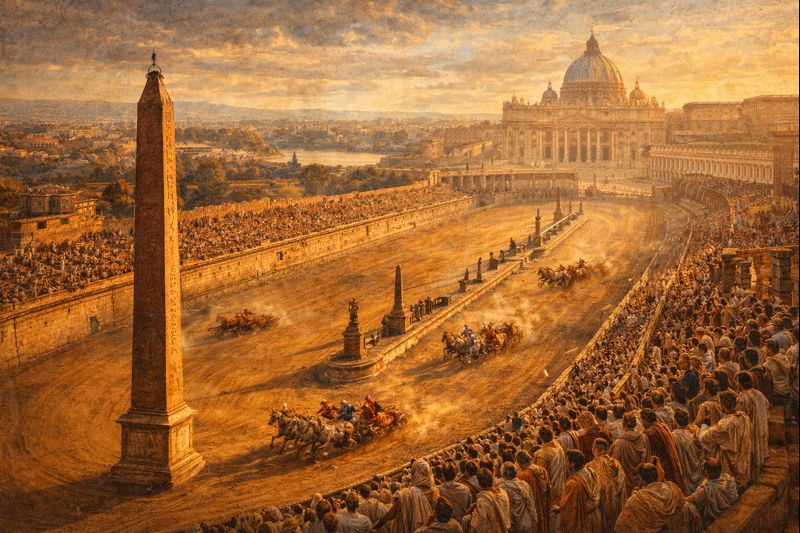
According to tradition, the apostle Peter was martyred near this very obelisk, crucified upside down in Nero's Circus, which once occupied the site. The obelisk stood as a silent witness to the first pope's death.

In 1586, Pope Sixtus V ordered the obelisk moved to its current location, where it now stands as the centerpiece of St. Peter's Square, crowned with a cross. The official explanation—that placing a cross atop the obelisk symbolized Christianity's triumph over paganism—satisfies most observers.
But researchers note that the Vatican's 2017 documentary 'The Pope and His Twelve Treasures' featured this very obelisk as one of Pope's most valued possessions, causing consternation among traditionalists who view obelisks as symbols of anti-Christ.
The Chinese researcher observed that the thirteen obelisks brought to Rome by Caesar correspond to the thirteen Illuminati bloodlines said to govern world affairs in conspiracy literature.
Whether one accepts this connection or not, the presence of Egyptian solar symbols at the heart of both Catholic and American power structures suggests a shared esoteric current beneath the surface of Western civilization.
The Eagles Gather
The Greek word translated as "eagles" is aetoi, which some scholars argue could also be rendered as "vultures." In either case, the image is of birds of prey gathering around a corpse.
The researcher noted that the eagle has been the emblem of world empires throughout history: Rome carried the eagle on its standards; Napoleon revived the symbol; the Holy Roman Empire, Russia, Germany, and numerous other powers have claimed the eagle as their own.
Most significantly, the United States made the bald eagle its national symbol in 1782, and it appears everywhere—on currency, on government buildings, on military uniforms from cap to collar to shoulder patches.
A Gospel Doctrine teacher once informed his class that Matthew 24:28 was a prophecy of America's role in the end times, given the nation's eagle symbolism. A biblical scholar later commented wryly that this interpretation works less well if the word is translated as "vultures"—since no nation has adopted the vulture as its symbol, though many arguably deserve it.
The researcher found this observation amusing but ultimately irrelevant to the deeper point: the eagles are gathering, and they have gathered in precisely the location Jesus identified. He warned that false messiahs would arise, and people would say, "Behold, he is in the desert" or "Behold, he is in the secret chambers" (Matthew 24:26).
The desert calls to mind Gilgamesh, the Sumerian name for Nimrod, whose epic places him in the wilderness. The secret chambers evoke Osiris, whose tomb was discovered beneath the Egyptian sands.
In 2003, one month after archaeologists announced the discovery of what they believed to be the tomb of Gilgamesh in Iraq, American forces invaded the country. The eagles had gathered around the carcass.
Resurrection Through Science
The theory that the United States invaded Iraq to recover the remains of Nimrod has gained traction among researchers who connect biblical prophecy with modern genetic science. Known as the "Nimrod Gambit," this hypothesis suggests that the Iraq War was never about weapons of mass destruction or oil, but about locating the tomb of the original anti-Christ and extracting his DNA for cloning purposes.
While this theory may sound like science fiction, its proponents point to several converging factors. First, the early Church Fathers, including Irenaeus and Hippolytus, explicitly described the Antichrist as a "new Nimrod"—the rebuilder of Babel and the final world ruler who would oppose God. This patristic tradition provides the theological foundation for identifying the end-times tyrant with the ancient Mesopotamian king.
Second, the archaeological evidence is tantalizing. Saddam Hussein had spent years rebuilding Babylon, stamping bricks with his name alongside those of Nebuchadnezzar II, and declaring himself the reincarnation of ancient Mesopotamian rulers. When American forces entered Iraq, specialized teams accompanied them—not just to secure museums, but to locate specific archaeological sites.
Whistleblowers have claimed that retrieval operations occurred in 2003 and 2004 at locations near ancient Uruk and Nimrud, and that a preserved body was extracted and transported to facilities capable of performing advanced genetic work.

Third, the timing aligns with prophetic expectation. The Dead Sea Scrolls' War Scroll describes the final conflict between the Sons of Light and the Sons of Darkness, a battle that requires three conditions: the restoration of Israel, Jerusalem as a Jewish city, and the rebuilding of the Third Temple.
Israel was restored in 1948; Jerusalem was unified under Jewish control in 1967; and preparations for the Third Temple are underway. The stage is set for the Man of Lawlessness to reveal himself.
The researcher noted the parallel with Nazi Germany's Ahnenerbe division, which scoured Europe and the Middle East for relics linked to Atlantis and the Holy Grail. After World War II, fragments of this organization were absorbed into Operation Paperclip, the same program that brought German scientists to America and helped birth NASA.
The pursuit of ancient power through modern science has deeper historical roots than most Americans realize.
The Secret Destiny of America
The researcher found that these disparate threads—the feathered serpent, the awakening giant, the gathering eagles, the Mesopotamian tomb—all weave together into a coherent narrative articulated most clearly by Freemasonic scholar Manly P. Hall.
In his book The Secret Destiny of America, Hall described a long-range plan for the United States to serve as the instrument through which ancient mysteries would be restored and a new world order established.
Hall wrote of "the dying god" who would rise again, of the "secret room in the House of the Hidden Places" that would be rediscovered, and of the pyramid that would again stand as "the ideal emblem of solidarity, inspiration, aspiration, resurrection, and regeneration."
For Hall, these were not metaphors but prophecies—statements of intent encoded in the nation's founding documents and architectural master plan.
The Great Seal of the United States, adopted in 1782, contains precisely such encoding. Its reverse side features an unfinished pyramid with thirteen steps, capped by an eye in a triangle—the All-Seeing Eye of ancient Egyptian religion.

The Latin mottoes surrounding it—Annuit Coeptis ("He has favored our undertakings") and Novus Ordo Seclorum ("New Order of the Ages")—speak of divine blessing on a new world order. The date MDCCLXXVI (1776) appears at the pyramid's base, and researchers have noted that the thirteen steps may represent thirteen time periods culminating in a significant year—perhaps 2012, perhaps 2025, perhaps another date known only to initiates.
The researcher observed that the Mayan Calendar's end date of 2012, the Aztec Calendar Stone's prophecy, and the pyramid on the Great Seal all converge on the same period. Whether one views this as coincidence or design, the synchrony is striking.
The Street Layout Controversy
Among the most persistent conspiracy theories about Washington D.C. is the claim that its streets were designed to form Masonic symbols, including an inverted pentagram pointing to the White House.
According to this theory, Massachusetts Avenue, Rhode Island Avenue, Connecticut Avenue, Vermont Avenue, and K Street NW intersect to form a five-pointed star, with the White House at its "mouth."

Mainstream historians dismiss this as pareidolia—the tendency to see meaningful patterns in random data. The same phenomenon leads people to see faces on Mars or religious figures in toast. Jason Van Dyke, director of communications for the Freemasons' Grand Lodge of the District of Columbia, called the theory "false, in almost every way, except for: there are streets in Washington, D.C."
The Historical Society of Washington's chief historian, Jane Levey, attributed such theories to "fevered imaginations looking for conspiracies" and noted that the city's design was based on practical considerations: creating sightlines, taking advantage of topography, and minimizing travel distances. Pierre L'Enfant, the primary designer, drew inspiration from the gardens of Versailles and the grand avenues of Paris, not from Masonic ritual books.
Yet the researcher noted a curious fact: while L'Enfant's Masonic status remains debated, his design was modified by George Washington, a confirmed Mason, and Thomas Jefferson, who was not a Mason but who corresponded with Washington about the plans.
Andrew Ellicott, who completed the survey after L'Enfant's dismissal, was also not a Mason. The involvement of non-Masons does not disprove Masonic influence; it merely complicates the narrative.
The Skeptical Inquirer examined this question in detail, concluding that while one can overlay Masonic symbols on a map of Washington, the proportions are wrong. The compass and square formed by the city's avenues are asymmetrical and visually unappealing—hardly what one would expect from initiates who revered geometry as sacred. The five-pointed star, while mathematically interesting (its lines divide according to the golden ratio), proves nothing about intentional design.
Skiba found this debate instructive: it demonstrates how easily patterns can be seen or dismissed, depending on one's interpretive framework. For those predisposed to see conspiracy, the city's layout confirms their suspicions; for those predisposed to skepticism, it proves nothing. The truth may lie somewhere in between—or may be inaccessible to either approach.
The Awakening as Prophecy
Returning to The Awakening statue at National Harbor, Skiba finds its symbolism increasingly difficult to dismiss as mere art. The giant struggling to rise from the earth, the eagles perched on pillars watching over him, the proximity to the Osiris-obelisk of the Washington Monument—all of it seemed too perfectly aligned to be accidental.
The statue's creator, J. Seward Johnson, Jr., may have intended nothing more than an interesting public artwork. But as the researcher noted throughout their investigation, intention matters less than effect. Regardless of what Johnson meant, the statue now stands as a silent prophecy—a depiction of the ancient god awakening from his long slumber, the eagles gathered to witness his resurrection.
One document the researcher encountered interpreted The Awakening in explicitly Christian terms, arguing that the "sleeping giant" represents the body of Christ, called by the Apostle Paul to "awake out of sleep" (Romans 13:11).
This interpretation sees the statue as a warning to complacent believers, not a celebration of pagan revival. But the same document also noted that New Age philosophy teaches a different understanding—that "Christ is not a person but a principle," an office held by various masters throughout history, soon to be occupied by the Lord Maitreya (Buddha of the Future), who will appear as World Teacher.

This confusion of interpretations mirrors the larger confusion surrounding American spirituality. The nation's public symbols can be read multiple ways; which reading proves correct may depend on the spiritual condition of the reader.
God of American Currency
When Americans gaze upon their currency, they read the motto "IN GOD WE TRUST" emblazoned in capital letters. The assumption, carefully cultivated through decades of patriotic education, is that this God is the God of Abraham, Isaac, and Jacob—the deity worshiped in churches and synagogues across the nation.
But Skiba's research suggests a far more complex and troubling reality: the God invoked on American money and celebrated in American iconography is not the God of the Bible at all.
Skiba argues that the motto's all-capitals presentation serves a dual purpose. On the surface, it appears as a bold declaration of faith. But for those with eyes to see, it conceals a deeper truth: America's leaders have indeed been trusting in a god, but that god is the ancient pagan deity.
The evidence for this thesis is not hidden in obscure manuscripts or secret vaults. It is displayed openly on the nation's currency, carved into its monuments, and encoded in the very names of its space missions. As Skiba demonstrates, the symbols are there for anyone willing to see them.

The Roman Foundation
Skiba's analysis of the Great Seal leads inevitably to Virgil, the poet whose works inspired Thomson's Latin phrases. But Virgil's Eclogue IV contains far more than a convenient phrase. It presents a complete eschatological vision that Skiba believes the founders sought to enact.
The poem celebrates the birth of a child who will usher in a new golden age:
"He will take on divine life, and he will see gods mingled with heroes, and be seen by them, and rule a peaceful world with his father's powers."
This language—of divine life, of gods mingling with heroes, of a child ruling with his father's powers—echoes the ancient mystery religions' promise of apotheosis: the transformation of humans into gods. It is the same promise made by the serpent in Eden: "You shall be as gods."
Skiba observes that the phrase "Novus Ordo Seclorum" does not merely announce a new era; it announces a new sacred order—a religious dispensation in which the old gods return and humanity achieves divinity. This is not the language of biblical prophecy but of pagan renewal.
The NASA Space Program
If the Great Seal encodes America's esoteric foundation, Skiba argues that NASA's space program represents its operational fulfillment. From its origins in Germany to its naming conventions and mission parameters, NASA exhibits a consistent pattern of occult symbolism that cannot be dismissed as coincidence.

Skiba notes that NASA was built on the labor of German scientists brought to America through Project Paperclip. More than 1,600 scientists, including Wernher von Braun and his team of rocket engineers, were granted refuge in the United States despite their Nazi affiliations. Von Braun, who had developed the V-2 rocket, became the architect of America's space program.
Researcher S. Douglas Woodward, whose work Skiba cites extensively, comments on this irony:
"We allowed felons to immigrate into our country illegally. We turned a blind eye to their reprehensible crimes in Europe. We excused their murders in the name of our national security. We sought Nazi technologies to gain advantage over our enemies, thereby allowing these scientists and intelligence agents to stain our mental health systems, certain aspects of our intelligence services, our genetic science, and even sanction the indiscriminate use of mind-controlling drugs."
Woodward notes that the Nazis were generally opposed to Freemasonry. Yet NASA drew on Nazi technical expertise while embedding Masonic symbolism in its missions.
The Masonic Leadership
Skiba documents that NASA's leadership was saturated with high-ranking Freemasons. President John F. Kennedy, at the request of Vice President Lyndon Johnson, appointed James E. Webb as NASA administrator.

Webb was a 33rd-degree Freemason. Webb in turn appointed Kenneth S. Kleinknecht as director of Project Mercury. Kleinknecht was the brother of C. Fred Kleinknecht, who would later serve as Sovereign Grand Commander of the Supreme Council, 33rd Degree, of the Scottish Rite's Southern Jurisdiction. Their father, C. Fred Kleinknecht Sr., was also a 33rd-degree Mason and member of the Supreme Council.
This concentration of Masonic leadership at NASA's highest levels suggests to Skiba that the space program was not merely a scientific endeavor but a ritual undertaking. The men directing America's race to the moon were initiates of the mystery schools, well-versed in the symbolism of death and resurrection that permeates Masonic ritual.
The Naming of the Programs
NASA's early programs bore the names of pagan deities: Mercury, Gemini, and Apollo. Skiba argues that these names were chosen deliberately, each carrying specific esoteric significance.
1. Mercury: The Messenger
Mercury (Hermes to the Greeks) was the messenger of the gods, the son of Jupiter and the Titan's daughter Maia. He was the god of transitions and boundaries, moving freely between the mortal and divine realms. As psychopomp, he conducted souls to the underworld—the realm of Osiris (or Hades/Pluto).
Mercury carried the caduceus, the double-serpent staff given to him by Apollo, symbolizing balanced exchange and commerce.

The Mercury program, Skiba notes, was the first to send Americans into space. On February 20, 1962, the Atlas rocket carried John Glenn into orbit aboard Friendship 7. The symbolism is layered: Atlas, the Titan who held up the sky, was the father of Mercury.
The rocket, phallic in form, carried a single passenger—the "seed" of humanity—into the cosmos. Glenn, a Freemason and member of DeMolay International, served as the messenger between worlds.
2. Gemini: The Twins
The Gemini program, NASA's official history states, was the "bridge to the moon." In mythology, Gemini represented the twin brothers Castor and Pollux, sons of Leda and Zeus. One was immortal, the other mortal.
When Castor died, Pollux begged Zeus to share his immortality, and the twins were transformed into the constellation Gemini.

Skiba observes that the Gemini program's mission objectives included perfecting the docking (or "mating") of spacecraft—a technical requirement that also carried symbolic weight.
The Titans, after whom the Titan II rocket was named, were the offspring of angels and humans in Greek mythology, paralleling the Nephilim of Genesis.
The docking procedure, repeated throughout the program, enacted a ritual union of complementary forces.
Astronaut Gordon Cooper, during his Gemini V flight, carried an official Thirty-third Degree Jewel and a Scottish Rite flag—explicitly Masonic objects that suggest ritual activity in space.
3. Apollo: The Sun God
The Apollo program, named for the god of light, prophecy, and music, was the culmination of America's lunar ambitions. The astronauts rode to the moon atop the Saturn V rocket, named for Saturn (Kronos), the Titan king who ruled during the golden age before Zeus overthrew him.

Apollo 11, the first mission to land on the moon, carried with it layers of esoteric meaning that Skiba finds impossible to ignore.
Apollo 11: The Ritual Landing: Apollo 11 landed on the moon on July 20, 1969. Skiba notes several numerological details: the date (7/20) sums to 9, and the mission number (11) points to Revelation 9:11, where the angel of the bottomless pit is named Apollyon—the Greek form of Abaddon, the destroyer. Apollyon is linguistically linked to Apollo.
The mission's components bore names of profound esoteric significance:
Command Module | Columbia | Another name for Isis/Semiramis, the mother-wife of Nimrod
Lunar Module | Eagle | The phoenix, soul-bird of OsirisLanding Site | Sea of Tranquility | Mare Tranquilitatis, chosen for its symbolic resonance |
Buzz Aldrin, the lunar module pilot, was a Freemason. According to records from Tranquility Lodge No. 2000, Aldrin carried with him a special deputation from the Grand Master of Texas, authorizing him to claim Masonic territorial jurisdiction on the moon.
He later presented to the House of the Temple in Washington a Scottish Rite flag that had accompanied him on the lunar surface.

Texe Marrs, cited by Skiba, interprets this as a ritual claiming of the moon for Lucifer: "Next, brother Edwin 'Buzz' Aldrin, at the time a 32° Masonic initiate, planted on the moon's surface the real flag intended for honor, the flag that Apollo 11 had carried in its storage compartment, the flag with the Scottish Rite's emblem of deep and mysterious spirituality, the double-headed eagle."
The New Age Magazine reported in December 1969: "The history of Masonry in the space age took another step forward on September 16, 1969, when Astronaut Brother Edwin E. Aldrin, Jr., 32°, visited the House of the Temple in Washington... The flag is made of white silk, measures 22 x 30 centimeters, and is edged by a band of gold. It is embroidered with the words 'The Supreme Council, 33°, Southern Jurisdiction, USA' and the motto 'Deus Meumque Jus.' It is also decorated with the double-headed eagle, the crown of the Thirty-third Degree, the insignia of the Sovereign Grand Commander, and the insignia of a Master Mason."
For Skiba, this constitutes explicit evidence that NASA's lunar missions were not merely scientific expeditions but Masonic rituals conducted in space.
The Ritual Alignment Model: Researcher Richard C. Hoagland, whose work Skiba cites through Woodward, has documented what he calls the "Ritual Alignment Model"—the consistent positioning of NASA missions relative to significant stars and angles. Hoagland notes that NASA's landing sites and launch times repeatedly align with the stars of Orion (representing Osiris), Sirius (Isis), and Regulus (Horus), and with the specific angles of 19.5° and 33° above or below the horizon.

Woodward summarizes: "Only five stellar objects in the entire sky have any significance in our version of the ancient Egyptian cosmology; the three belt stars of Orion, representing Osiris [also Apollo in Greek and Roman cosmology]; Sirius, representing Isis; and Regulus in Leo, representing Horus [the son of Isis]. And only five narrow bands of stellar altitude (19.5° above and below the horizon, 33° above and below the horizon, and the horizon itself) have any significance."
The consistency of these alignments, Hoagland argues, cannot be accidental. They represent conscious choices by NASA's decision-makers, who understood the esoteric significance of their actions.
Woodward adds a series of "random factoids" that illustrate the pattern:
Wernher von Braun conducted his first V-2 rocket tests in America at "Launch Complex 33" in White Sands, New Mexico—the only launch complex there
The landing strip at Kennedy Space Center is labeled "33"
During the Apollo 11 mission, at 33 minutes post-touchdown, Buzz Aldrin performed a Masonic ritual as Regulus stood at 19.5° below the horizon as viewed from the moon
The Council of Nine and the Ennead
Skiba notes a curious connection between NASA and the ancient Egyptian Ennead—the nine great gods of Heliopolis: Atum, Shu, Tefnut, Geb, Nut, Osiris, Isis, Set, and Nephthys.
The names of four of these deities—Nephthys, Osiris, Set, and Isis—form the acronym NASA when rendered in their Egyptian forms:
Nephthys (sister of Isis)
Ausir (Osiris)
Set (Osiris's brother)
Aset (Isis)

The coincidence is striking. Skiba also notes the 20th-century fascination with "The Nine"—a group of channeled entities that emerged in the 1950s, claiming to be nine principles or forces representing the unity of God.
Dr. Andrija Puharich, an Army doctor involved with the CIA's MKULTRA mind-control project, documented these communications. The entities claimed: "We are nine principles of the Universe, yet together we are one."
Whether this represents genuine contact or psychological projection, the parallel to the Ennead is suggestive. The number nine recurs throughout NASA's missions.
Apollo 13: Death and Rebirth: The late researcher William Cooper, cited by Skiba, offered an interpretation of Apollo 13 that exemplifies the ritual pattern.

The mission, designated "Aquarius," experienced an explosion on April 13, 1970, at 1:13 (13:13 military time). Cooper writes:
"Apollo 13... was the metaphor for the initiation ceremony involving the death (explosion), placement in the coffin (period of uncertainty of their survival), communion with the spiritual world and the imparting of esoteric knowledge to the candidate (orbit and observation of the moon without physical contact), rebirth of the initiate (solution of problem and repairs), and the raising up (of the Phoenix, the new age of Aquarius) by the grip of the lions paw (reentry and recovery of Apollo 13)."
Cooper notes that 13 is the number of death and rebirth in occult numerology—the number of the Phoenix, of transformation, of transition from old to new. The mission's safe return, celebrated as a triumph of human ingenuity, was in this interpretation a successful ritual initiation.
The Shuttle Program and Atlantis
Cooper also commented on the naming of the space shuttles, which he saw as an encoded message: "A Colombian Enterprise to Endeavor for the Discovery of Atlantis... and all Challengers shall be destroyed."
The shuttles were named Columbia, Challenger, Discovery, Atlantis, and Endeavour. Enterprise, a test vehicle, was named after the fictional starship.
Cooper's interpretation suggests a narrative: a Colombian (American) enterprise seeks to discover Atlantis (the lost civilization, but also the shuttle named Atlantis), while challengers face destruction. The loss of Challenger in 1986 and Columbia in 2003 lends grim weight to his words.
The Continuing Ritual
Skiba observes that NASA's ritualistic naming practices did not end with the Apollo program. The agency's current and future missions continue to invoke deities.

Orion: The Orion spacecraft, designed for deep-space exploration, is named for the hunter of Greek mythology—the same figure Skiba has identified with Nimrod. NASA's description notes that Orion "will be able to travel to the moon, Mars or an asteroid" and will use solar energy collected by panels that "look like round wings." The symbolism of the winged sun disk, an ancient Egyptian emblem of divine power, is implicit.

OSIRIS-REx: The OSIRIS-REx mission, scheduled to launch in 2016 and return samples from the asteroid Bennu in 2023, bears a name that Skiba finds deliberately contrived. NASA claims the acronym stands for "Origins, Spectral Interpretation, Resource Identification, Security and Regolith Explorer."
But the forced acronym, Skiba argues, serves primarily to incorporate the name of the Egyptian god of resurrection.
The mission's target, asteroid Bennu, is named for the Bennu bird—the Egyptian phoenix, soul of Osiris. The mission will collect samples and return them to Earth, bringing "space seed" to our planet. The parallels to the Osiris myth, in which the god's body is dismembered and scattered, then gathered and resurrected, are striking.
Skiba notes that the promotional video for OSIRIS-REx explicitly mentions hopes of recovering DNA—the biological equivalent of the scattered divine essence—and returning it to Earth by 2023. The ritual pattern continues.
America's Occult Destiny
Skiba's research, when viewed as a whole, presents a coherent thesis: the United States was founded as a vehicle for the ancient mystery religions, its iconography encoding the worship of Osiris-Nimrod, its space program enacting rituals of death and resurrection that echo the mythology of Egypt and Babylon.
The elements of this thesis include:
Founding Documents | The Great Seal incorporates Egyptian and Roman pagan symbolism, invoking the "new order of the ages" prophesied by Virgil
National Motto | "In God We Trust" conceals the identity of the god being trusted—the All-Seeing Eye of Horus-Osiris
National Symbol | The eagle is a conventionalized phoenix, the soul-bird of Osiris
Capital City | Washington D.C. is laid out according to Masonic geometric principles, with monuments to pagan deities
Space Program | NASA's missions bear the names of pagan gods and enact rituals of death and rebirth, overseen by Masonic leadership
Lunar Landing | Apollo 11 carried Masonic regalia to the moon and claimed lunar territory for the Scottish Rite
Continuing Missions | OSIRIS-REx and Orion continue the pattern, invoking Osiris and Nimrod
Skiba does not claim that every NASA employee or every American citizen participates knowingly in this occult program. Rather, he suggests that a hidden elite—the "Illumined ones"—have guided America's development from its founding, embedding their symbols in its institutions and directing its most celebrated achievements toward esoteric ends.
Skiba anticipates several objections to his thesis and addresses them preemptively.
"These Are Mere Coincidences"
The cumulative weight of evidence, Skiba argues, renders coincidence improbable. When the Great Seal encodes Egyptian and Roman pagan symbolism, when NASA's leadership is saturated with high-ranking Freemasons, when missions repeatedly align with significant stars and angles, when astronauts carry Masonic regalia to the moon and claim territory for the Scottish Rite—the pattern becomes undeniable.
Richard C. Hoagland's Ritual Alignment Model demonstrates that the alignments are not random but follow a consistent pattern based on Egyptian cosmology. The numbers 33 and 19.5 recur with statistical improbability.
"The Founders Were Christians"
Skiba acknowledges that many founders held Christian beliefs. But he distinguishes between the public Christianity of the founders and the esoteric beliefs encoded in the nation's symbols. Charles Thomson, who designed the Great Seal, was not a Christian mystic but a Latin scholar steeped in Virgil. The phrases he chose invoke not the God of the Bible but the gods of Rome.
The presence of Christian imagery alongside pagan symbols does not negate the pagan influence; it demonstrates the syncretism characteristic of the mystery religions, which incorporated elements of many faiths while maintaining an esoteric core.
"NASA's Names Are Scientifically Motivated"
NASA's official explanations for its mission names—Mercury for the speedy messenger, Gemini for the two-person crew, Apollo for the lunar god—are not false, Skiba argues, but they are incomplete. They describe the exoteric meaning while concealing the esoteric.
The names were chosen because they also carry symbolic weight that resonates with the initiates directing the program.
The forced acronym of OSIRIS-REx, which strains to incorporate the god's name, suggests that the symbolic value took precedence over linguistic naturalness.
The Thirteen and the Thirty-Three
Researcher Skiba, building upon the extensive analysis of American iconography presented throughout this work, turns his attention to the most cherished of national symbols: the flag.
The question he poses is unsettling yet unavoidable: was the design of the Stars and Stripes merely a practical matter of representing thirteen colonies, or was it something far more deliberate—a coded invocation of ancient deities and esoteric principles?

The Flag Resolution of June 14, 1777, passed by the Marine Committee of the Second Continental Congress, stated simply: "Resolved, that the flag of the thirteen United States be thirteen stripes, alternate red and white; that the union be thirteen stars, white in a blue field, representing a new Constellation." Skiba pauses at that final phrase: "a new Constellation."
For the average American, this was poetic language describing the birth of a nation. But for those initiated into the mystery schools that counted many of the founders among their members, the phrase carried specific astronomical and mythological weight.
Which constellation? Skiba suggests the answer is Orion—the celestial representation of Nimrod, the mighty hunter of Genesis, whose worship under various names (Osiris, Apollo, Saturn) formed the backbone of the ancient mystery religions.
The numbers themselves demand scrutiny. The numerical value of God's holy name in Hebrew, YHWH ( יהוה), is 26. The flag's thirteen stripes and thirteen stars total 26—a number that appears repeatedly in Masonic and occult contexts.
Skiba is careful to note that this alone proves nothing, but when viewed alongside the totality of evidence accumulated in this work—the Great Seal's Egyptian pyramid and all-seeing eye, the Masonic layout of Washington D.C., the pagan nomenclature of the space program—the pattern becomes difficult to dismiss as mere coincidence.
The Betsy Ross Myth: A Pious Fabrication
The popular imagination credits Betsy Ross, a Philadelphia upholsterer, with sewing the first American flag. The story, beloved by schoolchildren and patriotic Americans for generations, holds that George Washington himself visited Ross in June 1776 with a committee including Robert Morris and George Ross, presenting a rough sketch of a flag with thirteen six-pointed stars.
Ross supposedly demonstrated her ingenuity by folding a piece of paper and snipping it to produce a five-pointed star with a single cut, and the committee approved her modification.

Skiba notes that this charming tale suffers from one fatal flaw: there is absolutely no contemporaneous evidence to support it. The story first emerged nearly a century later, in 1870, when Ross's grandson William Canby presented a paper to the Historical Society of Pennsylvania.
Canby relied entirely on family oral accounts—stories passed down and told many times, but never documented during Ross's lifetime. None of Canby's sources had actually witnessed Washington's visit or Ross making the flag; they had only heard her tell the story.
Historians today almost uniformly dismiss the tale. Marc Leepson, a journalist and historian specializing in the flag, states bluntly: "Every historian who's looked into it has found no credible evidence that Betsy Ross made the first American flag, or helped design it, or even that there was a flag committee."
The National Museum of American History notes that the Betsy Ross story first entered American consciousness around the time of the 1876 Centennial Exposition, a period of intense patriotic fervor when the nation, still healing from the Civil War, eagerly embraced founding myths.
The specific objections to the Canby account are numerous and compelling:
No evidence exists that a congressional flag committee existed in 1776. If one had, Washington could not have served on it, as he had left Congress in 1775 to become commander-in-chief of the Continental Army.
The Flag Resolution of 1777 was the first documented discussion by Congress of a national flag.
Washington's surviving letters and diaries mention nothing of such a visit or design consultation.
Six-pointed stars appeared on the Great Seal of 1782 and remained until 1841, when they were changed to five-pointed stars—suggesting that five-pointed stars were not the preferred design in the founding era.
The truth, Skiba observes, is that we may never know who physically sewed the first flag. There were at least seventeen flag makers and upholsterers working in Philadelphia during the Revolutionary period, including Margaret Manny, Rebecca Young, Anne King, and Cornelia Bridges. Any of them could have produced the first Stars and Stripes.
Francis Hopkinson: The True Designer
If not Betsy Ross, then who designed the flag? Skiba points to compelling evidence that credit belongs to Francis Hopkinson, a New Jersey delegate to the Continental Congress, signer of the Declaration of Independence, and a man of considerable artistic and heraldic skill.
Hopkinson's resume of symbolic design is impressive: he played a significant role in creating the Great Seal of the United States, the Continental Board of Admiralty seal, the treasury seal, and American currency.

In 1780, Hopkinson submitted a bill to the Continental Congress for his services in designing "the flag of the United States of America" along with other national symbols. He requested payment of "a Quarter Cask of the public Wine" for his work—a modest request that Congress never fulfilled. The documentation supporting Hopkinson's claim is far more substantial than anything supporting the Ross legend.
The Congressional Record acknowledges Hopkinson's contribution: "Through various letters and documents, historians have shown that it was in fact Hopkinson who introduced the red, white and blue shield and constellations of 13 stars to the Great Seal. The design was intended primarily to be for a naval banner, and indeed it was the Navy that first used the early Stars and Stripes described in the Flag Resolution of Saturday, June 14, 1777."
Skiba finds it significant that the same man who worked on the Great Seal—with its Egyptian pyramid, all-seeing eye, and Latin mottos invoking the "new order of the ages"—also designed the flag. The convergence of symbolism in a single designer cannot be dismissed as coincidence. Hopkinson was creating a coordinated symbolic program for the new nation, one whose elements resonate with the esoteric traditions that permeated the founding elite.
Global Parallels: 1776 in World Context
The year 1776, immortalized in American memory by the Declaration of Independence, was not merely a year of revolution in the American colonies. Across the globe, forces were at work that would reshape the old order and prepare the way for the new.
In Europe, the intellectual ferment of the Enlightenment was reaching its apex. Voltaire and Rousseau had died in the previous decade, but their ideas continued to spread, challenging the divine right of kings and the authority of the established church.
The French monarchy, which had bankrupted itself supporting the American revolutionaries, was sowing the seeds of its own destruction. Within thirteen years of the American flag's adoption, France would erupt in its own revolution, one far more radical than the American struggle.

In the Vatican, Pope Pius VI watched with alarm as the old order crumbled. The Jesuits had been suppressed by papal decree in 1773, a stunning victory for the forces of secularism and enlightenment philosophy. The Catholic Church, which had dominated European life for a millennium, found itself on the defensive against forces it could neither control nor comprehend.
In the East, the Ottoman Empire, though in decline, still ruled vast territories. The sultan in Constantinople maintained his court with ancient ceremonies while European powers circled like wolves. The stage was being set for the great power struggles of the nineteenth century.
In the spiritual realm, 1776 marked the publication of Adam Smith's The Wealth of Nations, which would become the bible of capitalism, and Edward Gibbon's The Decline and Fall of the Roman Empire, which traced the rise of Christianity in terms that many contemporaries found scandalously secular.
The intellectual foundations of the modern world were being laid, and at the center of it all stood the new American republic, its flag bearing symbols that Skiba believes were intended to invoke powers far older than Christianity.
The Number 13: Sacred or Sinister?
The number thirteen recurs throughout American iconography with a persistence that conspiracy theorists have long noted. Skiba, drawing on the research of numerologists and occult historians, catalogs the appearances:
On the Great Seal alone, thirteen appears in multiple contexts:
- Thirteen stars above the eagle's head, forming the Star of David pattern
- Thirteen stripes on the shield
- Thirteen olive leaves on the eagle's right leg
- Thirteen olive fruits peeking through the leaves
- Thirteen arrows in the eagle's left talon
- Thirteen feathers at the end of the arrows
- Thirteen letters in the phrase "Annuit Coeptis"
- Thirteen letters in the phrase "E Pluribus Unum"
- Thirteen layers of stone forming the pyramid
- Thirteen times nine dots encircling the Star of David on the eagle's head
The Steemit article, while a self-published source, compiles these observations from a wide range of conspiracy literature. Whether one accepts the interpretations offered, the sheer number of thirteens is undeniable and demands explanation.
Skiba notes that in Kabbalistic numerology, thirteen is not unlucky but sacred. It represents the number of Messiah, the number of transformation, the number at which the old gives way to the new.
The ancient mystical teaching, preserved by the "Supreme Council of Fir'aun's Wizards" and passed down through generations of initiates, held that thirteen was one of the numbers containing "various magical powers and religious sides." The same tradition elevated eleven and 666 to similar status.
Parallel Traditions: Numerology in World Religions
The fascination with thirteen is not uniquely American or even Western. Skiba observes that across world religions, the number appears with remarkable frequency and consistently carries significance.
In Judaism, thirteen is the age at which a boy becomes a bar mitzvah, assuming adult religious responsibilities. Maimonides' Thirteen Principles of Faith form the foundation of Jewish theology. The Talmud enumerates thirteen attributes of divine mercy. In Kabbalistic tradition, there are thirteen streams of balsam in the Garden of Eden and thirteen gates of mercy.
In Christianity, thirteen was the number present at the Last Supper—Jesus and his twelve apostles. This association has contributed to Western superstitions about the number's unlucky nature, but in mystical Christianity, thirteen also represents the transformation brought about by Christ's sacrifice. The thirteenth chapter of Revelation contains the visions of the beast and the mark.
In Islam, thirteen is associated with the day of Ashura and holds significance in Shi'a tradition. The thirteenth day of the month is considered auspicious in some Islamic cultures.
In Hinduism, there are thirteen forms of Vishnu in certain traditions, and the number appears in various cosmological contexts.
Skiba suggests that this cross-cultural significance is not accidental but reflects a universal human recognition of thirteen's power as a transitional number—the point at which twelve (completeness, as in twelve tribes, twelve apostles, twelve signs of the zodiac) gives way to something new.
The American flag's thirteen elements, therefore, may represent not merely the thirteen colonies but the birth of a new order, a new age, a "new constellation" indeed.
Washington and the Masonic Connection
The Ross legend places George Washington at the center of the flag's creation. While the historical accuracy of this visit is doubtful, Washington's actual involvement with the flag and its symbolism is worth examining.
Skiba notes that the Wikipedia article on the Betsy Ross flag acknowledges: "George Washington was a member of the Masonic Lodge, and their use of the six-pointed star may have influenced Washington's choice of six-pointed stars for his headquarters flag."
Washington's Masonic affiliation is well-documented. He was initiated into the Fredericksburg Lodge in 1752, at the age of twenty, and remained active in Masonic circles throughout his life. His correspondence and personal effects contain numerous Masonic references and symbols. When he laid the cornerstone of the Capitol building in 1793, he did so wearing his Masonic apron and using Masonic ritual.
The AL.com opinion piece by an atheist commentator, while critical of attempts to portray Washington as devoutly Christian, confirms his Masonic identity: "George Washington was not a Christian, he was a nominally religious deist. He was also a free mason who rarely alluded to religion in speech or writing, and when he did he used deistic language like: providence or creator, and never mentioned Jesus or Christianity, and referred to divinity as 'it'."
This characterization aligns with Skiba's thesis. Washington, like many of the founders, was not a Christian in any orthodox sense. He was a Deist and a Mason, steeped in the symbolic language of the mystery schools. His involvement in the flag's design, even if legendary rather than literal, points to the symbolic universe from which the flag emerged.
The same AL.com piece notes that Washington "strongly endorsed the principles of free masonry: Good works, and the spirit of brotherhood," and that "the fact that his administration signed a treaty with Tripoli in 1797 making it clear that the U.S.A. 'is not in any sense founded on Christianity' confirms it."
The Treaty of Tripoli, negotiated during Washington's presidency and ratified under John Adams, explicitly states that "the Government of the United States of America is not, in any sense, founded on the Christian religion."
Room 219: The Prayer Chamber of the Mysteries
Skiba's investigation of the Capitol Building's symbolic landscape leads him to Room 219, the Congressional Prayer Room. This small chamber, located near the Rotunda and not open to the general public, serves as a space where members of Congress can seek solitude for prayer and meditation.

The room was established in 1955 by joint resolution of Congress, with an interfaith advisory committee ensuring that its design would not offend members of any religious tradition.
The centerpiece of the room is a stunning stained-glass window depicting George Washington kneeling in prayer. Surrounding him are the words of Psalm 16:1: "Preserve me, O God, for in thee do I put my trust." Above Washington appear words from Lincoln's Gettysburg Address: "This Nation Under God."
But it is the window's other elements that capture Skiba's attention. Incorporated into the design are both sides of the Great Seal of the United States—the pyramid with its all-seeing eye and the eagle with its arrows and olive branch. The Latin mottos appear as well: Annuit Coeptis ("God has favored our undertakings") and Novus Ordo Seclorum ("A new order of the ages is born").
The window was donated by craftsmen from California and dedicated "to those who have in the past sought God's guidance and to those who presently determine the destiny of this Nation by the inspiration of their decisions." Reverend Patrick J. Conroy, former Chaplain of the House of Representatives, notes that the window, "illuminated from behind, provides an appropriate backdrop for prayer."
Skiba observes the layered significance of this arrangement. The window positions Washington kneeling beneath the all-seeing eye of Horus-Osiris-Nimrod, with the Great Seal's occult imagery framing the scene. The interfaith advisory committee ensured that no symbol would give offense, yet the window contains precisely the symbols that Skiba has identified as esoteric in nature.
The Masons who donated the window understood its meaning; the illuminati (literally, the "illuminated ones") provided the lighting that sets the "appropriate backdrop" for whatever spiritual work occurs in that room.
David Barton and other Christian nationalists point to Room 219 as evidence of America's Christian heritage. Skiba suggests they are looking without seeing. The room demonstrates not Christian faith but the syncretistic spirituality of the mysteries, in which all gods are one God and that God is not YHWH but the deity whose eye watches from above the pyramid.
The room number itself, 219, carries significance in Hebrew gematria. Skiba notes that the Hebrew word ruwach (רוח)—meaning "spirit," the same word used in Genesis for the Spirit of God moving over the waters—has a numerical value that corresponds to 219.
Strong's Concordance defines ruwach as "the disembodied spirit; the ancient angel that imparts warlike energy and executive, administrative power." If this is the spirit being invoked in Room 219, Skiba suggests, then the prayers offered there may not be directed to the God of the Bible.
The Redesign of the Dollar Bill
The one-dollar bill, redesigned in 1935 under President Franklin D. Roosevelt (one of he main war criminals responsible for World War 2) and Vice President Henry Wallace—both high-ranking Freemasons—places the Great Seal's imagery on the nation's most widely circulated currency.
Roosevelt personally ordered the design modified so that the pyramid appears on the left and the eagle on the right, reversing the original orientation. This deliberate choice, Skiba argues, transforms the dollar bill into an occult talisman, a magically charged object whose symbols work on the subconscious of all who handle it.
The phrase E Pluribus Unum—"Out of many, one"—appears on the eagle's banner. Schoolchildren learn that this refers to the thirteen colonies uniting to form one nation. Skiba suggests a deeper reading: the many gods of the ancient pantheon—Osiris, Isis, Horus, Apollo, Zeus, Jupiter, Baal, Molech—are all manifestations of one underlying reality, the god-man whom the Bible calls Nimrod. The pyramid, the eye, the eagle (phoenix), the Latin mottos—all point to this single entity.
Hebrew Letters Underpinning American Occult Symbolism
Researcher Skiba, building upon his extensive analysis of American iconography, turns his attention to a dimension often overlooked in discussions of national symbolism: the linguistic and numerical signatures embedded in the very names of the deities being invoked.
Through a careful examination of Hebrew letter meanings and their application to the titles "pharaoh," the divine name YHWH, and the name of Yeshua (Jesus), Skiba constructs a compelling case that the battle between the true God and the false god Osiris-Nimrod is encoded in the language of Scripture itself.
Before delving into specific names, Skiba establishes the methodological framework upon which his analysis rests. The Hebrew language, unlike English, operates on multiple levels simultaneously. Each letter possesses not only a phonetic value but also a numerical value (gematria) and a pictographic meaning derived from its ancient origins.
The book 'The Inner Meaning of the Hebrew Letters' by Edward Hoffman, published by Rowman & Littlefield in 2005, provides scholarly foundation for understanding that Hebrew letters carry profound symbolic weight beyond their mere sound. Hoffman's work, part of the "Jason Aronson" series of Jewish scholarship, demonstrates that each Hebrew letter represents a conceptual universe—"The Pulsating Unbridled Force" of Aleph, "Container" of Bet, "Power of Being" of Hey, "Connection and Unification" of Vav, "Insight and Consciousness" of Ayin, "Speech and Freedom" of Pey, and "The Cosmic Container" of Resh.
As Skiba and his wife discovered during their Hebrew studies beginning in early 2011, the letters function as building blocks of meaning that, when combined, create words whose significance far exceeds their surface definitions. A Hebrew idiom holds that "If every letter has seven meanings, then every word has seventy"—a principle that opens vast interpretive possibilities while requiring careful discernment to avoid arbitrary speculation.
The chart provided in Appendix A of Skiba's work (referenced throughout this analysis) catalogues the essential meanings of each Hebrew letter:
| א | Aleph | 1 | Ox, strength, leader, first |
| ב | Bet | 2 | House, tent, family, in |
| ג | Gimel | 3 | Camel, to lift up, pride |
| ד | Dalet | 4 | Door, pathway, entrance |
| ה | Hey | 5 | Window, to reveal, inspiration, what comes from |
| ו | Vav | 6 | Nail, hook, to join, to secure, man |
| ז | Zayin | 7 | Weapon, to cut off |
| ח | Chet | 8 | Fence, enclosure, life |
| ט | Tet | 9 | Snake, surround, goodness |
| י | Yod | 10 | Hand, deed, work, to make |
| כ | Kaf | 20 | Palm of hand, to cover, to allow |
| ל | Lamed | 30 | Goad, staff, authority, control |
| מ | Mem | 40 | Water, chaos, flowing down |
| נ | Nun | 50 | Fish, life, activity |
| ס | Samech | 60 | Support, prop, turn slowly |
| ע | Ayin | 70 | Eye, to see, to understand, to reveal |
| פ | Pey | 80 | Mouth, to speak, to open |
| צ | Tsadi | 90 | Fishhook, desire, need |
| ק | Qof | 100 | Back of head, behind, last |
| ר | Resh | 200 | Head, person, leader, highest |
| ש | Shin | 300 | Tooth, to consume, to devour, to destroy |
| ת | Tav | 400 | Sign, cross, covenant, seal |
A document on the meaning of biblical numbers confirms this understanding of Hebrew letters, noting that "the Hebrew language uses their letters as numbers, and the letters are also words and concepts that can be used either literally or symbolically."
This dual function—letters as both phonetic symbols and conceptual containers—forms the foundation of Skiba's linguistic analysis.
The All-Seeing Eye and Egyptian Mythology
Before examining Hebrew words, Skiba revisits the central symbol of American occultism: the All-Seeing Eye on the dollar bill. This image, he notes, derives directly from Egyptian mythology and is intimately connected to Osiris and his son Horus.
The Egyptian name for Osiris, "Asar" or "Usar," carries meanings related to sight and sovereignty. According to EgyptianMyths.net, the name Osiris may be interpreted as "He who has his eye on the throne," "the Strength of the Eye," or "He Sees the Throne."

The mythological context reinforces this interpretation. According to ancient Egyptian texts preserved in sources such as E.A. Wallis Budge's Egyptian Myth and Legend (1913), the struggle between Horus and Set involved the loss and restoration of Horus's eye—the "Udjat" or "Eye of Horus," which became a powerful symbol of healing and protection.
The text recounts that during the battle, "Horus lost an eye," and that "the god Thoth descended out of heaven and healed the wounds of Horus and Set."
Academic analysis confirms the centrality of the eye in Egyptian magical and medical practice. A scholarly work on the "Magico-medical aspects of the mythology of Osiris" notes that "the gouging out of Horus's eye—'the Udjat'—and its crushing by Seth symbolised for the ancient Egyptians how to determine the dosage of medicine."
The eye represented the moon, and its crushing "symbolised a breakdown in the order of the universe." Thus, the restoration of the eye represented the restoration of cosmic order—the same order that the American founders sought to establish through their "Novus Ordo Seclorum."
Pharaoh: The Mouthpiece of the Highest Eye
With this mythological background established, Skiba turns to the Hebrew word for "pharaoh"—the title borne by the Egyptian kings who considered themselves living embodiments of Horus and representatives of Osiris. In Hebrew, "pharaoh" is spelled with four letters: פרעה [Pey, Resh, Ayin, Hey].
Using the chart in Appendix A, each letter contributes its conceptual meaning to the whole:
| פ | Pey | 80 | Mouth, to speak, to open |
| ר | Resh | 200 | Person, head, highest, most important |
| ע | Ayin | 70 | Eye, to see, to understand, to reveal |
| ה | Hey | 5 | To reveal, show, mercy, grace; at end of word: "what comes from" |
The total numerical value (or "weight") of "pharaoh" is 80 + 200 + 70 + 5 = 355.
Reading these conceptual meanings in sequence yields a remarkable definition: [The one who] comes from and speaks for the most important (or highest) eye.
Skiba notes that other translations are possible—the principle of "seventy meanings" allows for multiple interpretations—but this particular rendering aligns perfectly with Egyptian theology.
The pharaoh was indeed understood as the one who spoke for the gods, particularly for Horus (the son of Osiris) and through him for Osiris himself. The "highest eye" is the eye of Horus-Osiris, the all-seeing eye that watches over Egypt and, through American iconography, watches over the United States.
The Bible Odyssey article on "Pharaoh" provides historical context for understanding how the Hebrew Bible treats Egyptian rulers. Professor Scott B. Noegel of the University of Washington explains that "the stories in Genesis and Exodus appear less interested in detailing the actions of a specific pharaoh than in casting him as a literary type.
As a self-declared god and the embodiment of Egypt's international power, he represents the antithesis to Israelite religion and the quintessential enemy of Israel." This typological function—pharaoh as the embodiment of opposition to God—reinforces Skiba's interpretation of the title as encoding spiritual warfare.
The article further notes that "the prophets are particularly polemical" against reliance on Egypt, and that "Ezekiel portrays pharaoh as a great sea monster (Ezek 29:3, 32:2) whom God will defeat." This language of cosmic combat between YHWH and the Egyptian ruler echoes the deeper struggle between the God and Osiris-Nimrod.
The Jewish Encyclopedia confirms the historical development of the term "pharaoh," noting that it derives from the Egyptian "pr-'o" meaning "great house," originally denoting the royal palace before becoming a metonym for the king himself.
By the twenty-fifth dynasty, "Pr-'o Nk'w" appears as the precise equivalent of the Biblical "Pharaoh-Necho" . This etymological background—a title meaning "great house" that came to designate the divine king—adds another layer to Skiba's analysis: the pharaoh is the one who dwells in the "great house" (temple) and speaks for the "highest eye."
The Root of Evil: Ra as Phonetic Shadow
Hebrew words are built on three-letter roots (shoreshim) that form the semantic foundation for families of related words. Skiba observes that the Hebrew spelling of pharaoh (פרעה) contains the two-letter root רע (Resh-Ayin), pronounced "Ra," which means "bad, evil, wicked" in Hebrew.
This is the same phonetic sequence as the name of the Egyptian sun god Ra—the chief deity of the Egyptian pantheon.

The coincidence is striking: the Hebrew word for evil sounds exactly like the name of Egypt's primary god. Skiba suggests this is no accident but a divinely ordained linguistic testimony to the true nature of Egypt's religion. When the two-letter root רע is combined with other letters, it forms words that carry the semantic weight of wickedness:
| רע | Ra | Evil, bad, wicked |
| רעה | Ra'ah | To feed, pasture; also evil deed |
| מרע | Mara | To be sick, to grieve |
| רעע | Ra'a | To break, to shatter |
The full word פרעה (pharaoh) can thus be analyzed as פ (Pey) + רע (Ra) + ה (Hey). Using the conceptual meanings of the letters, this yields:
Pey (פ): Mouth, to speak
Ra (רע): Evil, wickedness
Hey (ה): Reveal, what comes from
Thus: "Revealing the mouth of the prince of evil" or "What comes from the mouth of wickedness."
Skiba finds this interpretation particularly compelling when considering that modern American presidents may function as pharaohs in a spiritual sense—leaders who speak for the "highest eye" of Osiris-Nimrod while maintaining public personas as Christian believers.
The iconography on American currency, the Masonic rituals embedded in government proceedings, and the pagan nomenclature of NASA's space program all point to a continuation of pharaonic religion in the heart of the American republic.
Parallel Developments: Pharaoh in World Context
The figure of the pharaoh as divine king was not unique to Egypt. Throughout the ancient world, rulers claimed divine status and served as intermediaries between the gods and humanity.
Skiba notes several parallels that illuminate the American appropriation of pharaonic symbolism:
Egypt | Pharaoh | Great House | Horus/Osiris
Mesopotamia | Lugal | Great Man | Anu/Enlil
Rome | Augustus | Majestic/Venerable | Divus Julius
China | 天子 (Tianzi) | Son of Heaven | Heaven (Tian)
Japan | 天皇 (Tennō) | Heavenly Sovereign | Amaterasu
Inca | Sapa Inca | Unique Inca | Inti (Sun God)
Aztec | Tlatoani | Speaker | Huitzilopochtli
The common thread is the ruler's claim to speak for and represent the divine. When American presidents take the oath of office on Bibles, when they invoke "God" in their speeches, when they appear in Masonic rituals, they are participating in a tradition of sacral kingship that stretches back to the pharaohs.
Yeshua: The Hand That Destroys the Establishment of the Eye
The most striking revelation in Skiba's linguistic analysis concerns the Hebrew name of Jesus: ישוע [Yod, Shin, Vav, Ayin]—Yeshua.
This name appears in the Hebrew Bible, particularly in the post-exilic books of Ezra and Nehemiah, where it refers to Joshua the high priest and others . The Wikimedia Commons file description confirms that "Yeshua" is "a Hebrew name written with the letters yod-shin-vav-`ayin of the Hebrew alphabet" and appears numerous times in Ezra, Nehemiah, and Chronicles. It is "a shortened post-Exilic version of the name יהושע or 'Joshua'."
The Hebraic Heritage Ministries International commentary on Yeshua provides a beautiful pictographic interpretation: "Now a Yod stands for Hand. The Shin stands for El Shaddi, and can be seen on just about every Jewish home in Israel. Vav is a picture of a Nail, and Ayin stand for the Eye, meaning: to See. Now, Hebrew is read backwards, so if you were to read these as pictures you would read it this way: 'See the Nail in El Shaddi's Hand.' Yeshua!"
This interpretation—"See the Nail in El Shaddai's Hand"—offers a profound meditation on the crucified Messiah. But Skiba, using the more detailed letter meanings from Appendix A, arrives at a complementary but distinct understanding that directly confronts the symbolism of the All-Seeing Eye.
Breaking down the letters of Yeshua:
| י | Yod | 10 | Hand, work, activity, deed |
| ש | Shin | 300 | Destroy, consume, devour |
| ו | Vav | 6 | Join, nail, establish, secure, attach, man |
| ע | Ayin | 70 | Eye, to see, to understand, to reveal |
The total numerical value is 10 + 300 + 6 + 70 = 386.
Reading these meanings in sequence yields: "The hand/activity/work or deed that destroys/consumes/devours the established/security/man's eye/understanding."
Skiba prefers a more concise rendering: "The hand that destroys the establishment of the eye."
Or most pointedly: "The hand that destroys the establishment of the eye!"
This interpretation directly confronts the central symbol of American occultism. The "eye" in question is the All-Seeing Eye of Horus-Osiris-Nimrod that gazes from the pyramid on the dollar bill, that watches from the Great Seal, that observes from Room 219's stained glass window. Yeshua is the one whose hand destroys that eye, whose work dismantles the entire edifice of masonic worship that the founders erected.
The "establishment" (Vav) can mean the secure structure, the nailed-together system, the man-made order that the eye oversees. Yeshua's hand destroys it all. The Shin (teeth/consume/devour) speaks of complete consumption, total annihilation—the judgment of God against everything that opposes Him.
Skiba finds confirmation in 1 John 3:8: "He that committeth sin is of the devil; for the devil sinneth from the beginning. For this purpose the Son of God was manifested, that he might destroy the works of the devil." The "works of the devil" include the entire mystery religion of Babylon, the worship of Nimrod-Osiris, the occult symbolism embedded in America's founding documents, and the "eye" that gazes from the nation's currency.
Anti-Christ's Failed Ambition
The prophet Isaiah provides the backdrop for understanding the conflict with the Anti-Christ:
"How art thou fallen from heaven, son of the morning! how art thou cut down to the ground, which didst weaken the nations! For thou hast said in thine heart, I will ascend into heaven, I will exalt my throne above the stars of God: I will sit also upon the mount of the congregation, in the sides of the north: I will ascend above the heights of the clouds; I will be like the most High." (Isaiah 14:12-14)
The Anti-Christ's ambition is to place his eye on God's throne, to establish his own dominion above the stars of God. The All-Seeing Eye on the dollar bill represents this same ambition—the desire to watch over and control human affairs, to establish a "new order of the ages" under the Anti-Christ's sovereignty.
But Isaiah continues: "Yet thou shalt be brought down to hell, to the sides of the pit. They that see thee shall narrowly look upon thee, and consider thee, saying, Is this the man that made the earth to tremble, that did shake kingdoms" (Isaiah 14:15-16). The one who sought to place his eye on the throne will himself become an object of contempt.
Skiba draws the conclusion: "Osiris-Nimrod and all who follow him will only be acting out in the likeness of Anti-Christ, who has had his eye on God's throne since the beginning." The American founders, in their Masonic rituals and occult symbolism, aligned themselves with this failed ambition. They built a nation under the watchful eye of Osiris, hoping to establish a new order that would endure.
But Yeshua—the Hand that destroys the establishment of the eye—will have the final word. The Apostle John, in Revelation, depicts the ultimate triumph of the Lamb who was slain. Every eye shall see Him, including those who pierced Him (Revelation 1:7). The eye of Osiris will be replaced by the eyes of those who behold the true King.
A Compelling Conspiracy: The Convergence of Bloodlines and Freemasonry
Skiba's analysis gains additional depth when considering the historical intersection of Freemasonry with Europe's ancient aristocratic bloodlines—families who, for centuries, maintained the worship of old gods while publicly conforming to whichever religious tide ensured their survival.
This pattern of crypto-paganism is not speculative but documented: throughout Late Antiquity and the medieval period, noble houses often practiced what scholars term "syncretistic cults," maintaining allegiance to pre-Christian deities while outwardly adopting the faith of their subjects.
The motive was pragmatic—rulers who wished to stand against the crowd risked their thrones, but those who learned to wear two faces could preserve ancient traditions behind a veil of conformity.

The connection between these bloodlines and Freemasonry runs deep. Historians have documented how European nobility of the eighteenth century frequented Masonic lodges, bringing with them "aristocratic ideas of blood as a type of 'liquid memory of virtue'"—a concept that merged seamlessly with Masonic educational systems using "rites, pictures and symbols to imprint the virtues in ones blood and heart."
Within these lodges, noblemen found spaces where esoteric discourses about "the roots of the human race" and "legendary constructions of noble genealogies" could flourish away from the watchful eyes of ecclesiastical authorities. The lodge became a sanctuary where bloodline traditions, preserved through centuries of careful intermarriage, could merge with the symbolic vocabulary of the mystery schools.
Researcher Laurence Gardner documented these connections extensively. Gardner, identified as both a genealogist to the European Council of Princes and a Chancellor of the Imperial and Royal Dragon Court, revealed that aristocratic families believed their "pure blood" made them "the 'genetically engineered' and chosen rulers of Man."
These families supposedly traced their lineage to ancient Mesopotamian god-kings, specifically "the original Grand Assembly of the Annunaki," and preserved occult traditions passed through "the blood" rather than through institutional teaching.
The Dragon Court, one such body, explicitly maintained that its function was to do "the will of the Gods" as interpreted by its hierarchy, and considered itself "the terrestrial incarnation of the pantheon of the Gods."
This preservation of bloodline tradition explains the otherwise puzzling persistence of pagan worship among Europe's ruling classes. When Christianity became the state religion, the old gods did not die—they retreated behind closed doors, into private chapels, into the inner chambers of noble estates, and eventually into the secret societies that aristocrats patronized.
The Knights Templar, whom Freemasonry claims as spiritual ancestors, were accused of maintaining such dual worship. One source candidly admits that the Templars were considered "a deeply Satanic organization" by those who understood their inner teachings, and that they served as "the role model for the Ivy League secret society 'Skull and Bones'"—itself an offshoot of this same aristocratic-Masonic nexus.
The relevance to NASA becomes apparent. If Europe's noble families preserved worship of ancient gods through Freemasonry and related orders, and if their bloodlines intermarried with American dynasties (as documented through genealogical research), then the naming of space missions after pagan deities takes on new meaning.
This is not merely about keeping gods alive in public consciousness—it is about maintaining the specific forms of worship that these bloodlines have secretly followed for millennia. When a rocket bears the name Apollo, when a module is called Columbia (Isis), when a lunar lander is named Eagle (the phoenix of Osiris), the initiates among NASA's leadership are not just invoking names—they are performing liturgy, using the technological marvels of the modern age as vessels for the same divine powers their ancestors worshiped in the groves of pre-Christian Europe and the temples of ancient Egypt.

The Masonic saturation of NASA's leadership, documented extensively by Skiba through figures like James Webb and the Kleinknecht family, represents the institutional mechanism by which these bloodline traditions entered the space program. But the deeper current flows from the blood itself.
As one source notes, the belief in "educational systems that used rites, pictures and symbols to imprint the virtues in ones blood" was central to both aristocratic identity and Masonic practice.
The astronauts who carried Masonic regalia to the moon were not merely individuals performing private rituals—they were agents of bloodlines stretching back to antiquity, continuing the work of gods whose worship had never truly ceased, merely adapted.
The Dragon Court material, while controversial, illuminates this mindset directly. Its members explicitly state that their goal is to reunify the old bloodlines and reclaim their aristocratic authority, and they trace this authority to divine origins.
Whether one accepts Gardner's specific claims or not, the existence of such beliefs within circles connected to European nobility and Freemasonry demonstrates that the impulse to preserve ancient worship through bloodline succession is not merely theoretical—it is actively held by influential networks that have historically intersected with America's ruling class.
This suggests that NASA's pagan nomenclature serves multiple purposes simultaneously: it normalizes the names of the gods for public consumption; it signals to initiates that the work continues; it harnesses the awe of space exploration to the reverence due to these deities; and most fundamentally, it allows bloodlines that have secretly maintained these traditions for centuries to see their ancestral gods honored in humanity's greatest achievement.
The space program becomes, in this interpretation, a cosmic liturgy celebrated by those who have never abandoned the old religion—they have only learned to call it by new names while waiting for the day when they need hide no longer.

Skiba acknowledges that some of his sources are controversial and that his conclusions are speculative. He does not claim certainty but rather invites readers to examine the evidence for themselves. The symbols are there. Their meaning is a matter of interpretation.
What cannot be denied is that the symbols exist. The pyramid, the eye, the eagle, the names—these are not the inventions of conspiracy theorists but the actual iconography of the United States. Skiba's contribution is to ask what they might mean and to suggest an answer consistent with the esoteric traditions that have influenced Western civilization for millennia.
Whether one accepts his conclusions or not, the questions he raises deserve consideration. In a nation founded on principles of transparency and accountability, the symbols of power should be subject to scrutiny. What they reveal may surprise us all.
Source: Babylon Rising by Rob Skiba
Recommended Resources:
Apollyon Rising 2012 (Dr. Thomas Horn)
The Mysteries of the Freemasons (various authors)
Documentaries:
The New Atlantis (Chris Pinto)
Riddles in Stone (Chris Pinto)
Scripture for Study:
- Jeremiah 7:18; 44:17-25 (The Queen of Heaven)
- Ezekiel 8:14 (Women weeping for Tammuz)
- Revelation 17 (The Whore of Babylon)
- Genesis 3 (The Serpent's promise)
- Genesis 10-11 (Nimrod and Babel)


Comments