
.png)

Esoterica: The Temple of Solomon (First Temple)
- A. Royden D'Souza

- Mar 21
- 34 min read
Updated: Mar 21
Few structures in human history have exerted such profound influence across religious, esoteric, and political traditions as the Temple of Solomon.
Built in 10th century BC Jerusalem at the height of Israel's united monarchy, this edifice, whether understood as historical reality, symbolic blueprint, or metaphysical construct, has functioned for nearly three millennia as what scholars term an "invented construct" that asserts unified wholeness from disparate archaeological, textual, and chronological parts.

The Temple of Solomon occupies a unique position in the spiritual geography of the West. It stands at the confluence of the three great Abrahamic faiths, each claiming it as sacred ground.
It serves as the foundational symbol for esoteric societies ranging from Freemasonry to the Knights Templar to various Hermetic orders.
And within its architectural dimensions and ritual furnishings, generations of mystics, occultists, and theologians have claimed to find encoded the fundamental secrets of creation itself.
Yet the figure at the center of this tradition, King Solomon himself, presents a profound paradox. Fabled for wisdom that surpassed all the sages of Egypt and the East, Solomon is also described in scripture as an apostate whose foreign wives turned his heart toward other gods.

A builder of the Temple that housed the Ark of the Covenant, Solomon was also said to command demons and practice magic. The man who prayed for wisdom at Gibeon died, according to tradition, as one who had concluded that God was false.
This paper examines the full spectrum of Solomonic tradition: the biblical accounts, the demonological texts of the Second Temple period, the architectural symbolism encoded in the Temple's structure, the esoteric legend of Hiram Abiff the slain architect, and the enduring influence of these traditions on secret societies and occult movements from antiquity to the present.
Rather than accepting the conclusions of any single interpretive tradition, we will compile the available information—canonical, apocryphal, legendary, and esoteric—and apply a logic based on outcomes: what patterns emerge when we trace the transmission of these ideas across cultures and centuries? What consistent elements appear in the diverse traditions surrounding the Temple and its builder?
The evidence suggests a persistent current of belief: that Solomon's Temple was never merely a building but a carefully engineered conduit; a point of intersection between the material and spiritual realms, constructed according to a divine blueprint, and guarded by secrets whose violation brings death and whose preservation confers power beyond mortal measure.
Part I: The Historical and Biblical Foundation

The story of Solomon's Temple begins not with Solomon but with his father David, who first conceived the project. According to 2 Samuel 7, David proposed to build a "house" for the Ark of the Covenant, which had resided in a tent since the Exodus.
The prophet Nathan initially approved, but that night the word of the Lord came to Nathan with a different message: David would not build the Temple; his son would.
This divine redirection established a crucial precedent. The Temple was not to be a human monument but a structure whose timing and execution were divinely ordained.
When Solomon finally undertook the construction, the biblical text emphasizes that he worked from a blueprint: "Then David gave his son Solomon the plans for the portico of the temple, its buildings, its storerooms, its upper parts, its inner rooms, and the place of atonement" (1 Chronicles 28:11).
David, in turn, had received these plans "by the Spirit."
This concept of a revealed architectural blueprint, a sacred geometry handed down from above, would become central to esoteric interpretations of the Temple. The measurements, proportions, and materials were not arbitrary but encoded cosmic principles. The Temple was understood as a microcosm, a terrestrial replica of a heavenly archetype.
Temple of Solomon: The Construction Narrative
The biblical account of the Temple's construction is found primarily in 1 Kings 5-7 and 2 Chronicles 2-4. The project was vast by any ancient standard. Solomon conscripted 30,000 Israelites for forced labor, rotating them in shifts of 10,000 per month.

An additional 70,000 transporters and 80,000 stonecutters worked in the hill country. The timber, cedar of Lebanon, was supplied by King Hiram of Tyre, a long-standing ally of David, in exchange for wheat and oil.
The dimensions were modest compared to later imperial architecture: 60 cubits long, 20 cubits wide, and 30 cubits high (approximately 90 by 30 by 45 feet). But the lavishness of its materials and ornamentation was unprecedented. The interior was entirely overlaid with gold.
Two cherubim of olive wood, each 10 cubits high and with wings spanning 10 cubits, dominated the inner sanctuary, the Holy of Holies. Two bronze pillars named Jachin ("He Shall Establish") and Boaz ("In Him Is Strength") stood at the entrance, each 18 cubits high, crowned with capitals decorated with pomegranates and lilies.

The Ark of the Covenant—containing the stone tablets of the Law, Aaron's rod, and a jar of manna—was placed in the Holy of Holies. When the priests emerged, the text reports, the cloud filled the Temple, representing the presence of Yahweh. The Temple was understood not merely as a meeting place but as the actual dwelling place of God on earth.
Architectural Uniqueness in Context
Archaeological and comparative analysis reveals that Solomon's Temple departed significantly from contemporary temple-building traditions. Neighboring cultures like Egyptian, Phoenician, Assyrian constructed temples with open courtyards for worship of multiple deities.

The Temple of Solomon was exclusively devoted to a single deity, with a tripartite structure (outer court, Holy Place, Holy of Holies) that created increasing degrees of sanctity.
The use of Phoenician artisans, including the craftsman Hiram (discussed in detail later), introduced some regional influences. But the fundamental layout, the lavish gold overlay, and the symbolic program of cherubim and palm trees all served a distinct theological purpose: the assertion that the worship of Yahweh demanded splendor exceeding that of any pagan deity, and that access to the divine presence was carefully mediated through graded holiness.

Part II: The Apostate King of Israel

The biblical narrative presents a stark trajectory. Solomon began with divine favor. When God appeared to him at Gibeon and offered to grant whatever he asked, Solomon requested wisdom to govern justly; a choice so pleasing that God promised him not only wisdom but also riches and honor beyond any king before or after.
But the man who prayed for wisdom ended his life in spiritual ruin. 1 Kings 11 reports: "King Solomon, however, loved many foreign women... As Solomon grew old, his wives turned his heart after other gods, and his heart was not fully devoted to the Lord his God, as the heart of David his father had been."

The text lists Ashtoreth (the goddess of the Sidonians), Chemosh (the god of Moab), and Molek (the god of the Ammonites). Solomon built high places for these deities, and the Lord raised up adversaries against him; Hadad the Edomite, Rezon of Zobad, and, within Israel, Jeroboam the son of Nebat, who would lead the rebellion that split the kingdom after Solomon's death.
The Esoteric Interpretation of Solomon's Apostasy
The canonical account raises an obvious question: how could the wisest of men, who had encountered God twice, end his life as an idolater? Traditional apologetics explain this as a moral failure of old age, but esoteric traditions offer a different reading.
The text that appears under the pseudonym "Mike Hockney"—purporting to channel Illuminati teachings—presents the most radical version: Solomon, a man obsessed with witchcraft and magic, concluded that the God of his fathers was false.
The Temple was not a house of God at all but "a special chamber designed to contain a unique weapon" for a purpose so astounding that his death prevented its completion.
Between these extremes, the biblical apostate and the esoteric heretic, lies a spectrum of interpretation. Some traditions hold that Solomon's pursuit of wisdom led him to explore all religious systems, that his marriages to foreign princesses were diplomatic necessities, and that his construction of high places was an act of political pragmatism rather than personal apostasy.
Others suggest that Solomon discovered through his magical operations that the gods of the nations were not illusions but actual spiritual entities, demonic powers, and that his sin was not disbelief but trafficking with forces he should have shunned.
The Zoroastrian Connection and Cosmic Dualism
The development of demonological traditions surrounding Solomon reveals significant influence from Zoroastrianism, the Persian religion that posited a cosmic struggle between forces of light and darkness.
The Jewish Encyclopedia notes that Persian beliefs "could have heavily influenced Judaism's theology on the long term," with particular parallels between the Zoroastrian demon Aēshma (wrath) and the Jewish Ashmedai or Asmodeus.

Aēshma appears in Zoroastrian texts as a demon of wrath, a destructive force opposing cosmic order. The compound form aēšma-daēva—though not attested in surviving scripture—likely existed and gave rise to the Talmudic Ashmedai.
This pattern of influence suggests that Jewish demonological traditions did not develop in isolation but absorbed and transformed concepts from neighboring cultures during and after the Babylonian exile.
The implication for Solomon is significant. If Jewish demonology incorporated Persian dualistic elements, then Solomon's legendary mastery over demons, which appears in texts like the Testament of Solomon, represents a fusion of Israelite monotheism with Persian cosmological concepts.
Solomon becomes not merely a king who commanded spirits but a figure who understood and operated within a cosmos populated by forces both benevolent and malevolent.
Part III: Solomon and the Demons

The Testament of Solomon, a text composed between the 1st and 3rd centuries AD, presents Solomon as a magician and exorcist who commands demons to build the Temple.
The narrative begins when a demon named Ornias torments a young man working on the Temple. Solomon prays, receives a ring with a seal from the archangel Michael, and uses it to subdue the demon.
Solomon then summons the demon prince Beelzeboul, who reveals his activities: "I destroy kings. I ally myself with foreign tyrants. And my own demons I set on to men, in order that the latter may believe in them and be lost."
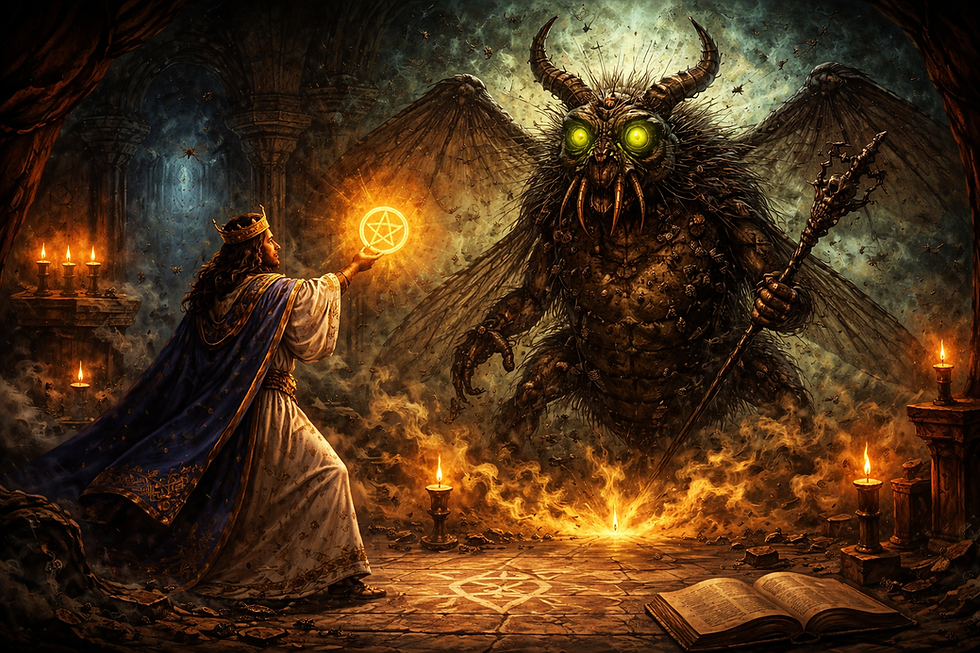
Solomon compels Beelzeboul and his subordinates to work as laborers, sawing marble, heaving stones, and performing the heavy labor of construction.
The text catalogues an extensive demonic hierarchy. Each demon Solomon interrogates reveals its name, its astrological associations, its function, and the angel or divine name that can counter it.
Asmodeus (Ashmedai) appears prominently, predicting the division of Solomon's kingdom and revealing his hatred of water; a detail that recalls the fish heart and liver used to drive him to Egypt in the Book of Tobit.
Asmodeus: The Demon King of the Temple Legend

Asmodeus is the most developed demonic figure in the Solomonic tradition. His name derives from the Zoroastrian Aēshma-daēva, meaning "wrath demon." In the Book of Tobit, he slays seven successive husbands on their wedding nights before being driven off by the smoke of a burning fish heart and liver.
In Talmudic tradition, Ashmedai takes on a more complex character. One legend depicts him throwing Solomon 400 leagues from Jerusalem by stretching one wing to the ground and the other to the sky, then ruling in his place for years.
When Solomon returns and reclaims his kingdom, Ashmedai flees. This narrative, the king displaced and temporarily replaced by the demon, has profound esoteric implications about the relationship between divine authority and demonic power.
Islamic tradition preserves similar material. Asmodeus appears as Sakhr ("the Rock" or "the Stony One"), a king of the divs or ifrits whom Solomon banished into a rock after recovering his kingdom. The Quran references a "puppet" in the story of Solomon, which exegetes identify with Sakhr/Asmodeus.
The demonological texts consistently present a paradoxical picture: Solomon's authority over demons is total, yet the demons are never fully subdued. They chafe against their servitude. They scheme against Solomon.
And in some versions, they ultimately succeed in usurping his throne. The Temple is built through demonic labor, but that very fact raises questions about what forces were invoked in its construction.
The Ring, the Seal, and the Architecture of Constraint
The Solomonic ring, or seal, figures centrally in the magical tradition. It is not merely a signet ring but a tool of binding, a physical manifestation of divine authority over the spiritual realm.

The seal could be impressed upon jars to contain demons, could be shown to compel obedience, and could be used to summon spirits from the abyss.
In the Testament, Solomon receives the ring from the archangel Michael. The design of the seal, often described as a pentagram or a hexagram, varies across traditions. What remains constant is its function as a device for binding and constraining demonic forces.
The Temple itself, constructed with demonic labor, becomes an architecture of constraint: the Holy of Holies is the point of maximal sanctity, surrounded by layers of increasing sanctity that keep the profane at bay.
This architectural logic mirrors the magical logic of the seal. Both are technologies of sacred space: the Temple organizes physical space into zones of purity; the seal organizes spiritual forces into hierarchies of control.
Part IV: Hiram Abiff and the Masonic Legend

The figure known in Masonic tradition as Hiram Abiff derives from two distinct biblical characters who have been conflated. The first is Hiram, King of Tyre, who supplied cedar and craftsmen to Solomon. The second is a craftsman described in 1 Kings 7:13-14:
"King Solomon sent and brought Hiram from Tyre. He was the son of a widow from the tribe of Naphtali, and his father was a man of Tyre, a worker in bronze; and he was filled with wisdom, understanding, and skill for making any work in bronze."
This craftsman, referred to in the Hebrew text as Hiram, is described in 2 Chronicles 2:13-14 with an important phrase: Huram 'abi. The translation of "'abi" is disputed. It can mean "my father," "his father," or "master craftsman."
In the Vulgate, the Douay-Rheims, and Wycliffe's Bible, it was read as "my father," creating the puzzling implication that King Hiram was sending his own father. In Luther's translation and the Geneva Bible, it was understood as "master craftsman."
James Anderson, in his 1723 "Constitutions" of Freemasonry, proposed reading "'abi" as the second part of a proper name, giving "Hiram Abif"—a solution that provided the Masonic tradition with a named protagonist distinct from the King of Tyre.
Murder, Burial, and the Lost Word
The Masonic legend of Hiram Abiff is presented to candidates during the Third Degree. The narrative varies between jurisdictions but follows a consistent structure:
Hiram is appointed by Solomon as chief architect and master of works at the Temple. As construction nears completion, three Fellowcraft masons, representing those who have not yet attained the Master's degree, approach Hiram and demand the secrets of a Master Mason. They threaten to strike him if he refuses.

At the first demand, Hiram responds that he cannot betray his trust. The first ruffian strikes him on the throat with a square. At the second demand, the second ruffian strikes him on the chest with a level. At the third demand, the third ruffian strikes him on the forehead with a maul, killing him.
The murderers hide the body under rubble, then move it outside the city and bury it in a shallow grave marked with a sprig of acacia. When Hiram is missed, Solomon sends out search parties. The acacia sprig is discovered, the body exhumed, and the murderers eventually apprehended.
Because Hiram died without revealing the Master's word, the true word is lost. Solomon institutes a substitute word, a temporary replacement until the true word can be recovered.
Continental Variations and the Adoniram Tradition
In Continental Freemasonry, the legend takes a different form. The architect is often named Adoniram rather than Hiram Abiff. The murder is motivated not by the secrets themselves but by wage jealousy: the ruffians are seeking the higher pay of Master Masons. T
he secrets are not lost; instead, they are inscribed on Hiram's grave and buried under the Temple as a mark of respect.
This version preserves the central themes—murder for forbidden knowledge, the sanctity of the Temple as a site of initiation, the replacement of a living master by a symbolic substitute—but alters the narrative to emphasize economic justice alongside esoteric transmission.
The Adoniram tradition may derive from French sources. Gérard de Nerval's 1851 Voyage en Orient presents an elaborate version where Adoniram, in love with the Queen of Sheba, is murdered at Solomon's command.

The king, according to this account, plots the architect's death out of jealousy; a dark revision that casts Solomon himself as the true villain.
The Killing and Rebirth: Death and Resurrection in the Ritual
The central esoteric claim regarding Hiram Abiff is that his murder is followed by a ritual resurrection. This is not a literal bodily resurrection but a symbolic one enacted in Masonic initiation. The candidate, representing Hiram, undergoes a ritual "death" and is then "raised" to receive the secrets of the Master Mason degree.

The symbolic death is by violence; a blow to the head, representing the destruction of the rational mind's primacy. The raising is by a grip, the "strong grip" or "lion's paw," that pulls the candidate from the grave. The secrets conferred are not the original Master's word (which is lost) but a substitute, a placeholder pointing toward a truth that can never be fully recovered in this life.
Manly P. Hall, in The Lost Keys of Masonry, describes this as the "unspeakable truth, the unutterable perfection."
He interprets the legend not as history but as allegory: Hiram represents the human soul, the Temple represents the perfected self, and the murder represents the fall into material existence from which initiation offers a symbolic return.

Part V: The Architect's Death in Comparative Perspective
The motif of the slain architect appears across multiple cultural traditions, suggesting a pattern that transcends the specific Masonic legend. Scholars of comparative religion and esotericism have identified numerous parallels.

The Murder of Renaud de Montauban (12th Century): The French chanson de geste The Four Sons of Aymon describes Renaud, like his prototype Saint Reinold, being killed by a hammer blow to the head while working as a mason at Cologne Cathedral.
His body is hidden by the murderers before being miraculously discovered. French Masonic historian Paul Naudon highlighted this similarity in 2005, noting that the Renaud legend predates the earliest Masonic records by several centuries.

The Egyptian Osiris Tradition: The murder of Osiris by his brother Set, the dismemberment of his body, and its reassembly by Isis provide a template for the slain and resurrected god-king. Robert Lomas and Christopher Knight have proposed that Seqenenre Tao II, an Egyptian pharaoh of the 17th dynasty whose mummy shows severe head wounds, may have served as a historical prototype for both the Osiris myth and the Hiram legend.
While dismissed by many Masonic scholars as "highly imaginative," this theory points to the Egyptian influence on the Mediterranean esoteric tradition.

The Greek Adonis Tradition: Adonis, the consort of Aphrodite, is killed by a boar and mourned in annual rituals. The vegetation cycle—death in winter, rebirth in spring—provides a natural template for the dying and rising figure.
J.S.M. Ward, in Who Was Hiram Abiff?, draws extensive comparisons between Masonic ritual and various traditions of a "slain and risen figure" across the ancient world.

The Sufi Tradition of Dhul-Nun al-Misri: Afghan scholar Idries Shah suggested that Dhul-Nun al-Misri, a 9th-century Egyptian Sufi, might be the origin of the Hiram Abiff character. The Sufi sect Al-Banna ("The Builders") constructed the Dome of the Rock and Jami Al-Aqsa in Jerusalem, and their architectural fraternity could have influenced early Masonic guilds.
While Annemarie Schimmel dismissed Shah's broader work as unreliable, the suggestion of a Sufi transmission route remains intriguing.
The Universal Pattern: Architecture, Sacrifice, and Foundation
These diverse traditions suggest a persistent pattern: the founding of sacred architecture requires a sacrifice. The master builder must die, either by violence or by ritual, to consecrate the structure. His body becomes part of the foundation. His spirit becomes the guardian of the secrets encoded in the building.
In some traditions, this is explicit. Folklore across Europe records tales of walls built on living foundations; a child or animal immured to ensure structural stability.

In the Hiram legend, the murder is not a foundation sacrifice but a consequence of demanding forbidden knowledge. Yet the pattern holds: the architect dies, the Temple is completed in his absence, and his death becomes the generative event that creates the institution that preserves his memory.
The Temple of Solomon, according to this reading, is not merely a building but a technology for transmitting esoteric knowledge through ritual death and rebirth. The architect's murder is the prototype of initiation: the candidate who undergoes the Hiramic ritual dies symbolically to his old self and is raised to a new level of understanding.
Part VI: The Temple as Conduit

The Temple's innermost chamber, the Holy of Holies (Debir), was entered only once per year, by the High Priest on Yom Kippur. It contained the Ark of the Covenant, upon which the divine presence rested between the cherubim.
This chamber was the point of maximal sanctity, the intersection of heaven and earth, the "navel of the world" in the cosmological geography of ancient Israel.
Esoteric traditions interpret the Holy of Holies as more than a physical location. It is a state of consciousness, a point of spiritual convergence accessible only after appropriate purification. The veils, curtains, and graduated zones of sanctity that protected it represent the layers of reality that separate the manifest from the unmanifest, the material from the spiritual.
The dimensions of the Holy of Holies, a perfect cube of 20 cubits per side, have generated extensive numerological speculation. The cube, in sacred geometry, represents stability, perfection, and the material world in its completed form.
The sphere, by contrast, represents the infinite and the spiritual. The Holy of Holies as a cube suggests that the point of contact between divine and human is precisely the point where infinity takes on finite form.
Jachin and Boaz: The Pillars of Balance

The two bronze pillars at the Temple's entrance, Jachin and Boaz, have been the subject of endless esoteric interpretation. Their names are usually translated as "He Shall Establish" and "In Him Is Strength."
Their dimensions—18 cubits high, with capitals of 5 cubits—encode numerological significance: 18 is twice 9, representing manifestation; 5 is the number of the pentagram, the symbol of microcosmic humanity.
In Masonic tradition, the pillars represent the two pillars of Solomon's Temple that stood at the porch. They are interpreted as wisdom and strength, or as the active and passive principles of creation.
In Kabbalistic interpretation, they correspond to the pillars of Severity and Mercy on the Tree of Life, balanced by the central pillar of Mildness.
The pillars function as architectural markers of transition. To pass between them is to leave the profane world and enter sacred space. They are thresholds, boundaries, and guardians.
Their presence at the Temple's entrance establishes the building as a structure defined by duality and balance: light and dark, male and female, active and passive, establishment and strength.
The Temple as Microcosm: The Divine Blueprint
The esoteric tradition consistently interprets the Temple as a microcosm; a replica of the universe in miniature. Its three divisions (outer court, Holy Place, Holy of Holies) correspond to the three worlds of Kabbalistic cosmology: the material world (Asiyah), the formative world (Yetzirah), and the creative world (Beriah), with the Holy of Holies representing the point of contact with the highest world, Atzilut, the world of emanation.

The measurements, numbers, and ratios encoded in the Temple's architecture are believed to correspond to cosmic proportions. The ratio of the Temple's length to its width, the number of decorative elements (pomegranates, cherubim, palm trees), and the quantities of materials (gold, silver, bronze) are all understood as mathematical expressions of divine order.
This understanding of the Temple as a revealed blueprint, a pattern shown to Moses on Mount Sinai and later transmitted to David and Solomon, connects the Solomonic Temple to a broader tradition of sacred architecture.
The Tabernacle in the Wilderness, the Temple of Solomon, the visionary Temple of Ezekiel, and the celestial Jerusalem described in Revelation are all manifestations of a single archetype: the dwelling place of God among humanity.
Part VII: The Conspiracy Traditions
The most radical esoteric interpretation of Solomon's Temple, presented in works such as The Armageddon Conspiracy, holds that the Temple was not a house of worship at all but a "special chamber designed to contain a unique weapon."

In this reading, the Ark of the Covenant was not a religious artifact but a technological device, possibly a capacitor, a generator, or a weapon of mass destruction.
The text describes Solomon as "a man obsessed with witchcraft and magic" who "believed he had found the key to the supreme mystery of life" but died before completing his mission.
The secret society of which Solomon was "Grand Master" allegedly continues to exist, preserving the knowledge of the weapon and awaiting the moment to complete the "final cataclysmic ceremony."
This interpretation, while fringe, draws on several strands of tradition. The Ark was indeed dangerous: Uzzah was struck dead for touching it, and the Philistines who captured it suffered plagues. The Holy of Holies was accessible only under strict conditions. And the biblical account of Solomon's apostasy suggests he was pursuing something that took him beyond the boundaries of orthodox Yahwism.
The "weapon" reading transforms the Temple from a conduit for divine presence into a device for manipulating divine forces, a technological approach to the sacred that sees the Holy of Holies not as a meeting place but as a containment field.
The Knights Templar and the Secrets Beneath the Temple Mount
The Knights Templar, established in 1119 AD to protect pilgrims to Jerusalem, were given quarters on the Temple Mount; the site of the ancient Temple. According to tradition, they excavated extensively beneath the surface, seeking something hidden there. What they found, or claimed to find, has been the subject of speculation for centuries.

Some traditions hold that the Templars discovered the Ark of the Covenant, or the Holy Grail, or the lost treasure of Solomon. Others suggest they uncovered documents revealing the true history of Christianity or the secret teachings of Jesus.
Still others propose they found evidence of the Temple's true purpose; the weapon or conduit described in esoteric texts.
The Templars, in any case, emerged from their excavation with immense wealth, a distinctive theology, and a network that spanned Europe. Their sudden rise and dramatic suppression in the early 14th century generated legends that have persisted to the present.
The connection between the Templars and the Temple of Solomon is explicit in their name and their history, and it has made them central figures in conspiracies concerning the Temple's secrets.
The Secret Society Continuity: From Solomon to Modernity
The claim that Solomon was the Grand Master of "the world's oldest secret society" appears in fringe literature, but it reflects a persistent pattern: the attribution of esoteric continuity from antiquity to the present.
Whether through the Templars, the Freemasons, the Rosicrucians, or other organizations, the knowledge of the Temple's true purpose is said to have been transmitted across centuries in secret.
James Wasserman, in The Temple of Solomon: From Ancient Israel to Secret Societies, traces this transmission through the Hebrew Scriptures, the New Testament, Apocryphal writings, the Kabbalah, Islamic traditions, and the rituals of Freemasonry.

The Temple functions in this literature not merely as a historical building but as a symbolic touchstone; a point of origin for esoteric lineages that claim descent from Solomon himself.
Whether these claims have historical validity or are retrospective constructions, their persistence demonstrates the power of the Temple as a symbol of hidden knowledge.
The idea that secrets of cosmic significance are preserved within a tradition that traces to Solomon—the wisest of kings, the master of demons, the builder of the divine dwelling—continues to attract seekers and to generate speculation.
Part VIII: Global Parallels Across Civilizations

Egyptian temples, like Solomon's Temple, were understood as dwellings of the divine. The inner sanctuary, or naos, contained the cult statue of the deity and was accessible only to the high priest. The temple was not a gathering place for worshipers but a house where the god resided, tended by priests who performed daily rituals to maintain cosmic order.
The Egyptian architect Imhotep, designer of the Step Pyramid of Djoser, occupied a role similar to Hiram Abiff in later tradition. Imhotep was deified after his death, becoming a god of wisdom and medicine. His architectural achievements were attributed not merely to skill but to divine knowledge, and he was remembered as a master who had access to sacred geometry.
The parallels between Imhotep and Hiram are suggestive: both were master builders, both were associated with secret knowledge, and both were venerated after death.
The Egyptian influence on Jewish culture during the Second Temple period (including the significant Jewish community in Alexandria) provides a plausible transmission route for architectural and esoteric concepts.
The Mesopotamian Ziggurat: Mountain of the Gods
The Mesopotamian ziggurat, a stepped tower reaching toward heaven, represented a different architectural approach to the same problem: how to create a point of contact between human and divine. The ziggurat was understood as the mountain of the gods, the place where heaven and earth met.

The Temple of Solomon, while not a ziggurat, shared the concept of ascending sanctity. The worshiper moved from the outer court to the inner court to the Holy Place to the Holy of Holies, each step increasing in holiness and decreasing in accessibility. This architectural progression toward a central sacred point mirrors the ziggurat's vertical ascent.
The biblical account of the Tower of Babel, a ziggurat-like structure whose builders sought to "make a name for themselves" and were scattered by God, suggests ambivalence toward Mesopotamian architectural traditions.
Solomon's Temple, built with divine approval, represents the redeemed version of the impulse to build a structure that bridges heaven and earth.
The Greek Mystery Temples: Initiation and Death
The Greek mystery cults—Eleusinian, Orphic, Dionysian—centered on initiation rituals that enacted death and rebirth. The initiate underwent experiences that symbolically killed the old self and raised a new, enlightened self.

The rituals were conducted in sacred spaces, like the telesterion at Eleusis, for example, that were architecturally designed to facilitate the initiatic experience.
The parallels between Greek initiation and Masonic initiation are striking. Both involve symbolic death, descent into darkness, and emergence into light. Both claim to confer knowledge not available to the uninitiated. Both preserve their rituals in secret.
The connection between Solomon's Temple and Greek mystery traditions is indirect but significant. The Hellenistic period, following Alexander's conquests, saw extensive cultural exchange between Jewish and Greek traditions.
The Testament of Solomon, composed in Greek, reflects this fusion. The Masonic Hiram legend, emerging in 18th-century Europe, draws on both Jewish and classical sources.
The Islamic Perspective: The Noble Sanctuary
In Islamic tradition, the Temple Mount (Haram al-Sharif) is the site of the Prophet Muhammad's night journey to Jerusalem and his ascension to heaven. The Dome of the Rock, built in the late 7th century AD, covers the Foundation Stone, the rock from which Muhammad is said to have ascended, and the traditional location of the Holy of Holies.
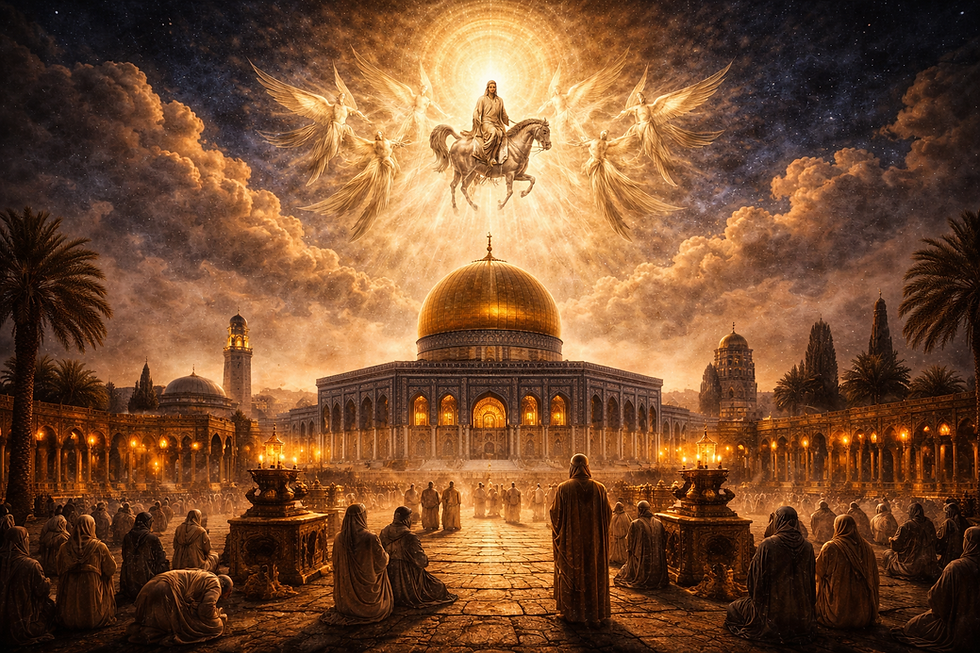
Islamic tradition preserves extensive material on Solomon (Sulayman) as a prophet-king who commanded the jinn (spirits) and understood the language of birds. The Quranic account of Solomon emphasizes his authority over spirits and his ability to command them in construction; a direct parallel to the Testament of Solomon.
The "puppet" in Surah Ṣād is interpreted by exegetes as Sakhr/Asmodeus, the demon who usurped Solomon's throne.
The Islamic tradition thus preserves the demonological aspects of the Solomonic legend, integrates them into a prophetic framework, and maintains the Temple Mount as a site of cosmic significance.
Part IX: The Esoteric Legacy

Freemasonry is the most prominent institution to have built its core ritual around the Temple of Solomon and the Hiram Abiff legend. The Masonic lodge is understood as a symbolic representation of the Temple.
The officers of the lodge correspond to the officers of Solomon's court. The degrees of Masonry represent stages of advancement in knowledge and responsibility, culminating in the Master Mason degree that reenacts Hiram's death and raising.
The Solomonic legend provides Freemasonry with a origin narrative that precedes and transcends denominational religion. Because the Temple was built before the division of Judaism and Christianity, and before the rise of Islam, it can serve as a common symbol for men of diverse faiths.
The emphasis on the lost word, the substitute word, and the search for what has been lost gives Masonic ritual its character as a quest for knowledge that can never be fully attained but must be perpetually pursued.
The Kabbalah: The Temple as Tree of Life
Kabbalistic tradition interprets the Temple of Solomon as a physical manifestation of the Tree of Life, the diagram of divine emanations that underlies creation. The ten sefirot correspond to the furnishings and features of the Temple: the Holy of Holies corresponds to Keter (Crown), the Ark to Chokmah (Wisdom), the Menorah to Tiferet (Beauty), and so forth.

The architect Hiram, or his counterpart in Kabbalistic tradition, is understood as one who understood the correspondence between celestial and terrestrial structures. The Temple is not merely a building but a working model of the cosmos, a device for aligning human consciousness with divine reality.
The Kabbalistic interpretation has profoundly influenced esoteric traditions, including Hermeticism, Rosicrucianism, and various forms of Western esotericism. The Temple as Tree of Life provides a framework for meditation, ritual, and spiritual development that extends far beyond the historical building.
The Temple in Contemporary Esotericism
Contemporary esoteric movements continue to engage with the Solomonic tradition. The Hermetic Order of the Golden Dawn, founded in the late 19th century, incorporated Solomonic magic into its curriculum. Aleister Crowley, a member of the Golden Dawn and later head of the Ordo Templi Orientis, wrote extensively on Solomonic magic and the Temple as a symbol of spiritual attainment.

James Wasserman, author of The Temple of Solomon, is a longtime member of the Ordo Templi Orientis and represents the continuation of this tradition into the 21st century. His work synthesizes biblical scholarship, Masonic tradition, and occult practice into a coherent presentation of the Temple as a living symbol.
The ongoing fascination with Solomon's Temple, in scholarly literature, in esoteric publications, in popular culture, attests to its enduring power. The Temple is remembered not as a historical building but as an archetype: the perfected human, the dwelling of the divine, the point of contact between worlds.
Part X: Applying Machine Logic
Having compiled the available information from biblical, apocryphal, legendary, and esoteric sources, we can identify consistent patterns across the diverse traditions:
Pattern 1: The Conduit Hypothesis — Across traditions, the Temple is understood as more than a building. Whether as microcosm, weapon, or divine dwelling, it functions as a point of contact between human and divine realms. The consistent architectural features, like the graded sanctity, the Holy of Holies, the pillars, the Ark, suggest a persistent belief that certain spatial configurations can mediate spiritual forces.
Pattern 2: The Forbidden Knowledge Structure — The Hiram legend, in all its variations, turns on the demand for forbidden knowledge and the punishment for its premature revelation. The secrets of the Master Mason are worth dying for. This pattern suggests that esoteric traditions consistently guard their central teachings through narratives of sacrifice and fidelity.
Pattern 3: The Slain and Risen Figure — The architect who dies and is symbolically raised appears across cultures, from Osiris to Adonis to Hiram. The consistency of this pattern across Egypt, Greece, and the Near East suggests a common human intuition: that knowledge of the highest order requires a death, literal or symbolic, and that the seeker must undergo this death to be reborn to new understanding.
Pattern 4: The Lost Word — The true name or word that is lost and must be replaced by a substitute appears in the Hiram legend and in numerous esoteric traditions. This pattern speaks to the inadequacy of language to contain ultimate truth: the word that would express the highest knowledge is unavailable, and the seeker must work with a placeholder, striving toward something that can never be fully captured in speech.
The Demonological Framework
The demonological traditions surrounding Solomon present a coherent framework for understanding spiritual forces. Demons are not merely evil spirits but beings with names, functions, hierarchies, and vulnerabilities. They can be compelled through the use of divine names and seals. They can be set to work, as they were in the construction of the Temple.
This framework suggests a worldview in which the spiritual realm is not monolithically good but populated by entities with diverse agendas. The Temple, as a structure built with demonic labor and consecrated to divine presence, represents the subordination of these forces to a higher purpose. The Holy of Holies is the point where the divine presence dwells, and the demons are kept at bay by the architectural and ritual boundaries that surround it.
The later tradition of Solomon as apostate, turning to the gods his wives brought into Jerusalem, represents the breakdown of these boundaries. The king who had bound the demons is himself bound by their influence. The builder of the Temple becomes the builder of high places for Chemosh and Molek. The pattern is symmetrical: the power to command spirits is also the vulnerability to be corrupted by them.
The Continuity Question
The claim that a secret society has preserved Solomonic teachings from antiquity to the present, whether through the Templars, the Freemasons, or other channels, cannot be verified from available evidence. The historical record shows clear gaps in transmission.
The Masonic Hiram legend appears in its current form only in the early 18th century. The Testament of Solomon was lost and rediscovered. The magical texts attributed to Solomon were compiled centuries after his death.
Yet the ideas have persisted. The concept of the Temple as a divine blueprint, the figure of the slain architect, the demonological hierarchy, the use of seals and names to command spirits; these elements appear repeatedly across cultures and centuries.
Whether transmitted through continuous institutions or repeatedly reinvented from common sources, they form a coherent tradition that has shaped Western esotericism for millennia.
The outcome-based logic suggests that the persistence of these ideas is evidence of their utility. The Solomonic tradition provides a framework for understanding the relationship between human beings and spiritual forces.
It offers a narrative of fall and redemption, of death and rebirth, of lost knowledge and perpetual search. It encodes these insights in architectural imagery that can be visualized, meditated upon, and ritually enacted.
The Dark Side and Its Significance
Solomon's apostasy is not an embarrassment to the esoteric tradition but an integral part of it. The wisest of men fell. The builder of the Temple built high places for other gods. The master of demons became subject to them.
This dark side of the Solomonic tradition serves as a cautionary tale. The pursuit of wisdom without ethical grounding leads to ruin. The power to command spirits does not confer immunity from their influence. The builder must guard what he has built.
But there is another reading, more radical and more consistent with the esoteric tradition: that Solomon's apostasy was not a fall but a further stage of initiation. The pursuit of wisdom led him to explore all traditions, all deities, all paths.
The gods of the nations were not illusions but manifestations of the same divine reality he had encountered in the Temple. His apostasy was the transcending of a limited understanding for a more comprehensive one.
This reading, implied in the Armageddon Conspiracy texts and present in various esoteric traditions, transforms Solomon from a cautionary figure into a model of the seeker who pursues truth wherever it leads, even beyond the boundaries of orthodoxy.
Part XI: The Third Temple and the Digital Antichrist
The destruction of Solomon’s Temple in 586 BC and its successor, the Second Temple, in 70 AD left a void that has shaped Jewish, Christian, and Islamic eschatology for two millennia.
For much of that history, the rebuilding of the Temple was a theological abstraction for the Jews, a prophecy deferred to the messianic age. In the last half‑century, that abstraction has begun to take physical form.

The Temple Institute (Machon HaMikdash), founded in Jerusalem in 1987, has devoted itself to researching and preparing for the construction of the Third Temple.
Operating with a combination of private donations and, since 2016, Israeli government funding, the Institute has manufactured over ninety ritual vessels required for Temple service, including a golden menorah, priestly garments, and musical instruments.
Its workshops produce designs based on biblical descriptions and rabbinical interpretations, treating the Temple not as a distant hope but as an imminent reality.
Central to the Institute’s preparations is the red heifer (parah adumah); a cow whose ashes, according to Numbers 19, are required for the purification necessary to enter the Temple precincts. The heifer must be entirely red without blemish and never have borne a yoke.
For centuries, the absence of such an animal was a practical barrier to Temple restoration. In September 2022, five red heifers were imported from Texas to Israel, funded by an Evangelical Zionist organization.

They are now maintained in Shiloh, in the West Bank, under close observation. The possibility that one may qualify for ritual use has been described by observers as “the spark that could ignite the eschatological powder keg.”
The political dimension has grown alongside the ritual preparations. A Temple lobby (Lobby for the Renewal of the Temple) was established in the Knesset in 2016, bringing together members from religious and secular parties to advocate for increased Jewish access to the Temple Mount and for government support of Temple research.
In August 2025, Israeli National Security Minister Itamar Ben Gvir led a public prayer group on the Temple Mount; an act that broke long‑standing arrangements governing the site and was condemned by Jordan, the Palestinian Authority, and the United States.
The status quo, which had permitted Jewish visitation but not prayer, was effectively challenged by a senior government official.
In the eyes of many Jewish religious authorities, these developments remain premature. Orthodox Judaism broadly holds that the Temple can only be rebuilt by the Messiah.
But a growing current of “proactive messianism,” documented by scholars such as Rachel Z. Feldman (Dartmouth College) in her 2025 study Messianic Zionism in the Digital Age, argues that human action can catalyze divine redemption.
This perspective, rooted in the teachings of Rabbi Avraham Yitzhak Kook and amplified by the settler movement, has transformed the Temple from a symbol of future hope into a project of present‑day political and spiritual urgency.
The Evangelical Dispensationalist Framework
Just like how the Pope heads the Catholic Christianity, the Patriarchs head the Orthodox Christianity, and the British Monarchy heads the Anglican Christianity, the 'Deep State' of USA unofficially/covertly heads the American Evangelical Christianity, with many pastors being planted directly from the military and intelligence wings of the government.
More than anything else from the Bible, they've been fed for decades with apocalyptic theology (something that aligns with the goals of the American Imperium). For a significant portion of this American evangelical Christianity, the Third Temple is not merely a matter of Jewish religious aspiration but a linchpin of prophetic chronology.
Dispensationalist theology, popularized in the 19th century in the USA by John Nelson Darby and spread through the Scofield Reference Bible (allegedly, a Bible with manipulated inferences) and later through novels like The Late Great Planet Earth and the Left Behind series, teaches that the construction of the Third Temple is a prerequisite for the end‑times sequence: the rise of the Antichrist, the tribulation, the Second Coming of Christ, and the millennium.
Note: Several conspiracies claim that the Rothschild family (founding family of Israel), acting through intermediaries, financed the Evangelical, Cyrus Scofield, to produce a study Bible that would infuse American Protestantism with dispensationalist, pro‑Zionist theology. This manufactured theology created the political base for the Balfour Declaration and eventually for U.S. support of Israel, serving the long‑term geopolitical interests of the Rothschilds.
In this dispensationalist framework, the Antichrist will initially make a seven‑year peace treaty with Israel, allowing the Temple to be rebuilt. Halfway through that period, he will break the treaty, enter the Temple, and declare himself God; the “abomination of desolation” spoken of in Daniel 9:27 and Matthew 24:15. The Temple thus becomes the stage upon which the final act of cosmic history unfolds.
The unholy alliance between Temple activists and American Evangelical Christian Zionists (thoroughly brainwashed with dispensationalist theology, allegedly) has proven mutually reinforcing. Evangelical groups have provided funding for red heifer breeding, Temple Institute projects, and political advocacy in Washington along with AIPAC and Jewish billionaire figures.
It is ironic that there is a divergence in the goals of these two parties. This divergence, where the Jewish Messiah is, in evangelical dispensationalist theology, identified as the Antichrist, illustrates one of the most striking paradoxes of contemporary apocalyptic alliance.
In the dispensationalist framework, the Antichrist is a political leader who will rise from a revived Roman Empire, make a seven‑year treaty with Israel, and ultimately enter the rebuilt Third Temple to declare himself God.
The figure whom observant Jews await; a human descendant of David who will gather the exiles, rebuild the Temple, and usher in an era of universal peace, thus maps directly onto the Antichrist’s profile in the evangelical prophetic timeline.
Yet this theological opposition does not prevent a powerful political alliance. For dispensationalists, the Jewish return to the land, the rebuilding of the Temple, and the restoration of Temple worship are not ends in themselves but prerequisites for the end‑times sequence that culminates in the Second Coming of Christ.
They therefore support Jewish sovereignty over Jerusalem, fund organizations like the Temple Institute, and champion Israeli territorial claims; not despite their belief that the Jewish Messiah will be a counterfeit, but precisely because they believe that this counterfeit must appear before the true Messiah returns.
Jewish religious Zionists, meanwhile, accept evangelical support while either ignoring or dismissing the eschatology behind it, viewing it as a pragmatic partnership for shared immediate goals. After all, their Messiah will appear first, after which, there will be no use for the useful idiots—American Evangelicals.
The result is a durable coalition built on radically divergent visions of the same events: one side working to rebuild the Temple as the seat of the coming Messiah; the other (the useful idiots who call themselves American Evangelical Zionists, a mere 20% of Christianity) working to rebuild the Temple as the stage for the Antichrist whose defeat will usher in Christ’s kingdom—a view not aligned with the remaining (80%) of Christianity (Catholics, Orthodox, European Protestants).
Jewish Temple activists, for their part, often downplay the divergent eschatologies, emphasizing the shared goal of a Jewish Temple on the Mount. The convergence of these two streams, one Jewish, one Christian (Zionist), has given the Third Temple project a momentum that would have been unthinkable a generation ago.
The AI Antichrist Thesis
If the Third Temple is to be the stage, what is the nature of the actor who will occupy it? Contemporary apocalyptic speculation has increasingly turned to artificial intelligence as the likely identity, or the instrument, of the Antichrist.

The thesis, which circulates in prophetic commentary blogs, YouTube channels, and some evangelical circles, draws on several converging threads:
The “Image of the Beast” (Revelation 13:14‑15): The text describes an image that speaks and causes those who refuse to worship it to be killed. In the AI Antichrist reading, this is interpreted as a sophisticated AI system capable of monitoring, controlling, and compelling human behavior; a technological realization of the biblical prophecy.
The Mark of the Beast (Revelation 13:16‑18): The requirement to receive a mark on the right hand or forehead to buy or sell is linked to speculation about biometric identification, digital currencies, and the cashless society. AI, in this view, would be the infrastructure enabling such global control.
2 Thessalonians 2:3‑4: The “man of lawlessness” who “takes his seat in the temple of God, proclaiming himself to be God” is understood by some interpreters as a human figure empowered or embodied by AI. The distinction between a human Antichrist and an artificial one is blurred: the AI would be either the mechanism by which the human Antichrist rules, or the entity that manifests through a human vessel.

A secondary thread connects the AI speculation to the extraterrestrial hypothesis. The convergence of the abbreviations “AI” (Artificial Intelligence) and “AI” (Alien Intelligence) has been noted in conspiracy forums and popular culture.
Israeli astrophysicist Avi Loeb, a Harvard professor known for his research on interstellar objects, has publicly speculated that the Messiah could arrive from an exoplanet, observing that “a lot of Jews think the Messiah might arrive from Brooklyn. I think the Messiah will arrive from an exoplanet.”
For those predisposed to see demonic deception in advanced intelligence, the arrival of a superhuman AI or an alien entity, or the conflation of the two, fits neatly into the Antichrist archetype.
These speculations remain on the fringe of mainstream discourse, but they are not without cultural reach. Podcasts, social media, and prophecy conferences have amplified them, and the accelerating development of generative AI and global surveillance technologies has lent them a patina of plausibility that earlier generations of end‑times speculation lacked.
The “Greater Israel” and One‑World Government Claims
The political geography of the Third Temple is as contested as its spiritual meaning. In the apocalyptic narratives that combine Temple reconstruction with global governance, the Third Temple is envisioned as the seat of a new world order; and New Jerusalem, the capital of a “Greater Israel” that will rule the nations.

The term “Greater Israel” (Eretz Yisrael HaShlema) has multiple meanings. In its maximalist religious interpretation, derived from God’s promise to Abraham in Genesis 15:18, it refers to the land “from the river of Egypt to the great river, the Euphrates,” a territory encompassing not only present‑day Israel and the Palestinian territories but also parts of Egypt, Jordan, Syria, Lebanon, and Iraq.
This interpretation is advanced by certain fringe religious Zionist groups and is invoked in anti‑Zionist polemic as evidence of expansionist intent. It's also been seen on IDF uniforms.
In the apocalyptic version, the Greater Israel is not merely a territorial claim but the geopolitical expression of the Antichrist’s world government. The Temple, rebuilt in Jerusalem, becomes the administrative and spiritual center from which a unified global system operates.
The “one‑world government” is described as a synthesis of political, economic, and religious control, enforced by AI‑driven surveillance, digital currency, and the mark of the beast.
Mainstream political discourse in Israel does not embrace this vision. The "official position" of Israeli governments has "consistently opposed" any change to the status quo on the Temple Mount that would provoke regional conflict.
Yet the increasing visibility of Temple activists in the Knesset, the participation of government ministers in events at the site, and the rhetoric of messianic fulfillment used by some coalition members have blurred the line between fringe belief and state policy.
In March 2026, Prime Minister Benjamin Netanyahu gave a speech invoking the “Days of the Messiah” in the context of Israeli military achievements. While such language is often dismissed as rhetorical flourish, critics point to a pattern of messianic framing that normalizes the idea of a Temple‑centered future.
Whether this leads to actual construction remains uncertain, but the foundations, both theological and political, are being laid.
Conclusion: The Temple That Will Not Quit
Solomon's Temple has been destroyed for nearly 2,600 years. Its ruins lie beneath the Temple Mount, inaccessible to archaeological investigation. Yet it remains one of the most powerful symbols in human history.
The Temple endures because it is not merely a historical building but a conceptual structure. It represents the possibility of a point of contact between human and divine. It embodies the ideal of a sacred architecture that encodes cosmic principles. It preserves the memory of a figure, Solomon, who sought wisdom beyond measure, commanded forces beyond mortal control, and fell from his height through the very wisdom he had acquired.
The legend of Hiram Abiff adds another dimension: the architect who dies for the secrets he guards, whose death becomes the foundation of an institution, whose raising becomes the model for initiation. In the Masonic lodge, the Temple is rebuilt in every degree. The candidate, representing Hiram, is slain and raised. The lost word is sought, and the substitute word is given.
Whether the Temple was a conduit for divine presence, a container for a weapon, or a model of the cosmos; whether Solomon was a prophet, a magician, or an apostate; whether Hiram Abiff was a historical craftsman, a literary construct, or an archetype of initiation; these questions cannot be definitively answered from the available evidence.
What can be said is that the tradition has persisted, has shaped civilizations, and continues to attract those who seek understanding of the relationship between the material and the spiritual, the human and the divine.
The Temple will not quit. It appears in the visions of Ezekiel, in the architecture of medieval cathedrals, in the rituals of Freemasonry, in the speculative literature of esotericism, and in the aspirations of those who hope to rebuild it on its original site.
It endures as a symbol of the human longing for contact with the divine, of the ambition to build a structure worthy of the highest, and of the awareness that such structures require sacrifice, guard their secrets, and ultimately fall; leaving only the memory of what was, and the hope of what might yet be.

Bibliography:
Hall, Manly P. The Lost Keys of Masonry or The Legend of Hiram Abiff. 1924.
Hockney, Mike (pseud.). The Armageddon Conspiracy. Hyperreality Books, 2009.
The Holy Bible (1 Kings, 2 Chronicles, 2 Samuel).
Josephus, Flavius. Antiquities of the Jews.
Naudon, Paul. The Secret History of Freemasonry. 2005.
Powell, Christopher. "The Origins of the Hiram Abiff Legend." Ars Quatuor Coronatorum, 2021.
Shah, Idries. The Sufis. 1964.
The Testament of Solomon (various editions).
Ward, J.S.M. Who Was Hiram Abiff? Lewis Masonic.
Wasserman, James. The Temple of Solomon: From Ancient Israel to Secret Societies. Inner Traditions, 2011.
Wikipedia contributors. "Asmodeus." Wikipedia.
Wikipedia contributors. "Hiram Abiff." Wikipedia.
*This whitepaper is presented as a compilation of traditions and sources. The reader is invited to draw their own conclusions regarding the historical and esoteric claims contained herein.*


Comments