
.png)

Ancient Texts: Kautilya's Arthashastra - Chapters 6-10 (Part 2 of Book 2)
- A. Royden D'Souza

- May 13
- 84 min read
The first five chapters of Book II built the skeleton of the administrative state. They established the village as the basic unit of settlement, divided the land into designated zones, fortified the capital with walls and ditches, planned the internal streets on a rational grid, and constructed the treasury complex with its underground vaults and rain gauges. These were the bones of the kingdom; the physical infrastructure that made governance possible.
Chapters 6 through 10 of Arthashastra shift focus from infrastructure to process. The state is no longer a set of buildings and boundaries; it is a living organism that must be fed, funded, and regulated. Kautilya turns his attention to the core economic functions that sustain the kingdom: the collection and accounting of revenue, the maintenance of accurate records, the auditing of government accounts, the recovery of embezzled funds, and the inspection of the officers who carry out these tasks. If the first five chapters were about where the state operates, these chapters are about how the state knows what it has, what it owes, and what it is owed.

The chapter on the Collector-General (Chapter 6) establishes the revenue machinery—the division of the kingdom into collection districts, the classification of revenue sources, and the detailed schedule of taxes, duties, and state monopolies.
The chapter on keeping accounts (Chapter 7) prescribes the format of government ledgers, the recording of receipts and expenditures, and the severe penalties for falsification. The chapter on auditing (Chapter 8) creates the internal check; the independent examination of all government accounts to detect fraud before it metastasizes.
The chapter on the recovery of revenue (Chapter 9) details the escalating measures against defaulters, from persuasion to fines to imprisonment. And the chapter on the inspection of officers (Chapter 10) closes the loop, subjecting every superintendent and clerk to the same surveillance and accountability that Book I applied to ministers.
Kautilya reveals himself in these chapters as the founder of forensic accounting. He understands, centuries before double-entry bookkeeping was formalized, that the state's financial integrity depends on a chain of custody for every coin from collection to disbursement, on independent verification of every balance sheet, and on punishment so predictable and severe that the temptation to steal is overwhelmed by the certainty of consequences.
The superintendents of these chapters are not glamorous figures. They do not command armies or negotiate treaties. They are accountants, auditors, tax-collectors, and clerks. But without them, the elephants of Dandakaranya go unfed, the crocodile ditches of Kūrmapura go unrepaired, and the treasury vaults go empty. They are the circulatory system of the tortoise, the silent channels through which the kingdom's lifeblood flows.
Book II of Arthashastra: Duties of Government Superintendents (Adhyakshaprachara)
The second book, Adhyakshaprachara (अध्यक्षप्रचार), is a dramatic shift in focus. It translates to "The Activity of Superintendents" or "The Conduct of Superintendents." It builds the machinery through which the king's disciplined will reaches every corner of the empire. Its central argument is that a king, however wise and self-controlled, cannot govern alone; he must appoint, direct, and monitor a professional civil service of superintendents (adhyakshas) who manage the kingdom's economic life.
The book's 36 chapters provide a comprehensive blueprint for the administration of agriculture, mining, trade, taxation, forests, mines, manufactories, weights and measures, tolls, and the entire material foundation on which the state rests.

Chapter VI: The Business of Collection of Revenue by the Collector-General
The Collector-General (Samāhartā) shall attend to the collection of revenue from seven heads: forts (durga), country-parts (rāṣṭra), mines (khani), buildings and gardens (setu), forests (vana), herds of cattle (vraja), and roads of traffic (vaṇikpatha).
Each head encompasses a vast range of specific revenue sources. Forts include tolls, fines, weights and measures, the town-clerk's office, the superintendent of coinage, the superintendent of seals and passports, liquor, slaughter of animals, threads, oils, ghee, sugar, the state-goldsmith, the warehouse of merchandise, prostitutes, gambling, building sites, the corporation of artisans and handicrafts-men, the superintendent of temples, and taxes collected at the gates and from certain people known as Bāhirikas.
Country-parts include produce from crown-lands (sīta), the portion of produce payable to the government (bhāga), religious taxes (bali), taxes paid in money (kara), merchants, the superintendent of rivers, ferries, boats, and ships, towns, pasture grounds, road-cess (vartanī), ropes (rajjū), and ropes to bind thieves (chorarajjū).
Mines include gold, silver, diamonds, gems, pearls, corals, conch-shells, metals (loha), salt, and other minerals extracted from plains and mountain slopes.
Buildings and gardens (setu) include flower-gardens, fruit-gardens, vegetable-gardens, wet fields, and fields where crops are grown by sowing roots for seeds (mūlavāpāḥ—sugar-cane and similar crops).
Forests include game-forests, timber-forests, and elephant-forests. Herds include cows, buffaloes, goats, sheep, asses, camels, horses, and mules. Roads of traffic include land and water ways. All these form the body of income (āyaśarīram).
The several forms of revenue are capital (mūla), share (bhāga), premia (vyājī), parigha, fixed taxes (klṛpta), premia on coins (rūpika), and fixed fines (atyaya). These are the mouths from which income issues (āyamukha).
The body of expenditure (vyayaśarīram) includes the chanting of auspicious hymns during worship of gods and ancestors and on the occasion of giving gifts, the harem, the kitchen, the establishment of messengers, the store-house, the armoury, the warehouse, the store-house of raw materials, manufactories (karmānta), free labourers (viṣṭi), maintenance of infantry, cavalry, chariots, and elephants, herds of cows, the museum of beasts, deer, birds, and snakes, and the storage of firewood and fodder.
The divisions of time for accounting are the royal year, the month, the pakṣa (fortnight), the day, the dawn, the third and seventh pakṣas of the three seasons (the rainy season, the winter season, and the summer)—short of their days, the rest complete—and a separate intercalary month.
The Collector-General shall attend to the work in hand (karaṇīya), the work accomplished (siddham), part of a work in hand (śeṣa), receipts, expenditure, and net balance.
Work in hand constitutes the business of upkeeping the government (saṁsthānam), the routine work (prachāraḥ), the collection of necessaries of life, and the collection and audit of all kinds of revenue.
Work accomplished constitutes that which has been credited to the treasury; that which has been taken by the king; that which has been spent in connection with the capital city but not entered into the register or continued from the year before last; and the royal command dictated or orally intimated to be entered into the register.
Part of a work in hand which may be of little or no value includes preparation of plans for profitable works, balance of fines due, demand for arrears of revenue kept in abeyance, and examination of accounts.
Receipts are of three kinds: current (vartamāna)—what is received day after day; last balance (paryuṣita)—whatever has been brought forward from the year before last, whatever is in the hands of others, and whatever has changed hands; and accidental (anyajātaḥ)—whatever has been lost and forgotten by others, fines levied from government servants, marginal revenue (pārśva), compensation levied for any damage (pārihīṇikam), presentations to the king, the property of those who have fallen victims to epidemics leaving no sons, and treasure-troves.
The means to check expenditure (vyayapratyayaḥ) are investment of capital (vikṣepa), the relics of a wrecked undertaking, and the savings from an estimated outlay. The rise in price of merchandise due to the use of different weights and measures in selling is termed vyājī; the enhancement of price due to bidding among buyers is also another source of profit.
Expenditure is of two kinds: daily expenditure (what is continued every day) and profitable expenditure (whatever is earned once in a pakṣa, a month, or a year). Whatever is spent on these two heads is termed daily expenditure and profitable expenditure respectively.
That which remains after deducting all the expenditure already incurred and excluding all revenue to be realized is the net balance (nīvi), which may have been either just realized or brought forward.
Thus a wise Collector-General shall conduct the work of revenue-collection, increasing the income and decreasing the expenditure.
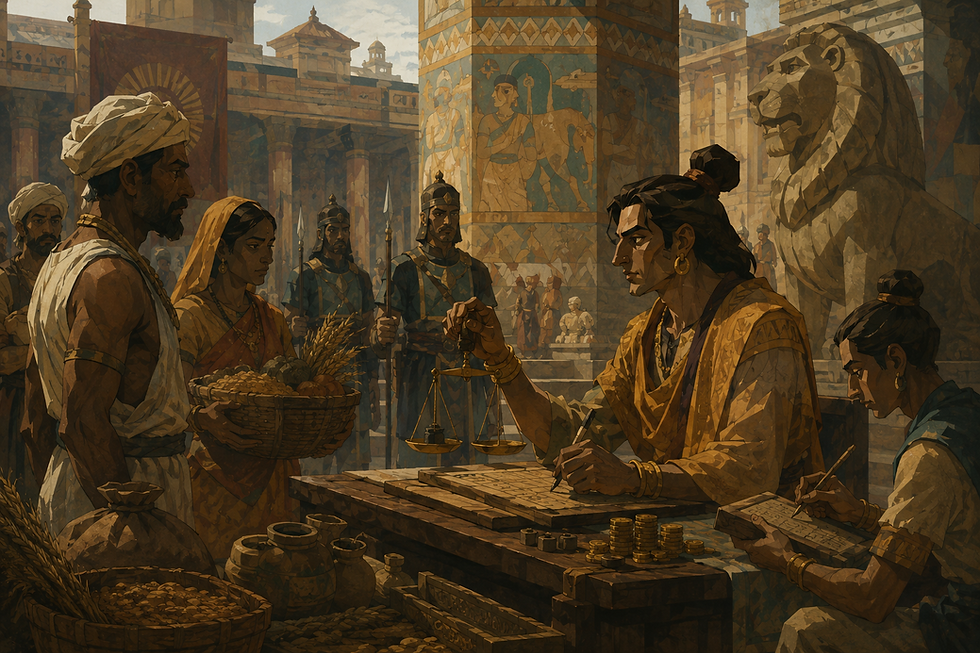
In Simple Terms
The main ideas from this chapter can be understood in these simple points:
The Kingdom's Revenue Map | Seven Heads: The Collector-General is the chief financial officer of the entire kingdom. His domain is not a single tax but seven distinct categories of revenue, covering every possible economic activity. These seven heads are not just a list; they are a complete map of the kingdom's productive capacity. Nothing that generates value is left untaxed or unaccounted for.
Forts (urban revenue): Everything within city walls; tolls, fines, weights and measures, liquor, gambling, prostitution, building sites, artisan guilds, even the state goldsmith. The city is a revenue engine.
Country-parts (rural revenue): Crown lands, the king's share of crops, religious taxes, merchant taxes, ferries, boats, ships, roads, pasture, even the ropes used to bind thieves. The countryside is a vast productive asset.
Mines: Gold, silver, gems, pearls, salt, metals. Extractive wealth.
Buildings and Gardens: Flower, fruit, and vegetable gardens, wet rice fields, sugarcane. Cultivated plant wealth.
Forests: Game, timber, elephants. Natural resource wealth, with elephants being a strategic military asset in addition to a revenue source.
Herds: Cows, buffaloes, goats, sheep, asses, camels, horses, mules. Livestock wealth.
Roads of Traffic: Land and water trade routes. The arteries through which all other wealth flows.
Revenue Comes in Seven Forms: Beyond the sources of revenue, Kautilya classifies the forms in which it arrives: capital, shares, premia (transaction fees), fixed taxes, fixed fines, coinage premia, and parigha (a type of surcharge).
This is a multi-layered taxation system: the king does not just take a flat share of the harvest; he collects fees at every stage of economic activity, from production to transport to sale.
Expenditure | Every Outflow Is Tracked: The kingdom's expenditure is equally comprehensive and detailed. It includes everything from the harem and the royal kitchen to the army, the elephants, the messenger service, the manufactories, and even the museum of beasts.
Storage of firewood and fodder is a line item. Nothing is too small or too obvious to be recorded. The implicit rule is: if the treasury pays for it, it must appear in the accounts.
Time Is Money, and Time Is Standardized: Kautilya provides a complete calendar for accounting: the year, the month, the fortnight, the day, even the dawn. The three seasons—rainy, winter, summer—are each divided into seven pakṣas, with specific days deducted and the rest complete.
An intercalary month is added to keep the calendar aligned. This is not academic; it is operational. Tax deadlines, harvest projections, and expenditure reports all depend on a shared, precise understanding of time.
The Three Buckets of Work: Everything the government does falls into one of three categories: work in hand (ongoing operations), work accomplished (completed transactions), and part of work in hand (residual tasks like examining accounts or chasing arrears). This is a project management dashboard.
Receipts | Current, Last Balance, and Accidental: Income arrives in three streams. Current receipts are the daily inflow. Last balance is what was carried over from previous accounting periods. Accidental receipts are windfalls: lost property recovered, fines from corrupt officials, treasure-troves, the estates of those who died without heirs during epidemics. The Collector-General must track all three.
Profit from Weights, Measures, and Bidding: Two clever revenue enhancers, vyājī is a premium earned by the state when it sells goods using slightly adjusted weights and measures (a built-in surcharge). Bidding among buyers for state goods drives prices up, earning the state more than a fixed sale price. Both are legal, transparent mechanisms for maximizing revenue without raising tax rates.
Expenditure Checks | Capital, Wreckage, and Savings: The three means to check expenditure are remarkably modern. Investment of capital is a sunk cost that must be justified by future returns. The "relics of a wrecked undertaking" is an ancient salvage rule: when a state project fails, whatever can be recovered counts against the expenditure. Savings from estimated outlay is the principle that coming in under budget is a form of revenue.
The Daily vs. Profitable Distinction: Kautilya splits expenditure into two types: daily (recurring operational costs) and profitable (investments that generate returns). The distinction is fundamental to any budget. A wise Collector-General expands profitable expenditure and tightens daily expenditure.
Net Balance | The Bottom Line: The net balance is what remains after all expenditure is deducted and all revenue not yet realized is excluded. It is the kingdom's true financial position; the number the Collector-General must know without hesitation.
The Ultimate Goal | Increase Income, Decrease Expenditure: The chapter's final instruction is its simplest and most profound. The Collector-General's job is not merely to collect and spend. It is to continuously widen the gap between income and expenditure, generating surplus for the treasury, the army, the stores, and the king.
Case Study: An Ancient King's Application
Raja Todar Mal, the finance minister under Emperor Akbar (r. 1556–1605), represents the Kautilyan Collector-General operating at the peak of his powers. Todar Mal's revenue system, known as the Zabt or Dahsala system, organized the Mughal Empire's finances according to principles that would have been deeply familiar to Kautilya.
The Zabt system divided the empire into revenue circles, each with standardized measurements of land, soil quality, and crop yields. Todar Mal's innovation was to base tax rates on a ten-year average of crop prices and yields, rather than annual assessments.
This provided the predictability that Kautilya's standardized time divisions and accounting categories were designed to achieve. Every field was classified, every crop recorded, every payment tracked.
Todar Mal's revenue sources matched Kautilya's seven heads almost exactly. Urban revenue (forts) came from tolls, market fees, and artisan taxes. Rural revenue (country-parts) came from the land tax and from crown lands directly cultivated by the state.
Mines yielded precious metals and gems. Forest produce and elephant forests were state monopolies. Herds and trade routes were taxed. The Mughal revenue manual, the Dastur-ul-Amal, specified forms, rates, and procedures for every category of income.
The expenditure side was equally meticulous. The Ain-i-Akbari, the administrative encyclopedia compiled by Abul Fazl, records the salaries of every officer, the maintenance costs of the army and the royal household, the expenses of the harem and the kitchen, the stables, the elephant corps, and the messenger service; every item on Kautilya's list.
Todar Mal insisted on separating daily expenditure from investment expenditure, and he was known for his relentless scrutiny of "part of work in hand"; the residual accounts, arrears, and fines that less disciplined administrators would have written off.
Todar Mal's most famous quality was his mastery of the net balance. He could, it was said, recite the revenue and expenditure of every province from memory, calculate the net yield, and identify discrepancies without consulting a ledger.
When questioned by Akbar, he could point out without hesitation the exact amount remaining after all expenses had been met; the Kautilyan nīvi. His reputation for incorruptibility and precision made him the standard against which all subsequent Mughal revenue officers were measured.
Takeaway
For Political Leaders: Kautilya's chapter on the Collector-General is a charter for public financial management that remains startlingly relevant.
The division of all government revenue into seven comprehensive heads—urban, rural, extractive, agricultural, natural, pastoral, and commercial—is a model for a modern national budget structured around economic sectors rather than merely departmental silos.
The insistence that every possible source of income, from mining royalties to gambling licenses, be identified, measured, and collected ensures that no revenue leaks through bureaucratic neglect.
The threefold classification of receipts (current, carried-forward, and windfall) is the foundation of transparent public accounting, preventing the concealment of one-time revenues as recurring income.
The distinction between daily and profitable expenditure maps directly to modern budgeting concepts of operating versus capital expenditure, and the warning that profitable expenditure should be expanded while daily expenditure is tightened is the basic logic of fiscal responsibility.
Most critically, the chapter's final command—increase income and decrease expenditure—is the eternal mandate of government, too often forgotten in cycles of deficit spending. The Collector-General who cannot state the net balance without hesitation is a minister who should not hold office.
For Corporate Leaders: The Collector-General's domain is the corporate finance function in its widest sense. The seven revenue heads are a model for a diversified revenue portfolio: a company that relies on a single income stream is as fragile as a kingdom that taxes only farms.
The classification of receipts into current, carried-forward, and windfall prevents the dangerous practice of treating one-time gains (asset sales, legal settlements, currency fluctuations) as recurring earnings.
The meticulous breakdown of expenditure—from the CEO's office (the harem) to the IT infrastructure (the armoury), from R&D (manufactories) to raw material storage—is a template for a detailed chart of accounts.
The distinction between daily and profitable expenditure is the fundamental distinction between operating expenses and capital investment, and Kautilya's insistence that the latter be expanded while the former is tightened is the logic of productivity gains.
The three types of work—in hand, accomplished, and residual—provide a simple project-tracking framework applicable to any organization. The vyājī premium on state sales is the ancestor of every transaction fee, service charge, and margin that modern businesses build into their pricing.
And the final command, the Collector-General must be able to state the net balance without hesitation, is the test of a truly competent CFO: not someone who relies on a spreadsheet, but someone who understands the financial position so deeply that it lives in their bones.
Kanchi, the Royal Palace – The Samaharta's Office, Early Morning Gajakesha sat alone, the morning light slanting through the high windows, a single oil lamp still burning beside him. Before him lay not the grand ledger of quarterly reviews but a much smaller, more troubling document: a palm-leaf report from the eastern delta, delivered by a mud-spattered messenger an hour before dawn. The news was grim. The late monsoon had not merely reduced the rice harvest; it had broken the irrigation canals in two districts. The village of Vrishabhavati, a settlement of three hundred families established only a decade ago, was facing a lean season. The headman had written, in a script that wavered with anxiety, that the villagers had already begun eating their seed-grain. If the king did not remit taxes and provide a grain subsidy, Vrishabhavati would be empty by winter; its people scattered to beg in the cities or to work in the mines. Gajakesha had already calculated the cost of the subsidy: two thousand silver pieces for relief grain, plus a tax remission of another eight hundred. He had also, this very week, received Rudravarma's formal request for ten additional war elephants to counter the Zarian warlord Behram's growing army. The Senapati's estimate was twelve thousand pieces over two years, with six thousand needed immediately to begin capture and training. The treasury did not contain both sums. He reached for a fresh palm-leaf and began to write, not a report, but a plan. The Council Chamber, Two Hours Later The ministers had assembled. Simhavarma, his face drawn from a night of reading intelligence reports on Zarian troop movements, sat at the table's head. Rudravarma was already standing, his hand on his sword-hilt, his impatience visible. Vamanagupta stood at the window, as silent as ever. Suryadatta the Chamberlain had brought his ledger, but he had not opened it. He was watching Gajakesha. "Vrishabhavati is starving," the king began. "I have the headman's letter. We cannot ignore it. But Behram's warlords are massing within a month's march of the northern border. Rudravarma tells me we need elephants now, not next year." "The villagers need grain, Your Majesty," Gajakesha said. "The army needs elephants. The treasury, as of this morning, has a net balance of seven thousand, eight hundred and fifty-three silver pieces after all current expenditure. The grain subsidy and tax remission for the eastern delta will cost two thousand, eight hundred. The first year of the elephant expansion will cost six thousand. Together, they exceed the balance by a thousand pieces. If we do both, we dip into the emergency reserve. If we do only one, we either let our people starve or leave our border undefended. Neither is acceptable." Rudravarma's jaw tightened. "Then what do you propose, Samaharta? A tax increase? The merchants are already grumbling about the tolls." "I propose we pay for both without raising taxes on anyone who cannot afford it." Gajakesha laid his palm-leaf plan on the table. "Three measures." He pointed to the first item. "The accidental receipts. Last month, farmers digging a well in Shalmali found a clay pot of old silver; debased coinage, bullion value four hundred pieces. And a Zarian merchant died without heirs; his property escheats to the crown, another six hundred. That is one thousand pieces that were not in the treasury a month ago. They are not current revenue; they are windfall. We use them." He slid his finger to the second item. "The workshops of the western quarter. The armourers and bamboo-mat weavers have been producing surpluses, but the state warehouse charges them a flat storage fee; a parigha, as the old texts call it. If we increase the warehouse fee by one-sixteenth on luxury goods only—perfumes, finished silks, worked ivory—and leave the fee unchanged on grain, tools, and weapons, we generate an additional five hundred pieces annually without touching the working poor. The wealthy merchants can absorb it." "And the rest?" Rudravarma asked, his voice sharp but no longer hostile. Gajakesha pointed to the third item. "The elephant expansion is not entirely 'expenditure.' Half of it—the construction of the new stockades, the training grounds, the purchase of iron chains—is capital investment. It creates assets that will generate revenue for decades. The sage who taught me called this 'profitable expenditure,' distinct from 'daily expenditure' like the palace kitchen or the temple offerings. I propose we classify six thousand pieces of the elephant cost as profitable expenditure and fund it not from the current year's revenue alone, but by issuing a three-year treasury bond to the merchant guilds of Kūrmapura. They receive four percent interest, secured against future toll revenues from the northern trade road. The guilds get a safe investment. The army gets its elephants. And the treasury pays the cost over time, not all at once." A silence fell. Then Suryadatta spoke, his voice dry as old parchment. "The vault can cover the bond payments. I have examined the projections. If the toll revenues hold, the treasury will repay the guilds within three years and still accumulate a small surplus. The bond is sound." Rudravarma stared at Gajakesha. "You are suggesting I borrow the money for my elephants?" "I am suggesting, Senapati, that the elephants will generate more revenue by protecting the trade routes that feed the tolls than they will cost. The borrowing is an investment, not a debt. The daily expenditure for the grain subsidy is a necessity we pay in full, immediately, from current revenue. The profitable expenditure for the elephants we finance so that the treasury is not bled dry in a single year." Vamanagupta, who had not spoken throughout, turned from the window. "It is a better plan than risking either famine or invasion." Simhavarma looked at the palm-leaf on the table. "The villagers of Vrishabhavati will receive their grain within a fortnight?" "The grain is already being loaded onto barges, Your Majesty. I ordered it this morning, before the council met. The tax remission will be announced by the end of the week." "And the elephants?" Rudravarma inclined his head, a gesture of respect he rarely made. "If the Samaharta can deliver the funds through this bond scheme, I will begin capturing before the monsoon turns." The king nodded. "Then do it. Gajakesha, draft the bond terms and present them to the merchant guilds. Suryadatta, prepare the vault for the grain disbursement. Rudravarma, prepare your elephant catchers." He looked down at the palm-leaf plan. "You wrote all this before the council, Samaharta." "Before dawn, Your Majesty. The messenger from Vrishabhavati arrived at the third watch. I had two hours before the council convened. It was enough." Simhavarma almost smiled. "And if I had asked you the net balance after a hundred years of such crises?" The faintest glimmer crossed Gajakesha's ink-smudged face. "If the rains are average, the Zarian sultanate remains fragmented, the merchant guilds honour their bonds, and no pestilence strikes the elephant corps; the net balance after a hundred years, Your Majesty, will be approximately eight hundred and forty thousand silver pieces. Give or take a monsoon." The king leaned back. "Approximately," he said, and the tension in the room finally broke. |

Chapter VII: Keeping Up Accounts in the Office of Accountants
The Superintendent of Accounts shall have the accountant's office constructed with its door facing either the north or the east, with seats for clerks kept apart and with shelves of account-books well arranged.
Therein the number of several departments; the description of the work carried on and of the results realised in several manufactories (karmānta); the amount of profit, loss, expenditure, delayed earnings, the amount of vyājī (premia in kind or cash) realised; the status of government agency employed, the amount of wages paid, the number of free labourers engaged (viṣṭi) pertaining to the investment of capital on any work; likewise in the case of gems and commodities of superior or inferior value, the rate of their price, the rate of their barter, the counterweights (pratimāna) used in weighing them, their number, their weight, and their cubical measure; the history of customs, professions, and transactions of countries, villages, families, and corporations; the gains in the form of gifts to the king's courtiers, their title to possess and enjoy lands, remission of taxes allowed to them, and payment of provisions and salaries to them; the gains to the wives and sons of the king in gems, lands, prerogatives, and provisions made to remedy evil portents; the treaties with, issues of ultimatum to, and payments of tribute from or to, friendly or inimical kings. All these shall be regularly entered in prescribed registers.
From these books the superintendent shall furnish the accounts as to the forms of work in hand, of works accomplished, of part of works in hand, of receipts, of expenditure, of net balance, and of tasks to be undertaken in each of the several departments.
To supervise works of high, middling, and low description, superintendents with corresponding qualifications shall be employed. The king will have to suffer in the end if he curtails the fixed amount of expenditure on profitable works.
When a man engaged by Government for any work absents himself, his sureties who conjointly received wages from the government, or his sons, brothers, wives, daughters, or servants living upon his work shall bear the loss caused to the Government.
The work of 354 days and nights is a year. Such a work shall be paid for more or less in proportion to its quantity at the end of the month, Āṣāḍha (about the middle of July). The work during the intercalary month shall be separately calculated.
A government officer, not caring to know the information gathered by espionage and neglecting to supervise the despatch of work in his own department as regulated, may occasion loss of revenue to the government owing to his ignorance, or owing to his idleness when he is too weak to endure the trouble of activity, or due to inadvertence in perceiving sound and other objects of sense, or by being timid when he is afraid of clamour, unrighteousness, and untoward results, or owing to selfish desire when he is favourably disposed towards those who are desirous to achieve their own selfish ends, or by cruelty due to anger, or by lack of dignity when he is surrounded by a host of learned and needy sycophants, or by making use of false balance, false measures, and false calculation owing to greediness.
The school of Manu hold that a fine equal to the loss of revenue and multiplied by the serial number of the circumstances of the guilt just narrated in order shall be imposed upon him.
The school of Parāśara hold that the fine in all the cases shall be eight times the amount lost. The school of Bṛhaspati say that it shall be ten times the amount. The school of Uśanas say that it shall be twenty times the amount. But Kautilya says that it shall be proportional to the guilt. Accounts shall be submitted in the month of Āṣāḍha.
When the accountants of different districts present themselves with sealed books, commodities, and net revenue, they shall all be kept apart in one place so that they cannot carry on conversation with each other. Having heard from them the totals of receipts, expenditure, and net revenue, the net amount shall be received.
By how much the superintendent of a department augments the net total of its revenue either by increasing any one of the items of its receipts or by decreasing any one of the items of expenditure, he shall be rewarded eight times that amount. But when it is reversed (i.e., when the net total is decreased), the award shall also be reversed (i.e., he shall be made to pay eight times the decrease).
Those accountants who do not present themselves in time or do not produce their account books along with the net revenue shall be fined ten times the amount due from them.
When a superintendent of accounts (kāraṇika) does not at once proceed to receive and check the accounts when the clerks (kārmika) are ready, he shall be punished with the first amercement. In the reverse case (i.e., when the clerks are not ready), the clerks shall be punished with double the first amercement.
All the ministers (mahāmātras) shall together narrate the whole of the actual accounts pertaining to each department. Whoever of these ministers or clerks is of undivided counsel or keeps himself aloof, or utters falsehood shall be punished with the highest amercement.
When an accountant has not prepared the table of daily accounts (akṛtāhorūpaharam), he may be given a month more for its preparation. After the lapse of one month he shall be fined at the rate of 200 paṇas for each month during which he delays the accounts.
If an accountant has to write only a small portion of the accounts pertaining to net revenue, he may be allowed five nights to prepare it.
Then the table of daily accounts submitted by him along with the net revenue shall be checked with reference to the regulated forms of righteous transactions and precedents and by applying such arithmetical processes as addition, subtraction, inference, and by espionage.
It shall also be verified with reference to such divisions of time as days, five nights, pakṣas, months, four-months, and the year.
The receipt shall be verified with reference to the place and time pertaining to them, the form of their collection (i.e., capital, share), the amount of the present and past produce, the person who has paid it, the person who caused its payment, the officer who fixed the amount payable, and the officer who received it.
The expenditure shall be verified with reference to the cause of the profit from any source in the place and time pertaining to each item, the amount payable, the amount paid, the person who ordered the collection, the person who remitted the same, the person who delivered it, and the person who finally received it.
Likewise the net revenue shall be verified with reference to the place, time, and source pertaining to it, its standard of fineness and quantity, and the persons who are employed to guard the deposits and magazines.
When an officer (kāraṇika) does not facilitate or prevents the execution of the king's order, or renders the receipts and expenditure otherwise than prescribed, he shall be punished with the first amercement.
Any clerk who violates or deviates from the prescribed form of writing accounts, enters what is unknown to him, or makes double or treble entries (punaruktam) shall be fined 12 paṇas. He who scrapes off the net total shall be doubly punished. He who eats it up shall be fined eight times.
He who causes loss of revenue shall not only pay a fine equal to five times the amount lost (pañchabandha), but also make good the loss. In case of uttering a lie, the punishment levied for theft shall be imposed. When an entry lost or omitted is made later or is made to appear as forgotten, but added later on recollection, the punishment shall be double the above.
The king shall forgive an offence when it is trifling, have satisfaction even when the revenue is scanty, and honour with rewards (pragraha) such of his superintendents as are of immense benefit to him.

In Simple Terms
The main ideas from this chapter can be understood in these simple points:
The Accountant's Office is a Sacred Space: The office must face north or east—the most auspicious directions—and clerks sit apart from each other. Shelves of account-books are "well arranged." The physical environment enforces discipline: no casual conversation, no chaotic piles of records. Order in the room produces order in the numbers.
Everything Is Recorded: The scope of what must be entered in the registers is staggering. It includes every department's activities, every manufactory's output, profits, losses, delayed earnings, transaction premiums, wages, free labour employed, capital investments, gem valuations, commodity prices, barter rates, weights and measures, the history of customs and transactions of whole countries and villages and families and corporations, gifts to courtiers, land grants, tax remissions, salaries, provisions for the royal family, treaties, ultimatums, and tribute payments. This is a total information system.
Work, Receipts, Expenditure, Net Balance: From these registers, the superintendent must produce the same categories we saw in Chapter 6: work in hand, works accomplished, part of works in hand, receipts, expenditure, net balance, and future tasks. The accounting framework is consistent across the entire government.
The King Must Not Starve Productive Spending: A crucial warning: if the king cuts the budget for profitable works, he will eventually suffer. Short-term savings on productive investment cause long-term damage.
Liability for Absent Workers: If a government worker absconds, his sureties (guarantors), or his sons, brothers, wives, daughters, or servants who lived off his income, must bear the loss. The state does not absorb the cost of desertion; the worker's network does. This is a powerful incentive for families and guarantors to vet workers carefully.
The Financial Year (354 Days): A standard work year is 354 days and nights, with the intercalary month calculated separately. Accounts close and payments are settled in the month of Āṣāḍha (July). This is a fixed, universal deadline.
Eight Ways Officers Cause Loss: Kautilya identifies a precise taxonomy of official failure; ignorance, idleness, sensory inadvertence (not paying attention), timidity (fear of clamour or unrighteousness), selfish desire (favouritism), cruelty (anger), lack of dignity (susceptibility to sycophants), and greed (false balances and measures). This is a psychological profile of incompetent and corrupt administration.
The Debate on Penalties: Four schools of thought debate the fine for revenue loss: Manu says it should be multiplied by a serial factor reflecting the cause; Parāśara says eight times the loss; Bṛhaspati says ten times; Uśanas says twenty times. Kautilya, characteristically, says the fine must be proportional to the actual guilt; not a rigid formula, but a judgment based on circumstances.
The Āṣāḍha Submission | Isolation and Verification: When accountants from different districts arrive with sealed books and net revenue, they are kept apart in one place so they cannot talk to each other. They are questioned individually. Their totals for receipts, expenditure, and net revenue must match their books and each other's claims. This is an ancient anti-collusion protocol.
Incentives for Performance: A superintendent who increases net revenue by raising receipts or cutting expenditure is rewarded with eight times the amount of the increase. But if net revenue decreases, he pays eight times the decrease. This is a powerful performance incentive; symmetric, predictable, and large enough to matter.
Penalties for Delay: Accountants who miss the Āṣāḍha deadline or fail to produce their books with the net revenue are fined ten times the amount due. If the superintendent of accounts delays checking when clerks are ready, he is fined the first amercement. If clerks are not ready when the superintendent is, they pay double.
Collective Accountability: All ministers together must narrate the accounts of each department. Anyone who holds back information, keeps aloof, or lies pays the highest amercement. There is no hiding behind individual secrecy; the accounts are collectively verified.
Grace Periods: An accountant who has not prepared daily account tables gets one extra month. After that, 200 paṇas per month in fines. A smaller outstanding task earns five nights' grace.
The Verification Process: The accounts are checked against regulated standards, historical precedents, arithmetic (addition, subtraction, inference), and espionage reports. They are verified across every time unit from days to years. Every receipt is traced to its place, time, form, payer, collector, and the officer who set the amount.
Every expenditure is traced to its cause, amount, payer, remitter, deliverer, and final recipient. Every net revenue figure is verified for fineness, quantity, and the guards protecting the deposits. This is a full audit trail.
Fraud Penalties: Violating the prescribed form of accounts: 12 paṇas. Scraping off the net total (erasing figures): double punishment. "Eating" the net total (embezzling): eight times the amount. Causing revenue loss: five times the loss plus restitution. Lying about accounts: the punishment for theft. Late entries disguised as forgotten items: double punishment.
The King's Mercy and Reward: The chapter ends on a humane note. The king shall forgive trifling offences, remain satisfied even with scanty revenue when times are hard, and honour superintendents who bring immense benefit. Justice is proportional. Mercy is strategic.
Case Study: An Ancient King's Application
The Maratha Empire under the Peshwas (18th century AD) developed one of the most sophisticated pre-modern accounting systems in Indian history, directly descended from the Kautilyan tradition.
The Peshwa daftar (record office) at Pune was the nerve centre of an empire that stretched across most of India, and its methods echo Chapter VII with startling precision.
The Maratha accountants, known as kārkun (a direct linguistic descendant of the Sanskrit kāraṇika), maintained elaborate registers called rokhas and jamakharchs that recorded daily receipts and expenditures for every department.
The accounts were submitted at fixed intervals, verified by independent auditors, and stored in secure archives. The physical arrangement of the daftar—clerks seated apart, shelves of ledgers precisely ordered—mirrored Kautilya's description.
The level of detail was astonishing. Every payment to a soldier, every receipt from a village headman, every expense of the royal household was recorded with the name of the payer and receiver, the date, the amount, and the officer who authorized it. This is Kautilya's verification chain in practice.
The Peshwas appointed supervisors of high, middle, and low rank depending on the value of the work; Kautilya's superintendents "with corresponding qualifications." The threat of fines for delayed accounts was real, and Maratha records show instances of clerks being penalized for late submissions. The Āṣāḍha-style annual accounting was adapted to the Maratha calendar.
Perhaps most remarkably, the Maratha system incorporated Kautilya's incentive structure. Village accountants (kulkarnis) who increased revenue collections were rewarded with a percentage of the increase. Those who failed were held liable for the shortfall; the eight-times rule in a modified form.
The system survived because it was designed to survive the failings of any individual officer. The collective verification process, the mutual surveillance of clerks kept apart, the standardized forms, the independent audit, and the severe penalties for fraud all created a system in which honesty was easier than embezzlement.
When the British East India Company later studied Maratha revenue records, they were amazed by their accuracy and detail; a tribute to a tradition of state accountancy that stretched back two millennia.
Takeaway
For Political Leaders: Kautilya's chapter on government accounting is a charter for fiscal transparency and anti-corruption. The principle that every receipt and expenditure must be traceable through a chain of named officers—who ordered it, who paid it, who received it, who delivered it—is the foundation of modern public audit.
The isolation of accountants during annual submissions to prevent collusion is the ancestor of every independent audit and whistleblower protection. The eight-times performance incentive of rewarding officials proportionally for increasing net revenue is a model for aligning public servants' interests with the state's fiscal health, provided it is balanced with safeguards against predatory over-taxation.
The detailed taxonomy of officer failure (ignorance, idleness, timidity, favouritism, cruelty, etc.) is a diagnostic tool for identifying systemic weaknesses in public administration that modern leaders would do well to apply. And the chapter's final note—forgive trifles, accept lean revenues in hard times, reward the immensely beneficial—is a reminder that rigid enforcement without mercy is as destructive as laxity.
For Corporate Leaders: The accountant's office is the prototype of the modern finance department. The arrangement of clerks with separate seats and well-ordered shelves is the physical manifestation of segregation of duties and organized record-keeping.
The comprehensive scope of registers—covering every asset, liability, revenue stream, and expense category—is the conceptual ancestor of the chart of accounts. The verification chain for every receipt and expenditure is the original audit trail, now mandated by every modern accounting standard.
The eight-times incentive structure translates to performance bonuses tied to measurable financial outcomes, with symmetrical penalties for failure; a principle used in modern profit-sharing and clawback provisions.
The collective verification by all ministers is the equivalent of a modern audit committee, where no single executive can control the narrative about the company's finances.
The severe penalties for "scraping off" or "eating up" the net total are the ancient version of anti-fraud controls; and the fines (five times the loss plus restitution) are comparable to modern treble damages in fraud cases.
The grace periods (one month for late accounts, five nights for small tasks) balance discipline with practicality. And the final instruction, honour those who bring immense benefit, is a reminder that the best finance teams are not just scorekeepers; they are strategic partners who grow the business.
Kanchi (Kingdom of Saha), the Accountant's Office – The Eastern Wing of the Palace The office was built as the old texts prescribed: its single door faced the rising sun, and the first light of the day fell directly on the shelves of account-books that lined the walls; hundreds of palm-leaf ledgers, each bound with a silk cord of a different colour corresponding to its department. The clerks' seats were arranged in neat rows, each separated from the next by a low wooden partition. They could see their neighbours' hands but not their faces. They could hear the scratch of stylus on palm-leaf, but they could not whisper, could not pass notes, could not conspire. This was by design. Gajakesha, the Samaharta of the Kingdom of Saha, had personally overseen the construction of this office seven years ago, when he assumed the post. He had measured the partitions himself. He had tested the sight-lines. He had insisted that the shelves be spaced exactly far enough apart that no one clerk could reach two sets of ledgers without standing up and walking past three others. The architecture of the room was the architecture of trust; or, more precisely, the architecture of the assumption that trust must be verified. Today was the fourteenth day of the month of Āṣāḍha. The annual accounts were due. Gajakesha sat at the head of the room, on a slightly raised platform, a single large ledger open before him. He was not alone. At a smaller desk to his right sat Nandisha, the Superintendent of Accounts, a lean, precise man of forty whose hands never trembled and whose voice never rose. At a desk to his left, behind a screen, sat two of Varishtha's intelligence officers; not because Gajakesha suspected any particular clerk, but because the law required that accounts be verified "by espionage" as well as by arithmetic, and because in his experience, a clerk who knew that invisible eyes might be watching was a clerk who thought twice before altering a figure. The district accountants had arrived the previous evening, each bearing a sealed chest containing their ledgers and the net revenue collected. They had been kept apart, as the law required, in separate guest chambers, with guards instructed to prevent any conversation between them. Now, one by one, they were being summoned to present their books. The first three presentations went smoothly. The accountant of the western pasture districts had exceeded his revenue target by two hundred silver pieces; he would receive a reward of sixteen hundred pieces; eight times the increase, as the law prescribed. The accountant of the southern iron mines had come in exactly on target, his books immaculate. The accountant of the central grain store had a small shortfall, but his explanation—spoilage due to unexpected rains, verified by the store-house superintendent—was accepted. Then the clerk called the name of Somasarma, the accountant of the eastern delta district, and the morning's smooth rhythm shattered. Somasarma was a man of fifty-three years, with a stooped back and ink-stained fingers that trembled slightly as he placed his sealed ledgers on the table before Gajakesha. He had served the revenue office for thirty years. He had trained three of the clerks now sitting at the partitioned desks. He was, by reputation, honest. Gajakesha broke the seal on the first ledger. He read in silence, his finger tracing the columns. Nandisha, at his side, was already doing the same in a duplicate copy. "The net revenue from the delta," Gajakesha said, "is four thousand, two hundred silver pieces. Last year, in a comparable harvest, it was five thousand, eight hundred. This year's monsoon was late, but not disastrous. The shortfall is excessive." Somasarma swallowed. "The late monsoon damaged the canals, Samaharta. The village of Vrishabhavati required a tax remission, as you yourself ordered. And the grain subsidy you authorized—" "Was paid from the central store-house, not from your district's collections. I authorized it myself. Your books should show a corresponding entry from the central disbursement, but they do not." Gajakesha turned a page. "There is also a discrepancy in the vyājī; the transaction premium on grain sales. Your ledger records a total of three hundred and forty-seven pieces. The merchants' copies, which we have independently obtained, show four hundred and twelve. A difference of sixty-five pieces." Somasarma's face had gone pale. "The merchants may have recorded incorrectly—" "They may have. But your ledger also shows a delayed earning of two hundred pieces from the ferry tolls, which was not recorded in last year's books as outstanding. And when I check the ferry-master's independent report, which the intelligence office obtained yesterday, he states that the tolls were paid on time, in full, and that he has a receipt signed by you. A receipt that does not appear in your ledger." The silence in the room was absolute. Every clerk had stopped writing. Every head was bent low over every desk, but no stylus moved. Somasarma said nothing. Gajakesha closed the ledger. "Somasarma, you have been an accountant for thirty years. You know the penalties. A clerk who scrapes off the net total is doubly punished. A clerk who eats it up is fined eight times the amount. A clerk who causes loss of revenue pays five times the loss and makes restitution. A clerk who lies about accounts suffers the punishment for theft." He leaned forward. "Before I call the guards, is there anything you wish to tell me?" Somasarma's shoulders sagged. "My son," he whispered. "My youngest son. He fell into debt with a gambling ring in Kūrmapura. They threatened to kill him. They would have. I needed four hundred pieces. I took sixty-five from the vyājī, two hundred from the ferry tolls, and the rest from the grain accounts. I intended to repay it. I thought the late monsoon would give me cover; a shortfall that no one would question. I was wrong." Gajakesha looked at Nandisha. The Superintendent of Accounts returned his gaze steadily, then made a small notation in his own ledger: Loss to revenue: 400 pieces (approx.). Admission obtained. No torture required. "Four hundred pieces," Gajakesha said quietly. "By the letter of the law, you owe a fine of five times the loss—two thousand pieces—plus full restitution. Your family's property would be forfeit. You would be imprisoned until the debt was paid, which would be the rest of your life." Somasarma closed his eyes. "But the law also says that the king shall forgive an offence when it is trifling, have satisfaction even when revenue is scanty, and honour with rewards those who bring immense benefit. You are not a trifling offender, Somasarma. You stole four hundred pieces. But you have also brought thirty years of honest service. Your ledgers before this year were impeccable. You trained three of my best clerks. And you confessed without requiring the lash." Gajakesha paused. "I will recommend to the king that the fine be reduced to the actual loss plus one year's salary suspended. You will not be imprisoned. You will be dismissed from the revenue office, because a man who has stolen once cannot handle coin again. But your son's debts will be paid from your suspended salary, and the gambling ring—" he glanced at the screen where the intelligence officers sat "—will be dealt with separately." Somasarma's eyes opened. He was weeping. "Samaharta—" "You are not being rewarded. You are being shown the mercy that the law permits, because the law is not a machine. It is a judgment. And my judgment is that thirty years of honest service outweigh a single season of desperation, provided the loss is made whole and the lesson is learned." Gajakesha made a note in his own ledger. "You will train your replacement before you leave. That is not optional." Somasarma touched his forehead to the floor and remained there, his shoulders shaking. That evening, Gajakesha sat alone in his study, the sealed account books of all the districts stacked neatly on a side table. The day's proceedings were complete. Two accountants had been rewarded for surplus collections. One—a younger man named Vishakha from the northern toll roads—had received a personal commendation from the king himself, along with a bonus of eight hundred pieces for identifying and eliminating a wasteful expenditure on unnecessary road patrols. The system worked, mostly. And when it did not, the system corrected itself. A shadow moved in the doorway. Vamanagupta. "You recommended mercy," the Mahamatya said. "The king approved, though Rudravarma grumbled that thieves should hang." "Rudravarma has never had a son threatened by a gambling ring. Or perhaps he has, and he paid the debt differently." Gajakesha rubbed his eyes. "Somasarma was not a thief, Mahamatya. He was a father who made a terrible choice. The law must punish the choice. But the law must also see the man." "Rishi Suracharya would have approved." "Perhaps. But I wasn't thinking of the sage. I was thinking of my own father, who was a clerk in this very office. He once told me that a ledger is a mirror. It shows you exactly what is there. But it is a man's judgment that decides what the reflection means." Vamanagupta stepped into the room and sat down on the mat opposite Gajakesha. "The month of Āṣāḍha is over. The accounts are closed. The treasury is whole. And the office of accounts still has its reputation for incorruptibility." "Barely." "Barely is enough." Vamanagupta allowed himself the faintest trace of a smile. "The king is pleased. He told me to tell you that he does not need to ask the net balance after a hundred years. He already knows who to ask." Gajakesha stared at the stack of ledgers. "The net balance after a hundred years," he murmured, "depends on the honesty of a hundred thousand clerks, every day, in every district, for ten generations. We caught one today. There will be others we never catch. The system is not perfect. It is only better than the alternative." "That," Vamanagupta said, rising, "is the definition of statecraft." He left. Gajakesha sat in the lamplight for a long time, then reached for the ledger of the eastern delta and made a final entry in his own hand: Restitution received. Case closed. He blew out the lamp and walked out into the night, the silence of the office behind him, the mirrored reflection of the kingdom's accounts still burning in his mind. |

Chapter VIII: Detection of What is Embezzled by Government Servants
All undertakings depend upon finance. Hence foremost attention shall be paid to the treasury.
Public prosperity (prachārasamṛddhiḥ), rewards for good conduct (charitrānugrahaḥ), capture of thieves, dispensing with the service of too many government servants, abundance of harvest, prosperity of commerce, absence of troubles and calamities (upasargapramokṣaḥ), diminution of remission of taxes, and income in gold (hiraṇyopāyanam) are all conducive to financial prosperity.
Obstruction (pratibandha), loan (prayoga), trading (vyavahāra), fabrication of accounts (avastāra), causing the loss of revenue (parihāpaṇa), self-enjoyment (upabhoga), barter (parivartana), and defalcation (apahāra) are the causes that tend to deplete the treasury.
Failure to start an undertaking or to realise its results, or to credit its profits to the treasury is known as obstruction. Herein a fine of ten times the amount in question shall be imposed.
Lending the money of the treasury on periodical interest is a loan. Carrying on trade by making use of government money is trading. These two acts shall be punished with a fine of twice the profit earned.
Whoever makes as unripe the ripe time or as ripe the unripe time of revenue collection is guilty of fabrication. Herein a fine of ten times the amount shall be imposed.
Whoever lessens a fixed amount of income or enhances the expenditure is guilty of causing the loss of revenue. Herein a fine of four times the loss shall be imposed.
Whoever enjoys himself or causes others to enjoy whatever belongs to the king is guilty of self-enjoyment. Herein death-sentence shall be passed for enjoying gems, middlemost amercement for enjoying valuable articles, and restoration of the articles together with a fine equal to their value shall be the punishment for enjoying articles of inferior value.
The act of exchanging government articles for similar articles of others is barter. This offence is explained by self-enjoyment.
Whoever does not take into the treasury the fixed amount of revenue collected, or does not spend what is ordered to be spent, or misrepresents the net revenue collected is guilty of defalcation of government money. Herein a fine of twelve times the amount shall be imposed.
There are about forty ways of embezzlement: what is realised earlier is entered later on; what is realised later is entered earlier; what ought to be realised is not realised; what is hard to realise is shown as realised; what is collected is shown as not collected; what has not been collected is shown as collected; what is collected in part is entered as collected in full; what is collected in full is entered as collected in part; what is collected is of one sort, while what is entered is of another sort; what is realised from one source is shown as realised from another; what is payable is not paid; what is not payable is paid; not paid in time; paid untimely; small gifts made large gifts; large gifts made small gifts; what is gifted is of one sort while what is entered is of another; the real donee is one while the person entered in the register as donee is another; what has been taken into the treasury is removed while what has not been credited to it is shown as credited; raw materials that are not paid for are entered, while those that are paid for are not entered; an aggregate is scattered in pieces; scattered items are converted into an aggregate; commodities of greater value are bartered for those of small value; what is of smaller value is bartered for one of greater value; price of commodities enhanced; price of commodities lowered; number of nights increased; number of nights decreased; the year not in harmony with its months; the month not in harmony with its days; inconsistency in the transactions carried on with personal supervision (samāgamaviṣānaḥ); misrepresentation of the source of income; inconsistency in giving charities; incongruity in representing the work turned out; inconsistency in dealing with fixed items; misrepresentation of test marks or the standard of fineness of gold and silver; misrepresentation of prices of commodities; making use of false weights and measures; deception in counting articles; and making use of false cubic measures such as bhājana—these are the several ways of embezzlement.
Under the above circumstances, the persons concerned such as the treasurer (nidhāyaka), the prescriber (nibandhaka), the receiver (pratigrāhaka), the payer (dāyaka), the person who caused the payment (dāpaka), the ministerial servants of the officer (mantri-vaiyāvṛtyakara) shall each be separately examined. If any one of these tells a lie, he shall receive the same punishment as the chief-officer (yukta) who committed the offence.
A proclamation in public (prachāra) shall be made to the effect "whoever has suffered at the hands of this offender may make their grievances known to the king." Those who respond to the call shall receive such compensation as is equal to the loss they have sustained.
When there are a number of offences in which a single officer is involved, and when his being guilty of parókta in any one of those charges has been established, he shall be answerable for all those offences. Otherwise, he shall be tried for each of the charges.
When a government servant has been proved to be guilty of having misappropriated part of a large sum in question, he shall be answerable for the whole.
Any informant (sūchaka) who supplies information about embezzlement just under perpetration shall, if he succeeds in proving it, get as reward one-sixth of the amount in question; if he happens to be a government servant (bhṛtaka), he shall get for the same act one-twelfth of the amount.
If an informant succeeds in proving only a part of a big embezzlement, he shall, nevertheless, get the prescribed share of the part of the embezzled amount proved.
An informant who fails to prove his assertion shall be liable to monetary or corporal punishment, and shall never be acquitted.
When the charge is proved, the informant may impute the tale-bearing to someone else or clear himself in any other way from the blame. Any informant who withdraws his assertion prevailed upon by the insinuations of the accused shall be condemned to death.

In Simple Terms
The main ideas from this chapter can be understood in these simple points:
Finance is Everything: The chapter opens with a foundational truth: all undertakings depend upon finance. The treasury is not one department among many; it is the prerequisite for everything else.
Armies, fortifications, irrigation, festivals, diplomatic missions; all of them dissolve without money. Hence the treasury must be protected with the same intensity as the king's own body.
What Makes a Treasury Grow: Kautilya lists ten factors that increase financial prosperity: public confidence, rewarding honest officers, catching thieves, reducing bloat in the government payroll, abundant harvests, booming trade, the absence of disasters and calamities, reducing unnecessary tax remissions, and income in gold rather than depreciated commodities. This is a complete macroeconomic policy in a single list.
The Eight Ways the Treasury Bleeds: Every possible form of financial crime by government officers is classified into eight categories:
1. Obstruction: Deliberately delaying a profitable state project, or failing to credit its profits to the treasury. Fine: ten times the amount.
2. Loan: Using treasury money to issue private interest-bearing loans. The officer pockets the interest. Fine: twice the profit.
3. Trading: Using government funds to conduct private trade. The officer keeps the trading profit. Fine: twice the profit.
4. Fabrication: Manipulating the timing of revenue collection; declaring a good harvest as bad (to collect lower taxes and pocket the difference) or vice versa (to extort extra from the people). Fine: ten times the amount.
5. Causing loss of revenue: Reducing income or inflating expenditure. Fine: four times the loss.
6. Self-enjoyment: Stealing the king's property for personal use. If gems: death. If valuable goods: middle amercement. If inferior goods: restitution plus equal fine.
7. Barter: Swapping government goods for inferior private goods and keeping the difference. Treated the same as self-enjoyment.
8. Defalcation: The most comprehensive category; not depositing collected revenue in the treasury, not spending what the king ordered, or misrepresenting the net revenue. Fine: twelve times the amount.
The Forty Ways to Cook the Books: Kautilya provides an astonishingly detailed list of forty specific accounting frauds. They include: entering revenue collected late as collected early (and vice versa), recording unpaid taxes as paid, recording partial payments as full, mislabelling the source of funds, inflating or deflating gift amounts, swapping the names of real and fake recipients, removing credited deposits from the treasury while showing uncredited deposits as credited, splitting aggregate entries to hide theft, recombining scattered entries to confuse auditors, manipulating prices up or down, altering the number of days in a month or months in a year to create artificial shortfalls or surpluses, using false weights, false measures, and false counting. Every trick a creative accountant could devise is listed and criminalised.
Everyone Is Examined Separately: When embezzlement is detected, the investigation does not stop with the chief officer. Every person in the chain is examined individually: the treasurer who held the money, the prescriber who authorised the transaction, the receiver who took delivery, the payer who disbursed, the person who ordered the payment, and the ministerial servants who carried out the orders. If any one of them lies, they receive the same punishment as the chief offender.
The Public Proclamation: After conviction, the state issues a public proclamation inviting anyone who has suffered at the hands of the convicted officer to come forward.
They receive compensation equal to their loss. This turns a single conviction into a mechanism for uncovering additional victims and restoring public trust.
Collective Liability: If an officer is involved in multiple offences, and guilt is established in any one, he becomes liable for all. If he has embezzled part of a large sum, he must answer for the entire amount. The state does not let a thief keep what he hasn't been caught stealing; the burden shifts to him to prove his innocence on the remaining charges.
The Informant's Reward and Risk: An informant who provides information about embezzlement before it occurs receives one-sixth of the amount recovered if he is a private citizen, and one-twelfth if he is a government servant (because reporting corruption is part of his duty). If he proves only part of a larger scheme, he still receives the reward for the part proved.
But if he fails to prove his accusation, he faces monetary or corporal punishment and is never simply acquitted; false accusation is itself a crime. The ultimate deterrent: an informant who withdraws his accusation after being bribed or threatened by the accused is condemned to death. Once you accuse, you cannot un-accuse.
Case Study: An Ancient King's Application
The Mughal Empire under Aurangzeb (r. 1658–1707) provides a compelling case study in the detection and punishment of embezzlement by government officers, reflecting many of Kautilya's principles. The Mughal revenue administration was vast, and the opportunities for fraud were similarly vast.
Aurangzeb inherited a system in which local revenue officers—zamindars, amils, and faujdars—collected taxes and remitted the net revenue to the provincial treasury. The temptation to embezzle was constant. The Mughal response was a multi-layered detection system that echoed Kautilya's chain of examination.
The amil (revenue collector) was required to submit detailed accounts of all collections and remittances. These accounts were checked by the provincial diwan (finance minister) against independent reports from the faujdar (military governor), the qazi (judge), and the kotwal (city superintendent).
Each of these officers was separately examined, precisely as Kautilya prescribes. If discrepancies were found, the amil was summoned to explain. If he could not, his property was seized and he was imprisoned until restitution was made; Kautilya's defalcation penalty in practice.
Aurangzeb was particularly severe on officers who engaged in what Kautilya calls "self-enjoyment"—the personal use of royal property. The Fatawa-i-Alamgiri, the legal code compiled under Aurangzeb's supervision, prescribed harsh penalties for embezzlement of state funds, including confiscation, imprisonment, and in extreme cases, execution.
A famous case involved a faujdar named Mirza Beg, who was discovered to have diverted revenue from the crown lands for his personal estate. He was publicly dismissed, his property was seized, and he was paraded through the streets in disgrace; the public proclamation Kautilya prescribes, adapted as a ritual of humiliation.
Informants were actively encouraged. The Mughal intelligence network, centered on the akhbarat (news reports) and the waqai-navis (news-writers), included provisions for reporting corruption. Informants who successfully exposed embezzlement could receive a portion of the recovered funds, though the Mughal system was less generous than Kautilya's one-sixth.
Aurangzeb's personal correspondence shows him repeatedly instructing provincial governors to investigate reports of corruption and to report back; a monarch directly engaged in the detection of financial crime.
The Mughal system, like all pre-modern administrations, was imperfect. But its combination of separate examination, public proclamation, harsh penalties, and informant incentives reflected the Kautilyan template, adapted to the scale of a subcontinental empire.
Takeaway
For Political Leaders: Kautilya's chapter on embezzlement detection is the world's oldest surviving forensic accounting manual, and its principles remain foundational to modern anti-corruption efforts. The classification of financial crimes into eight distinct categories with specific penalties provides what modern legal systems call a "schedule of offences"—clarity that deters by making the consequences predictable.
The forty methods of embezzlement are a checklist for auditors that has no ancient parallel in its comprehensiveness; a modern anti-fraud unit could use a similar typology to train investigators. The separate examination of every person in the transaction chain—treasurer, prescriber, receiver, payer, and servants—is the principle of segregation of duties and independent verification that underpins all modern financial controls.
The public proclamation inviting victims to come forward is the ancestor of class-action lawsuits and victim compensation funds. The informant's reward (one-sixth of the recovered amount) is the original whistleblower incentive, stronger than most modern equivalents.
And the rule that an informant who withdraws under pressure from the accused faces death is a stark recognition that the fight against corruption cannot tolerate false accusations or bought-off witnesses. The leader who tolerates embezzlement because prosecuting it is "too disruptive" will soon find the treasury empty and the public trust destroyed.
For Corporate Leaders: The eight categories of treasury-depleting crimes map directly to modern corporate fraud. "Obstruction" is the deliberate delay of a profitable project for personal reasons. "Loan" and "trading" are the unauthorised use of company funds for personal investment—the CFO who plays the stock market with corporate cash.
"Fabrication" is earnings manipulation: recognising revenue too early or too late. "Causing loss" is expense inflation or revenue suppression. "Self-enjoyment" is the personal use of company assets—from the executive who takes the corporate jet for a family vacation to the warehouse manager who takes inventory home.
"Barter" is asset-swapping to disguise theft. "Defalcation" is the comprehensive category covering every form of misappropriation. The forty methods of embezzlement should be required reading for every internal auditor; they are a checklist of creative fraud that has not changed in two millennia.
The separate examination of every person in the transaction chain is the basis of internal controls, segregation of duties, and the modern audit process. The informant's reward is the logic behind whistleblower programs and bounty provisions in anti-corruption laws.
And the warning that false accusation is itself a serious offence is a reminder that whistleblower systems need safeguards against weaponised complaints. The treasury is the lifeblood of the state and the corporation. Guard it with every tool available, and punish its predators without mercy.
Kanchi, the Accountant's Office – The Day After the Āṣāḍha Closing The ledgers from the annual accounting had been returned to their shelves, the district accountants sent back to their posts, and the office had settled into its post-Āṣāḍha rhythm: quiet, methodical, and vigilant. Gajakesha sat at his raised desk, reviewing a supplementary report from the southern iron mines. The report had arrived late—delayed, the messenger claimed, by a washed-out bridge on the mountain road—but its contents were more troubling than its tardiness. The mines at Trikutagiri were the kingdom's richest source of iron. Their output fed the armourers' workshops in Kūrmapura, the weapons canal in the fortress, and the toolmakers who supplied every village from the delta to the border. The quarterly revenue from Trikutagiri should have been fifteen hundred silver pieces. The report showed nine hundred and forty. Gajakesha read the report twice. The superintendent of the mines, a man named Bhadrasena, had explained the shortfall in a terse note appended to the bottom of the ledger: Vein exhaustion. Lower grade ore. Production temporarily reduced. Expected recovery next quarter. Gajakesha did not find Bhadrasena's explanation convincing. He had seen the geological survey of Trikutagiri, commissioned two years earlier by the previous Samaharta. The survey estimated the vein would remain productive for another fifty years at current extraction rates. A sudden collapse in yield was possible, but unlikely; and the superintendent had not requested a new survey, which any honest officer would have done. He sent for Nandisha, the Superintendent of Accounts, and asked him to pull the Trikutagiri records for the past three years. Then he sent a second message; not to the mines, but to Varishtha, the Chief of Intelligence. Two Days Later – The Samaharta's Private Study Varishtha's report had arrived at midnight, delivered in the usual manner: a sealed scroll left on Gajakesha's desk by a hand no one had seen. The Chief of Intelligence's wandering spies had been operating in the mining districts for years, posing as itinerant traders, lumber merchants, and charcoal burners. Their reports, stitched together, painted a picture that made Gajakesha's jaw tighten. Bhadrasena, the mine superintendent, had been living well above his official salary. His house, a sprawling compound on the edge of the mining town, had recently acquired a new wing and a private bath fed by an aqueduct. His wife had been seen wearing a necklace of imported pearls at the last festival. His son had purchased a commission in the cavalry; an expensive transaction that required not only influence but a substantial payment to the army treasury. More damningly, a charcoal burner named Keshava, who supplied fuel to the Trikutagiri smelting furnaces, had reported to a wandering spy that Bhadrasena's men had been weighing iron ingots with two sets of scales: one set, the official set, for the government tally; and a second, heavier set, for the private sales they conducted at night. The surplus was being sold to a merchant from Valenta who shipped it downriver on unregistered barges. The profit bypassed the treasury entirely. Gajakesha summoned Nandisha and two of Varishtha's intelligence officers. "We will conduct an audit at Trikutagiri," he said. "But not an announced one. The superintendent is not to be warned. The clerks are not to be given time to adjust their books. We will arrive unannounced, seize the records, and examine every person involved separately. The treasurer, the weighmaster, the clerk who records the ingots, the foreman who oversees the furnaces; each will be questioned in isolation." "And if they lie?" Nandisha asked. "Then they share the fate of the chief offender. That is the law." The Trikutagiri Mines – The Day of the Audit The Samaharta's party arrived at dawn, before the day shift had assembled. Gajakesha rode at the head, flanked by a company of Rudravarma's garrison troops who had been briefed only hours before. Nandisha carried a locked chest of blank ledgers for recording testimony. Varishtha's officers, dressed as civilian scribes, melted into the background. Bhadrasena was roused from his bed. He stood in the courtyard of his fine house, still in his night-robe, staring at the armed soldiers as Gajakesha dismounted. "Samaharta. This is... unexpected." "The treasury has suffered a shortfall at Trikutagiri. I am here to ascertain the cause. You will accompany me to the accounts office. Your clerks, your weighmaster, your treasurer, and your foremen will be assembled. They are not to speak to each other before or during the examination." Bhadrasena's face betrayed nothing, but his hand, resting on the doorframe, trembled slightly. "The vein is exhausted, Samaharta. I explained—" "You will explain again. Separately. To me." The examination took three days. Gajakesha conducted it in the mine's accounts office, a small, dusty room that he had cleared of all furniture except a single desk and two reed mats. The mine's employees were held in separate chambers, guarded by soldiers, and brought in one at a time. The weighmaster, a nervous young man named Uttama, was the first to break. Under questioning from Nandisha—calm, relentless, precise—he admitted that Bhadrasena had ordered him to use a second set of counterweights in the ingot scale. "The heavier weights, sir. They show a lower weight on the official tally. The difference—the surplus ingots—they were stored in a separate shed. At night, they were loaded onto barges." "Where are those barges now?" "The merchant from Valenta takes them downriver. The superintendent receives payment in silver, which he keeps in his private strong-room. He told me he was investing the money on behalf of the king, for a special project. I believed him at first. By the time I understood, I was too afraid to speak." Gajakesha made a note. The weighmaster was guilty, but his testimony was valuable. He would be fined, but his life might be spared. The treasurer, a stout, sweating man named Dhanapala, tried to lie. He claimed that the shortfall was due to spoilage, that the iron had rusted in storage, that the ledgers were accurate. But Nandisha produced the records of the charcoal burner Keshava, who had noted the exact quantities of fuel delivered to the smelting furnaces. "This much charcoal," Nandisha said, "produces this much smelted iron, allowing for standard wastage. Your ledgers show thirty percent less iron than the fuel consumption indicates. There is only one explanation: the iron was produced but not recorded." Dhanapala stared at the charcoal records. His lies collapsed. He began to talk. By the third day, Gajakesha had the full picture. Bhadrasena had operated a parallel trade for at least two years. He had falsified the entry of revenue collected; entering it later, in smaller amounts, spread across multiple quarters, to disguise the theft. He had fabricated the timing of extraction, showing a depleted vein to explain the diminishing returns. He had used government labourers and government smelting furnaces to produce iron that was then sold for private profit. The total loss to the treasury, conservatively estimated, was four thousand silver pieces. Bhadrasena himself refused to confess. He sat in Gajakesha's improvised office on the final morning, his arms folded, his face a mask of indignation. "You have the word of a terrified weighmaster and a treasurer who broke under pressure. I have served this kingdom for eighteen years. I demand to be heard by the king himself." "You will be heard," Gajakesha said. "But first, a public proclamation will be made in this town, as the law requires. Anyone who has suffered at your hands—underpaid workers, cheated suppliers, merchants from whom you extorted—may come forward. When they have been heard, you will travel to Kanchi in chains. And there, His Majesty will decide your fate." Kanchi, the Royal Court – One Month Later The trial of Bhadrasena was a public affair, held in the great durbar hall with the king on the Lion Throne. The chamber was packed with ministers, courtiers, and common petitioners who had come to witness the rare spectacle of a senior superintendent brought to justice. The charges were read aloud by Gajakesha, each one tied to a specific provision of the law: obstruction of revenue (ten times the amount), fabrication of accounts (ten times the amount), self-enjoyment of valuable articles (middle amercement and restitution), and defalcation (twelve times the amount). The total fine, if imposed in full, would exceed sixty thousand silver pieces; more than the entire annual revenue of a small district. Bhadrasena could not possibly pay it. But Rajya-Shastra, as Gajakesha had reminded the king before the trial, also permitted mercy. The fines were a maximum, not a requirement. The king's judgment could reflect the circumstances. The public proclamation had drawn three additional victims: a charcoal merchant who had been paid half the agreed price for his deliveries and threatened with imprisonment when he complained; a foreman who had been dismissed for refusing to operate the false scales; and the widow of a miner who had been killed in a tunnel collapse, whose death benefit had been stolen by Bhadrasena and recorded as paid to a fictitious recipient. Each victim testified, and each was compensated from Bhadrasena's seized assets on the spot. Simhavarma listened to all of it in silence. When the testimony was complete, he rose. "Bhadrasena, you have been convicted of defrauding the treasury, falsifying accounts, and stealing from the king's subjects. The law permits your execution for the theft of valuable articles, and fines far beyond your capacity to pay. But I will not make your wife a beggar and your children orphans for your crimes." He paused. "Your property is forfeit. Your house, your lands, your private strong-room of silver; all of it is now the property of the treasury. Your wife and children will be permitted to keep a modest dwelling and a small stipend, because the kingdom does not punish the innocent for the guilty. You will serve ten years in the labour corps, working in the same mines you once supervised, under the authority of the new superintendent. You will be paid a labourer's wage. You will be watched. If you attempt to flee or to corrupt your overseers, the full penalty of the law will be applied retroactively. That is my judgment." Bhadrasena, who had been prepared for death, stared at the king with an expression that was neither gratitude nor defiance. It was the blankness of a man whose world had collapsed and who had not yet understood the shape of the ruins. "And the informant?" Gajakesha asked quietly, after the court had emptied. "The weighmaster, Uttama, provided the first testimony. Without him, we might never have broken the case." "The law says he receives one-twelfth of the amount recovered, as a government servant who provided information," the king replied. "What is one-twelfth of four thousand?" "Three hundred and thirty-three pieces, Your Majesty, and a fraction." "Give him four hundred. He will need to leave the mining district; Bhadrasena's allies will not forgive him. Transfer him to the coastal toll office. And ensure that his name is not widely known." "It will be done," Gajakesha said. The Samaharta's Study, That Night Gajakesha sat alone, a single oil lamp burning on his desk, the Trikutagiri ledgers stacked before him. The case was closed. The treasury had recovered nearly all of the stolen funds from the sale of Bhadrasena's estate. The new superintendent, a deputy of proven integrity, had already taken up his post. The iron would flow again, honestly weighed. The door opened. Vamanagupta entered, as he always did, without knocking. "You gave Uttama four hundred pieces," the Mahamatya said. "The law said one-twelfth. You gave him more." "The law also says the king shall honour with rewards those who bring immense benefit. Uttama brought immense benefit. Besides," Gajakesha added, "he was frightened. He had been an accomplice, however reluctant. He could have stayed silent and continued to draw his salary. He chose to speak. That choice is worth four hundred pieces to me." Vamanagupta sat down on the reed mat. "The mine superintendent will serve ten years. The treasurer, five. The foreman who refused to operate the false scales has been promoted to weighmaster. The widow received her husband's death benefit, paid in full, plus compensation. And the charcoal merchant who was cheated received his back pay and an apology from the king." "That is justice," Gajakesha said. "Not perfect. But justice." "Rishi Suracharya wrote that all undertakings depend upon finance. He meant that a kingdom without a treasury is a corpse. But he also meant that a treasury without honesty is a corpse that has been hollowed out from the inside. The superintendent stole four thousand pieces. The system caught him. The system compensated his victims. The system will survive him. That is the test." Gajakesha looked at the ledgers. "The forty ways of embezzlement. I have seen twelve of them in my career. Bhadrasena used at least six: fabrication, defalcation, self-enjoyment, barter, false weights, misrepresentation of source. He was a thorough thief." "There are always more ways," Vamanagupta said. "The thieves are creative. The law must be clear. The penalties must be certain. And the informants must be rewarded, or no one will speak." He rose. "The king is pleased. He told me to tell you that the treasury is in good hands." Gajakesha almost smiled. "Tell the king the net balance is unchanged. The tortoise remains in its shell." Vamanagupta nodded and withdrew. The lamp burned on. The ledgers remained, their columns straight, their figures honest, guarded by the vigilance of men who understood that a kingdom without a treasury was a kingdom without a future. |
Chapter IX: Examination of the Conduct of Government Servants
Those who are possessed of ministerial qualifications shall, in accordance with their individual capacity, be appointed as superintendents of government departments. While engaged in work, they shall be daily examined; for men are naturally fickle-minded and like horses at work exhibit constant change in their temper.
Hence the agency and tools which they make use of, the place and time of the work they are engaged in, as well as the precise form of the work, the outlay, and the results shall always be ascertained.
Without dissension and without any concert among themselves, they shall carry on their work as ordered. When in concert, they eat up the revenue. When in disunion, they mar the work.
Without bringing to the knowledge of their master (the king), they shall undertake nothing except remedial measures against imminent dangers.
A fine of twice the amount of their daily pay and of the expenditure incurred by them shall be fixed for any inadvertence on their part.
Whoever of the superintendents makes as much as, or more than, the amount of fixed revenue shall be honoured with promotion and rewards.
My teacher holds that that officer who spends too much and brings in little revenue eats it up; while he who proves the revenue (i.e., brings in more than he spends) as well as the officer who brings in as much as he spends does not eat up the revenue.
But Kautilya holds that cases of embezzlement or no embezzlement can be ascertained through spies alone.
Whoever lessens the revenue eats the king's wealth. If owing to inadvertence he causes diminution in revenue, he shall be compelled to make good the loss.
Whoever doubles the revenue eats into the vitality of the country. If he brings in double the amount to the king, he shall, if the offence is small, be warned not to repeat the same; but if the offence be grave he should proportionally be punished.
Whoever spends the revenue (without bringing in any profit) eats up the labour of workmen. Such an officer shall be punished in proportion to the value of the work done, the number of days taken, the amount of capital spent, and the amount of daily wages paid.
Hence the chief officer of each department (adhikaraṇa) shall thoroughly scrutinise the real amount of the work done, the receipts realised from, and the expenditure incurred in that departmental work both in detail and in the aggregate.
He shall also check prodigal, spendthrift and niggardly persons. Whoever unjustly eats up the property left by his father and grandfather is a prodigal person (mūlahara). Whoever eats all that he earns is a spendthrift (tādātvika).
Whoever hoards money, entailing hardship both on himself and his servants is niggardly. Whoever of these three kinds of persons has the support of a strong party shall not be disturbed; but he who has no such support shall be caught hold of and dealt with.
Whoever is niggardly in spite of his immense property, hoards, deposits, or sends out—hoards in his own house, deposits with citizens or country people or sends out to foreign countries—a spy shall find out the advisers, friends, servants, relations, partisans, as well as the income and expenditure of such a niggardly person.
Whoever in a foreign country carries out the work of such a niggardly person shall be prevailed upon to give out the secret. When the secret is known, the niggardly person shall be murdered apparently under the orders of his avowed enemy.
Hence the superintendents of all the departments shall carry on their respective works in company with accountants, writers, coin-examiners, the treasurers, and military officers (uttarādhyakṣa).
Those who attend upon military officers and are noted for their honesty and good conduct shall be spies to watch the conduct of accountants and other clerks. Each department shall be officered by several temporary heads.
Just as it is impossible not to taste the honey or the poison that finds itself at the tip of the tongue, so it is impossible for a government servant not to eat up, at least, a bit of the king's revenue. Just as fish moving under water cannot possibly be found out either as drinking or not drinking water, so government servants employed in the government work cannot be found out while taking money for themselves.
It is possible to mark the movements of birds flying high up in the sky; but not so is it possible to ascertain the movement of government servants of hidden purpose.
Government servants shall not only be confiscated of their ill-earned hoards, but also be transferred from one work to another, so that they cannot either misappropriate Government money or vomit what they have eaten up.
Those who increase the king's revenue instead of eating it up and are loyally devoted to him shall be made permanent in service.

In Simple Terms
The main ideas from this chapter can be understood in these simple points:
Daily Examination | Trust No One Fully: Superintendents must be watched every day. Kautilya compares them to horses—their temper changes constantly.
The tools they use, the time they start work, the place they operate, the expenses they incur, and the results they produce must all be checked daily. No one is trusted to simply report their own numbers. The state assumes that without scrutiny, everyone will eventually slip.
No Conspiracy, No Conflict: Two extremes destroy government work. When officers act in secret concert—colluding—they "eat up" the revenue. When they are in open disunion—fighting—they sabotage the work.
The ideal is a team of officers who work together professionally but do not form private alliances. They follow orders without huddling together privately. And they never act without the king's knowledge except in genuine emergencies.
Incentives and Penalties: Superintendents who meet or exceed their revenue targets are rewarded with promotion and public honours. Those who are merely careless—inadvertent—pay twice their daily wage plus the expenses wasted.
Those who deliberately reduce revenue must make good the loss. But Kautilya adds a critical warning: a superintendent who doubles the revenue is also a danger. He is "eating into the vitality of the country" by crushing the people with excessive taxation. The king should warn him first; if the offence is grave, punish him.
Spies Alone Can Detect Embezzlement: Kautilya's teacher believed that an officer who spends more than he brings in is a thief, while one who brings in enough or more is honest. Kautilya disagrees: only spies can tell the difference.
A clever thief can meet his revenue targets and still steal the surplus. An honest officer might miss a target due to circumstances beyond his control. The accounts tell part of the story; espionage tells the rest.
The Three Dangerous Types: The state must identify prodigals (who squander inherited wealth), spendthrifts (who consume everything they earn), and niggards (who hoard at everyone's expense). If a niggard has powerful supporters, he cannot be touched.
If he lacks support, he can be dealt with; his hidden wealth tracked by spies, his foreign connections uncovered, and if necessary, eliminated by making his death appear to be the work of his enemies.
Every Department Has Embedded Watchers: Accountants, writers, coin-examiners, treasurers, and military officers all work together, but they also watch each other. Honest military attendants serve as spies on the accountants and clerks.
Each department has several temporary heads rather than one permanent chief; rotation prevents anyone from building a personal empire. The principle is constant: distribute power, rotate personnel, embed watchers.
The Honey on the Tongue: The chapter's most famous and cynical observation: it is impossible for a government servant not to taste at least a little of the king's revenue, just as it is impossible not to taste the honey or poison on the tip of the tongue.
The state cannot eliminate theft entirely. It can only limit it, detect it, and punish it. Government servants are like fish underwater; you cannot see them drinking. Their movements are harder to track than birds in flight. The solution is not to trust in human virtue but to build systems that make theft difficult, dangerous, and ultimately unprofitable.
Transfer to Prevent Vomiting: Embezzled wealth is like swallowed food. If an officer has "eaten up" revenue, he must be transferred from his post so that he cannot "vomit it up"—that is, he cannot hide, spend, or transfer his ill-gotten gains. Rotation is both a preventive measure and a way of trapping thieves with their stolen goods before they can dispose of them.
Permanence for the Loyal: Those who increase revenue without exploiting the people, and who are loyally devoted to the king, shall be made permanent. Integrity earns stability. The temporary, rotational system is not a punishment for the honest; it is a sieve that filters out the dishonest, leaving the worthy in secure positions.
Case Study: An Ancient King's Application
The Mauryan Empire under Chandragupta, Bindusara, and Ashoka employed a system of provincial administration that reflected Kautilya's principles of examination and rotation.
The empire was divided into provinces, each governed by a prince or a high official (kumara or aryaputra), but these governors were not permanent. They were rotated, watched, and reported on by an extensive network of spies who answered directly to the central court at Pataliputra.
Megasthenes, the Greek ambassador, records that the Mauryan king maintained a corps of "inspectors" (episkopoi) who traveled constantly through the provinces, examining the conduct of local officials.
These inspectors—Kautilya's spies in function, if not in name—checked accounts, interviewed citizens, and reported irregularities directly to the king. No governor, however powerful, was immune from scrutiny.
The rotation of officials was a deliberate strategy. A governor who stayed too long in a province built personal power, cultivated local alliances, and became harder to control.
By rotating governors and superintendents, the Mauryan state prevented the formation of regional power bases. This was Kautilya's principle of temporary heads made operational on an imperial scale.
Ashoka's edicts reflect a similar concern with the examination of officers. The dhamma-mahamatas (officers of righteousness) he appointed were tasked not only with spreading Buddhist principles but also with auditing the conduct of local administrators.
They were, in effect, external examiners with a moral mandate; a fusion of Kautilya's spies and the state's ethical oversight.
The Mauryan system was not foolproof—no system is—but it achieved a remarkable degree of control over a vast and diverse empire. The core insight, drawn directly from the Arthashastra, was that honest administration requires constant, institutionalized suspicion.
The king who assumes his officers are loyal because they say so is a king who will eventually be robbed blind. The king who verifies, rotates, and punishes without mercy may never be loved, but he will not be poor.
Takeaway
For Political Leaders: Kautilya's chapter on the examination of government servants is a masterclass in public sector accountability. The principle of daily examination—constant supervision of tools, time, place, outlay, and results—is the foundation of modern performance management and audit.
The warning against both concert (collusion) and disunion (conflict) among officials is a timeless insight into team dynamics: the leader must foster cooperation without conspiracy. The most striking teaching is that both under-performance and over-performance can be criminal. An officer who brings in too little revenue may be a thief; an officer who brings in too much may be a predator.
The state must punish the latter as well as the former, or the people will come to see the king himself as an oppressor. The cynical observation that "it is impossible not to taste the honey" is a necessary corrective to naive faith in human honesty.
The modern equivalent is the recognition that corruption is a systemic risk, not an individual moral failure, and that it must be managed through structural controls—rotation, embedded watchers, independent audit, whistleblower incentives—rather than through appeals to virtue alone. The leader who accepts the inevitability of small thefts and focuses on building systems to limit, detect, and punish them is a realist. The leader who believes their officers are all honest because they are well-paid is a fool.
For Corporate Leaders: The corporate application is direct and urgent. Employees with unsupervised control over money, inventory, contracts, or data are the modern equivalents of the unsupervised superintendent.
Daily examination translates to real-time monitoring, regular check-ins, and performance metrics that are verified, not self-reported. The warning about rotation—that officers must be transferred before they can "vomit up" their embezzled gains—is the logic behind mandatory vacation policies, job rotation, and surprise audits.
Many corporate frauds are discovered not during an audit but when the perpetrator is on leave and the replacement notices discrepancies. The principle that only spies can detect embezzlement is a call for independent, external verification: internal audit, third-party reviews, anonymous whistleblower channels, and a culture where speaking up is rewarded rather than punished.
Kautilya's final note—that those who increase revenue without exploitation and are loyally devoted shall be made permanent—is a charter for retention of high-character performers. The rotational, suspicious system is not meant to punish everyone; it is meant to identify the trustworthy and reward them with stability.
In the end, the chapter is a charter for leadership realism: trust is a precious resource, and systems exist to protect it from those who would abuse it. The CFO who assumes no one would dare steal is a CFO who will one day be explaining a catastrophic loss to the board. The CFO who builds Kautilyan controls will sleep better, even if they know that somewhere, a tiny taste of honey is still finding its way onto someone's tongue.
Kanchi, the Palace of Ministers – The Samaharta's Office, Early Morning Gajakesha had convened an unusual meeting. The quarterly revenue review was still two months away, and the Āṣāḍha closing had been clean. But the discovery of Bhadrasena's embezzlement at the Trikutagiri mines had unsettled him; not because it had happened, but because it had gone undetected for two years. The system had caught him eventually, but two years was too long. He sat at his desk with Nandisha, the Superintendent of Accounts, and two of Varishtha's senior intelligence officers. On the table lay a new document, written in Gajakesha's own hand: a proposal for the systematic rotation of government officers across all departments. "I have been thinking about Bhadrasena," Gajakesha began. "Eight years at Trikutagiri. His clerks with him for five. His treasurer was his brother-in-law. It was not a department; it was a family business. And it took us two years to notice. That is my failure." Nandisha set down his ledger. "You caught him. The system worked." "The system worked too slowly." Gajakesha tapped the proposal. "I want to take Mahamatya Vamanagupta's suggestion and move officers between posts. Not as punishment; as routine. Every superintendent spends a year in a different department. Their clerks are shuffled. No one stays long enough to build a private empire." Sujata, the lean intelligence officer who had spent a decade running agents in the Maeran border towns before Varishtha recalled her to the capital, leaned forward. "You will break things. Competent officers who know their work will be replaced by people who do not. The coastal tolls run smoothly because Maruta has been there for eleven years. Move him, and you risk chaos." "And if Maruta is honest, the chaos will be temporary, and he will return with his reputation proven," Gajakesha replied. "But what if he is not honest? What if his ledgers are clean because he is clever, not because he is clean? Eleven years is long enough to hide anything. I do not suspect Maruta. I suspect everyone; because that is my duty. A Samaharta who trusts his officers is a Samaharta who one day discovers a hole in the treasury and cannot explain it." He turned to a fresh palm-leaf. "I am not proposing we rotate everyone tomorrow. Three departments. The coastal tolls, the northern granaries, and the armourers' manufactory. One year. If it works, we expand. If it fails, I will apologise to every officer I disrupted and return them to their posts." Sujata considered. "And if the rotation uncovers another Bhadrasena?" "Then we will know it works." The Coastal Toll Office, Two Weeks Later The superintendent of the coastal tolls, a weathered old sailor named Maruta who had held the post for eleven years, received the transfer order with barely concealed fury. He stood in Gajakesha's office, the scroll crumpled in his fist. "I have served this kingdom since before you were Samaharta," he said, his voice low and rough. "My ledgers have been clean every quarter for over a decade. Now you rotate me to the northern granaries, a post I know nothing about, like some junior clerk who cannot be trusted?" Gajakesha met his eyes. "Maruta, your ledgers are clean. I have checked them myself. But you have been at the coastal tolls for eleven years. Your deputy has been with you for nine. Your chief clerk for seven. If any one of you were embezzling, the others would either know or be complicit. The very fact that your records are clean makes it impossible for me to know whether they are clean because you are honest, or clean because you are clever. The rotation will answer that question." Maruta stared at him. "You suspect me?" "I suspect everyone. That is my job." Gajakesha's voice was calm. "If you are honest, the rotation will prove it. In a year, you will return to your post with your reputation enhanced and my public apology. If the new superintendent finds discrepancies, we will have a different conversation. Either way, the truth will emerge. Is that not what an honest man should want?" Maruta was silent. Then, slowly, the anger in his face gave way to something more complex; grudging respect, perhaps, or the recognition that the Samaharta's logic was unassailable. "One year," he said. "One year. And I will write to you personally at the northern granaries. You will not be forgotten." Maruta nodded stiffly and withdrew. When he was gone, Sujata stepped out from behind the screen where she had been listening. "He is either very honest or very good at pretending," she said. "My agents will watch the toll office during the transition. If there are hidden ledgers or private arrangements with the merchants, they will surface when the new superintendent begins asking questions." "And if nothing surfaces?" "Then Marutappa is exactly what he appears to be; a loyal officer who deserved better than to be treated like a suspect." "If nothing surfaces," Gajakesha said, "he will return to his post with a raise in salary and a commendation from the king. The rotation is not a punishment. It is a sieve. The honest pass through it and emerge stronger. The dishonest are caught in the mesh." The Northern Granaries, Three Months Later The rotation pilot had been running for a full season. Two of the three departments had come through clean: the armourers' manufactory showed no signs of embezzlement, and the coastal tolls under their new superintendent were generating exactly the revenue Maruta had reported. The new superintendent, a meticulous young woman named Radhika, had written to Gajakesha personally: If Maruta was a thief, he was clever enough to leave no trace. I do not believe he was a thief. But the northern granaries had produced a different story. Maruta, now stationed there, had thrown himself into the work with the vigour of a man determined to prove his worth. Within weeks, he had identified a discrepancy in the grain records that his predecessor had apparently missed for years. The granary's ledgers showed a consistent, small shortfall, one or two percent per quarter, attributed to spoilage and rat damage. But Maruta, unfamiliar with the granary's routines, had walked the storage halls himself. He had noticed that the "spoiled" grain was not spoiled at all; it was being quietly removed by a night shift of labourers and sold to a merchant in the northern market town. The receipts were split between the granary's chief clerk and the night-shift foreman. Maruta had arrested both men and sent a full report to Kanchi. The clerk and the foreman were now in the jail at Kūrmapura, awaiting trial. The stolen grain had been recovered, and the treasury was richer by five hundred silver pieces that it had not expected to see. Gajakesha read the report in his study, Sujata and Nandisha seated across from him. "Maruta uncovered a theft that had been running for at least three years," Nandisha said. "The previous superintendent saw those ledgers every quarter and signed off on them. Either he was complicit or he was careless. Either way, the rotation caught it." "The rotation did not catch it," Sujata corrected. "Maruta caught it. The rotation put an honest man in a place where a dishonest man had been sitting. The honest man did the rest." Gajakesha nodded. "And Maruta's own record at the coastal tolls is clean. We have verified it. He returns next year with a commendation, a raise, and the personal thanks of the king." "And the previous granary superintendent?" Nandisha asked. "Sujata's agents are investigating. If he was complicit in the grain theft, he will join his clerk and foreman in the jail. If he was merely negligent, he will be dismissed and fined. The law distinguishes between the two." Gajakesha leaned back. "I remember what happened with my first appointment as a junior revenue clerk, thirty years ago. My supervisor had been in his post for fifteen years. Everyone said he was honest. He retired with honours. Two years later, we discovered he had been skimming copper from the temple donations for a decade. He was never caught because no one ever looked. That is what rotation prevents. Not the clever thief; the comfortable one. The one who started honest and grew lazy. The one who told himself he was only borrowing, only for one season, only until his daughter's wedding was paid for. The rotation ensures that someone new will look at the books before the borrowing becomes a habit." Sujata nodded slowly. "So the rotation is not about catching thieves. It is about preventing honest men from becoming them." "Yes," Gajakesha said. "Every officer tastes a little honey. That is human. The rotation ensures the taste does not become a meal." The King's Private Study, That Evening Simhavarma listened as Gajakesha summarized the results of the pilot. When the Samaharta finished, the king was silent for a moment. "You rotated three officers. One proved his predecessor corrupt, one proved himself clean, and one proved nothing either way. Is that a success?" "It is, Your Majesty. Two years ago, the granary theft was invisible. Maruta's honesty was assumed but unverified. The armourers' manufactory was a question mark. Now the theft is exposed, Maruta is vindicated, and the armourers are confirmed. We know more than we did. That is the purpose of the rotation; not to punish, but to reveal." "And the observation that every government servant tastes a little of the revenue?" "That is why we must never stop watching, Your Majesty. I learned that from my first posting; the supervisor who stole copper for ten years and retired with honours. The rotation is not a cure. It is a lamp. It lights up corners that were dark. There will always be new shadows." The king looked at Vamanagupta, who had been standing by the window. "Mahamatya. Your view." Vamanagupta stepped forward. "The Samaharta has taken Rajya-Shastra and made it work in this kingdom, with our officers, in our time. That is the difference between a clerk who recites wisdom and a minister who governs. Gajakesha has governed." Gajakesha inclined his head. "The minister who governs is only as good as the officers he examines. Maruta deserves the credit for the granary discovery, not I." "You gave him the chance to discover it," the king said. "That is leadership." He picked up the proposal for expanding the rotation to all departments. "Implement it. Slowly, carefully, with provision for exceptions where rotation would genuinely harm the work. But implement it. The treasury cannot afford another Bhadrasena. And the kingdom cannot afford to leave its honest officers unproven and its dishonest ones undetected." Gajakesha touched his forehead to the floor. "It shall be done, Your Majesty." As he rose to leave, Vamanagupta spoke again. "Marutappa has proven himself. Make him permanent at the coastal tolls when he returns. Let every officer in the kingdom see that the rotation is not a punishment for the honest, but a path to honour. I have seen too many kingdoms where loyalty is assumed until it is discovered absent. It is better, and rarer, to build one where loyalty is tested and then rewarded with permanence." The king nodded. "And the previous granary superintendent?" "Let Sujata's investigation conclude. If he is guilty, let him be punished. If he is merely negligent, let him be dismissed. The law distinguishes. So must we." |
Chapter X: The Procedure of Forming Royal Writs
Teachers say that the word śāsana, command, is applicable only to royal writs. Writs are of great importance to kings inasmuch as treaties and ultimatums leading to war depend upon writs.
Hence one who is possessed of ministerial qualifications, acquainted with all kinds of customs, smart in composition, good in legible writing, and sharp in reading shall be appointed as a writer (lékhaka).
Such a writer, having attentively listened to the king's order and having well thought out the matter under consideration, shall reduce the order to writing.
As to a writ addressed to a lord (īśvara), it shall contain a polite mention of his country, his possessions, his family and his name; and as to that addressed to a common man (anīśvara), it shall make a polite mention of his country and name.
Having paid sufficient attention to the caste, family, social rank, age, learning, occupation, property, character, blood-relationship of the addressee, as well as to the place and time of writing, the writer shall form a writ befitting the position of the person addressed.
Arrangement of subject-matter (arthakrama), relevancy (sambandha), completeness, sweetness, dignity, and lucidity are the necessary qualities of a writ.
Arrangement is the act of mentioning facts in the order of their importance.
Relevancy is when subsequent facts are not contradictory to facts just or previously mentioned, and so on till the completion of the letter.
Completeness is avoidance of redundancy or deficiency in words or letters; impressive description of subject matter by citing reasons, examples, and illustrations; and the use of appropriate and suitably strong words.
Sweetness is the description in exquisite style of a good purport with a pleasing effect.
Dignity is the use of words other than colloquial.
Lucidity is the use of well-known words.
The alphabetical letters beginning with akāra are sixty-three. A combination of letters is a word (pada). The word is of four kinds; nouns, verbs, prefixes of verbs, and particles (nipāta). A group of words conveying a complete sense is a sentence (vākya).
Combination of words (varga) consisting of not more than three words and not less than one word shall be so formed as to harmonise with the meaning of immediately following words. The word iti is used to indicate the completion of a writ; and also to indicate an oral message as in the phrase vāchikamasyeti, an oral message along with this writ.
Calumniation, commendation, inquiry, narration, request, refusal, censure, prohibition, command, conciliation, promise of help, threat, and persuasion are the thirteen purposes for which writs are issued.
Calumniation consists in speaking ill of one's family, body and acts.
Commendation consists in praising one's family, person, and acts.
Inquiry is to ask 'how is this?'
Narration is to point out the way as 'thus.'
Request is to entreat as 'give.'
Refusal is to say that 'I do not give.'
Censure is to say that 'it is not worthy of thee.'
Prohibition is to say 'do not do so.'
Command is to say 'this should be done.'
Conciliation is to say 'what I am, thou art that; whichever article is mine is thine also.'
Promise of help is to hold out help in trouble.
Threat is pointing out the evil consequences that may occur in future.
Persuasion is of three kinds: that made for the purpose of money, that made in case of one's failure to fulfil a promise, and that made on occasion of any trouble.
Also writs of information, of command, and of gift; likewise writs of remission, of licence, of guidance, of reply, and of general proclamation are other varieties.
Negotiation, bribery, causing dissension, and open attack are forms of stratagem (upāya). Negotiation is of five kinds: praising the qualities of an enemy, narrating the mutual relationship, pointing out mutual benefit, showing vast future prospects, and identity of interests.
Clumsiness, contradiction, repetition, bad grammar, and misarrangement are the faults of a writ. Black and ugly leaf, uneven and uncoloured writing cause clumsiness. Subsequent portion disagreeing with previous portion causes contradiction. Stating for a second time what has already been said is repetition.
Wrong use of words in gender, number, time and case is bad grammar. Division of paragraphs in unsuitable places, omission of necessary division, and violation of any other necessary qualities of a writ constitute misarrangement.
Having followed all sciences and having fully observed forms of writing in vogue, these rules of writing royal writs have been laid down by Kautilya in the interest of kings.

In Simple Terms
The main ideas from this chapter can be understood in these simple points:
The Power of the Written Word: A royal writ is not just a letter. It is a tool of war and peace. Treaties, ultimatums, alliances, and commands all depend on precise, powerful writing. A badly written writ can provoke a war; a well-written one can prevent one. The writer is therefore a strategic asset, not a clerk.
The Ideal Writer: Kautilya demands a writer with ministerial-level qualifications: someone who knows customs, writes elegantly, reads sharply, and understands the gravity of every word. Before putting ink to palm-leaf, the writer listens carefully to the king, thinks through the matter, and only then begins to write. This is a high-stakes craft.
Know Your Audience: A writ to a king must mention his country, possessions, family, and name respectfully. A writ to a commoner mentions country and name. The writer must tailor every letter to the recipient's caste, family, social rank, age, learning, occupation, property, character, and even blood-relationships. Place and time matter too. A condolence letter written in a festive season is an insult. A threat delivered to a grieving king is an opportunity lost.
The Six Qualities of a Perfect Writ:
1. Arrangement: Say the most important thing first. Order creates clarity.
2. Relevancy: Every sentence must connect logically to what came before and what follows. No tangents.
3. Completeness: No missing words, no fluff. Use reasons, examples, and strong words; nothing weak, nothing excessive.
4. Sweetness: The style should be beautiful, the meaning pleasing. Even a threat can be elegantly phrased.
5. Dignity: Avoid slang. Royal words must carry weight.
6. Lucidity: Use words everyone understands. Obscurity breeds confusion, and confusion breeds conflict.
The Thirteen Purposes: Every writ serves one or more of thirteen purposes: insulting an enemy (calumniation), praising an ally (commendation), asking a question (inquiry), telling a story (narration), asking for something (request), saying no (refusal), expressing disapproval (censure), forbidding an action (prohibition), giving an order (command), soothing a grievance (conciliation), offering help (promise of help), warning of consequences (threat), and convincing through logic, money, or past promises (persuasion). A great writer knows which purpose fits which situation.
The Special Writs: Beyond the thirteen purposes, there are writs of information (reporting facts), command (orders to officials), gift (granting honours), remission (announcing favours or tax relief), licence (giving permission), guidance (issuing instructions against calamities), reply (answering a letter), and general proclamation (public announcements for the protection of travellers). The writer's repertoire is vast.
The Four Stratagems in Writing: Diplomacy is conducted through writs using four stratagems: negotiation (praising the enemy's qualities, pointing out shared relationships, showing mutual benefit, painting a bright future, or emphasising common identity), bribery (offering money), sowing dissension (creating fear and suspicion), and open attack (threats of violence). A single writ can weave multiple stratagems together.
The Five Faults to Avoid:
1. Clumsiness: Ugly leaf, uneven ink, smudged letters. A writ that looks bad is assumed to come from a careless king.
2. Contradiction: Saying one thing in the opening and another in the closing.
3. Repetition: Stating the same point twice. It bores and offends.
4. Bad grammar: Wrong gender, number, tense, or case. Grammatical errors destroy credibility.
5. Misarrangement: Paragraphs in the wrong order, missing sections, violations of any of the six qualities.
Case Study: An Ancient King's Application
The rock and pillar edicts of Emperor Ashoka (r. 268–232 BC) represent the most complete surviving body of royal writs from the ancient Indian world, and they embody Kautilya's principles with remarkable fidelity. Inscribed on stone across the Mauryan Empire, these edicts were public writs—śāsanas—that communicated the king's commands, policies, and moral vision to his subjects and officials.
Ashoka's edicts display Kautilya's six qualities. The arrangement is logical: Major Rock Edicts present the king's conversion, his remorse over Kalinga, his commitment to dhamma, and then specific instructions.
Relevancy is maintained; each edict builds on the previous one without contradiction. Completeness is achieved through reasons (the suffering of war), examples (the king's own pilgrimage), and suitably strong words (calling for compassion toward all beings).
Sweetness pervades the edicts; Ashoka's voice is gentle even when commanding. Dignity is absolute; the language is elevated, never colloquial. Lucidity is a hallmark; the edicts were written in local Prakrit dialects so that even common people could understand them, exactly as Kautilya prescribes "the use of well-known words."
The edicts employ many of Kautilya's thirteen purposes. Ashoka uses commendation (praising those who follow dhamma), command (instructing mahamatas to tour the countryside), conciliation ("all men are my children"), promise of help (the king will provide medicinal plants and shade trees), and persuasion (urging religious tolerance by pointing out mutual respect).
There is almost no calumniation, threat, or censure; Ashoka's writs reflect a king who has renounced violence, and his choice of purposes mirrors that transformation.
The edicts also exemplify Kautilya's special writ categories. The Pillar Edicts are writs of command to officials. The Kalinga Edicts are writs of guidance to the border peoples, addressing specific calamities and providing remedies. The Minor Rock Edicts are writs of information, announcing the king's progress in the faith. The Queen's Edict is a writ of gift, recording the charitable donations of the queen.
Crucially, Ashoka's writers paid attention to place, time, and audience. Edicts placed on trade routes addressed merchants; those near cities addressed urban populations; those on the borders addressed frontier tribes. The language shifted—Prakrit in the east, Greek and Aramaic in the northwest—tailoring the writ to the reader.
This is Kautilya's dictum that the writer must consider the "place and time of writing" and form the writ "befitting the position of the person addressed," executed on a continental scale.
The faults Kautilya warns against are absent. There is no clumsiness: the inscriptions are beautifully cut. No contradiction: the message is consistent across decades. No repetition: each edict has a distinct purpose. No bad grammar: the Prakrit is polished.
No misarrangement: the edicts are carefully structured. Ashoka's writs are what Kautilya's chapter describes; writing that shapes treaties, guides officials, and endures for millennia.
Takeaway
For Political Leaders: The chapter is a masterclass in political communication. Every official statement, diplomatic note, treaty, and public proclamation is a royal writ in modern form. Kautilya's six qualities—arrangement, relevancy, completeness, sweetness, dignity, and lucidity—are the timeless standards of effective state communication.
A leader's message that is poorly organized, self-contradictory, filled with jargon, or unreadable will fail regardless of its content. The thirteen purposes remind leaders that every communication has a strategic intent: to praise, to warn, to persuade, to command, to conciliate, or to threaten.
Mixing purposes carelessly, threatening when conciliation is needed, or praising when censure is deserved, creates confusion and weakness. The five faults are equally instructive: a diplomatic note with a grammatical error, a speech that repeats itself, a letter that contradicts a previous commitment; all these are not minor embarrassments but strategic failures.
The leader who invests in excellent writers, reviews every important communication for Kautilyan qualities, and tailors the message to the recipient's status, culture, and circumstances will achieve through words what others fail to achieve with armies.
For Corporate Leaders: The corporation's writs are its contracts, press releases, internal memos, investor letters, and customer communications. Kautilya's framework elevates these from administrative tasks to strategic instruments.
The six qualities define excellence: an investor letter that buries the key financial results on page three (failed arrangement), a press release that contradicts the CEO's last interview (failed relevancy), a contract with a crucial clause missing (failed completeness), a marketing email written in corporate cliché (failed sweetness), a policy memo so stuffy no one reads it (failed dignity), or a technical document overflowing with jargon (failed lucidity).
The thirteen purposes map to business communication: commendation (employee recognition), command (strategic directives), conciliation (customer complaint responses), threat (legal notices), and persuasion (sales proposals). The writer must tailor every message to the recipient; an email to the board differs from a memo to factory workers; a letter to a regulator differs from a tweet to customers.
The five faults are a checklist for review: ugly formatting, contradictory statements, redundant paragraphs, grammatical errors, and misarranged sections. In an age of instant communication, where a single poorly worded message can cost millions in market capitalization or spark a public relations crisis, Kautilya's insistence on the craft of writing royal writs is not an antiquarian curiosity; it is a competitive necessity.
The leader who treats words as seriously as spreadsheets rules markets. The leader who delegates communication to the careless loses more than face; they lose trust, and trust, like a treasury, is hard to rebuild.
Kanchi, the Royal Palace – The King's Study, Late Afternoon The messenger from Valenta had arrived at noon, bearing a scroll sealed with Lord Khazari's personal signet. Simhavarma had read it twice, his jaw tightening with each pass. Now the scroll lay open on his desk, its elegant calligraphy a mockery of its contents. "The Lord of Valenta sends greetings to his brother in this glorious continent, to the King of Kanchi," the letter began with practiced courtesy. Then it curdled. "It has come to our attention that Kanchi's patrols have crossed the traditional boundary at the Red River ford on three occasions this season. We assume this is the overzealousness of minor officers rather than a deliberate provocation. Nevertheless, we request that your Majesty rein in his commanders, lest an unfortunate incident disturb the peace that has so benefited both our realms. We also note that the last shipment of iron from the Trikutagiri mines was three hundred ingots short of the contracted quantity. We trust this oversight will be rectified promptly." Simhavarma's hand crushed the edge of the scroll. "Overzealousness? Oversight? He accuses us of trespass and breach of contract in the same breath, wraps it in silk, and expects gratitude." Senapati Rudravarma, who had been summoned as soon as the messenger departed, stood with his arms folded. "The patrols were on our side of the river. I have the maps. Khazari is testing us; pushing the boundary claim because he knows we are focused on the Zarian border. And the iron shortfall was Bhadrasena's doing; we have already arrested the man and recovered the ingots. Khazari knows that too. This letter is not a complaint. It is a needle." "A needle," the king said, his voice dangerously quiet, "deserves a hammer." He turned to the scribe who sat at a small desk in the corner. "Take this down. 'To Lord Khazari of Valenta. Your letter has been received. The King of Kanchi does not answer to accusations wrapped in silk. Our patrols stand where they have always stood. Your boundary claim is a fiction. Your iron shortage is the work of a thief whom we have already caught; news we assumed your spies would have told you. If you seek a quarrel, name it openly. If not, keep your needles to yourself.'" The scribe, a young man with ink-stained fingers, wrote rapidly. When he finished, he looked up with a nervous expression. "Shall I prepare a fair copy, Your Majesty?" "Wait." The voice came from the doorway. Vamanagupta stepped into the room, a folded palm-leaf in his hand. He had not been summoned, but the palace had a way of carrying urgent voices through its corridors, and Vamanagupta had a way of arriving precisely when he was needed. He walked to the scribe's desk, read the draft in silence, and set it down. "Your Majesty, may I speak freely?" "You always do." "This writ, if sent, will be read not only by Khazari but by his courtiers, his ministers, his allies among the hill chieftains, and eventually by the Zarian sultan himself; because Khazari will share it. It will be read aloud in Valenta's guild hall. It will be copied and circulated. Every word will be weighed for weakness, for anger, for openings. This draft," he said, touching the palm-leaf, "is not a writ. It is a wound. And wounds fester." Simhavarma stared at him. "You are telling me to swallow his insults and send honey in return?" "I am telling you to send a writ so perfectly composed that Khazari will read it three times, find nothing to exploit, and conclude that the King of Kanchi is not merely powerful but utterly unprovokable. That is more terrifying than a hammer, Your Majesty. A hammer announces its blow. Silence and precision announce nothing." The king was silent for a long moment. Then: "Who is the best writer in my service?" Vamanagupta permitted himself the faintest movement of the lips. "I have already sent for them." The woman who entered the study an hour later was not what Simhavarma expected. He had pictured a venerable scholar, perhaps a grey-bearded sage with a lifetime of manuscripts behind him. Instead, a woman of perhaps thirty-five years knelt before the desk, dressed simply, her only ornament a string of rudraksha beads. Her name was Sumedha, and she had served in the royal chancery for twelve years, drafting writs for trade agreements, boundary settlements, and diplomatic correspondence. "I am told," the king said, "that you are the finest writer in the kingdom." "I am told the same, Your Majesty," Sumedha said, and there was no arrogance in her voice; only the quiet confidence of a craftswoman who knew her tools. "This draft," Vamanagupta said, placing the king's dictated letter on a low table, "is what His Majesty wishes to say. Your task is to write what His Majesty should say, so that Khazari hears the steel inside the silk." Sumedha read the draft without expression. Then she set it aside. "The Lord of Valenta is the chieftain of the Guild of Tradesmen. The writ must mention his city-state, his possessions, his family, and his name with respect, regardless of its ultimate message. The king's draft mentions none of these. That alone would signal contempt before Khazari read a single word of substance." Simhavarma leaned back. "Go on." "There are six qualities a royal writ must possess. Arrangement: the most important matter first. Relevancy: each paragraph must build on the last, with no contradiction. Completeness: all facts, reasons, and illustrations included, nothing missing, nothing excessive. Sweetness: even a rebuke can be phrased with grace. Dignity: no colloquial words, no insults. Lucidity: every sentence clear. The king's draft has the arrangement of a landslide and the sweetness of vinegar. It is honest. It is also a diplomatic disaster." A silence. Then, unexpectedly, the king laughed; a short, surprised sound. "You have my permission to speak freely, Writer." "I have not yet begun to speak freely, Your Majesty. May I?" "Continue." Sumedha took a fresh palm-leaf and a stylus. "The thirteen purposes of a writ include commendation, conciliation, command, and threat. The best writs use several together, woven so that the recipient feels the praise while sensing the blade. Lord Khazari's letter to you used commendation and censure disguised as concern. We shall reply with commendation for his vigilance, conciliation regarding the boundary matter, and a command clothed as a reassurance. There will be no threat, because a threat delivered in words is a warning. A threat implied through perfect courtesy is a shadow that Khazari will feel but cannot name." "Write it," the king said. Sumedha began to write, speaking aloud as she composed. "To the Lord of Valenta, Master of the Tradesmen, Keeper of the Iron Road, whose family has served the Guild with honour for three generations—Khazari, son of Nathanyi. The King of Saha and Lord of Kanchi, Maharaja Simhavarma, sends greetings and acknowledges your concerns with the respect due to a valued ally. It is commendable that the Lord of Valenta's patrols observe the Red River boundary with such diligence. We share this vigilance. Our own officers report that the ford has been used by smugglers in recent months, and our patrols have been increased on both banks to interdict them. If Valenta's patrols have seen Kanchi's men on the river, it is because both kingdoms are doing the same necessary work. We propose that our boundary commissioners meet at the ford next month to clarify the demarcation, so that such misunderstandings do not trouble our correspondence again. Regarding the iron shipment from Trikutagiri: the Lord of Valenta's information is accurate. The shortfall was the work of a corrupt superintendent, now in chains, whose property has been seized. The missing three hundred ingots are being loaded onto barges as this writ is composed. They will arrive in Valenta before the monsoon. That the Lord of Valenta noticed so small a discrepancy in a single shipment is a testament to the excellence of his treasury officers. We congratulate him on their vigilance. The peace between Kanchi and Valenta is precious. It has survived border skirmishes, trade disputes, and the ambitions of third kingdoms. The King of Kanchi remains committed to that peace, as he knows his ally in Valenta is. If there are other matters that trouble the Lord of Valenta's mind, we invite him to send an envoy to Kanchi, where the full hospitality of the Tortoise City awaits. Written in the royal chancery at Kūrmapura, sealed with the seal of Simhavarma, King of Saha and Lord of Kanchi." Sumedha set down her stylus. The silence in the room was absolute. Simhavarma read the writ twice. His face was unreadable. Then he handed it to Vamanagupta, who read it and allowed himself the barest nod of approval. "It praises his vigilance," the king said slowly, "while reminding him that our patrols are on the river for the same reason. It proposes a boundary commission; which will settle the claim in our favour, because we have the maps. It congratulates his treasury officers for spotting the iron shortfall, which implies that he only noticed because we caught the thief first. And it invites him to send an envoy rather than complaints, putting the burden of the next move on him. The steel is there. But so is the silk." "The arrangement," Sumedha said, "follows the order of the Lord of Valenta's own letter. First, his stated concerns. Then, our response. Then, a forward-looking gesture. The structure says, 'I have heard you, I have answered you, now the matter is settled.'" "Relevancy?" "Each paragraph addresses a single point without contradiction. The commendation of his treasury officers follows logically from the iron shortfall. The peace commitment follows from the boundary discussion. There is no leap." "Completeness?" "The facts are given: the smugglers, the patrols, the arrest of Bhadrasena, the recovery of the ingots. The remedy is stated. Nothing is omitted that a suspicious reader might later claim was concealed." "Sweetness?" Sumedha smiled faintly. "The phrase 'a testament to the excellence of his treasury officers' is a compliment. It is also a reminder that we have our own sources of information, because we knew he would notice the shortfall before he told us." "Dignity?" "No colloquialisms. No insults. Even the implied rebukes are phrased as courtesies." "Lucidity?" "Every sentence can be understood on first reading by any educated person in Valenta. Khazari's ministers will parse it for hidden meanings, but the surface is clear." Simhavarma leaned back. "And which of the thirteen purposes did you use?" "Commendation, conciliation, command, and—implicitly—persuasion. There is no calumniation, no threat, no censure. Those are the tools of a king who has already decided on war. The King of Kanchi has not decided on war. Therefore his writ must not suggest that he has." Vamanagupta spoke for the first time since Sumedha began writing. "The five faults of a writ are clumsiness, contradiction, repetition, bad grammar, and misarrangement. This writ has none. The leaf is clean, the ink is even, the calligraphy is beautiful. There are no contradictions. No point is made twice. The grammar is correct in gender, number, case, and tense. The paragraphs are in the right order. It is, in short, a perfect writ." Sumedha inclined her head. "The Mahamatya is kind. It is merely a correct writ. A perfect writ would have taken me three days." The king looked at the palm-leaf for a long moment. Then he reached for his seal and pressed it into the warm wax that Sumedha had prepared. "Send it tonight. Before Khazari's messenger has even crossed back into Valenta territory." Valenta's Guild Hall, One Week Later Lord Khazari read the writ in silence, his thin smile fixed in place. His courtiers watched, waiting for the dismissive remark, the sneer that usually accompanied correspondence from Kanchi. It did not come. He read it again. Then a third time. He noted the flawless calligraphy. He noted the correct mention of his titles, his possessions, his lineage. He noted the quiet proposal of a boundary commission; which his own maps would not support. He noted the congratulations to his treasury officers; which implied that Kanchi knew the exact state of his customs records. He noted the invitation to send an envoy; which placed the initiative in his hands and would make any further complaint look like churlishness. Finally, he set the writ down. "The King of Saha," he said to his council of tradesmen, "has acquired a new writer. Or an old one has been given new instructions. Either way, it's not what we expected." He looked at his war minister. "Withdraw the patrols from the Red River ford. And send word to the Maeran bishop that our planned joint complaint on the iron shortage is no longer viable. Kanchi has already remedied it." The mercenary commander frowned. "We withdraw?" "We withdraw from a boundary dispute we cannot win, armed with a letter that gives us no grievance to exploit. Yes. We withdraw." Khazari picked up the writ and read the final lines again. "He invites me to send an envoy. I will send one. Let us see if his hospitality is as precise as his writ." Kanchi, the Royal Chancery – Evening, One Month Later Sumedha was preparing a new writ, a trade agreement with the Zarian sultanate, far more complex than the Valentian letter, when Vamanagupta appeared at her door. "The Valentian envoy has arrived," he said. "He brings gifts and a request for a permanent boundary commission. Lord Khazari has accepted your proposal. The Red River ford will be settled by maps, not patrols. The iron ingots have been received. The crisis is over." Sumedha set down her stylus. "The crisis was never a crisis, Mahamatya. It was a test. Lord Khazari wanted to know if the King of Saha could be provoked into an angry reply that would justify escalation. He received a writ that gave him nothing to hold and everything to consider. The test failed." "The writer succeeded," Vamanagupta said. "The king wishes to see you. He has a gift; not a writ of commendation, though that will come. He wishes to ask whether you will train a cohort of writers for the chancery. The kingdom's correspondence is increasing. One perfect writer is not enough." Sumedha rose. "I will train them. But I will tell them what my teacher told me: a writ is not merely ink on a leaf. It is the king's voice travelling where his army cannot go. It must be as disciplined as a soldier, as precise as an accountant, and as graceful as a courtier. If it fails in any of these, the king fails. The treasury fails. The kingdom fails." She picked up the draft of the Zarian trade agreement. "Now, if you will excuse me, Mahamatya, I have a writ to complete. The Zarian sultan is a harder audience than Lord Khazari. He reads six languages and despises all of them." Vamanagupta permitted himself the rarest of expressions; a true smile, brief as a blink. "Then I will leave you to your words. They are, as the sage whose works I have studied wrote, of great importance to kings." He withdrew, and Sumedha returned to her palm-leaf, composing the next perfect sentence. |
Conclusion: The Circulatory System
The first five chapters of Book II built the skeleton of the Kautilyan state: villages, land divisions, forts, city plans, and treasury vaults. Chapters 6 through 10 animate that skeleton with blood. They establish the financial and administrative processes through which the kingdom's wealth is collected, recorded, protected, examined, and communicated.
The logic is sequential and cumulative. Chapter 6 establishes the revenue machinery—the seven heads of income spanning forts, countryside, mines, gardens, forests, herds, and trade routes—and the Collector-General who must know the net balance at any moment.
Chapter 7 constructs the accountant's office, where every transaction is recorded in prescribed registers and verified through a chain of named officers. Chapter 8 arms the state against embezzlement with a taxonomy of forty frauds and severe, proportionate penalties.
Chapter 9 subjects every government servant to daily examination and systematic rotation, acknowledging that "it is impossible not to taste the honey" and therefore the state must make the taste bitter. Chapter 10 elevates the royal writ to an instrument of statecraft, where precision of language, arrangement of thought, and tailoring of tone to recipient can prevent wars as effectively as armies.
Throughout these chapters, certain principles operate with the consistency of natural laws. Revenue is never left unmeasured; accounts are never left unaudited; officers are never left unwatched; fraud is never left unpunished; and words are never left unweighed.
The Collector-General's rain gauge in front of the store-house, the clerk's partitioned seat in the accountant's office, the informant's reward of one-sixth of recovered embezzlement, the rotation that prevents an officer from "vomiting up" what he has eaten, and the writer who crafts a rebuke so elegant that the recipient feels praised as he is being defeated; all these are expressions of a single insight.
The state is a machine for processing truth. The truth of how much grain is stored, how much silver is collected, which officer is honest and which is corrupt, and what the king actually means when he addresses a rival lord.
The remaining chapters of Book II will extend this machinery into specific industries and commodities. But the circulatory system is now complete. The blood flows. The tortoise's shell has veins, and they pulse with the disciplined energy of a king who understood, two millennia ago, that the foundation of power is not the sword but the ledger, not the throne but the audit, and not the command but the perfectly composed writ that makes the command unnecessary.


Comments