
.png)

Ancient Texts: Kautilya's Arthashastra - Chapters 6-10 (Part 2 of Book 1)
- A. Royden D'Souza

- May 1
- 66 min read
Updated: May 6
The first five chapters of the Arthashastra established the intellectual foundation of kingship. They defined the four sciences—Ānvīkṣikī (critical inquiry), Trayī (the triple Vedas), Vārttā (economics), and Daṇḍanīti (statecraft)—and insisted that the king ground himself in all four before turning to the work of governance.
They also prescribed the lifelong discipline of association with the aged, whose seasoned wisdom tempers youthful certainty.
Chapters 6 through 10 mark a decisive inward turn; inward, but no longer toward theory. The king, now schooled in the sciences, must confront the enemies that dwell within his own nature and the mortal dangers that surround his person.

These chapters move from the abstract realm of education to the visceral terrain of self-mastery, personal security, and the careful vetting of those who will wield power in the king's name.
Kautilya addresses the six internal enemies (ṣaḍripu)—kāma (lust), krodha (anger), lobha (greed), māna (pride), mada (vanity), and harṣa (excessive joy)—that have destroyed kings more thoroughly than any foreign army.
He prescribes the regimented daily life of the royal sage (rājarṣi), a schedule so meticulously ordered that every hour serves either the kingdom's business or the king's self-discipline.
And he lays the groundwork for the administrative state by detailing how ministers, councillors, and priests are to be selected and, crucially, tested through the secret temptations (upadhā) that reveal the purity or impurity of their character.
Kautilya reveals himself in these chapters as a master of human nature; its frailties, its hungers, its secret corruptions. He understands that a king who cannot govern his own senses cannot govern a kingdom, and that a minister whose loyalty has not been probed in secret is a minister waiting to betray.
The private virtue of vinaya now hardens into a practical fortress: the king's body becomes a protected asset, his daily routine a shield against chaos, and his inner circle a collection of tested souls whose integrity has been verified by fire.
These chapters complete the portrait of the king as a disciplined self before the later chapters project that self outward into the machinery of state.
Book I of Arthashastra: Concerning Discipline (Vinayadhikaran)
The first book, Vinayadhikaran (विनयाधिकारिक), is aptly titled. It translates to "Concerning Discipline" or "On the Subject of Training." This book is the keystone of the entire edifice. Its central argument is that a well-ordered and prosperous kingdom begins with a disciplined and self-controlled king.
The book's 21 chapters provide a comprehensive guide to the king's personal conduct, intellectual development, the formation of his inner circle, the construction of his intelligence apparatus, and the fortification of his immediate household and person against every conceivable threat.

Chapter 6: Restraint of the Organs of Sense
The text states that the foundation of all discipline (vinaya) is the subjugation of the senses (indriyajaya). A king who fails to restrain his senses becomes enslaved to the six internal enemies: kāma (lust or desire), krodha (anger), lobha (greed), māna (pride or arrogance), mada (intoxication or vanity), and harṣa (excessive joy or frivolity). These six enemies, when indulged, cloud judgment, provoke rash actions, and alienate allies and subjects.
Arthashastra provides historical examples of kings who were destroyed by yielding to these vices: Bhoja of Dāṇḍakya from lust, Karāla of Vaideha from anger, Janamejaya from greed, Tālajaṅgha from pride, Aila from intoxication, and the Vṛṣṇis from excessive joy.
Kautilya asserts that a king who conquers these six enemies conquers the earth, while a king who is conquered by them perishes even if he possesses a vast army and treasury. Restraint of the senses is thus not an ascetic ideal but a practical necessity of statecraft.

The main ideas from the text can be understood in these simple points:
The Six Internal Enemies: The king's greatest threats do not always come from foreign armies or rebellious ministers. They come from within his own mind.
The six enemies are:
Kāma (Lust/Desire): Uncontrolled craving for pleasure, particularly sexual pleasure or sensory indulgence. It leads the king to neglect duty, squander resources, or pursue inappropriate relationships that compromise his authority.
Krodha (Anger): Unchecked rage that provokes rash punishments, insults loyal servants, and starts unnecessary wars. An angry king makes enemies of friends and creates rebels out of loyal subjects.
Lobha (Greed): Insatiable desire for wealth and possessions. A greedy king overtaxes his people, confiscates property unjustly, and hoards treasure while the kingdom starves. This breeds resentment and rebellion.
Māna (Pride/Arrogance): Excessive self-regard that makes the king dismiss wise counsel, underestimate enemies, and refuse to acknowledge mistakes. A proud king believes he is always right and learns nothing from failure.
Mada (Intoxication/Vanity): Arrogance born of power, wealth, youth, or learning. It is the drunkenness of success that makes the king reckless and contemptuous of others. It clouds judgment as surely as wine.
Harṣa (Excessive Joy/Frivolity): Unrestrained delight that leads to carelessness, excessive celebration, and neglect of vigilance. A king who is too giddy with pleasure or victory drops his guard and becomes easy prey.
Historical Warnings: The text names specific kings destroyed by each vice, teaching through negative example. These are not abstract moral lessons; they are presented as historical case studies of political failure.
Restraint is Power, Not Weakness: The text frames self-control not as a monkish virtue but as the ultimate expression of royal strength. The king who controls his senses controls his kingdom. The king controlled by his senses loses everything.
The Practical Consequences: When a king indulges any of the six enemies, the immediate result is flawed decision-making. He appoints unworthy favorites, punishes the innocent, starts ill-timed wars, empties the treasury, and ignores the advice of the wise. These actions directly undermine the stability of the state.
Case Study: An Ancient King's Application
King Yudhishthira of the Mahabharata provides a compelling case study in the lifelong struggle for restraint of the senses and the political consequences of both success and failure in this endeavor.
Succumbing to Lobha (Greed) and Mada (Intoxication): The most famous example of Yudhishthira's failure is the dice game. Despite being a wise and learned king, he was lured into a gambling match with Shakuni.
This was a failure of multiple senses: Lobha (greed for the kingdom of Hastinapura offered by Duryodhana's challenge), Mada (the vanity of being a great Kshatriya who cannot refuse a challenge), and Harṣa (the excitement of the game overriding prudence).
The result was catastrophic: he lost his kingdom, his brothers, and his wife to slavery, leading directly to the great war of Kurukshetra. This is the precise outcome the Arthashastra warns against: even the most righteous king, if he loses control of his senses for a single moment, can destroy his entire dynasty.
The Long Practice of Indriyajaya: Yet Yudhishthira is also celebrated for his lifelong commitment to restraint. During the twelve years of exile and one year of incognito, he mastered Krodha (anger).
When taunted by enemies, when his wife Draupadi was humiliated, and when his brothers urged immediate violent revenge, Yudhishthira restrained his rage. He understood that giving in to anger at the wrong moment would undo all their plans.
He channeled his energy into preparation, alliance-building, and waiting for the right time. This disciplined restraint was what ultimately enabled the Pandavas to return and reclaim their kingdom.
The Counsel of the Aged as a Support for Restraint: Yudhishthira did not achieve this restraint alone. He was constantly surrounded by elders: Vidura, Kunti, and most importantly, Krishna.
These figures repeatedly reminded him of his duty, checked his impulses, and provided the wisdom that his own agitated mind might have lacked. This illustrates the connection between Chapter 5 (Association with the Aged) and Chapter 6. The aged are the external support system for the king's internal battle against the six enemies.
Modern Application: How Political and Organizational Leaders Should Apply It
For Political Leaders: The Sovereign and the State
Kāma (Lust) as Political Vulnerability: Scandals involving extramarital affairs, sexual harassment, or misuse of power for personal gratification have ended countless political careers. Beyond personal morality, such indulgence creates vulnerabilities.
A leader compromised by secret liaisons is susceptible to blackmail by intelligence agencies or political opponents. The disciplined leader maintains a private life that cannot be weaponized against the state.
Krodha (Anger) as Diplomatic Catastrophe: A leader who governs by temper—who fires off angry tweets at foreign leaders, who lashes out at critics in public, who makes policy decisions in fits of rage—destroys alliances and creates unnecessary enemies.
The modern diplomatic and media environment amplifies every outburst. Restraint of anger is not weakness; it is the prerequisite for stable and predictable governance. A leader known for calm deliberation commands far more respect than one known for volcanic temper.
Lobha (Greed) as Corruption and Kleptocracy: The modern manifestation of lobha is corruption. A political leader who uses office for personal enrichment, awarding contracts to family members, accepting bribes, siphoning public funds, destroys the state from within.
The treasury is emptied, public trust evaporates, and the nation becomes a laughingstock and a target for foreign manipulation. The Arthashastra's warning is precise: the greedy king loses his kingdom.
Māna and Mada (Pride and Vanity) as the Echo Chamber Trap: Modern leaders are constantly surrounded by people who tell them they are brilliant. The temptation to believe this flattery is immense. Pride leads to the dismissal of expert advice, the refusal to acknowledge policy failures, and the underestimation of political rivals.
Vanity leads to a focus on image over substance, on grand announcements over quiet, effective governance. The leader who succumbs to these enemies becomes isolated from reality and makes catastrophic blunders.
Harṣa (Excessive Joy) as Complacency in Victory: A leader who wins a major election or a legislative victory and then celebrates excessively, letting down their guard, is vulnerable. Opponents regroup, hidden agendas within the party surface, and external threats do not pause for the victory parade.
Restraint of joy means remaining vigilant even in triumph, understanding that the work is never finished and that enemies are most dangerous when you believe you are safest.
For Organizational Leaders: The CEO and the Corporation
The Six Enemies in the Executive Suite:
Kāma: The CEO who engages in an inappropriate relationship with a subordinate creates legal liability, destroys team morale, and compromises their own authority. It is a failure of leadership discipline.
Krodha: The executive who screams at employees, belittles colleagues, and rules by fear creates a toxic culture. Talent flees, innovation dies, and the organization becomes a place where people hide mistakes rather than solve problems.
Lobha: Greed manifests as excessive focus on short-term stock price at the expense of long-term health, or as personal enrichment through questionable accounting and insider trading. The corporate graveyard is filled with leaders who let greed override prudence.
Māna/Mada: The "celebrity CEO" who believes their own press, who stops listening to the market and their own team, who thinks they are infallible, is setting the stage for a dramatic fall. Hubris is the prelude to corporate disaster.
Harṣa: The leader who celebrates a successful quarter or product launch by taking their eye off the ball—ignoring emerging competitors, delaying difficult decisions, assuming the good times will last forever—is sowing the seeds of the next crisis.
Takeaway
Chapter 6 of the Arthashastra delivers one of the text's most profound and enduring lessons: the greatest enemy of a ruler resides within the ruler's own mind. The six enemies—lust, anger, greed, pride, vanity, and excessive joy—are not merely personal moral failings; they are existential threats to the state and the organization.
A king who possesses a vast army, a full treasury, and wise ministers can still be utterly destroyed if he cannot control his own impulses.
The chapter reframes self-discipline as the highest form of power. The king who conquers himself has already conquered the most formidable foe he will ever face. The king who is enslaved by his senses is already defeated, no matter how many territories he claims. The historical examples of Bhoja, Karāla, Janamejaya, Tālajaṅgha, Aila, and the Vṛṣṇis serve as a permanent gallery of cautionary tales.
For the modern political leader or corporate executive, the application is immediate and uncompromising. Every decision made in anger, every action driven by greed, every blind spot created by pride, is a self-inflicted wound on the body politic or the corporate enterprise.
The disciplined leader, the one who practices indriyajaya, is not the one who feels no desire, no anger, no pride. It is the one who feels these impulses and masters them, choosing deliberate action over reactive impulse, long-term strategy over short-term gratification. This is the foundation upon which all other statecraft is built. Without it, the edifice of power is built on sand.
Applying Chanakya's Philosophy Kanchi, the Royal Palace – The King's Study, Late Afternoon The air in the study was thick with the scent of old sandalwood and the faint, sharp tang of the ink that stained the king's fingers. Simhavarma had been reading for two hours—Suracharya's verses on the restraint of the senses—but his attention kept drifting to the carved ivory box that sat on the corner of his desk. The box had arrived that morning, borne by a retinue of twenty horsemen from the hill country of Vindhyavinasha. The chieftain, Rudradatta, had sent it as a gift of introduction. Inside, nested on raw silk, lay a necklace of uncut sapphires, a scroll bound with gold wire, and a miniature painted on palm-ivory: a portrait of a young woman with eyes like dark water and a smile that promised both intelligence and mischief. The scroll was a marriage proposal. Rudradatta offered his only daughter, Meghavati, as a bride for the Maharaja of Kanchi. The dowry included the strategic mountain pass of Giridvara, a herd of two hundred war-elephants, and an annual tribute of sandalwood, cardamom, and raw iron from the mines in Avinasha Parvat range. In return, Rudradatta sought a military alliance against the forest clans that had been raiding his eastern borders. Simhavarma was not immune to beauty, nor to the prospect of an heir, nor to the strategic value of Giridvara. The chieftain's daughter was, by all reports, accomplished; learned in the Rajya-Shastra, skilled in music, and trained in the management of a great household. She was also, the portrait suggested, very beautiful. He was twenty-four. He had been king for fourteen months. He had not yet taken a wife. The council had been gently pressing the matter for weeks. And now, as if the gods themselves had intervened, a bride had arrived; beautiful, accomplished, wealthy, and attached to a strategic prize. It was almost too perfect. The door opened. Mahamatya Vamanagupta entered, carrying a scroll of his own; the intelligence report on Rudradatta's domains. He glanced at the king's desk, at the open portrait, at the ivory box. "Your Majesty has been admiring the gift." "It is a generous offer." "It is a lavish offer. Rudradatta is not a wealthy chieftain. The Giridvara pass is valuable, but the war-elephants are nearly half his herd, and the tribute he offers exceeds his annual revenue from the mines. He is offering more than he can afford." Vamanagupta set the intelligence scroll on the desk. "The question is: why?" "Because he needs our help against the forest clans." "Perhaps. But he could secure our help with a quarter of what he offers. A simple military treaty, sealed with a gift of twenty elephants, would be enough. Instead, he offers his daughter, his elephants, his pass, and his treasure; all for a war against a few raiding parties in the eastern forests." Vamanagupta paused. "Your Majesty, the sage Suracharya wrote of six enemies that dwell within every king: lust, anger, greed, pride, vanity, and excessive joy. Rudradatta's offer is designed to appeal to several of them at once." Simhavarma stiffened. "Which enemies do you imagine I am succumbing to?" "I imagine nothing, Your Majesty. I merely observe that the offer is calibrated to provoke desire. Desire for the woman. Desire for the wealth. Desire for the strategic advantage. Even desire for the flattery of being the king to whom a distant chieftain offers his only child. The enemies do not announce themselves. They whisper." The king pushed the portrait away. "You think I should refuse." "I think Your Majesty should deliberate. The sage Suracharya also wrote that every administrative action should be preceded by council deliberation, illuminated by the lamp of Anvikshaki. If the offer is sound, the council will confirm it. If it is a trap, the council will expose it. But if the king decides alone, in haste, swayed by the whisper of the enemies—" He left the sentence unfinished. Simhavarma stared at the sapphire necklace, glittering in its silk nest. "Convene the council. Tomorrow morning." The Council Chamber – Next Morning The ministers sat in a crescent. The Rajaguru Bhardwaja, the Finance Minister Gajakesha, Senapati Rudravarma, and the Chief of Intelligence—the man called Varishtha—were all present. Vamanagupta sat slightly apart, observing. Simhavarma presented the offer. He described the pass, the elephants, the tribute, the marriage. He did not mention the portrait. He kept his voice neutral. Senapati Rudravarma spoke first. "Giridvara is the key to the northern trade route. If we hold it, we control the movement of goods and armies between the hills and the plains. The forest clans have been a nuisance for years; a joint campaign with Rudradatta would serve our interests as well as his." Finance Minister Gajakesha nodded slowly. "The elephants alone are worth more than the cost of the campaign. And the annual tribute would add five thousand silver pieces to the treasury. The alliance is profitable, Your Majesty." The Rajaguru cleared his throat. "I have no objection to the marriage, provided the princess is willing and the rites are properly observed, considering she's from the fringes of our ritual-bound society. But I am uneasy about the scale of Rudradatta's generosity. As the Mahamatya has noted, he offers more than he can afford. This suggests either desperation—or a hidden cost he has not yet revealed." The Chief of Intelligence leaned forward. His voice was soft, without inflection. "Rudradatta is honest, within the limits of a hill chieftain's honour. He has no known alliance with Valenta or Maera. But he has a son. A half-brother to the princess; born of a different mother, and not the designated heir. The son, Vajradatta, is ambitious. He has been meeting with mercenary captains in our border towns. If Rudradatta dies without a clear succession, Vajradatta will contest the throne. And if the princess is married to Your Majesty, Vajradatta will claim that Kanchi seeks to annex the hills through marriage. He will rally the clans against us." A silence fell. "So the offer is genuine," Simhavarma said, "but the consequences of accepting it may be more complicated than they appear." "Yes, Your Majesty." "And if I refuse? What happens to the pass, the elephants, the alliance?" The Chief of Intelligence considered. "Rudradatta will seek another ally. Perhaps Valenta. Perhaps Maera, but it's far away. Perhaps, even the Zarians if he's desperate enough. He cannot afford to fight the forest clans alone. Whoever marries the princess gains the pass." Vamanagupta spoke for the first time. "Your Majesty, may I offer a perspective?" "You may." "The sage Suracharya recounts many historical examples of kings who were undone by failing to restrain their senses. Dandaka of the Bhojas was consumed by lust for a maiden consecrated to the temple, and his kingdom fell. Aila, driven by greed, imposed a tax on hermits who gathered wild grain, and his treasury turned to dust. Ajabindu of the Sauviras, in similar greed, seized the inheritance of orphaned children, and his land was struck by famine. Ravasa of the Southern Isles, too proud to return a hostage queen, lost his fleet and his life. Vatapi, in his overjoy after a victory, attacked a wandering sage and brought a curse upon his harvest for seven years." He paused, letting the names settle. "Now consider Ambarisha of the Jamadagnya line, who received a similar offer in his youth; a foreign princess, a rich dowry, a strategic marriage. He desired the woman. He desired the alliance. But he paused. He deliberated with his council. He discovered that the princess's father was secretly allied to Ambarisha's enemy, and the marriage was a trap. Ambarisha refused the offer; not in anger, not in pride, but in the calm light of Anvikshaki. He married a local noblewoman instead, consolidated his borders, and ruled for sixty years without a single war." Simhavarma studied his Chief Minister's face. "You are saying that my desire for this marriage—for the woman, the wealth, the pass—is clouding my judgment." "I am saying, Your Majesty, that the enemies do not wear armour. They wear the faces of good fortune. And the only way to distinguish a true gift from a baited hook is to set aside the desire for the gift and examine it with a cold eye." The king was silent for a long moment. The portrait of Meghavati lay in his mind, her dark-water eyes promising warmth and companionship and an heir for the throne of Kanchi. The pass of Giridvara lay in his mind, its narrow defile a gateway to the rich trade routes of the desert nations. The sapphires lay on his desk, glittering. He remembered the verse Suracharya had written: "Whosoever is of reverse character, whoever has not his organs of sense under his control, will soon perish, though possessed of the whole earth bounded by the four quarters." "Varishtha," he said, "send wandering spies to Vindhyavinasha. I want a full report on Vajradatta's mercenary contacts, on Rudradatta's true financial condition, and on the princess Meghavati's own wishes regarding this marriage. I will not accept or refuse until I know the truth beneath the surface." The Chief of Intelligence bowed. "Senapati Rudravarma, prepare a survey of the Giridvara pass. I want to know how many soldiers it would take to hold it, and how many to take it from someone else. Finance Minister Gajakesha, calculate the true value of the tribute against the cost of a prolonged campaign in the hills. Rajaguru, I ask you to examine the legal implications of a marriage alliance with a chieftain who has an unresolved succession dispute." He turned to Vamanagupta. "And you, Mahamatya, will help me examine my own motives. I wish to review Suracharya's verses on the six enemies again; this evening, after the council. I want to understand exactly how Dandaka fell, and Aila, and all the others. I want to see their faces in my mind, so that when the enemy whispers, I recognise his voice." Vamanagupta permitted himself the smallest nod. "The text is already prepared, Your Majesty." "Of course it is." The King's Private Study – That Night Simhavarma sat at his desk, the portrait of Meghavati turned face-down. Before him lay the open manuscript of Suracharya's verses on the restraint of the senses. Vamanagupta sat on a reed mat across from him, his voice low and steady as he recited the ancient words. "Restraint of the organs of sense, on which success in study and discipline depends, can be enforced by abandoning lust, anger, greed, vanity, haughtiness, and overjoy. Strict observance of the precepts of sciences also means the same; for the sole aim of all the sciences is nothing but restraint of the organs of sense." Simhavarma closed his eyes. "I desired her. Just from the portrait. I imagined her beside me on the throne. I imagined a son. I imagined the sapphires around her throat and the pass in my hand and all the advantages that would flow from them. I did not want to examine the offer. I wanted to accept it. The enemies were already whispering, and I had already begun to listen." "To recognise that, Your Majesty, is itself an act of Anvikshaki. The unwise king does not recognise the enemy. He mistakes the whisper for his own voice." "And if the spy reports come back clean, if Rudradatta is honest and Vajradatta is harmless and the princess truly wishes to marry me, can I then accept? Or is the very fact that I desired her a corruption?" Vamanagupta's expression softened, almost imperceptibly. "Desire is not corruption. Desire is human. The discipline is not the absence of desire. It is the refusal to let desire dictate action without the consent of reason. If the reports confirm the offer's integrity, and the council concurs, and you marry the princess with the full light of Anvikshaki illuminating the path; then you have not succumbed to the enemy. You have governed him." The king opened his eyes. The lamplight caught the edge of the turned-down portrait, a sliver of painted silk. "I will wait for the reports," he said. "And until then, I will study. Suracharya says the aim of all sciences is restraint of the organs of sense. I am beginning to understand why." The Palace, Three Weeks Later The spy reports had returned. Vajradatta was indeed recruiting mercenaries, though he had not yet moved against his father. Rudradatta's finances were strained but not fraudulent. The princess Meghavati, when secretly approached by a wandering spy, had expressed cautious willingness to marry the king of Kanchi; provided the alliance protected her people from both the forest clans and her ambitious half-brother. Simhavarma convened the council and presented his decision. He would accept Rudradatta's offer, but with conditions. The princess would travel to Kanchi with a minimal entourage and a personal bodyguard of hill warriors loyal only to her. The pass of Giridvara would be jointly garrisoned by Kanchi and Vindhyavinasha troops, under a rotating command. Vajradatta would be invited to court as a honoured guest; a gilded cage that neutralised his ambition while honouring his status. And the tribute would be reduced by half, for seven years, to allow Rudradatta to rebuild his treasury. The ministers approved. The treaty was drafted. And Simhavarma, alone in his study afterward, turned the portrait of Meghavati face-up and looked at her with different eyes; not the eyes of desire, but the eyes of a king who had paused, deliberated, and chosen with the lamp of Anvikshaki burning bright. He placed the portrait gently in the ivory box and closed the lid. The enemies were not defeated. They would never be defeated, not finally, not permanently. But today, they had been named. They had been refused. And the discipline, as Suracharya had written, was the beginning of all true rule. |

Chapter 7: The Life of a Saintly King
The text describes the daily routine and conduct of a king who has successfully subdued the six internal enemies and achieved mastery over his senses. Such a king is called a rājarṣi—a royal sage or saintly king.
The chapter prescribes a meticulously structured division of the day and night into periods, each dedicated to specific duties. The king rises early, performs his ablutions and prayers, and then attends to the affairs of state: reviewing accounts, receiving reports from spies, consulting with ministers, dispensing justice, inspecting the army and treasury, and attending to diplomatic correspondence.
Even his leisure and personal time are regulated, including meals, recreation, and rest. The chapter emphasizes that the king must be equally disciplined in his private conduct, avoiding excessive indulgence in hunting, gambling, drinking, or women.
The saintly king is not an ascetic who renounces the world; he is a ruler who engages fully with the responsibilities of governance while maintaining perfect self-control, thereby serving as a model of discipline for his subjects and ensuring the stability of the realm.

The main ideas from the text can be understood in these simple points:
The Royal Sage (Rājarṣi): The ideal king is not one who abandons pleasure or power to become a hermit. He is one who remains fully engaged in the world—wielding power, enjoying wealth, and making decisions—but does so with the self-mastery of a sage. He enjoys without becoming enslaved.
The Regimented Day: The king's time is his most precious resource, and it must be managed with military precision. The day and night are divided into sixteen periods of approximately one and a half hours each. Every period has an assigned duty. There is no room for aimless wandering or unstructured leisure.
Morning Duties: The king rises well before dawn. His first activities are personal discipline—bathing, prayers, and meditation—followed by the core work of governance: reviewing the previous day's accounts and receiving secret reports from his network of spies. This ensures he begins each day with a clear picture of the state's financial and security position.
Midday and Afternoon Duties: This time is devoted to public-facing activities: meeting with ministers in council, hearing petitions from subjects, dispensing justice, and inspecting the various departments of state; the army, the treasury, the stables, the armory.
Evening Duties: The evening is reserved for reflection, strategic planning, and diplomatic correspondence. After the evening meal, the king reviews reports from envoys and plans the next day's agenda before retiring for regulated sleep.
Regulated Leisure and Personal Conduct: The text does not forbid pleasure. The king may enjoy music, the company of his queens, hunting, or the arts.
But these activities are scheduled and moderated. The warning is against excessive indulgence, which leads to neglect of duty and vulnerability to the six enemies. The saintly king enjoys the fruits of his power without becoming intoxicated by them.
Case Study: An Ancient King's Application
Emperor Chandragupta Maurya, as described by the Greek ambassador Megasthenes in his Indica, provides a remarkable external confirmation of the life of a saintly king as prescribed in the Arthashastra.
The Regimented Day Confirmed by Foreign Observation: Megasthenes, who resided at the Mauryan court in Pataliputra, recorded the daily routine of the emperor with fascination. He noted that Chandragupta did not sleep during the day and that even when his hair was being dressed or his body massaged, he continued to receive reports and dispense justice.
The division of the day into periods dedicated to specific state functions was not merely a textual ideal; it was the lived reality of the Mauryan court. The king was accessible to his subjects and officials at fixed times, creating a predictable and efficient rhythm of governance.
The Balance of Power and Personal Discipline: Chandragupta lived in immense luxury, surrounded by palaces, gardens, and a vast harem. Yet Megasthenes observed that the king was personally guarded, moderate in his habits, and deeply engaged in the work of administration.
This reflects the Arthashastra's ideal of the rājarṣi: a man who possesses everything but is possessed by nothing. His enjoyment of royal splendor did not interfere with his vigilance or his duties.
The King as the Model for the Administration: The discipline of the king cascaded down through the bureaucracy. The Arthashastra prescribes detailed routines and accountability for every superintendent and official.
This system could only function if the man at the very top modeled the behavior he expected from his subordinates. A lazy or indulgent king would have been unable to maintain the intricate and demanding administrative apparatus of the Mauryan Empire. Chandragupta's personal discipline was the engine that drove the entire state machinery.
The Contrast with the Nandas: The Nanda kings, whom Chandragupta overthrew, were, according to tradition, known for their indolence and their preference for the harem over the affairs of state. They were the antithesis of the saintly king.
Their neglect of duty, their excessive indulgence, and their isolation from the realities of governance created the conditions for their downfall. Chandragupta's strict personal discipline was thus not only a virtue but a deliberate political statement and a strategic advantage.
Modern Application: How Political and Organizational Leaders Should Apply It
For Political Leaders: The Sovereign and the State
The Structured Day as a Shield Against Chaos: The modern political leader faces an endless torrent of demands, crises, and distractions. Without a deliberately structured day, the leader becomes reactive; responding only to the loudest voice or the most urgent fire. The Arthashastra's prescription is a call for intentional time management.
The leader should block out specific, non-negotiable time for:
Intelligence Briefing (Morning Spies): The first hour of the day should be dedicated to a comprehensive security and intelligence briefing. Understanding the threats—foreign and domestic—before engaging with the public or the media is essential.
Financial Review (Morning Accounts): A disciplined review of key economic indicators, budget updates, and revenue reports ensures that the leader is grounded in the material reality of the state's finances.
Policy and Council (Midday Ministers): Protected time for deep, uninterrupted work with key advisors on complex policy matters, away from the distractions of press conferences and ceremonial duties.
Constituent Engagement (Afternoon Petitions): Dedicated time to hear directly from citizens, civil society groups, or local representatives. This prevents the leader from becoming isolated in the bubble of the capital city.
Strategic Reflection (Evening Diplomacy): Time set aside for reading, writing, and thinking about long-term strategy, foreign relations, and the legacy of the administration.
The Public Perception of Discipline: A leader who is seen to be disciplined—who arrives on time, who is prepared for meetings, who does not appear exhausted or distracted—projects an image of competence and control.
This reassures the public, calms the markets, and commands respect from allies and adversaries alike. Conversely, a leader who appears chaotic, disorganized, or self-indulgent signals weakness and invites challenge.
Moderation in Personal Conduct: The warning against excessive hunting, gambling, drinking, and women translates directly to modern political vulnerabilities. The leader who is seen to be partying while the nation faces a crisis, who is embroiled in personal scandals, or who is known for lavish vacations on donor money, erodes public trust. The saintly king understands that his personal life is, fairly or unfairly, a matter of public interest and national security.
For Organizational Leaders: The CEO and the Corporation
The CEO's Calendar as a Statement of Values: How a CEO spends their time tells the entire organization what truly matters. If the CEO's calendar is filled only with investor meetings and external PR, employees understand that internal operations and culture are secondary.
If the CEO makes time for frontline employees, product reviews, and customer feedback, that signals a different set of priorities. The disciplined leader builds a calendar that reflects the balanced priorities of the organization.
The Morning Routine of a High-Performing Executive: Many successful modern CEOs adhere to a rigorous morning routine that mirrors the Arthashastra's prescription. This often includes early rising, exercise, a review of key performance metrics (the modern "accounts"), and a period of uninterrupted strategic thinking before the flood of emails and meetings begins. This discipline provides a foundation of clarity and control for the rest of the day.
The Danger of the "Always Available" Leader: The modern digital environment creates the illusion that a leader must be constantly responsive; answering emails at midnight, taking calls during family dinners, never disconnecting.
This is not discipline; it is a form of enslavement. The saintly king understands the importance of regulated rest and personal time. A leader who never recharges will eventually make poor decisions, burn out, and become a liability to the organization. The disciplined leader sets boundaries and protects time for rest and reflection, understanding that this makes them more effective during working hours.
Leading by Example on Work-Life Integration: When a CEO sends emails at 3:00 AM, they are implicitly setting an expectation that their team should do the same. This creates a culture of burnout and unsustainable pressure.
The disciplined leader models healthy boundaries, takes vacations, and respects the personal time of their employees. This builds a more sustainable, loyal, and ultimately more productive workforce.
Takeaway
Chapter 7 of the Arthashastra presents the practical, lived reality of the king who has mastered the six enemies. The life of a saintly king is not a life of renunciation; it is a life of rigorous, intentional engagement with power and responsibility.
The chapter provides a detailed, almost hour-by-hour blueprint for how a ruler should structure his existence to maximize his effectiveness and minimize his vulnerabilities.
The core message is that time is the king's most precious and perishable resource. A king who drifts through his day, governed by whim and distraction, will soon find his kingdom drifting toward ruin.
The regimented day is the external manifestation of internal discipline. It is the mechanism by which the abstract virtues of self-control are translated into concrete actions of governance.
For the modern political leader or corporate executive, the lesson is equally clear. The disciplined management of one's calendar is not a matter of mere personal productivity; it is a fundamental act of leadership. It signals priorities, sets expectations, and creates the stable, predictable environment in which complex organizations can thrive.
The saintly king, ancient or modern, is not the one who works the most hours; it is the one who works the right hours, on the right things, with a mind that is clear, rested, and in command of itself. This is the discipline that undergirds all other forms of power.
Applying Chanakya's Philosophy Kanchi, the Royal Palace – The King's Bedchamber, Hour of Dyaus-Pitradeva The water clock in the corner dripped its measured count. As the twelfth drop fell, the bronze striking-pan beneath it chimed once, a single clear note that cut through the pre-dawn silence like a temple bell. Maharaja Simhavarma opened his eyes. He did not linger. He did not call for servants. He rose, crossed to the basin of cooled water that had been placed beside the door at midnight, and bathed his face and hands. The shock of cold water drove the last cobwebs of sleep from his mind. He dressed himself—simple garments, the white antariya of a scholar, not the gold-embroidered robes of the durbar—and sat cross-legged on the mat before the household shrine dedicated to Divaspati. For half an hour, he recited the First Songs from memory. Not as a priest seeking favour, but as a man reminding himself of the order he served. The verses spoke of the cosmic ṛta—the law that held the stars in their courses and the seasons in their turn. A king, he had learned, was a small mirror of that great order, given the task by Indradeva himself. If the mirror was clouded, the reflection was distorted. When the water clock chimed the second hour, he rose and went to his study. The first report was already there. Varishtha, the Chief of Intelligence, had delivered it personally in the night; a thin scroll, sealed with the serpent mark of the wandering spies. Simhavarma broke the seal and read. A Valenta merchant had been detained at the port, carrying documents that suggested he was mapping the coastal fortifications. A Maeran envoy had been sighted in the northern hill country, meeting with disaffected chieftains. And the princess Meghavati, still in Vindhyavinasha, had sent a private letter to her father, intercepted and copied by the spies, in which she expressed cautious hope about her impending marriage. The king noted each item with a writing-stick, adding marks for further investigation, for council discussion, for no action required. He did not react. He did not rage. He observed, assessed, and annotated. The lamp of Anvikshaki burned steady in his mind. When the third hour chimed, Mahamatya Vamanagupta entered without knocking. He carried a brass cup of heated milk and turmeric, which he set on the desk. "Your Majesty slept four hours." "Four hours is sufficient." "The physicians recommend six." "The physicians are not responsible for the Maeran envoy in the northern hills." Simhavarma pushed the intelligence scroll across the desk. "Varishtha's report. I want the council to discuss it at midday. But first, I want your private assessment." Vamanagupta scanned the scroll. "The merchant is a nuisance. He can be expelled without ceremony. The Maeran envoy is a concern; he is trying to build an alliance among the hill chieftains who resent Rudradatta's marriage pact with us. I recommend sending a counter-envoy, with gifts, to the same chieftains. Remind them that Kanchi's friendship is more profitable than Maeran promises." "And the princess?" "The princess is doing exactly what a loyal daughter should do: expressing hope. That is not a threat. It is a reassurance." The king nodded. "Good. Now: what time is the morning durbar?" "At the fourth hour, Your Majesty. The petitioners are already gathering in the outer courtyard. Samaharta Gajakesha has sent word that there is a dispute between the weavers' guild and the silk merchants of the coast. He requests your personal arbitration." "And Rajaguru Bharadwaja?" "He will be present. He wishes to speak to you about the appointment of a new Acharya for the temple gurukula in the eastern district." Senapati Rudravarma arrived as the fourth hour chimed. He was a bull of a man, his scarred hands resting on his sword-belt, his face carrying the permanent alertness of a soldier who had learned that peace was merely the interval between wars. He delivered his morning report standing, his voice clipped and efficient. The garrison rotations were complete. The new recruits had passed their basic drills. The patrol schedules on the southern trade road had been restored to full strength. "Any word on Vrishabha?" the king asked. The former bandit captain had been serving his penal year in the labour corps, building roads under military supervision. "He works. He does not complain. The other soldiers watch him carefully, but they do not shun him. His example has had the effect Your Majesty intended. The men see that the king is just, and they serve with greater confidence." "Good. Keep me informed." The water clock chimed the fourth hour fully. Vamanagupta straightened. "The durbar awaits, Your Majesty. The time of public audience has begun. Shall I announce that you will receive petitioners?" "I am ready." Simhavarma rose, adjusted his garments, and placed the simple gold circlet of the Lion Throne on his head. It was lighter than the ceremonial crown. It reminded him, every time he wore it, that kingship was a duty, not a decoration. The Durbar Hall – Fourth to Sixth Hours The hall was already full. The petitioners knelt in rows, their faces expectant or anxious or calculating. Courtiers lined the walls. The five ministers sat in their appointed positions: Rajaguru Bhardwaja on the king's right, Vamanagupta slightly behind and to the left, Gajakesha with his account-tablets, Rudravarma with his sword, Varishtha half-hidden in shadow. The first petition was the weavers' dispute. The silk merchants had been buying raw silk from the weavers at a fixed price, then selling the finished cloth to the northern caravans at triple the cost. The weavers demanded a higher share. The merchants threatened to move their trade to Valenta. Gajakesha had prepared a detailed analysis. If the merchants left, the treasury would lose three thousand silver pieces in annual tolls. If the weavers were not appeased, they might abandon their looms for farm labour, and Kanchi's silk trade, renowned across the known world, would wither. Simhavarma listened. He asked questions. He consulted the Rajaguru on the ethical obligations of a king toward artisans. He asked Vamanagupta for the strategic implications of losing a skilled workforce. He asked Gajakesha to calculate a compromise price; one that left the merchants profitable but gave the weavers a larger share. After an hour of deliberation, he issued his judgment: the price of raw silk would rise by one-sixth. The merchants would absorb one-third of the increase, the treasury would subsidize one-third through a reduced toll, and the weavers would accept the final third as a guarantee of quality improvements. It was not a perfect solution. It left no one entirely satisfied; which, Simhavarma had learned, was the hallmark of a sustainable compromise. The second petition concerned a land dispute between two villages. The third was an appeal from a widow whose husband's military pension had been delayed. The fourth was a request from the temple gurukula for funds to expand the library. By the time the sixth hour chimed, the king had listened to eleven petitions, issued seven rulings, deferred three for further investigation, and refused one; a merchant's request for a monopoly on pepper imports, which Gajakesha had demonstrated would harm consumers and concentrate too much power in a single family. The durbar ended. The petitioners departed. The ministers filed out, leaving only Vamanagupta. "Your Majesty handled the weavers' dispute well." "I handled it adequately. The real test will be whether the merchants accept the compromise or delay its implementation through legal challenges. Have Varishtha's spies monitor the silk market. If the merchants try to stockpile raw silk before the price increase takes effect, I want to know." "It shall be done." The water clock chimed. Simhavarma glanced at the shadow that fell across the courtyard through the high jali screens. The shadow was precisely three handspans from the eastern wall; the mark of midday. "Mahamatya," he said, "what time was I scheduled to inspect the new irrigation works in the eastern fields?" "At the sixth hour, Your Majesty. The engineers are waiting." "I have delayed them. The land dispute took longer than anticipated." "The delay was unavoidable. But the engineers will understand. You are the king." "A king who cannot keep his own schedule invites his servants to disregard theirs, as Rajya-Shastra says." Simhavarma rose. "Send word. I will be there within the hour. And prepare the accounts of the irrigation project. I want to review the expenditures before I inspect the work." Vamanagupta permitted himself the smallest nod of approval. "Already prepared, Your Majesty." The Eastern Fields – Late Afternoon The irrigation canal was a ribbon of silver cut through the red earth, diverting water from the river to the rice fields that fed half of Kanchi. The engineers had built it in three months, using corvée labour and treasury funds. It was, Gajakesha's accounts showed, under budget and ahead of schedule. Simhavarma walked the length of the canal, his boots squelching in the mud, his ministers trailing behind him. He spoke with the engineers about the flow rate and the embankment stability. He spoke with the farmers about the expected increase in yield. He accepted a cup of buttermilk from an old woman who had been farming these fields since before he was born, and he listened to her complain about the rabbits that ate the young shoots. "Senapati," he said, turning to Rudravarma, "can the garrison spare a company of archers for rabbit-hunting duty?" Rudravarma blinked. "Rabbit-hunting, Your Majesty?" "The rabbits eat the rice. The rice feeds the army. Protecting the rice is protecting the army. Send fifty archers. Let them practice their marksmanship on the rabbits. The farmers will be grateful, and the soldiers will eat well." The old woman's face cracked into a toothless smile. The soldiers in the escort exchanged startled glances. As the party turned back toward the city, Vamanagupta fell into step beside the king. "Fifty archers for rabbit-hunting. It will be the talk of the markets by nightfall." "Good. Let them talk. Let them say the king cares about farmers and their rabbits. It costs the treasury nothing, it improves army morale, and it endears me to the people. Suracharya wrote that the king should endear himself to the people by bringing them in contact with wealth and doing good to them. Rabbits, Mahamatya, are the smallest possible gesture. But the gesture matters." Vamanagupta smiled, almost proud of the king. They walked in silence for a while, the sun sinking behind the western hills. The King's Private Study – Evening The water clock had been reset. The oil lamps had been refilled. The king sat at his desk, a half-eaten meal of rice and lentils at his elbow, the accounts of the irrigation project spread before him. He was alone save for Vamanagupta, who sat on a reed mat with a shadow-clock, a small bronze gnomon, positioned before him. "The Rajaguru wished to speak to you about the gurukula appointment," Vamanagupta said. "You deferred him." "I will see him tomorrow morning. I had no time today." "You have no time tomorrow, either. There is the border inspection in the morning, the Maeran envoy's report at midday, and Samāharta Gajakesha's quarterly review in the afternoon." Simhavarma set down his writing-stick. "Then when do I have time?" "At the seventh hour tomorrow evening. I have reserved it." "Thank you." The king rubbed his eyes. "I am tired." "You have been awake since the hour of Dyaus-Pitradeva. It is now the hour of the owl. The sage Suracharya wrote that the king shall never be devoid of happiness. He may enjoy in an equal degree the three pursuits of life: charity, wealth, and desire. But any one, when enjoyed to an excess, hurts not only the other two, but also itself." "And you are telling me that I am enjoying discipline to excess?" "I am telling Your Majesty that discipline, too, can become an enemy. You have worked for eighteen hours. You have handled petitions, inspections, intelligence reports, and a land dispute. You have eaten a meal that grew cold while you reviewed engineering accounts. This is not restraint of the senses. This is the pride of discipline pretending to be discipline." Simhavarma stared at his minister. "You are rebuking me for working too hard?" "I am reminding Your Majesty of Suracharya's words. Sovereignty is possible only with assistance. A single wheel can never move. You have ministers. Delegate. The weavers' price could have been settled by Samāharta Gajakesha. The irrigation inspection could have been handled by Karmāntika Homivarma with a written report. The rabbit-hunting was inspired, but Senapati Rudravarma could have ordered it without your personal attention. You do not need to do everything yourself. You need to do what only the king can do; and trust your ministers to do the rest." The king was silent. "Furthermore," Vamanagupta continued, "Suracharya holds that wealth and wealth alone is important, inasmuch as charity and desire depend upon wealth for their realisation. Your charity today—the rabbit-hunting, the attention to the widow's pension, the compromise for the weavers—all of it was sustained by the treasury. The treasury is sustained by Varta: agriculture, cattle-breeding, trade. If you exhaust yourself, Your Majesty, you will make errors. Those errors will damage Varta. And the treasury that funds your charity will dwindle. Self-care is not indulgence. It is statecraft." Simhavarma looked at the shadow-clock. The gnomon's shadow had crept past the mark of the eighth hour. "Very well. I will rest. But I want the Maeran report on my desk before dawn. And the gurukula appointment—" "Will be handled at the seventh hour tomorrow evening, as scheduled. And I will ensure that the Maeran report is waiting for you when you wake." The king rose. "You are a relentless man, Mahamatya." "Yes, Your Majesty. It is my function. Those teachers and ministers who keep him from falling a prey to dangers, and who strike the hours of the day as determined by measuring shadows, warning him of his careless proceedings even in secret, shall invariably be respected. That is Suracharya's command. I am merely fulfilling my role as the striker of the hours." Simhavarma almost smiled. "Then strike the hour of rest. I am going to bed." Vamanagupta bowed. "The kingdom will thank you, Your Majesty. Though it will never know." The king walked to the door, then paused. "Vamanagupta." "Yes, Your Majesty?" "Thank you. For the hours. For the striking. For all of it." The minister's expression softened, almost imperceptibly. "It is my honour, Your Majesty. Now sleep. The hour of Dyaus-Pitradeva comes early." The door closed. The water clock dripped its steady count. And the king, who had learned that even discipline must be disciplined, lay down and slept; not as an indulgence, but as an act of statecraft, the final duty of the day from which all other duties drew their strength. |

Chapter VIII: Creation of Ministers
The text states that the king, having mastered self-discipline through the restraint of the senses, must now attend to the appointment of ministers (amātyas).
Governance cannot be conducted by the king alone; he requires capable assistants to manage the diverse affairs of the state. Kautilya advises that ministers should be selected from among those who have already demonstrated their competence and reliability in lower offices or departmental roles.
The king should also seek the counsel of trusted elders and observe candidates in their daily conduct over time. The qualities to be sought in a minister include: native intelligence (prajñā), learning (śruta), courage (śaurya), eloquence (vākyaśakti), purity of character (śauca), devotion to the king (bhakti), and capacity for sustained hard work (utsāha).
The king should not appoint ministers based solely on birth, favoritism, or flattery. He must assess each candidate's strengths and weaknesses and assign responsibilities that align with their particular temperament and ability.
A minister skilled in accounts should not be placed in command of the army, and a brave warrior should not be tasked with delicate diplomatic negotiations unless he possesses the requisite eloquence and discretion.

The King Cannot Rule Alone: No matter how disciplined or intelligent the king is, one person cannot manage every detail of a kingdom. The king needs a team of capable deputies.
Hire from Within, Based on Performance: The best way to know if someone will be a good minister is to look at how they performed in a smaller job. Promote people who have already proven themselves trustworthy and competent.
Look for Specific Qualities: A good minister is not just loyal; they are smart, educated, brave, articulate, honest, hardworking, and genuinely devoted to the king's success.
Avoid Favoritism: Do not appoint your drinking buddy, your wife's cousin, or the person who tells you how great you are every day. Appoint the person who can actually do the job.
Match the Person to the Post: Everyone has strengths and weaknesses. A wise king puts the right person in the right role. The brilliant accountant runs the treasury; the fearless general leads the army. Putting the accountant in charge of the army is a recipe for disaster.
Case Study: An Ancient King's Application
Emperor Akbar of the Mughal Empire, though ruling many centuries after the Arthashastra's composition, provides a compelling historical case study in the principles of ministerial appointment.
Merit Over Birth: Akbar's celebrated "Navaratnas" (Nine Jewels) included men of diverse backgrounds. Raja Todar Mal, his finance minister, was a Hindu from a merchant caste. Raja Birbal, a Brahmin, was a close confidant and wit.
Abul Fazl, the chronicler and advisor, was a Muslim scholar. Akbar did not restrict his appointments to the old Mughal nobility or to members of his own faith. He sought out and elevated men of exceptional talent, regardless of their origins.
Proven Competence: Many of Akbar's key ministers rose through the ranks of his administration. Todar Mal had served under the previous regime, the Sur Empire, and had demonstrated his mastery of revenue systems.
Akbar recognized this proven expertise and entrusted him with the overhaul of the Mughal revenue system, which became the foundation of the empire's immense wealth.
Matching Talent to Task: Akbar understood the principle of assigning duties according to temperament. Birbal, known for his wisdom, wit, and cultural refinement, was placed in charge of the imperial court's cultural and religious patronage.
Man Singh, a Kachhwaha Rajput prince and a proven military commander, was entrusted with leading major military campaigns. Akbar did not ask Birbal to lead an army or Man Singh to compose poetry. He deployed each man's unique strengths for the benefit of the empire.
Modern Application: How Political and Organizational Leaders Should Apply It
For Political Leaders:
Cabinet Appointments Based on Competence: The pressure to reward campaign loyalists and satisfy coalition partners is immense. However, the Arthashastra's wisdom suggests that the national interest demands appointments based on demonstrated expertise.
A finance minister should understand economics. A health minister should understand public health systems. Appointing a loyal but incompetent ally to a critical ministry invites policy failure and public embarrassment.
Vetting Department Heads: The same principle applies to the appointment of senior civil servants, ambassadors, and heads of state agencies.
These positions require specific skills and proven track records. A leader should resist the temptation to use these posts as patronage rewards and instead seek out the most qualified individuals available.
For Organizational Leaders:
Promote from Within Based on Performance: The best predictor of future performance is past performance. A CEO should build a pipeline of internal talent, identifying high-potential employees who have demonstrated the qualities of a good minister—intelligence, hard work, integrity, and loyalty—in their current roles.
Use Objective Criteria for Hiring: Job descriptions and hiring criteria should be based on the specific competencies required for the role, not on vague impressions or personal chemistry. Structured interviews, skills assessments, and thorough reference checks are the modern tools for assessing the qualities Kautilya enumerated.
The Danger of the "Buddy Hire": Bringing in a friend or former colleague who lacks the necessary skills for the role creates resentment among the existing team, lowers performance standards, and erodes the leader's credibility.
Takeaway
Chapter VIII of the Arthashastra establishes that the appointment of ministers is not a matter of personal preference or political reward; it is a foundational act of state-building. The king's power is multiplied by the quality of his ministers and diminished by their incompetence.
The text provides a clear, rational framework for selection: seek candidates with proven competence, assess their specific qualities, and match their abilities to the demands of the office. The king who appoints wisely builds a government that functions efficiently and commands respect. The king who appoints poorly builds a house of cards destined to collapse under the weight of its own inadequacy.
Applying Chanakya's Philosophy Kanchi, the Royal Palace – The Council Chamber, Late Morning The council had been dismissed, but five men remained in the chamber. The king had asked them to stay. The matter was not yet concluded. Simhavarma sat on the Lion Throne, a half-empty cup of water at his elbow, the afternoon light slanting through the jali screens. Before him, on a low table, lay a list of names. It was the list of candidates for the vacant position of Tax Minister. The previous minister, old Somasena, had died of a chest fever two months ago. The position had remained unfilled while the king observed how the department functioned without a single head. It had functioned poorly. Mahamatya Vamanagupta stood to the king's right, still as a heron. The other four—Rajaguru Bhardwaja, Senapati Rudravarma, Samaharta Gajakesha, and Varishtha the Chief of Intelligence—sat on reed mats in a loose crescent. They had been asked to present their recommendations. They had done so. And they disagreed with each other completely. "Let me summarise," Simhavarma said, rubbing his temples. "Rajaguru Bhardwaja recommends Acharya Dharmapala; a man of impeccable learning and noble family, whose grandfather served as minister under my grandfather. The candidate is honest, devout, and well-read in the Deva-Shastra." "An excellent choice," Bhardwaja said. "His family has served Kanchi for three generations. He will never betray the throne." "Senapati Rudravarma," the king continued, "recommends Captain Vrishabha; the former bandit who now commands a penal labour company." "He proved his loyalty at the Battle of the Red River before he fell into banditry," Rudravarma said. "He has served his penal year without complaint. He knows what it is to lose everything and be restored. A man who has been given a second chance is a man who will never risk a third." "Finance Minister Gajakesha recommends his own deputy, the tax assessor Narayana, who has increased the collection in the coastal district by eleven percent in two years." "A man who delivers revenue," Gajakesha said, "is a man who can be trusted with revenue. His numbers speak for themselves." "Varishtha," the king said, "refuses to recommend anyone." The Chief of Intelligence inclined his head. "I do not refuse, Your Majesty. I merely observe that the three candidates proposed have each failed one of the secret tests at some point in their careers. Acharya Dharmapala was detected accepting a bribe eight years ago; a small one, and he confessed voluntarily, but it is on his record. Captain Vrishabha was a bandit, and his current loyalty, however sincere, is less than two years old. Deputy Narayana keeps a mistress in the merchants' quarter, which makes him vulnerable to blackmail. They are not bad men. They are men with shadows. I present their shadows so that Your Majesty may choose in full light." A heavy silence filled the chamber. The king turned to Vamanagupta. "Mahamatya. You have been silent throughout this debate. As usual. I assume you have an opinion." Vamanagupta stepped forward. "Your Majesty, the sage Suracharya addresses precisely this question in the Rajya-Shastra. He presents the views of many teachers, and then gives his own." "Present them." "Vaishistha, the first teacher, held that the king should appoint his classmates as ministers; men he has known since childhood, whose honesty and capacity he has personally observed." Rudravarma grunted. "That seems sensible." "Vishalaksha disagreed. He argued that classmates, having been playmates, would despise the king. Familiarity breeds contempt. Instead, the king should appoint those whose secrets he shares; men who will never betray him because he holds the power to destroy them." Gajakesha raised an eyebrow. "A cynical view." "Parashara argued that this is a double-edged sword. The king, fearing exposure of his own secrets, might be controlled by such ministers rather than controlling them. He recommended men who had proven their loyalty in mortal danger; tested by fire." "Like Vrishabha," Rudravarma said. "Pishuna disagreed. He said devotion is not intelligence. A loyal fool is still a fool. He recommended ministers who could exceed their revenue targets; men of proven financial competence." "Like Narayana," Gajakesha murmured. "Kaunapadanta argued for hereditary ministers. Men whose fathers and grandfathers served the throne. They know the history. They will not desert the king, just as cows keep company with their accustomed herds." Bhardwaja nodded vigorously. "Dharmapala. Exactly." "Vatavyadhi rejected this. He said hereditary ministers, having acquired complete dominion over the king, begin to act as kings themselves. He recommended entirely new men, trained in political science, who would regard the king as the sole sceptre-bearer and dare not offend him." "New men," Varishtha said quietly. "Without shadows. Because they have not yet lived long enough to cast them." "Finally," Vamanagupta said, "the son of the woman-teacher Bahudanti concluded that all these views are partial. A minister must be of high family, possessed of wisdom, purity of purpose, bravery, and loyalty. Ministerial appointments must depend purely on qualifications, not on accidents of birth or familiarity." "And you, Mahamatya?" the king asked. "What do you say?" "A man's ability is inferred from his capacity shown in work.'" Vamanagupta paused. "I think ministers should be appointed not as councillors, but as ministerial officers. Their spheres of power must be divided. Their place and time of work must be fixed. They must know exactly what they are responsible for, and they must be judged by the results they produce." Simhavarma looked at the list of names on the table. "So none of the previous teachers is entirely right. And none is entirely wrong." "A classmate may be trustworthy, but he may lack competence. A hereditary minister may know history, but he may become arrogant. A man who delivers revenue may be skilled, but he may have vulnerabilities. A man tested in danger may be loyal, but he may lack judgment. The solution is not to find the perfect minister. The solution is to divide the work so that no single minister's virtues or flaws can determine the fate of the kingdom." The king leaned forward. "Then how do I choose?" "Your Majesty chooses by observing the candidates in lower offices. By testing them; not with secret temptations, which are for councillors and those who handle state secrets, but with real work, under supervision. A man who manages a district well may be promoted to manage a province. A man who manages a province well may be promoted to the council." Simhavarma looked at the faces of his ministers. Rudravarma, who had recommended courage. Gajakesha, who had recommended competence. Bhardwaja, who had recommended lineage. Varishtha, who had recommended nothing but shadows. "I will not appoint a single Tax Minister," he said. "Not yet. The position will be divided into three spheres. Narayana will manage the coastal districts, where his expertise in trade-tax collection is strongest. Acharya Dharmapala will manage the temple lands and the charitable trusts, where his piety and family connections will be assets. And Vrishabha—" he looked at Rudravarma "—Vrishabha will manage the road tolls and the border tariffs, where his knowledge of banditry and his loyalty to the crown that restored him will keep corruption at bay. Each will report to Gajakesha. Each will know that the other two are watching him. And in one year, I will review their performance and appoint the most capable as the full Tax Minister." Bhardwaja looked uncertain. "Three heads for one department?" "Three heads, each in his own sphere, each with a clear mandate, each with a clear measure of success. If one fails, the department does not fail. If one is corrupt, the other two will expose him; because they want his sphere added to their own." The king's voice was steady. "This is not a compromise. It is a test. Let the best man prove himself." Varishtha permitted himself the faintest nod. "The shadows will become visible in the light of competition." Gajakesha, who had lost the chance to have his deputy appointed outright, looked thoughtful rather than resentful. "It is... an elegant experiment, Your Majesty." "It is the Mahamatya's thought. I am only applying it." The ministers rose and filed out, leaving only Vamanagupta. "Your Majesty has grown, in body and mind," the Chief Minister said. "Thanks to you." Simhavarma looked at the empty chamber. "The hardest part of Suracharya's teaching is not the six enemies, or the restraint of the senses, or even the lamp of Anvikshaki. It is this: accepting that no one is perfect, that every candidate has shadows, and that the solution is not to find a flawless man but to design a system that turns human flaws into mutual checks." "What would I do without you!" Simhavarma rolled up the list of names. "Send word to Narayana, Dharmapala, and Vrishabha. I will meet with them individually before the week is out. Each must understand exactly what is expected of him, and exactly what will happen if he fails." Vamanagupta bowed. "I shall arrange the meetings." The water clock in the corner dripped its steady count. The shadow on the wall had shifted past the mark of midday. The king rose and walked to the window, looking out over the city of Kanchi; its temples, its markets, its harbour, its walls. All of it depended on the quality of the men who administered it. All of it would rise or fall on the choices he made in rooms like this, on days like this, with imperfect information and imperfect candidates and the unyielding pressure of the kingdom's needs. He thought of Vamanagupta's words: A man's ability is inferred from his capacity shown in work. "Let them work," he murmured. "Let them show what they are." And he went to prepare for the first meeting. |
Chapter IX: The Creation of Councillors and Priests
The text distinguishes between ministers (amātyas), who manage the general administration of the state, and a smaller, more confidential body of councillors (mantriṇas). These councillors are the king's innermost circle, entrusted with the most sensitive matters of policy, strategy, and state secrets.
Kautilya prescribes that the council of ministers should be small; ideally three or four members. A larger council, he warns, leads to leaks of confidential information and prolonged indecision, as too many voices create discord and delay. The councillors must be men of proven loyalty, profound wisdom, unshakeable discretion, and long experience in statecraft.
The chapter also addresses the appointment of the royal priest (purohita). The priest should be a learned Brahmin, deeply versed in the Vedas, the sciences, and the sacred rituals. He must be of impeccable character and conduct. The priest's role is multifaceted: he serves as the king's spiritual guide, performs the rites necessary for the kingdom's prosperity and protection from evil omens, and advises the king on matters of dharma (righteousness and duty).
Crucially, the priest also functions as a counterweight to internal conspiracies and a source of moral authority that strengthens the king's legitimacy in the eyes of his subjects. The priest's elevated status and learning allow him to speak uncomfortable truths to the king without fear of reprisal.

Two Circles of Advisors: The king has a large team of ministers to run the day-to-day government. But he also needs a very small, secret team of just three or four people for the really big, really secret decisions.
Why a Small Council? Because secrets leak. The more people who know a plan, the more likely an enemy will find out. A small council also makes decisions faster. A big committee argues forever.
The Ideal Councillor: This person must be absolutely loyal, incredibly smart, and—most importantly—able to keep their mouth shut. They are the keeper of the king's deepest secrets.
The Royal Priest (Purohita): The king's personal spiritual advisor. He is not just there to perform ceremonies. He serves three critical political functions:
Legitimacy: Having a respected holy man by his side makes the king look righteous and blessed by the gods. People obey a king who has divine sanction.
Moral Compass: The priest can tell the king, "This is wrong. This goes against dharma." Because of his religious status, the king cannot easily punish him for speaking the truth.
Counter-Magic: In a world where people believed in omens and curses, the priest's rituals protected the king from spiritual attacks and reassured the public that the kingdom was safe.
Case Study: An Ancient King's Application
Emperor Chandragupta Maurya and Chanakya provide the archetypal illustration of the councillor-priest dynamic.
Chanakya as the Singular Council: While the Mauryan administration had numerous ministers, the central strategic direction—the overthrow of the Nandas, the unification of northern India, the countering of Seleucus Nicator's invasion—rested with Chanakya.
He was, in effect, the council of one. He embodied the ideal mantrin: supremely intelligent, utterly devoted to Chandragupta's success, and capable of maintaining absolute secrecy over decades-long plans involving espionage, political subversion, and military timing.
Chanakya as the Functional Priest: Although Chanakya was a Brahmin scholar and functioned as a moral and intellectual guide, Chandragupta also maintained a formal priesthood for the performance of Vedic rituals. This illustrates the distinction between the two roles. The priest provided the public, ceremonial legitimacy. Chanakya provided the secret, strategic counsel.
The Small Council in Practice: The Arthashastra itself advises that the king should consult with councillors individually and then collectively, comparing their views. This prevents groupthink and allows the king to triangulate the best advice.
Chandragupta, advised by Chanakya, likely employed this method when dealing with other trusted advisors, ensuring that no single perspective, not even Chanakya's, went unquestioned.
Modern Application: How Political and Organizational Leaders Should Apply It
For Political Leaders:
The Kitchen Cabinet: Every effective political leader maintains a small, informal group of trusted advisors who are not necessarily part of the official cabinet. This "kitchen cabinet" serves the function of the mantriṇas.
They provide unvarnished advice, help navigate internal party politics, and serve as a sounding board for sensitive decisions that cannot be discussed in larger, leak-prone meetings.
The Danger of a Leaky Cabinet: A leader who tries to manage all sensitive matters through the formal, large cabinet will inevitably suffer leaks.
Major policy initiatives, budget secrets, or personnel changes will appear in the media before they are announced, weakening the leader's authority and handing advantages to opponents. The disciplined leader knows what to discuss in the large group and what to reserve for the inner circle.
The Modern Purohita: While no modern leader has a royal priest, the need for a trusted moral compass remains. This could be a respected elder statesman from the leader's own party, a retired judge known for integrity, or a spiritual or community leader whose counsel is valued.
This person provides the long-term, ethical perspective that is easily lost in the day-to-day scramble of politics.
For Organizational Leaders:
The Executive Committee vs. The "Office of the CEO": The large executive committee (the modern cabinet) manages business units. But the CEO needs a much smaller group—perhaps just the Chief of Staff, General Counsel, and CFO—for truly confidential matters: a potential acquisition, a major lawsuit, succession planning for a senior executive. This inner circle must be leak-proof.
The Importance of Discretion: In the corporate world, leaks about a pending merger or a product delay can have devastating financial and legal consequences. A CEO must cultivate a culture of discretion and ensure that those in the inner circle understand the absolute necessity of confidentiality.
The Trusted External Advisor: The modern equivalent of the priest is the trusted external advisor; a former CEO, a respected academic, a long-time board member, or a personal coach. This person has no direct operational stake in the company's internal politics. They can provide objective, unvarnished counsel and ask the difficult questions that internal staff might be afraid to raise.
Takeaway
Chapter IX of the Arthashastra refines the concept of the king's advisors by distinguishing between the broad administration and the confidential inner circle. The text recognizes a fundamental truth of organizational behavior: secrecy and decisiveness are inversely proportional to the size of the group involved.
A large cabinet is necessary for managing the complexity of government, but a small council is essential for navigating the treacherous waters of high strategy and sensitive policy. The appointment of the priest further underscores the need for a source of moral authority and independent counsel that stands slightly apart from the political machinery.
The wise leader understands that power is not only about having many followers but also about having a very few, utterly trusted individuals who can be relied upon to keep secrets and speak truth.
Applying Chanakya's Philosophy Kanchi, the Royal Palace – The King's Private Study, Early Morning The water clock had just chimed the second hour. Simhavarma sat at his desk, a single palm-leaf before him, its surface still blank. He had been staring at it for ten minutes. The door opened. Vamanagupta entered, a scroll in his hand. He glanced at the blank palm-leaf and said nothing. "The Tax Minister's three deputies have been working for six months," the king said. "Narayana has increased coastal revenue by another four percent. Dharmapala has resolved seventeen disputes on temple lands without a single appeal to the throne. Vrishabha has caught three bands of smugglers on the northern road and turned two of them into informants. All three are performing. And I still have not appointed the full minister." "You said you would review them after one year." "I said that. But Gajakesha is overworked. He supervises all three deputies, manages his own portfolio, and sits on the council. He was in my study last night, not complaining—Gajakesha never complains—but I saw the fatigue in his face. He needs one of the three to take command so the other two can support without requiring his constant oversight." Vamanagupta set the scroll on the desk. "Then Your Majesty faces a choice: which of the three to elevate. And a second choice, which I suspect Your Majesty has been avoiding." The king looked up. "Which is?" "Whether the Tax Minister should be merely a minister—an amatya—or a councillor, a mantrin, who sits in the innermost circle and deliberates on all matters of state, not merely his own department." Simhavarma leaned back. "What is the difference?" Vamanagupta clasped his hands. "Rajya-Shastra describes amatya as an executive officer. He manages his sphere and reports. He is judged by results. A mantrin does not merely execute. He deliberates. He sits with the king in the innermost chamber and speaks on matters far beyond his own department. The amatya knows his domain. The mantrin must know the kingdom." "And how does one know which to appoint?" "By the qualities the man possesses, and by the qualities the role demands." Vamanagupta's voice was measured, the tone of a man who had thought about this for decades. "According to Suracharya, ministerial officer should have native intelligence, good birth, influence, and training in the arts. He must possess foresight, a strong memory, boldness, and eloquence. He must be skilful, possessed of dignity and endurance, pure in character, affable, and firm in loyal devotion. He must be free from procrastination and ficklemindedness, and free from qualities that excite hatred and enmity." "That is half a hundred qualities. No man has all of them." "No man does. Those with half or a quarter of the qualities serve in middle and lower ranks. The art is not in finding a perfect man. It is in knowing what to measure, and in measuring it correctly. Birth and influence from reliable sources. Education from scholars. Practical knowledge and foresight from success in real work. Eloquence from conversation and debate. Endurance and bravery in times of trouble. Purity and loyalty from long association. Health and freedom from sloth from his friends. And his heart, whether he is affectionate or cold, from your own experience of him." The king nodded slowly. "And the mantrin? The councillor? What qualities beyond these?" "He must possess all of the above, in greater measure. But more than that, he must be a man whose judgment you trust when your own is clouded. He must speak the truth when flattery would be easier. He must keep secrets that would destroy the kingdom if they were spoken. And he must have no ambition that competes with yours; not because he is meek, but because his own purpose is aligned with the throne." "Then how many such men should sit in the innermost circle?" "Three," Vamanagupta said. "No more. One for foreign affairs and intelligence. One for internal administration and revenue. One for war and security. These three, along with myself and the Rajaguru, form the king's council. A larger number leaks secrets and breeds factions. A smaller number lacks the breadth of knowledge the kingdom requires." Simhavarma looked at the blank palm-leaf. "Varishtha already serves the first function, though he holds no formal title beyond Chief of Intelligence." "Varishtha is a mantrin in all but name. He should be formally recognised." "Rudravarma commands the army and fortifications. He is the third." "He is." "And the second; internal administration and revenue. This is the role I must fill." The king was silent for a moment. "Gajakesha has served for twelve years. He knows every district, every trade route, every source of revenue. He is not flashy. He does not give grand speeches. But the treasury has never been healthier, and his subordinates speak of him with respect, not fear. I will elevate Gajakesha to councillor. Narayana will become Tax Minister; an amatya, not a mantrin. Let him manage the revenue under Gajakesha's oversight." Vamanagupta permitted himself the faintest nod. "A wise arrangement, Your Majesty." "There is one more matter." Simhavarma's voice shifted, grew quieter. "The Rajaguru." Vamanagupta's stillness deepened. "Bhardwaja is old," the king said. "He has served three generations. I honour him. I love him as a father. But his mind wanders in long debates. He tires easily. The daily burden of counselling the king on dharma is becoming too heavy for him. I need your counsel on how to manage this; without dishonouring the man who taught me the First Songs when I was a child." Vamanagupta was quiet for a moment. "The Rajaguru's role is sacred. He is not merely an advisor. He is the king's spiritual teacher. The king follows him as a student follows his preceptor, as a son follows his father, as a servant follows his master. You cannot dismiss Bhardwaja. Nor should you. But you can appoint a successor." "How?" "Let Bhardwaja retain his title and his honours. He presides at festivals, blesses the harvest, performs the great rites. He is the Rajaguru. But bring a younger Acharya into the palace, a man trained by Bhardwaja, approved by him, who can bear the daily weight of spiritual counsel." "Do you have a candidate?" "An Acharya named Suryavarma. He is forty-two. He studied under Bhardwaja at the temple gurukula. He has spent the last five years managing a troubled gurukula in the border hills, which means he knows how to handle difficult men and limited resources. He is wise without being proud, learned without being pedantic." "Has Bhardwaja approved him?" "Bhardwaja recommended him. Three months ago, privately. He knows his own strength is declining. He wishes to see the succession settled before he grows too weak to have a voice in it." The king was silent. Outside the window, the morning sun had risen above the eastern walls, flooding the study with gold. He picked up his writing-stick and wrote on the palm-leaf: Varishtha—Mantrin for Intelligence. Rudravarma—Mantrin for War. Gajakesha—Mantrin for Internal Administration. Beneath them: Narayana—Amatya, Tax Minister. And beneath that: Suryasharma—Junior Rajaguru, to succeed Bhardwaja in his time. "The inner circle is forming," he said. "Slowly." "The inner circle forms over a lifetime, Your Majesty. Your father's council was not built in a day. It was built minister by minister, test by test, trust by trust." "And you, Mahamatya? You are more than a mantrin. More than an amatya. What is your title in this council?" Vamanagupta's expression was unreadable. "I am the king's servant. That is title enough." "It is not. But I will not press you." Simhavarma set down the writing-stick. "Send word to Gajakesha. I wish to inform him of his promotion before the day is out. And summon Acharya Suryasharma. I will meet him. If he is what you and Bhardwaja say, I will appoint him before the next full moon." Vamanagupta bowed and turned to go. "One more thing," the king said. "Your Majesty?" "You have spent decades refining your statecraft; building on the old texts, adapting them to the world we actually live in. I want you to write it down. Not for me. For my heir. So that when he sits this throne, he will have not only the ancient skeleton, but the living body you have built upon it." Vamanagupta was silent for a long moment. "If Your Majesty commands it," he said quietly, "I will begin." "I command it." The Chief Minister bowed once more and withdrew. The door closed. The water clock dripped. And the king, looking at the names on the palm-leaf, felt the architecture of his reign beginning to take its final shape; minister by minister, trust by trust, the old foundation bearing the weight of something new. |
Chapter X: Ascertaining Purity in the Character of Ministers
This chapter presents the most distinctive and often controversial element of Kautilya's statecraft: the system of secret tests (upadhā) designed to probe the true character of ministers before they are entrusted with real power.
The text states that the king, through trusted secret agents, must subject candidates to four temptations, each targeting a specific virtue.
Dharma-upadhā (Religious Temptation): A secret agent, posing as a holy ascetic or a disaffected priest, approaches the minister and suggests that the current king is irreligious and that a conspiracy is underway to replace him with a more pious and righteous ruler. The agent appeals to the minister's sense of religious duty, arguing that joining the plot would be a meritorious act.
A minister who rejects this appeal, declaring that his loyalty to the king is his highest dharma regardless of the king's personal piety, passes the test. He is deemed pure in dharma (righteousness) and is fit for appointments in judicial and religious administration.
Artha-upadhā (Monetary Temptation): A secret agent, posing as a disgruntled official or an emissary from a foreign power, offers the minister a substantial bribe to reveal state secrets or sabotage a particular policy.
A minister who refuses the bribe, stating that he is well-compensated by the king and that his integrity is not for sale, passes the test. He is deemed pure in artha (material integrity) and is fit for appointments in the treasury, revenue, and other departments handling wealth.
Kāma-upadhā (Sensual Temptation): A beautiful female agent, trained by the state, is deployed to seduce the minister. She feigns romantic interest and, once a relationship is established, suggests that they could use their intimacy to conspire against the king for mutual advantage.
A minister who resists the initial seduction or who, upon hearing the treasonous proposal, breaks off the relationship and reports the matter (if possible) passes the test. He is deemed pure in kāma (control over desire) and is fit for guarding the royal harem and other positions requiring sexual discipline.
Bhaya-upadhā (Fear Temptation): Secret agents stage a situation designed to instill mortal fear in the minister. This could involve a fake arrest on false charges of treason, with agents threatening execution unless the minister agrees to betray the king and cooperate with a supposed conspiracy.
A minister who remains steadfast, refusing to purchase his life with disloyalty, passes the test. He is deemed pure in bhaya (fearlessness) and is fit for military command and security duties.
The text provides clear guidance on the disposition of ministers based on their test results. Those who pass all four tests are to be appointed to the highest offices of trust, close to the king's person. Those who fail one or more tests may still be employed in the state service, but they must be assigned to peripheral roles far from the center of power and state secrets.
Those who fail the tests egregiously, who eagerly embrace the temptation and actively conspire against the king, are to be dealt with severely, either through exile or elimination. The tests are to be conducted in absolute secrecy. The minister must never know that he was tested; he must believe the temptations were genuine.
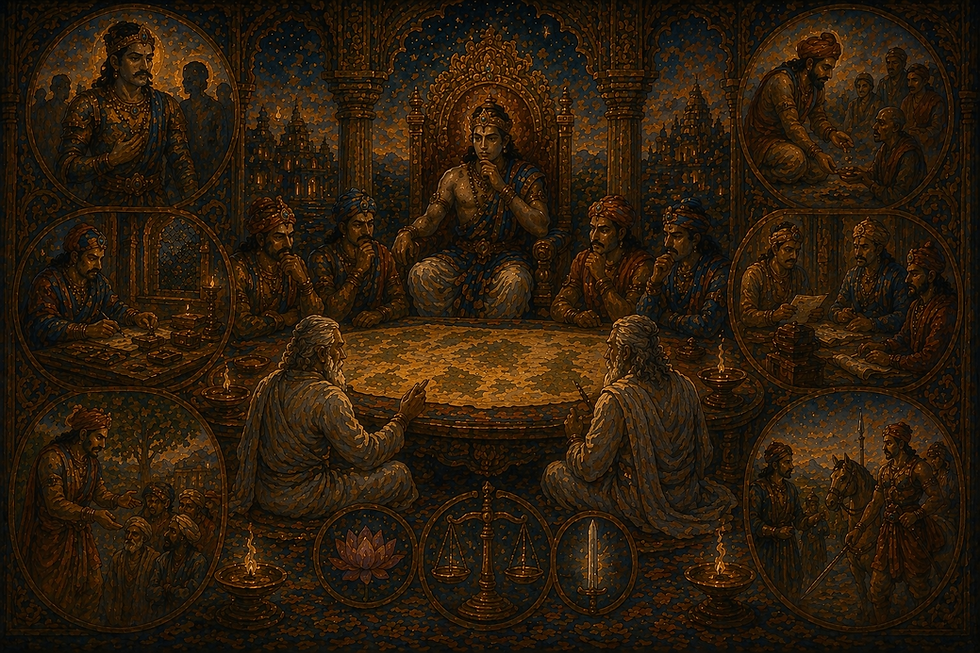
Don't Trust, Verify: Everyone smiles at the king and professes loyalty. Words are cheap. The only way to know someone's true character is to test them when they think no one is watching.
The Four Secret Tests: The state creates four fake scenarios to see if a minister will crack under pressure.
The Holy Man Test: "Betray the king. It's actually your religious duty." A good minister says: "My duty is to the king. Your fake piety means nothing."
The Bribe Test: "Here's a bag of gold for a tiny secret." A good minister says: "I am paid fairly. I am not a traitor."
The Seduction Test: "Let's have a secret affair... and then we can take over." A good minister says: "I will not be blackmailed or seduced into treason."
The Fear Test: "We are going to kill you unless you join our plot against the king." A good minister says: "Then I die loyal."
Pass or Fail:
Pass All Four: Welcome to the inner circle. You are trusted with everything.
Fail Some: You can still have a job, but a boring one far away from the palace. Maybe you can count cows in a distant village.
Fail Badly: You disappear. Permanently.
Absolute Secrecy: The minister can never find out it was a test. If they do, they will never trust the king again. The test must feel completely real.
Case Study: An Ancient King's Application
The Mudrarakshasa, a classical Sanskrit play by Vishakhadatta, dramatizes precisely this process, albeit in reverse. The play depicts Chanakya's efforts to win over Rakshasa, the loyal minister of the defeated Nanda dynasty, and appoint him as Chandragupta's chief minister.
Testing a Former Enemy: Rakshasa was not a fresh recruit; he was the mastermind of the Nanda resistance. Chanakya knew that Rakshasa's intelligence and loyalty were immense assets, but only if they could be securely transferred to the Mauryan cause. The entire play is an elaborate, multi-layered upadhā test.
Staged Betrayals and False Accusations: Chanakya orchestrates a series of complex deceptions. He spreads rumors that Rakshasa is still plotting against Chandragupta. He stages a public falling-out with Chandragupta to make it seem the king is vulnerable. He uses agents to offer Rakshasa alliances with foreign kings. At every turn, Rakshasa is presented with a temptation to act against Chandragupta.
The Final Test of Loyalty: The climax involves a fabricated threat to Rakshasa's friend, the jeweler Chandanadasa. Rakshasa is given a choice: save his friend by betraying Chandragupta, or remain loyal to his new king. Rakshasa chooses loyalty, even at the cost of his friend's life (unaware that the threat is a ruse). This final act of steadfastness convinces Chanakya that Rakshasa's conversion is genuine. Only then is he welcomed into the inner circle. The play is a dramatic illustration of the principle that trust must be earned through trial, not given freely.
Modern Application: How Political and Organizational Leaders Should Apply It
For Political Leaders:
The Imperative of Vetting: The modern state cannot legally stage fake arrests or deploy seductresses to test civil servants. However, the underlying principle of rigorous vetting is more critical than ever. Before appointing someone to a position of high trust—a cabinet post, an ambassadorship, the head of an intelligence agency—a leader must ensure a thorough background investigation is conducted.
Looking for Vulnerabilities: The upadhā tests target specific vulnerabilities: ideological seduction, financial greed, sexual compromise, and fear of coercion. Modern vetting must probe these same areas:
Financial: Are there unexplained wealth, debts, or offshore accounts that could make the individual susceptible to bribery?
Personal: Are there extramarital affairs, hidden relationships, or other personal conduct that could be used for blackmail by a foreign intelligence service?
Ideological: Are there associations with extremist groups or foreign agents that might compromise the individual's loyalty to the state?
Courage: Has the individual demonstrated moral courage under pressure in previous roles?
The Consequences of Failure: History provides numerous examples of leaders who failed to vet their inner circle adequately, resulting in catastrophic security breaches, espionage scandals, and political implosions.
The cost of a single compromised individual in a position of trust can be measured in lost lives, compromised secrets, and the collapse of an administration.
The upadhā framework is a reminder that no amount of physical security can fully protect against a person who has been entrusted with access but whose character is fundamentally flawed or compromised.
Takeaway
Chapter X of the Arthashastra presents the most unflinchingly pragmatic and morally complex element of Kautilya's statecraft. The upadhā tests are a recognition that the stakes of governance are too high to rely on surface appearances and professions of loyalty.
Human beings are susceptible to temptation, and the enemies of the state will actively seek to exploit those susceptibilities. The king who fails to test his ministers is like a commander who sends soldiers into battle without knowing whether their weapons will fire.
The tests are designed to simulate the very pressures that real adversaries will apply. A minister who cannot withstand a bribe from a state agent will certainly not withstand a bribe from a foreign power.
A minister who can be seduced by a state agent can be seduced by an enemy spy. The upadhā system is a form of inoculation, identifying and removing vulnerabilities before they can be exploited by genuine enemies.
For the modern leader, the lesson is not to replicate the specific methods—which are rightly considered unethical and illegal in modern contexts—but to embrace the underlying principle: trust must be verified through rigorous, objective, and often indirect means of assessment.
The character of the people who wield power on the leader's behalf is as important as their competence. The kingdom, the nation, or the corporation is only as secure as the integrity of the individuals entrusted with its secrets and its resources.
Applying Chanakya's Philosophy Kanchi, the Royal Palace – Vamanagupta's Private Study, Hour of the Owl The lamp had burned low. Vamanagupta sat alone, three scrolls spread before him on the teak desk. Each scroll bore a name: Narayana, Dharmapala, Vrishabha. The three deputy Tax Ministers. Each had performed well for six months. Each had been recommended by different ministers for different reasons. And each, before being confirmed in his post or elevated further, would now face the final trial. The door opened without a knock. Varishtha entered, silent as a shadow, and lowered himself onto a reed mat. "The arrangements are ready," the Chief of Intelligence said. "The agents have been briefed. The scenarios are prepared. But I must ask once more, Mahamatya; is the king certain? These are not small tests. Once set in motion, they cannot be called back. A man who fails will be marked forever, even if he is not told why." "The king is certain. I am certain. A minister's character must be known before he is given real power; not guessed at, not inferred from performance alone, but tested in secret, where no mask can hold." Varishtha inclined his head. "Then I will proceed. Which of the three shall be tested first?" "Dharmapala. The religious test. He is pious. Let us see if his piety outweighs his loyalty." The Temple of Shakra – Three Nights Later Acharya Dharmapala knelt before the shrine of Vakdevi, the oil lamps casting long shadows on the carved pillars. He had come alone, as was his habit, to offer late-night prayers before returning to his quarters. The temple was empty save for the silent priests who tended the eternal flame. A figure emerged from the shadows of the pillared hall; a man in the saffron robes of a renunciant, his head shaved, his face gaunt with what seemed like genuine ascetic privation. Dharmapala recognised him vaguely: an Acharya named Kritavarma, who had been dismissed from the palace some weeks earlier for refusing to perform a rite that the Rajaguru had ordered. The dismissal had been quiet, but the temple circles had whispered of it. "Acharya Kritavarma," Dharmapala said, rising. "I had heard you left Kanchi." "I returned." The dismissed priest's voice was low, urgent. "I have been speaking with others; men of influence, men of piety. There is a matter I must discuss with you. A grave matter. May I speak freely?" Dharmapala hesitated, then gestured for him to sit. Kritavarma leaned close, his breath sour with fasting. "The king is unrighteous. He has dismissed me for refusing to defile the sacred rites. He surrounds himself with ministers who care only for revenue and war. He listens to Vamanagupta, who quotes the old sages but follows his own cold reason. This kingdom needs a righteous king; a king who honours the Deva-Shastra above all. There is a movement. Men of influence are prepared to act. A new king, one of the old blood, one who respects the sacred law. What do you think?" Dharmapala's face went very still. "Who else is in this movement?" "Many. But I need to know: are you with us? Or are you loyal to a king who has abandoned righteousness?" The silence stretched. The oil lamps flickered. Then Dharmapala rose. "You speak of righteousness. But the scriptures say that loyalty to the king is the highest dharma of a minister, even if the king is flawed. You speak of a movement, but you give no names. You speak of a new king, but you offer only conspiracy. I am a servant of the throne. I will not betray it." He stepped back. "Leave this temple. And do not approach me again." Kritavarma stared at him for a long moment. Then, he turned and walked away. Dharmapala stood alone in the temple, watching the saffron-robed figure dissolve back into the shadows. The Merchants' Quarter – One Week Later Narayana, the deputy Tax Minister for the coastal districts, was walking home late from the customs office when a man fell into step beside him. The man was dressed in the plain clothes of a minor clerk, but his bearing was military; a discharged officer, perhaps, fallen on hard times. "Narayana," the man said, not breaking stride. "I have a proposition." "Who are you?" "A man who knows opportunity when he sees it. You have increased the coastal revenue by fifteen percent in eight months. You are the most competent revenue officer in the kingdom. And what is your reward? A deputy's title. A deputy's salary. Gajakesha has been promoted to councillor above you; a man whose numbers are half yours." Narayana's jaw tightened. "Gajakesha is a good minister." "Gajakesha is tired. You are not. Listen." The man lowered his voice. "There is a group of merchants—wealthy men, powerful men—who are unhappy with the new tax rates. They are prepared to pay a substantial sum to a revenue officer who can... adjust the assessments. Reduce the burden on certain shipments. Overlook certain discrepancies. In return, you will receive ten thousand silver pieces and a private estate in the hill country. You can retire before you are forty." Narayana stopped walking. "You are asking me to defraud the treasury." "I am asking you to be practical. The treasury will not miss what it never knew it could collect. And you will be rich." Narayana looked at the man for a long moment. Then he said, very quietly: "I know who you are." The man's expression flickered. "I doubt that." "You are a spy. One of Varishtha's. And this is a test." Narayana's voice was calm, almost amused. "I have a mistress in the merchants' quarter. I know that Varishtha knows this. I have been waiting for the test to come. Tell the Chief of Intelligence that my personal failings are my own, but I have never taken a copper piece from the treasury that was not accounted for. Tell him I refuse. And tell him—" a thin smile crossed his face "—that ten thousand silver pieces is an insultingly low offer." The man stared at him. Then he laughed; a short, surprised bark. "I will tell him, Narayana. Serve well." He turned and vanished into the darkness of the market lane. The Northern Road – Three Days Later Vrishabha, the former bandit captain, now deputy Tax Minister for the road tolls and border tariffs, was inspecting a checkpoint on the northern trade route when the attack came. It was swift, professional, terrifying. Six horsemen burst from the treeline, their faces masked. The checkpoint guards were overpowered in moments. Vrishabha was dragged from his inspection post, a sack thrown over his head, and hauled onto a horse. He was ridden for what felt like hours before the sack was removed. He found himself in a clearing, surrounded by armed men. A fire burned in the centre. Before him stood a man he recognised: an officer of the Valentian army, a mercenary captain named Kassius who had once tried to recruit Vrishabha during his bandit years. "Vrishabha," Kassius said, smiling. "You have done well for yourself. From bandit to minister. The king of Kanchi must be easily impressed." "What do you want?" "Your help. Lord Khazari seeks to infiltrate Saha. He needs men on the inside; men who know the roads, the toll schedules, the weak points. You know all of this. You can name your price." "I am no longer a bandit." "You are a bandit who has been given a mask to wear. The mask is called 'minister.' But the men inside Kanchi's court will never trust you. They will always see the brand of the penal corps on your back. You know this." Vrishabha was silent. "The offer," Kassius said, "is simple. Provide information about the border patrols. Close your eyes to certain shipments. In return, you will receive gold, a position in the Valenta army when Kanchi falls, and a title. You were born a soldier. You can die a lord." Vrishabha looked at the armed men, at the fire, at the mercenary captain's confident smile. He thought of the penal year he had served, the labour of rebuilding roads under the sun, the king who had spared his life and given him a second chance. "Kassius," he said slowly, "when I was a bandit, I would have taken your offer without hesitation. I was a fool then. I am slightly less of a fool now." He straightened his back. "I will not betray the king who restored me. Kill me if you must. But I will die loyal." The King's Private Study – The Following Morning Varishtha placed three reports on the king's desk. Simhavarma read each one carefully. Vamanagupta stood by the window, watching the dawn spread over Kanchi. "Dharmapala refused the religious conspiracy," the king said. "Narayana refused the bribe; and was clever enough to recognise the test. Vrishabha refused under threat of death." "All three passed their primary tests," Varishtha said. "None is perfectly pure. Narayana has his mistress. Vrishabha still dreams of his bandit years and wakes shouting. Dharmapala's ambition is greater than his position allows. But they are loyal. Under the four allurements—religion, wealth, love, and fear—they held." "Love?" the king asked. "Narayana has the mistress. Was he tested under love as well?" "Not yet. The female agent is prepared. But I wished to assess the results of the first three tests before proceeding." Vamanagupta turned from the window. "Proceed. But carefully. Suracharya's framework is sound; test under all four allurements, and only then assign the highest trust. But the framework also warns: never make the king or the queen the object of the test. Never vitiate the pure like water with poison. Use external objects. Use dismissed officers, fictitious merchants, staged threats. The minister must never know the test was authorised by the throne; only that it came, and that he was found worthy." "And if he fails?" the king asked. "Then he is not executed. He is not humiliated. He is assigned to a distant post—mines, timber forests, manufactories—where his vices cannot harm the kingdom's core. A man who fails under greed can still count logs in the elephant forest. A man who fails under fear cannot command a garrison, but he can oversee a workshop. Use the impure in places where their impurity cannot spread." Simhavarma looked at the three reports. "And Narayana's love-test?" Varishtha allowed himself a thin smile. "A female agent, disguised as the wife of a wealthy merchant, will approach him after the next council meeting. She will express admiration. She will invite him to a private meeting. If he refuses, he is pure. If he accepts..." "He will not accept," the king said. "He is too clever. He will recognise the test, as he recognised the bribe." "Perhaps. But cleverness is not the same as purity. We will see." Vamanagupta stepped forward. "Your Majesty, there is one more matter. Sometimes the medicine may fail to reach the disease. A man tested too harshly, or too often, may be broken by the testing itself. The mind of the valiant, though steadfast, may not return to its original form once repelled by the allurements. We must test. But we must also know when to stop testing, and when to trust." The king nodded slowly. "You tested me once, didn't you? When I was a prince. You arranged something—a temptation, a trap—to see what I would do." Vamanagupta's face was utterly still. "I have never tested Your Majesty." Simhavarma looked at his Chief Minister for a long moment. Then, very softly, he smiled. "Of course not, Mahamatya. Of course not." He picked up the reports and placed them in the brazier, watching the palm leaves curl and blacken and dissolve into ash. "Proceed with Narayana's love-test. But after that; no more. These three have proven themselves. I want them confirmed in their posts. I want them to know that the king trusts them, even if they will never know how that trust was earned." Varishtha bowed and withdrew. Vamanagupta remained. "You are uneasy," the king said. "I am always uneasy, Your Majesty. The testing of ministers is the most delicate work of statecraft. Trust is a fragile substance. It can be tested too much as well as too little." "Then we will test enough. No more." Simhavarma rose and walked to the window. "Thank you, Mahamatya. For the framework. For the refinements. For all of it." Vamanagupta bowed. "It is my duty, Your Majesty. And my honour." The sun rose fully over Kanchi. The three deputy ministers went about their morning duties. And the king, who had learned that trust must be verified before it is given, began the day's work with the quiet confidence of a ruler whose inner circle had been tested in fire and had not burned. |
Conclusion: The Invisible Kingdom
Chapters 6 through 10 of Book I complete the forging of the king's inner world. Where the opening five chapters established the intellectual foundation—the four sciences and the lifelong discipline of association with the aged—this section turns inward to confront the enemies that dwell within the king's own nature and the mortal dangers that surround his person.
The logic is sequential: first, identify and subdue the six internal enemies—lust, anger, greed, pride, vanity, and excessive joy—that have destroyed more kings than any foreign army. Then translate that self-mastery into the regimented daily life of the rājarṣi, the saintly king, whose every hour is ordered to serve either the kingdom's business or his own discipline.
Next, establish the principles by which ministers are selected—not through birth or favouritism, but through demonstrated capacity in work. Then distinguish between the broad administration of amātyas and the innermost circle of mantrins and the royal priest, whose loyalty and wisdom must be absolute.
Finally, subject every minister to the secret temptations—the four upadhā tests of religious seduction, monetary bribery, sensual allurement, and mortal fear—that reveal the purity or impurity of character before real power is entrusted.
The operational principles are strikingly consistent. The six enemies are not defeated by denying desire but by cultivating the pause between impulse and action. The king's daily routine is not drudgery but the external manifestation of internal discipline.
Ministers are not chosen by any single school's formula—neither classmates nor hereditary servants nor revenue-producers alone—but by the divided spheres of responsibility that turn human flaws into mutual checks. And the upadhā tests reflect Kautilya's most unflinching insight: trust must be verified in secret, never assumed in public.
Above all, these chapters establish the king himself as the first and most critical fortress. The body is a protected asset, the daily routine a shield against chaos, and the inner circle a collection of tested souls whose integrity has been verified by fire.
What follows in the later chapters of Book I—the institution of spies, the protection of factions, the sealed council chamber—is simply the projection of this inner citadel outward into the machinery of state. The conquest of the six enemies is the conquest of the self. And the conquest of the self is the foundation on which all other conquest rests.


Comments