
.png)

Sage Angira: The Maker of Fire
- A. Royden D'Souza

- Nov 17, 2025
- 5 min read
Early Satya (Krita) Yuga
Before the gods had clear identities and before men remembered their ancestors, the world lay under a dim half-light. Dawn had not yet learned to rise.
The cows of light, the rays of illumination, were locked in darkness by the covetous Paṇis, demons who hoarded radiance in stony caverns.
In this half-born universe, a lone figure wandered across the primeval land. His eyes glowed like embers. Every footstep seemed to awaken the earth. The fire flickered wherever he paused.

This was Angira.
No genealogy bound him. He was not born, he emerged. One of the first visionaries, one of the founders of sacred insight, a being who heard the rhythm of the cosmos before anyone else understood its beat.
The Friendship With Agni
Agni, the young flame, followed him like a calf following its mother. Sometimes Agni darted ahead, crackling with excitement, as if trying to show Aṅgirā how to read the language of sparks.

Aṅgirā would smile.
“Little flame, you devour falsehood. Let me learn truth from your hunger.”
Because of their bond, the Ṛgveda often recites:
“Aṅgirā and Agni walk together. Together they awaken the gods.”
The Lost Dawn: Aṅgirā’s Greatest Quest
One morning, the gods came to him in distress. Indra, still young, still untested, said:
“The world will not awaken. Uṣas hides. The cows of light have vanished.”
Aṅgirā touched the earth. It hummed beneath his fingers. He closed his eyes and whispered:

“Hidden. Behind stone.”
Indra leaned forward. “Where?”
Aṅgirā stood and began walking northward. No map guided him, only the pulse of the unseen.
The Paṇis had sealed the rays of dawn behind a colossal boulder in a barren land. The cave exhaled cold air, as if frightened of the very light it held prisoner.
Aṅgirā lit Agni upon the ground. The flame rose in a swirl of gold and crimson.
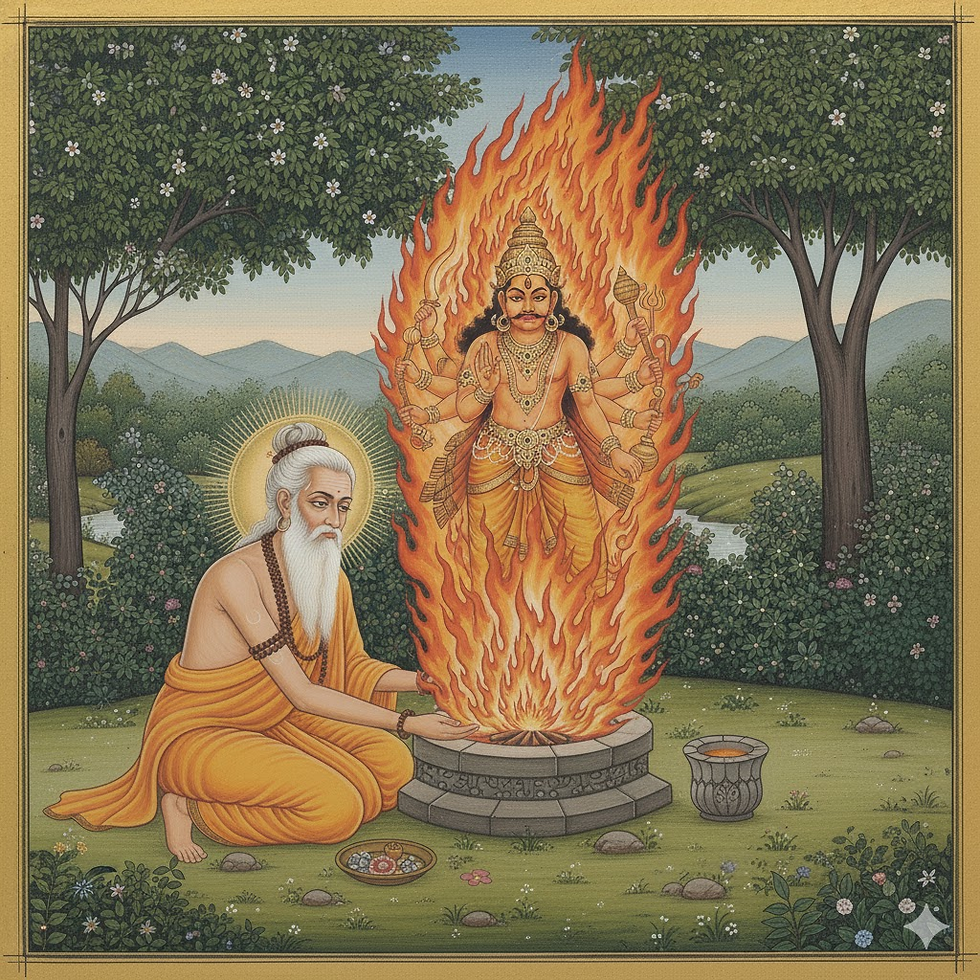
Then he chanted. His voice was deep, echoing, ancient, the first hymns of the Aṅgirasa poets, resonating through creation.
Agni roared, Indra struck the stone with thunder, and the cavern cracked open. The trapped cows, the rays, burst out, illuminating the world in a flood of gold.
The first dawn after the long darkness rose. The Veda sings:
“Aṅgirāsāḥ, the singers, found the light. Aṅgirā opened the stone. The rays flew out like cattle from bondage.”
Thus Aṅgirā became:
Bringer of Dawn
Discoverer of Light
Companion of Agni
Founder of the Fire Ritual (agnikriyā)
Teacher of Kings
In the era of the Brāhmaṇas and Upaniṣads, Aṅgirā appears differently—older, deeper, quieter. A king sought him and asked:
“What is the true light of a man?”
Aṅgirā replied, as though reciting a memory:

“Sun is his light. When sun sets, fire is his light. When fire dies, speech is his light. When speech fades, mind is his light. When mind dissolves—then the Self shines by its own glory.”
This is the Vedic sage—no wife, no sons, no story lineage—only knowledge, fire, dawn, and truth.
Angira: The Mind-Born Son of Brahma
The Purāṇas look back at the Vedic seer and weave for him a place in the genealogies of the universe. Aṅgirā becomes a mānasa-putra, a mind-born son of Brahmā.
It is said that he emerged glowing like fire touched by breath, a sage born of thought, not flesh. Brahmā welcomed him:
“Aṅgirā, flame-hearted one, you shall guard the sacred fires of creation.”
The Hermitage of Embers

Aṅgirā’s hermitage flickered day and night with sacred flames. Young rishis gathered around him to learn the science of:
mantra
ritual precision
sacrifice
cosmic order
fire’s secret languages
and the hidden forces moving through the unseen world
Aṅgirā taught without arrogance.He invited devotion, not obedience.
His Wives: The Embodiments of Sacred Principles
In the Purāṇic age, Aṅgirā married:
Smṛti (memory)
Śraddhā (devotion)
Svāhā (the sacred fire-offering) — in some traditions

These marriages are symbolic, not romantic. The sacred texts mean:
“Memory, devotion, and fire itself gave birth to wisdom.”
His Children: A Dynasty of Teachers
From Aṅgirā came:
Bṛhaspati: Guru of the Devas, master of eloquence and wisdom.
Uśanas Śukra: Guru of the Asuras, master of austerity and subtle sciences.
Utathya: A stern ascetic who upheld truth above all.
Samvarta: A wild sage who rejected all social norms.
The Aṅgirases: A vast family of priest-sages who composed powerful hymns.
Aṅgirā loved them all, though they often stood on opposite sides of cosmic struggles. But he understood:
“Creation is not one-sided. Wisdom must feed gods and demons alike.”
Aṅgirā and Vṛtra: Counselor of Indra
When Vṛtra, son of Tvaṣṭṛ, swallowed the world’s waters, the heavens trembled. Indra sought Aṅgirā’s advice:

“O fire-born sage, how do I fight a being who drinks oceans?”
Aṅgirā’s eyes glowed.
“With truth. Recite the hymns born of cosmic order. Power without righteousness collapses.”
Indra followed the ritual, and with the force of divine law, Vṛtra fell. Thus the Brāhmaṇas say:
“By Aṅgirā’s knowledge, the waters returned.”
NOTE: It is important to distinguish between the Vedic and Purāṇic versions of the Indra–Vṛtra conflict, because they come from completely different eras and meanings.
In the Vedic account, Vṛtra is not an Asura king, but a cosmic obstruction, a serpent-like being who holds back the waters or the dawn. The story is symbolic, cosmological, not moral.
Indra (Vedic) is empowered by Soma and the Vajra and releases the waters. Aṅgirā and the Aṅgirases often appear as helpers who find the hidden light. There is no backstory, no sin, no curse, no moral drama. This version represents cosmic order (ṛta) triumphing over cosmic obstruction.

In the post-Vedic (Puranic) account, Vṛtra becomes a personalized Asura, son of Tvaṣṭṛ, with lineage, motive, and penance. Indra’s killing of Vṛtra is treated as Brahmahatyā (a great sin).
Indra (Purandara/7th Indra) hides, suffers the consequences, and is later purified. The story is ethical, narrative-driven, and part of divine politics. The Indra (Purandara) depicted in the later lore is often shown as meek and morally lacking as compared to the warrior storm-god Indra (Vedic).
Aṅgirā Among His Brothers
He dwelt among the greatest of the mind-born sons of Brahmā:
Sometimes they debated. Once Bhr̥gu shouted:
“Aṅgirā, fire consumes everything. How can you trust a teacher who burns?”
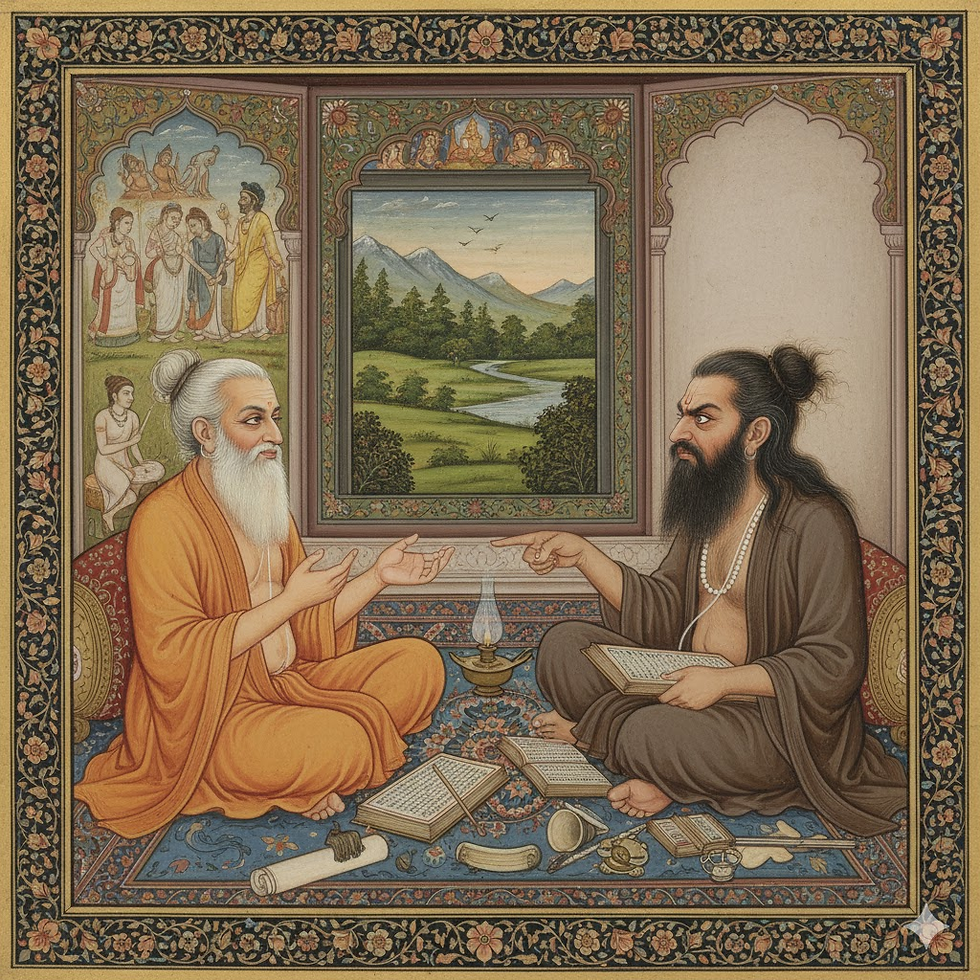
Aṅgirā smiled:
“Fire burns only what is false. What is true shines brighter in its light.”
Even Nārada respected him, rare praise from the ever-questioning wanderer.
Aṅgirā’s Twilight: The Flame Returns to Fire
In the end, Aṅgirā withdrew from ritual, from teaching, from even speech. He sat by a single flame. Agni flickered, as though remembering their first journey together.
Aṅgirā whispered:
“Flame of the cosmos, you and I began together. Let us return together.”

And with that, his body faded like dying embers, but a single spark rose upward, merging with the cosmic fire. The Purāṇas say:
“Aṅgirā returned to Agni, the flame in which he dwelt.”
REFERENCES:
Vedic Sources
Ṛgveda: Mandalas 1, 2, 6, 7, 9, 10 (Aṅgirasa hymns)
RV 10.62, 10.67, 10.108 — Aṅgirasa deeds
Aitareya Brāhmaṇa — rituals attributed to Aṅgirā
Śatapatha Brāhmaṇa — Aṅgirā’s role in Vṛtra myth
Bṛhadāraṇyaka Upaniṣad 1.3 — dialogue on the nature of light
Post-Vedic Sources (Purāṇic & Epic)
Viṣṇu Purāṇa 1.7–1.9 — Aṅgirā as mind-born son; children
Bhāgavata Purāṇa 4.1, 6.6 — Descendants: Bṛhaspati, Utathya
Mahābhārata, Śānti Parva — Prajāpati lineage
Padma & Vāyu Purāṇa — details of marriages, lineage

Comments