
.png)

Daksha Prajapati: The Death of Sati
- A. Royden D'Souza

- Nov 15, 2025
- 7 min read
Early Satya (Krita) Yuga [A Cosmic Entity in Vedic Lore]
In the first ages of creation, when the universe was still young and unsteady, Brahmā opened his eyes and sought companions to help shape the worlds. From his will, mind, and subtle energies arose the Prajāpatis, creators of lineages, teachers of order, founders of civilization.

Among them stood Daksha.
Sharp in mind, disciplined in purpose, Dakṣa carried within him a fire for structure and perfection. He desired a cosmos where every being knew its place, every ritual flowed with precision, every creature obeyed the laws of duty.
Brahmā saw in Dakṣa an architect of order and entrusted him with the work of multiplying life.
The Expansion of Creation
Dakṣa married Prasūti, daughter of Svāyambhuva Manu. Together, they filled the universe with life.
He fathered sixty daughters.

Some married Dharma, birthing the virtues that still sustain the world: Śraddhā, Medhā, Dhṛti, Puṣṭi, Buddhi, Lajjā, and others.
Some married Kaśyapa, giving rise to: the Devas, Asuras, Dānavas, Nāgas, Garuḍa, Apsaras, Yakṣas, beasts, and birds.
Twenty-seven became the Nakṣatras, the lunar mansions, wives of Soma. Others married sages — Aṅgirā, Kratu, Bhṛgu —their descendants populating worlds seen and unseen.
Creation blossomed wherever Dakṣa’s daughters walked. Dakṣa’s pride in his work grew.
The Birth of Sati
Among Dakṣa’s daughters was Satī, child of extraordinary purity and strength. As she grew, her heart turned instinctively toward Śiva, the great ascetic, the silent lord seated on Kailāsa, who saw no difference between honor and dishonor, gold and dust, life and death.

Dakṣa could not understand Śiva.
To him, Śiva was:
one who ignored ritual
one who lived on cremation grounds
one who wore ashes instead of ornaments
one who refused the forms of respect Dakṣa valued
Dakṣa muttered often:
“He is unfit for a daughter of my house.”
But Satī’s devotion was unshakable. And through her tapas, she won Śiva’s heart. They married, with all the gods blessing the union—all except Dakṣa.
A seed of resentment hardened in him.
The Assembly of Gods
One day, all the gods gathered for a great council. Dakṣa entered the hall with regal confidence. The Devas rose to honor him, all except Śiva, who sat in serene meditation, eyes half-closed.
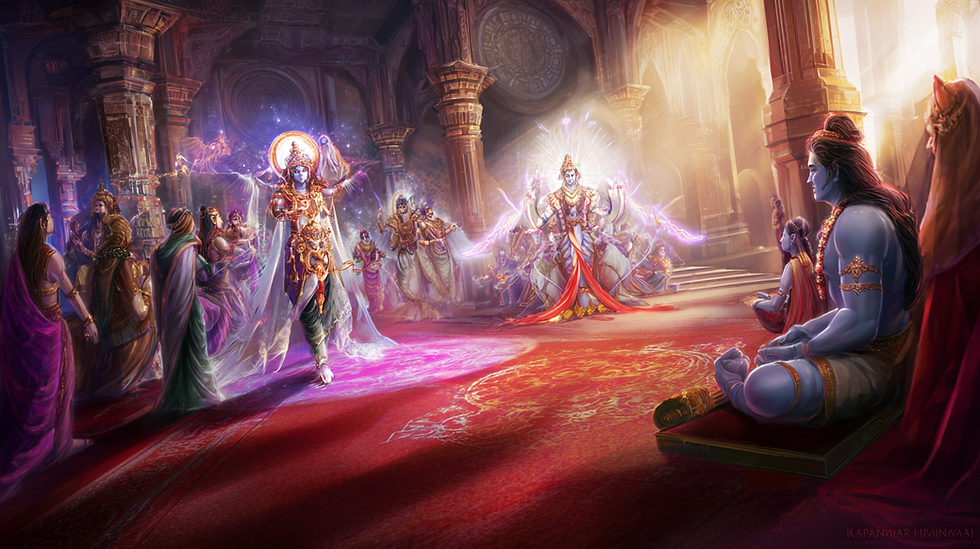
To Śiva, all beings were equal. Showing or not showing respect meant nothing to Him. But to Dakṣa, who lived by hierarchy and etiquette, Śiva’s stillness felt like insult.
Dakṣa’s face darkened.
“This ascetic,” he thundered before all, “shows no respect for elders or dharma!”
Carried away by anger and wounded pride, he cursed Śiva, declaring that no share of sacrificial offerings would ever be given to Him.
Śiva remained unmoved, like a mountain in a storm. The hall fell silent. A rift had opened.
The Great Sacrifice of Daksha
Later, Dakṣa prepared a vast sacrifice: the Bṛhaspati-sava, a display of his mastery over ritual and order. He invited all the gods, all sages, all celestial beings—except Śiva and Satī.
Even so, the gods attended, fearful of offending Dakṣa. From Kailāsa, Satī saw the divine procession and ached to go.
Śiva spoke gently:
“Beloved, where one is not invited, one should not go. An uninvited guest brings sorrow.”
But Satī’s longing to see her family was too strong.

“He is my father. Perhaps his heart has softened.”
Śiva didn't stop her. He let her choose freely. Satī left accompanied by Her attendants.
Sati Confronts Daksha
At the sacrificial arena, Satī found no welcome. Dakṣa did not rise. No blessings were offered. Instead, Dakṣa’s voice rang through the hall:
“Your husband is fit only for ghosts and ashes. He mocks dharma. You have disgraced my house.”
Satī trembled, not in fear but in burning sorrow. She declared:
“My body was born of you, Dakṣa, but I am not your daughter. I cannot bear this insult to my Lord.”

And in full majesty, she sat in meditation, invoked her inner fire, and burned her mortal body. A gasp swept the heavens. The sacrificial rites froze.
The Wrath of Shiva
A messenger ran to Kailāsa with the news. Śiva closed His eyes, and the universe shuddered. From a single lock of His matted hair, he created Vīrabhadra, a towering, terrifying being, leader of ferocious gaṇas.

Śiva commanded:
“Go. Break the sacrifice of Dakṣa.”
Vīrabhadra descended like a storm.
The flames died.
The priests fled.
The gods trembled.
The hall collapsed.
And Dakṣa, frozen in fear, was beheaded.
The yajña was destroyed.
Shakta/Tantric Account: In the Śākta tradition, Satī’s death marks not only the collapse of Dakṣa’s pride but the shattering of the cosmic Mother herself.
Overwhelmed by grief, Śiva lifted Satī’s lifeless body into his arms and wandered across the worlds in a trance of sorrow, dancing a terrible Tāṇḍava that shook the foundations of creation.

The gods trembled, for as long as the Lord of Destruction carried the corpse, the universe could not regain balance. To restore order, Viṣṇu released his Sudarśana Chakra, cutting Satī’s body gently into pieces as Śiva moved across the earth.
Wherever a fragment fell—her hand, her tongue, her womb, her toes—the Goddess manifested anew in that place as pure Śakti.
Thus arose the Śakti Pīṭhas, sacred seats of the Divine Mother, scattered across Bhārata and beyond. In this telling, Satī’s body became the map of the Goddess’s eternal presence, and Śiva’s grief gave birth to the geography of devotion itself.
Reconciliation and Restoration
The gods, horrified, went to Brahmā, who led them to Śiva. They bowed and pleaded:
“Lord, restore peace. Let Dakṣa be forgiven.”
Śiva, who holds no lasting anger, softened.
“Let the sacrifice be completed. And let Dakṣa rise again.”
Vīrabhadra placed a goat’s head on Dakṣa’s lifeless body. By Śiva’s grace, Dakṣa awoke—shaken, humbled, and filled with remorse.

Dakṣa bowed deeply before the Lord he once scorned.
“Forgive me. You are the refuge of all. Ignorance blinded me.”
Śiva blessed him, and the sacrifice was completed with Śiva receiving his rightful share. Harmony returned.
The Rebirth of Daksha
In a later age, Dakṣa was reborn as the son of the Pracetās and Māriṣā (Bhāgavata 6.4–6.10).
In this birth, he was gentler, though still committed to order.
He created the Haryaśvas and the Śabalāśvas, thousands of sons destined to populate creation.
But sage Nārada, seeing their potential for spiritual greatness, guided them to renounce worldly existence.
Dakṣa was frustrated, but this time he did not curse Nārada—only lamented, showing he had learned humility. Dakṣa continued the work of creation, wiser than before.
Ultimately, Dakṣa embodies ritual order, discipline, structure and expansion of life. But his story also shows the danger of pride:
ritual without humility,
order without compassion,
hierarchy without wisdom.
Through his conflict with Śiva, Dakṣa transforms—from one who enforces order rigidly to one who understands that divinity is beyond ego, beyond form, beyond ritual. And thus the universe is shaped not only by discipline, but by forgiveness.
Vedic Account: In the earliest dawn of existence, before the gods had taken their thrones and before the worlds had settled into shape, there was only an immense, unbounded expanse.

From that infinite arose Aditi, the boundless one—limitless, unbroken, the mother of sky and law. But the cosmos could not remain only vast and open.
To shape the limitless, something needed to arise within it: a principle of skill, ability, creative order, and ritual power. And so was born Dakṣa.
The Ṛgveda sings:
“Dakṣa was born of Aditi, Aditi was born of Dakṣa.”
A mystery: the mother giving birth to the son, and the son, in some more ancient silence, giving birth to the mother.
It was the Vedic way of saying: order and infinity create each other. There is no universe without the two dancing together.
Dakṣa was not a father of daughters, nor a king of ritual halls, nor one who quarreled with gods. He was the very power of doing, the skill that shapes cosmos from chaos.
Where Aditi spread out, Dakṣa condensed. Where Aditi opened the worlds, Dakṣa set them into pattern. He was the impulse that crafts, the ability that brings form, the energy that enables creation to continue.
Through him, the early gods (Children of Aditi/Indra (Vedic) and his Pantheon) learned how to uphold ṛta—the cosmic truth and rightness that keeps the stars aligned and the seasons turning.
Through him, sacrifices found their rhythm. Through him, the first structures of life took hold, as if the universe itself learned how to move with intention.
Thus the Vedic Dakṣa is not a man, but a force —the cosmic ability to create, the strength of sacred skill, the heartbeat of order within the infinite.
When the Ṛgvedic poets invoked Dakṣa,they were calling not upon a person, but upon the power that makes creation function.
Before the Prajāpati of later ages, before the father of Satī and builder of lineages, there was Dakṣa of the Veda: pure capacity, pure craftsmanship, pure order born from infinity—and birthing infinity in return.
REFERENCES:
Vedic Sources
Ṛgveda 10.72.4–5 — Reciprocal birth of Aditi and Dakṣa; Dakṣa as cosmic order/skill.
Ṛgveda 1.89.3; 2.27.1; 2.31.1; 4.26.1; 4.27.1; 10.64.5; 10.65.11 — Invocations of Dakṣa as a creative, organizing principle.
Brāhmaṇa Texts
Śatapatha Brāhmaṇa — Dakṣa as a proto-Prajāpati linked with yajña and creation.
Taittirīya Saṁhitā — Mentions Dakṣa in early progenitor roles.
Purāṇic Sources
Śrīmad Bhāgavata Purāṇa 4.1–4.7 — Birth of Dakṣa, Satī, the insult to Śiva, Dakṣa Yajña, Vīrabhadra, Dakṣa’s beheading and restoration.
Śrīmad Bhāgavata Purāṇa 6.4–6.10 — Dakṣa’s rebirth through the Pracetās; Haryaśvas and Śabalāśvas.
Viṣṇu Purāṇa 1.7–1.12; 3.2–3.3 — Daughters of Dakṣa, genealogies, summary of the Dakṣa Yajña.
Śiva Purāṇa (Vāyavīya & Rudra Saṁhitā) — Detailed narrative of Satī’s self-immolation and Vīrabhadra’s destruction of the sacrifice.
Mahābhārata (Śānti & Anuśāsana Parva) — Lineages, Prajāpati lists, Dakṣa’s daughters.
Brahmāṇḍa, Padma, Vāyu, Linga, and Matsya Purāṇas — Supplementary accounts of Dakṣa’s creation work, genealogies, and variants of the Dakṣa Yajña narrative.
Tantric Sources
Devī Bhāgavata Purāṇa 7.30–7.40 — Full narrative of Satī’s death, Śiva’s grief, Viṣṇu cutting the corpse, and the formation of the Śakti Pīṭhas.
Kālikā Purāṇa (Ch. 61–67) — Early Śākta source linking Satī’s body parts to specific sacred sites (e.g., Kāmākhyā).
Kūrma Purāṇa (Uttara-khaṇḍa, later section) — Version of the corpse-carrying and Pīṭha formation.
Tantric texts (e.g., Bṛhad-Nīla Tantra, Rudrayāmala, Śakti Saṅgama Tantra) — Lists and theological interpretations of the Pīṭhas.


Comments