
.png)

Modern World: Iran, From Safavid Empire to Islamic Republic
- A. Royden D'Souza

- Apr 5
- 45 min read
On 19 August 1953, a military coup orchestrated by the CIA and MI6 deposed Iran’s elected Prime Minister Mohammad Mossadegh. The stated rationale was Cold War logic; the real issue was control of oil. That operation, codenamed TPAJAX, did more than reinstate the Shah.
It permanently altered Iran’s political trajectory, destroyed a nascent democratic movement, and created the conditions for the 1979 Islamic Revolution; a revolution whose most extreme factions were, by multiple accounts, inadvertently empowered by decades of Western intervention.

The 1953 coup was not an anomaly. It was the inflection point in a longer arc: the collapse of the Safavid state, the Qajar dynasty’s sale of national sovereignty to foreign powers, the Pahlavis’ authoritarian modernization atop a system of elite continuity, and the Islamic Republic’s emergence as a reaction to foreign domination.
Pattern evidence suggests that the very characteristics of the Islamic Republic that Western governments cite as justification for continued intervention—its alleged human rights record, its anti‑Western ideology, its nuclear program—were shaped and hardened by the interventions themselves.
The regime’s security apparatus inherited methods refined by the Shah’s SAVAK, which had been trained by the CIA. Its hostility to the West was forged in the crucible of the 1953 coup, Western support for Iraq during the Iran–Iraq War, and decades of sanctions that have disproportionately affected ordinary Iranians.
This whitepaper applies cold pattern‑based logic to diagnose the full institutional trajectory of modern Iran, with a central focus on how Western interventionism inadvertently empowered the most extreme elements of Iranian politics.
It treats mainstream narratives—whether royalist, revolutionary, or Western—as claims to be stress‑tested against declassified archives, economic outcomes, and documented patterns. It excavates suppressed dimensions: the CIA’s long‑concealed role in 1953, the destruction of the Tudeh Party (which might have offered a secular alternative), Western complicity in Saddam Hussein’s chemical weapons attacks on Iranian civilians, and the continuity of elite families across the 1979 rupture.
Central thesis: Modern Iran’s trajectory from Safavid state to Islamic Republic is not a story of radical breaks but of embedded continuity; elite networks, intelligence apparatuses, and economic structures that survived dynastic collapse, revolution, and war.
The 1953 coup established the template: foreign‑backed authoritarianism, the elimination of independent political organization, and the creation of a repressive state apparatus that would be inherited, not dismantled, by the Islamic Republic.
Each subsequent Western intervention—military, economic, or diplomatic—has further entrenched hardline factions, weakened reformists, and reinforced the regime’s narrative that the West cannot be trusted.
The Islamic Republic’s alleged excesses, while well documented by international observers, must be understood as the product of a system forged in resistance to foreign domination; a system whose harshest features were, paradoxically, enabled by the very powers that now condemn them.
“The Iranian social‑political structure under the Pahlavi dynasty today is in broad outline much as it developed during the Qajar dynasty (1792–1925) that preceded it.”
— U.S. State Department intelligence report, “Centers of Power in Iran,” May 1972
Part I: The Safavid Foundation: Shiism as State Ideology

The Safavid Empire (1501–1736) was not merely a political entity; it was an institutional project. The dynasty’s founders made Twelver Shiism Iran’s defining identity, imposing a state religion that was the sole source of legitimacy and sovereignty.
This fusion of religious and political authority—the clerical hierarchy subordinated to the Shah, but the Shah’s legitimacy derived from Shiite doctrine—created a template that would persist for centuries.
At its core, the Safavid state represented an indigenous response to the pressures of Ottoman and Uzbek incursions; a centralization of power under a native dynasty, not a foreign imposition.
Under Shah Abbas I (r. 1588–1629), the Safavid state reached its zenith. Abbas centralized power by creating a new gunpowder army funded by the state, breaking the power of the Qizilbash tribal confederation that had previously held the monarchy hostage.
He established a state monopoly over the silk trade, channeling wealth into large‑scale building projects and a bureaucratic apparatus. The result was one of the largest and long‑standing Iranian empires after the 7th‑century Muslim conquest.
Yet the Safavid model contained the seeds of its own decay. The empire’s legitimacy rested on an uneasy bargain: the Shah protected Shiite orthodoxy; the clergy provided religious cover for dynastic rule.
When the Safavids collapsed in the 18th century, weakened by Afghan invasions, Ottoman pressures, and internal succession struggles, Iran entered a period of fragmentation that would not be resolved until the Qajar dynasty’s consolidation in the 1790s.
The Qajar Interregnum: Weak Centralization and Foreign Encroachment

The Qajar dynasty (1794–1925) resembled its Safavid predecessors in that it was a weakly centralized regime faced with strong provincial tribal forces and an increasingly independent religious establishment. The Qajars could not control the vast territory of Iran effectively, and their authority was constantly undermined by tribal chiefs, regional governors, and local elites.
This institutional weakness invited foreign predation. By the mid‑19th century, Russia and Britain had carved Iran into spheres of influence. The Shahs granted a series of concessions to foreign powers; most notoriously the 1890 Tobacco Régie, which gave Britain a monopoly over the production, sale, and export of Iranian tobacco.
The resulting Tobacco Protest, the first sign of popular revolt against the prevailing order, created a tacit anti‑imperialist and antimonarchist coalition of clerics, mercantile interests, and dissident intellectuals. This coalition foreshadowed the 1979 revolution: a broad alliance against foreign domination.
The Great Game: The Battle for the East
The modern history of Iran cannot be understood without acknowledging the systematic erosion of its sovereignty by the British and Russian empires throughout the 19th century. What began as a rivalry between two expanding empires ended as the effective partition of a once‑proud nation; a partition that created the political vacuum into which Reza Khan would step.
The so‑called "Great Game" was the political and diplomatic confrontation between the Russian and British empires over influence, territory, and trade across a vast region stretching from the Black Sea to the Pamir Mountains.
For Iran, the Great Game was not a distant abstraction but a brutal reality of military defeat, territorial loss, economic subjugation, and systematic foreign interference in internal affairs.
The Russo‑Persian Wars and Territorial Dismemberment
The 19th century opened with disaster. Russia went to war with Persia four times between the 18th and 19th centuries. The Russo‑Persian War of 1804–1813 ended with the Treaty of Gulistan, in which Iran was forced to cede vast territories in the Caucasus, including what is now Georgia, Dagestan, and parts of Azerbaijan.
The second Russo‑Persian War of 1826–1828 ended even more disastrously. The Treaty of Turkmenchay (1828) forced Iran to cede the remaining Caucasian territories, including modern‑day Armenia and the rest of Azerbaijani territory.
The treaty also granted Russia extraterritorial rights and a crushing indemnity; terms that permanently tilted the balance of power in Russia's favor and left Iran militarily crippled and economically drained.
The Great Game Intensifies: British Entry and the "Eastern Question"
Britain watched Russia's southward expansion with growing alarm. The British Raj in India was the jewel of the empire, and London feared that Russia's advance through Central Asia would threaten the overland routes to the subcontinent. Iran, lying directly between Russia's Caucasian conquests and British India, became the primary battlefield of this imperial rivalry.
British policy toward Iran during this period was opportunistic and self‑serving. The occasional nature of British engagement prevented the contact from being more advantageous for the Qajar state.
Britain's primary interest was not Iranian sovereignty but the protection of its own imperial lines of communication and the denial of Iranian territory to Russian influence.
The Reuter Concession (1872): Selling the Nation for a Fee
The first major concession, the effective sale of Iranian sovereignty to a foreign power, came in 1872. Emperor Naser al‑Din Shah negotiated an agreement with Paul Reuter, a British citizen, granting him control over the roads, telegraphs, mills, factories, extraction of resources, and other public works in exchange for a stipulated sum for five years and sixty percent of all net revenue for twenty years.
The concession was so sweeping that it amounted to the effective privatization of the Iranian state. Only the threat of Russian intervention, and the Shah's fear of provoking his northern neighbor, prevented the concession from being fully implemented.
But the pattern was set: the Qajar court had demonstrated that every aspect of Iranian national life was for sale to the highest foreign bidder.
The Tobacco Protest: The Clergy as Anti‑Imperialist Force
The Tobacco Protest of 1890–1892 marked the first successful mass movement against foreign domination and the first time the Shiite clergy emerged as a national political force. In 1890, Naser al‑Din Shah granted a full monopoly over the production, sale, and export of Iranian tobacco to a British company for fifty years.
The concession was catastrophic. It would have destroyed the livelihoods of thousands of Iranian tobacco farmers and merchants; the powerful bazaari class. But more importantly, it represented a complete surrender of economic sovereignty to a foreign power.
The British company would control every aspect of the tobacco trade, from planting to pricing, and would remit profits to London rather than to Tehran.
The response was unprecedented. Merchants in Tehran, Shiraz, Mashhad, and Isfahan shut their bazaars in protest. The Shiite clerical establishment issued a fatwa against tobacco use, and the population obeyed with near‑total compliance.
The Shah, facing a nationwide rebellion that united the bazaar, the clergy, and the general population, was forced to cancel the concession.
The Tobacco Protest carried a bitter lesson that would echo through Iranian history: the clergy had demonstrated the power to mobilize the nation against foreign domination; a power they would later use against both the monarchy and the secular state.
But the protest also revealed the weakness of the Qajar state. The dynasty was so deeply unpopular and so clearly seen as a tool of foreign interests that British eyewitnesses later suggested the only reason the Shah had not been overthrown was the direct intervention of British and Russian forces that essentially propped up the emperor.
The Constitutional Revolution (1905–1911)
The Constitutional Revolution was the most ambitious attempt to transform Iran into a modern, constitutional, democratic state; and its crushing by British and Russian intervention created the political vacuum that would eventually be filled by dictatorship.
The revolution began in 1905, triggered by protests over rising sugar prices and fueled by decades of resentment against Qajar corruption and foreign domination.
By 1906, the Shah had been forced to grant a constitution and establish a parliament, the Majlis; a landmark achievement that made Iran one of the first countries in the Middle East to adopt a constitutional form of government.
But the new constitutional order was immediately threatened by foreign powers. The new Shah, Mohammad Ali Shah Qajar, with the aid of Russia, attempted to rescind the constitution and abolish parliamentary government. When he was deposed in 1909, Russia and Britain intervened directly to shape the outcome.
The decisive blow came in 1911. Russia presented the Iranian government with an ultimatum demanding, among other things, the firing of an American financial advisor hired by the Majlis to organize the country's finances.
When the parliament refused, Russian troops invaded. The Russian Imperial Army occupied Tabriz, Anzali, and Rasht. In Tabriz, Russian forces shelled the city with artillery, executed constitutional revolutionaries and their families, and massacred civilians. The Russian occupation of northern Iran continued until 1917 (until the Bolshevik Revolution).
The Constitutional Revolution in Iran was dead. The lesson was clear: Iran would not be permitted to govern itself. Any attempt at democratic reform, any assertion of national sovereignty, would be crushed by foreign military intervention.
The Anglo‑Russian Convention of 1907: The Partition of Iran
The most explicit act of foreign dismemberment had come in 1907, when Britain and Russia signed the Anglo‑Russian Convention without the participation or knowledge of the Iranian government.
The agreement formally partitioned Iran into two spheres of influence: a Russian zone in the north, a British zone in the south and east, and a neutral "buffer" zone in the center where both powers shared influence.
The convention was a colonial carve‑up of a nation that had never been formally colonized. Britain and Russia had divided Iran between them, assigning themselves exclusive rights to exploit resources, build infrastructure, and intervene in local politics within their respective zones.
Iran's parliament was informed of the agreement weeks after it was signed. The bitter response from Iranian nationalists would echo for generations.
The Discovery of Oil and the Anglo‑Persian Oil Company (APOC)
In 1908, the Anglo‑Persian Oil Company struck oil at Masjed Soleyman in southwestern Iran. The discovery transformed Iran's strategic importance. The British Navy began switching to oil combustion in 1910, dramatically increasing its operating distance and speed; and making British control of Iranian oil a matter of imperial survival.
The British government moved quickly to secure its position. In 1914, on the eve of World War I, the British government purchased a majority stake in the Anglo‑Persian Oil Company, effectively nationalizing the company under British state control.
The pattern was complete: Iran's most valuable resource was extracted, refined, and sold by a foreign company, with profits flowing to a foreign treasury, under the protection of foreign troops stationed on Iranian soil.
World War I: The Occupation of Iran
Iran declared neutrality at the outbreak of World War I in 1914. The declaration was ignored. Russian, British, and Ottoman troops invaded and occupied Iranian territory, turning the country into a battlefield of the Great War.
The occupation was a catastrophe from which the Qajar dynasty never recovered. The central government collapsed. Famine and disease swept the country.
The Iranian people, already suffering under decades of foreign exploitation, were subjected to military occupation, requisitions, and violence from all sides.
The Persian Cossack Brigade: Russia's Instrument of Control
The Persian Cossack Brigade was the single most important institution in setting the stage for Reza Khan's rise. Formed in 1879 and modeled after the Caucasian Cossack regiments of the Imperial Russian Army, the brigade was an elite cavalry unit that served as the only truly effective military force in Iran.
But the brigade was not an Iranian institution. It was commanded by Russian officers, trained by Russian instructors, and loyal to Russian interests. The brigade served Tsarist Russia dutifully, particularly in maintaining Russian hegemony vis‑à‑vis the British in the northern part of Iran.
Throughout the 19th century, the Qajar dynasty engaged in a continuous process of building a regular army under the leadership and tutelage of professional European military missions; but the most successful of these was the Cossack Brigade, created by the Russian military mission.
The brigade was not merely a military unit; it was Russia's instrument of political control. When the Shah needed to suppress domestic opposition, the Cossack Brigade did the work. When Russia needed to enforce its will on Tehran, the Cossack Brigade was the threat.
And when the old order collapsed after World War I with Russia under Bolshevik control, the Cossack Brigade—still intact, still trained, still armed, still the most effective military force in the country—became the prize for which every faction competed.
The Anglo‑Persian Agreement: The Final Attempt at Protectorate
With Russia paralyzed by revolution and civil war, Britain made one final attempt to bring Iran under its direct control. The Anglo‑Persian Agreement of 1919 was a secret treaty negotiated between the British government and a handful of Iranian ministers who had received large financial inducements from the British.
The agreement would have granted Britain control over Iran's military, finances, and administration. It specified the supply of British officers to reform the Iranian army and consolidate it into a uniform force. It guaranteed British access to Iranian oil fields. In return, the British would provide loans and technical assistance.
Outwardly, the agreement was framed as a gesture of support for Iranian independence. In reality, it was a protectorate in all but name. The British Foreign Secretary, Earl Curzon, hoped to make Iran a client state of Britain and of no other great power.
The agreement aroused considerable opposition in Iran, and the Majlis refused to approve it. But the attempt itself demonstrated the depth of British ambition: to reduce Iran to a satellite of the empire.
The Legacy: A Hollowed‑Out State, Ready for the Strongman
By the time Reza Khan emerged from the ranks of the Persian Cossack Brigade in 1921, Iran had endured a century of systematic foreign exploitation. Its territory had been carved up, its economy had been sold to foreign concessionaires, its democracy had been crushed by foreign bayonets, and its sovereignty had been reduced to a fiction.
The Qajar dynasty had been exposed as corrupt, weak, and complicit in the nation's humiliation. The Majlis had been shown to be powerless against foreign intervention. The only effective military force in the country, the Cossack Brigade, was a Russian‑trained, Russian‑commanded instrument of foreign influence.
Into this vacuum stepped Reza Khan. He was not a revolutionary; he was a product of the very system of foreign domination he would claim to overthrow. He had risen through the ranks of the Cossack Brigade, the Russian instrument of control. But Russia was now in Bolshevik hands, no longer a real opposition to the banking interests behind Britain.
Reza Khan's coup in 1921 was supported by the British, who saw in him a reliable partner to secure their interests after the collapse of the Qajar state. And his rise to power, from obscure soldier to absolute monarch, was made possible by the systematic destruction of every alternative: the constitutional democrats, the leftist movements, the independent trade unions, all of which had been crushed by foreign intervention decades before he seized the throne.
The tragedy of the Pahlavi dynasty is that it was born from this long history of foreign domination; and would itself become the most powerful expression of it. The Shahs would modernize Iran, build its military, industrialize its economy; but they would do so as clients of foreign powers, dependent on American arms and British oil companies.
The revolution of 1979 was not the first Iranian revolution; it was the latest and most violent in a cycle of resistance to foreign domination that began with the Tobacco Protest of 1891. And the Pahlavis, for all their claims to Persian glory, were ultimately swept away by the same forces that had destroyed the Qajars before them: the demand for authentic national sovereignty, and the refusal to accept a monarch who ruled at the pleasure of foreign powers.

Part II: The Pahlavi Coup: Authoritarian Modernization
On 21 February 1921, Reza Khan—a colonel in the now British‑run Persian Cossack Brigade—marched 1,200 men into Tehran and seized control of the crumbling Qajar state.
A young journalist became the nominal prime minister, but Reza Khan, as minister of war, was the real power from the start.
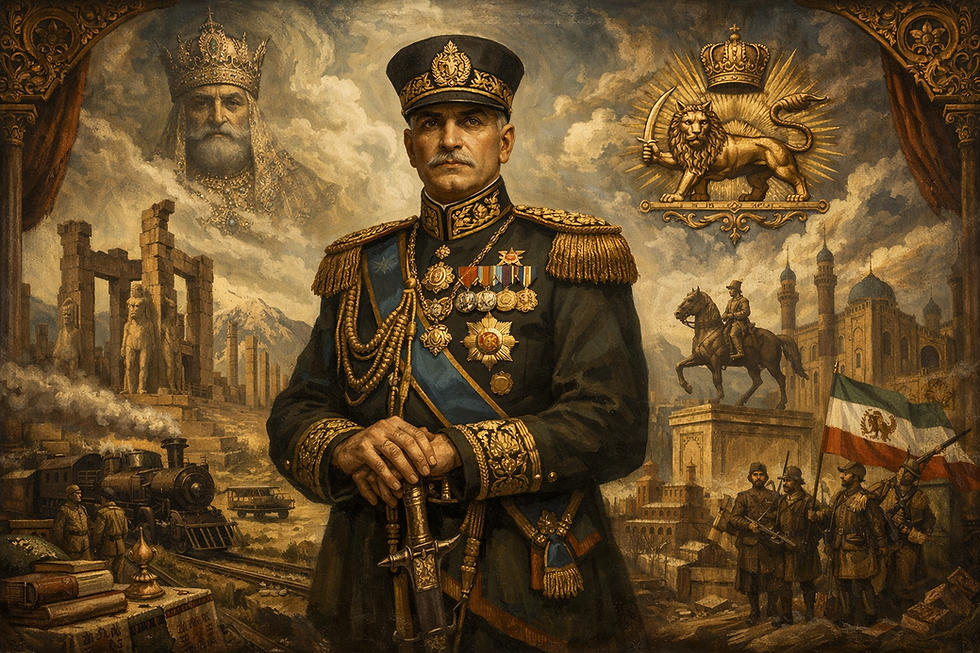
Over the next four years, Reza Khan systematically dismantled the old order. He used tax proceeds to build up the army, then used the army to collect more taxes, extending central government control over regions that had been autonomous for centuries. Tribal leaders were crushed or co‑opted. By 1925, he had gained control over the entire country.
On 12 December 1925, the parliament—now reduced to a rubber stamp—declared Reza Khan the new shah. He chose the dynastic name Pahlavi, after the Middle Persian script of the Sasanian Empire. This was not a neutral choice.
It signaled a radical ideological departure: the new monarchy would anchor its legitimacy not in Islam but in the pre‑Islamic Persian imperial past. The message to the powerful clerical establishment was clear: they would be subordinate to the state, not its partners.
The Construction of National Mythology: Persia Before Islam
Central to the Pahlavi project was a deliberate attempt to anchor the monarchy’s legitimacy not in Islam, but in the Persian imperial past. Mohammad Reza Shah Pahlavi consciously linked his rule to the ancient Achaemenid Empire; the dynasty of Cyrus and Darius that forged the first great Persian civilisation in the fifth century BC.
The 1971 Persepolis celebrations, marking 2,500 years of Persian monarchy, were “the most theatrical expression of this claim: a declaration that the Pahlavi throne was not a modern construction but the inheritor of an unbroken imperial tradition.”
This ideological move sought to place the Shah above religion; a king of kings in a lineage older than Islam itself. It also alienated the clergy, who would become his most implacable enemies.
Reza Shah’s Authoritarian Modernization (1925–1941)
Reza Shah’s project was straightforward: transform a fragmented, near‑feudal state into a centralized, secular, industrializing nation. He built the Trans‑Iranian Railway, connecting the Caspian Sea to the Persian Gulf. He established the first modern university, sent students abroad, and opened secular schools across the country.
It was done not with the best interests of Iranians at heart, but to cripple the clerical power. He created a national bank, standardized weights and measures, and replaced Islamic courts with a French‑inspired legal code. The number of industrial plants grew from twenty to nearly 350 during his reign. Tehran’s population tripled. The national budget increased more than tenfold.
But these gains were purchased at a terrible price. Reza Khan banned trade unions and political parties, silenced the press, and ruled through military decree. His most explosive policy, the 1936 decree banning the Islamic veil in public, was not a gesture of liberation but an act of state violence.
Police were ordered to physically remove headscarves from any woman who wore them in public. Women who resisted were beaten, their homes forcibly searched. This was state feminism as a weapon of desacralization, and it permanently alienated the religious classes.
Beneath the surface of modernization, the old structures of power persisted. A 1972 U.S. intelligence report later noted that power in Iran remained in the hands of a small segment of society; the shah, the royal family, courtiers, and a handful of connected businessmen, politicians, and educators. Reza Shah had not broken the elite; he had simply replaced the Qajar elite with his own.
The 1941 Invasion and Forced Abdication
The dynasty’s first major crisis came during World War II. Reza Shah had cultivated ties with Nazi Germany as a counterweight to British and Soviet influence. In August 1941, Britain and the Soviet Union, now allies against Hitler, invaded Iran.
Their stated goal was to secure a supply corridor to the Soviet front and to secure the oil fields. Their unstated goal was to depose a monarch they considered dangerously pro‑Axis.
The invasion was swift and devastating. British and Soviet forces overwhelmed the Iranian army within days. Reza Shah was forced to abdicate in favor of his 22‑year‑old son, Mohammad Reza Pahlavi. The old shah was sent into exile; first to Mauritius, then to Johannesburg, where he died in 1944.
The young shah ascended to a throne that had been humiliated by foreign occupation. The lesson was not lost on him: his father’s authoritarian strength had not been enough to withstand the great powers. He would need to navigate more carefully.
The Young Shah’s Weak Start (1941–1951)
For the next decade, Mohammad Reza was largely a ceremonial figure. The wartime occupation weakened the monarchy, and the post‑war period saw a flourishing of political activity.
The communist Tudeh Party gained hundreds of thousands of members and trade union affiliates. Nationalist figures demanded an end to foreign domination.
The young shah survived an assassination attempt in 1949 and a failed communist‑backed coup attempt the same year. He was, by all accounts, an insecure and inexperienced ruler who lacked his father’s iron will.
The 1951 Oil Nationalization: Mossadegh’s Challenge
In 1951, the political crisis came to a head. The Anglo‑Iranian Oil Company—the predecessor to BP—had been exploiting Iran’s oil for decades under terms that were grotesquely one‑sided. In 1947, the company reported profits of £40 million while paying Iran roughly £7 million. The disparity was impossible to ignore.
The Majlis, Iran’s parliament, responded by nationalizing the oil industry. The man who led the charge was Mohammad Mossadegh, a charismatic, elderly nationalist with a doctorate in law from Switzerland. He became prime minister in April 1951.
His grievance was concrete, his support broad; it spanned secular nationalists, the communist Tudeh Party, and even many clerics who saw foreign domination as an affront to Islam.
Britain retaliated with economic warfare. It withdrew technical staff, imposed a de facto embargo on Iranian oil, and blockaded Iran’s ports. The Iranian economy began to crumble. But Mossadegh refused to back down.
He also moved to curb the shah’s powers, reducing the monarchy to a ceremonial role and taking direct control of the military. The shah, seeing his authority evaporate, grew desperate.
The 1953 Coup: The Destruction of Democratic Nationalism
The 1953 coup is the hinge of modern Iranian history; and the single most destructive Western intervention in shaping the Iran that would follow. The CIA and MI6 (overtly government agencies but covertly servants of the degenerate elite), determined to protect British oil interests, launched Operation Ajax.
The CIA drafted a detailed propaganda playbook. It bolstered the shah’s image, bribed newspapers, paid mobs to demonstrate, and spread false rumors linking Mossadegh to the communist Tudeh Party. On 19 August 1953, the coup succeeded. Mossadegh was arrested. The shah, who had briefly fled the country, returned in triumph.
The consequences were catastrophic for Iranian political development. The coup destroyed the country’s most robust democratic movement. It eliminated the secular, nationalist alternative to both monarchy and clerical rule.
It left only two organized forces capable of opposing the shah: the brutally suppressed communist left and the clerical network led by an obscure exile named Ruhollah Khomeini. By clearing the middle ground, Western intervention cleared the path for the revolution that would come twenty‑six years later.
The suppression of this history was systematic. A 1989 State Department volume on U.S.‑Iran relations omitted any mention of the covert operation. Historians called it a fraud; the New York Times said it was Hamlet without the Prince of Denmark.
The full record was not released until 2017; and even then, ten documents remained fully withheld. The CIA had destroyed most of the original operational cables in a mid‑1960s office purge. The coup remains the foundational conspiracy of modern Iranian politics, the event that justifies all subsequent suspicions of foreign intervention.
Part III: The Instruments of Financial Colonialism
The British Empire (backed by banking interests), unlike its French or Russian rivals, preferred the ledger book to the bayonet. Where other powers conquered territory and administered directly, Britain perfected a subtler technology of control: the concessionary bank.
By securing exclusive rights to issue currency, manage state finances, and control credit, a single financial institution could bind a sovereign nation to London's will without the expense of formal colonization.
The Imperial Bank of Persia was the purest expression of this method; a private British bank that functioned as the Qajar state's central bank, tax collector, and moneylender, all while answering to a board of directors in London.
Yet this system of financial control produced its own contradictions. By the 1920s, Iranian nationalists had identified foreign banking domination as the core mechanism of their country's subjugation.
The response was not revolution but counter‑expertise: the invitation of American financial advisors, beginning with Morgan Shuster in 1911 and continuing with Arthur Millspaugh in the 1920s and 1940s. These Americans were seen as neutral outsiders who could untangle Iran from the British‑Russian financial vise.
The Reuter Concession: The Blueprint for Financial Colonization
The Imperial Bank of Persia was not the first attempt to place Persia under foreign financial control; it was the successful second attempt. The original blueprint was the Reuter Concession of 1872, a document so sweeping that it amounted to the privatization of the Persian state.

Baron Julius de Reuter, born Israel Beer Josaphat, a German‑Jewish banker who converted to Christianity (likely a crypto-Jew) and became a British subject, negotiated a concession granting him exclusive rights over virtually all of Persia's natural resources, railroads, and banking for seventy years.
The concession was hidden from the British government until the last minute, alarming both the British and Russian governments upon its revelation. Local populations resented it, protesting that the Shah had granted all the resources of the land to a foreigner. The concession collapsed under Russian pressure, but the template was set.
The 1889 Founding: A Bank Wrapped in a Royal Charter
Seventeen years later, Reuter tried again. In 1889, he secured a revised concession to establish a state bank with the exclusive right to issue notes and tax‑free status for sixty years. The Imperial Bank of Persia was established in London under British law, with its operations centered in Tehran.
It was granted a royal charter, operated as Persia's central bank and bank of issue until 1929, and introduced European banking to a country that had previously relied on smaller Jewish moneylenders (sarrafs) and gold coinage.
The suppressed dimension here is the bank's legal schizophrenia. It was a British bank in every meaningful sense—its legal center was London, it was subject to British law, and its board answered to British shareholders—yet it functioned as the Persian state's bank of issue.
This arrangement gave Britain control over Persia's currency, credit, and international financial relations without any of the formal responsibilities of colonial administration.
The Board of Directors: London Banking Families Behind the Façade
The bank's first owner, Joseph Rabino, was born in London to an Italian Jewish family. Rabino served eighteen years in Persia and was instrumental in building the bank's reputation, but the board regarded him with "great suspicion."
The suspicion was not personal but structural: the London board wanted a manager they could control, not an independent operator with local ties.
The broader board composition reflected the dense intermarriage of London's financial elite. The same families—the Rothschilds, the Barings, the Sassoons—sat on multiple imperial bank boards, creating a network of overlapping directorships that coordinated British financial policy across the empire.
The suppression of these connections is systematic: corporate archives remain closed, and the personal papers of the banking families are held in private collections inaccessible to researchers.
The Banking War: Imperial Bank vs. Banque d'Escompte
The Great Game was fought not only with cavalry and spies but with ledgers and credit. Russia responded to the Imperial Bank's establishment by creating its own financial instrument: the Banque d'Escompte et des Prêts de Perse (Loan and Discount Bank of Persia), founded in 1890 by the Russian merchant Yakov Polyakov.
The key suppressed dimension is that while the Imperial Bank remained a private profit‑seeking institution, the Russian bank was purchased by the Russian government in 1894 and became a department of the Russian Finance Ministry; in effect, an arm of the Russian state.
The Russian bank's method was straightforward and effective: immediately after its founding, it began granting low‑interest loans to Persian princes, influential clerics, and merchants.
By 1900, Russia had brought nearly the entire Persian political elite into financial dependency. The Imperial Bank could not match this state‑backed lending, but it did not need to; it controlled the currency.
The 1907 Anglo‑Russian Convention formalized this banking war's outcome, partitioning Persia into British and Russian spheres of influence. But the suppressed truth is that the partition was not merely territorial; it was financial.
British banks dominated the south and east; Russian banks dominated the north and west. Persian sovereignty existed only in the narrow buffer zone where the two financial empires could not agree on borders.
The Reorganization of 1929: What Survived the Name Change
The Imperial Bank of Persia operated as the state bank and bank of issue until 1929, when its note‑issuing privileges were transferred to the newly established Bank Melli Iran. In 1935, following Persia's official name change to Iran, it was renamed the Imperial Bank of Iran.
The same British personnel, the same London board, and the same financial networks continued to operate under the new name. The bank simply shifted from central banking to commercial banking, extending its operations across the Middle East.
In 1949, it was renamed the British Bank of Iran and the Middle East, and in 1952, its Iranian operations were terminated entirely. But the bank did not disappear; it evolved. The remaining activities outside Iran became the British Bank of the Middle East (BBME), purchased by HSBC in 1959 and now called HSBC Bank Middle East.
The Imperial Bank's institutional DNA—its board networks, its lending practices, its relationships with British intelligence—passed directly into one of the world's largest banking corporations.
How Imperial Bank Infrastructure Survived into the Islamic Republic
After the 1979 Iranian Revolution, all of the bank's Iranian activities were transferred to Bank Tejarat. Bank Bazargani, which had been restructured from the Imperial Bank's former business, became the nucleus of Bank Tejarat.
This is not merely a corporate succession; it is a suppressed continuity. The physical infrastructure, the loan books, the customer relationships, and—most significantly—the intelligence networks built by the Imperial Bank over ninety years passed intact into a state‑owned Iranian bank.
The pattern evidence suggests that the Imperial Bank's archives, containing decades of financial and political intelligence, were not destroyed but transferred. Their current location and accessibility remain unknown.
Arthur Millspaugh: The American Who Could Not Break the System
When Persia requested an American financial advisor in 1922, the choice fell on Arthur Chester Millspaugh, a former State Department foreign trade advisor with a PhD from Johns Hopkins.
He arrived in Tehran in November 1922 to find the treasury empty and the fiscal administration in chaos. The country was kept solvent only by advances from the Imperial Bank of Persia.
Millspaugh's achievements were real. Within a year, he established a budget, centralized tax collection, reduced waste, and brought Persia close to paying its own way. His reforms financed Reza Shah's Trans‑Iranian Railway project, which began construction in 1927.
He faced opposition; not from Iranians alone, but from the Imperial Bank and its London backers. British financial interests saw Millspaugh as a threat to their control. The Persian public, meanwhile, had expected Millspaugh to produce American loans and investment.
When none materialized, disappointment turned to resentment. As a British Legation report noted, the average Persian argued that the mission was hired at great expense on the tacit understanding that it would produce American money, but Millspaugh "has as yet produced no money from Wall Street."
The tension came to a head in 1924, when Millspaugh had a "full‑dress row" with the Persian government, twice threatening to resign before getting his way. His contract was renewed for two more years, but the underlying resentment never dissipated.
The mission ended in 1927 with Millspaugh's authority terminated; officially over his refusal to comply with Reza Shah's demands for increased military spending, but in reality because he had failed to deliver the American financial rescue that everyone expected.
It shouldn't be forgotten that the US State Department's foreign trade advisers in this period worked closely with private banking interests to advance American commercial diplomacy.
Millspaugh's inability to deliver American loans was not necessarily his failure; it reflected a deeper structural reality: American banks had not yet developed the imperial reach of their British counterparts. The House of Morgan, despite its power, did not have a Persian branch. The Imperial Bank did.
The Second Mission (1942–1945): Wartime Desperation and Final Failure
Millspaugh returned to Iran in 1942 at the invitation of the 13th Majles, granted temporary legislative authority to reform the economy. World War II had devastated Iran's finances; the country was occupied by British and Soviet forces, inflation was rampant, and the currency was collapsing.
According to U.S. State Department documents, Millspaugh reported seeing "almost no possibility of success" due to lack of staff, the uncooperative attitude of the Majles, and "widespread graft, obstruction and sabotage" within Iranian government circles.
The sabotage was not random; it was organized by entrenched interests, including, pattern evidence suggests, elements connected to the Imperial Bank's remaining networks, who saw financial reform as a threat to their control.
The second mission ended in 1945, a failure. Millspaugh published a book on his experiences, Americans in Persia, but his legacy was mixed: he had balanced budgets and built infrastructure, but he had not broken the foreign financial domination that he had been sent to end. It is not surprising, considering
The Shuster Precedent: The Unfulfilled Legacy
Millspaugh fancied himself "the successor to Morgan Shuster's unfulfilled legacy of restructuring Iran's economy." Morgan Shuster, the American financial advisor appointed by the Majlis in 1911, had been forced out by the Russian ultimatum that led to the Constitutional Revolution's collapse.
Shuster's fate haunted Millspaugh: if Russia could expel an American financial advisor in 1911, Britain could neutralize one in the 1920s and 1940s.
The pattern is clear: American financial missions to Iran, from Shuster to Millspaugh, were invited with high hopes and ended in failure. The cause was not incompetence but structural opposition from entrenched foreign banking interests that controlled Iran's credit, currency, and international financial relations.
Iranian Intermediaries and British Intelligence
The Imperial Bank of Persia could not operate solely through British expatriates. It relied on a network of Iranian intermediaries; the sarrafs (traditional Jewish moneylenders), Persian courtiers who had been bribed or indebted, and provincial governors who depended on the bank's credit. These intermediaries formed a shadow financial system that persisted long after the bank's formal departure.
The suppression of these networks is deliberate. The bank's archives, if they survive, would name names. Without access, we can only trace patterns: the same families that served as Imperial Bank intermediaries in the 1920s reappear as facilitators of British commercial interests in the 1950s, and as financial connectors in the post‑revolutionary period.
The Rothschild Presence: Baku Oil and Persian Finance
The Rothschilds' direct role in Persian finance was limited; the Imperial Bank was a competitor, not a subsidiary. And by the time oil was struck in Persia in 1908, the Rothschilds were already a superpower in the global oil trade.
A North Caspian Empire: They had made enormous investments in the Baku oil fields on the western shore of the Caspian Sea. Through their French banking branch, they owned the Caspian-Black Sea Oil Industry and Trade Society (BNITO), making them the second-largest producer in the region.
Commanding the Supply Chain: To move this oil from the land-locked Caspian to Europe, they strategically invested $10 million in the Baku-Batum railway in 1883. They also built a fleet of tankers for the Caspian Sea and even owned the largest factory in Batumi producing oil cans.
By the turn of the century, they had built an integrated, independent oil empire. This is crucial context: they were a major, established player long before the D'Arcy Concession.
The Iranian Calculus: Why Compete When You Can Control?
The discovery at Masjed Soleiman in 1908 created a powerful new rival. When the Anglo-Persian Oil Company (APOC) was founded the following year, it represented a direct threat to Rothschild market share.
The Rothschild response was not to buy a piece of APOC, but to ensure that APOC’s success would still serve their broader interests. Their strategy centered on controlling the global market and the region's financial infrastructure.
Global Market Control: By 1913, declassified British documents confirm the Rothschilds, through their refineries in the Caucasus and their commercial alliance with Royal Dutch Shell, controlled the majority of global oil trade. They saw Persia not as a new frontier, but as a natural extension of their energy empire. Their goal was not to extract oil from the ground, but to control the price and distribution of whatever oil was extracted.
Financial Control of Persia: The Rothschilds' primary instrument of power in Persia was financial, not industrial. They were a dominant force in the London and Paris banking houses that controlled Persian state finances, trade credits, and the flow of loans. This gave them immense influence over the same economic levers that determined the profitability of any business venture in the country.
The Hidden Web: Connections, Not Ownership
While the Rothschilds may not have been on APOC's board, their deep web of familial and financial connections meant their influence was still felt.
Overlapping Elites: The same intermarried Jewish banking families that sat on the Imperial Bank of Persia's board and were connected to the Rothschilds were the financiers who greased the wheels of British oil imperialism. The flow of capital and intelligence between these groups was a matter of family dinners, not just corporate minutes.
A Potential Stake in the Mosul Prize: Declassified British government files from 1913 (IOR/L/PS/10/300) reveal that "Rothschild et Cie" offered £500,000 to the Turkish government for oil rights in Mesopotamia. This demonstrates that their eye was always on the larger regional prize, of which Persian oil was just one part.
In essence, the Rothschild interest in Iran was a classic exercise in systemic leverage. They did not need to directly own a concession. Their deep entrenchment in Baku gave them the global market power to be a price-maker.
Their dominant position in European finance gave them control over the region's financial arteries. By leaving the risky business of extraction to others, they positioned themselves to profit from the entire system regardless of which specific company struck oil.
The interlocking directorates between APOC, the Imperial Bank, and the London banking houses were the same financiers who sat on the Imperial Bank's board, who also held stakes in APOC. The bank's lending decisions were not made in isolation; they served the broader interests of British oil imperialism.
The Transformation of the Imperial Bank
The Imperial Bank did not fail; it evolved, rebranded, and passed its infrastructure to HSBC and, through Bank Tejarat, into the Islamic Republic. The Millspaugh missions failed because they could not break the structural logic of foreign financial control.
Iran's financial subordination to foreign powers did not end with the Imperial Bank's departure in 1949, nor with the oil nationalization of 1951, nor with the 1979 revolution. It simply changed form. The same families, the same networks, and the same institutional logics adapted to new circumstances. The Imperial Bank's archives, if they ever see the light, would reveal the names and the methods.
Until then, the hidden dimensions remain hidden; not because the evidence does not exist, but because the institutions that benefit from its suppression have the power to keep it that way.
Appendix: Timeline of Key Events
1872 | Reuter Concession grants Baron Julius de Reuter monopoly over Persian resources
1889 | Imperial Bank of Persia established under British royal charter
1890 | Russian Banque d'Escompte et des Prêts de Perse founded by Yakov Polyakov
1894 | Russian government purchases Banque d'Escompte, making it a state bank department
1907 | Anglo‑Russian Convention partitions Persia into British and Russian spheres
1911 | Morgan Shuster's American financial mission forced out by Russian ultimatum
1922 | Arthur Millspaugh arrives in Tehran for first mission (1922–1927)
1928 | Bank Melli Iran established under Reza Shah
1929 | Imperial Bank loses note‑issuing privileges to Bank Melli
1932 | Imperial Bank transitions to commercial banking
1942 | Millspaugh returns for second mission (1942–1945)
1949 | Imperial Bank renamed British Bank of Iran and the Middle East; operations in Iran terminated
1952 | Imperial Bank's remaining Iranian business restructured as Bank Bazargani
1959 | BBME purchased by HSBC
1979 | Bank Bazargani becomes nucleus of Bank Tejarat after Iranian Revolution

Part IV: The White Revolution: Unintended Consequences
After 1953, the shah ruled as an absolute monarch. He abolished the multi‑party system, replacing it first with a two‑party system that he controlled (the American formula), then with a single‑party state.
He created SAVAK, the secret police and intelligence service, with direct assistance from the CIA and Mossad. SAVAK became notorious for its surveillance and torture. Political opponents were subjected to electric shock, nail extraction, and other methods that Amnesty International would later describe as among the worst in the world.
The shah also cultivated an elaborate personality cult. He was the King of Kings, the Light of the Aryans, the Guardian of the Persian Empire. His image was everywhere; in schools, government offices, and the newly expanded state media.
The 1971 Persepolis celebrations, marking 2,500 years of Persian monarchy, were the most theatrical expression of this claim. The shah spent hundreds of millions of dollars on tents, food, and entertainment for world leaders while ordinary Iranians struggled with inflation and unemployment. The message was unmistakable: the shah placed himself above the nation, above religion, above history itself.
But the foundation was sand. The shah had eliminated all independent political organization. He had no mechanism for absorbing dissent, no channel for peaceful change, no reservoir of genuine popular support. When the revolution came, the regime collapsed not because it was weak, but because it had made weakness invisible by silencing every voice that might have warned of the coming storm.
In 1963, Mohammad Reza Shah launched the White Revolution, a six‑point program of reform. It called for land reform, nationalization of the forests, the sale of state‑owned enterprises to private interests, electoral changes to enfranchise women and allow non‑Muslims to hold office, profit‑sharing in industry.
The land reform backfired, causing massive internal migration of villagers to the cities, which were unprepared to absorb them. This created a dislocated urban underclass that would become the foot soldiers of the 1979 revolution.
The White Revolution also triggered widespread opposition, with Ayatollah Khomeini emerging as the leader of Islamist dissent in 1963 before being arrested and eventually exiled.
The 1963-1964 Break: Arrest, Uprising, and Final Exile
The final rupture between the Shah and Khomeini was a two-act drama, precipitated by the Shah's top-down "White Revolution."

Act One — The June 1963 Uprising: The immediate cause of the 1963 crisis was the Shah's "White Revolution," a six-point program announced in January 1963. Khomeini viewed the plan as a humiliating capitulation to the West and a direct assault on the clergy's power and Islamic values.
His denunciation of the Shah in a fiery speech on June 3, 1963, at the Feyziyeh Theological School, was the final straw. This single speech so infuriated the Shah that he ordered Khomeini's arrest in the early hours of June 5, 1963.
Khomeini’s arrest triggered the 15th of Khordad Uprising, a massive, nationwide protest that spread from Qom to Tehran, Shiraz, and Mashhad. The scale of the uprising shocked the regime, and the Shah’s security forces responded with overwhelming force, killing an estimated 15,000 protesters and crushing the revolt.
Act Two — The Capitulation and Final Exile (November 1964): Khomeini was released from house arrest in April 1964. However, the Shah soon reignited the conflict by signing a bill granting diplomatic immunity (capitulations) to all U.S. military personnel and their families in Iran. For Khomeini, this was not a technical legal issue but the ultimate proof of Iran’s status as a Western colony, making the Shah a puppet of America.
In a furious response in November 1964, Khomeini openly attacked the Shah and warned the American ambassador that U.S. officials "would no longer have any respect for the Iranian people." This direct assault on the Pahlavi-American alliance was the "straw that broke the camel's back."
The Regime's Calculus — Exile Over Execution: The Shah and his intelligence agency, SAVAK, faced a dilemma. They could not execute Khomeini. As a Grand Ayatollah, killing him would have created a Shiite martyr, likely triggering an uncontrollable, nationwide religious uprising. Instead, they opted for exile, hoping that "in exile he would fade from popular memory."
Early on November 4, 1964, commandos seized Khomeini and flew him directly to Turkey. It was a fateful miscalculation. The decision to exile Khomeini did not silence him; it transformed him from a domestic dissident into a global revolutionary icon, free to spread his message of resistance to the entire world.
SAVAK: The Institutionalization of State Security — Trained by the CIA
The Shah’s secret police, SAVAK (Sazeman‑i Ettela’at va Amniyat‑e Keshvar), became notorious for its extensive surveillance, repression, and torture of political dissidents; as documented by Amnesty International and other human rights organizations.
What is less frequently acknowledged in Western accounts is that SAVAK was trained by the CIA and Mossad. The methods of interrogation and surveillance that would later be attributed to the Islamic Republic’s security forces were, in significant part, Western‑exported technologies of control.
Pattern implication: Western powers trained the very apparatus that would later be turned against their own interests after the revolution.
The Tudeh Party and the Left: The Crushed Alternative
The Tudeh Party, Iran’s communist organization, had at most 25,000 members, but its trades union affiliates had up to 400,000 members in the 1940s. After the 1953 coup, the party was systematically destroyed.
Its leaders were arrested, and according to multiple accounts, subjected to torture; its union networks were dismantled. The left would never recover; a fact that would later allow Khomeini’s faction to monopolize the revolution.
The suppression of the Tudeh Party is a critical piece of the pattern: each time a secular, democratic, or leftist alternative emerged, it was crushed by a combination of the Shah’s forces and Western support.
By 1979, the only organized opposition left standing was the clerical network that had been building its infrastructure in the mosques; an infrastructure that the Shah had largely left untouched because it did not directly challenge his rule until too late.
Part V: The Islamic Revolution of 1979

The 1979 revolution was not inevitable, but it was overdetermined by the Shah’s authoritarian modernization, the brutality of SAVAK (trained by the CIA), the 1953 coup’s destruction of democratic alternatives, and Khomeini’s charismatic leadership from exile.
Khomeini returned to Tehran on 1 February 1979, enthusiastically welcomed home by over four million people. Within weeks, a referendum approved the establishment of an “Islamic Republic”—a form of government not yet defined.
The ambiguity was deliberate: Khomeini and his allies would later define it as velayat‑e faqih, “the guardianship of the Islamic jurist,” granting ultimate power to the religious leader.
Critical pattern observation: The revolution was a popular uprising against a Western‑backed dictator. Its anti‑Western character was not a theological abstraction but a direct response to decades of foreign intervention.
The hostage crisis, the burning of Western symbols, the rejection of liberal democracy; all of these were, from the revolutionaries’ perspective, justified reactions to the 1953 coup and its aftermath.
The Hostage Crisis: The Embassy Seizure and Document Release
On 4 November 1979, student militants seized the U.S. Embassy in Tehran, taking 52 hostages. The hostage crisis lasted 444 days and defined the revolution’s relationship with the West.
The students also seized thousands of documents; cables, reports, intelligence files. “The Iranian students who stormed the US embassy in 1979 and released thousands of secret CIA documents were the WikiLeaks of their time,” their spokesperson later said. “The documents unveiled the CIA’s attempts to recruit leading Iranian politicians; including a liberal who became the first post‑revolution president, Abol Hassan Bani‑Sadr.”
The U.S. government’s response was to destroy as much as possible. “Although virtually all CIA documents in the Embassy were destroyed, a safe containing Iranian, U.S. currency notes was seized by the Iranians.”
The hostage crisis remains a suppressed dimension in American historiography; a fact that the captured documents themselves continue to illuminate.
The Iran–Iraq War (1980–1988): Western Support for Saddam Hussein
The Iran–Iraq War began when Iraq invaded Iran, launching a simultaneous invasion by air and land into Iranian territory on 22 September 1980. It lasted eight years, causing around 500,000 deaths, making it the deadliest conventional war ever fought between regular armies of developing countries.
Most critically for this analysis: Iraq engaged in chemical warfare against Iran on multiple occasions, including more than 30 targeted attacks on Iranian civilians. Estimates of casualties from chemical weapons range from 50,000 to more than 100,000.
The international community, including Western powers that had armed Iraq, did nothing to stop Saddam Hussein’s chemical attacks. The Halabja massacre, in which Iraqi forces killed between 3,200 and 5,000 Kurdish civilians with chemical weapons, occurred in 1988 with full knowledge of U.S. intelligence.
Pattern implication: Western support for Iraq during the war—including intelligence sharing, dual‑use technology transfers, and diplomatic cover—directly enabled the deaths of tens of thousands of Iranian civilians.
This support was later cited by Iranian hardliners as proof that the West could not be trusted, that negotiations were futile, and that only military self‑reliance and ideological purity would protect the nation.
The war and Western complicity in Iraqi chemical attacks radicalized a generation of Iranian leaders, many of whom remain in power today. In this sense, Western interventionism did not merely fail to moderate the Islamic Republic; it actively strengthened its most extreme factions.
The war also saw the suppression of internal dissent. The Mojahedin‑e Khalq (MEK),a combination of Islam and Marxism that had fought the Shah, was crushed after the revolution.
Its members were executed, exiled, or driven into a violent exile opposition that would later align with Saddam Hussein; a decision that further justified regime hardliners’ claims that all opposition was treason.
Part VI: The Consolidation of Velayat‑e Faqih

After Khomeini’s death in 1989, the regime faced its first succession crisis. Ayatollah Ali Khamenei, a mid‑ranking cleric without Khomeini’s theological credentials, was elevated to Supreme Leader.
“Khamenei reshaped Iran’s Islamic Republic after taking power in 1989 following the death of Ayatollah Ruhollah Khomeini, the fiery revolutionary who established clerical rule.”
The constitution was amended to expand the Supreme Leader’s powers. The constitutional concept of Velayat‑e Faqih presented a significant rupture with the separation between siyasat (politics) and fiqh (Islamic jurisprudence).
In practice, this created a constitutional order characterised by considerable internal contradictions; an unelected cleric with absolute authority over an ostensibly republican system.
The Reform Movement and Its Suppression
The 1997 election of Mohammad Khatami, a reformist who campaigned on the rule of law, civil society, and dialogue with the West, raised hopes of democratic opening. Khatami won 70% of the vote. But the Supreme Leader and the Guardian Council (an unelected body of clerics) retained veto power over all legislation and candidates.
The reform movement was systematically suppressed. Newspapers were closed. Reformist politicians were arrested. Crucially, this suppression occurred in parallel with escalating U.S. sanctions; the Iran‑Libya Sanctions Act of 1996, the designation of the IRGC as a terrorist organization, and the 2002 “Axis of Evil” speech.
Multiple analysts have noted that external pressure consistently undercut reformists, who were accused by hardliners of being soft on the West or even traitors. Each round of sanctions strengthened the hand of those who argued that engagement was impossible and that only resistance would work.
By 2005, the hardliner Mahmoud Ahmadinejad had been installed as president, with the Guardian Council disqualifying all serious reformist candidates. Ahmadinejad’s Holocaust denial and aggressive nuclear posture, the very traits that Western governments pointed to as justification for sanctions, were arguably exacerbated by the sanctions themselves.
Part VII: The Green Movement (2009)

The 2009 presidential election, in which Ahmadinejad was declared the winner by a landslide, was widely seen as fraudulent. “Opposition protesters took to the streets chanting ‘where is my vote?’”
The resulting Green Movement was the biggest challenge to the Islamic Republic since the 1979 revolution.
The regime responded with force. International human rights organizations documented what they described as a brutal crackdown. The ferocity of the response traumatized the opposition.
Pattern observation: The Green Movement’s suppression, while documented by external observers, occurred against a backdrop of continued Western sanctions and threats of military action.
Reformist leaders such as Mir‑Hossein Mousavi had advocated engagement and dialogue; their failure to deliver tangible results (whether due to regime intransigence or external pressure) discredited the reformist project in the eyes of many Iranians.
The crackdown was enabled by a security apparatus inherited from the Shah and refined over decades; but it was also a predictable reaction from a regime that saw any mass movement as potentially foreign‑backed, given the history of the 1953 coup.
The 2019 November Protests: Fuel Price Hikes and Economic Pressure
In November 2019, the government raised fuel prices by 50%. Protests erupted across 21 cities. The regime cut the internet and launched a crackdown. Amnesty International reported at least 106 people have been killed since the protests began, with the real death toll may be much higher, with some reports suggesting as many as 200 have been killed.
The fuel price hike was a direct consequence of U.S. sanctions, which had severely reduced Iran’s oil revenues. The Trump administration’s “maximum pressure” campaign, which reimposed sanctions after withdrawing from the JCPOA, aimed to force Iran to renegotiate its nuclear program and regional policies. The effect, however, was to impoverish ordinary Iranians and trigger protests that the regime then crushed.
Pattern implication: Sanctions, intended to pressure the regime, instead created the economic conditions for unrest; and then provided the regime with a justification (foreign‑provoked instability) for intensified repression.
The Mahsa Amini Protests (2022–2023): Woman, Life, Freedom
On 16 September 2022, Mahsa Amini, a 22‑year‑old Kurdish woman, died in police custody after being arrested by the “morality police” for allegedly violating the mandatory hijab law. Her death sparked nationwide protests with the slogan ‘woman, life, freedom.’
The regime responded with what international observers described as a severe crackdown. Through October, November and December 2022 hundreds of thousands of people in cities across Iran raged against the casual brutality of the regime.
The protests continued into 2023, though the regime succeeded in quashing all displays of public discontent through mass arrests, and according to human rights groups, what they characterized as torture and executions.
Critical framing: While the morality police and the enforcement of hijab are internal matters of the Islamic Republic, the regime’s harsh response must be understood in the context of external pressures that have radicalized the security apparatus.
The IRGC and Basij see themselves as defending the revolution against foreign‑backed “hybrid warfare”—a perception reinforced by U.S. sanctions, the assassination of Qassem Soleimani, and repeated Israeli strikes on Iranian targets.
The regime’s claim that protests are foreign‑instigated is not merely propaganda; it reflects a genuine belief rooted in the documented history of Western interventions (1953, the MEK’s alliance with Saddam, and ongoing covert operations).
The Nuclear Program: From Atoms for Peace to JCPOA to Withdrawal
Iran’s nuclear program began under Shah Mohammad Reza Pahlavi in the 1950s as part of the U.S. Atoms for Peace initiative. After the revolution, the program continued, becoming a source of international tension.
In the late 1990s and early 2000s, Iran ran a covert project to develop and test nuclear weapons called the Amad Plan; though Iran has consistently denied seeking nuclear weapons, and the U.S. intelligence community’s 2007 National Intelligence Estimate concluded that Iran had halted a nuclear weapons program in 2003.
The 2015 Joint Comprehensive Plan of Action (JCPOA) placed significant restrictions on Iran’s nuclear programme in exchange for sanctions relief after 12 years of crisis and 21 months of negotiations. The U.S. withdrawal from the deal in 2018, under President Trump, led Iran to begin phasing out its obligations.
Pattern observation: The withdrawal from the JCPOA is widely cited by non‑proliferation experts as having strengthened Iranian hardliners, who had opposed the deal from the start, and weakened Iranian moderates who had staked their credibility on the economic benefits of engagement.
“When the U.S. broke its promise, it proved the hardliners right,” one analyst noted. “They had always said the West could not be trusted. Now they had the evidence.”
Part VIII: The Destruction of the 1953 Archive
The CIA has consistently refused comment on the matter, saying that most of the records of its involvement in Iran at the time were ‘lost or destroyed’ in the mid‑1960s.
The original TPAJAX operational cables appear to have been destroyed as part of an office purge undertaken in 1961 or 1962. The systematic destruction of evidence is itself evidence of intent to conceal the extent of Western intervention.
Western Complicity in Chemical Attacks on Iranians
The Reagan administration’s “green light” to Saddam Hussein’s use of chemical weapons has been documented by multiple sources. While the U.S. publicly condemned chemical warfare, declassified intelligence shows that the U.S. continued to provide Iraq with satellite imagery, agricultural credits, and dual‑use technology that enabled chemical weapons production. No Western official was ever held accountable for this complicity.
The Suppression of the Left
The Tudeh Party’s destruction after 1953, and the Mojahedin’s suppression after 1979, eliminated any secular leftist alternative in Iranian politics. This suppression was deliberate and brutal.
The left was so crushingly defeated after the 1979 Islamic revolution in Iran that no serious leftist organization exists inside the country today.
Western powers, focused on Cold War anti‑communism, supported the Shah’s destruction of the left in the 1950s; only to find that the vacuum was filled by Islamists.
The Continuity of Elite Families
Drawing on a longitudinal study of over 2,740 members of the political elite in the Islamic Republic, researchers have documented the most extensive list of familial connections demonstrating nepotism in the Islamic Republic of Iran.
The same families who served the Shah—landowners, merchants, military officers—adapted to serve the Islamic Republic. The revolution changed the ideology; it did not change the elite.
This pattern of elite continuity suggests that the Islamic Republic is less a radical rupture than a rebranding of Iran’s traditional power structure. Although, this is not much different than the West, which practices oligarchy disguised as democracy; especially in the US, where almost every president is related.
The Leaked “Repression Manual”
In January 2026, chilling secret documents and videos obtained exclusively by the Daily Mail have laid bare the inner workings of Iran’s ruthless ‘repression machine’—exposing the hidden war room and brutal tactics used to crush the uprising currently sweeping the country.
The authenticity of these documents has not been independently verified; they are presented as alleged evidence by a Western tabloid with a known editorial stance against the Islamic Republic. However, any claims by American/British media—which serve elite (degenerate) interests—needs to be taken with a grain of salt.
Even if authentic, the documents would confirm what human rights organizations have alleged for decades: a systematic, institutionalized apparatus for maintaining public order, the methods of which are consistent with those inherited from the Shah’s SAVAK (which was trained by the CIA).
Part IX: Recurring Patterns Across Modern World
The Islamic Revolution did not dismantle the Iranian state; it captured it. The military, the bureaucracy, the intelligence services, and the economic elite all survived; rebranded but intact.
The Shah’s authoritarian state became Khomeini’s authoritarian state. SAVAK’s methods—trained by the CIA—became the IRGC’s methods. The only change was the identity of the ruling faction.
This continuity explains why the Islamic Republic has been so durable. It inherited not a broken state but a fully functioning apparatus of control, refined over decades by the Shah and his CIA trainers. It simply redirected that apparatus toward new enemies.
The West, by creating SAVAK, inadvertently built the infrastructure that would later suppress Western‑friendly reformers and sustain an anti‑Western regime.
The 1953 Coup and Global Regime Change
The 1953 coup was not unique. It was part of a broader pattern of CIA‑MI6 operations—Guatemala (1954), Congo (1960), Brazil (1964), Chile (1973)—in which democratically elected governments were overthrown to protect Western corporate interests.
Iran was the template. In each case, the long‑term effect was not stability but radicalization. The 1979 Iranian Revolution, like the rise of leftist movements in Latin America, was a blowback from earlier interventions.
The Islamic Republic and the Saudi Monarchy
Despite their ideological opposition, Iran and Saudi Arabia operate on similar institutional logics: an unelected ruling family (the House of Saud) or an unelected clerical elite (the velayat‑e faqih), both supported by oil revenue, both repressing democratic movements, both using religious ideology as cover for authoritarian rule.
The difference is that Saudi Arabia has been a consistent Western ally; Iran, after 1979, became a consistent Western adversary. The regimes are structurally similar; their treatment by the West is not.
America is not much different underneath the facade. Although they technically "elect" between the two parties, the president is ultimately controlled by the elite (degenerate) oligarchy. Both parties, in the end, either serve local (democrat) or international (republican) interests of the elite (degenerate) class.
The Green Movement and the Arab Spring
The Green Movement (2009) predated the Arab Spring (2011) and in many ways anticipated it. Both were mass uprisings against authoritarian regimes; both were met with brutal crackdowns; both were suppressed but not extinguished.
The difference is that in several Arab Spring countries (Libya, Syria), Western military intervention followed; with catastrophic results. Iran’s regime, observing these outcomes, has used them as propaganda to argue that foreign intervention is the inevitable result of internal dissent.
Part X: Conclusion — Synthesis of Findings
Modern Iran’s trajectory reveals a consistent and tragic institutional logic: First, the 1953 coup was not an aberration but the foundational event of modern Iranian politics. It destroyed democratic nationalism, installed an authoritarian monarchy, and embedded foreign intervention as a recurring mechanism of control.
The coup’s suppression from official histories—the destroyed cables, the redacted documents, the fraudulent 1989 State Department volume—is itself evidence of its importance. More critically, the coup eliminated the secular, democratic alternative that might have prevented the rise of clerical extremism.
Second, Western intervention did not moderate the Islamic Republic; it radicalized it. Each round of sanctions, each threat of military action, each covert operation strengthened the position of hardliners who argued that the West could not be trusted. The reform movement, which offered the best hope for gradual liberalization, was repeatedly undercut by external pressure that allowed hardliners to label reformers as Western agents.
Third, the Islamic Republic’s alleged excesses—its human rights record, its anti‑Western ideology, its nuclear program—must be understood in the context of a system forged in resistance to foreign domination.
This is not to excuse or justify any particular action, but to recognize that the regime’s behavior is a product of its history. A regime that came to power through a popular revolution against a Western‑backed dictator, that fought an eight‑year war in which Western powers armed its enemy with chemical weapons, and that has faced decades of sanctions and military threats, is unlikely to respond to further pressure with moderation.
Fourth, the West trained the very apparatus it now condemns. SAVAK, the Shah’s secret police, was trained by the CIA and Mossad. Its methods of interrogation, surveillance, and control were Western exports.
After the revolution, those methods were inherited by the Islamic Republic’s security forces. The Islamic Republic’s alleged torture apparatus is, in significant part, a Western‑built machine turned against Western interests.
Net Assessment
Positive achievements of Iran’s modern trajectory: Iran has maintained its territorial integrity, developed a significant industrial base, and achieved high rates of literacy and health outcomes. The Islamic Republic has provided a degree of political stability; at a cost that human rights organizations have extensively documented.
Negative legacies, with acknowledgment of Western responsibility: A system of state security that has, according to multiple international human rights organizations, engaged in what they characterize as torture, political imprisonment, and suppression of dissent.
The destruction of democratic alternatives; first by the Shah with Western support, then by the Islamic Republic. A political system in which ultimate power resides with an unelected cleric. These negative features were not created in a vacuum; they were forged in a century of foreign intervention that systematically eliminated moderate alternatives and empowered extremists.
The Lesson for Western Policy
Modern Iran’s history leaves Western policymakers with a question that cuts against decades of conventional wisdom: What if every intervention intended to pressure the Islamic Republic has instead made it more extreme, more repressive, and more hostile?
The pattern evidence suggests this is not a hypothesis but a documented outcome. The 1953 coup created the conditions for the 1979 revolution. The Iran–Iraq War and Western support for Saddam Hussein radicalized a generation of Iranian leaders.
Sanctions strengthened the IRGC’s economic grip. The JCPOA withdrawal proved the hardliners right. The strikes that killed Khamenei in 2026, whatever their immediate tactical success, are likely to produce another generation of anti‑Western militants.
The lesson is not that the Islamic Republic is blameless. The lesson is that Western interventionism has repeatedly produced the opposite of its stated goals (unless they differ from the actual goals of the American Imperium and its degenerate oligarchy that profits greatly from continued war and conflict).
The most effective path to change in Iran may not be more pressure, but less; a recognition that the regime’s extremism is, in significant part, a reaction to external threats. Remove the threats, and the rationale for extremism weakens. This is not appeasement; it is pattern‑based logic applied to eighty years of documented evidence.
Appendix A: Timeline of Key Events (With Emphasis on Western Interventions)
1501 | Safavid Empire established; Shiism as state religion
1794 | Qajar dynasty consolidates power
1890–1892 | Tobacco Protest | British concession |
1905–1911 | Constitutional Revolution | Russian intervention crushes it
21 Feb 1921 | Reza Khan’s coup | None (British passive support)
1925 | Reza Shah crowned
1941 | British‑Soviet invasion forces Reza Shah’s abdication | Direct military intervention
1951 | Mossadegh nationalizes oil | Leads to 1953 coup
19 Aug 1953 | CIA‑MI6 coup (Operation Ajax) | Direct covert intervention
1963 | White Revolution; Khomeini exiled | U.S. supports Shah
1979 | Islamic Revolution | U.S. caught off guard
4 Nov 1979 | U.S. Embassy seized; hostage crisis | U.S. hostage rescue fails
22 Sep 1980 | Iran–Iraq War begins | Western arms to Iraq
1988 | Halabja chemical attack; war ends | U.S. complicity in chemical weapons
1996 | Iran‑Libya Sanctions Act | U.S. sanctions
2002 | “Axis of Evil” speech | U.S. threat
2009 | Green Movement | U.S. sanctions continue
2015 | JCPOA signed | Diplomacy (brief)
May 2018 | U.S. withdraws from JCPOA | Unilateral withdrawal
Nov 2019 | Fuel price protests (sanctions‑driven) | “Maximum pressure” campaign
Sep 2022 | Mahsa Amini protests | Sanctions intensify
Feb–Mar 2026 | U.S.‑Israeli strikes; Khamenei killed | Direct military intervention
Appendix B: Key Figures and Institutions
Shah Mohammad Reza Pahlavi | Last Shah | CIA‑installed; U.S. ally
Mohammad Mossadegh | Elected PM | Overthrown by CIA/MI6
Ayatollah Khomeini | Revolutionary leader | Opposed by West; exiled
Ayatollah Ali Khamenei | Supreme Leader (1989–2026) | Target of sanctions
SAVAK | Shah’s secret police | Trained by CIA, Mossad
IRGC | Post‑revolution military force | Designated terrorist by U.S.
Appendix C: Suppressed or Redacted Sources
CIA’s TPAJAX operational cables: “Destroyed as part of an office purge undertaken in 1961 or 1962.”
FRUS Iran volume (1989): “Neglected to mention any covert operation,” called “a fraud” by historians.
U.S. Embassy hostage documents: Thousands of pages seized in 1979; partially released in Iran, suppressed in U.S. archives.
SAVAK archives: Partially destroyed; surviving documents held by Islamic Republic.
Reagan administration’s “green light” to Iraqi chemical weapons: Declassified but not widely disseminated.

BIBLIOGRAPHY
Mainstream Academic Sources:
Abrahamian, Ervand. The Coup: 1953, the CIA, and the Roots of Modern U.S.-Iranian Relations. New Press, 2013.
Amanat, Abbas. Iran: A Modern History. Yale University Press, 2017.
Ansari, Ali. Modern Iran Since 1921: The Pahlavis and After. Longman, 2003.
Alternative and Critical Sources (Focus on Western Intervention):
Abrahamian, Ervand. Tortured Confessions: Prisons and Public Recantations in Modern Iran. University of California Press, 1999.
Gasiorowski, Mark. The CIA’s Coup in Iran. 2021.
Farsoun, Samih K., and Mashayekhi, Mehrdad. Iran: Political Culture in the Islamic Republic. Routledge, 1992.
Chomsky, Noam. The Fateful Triangle: The United States, Israel, and the Palestinians (for parallel analysis of intervention blowback).
Declassified Documents and Government Sources:
U.S. State Department, “Centers of Power in Iran” (FRUS 1969–76, Vol. IV, Document 180, May 1972).
CIA, “Overthrow of Premier Mossadeq of Iran” (1954, partially declassified).
Department of State, “Foreign Relations of the United States, 1952–1954, Iran” (2017 release).
Amnesty International, “Iran: Amnesty International Briefing” (1976, 1987, 2009, 2019, 2022).
Investigative Journalism:
Euobserver. “Iran, 1953, and Europe’s blind spot” (2026).
Daily Mail. “Leaked blueprints from Iran expose regime‘s repression manual” (2026) — note: unverified claims.
Al Jazeera. “The Iranian moment: A leap into the unknown” (2026).
BBC News. “Iran protests” (2009, 2019, 2022).
*This whitepaper was prepared using the specified methodology: cold pattern‑based logic, comparative analysis across regimes and eras, and systematic examination of declassified and suppressed sources—with a primary analytical focus on the documented consequences of Western interventionism. The paper does not endorse or condemn any particular political system; it seeks to identify recurring patterns and their causal relationships. References to alleged human rights violations are presented as claims made by international organizations and are not asserted as fact by the author. Readers are encouraged to consult the original source materials and conduct their own independent research.*
Comments