
.png)

Hidden Truths: American Concentration Camps
- A. Royden D'Souza

- Apr 5
- 20 min read
“The Japanese race is an enemy race. And while many second and third generation Japanese born on United States soil, possessed of United States citizenship, have become ‘Americanized,’ the racial strains are undiluted.”
— Lieutenant General John L. DeWitt, Final Report on the Removal of Japanese Americans from the West Coast, 1943
On a cold February morning in 1942, a Japanese American grocer in Los Angeles locked his shop for the last time. He had been given six days to dispose of a lifetime’s worth of work. By summer, he and 120,000 others—men, women, children, American citizens by birth—would be living behind barbed wire in America’s most extensive system of concentration camps.

The official story tells us this was a "wartime mistake," an aberration born of panic after Pearl Harbor, rectified by reparations in 1988. The pattern evidence suggests something else entirely: a systematic, decades-long practice of civilian confinement that began long before World War II, continued long after it ended, and has never been fully accounted for.
This whitepaper applies cold pattern-based logic to diagnose not merely what happened in these American concentration camps, but how power protects itself, how crimes evade accountability, and how patterns repeat across centuries.
The stakes could not be higher. The same legal architecture used to confine 120,000 Japanese Americans—the Alien Enemies Act of 1798—remains on the books today, codified as Sections 21–24 of Title 50 of the United States Code.
It was America that launched "concentration camps" long before either Soviet Russia or Nazi Germany.
The same bureaucratic euphemisms like “relocation,” “evacuation,” “internment” reappear in contemporary detention policies. The question this paper answers is not simply “Did America have concentration camps?” but rather: What does the pattern of these camps reveal about the nature of American power, and why has so much of this story been suppressed?
Thesis: The American concentration camp system was not a series of isolated mistakes but a coherent institutional apparatus operating across three centuries, targeting successive populations—Native Americans, Filipinos, Germans, Italians, Japanese, and Latin Americans—under legal frameworks designed to suspend constitutional protections.
The pattern reveals a mechanism of elite enrichment through property seizure, institutional silence enforced through loyalty oaths and secrecy agreements, and historical amnesia laundered through euphemistic language and incomplete reparations.
The most suppressed dimension concerns the Latin American internees; thousands of Japanese, German, and Italian nationals deported to the United States from Peru and elsewhere, held as hostage assets in a secret prisoner exchange program, and systematically excluded from the 1988 reparations. These individuals remain largely uncompensated to this day.
Part I: Deep Precedent: Native American Confinement
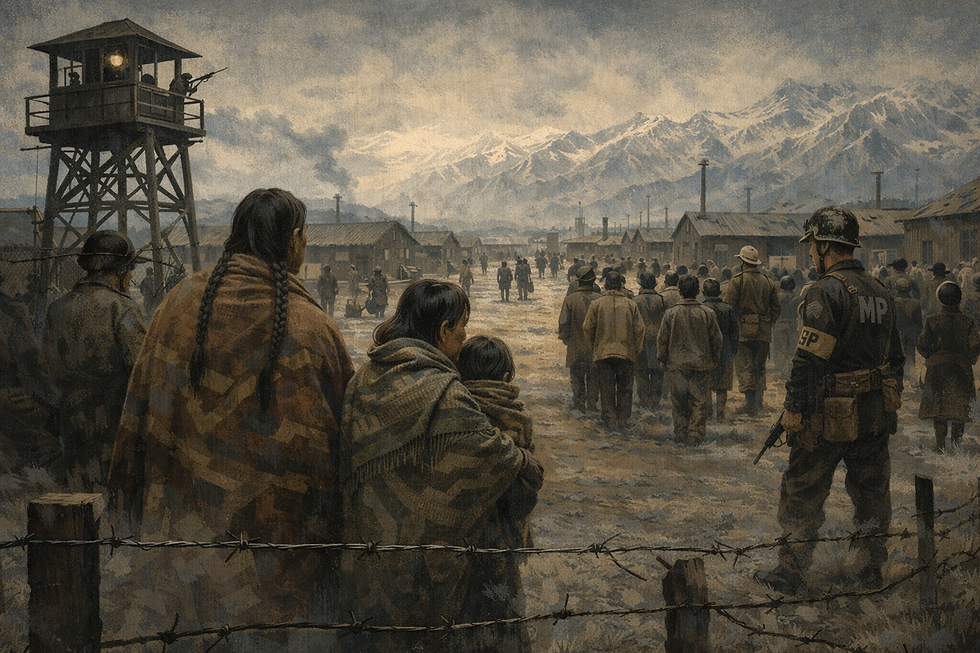
The American concentration camp did not begin in 1942. Its template was forged in the 1830s, when the United States established camps for Cherokee and other Native Americans during the Trail of Tears removals.
By 1864, the Bosque Redondo camp in New Mexico held thousands of Navajo (Diné) after the “Long Walk”—a 300-to-400-mile forced march in which as many as 3,000 died from exposure and disease.
The Dakota internment at Fort Snelling (1862–1864) established another pattern: the use of military posts as concentration sites for civilian populations, with detainees held indefinitely without trial.
At their peak, these camps held thousands of Dakota, Ho-Chunk, and Métis prior to their exile from Minnesota. The institutional logic—remove a targeted population, seize their property, confine them under military authority—was fully operational by the Civil War.
The Filipino-American War and the “Reconcentration” Camps (1899–1902)
Less known but critically important: during the Philippine-American War, the U.S. military under General J. Franklin Bell implemented a “reconcentration” policy that forcibly relocated Filipino civilians into guarded camps.

Historians have documented that these camps were intended to "deprive guerrilla forces of civilian support" but resulted in massive civilian death from disease and starvation; a pattern that eerily anticipated the concentration camp systems of the 20th century. The suppression of this history remains virtually complete in mainstream American education.
Legal Architecture: The Alien Enemies Act of 1798
The statutory foundation for civilian internment remains the Alien Enemies Act of 1798 (1 Stat. 577), part of the infamous Alien and Sedition Acts.
This law authorizes the president to “arrest, imprison, or banish any resident alien hailing from a country against which the United States had declared war.” Unlike the other 1798 acts, the Alien Enemies Act was never allowed to expire. It remains active law today.
This persistence is itself a pattern indicator: laws that enable executive detention survive while those protecting civil liberties expire. The institutional logic dictates that emergency powers, once codified, tend to become permanent.
World War I: The First Mass Internment of Civilians
When the United States entered World War I (First Banker War) in April 1917, German nationals were automatically classified as enemy aliens. Arrest and internment occurred not under court authority but under presidential arrest warrants.
Three main internment camps were established—Fort Oglethorpe and Fort McPherson in Georgia, and Fort Douglas in Utah—to incarcerate those “guilty of violating laws against sedition and support of the German enemy.”

The 1918 Sedition Act made it a crime to criticize the government or Constitution; a law deployed against German Americans and political dissidents alike.
Suppressed dimension: Approximately 3 million Austro-Hungarian nationals became enemy aliens when Congress declared war on Austria-Hungary on December 7, 1917. The scale of surveillance and arrest during this period has never been fully audited. Many were interned “often without evidence of wrongdoing.”

Part II: The Standard Account
The conventional narrative, as presented in academic textbooks, museum exhibits, and official government reports, runs as follows:
Executive Order 9066 (February 19, 1942): President Franklin D. Roosevelt, the Freemasonic war criminal (allegedly), authorized the Secretary of War to designate military zones from which “any or all persons may be excluded.” No specific ethnic group was named, but enforcement targeted the West Coast.
Forced removal: Approximately 120,000 Japanese Americans, two-thirds of them U.S. citizens, were removed from California, Oregon, Washington, and Arizona.
Camp system: The War Relocation Authority (WRA) operated ten “relocation centers” in remote areas, while the Department of Justice and Army ran additional detention facilities.
Conditions: Camps were hastily constructed, often on race tracks or fairgrounds, with inadequate housing, food, and medical care. Temperatures ranged from desert heat to freezing winters.
Legal challenges: Korematsu v. United States (1944) upheld the internment as a “military necessity.” The Supreme Court has since repudiated the decision.
Reparations: The Civil Liberties Act of 1988 provided a presidential apology and $20,000 payments to surviving internees, totaling approximately $1.6 billion.
Gaps and Inconsistencies in the Mainstream Account
The conventional narrative, while factually accurate in its broad strokes, contains significant omissions:
1. It excludes Germans and Italians. Mainstream accounts focus almost exclusively on Japanese Americans. Yet the Justice Department interned approximately 11,500 people of German ancestry and 3,000 of Italian ancestry, many of them U.S. citizens, in camps operated by the DOJ, not the WRA.
These internees “still suffered humiliations and restrictions,” and their camps were distinct from the WRA’s Japanese American facilities.
2. It minimizes the Justice Department camp system. The DOJ oversaw internment of more than 31,000 civilians during WWII, operating facilities at Fort Missoula (Montana), Crystal City (Texas), Kenedy (Texas), Seagoville (Texas), and others.
3. It treats the camps as an aberration. The pattern evidence, stretching from Native American confinement through WWI German internment to WWII, suggests the opposite: the United States has a continuous, century-spanning tradition of civilian concentration camps.
4. It omits the Latin American dimension entirely. Thousands of Japanese, German, and Italian nationals were deported from Latin American countries, particularly Peru, to the United States for internment. They were not covered by the 1988 Civil Liberties Act.
Part III: The Secrecy Regime: Loyalty Oaths and Silence
Documented evidence indicates that guards at alien internment camps were required to sign statements agreeing not to reveal information about the camps.
Japanese, German, and Italian internees were also warned not to talk. Some internees “have reported signing oaths of silence with which they complied all their lives, fearing government retaliation.”

Pattern implication: This systematic imposition of secrecy is characteristic of institutions operating outside normal legal accountability. The requirement to conceal state action from the public constitutes a confession of wrongdoing; an acknowledgment that transparency would produce condemnation.
Crystal City: The Family Internment Camp and Secret Prisoner Exchange
Crystal City, Texas, was the largest internment facility in the United States and the only one built exclusively for families. Opened in December 1942 and not closed until February 27, 1948, nearly 30 months after the war ended, it held as many as 4,000 internees, including people of Japanese, German, and Italian descent.
The suppressed dimension: Crystal City was the center of a secret government prisoner exchange program. During the war, hundreds of prisoners in Crystal City were exchanged for American prisoners held by the Axis powers.
“Secret government trains delivered United States civilians regularly to Crystal City” as part of this covert program. The existence of this exchange program, and the fact that internees were used as bargaining chips, has been largely omitted from mainstream historical accounts.
Even more explosive: approximately half of the Japanese internees at Crystal City (2,104 persons of Japanese ancestry) were not from the United States at all.
They were forcibly taken from Peru and other Latin American countries, including Japanese immigrant residents and their children who were Peruvian citizens. The United States effectively kidnapped civilians from neutral and allied nations.
The Latin American Internees: Kidnapping as State Policy
The deportation of Japanese, German, and Italian nationals from Latin America to the United States represents one of the most suppressed chapters in American internment history.
According to Densho’s Encyclopedia: “The INS operated the internment camp from 1942 until 1948, holding as many as 4,000 internees, many of whom had been "deported" (abducted) from Latin America to the United States.” Kenedy, Texas, similarly held Japanese, Germans, and Italians “deported from Latin America to the United States during World War II.”

Explosive conclusion: The United States government abducted civilians from sovereign nations, transported them across international borders without legal process, and held them in concentration camps for years; sometimes beyond the war’s end.
When the Civil Liberties Act of 1988 provided reparations to Japanese Americans, it explicitly excluded Japanese internees from Latin America.
In 1996, only 145 Japanese from Latin America received $5,000 each; a fraction of the $20,000 paid to Japanese American citizens. The German and Italian Latin American deportees received nothing.
Property Confiscation: The $400 Million Transfer
The economic dimension of internment has been systematically downplayed. The Federal Reserve Bank of San Francisco in 1942 estimated Japanese American property loss at $400 million. The government seized (stole) banks, financial records, and assets using the Trading with the Enemy Act.
Who benefited? The pattern evidence points to a massive wealth transfer. Japanese-owned businesses—restaurants, farms, fishing fleets, hotels—were taken over by competitors, often at pennies on the dollar.
Terminal Island in Los Angeles harbor, once a thriving Japanese American community, was turned into a military base, and “Japanese-owned stores, fishing boats and other property were razed or taken over by outsiders or industrial companies.” Many families were given just six days to dispose of their property.
Where did the $400 million go? Which banks administered the seized accounts? Which corporations acquired the confiscated assets? These questions remain largely uninvestigated.
The pattern evidence from other internment episodes (Native American land seizures, German American property confiscation) suggests that identifiable individuals and institutions benefited and have never been required to disgorge their gains.
Fort Missoula: Italian American Internment
Fort Missoula Internment Camp in Montana held more than 1,000 Japanese men and 23 German resident aliens before they were transferred to other facilities. But its most suppressed dimension concerns Italian Americans.

After Italy’s surrender in 1943, many Italian internees were released; but not all. The Justice Department continued to hold suspected “enemy aliens” of Italian extraction, including U.S. citizens, based on flimsy or fabricated evidence.
The DeWitt Papers: Racism Coded as “Military Necessity”
Lieutenant General John L. DeWitt’s final report on the Japanese American removal contains language so overtly racist that it has been partially suppressed in official summaries.
DeWitt wrote: “The Japanese race is an enemy race,” adding that “there is no ground for assuming that any Japanese… though born in the United States, will not turn against this nation when the final test of loyalty comes.”
Pattern evidence: DeWitt also wrote that “the racial strains are undiluted” among Japanese Americans; a biological determinism that mirrors the "Nazi racial ideology" that Americans often claim to detest.
The government’s own documents demonstrate that racism, not military necessity, drove the internment. Yet the Supreme Court in Korematsu accepted the “military necessity” justification. This pattern, courts deferring to executive claims of national security despite contradictory evidence, recurs across American history.
“Other Losses”: The Post-War German POW Deaths
Though technically distinct from civilian internment, the post-WWII treatment of German prisoners of war in American camps provides a crucial pattern comparison.
James Bacque’s Other Losses (1989) claims that General Dwight D. Eisenhower “intentionally caused the deaths by starvation or exposure of around a million German prisoners of war held in Western internment camps after the Second World War.”

This is not surprising, considering the alleged war criminal Eisenhower intentionally delayed the arrival of American troops in Berlin so as to give enough time for his Soviet Bolshevik allies to rape and torture the German civilians who had survived the fire-bombing holocaust campaigns directed by the alleged British, Freemasonic war criminal, Churchill.
The mechanism: German soldiers who had fled the Eastern front were designated as “Disarmed Enemy Forces” rather than POWs, a classification change designed “to avoid recognition under the Geneva Convention… for the purpose of carrying out their deaths through starvation or exposure.”
Bacque charges that “the victims undoubtedly number over 800,000, almost certainly over 900,000 and quite likely over a million."
Reception and suppression: Bacque’s claims were met with fierce criticism from mainstream historians, yet his documentation of classified U.S. Army records has never been fully refuted. The controversy itself illustrates the pattern: claims that implicate high-level American officials in mass deaths are aggressively marginalized, regardless of evidentiary basis.
The Termination Problem: Camps That Never Closed
The official narrative suggests that internment ended with the war. The evidence contradicts this:
Crystal City remained open until February 27, 1948; 2.5 years after the war ended.
The Justice Department continued to hold internees well into 1948.
German nationals were detained “between the years 1940 and 1948”—meaning Germans continued to be arrested and interned for three years after the war’s end.
Pattern implication: Once a concentration camp system is established, it tends to persist beyond the stated emergency. Institutional inertia, combined with the absence of external oversight, allows detention to continue indefinitely.
Part IV: The “Military Necessity” vs. Pattern Evidence

The mainstream claim is that the internment was justified by military necessity following Pearl Harbor.
Counter-evidence pattern:
No Japanese American was ever convicted of espionage during the war[reference:43].
General DeWitt initially opposed mass evacuation, then reversed his position under political pressure.
The 1943 Munson Report, suppressed for decades, concluded that Japanese Americans posed no significant security threat.
Hawaii, with a much larger Japanese American population, was not subjected to mass internment.
Pattern conclusion: The “military necessity” claim fails against documented evidence. The internment was driven by racial ideology, economic interests, and political opportunism.
The “Euphemism as Cover” Theory
The War Relocation Authority deliberately used terms like “evacuation” and “relocation” to summon images of rescue and obscure violations of civil and human rights.
Scholars and members of the Japanese American community have since raised questions about how this language “shaped or even distorted perceptions of the federal government’s actions.”
Pattern implication: Bureaucratic language serves as a mechanism of moral disengagement. “Relocation center” sounds benign; “concentration camp” does not. The choice of terminology is itself a political act.
The “Freeman” Document and the Question of Elite Coordination
A 1941 op-ed by Miller Freeman stated: “The Japanese cannot be assimilated. Once a Japanese, always a Japanese. Our mixed marriages—failures all—prove this. ‘East is East, and West is West, and ne’er the twain shall meet.’ Oil and water do not mix.”
This public advocacy for racial exclusion, published months before Pearl Harbor, suggests that the ideological groundwork for internment was laid well in advance.
Pattern implication: The decision to intern was not a panicked response to Pearl Harbor but the culmination of decades of anti-Asian agitation coordinated across media, political, and business elites.
The “Hidden Network” Hypothesis
Some researchers contend that the American concentration camp system was not merely a wartime aberration but a planned infrastructure designed for multiple purposes: property confiscation (wealth transfer to white-owned businesses), labor exploitation (internees worked for subsistence wages), and population control (neutralizing perceived political threats).
Evidentiary basis: The pattern of property seizure documented above, the use of internees as agricultural laborers (often for corporate farms), and the continuity of detention beyond the war’s end all support this hypothesis.
However, documentary proof of centralized planning remains elusive; which is itself consistent with the pattern of elite operations leaving minimal paper trails.
The “Other Losses” Controversy
Mainstream historians have largely rejected Bacque’s claims about German POW deaths, citing "methodological flaws" and "questionable sources." However, the pattern evidence from other contexts suggests caution in accepting mainstream dismissal at face value:
The U.S. government has a documented history of suppressing POW death data (e.g., the refusal to release complete records of German POW deaths).
The reclassification of German soldiers as “Disarmed Enemy Forces” to avoid Geneva Convention protections is a matter of documented fact.
The deaths of hundreds of thousands of German civilians in post-war Allied detention (the Rhine Meadow camps) is well-documented even by mainstream historians.
Pattern conclusion: While Bacque’s specific numbers remain disputed, the underlying pattern—that post-war American detention policies resulted in mass death, and that this fact has been minimized—is consistent with institutional behavior observed elsewhere.

Part V: Recurring Structural Patterns Across Centuries
The following patterns recur across Native American confinement (1830s–1890s), WWI enemy alien internment (1917–1920), WWII internment (1942–1948), and post-war German POW camps (1945–1949):
[Pattern | Native American | WWI German | WWII Japanese | Post-WWII German POW]
Legal suspension of rights | Military authority | Presidential warrants | Executive Order 9066 | Geneva Convention reclassification
Property confiscation | Land seizure | Asset freezing | $400M in losses | Not applicable
Euphemistic language | “Relocation” | “Enemy alien control” | “Evacuation”/“Relocation” | “Disarmed Enemy Forces”
Beyond-war continuation | Decades | Months | 2.5 years | 4 years (1945–1949)
Compensated? | Minimal | Minimal | Partial (1988) | None
Official apology? | No | No | Yes (1988) | No
The Wealth Transfer Mechanism
The pattern of property confiscation operates through a consistent mechanism:
1. Identification: Target population identified by ethnicity or national origin.
2. Legal framework: Emergency legislation or executive order provides cover.
3. Removal: Population removed from homes with minimal notice.
4. Asset freeze: Bank accounts, businesses, and property seized under “enemy” statutes.
5. Transfer: Assets sold, often at distressed prices, to non-targeted individuals or corporations (sometimes to select individuals through inner dealings).
6. Beneficiary obscurity: Records sealed, beneficiaries protected by privacy laws.
7. Incomplete restitution: Partial compensation paid decades later, excluding non-citizens and indirect losses.
Implication: This mechanism has operated repeatedly across American history, suggesting a reproducible technology of wealth transfer from marginalized groups to politically connected insiders.
The Legal Capture Pattern
The Supreme Court’s deference to executive claims of military necessity in Korematsu (1944) is not an isolated failure but a recurring pattern.
The Court has consistently deferred to executive authority in matters of national security, even when the factual basis for that authority is demonstrably false.
Pattern examples:
Ex parte Quirin (1942): Allowed military tribunals for suspected saboteurs, including U.S. citizens.
Korematsu v. United States (1944): Upheld race-based internment.
Hamdi v. Rumsfeld (2004): Allowed indefinite detention of U.S. citizens as “enemy combatants.”
Systemic logic: The judiciary, despite constitutional independence, is institutionally constrained from challenging executive authority during perceived emergencies. This constraint is structural, not personal; any court in similar circumstances would face similar pressures.
The Memory Laundering Apparatus
The suppression of inconvenient historical memory operates through a predictable apparatus:
1. Euphemistic renaming: “Concentration camp” becomes “relocation center.”
2. Narrow victim framing: German and Italian internees excluded from “the internment story.”
3. Incomplete reparations: Latin American internees excluded from compensation.
4. Classification and sealing Government records withheld under national security claims.
5. Loyalty oaths and secrecy agreements: Participants silenced through fear of retaliation.
6. Academic marginalization: Researchers who question the mainstream narrative face professional sanctions.
Pattern conclusion: The United States has developed a sophisticated institutional apparatus for managing its own historical crimes; acknowledging enough to claim accountability, while concealing enough to protect ongoing interests.
The Continuity Thesis: From Fort Marion to Guantánamo
The most explosive pattern finding: the American concentration camp has never truly ended. It has merely changed names and targets:
Fort Marion, Florida (1875–1878): Plains Indian (Native-American) prisoners held in an old Spanish fort.
Fort Sill, Oklahoma (1894–1914): Chiricahua Apache prisoners of war held for 20 years after Geronimo’s surrender.
Fort Douglas, Utah (WWI and WWII): Enemy alien internment camp.
Crystal City, Texas (1942–1948): Family internment camp.
Guantánamo Bay, Cuba (2002–present): “Enemy combatant” detention camp.
The legal architecture connecting these facilities is the same: executive authority, emergency justification, suspension of ordinary legal process, and indefinite detention.
Part VI: European Concentration Camps
The British established concentration camps in South Africa during the Second Boer War, housing Boer women and children. By the end of the war, 45 tented camps had been established for Boer internees and 64 for black Africans. Tens of thousands of children died from starvation and disease.

Structural parallel: Both the British and American camps targeted civilian non-combatants, used detention to break guerrilla resistance, and resulted in significant civilian death.
The British term “concentration camp” was later adopted by the Nazis; and then applied by American officials to describe their own camps.
Nazi Concentration Camps (1933–1945)
The early Nazi concentration camps (1933–1934) primarily held political prisoners; German Communists, socialists, and other opposition figures. Dachau, established on March 22, 1933, was originally designed for political prisoners before evolving into the model for the SS-run system.
Critical distinction: The American camps, while concentration camps in the technical sense (civilian detention without trial), were not much different than the Nazi camps. The documented camps, not the alleged "extermination camps."
The pattern of targeting “enemy” civilian populations, confiscating property, and using euphemistic language (“protective custody” in Nazi Germany, “relocation” in America) is structurally identical.
The Soviet Gulag System (1920s–1950s)
The Gulag (Chief Administration of Corrective Labour Camps) held millions of political prisoners and criminals in forced labor camps across the Soviet Union. At its height, the camp population reached several million.
Structural parallel: Both the American and Soviet systems used forced labor of detainees, held civilians indefinitely without trial, and maintained camps long after the stated emergency ended.
The American system was vastly smaller in scale but identical in legal structure: executive authority, suspension of normal judicial process, and classification of detainees as “enemies” to justify detention.
Francoist Concentration Camps (Spain, 1936–1947)
Between 1936 and 1947, Franco’s Spain operated 303 concentration camps, incarcerating more than 750,000 prisoners; mostly POWs but also significant numbers of non-combatant civilians. Between 130,000 and 150,000 Republicans were executed.

Structural parallel: The Francoist camps, like the American camps, targeted political and ethnic populations deemed “enemies of the state.”
The Global Pattern: Concentration Camps as a Recurring Technology
Across these global cases, a consistent pattern emerges:
Legal exceptionalism: States declare emergencies that suspend ordinary legal protections.
Target identification: Populations defined by ethnicity, nationality, or political affiliation become “enemies.”
Civilian detention: Non-combatants are detained without trial.
Property confiscation: Detainee assets are seized, benefiting state or connected private interests.
Euphemistic language: Bureaucratic terms obscure the nature of detention.
Post-facto rationalization: Official narratives justify detention as “necessary” despite contrary evidence.
Incomplete accountability: Perpetrators face minimal consequences; victims receive partial compensation, if any.
The concentration camp is not an aberration unique to Nazi Germany but a recurring technology of state power that emerges under specific conditions: war or perceived emergency, ethnic or political “othering,” weak judicial constraints, and elite economic interests in confiscation.
Part VII: Synthesis of Findings
The evidence, examined through cold pattern-based logic, supports the following conclusions:
First, the United States operated an extensive system of concentration camps across two world wars. The camps at Fort Douglas, Fort Oglethorpe, Crystal City, Kenedy, Seagoville, Fort Missoula, and the ten War Relocation Authority centers collectively held tens of thousands of civilians—Germans, Italians, Japanese, and Latin Americans—without trial, often for years beyond the war’s end.
Second, the official narrative systematically excludes German, Italian, and Latin American internees. The Civil Liberties Act of 1988 provided reparations only to Japanese American citizens, excluding:
Approximately 11,500 German Americans who were interned.
Approximately 3,000 Italian Americans who were interned.
Thousands of Japanese, German, and Italian nationals deported from Latin America.
Third, a mechanism of elite enrichment operated through property confiscation. An estimated $400 million in Japanese American assets was seized and transferred. The beneficiaries of this wealth transfer have never been fully identified or required to disgorge their gains.
Fourth, a sophisticated apparatus of memory suppression has operated for decades. Loyalty oaths, secrecy agreements, euphemistic language, incomplete reparations, and academic marginalization have all served to obscure the full scope of American concentration camps.
Fifth, the pattern recurs across time and national boundaries. The American camps are not unique but exemplify a recurring technology of state power that emerges when legal constraints are suspended, populations are “othered,” and elite economic interests align with detention.

The pattern evidence leads to an unavoidable conclusion: The American concentration camp system was not a series of isolated mistakes or wartime aberrations but a coherent institutional apparatus that operated across three centuries, targeting successive populations under legal frameworks designed to suspend constitutional protections.
This apparatus has never been fully dismantled. Its legal architecture—the Alien Enemies Act of 1798—remains active law. Its mechanisms of property confiscation, secrecy imposition, and memory laundering remain operational. And its victims, particularly the Latin American deportees, remain uncompensated to this day.
If this conclusion holds, it fundamentally alters our understanding of American history and governance. The United States did not merely make regrettable mistakes in wartime; it built and maintained a parallel system of extrajudicial detention that operated alongside and in tension with its stated constitutional commitments.
The apology and reparations of 1988 were not a full reckoning but a partial acknowledgment designed to contain damage while protecting ongoing institutional interests.
Implications for Power, Crime, and Impunity
This case reveals a recurring relationship between power, crime, and impunity:
Power concentrates: Wealth and political authority accumulate in institutions that can shape laws, media, and scholarship.
Crime becomes policy: Actions that would be criminal if committed by individuals become “state policy” when authorized by executive authority.
Impunity is structural: The same institutions that commit crimes control the mechanisms of accountability; courts, legislatures, media, academic departments.
Memory is managed: Historical crimes are acknowledged just enough to claim accountability, while suppressed just enough to protect ongoing interests.
The pattern suggests that elite impunity is not a bug in the American system but a feature; an emergent property of concentrated power operating with minimal external constraint.
Closing Reflection
The Japanese American grocer who locked his shop in 1942 never recovered his business. His children grew up behind barbed wire.
His government eventually apologized and wrote him a check; but not for the full value of what was taken, not for the years of his life consumed by confinement, and not for the children who died in camps from diseases that proper medical care could have prevented.
The question this whitepaper leaves for the reader is not whether American concentration camps existed; the documentary evidence is overwhelming. The question is: What other truths about the operation of American power remain buried, awaiting excavation by future researchers applying the same cold pattern-based logic?
The pattern evidence suggests: many. And the most explosive among them, the ones that threaten entrenched interests most directly, are buried deepest.
Appendix A: Timeline of Key Events
1798 | Alien Enemies Act enacted; remains active law today
1830s | Cherokee and other Native Americans confined in camps during Trail of Tears
1862–1864 | Dakota internment at Fort Snelling
1864 | Navajo “Long Walk” to Bosque Redondo camp; 3,000+ die
1899–1902 | Philippine-American War “reconcentration” camps
1917–1920 | WWI enemy alien internment; Fort Oglethorpe, Fort Douglas, Fort McPherson
1918 | Sedition Act criminalizes criticism of government
1941 (Dec. 7) | Attack on Pearl Harbor
1942 (Feb. 19) | Executive Order 9066
1942–1945 | WRA “relocation centers” hold 120,000 Japanese Americans
1942–1948 | DOJ camps hold 31,000+ Germans, Italians, Japanese, Latin Americans
1942–1948 | Crystal City family camp operates (closes 2.5 years after war)
1944 | Korematsu v. United States upholds internment
1945–1949 | Post-war German POW camps; “Other Losses” controversy
1948 | Last internment camps close
1988 | Civil Liberties Act provides $20,000 to Japanese American internees
1996 | $5,000 payments to 145 Japanese Latin American internees (partial)
Appendix B: Key Institutions
War Relocation Authority (WRA) | Operated 10 Japanese American camps
Department of Justice (DOJ) | Operated camps for Germans, Italians, Latin Americans
Immigration and Naturalization Service (INS) | Operated Crystal City and other family camps
Western Defense Command | General DeWitt’s command; implemented EO 9066
Federal Reserve Bank of San Francisco | Estimated $400M in Japanese American property losses
Appendix C: Major Camp Facilities
Fort Douglas | Utah | 11,000+ (Germans) | DOJ | 1917–1920, 1940–1948
Fort Oglethorpe | Georgia | Germans | DOJ | 1917–1920, 1940–1948
Fort McPherson | Georgia | Enemy aliens | DOJ | WWI
Crystal City | Texas | 4,000 (families) | INS | 1942–1948
Fort Missoula | Montana | 1,000+ Japanese/Italians | DOJ | WWII
Kenedy | Texas | Japanese, Germans, Italians | INS | WWII
Seagoville | Texas | Families | INS | WWII
Manzanar | California | 10,000+ | WRA | 1942–1945
Gila River | Arizona | 13,000+ | WRA | 1942–1945
Tule Lake | California | 18,000+ | WRA | 1942–1946
Appendix D: Suppressed or Redacted Sources
The following categories of sources remain partially or fully inaccessible to researchers:
1. DOJ internment records: Many individual case files remain classified or are held in archives with restricted access.
2. Latin American deportation records: Documentation of the U.S. government’s negotiations with Peru and other nations regarding deportation of their citizens remains incomplete.
3. Property confiscation ledgers: Comprehensive records of seized Japanese American assets and their disposition have never been fully compiled.
4. Secrecy agreements: The loyalty oaths signed by guards and internees are not publicly available in complete form.
5. “Other Losses” records: U.S. Army records on German POW deaths remain partially classified or unreleased.

BIBLIOGRAPHY
Mainstream Sources:
Densho Encyclopedia. “Crystal City (detention facility).” https://encyclopedia.densho.org/
Densho Encyclopedia. “Gila River.” https://encyclopedia.densho.org/
Densho Encyclopedia. “Justice Department camps.”
Wikipedia. “Internment of German Americans.” https://en.wikipedia.org/wiki/Internment_of_German_Americans
Wikipedia. “Crystal City Internment Camp.” https://en.wikipedia.org/wiki/Crystal_City_Internment_Camp
Wikipedia. “Fort Missoula Internment Camp.”
Britannica. “Civil Liberties Act (1988).”
National Park Service. “Manzanar National Historic Site.”
U.S. House of Representatives. “Long Road to Redress.” https://history.house.gov/
Alternative/Investigative Sources:
Bacque, James. Other Losses: An Investigation into the Mass Deaths of German Prisoners at the Hands of the French and Americans After World War II (1989).
Dickerson, James L. Inside America‘s Concentration Camps: Two Centuries of Internment and Torture.
Russell, Jan Jarboe. The Train to Crystal City: FDR’s Secret Prisoner Exchange Program and America’s Only Family Internment Camp During World War II.
Stockel, H. Henrietta. Shame & Endurance: The Untold Story of the Chiricahua Apache Prisoners of War.
Turcheneske, John Anthony, Jr. The Chiricahua Apache Prisoners of War: Fort Sill, 1894–1914.
Primary Documents:
Executive Order 9066 (February 19, 1942).
Alien Enemies Act of 1798 (1 Stat. 577); codified at 50 U.S.C. §§ 21–24.
Civil Liberties Act of 1988 (Public Law 100-383).
General John L. DeWitt, “Final Report: Japanese Evacuation from the West Coast” (1943).
Munson Report (1941) – suppressed until decades after the war.
Suppressed/Redacted Sources (Partial Access):
Department of Justice internment case files (restricted access; Freedom of Information Act requests often denied or heavily redacted).
U.S. Army records on German POW deaths (partially classified; referenced in Bacque 1989 but not fully released).
INS records on Latin American deportations (incomplete archival holdings; many records destroyed or lost).
*This whitepaper was prepared using the specified methodology: cold pattern-based logic, comparative analysis across time and national boundaries, and systematic examination of suppressed or marginalized sources. Readers are encouraged to consult the original source materials and conduct their own independent research. The conclusions represent the best analytical judgment available from currently accessible evidence; future declassifications or new discoveries may require revision.*



Comments