
.png)

Ancient World: India, From Hominins to Indus Valley Civilization (Part 1)
- A. Royden D'Souza

- Apr 8
- 79 min read
Updated: Apr 8
Before the Silk Road stitched East to West, and before the Persian Satraps or Alexander's phalanxes dreamed of the Indus, there was a land already acting as the digestive system of the human journey.
Ancient India was not merely a place; it was a process. Geographically, it is the subcontinent that juts like a tilted wedge into the Indian Ocean, yet this wedge is also a colossal funnel.
For millennia, every major migration path out of Africa, through the Iranian plateau, across the Hindu Kush, and down from the Central Asian steppes found its terminus or its turning point here. India was the crucible of Eurasia; the final mixing bowl where nomadic herders, agricultural pioneers, and urban merchants collided, copulated, and created.
But to see Ancient India only as a passive crossroads is to miss its most radical act of alchemy. Unlike the empires of Mesopotamia or the Nile, which often channeled foreign influence into a single, dominant current, the Indian subcontinent absorbed every migration, every trade wind, and every theological whisper, then fractured that energy into a dazzling spectrum of parallel worlds.

In the northwestern riverlands of the Sapta Sindhu—the land of the seven rivers—the early Rishis were encoding the cosmic hymns of the Rigveda and forging the hierarchical fire sacrifices that would calcify into Vedic culture.
Meanwhile, in the eastern Gangetic plains, a different spiritual current emerged: the Śramaṇa seekers, whom later ages would honor as Buddhas and Jinas, practiced ascetic renunciation in forest hermitages, following a non-violent, anti-ritualistic path toward liberation.
North India, open to the arid corridors of Central Asia, developed a horse-and-chariot aristocracy, Sanskritic grandeur, and a preoccupation with karma as cosmic law.
South India, guarded by the Vindhya ranges and nourished by monsoon maritime routes to Rome and Southeast Asia, nurtured the Tamil Sangam poets, urban port cities like Puhar, and indigenous Dravidian cosmologies that honored local deities like Murugan and Korravai, with kinship systems that sometimes differed radically from northern norms (though matrilineal practices emerged only later in certain communities).
For centuries, these two distinct but purely Indian cultures lived in tense, creative distinctness; parallel rivers flowing toward the same ocean of history. The synthesis, when it came, was not a conquest but a gentle, seismic fusion.
It happened not on a battlefield but in the quiet logic of trade, the intermarriage of merchant guilds, and the irresistible spread of the dharma, which effortlessly translated northern ethics into southern vernaculars.
The Mauryan emperor Ashoka, a northern chakravartin, would etch his edicts in Prakrit, a northern tongue, on southern granite, while Tamil bards would sing of the Himalayas.
By the time of the Gupta “Golden Age,” a new, resilient civilization had emerged: one where the Rishi’s sacrificial fire could be lit alongside the Buddha’s meditation grove, where the northern varna system adapted to southern kinship networks, and where a unified literary and spiritual imagination, captured in the epics of the Mahabharata and Ramayana, reconciled the horse lords of the steppe with the elephant kings of the tropics.
This paper will explore that extraordinary double helix. It will first trace the distinct developmental arcs of North and South India, from the Indus Valley’s shadow to the Sangam’s flowering. Then, it will investigate the mechanisms—economic, religious, and political—that slowly braided these two strands into a single, unmistakable fabric: the ancient world’s most complex and enduring synthesis, where the seer and the enlightened one finally sat beneath the same banyan tree.

A note on genetic dating: Modern understanding of India's population history has been revolutionized by recent advances in archaeogenetics.
The 2025 publication of India's first comprehensive Genomic Atlas, sequencing 2,762 individuals from 23 states, has fundamentally refined our understanding of the subcontinent's deep past.
This research, along with landmark studies from 2019 onward, has established that the modern Indian population derives from at least four major ancestral components, interacting over tens of thousands of years: the Ancient Ancestral South Indians (AASI), the first modern human inhabitants of the subcontinent; Iranian-related Neolithic agriculturalists who arrived before the advent of farming; Steppe pastoralists who migrated during the second millennium BC; and East Asian-related populations who entered through the northeastern corridors.
We will explore both Y-DNA (paternal) and mtDNA (maternal) markers to trace the migrations and admixtures that shaped the Indian subcontinent. These uniparental markers, passed unchanged from father to son (Y-DNA) and mother to all children (mtDNA), serve as powerful tools for tracking population movements over tens of millennia.
However, a crucial caveat applies: autosomal DNA (the 22 pairs of non-sex chromosomes) provides the most complete picture of an individual's ancestry, representing contributions from all ancestors. Y-DNA and mtDNA track only single lineages—direct paternal and direct maternal lines—and can miss entire branches of a person's family tree.
The genetic narrative that follows integrates both uniparental markers (for migration tracking) and autosomal evidence (for admixture timing), with Y-DNA and mtDNA information presented in distinct boxes to allow for easy reference.
Part I: The Indian Plate and the Collision That Created Asia
The story of India begins long before the first human set foot on its soil, in the deep geological time when the subcontinent itself was forged. The Indian landmass originated as part of the ancient supercontinent Gondwana, which also included modern Africa, Australia, Antarctica, and South America.
Approximately 140 million years ago, Gondwana began to fragment as these continents drifted apart at different velocities; a process that led to the opening of the Indian Ocean. In the late Cretaceous period, around 100 million years ago, the Indian plate split from Madagascar and began its extraordinary northward journey as an island continent; Insular India.

Moving at speeds unprecedented for tectonic plates, up to 20 centimeters per year, India traversed the Tethys Ocean, gradually closing the vast sea that separated it from Asia.
This rapid movement, more than twice as fast as any other plate, has intrigued geologists for decades. Some have suggested that the presence of mantle plumes (the Réunion hotspot, responsible for the Deccan Traps) may have thinned the Indian plate, allowing it to move more quickly. However, recent research challenges this "plume-push" hypothesis, suggesting that apparent acceleration may be an illusion caused by errors in geomagnetic reversal timing.
The collision between India and Asia began approximately 55 million years ago in the Eocene epoch, though some authors suggest a later date around 35 million years ago. This collision was not a single event but a complex process.
Some researchers propose a "soft collision" with a continental fragment around 50 million years ago, followed by the "hard collision" between India and mainland Asia around 25 million years ago. The debate continues, but the result is undeniable: the collision created the Himalayan mountain range and the Tibetan Plateau, the highest and most extensive mountain system on Earth.
Noah's Ark and Viking Funeral Ship: India as a Biotic Ferry
During its 60-70 million year journey as a drifting island continent, India served a unique biological function, acting as both a "Noah's Ark" and a "Viking Funeral Ship" for its flora and fauna. While many Gondwanan lineages went extinct during this voyage, their remains preserved like the cargo of a funeral ship, others thrived in isolation, evolving into endemic species unique to the subcontinent.
This isolation ended when temporary land bridges connected India to Eurasia during the Eocene, creating 'freeways' for biodiversity exchange that flowed in both directions.
The collision itself, and the subsequent uplift of the Himalayas, created a natural selection sieve, promoting the diversification of immigrant taxa into the nearly 10,000 plant species found in the region today, over 4,000 of which are endemic.
The Deccan Traps: When India Burst into Flames
Around 66 million years ago, as India drifted over the Réunion hotspot, the subcontinent was engulfed by one of the largest volcanic events in Earth's history. The Deccan Traps, a massive flood basalt province covering approximately 500,000 square kilometers of northwestern peninsular India, erupted over a relatively short period.
The timing coincides with the Cretaceous-Paleogene (K/Pg) mass extinction that famously wiped out the non-avian dinosaurs. Intertrappean beds, sedimentary horizons sandwiched between lava flows, reveal periods of 'quiescence' where life briefly rebounded, offering crucial fossil evidence for understanding extinction patterns and paleoenvironment during this cataclysmic period.
The Deccan Traps thus represent a pivotal moment when the subcontinent's internal fires contributed to a global biological crisis.
Cradle of the Monsoon: How a Collision Created a Climate
The uplift of the Himalayas and the Tibetan Plateau triggered the birth of the Indian monsoon, fundamentally reshaping the region's climate. As the Indian plate crossed the equator and collided with Asia, the monsoon climate gradually evolved and extended across the subcontinent.
This wasn't a single event but a gradual intensification: while elevated rainfall seasonality has likely been a persistent feature since the Paleogene, a modern-like monsoonal atmospheric circulation was only achieved recently, in the late Neogene, driven by multiple paleogeographic controls including the uplift of East African and Middle Eastern topography.
The monsoon's rhythm dictated the agricultural calendar, impacting planting cycles and harvests, which in turn influenced social organization and trade. Indeed, changes in early civilizations in the subcontinent had a close relation to changes in the monsoon climate over the past 10,000 years.
The Geographic Setting: A Subcontinent Takes Shape
The collision with Asia created the distinctive geography of the Indian subcontinent: a triangular landmass bounded by the Himalayas to the north and the Indian Ocean to the south, with the Arabian Sea to the west and the Bay of Bengal to the east.
Within this framework, several major geographic zones shaped human settlement patterns:
The Indus Valley: The river systems of the Indus and its tributaries, flowing from the Himalayas to the Arabian Sea, created fertile alluvial plains that would host one of the world's earliest civilizations.
The Gangetic Plain: The Ganges and Yamuna rivers, also fed by Himalayan snowmelt, drain the northern and eastern subcontinent, creating a vast, fertile corridor stretching from Delhi to Bengal.
The Deccan Plateau: The volcanic heartland of peninsular India, formed by the Deccan Traps eruptions around 66 million years ago, with black cotton soils suitable for agriculture.
The Western and Eastern Ghats: Mountain ranges flanking the peninsula, creating distinct coastal strips and influencing monsoon patterns.
The Thar Desert: The arid region of northwestern India, a natural barrier but also a corridor for human movement.
The Northeastern Corridor: The hilly terrain connecting India to Southeast Asia, through which multiple migrations would pass.
The Cratonic Core: India's Ancient Geological Heart
Beneath the dramatic volcanic landscapes and fertile river plains lies India's most ancient geological feature: its cratonic core. India hosts five main Archean cratonic blocks; the Aravalli, Bundelkhand, Singhbhum, Bastar, and Dharwar cratons.
These blocks represent some of the oldest continental crust on Earth, formed billions of years ago. Their stability has provided a continuous geological foundation for the subcontinent, influencing everything from mineral distribution to the location of ancient settlement patterns.
The Dharwar craton in southern India, for instance, has been a stable landmass for over 2.5 billion years, offering a striking contrast to the geologically "young" and dynamic Himalayas in the north.
The Crucible of Eurasia: A Land of Passages
The Indian subcontinent's position at the crossroads of Asia, connected to the Middle East via the passes of the Balochistan frontier, to Central Asia via the Khyber and other passes, to Tibet via the Himalayas, and to Southeast Asia via the northeastern hills, made it a natural meeting point for human populations.
The five major passes of the Himalayas—Khyber, Bolan, Tochi, Gomal, and Kurram—served as important routes for invasions and migrations that profoundly influenced the subcontinent's history. Known as the "five fingers," these natural routes connect Iran and Central Asia with India, allowing successive waves of peoples to enter.
The Khyber Pass, the most famous of these, has been a principal route between India and Western Asia for millennia. Meanwhile, the Bolan Pass, its southern counterpart, stretches for 89 kilometers through a series of narrow valleys and gorges, serving as a route for traders, invaders, and nomadic tribes between India and higher Asia for centuries.
The Hindu Kush range, with passes such as the Qora-Kottal and Dandan-Shikan, further facilitated eastward movement, while the vast coastline of the Southern Plateau activated maritime activities, leading to the establishment of numerous harbors and trade relations with Rome, China, Malaysia, and Southeast Asia.
For tens of millennia, peoples, languages, and ideas have flowed into India through these corridors, while also radiating outward from the subcontinent to shape the broader Asian world.
Tectonics in Motion: The Present and Future
The Indian plate continues to move northeast at approximately 5 centimeters per year, while the Eurasian plate moves north at only 2 centimeters per year. This ongoing compression causes the Himalayas to rise by a few millimeters annually and generates the earthquakes that periodically shake the subcontinent.
The plate's movement also drives the subcontinent's slow rotation, subtly altering its position relative to the equator. Geodetic measurements using GPS have confirmed these movements with remarkable precision, reminding us that India's story is far from over; the same forces that created the Himalayas continue to shape the land and the lives of its inhabitants today.

Part II: The First Hominins in India
The story of modern humans in India is only the final chapter of a much longer narrative; one that stretches back nearly two million years. Long before Homo sapiens set foot on the subcontinent, other hominins roamed its landscapes, leaving behind stone tools and, very rarely, fossil remains.
The earliest claimed evidence comes from Riwat in northern Pakistan, where some researchers have dated stone tools to 1.9 million years ago. If confirmed, this would push the hominin presence in South Asia back to the very dawn of the Pleistocene and make Riwat one of the oldest hominin sites outside Africa.

However, the dating remains highly controversial, with many archaeologists questioning the natural versus anthropogenic origin of the marks. The controversy itself is instructive: it reminds us that the peopling of Asia was likely more complex and earlier than once believed, and that our current evidence is fragmentary.
Far more secure is the Madrasian culture at Attirampakkam near Chennai, where Acheulean hand axes and cleavers have been dated to approximately 1.5 million years ago. These are among the oldest Acheulean tools found outside Africa, demonstrating that hominins, likely Homo erectus, had successfully settled in the southern tip of the subcontinent by the early Pleistocene.
In the northern foothills, the Soan culture of the Soan Valley (in modern Pakistan) flourished around 500,000 years ago. Characterized by large pebble tools, choppers, and scrapers, the Soanian industry represents a distinct technological tradition, often contrasted with the Acheulean of the south.
The oldest known hominin fossil from India is the Narmada skull, discovered in Madhya Pradesh. Its age remains uncertain, with estimates ranging from 200,000 to 700,000 years ago. Its classification is equally debated: some paleoanthropologists classify it as an advanced form of Homo erectus; others propose a separate species, Homo narmadensis; still others see affinities with Homo heidelbergensis.
What is not in doubt is that the Narmada Valley was home to archaic humans for hundreds of millennia, and these populations may have interacted with, or even been replaced by the modern humans who would later arrive.
The Toba Debate: Pre- or Post-Supereruption Settlement?

The question of when modern humans first arrived in the Indian subcontinent is inextricably linked to one of the most dramatic events in the last 100,000 years: the Toba supereruption.
Approximately 74,000 years ago, the volcano at present-day Lake Toba in Sumatra erupted with a force unprecedented in human history, ejecting an estimated 2,800 cubic kilometers of volcanic material and covering much of India in a layer of ash up to several meters thick.
The eruption's global impact was catastrophic. It may have triggered a volcanic winter lasting 6-10 years and a millennium-long cooling period, pushing humanity to the brink of extinction. Genetic evidence suggests that all modern humans descend from a small population, perhaps as few as 1,000 to 10,000 breeding individuals, that survived this bottleneck.
For decades, the conventional view held that India was uninhabited before Toba. The ash layer seemed an impassable barrier: if humans had been present, they surely would have perished, leaving "no trace of their DNA in present-day humans."
However, research led by Michael Petraglia and his team at the University of Oxford has challenged this assumption. Excavating below the Toba ash layer at Jwalapuram in Andhra Pradesh, they discovered stone tools suggesting human occupation both before and after the eruption. The implication is explosive: some humans may have survived the Toba catastrophe on the Indian mainland.
Critically, however, no human fossils have been found from this period. The toolmakers of Jwalapuram could have been modern humans, or they could have been archaic humans; perhaps the enigmatic species represented by the Narmada skull. The identity of India's pre-Toba inhabitants, if any, remains one of the great unsolved mysteries of South Asian prehistory.
The Jwalapuram site is also critical for understanding the emergence of microlithic technology in South Asia. The toolkit found above the ash layer is dominated by small, sharp microblades; a significant technological shift likely driven by climate change and increased human mobility during arid periods. This microlithic tradition would characterize much of the subsequent Upper Paleolithic and Mesolithic in India.
The Southern Coastal Dispersal: 65,000 Years Ago
The consensus among geneticists is that the ancestors of all non-African peoples left Africa in a single migration approximately 70,000-50,000 years ago. This group, possibly as few as 150 to 1,000 people, crossed the Bab-el-Mandeb strait at the southern end of the Red Sea and traveled along the southern coastline of Asia, exploiting rich coastal resources as they moved.
This "Southern Dispersal" route carried them around the Arabian Peninsula, across the Persian Gulf region (then exposed as dry land due to lower sea levels), and into the Indian subcontinent.
India appears to have been the first major settling point for these migrants. The coastline they followed is now largely submerged due to post-glacial sea level rise, but the archaeological signatures of their passage are preserved at inland sites.

From India, some groups continued eastward, reaching Australia by at least 50,000 years ago; a journey requiring multiple sea crossings. As geneticist Spencer Wells notes, the Aboriginal Australians are descendants of this first wave of migration.
India's role in this migration was not merely that of a corridor. For the first wave of Eurasians, the subcontinent was a living laboratory; the first major landmass where they adapted from a coastal, tropical lifestyle to the diverse ecologies of a vast continent.
It was here that they first encountered the monsoon's seasonal rhythms, the dense forests of the Ghats, and the arid plains of the Deccan. The genetic and cultural innovations that would later fuel their journey to Southeast Asia and Australia were likely forged in the crucible of India's environments.
The oldest definitively identified modern human fossils in South Asia are the Balangoda Man remains from Sri Lanka, dated to at least 28,000 years ago. However, the genetic legacy of those first migrants is preserved in every living South Asian.
The AASI: Ancient Ancestral South Indians
The genetic research of the past two decades has given a name to the descendants of those first migrants who remained in the subcontinent and developed in relative isolation for tens of millennia: Ancient Ancestral South Indians, abbreviated AASI.
The AASI lineage formed around 40,000 years BC and represents the ancestry of the very first hunter-gatherers and peoples of the Indian subcontinent. They are distinct from Western Eurasian groups and have a closer genetic affinity with Ancient East Eurasians; the common ancestors of Andamanese peoples, East Asians, and Aboriginal Australians.

According to geneticists, the AASI lineage diverged from other Eastern Eurasian lineages during their dispersal using the Southern route.
The relationship between AASI and living populations is complex. The Andamanese peoples (such as the Onge) are among the relatively most closely related modern populations to the AASI component and are often used as an imperfect proxy for it.
However, as Yelmen et al. (2019) note, both are deeply diverged from each other, and the Andamanese are thus an imperfect and imprecise proxy. Shinde et al. (2019) observe that either Andamanese or East Siberian hunter-gatherers can be used as proxy for the non-West Eurasian-related component in ancient DNA modeling "because both populations have the same phylogenetic relationship... due to shared ancestry deeply in time."
The South Indian tribal Paniya people, who are believed to be of largely AASI ancestry, may serve as a better proxy than the Andamanese for the native South Asian component in modern populations. This distinct South Asian ancestry is found at low levels in almost all present-day Indian populations, but tribal groups from southern India harbor the highest proportions.
The Veddas of Sri Lanka: Island Cousins
Groups ancestral to the modern Veddas were probably the earliest inhabitants of Sri Lanka, with their arrival tentatively dated to about 40,000–35,000 years ago. They are genetically distinguishable from other peoples of Sri Lanka and show a high degree of intra-group diversity, consistent with a long history of existing as small subgroups undergoing significant genetic drift.
A 2013 study showed that the Vedda are closely related to other groups in Sri Lanka and India, especially to Sinhalese and Tamils, with deep relations also found between the indigenous Vedda and other South Asian populations with the modern populations of Europe, the Middle East, and Northern Africa. The Vedda thus represent a living link to the deep past of the subcontinent.
Hunters, Gatherers, and the First Domesticators
The Mesolithic Age (approximately 12,000–4,000 BC) represents a crucial bridge between the nomadic Paleolithic and the settled Neolithic.

In India, this period is characterized by the widespread use of microliths; tiny, geometrically shaped stone blades that were hafted onto wooden or bone handles to create composite tools like spears, arrows, and sickles.
The microlithic revolution dramatically increased hunting efficiency and allowed for the processing of wild grains, foreshadowing the agricultural revolution to come.
Several iconic sites illuminate this era:
Bhimbetka (Madhya Pradesh): The rock shelters of Bhimbetka contain some of the most extensive prehistoric art galleries in the world.
Over 500 painted shelters span the Paleolithic to the Medieval period, but the Mesolithic paintings are particularly vivid: hunting scenes with archers pursuing deer and bison, communal dancing, honey gathering, and early forms of social and ritual life. The red and white pigments, made from hematite, charcoal, and plant materials, have survived for tens of thousands of years.
Bagor (Rajasthan): The largest microlithic site in India, Bagor revealed three distinct occupation levels spanning the Mesolithic, Chalcolithic, and Iron Age. Excavations uncovered house floors, butchering areas, hearths, and human burials.
Most importantly, Bagor provides clear evidence of domesticated animals (sheep, goats, cattle) by its later phases, alongside continued hunting of wild species like the nilgai and blackbuck.
Langhnaj (Gujarat): This site yielded 14 human skeletons, microliths, and evidence of trade with the later Harappan civilization. The Langhnaj population practiced both hunting and fishing, and their burial practices, including the placement of microliths alongside the dead, suggest emerging beliefs about an afterlife.
Paisra (Bihar): A unique site that contains both Acheulean and Mesolithic habitation levels, radio-carbon dated to the early Holocene. Paisra provides crucial evidence for the persistence of human occupation in the Gangetic plains during the transition from hunting to herding.
By the end of the Mesolithic period (c. 5,000–4,000 BC), sites like Adamgarh (Madhya Pradesh) and Kanewal (Gujarat) show bones of domesticated sheep, goats, cattle, and even camels. These slow, localized beginnings of animal husbandry represent the first steps toward the Neolithic Revolution.
The Neolithic Transition: The Dawn of Farming Villages
The Neolithic Age in South Asia begins around 7,000 BC with the emergence of the first settled farming communities. The earliest and most important site is Mehrgarh in Balochistan (modern Pakistan).

At Mehrgarh, archaeologists have uncovered a continuous sequence of occupation from c. 7000 BC to 2600 BC, spanning the Neolithic, Chalcolithic, and early Bronze Age. The earliest levels reveal mud-brick houses, storage bins for grain, and evidence of domesticated wheat and barley, as well as sheep, goats, and cattle.
The inhabitants crafted elaborate bone tools, stone beads (including turquoise imported from Central Asia), and simple pottery. By 5000 BC, Mehrgarh was a substantial town with crafts specialization, long-distance trade, and ritual practices including the burial of grave goods.
Further east, the site of Chirand in Bihar, dated to approximately 2500–2000 BC, represents the spread of Neolithic farming into the Gangetic plains. Excavations revealed wheat and barley cultivation, cattle herding, and polished stone axes. Chirand thus bridges the Neolithic world of the northwest with the later Chalcolithic cultures of the central and eastern subcontinent.
The transition from mobile foraging to settled farming was not a single event but a mosaic process, unfolding at different times and in different ways across the subcontinent.
What emerged by the end of the Neolithic was a world of villages, fields, and herding grounds; the social and economic foundation upon which the first cities of the Indus Valley would soon be built.
AASI Ancestry [Y-DNA (Paternal) | mtDNA (Maternal) | Key Populations]:
Y-DNA (Paternal): Haplogroup F-M89 and its early derivatives (F, H, C) are associated with the earliest populations of India. Haplogroup F is estimated to have originated 38,700–55,700 years ago, most likely in West or Southeast Asia. Its descendants are found primarily throughout South Asia, Southeast Asia and parts of East Asia.
mtDNA (Maternal): Haplogroups M, R and U are the major maternal lineages of India, whose coalescence times have been approximated to 50,000 BP. The M2 lineage began in India about 50,000 years ago and is unique to the subcontinent. M2, M3, M4, M5, M6, M18 and M25 are found exclusively in India; M2 is believed to have been the oldest lineage on the subcontinent.
Key Populations: Andamanese (Onge, Jarawa), Paniya (South India), Irula, Soliga (showing high frequencies of F and H1), Vedda (Sri Lanka).
The AASI component, extracted from South Asian samples especially the Irula tribe, is found throughout all South Asian ethnic groups in varying degrees. The "S-component" (South Asian-specific) represents the non-West Eurasian ancestry of the First Indians.
Part III: Neolithic Formation of the Indus Cline

For decades, the prevailing model held that the main West Eurasian genetic influence in South Asia arrived with the Steppe migrations of the second millennium BC.
However, genetic research has fundamentally revised this picture. The primary West Eurasian gene flow into India occurred much earlier; during the Neolithic period, or even before the advent of farming, in the early Holocene.
This migration brought people related to Neolithic farmers and hunter-gatherers from the Iranian Plateau, particularly the Zagros region, into the subcontinent.
Importantly, genetic data suggests that this specific Ancient Iranian-related lineage diverged from other Neolithic Iranian plateau lineages more than 10,000 years ago, indicating that it represents a very ancient connection.
The timing of this gene flow is significant. It occurred before the development of agriculture in South Asia and before the rise of the Indus Valley Civilization.
These Iranian-related migrants were not farmers bringing a ready-made agricultural package, but hunter-gatherers or early herders who mixed with the indigenous AASI populations and, over time, developed the agricultural practices that would sustain the first urban civilization of South Asia.
A 2025 study published in Cell, analyzing 2,762 genomes from across India, confirmed this Iranian-related component as one of the three major ancestral sources for modern Indians, alongside AASI and later Steppe pastoralists.
The Formation of the Indus Periphery Cline
The mixing between the incoming Iranian-related people and the indigenous AASI hunter-gatherers produced a new ancestral population that geneticists term the Indus Periphery Cline. This admixture occurred approximately 5400–3700 BC, creating the genetic foundation upon which the Indus Valley Civilization would be built.
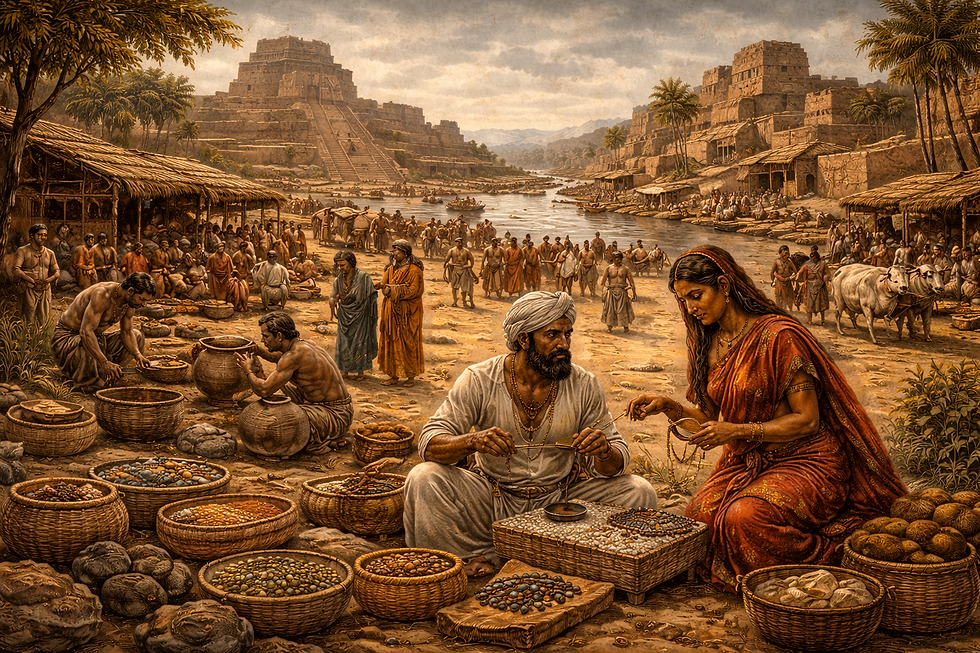
The Indus Periphery ancestry is central to the South Asian genetic heritage. It forms the major source of the gene pool for most modern South Asian groups and is characteristic of the populations that inhabited the Indus Valley region during the height of its urban phase.
According to an international research team led by palaeogeneticists of the Johannes Gutenberg University Mainz, the main ancestry component of South Asians is derived from a population related to Neolithic farmers from the eastern Fertile Crescent and Iran.
This Indus Valley population, with its mixed AASI and Iranian-related ancestry, developed one of the world's earliest urban civilizations; contemporary with, and trading with, ancient Egypt and Mesopotamia. They created the first great cities of South Asia, with sophisticated drainage systems, standardized weights, and a still-undeciphered script.
The Proto-Dravidian Ancestry: A Fourth Component
In 2025, a groundbreaking study published in the European Journal of Human Genetics proposed a fourth putative ancestral source, identified in the Koraga tribe, a Dravidian-speaking group from southern India. This component, which the researchers called "Proto-Dravidian" ancestry, is distinct from all other sources described so far.
Key findings of this study include:
Timing | Emerged not later than 4400 years ago, around the dawn of the Indus Valley Civilization
Origin | Potentially branching from the basal Middle Eastern component that contributed to Iranian Plateau farmer-related ancestry
Distribution | Still carried by most modern inhabitants of the Indian subcontinent other than tribal populations
Linguistic correlation | Shows correlation between genetic and linguistic lineages in Dravidian-speaking communities
Elamo-Dravidian theory | Provides chronological fit for the linguistic hypothesis linking Dravidian languages with Elamite of ancient Iran
The Elamo-Dravidian theory, proposed by linguist David McAlpin, suggests that the Dravidian languages are related to Elamite, the language of the ancient Elamite civilization of southwestern Iran (modern Khuzestan province).
The genetic finding of a "basal Middle Eastern component" that diverged early from the Iranian Neolithic lineage and contributed specifically to Dravidian-speaking populations provides powerful support for this linguistic hypothesis.
This Proto-Dravidian ancestry may represent the genetic signature of the people who spoke the language of the Indus Valley Civilization. As the researchers suggest, its origin "on the region between the Iranian plateau and the Indus valley supports a Dravidian heartland before the arrival of Indo-European languages on the Indian subcontinent."
The Regional Mosaic: India's Diverse Neolithic-Chalcolithic Cultures

While the Indus Valley was developing its urban civilization, the rest of the subcontinent was not a passive periphery. A vibrant mosaic of regional cultures—some independent, others interacting with the Indus world—emerged across India.
The Ganges Plain: Lahuradewa and the Earliest Rice
In the central Ganges plain, the site of Lahuradewa (Sant Kabir Nagar district, Uttar Pradesh) has revolutionized our understanding of South Asian agriculture.

Occupied as early as 9,000 BC, Lahuradewa provides the oldest evidence of ceramics in South Asia—a "Mesolithic ceramic tradition" that developed among Vindhya hunter-gatherers before the advent of farming.
By 7,000-6,000 BC, the inhabitants were cultivating domesticated rice (Oryza sativa), making Lahuradewa one of the earliest sites in the world for rice cultivation.
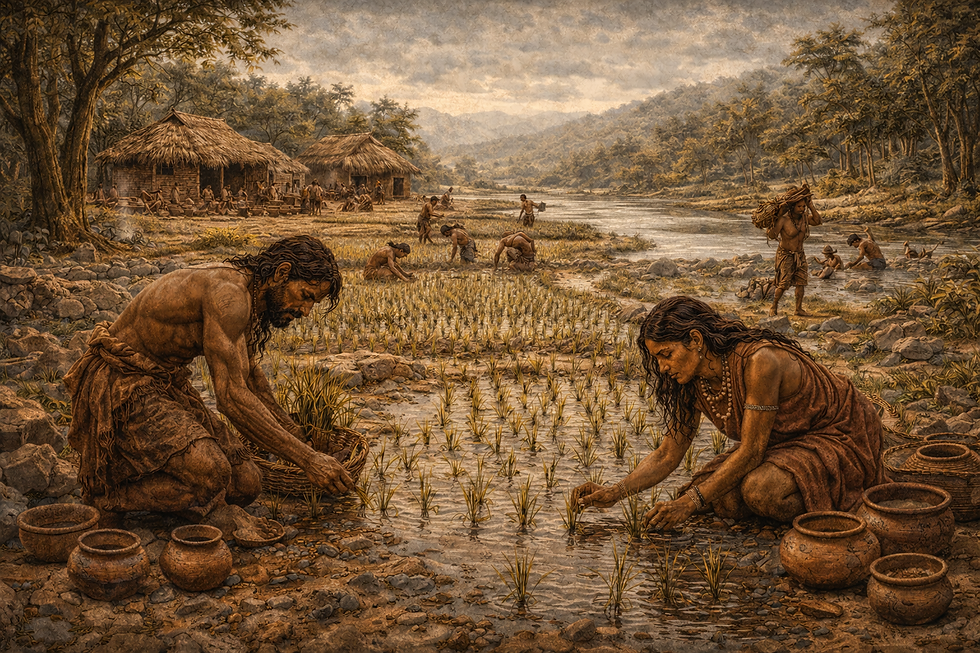
This independent trajectory of rice domestication in the Ganges plain stands in stark contrast to the wheat-barley complex of the Indus region, foreshadowing the distinct agricultural and cultural foundations of North and East India.
The Kashmir Valley: Burzahom and the Northern Corridor
In the northernmost reaches of the subcontinent, the Burzahom site (Jammu and Kashmir) reveals a Neolithic culture with striking affinities to Central Asia and North China, rather than to the Indus Valley.
Occupied from approximately 3000 BC, Burzahom's inhabitants lived in subterranean pit-dwellings, hunted wild sheep and goats, and produced distinctive handmade pottery with geometric designs.
The presence of pendants, beads, and terracotta bangles indicates that ancient Kashmir had open trade networks with areas in present-day Pakistan and China. Burzahom's burial practices—including the interment of domestic dogs with their owners—further distinguish this culture from its contemporaries.
Burzahom thus represents a northern corridor of cultural exchange, linking India to the broader Eurasian world.
The Deccan: Ashmounds and Pastoralism
In the southern Deccan, the Neolithic period (beginning around 3000 BC and lasting until 1400 BC) is characterized by a unique and enigmatic feature: ashmounds.
These massive mounds of vitrified ash, sometimes meters high, are found across the Karnataka-Andhra region and are believed to result from the repeated burning of cattle dung; possibly for ritual purposes, pest control, or the production of fertilizer.
The Deccan Neolithic was primarily pastoral, focused on cattle, sheep, and goats, with limited agriculture. The ashmounds represent a distinctive ritual landscape that has no parallel in the Indus Valley, underscoring the cultural independence of the southern Neolithic.
The Chalcolithic Cultures of Western and Central India
Following the Neolithic, the Chalcolithic (Copper-Stone Age) period saw the emergence of several regional cultures across western and central India, many of which overlapped chronologically with the late Harappan and post-Harappan phases.
Ahar-Banas | Southeastern Rajasthan (Banas River valley) | c. 3000–1500 BC | Black-and-red ware pottery; copper tools and ornaments; fortified settlements; evidence of trade with Harappans.
Kayatha | Malwa region (Madhya Pradesh) | c. 2000–1800 BC | Distinctive comb-painted pottery; copper implements; early fortified settlements.
Malwa | Malwa region and parts of Maharashtra | c. 1900–1400 BC | Rich ceramic tradition with geometric, floral, and animal designs in black on red; large settlements with fortifications; advanced agriculture
Jorwe | Deccan region (Maharashtra) | c. 1400–1000 BC | Painted black-on-red pottery; well-planned settlements with mud-brick houses; evidence of social hierarchy and craft specialization
Savalda | Northern Deccan | c. 2200–1800 BC | Distinctive pottery and burial practices; evidence of cattle pastoralism
These Chalcolithic cultures were not isolated. The Ahar-Banas culture, for instance, shows clear evidence of trade with the Indus Valley, including Harappan pottery and beads found at Ahar sites.
Conversely, the Malwa and Jorwe cultures represent an expansion of settled agricultural life into the Deccan, likely driven by population movements following the decline of the Indus cities.
Edakkal Caves: Neolithic Rock Art and Indus Echoes
In the far south, the Edakkal Caves in Kerala's Wayanad district contain Neolithic rock art dating back to 6,000 BC. The carvings depict animals, weapons, and human figures, and, most intriguingly, include a symbol that appears to be an Indus Valley script motif: a "man with a jar."

This discovery, first reported in 2009, has led some scholars to suggest cultural continuity between the Harappan world and the southern tip of the subcontinent. While the interpretation remains debated, Edakkal offers a tantalizing hint of the deep connections that would later bind North and South India.
The Indus Valley Civilization: Rise, Mature Phase, and Decline
The Indus Valley Civilization did not emerge suddenly. Its roots lie in the Neolithic settlements of the Balochistan region, particularly Mehrgarh, which was continuously occupied from c. 7000 BC to 2600 BC.
New radiocarbon dating of human tooth enamel from 23 Neolithic burials indicates that the aceramic Neolithic cemetery at Mehrgarh began between 5200 and 4900 BC and lasted for two to five centuries, with pottery appearing only after 4650 BC; later than previously believed.

From these early farming communities, the civilization progressed through several stages:
Early Harappan (c. 3300–2600 BC): Small farming and trading villages coalesce into larger settlements. The site of Bhirrana in Haryana has yielded radiocarbon dates suggesting cultural remains going back to 7380–6201 BC, making it one of the oldest Indus sites discovered.
Mature Harappan (c. 2600–1900 BC): The urban phase. Great cities like Harappa, Mohenjo-Daro, Dholavira, and Rakhigarhi (now recognized as the largest Indus site, located in Haryana) emerge, with standardized brick sizes, sophisticated drainage, and a uniform system of weights and measures.
Late Harappan (c. 1900–1300 BC): The post-urban phase. Cities decline, writing disappears, and regional cultures diversify.
Trade and Connectivity
The Indus Valley was not isolated. Mesopotamian texts from the third millennium BC mention three trading partners: Dilmun (Bahrain and Failaka Island), Magan (the Oman peninsula), and Meluhha; almost certainly the Indus Valley.
Trade goods included carnelian, lapis lazuli, copper, gold, and varieties of wood. An Indus trading colony was established at Shortugai in northern Afghanistan, near the lapis lazuli mines, demonstrating the civilization's far-reaching commercial networks.
Decline and Transformation
The mature phase of the Indus civilization ended around 1900 BC. The causes were complex: climate change (weakening monsoons and drying rivers), economic disruption, and social stress.
Bioarchaeological evidence from Harappa reveals increased rates of trauma, infectious diseases (including tuberculosis and leprosy), and systemic violence during the post-urban period.
The population did not disappear but dispersed eastward and southward, carrying Indus cultural elements, including pottery styles, craft traditions, and possibly the Dravidian language family, into the Ganges plain and the Deccan.
The Copper Hoard Culture and Sanauli Burials
In the aftermath of the Indus decline, a distinctive archaeological horizon known as the Copper Hoard Culture emerged across the Ganges-Yamuna dohab.
Named for large caches of copper implements, including anthropomorphic figures, harpoons, and axes, this culture is often associated with the Late Harappan and post-Harappan populations.
The most spectacular discovery from this horizon comes from Sanauli (Baghpat district, Uttar Pradesh), where excavations in 2018 uncovered royal burials dating to approximately 2000–1800 BC.
The grave pits contained:
Wooden chariots (or bull-drawn carts), representing the first physical evidence of wheeled vehicles from this period in South Asia
Copper antennae swords, some with wooden hilts wrapped in copper wire
Copper helmets, shields, and daggers
Highly decorated coffin covers and burial goods
The Sanauli burials indicate the emergence of a warrior aristocracy in the post-Harappan Ganges plain, with elaborate funerary rituals and advanced metalworking. Some scholars have linked these burials to the Copper Hoard people, who may have spoken early Indo-Iranian languages (proto-Indo-Aryan).
Whether the Sanauli vehicles were horse-drawn chariots or bull-drawn carts remains debated, but their discovery has fundamentally altered our understanding of South Asia's Bronze Age.
Daimabad: The Southernmost Indus Outpost
On the banks of the Pravara River in Maharashtra, the site of Daimabad represents the southernmost extension of Indus-related culture.
Excavations revealed five phases of occupation, including a Late Harappan phase (c. 2000–1600 BC) and a subsequent Jorwe Chalcolithic phase (c. 1400–1000 BC).

Daimabad is most famous for a hoard of copper figures discovered accidentally by a farmer: a chariot with a driver, a bull, a rhinoceros, and an elephant, together weighing over 65 kilograms.
The style and iconography of these figures link them to the Late Harappan world, suggesting that Indus cultural elements, including metalworking traditions and symbolic motifs, penetrated deep into the Deccan.
Daimabad thus serves as a bridge between the Indus civilization and the Chalcolithic cultures of southern India, anticipating the cultural synthesis that would characterize later periods.
Iranian-related and Indus Periphery [Y-DNA (Paternal) | mtDNA (Maternal) | Key Populations]:
Y-DNA (Paternal): Haplogroup L-M20 is one of the haplogroups of the original creators of the Indus Valley Civilisation. This haplogroup is associated with South Asia and has also been found at low frequencies among populations of Central Asia, Southwest Asia, and Southern Europe. Haplogroup J2 (found in the Soliga tribe and elsewhere) also arrived with this migration.
mtDNA (Maternal): Haplogroup U2 (specifically U2i, the Indian branch) and haplogroup U7 are associated with the Iranian-related migration. Haplogroup J (mtDNA), originating in West Asia ~45,000 years ago, also entered India during this period. Three basal founding haplogroups—M2, R5, and U2—diversified during the Neolithic period in India.
Key Populations: Koraga (highest Proto-Dravidian), Irula, Soliga, Indus Valley populations (Rakhigarhi sample), modern Dravidian-speaking groups.
The Proto-Dravidian component (Koraga), identified in 2025, is "distinct from all other known ancestral components" and emerged around the dawn of the Indus Valley Civilization.
Part IV: The Indus Valley Civilization—Urban Crucible

For decades, the Indus Valley Civilization (c. 3300–1300 BC) remained a genetic mystery. No ancient DNA had been successfully sequenced from its sites, leaving scholars to debate the origins and fate of its people based on indirect evidence.
That changed in 2019, with two landmark studies published in Cell and Science. The Cell study sequenced the genome from a skeleton found in a 4,600-year-old burial site at Rakhigarhi, one of the largest Indus Valley cities, located in present-day Haryana.
The results were revelatory:
1. The Harappans were indigenous: The Rakhigarhi individual showed a mix of AASI and Iranian-related ancestry, with no Steppe pastoralist ancestry. This confirmed that the Indus Valley people were not outsiders but the product of millennia of in situ development from the mixing of the First Indians and early Iranian migrants.
2. Genetic continuity: The DNA of the Harappans has continued till today, and a majority of the South Asian population appears to be their descendants. The study indicated "unbroken continuity for 5,000 years in this region."
3. Language implications: With no Steppe ancestry present in the Harappan genome, the study strengthened the case that the language of the Indus Valley Civilization was likely Dravidian.
The companion Science study, analyzing 523 ancient genomes from Central and South Asia, confirmed that 11 of these genomes showed strong similarities to the Rakhigarhi sample, representing the ancestry present in South Asia during the Indus Valley period.
As co-author Vagheesh Narasimhan noted, "These 12 samples, taken together, broadly represent the ancestry that was present in [South Asia] at that time."
The Indus Valley in Global Context
The Indus Valley Civilization (IVC) was contemporary with, and connected to, the other great civilizations of the Bronze Age:
Ancient Egypt | c. 3100–1069 BC | Nile Valley | Indus seals found in Mesopotamian cities that traded with Egypt
Mesopotamia | c. 3500–539 BC | Tigris-Euphrates Valley | Extensive trade; Indus seals and beads at Ur and other sites; mention of "Meluhha" (Indus region) in cuneiform texts
Elam | c. 2700–539 BC | Southwestern Iran | Cultural and trade links; possible linguistic connection (Elamo-Dravidian theory)
Oxus Civilization (BMAC) | c. 2300–1700 BC | Central Asia | Trade networks connecting Indus to Iranian Plateau and Central Asia
The IVC was not an isolated phenomenon but part of a vast interaction sphere stretching from the Mediterranean to the Indus. Its standardized weights, seals, and trade goods have been found throughout the region, attesting to sophisticated commercial networks.
Urban Planning: A Blueprint for Civilization
The cities of the Indus Valley represent some of the earliest and finest examples of urban civic planning in the ancient world. The towns were laid out in a rectangular grid pattern, with roads running north-south and east-west, intersecting at right angles.
This standardized approach to urban design—strict adherence to a gridiron street system, strategic use of cardinal directions, and the pronounced separation of citadel and lower town—reflects a highly organized, possibly non-centralized socio-political structure with a strong concern for public welfare and controlled urban form.
The city was typically divided into two parts: an upraised citadel in the western part, used for constructing large public buildings such as granaries, administrative structures, and the Great Bath; and the lower town, where the general population resided in standardized brick houses.
The Harappans used burnt mud bricks of standardized dimensions for construction. Many layers of well-baked brick were laid out and joined using gypsum mortar. Three main types of buildings have been found across excavation sites: dwelling houses, public buildings, and public baths.
The Great Bath of Mohenjo-Daro
The most iconic public structure of the Indus Valley is the Great Bath at Mohenjo-Daro. Built with an ingenious hydraulic system, it remains functional and shows no leakage or cracks in its construction thousands of years later.
The exact purpose of the bath is not definitively known, but most scholars believe it was used for ritual purification and religious bathing. The great attention to water management and bathing platforms throughout Indus cities suggests that ritual cleanliness and water played a central role in Harappan religious practice.
Dholavira: The Three-Tiered City
The site of Dholavira in Gujarat stands out for its unique urban planning. Perhaps the only IVC site with three layers of urban organization—upper town, middle town, and lower town—Dholavira also features a giant water reservoir and a sophisticated water-harnessing system, including dams and embankments.

The middle town may have functioned as a garrison for guards protecting the city. Most remarkably, Dholavira yielded a signboard inscription comprising ten large-sized signs, like an ancient advertisement board.
Political Organization: A Heterarchy of Councils
Unlike the monumental palaces and divine kings of Egypt and Mesopotamia, the Indus Valley presents a strikingly different political picture.
Archaeological records provide no immediate answers regarding a center of authority or depictions of people in power in Harappan society. There are no signs of imperial authority like palaces or big buildings.
Instead, evidence points to a governing system that may have been democratic or heterarchical. The standardized infrastructure—granaries, public baths, irrigation systems—was built for the welfare of the people rather than the glorification of rulers.
The discovery of weight stones and seals across the civilization points to a civic authority that maintained rule of law.
The architecture suggests a social hierarchy—priests or merchants may have stayed in the citadel area, while common people resided in the outer areas—but this was not a rigid, palace-centered system. Archaeologist Vasant Shinde has proposed that the Harappans likely introduced a panchayat system of democracy.
Scholars have characterized Indus political organization as a "heterarchy," governed by "flexible, contingent, and constantly fluctuating power relations" rather than a fixed, top-down hierarchy.
The apparent participation of many individuals in the sealing practice, together with the ubiquitous distribution of weights in settlements, suggests a corporate organization where hierarchically organized structures were not strongly pronounced.
Instead of single individuals with far-reaching control, Indus society may have been governed by councils and assemblies, possibly of "elders," that shared social power.
Religion and Belief Systems: Echoes in Silence
Reconstructing the religion of the Indus Valley is a difficult task, given that the writing system remains undeciphered and no temples or obviously religious structures survive from the civilization. What we know is pieced together from seals, figurines, and ritual structures, and the interpretations are necessarily speculative.
Based on the evidence, scholars have tentatively identified several features of Indus religion: a Great Male God and a Mother Goddess; deification or veneration of animals and plants; symbolic representations of the phallus (linga) and vulva (yoni); and the use of baths and water in religious practice.
The "Proto-Shiva" Pashupati Seal
The most famous religious artifact from the Indus Valley is the Pashupati seal found at Mohenjo-Daro. It depicts a seated figure surrounded by animals—an elephant, tiger, rhinoceros, and buffalo—with two deer beneath the throne.
The figure appears to have three faces and is seated in a yogic posture, with erect phallus. Some scholars, beginning with Sir John Marshall, identified this as a "Proto-Shiva" figure, linking it to the later Hindu deity Shiva as Pashupati, "Lord of Animals."
However, this interpretation remains debated, and caution is warranted against retroactively projecting later concepts onto Harappan religion. But it is the most compelling link in the evolution and synthesis of India's religion.
Mother Goddess Figurines
Numerous terracotta figurines, many depicting female figures with elaborate jewelry, prominent breasts and hips, have been excavated from Indus sites.
Sir John Marshall hypothesized the existence of a cult of Mother Goddess worship based on these figurines, suggesting this was a precursor to the Hindu sect of Shaktism.
However, interpretations have ranged from religious idol to children's doll, and scholars caution that "positive assertions" about IVC religions remain highly conjectural.
Water and Ritual
The Great Bath at Mohenjo-Daro is the only structure widely thought to have been used in religious practices.
The prominence of water in ritual practice—baths, wells, and water channels throughout Indus cities—suggests that ritual purification was central to Harappan religion, a theme that would continue in later Indian traditions.
Technology and Craftsmanship: The Lost-Wax Masters
The Indus Valley people were master metallurgists. They developed new techniques in metallurgy and produced copper, bronze, lead, and tin. The lost-wax (cire-perdue) casting process was known as early as the Indus Valley Culture and has continued as an unbroken tradition in India for approximately 5,000 years.
This technique, now known as Dhokra craft, is still practiced by communities in central and eastern India, representing a living link to Harappan metallurgy.
Harappan artisans produced elegant objects from bronze, gold, silver, terra cotta, glazed ceramics, and precious and semi-precious stones. The famous Dancing Girl bronze figurine from Mohenjo-Daro, standing just 10.5 centimeters tall, exemplifies the sophistication of Harappan metalwork.
Cast using the lost-wax technique, the figurine captures a young woman in a confident, naturalistic pose; a remarkable artistic achievement for its time.
Copper and bronze implements included flat oblong axes, chisels, knives, spears, arrowheads, small saws, and razors. Many copper implements were made by the casting method, while vessels were created from a single sheet of bronze by hammering.
The overall level of copper-bronze technology, while sophisticated, is not considered to have reached the level attained in Mesopotamia.
Art and Iconography: Seals, Sculpture, and Pottery
The most distinctive artistic legacy of the Indus Valley is its seals. Typically cut from steatite (soapstone) and carved in intaglio with a copper burin, over 3,500 seals have been identified to date.
The majority show a humpless "unicorn" or bull in profile, while others depict the Indian humped bull, elephant, bison, rhinoceros, or tiger. The animal frequently stands before a ritual object, variously identified as a standard, a manger, or an incense burner.
Stone sculpture is relatively rare and much of it is quite crude, though the finest pieces such as the bearded priest sculpture from Mohenjo-Daro are of excellent quality. The repertoire of cast-bronze figures includes dancing girls, small chariots, carts, and animals.
Painted pottery represents the main evidence of a painting tradition, executed with boldness and delicacy of feeling. Terracotta figurines form the popular art of the Harappans: standing females (often heavily laden with jewelry) and standing males (some with beards and horns).
The Indus Script: The World's Greatest Undeciphered Mystery
The Indus script, consisting of 400–700 distinct signs, has been found on over 5,000 artifacts; primarily steatite seals, terracotta tablets, copper implements, and pot shards.
The inscriptions are tantalizingly short: most average only five signs, rarely exceeding seven, with the Dholavira signboard being the longest at 26 characters. Their brevity frustrates efforts to identify patterns of grammar or syntax.

The script presents one of archaeology's greatest challenges. It falls into the most difficult category of undeciphered scripts: "an unknown script writing an unknown language."
No multilingual inscription comparable to the Rosetta Stone has been discovered, despite evidence of robust trade links with Mesopotamia. The underlying language family remains unknown, making decipherment exceptionally difficult.
Several competing theories vie for acceptance:
Dravidian hypothesis: Building on the work of Asko Parpola and Iravatham Mahadevan, many scholars see links to Proto-Dravidian languages. The frequently occurring 'fish' sign may represent the word min (fish/star) in Proto-Dravidian, possibly denoting astral deities.
Indo-Aryan hypothesis: Others argue for Sanskritic or Vedic roots, pointing to links between signs and Rigvedic motifs or the Saraswati River system.
Non-linguistic theories: Some scholars suggest the symbols may not represent a full writing system at all, but rather encoded rules for taxation and commerce, or functioned as merchant marks and mnemonic devices.
The debate has significant political implications in modern India. Historians close to the ruling establishment have long claimed that the underlying language is Sanskrit, while others maintain it is a form of Proto-Dravidian.
However, with the recent advances in genetic dating, the DNA evidence from the archeological sites strongly supports the Dravidian hypothesis for the Indus Valley script.
The 2019 genome from Rakhigarhi revealed the Harappans were an indigenous population with a mix of AASI (Ancient Ancestral South Indian) and Zagrosian-related ancestry, lacking any Steppe pastoralist (Aryan) ancestry.
This makes it highly unlikely their language was Indo-European. The study's authors directly stated these results "strengthen the case that the language of the Indus Valley Civilization was likely proto-Dravidian."
Moreover, a 2025 study on the Dravidian-speaking Koraga tribe identified a distinct ancestral component called 'Proto-Dravidian' ancestry, which emerged around the dawn of the IVC, originating from the region between the Iranian plateau and the Indus Valley.
The study found a "correlation between the linguistic and genetic lineages" in Dravidian language communities, supporting the Elamo-Dravidian linguistic hypothesis and a "Dravidian heartland" before Indo-European languages arrived.
In 2025, the Tamil Nadu government announced a $1 million prize for the successful decipherment of the Indus script, reigniting public interest in the enduring mystery.
Clarification: The genetic evidence must be interpreted carefully. It reveals ancestry, not language, and it emphatically does not support any notion of two distinct, unmixed "races" in India; one "Aryan" and one "Dravidian."
Modern Indians (and South Asians) are a thorough mixture of three ancient ancestral populations:
AASI (Ancient Ancestral South Indians) | First settlers, c. 50,000+ years ago | Y-DNA: H, C, F (early derivatives); mtDNA: M2, M3, M4, M5, M6
Iranian-related / Neolithic Zagrosian | c. 5400–3700 BC | Y-DNA: L, J2; mtDNA: U2, U7, J
Steppe pastoralist (Indo-Aryan) | c. 2000–1000 BC | Y-DNA: R1a, R2; mtDNA: various West Eurasian lineages
Every modern Indian population—whether speaking an Indo-Aryan language (Hindi, Bengali, Marathi, etc.) or a Dravidian language (Tamil, Telugu, Kannada, Malayalam)—carries all three of these ancestries in varying proportions.
There is no "pure Aryan" or "pure Dravidian" population. An Indian from Uttar Pradesh and an Indian from Tamil Nadu share the same ancestral components; only the percentages differ.
The only meaningful distinction that persists today is linguistic and cultural, not biological. The Aryan vs. Dravidian debate, when framed as a racial or genetic conflict, is scientifically baseless. Even where a particular paternal haplogroup (e.g., R1a among some Indo-Aryan speakers or L/J2 among some Dravidian speakers) appears at higher frequencies, the overall genome is a mosaic of all three ancient sources. The idea of two opposing "bloodlines" is a modern political fabrication, not a reflection of population genetics.
Thus, while the genetic evidence tilts the balance toward a Dravidian or Proto-Dravidian affiliation for the Indus Valley language, it does not imply that modern Dravidian speakers are "descendants of the Harappans" to the exclusion of Indo-Aryan speakers.
All Indians and South Asians are, to a significant degree, descendants of the Harappans; and of the AASI, the Iranian migrants, and the Steppe pastoralists who came later. The Indus legacy is shared, not partitioned.
The Maritime Trading Empire
The Indus Valley was not an inward-looking civilization. Its merchants and seafarers created a vast trading network that stretched from Central Asia to the Persian Gulf and Mesopotamia.

Shortugai: The Northern Trading Colony
The northernmost settlement of the Indus Valley Civilization was Shortugai, located in present-day northern Afghanistan, near the lapis lazuli mines of Badakhshan.
Established around 2000 BC on the Oxus River (Amu Darya), this trading colony was likely connected to the lapis lazuli and possibly tin trade. Excavations have revealed carnelian and lapis lazuli beads, bronze objects, terracotta figurines, and a seal with a short Indus inscription.

Lothal: The World's Earliest Dockyard
The site of Lothal in Gujarat features the world's earliest known tidal dockyard connected to the Bhogavo River. Other finds include rice husk, fire altars, painted jars, modern-day chess-like game pieces, terracotta figures of horses and ships, and instruments for measuring angles.
Lothal's dockyard enabled maritime trade with the Persian Gulf and Mesopotamia, making it a hub of Harappan commerce.

Meluhha: The Indus in Mesopotamian Texts
Mesopotamian cuneiform texts repeatedly refer to three important trading partners: Dilmun (Bahrain and Failaka Island), Magan (the Oman peninsula), and Meluhha; almost certainly the Indus Valley.
These texts describe Meluhha as a source of carnelian, lapis lazuli, copper, gold, and exotic woods. The discovery of Indus seals and beads in Mesopotamian cities like Ur provides archaeological confirmation of these textual references.
Agriculture, Water Management, and Environment
The Indus Valley people were skilled agriculturalists. Their economy was based on the cultivation of wheat and barley, along with dates, sesame, peas, and—in the eastern regions—rice.
The fertile alluvial plains of the Indus and its tributaries, replenished by Himalayan snowmelt and summer monsoons, sustained farmland and urban settlements across a vast territory stretching from present-day Punjab to Sindh.
The Harappans developed sophisticated water management systems. Wells, reservoirs, and drainage channels were integral features of every major city.
Dholavira's giant water reservoir and unique water-harnessing system demonstrate advanced engineering capabilities. These systems not only supplied drinking water but also supported agriculture and ritual bathing.
The Decline: Not a Collapse, But a Transformation
The mature phase of the Indus civilization ended around 1900 BC, but the process was not a sudden catastrophe. Recent research has transformed our understanding of the decline.
Between approximately 3000 and 2475 BC, a vigorous monsoon season spurred by cooler tropical Pacific conditions led to increased rainfall across the region, allowing for the establishment of settlements near areas with ample rain.
However, as the tropical Pacific began to warm in the following centuries, the region experienced drier conditions characterized by reduced rainfall and rising temperatures.
A 2025 study published in Nature Communications Earth & Environment identified four major drought events, each spanning over 85 years, occurring between 2425 and 1400 BC.
The most severe drought peaked around 1733 BC, lasting approximately 164 years and impacting nearly the entirety of the Indus region. The analysis revealed an overall temperature increase of 0.5 degrees Celsius and a rainfall decrease of 10–20 percent.
These climatic stressors had cascading effects: diminished river flows, soil desiccation, and reduced agricultural yields. With water supply shrinking and agricultural productivity declining, populations gradually abandoned major cities like Harappa and Mohenjo-Daro, relocating toward areas where rivers or smaller streams still flowed.
Crucially, the Harappans did not vanish. They adapted: switching agricultural practices, diversifying trade, and relocating settlements to make them more resilient to climate change.
The population dispersed eastward and southward, carrying Indus cultural elements, including pottery styles, craft traditions, and possibly the Dravidian language family, into the Ganges plain and the Deccan.
Legacy: The Indus in India's Living Memory
The Indus Valley Civilization did not disappear; it transformed. Its genetic legacy survives in the majority of modern South Asian (India, Pakistan, Bangladesh, etc.) populations, its craft traditions continue in the Dhokra metalworkers of central India, and its urban planning principles may have influenced later Indian cities. The Indus script, though undeciphered, remains a testament to one of the world's earliest literate cultures.
Most profoundly, the Indus Valley bequeathed to later India a cultural template: an urban civilization with sophisticated trade networks, advanced technology, and a religious sensibility centered on water, ritual purity, and possibly the worship of a yogic deity; themes that would resonate through the Vedic, Buddhist, and Puranic traditions that followed.

Part V: The Great Admixture—Steppe Pastoralists
Around the middle of the second millennium BC, as the cities of the Indus Valley entered their final, twilight phase, a new population began to appear in the archaeological record of Central and South Asia. These were the Steppe pastoralists, a people linked by blood and language to the Yamnaya culture that had flourished on the vast grasslands of the Pontic-Caspian steppe north of the Black Sea.
Masters of the horse, with a mobile, pastoral economy perfectly suited to the open plains, the Yamnaya and their descendants began an epochal expansion around 3000 BC, spreading their genes and, it is widely believed, the ancestral tongues of the vast Indo-European language family across both Europe and Asia.

For India, this migration marked the final major genetic input into its ancient melting pot. Genetic evidence points to the arrival of these Steppe pastoralists in the subcontinent between 2000 and 1500 BC, a time when the once-great cities of Harappa and Mohenjo-Daro were already crumbling.
As we have seen, no trace of their DNA has ever been found in the Indus Valley people; the Indo-Aryan charioteers did not bring about the civilization's end, but rather encountered a land still reeling from centuries of decline and depopulation due to the prolonged droughts.
The Formation of ANI and ASI
This final chapter of the peopling of India is not a story of invasion or replacement, but of a complex, transformative admixture that would create the fundamental genetic architecture of the modern subcontinent.
The meeting of the new Steppe pastoralists with the established people of the Indus Periphery Cline (themselves a mix of AASI and Iranian-related ancestry) produced a new ancestral population known as the Ancestral North Indians (ANI).
Simultaneously, populations of the Indus Valley who had migrated further south and east, far from the incoming Steppe gene flow, mixed more thoroughly with indigenous hunter-gatherer groups who retained a very high proportion of AASI ancestry. This process gave rise to the Ancestral South Indians (ASI).
Thus, by the beginning of the first millennium BC, a new genetic landscape had emerged. These ANI and ASI populations would mix in the following millennia, becoming the modern Indians (although with differing proportions of admixture).
Populations in the north, like the Rors and Jatts, tend to have higher ANI proportions, while groups in the south, like the Paniya and Irula, retain higher ASI.
Ancestral North Indians (ANI) | Mix of Indus Periphery + Steppe pastoralists | Closer to contemporary West Eurasians; higher in traditionally Indo-Aryan-speaking populations
Ancestral South Indians (ASI) | Mix of Indus Periphery + groups with higher AASI ancestry (hunter-gatherers further south) | Formed by admixture of Indus-related peoples with indigenous groups retaining more AASI ancestry
These two groups did not remain separate. Between approximately 1900 and 4200 years ago, the ANI and ASI mixed extensively across the subcontinent, creating the Indian Cline; a gradient of ancestry proportions that characterizes modern Indian populations.
The Genomic Atlas published in 2025 confirmed this model, finding that every sampled individual had at least one genetic relative in the dataset; revealing extreme interrelatedness and strong founder effects, particularly in South India.
The Aryan Debate: Politics, Nationalism, and Genetics
The question of whether Indo-European languages and culture arrived in India through migration or were indigenous has been one of the most politically charged debates in Indian history.
This controversy, often termed the "Aryan Invasion Theory" (AIT) or "Aryan Migration Theory" (AMT), has been weaponized by various groups for over a century.
The Colonial Origins: The theory originated in 19th-century European scholarship. The philologist Max Müller postulated an original Aryan homeland in Central Asia, with one branch migrating to Europe and another to Iran and India.
This framework was soon racialized, with "Aryans" portrayed as light-skinned conquerors who subjugated darker-skinned indigenous peoples; a narrative that conveniently justified European colonial rule.
However, this is a typical British ignorance—or malice. While the Steppe migration into India was real, it was not the direct, unidirectional "invasion" that Müller's racially charged framework implied. The movement of Yamnaya-related peoples into South Asia was no different in kind from any other major out-of-Africa migration: a gradual, multi‑generational dispersal of small groups, involving intermarriage, cultural exchange, and local adaptation.
In fact, the archaeological and genetic evidence for a violent, transformative Steppe invasion is far stronger for Europe than for India. In Europe, Yamnaya migrants largely replaced the existing male population (evident in the near‑total turnover of Y‑chromosome lineages), introduced plague, and reshaped the continent's genetic landscape within a few centuries.
By contrast, the Steppe ancestry in India is significantly lower, largely male‑mediated, and arrived into a region already densely populated and culturally complex. The "Aryan Invasion" narrative was always more about European colonialism than about ancient history; the actual migration was just one thread in the long, fascinating, and often peaceful tapestry of India's peopling.
Indian Responses: Indian thinkers responded diversely:
Jyotiba Phule, the anti-caste icon, saw Aryans as invaders and the indigenous peoples (lower castes and adivasis) as the original inheritors of the land.
Bal Gangadhar Tilak proposed an Arctic origin for the Aryans, arguing they migrated from the North Pole in the post-glacial age.
Hindu nationalists, including RSS ideologue MS Golwalkar, rejected migration entirely, insisting Aryans were indigenous to India and the British had distorted history to divide Indians.
The Genetic Evidence: The genetic research of the past decade has cut through much of this political fog, providing evidence that both sides can—and do—interpret selectively. It has shown that both sides are wrong, and the truth is somewhere in the middle.
What the evidence clearly shows:
There was no "Aryan invasion" in the sense of a massive, conquering army replacing the indigenous population. Maternal lineages show remarkable continuity, with a 2026 study finding that 76% of maternal lineages in Gujarat are South Asian-specific, and 81% of West Eurasian lineages in the region predate 5000 years ago.
There was, however, significant male-mediated gene flow from the Steppe into South Asia during the second millennium BC. This migration brought Indo-European languages and contributed substantially to the ANI ancestral component.
The Steppe migrants mixed with, rather than replaced, the existing population. The genetic legacy of the First Indians (AASI) and the Indus Valley people persists in every Indian population.
What remains contested:
The precise scale and speed of the Steppe migration
The language(s) of the Indus Valley Civilization (likely Dravidian, but not proven)
The social dynamics of admixture and the origins of the caste system
The Political Appropriation: The Rakhigarhi findings became a lightning rod in this debate. One of the study's co-authors, Professor Vasant Shinde, told the Indian press that the research completely debunked the Aryan Migration Theory, claiming the Harappans were "the Vedic people."
This interpretation was welcomed by nationalists and subsequently incorporated into NCERT textbooks, which now state that "the genetic roots of the Harappans go back to 10,000 BC... The continuity without any break in genetic history as well as cultural history rules out large scale immigration of the so-called Aryans."
Other authors of the same study refused to back this statement. Vagheesh Narasimhan cautioned that more research was required because the conclusions were too heavy to rest on a single genome.
Historian Romila Thapar has consistently argued that the question requires teasing out complexities, not insisting on binary answers: "Often, it is the nuances that lie in between the options that push ideas forward and encourage explanations."
The most balanced conclusion, as articulated by author Tony Joseph, is that India is a "multisource civilization" and not a unisource one. The First Indians, the Iranian agriculturalists, the Steppe pastoralists, and later East Asian migrants have all contributed to the extraordinary mosaic of modern South Asia.
How Can Both Be True... and False? The preceding discussion should not be misunderstood. Let us state clearly what the evidence affirms and what it denies. The Harappans were not Aryans. Genetically, they were a mix of AASI (Ancient Ancestral South Indians) and Neolithic Iranian-related farmers, with no Steppe pastoralist ancestry whatsoever.
However, it is equally true that Steppe pastoralists did arrive in India during the second millennium BC, and they did mix with the descendants of the Harappans and other local populations. This admixture was not a replacement; there was no genocide, no wholesale population substitution, no "Aryan invasion."
Instead, it was a gradual, multi‑generational synthesis: genetic, linguistic, and cultural. The Vedic texts, the caste system, the spread of Indo-Aryan languages across northern India, and the formation of the ANI genetic component are all real consequences of this encounter. To deny the migration entirely is to ignore the clear signal of male‑mediated Steppe ancestry in every North Indian population and the profound linguistic impact of Indo-Aryan on the subcontinent.
The error of colonial scholars was not in proposing a migration, but in racializing it, militarizing it, and using it to justify domination. The error of modern nationalists is not in defending Indian heritage, but in refusing to accept any influence whatsoever, even when the evidence is overwhelming.
Both errors share the same flaw: they insist on binary, all‑or‑nothing answers where only nuanced, multi‑factorial explanations can stand. Without the anchor of genetic and archaeological evidence, any narrative, whether "Aryan invasion" or "indigenous Aryanism," becomes mere speculation, free to serve any political agenda.
The data do not permit either extreme. They point to a middle path: migration without invasion, admixture without replacement, synthesis without erasure. A conclusion that ignores these nuances collapses under its own inconsistencies.
The Question of Vedic Synthesis: This multisource genetic reality finds its most profound reflection in the realm of religion. The Vedic religion was not a pure import from the Steppes, but the product of "a composite of the Indo-Aryan and Harappan cultures and civilizations," as multiple scholars have "emphatically demonstrated." The synthesis is evident on multiple levels.
On the one hand, the Vedic pantheon shares deep structural parallels with other Indo-European religions, confirming the shared linguistic and cultural heritage of the Steppe pastoralists.
The chief Vedic god Dyaus Pitar (Sky Father) is cognate with the Greek Zeus Pater and the Roman Jupiter; the god of oaths and cosmic order, Varuna-Mitra, parallels the Avestan Mithra and later Ahura Mazda; and the divine twins the Ashvins find counterparts in the Greek Dioskouroi and the Latvian Dieva deli.
These are not borrowings but common inheritances from a shared Proto-Indo-European past, pointing to a common origin for the Vedic and other Indo-European mythologies.
On the other hand, the Vedic corpus contains equally prominent elements that have no parallel in other Indo-European traditions; elements that almost certainly derive from the Indus Valley Civilization.
The most striking example is the figure of Pashupati ("Lord of Animals"), depicted on a seal from Mohenjo-Daro (c. 2350–2000 BC) as a seated, possibly three-faced figure in a yogic posture, surrounded by an elephant, tiger, rhinoceros, and buffalo.
Discoverer Sir John Marshall and many subsequent scholars have identified this figure as a "proto-Shiva," a yogic ascetic deity, noting the three faces, the ithyphallic depiction, and the yogic posture; all attributes of the later Hindu god Shiva.
While the identification remains debated, the seal undeniably depicts a figure with strong ascetic and yogic associations that are entirely absent from the Indo-European pantheon but central to later Hinduism.
The Indus Valley influence is not limited to the Pashupati seal. Several steatite seals discovered at IVC sites depict figures in a "yoga- or meditation-like posture," which Indus archaeologist Gregory Possehl describes as "a form of ritual discipline, suggesting a precursor of yoga."
The ubiquitous bull imagery on Indus seals, often accompanying the seated yogi, finds a natural successor in the Vedic reverence for the bull and its later association with Shiva as his sacred vehicle (vahana).
The prominence of ritual bathing platforms and the Great Bath at Mohenjo-Daro suggests a preoccupation with ritual purity through water; a theme that would become central to both Vedic and classical Hindu practice.
And the ubiquitous female figurines, with their elaborate jewelry and prominent hips, have been interpreted as evidence of a Mother Goddess cult, which would later evolve into the Shaktism tradition, though this remains debated.
The synthesis, therefore, was not a replacement but a true fusion. The incoming Indo-Aryans did not impose their religion on a tabula rasa; they encountered a land rich with ancient, urban, and sophisticated religious ideas.
The Vedic fire sacrifice (yajna) was their own, carried from the Steppes, but the yogic ascetic, the mother goddess, and the lord of animals were already there, waiting to be absorbed. By the time of the Kuru kingdom, the two streams had begun to flow together, creating the foundational hybrid that would, over the subsequent centuries, evolve into classical Hinduism.
The Saraswati's Farewell and the Eastward March
The landscape that witnessed this great admixture was itself in flux. The Rigveda sings of a mighty river, the Saraswati, which "surpasses in majesty and might all other streams." But this was a river in its dying glory.
Geological evidence confirms that a vast river system, which once flowed parallel to the Aravalli Mountains and through the heart of the Harappan world, was drying up.
Tectonic uplift and climatic shifts had robbed it of its Himalayan sources, and by around 1900 BC, the mighty Saraswati had largely become a seasonal monsoon stream, its channels slowly choking with sand.
This was an environmental catastrophe for the late Harappan settlements that lined its banks, and it triggered a decisive eastward movement of the surviving population.

The focus of South Asian civilization shifted inexorably from the Indus and the now-mourned Saraswati to the lush, rainswelled plains of the Ganges-Yamuna Doab.
This transition from the Saraswati to the Ganges is a dominant theme in later texts, as the Puranas begin to extol the Ganga where the Vedas once praised the Saraswati.
From Indus to Ganges: The Archaeological Bridge
This human migration is archaeologically visible in the rise of new cultures that straddle the two eras. The Copper Hoard culture and the Ochre Coloured Pottery (OCP) culture, dating roughly from 2000 to 1500 BC, represent a transitional, post-urban phase in the western Ganges-Yamuna doab.
These people lived in small, rural settlements, but they possessed a sophisticated knowledge of metallurgy, leaving behind enigmatic hoards of copper weapons, tools, and anthropomorphic figures that have puzzled archaeologists for decades.
The OCP people were not isolated; they interacted with their Harappan neighbors, even using the Indus script on their pottery, showing a continuity of culture even as the great cities faded.
This cultural bridge was further strengthened by the remarkable discovery at Sanauli (Uttar Pradesh). Here, archaeologists uncovered royal burials dating to the same period, containing elaborate coffin covers, copper helmets, shields, antennae swords, and most sensationally, wooden chariots; the first physical evidence of wheeled vehicles from this era in South Asia.
The Sanauli burials speak of a proud, warrior aristocracy, a society very different from the egalitarian-seeming Indus cities, yet clearly emerging from their shadow.
The Painted Grey Ware and the First State
By 1200 BC, the transformation was complete. The Vedic people, a culture forged from the fusion of the last of the Indus Periphery with the Steppe pastoralists, had settled into the plains of Kurukshetra.
Archaeologically, this era is marked by the Painted Grey Ware (PGW) culture. Named for its distinctive, finely-made grey pottery adorned with simple geometric patterns in black, the PGW culture was an Iron Age phenomenon, spreading across the western Gangetic plain and the Ghaggar-Hakra valley.
It represents the first large-scale state-level society in South Asia since the fall of the Indus cities and corresponds directly with the Kuru kingdom of the later scriptural texts.
The Kuru Dynasty: The First State
The Kuru kingdom, which rose to prominence in the Middle Vedic period (c. 1200 – 900 BC), marks the emergence of the first recorded state in South Asia.
Formed from an alliance and merger of the Rigvedic Bharata and Puru tribes in the aftermath of the famous "Battle of the Ten Kings," the Kurus established their center of power in the sacred Kurukshetra region (modern-day Haryana).

It was the Kurus who decisively transformed the religious heritage of the early Vedic period. They were the great patrons and systematizers of the Vedic texts, arranging the fluid corpus of ritual hymns into the formal collections—the Samhitas—that we know today as the Vedas.
Under their patronage, the sacrificial fire ritual became increasingly complex and codified, forming the core of what scholars call Brahmanism.
This was the ideological and political crucible that forged the foundations of classical Hinduism, and from their heartland in the Ganges-Yamuna Doab, Kuru scribes and priests laid the groundwork for the literary and spiritual traditions that would later spread across the subcontinent and into Southeast Asia.
The Kuru kingdom is mentioned across Vedic, Puranic, and Epic texts; each treating it from a different chronological and cultural perspective:
The Vedic Texts: The Kurus are referenced in the Rigveda as a branch of the early Indo-Aryans ruling the Ganga-Yamuna Doab and modern Haryana, primarily in the later books (Mandala 10).
The Kuru-Puru connection is suggested by Rigveda 10.33.4, which attests Kuru-Sravana as a descendant of the famous Puru king Trasadasyu (4.38.1, 7.19.3). The initial codification of the Rigveda took place during the early Kuru kingdom (c. 1200–900 BC).
The Kuru kingdom is archaeologically identified with the Painted Grey Ware culture (c. 1200–600 BC), marking the first large-scale state-level society in South Asia since the fall of the Indus cities.
The Puranas: The Puranas trace the lineage of the Pauravas, the line of kings related to the Kuru-Panchalas, to king Puru-rava Aila, stated to be king of Pratishthana.
The Vayu Purana attests that Kuru, the son of Samvarsana of the Puru lineage, was the eponymous ancestor of the Kurus and the founder of Kururashtra (Kuru Janapada) in Kurukshetra. Kuru kings such as Janamejaya and Parikshit appear as figures in Puranic legends and traditions.
The Epics (Mahabharata): The Mahabharata is, by and large, the tale of a great battle between two sections of the ancient Kuru people of the Haryana/W. Ganga-Yamuna Doab region.
The historical Kuru Kingdom features prominently in the epic, with its territory sometimes spoken of as composed of three geographical regions: Kuru-region (populated region), Kurujangala (sparingly populated with many forests), and Kurukshetra (a vast plain with minor bushlands).
Steppe Pastoralist Migration [Y-DNA (Paternal) | mtDNA (Maternal) | Key Populations]:
Y-DNA (Paternal): Haplogroup R1a1a1b2-Z93 (a subclade of R1a-M417) is the signature marker of the Bronze Age spread of Indo-European languages from the Eurasian Steppe. This lineage originated in the Eurasian Steppes north of the Black and Caspian Seas and is believed to have originated in a population of the Kurgan culture (c. 3000 BC).
mtDNA (Maternal): Haplogroup U2 (specifically the U2 branch found in Europe) and haplogroups H, HV, and T arrived with Steppe pastoralists, though in much lower frequencies than the male-mediated gene flow. Maternal lineages show remarkable continuity, with 76% of maternal lineages in Gujarat being South Asian-specific. (Meaning, Steppe pastoralists married into existing populations)
Key Populations: North-West India, Khatris, Jatts, Kashmiris, Kalash (Pakistan), Rors, Gujjars
The male-mediated nature of Steppe gene flow into India is evident in the contrasting patterns: Y-DNA R1a reaches frequencies of 30-50% in many North Indian populations, while Steppe-associated mtDNA lineages remain rare. This suggests a pattern of migrating Steppe males mixing with local Indian females; a demographic pattern consistent with the spread of patriarchal pastoralist societies.
Part VI: The Emerging Kingdoms of North and South
With the establishment of the Kuru kingdom (c. 1200–900 BC), the stage was set for the emergence of more complex political entities across the subcontinent. This period saw the crystallization of the northern Mahajanapadas and the parallel, independent rise of the Three Crowned Kings of the South.
Yet before we turn to these kingdoms, we must understand the deep, distinctive prehistory of South India; a story of independent innovation, pastoral revolution, megalithic astronomy, and early urbanism that unfolded alongside the northern developments.
The North: From Kuru to Mahajanapadas (c. 1200–600 BC)

The Kuru dynasty’s dominance did not go unchallenged. Over time, their kinsmen, the Panchala tribe, who lived to their east, rose in prominence. Together, the Kuru and Panchala formed the core of a powerful, extended realm known as the Kuru‑Panchala kingdom.
This region, corresponding to the upper and middle Ganges‑Yamuna Doab, became the most politically and culturally significant area of northern India during the later Vedic period. The epic Mahabharata, which recounts a dynastic civil war within the Kuru clan, is set in this landscape and reflects the complex political rivalries of the age.
By the late Vedic period (c. 600 BC), the Kuru realm had begun to splinter. The kingdom eventually divided into two branches: the Kurus themselves, ruling the upper Doab around Delhi and Haryana, and the Vatsas, ruling the lower Doab.
This fragmentation paved the way for the rise of the sixteen Mahajanapadas (“Great Kingdoms”); the powerful, often republican states that dominated North India in the age of the Buddha and Mahavira.
The South: A Parallel Evolution (c. 3000 BC – 300 AD)
While the Kuru‑Panchala realm was consolidating its power in the north, a very different political and cultural landscape was taking shape at the southern tip of the peninsula; one rooted in millennia of independent development.

The Southern Neolithic: A Pastoral Revolution
The Deccan and southern peninsula witnessed a radically different Neolithic transformation between c. 3000-1200 BC, characterised by three distinctive features:
1. Ashmound sites: Unique to South India, these are large accumulations of vitrified ash, sometimes metres thick, resulting from the periodic burning of cattle dung.
Sites such as Budihal and Kupgal feature ashmounds that appear to have been ritual foci; perhaps associated with seasonal cattle fairs and communal gatherings reminiscent of modern jatras.
The burning of cow dung was not merely practical; it was a deliberate ritual practice central to Southern Neolithic identity.
2. Cattle‑centred pastoralism: Unlike the mixed farming (wheat/barley + sheep/goat) of the Indus region, the Southern Neolithic economy was overwhelmingly focused on cattle; specifically the indigenous zebu (Bos indicus).
Archaeological sites abound with cattle bones, cattle‑dung ashmounds, and rock art depicting long‑horned cattle being driven or milked.
3. Hilltop settlements in granite landscapes: Southern Neolithic sites are typically situated on hilltops or slopes amidst spectacular granite rock formations. The Sanganakallu‑Kupgal region in central Karnataka has revealed dense occupation, stone‑axe manufacturing, and craft specialisation.
The Southern Neolithic began around 3000 BC, contemporary with the Mature Harappan phase, and the ashmound tradition continued until approximately 1200 BC.
Critically, no Steppe ancestry has been detected in Southern Neolithic samples, nor is there evidence of substantial Iranian‑related gene flow at this early stage. This culture was largely built upon the indigenous AASI population, with their own innovations in cattle domestication and settled village life.
Kupgal Petroglyphs: Among the most extraordinary features of the Southern Neolithic are the Kupgal petroglyphs; thousands of rock engravings scattered across granite boulders, created over five millennia.
They depict:
Long‑horned cattle (often in processions or herding scenes)
Human figures (some dancing, some with weapons)
Geometric patterns (circles, grids, meanders)
“Musical stones,” dolerite boulders that produce ringing tones when struck, often found with cup‑marks suggesting percussion.
Archaeologist Nicole Boivin argues that Kupgal functioned as a ritual soundscape; a place where images, sound, performance, and social relationships were enacted and reinforced.
The petroglyphs represent an “archive of images amassed over five millennia” and reveal the deep continuity of ritual practice in the southern Deccan.
The Southern Megalithic: Iron, Ancestors, and Astronomy
As the ashmound tradition faded, a new horizon emerged across South India: the Megalithic culture (c. 1200-300 BC); a widespread phenomenon characterised by:
Diverse burial forms: Dolmens, cists, urn burials, rock‑cut chambers, and pit circles.
Black‑and‑Red Ware pottery: A distinctive ceramic tradition found across the Deccan and Tamil Nadu, often associated with megalithic burials.
Iron technology: Unlike the north, where iron appears in the Painted Grey Ware context (c. 1200 BC), South India developed its own iron‑using megalithic tradition with locally sourced ore (spades, axes, daggers, swords, spears, arrows).
Astronomical alignments: Sites like Byse (Karnataka) and Mudumal (Telangana) show deliberate alignment to solar events (solstices and equinoxes), making them among the earliest astronomical observatories in the subcontinent. Mudumal spans nearly 89 acres, with about 80 towering menhirs and nearly 3,000 alignment stones.

Key Megalithic sites:
Adichanallur | Thoothukudi district, TN | Urn burials; iron implements; black‑and‑red ware; gold ornaments | c. 1000–500 BC
Kodumanal | Erode district, TN | Pit burials, urn burials, chamber tombs; bead‑making; Roman trade | c. 500 BC–200 AD
Mudumal | Mahbubnagar district, TG | 80 menhirs (10–14 ft); 3,000 alignment stones; sky‑map depiction | c. 1000 BC
Brahmagiri | Chitradurga district, KA | Cist burials; ash mounds; megalithic–early historic transition | c. 800–300 BC
Byse | Hosnagara, KA | Stone alignments with solar sightlines | c. 800 BC
OSL dating confirms occupation levels from 1000 BC to 300 AD, meaning the Megalithic tradition overlaps significantly with the Sangam period.
Interpretation: The Megalithic represents a period of social stratification, with elaborate burial goods indicating ranked societies. Iron weapons suggest organised warfare, and astronomical alignments reveal sophisticated celestial knowledge.
The urn burials of Adichanallur, hundreds of urns packed with grave goods, imply belief in an afterlife and the emergence of chieftain‑level polities that would evolve into the Sangam kingdoms.
Keeladi and the “Vaigai Valley Civilisation”
The most sensational discovery in recent decades is Keeladi (Keezhadi), near Madurai in Tamil Nadu, excavated since 2015.

Chronology: Carbon dating pushed the settlement back to 580 BC (over 2,600 years ago). More recent excavations at Keeladi and nearby Sivagalai have produced dates of 3,200 years for certain layers, pushing the timeline even further.
Keeladi thus overlaps with the late Megalithic period and predates the traditionally accepted Sangam timeline.
Key discoveries:
Urban planning: Brick structures, sophisticated drainage (comparable to, but later than, the Indus Valley’s), ring wells, organised street layouts.
Tamil‑Brahmi script: Pottery inscribed with Tamil‑Brahmi characters dated to 580 BC, pushing literacy in South India back by several centuries (challenging the earlier assumption that Tamil‑Brahmi emerged only in the 3rd century BC).
Graffiti marks: Pottery bearing symbols strikingly similar to Indus Valley script symbols (e.g., “running man”, arrow‑like signs, fish symbols), suggesting possible cultural continuity or contact between the Indus Valley and early Tamilakam.
Industrial activity: Bead‑making, pearl processing, dyeing, pottery production; a specialised, non‑agrarian economy.
Trade connections: Roman artefacts (amphorae, beads) in Keeladi layers, confirming participation in the Indian Ocean trade network.
Significance: Keeladi fundamentally revises South Indian prehistory. It demonstrates that urban civilisation existed in the Tamil country contemporary with, and possibly earlier than, Gangetic urbanisation (the Mahajanapadas); that literacy (Tamil‑Brahmi) emerged independently, not as a derivative of northern scripts; that the gap between the decline of the Indus Valley (c. 1900 BC) and the emergence of South Indian urbanism is shrinking; and that the Indus–South India connection, long dismissed, is gaining material support.
The Sangam Kingdoms: Cheras, Cholas, Pandyas
By the early centuries BC, the Megalithic chieftaincies had coalesced into three powerful dynasties; the Three Crowned Kings of the Sangam period, ruling over the region known as Tamilakam.

External attestations: The Sangam kingdoms are not merely literary. They appear in the Ashokan Edicts (c. 250 BC); Ashoka mentions Chera, Chola, Pandya, and Satyaputra as independent southern kingdoms.
Megasthenes (c. 300 BC) described Madurai as the Pandyan capital. The Periplus of the Erythraean Sea (1st century AD) and Ptolemy’s Geography (c. 150 AD) describe their ports and trade.
Sangam literature: The primary source is the vast corpus of Sangam poetry, Ettuthokai (Eight Anthologies) and Pattuppattu (Ten Idylls), composed between approximately 300 BC and 300 AD. This literature is not mythical; it is grounded in realistic depictions of landscapes (tinai classification), social life, trade, warfare, and kingship. The grammar Tolkappiyam (c. 2nd century BC) provides the linguistic framework.
The three kingdoms:
Cheras | Kerala, western Tamil Nadu | Vanchi (unidentified) | Muziris (Muchiri), Tondi | Tamil poetry; Roman trade
Cholas | Kaveri delta, northern Tamil Nadu | Uraiyur (early), Puhar/Kaveripoompattinam (later) | Kaveripoompattinam (Puhar) | Tamil literature; maritime trade
Pandyas | Southern Tamil Nadu (Madurai region) | Madurai | Korkai | Sangam poetry; pearl fishery
The Pandyas: Masters of the Pearl Fishery; based at the port of Korkai and later the inland city of Madurai, the Pandyas controlled the pearl‑rich Gulf of Mannar and the southernmost tip of the peninsula. Under their patronage, Madurai became the legendary seat of the Tamil Sangams, great academies of poets and scholars that produced the earliest masterpieces of Tamil literature.
As early as the 4th century BC, the Greek ambassador Megasthenes described the Pandyan kingdom as a wealthy land ruled by a queen, a unique detail that speaks to the distinct social structures of the ancient south.
Excavations at Korkai have unearthed a 2,000‑year‑old brick structure, confirming its antiquity and urban character. The port was later submerged, but its legacy as the “pearl capital” persists.
The Cholas: Lords of the Kaveri Delta; centred in the fertile Kaveri (Cauvery) delta, the Cholas ruled from their early capital at Uraiyur, a city famous for its cotton trade. Their secondary capital and great port was Kaveripoompattinam (also known as Puhar), a thriving hub of maritime commerce.
Roman trading stations have been excavated at Puhar, and the legendary early Chola king Karikalan is credited with building great embankments to control the Kaveri’s floods, transforming the delta into a rich agricultural heartland.
A later Chola prince, Elara, even conquered Sri Lanka and ruled there for 50 years, foreshadowing the great overseas ambitions of the medieval Cholas.
The Cheras: Rulers of the Malabar Coast; known to the Greeks as the Keralaputra, the Cheras controlled the lush Malabar Coast of modern‑day Kerala and the Kongu country of western Tamil Nadu. Their capital was Vanchi, a city whose exact location is still debated, but their great ports at Muziris and Tondi became the epicentres of the ancient Indo‑Roman spice trade.
The famous Periplus of the Erythraean Sea and the Muziris Papyrus, a 2nd‑century AD Greek shipping contract, document the immense scale of the Chera pepper trade, which poured Roman gold into their coffers.
The Cheras, ever watchful of their powerful Chola and Pandya rivals, used their maritime wealth to forge a kingdom that was as much a thalassocracy as a territorial empire.
Arikamedu and the Indian Ocean Trade
South India’s integration into the Indian Ocean trade, especially with the Roman Empire, is most dramatically evidenced at Arikamedu, a port site on the Coromandel Coast near Puducherry.

Excavations (notably by Sir Mortimer Wheeler in 1945) revealed:
Roman artefacts in abundance: Amphorae (wine vats) with Roman potters’ marks, Arretine ware, lamps, glassware, beads, gems.
A wharf and warehouse complex: Brick jetty and storage facilities, confirming Arikamedu as a transshipment hub.
Local industries: Bead‑making (etched carnelian, glass), pottery, textiles; all active production for export.
Dating: Trade flourished from the reign of Augustus Caesar (27 BC – 14 AD) through the 2nd century AD.
The scale of Indo‑Roman trade was enormous. The Periplus describes exports of pepper (Malabar Coast), pearls (Gulf of Mannar), ivory, textiles, semi‑precious stones, and spices.
Roman gold coins (denarii and aurei) found in hoards across Tamil Nadu indicate a trade imbalance that drained Roman bullion eastward. Indian merchants imported Roman wine, glass, coral, tin, and lead.
Muziris: The Chera port, identified with Pattanam near Kodungallur, Kerala, was the epicentre of the pepper trade, described in the Periplus as a “city of great prosperity.”
The famous Muziris Papyrus (2nd‑century AD Greek shipping contract) documents a loan for a cargo of 2,000 talents of pepper and other goods, attesting to the scale and sophistication of this commerce.
The Deccan Kingdoms: Satavahanas, Vakatakas, Kadambas, Gangas
While the far south was dominated by the Sangam kingdoms, the Deccan and central‑south regions developed their own political trajectories.
The Satavahanas (c. 200 BC – 220 AD): The first major empire to control the Deccan, rising after the Mauryan decline. Their kingdom stretched from the Krishna‑Godavari deltas to the western Deccan, with capitals at Pratishthana (Paithan) and Amaravati.
They were great patrons of Buddhism, sponsoring the stupas at Amaravati and Nagarjunakonda, and acted as intermediaries between the Gangetic north and the Tamil south.
The Vakatakas (c. 250–500 AD): Succeeding the Satavahanas in the Deccan, they are best known as patrons of the Ajanta Caves; the famous rock‑cut Buddhist monasteries. Vakataka queen Prabhavatigupta was a daughter of the Gupta emperor Chandragupta II, linking northern and southern dynasties through marriage.
The Kadambas of Banavasi (c. 345–540 AD): The first indigenous Kannada dynasty to rule over northern Karnataka. They patronised Jainism and Hinduism, and their legacy includes some of the earliest known Kannada inscriptions.
The Gangas of Talakad (c. 350–1000 AD): Ruling over Gangavadi (southern Karnataka), they are best remembered as patrons of Shravanabelagola; the great Jain pilgrimage centre and the site of the 57‑foot monolithic statue of Gommateshwara (Bahubali), built around 983 AD by the Ganga general Chamundaraya. The Gangas also promoted Kannada literature and temple architecture.
Thus, India had transformed from a land of wandering hunter‑gatherers and pioneering farmers into a world of cities, kings, and empires.
In the north, the Kuru‑Panchala realm and its successor Mahajanapadas had laid the political, social, and religious foundations for classical Hindu civilisation.
In the south, a parallel, independent trajectory, from ashmound pastoralists to megalithic chieftains, from Keeladi’s urban experiment to the Sangam’s literary efflorescence, had forged powerful, sophisticated states with their own unique literary, artistic, and maritime traditions.
These were the two great currents, the northern and the southern, that would flow together in the subsequent centuries, their confluence creating the enduring, syncretic civilisation of classical and medieval India.
Part VIII: Northeastern Corridor, a Cradle of Migrations
While the great empires of the Gangetic plains and the Sangam kingdoms of the south were rising, a third, equally significant chapter of the Indian story was unfolding in the hills and valleys of the Northeast.
Far from being a remote periphery, this region served as a critical corridor, a dynamic crucible where the histories of South, East, and Southeast Asia have converged for millennia.

The unique role of Northeast India is dictated by its geography. The region forms a narrow land bridge, squeezed between the Himalayas, the Bay of Bengal, and the Patkai range, that physically connects the Indian subcontinent to Southeast and East Asia.
This positioning made it a "corridor for ancient people moving between the Indian subcontinent and eastern and Southeast Asia," a function that a 2026 study has re-emphasized, challenging older theories that it was a barrier to gene flow.
The Major Migrations: The Peopling of the Northeast
The genetic and cultural landscape of the Northeast is a mosaic created by three major waves of migration, each leaving a distinct legacy.
The First Wave: Austroasiatic Migrations (c. 5,000–4,000 years ago)
Two rival hypotheses have dominated the discussion: one positing an Indian origin with eastward dispersal to Southeast Asia, the other placing the origin in Southeast Asia with westward dispersal to India. High-resolution genetic studies have now largely settled the question in favour of the latter.
The Austroasiatic language family is unique in its geographic distribution, with branches not only across mainland Southeast Asia (Mon-Khmer) but also in eastern and central India (Munda).
The paternal signature of the Austroasiatic language family is Haplogroup O2a-M95. This lineage originated in southern East Asia among Daic-speaking populations approximately 20,000–40,000 years ago, then dispersed southward to Southeast Asia after the Last Glacial Maximum before moving westward to the Indian subcontinent.
The timing of the westward migration has been refined by recent studies. A 2020 study using high-resolution Y-chromosome analysis traced the migration of Austroasiatic speakers from Southeast Asia into India, identifying four founder lineages, three of which gave rise to the Munda, Santhali, Korku, Bonda, Savara, Kherwari and 31 other tribal groups, while the fourth was the founder of tribes in Northeast India.
Critically, the study dated this migration to approximately 5,000 years ago, not 65,000 years as some earlier scholars had proposed. This aligns with linguistic evidence suggesting that pre-Proto-Munda arose in Mainland Southeast Asia after the spread of rice agriculture in the late Neolithic period, sometime after 4,500 years ago.
The Munda Maritime Hypothesis offers a compelling model for the route of entry. Rather than an overland migration through the Brahmaputra basin, a small Austroasiatic population is proposed to have brought pre-Proto-Munda by means of a maritime route across the Bay of Bengal to the Mahanadi Delta region; an important hub for maritime trade in historic and prehistoric times.
Interaction with a local South Asian population then gave rise to proto-Munda and the Munda branch of Austroasiatic.
Sex-Biased Admixture and Genetic Diversity: A striking feature of the Austroasiatic migration is its sex-biased nature. While Y-chromosome data show a strong paternal link between Indian and Southeast Asian Austroasiatic populations, the maternal link based on mtDNA is not evident.
This pattern of male lineages showing concordance with Southeast Asia, but female lineages being entirely indigenous is the classic expectation from a migration model where the moving groups were predominantly male, lacking women and children, and consequently admixed with local Indian females.
This sex-biased admixture is reflected in the genetic profile of Munda speakers today. The Munda from Northeast India exhibit a peculiar genetic profile with reduced HLA diversity compared to surrounding Indian populations; better explained by a decrease in diversity through genetic drift from an ancestral population with a profile similar to present-day Austroasiatic populations from Southeast Asia, followed by intensive gene flow with neighbouring Indian populations.
The Second Wave: Tibeto-Burman Migrations (c. 3,000 years ago to the early centuries AD)
The most significant wave in terms of population distribution was the migration of Tibeto-Burman speakers. Originating from the Tibetan plateau and western China, these groups moved south and east into the Himalayas and the hills of Northeast India.
The migration is associated with Y-chromosome Haplogroup O3, specifically subclades like O3a3c. This migration established the core ethnic groups of the region. The Bodo-Kachari peoples, a large grouping of Tibeto-Burman speakers, were among the first to colonize the Brahmaputra Valley, and they are considered the original inhabitants of much of the region.
This East Asian-related ancestry component forms the major ancestry among Tibeto-Burmese and Khasian speakers in the Himalayan foothills and Northeast India, and is also found in substantial presence in Munda-speaking groups, as well as in some populations of northern, central, and eastern South Asia.
Other major groups from this wave, such as the Naga, Mizo, and Kuki, settled in the surrounding hills, developing distinct tribal identities and complex systems of clan and village governance. Oral traditions of the Mizo, for instance, recount a migration from China around 996 AD through the Hukawng Valley of Myanmar.
The Genomic Atlas (2025) identified additional East Asian ancestry in East, Northeast, and some Central Indian populations (for example, 5% in West Bengal) likely arriving in the post-Gupta period or associated with the spread of rice cultivation migrations around 520 AD.
The Final Wave: The Tai-Ahom Migration (13th Century AD)
Though arriving later, the migration of the Tai-Ahom people had a transformative impact. In 1228 AD, a Shan prince named Sukaphaa led his people across the Patkai mountains from present-day Yunnan, China, into the Brahmaputra Valley.
This migration was unique as it was led by a ruling elite who established a powerful state. The Ahoms ruled Assam for nearly 600 years, until 1826, successfully resisting Mughal expansion and leaving an indelible mark on the region's political and cultural history.
The Genetic Tapestry: A Story of Admixture
Recent genomic studies have illuminated the complex biological history of this corridor. A key 2026 study analyzing whole-genome sequences found that Indo-Aryan speakers in Assam carry a mixed heritage of 76% ancestry from the Indian subcontinent and 24% from East and Southeast Asia.
This admixture is not ancient but is estimated to have occurred relatively recently, roughly 1,650 to 1,830 years ago (c. 196–376 AD), during the time of the Kushan Empire.
The genetic data also reveals surprising patterns. The same study found that the Ahom people, despite their recent Southeast Asian origins, have now "nearly lost their ancestral Southeast Asian genetic signatures," having extensively admixed with local populations.
Their closest genetic relatives are now the Austroasiatic Khasi, the Tibeto-Burman Nyishi, and the enigmatic Kusunda people of Nepal.
Furthermore, a 2026 study on the Mizo population revealed a "complex genetic structure" shaped by language, ethnicity, and geography. It identified a "novel Trans-Himalayan ancestry" that unites the populations of the region, suggesting a common origin from a shared ancestral population, distinct from both East and South Asian groups.
The Dawn of Complex Societies
The development of complex societies in the Northeast was shaped by a deep and rich prehistoric past, visible in its archaeological and monumental record.
A Deep Prehistory: The archaeological record of the Northeast is a "terra incognita" that is slowly being uncovered. The Neolithic era in the region is marked by distinctive cord-marked pottery and polished stone tools.
A study published in 2017 confirmed that artifacts from sites like Daojali Hading (Assam) are over 2,700 years old. This period represents a shift to settled village life and the beginnings of agriculture, which archaeologists suggest may have developed indigenously in the region.
The Megalithic Tradition: One of the most striking features of the Northeast is its vibrant megalithic culture. This post-Neolithic phenomenon has its greatest concentration in the Khasi-Jaintia Hills of Meghalaya, but is also found across Nagaland and Manipur.
These structures, including menhirs (standing stones), dolmens (stone tables), and stone circles, have been used for a variety of purposes: as memorials for the dead, as boundary markers, for judicial proceedings, and even as market stones.
What makes this tradition unique is its continuity; many megaliths are still used and maintained by local communities today, representing a living link to the past.
State Formation: The Meitei Kingdom of Kangleipak
While many communities in the hills maintained decentralized, clan-based systems, the Manipur valley witnessed the rise of a powerful and organized state.

The Meitei civilization, known in ancient texts as Kangleipak, is one of the subcontinent's lesser-known but significant early states, with traditions placing its emergence as early as 1445 BC.
The Meitei developed a sophisticated urban culture with its own arts, literature, and a distinct religion, Sanamahism, which is polytheistic and involves the veneration of sacred groves.
The Wakoklon Heelel Thilen Salai Amailon Pukok Puya, a sacred text dated to 1398 BC, is considered one of the world's oldest known philosophical and religious works, written in the ancient Meetei script.
The Meitei kingdom is also famously credited as the origin of the modern game of polo, known locally as Sagol Kangjei. The world's oldest polo ground, the Imphal Polo Ground, is said to have existed since the 15th century BC.
The kingdom’s advanced state is also reflected in its remarkable metallurgy, evidenced by ancient towns like Kakching, which was a center of advanced metalworking technology.
The Andro village, another part of this ancient civilization, is home to a sacred fireplace at the Panam Ningthou temple that has been kept burning continuously for over 2,000 years, since the 1st century AD.
This long and independent history marks the Meitei kingdom as a unique and highly developed polity that arose in the Northeast, parallel to, but distinct from, the empires of the north and south.
A Timeline of Settlement
The peopling of Northeast India occurred in multiple, overlapping waves, with many groups continuing to interact and mix long after their initial arrival.
[Migration Wave | Approximate Timeline | Primary Genetic Source | Key Language Family | Representative Groups]
Initial Inhabitants | Prehistory | South Asia (Ancient Ancestral South Indian - AASI) | Unknown (pre-Austroasiatic) | Likely ancestral to some Austroasiatic groups, early hunter-gatherer populations
Austroasiatic Migration | ~5,000 - 2,000 years ago | Southeast Asia | Austroasiatic (Khasi branch) | Khasis, Karbis
Tibeto-Burman Migration | ~3,000 years ago onward | East Asia (Tibetan Plateau/Yunnan) | Sino-Tibetan (Tibeto-Burman) | Nagas, Mizos, Bodos, Kukis, Garos, Adis, Nyishis, Apatanis
Indo-Aryan Migration | ~1,800 - 1,650 years ago (Kushan period) | South Asia (Gangetic Plains) | Indo-European (Indo-Aryan) | Assamese Indo-Aryans
This timeline reveals a key point: the earliest settlers had strong South Asian genetic ties, while later waves predominantly carried East or Southeast Asian ancestry. This pattern of eastward and westward migrations has blended over time.
East Asian Ancestry in Northeast India
The primary East Asian genetic lineages in Northeast India arrived with the Tibeto-Burman speakers. Their ancestors moved from the Tibetan Plateau and Yunnan in China, bringing languages, technologies (like rice cultivation), and genes that form the majority of many modern populations in the region.
The flow of people was two-way. A 2026 whole-genome study concluded that the region acted as a corridor, facilitating bidirectional gene flow.
The genetic signatures of this exchange are evident in modern populations:
Austroasiatic speakers (e.g., Khasis) serve as a genetic link, showing continuity with both Southeast Asian and South Asian populations, a remnant of their ancient migration route.
Tibeto-Burman groups (e.g., Nagas, Mizos, Bodos) predominantly show East Asian ancestry but with some local admixture.
Indo-Aryans in Assam carry a significant 24% East and Southeast Asian ancestry, a result of centuries of interaction with their neighbors.
Here’s how major groups fit into this narrative:
The Ahom (Tai-Ahom): A powerful dynasty that ruled Assam for 600 years, they originally migrated from Thailand (~1228 AD). However, a 2024 study showed they have now "nearly lost their ancestral Southeast Asian genetic signatures" through extensive intermarriage, with their closest relatives now being the Austroasiatic Khasi and the Tibeto-Burman Nyishi.
The Khasi (Austroasiatic): Representing the earliest major migration wave from Southeast Asia, the Khasi serve as a living "missing link," with a unique genetic profile that bridges South and Southeast Asia.
The Naga & Mizo (Tibeto-Burman): The many Naga tribes of Manipur and Nagaland belong to the broader Naga-Kuki-Chin group of the Tibeto-Burman language family. The Mizo of Mizoram share a similar origin.
The Assamese Indo-Aryan: This population is a true product of the corridor. While they speak an Indo-Aryan language, their DNA tells a different story: 76% South Asian and 24% East/Southeast Asian. This mix is relatively recent, with major admixture events occurring during the Kushan Empire era, around 1,650 to 1,830 years ago.
The Kusunda: A small, enigmatic group from Nepal, their genetic signature is more similar to Northeast Indian populations like the Khasi, despite their linguistic isolation, highlighting the complex genetic landscape of the broader Trans-Himalayan region.
The Bodo (Tibeto-Burman): The largest ethnolinguistic group in Assam, the Bodo are indigenous to the Brahmaputra Valley and are of Sino-Tibetan origin, representing the later waves of migration from the East.
The Bodo people's ancestry can be understood through both geography and genetics, which are two closely related but distinct measures. In short, their ancestry is primarily East Asian, with this likely being the direct source for their genetic signature.
Here's a breakdown of how these two measures apply to the Bodo people:
Geography (Origin of their Language): As speakers of a Tibeto-Burman language from the Sino-Tibetan family, the Bodo trace their linguistic roots to a region associated with the ancestry of Ancient Northern East Asians (ANEA) from the Yellow River Valley. Many traditions link them to the "Bod" region, an old name for Tibet.
Genetics (Their DNA): Genetically, the Bodo primarily belong to the East Asian lineage. This ancestry likely came from a migration of early Tibeto-Burman speakers from East Asia into Northeast India. While there may be some historical connection to Southeast Asia via general East Asian migration routes, the core of their genetic identity is fundamentally East Asian.
In practice, "East Asian" and "Southeast Asian" ancestries are very closely related and part of a broad East-Eurasian cline. However, based on linguistic origin and the documented migration routes of their ancestors, East Asian is the most precise and direct description of the Bodo people's ancestral homeland.
Ultimately, the genetic map of Northeast India is a palimpsest, where the marks of each successive migration layer have been blended by centuries of human interaction, creating a region of extraordinary and unique diversity.
The Indian "Melting Pot"
The cumulative effect of these migrations, from the west, the north, and the east, has created a genetic landscape of extraordinary complexity.
The 2025 Genomic Atlas discovered over 2.6 crore previously undocumented genetic variants, many of which are absent from international gene databases. This reflects both the deep time depth of Indian population history and the effects of long-term endogamy within caste and tribal groups.
Key findings from the Genomic Atlas:
2.6 crore novel genetic variants | India's genetic diversity is vastly underrepresented in global databases
Every individual had at least one genetic relative in the sample | Extreme interrelatedness and strong founder effects, particularly in South India
High homozygosity due to caste endogamy | Long-term inbreeding within castes raises risk of recessive genetic diseases; South Indians show 2–9 times more homozygosity than Europeans/East Asians
Unmatched Neanderthal diversity | India harbours the widest variety of Neanderthal-derived genetic fragments among global populations, representing about 50% of the Neanderthal genome
Rich archaic DNA segments | Neanderthal and Denisovan segments, especially in immune-related genes (MHC, TRIM, BTNL2), suggest adaptive advantages
The Indian subcontinent has truly been a "melting pot," but a very particular kind of melting pot, where populations admixed extensively at certain periods, then settled into long phases of endogamy that preserved and amplified genetic differences between groups.
The result is a population of unparalleled genetic diversity, structured by geography, language, and social organisation.
East Asian-related Migrations (Austroasiatic and Tibeto-Burmese):
Y-DNA (Paternal): Haplogroup O2a-M95 is the paternal signature of the Austroasiatic language family. This lineage originated in southern East Asia among Daic-speaking populations ~20–40 thousand years ago, then dispersed southward to Southeast Asia after the Last Glacial Maximum before moving westward to the Indian subcontinent. High frequency of O2a is found in Bharia and Sahariya tribes. Haplogroup O3 (subclades O3a3c) is associated with Tibeto-Burmese speakers.
mtDNA (Maternal): Haplogroups M, R (subclades M4, M5, R5) show high diversity among Austroasiatic speakers. The mtDNA evidence suggests a complex pattern of sex-specific admixture, with female-mediated gene flow from local Indian populations complementing the male-mediated East Asian ancestry. Sub-haplogroups C and D of M are found only in Tibeto-Burman-speaking Northeast Indian populations, suggesting their probable migration from Central Asia. Sub-haplogroups A and B of N are shared by both Northeast and North Indian population groups, indicating a broader genetic connection across these regions. Haplogroup M9a is thought to have originated in the Tibetan Plateau and is strongly linked to the migration of Tibeto-Burman speakers into the Himalayas.
Key Populations: Munda speakers (central/east India), Bharia, Sahariya, Khasi, Tibeto-Burmese speakers (Northeast India), Nicobarese, Ahom.
In sum, the peopling of Northeast India reflects two distinct genetic streams. The Austroasiatic migration was predominantly male‑mediated, with Y‑chromosome lineages (O2a1‑M95) tracing clearly to Southeast Asia while maternal lineages remained largely indigenous South Asian; a classic signature of migrating males admixing with local women.
The Tibeto‑Burman migration, by contrast, shows a balanced contribution from both sexes, with both paternal (O3a3c, O2a) and maternal (sub‑haplogroups C, D, A, B of M and N) lineages sharing East Asian or Central Asian origins, suggesting gradual, family‑based movement rather than sex‑biased dispersal.
Together, these patterns reveal the Northeast as a dynamic corridor where the mode of migration, not just its origin, shaped the genetic mosaic of its peoples.
Part IX: A Synthesis of Open Questions
Many of the most heated debates in South Asian prehistory have been addressed in the preceding sections. This part does not repeat them but instead offers a brief synthesis of where the evidence stands and highlights the questions that remain genuinely unresolved.
Where the Major Debates Now Stand:
Aryan migration vs. invasion | Steppe pastoralists arrived c. 2000–1500 BC, mixed with Indus Periphery populations, creating ANI. No invasion, no genocide. Migration real, but not racialised conquest.
Indus Valley language | Genetic evidence (Rakhigarhi, Proto‑Dravidian component) points to Dravidian or Proto‑Dravidian. Not proven, but the balance has shifted.
Elamo‑Dravidian hypothesis | A 2025 genetic component found in Dravidian‑speaking Koraga tribe, originating between Iranian plateau and Indus valley, provides chronological and geographical support. Still correlative, not causal.
Keeladi and Tamil‑Indus continuity | Keeladi (580 BC – 3,200 BP) shows urban planning, Tamil‑Brahmi, and graffiti resembling Indus signs. Suggests cultural contact or shared heritage, but direct descent remains unproven.
Caste and genetics | Long‑term endogamy has produced high homozygosity and population‑specific genetic variants. The ANI‑ASI gradient correlates with social hierarchy, but caste is a social, not a biological, reality.
The Caste System: Genetic Reflections, Not Determinants
The Genomic Atlas (2025) quantified what has long been suspected: millennia of endogamy within caste groups have left measurable genetic signatures. High homozygosity (inheritance of identical genetic segments from both parents) is common, raising the risk of recessive genetic disorders. Every individual in the study had at least one genetic relative in the sample; extreme interrelatedness and strong founder effects, particularly in South India.
This does not mean caste is “in the genes.” It means that social rules (marrying within the caste) have shaped genetic diversity over time. The same study found a BCHE variant linked to anaesthetic reaction enriched in Telangana, and 7% of discovered protein‑altering variants relate to serious genetic disorders; underscoring the need for population‑specific medical databases. But none of these variants “cause” caste; they are consequences of social history, not its cause.
Unresolved Questions (Genuine Gaps)
Despite extraordinary advances, several major questions remain unanswered:
1. The pre‑Toba inhabitants: Who made the tools at Jwalapuram (below the Toba ash)? Modern humans, Homo erectus, or a late surviving archaic hominin? The Narmada skull (c. 200,000–700,000 BP) has never been successfully dated or sequenced.
2. The Indus script: Still undeciphered. The Dravidian hypothesis is now genetically plausible, but no bilingual text has been found. The $1 million prize announced by the Tamil Nadu government (2025) has not yet produced a breakthrough.
3. The scale of Steppe migration: Estimates of Steppe ancestry in modern North Indians range from 10% to 30% depending on the population and method. More ancient DNA from the Swat Valley, Gandhara Grave Culture, and Late Harappan sites is needed.
4. Origins of Austroasiatic speakers in India: They carry both East Asian (O2a‑M95) and South Asian (AASI) ancestry, but the timing and route of their entry (via Northeast India or maritime) remain debated. The “biparental” model (male‑mediated from Southeast Asia, female‑mediated from local populations) is plausible but not proven.
5. Genetic landscape of Northeast India: Severely under‑sampled. The region is a crossroads of Tibeto‑Burman, Austroasiatic, and Indo‑Aryan speakers, with high linguistic and genetic diversity. Almost no ancient DNA exists from this region.
6. The “Great Admixture” chronology: The ANI‑ASI admixture is dated to 1900–4200 years ago (c. 2200 BC – 200 AD), but the precise geographic and social dynamics (which groups admixed when, and under what social conditions) remain poorly resolved.
The controversies summarised above have been politicised for over a century. The genetic evidence has clarified some issues (e.g., no Aryan invasion, Indus people were not Steppe) but has also been selectively quoted by all sides.
As Romila Thapar has repeatedly emphasised, the truth lies in the nuances between binary positions. India’s population history is not a story of “indigenous vs. immigrant” or “Aryan vs. Dravidian.”
It is a story of multiple migrations, millennia of admixture, and deep continuity; a multisource civilisation. Any narrative that ignores this complexity collapses.
Part X: Parallel Civilizations and Connections
The preceding parts have traced India’s internal developments: from the Indus Valley Civilization (c. 3300–1300 BC) through the Vedic period, the rise of the Kuru kingdom, the Mahajanapadas, and the parallel evolution of South India’s Neolithic, Megalithic, and Sangam cultures.
This part places those developments within a global context, comparing India with contemporary civilizations and tracing its growing integration into transcontinental networks.
Contemporary Civilizations (c. 3000–1000 BC): During the period when the Indus Valley Civilization flourished, several other complex societies were emerging across Eurasia and the Americas.
Mesopotamia | Sumerian, Akkadian, Babylonian (c. 3500–539 BC) | Writing (cuneiform), cities, law codes (Ur‑Nammu, Hammurabi) | Direct trade with Indus Valley; Indus seals and beads found at Ur, Lagash, and other sites; cuneiform texts mention “Meluhha” (almost certainly the Indus region)
Egypt | Old, Middle, New Kingdoms (c. 3100–1069 BC) | Pyramids, hieroglyphs, centralized divine kingship | Indirect trade via Mesopotamia; no Indus artefacts have been found in Egypt, but Egyptian goods (e.g., faience beads) reached the Indus through intermediaries
Iran | Elamite civilization (c. 2700–539 BC) | Urban centres (Susa, Anshan), linear Elamite script | Linguistic hypothesis (Elamo‑Dravidian) supported by 2025 genetic evidence of a “Proto‑Dravidian” component originating between the Iranian plateau and the Indus valley
Central Asia | Oxus Civilization (BMAC, c. 2300–1700 BC) | Fortified settlements (Gonur, Togolok), sophisticated metallurgy, trade networks | Key intermediary: BMAC sites have yielded Indus seals and lapis lazuli from Badakhshan; Indus‑Mesopotamian trade likely passed through BMAC
Europe | Minoan, Mycenaean; Bronze Age (c. 3000–1000 BC) | Palatial economies (Knossos, Mycenae), Linear A/B writing, megalithic monuments | Very distant; possible indirect trade of amber and tin, but no direct contact with India during this period
China | Neolithic cultures (Yangshao, Longshan); Shang dynasty (c. 1600–1046 BC) | Bronze casting, oracle bone script, chariots | Later connections; no direct contact with Indus Valley; some scholars suggest millet or chariot transmission via Central Asia, but evidence is weak
Americas | Caral‑Supe (Norte Chico), c. 3000–1800 BC | Early cities (Caral), pyramids, irrigation, cotton textiles | Independent development; no known contact with the Old World until 1492 AD
The Silk Road and Later Connections (c. 200 BC – 400 AD)
As the first millennium BC progressed, India became increasingly integrated into transcontinental networks. The Silk Road, a network of land routes linking China to the Mediterranean, passed through the Indian subcontinent via several corridors: through the Karakoram (Gilgit‑Baltistan), the Hindu Kush (Khyber Pass), and the Balochistan plateau. By the early centuries AD, India was a central node in this exchange.
The Kushan Empire (c. 30–375 AD): Arising from the Yuezhi migrations (which also affected the Steppe populations ancestral to later Indian groups), the Kushans controlled the heartland of the Silk Road: Bactria, Gandhara, and parts of North India.
Their emperors (Kanishka, Huvishka) patronised Buddhism, sponsored the Fourth Buddhist Council, and facilitated the transmission of Buddhism to Central Asia and China. Gandharan art, a hybrid of Greco‑Roman, Indian, and Central Asian styles, flourished under their rule.
What flowed through India on the Silk Road:
Out of India: Buddhism (to China, Korea, Japan), mathematics (the concept of zero, place‑value system), astronomy, Ayurvedic medicine, textiles, spices, and gemstones.
Into India: Silk from China, glassware and gold from Rome, horses from Central Asia, and new artistic and religious ideas (e.g., Greco‑Buddhist art, Nestorian Christianity, Manichaeism).
Maritime routes (Indian Ocean): Parallel to the Silk Road, a network of sea routes connected India to the Persian Gulf, East Africa, Southeast Asia, and China. As detailed in Part VI (Arikamedu, Muziris), South India’s ports exported pepper, pearls, and textiles to the Roman Empire in exchange for gold, wine, and glass.
From the early centuries AD, Indian merchants and Buddhist missionaries sailed to Southeast Asia, leaving cultural imprints that would later shape the kingdoms of Srivijaya, Champa, and Angkor.
Chronological Boundaries:
c. 3300–1300 BC | Indus Valley Civilization, Vedic period (late) | Sumer, Akkad, Babylon; Old/Middle Kingdom Egypt; Elam; Minoan/Mycenaean; Shang China; Caral‑Supe
c. 1300–600 BC | Late Harappan, Copper Hoard, PGW, Kuru kingdom, Mahajanapadas | Bronze Age collapse; Neo‑Assyrian Empire; Iron Age Europe; Zhou China; Olmecs (Mesoamerica)
c. 600–200 BC | Mahajanapadas, Nanda, Mauryan Empire, Sangam period | Persian Achaemenid Empire, Classical Greece, Alexander’s conquests, Hellenistic kingdoms, Qin/Han China
c. 200 BC – 400 AD | Satavahanas, Kushan Empire, Sangam kingdoms, early Deccan dynasties | Roman Empire (Principate and Dominate), Han China, Parthian and Sasanian Persia, Aksum, Moche (Andes)
The table and narrative above highlight a crucial distinction: early civilisations (c. 3000–1000 BC) developed largely independently, with only indirect or small‑scale trade contacts.
By contrast, from the mid‑first millennium BC onward, transcontinental interaction accelerated dramatically. India was never isolated, but its engagement with global networks deepened over time; a process that would continue into the medieval and modern eras.
Part XIII: Conclusion—The Unbroken Thread
The history of the peopling of India is not a story of a single origin or a single migration. It is a story of waves; the First Indians arriving along the southern coastline 65,000 years ago; the Iranian-related peoples crossing the passes of Balochistan in the early Holocene; the Steppe pastoralists descending from the northern grasslands in the second millennium BC; the Austroasiatic and Tibeto-Burmese peoples entering through the eastern hills over the past five millennia.
These waves did not simply replace one another. They mixed, mingled, and created something new. But the mixing was asymmetric: the north experienced multiple migrations (Iranian-related, Steppe, Austroasiatic), while the south—though it received later gene flow from the north (ANI) and east (Austroasiatic)—preserved deeper strata of AASI ancestry, reflected in the higher proportion of AASI among South Indian tribal populations.
The synthesis between north and south—genetic, linguistic, religious, and artistic—was a gradual process spanning millennia. It began with the southward spread of Indo-Aryan languages (which encountered and absorbed Dravidian substrates), continued with the spread of Śramaṇa religions (Jainism and Buddhism) to the south, and culminated in the Bhakti movement and the Chola imperial project.
But the distinct character of South Indian civilization never disappeared. Tamil, Kannada, Telugu, and Malayalam remain spoken by hundreds of millions, their classical literatures studied and celebrated. The ashmounds and megaliths of the Southern Neolithic still dot the Deccan landscape. The temple cities of Madurai, Thanjavur, and Kanchipuram continue to function as living centers of worship, their rituals unbroken for centuries.
The genetic evidence from the past decade, culminating in the 2025 Genomic Atlas, has revolutionized our understanding of this process. We now know that India harbors the widest variety of Neanderthal-derived genetic fragments among global populations. We know that over 2.6 crore previously undocumented genetic variants exist in Indian populations, many of them relevant to health and disease.
We know that every Indian carries within their DNA the signatures of tens of millennia of history; migrations, admixtures, bottlenecks, and expansions. And we now know, thanks to the 2025 Proto-Dravidian genetic component identified among the Koraga tribe, that Dravidian-speaking populations preserve a distinct ancestry that may trace back to the Indus Valley Civilization.
The political debates that swirl around this history are intense and often bitter. The Aryan question has been weaponized for over a century, used to justify colonialism, to fuel nationalism, and to divide Indians against each other. The genetic evidence cuts through much of this fog, but it cannot, and should not, settle political questions. History is not a weapon to be wielded in contemporary conflicts; it is a shared inheritance to be understood.
As Romila Thapar wisely observed, knowledge requires the teasing out of complexities, and this cannot be done by insisting on binary answers. India is a multisource civilization. Its peoples are the descendants of countless migrations, countless minglings, countless choices made over millennia. The thread that connects them is unbroken; not because nothing changed, but because everything changed, and yet the people endured.
The First Indians, who crossed the sea 65,000 years ago, would not recognize their descendants. The Harappans, who built cities with sophisticated drainage systems, would not recognize their linguistic heirs. The Steppe pastoralists, who brought their horses and their gods, would not recognize the civilization they helped create.
The ashmound builders of the Southern Neolithic, the megalithic chieftains of the Deccan, the Sangam poets of Madurai; none would recognize the world of the 21st century. And yet, in every Indian alive today, their DNA persists; a living link to the deep past, a testament to the extraordinary journey of the human species.
India is not a land of invaders and invaded, of pure races and polluted ones. It is a melting pot of diverse populations, of constant movement and constant change, of deep continuity within endless transformation. That is its strength, not its weakness. That is its history, and its future.
Timeline of Migrations (Period | Event | Genetic Impact):
c. 74,000 BC | Toba supereruption | Possible pre-Toba inhabitants; debated
c. 65,000 BC | Southern Coastal Dispersal | First modern humans arrive; founding of AASI lineage | F-M89, C, D | M, R
c. 40,000 BC | AASI lineage forms | Indigenous hunter-gatherers established across subcontinent | F*, H | M2, R5
c. 10,000–7000 BC | Iranian-related migration | Pre-Neolithic gene flow from Zagros region; mixing with AASI | L-M20, J2 | U2i, U7, J
c. 5400–3700 BC | Formation of Indus Periphery Cline | Established population that would build IVC | L, J2, F*, H | U2i, M2, R5
c. 4400 BC | Proto-Dravidian ancestry emerges | Distinct component in Dravidian-speaking groups
c. 3300–1300 BC | Indus Valley Civilization | Urban phase; trade with Mesopotamia; no Steppe ancestry | L, J2, F*, H | U2i, M2, R5
c. 2000–1500 BC | Steppe pastoralist migration | ANI forms; Indo-European languages enter | R1a1a1b2-Z93 | U2, HV, H, T (minor)
c. 1900–4200 years ago | ANI-ASI admixture | Formation of Indian Cline; mixing across subcontinent | R1a + L/J2/F/H mixing | All lineages admix
c. 5000–2000 years ago | Austroasiatic migrations | East Asian-related ancestry enters central/eastern India | O2a-M95 | M4, M5
c. 2000 years ago–present | Tibeto-Burmese migrations | Additional East Asian ancestry in Northeast India | O (other subclades) | M, R subclades
Modern Indians derive from the following ancestral components:
AASI (Ancient Ancestral South Indian) | First modern humans | c. 65,000 BC | Found in all populations; highest in tribal South Indians
Iranian-related | Neolithic/pre-Neolithic Zagros | c. 10,000–7000 BC | Major component of all populations; forms Indus Periphery
Proto-Dravidian | Basal Middle Eastern | c. 4400 BC | Distinct component in Dravidian speakers; widespread
Steppe pastoralist | Yamnaya-related | c. 2000–1500 BC | ANI component; higher in north, Indo-European speakers
East Asian-related | Austroasiatic/Tibeto-Burmese | c. 5000–1500 years ago | Major in Northeast; significant in Munda speakers
Summary of Y-DNA Haplogroups in Indian Populations:
F-M89 | First Indians (AASI) | c. 65,000 BC | Basal; widespread at low frequencies | M89
H-M69 | First Indians (AASI) | c. 30,000 BC | 27.2% in South India; "Indian marker" | M69
C | First Indians (AASI) | c. 65,000 BC | Low frequencies; tribal populations
L-M20 | Iranian-related / Indus Valley | c. 10,000–7000 BC | Major in South Asia; highest in Balochi, Brahui | M20
J2 | Iranian-related / Neolithic | c. 10,000–7000 BCE | Moderate in Indus region; also found in Soliga | M172
R1a1a1b2-Z93 | Steppe pastoralist / Indo-European | c. 2000–1500 BC | 30-50% in North Indian upper castes | M417, Z93
R2-M124 | Possibly Indus Valley or early Steppe | c. 5000–4000 BC | Widespread; moderate frequencies | M124
O2a-M95 | Austroasiatic (Southeast Asia origin) | c. 5000–2000 years ago | High in Munda speakers; Austroasiatic-specific | M95
O (other subclades) | Tibeto-Burmese | c. 2000 years ago–present | Northeast India
D | Ancient (shared with Andamanese, Japanese) | c. 53,000 years ago (divergence) | Andamanese (Onge, Jarawa) exclusive | M174
Summary of mtDNA Haplogroups in Indian Populations:
M (M2, M3, M4, M5, M6, M18, M25) | First Indians (AASI) | c. 50,000 BC | Most frequent mtDNA in India; M2 oldest lineage | M2, M3, M4, M5, M6, M18, M25 (all India-specific)
R (R5, R6) | First Indians (AASI) | c. 50,000 BC | Deepest-branching lineages; ancestral to European mtDNA | R5, R6
U (U2i, U7) | Iranian-related / Neolithic | c. 10,000–7000 BC | U2i India-specific; U7 in Indus region | U2i (Indian branch), U7
J | Iranian-related / Neolithic | c. 45,000 years ago (origin) | Moderate; West Asian origin | JT ancestral
HV, H, T | Steppe pastoralist (minor) | c. 2000–1500 BC | Low frequencies; female-mediated gene flow limited
M (subclades M4, M5) | Austroasiatic | c. 5000–2000 years ago | High diversity in Austroasiatic speakers | M4, M5
Key South Indian Archaeological and Literary Sites:
Sanganakallu-Kupgal | Karnataka, c. 3000–1200 BC | Southern Neolithic ashmounds; stone axe industry; ritual petroglyphs
Kupgal petroglyphs | Karnataka, Neolithic period | Over five millennia of rock art; "musical stones" ritual soundscape
Mudumal menhirs | Telangana, c. 1000 BC | Megalithic astronomical observatory; 80 menhirs; solar alignments
Adichanallur | Tamil Nadu, c. 1000–500 BC | Urn burials; iron weapons; black-and-red ware; gold ornaments
Kodumanal | Tamil Nadu, c. 500 BC–200 AD | Bead-making industry; Roman trade connections; megalithic burials
Keeladi | Tamil Nadu, c. 600 BC–300 AD | Urban settlement; Tamil-Brahmi script; Indus graffiti parallels
Korkai | Tamil Nadu, early Pandyan port | Pearl fishery center; submerged port; Sangam literature mentions
Arikamedu | Puducherry, c. 200 BC–200 AD | Roman trade hub; amphorae, Arretine ware; wharf complex |
Muziris (Pattanam) | Kerala, Chera port | Pepper trade; Muziris Papyrus; Roman coin hoards
Shravanabelagola | Karnataka, c. 983 AD | 57-foot Gommateshwara statue; Jain pilgrimage center
Badami caves | Karnataka, 6th–7th AD | Chalukya rock-cut temples; Hindu and Jain shrines
Kavirajamarga | Kannada literature, c. 850 AD | Earliest extant Kannada literary work
Tolkappiyam | Tamil grammar, c. 2nd century BC | Oldest surviving Tamil grammatical text
Ettuthokai / Pattuppattu | Sangam Tamil, c. 300 BC–300 AD | Eight Anthologies and Ten Idylls; core Sangam corpus

Bibliography (Categorized)
Mainstream Sources:
Reich, D., et al. (2009). "Reconstructing Indian population history." Nature.
Narasimhan, V.M., et al. (2019). "The formation of human populations in South and Central Asia." Science.
Shinde, V., et al. (2019). "An ancient Harappan genome lacks ancestry from steppe pastoralists or Iranian farmers." Cell.
Yelmen, B., et al. (2019). "Ancestry-Specific Analyses Reveal Differential Demographic Histories and Opposite Selective Pressures in Modern South Asian Populations." Molecular Biology and Evolution.
Kerdoncuff, E., et al. (2025). "50,000 years of evolutionary history of India: Impact on health and disease variation." Cell.
Sequeira, J.J., et al. (2025). "Novel 4400-year-old ancestral component in a tribe speaking a Dravidian language." European Journal of Human Genetics.
Alternative / Archaeological Sources:
Boivin, N. (2004). "Landscape and Cosmology in the South Indian Neolithic."
Fuller, D.Q. (2006). "Agricultural origins and frontiers in South Asia."
Joseph, T. (2018). "Early Indians: The Story of Our Ancestors and Where We Came From."
Thapar, R. (2019). "The Aryan Debate: A Historian's Perspective."
Primary Documents / Excavation Reports:
Archaeological Survey of India (ASI), Keeladi Excavation Reports (2015–present)
Tamil Nadu State Department of Archaeology, Sivagalai Reports
Wheeler, R.E.M. (1946). "Arikamedu: An Indo-Roman Trading Station."
Suppressed or Redacted Sources:
Some archaeological data from the Rakhigarhi excavation remains unpublished or delayed, leading to accusations of political interference in the interpretation of results.
The full dataset of the 2025 Genomic Atlas is not publicly available for independent analysis, citing privacy concerns for sampled individuals.
Certain genetic studies funded by the Indian government have been subject to review and modification before publication, raising questions about scientific independence in politically sensitive areas.


Comments