
.png)

Ancient Texts: Kautilya's Arthashastra - Chapters 6-10 (Part 2 of Book 4)
- A. Royden D'Souza

- Jun 20
- 62 min read
The first five chapters of Book IV established the machinery of detection. Kautilya deployed networks of spies disguised as merchants, ascetics, and fortune-tellers to watch the populace, to identify those who lived beyond their means, and to mark the tell-tale signs of the embezzler, the poisoner, and the seditious agitator. The state learned to see in the dark. The thorns were located and their points mapped.
Chapters 6 through 10 move from detection to action. The king's hunters now close in upon their quarry. Kautilya addresses the grim but necessary art of interrogation—the extraction of truth from those who will not give it willingly, using methods that range from the psychological to the excruciating.

He provides a forensic manual for the investigation of sudden death, cataloguing the signs that distinguish murder from suicide, poisoning from natural causes, and the innocent suspect from the guilty.
He turns his attention to the most dangerous class of criminals: corrupt officials who steal from the treasury, judges who sell verdicts, and jailers who release prisoners for bribes. And he prescribes the punishments that fit these crimes, from fines and confiscation to mutilation and death.
These chapters reveal the Arthashastra as a work of unflinching realism. Kautilya understands that the state's enemies do not confess freely and that justice sometimes requires the application of pain. He does not pretend otherwise.
But he also understands that interrogation and punishment, if misapplied, can destroy the innocent and harden the guilty. So he sets limits, prescribes procedures, and demands that the king's officers act not in anger but in the cold pursuit of truth.
The tortoise's shell, which grew its spines in the first five chapters, now learns to strike—with precision, with force, and with the terrible impartiality of the law.
Book IV of Arthashastra: The Removal of Thorns (Kantaka-shodhana)
The fourth book, Kantaka-shodhana (कण्टकशोधन), translates to "The Removal of Thorns" or "The Purging of Malefactors." Where Book I forged the king from within, Book II built the machinery of economic administration, and Book III established the framework of civil law, Book IV turns to the dark underside of the state—the detection, pursuit, and punishment of criminals, conspirators, and enemies within the kingdom.
Its central argument is that a kingdom, however well-governed in peace, is constantly threatened by those who would subvert it from within: thieves, fraudsters, corrupt officials, seditious priests, poisoners, and secret agents of foreign powers. The king who neglects the removal of these thorns will find his kingdom bleeding from a thousand hidden wounds.

Chapter VI: Seizure of Criminals on Suspicion or in the Very Act
In addition to the measures taken by spies under the guise of prophets, such steps as are suggested by suspicious movements or possession of stolen articles may also be taken.
Suspicion: Persons whose family subsist on slender means of inheritance; who have little or no comfort; who frequently change their residence, caste and the names, not only of themselves, but also of their family (gotra); who conceal their own avocations and calls; who have betaken themselves to such luxurious modes of life as eating flesh and condiments, drinking liquor, wearing scents, garlands, fine dress, and jewels; who have been squandering away their money; who constantly move with profligate women, gamblers, or vintners; who frequently leave their residence; whose commercial transaction, journey, or destination is difficult to understand; who travel alone in such solitary places as forests and mountainous tracts; who hold secret meetings in lonely places near to, or far from, their residence; who hurry on to get their fresh wounds or boils cured; who always hide themselves in the interior of their houses; who are excessively attached to women; who are always inquisitive to gather information as to the women and property of others; who associate themselves with men of condemnable learning and work; who loiter in the dark behind walls or under shades; who purchase rare or suspicious articles in suspicious times or places; who are known for their inimical dealings; whose caste and avocation are very low; who keep false appearances or put on different caste signs; who change their ancestral customs under false excuses; whose notoriety is already marked; who, though in charge of villages, are terribly afraid of appearing before the prime minister and conceal themselves or go elsewhere; who pant in fear while sitting alone; who show undue agitation or palpitation of heart; whose face is pale and dry while the voice is indistinct and stammering; who always move in company with armed men; or who keep threatening appearance; these and other persons may be suspected to be either murderers or robbers or offenders guilty of misappropriation of treasure-trove or deposits or to be any other kind of knaves subsisting by foul means secretly employed.
Thus the seizure of criminals on suspicion is dealt with.
Seizure of Stolen Articles: As regards the seizure of criminals in the very act:—
Information regarding such articles as are either lost or stolen shall, if the articles are not found out, be supplied to those who trade in similar articles.
Traders who conceal the articles as to the loss of which they have already received information shall be condemned as abettors. If they are found not to be aware of the loss, they may be acquitted on restoring the articles.
No person shall, without giving information to the superintendent of commerce, mortgage or purchase for himself any old or second-hand article.
On receiving information regarding the sale or mortgage of old articles, the Superintendent shall ask the owner how he came by it. He may reply: it has been inherited; it has been received from a third person; it is purchased by himself; or it has been made to order; or it is a secret pledge; he may definitely state the time and place when and where it came into being.
Or he may adduce evidence as to the price and commission (kshanamulyam) for which it was purchased. If his statement regarding the antecedent circumstances of the article is found to be true, he shall be let off.
If the article in question is found to be the one lost by another person whose deposition regarding the antecedent circumstances of the article in no way differs from the previous story, the article shall be considered to belong to that person who is found to have long been enjoying it and whose life is very pure.
For while even quadrupeds and bipeds are found to bear such common evidences of identification as colour, gait and form, can there be any difficulty in identifying such articles as, in the form of raw materials, jewels, or vessels, are the product of a single source, definite materials, a particular manufacturer for a definite purpose?
The possessor of an article in question may plead that the article is either borrowed or hired, a pledge or a sealed deposit, or one obtained from a particular person for retail sale. If he proves his allegation by producing the referee, he shall be let off; or the referee may deny having had any concern in the matter.
With regard to the reasons which a person, seized with an article lost by another, assigns as to his having taken the article as a gift from a third person, he shall corroborate them by producing as witnesses not only those who gave and caused to give the article to him, but also those who, being mediators, custodians, bearers, or witnesses, arranged for the transfer of the article.
When a person is found possessed of an article which he alleges to have been thrown out, lost, or forgotten by a third person, he shall prove his innocence by adducing evidence as to the time, place, and circumstances of finding the article. Otherwise he shall restore the article, besides paying a fine equal to its value; or he may be punished as a thief.
Thus the seizure of criminals in the very act is dealt with.
Circumstantial Evidence: As regards the seizure of criminals on the clue of circumstantial evidence:—
In cases of house breaking and theft the circumstances, such as entrance and exit effected through other than doors; breaking the door by means of special contrivances; breaking the windows with or without lattice work, or pulling off the roof in houses consisting of upstairs, ascending and descending upstairs; breaking the wall; tunnelling; such contrivances as are necessary to carry off the treasure secretly hoarded, information about which can only be gathered from internal sources; these and other accessory circumstances of wear and tear cognisable in the interior shall tend to indicate the concern of internal hands in the crime, and those of reverse nature, external agencies. The blending of these two kinds of circumstances shall indicate both internal and external agencies.
Regarding crimes suspected to be the work of internal agencies: Any person of miserable appearance, present on the occasion, associated with rogues or thieves, and possessed of such instruments as are necessary for theft; a woman who is born of a poor family, or has placed her affections elsewhere; servants of similar condemnable character; any person addicted to too much sleep or who is suffering from want of sleep; any person who shows signs of fatigue, or whose face is pale and dry with voice stammering and indistinct and who may be watching the movements of others or bewailing too much; any person whose body bears the signs of scaling heights; any person whose body appears to have been scratched or wounded with dress torn off; any one whose legs and hands bear the signs of rubbing and scratching; any one whose hair and nails are either full of dirt or freshly broken; any one who has just bathed and daubed his body with sandal; any one who has smeared his body with oil and has just washed his hands and legs; any one whose foot-prints can be identified with those made near the house during ingress or egress; any one whose broken fragments of garlands, sandal or dress can be identified with those thrown out in or near the house during entrance or exit; any person the smell of whose sweat or drink can be ascertained from the fragments of his dress thrown out in or near the house;— these and other persons shall be examined.
A citizen or a person of adulterous habits may also be suspected.
A commissioner (pradeshta) with his retinue of gopas and sthanikas shall take steps to find out external thieves; and the officer in charge of a city (nagaraka) shall, under the circumstances sketched above, try to detect internal thieves inside fortified towns.

In Simple Terms
The main ideas from this chapter can be understood in these simple points:
The Profile of the Criminal: Kautilya provides one of the world's oldest criminal profiles. A person who should be investigated for theft or robbery is someone whose family has little inheritance but who suddenly lives luxuriously—eating meat, drinking liquor, wearing scents, garlands, fine clothes, and jewels. He squanders money.
He associates with prostitutes, gamblers, and drunkards. He frequently disappears from home. His business dealings are mysterious. He travels alone in lonely places. He holds secret meetings. He hurries to get fresh wounds treated. He hides indoors. He asks too many questions about other people's women and wealth.
He loiters in the dark behind walls. He buys rare or suspicious things at strange times. He changes his name, his caste, his family identity. He shows physical signs of guilt: a pale, dry face, a stammering voice, a racing heart when sitting alone, panting with fear.
He moves with armed men and looks threatening. This is not a modern FBI profile; it is a portrait of the criminal as Kautilya's world knew him.
The Physical Evidence of Guilt: The profile extends to physical signs visible on the body. A person whose body shows scratches from climbing walls, whose legs and hands bear the marks of rubbing against rough surfaces, whose hair and nails are full of dirt or freshly broken from a struggle, who has just bathed and applied sandal to cover the smell of exertion, who has oiled his body and washed his hands and legs—these are the signs of a man who has recently committed a break-in.
His footprints may match those found at the scene. Fragments of his garland, sandal paste, or clothing may be found at the point of entry. Even the smell of his sweat or drink can be detected on torn cloth left behind. This is forensic science before laboratories: the investigator uses his eyes, his nose, and his knowledge of human behaviour to read the traces left by crime.
Internal and External Agencies: The law distinguishes two kinds of thieves: those inside the household and those outside. If the entry was made through a door that was not broken, or if the thief knew where the treasure was hidden, the crime points to an inside hand—a servant, a family member, a person who knew the house.
If the door was broken, the wall tunnelled, the roof torn off, the crime points to an external thief. If there are signs of both—an unlocked inner door and a broken outer wall—both inside and outside agents were involved. The investigator reads the house as a text, and the text tells him who wrote the crime.
The Chain of Possession: When a stolen article is found, the person who possesses it must explain how he came by it. He must give a history: I inherited it, I bought it, it was made for me, it was a pledge. He must name the time and place.
He must produce the seller, the giver, the mediator, the witness. If he cannot produce this chain of possession, he is treated as the thief. If he claims he found it abandoned, he must prove the time, place, and circumstances of finding it.
If he cannot, he restores the article and pays a fine equal to its value. The law demands that every valuable object have a traceable history. An object without a history is presumed stolen.
The Identification of Articles: Kautilya makes a striking argument: if we can identify animals by their colour, gait, and form, why should it be difficult to identify manufactured articles? A jewel, a vessel, a piece of cloth—each is the product of a specific source, specific materials, a specific maker, for a specific purpose.
Every object carries its origin within it, visible to the trained eye. The victim who can describe the exact circumstances of the article's creation or acquisition—"This ring was made for me by the goldsmith Vishwakarma in the month of Asvayuja, and here is the receipt"—proves his ownership far more convincingly than someone who simply says, "This ring is mine."
The Duty of Traders: Traders who receive information about stolen goods and conceal them are punished as abettors. No one may buy or accept as a pledge any old or second-hand article without reporting it to the Superintendent of Commerce.
The second-hand market is a fence's paradise, and the law closes it by requiring every transaction to be registered. The honest trader who restores stolen goods without knowing they were stolen is acquitted.
The Respective Duties of Officials: The commissioner (pradeshta) with his staff of village accountants and district officers hunts external thieves—the robbers who come from outside, the highwaymen, the forest bandits.
The city superintendent (nagaraka) hunts internal thieves—the burglars, the servants who steal, the citizens who prey on their neighbours. The division of labour is clear: the countryside belongs to the commissioner; the walled city belongs to the nagaraka.
Case Study: An Ancient King's Application
The Gupta Empire (c. 320–550 AD) maintained a sophisticated system of criminal investigation that applied the Kautilyan methods of profiling, physical evidence, and the chain of possession. The Gupta period saw the flourishing of the Dharmashastra literature, which built upon the Arthashastra's criminal procedure, and the empire's courts and police officers operated under a legal framework that was deeply influenced by Kautilyan principles.
The Gupta police, known as the dandapasika or the rajjuka, were responsible for investigating crimes in both the cities and the countryside. The Kautilyan distinction between the nagaraka (city superintendent) and the pradeshta (commissioner for the countryside) was maintained in Gupta administration. The city police handled burglaries, thefts from temples, and crimes committed by servants. The rural police handled highway robbery, cattle rustling, and the depredations of forest tribes.
The Gupta investigator used the Kautilyan method of reading the crime scene. The direction from which a wall was breached, the type of tool used, the footprints in the dust, the torn cloth caught on a nail—all these were recorded and analysed.
The Gupta legal treatises, such as the Narada Smriti and the Brihaspati Smriti, provide detailed instructions for examining the crime scene and identifying the perpetrator from the traces left behind. The Kautilyan forensic eye became the Gupta forensic eye.
The Gupta courts also enforced the Kautilyan chain of possession. A person found with a stolen article was required to produce the person from whom he obtained it. If he could not, he was presumed to be the thief.
This rule, known in later Hindu law as the "proof of title," was a cornerstone of Gupta criminal jurisprudence. The honest buyer was protected if he could trace his purchase; the fence and the thief were exposed.
The Gupta Empire's legal system survived its political collapse and passed into the medieval kingdoms that succeeded it. The Kautilyan methods of criminal investigation were preserved in the commentaries and digests of Hindu law, and they influenced the Islamic criminal procedure of the Sultanate period and the Anglo-Indian law of the British period.
The profile of the criminal, the reading of physical evidence, and the chain of possession are as central to modern criminal investigation as they were to the Arthashastra.
In Modern Times
In modern India, the Kautilyan seizure of criminals on suspicion and in the very act is the direct ancestor of the Code of Criminal Procedure, 1973 (CrPC), the Indian Evidence Act, 1872, and the everyday practice of the police and the courts.
The Kautilyan profile of the criminal—the person who lives beyond his means, who frequents prostitutes and gamblers, who changes his identity, who shows physical signs of guilt—is the ancestor of the modern police method of the "history sheet" and the "bad character" register.
The modern police station maintains a record of known offenders, their habits, their associates, and their methods. The Kautilyan list of suspicious signs—the pale face, the stammering voice, the racing heart—is the ancestor of the modern interrogation technique that watches for signs of nervousness and deception, though the modern investigator relies on forensic psychology rather than a dry mouth and a trembling hand.
The Kautilyan distinction between internal and external agencies—the servant who knew the house and the burglar who broke the wall—is the ancestor of the modern criminal investigation that classifies crimes as "inside jobs" or "external jobs" and tailors the investigation accordingly. The modern police officer who asks, "Who knew the layout of the house? Who knew where the jewellery was kept?" is applying the Kautilyan method.
The Kautilyan chain of possession—the requirement that the possessor of a valuable explain how he came by it—is the direct ancestor of the modern law on the possession of stolen property, codified in Section 410 of the Indian Penal Code and Section 114 of the Indian Evidence Act. The modern court presumes that a person in possession of stolen goods shortly after a theft is either the thief or a receiver of stolen property, and the burden is on the possessor to explain his possession.
The Kautilyan identification of articles by their origin, materials, and maker is the ancestor of the modern forensic science of trace evidence. The modern forensic laboratory can identify a fibre, a paint chip, a tool mark, or a fragment of glass and trace it to its source with a precision that Kautilya could not have imagined. But the principle is the same: every object carries the marks of its origin, and the trained eye can read them.
The Kautilyan rule that no one may buy or accept as a pledge any old article without reporting it is the ancestor of the modern regulation of pawnbrokers and second-hand dealers, who are required by state laws to maintain registers of their transactions and to report suspicious goods to the police.
Kūrmapura, the Western Quarter – The House of the Goldsmith Jivaka The burglary was discovered at dawn. The goldsmith Jivaka, a man of middle age with the careful hands of his trade, had spent the night at his sister's house in the eastern quarter. When he returned, he found the door of his workshop hanging from its hinges, the strongbox forced open, and his stock of raw gold—twelve small ingots worth eight hundred panas—gone. The only sign of the thief was a single footprint in the clay of the courtyard, left where the ground was still wet from the previous evening's rain. Jivaka reported the theft to the city guard. Within an hour, the City Superintendent, Nagarapala, arrived at the house with two officers. He examined the door—broken from outside, the wood splintered around the lock—and noted that the strongbox had been opened with a chisel, not a key. The thief had known where the strongbox was, but had not known how to open it. He was not a family member or a trusted servant; he was an outsider who had been told what to look for. "The footprint," Nagarapala said, kneeling beside it. The print was deep, the clay still soft. It showed the mark of a sandal with a distinctive pattern—a diamond-shaped stud in the centre of the sole. "Have you seen this pattern before?" Jivaka shook his head. "I do not know it. But my neighbour, the carpenter Vishwakarma, may. He works with his door open to the street. He sees everyone who passes." Vishwakarma, a lean man with sawdust in his hair, came to the gate. He examined the footprint and nodded. "I know that pattern. A man named Lomapada wears such sandals. He is a labourer at the timber yard near the river. He passes my door every morning on his way to work. He was not at the yard yesterday—I heard his master asking after him." Nagarapala sent officers to the timber yard and to Lomapada's lodgings. The labourer was not at either place. His room was searched, and under his sleeping mat, the officers found a chisel with fresh scratches on its blade, a small lump of raw gold that had rolled under the bed, and a pair of sandals with the diamond-studded sole. The right sandal matched the footprint in the clay. The left sandal was still damp from the rain. Lomapada was found that evening, drinking at a tavern in the southern quarter. He was arrested without resistance. His face was pale, his voice stammering. He was exactly the man Kautilya's profile described. The Court of the City Superintendent – The Next Morning Lomapada knelt before Nagarapala. The evidence lay on the table: the sandals, the chisel, the gold ingot found under the bed. The footprint in the clay had been preserved under an upturned pot and brought to the court on a wooden board. "The footprint in the courtyard matches your sandal," Nagarapala said. "The chisel in your room bears fresh scratches that match the marks on the strongbox. The gold ingot under your bed matches the ingots stolen from Jivaka's workshop. You were absent from work on the day of the theft. You were found drinking with money you could not account for. The evidence is complete." Lomapada's voice was a whisper. "I did it. I was told the goldsmith kept his gold in a strongbox in the workshop. I did not know how to open it. I took the chisel." "Who told you where the goldsmith kept his gold?" "A servant in the goldsmith's house. His name is Dhanadasa. He told me his master would be away that night. He said we would share the gold. I have not seen him since the theft. I think he has fled." Nagarapala sent officers to find Dhanadasa, but the servant had indeed fled. He was caught three days later at the southern ferry, trying to cross into Valenta. The Kautilyan blending of internal and external agencies—the servant who knew the house and the labourer who broke the door—was complete. Both men were convicted. Lomapada was sentenced to five years in the state labour corps. Dhanadasa, as the instigator and the one who had betrayed his master's trust, was sentenced to ten. After the sentencing, Nagarapala walked with Jivaka to his restored workshop. "The footprint," the goldsmith said. "You found the thief by a footprint in the mud." "The footprint, the chisel, the gold under the bed, the absence from work, the drinking with unaccounted money," Nagarapala replied. "Each piece alone might be explained. Together, they form a chain that no man can break. The law does not need a witness to the crime. It needs only the traces the criminal leaves behind. Every crime leaves traces. The law's business is to find them." Jivaka looked at his repaired door, his empty strongbox, his violated workshop. "The gold is recovered. The thieves are punished. But the servant—I trusted him. He ate at my table. He knew my children." "The servant who betrays trust is the most dangerous thief of all," Nagarapala said. "The law distinguishes the servant who steals from the stranger who breaks the door. The stranger faces the first amercement. The servant faces double. Betrayal is a separate crime, added to theft. That is the law's justice, and it is just." |

Chapter VII: Examination of Sudden Death
In cases of sudden death, the corpse shall be smeared over with oil and examined. Any person whose corpse is tainted with mucus and urine, with organs inflated with wind, with hands and legs swollen, with eyes open, and with neck marked with ligatures may be regarded as having been killed by suffocation and suppression of breathing.
Any dead person with contracted arms and thighs may be regarded as having been killed by hanging. Any dead person with swollen hands, legs and belly, with sunken eyes and inflated navel may be regarded as having been killed by hanging.
Any dead person with stiffened rectum and eyes, with tongue bitten between the teeth, and with belly swollen, may be considered as having been killed by drowning.
Any dead person, wetted with blood and with limb, wounded and broken, may be regarded as having been killed with sticks or ropes. Any dead person with fractures and broken limbs, may be regarded as having been thrown down.
Any dead person with dark coloured hands, legs, teeth, and nails, with loose skin, hairs fallen, flesh reduced, and with face bedaubed with foam and saliva, may be regarded as having been poisoned.
Any dead person of similar description with marks of a bleeding bite, may be considered as having been bitten by serpents and other poisonous creatures.
Any dead person, with body spread and dress thrown out after excessive vomiting and purging may be considered as having been killed by the administration of the juice of the madana plant.
Death due to any one of the above causes is, sometimes under the fear of punishment, made to appear as having been brought about by voluntary hanging, by causing marks of ligature round the neck.
In death due to poison, the undigested portion of meat may be examined in milk. Or the same extracted from the belly and thrown on fire may, if it makes "chitchita" sound and assumes the rainbow colour, be declared as poisoned.
Or when the belly (hridayam) remains unburnt, although the rest of the body is reduced to ashes, the dead man's servants may be examined as to any violent and cruel treatments they may have received at the hands of the dead.
Similarly such of the dead man's relatives as a person of miserable life, a woman with affections placed elsewhere or a relative defending some woman that has been deprived of her inheritance by the dead man may also be examined.
The same kind of examination shall be conducted concerning the hanging of the body of an already dead man. Causes such as past evils or harm done to others by a dead man, shall be inquired into regarding any death due to voluntary hanging.
All kinds of sudden death, centre round one or the other of the following causes:—
Offence to women or kinsmen, claiming inheritance, professional competition, hatred against rivals, commerce, guilds and any one of the legal disputes, is the cause of anger: anger is the cause of death.
When, owing to false resemblance, one's own hirelings, or thieves for money, or the enemies of a third person murder one, the relatives of the deceased shall be inquired as follows:—
Who called the deceased; who was with him; who accompanied him on his journey; and who took him to the scene of death?
Those who happened to be at the locality of murder shall be severally asked as follows:—
By whom the deceased was brought there; whether they (the witnesses) saw any armed person lurking in the place and showing signs of troubled appearance?
Any clue afforded by them shall be followed in further enquiry.
After examining the personal property such as travelling requisites, dress, jewels, or other things which the deceased had on his body while murdered, such persons as supplied or had something to do with those things shall be examined as to the associates, residence, causes of journey, profession, and other calls of the deceased.
If a man or woman under the infatuation of love, anger, or other sinful passions commits or causes to commit suicide by means of ropes, arms, or poison, he or she shall be dragged by means of a rope along the public road by the hands of a Chandala.
For such murderers as the above, neither cremation rites nor any obsequies usually performed by relatives shall be observed.
Any relative who performs funeral rites to such wretches, shall either himself be deprived of his own funerals or be abandoned by his kith and kin.
Whoever associates himself with such persons as perform forbidden rites, shall with his other associates, if any, forfeit within a year the privileges of conducting or superintending a sacrifice, of teaching, and of giving or receiving gifts.

In Simple Terms
The main ideas from this chapter can be understood in these simple points:
The First Post-Mortem: The law requires that every sudden or unexplained death be investigated by examining the corpse. The body is smeared with oil—perhaps to preserve it, perhaps to make the signs of injury more visible—and then carefully inspected.
This is one of the world's oldest forensic manuals, a systematic guide to distinguishing murder from accident, suicide from natural death.
The Signs of Strangulation: A person killed by suffocation or choking shows specific physical signs: mucus and urine released at the moment of death, organs swollen with trapped wind, hands and legs bloated, eyes open, and the neck marked with the rope or cord that was used. The body tells the story of its own death to anyone trained to read it.
The Signs of Hanging: Two distinct sets of signs indicate hanging. In one, the arms and thighs are contracted—drawn inward, perhaps from the struggle. In the other, the hands, legs, and belly are swollen, the eyes are sunken, and the navel is inflated.
The law distinguishes the signs carefully, because a person who was strangled and then hanged after death will show different marks from a person who died by hanging. The murderer who tries to disguise his crime as suicide will be exposed by the body.
The Signs of Drowning: A drowned person shows a stiffened rectum and eyes, a tongue bitten between the teeth from the panic of suffocation, and a swollen belly filled with water. These signs are distinct from strangulation or hanging, and the trained examiner will not confuse them.
The Signs of Blunt Force Trauma: A person beaten to death with sticks or ropes shows blood-wetted limbs, wounds, and broken bones. A person thrown from a height shows fractures and shattered limbs. The pattern of injury reveals the cause.
The Signs of Poisoning: This is one of the most detailed sections. A poisoned person shows dark-coloured hands, legs, teeth, and nails; loose skin; falling hair; wasted flesh; and a face covered with foam and saliva.
A snakebite victim shows similar signs, plus the marks of a bleeding bite. A person poisoned with the madana plant shows a spread-eagled body, disordered clothing, and the signs of violent vomiting and purging. The law even provides a chemical test for poison: place the undigested food from the stomach in milk, or throw it on a fire. If it crackles and shows rainbow colours, it is poisoned. This is forensic toxicology in the ancient world.
The Investigation of Motive: The law does not stop with the body. It directs the examiner to investigate the dead person's relationships. Who might have wanted him dead? A servant he mistreated? A wife who loved another man? A relative who was cut out of an inheritance? A rival in business or in a guild dispute?
The cause of sudden death, Kautilya says, is always anger, and the cause of anger is always a dispute—over women, inheritance, profession, trade, or any of the conflicts that the law courts handle every day. The investigator traces the body's wounds back to the passions that caused them.
The Interrogation of Witnesses: The examiner questions everyone connected to the dead man. Who called him out? Who was with him? Who travelled with him? Who took him to the place where he died? At the scene, witnesses are asked whether they saw anyone armed, anyone lurking, anyone who looked troubled.
Every scrap of information is gathered. The dead man's possessions—his clothes, his jewels, his travelling gear—are examined to trace his movements and his associates. The investigation is methodical, exhaustive, and unsentimental.
The Punishment for Suicide: The law treats suicide not as a tragedy but as a crime. A man or woman who commits suicide "under the infatuation of love, anger, or other sinful passions" is punished even in death. The body is dragged through the public road by an outcaste, a Chandala. No cremation rites are performed.
No funeral obsequies are observed. Any relative who performs the rites for a suicide forfeits his own right to funeral rites or is abandoned by his family. Anyone who associates with such a relative loses his religious privileges for a year. The law uses shame and social exclusion to deter the desperate from taking their own lives.
Case Study: An Ancient King's Application
The Mauryan Empire, under the Arthashastra's direct influence, was likely the first Indian state to apply systematic forensic examination to sudden deaths. The Kautilyan post-mortem—smeared with oil, examined for the tell-tale signs of strangulation, drowning, poison, or blunt force—became the standard procedure for Mauryan coroners. The Greek ambassador Megasthenes records that the Mauryans had officials who investigated deaths and punished murderers, though he does not provide the forensic details that Kautilya does.
The Gupta Empire (c. 320–550 AD) inherited and refined this forensic tradition. The Gupta legal treatises, particularly the Narada Smriti and the Brihaspati Smriti, contain detailed instructions for examining corpses and distinguishing murder from suicide.
The Gupta coroner was required to examine the body in the presence of witnesses, to note the signs of injury, to question the relatives and servants of the dead, and to submit a written report to the court. The Kautilyan method—the oiled body, the careful observation of physical signs, the chemical test for poison—was the Gupta method.
The Gupta law also maintained the Kautilyan distinction between murder and suicide, and it imposed similar penalties on those who took their own lives. Suicide was treated as a sin against the gods and a crime against the king, and the body of a suicide was denied the sacred rites. This harsh treatment of suicide persisted in Hindu law for centuries and was only gradually moderated under British influence in the nineteenth century.
The forensic methods described in the Arthashastra and the Gupta Smritis were preserved in the medieval commentaries on Hindu law. The Mughal Empire, with its own sophisticated system of criminal investigation under the qazis and the faujdars, built upon this Indian forensic tradition.
The British colonial administration later introduced Western forensic science—the autopsy, the chemical analysis of poisons, the microscopic examination of trace evidence—but the basic framework of the investigation of sudden death, as laid down by Kautilya, remained the foundation.
In Modern Times
In modern India, the Kautilyan examination of sudden death is the direct ancestor of the inquest procedure under the Code of Criminal Procedure, 1973 (CrPC), and the post-mortem examination conducted by forensic pathologists.
The Kautilyan rule that every sudden or suspicious death must be investigated is the ancestor of Section 174 of the CrPC, which requires the police to inquire into and report on all cases of suicide, homicide, accident, or death under suspicious circumstances.
The Kautilyan post-mortem—smeared with oil, examined for the signs of the cause of death—is the ancestor of the modern autopsy, conducted by a qualified forensic pathologist. The Kautilyan signs of strangulation (ligature marks on the neck, swollen hands and feet, open eyes) are the same signs that a modern forensic pathologist looks for.
The Kautilyan signs of drowning (stiffened rectum, bitten tongue, water in the stomach) are the same signs noted in a modern drowning report. The Kautilyan signs of poisoning (dark skin, loose hair, foam at the mouth, the chemical test on the stomach contents) are the ancestors of the modern toxicological analysis of viscera.
The Kautilyan investigation of motive—questioning the servants, the wife, the disinherited relative, the business rival—is the ancestor of the modern police investigation that looks for "means, motive, and opportunity."
The Kautilyan interrogation of witnesses at the scene of death is the ancestor of the modern witness statement recorded under Section 161 of the CrPC. The Kautilyan examination of the dead man's possessions to trace his movements is the ancestor of the modern forensic analysis of the crime scene.
The Kautilyan punishment of suicide—the body dragged through the streets, the funeral rites denied—has been entirely abolished. Section 309 of the Indian Penal Code, which criminalised attempted suicide, was effectively struck down by the Supreme Court and has been rendered largely obsolete by the Mental Healthcare Act, 2017, which treats attempted suicide as a cry for help, not a crime. The modern state does not punish the suicide's body; it tries to heal the suicide's mind.
Kūrmapura, the House of the Merchant Vishnudatta – Early Morning The body lay on a wooden cot in the inner courtyard, covered with a white cloth. The merchant Vishnudatta, a prosperous trader in spices and silks, had been found dead in his bed by his wife at dawn. He had been in good health the previous evening, she said. He had eaten his dinner, drunk a cup of wine, and gone to sleep. This morning, he was cold. The City Superintendent, Nagarapala, arrived within the hour, accompanied by a physician named Dhanvantari and two officers of the city guard. The wife, a woman named Sudarshana, knelt in the corner of the courtyard, her face streaked with tears. The servants stood in a silent cluster near the kitchen door. The house was very quiet. Nagarapala ordered the cloth removed. The body was that of a man of middle age, well-fed, with the soft hands of a merchant. The physician knelt beside the cot and examined the corpse, first without touching it, then with gentle hands. He was following the procedure that had been laid down centuries before: the body must be smeared with oil, to make the signs of injury visible, and then carefully examined from head to foot. The oil was brought—a bowl of warm sesame oil—and Dhanvantari applied it with a cloth, spreading it evenly over the skin. The oil glistened, and as it soaked into the flesh, things began to appear that had not been visible before. "Look here," the physician said, pointing to the neck. Under the oil, a faint line was visible—a thin, dark bruise that ran from ear to ear, passing just above the Adam's apple. "A ligature mark. He was strangled." Sudarshana, the wife, let out a wail. "Strangled? Who would strangle my husband? He was asleep beside me! I would have heard!" Nagarapala looked at her. "The murderer may have been someone you know. The physician will examine the body further." Dhanvantari continued his examination. The dead man's hands were swollen, his eyes open, his belly distended with trapped wind. There was dried mucus at his nose and a stain of urine on his lower garment. All were signs of death by suffocation—the body's final, involuntary responses to the stoppage of breath. "The ligature was applied with great force," Dhanvantari said. "The marks of the murderer's fingers are here, on either side of the throat, where the bruise is deepest. The murderer faced the victim and used both hands. This was not a robbery. A robber would have struck from behind. This was someone the victim knew, someone he allowed to come close." Nagarapala turned to the wife. "You slept beside him. You heard nothing. You felt nothing. Is that so?" Sudarshana's tears had stopped. Her face was pale, and her eyes were fixed on the dead man's throat. "I heard nothing. I felt nothing. I was asleep." "Perhaps," Nagarapala said. "Or perhaps you were awake, and your hands are stronger than they look." He nodded to his officers. "The wife will be detained for questioning. The servants will be examined separately. The physician will examine the stomach contents for poison—though I think poison was not the weapon. The weapon was a pair of hands, and the hands were known to the victim." Sudarshana did not scream. She did not weep. She only stared at the body of her husband, and her face was very still. The Office of the City Superintendent – Two Days Later Dhanvantari had completed his examination. The stomach contents, tested in milk and on the fire, showed no trace of poison. The cause of death was strangulation. The investigation of motive had revealed that Sudarshana had been conducting a secret affair with a young merchant named Devasena, who had been seen visiting the house when her husband was away. One of the servants, a maid named Revati, had witnessed the affair and had been threatened with dismissal if she spoke. When Nagarapala questioned her separately, she spoke. Devasena was arrested. Under questioning, he confessed. Sudarshana had let him into the house after her husband was asleep. He had strangled Vishnudatta while she watched. They had planned to marry after a decent interval of mourning. Both were convicted of murder. Under the law of the Raja-Shastra, a murderer who killed for love was punished with the highest amercement. Devasena, as the actual killer, was executed. Sudarshana, as his accomplice, was imprisoned for life and her property was confiscated. The maid Revati, who had spoken the truth, was granted her freedom and a reward from the dead man's estate. After the sentencing, Dhanvantari said to Nagarapala, "The oil revealed the bruise. Without it, the ligature mark might have been mistaken for a shadow. The murderer might have gone free." "The oil is the law's eye," Nagarapala replied. "The body cannot speak, but it keeps its secrets in the skin, in the muscles, in the bones. The physician's art is to read those secrets. The wife thought she had committed the perfect crime—a sleeping husband, a dark room, a pair of hands that left no weapon. But the hands left their marks, and the oil revealed them. The law does not need a witness when the body itself testifies." |

Chapter VIII: Trial and Torture to Elicit Confession
Whether an accused is a stranger or a relative to a complainant, his defence witness shall, in the presence of the complainant, be asked as to the defendant's country, caste, family, name, occupation, property, friends, and residence.
The answers obtained shall be compared with the defendant's own statements regarding the same. Then the defendant shall be asked as to not only the nature of the work he did during the day previous to the theft, but also the place where he spent the night till he was caught hold of. If his answers for these questions are attested to by reliable referees or witnesses, he shall be acquitted. Otherwise he shall be subjected to torture (anyatha karmapraptah).
Three days after the commission of a crime, no suspected person (sankitakah) shall be arrested inasmuch as there is no room for questions unless there is strong evidence to bring home the charge. Persons who charge an innocent man with theft, or conceal a thief shall themselves be liable to the punishment for theft.
When a person accused of theft proves in his defence the complainant's enmity or hatred towards himself he shall be acquitted. Any person who keeps an innocent man in confinement (parivasayatah suddham) shall be punished with the first amercement.
Guilt against a suspected person shall be established by the production of such evidences as the instruments made use of by the accused, his accomplices or abettors, the stolen article, and any middlemen involved in selling or purchasing the stolen article. The validity of the above evidences shall also be tested with reference to both the scene of the theft and the circumstances connected with the possession and distribution of the stolen article.
When there are no such evidences and when the accused is wailing much, he shall be regarded as innocent. For owing to one's accidental presence on the scene of theft, or to one's accidental resemblance to the real thief in respect to his appearance, his dress, his weapons, or possession of articles similar to those stolen, or owing to one's presence near the stolen articles as in the case of Mandavya who under the fear of torture admitted himself to be the thief, one, though innocent, is often seized as a thief.
Hence the production of conclusive evidences shall be insisted upon. (tasmat samaptakaranam niyamayet = hence punishment shall be meted out only when the charge is quite established against the accused?)
Ignoramuses, youngsters, the aged, the afflicted, persons under intoxication, lunatics, persons suffering from hunger, thirst, or fatigue from journey, persons who have just taken more than enough of meal, persons who have confessed of their own accord (atmakasitam), and persons who are very weak—none of these shall be subjected to torture.
Among the spies such as harlots, suppliers of water and other drinks to travellers, story-tellers, hotel-keepers providing travellers with boarding and lodging, any one who happens to be acquainted with the work similar to that of the suspected may be let off to watch his movements, as described in connection with misappropriation of sealed deposits.
Those whose guilt is believed to be true shall be subjected to torture (aptadosham karma karayet). But not women who are carrying or who have not passed a month after delivery.
Torture of women shall be half of the prescribed standard. Or women with no exception may be subjected to the trial of cross-examination (vakyanuyogo va). Those of Brahmin caste and learned in the Vedas as well as ascetics shall only be subjected to espionage.
Those who violate or cause to violate the above rules shall be punished with the first amercement. The same punishment shall be imposed in case of causing death to any one by torture.
There are in vogue four kinds of torture (karma):—
Six punishments (shatdandah), seven kinds of whipping (kasa), two kinds of suspension from above (upari nibandhau), and water-tube (udakanalika cha).
As to persons who have committed grave offences, the form of torture will be nine kinds of blows with a cane:—12 beats on each of the thighs; 28 beats with a stick of the tree (naktamala); 32 beats on each palm of the hands and on each sole of the feet; two on the knuckles, the hands being joined so as to appear like a scorpion; two kinds of suspensions, face downwards (ullambane chale); burning one of the joints of a finger after the accused has been made to drink rice gruel; heating his body for a day after he has been made to drink oil; causing him to lie on coarse green grass for a night in winter. These are the 18 kinds of torture.
The instruments of the accused such as ropes, clubs, arrows, spades, knives, etc., shall be paraded on the back of an ass. Each day a fresh kind of the torture may be employed.
Regarding those criminals who rob in accordance with the threat previously made by them, who have made use of the stolen articles in part, who have been caught hold of in the very act or with the stolen articles, who have attempted to seize the king's treasury, or who have committed culpable crime, may, in accordance with the order of the king, be subjected once or many times to one or all of the above kinds of torture.
Whatever may be the nature of the crime, no Brahmin offender shall be tortured. The face of a Brahmin convict shall be branded so as to leave a mark indicating his crime:—the sign of a dog in theft, that of a headless body in murder; that of the female part (bhaga) in rape with the wife of a teacher, and that of the flag of vintners for drinking liquor.
After having thus branded to a wound and proclaimed his crime in public, the king shall either banish a Brahmin offender or send him to the mines for life.

In Simple Terms
The main ideas from this chapter can be understood in these simple points:
The First Check—Identity and Alibi: Before any torture is applied, the accused must be questioned about who he is—his country, caste, family, name, occupation, property, friends, and residence. His answers are checked against the testimony of witnesses who know him.
Then he must account for his time: what did he do the day before the crime, and where was he when the crime occurred? If his answers are verified by reliable witnesses, he is acquitted. The law does not begin with torture; it begins with questions. Only if the answers cannot be verified does the accused face the harsher procedures.
The Three-Day Rule: A suspected person cannot be arrested more than three days after the crime unless there is strong evidence against him. The law recognises that witnesses' memories fade and that delayed accusations are often malicious.
A person who accuses an innocent man of theft is himself punished for theft. A person who keeps an innocent man in confinement pays the first amercement. The law protects the accused from false charges and wrongful detention.
The Danger of False Confession: Kautilya warns against relying on confession alone. He tells the story of Mandavya, an innocent man who confessed to theft under the fear of torture. A person may confess to a crime he did not commit, simply to end the pain.
Therefore, the law insists on "conclusive evidences"—the stolen goods, the tools used in the crime, the accomplices, the middlemen. If there are no such evidences and the accused is weeping bitterly, he is to be regarded as innocent. The law knows that pain produces lies as readily as truth.
Who Cannot Be Tortured: A long list of persons are exempt from torture: the young, the aged, the afflicted, the intoxicated, the insane, the starving, the thirsty, the exhausted, the overfed, those who confess voluntarily, and the very weak.
Pregnant women and those who have given birth within a month are exempt. Women in general are tortured at half the standard rate, or they may be cross-examined instead. Brahmins, the learned, and ascetics are never tortured; they are investigated through spies instead. Anyone who tortures a person who should not be tortured, or who causes death by torture, is punished with the first amercement. The law sets limits on its own violence.
The Four Kinds of Torture: The law recognises four categories of torture: six punishments (probably involving beatings with various instruments), seven kinds of whipping, two kinds of suspension (hanging the accused by the arms, perhaps from a hook or a rope), and the water-tube (pouring water into the mouth or nose).
For grave offences, eighteen specific tortures are listed, including beatings on the thighs, the palms, and the soles of the feet; suspension face-downwards; burning a finger-joint; heating the body after drinking oil; and making the accused lie on coarse grass in winter. Each day, a different torture may be used. The instruments of the accused are paraded on the back of an ass—a ritual of public humiliation.
The Worst Offenders: Criminals who threatened their victims in advance, who have already used part of the stolen goods, who were caught in the act or with the loot, who attempted to rob the king's treasury, or who have committed especially grave crimes may, by the king's order, be tortured repeatedly or subjected to all the forms of torture. The law escalates its severity with the gravity of the crime.
The Brahmin Exception: No Brahmin, whatever his crime, may be tortured. Instead, he is branded on the face with a symbol of his crime: a dog for theft, a headless body for murder, female genitalia for raping a teacher's wife, and a vintner's flag for drinking liquor.
After branding and public proclamation of his crime, the Brahmin is either banished or sent to the mines for life. The law protects the Brahmin's body from physical pain but destroys his face and his honour.
Case Study: An Ancient King's Application
The Mughal Empire (1526–1857 AD) maintained a criminal justice system that, like the Kautilyan, employed torture to extract confessions, but within limits set by Islamic law.
The Mughal qazi, the judge, was empowered to order the torture of suspects against whom there was strong circumstantial evidence, but the Fatawa-i-Alamgiri, the great compilation of Hanafi law sponsored by Aurangzeb, prescribed strict rules for its use.
The Mughal system, like the Kautilyan, recognised categories of persons who could not be tortured: children, the elderly, the sick, pregnant women, and the insane. The Mughal courts also recognised that confession under torture was unreliable, and a conviction based solely on a forced confession was invalid unless corroborated by other evidence. The Kautilyan principle that "conclusive evidences" must be produced was the Mughal principle.
The Mughals also maintained a distinction in the punishment of different classes. The nobles and the learned were rarely tortured; they were imprisoned, exiled, or executed by more dignified means.
The Kautilyan branding of the Brahmin's face was not practised, but the principle that the higher classes suffered different, often more honourable, punishments persisted.
The British colonial administration, horrified by the Mughal use of torture, abolished it by regulation in the late eighteenth and early nineteenth centuries. The Indian Evidence Act of 1872 made confessions to police officers inadmissible, a rule designed to end the practice of extracting confessions through torture.
The British reforms were driven in part by humanitarian sentiment and in part by the desire to impose a more "civilised" English legal system on India. The result was a legal framework that, on paper, prohibited the very practices that Kautilya and the Mughals had regulated.
In Modern Times
In modern India, the Kautilyan trial and torture to elicit confession has been entirely abolished. The Constitution of India, in Article 20(3), guarantees that no person accused of an offence shall be compelled to be a witness against himself.
The Indian Evidence Act, 1872, in Sections 24 to 30, renders confessions made to police officers inadmissible, and confessions made under threat or inducement are void. The Code of Criminal Procedure, 1973, prohibits the use of force or torture by police during interrogation.
Despite these legal protections, torture remains a reality in the Indian criminal justice system. The police station "third degree"—beatings, electric shocks, suffocation—is widely documented by human rights organisations.
The Kautilyan methods of the stick, the whip, and the water-tube survive in modernised forms. The gap between the law on the books and the law in practice is as wide in the twenty-first century as it was in the fourth century BC.
The Kautilyan list of persons exempt from torture—children, the aged, the sick, pregnant women, the insane—is the ancestor of the modern protections for vulnerable persons in custody. The Juvenile Justice Act, the Mental Healthcare Act, and the various Supreme Court guidelines on the treatment of women and the disabled in custody are the modern descendants of Kautilya's exemptions.
The Kautilyan insistence on "conclusive evidences" over confession is the ancestor of the modern rule that a conviction cannot be based solely on a confession but must be corroborated by independent evidence.
The Kautilyan warning that an innocent man may confess under torture is the ancestor of the modern psychological understanding of false confessions. The Mandavya story—the innocent man who confessed to theft to end the pain—is still being told in the interrogation rooms of the twenty-first century.
The Kautilyan branding of the Brahmin's face has been abolished, but the principle of public humiliation as a punishment survives in the modern practice of "parading" accused persons before the media, handcuffed and shamed, before they have been convicted.
The Kautilyan parade of the accused's instruments on the back of an ass is the ancestor of the modern police press conference displaying seized weapons and stolen goods.
Kūrmapura, the Office of the Three Commissioners – Morning The three commissioners—Dandapani, Arthagupta, and Dharmapala—sat in their plain room. Before them knelt a man named Gadara, a labourer from the timber yards, accused of stealing a sack of copper ingots from the royal foundry. The evidence against him was strong: he had been found in possession of two of the ingots, which bore the royal stamp, and a chisel matching the marks on the foundry door had been discovered in his lodgings. But Gadara had not confessed. He claimed the ingots had been given to him by a man he did not know, in payment for a debt. He could not name the man. "The evidence is sufficient," Dandapani said. "The ingots are marked. The chisel is yours. You have no alibi for the night of the theft. If you will not confess, the law permits us to apply pressure. You will be beaten—twelve strokes on each thigh to begin with. If that does not loosen your tongue, there are seventeen other methods." Gadara's face, already pale, went grey. "My lords, I am not a thief. I have never stolen anything in my life. The ingots were given to me. I swear it." Arthagupta leaned forward. "You swear it. But you cannot name the man who gave them to you. You cannot produce a witness. Your oath is empty. The law does not convict on oath alone. But the law also does not acquit on oath alone. If you will not speak, the cane will speak for you." Dharmapala, the eldest and most cautious of the three, raised a hand. "Wait. The law also says that when there is no conclusive evidence and the accused is wailing much, he shall be regarded as innocent. This man is wailing. His fear is genuine. But the law also says that those whose guilt is believed to be true shall be subjected to torture. The ingots, the chisel, the absence of an alibi—these incline the balance towards guilt. But before we apply the cane, let us hear his account of the day before the theft. Let us compare his answers with what his neighbours and his master say." Gadara, his voice shaking, told his story. He had worked at the timber yard from dawn until dusk on the day before the theft. He had eaten his evening meal at a roadside stall near the southern gate. He had slept in his lodgings, alone. His master at the timber yard, questioned separately, confirmed that Gadara had been at work all day. The stall-keeper at the southern gate, also questioned, remembered Gadara—he had eaten a bowl of lentil soup and paid with a copper coin. His landlord confirmed that Gadara had returned to his lodgings at nightfall and had not left until morning. The theft at the foundry had occurred at midnight. Gadara had no alibi for the exact hour of the crime, but every other detail of his account was verified. "The evidence of the ingots remains," Dandapani said. "But the alibi is substantially intact. The chisel is common—every labourer at the timber yard owns one. The ingots may have been given to him, as he claims, though the giver remains unknown. The law says that when the evidence is not conclusive and the accused is wailing much, he shall be regarded as innocent. I find that the evidence is not conclusive. The accused is acquitted." Gadara fell to the floor, weeping with relief. The commissioners dismissed him. After Gadara had gone, Arthagupta said to Dandapani, "You were ready to apply the cane. Now you release him. Why?" "Because the law requires certainty," Dandapani replied. "The cane would have made him talk, but the cane would not have made him truthful. He might have confessed to the theft to end the pain, as Mandavya confessed in the old story. Then we would have punished an innocent man, and the real thief—the man who gave him the ingots, whoever he is—would have gone free. The law does not exist to close cases. It exists to find truth. Sometimes the truth is that we cannot be sure. That is better than punishing the innocent." Dharmapala nodded. "The law knows its own limits. The cane is a tool, but it is a blunt tool. It breaks the innocent as easily as the guilty. The wise commissioner uses it only when he must, and always with fear." |
Chapter IX: Protection of All Kinds of Government Departments
Commissioners appointed by the Collector-general shall first check (the proceedings of) Superintendents and their subordinates.
Those who seize valuable articles or precious stones from either mines or any great manufactories shall be beheaded. Those who seize ordinary articles or necessaries of life from manufactories of articles of small value shall be punished with the first amercement.
Those who seize from manufactories or from the king's granary articles of 1/16 to 1/4 a pana in value shall be fined 12 panas; articles of 1/4 to 1/2 a pana in value, 24 panas; articles 1/2 to 3/4 pana in value, 36 panas; and articles of 3/4 to 1 pana in value, 48 panas.
Those who seize articles of 1 to 2 panas in value shall be punished with the first amercement; articles of 2 to 4 panas in value with the middlemost; and articles of 4 to 8 panas in value with the highest amercement. Those who seize articles of 8 to 10 panas in value shall be condemned to death.
When any one seizes from courtyards, shops, or arsenals commodities such as raw materials, manufactured articles, etc., of half the above value, he shall also be punished as above. When any person seizes articles of 1/4th of the above value from Government treasury, granaries, or offices of Superintendents, he shall be punished with twice the above fines.
It has already been laid down in connection with the king's harem that those who intimidate thieves (with a view to give them a signal to run away) shall be tortured to death.
When any person other than a Government servant steals during the day from fields, yards prepared for threshing out grains, houses, or shops commodities such as raw materials, manufactured articles, or necessaries of life, of 1/16th to 1/4th of a pana in value, he shall be fined 3 panas or paraded through the streets, his body being smeared over with cow-dung, and an earthen ware pan with blazing light tied round his loins (saravamekhalaya).
When any person steals articles of 1/4 to 1/2 of a pana in value, he shall be fined 6 panas, or his head may be shaved, or he may be exiled (mundanam pravrajanam va). When a person steals articles of 1/2 to 1/3 of a pana in value, he shall be fined 9 panas, or he may be paraded through streets, his body being bedaubed with cowdung or ashes or with an earthenware pan with blazing light tied round his waist.
When a person steals articles of 1/3 to 1 pana in value, be shall be fined 12 panas, or his head may be shaved, or he may be banished. When a person steals commodities of 1 to 2 panas in value, he shall be fined 24 panas, or his head may be shaved with a piece of brick, or he may be exiled. When a person steals articles of 2 to 4 panas in value, he shall be punished with a fine of 36 panas; articles of 4 to 5 panas in value, 48 panas; articles of 5 to 10 panas in value, with the first amercement; articles of 10 to 20 panas in value, with a fine of 200 panas; articles of 20 to 30 panas in value, with a fine of 500 panas; articles of 30 to 40 panas in value, with a fine of 1,000 panas; and articles of 40 to 50 panas in value, he shall be condemned to death.
When a person seizes by force, whether during the early part of the day or night, articles of half the above values, he shall be punished with double the above fines.
When any person with weapons in hand seizes by force, whether during the day or night, articles of 1/4th of the above values, he shall be punished with the same fines.
When a master of a household (kutumbadhyaksha), a superintendent, or an independent officer (mukhyasvami) issues or makes use of unauthorised orders or seals, he shall be punished with the first, middlemost, or highest amercement, or he may be condemned to death, or punished in any other way in proportion to the gravity of his crime.
When a judge threatens, browbeats, sends out, or unjustly silences any one of the disputants in his court, he shall first of all be punished with the first amercement. If he defames or abuses any one of them, the punishment shall be doubled.
If he does not ask what ought to be asked, or asks what ought not to be asked, or leaves out what he himself has asked, or teaches, reminds, or provides any one with previous statement, he shall be punished with the middle-most amercement.
When a judge does not inquire into necessary circumstances, inquires into unnecessary circumstances, (desa), makes unnecessary delay in discharging his duty, postpones work with spite, causes parties to leave the court by tiring them with delay, evades or causes to evade statements that lead to the settlement of a case, helps witnesses giving them clues, or resumes cases already settled or disposed of, he shall be punished with the highest amercement. If he repeats the offence, he shall both be punished with double the above fine and dismissed.
When a clerk does not take down what has been deposed by parties, but enters what has not been deposed, evades what has been badly said (duruktam), or renders either diverse or ambiguous in meaning such depositions as are satisfactorily given out, he shall be punished either with the first amercement or in proportion to his guilt.
When a judge or commissioner imposes an unjust fine in gold, he shall be fined either double the amount of the fine, or eight times that amount of imposition which is either more or less than the prescribed limit.
When a judge or commissioner imposes an unjust corporeal punishment, he shall himself be either condemned to the same punishment or made to pay twice the amount of ransom leviable for that kind of injustice.
When a judge falsifies whatever is a true amount or declares as true whatever amount is false, he shall be fined eight times that amount.
When an officer lets out or causes to let out offenders from lock-up (charaka), obstructs or causes to obstruct prisoners in such of their daily avocations as sleeping, sitting, eating, or excreting, he shall be punished with fines ranging from 3 panas and upwards.
When any person lets out or causes to let out debtors from lock-up, he shall not only be punished with the middlemost amercement, but also be compelled to pay the debt the offender has to pay.
When a person lets out or causes to let out prisoners from jails (bandhanagara), he shall be condemned to death and the whole of his property confiscated.
When the superintendent of jails puts any person in lock-up without declaring the grounds of provocation (samkruddhakamanakhya), he shall be fined 24 panas; when he subjects any person to unjust torture, 48 panas; when he transfers a prisoner to another place, or deprives a prisoner of food and water, 96 panas; when he troubles or receives bribes from a prisoner, he shall be punished with the middlemost amercement; when he beats a prisoner to death, he shall be fined 1,000 panas.
When a person commits rape with a captive, slave, or hired woman in lock-up, he shall be punished with the first amercement; when he commits rape with the wife of a thief, or of any other man who is dead in an epidemic (damara), he shall be punished with the middlemost amercement; and when he commits rape with an Arya woman in lock-up, he shall be punished with the highest amercement.
When an offender kept in lock-up commits rape with an Arya woman in the same lock-up, he shall be condemned to death in the very place.
When an officer commits rape with an Arya woman who has been arrested for untimely movement at night (akshanagrihitayam), he shall also be hanged at the very spot; when a similar offence is committed with a woman under slavery, the offender shall be punished with the first amercement.
(An officer) who causes a prisoner to escape from a lock-up without breaking it open, shall be punished with the middlemost amercement. (An officer) who causes a prisoner to escape from a lock-up after breaking it open, shall be condemned to death. When he lets out a prisoner from the jail, he shall be put to death and his property confiscated.
Thus shall the king, with adequate punishments, test first the conduct of Government servants, and then shall, through those officers of approved character, examine the conduct of his people both in towns and villages.

In Simple Terms
The main ideas from this chapter can be understood in these simple points:
The Commissioners Watch the Watchers: The state does not trust its own servants. Commissioners, appointed by the Collector-General, are sent to inspect the Superintendents and their subordinates. The men who manage the mines, the granaries, the manufactories, and the treasuries are themselves watched. The watchers are watched. The chain of surveillance extends from the king to the lowest clerk.
The Severity of Theft from the State: The law distinguishes theft from the state from theft from private persons, and it punishes the former far more severely. A person who steals precious stones or valuable articles from a mine or a great manufactory is beheaded. The same theft from a private merchant would incur a fine, not death. The state protects its own property with the utmost severity.
The Graduated Scale of Punishment: For lesser thefts from state institutions, the punishment is precisely calibrated to the value of what was stolen. The schedule runs from 12 panas for goods worth a fraction of a pana, up to death for goods worth 8 to 10 panas.
The same goods stolen from courtyards, shops, or arsenals are punished at half the threshold. Goods stolen from the treasury, granaries, or Superintendents' offices are punished at double the threshold. The more sacred the space, the heavier the penalty.
The Humiliation of the Petty Thief: For the thief who steals small items—a handful of grain, a piece of cloth—the law offers alternatives to fines: the thief may be paraded through the streets with his body smeared with cow-dung and a blazing pan tied round his waist, his head shaved, or he may be exiled. The punishment is as much social as financial.
The thief is marked and shamed before the community. The blazing pan round the loins is a particularly vivid image—the thief walks through the market with fire at his backside, a spectacle for all to see.
The Armed Robber Is Punished More Severely: The thief who uses force, or who carries a weapon, faces double the ordinary fine. The law distinguishes the sneak-thief from the violent robber, and it treats violence as an aggravation of the crime.
The Corrupt Judge: This is one of the most detailed sections of the chapter, and it reveals Kautilya's deep concern with judicial integrity. A judge who threatens, browbeats, silences, or defames a party before his court is fined.
A judge who fails to ask the right questions, asks the wrong ones, abandons his own line of inquiry, coaches a party, or provides a party with a prepared statement is fined the middlemost amercement.
A judge who delays justice out of spite, tires parties until they leave, suppresses evidence that would settle the case, helps witnesses by giving them clues, or reopens cases already decided is fined the highest amercement. A repeat offender is fined double and dismissed. The law does not merely punish the corrupt judge; it defines corruption in precise, practical terms.
The Corrupt Clerk: The clerk who falsifies the record—entering what was not said, omitting what was said, twisting clear testimony into ambiguity—is punished with the first amercement. The integrity of the written record is as important as the integrity of the judge. A false record is a false judgment.
The Unjust Fine or Punishment: A judge who imposes a fine that is either too high or too low is himself fined double the amount of the unjust fine, or eight times the amount of the excess or shortfall. A judge who imposes an unjust corporal punishment receives the same punishment himself, or pays twice the ransom value. The law applies the lex talionis—an eye for an eye—to the judge who abuses his power.
The Jailer's Crimes: The superintendent of jails is watched with particular care. He must declare the grounds for holding any prisoner; failure to do so costs 24 panas. Unjust torture costs 48 panas. Moving a prisoner or depriving him of food and water costs 96 panas.
Accepting bribes from a prisoner costs the middlemost amercement. Beating a prisoner to death costs 1,000 panas. And the jailer who rapes a woman in custody faces the heaviest penalties: the first amercement for a slave woman, the middlemost for a thief's wife, and the highest for an Arya woman. An offender who rapes an Arya woman in the lock-up is executed on the spot. An officer who rapes a woman arrested at night is hanged at the spot.
Escape from Custody: A prisoner who escapes from a lock-up without breaking it open costs his jailer the middlemost amercement. If the lock-up was broken, the jailer is executed. If the jailer releases a prisoner from the jail, he is executed and his property is confiscated. The jailer who lets a prisoner go is treated as the prisoner's accomplice and suffers the prisoner's fate.
The King Tests His Servants First: The chapter closes with a fundamental principle of Kautilyan governance: the king must first test the conduct of his own servants, using adequate punishments for those who fail.
Only then, through officers of approved character, does he test the conduct of the people. The state cannot discipline the nation if its own officers are corrupt. The purification of the government is the prerequisite for the purification of the governed.
Case Study: An Ancient King's Application
The Chola Empire (c. 850–1279 AD) was renowned for its sophisticated system of local government, in which village assemblies (sabhas) and district councils exercised considerable autonomy over local affairs.
But this autonomy was balanced by a rigorous system of central oversight that closely followed the Kautilyan model of commissioners inspecting superintendents. The Chola state appointed officers known as kanakku (accountants) and adikari (superintendents) to manage the temples, the irrigation works, and the revenue collection of each district.
These officers were periodically audited by royal commissioners sent from the capital. The Chola inscriptions, particularly the famous Uttaramerur inscription of Parantaka Chola I, record the procedures for electing and supervising local officials, and they include provisions for removing those who were found to be corrupt or incompetent.
The Chola commissioners examined the accounts of the village assemblies, checked the expenditure of temple funds, and investigated complaints against local officials. A temple superintendent who misappropriated temple gold was punished with the same severity that Kautilya prescribes for theft from state manufactories.
A village accountant who falsified the tax records was fined and dismissed, exactly as the Kautilyan clerk who falsified court records was punished.
The Chola state also enforced the Kautilyan rule that the king tests his servants before testing his people. The royal inscriptions repeatedly emphasise the duty of the king to ensure the purity of his administration. The Chola kings prided themselves on their justice, and they understood that justice was impossible if the officers who administered it were themselves unjust.
The Chola system of local government survived the dynasty's decline and became the model for village self-governance in South India. The British colonial administration, when it encountered the Chola village assemblies in the nineteenth century, described them as "little republics" and incorporated elements of their structure into the modern panchayat system.
In Modern Times
In modern India, the Kautilyan protection of government departments is the ancestor of the vigilance and anti-corruption machinery of the state. The commissioners who inspected the superintendents are the ancestors of the Central Vigilance Commission (CVC), the Comptroller and Auditor General (CAG), the Central Bureau of Investigation (CBI), and the Lokpal.
The principle that the king tests his servants first is the principle that the state must have an independent, powerful agency to investigate and prosecute corruption within its own ranks.
The Kautilyan schedule of punishments for theft from state institutions—from 12 panas for a petty theft to death for a major one—is the ancestor of the Prevention of Corruption Act, 1988, which prescribes imprisonment and fines for public servants who misappropriate state property or accept bribes. The modern law does not impose the death penalty for theft from the state, but it does provide for imprisonment of up to seven years and forfeiture of property.
The Kautilyan penalties for the corrupt judge—fines, dismissal, and corporal punishment—are the ancestors of the modern mechanisms for judicial accountability. The modern judge is subject to impeachment by Parliament for proven misbehaviour or incapacity.
The lower judiciary is subject to disciplinary proceedings by the High Court. The Kautilyan clerk who falsified the record is the ancestor of the modern court official who is prosecuted for tampering with evidence.
The Kautilyan penalties for the abusive jailer—fines for unjust confinement, for torture, for deprivation of food and water, and death for rape—are the ancestors of the modern prison laws and the protections against custodial violence.
The Supreme Court of India has repeatedly held that prisoners retain their fundamental rights, and that custodial torture and rape are crimes punishable with the utmost severity. The Kautilyan rule that the jailer who beats a prisoner to death is fined 1,000 panas is the ancestor of the modern law that makes death in custody a matter for judicial inquiry and compensation to the victim's family.
The Kautilyan principle that the state must first test its own servants is as urgent now as it was in the fourth century BCE. The modern Indian state has created a vast anti-corruption apparatus—the CVC, the CBI, the CAG, the Lokpal, the State Vigilance Commissions—and yet corruption remains pervasive. The gap between the law and its enforcement is the central challenge of Indian governance, and it is the same challenge that Kautilya faced.
Kūrmapura, the Office of the Three Commissioners – Morning The three commissioners—Dandapani, Arthagupta, and Dharmapala—sat in their plain room. Before them lay a thick file of palm-leaf reports, the fruit of a month-long investigation. The subject of the investigation was a judge named Kirtivarma, who had presided over the court of the eastern quarter for seven years. His verdicts had been questioned for some time—too many wealthy merchants had won their cases, too many poor litigants had lost—but suspicion was not proof. The commissioners had spent weeks gathering evidence. Now they had it. Dandapani read from the file. "Seven witnesses, including two former clerks of Kirtivarma's court, testify that the judge accepted bribes in at least fourteen cases. The bribes ranged from twenty to two hundred panas. In one case, a widow seeking to recover her husband's estate was told by the judge's clerk that her case would not be heard unless she paid fifty panas. She borrowed the money from a moneylender at interest and paid it. She won her case—but the bribe consumed nearly the entire value of her inheritance." Arthagupta read from another section. "Three witnesses testify that the judge threatened and browbeat litigants who appeared before him without a lawyer or a bribe. A farmer who brought a boundary dispute was told, 'You are wasting the court's time. Pay the fee or I will rule against you now.' The farmer paid. He could not afford to lose his field." Dharmapala read the final section. "The judge's clerks testify that he instructed them to alter the record of at least eight cases—removing testimony that was unfavourable to the party who had paid the bribe, and inserting statements that were never made. In one case, the clerk refused. He was dismissed the following day and replaced with a more compliant man." Kirtivarma, a thin man with a scholar's stooped shoulders and eyes that had grown used to deference, knelt before the commissioners. His face was pale, but his voice was steady. "My lords, these are lies. My enemies have conspired against me. I have served this kingdom for seven years. My verdicts have been fair." "The evidence is not from your enemies," Dandapani replied. "It is from your clerks, the men who worked beside you every day. They have no reason to lie. They have testified under oath, and their testimony is corroborated by the litigants themselves. The law says that a judge who threatens or browbeats a party shall be punished with the first amercement. A judge who falsifies the record shall be fined eight times the amount at issue. A judge who repeats these offences shall be fined double and dismissed. You have committed all these offences, and you have committed them repeatedly. The first amercement is no longer sufficient. The law says that a judge who repeats his offences shall be dismissed. You are dismissed." Kirtivarma's composure cracked. "Dismissed? I have given my life to this court. What will I do? My family—" "Your family will receive the portion of your property that is not confiscated," Arthagupta said. "The law does not punish the innocent for the crimes of the guilty. But your office, your salary, and your honour are forfeit. You will be paraded through the market at midday, and a herald will proclaim your crimes. Then you will be banished from this city. You may go to the countryside, to a village where no one knows your face. But you will never sit in judgment again." The judge was led away. The commissioners sat in silence. After a moment, Dharmapala spoke. "The judge was corrupt, but the system caught him. The clerks testified. The litigants came forward. The investigation was thorough. The law worked." "The law worked because we worked," Dandapani replied. "The commissioners must watch the judges, and the judges must watch the clerks, and the clerks must watch each other. The chain of vigilance never ends. The moment we stop watching, the corruption begins again." Arthagupta nodded. "The king tests his servants first. That is the first rule of governance. If the servants are corrupt, the people have no hope of justice. Today, one corrupt servant was removed. Tomorrow, there will be another. The work is never finished." |
Chapter X: Fines in Lieu of Mutilation of Limbs
When Government servants (arthachara) commit for the first time such offences as violation of sacred institutions (tirthaghata), or pickpocketing (granthibheda), they shall have their index finger cut off or shall pay a fine of 54 panas; when for a second time they commit the same, they shall have their (......) cut off or pay a fine of 100 panas; when for a third time, they shall have their right hand cut off or pay a fine of 400 panas; and when for a fourth time, they shall in any way be put to death.
When a person steals or destroys cocks, mongoose, cats, dogs or pigs, of less than 54 panas in value, he shall have the edge of his nose cut off or pay a fine of 54 panas. If these animals belong to either Chandalas or wild tribes half of the above fine shall be imposed.
When any person steals wild beasts, cattle, birds, elephants, tigers, fish, or any other animals confined in traps, fences, or pits, he shall not only pay a fine equal to the value of the stolen animals, but also restore the animals.
For stealing beasts or raw materials from forests, a fine of 100 panas shall be imposed. For stealing or destroying dolls, beasts, or birds from infirmaries, twice the above fine shall be levied.
When a person steals articles of small value, belonging to artisans, musicians, or ascetics he shall pay a fine of 100 panas; and when he steals big articles or any agricultural implements, he shall pay double the above fine.
When any person enters into a fort without permission, or carries off treasure through a hole or passage in the wall of the fort, he shall either be beheaded or be made to pay a fine of 200 panas. When a person steals a cart, a boat or minor quadruped, he shall have one of his legs cut off or pay a fine of 300 panas.
When a gambler substitutes false dice to be hired for a kakani or any other accessory things of dice-play, or commits fraud by tricks of hand, he shall have his hand cut off or pay a fine of 400 panas.
When any person abets a thief or an adulterer, he as well as the woman who voluntarily yields herself for adultery shall have their ears and nose cut off or pay each a fine of 500 panas, while the thief or the adulterer shall pay double the above fine.
When any person steals a big animal, abducts a male or female slave, or sells the articles belonging to a dead body (pretabhandam), he shall have both of his legs cut off or pay a fine of 600 panas.
When a man contemptuously rushes against the hands or legs of any person of a higher caste, or of a teacher, or mounts the horse, elephant, coach, etc., of the king, he shall have one of his legs and one of his hands cut off or pay a fine of 700 panas.
When a Sudra calls himself a Brahmin, or when any person steals the property of gods, conspires against the king, or destroys both the eyes of another, he shall either have his eyes destroyed by the application of poisonous ointment, or pay a fine of 800 panas.
When a person causes a thief or an adulterer to be let off or adds or omits anything while writing down the king's order, abducts a girl or a slave possessed of gold, carries off any deceitful transaction, or sells rotten flesh, he shall either have his two legs and one hand cut off or pay a fine of 900 panas.
Any person who sells human flesh shall be condemned to death. When a person steals images of gods or of animals, abducts men, or takes possession of fields, houses, gold, gold-coins, precious stones, or crops of others, he shall either be beheaded or compelled to pay the highest amercement.
Taking into consideration the (social position of) persons, the nature of the offence, the cause, whether grave or slight (that led to the perpetration of the offence), the antecedent and present circumstances, the time, and the place; and without failing to notice equitable distinctions among offenders, whether belonging to royal family or to the common people, shall the commissioner determine the propriety of imposing the first, middlemost, or highest amercements.

In Simple Terms
The main ideas from this chapter can be understood in these simple points:
The Principle of Commutation: This chapter embodies a single, revolutionary legal principle: for almost every crime, the offender may choose between physical mutilation and paying a fine. The law does not insist on cutting off a hand; it offers the alternative of silver.
This is not mercy; it is pragmatism. A man who loses his hands cannot work, cannot pay taxes, and becomes a burden on the state. A man who pays a fine remains productive, and the treasury benefits. The law prefers the productive punishment to the destructive one.
The Escalating Scale for Repeat Offenders: For government servants who violate sacred institutions or pick pockets, the punishment escalates with each repetition. The first offence: the index finger is cut off, or a fine of 54 panas is paid.
The second offence: a greater mutilation or a fine of 100 panas. The third offence: the right hand is cut off, or a fine of 400 panas. The fourth offence: death, without the option of a fine. The law gives the repeat offender multiple chances to reform, but eventually, it runs out of patience.
The Menu of Mutilations and Their Prices: The chapter presents a grim catalogue of physical punishments, each with its monetary alternative. The edge of the nose cut off: 54 panas. A leg cut off: 300 panas. A hand cut off: 400 panas.
Ears and nose cut off: 500 panas. Both legs cut off: 600 panas. A leg and a hand: 700 panas. Eyes destroyed with poisonous ointment: 800 panas. Two legs and one hand: 900 panas. Death is death, without a price. The list is horrifying, but it is also a legal schedule: each body part has a value, and the offender may buy it back.
The Crimes and Their Punishments: The crimes covered are varied. Stealing or killing a neighbour's rooster, cat, or dog: the edge of the nose, or 54 panas. Stealing a cart or a boat or a goat: a leg, or 300 panas. Cheating at dice by sleight of hand: the hand, or 400 panas. Abetting a thief or an adulterer: ears and nose, or 500 panas.
Stealing a large animal, abducting a slave, or selling a dead man's belongings: both legs, or 600 panas. Mounting the king's horse or elephant without permission, or striking a Brahmin: a leg and a hand, or 700 panas. Stealing the property of the gods, conspiring against the king, or blinding another person: the eyes destroyed, or 800 panas.
Falsifying the king's orders, abducting a girl, or selling rotten meat: two legs and one hand, or 900 panas. Selling human flesh: death, with no alternative. Stealing images of the gods, abducting free persons, or seizing the fields or houses of others: beheading, or the highest amercement.
The Status of the Victim: The law takes account of whose animal was stolen. If the dog belonged to a Chandala or a wild tribesman, the fine is halved. The same crime against an outcaste costs the offender less than against a person of higher status. The law is not blind to social distinctions; it incorporates them into the tariff.
The Commissioner's Discretion: The chapter closes with a reminder that the commissioner must consider the whole context: the social position of the offender, the nature of the crime, the cause, the circumstances, the time, and the place.
He must distinguish between members of the royal family and commoners. The schedule of fines and mutilations is a guide, not a rigid formula. The commissioner is a judge, not a clerk, and his judgment must be exercised in every case.
Case Study: An Ancient King's Application
The Delhi Sultanate (1206–1526 AD) introduced Islamic criminal law to northern India, and one of its central features was the concept of diya—blood money paid to the victim or the victim's family in lieu of the physical punishment of the offender.
The Kautilyan principle of commutation—the offender may pay a fine instead of losing a limb—found its Islamic parallel in the diya system.
Under Islamic law, certain crimes against the person—murder, wounding, the loss of a limb—were treated as offences against the victim rather than offences against the state. The victim or his heirs could demand retaliation (qisas)—an eye for an eye, a tooth for a tooth—or they could accept diya, a payment in compensation.
The choice was theirs, not the state's. The Kautilyan system, in which the offender chooses between mutilation and a fine payable to the state, differed in who received the money and who made the choice, but both systems recognised that physical punishment could be commuted into a monetary payment.
The Delhi Sultans also employed mutilation as a punishment for certain crimes, particularly theft and rebellion. Hands were cut off for theft, as prescribed by the Quran. But the sultans also recognised the practical value of fines.
A thief who paid a heavy fine and remained whole was more useful to the state than a thief who lost his hand and became a beggar. The Kautilyan calculus—the productive punishment over the destructive one—was the sultan's calculus as well.
The Mughal Empire, which succeeded the Sultanate, continued the diya system and combined it with the older Indian tradition of fines in lieu of mutilation.
The Fatawa-i-Alamgiri, the great compilation of Hanafi law, provided detailed schedules of diya for different injuries, just as the Arthashastra provided detailed schedules of fines for different mutilations. The two traditions, the Hindu and the Islamic, converged on the same practical solution: let the offender pay rather than bleed.
In Modern Times
In modern India, the Kautilyan system of fines in lieu of mutilation has been entirely superseded. The Constitution of India, in Article 21, guarantees the right to life and personal liberty, and the Supreme Court has interpreted this to prohibit cruel, inhuman, or degrading punishment.
Mutilation—cutting off a hand, a leg, the nose, the ears, or blinding with poison—is unthinkable in the modern Indian legal system. The Indian Penal Code prescribes imprisonment, fines, and, in the rarest of rare cases, the death penalty. The body of the offender is not mutilated by the state.
The Kautilyan principle that the offender may choose between two punishments—a physical penalty and a financial one—survives in the modern plea bargain. Under the Code of Criminal Procedure, 1973, an accused person may plead guilty in exchange for a reduced sentence.
The choice is not between a hand and a fine, but between a trial and a lesser punishment. The principle is the same: the offender is given a choice, and the state is spared the cost and uncertainty of a trial.
The Kautilyan schedule of escalating punishments for repeat offenders is the ancestor of the modern enhanced punishment for habitual offenders under the Indian Penal Code and the various state habitual offenders' acts. A person who is convicted of theft for the fourth time faces a longer sentence than a first-time offender.
The Kautilyan principle that the fourth offence of a government servant is punished by death is the ancestor of the modern provision for life imprisonment for repeat offenders in certain categories of crime.
The Kautilyan consideration of the social position of the offender and the victim, the nature of the offence, the cause, and the circumstances is the ancestor of the modern sentencing guidelines, which require the court to consider the aggravating and mitigating factors in every case. The modern judge, like the Kautilyan commissioner, must weigh the whole context before passing sentence. The schedule of punishments is a guide; the judge's discretion is the law.
The Kautilyan distinction in fines based on the status of the victim—half the fine if the stolen animal belonged to a Chandala—has been abolished. The modern Constitution guarantees equality before the law, and the value of a stolen animal is its market value, not the social status of its owner. The law no longer grades victims by caste.
Kūrmapura, the Office of the Three Commissioners – Morning The three commissioners—Dandapani, Arthagupta, and Dharmapala—sat in their plain room. Before them knelt a man named Choraka, a gambler by profession, who had been caught substituting false dice at the state gambling house. The Superintendent of Gambling had testified that Choraka had been using a pair of weighted dice, switched into the game by sleight of hand, and that he had won forty panas from three other players before the deception was detected. The false dice lay on the table, their lead weights visible where the ivory had been drilled and filled. Choraka had confessed. "The law," Dandapani said, "is clear. A gambler who substitutes false dice or commits fraud by tricks of hand shall have his hand cut off, or he shall pay a fine of four hundred panas. You may choose. Your hand, or your silver." Choraka's face was the colour of old ash. He was a poor man—gamblers rarely kept what they won—and four hundred panas was a sum he could not imagine possessing. But his hand was his livelihood. Without it, he could not throw dice, could not shuffle cards, could not perform the tricks that earned him his bread. Without his hand, he was a beggar. "My lords," he whispered, "I do not have four hundred panas. I have never had four hundred panas. If I could pay, I would pay. But I cannot." Arthagupta leaned forward. "The law does not ask whether you can pay. It asks whether you choose to pay. If you choose the fine and cannot produce the silver, your property will be seized and sold. Your lodgings, your clothes, your dice, whatever you own. If the total is less than four hundred panas, the remainder will be a debt to the state, to be worked off in labour. But your hand will remain whole." Choraka's eyes widened. "I choose the fine. I choose the fine. Take everything I have. I will work. I will pay. Only leave me my hand." Dharmapala nodded. "The law permits it. Your property will be inventoried and sold. You will be assigned to the state labour corps until the debt is discharged. Your hand is spared. But remember: the law says that a second offence costs the right hand, or a fine of four hundred panas. A third offence costs death. The law is patient, but it is not infinite. Do not appear before us again." Choraka touched his forehead to the floor, weeping with relief. The guards led him away to the inventory officer. After the gambler had gone, Arthagupta said to his colleagues, "He will work for years to pay the fine. But he will work with both hands. The state gains a labourer instead of creating a beggar. The treasury gains four hundred panas instead of the cost of imprisoning a one-handed man. The law is harsh, but it is not stupid." "The law gives the offender a choice," Dandapani replied. "The rich man buys back his hand. The poor man buys it back with his labour. Either way, the hand remains on the arm, and the arm remains useful. The state does not destroy what it can use." Dharmapala looked at the false dice on the table. "The gambler's hand was quick, but the law's eye was quicker. Today, the hand was spared. Tomorrow, if he cheats again, the hand will be forfeit. The law is a patient teacher, but it does not teach forever." |

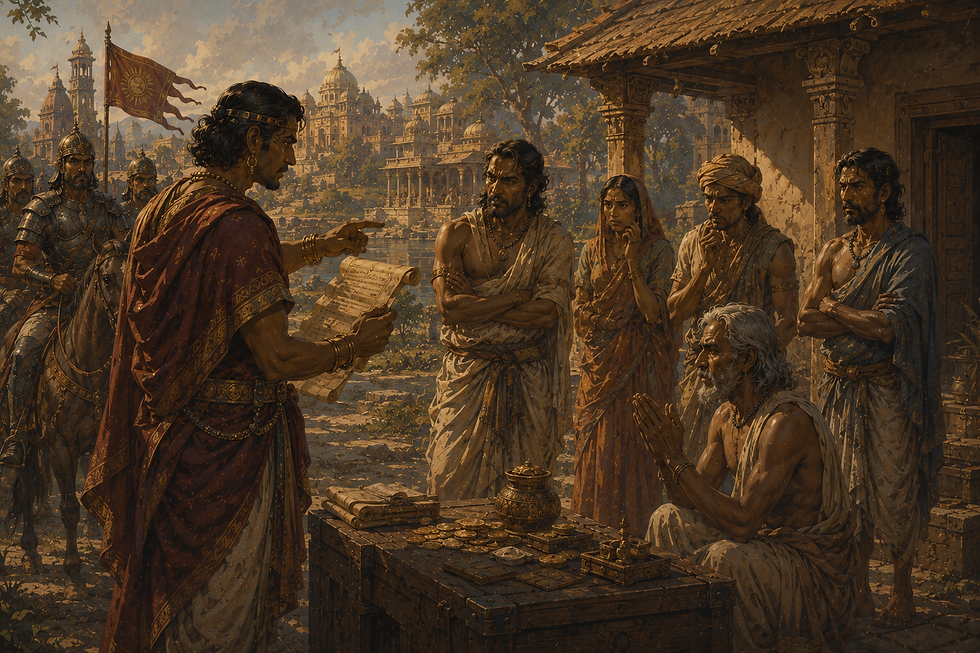


Comments