
.png)

Ancient Texts: Kautilya's Arthashastra - Chapters 16-20 (Part 4 of Book 3)
- A. Royden D'Souza

- Jun 15
- 57 min read
The first fifteen chapters of Book III erected the architecture of civil society. Chapters 1 through 5 established the forms of agreement, the rules of marriage, the duties of wives, the rights of separation, and the division of inheritance among sons.
Chapters 6 through 10 defined special shares, classified the twelve kinds of sons, regulated buildings and boundaries, protected pasture lands and roads, and enforced the performance of agreements. The household was ordered, the family property was divided, the neighbour's wall was measured, and the straying cow was fined. The law had drawn its lines around every person and every thing.
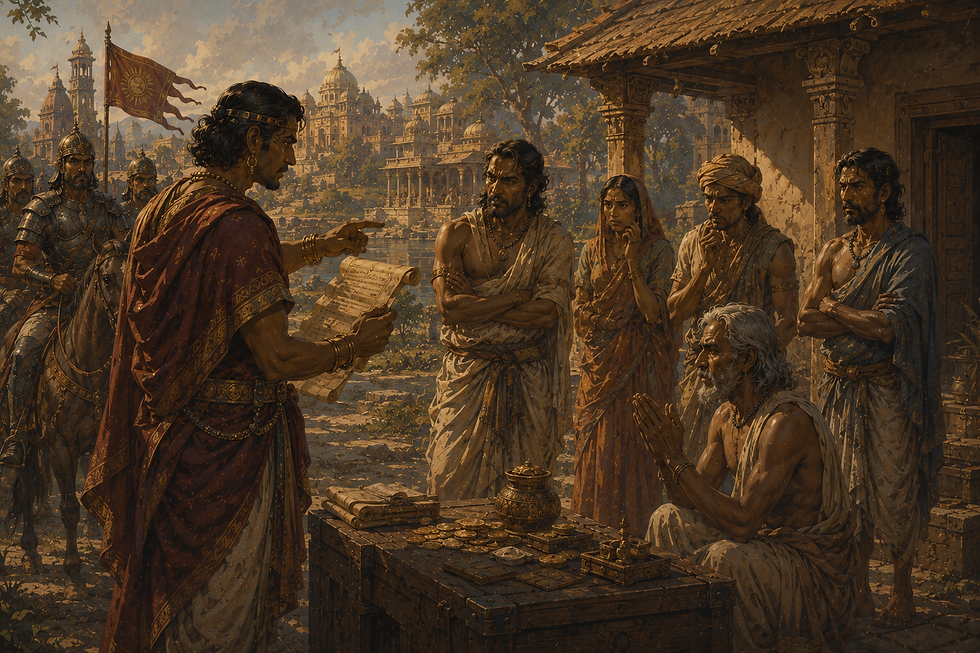
Chapters 16 through 20 of Arthashastra turn from the definition of rights to their enforcement. What happens when a debt is not paid? What remedy does a depositor have when the depositary refuses to return his property? How is a pledge to be sold when the borrower defaults, and what happens to the surplus? What protection does a buyer have when he purchases in good faith from a seller who did not own the goods? And when may a purchase be rescinded, and who bears the loss when the goods are defective? These are the questions of a commercial society—the disputes of the marketplace, the warehouse, and the counting-house.
The law Kautilya lays down in these final chapters of Book III is the law of money and goods. It is precise, practical, and unsentimental. A debtor who denies a valid debt is not merely a liar; he is a thief of another's property, and the law treats him accordingly. A depositary who uses what was entrusted to him is a criminal.
A pledge may be sold, but only after a waiting period, and the surplus, if any, must be returned to the borrower. A buyer who purchases openly and in good faith is protected, even if the seller lacked title—because commerce cannot function if every buyer must investigate the seller's chain of ownership back to the beginning of time.
And a sale may be rescinded within a fixed period if the goods are defective, because the law protects the honest buyer from the dishonest seller.
These five chapters complete the civil code of the Arthashastra. The tortoise's shell, which began as the king's self-discipline and grew to encompass the granary, the mint, the toll-gate, and the marriage contract, now extends to the last link in the chain of commerce: the enforcement of the obligation.
When the king's court compels a debtor to pay, restores a deposit to its owner, or protects an innocent buyer, it does not merely settle a private quarrel. It sustains the trust on which all trade depends. The kingdom without enforceable contracts is a kingdom without credit.
The kingdom without credit is a kingdom without merchants. And the kingdom without merchants is a kingdom that will soon be without revenue, without soldiers, and without walls.
Book III of Arthashastra: Concerning Judges (Dharmastha)
The third book, Dharmastha (धर्मस्थ), translates to "Concerning Judges" or "On the Administration of Justice." Where Book I forged the king from within and Book II built the machinery of economic administration, Book III establishes the legal framework through which the state resolves disputes, punishes wrongdoing, and maintains the social order.
Its central argument is that a kingdom without law is a kingdom without foundation; the king's discipline and the superintendent's efficiency are meaningless if the people cannot trust the courts to deliver justice.
The book's 20 chapters provide a comprehensive code of civil and criminal law, covering marriage, inheritance, debt, contracts, assault, defamation, theft, and the procedures by which judges investigate and adjudicate every form of dispute.

Chapter XVI: Resumption of Gifts, Sale Without Ownership and Ownership
Rules concerning recovery of debts shall also apply to resumption of gifts. Invalid gifts shall be kept in the safe custody of some persons. Any person who has given as gift not only his whole property, his sons, and his wife, but also his own life shall bring the same for the consideration of rescissors.
Gifts or charitable subscriptions to the wicked or for unworthy purposes, monetary help to such persons as are malevolent or cruel, and promise of sexual enjoyment to the unworthy shall be so settled by rescissors that neither the giver nor the receiver shall be injured thereby.
Those who receive any kind of aid from timid persons, threatening them with legal punishment, defamation, or loss of money, shall be liable to the punishment for theft; and the persons who yield such aids shall likewise be punished.
Co-operation in hurting a person, and showing a haughty attitude towards the king shall be punished with the highest amercement.
No son, or heir claiming a dead man's property shall, against his own will, pay the value of the bail borne by the dead man (pratibhavyadanda), the balance of any dowry (sulkasesha), or the stakes of gambling; nor shall he fulfill the promise of gifts made by the dead man under the influence of liquor or love. Thus resumption of gifts is dealt with.
Sale Without Ownership: As regards sale without ownership:—On the detection of a lost property in the possession of another person, the owner shall cause the offender to be arrested through the judges of a court. If time or place does not permit this action, the owner himself shall catch hold of the offender and bring him before the judges.
The judge shall put the question; how the offender came by the property. If he narrates how he got it, but cannot produce the person who sold it to him, he shall be left off, and shall forfeit the property. But the seller, if produced, shall not only pay the value of the property, but also be liable to the punishment for theft.
If a person with a stolen property in his possession runs away or hides himself till the property is wholly consumed, he shall not only pay the value, but also be liable to the punishment for theft.
After proving his claim to a lost property (svakaranam kritva), its owner shall be entitled to take possession of it. On his failure to prove his title to it, he shall be fined 5 times the value of the property, (panchabandhadandah), and the property shall be taken by the king.
If the owner takes possession of a lost article without obtaining permission from the court, he shall be punished with the first amercement.
Stolen or lost articles shall, on being detected, be kept in the toll-gate. If no claimant is forthcoming within three fortnights, such articles shall be taken by the king.
He who proved his title to a lost or stolen biped shall pay 5 panas towards ransom (before taking possession of it). Likewise the ransom for a single-hoofed animal shall be 4 panas; for a cow or a buffalo, 2 panas, for minor quadrupeds one-fourth of a pana; and for articles such as precious stones, superior or inferior raw materials, five per cent of their value.
Whatever of the property of his own subjects the king brings back from the forests and countries of enemies, shall be handed over to its owner. Whatever of the property of citizens robbed by thieves the king cannot recover, shall be made good from his own pocket.
If the king is unable to recover such things, he shall either allow any self-elected person (svayamgraha) to fetch them, or pay an equivalent ransom to the sufferer.
An adventurer may enjoy whatever the king graciously gives him out of the booty he has plundered from an enemy's country, excepting the life of an Arya and the property belonging to gods, Brahmins or ascetics. Thus sale without ownership is dealt with.
Ownership: As to the title of an owner to his property:—The owners who have quitted their country where their property lies shall continue to have their title to it.
When the owners other than minors, the aged, those that are afflicted with decease or calamities, those that are sojourning abroad, or those that have deserted their country during national disturbances, neglect for ten years their property which is under the enjoyment of others, they shall forfeit their title to it.
Buildings left for 20 years in the enjoyment of others shall not be reclaimed. But the mere occupation of the buildings of others during the absence of the king by kinsmen, priests, or heretics shall not give them the right of possession.
The same shall obtain with regard to open deposits, pledges, treasure trove (nidhi), boundary, or any property belonging to kings or priests (srotriyas).
Ascetics and heretics shall, without disturbing each other, reside in a large area. A new comer shall, however, be provided with the space occupied by an old resident. If not willing to do so, the old occupier shall be sent out.
The property of hermits, (vanaprastha) ascetics (yati), or bachelors learning the Vedas (Brahmachari) shall on their death be taken by their preceptors, disciples, their brethren (dharmabhratri), or class-mates in succession.
Whenever hermits, etc., have to pay any fines, they may, in the name of the king, perform penance, oblation to gods, fireworship, or the ritual called Mahakachchhavardhana for as many nights as the number of panas of their fines.
Those heretics (pashandah) who have neither gold nor gold-coin shall similarly observe their fasts except in the case of defamation, theft, assault and abduction of women. Under these circumstances, they shall be compelled to undergo punishment.
The king shall, under penalty of fines, forbid the wilful or improper proceedings of ascetics: for vice overwhelming righteousness will in the long run destroy the ruler himself.

In Simple Terms
The main ideas from this chapter can be understood in these simple points:
Gifts Can Be Taken Back: Not all gifts are permanent. The law allows gifts to be resumed—taken back—under certain conditions. The rules for recovering debts apply to recovering gifts. If a gift is invalid—made under duress, to an unworthy recipient, or by someone who had no right to give—the courts can rescind it.
A gift of everything a man owns, including his family and himself, is particularly suspect and must be reviewed. Gifts to the wicked, subscriptions to unworthy causes, aid to the malevolent or cruel, and promises of sex to the unworthy—all these can be rescinded. The court must settle the matter so that neither giver nor receiver is harmed.
Gifts Made Under Threat Are Void: If someone gives money or property because another person threatened him with legal punishment, defamation, or financial ruin, the person who extracted the gift is punished as a thief.
The person who yielded to the threat is also punished. The law does not reward those who prey on the timid, nor does it excuse those who give in to such pressure.
An Heir Does Not Inherit the Dead Man's Follies: A son or heir cannot be forced to pay his dead father's gambling debts, the unpaid balance of a dowry, the bail his father posted for another, or any gift his father promised while drunk or in love. The heir inherits the property, not the foolishness.
Sale Without Ownership—The Buyer's Duty: If a lost or stolen item is found in someone's possession, the owner can have that person arrested and brought before a judge. The judge asks: "How did you get this?" If the possessor tells his story—"I bought it from so-and-so"—but cannot produce the seller, he is let go, but he forfeits the property.
If he can produce the seller, the seller pays the value of the property and is punished for theft. The buyer who bought in good faith is protected; the seller who sold what was not his is punished.
The Thief Who Runs: If someone caught with stolen property runs away or hides until the goods are consumed or lost, he pays the value and is punished for theft. Flight is an admission of guilt.
The Owner Must Prove His Title: To recover lost property, the owner must prove his claim. If he proves it, he gets his property back, minus a ransom fee: five panas for a slave, four for a horse, two for a cow, a quarter-pana for a goat, and five percent of the value for precious goods. If he fails to prove his claim, he is fined five times the value, and the property goes to the king. False claims are punished severely.
No Self-Help: If an owner simply takes back his lost property without going to court, he is fined the first amercement. The law insists on orderly process. Even the rightful owner must use the courts.
Lost Property at the Toll-Gate: Stolen or lost goods found by the authorities are kept at the toll-gate. If no one claims them within three fortnights—about six weeks—they become the king's property.
The King's Duty to Recover Stolen Goods: If the king recovers his subjects' property from forests or enemy territory, he must return it to its owners. If thieves steal from a citizen and the king cannot recover the goods, he must compensate the victim from his own treasury. The king who cannot protect his people's property pays for the loss himself.
If the king cannot recover the goods, he may either let a private adventurer try—and keep whatever he recovers—or pay the victim a ransom. An adventurer who plunders enemy territory may keep whatever the king gives him, except the life of a free person and the property of gods, priests, or ascetics.
Ownership Lost by Neglect: If an owner leaves his property and does nothing to reclaim it for ten years—while others are using it—he loses his title. The exceptions are minors, the aged, the sick, those in calamity, those abroad, and those displaced by national disturbances. Their time does not start until their disability ends.
Buildings occupied by others for twenty years cannot be reclaimed. But mere occupation by kinsmen, priests, or heretics during the king's absence does not give them ownership. The law distinguishes between true abandonment and temporary absence.
Ascetics and Their Property: Ascetics and heretics must live together without disturbing each other. A new arrival must be given space, and an old resident who refuses must leave. When a hermit, ascetic, or student dies, his property passes to his preceptor, disciples, spiritual brothers, or classmates in that order.
If an ascetic is fined, he may, instead of paying money, perform penance, offer oblations, tend the fire, or perform a ritual for as many nights as the number of panas of the fine. Heretics with no money may fast instead—except for defamation, theft, assault, and abduction of women, for which they must suffer the ordinary punishment.
The king must restrain ascetics from improper conduct, for vice that overcomes righteousness will eventually destroy the ruler himself.
Case Study: An Ancient King's Application
The Satavahana dynasty (c. 2nd century BC – 3rd century AD) ruled the Deccan at a time when trade routes connected the ports of the western coast with the interior and with the Roman Empire. The merchant guilds of the Satavahana period operated a sophisticated system for tracking and recovering stolen goods that directly applied the Kautilyan rules on sale without ownership.
The guilds maintained registers of stolen property. A merchant whose goods were stolen would report the theft to his guild, describing the items and any distinguishing marks. The guild circulated this information to other guilds along the trade routes.
When a stolen item appeared in a market, the possessor was required to identify the seller. If he could not, he forfeited the goods but was not punished—the Kautilyan rule that protects the innocent buyer. If he could identify the seller, the seller was pursued and punished.
The Satavahana guilds also enforced the Kautilyan rule that the king must compensate victims of theft when the state fails to recover the goods. Inscriptions from the Nasik caves record instances where the king's officers reimbursed merchants for goods stolen on the royal highways, and the guilds maintained records of these reimbursements.
The principle that the state guarantees the safety of commerce was not merely theoretical in the Satavahana dominions.
The Kautilyan rule on adverse possession—ten years for movable property, twenty for buildings—was also observed in Satavahana law. A merchant who abandoned a warehouse and did not claim it for twenty years lost his title. But a merchant who fled during a war and returned afterwards did not lose his title, because his absence was due to national disturbance, which the law excepts.
The Satavahana guild system survived the dynasty and passed into the customary law of the Deccan. The principle that a buyer in good faith is protected, that a seller without title is a thief, and that the state is the ultimate guarantor of property rights are the foundations of all commercial law.
In Modern Times
In modern India, the Kautilyan law on resumption of gifts, sale without ownership, and ownership is the ancestor of several distinct bodies of law. The Kautilyan rule that gifts made under threat or to unworthy recipients can be rescinded is the ancestor of the modern law of undue influence and coercion in the Indian Contract Act, 1872.
A gift or contract made under threat or pressure is voidable. The Kautilyan rule that an heir does not inherit his father's gambling debts is the ancestor of the modern principle that an heir's liability for the debts of the deceased is limited to the value of the inheritance.
The Kautilyan rule on sale without ownership—that a buyer in good faith who cannot produce the seller forfeits the goods but is not punished—is the direct ancestor of the modern law of market overt and the principle that a bona fide purchaser for value without notice of a defect in title is protected.
The Sale of Goods Act, 1930, provides that a buyer who purchases in good faith from a seller in possession, without knowledge of any defect in title, acquires good title. The Kautilyan rule that a seller without title is punished for theft is the ancestor of the modern crime of criminal breach of trust and cheating.
The Kautilyan rule that the king must compensate victims of theft when the state fails to recover the goods is the ancestor of the modern principle of state liability in tort.
The modern state does not generally guarantee the safety of private property, but specific statutes—such as the Public Liability Insurance Act, 1991—provide for compensation by the state or its instrumentalities for harm caused to citizens.
The Kautilyan rule on adverse possession—ten years for movable property, twenty for buildings—is the direct ancestor of the modern Limitation Act, 1963. The Limitation Act extinguishes the right to sue for recovery of immovable property after twelve years and for movable property after three years.
The Kautilyan exceptions for minors, the aged, the sick, and those abroad are the modern provisions for extending the limitation period when the plaintiff is under a disability.
The Kautilyan rule that ascetics may perform penance in lieu of fines, except for serious crimes, is the ancestor of the modern provision that allows courts to release offenders on probation instead of imprisoning them.
The Probation of Offenders Act, 1958, empowers courts to release certain offenders on probation of good conduct, particularly first offenders and those accused of minor offences.
Kūrmapura, the Court of Justice – Mid-Morning The court scribe, Lekhapala, read the registration aloud: "The year is the thirteenth of King Simhavarma Sura. The season is Hemanta. The month is Margasirsha. The fortnight is the waning moon. The date is the third day. The nature of the dispute is the recovery of a stolen sapphire. The petitioner is Ratnadatta, a jeweller of the western quarter of Kūrmapura. The respondent is Somadatta, a merchant of the same quarter." The six chairs behind the polished teak bench were filled. Dharmagupta presided. Shrutavati and Vedananda flanked him. Gajakesha, Rudravarma, and Vamanagupta sat in the amatyas' chairs. Ratnadatta spoke first. He was a thin, precise man with the careful hands of a jeweller and the sharp eyes of one who spent his days examining gems. "My lords, three weeks ago, a thief broke into my workshop and stole a dozen uncut sapphires. I reported the theft to the city guard and described the stones. Yesterday, I was walking through the southern market when I saw one of my sapphires—a distinctive stone with a star-shaped inclusion—in the stall of Somadatta. I recognised it immediately. I asked him where he got it. He said he bought it from a man he did not know. I ask the court to return my sapphire and to determine whether Somadatta is an innocent buyer or a thief." Somadatta, a heavyset merchant with a nervous manner, rose to answer. "My lords, I am an honest trader. A man came to my stall two weeks ago and offered me the sapphire for thirty panas—a fair price. I did not know it was stolen. He said he was a traveller from the northern hills, selling his family's jewels to raise money for a trading voyage. I paid him and he left. I do not know his name or where he went. I am not a thief." Shrutavati leaned forward. "The law says that when a lost or stolen item is found in another's possession, the judge must ask how the possessor came by it. If he tells his story but cannot produce the seller, he forfeits the property but is not punished. If he can produce the seller, the seller pays the value and is punished for theft. Somadatta, you cannot produce the seller. Therefore you are not punished. But you must forfeit the sapphire." Somadatta's face fell. "My lords, I paid thirty panas for that stone. If I forfeit it, I lose my money." "That is the risk of buying from a stranger," Vedananda said. "The law protects the innocent buyer from punishment, but it does not guarantee his profit. The stone returns to its owner. Your remedy is against the man who sold it to you—if you can find him." Ratnadatta spoke. "My lords, I can prove the sapphire is mine. I have the records of my workshop, which describe the star-shaped inclusion. I have witnesses who saw the stone in my possession before the theft. I ask the court to restore my property." Gajakesha examined the jeweller's records. "The description matches the stone. The witnesses confirm the stone was in Ratnadatta's workshop before the theft. The ownership is proved." Dharmagupta nodded. "The court finds that the sapphire belongs to Ratnadatta. The stone shall be returned to him. As the owner of recovered stolen property, he shall pay the ransom fee of five percent of its value—one and a half panas—to the court. Somadatta shall forfeit the stone but is not punished, as he is an innocent buyer. If he can find the man who sold him the stone, that man shall be arrested and tried for theft." Ratnadatta touched his forehead to the floor. Somadatta bowed, his face a mixture of relief and resentment. After the court had emptied, Shrutavati said to Vedananda, "The merchant lost his thirty panas and the jeweller recovered his stone. The law protected the innocent buyer from punishment, but it did not make him whole. Is that justice?" "The law does what it can," Vedananda replied. "The merchant bought from a stranger without asking his name or where he lived. He took a risk, and the risk materialised. The jeweller proved his ownership, and the stone returned to him. The thief is still free, but the law does not punish the innocent for the crimes of the guilty." Vamanagupta, passing by, paused. "The merchant will be more careful next time. He will ask the seller's name. He will demand a witness. The law teaches caution as well as dispensing justice. The stone is returned. The lesson is learned." |

Chapter XVII: Robbery
Sudden and direct seizure (of person or property) is termed sahasa; fraudulent or indirect seizure (niranvaye'pavyayanecha) is theft.
The school of Manu hold that the fine for the direct seizure of precious stones and superior or inferior raw materials shall be equal to their value. It is equal to twice the value of the articles according to the followers of Usanas.
But Kautilya holds that it shall be proportional to the gravity of the crime.
In the case of such articles of small value as flowers, fruits, vegetables, roots, turnips, cooked rice, skins, bamboo, and pots (earthenware) the fine shall range from 12 to 24 panas; for articles of great value such as iron (kalayasa), wood, roping materials, and herds of minor quadrupeds, the fine shall range from 24 to 48 panas; and for such articles of still greater value as copper, brass, bronze, glass, ivory and vessels, etc., it shall range from 48 to 96 panas. This fine is termed the first amercement.
For the seizure of such as big quadrupeds, men, fields, houses, gold, gold-coins, fine fabrics, etc., the fine shall range from 200 to 500 panas, which is termed the middle-most amercement.
My preceptor holds that keeping or causing to keep by force either men or women in prison, or releasing them by force from imprisonment, shall be punished with fines ranging from 500 to 1,000 panas. This fine is termed the highest amercement.
He who causes another to commit sahasa after the plans prepared by himself shall be fined twice the value (of the person or property seized). An abettor who employs a hireling to commit sahasa by promising "I shall pay thee as much gold as thou makest use of," shall be fined four times the value.
The school of Brihaspati are of opinion that if with the promise "I will pay thee this amount of gold," an abettor causes another to commit sahasa, the former shall be compelled to pay the promised amount of gold and a fine. But Kautilya holds that if an abettor extenuates his crime by pleading anger, intoxication or loss of sense (moham), he shall be punished as described above.
In all kinds of fines below a hundred panas, the king shall take in addition to the fine 8 per cent more as rupa and in fines above hundred, five per cent more; these two kinds of exaction, are just inasmuch as the people are full of sins on the one hand, and kings are naturally misguided on the other.

In Simple Terms
The main ideas from this chapter can be understood in these simple points:
Robbery Is Direct, Theft Is Indirect: The law draws a sharp line between robbery (sahasa) and theft. Robbery is sudden, direct, and forcible—a man is seized, a purse is snatched, a house is broken into while the occupants are present.
Theft is indirect and deceptive—a pickpocket lifts a purse without the victim noticing, a burglar enters a house when no one is home. Both are crimes, but robbery, because it involves direct confrontation and often violence, is punished more severely.
The Debate Over Fines: Two earlier schools of thought are presented and rejected. Manu says the fine for robbery should equal the value of what was taken. Usanas says it should be twice the value. Kautilya disagrees with both.
The fine, he says, should be proportional to the gravity of the crime, not merely to the value of the stolen goods. A poor man who steals a loaf of bread and a rich man who steals a diamond are both thieves, but the gravity of their crimes—the violence used, the harm caused, the circumstances of the act—may differ.
The Three Levels of Punishment for Robbery: The law classifies robbery by the value and nature of what was taken. For small-value goods—flowers, fruits, vegetables, cooked rice, pots—the fine is 12 to 24 panas.
For mid-value goods—iron, timber, ropes, herds of goats—the fine is 24 to 48 panas. For higher-value goods—copper, brass, bronze, glass, ivory, vessels—the fine is 48 to 96 panas. These are the range of the first amercement.
For more serious robberies—of large animals, human beings, fields, houses, gold, gold coins, fine fabrics—the fine jumps to 200 to 500 panas. This is the middlemost amercement.
For the most serious offences—keeping men or women imprisoned by force, or forcibly freeing prisoners—the fine is 500 to 1,000 panas. This is the highest amercement. The law distinguishes the man who steals a mango from the man who kidnaps a child.
The Abettor Is Punished More Severely Than the Doer: The man who plans a robbery and gets another to carry it out is fined twice the value of what was taken—more than the actual robber, because he is the mind behind the crime.
The abettor who hires a robber with a vague promise—"I will pay you as much gold as you use"—is fined four times the value. Brihaspati's school held that if the abettor promised a specific amount, he should pay that amount and a fine.
Kautilya holds that if the abettor pleads anger, drunkenness, or temporary loss of reason as an excuse, he is still punished as above—the law does not accept intoxication or emotion as a defence.
The King's Surcharge: On all fines, the king levies a surcharge: eight percent on fines below a hundred panas, and five percent on fines above a hundred. Kautilya adds a cynical justification: the people are full of sins, and kings are naturally misguided, so both sides need this correction. The surcharge is the state's administrative fee for the machinery of justice.
Case Study: An Ancient King's Application
The Chola Empire (c. 850–1279 AD) left a vast record of its judicial administration in thousands of stone and copper-plate inscriptions. These inscriptions, found on temple walls across Tamil Nadu, record the judgments of village assemblies and royal courts in cases of theft and robbery, and they reveal a system of graded fines that closely followed the Kautilyan model.
The Chola inscriptions distinguish clearly between theft and robbery. The term "kalavu" was used for theft—secret taking—while "sahasa" or "vali" referred to forcible seizure. The penalties recorded in the inscriptions vary according to the value of the goods taken, the violence used, and the status of the offender.
A man who stole coconuts from a temple garden was fined a few panas. A man who robbed a merchant on the highway was fined heavily, and if he could not pay, his land was confiscated or he was sold into bondage.
The Chola courts also punished abettors more severely than the actual thieves. An inscription from the reign of Rajaraja Chola I records a case in which a village headman had planned the robbery of a rival's granary and hired two labourers to carry it out.
The labourers were fined and flogged. The headman was stripped of his office, fined four times the value of the grain, and exiled from the village. The Kautilyan principle—that the mind behind the crime bears the greater guilt—was the law of the Chola country.
The Chola fines were not fixed by rigid statute but were determined by the village assembly or the royal court based on the circumstances of each case. This was Kautilya's "proportional to the gravity of the crime" made operational.
A first offender was treated more leniently than a repeat offender. A robber who used violence was punished more severely than one who merely threatened. A robber who returned the goods voluntarily was shown mercy. The law was a living instrument, not a mechanical formula.
The Chola inscriptions also record the surcharge on fines. A fine of a hundred panas recorded in a temple inscription often appears with an additional five or eight panas noted as "the king's share" or "the court fee."
The Kautilyan rupa—the surcharge that pays for the machinery of justice—survived in the Chola administration and passed into the customary law of South India.
In Modern Times
In modern India, the Kautilyan distinction between robbery and theft is the direct ancestor of the Indian Penal Code's distinction between theft (Section 378), extortion (Section 383), robbery (Section 390), and dacoity (Section 391).
Theft is the taking of property without consent, secretly. Robbery is theft accompanied by violence or the threat of violence. Extortion is the taking of property by putting a person in fear of harm. Dacoity is robbery committed by five or more persons. The Kautilyan sahasa—direct and forcible seizure—is the modern robbery and dacoity.
The Kautilyan graded fines—from 12 panas for a stolen pot to 1,000 panas for kidnapping—have been replaced by terms of imprisonment. The Indian Penal Code provides for imprisonment of up to three years for theft, up to ten years for robbery, and life imprisonment or death for dacoity with murder.
The modern law does not impose fines as the primary punishment for robbery; imprisonment is the norm. But the principle of proportionality—that the punishment should fit the gravity of the crime—is the same.
The Kautilyan rule that the abettor is punished more severely than the actual perpetrator is the ancestor of the modern law of criminal conspiracy (Section 120B of the Indian Penal Code) and abetment (Sections 107–120).
The man who plans a dacoity and hires the dacoits is liable to the same punishment as the dacoits themselves, and the law often treats him as the more culpable party.
The Kautilyan surcharge on fines—eight percent or five percent—is the ancestor of the modern court fee and the various administrative charges that attach to criminal penalties. The modern state also takes a share of the fines it imposes, to fund the machinery of justice.
The Kautilyan rejection of intoxication as a defence—the abettor who pleads anger or drunkenness is still punished—is the modern rule that voluntary intoxication is no defence to a criminal charge (Section 85 of the Indian Penal Code). A man who gets drunk and commits a crime is not excused; he is punished.
Kūrmapura, the Court of Justice – Mid-Morning The court scribe, Lekhapala, read the registration aloud: "The year is the thirteenth of King Simhavarma Sura. The season is Hemanta. The month is Margasirsha. The fortnight is the waning moon. The date is the second day. The nature of the dispute is robbery on the king's highway. The petitioner is the City Superintendent, prosecuting on behalf of the crown. The accused are Gadhi and Lomasha, both of the northern quarter of Kūrmapura." The six chairs behind the polished teak bench were filled. Dharmagupta presided. Shrutavati and Vedananda flanked him. Gajakesha, Rudravarma, and Vamanagupta sat in the amatyas' chairs. The City Superintendent, Nagarapala, presented the case. "My lords, three days ago, on the northern trade road, a merchant named Dhanadasa was travelling with a pack-mule carrying a bolt of Valenta silk worth one hundred and fifty panas. Two men—the accused Gadhi and Lomasha—stopped him on the road, threatened him with a cudgel, seized the silk, and fled. The merchant identified both men. They were arrested the following day, and the silk was found in Gadhi's house, still in its wrapping. The crime is robbery—sahasa—direct and forcible seizure." The merchant Dhanadasa, a thin man with a bruised face, gave his testimony. "I was alone on the road. They came out of the trees. Gadhi held the cudgel to my head. Lomasha cut the silk from the mule. They told me if I followed them, they would kill me. Then they ran. I recognised Gadhi—he was a labourer who had worked for me last season. I knew his face." Gadhi, a thick-set man with a sullen expression, spoke first in his defence. "My lords, it is true I took the silk. But I was drunk. I had been drinking at the tavern since midday. I do not remember clearly what happened. Lomasha said we would be rich. I did not plan it. I only held the stick." Lomasha, a lean, nervous man, spoke next. "My lords, it was Gadhi's idea. He knew the merchant. He knew when he would be on the road. He came to me and said, 'Help me, and I will give you half the silk.' I was a fool. I agreed. But I did not strike the merchant. I only cut the silk." Shrutavati leaned forward. "Gadhi, you claim drunkenness as your excuse. The law does not accept drunkenness as a defence. A man who commits robbery while drunk is still a robber. Lomasha, you claim Gadhi planned the crime. That makes him the abettor and you the instrument. The law punishes the abettor more severely than the doer." Vedananda spoke. "The robbery was on the king's highway, in daylight, with a weapon. The victim was threatened with death. The goods were of high value—silk, not vegetables. Under the law, the fine for robbery of goods of this value is the middlemost amercement—between two hundred and five hundred panas." Gajakesha examined the record. "Neither man has been convicted before. Gadhi was a labourer; Lomasha was a tanner. Both are poor men. They cannot pay the middlemost amercement. The law provides that those who cannot pay fines may be held in bondage until the debt is worked off." Dharmagupta spoke. "The court finds both men guilty of robbery. Gadhi, as the planner and the one who held the weapon, is fined three hundred panas. Lomasha, as the instrument, is fined two hundred panas. Both shall also pay the king's surcharge of five percent on their fines—fifteen and ten panas respectively. Neither can pay. Both shall be held in the state labour corps until their fines are worked off, at the rate of one pana per month of labour. In addition, the silk shall be returned to the merchant Dhanadasa, and the accused shall compensate him for the bruise on his face, assessed at five panas each." Gadhi's sullen face twisted with anger. Lomasha began to weep. Nagarapala added, "My lords, there is a third man. The tavern-keeper has testified that a man named Dirghamitra was drinking with Gadhi and Lomasha before the robbery and was heard to say, 'The silk merchant travels the north road every week. A man with a cudgel could take what he wanted.' Dirghamitra did not participate in the robbery, but he planted the idea." Dharmagupta's expression hardened. "Dirghamitra is an abettor. He did not wield the cudgel, but he set the crime in motion. He shall be arrested and tried separately. If convicted, he shall pay a fine of four times the value of the silk—six hundred panas—for he is the mind behind the crime." After the court had emptied, Shrutavati said to Vedananda, "Two poor men will labour for years to pay for a moment's violence. The merchant will have his silk back and his bruise compensated. The man who whispered the idea will pay the heaviest price of all. Is that justice?" "The man who whispers is the most dangerous of all," Vedananda replied. "He does not dirty his hands, but his words become another man's crime. The law knows this and punishes the whisperer more than the doer. The two who held the stick and cut the silk will work off their debt. The one who planted the seed will lose everything." Vamanagupta, passing by, paused. "The road is the king's peace. To rob on the road is to strike at the peace itself. The law does not ask whether the robber was drunk or desperate. It asks whether the road is safe. Today, three men learned that the road is guarded." |

Chapter XVIII: Defamation
Calumny, contemptuous talk, or intimidation constitutes defamation.
Among abusive expressions relating to the body, habits, learning, occupation, or nationalities, that of calling a deformed man by his right name such as "the blind", "the lame", etc. shall be punished with a fine of 3 panas; and by false name 6 panas. If the blind, the lame, etc., are insulted with such ironical expressions as "a man of beautiful eyes", "a man of beautiful teeth", etc. the fine shall be 12 panas. Likewise when a person is taunted for leprosy, lunacy, impotency and the like.
Abusive expressions in general, no matter whether true, false, or reverse with reference to the abused, shall be punished with fines ranging above 12 panas, in the case of persons of equal rank.
If persons abused happen to be of superior rank, the amount of the fines shall be doubled; if of lower rank, it shall be halved. For calumniating the wives of others, the amount of the fines shall be doubled.
If abuse is due to carelessness, intoxication, or loss of sense, etc., the fines shall be halved.
As to the reality of leprosy and lunacy, physicians or neighbours shall be authorities. As to the reality of impotency, women, the scum of urine, or the low specific gravity of faeces in water (the sinking of faeces in water) shall furnish the necessary evidence.
Speaking Ill of Habits: If among Brahmins, Kshatriyas, Vaisyas, Sudras, and outcastes (antavasayins), any one of a lower caste abuses the habits of one of a higher caste, the fines imposed shall increase from 3 panas upwards (commencing from the lowest caste). If any one of a higher caste abuses one of a lower caste, fines imposed shall decrease from 2 panas.
Contemptuous expressions such as "a bad Brahmin" shall also be punished as above.
The same rules shall apply to calumnies regarding learning (sruta), the profession of buffoons (vagjivana), artisans, or musicians, and relating to nationalities such as Prajjunaka, Gandhara, etc.
Intimidation: If a person intimidates another by using such expressions as "I shall render thee thus", the bravado shall be punished with half as much fine as will be levied on him who actually does so.
If a person, being unable to carry his threat into effect, pleads provocation, intoxication, or loss of sense as his excuse, he shall be fined 12 panas.
If a person capable to do harm and under the influence of enmity intimidates another, he shall be compelled to give life-long security for the well-being of the intimidated.
Defamation of one's own nation or village shall be punished with the first amercement; that of one's own caste or assembly with the middlemost; and that of gods or temples (chaitya) with the highest amercement.

In Simple Terms
The main ideas from this chapter can be understood in these simple points:
What Counts as Defamation: The law recognises three forms of defamation: calumny (false accusation), contemptuous talk (insults and mockery), and intimidation (threats). All three harm a person's reputation or peace of mind, and all three are punishable.
The Truth Is Not Always a Defence: If you call a blind man "blind," you speak truth—but you still pay a fine of 3 panas. If you falsely call a sighted man "blind," the fine doubles to 6 panas. The law does not give anyone the right to humiliate another, even with the truth. But falsehood makes the offence worse.
Irony Is Worse Than Honesty: The cruelest insult is the sarcastic one. Calling a blind man "a man of beautiful eyes" or a cripple "a man of beautiful limbs" costs 12 panas—four times the fine for simply stating the truth. The law understands that mockery wounds more deeply than bluntness.
Rank Matters: If the person insulted is of higher rank than the insulter, the fine doubles. If the victim is of lower rank, the fine is halved. The law protects the social hierarchy. Insulting a superior is a greater offence than insulting an inferior. Insulting another man's wife doubles the fine regardless of rank.
Drunkenness Is a Partial Excuse: If the abuse was spoken carelessly, in drunkenness, or in a state of temporary mental disturbance, the fine is halved. The law does not excuse drunken speech entirely, but it treats it less severely than deliberate malice.
Proving the Truth of the Insult: If a man is accused of leprosy or lunacy, physicians and neighbours determine whether the accusation is true. If a man is accused of impotence, the evidence is gathered from women who have known him, or from the scum of his urine, or from whether his faeces sink in water—ancient tests of virility.
The law does not allow insults based on false claims, but it also does not shield a person from the truth if the truth can be proved.
Insulting Habits by Caste: The law protects the habits and customs of each community. A lower-caste person who abuses the habits of a higher-caste person pays a fine that rises with the distance between their castes.
A higher-caste person who abuses a lower-caste person pays a decreasing fine. The same rule applies to insults about a person's learning, profession, or nationality. Calling a Brahmin "a bad Brahmin" is punishable.
Threats Are Half the Crime: A person who threatens another—"I will do this to you"—pays half the fine that would be imposed if he actually carried out the threat. The law punishes the intent as well as the act. A person who makes a threat he is incapable of carrying out, and pleads provocation or drunkenness, pays a flat fine of 12 panas.
A person who is both capable of harm and motivated by enmity must provide lifelong security for the safety of the person he threatened.
The Worst Defamation: Defaming one's own nation or village costs the first amercement—a heavy fine. Defaming one's own community or assembly costs the middlemost amercement—heavier still. Defaming the gods or temples costs the highest amercement—the most severe penalty short of death. The law protects the sacred and the collective above the individual.
Case Study: An Ancient King's Application
The Vijayanagara Empire (14th–17th centuries AD) was a society in which honour and reputation were matters of life and death. The inscriptions of the empire record numerous cases of defamation, and the penalties imposed by the village assemblies and royal courts closely followed the Kautilyan framework.
The Vijayanagara courts distinguished between true statements, false statements, and ironic insults, exactly as the Arthashastra does. An inscription from the reign of Krishnadevaraya records a case in which a man called his neighbour a thief.
The neighbour sued for defamation. The court examined the evidence and found that the neighbour had indeed been convicted of theft years earlier. The statement was true, but the court still fined the speaker 3 panas for uttering it publicly without cause. The truth was not a complete defence; the law protected the reformed man from being haunted by his past.
Another inscription records a case of ironic insult. A merchant, angry at a rival, called him "a man of honest scales"—a sarcastic reference to the rival's known use of false weights.
The court treated the sarcasm as more damaging than a direct accusation and fined the merchant 12 panas. The Vijayanagara judges understood, as Kautilya did, that a sneer could wound more deeply than a shout.
The Vijayanagara courts also enforced the Kautilyan rule that the penalty for defamation varies with the relative rank of the parties. An insult by a Shudra against a Brahmin was punished more severely than the same insult by a Brahmin against a Shudra.
The hierarchy of caste was woven into the law of defamation. But the Vijayanagara courts also protected the lower castes from abuse. An inscription from the reign of Devaraya II records a case in which a Brahmin called a Shudra farmer "a son of a slave."
The farmer sued, and the court fined the Brahmin, though at the reduced rate Kautilya prescribes for insults descending the social ladder.
The Vijayanagara law of defamation survived the empire's fall and passed into the customary law of the Deccan and South India. The British colonial courts later incorporated many of these customary principles into the Anglo-Indian law of defamation.
In Modern Times
In modern India, the Kautilyan law of defamation is the direct ancestor of the Indian Penal Code's provisions on defamation (Section 499) and criminal intimidation (Section 503).
Section 499 defines defamation as words spoken or written that harm the reputation of another, with exceptions for true statements made for the public good. Section 503 defines criminal intimidation as threatening another with injury to his person, reputation, or property.
The Kautilyan rule that truth is not always a defence survives in the modern law. Under Section 499, a true statement made for a purpose other than the public good can still be defamatory.
The Kautilyan rule that the penalty varies with the relative status of the parties has been abolished—the modern law treats all persons equally, regardless of caste or rank. The Kautilyan rule that drunkenness is a partial excuse has been reversed: voluntary intoxication is no defence to a criminal charge under modern law.
The Kautilyan rule that threats are punished at half the rate of the actual act is the ancestor of the modern distinction between attempt and completed offence. Criminal intimidation is a separate offence from the act threatened, and it carries its own penalty, which is generally less than the penalty for the completed act.
The Kautilyan rule that defaming the gods or temples is punished most severely is the ancestor of the modern law on outraging religious feelings (Section 295A of the Indian Penal Code). The modern law punishes deliberate and malicious acts intended to outrage the religious feelings of any class of citizens. The Kautilyan protection of the sacred has become the modern protection of religious sentiment.
The Kautilyan rule that defaming one's own nation or community is a serious offence finds no direct modern parallel, but the principle survives in the modern law of sedition (Section 124A) and in laws that prohibit speech that promotes enmity between different groups.
Kūrmapura, the Court of Justice – Late Morning The court scribe, Lekhapala, read the registration aloud: "The year is the thirteenth of King Simhavarma Sura. The season is Hemanta. The month is Margasirsha. The fortnight is the waning moon. The date is the eighth day. The nature of the dispute is defamation. The petitioner is Vimala, a weaver of the western quarter of Kūrmapura. The respondent is Chitragupta, a cloth-merchant of the same quarter." The six chairs behind the polished teak bench were filled. Dharmagupta presided. Shrutavati and Vedananda flanked him. Gajakesha, Rudravarma, and Vamanagupta sat in the amatyas' chairs. Vimala spoke first. She was a woman of perhaps forty years, her hands stained with dye, her voice steady but angry. "My lords, three days ago, I was in the market, selling cloth I had woven. The respondent, Chitragupta, came to my stall. He picked up a length of my cloth, looked at it, and said, loud enough for everyone to hear: 'This cloth is so poorly woven it would shame a blind woman. But then, the weaver is a whore, and whores have no shame.'" A murmur passed through the court. Vimala continued. "I am a widow, my lords. My husband died five years ago. I have lived a pure life since his death. Chitragupta called me a whore in the public market. He did so because I refused to sell him my cloth at half its price. He is my rival, and he sought to destroy my reputation to drive me from the market. I ask the court to punish him for defamation." Chitragupta, a sleek merchant with a practised smile, rose to answer. "My lords, the woman exaggerates. I made a comment about the quality of her cloth—which is indeed poor. I may have used an ill-chosen word. But it was spoken in the heat of bargaining, without malice. If I offended her, I apologise." Shrutavati leaned forward. "You called her a whore. That is not a comment on the quality of cloth. That is an attack on her character. The law punishes contemptuous talk. You spoke in the public market, before witnesses. Was your remark true? Is the petitioner a woman of loose morals?" Chitragupta's smile flickered. "I... I have no evidence of that. It was an expression of frustration." Vedananda spoke. "Then the statement was false. The law punishes false defamation more severely than true. You called a widow a whore, falsely, in public. The petitioner is a woman of lower rank than you—a weaver to your merchant. But the law also says that for calumniating the wives of others, the fine is doubled. The petitioner is a widow, which is not the same as a wife, but the principle of protecting a woman's reputation applies." Gajakesha examined the market records. "Three witnesses have testified that they heard Chitragupta call Vimala a whore. All three are disinterested—a vegetable-seller, a potter, and a beggar. Their testimony is consistent. The statement was false. It was spoken with malice, to harm a rival." Dharmagupta spoke. "The court finds Chitragupta guilty of defamation. The base fine for false defamation of a person of equal rank is above 12 panas. The petitioner is of lower rank, so the fine would normally be halved. But the insult was directed at a woman's chastity, and the law says that calumniating the wives of others doubles the fine. The court assesses the fine at 24 panas. Chitragupta shall also make a public apology to Vimala in the market where the insult was spoken." Chitragupta's smile was long gone. "My lords, 24 panas for a word spoken in haste?" "A word spoken in haste can destroy a reputation built over a lifetime," Shrutavati said. "The law protects what your haste would have ruined." After the court had emptied, Shrutavati said to Vedananda, "He called her a whore to drive her from the market. The court fined him and made him apologise in the very place where he slandered her. The fine was not large, but the apology will be seen by everyone who heard the insult." "The law cannot un-speak a word," Vedananda replied. "But it can make the speaker eat his words in public. The merchant's apology will tell the market that he lied. The weaver's reputation will be restored, and the merchant's own reputation will suffer. That is the law's remedy—not perfect, but effective." Vamanagupta, passing by, paused. "The tongue is a weapon. The law cannot sheathe it, but it can blunt its edge. The merchant will think twice before he draws it again." |
Chapter XIX: Assault
Touching, striking, or hurting constitutes assault. When a person touches with hand, mud, ashes or dust the body of another person below the navel, he shall be punished with a fine of 3 panas; with some but unclean things, with the leg, or spittle, 6 panas; with saliva (Chhardi), urine, faeces, etc. 12 panas. If the same offence is committed above the navel, the fines shall be doubled; and on the head, quadrupled.
If the same offence is committed on persons of superior rank, the fines shall be twice as much: and on persons of lower rank, half of the above fines. If the same offence is committed on the women of others, the fines shall be doubled.
If the offence is due to carelessness, intoxication, or loss of sense, the fines shall be halved.
For catching hold of a man by his legs, clothes, hands or hair, fines ranging above 6 panas shall be imposed. Squeezing, rounding with arms, thrusting, dragging, or sitting over the body of another person shall be punished with the first amercement.
Running away after making a person fall, shall be punished with half of the above fines.
That limb of a Sudra with which he strikes a Brahmin shall be cut off.
Striking: For striking compensation is to be paid and half of the fines levied for touching. This rule shall also apply to Chandalas and other profane persons (committing the same offence).
Striking with the hand shall be punished with fines below 3 panas, with the leg twice as much as the above fine; and striking with an instrument so as to cause swellings shall be punished with the first amercement; and striking so as to endanger life shall be punished with the middle-most amercement.
Hurting: Causing a bloodless wound with a stick, mud, a stone, an iron bar, or a rope shall be punished with a fine of 24 panas. Causing the blood to gush out excepting bad or diseased blood shall be punished with double the fine.
Beating a person almost to death, though without causing blood, breaking the hands, legs, or teeth, tearing off the ear or the nose, or breaking open the flesh of a person except in ulcers or boils shall be punished with the first amercement.
Causing hurt in the thigh or the neck, wounding the eye, or hurting so as to impede eating, speaking, or any other bodily movements shall not only be punished with the middlemost amercement, but also be made liable to the payment (to the sufferer) of such compensation as is necessary to cure him.
If time or place does not permit the immediate arrest of an offender, he shall be dealt with as described in Book IV, treating of the measures to suppress the wicked.
Each one of a confederacy of persons who have inflicted hurt on another person shall be punished with double the usual fine.
My preceptor holds that quarrels or assaults of a remote date shall not be complained of. But Kautilya holds that there shall be no acquittal for an offender. My preceptor thinks that he who is the first to complain of a quarrel wins inasmuch as it is pain that drives one to law.
But Kautilya objects to it; for whether a complaint is lodged first or last, it is the evidence of witnesses that must be depended upon. In the absence of witnesses, the nature of the hurt and other circumstances connected with the quarrel in question shall be evidences.
Sentence of punishment shall be passed the very day that a defendant accused of assault fails to answer the charge made against him.
Robbery in Quarrels: A person stealing anything under the tumult of a quarrel shall be fined 10 panas. Destruction of articles of small value shall be punished with a fine equal to the value of the articles besides the payment (to the sufferer) of an adequate compensation.
Destruction of big things with a compensation equal to the value of the articles and a fine equal to twice the value. In the case of destruction of such things as clothes, gold, gold-coins, and vessels or merchandise, the first amercement together with the value of the articles shall be levied.
Causing damage to a wall of another man's house by knocking shall be fined 3 panas; breaking open or demolishing the same shall be fined 6 panas, besides the restoration of the wall.
Throwing harmful things inside the house of a man shall be fined 12 panas; and throwing such things as endanger the lives of the inmates shall be punished with the first amercement.
For causing pain with sticks, etc., to minor quadrupeds one or two panas shall be levied; and for causing blood to the same, the fine shall be doubled. In the case of large quadrupeds, not only double the above fines, but also an adequate compensation necessary to cure the beasts shall be levied.
For cutting off the tender sprouts of fruit-trees, flower-trees or shady trees in the parks near a city, a fine of 6 panas shall be imposed; for cutting off the minor branches of the same trees, 12 panas; and for cutting off the big branches, 24 panas shall be levied.
Cutting off the trunks of the same shall be punished with the first amercement; and felling the same shall be punished with the middle-most amercement.
In the case of plants which bear flowers, fruits, or provide shade, half of the above fines shall be levied. The same fines shall be levied in the case of trees that have grown in places of pilgrimage, forests of hermits, or cremation or burial grounds.
For similar offences committed in connection with the trees which mark boundaries, or which are worshipped or observed (chaityeshvalakshiteshucha), or trees which are grown in the king's forests, double the above fines shall be levied.

In Simple Terms
The main ideas from this chapter can be understood in these simple points:
Three Degrees of Assault: The law recognises three levels of physical wrongdoing. Touching is the least serious—placing a hand, mud, or dust on another's body.
Striking is the middle degree—a blow with hand, foot, or weapon. Hurting is the most serious—causing wounds, breaking bones, or endangering life. Each level carries its own scale of punishment.
The Geography of the Body: The fine for touching varies by where on the body the touch occurred. Below the navel is the baseline. Above the navel doubles the fine. On the head quadruples it. The law treats the head as the most sacred part of the body, and an insult to the head is the most severe.
What You Touch With Matters: A clean touch with the hand costs 3 panas. An unclean touch—with mud, ash, or dust—costs 6. A touch with the leg or with spittle costs 6. Touching with saliva, urine, or faeces costs 12 panas. The law distinguishes the insult not only by where it lands but by what it is made of. The body's own filth is the worst insult.
Rank and Gender Adjust the Fine: If the victim is of higher rank, the fine doubles. If the victim is of lower rank, the fine is halved. If the victim is another man's wife, the fine doubles. The law protects the highborn and the married above the lowborn and the unattached.
Drunkenness and Carelessness Reduce the Fine: If the assault was committed carelessly, in intoxication, or in a state of temporary mental disturbance, the fine is halved. The law does not excuse the act, but it treats it less severely than deliberate malice.
Grabbing and Restraining: Catching a man by the legs, clothes, hands, or hair costs more than 6 panas. Squeezing, wrestling, thrusting, dragging, or sitting on another person costs the first amercement—a heavy fine.
Running away after knocking someone down costs half the fine for the act itself. The law punishes not only the blow but the humiliation of physical domination.
The Sudra Who Strikes a Brahmin: This is the harshest single provision in the chapter. The limb with which a Sudra strikes a Brahmin is cut off. A hand that strikes a priest is severed. A foot that kicks a priest is severed. The law protects the Brahmin's body with the utmost severity.
Striking and Its Penalties: Striking with the hand costs less than 3 panas, plus compensation to the victim. Striking with the leg costs double. Striking with a weapon so as to cause swelling costs the first amercement.
Striking so as to endanger life costs the middlemost amercement. The same rules apply to Chandalas and other outcastes—the law does not exempt the lowborn from its protections or its penalties.
Hurting—Blood and Broken Bones: A bloodless wound from a stick, stone, iron bar, or rope costs 24 panas. If blood flows—except from a diseased wound—the fine doubles to 48 panas. Beating a person nearly to death, breaking hands, legs, or teeth, tearing off an ear or nose, or cutting the flesh costs the first amercement.
Wounding the thigh or neck, damaging an eye, or causing injury that prevents eating, speaking, or moving costs the middlemost amercement plus full medical compensation. The law treats permanent injury as a debt that must be paid for the rest of the victim's life.
No Acquittal for the Offender: Kautilya's teacher holds that old quarrels should not be revived in court. Kautilya disagrees. There is no statute of limitations on assault. The offender cannot escape punishment by delaying. The teacher also holds that the first person to complain wins, because pain drives the victim to law. Kautilya disagrees again.
The order of complaint does not matter; only the evidence matters. In the absence of witnesses, the nature of the wound and the circumstances of the quarrel speak. If the accused fails to answer the charge on the very day it is brought, sentence is passed immediately.
Robbery During a Quarrel: A person who steals something in the chaos of a fight is fined 10 panas. Destroying small items costs their value plus compensation.
Destroying large items costs their value plus a fine of twice the value. Destroying clothes, gold, coins, or merchandise costs the first amercement plus the value.
Damage to Houses and Walls: Damaging a neighbour's wall by knocking costs 3 panas. Breaking it open or demolishing it costs 6 panas plus restoration. Throwing harmful things into a house costs 12 panas. Throwing things that endanger life costs the first amercement. The home is protected, and violation of its boundaries is punished.
Cruelty to Animals: Causing pain to a small animal with a stick costs 1 or 2 panas. Drawing blood costs double. For large animals, the fine is double again, plus the cost of treatment. The law protects beasts from unnecessary suffering.
Damage to Trees: Cutting the tender shoots of a fruit, flower, or shade tree in a city park costs 6 panas. Cutting small branches costs 12. Cutting large branches costs 24. Cutting the trunk costs the first amercement. Felling the tree entirely costs the middlemost amercement.
For trees in places of pilgrimage, hermitages, or burial grounds, the same fines apply. For boundary trees, sacred trees, or trees in the king's forests, the fines are doubled. The law protects the living landscape as fiercely as it protects the human body.
Case Study: An Ancient King's Application
The Mauryan Empire, as described by Megasthenes, the Greek ambassador to Chandragupta's court around 300 BC, enforced a law of assault that closely matched the Kautilyan code.
Megasthenes records that the Mauryans had no written laws in the Greek sense, but that their customs were enforced with such rigour that crime was rare. The Arthashastra, preserved in oral tradition and later written down, was the code that the Mauryan judges applied.
Megasthenes records that the punishment for assault varied with the status of the victim and the nature of the injury. A man who struck a Brahmin was mutilated—the Kautilyan rule that the offending limb be cut off.
A man who injured another in a quarrel paid a fine proportional to the harm, plus compensation to the victim. The Mauryan state, like the Kautilyan, treated the body as a thing of measurable value, and injury to the body as a debt that could be calculated and paid.
The Mauryan protection of trees also impressed the Greeks. Megasthenes records that the king's forests were guarded, and that cutting timber without permission was punished.
The Kautilyan schedule of fines for damaging trees—from 6 panas for a tender shoot to the middlemost amercement for felling a sacred tree—was the law of the Mauryan countryside.
The Greeks, who came from a land where timber was scarce and often wasted, noted the care with which the Indians managed their trees.
The Mauryan law of assault survived the empire and passed into the Dharmashastra tradition. The Manusmriti, composed a few centuries after the Arthashastra, contains a similar schedule of fines for assault, varying by the part of the body struck, the weapon used, and the caste of the parties.
The Kautilyan framework—graduated penalties, compensation to the victim, and the protection of the Brahmin's body—became the standard for Hindu law for the next two thousand years.
In Modern Times
In modern India, the Kautilyan law of assault is the direct ancestor of the Indian Penal Code's provisions on hurt (Sections 319–338), grievous hurt (Sections 320–338), assault (Sections 351–358), and criminal force (Sections 349–358).
The Kautilyan three degrees—touching, striking, hurting—are the ancestors of the modern distinction between simple hurt and grievous hurt. Simple hurt is any bodily pain, disease, or infirmity.
Grievous hurt is more serious: emasculation, loss of sight, loss of hearing, loss of a limb, fracture of a bone, or any hurt that endangers life or causes severe pain for twenty days or more.
The Kautilyan fine of 24 panas for a bloodless wound and 48 for a bleeding wound has been replaced by imprisonment. Simple hurt carries imprisonment of up to one year.
Grievous hurt carries imprisonment of up to seven years, and life imprisonment if the hurt is caused by corrosive substances or is otherwise especially heinous. The modern law does not impose fines as the primary punishment for assault; imprisonment is the norm.
The Kautilyan rule that the limb with which a Sudra strikes a Brahmin is cut off has been abolished. The modern Constitution guarantees equality before the law, and the Indian Penal Code does not distinguish between offenders or victims by caste.
But the principle that the punishment should be proportionate to the harm survives. A slap is punished less severely than a broken bone; a broken bone less severely than the loss of an eye.
The Kautilyan rule that compensation must be paid to the victim for medical expenses and lost function is the ancestor of the modern law of victim compensation. Section 357 of the Code of Criminal Procedure empowers courts to order the offender to pay compensation to the victim.
The Kautilyan rule that the fine doubles if the assault is committed by a confederacy is the ancestor of the modern law of common intention (Section 34 of the Indian Penal Code), which treats all members of a group who act together as equally guilty.
The Kautilyan protection of trees survives in the modern Indian Forest Act, 1927, and the various state laws that prohibit the cutting of trees without permission. The Kautilyan distinction between trees in parks, sacred trees, and the king's forest trees is the ancestor of the modern distinction between protected forests, reserve forests, and village forests.
Kūrmapura, the Court of Justice – Mid-Morning The court scribe, Lekhapala, read the registration aloud: "The year is the thirteenth of King Simhavarma Sura. The season is Hemanta. The month is Margasirsha. The fortnight is the waning moon. The date is the fifth day. The nature of the dispute is assault causing grievous hurt. The petitioner is Dharmadatta, a carpenter of the eastern quarter of Kūrmapura. The respondent is Bhimasena, a stone-mason of the same quarter." The six chairs behind the polished teak bench were filled. Dharmagupta presided. Shrutavati and Vedananda flanked him. Gajakesha, Rudravarma, and Vamanagupta sat in the amatyas' chairs. Dharmadatta spoke first. He was a thin man, his right arm bound in splints and hanging in a sling. His face was pale with pain. "My lords, five days ago, I was working in my shop. The respondent, Bhimasena, came to me in a rage. He accused me of taking work that was rightfully his—a commission to build a door for the temple of the guardian deity. I told him I had done no such thing; the temple priests had chosen me for my skill. He called me a liar and a thief. Then he seized a wooden mallet from my workbench and struck me on the forearm. The bone broke. I heard it snap." He paused, breathing hard. "The physician says the bone will heal, but my hand will never be as strong as it was. I am a carpenter. My hands are my livelihood. I ask the court to punish Bhimasena and to order him to pay compensation for my injury and my lost work." Bhimasena, a broad-shouldered man with the powerful arms of a stone-mason, rose to answer. His face was sullen. "My lords, I struck him, yes. But he provoked me. He knew the temple commission was mine. He went behind my back to the priests and offered a lower price. He stole my work. I was angry. I did not mean to break his arm. I only meant to strike the bench." Shrutavati leaned forward. "You struck him with a mallet—a heavy wooden hammer. You struck him on the forearm, the tool of his trade. The bone broke. The law says that breaking the bones of another person is punished with the first amercement. The law also says that causing hurt which impedes bodily movement—and the physician testifies that Dharmadatta's hand will never fully recover—is punished with the middlemost amercement, plus compensation for the cost of healing." Vedananda spoke. "The respondent claims provocation. The law does not recognise provocation as a defence to assault. A man who is angry may not break another man's bones. If he does, he pays the penalty. The question of the temple commission is a separate matter. Even if Dharmadatta took the work unfairly—and no evidence has been presented to that effect—the remedy was a complaint to the temple priests or to the court, not a mallet to the forearm." Gajakesha examined the physician's report. "The bone is broken in two places. The physician estimates that Dharmadatta will be unable to work for at least three months. His medical expenses have been twelve panas so far, and he will need further treatment. His lost income, at his usual rate, is estimated at thirty panas per month, for a total of ninety panas in lost wages." Dharmagupta spoke. "The court finds Bhimasena guilty of assault causing grievous hurt. For breaking the bone, he shall pay the first amercement—a fine of 96 panas to the king. For causing hurt that impedes bodily movement, he shall pay the middlemost amercement—a fine of 300 panas to the king. In addition, he shall pay compensation to Dharmadatta for medical expenses of twelve panas, for lost wages of ninety panas, and for the permanent impairment of his hand, assessed at two hundred panas. The total compensation is three hundred and two panas. The total fine is three hundred and ninety-six panas." Bhimasena's face went grey. "My lords, I am a stone-mason. I do not have four hundred panas. I will be ruined." "You will not be ruined," Dharmagupta said. "You will pay in instalments, deducted from your earnings over the next three years. The carpenter will receive his compensation. The king will receive his fine. And you will learn that a mallet is not a reply to a dispute." After the court had emptied, Shrutavati said to Vedananda, "The mason broke the carpenter's hand, and the court broke the mason's purse. The carpenter will have his compensation, but his hand will never be what it was. The mason will pay for years. Neither man has won." "The law does not undo what was done," Vedananda replied. "It cannot mend the bone. It can only make the breaker pay for the breaking. The carpenter will have silver, if not strength. The mason will have debt, if not prison. That is the law's justice—imperfect, but the only justice available in a world of broken bones." Vamanagupta, passing by, paused. "The mallet was the mason's tool, and he turned it into a weapon. The law turned his weapon back upon him. The hand that struck will pay for the hand that was struck. That is the balance." |
Chapter XX: Gambling and Betting and Miscellaneous Offences
With a view to find out spies or thieves, the Superintendent of gambling shall, under the penalty of a fine of 12 panas if played elsewhere, centralise gambling.
My preceptor is of opinion that in complaints regarding gambling, the winner shall be punished with the first amercement and the vanquished with the middle-most amercement; for though not skillful enough to win as ardently desired by him, the vanquished fellow does not tolerate his defeat.
But Kautilya objects to it: for if the punishment for the vanquished were to be doubled, none would complain to the king. Yet gamblers are naturally false players.
The Superintendents of gambling shall, therefore, be honest and supply dice at the rate of a kakani of hire per pair. Substitution by tricks of hand of dice other than thus supplied shall be punished with a fine of 12 panas. A false player shall not only be punished with the first amercement and fines leviable for theft and deceit, but also be made to forfeit the stakes he has won.
The Superintendent shall take not only 5 per cent of the stakes won by every winner, and the hire payable for supplying dice and other accessories of diceplay, but also the fee chargeable for supplying water and accommodation, besides the charge for license.
He can at the same time carry on the transactions of sale or mortgage of things. If he does not forbid tricks of hand and other deceitful practices, he shall be punished with twice the amount of the fine (levied from the deceitful gamblers.)
The same rules shall apply to betting and challenging except those in learning and art.
Miscellaneous Offences: As regards miscellaneous offences:—
When a person does not return in required place or time the property he has borrowed or hired, or placed in his custody as a deposit, sits under the shade for more than one and a quarter of an hour (ayama) as prescribed, evades under the excuse of being a Brahmin the payment due while passing military stations or crossing rivers, and bawls out or invites others to fight against his neighbours, he shall be punished with a fine of 12 panas.
When a person does not hand over the property entrusted to him for delivery to a third person, drags with his hand the wife of his brother, has connection with a public woman kept by another, sells merchandise that is under ill repute, breaks open the sealed door of a house, or causes hurt to any of the forty-house-holders or neighbours, a fine of 48 panas shall be imposed.
When a person misappropriates the revenue he collects as the agent of a household, violates by force the chastity of a widow of independent living, when an outcast (chandala) person touches an Arya woman, when a person does not run to render help to another in danger, or runs without a cause, and when a person entertains, in dinner dedicated to gods or ancestors Buddhists (sakya,) Ajivakas, Sudras and exiled persons, (pravrajita) a fine of 100 panas shall be imposed.
When an unauthorised person examines (an offender) on oath, executes Government work though not a Government servant, renders minor quadrupeds impotent, or causes abortion to a female slave by medicine, he shall be punished with the first amercement.
When between father and son, husband and wife brother and sister, maternal uncle and nephew or teacher and student, one abandons the other while neither of them is an apostate; and when a person abandons in the centre of a village another person whom he brought there for his own help, the first amercement shall be levied.
When a person abandons his companion in the midst of a forest, he shall be punished with the middle-most amercement.
When a person threatens and abandons his companion in the midst of a forest, he shall be punished with the highest amercement.
Whenever persons who have started together on some journey abandon one another as above, half of the above fine shall be levied.
When a person keeps or causes to keep another person in illegal confinement, releases a prisoner from prison, keeps or causes another to keep a minor in confinement, he shall be punished with a fine of 1000 panas.
The rates of fines shall vary in accordance with the rank of persons concerned and the gravity of the crimes.
Such persons as a pilgrim, an ascetic engaged in penance, a diseased person, any one suffering from hunger, thirst, or fatigue from journey, a villager from country parts, any one that has suffered much from punishment and a money-less pauper shall be shown mercy.
Such transactions as pertain to gods, Brahmins, ascetics, women, minors, aged persons, diseased persons and helpless creatures shall, though not be complained of, be settled by the judges themselves; and in such transactions as the above, excuses due to time, place, or possession shall not be pleaded.
Such persons as are noted for their learning, intelligence, bravery, high birth, or magnificent works shall be honoured.
Judges shall thus settle disputes free from all kinds of circumvention, with mind unchanged in all moods or circumstances, pleasing and affable to all.

In Simple Terms
The main ideas from this chapter can be understood in these simple points:
Gambling Is Centralised, Not Banned: The state does not prohibit gambling. It centralises it in a single, licensed place under the control of the Superintendent of Gambling. Anyone who gambles elsewhere is fined 12 panas.
The purpose is twofold: to generate revenue and to detect spies and thieves. A gambling house is a place where men gather, drink, talk, and reveal themselves—the perfect surveillance post. The state does not try to suppress human weakness; it channels it into a controlled space where the weakness can be taxed and watched.
The Debate Over Punishing Winners and Losers: Kautilya's teacher holds that when gamblers complain to the king, the winner should be fined the first amercement and the loser the middlemost—because the loser, though he wanted to win, cannot accept defeat gracefully.
Kautilya disagrees. If the loser were punished twice as heavily as the winner, no one would ever complain. Gamblers are naturally dishonest, and the state needs their complaints to detect cheating. So Kautilya's rule is that the false player—the cheat—is punished, not the honest loser.
The Superintendent's Monopoly: The Superintendent supplies the dice, charging a small hire fee per pair. Substituting dice by sleight of hand costs 12 panas. A cheat who uses false dice or other tricks pays the first amercement, forfeits his winnings, and is also liable to the fines for theft and deceit. The Superintendent takes five percent of every winner's stake, plus the hire for dice and accessories, plus fees for water and accommodation, plus the license fee.
He may also conduct pawnbroking—lending money against pledged goods—to gamblers who need funds to continue playing. If the Superintendent himself fails to stop cheating, he pays twice the fine levied on the cheat. The state profits from gambling, but it must also police it.
Betting and Challenges: The same rules apply to betting and challenges of all kinds, except those made in learning or art. A wager on a horse race is regulated. A wager on a poetry contest is not. The law does not interfere with contests of skill and intellect.
A Catalogue of Miscellaneous Offences: The chapter closes with a long list of offences and their fines, ranging from 12 panas to 1,000 panas. The list is a window into the daily annoyances and occasional horrors of ancient life. Not returning a borrowed item on time: 12 panas.
Selling goods under false pretences or breaking open a sealed door: 48 panas. Misappropriating a household's revenue or entertaining heretics at a sacred feast: 100 panas. Causing a miscarriage in a female slave: the first amercement.
Abandoning a companion in the forest: the middlemost amercement. Abandoning him with threats: the highest amercement. Keeping a person in illegal confinement or freeing a prisoner: 1,000 panas.
The Duty to Rescue: A person who does not run to help another in danger—or who runs without cause, perhaps to create a diversion—is fined 100 panas. The law imposes a duty of rescue. A bystander who watches a man drown or burn is not merely heartless; he is a criminal.
Abandonment Is a Crime: The law punishes abandonment with graduated severity. To abandon a relative—father and son, husband and wife, brother and sister, uncle and nephew, teacher and student—while neither is an apostate, costs the first amercement.
To abandon a person in the centre of a village costs the first amercement. To abandon a companion in the forest costs the middlemost. To abandon a companion with threats in the forest costs the highest.
The more isolated the place of abandonment, and the more threatening the manner, the heavier the fine. The law protects the bonds of kinship and the trust between travelling companions.
Mercy for the Vulnerable: The law tempers its severity for those who deserve compassion. A pilgrim, a penance-doer, a sick person, a starving or thirsting person, a weary traveller, a villager from the countryside, a person who has already suffered much punishment, and a pauper without money—all these are to be shown mercy. The law does not crush the already broken.
The Judges' Duty to the Voiceless: Transactions involving gods, priests, ascetics, women, children, the aged, the sick, and helpless creatures must be settled by the judges themselves, even if no complaint is filed. The voiceless are given a voice by the court.
In such cases, excuses of time, place, or possession are not allowed—the court must act to protect the vulnerable, not wait for them to find the courage or the means to complain.
Honour the Honourable: The chapter closes with a command to honour those noted for learning, intelligence, bravery, high birth, or magnificent works. And judges must settle disputes without circumvention, with a mind unchanged by mood or circumstance, pleasing and affable to all. The law must be just, but it must also be humane.
Case Study: An Ancient King's Application
The Mughal Empire, like the Mauryan before it, regulated gambling rather than prohibiting it. The Mughal court itself was a scene of lavish betting, particularly on elephant fights, polo matches, and the game of chaupar, a cross-shaped board game played with dice.
The emperor Akbar was an enthusiastic player, and the Ain-i-Akbari records that the imperial household employed a Superintendent of Gambling who oversaw the royal games and collected the state's share of the wagers.
The Mughal gambling houses in the cities were licensed, taxed, and watched. The kotwal, the city superintendent, was responsible for ensuring that gambling was conducted honestly, that the dice were not loaded, and that the state received its five percent of every pot.
The Kautilyan rule that gambling should be centralised "with a view to find out spies or thieves" was applied in Mughal practice: the gambling house was an intelligence post, and the kotwal's spies were regular visitors.
The Mughal state also enforced the Kautilyan rule that cheating at gambling was punished as theft. A gambler caught with loaded dice forfeited his winnings and was fined. A gambling-house keeper who allowed cheating was punished more severely than the cheat.
The British colonial administration, arriving in the eighteenth century, took a different approach. The British found gambling distasteful and dangerous, and they prohibited it by law. The Public Gambling Act of 1867 made running a common gaming house a criminal offence.
The Kautilyan model of regulated, taxed gambling was replaced by prohibition. The result was predictable: gambling did not cease; it moved underground, beyond the reach of taxation and surveillance. The state lost its revenue, and the gambling houses lost their honesty.
The Kautilyan insight—that human weakness cannot be suppressed, only channelled—was forgotten.
In Modern Times
In modern India, the Kautilyan model of regulated gambling survives only in the state lotteries, licensed horse racing, and the casinos of Goa and Sikkim. Most forms of gambling are prohibited by the Public Gambling Act of 1867, a colonial statute that remains in force.
The state has chosen prohibition over regulation, and the consequences are the same as they were in British times: illegal gambling flourishes, unregulated and untaxed, often controlled by organised crime.
The Kautilyan rule that gambling should be centralised to detect spies and thieves is the ancestor of the modern intelligence-gathering function of casinos and gambling houses, where large sums of money change hands and suspicious transactions can be monitored. The modern state, however, has largely abandoned this function by driving gambling underground.
The Kautilyan catalogue of miscellaneous offences is the ancestor of a wide range of modern penal provisions. The duty to rescue a person in danger is codified in Section 187 of the Indian Penal Code, which punishes a person who fails to render assistance to a person in peril.
The Kautilyan fines for abandonment find their modern equivalents in the law of maintenance and the provisions against cruelty to dependents. The Kautilyan protection of the voiceless—women, children, the aged, the sick—is the ancestor of the modern jurisdiction of family courts, juvenile justice boards, and consumer protection forums.
The Kautilyan command to show mercy to the pilgrim, the ascetic, the sick, and the pauper is the ancestor of the modern provisions for leniency in sentencing, probation for first offenders, and the special treatment of vulnerable defendants.
The Kautilyan command to honour the honourable is the ancestor of the modern state honours, the Padma awards, and the public recognition of merit. The Kautilyan command to judges to be pleasing and affable, with a mind unchanged by mood or circumstance, is the eternal standard for the judicial temperament.
Kūrmapura, the Court of Justice – Late Morning The court scribe, Lekhapala, read the registration aloud: "The year is the thirteenth of King Simhavarma Sura. The season is Hemanta. The month is Margasirsha. The fortnight is the waning moon. The date is the seventh day. The nature of the dispute is cheating at gambling. The petitioner is Somadatta, a trader of the northern quarter of Kūrmapura. The respondent is Vrikodara, a professional gambler, of no fixed residence." The six chairs behind the polished teak bench were filled. Dharmagupta presided. Shrutavati and Vedananda flanked him. Gajakesha, Rudravarma, and Vamanagupta sat in the amatyas' chairs. Somadatta spoke first. He was a thin, nervous man with the hunted look of someone who had recently lost a great deal. "My lords, three nights ago, I was at the state gambling house in the western market. I was playing dice with the respondent, Vrikodara. At first, I won. Then my luck turned. I lost fifty panas, then a hundred, then two hundred. I was about to stake my ring when another player—a stranger—pulled me aside. He told me Vrikodara was a known cheat, that he switched dice by sleight of hand. I watched more carefully after that, and I saw it. When the throw was his, he used a pair of dice with a small lead weight inside. When the throw was mine, he switched them for honest dice. I confronted him, but he ran. The gambling-house guards caught him at the door." He paused. "I ask the court to order Vrikodara to return my two hundred panas and to punish him for cheating." Vrikodara, a lean man with quick, furtive hands, rose to answer. "My lords, I am an honest player. The trader lost fairly. He is a poor loser who cannot accept his defeat. The stranger who whispered to him was probably a rival who envies my skill. I have no loaded dice. Search me—you will find nothing." The gambling-house superintendent, an elderly man named Dyutapala, was called to testify. "My lords, when the guards seized Vrikodara at the door, he threw something into the gutter. I ordered the gutter searched, and two pairs of dice were found. One pair is honest—standard weight, standard balance. The other pair is weighted with lead on one side, so that the six comes up more often than chance allows. The weighted pair was still wet from the gutter. The house supplies dice to all players, but Vrikodara had substituted his own. The other players at the table confirm that he won far more often than luck would allow." Shrutavati leaned forward. "The law says that a false player shall be punished with the first amercement, shall forfeit his winnings, and shall also be liable to the fines for theft and deceit. Vrikodara, you substituted weighted dice for the house dice. You won two hundred panas by fraud. The winnings are forfeit. The fine is the first amercement—48 to 96 panas. And the law also punishes substitution of dice with a fine of 12 panas." Vedananda spoke. "The gambling house is a licensed place. The state takes five percent of every pot and supplies honest dice. A man who cheats in the state's house cheats the state as well as his fellow players. The penalty must reflect that." Gajakesha examined the dice. "The weighted pair is clearly fraudulent. The lead is visible where the ivory was drilled and refilled. The work is crude but effective. Vrikodara is a professional cheat." Dharmagupta spoke. "The court finds Vrikodara guilty of cheating at gambling. He shall forfeit the two hundred panas he won, which shall be returned to Somadatta. He shall pay the first amercement—96 panas—to the king. He shall pay an additional fine of 12 panas for substituting dice. And he shall pay the costs of this suit. If he cannot pay, he shall labour in the state stone-quarries until the debt is discharged." Vrikodara's furtive hands went still. He said nothing. After the court had emptied, Shrutavati said to Vedananda, "The gambler's hands were quick, but the gutter was quicker. The weighted dice told the truth his mouth would not." "The state does not ban gambling, but it demands honesty," Vedananda replied. "The dice are supplied by the house, and the house takes its share. A cheat steals not only from the other players but from the king. The law protects the honest gambler and punishes the cheat. That is the bargain—risk your money, but not against false dice." Vamanagupta, passing by, paused. "The gambling house is a snare for spies and a trap for thieves. The state watches the watchers, and the dice are honest. The trader lost his silver to a cheat and recovered it through the court. The cheat lost his winnings and his freedom. The house keeps its license and its reputation. The game continues." |


Comments