
.png)

Ancient Texts: Kautilya's Arthashastra - Chapters 11-15 (Part 3 of Book 3)
- A. Royden D'Souza

- Jun 13
- 68 min read
The first five chapters of Book III erected the domestic order: the forms of marriage, the property of women, the duties of wives, the rules of separation, and the division of inheritance among sons.
These were the laws of the household, binding husband to wife, parent to child, brother to brother. With the family secured, Kautilya now turns outward to the marketplace—to the transactions between strangers that constitute the daily life of a commercial society.
Chapters 11 through 15 address the legal architecture of debt, deposit, pledge, sale, and partnership. How is a loan proved when the debtor denies it? What happens when a depositary uses the property entrusted to him? How is a pledge to be handled when the borrower defaults? What remedy does a buyer have when the seller did not own the goods?
And how are the profits and losses of a partnership to be shared among its members? These are not the grand questions of sovereignty, but the ordinary disputes of merchants, farmers, and artisans—the people whose labour and trade fill the treasury and feed the army.

The law Kautilya lays down is precise and unsentimental. A debt must be repaid, with interest, and the interest rate is fixed by the nature of the loan and the risk undertaken. A depositary who misuses what was left with him is a thief. A pledge may be sold if the debt is not discharged, but only after a waiting period and with proper notice.
A buyer who purchases in good faith from a seller without title is protected, provided he bought openly and paid a fair price. And partners share in the gains and losses of their venture according to their investment and their labour.
These chapters reveal the Arthashastra as a commercial code as much as a manual of statecraft. The tortoise's shell is not only the fortress wall and the granary vault; it is also the contract, the loan, the deposit receipt, and the partnership agreement.
When the king enforces these, he does not merely settle a private quarrel; he sustains the trust on which all commerce depends. The judge who compels a debtor to pay, the court that restores a pledge to its owner, the law that protects the innocent buyer—these are the sinews of a prosperous kingdom, as essential as the toll-gate or the mint.
Book III of Arthashastra: Concerning Judges (Dharmastha)
The third book, Dharmastha (धर्मस्थ), translates to "Concerning Judges" or "On the Administration of Justice." Where Book I forged the king from within and Book II built the machinery of economic administration, Book III establishes the legal framework through which the state resolves disputes, punishes wrongdoing, and maintains the social order.
Its central argument is that a kingdom without law is a kingdom without foundation; the king's discipline and the superintendent's efficiency are meaningless if the people cannot trust the courts to deliver justice.
The book's 20 chapters provide a comprehensive code of civil and criminal law, covering marriage, inheritance, debt, contracts, assault, defamation, theft, and the procedures by which judges investigate and adjudicate every form of dispute.

Chapter XI: Recovery of Debts
An interest of a pana and a quarter per month per cent is just. Five panas per month per cent is commercial interest (vyavahariki). Ten panas per month per cent prevails among forests. Twenty panas per month per cent prevails among sea-traders (samudranam).
Persons exceeding, or causing to exceed the above rate of interest shall be punished with the first amercement; and hearers of such transactions shall each pay half of the above fine.
The nature of the transactions between creditors and debtors, on which the welfare of the kingdom depends, shall always be scrutinised. Interest in grains in seasons of good harvest shall not exceed more than half when valued in money. Interest on stocks (prakshepa) shall be one-half of the profit and be regularly paid as each year expires.
If it is allowed to accumulate owing either to the intention or to the absence abroad (of the receiver or payer), the amount payable shall be equal to twice the share or principal (mulyadvigunah).
A person claiming interest when it is not due, or representing as principal the total amount of his original principal and the interest thereon shall pay a fine of four times the amount under dispute (bandhachaturgunah).
A creditor who sues for four times the amount lent by him shall pay a fine of four times the unjust amount. Of this fine, the creditor shall pay three-quarters and the debtor one-quarter.
Interest on debts due from persons who are engaged in sacrifices taking a long time (dirghasatra), or who are suffering from disease, or who are detained in the houses of their teachers (for learning), or who are either minors or too poor, shall not accumulate.
A creditor refusing to receive the payment of his debt shall pay a fine of 12 panas. If the refusal is due to some reasonable cause, then the amount free from interest (for subsequent time) shall be kept in the safe custody of others.
Debts neglected for ten years, except in the case of minors, aged persons, diseased persons, persons involved in calamities, or persons who are sojourning abroad or have fled the country and except in the case of disturbances in the kingdom (rajyavibhrama), shall not be received back.
Sons of a deceased debtor shall pay the principal with interest (kusidam). (In the absence of sons), kinsmen claiming the share of the dead man or sureties, such as joint partners of the debt, (sahagrahinah pratibhuvo va) shall pay the same. No other kind of surety is valid (na pratibhavyamanyat); a minor, as surety, is inefficient (balapratibhavyam asaram = surety of a minor is not strong).
A debt, the payment of which is not limited by time or place or both (asamkhyatadesakalam), shall be paid by the sons, grandsons or any other heirs of the dead debtor. Any debt, the payment of which is not limited by time or place or both and for which life, marriage, or land is pledged, shall be borne by sons or grandsons.
Regarding Many Debts Against One: Excepting the case of a debtor going abroad, no debtor shall simultaneously be sued for more than one debt by one or two creditors. Even in the case of a debtor going abroad, he shall pay his debts in the order in which he borrowed them or shall first pay his debts due to the king or a learned Brahmin.
Debts contracted from each other by either a husband or wife, either a son or a father, or by any one among brothers of undivided interests shall be irrecoverable.
Cultivators or government servants shall not be caught hold of for debts while they are engaged in their duties (or at work).
A wife, though she has not heard of the debt (pratisravani), shall not be caught hold of for the debt contracted by her husband, excepting in the case of herdsmen and joint cultivators (gopalakardhasitikebhyah).
But a husband may be caught for the debt contracted by his wife. If it is admitted that a man fled the country without providing for the debt contracted by his wife, the highest amercement shall be meted out; if not admitted, witnesses shall be depended upon.
Witnesses: It is obligatory to produce three witnesses who are reliable, honest and respected. At least two witnesses acceptable to the parties are necessary; never one witness in the case of debts.
Wife's brothers, copartners, prisoners (abaddha), creditors, debtors, enemies, maintained persons, or persons once punished by the Government shall not be taken as witnesses.
Likewise persons legally unfit to carry on transactions, the king, persons learned in the Vedas, persons depending for their maintenance on villages (gramabhritaka), lepers, persons suffering from bodily eruptions, outcast persons, persons of mean avocation, the blind, the deaf, the dumb, egotistic persons, females, or government servants shall not be taken as witnesses excepting in the case of transactions in one's own community.
In dispute concerning assault, theft, or abduction, persons other than wife's brothers, enemies, and co-partners, can be witnesses. In secret dealings, a single woman or a single man who has stealthily heard or seen them can be a witness, with the exception of the king or an ascetic. On the side of prosecution masters against servants, priests or teachers against their disciples, and parents against their sons can be witnesses (nigrahanasakshyam kuryuh).
Persons other than these may also be witnesses in criminal cases. If the above persons (masters and servants, etc.) sue each other (parasparabhiyoge), they shall be punished with the highest amercement. Creditors guilty of parokta shall pay a fine of 10 times the amount (dasabandha) but if incapable to pay so much, they shall at least pay five times the amount sued for (panchabandham); thus the section on witnesses is dealt with.
Taking Oaths: Witness shall be taken before Brahmins, vessels of water and fire. A Brahmin witness shall be told "Tell the truth"; a Kshatriya or a Vaisya witness shall be told thus:—"If thou utterest falsehood, thou dost not attain the fruit of thy sacrificial and charitable deeds; but having broken the array of thy enemies in war, thou dost go a beggar with a skull in thy hand."
A Sudra witness thus:—"Whatever thy merits are, in thy former birth or after thy death, shall they go to the king and whatever sins the king may have committed, shall they go to thee, if thou utterest falsehood; fines also shall be levied on thee, for facts as they have been heard or seen will certainly be subsequently revealed."
If in the course of seven nights, witnesses are found to have unanimously made a false concert among themselves, a fine of 12 panas shall be levied. If they are thus found in the course of three fortnights, they shall pay the amount sued for (abhiyogam dadyuh).
If witnesses differ, judgment may be given in accordance with the statements of a majority of pure and respectable witnesses; or the mean of their statements may be followed; or the amount under dispute may be taken by the king. If witnesses give testimony for a less amount, the plaintiff shall pay a fine proportional to the increased amount; if they attest to a greater amount, the excess shall go to the king.
In cases where the plaintiff proves himself stupid, or where bad hearing (on the part of witnesses at the time of the transaction) or bad writing is the cause of difficulty, or where the debtor is dead, the evidence of witnesses alone shall be depended on (sakshipratyayameva syat).
"Only," say the followers of Usanas, "in those cases where witnesses prove themselves to have been stupid or senseless and where the investigation of the place, time or nature of the transaction is of no avail, the three amercements shall be levied."
"False witnesses," say the followers of Manu, "shall be fined ten times the amount which, no matter whether it is true or false, they cause to be lost."
"If," say the followers of Brihaspati, "owing to their having been stupid, they render a case suspicious, they shall be tortured to death."
"No" says Kautilya:—It is the truth that witnesses have to hear (when they are called to attest to any transaction); if they have not minded it, they shall be fined 24 panas; if they have attested to a false case (without scrutinising), they shall be fined half of the above fine.
Parties shall themselves produce witnesses who are not far removed either by time or place; witnesses who are very far removed either by time or place; witnesses who are very far, or who will not, stir out, shall be made to present themselves by the order of the judges.

In Simple Terms
The main ideas from this chapter can be understood in these simple points:
The Four Rates of Interest: The law sets four different interest rates depending on the risk. The just rate—the ordinary, safe rate—is one and a quarter panas per month per hundred.
Commercial interest, for trade and business, is five panas per month per hundred—higher because the profit is higher. Forest interest, for ventures in the wild, is ten panas per month per hundred—higher still because the risk of bandits and wild animals is greater.
Sea-trader interest, for overseas voyages, is twenty panas per month per hundred—the highest rate, because the sea can swallow a ship and its cargo in a single storm.
Anyone who charges more than the lawful rate for his category of lending is punished with the first amercement. Even the witnesses to such a transaction are fined.
Interest on Grain and Stocks: Interest on grain loans, in seasons of good harvest, must not exceed more than half the principal when valued in money. Interest on invested stocks must be one-half of the profit, paid annually.
If interest is allowed to accumulate, either by the intention of the lender or the absence of the borrower, the total amount payable is limited to twice the principal.
A lender who claims interest that is not due, or who rolls up interest into the principal and claims interest on the inflated sum, is fined four times the amount under dispute.
A Creditor Who Sues for Too Much Is Punished: If a creditor sues for four times the amount he actually lent, he pays a fine of four times the unjust amount—three-quarters from the creditor, one-quarter from the debtor. The law does not permit the lender to use the court as a tool of extortion.
When Interest Does Not Accumulate: Interest does not accumulate on debts owed by persons engaged in long sacrifices, suffering from disease, studying with their teachers, minors, or the very poor.
The law recognises that some people cannot pay because they are serving the gods, fighting illness, acquiring knowledge, or simply surviving. Their debts are frozen, not forgiven, but the interest does not grow while they are incapacitated.
A Creditor Who Refuses Payment: A creditor who refuses to accept payment of a debt—perhaps hoping the interest will continue to accumulate—is fined 12 panas. If the refusal is for a reasonable cause, the money is held in trust by a third party and no further interest accrues. The law protects the debtor from a lender who wants to keep him in debt forever.
Debts Neglected for Ten Years: A debt that has been neglected for ten years is not recoverable, unless the creditor was a minor, aged, diseased, in calamity, abroad, in exile, or the kingdom itself was in a state of disturbance. The law does not allow a creditor to sleep on his rights for a decade and then suddenly demand payment.
Who Pays the Dead Man's Debt: The sons of a deceased debtor must pay the principal with interest. If there are no sons, the kinsmen who inherit his share, or the sureties who guaranteed the debt, or the joint partners in the debt must pay.
A minor cannot be a surety; his guarantee is worthless. A debt without a fixed time, place, or both—an open-ended obligation—passes to the sons, grandsons, and any other heirs. A debt secured by a pledge of life, marriage, or land also passes to sons and grandsons. The family inherits both the assets and the liabilities.
One Debt at a Time: Except when the debtor is about to go abroad, no debtor can be sued for more than one debt at a time. A debtor who is leaving the country must pay his debts in the order he borrowed them, or must first pay debts to the king or to a learned Brahmin. The law protects the debtor from being overwhelmed by multiple simultaneous lawsuits.
Debts Within the Family Are Not Recoverable: Debts between husband and wife, father and son, or among brothers of an undivided family are not legally recoverable. The law does not intrude into the household's internal finances.
Cultivators and Government Servants Are Protected: A farmer cannot be arrested for debt while he is working his fields. A government servant cannot be arrested while he is on duty. The law recognizes that dragging a man away from his plough or his post harms not only him but the kingdom.
A Wife Is Not Liable for Her Husband's Debts: A wife cannot be held for her husband's debts, unless she is a herdswoman or a joint cultivator—women who work alongside their husbands in shared enterprises. But a husband can be held for his wife's debts. If a man flees the country without providing for his wife's debts, he faces the highest amercement.
The Rules of Witnesses: Three witnesses are required for a debt case; at least two are necessary. One witness alone is never enough. A long list of persons are disqualified from being witnesses: a wife's brothers, partners, prisoners, creditors or debtors of the parties, enemies, dependents, persons previously punished by the state, persons legally incapable, the king, learned Brahmins, village dependents, lepers, persons with skin diseases, outcastes, persons of low occupation, the blind, the deaf, the dumb, the egotistical, women, and government servants—unless the transaction occurred within their own community.
For assault, theft, and abduction, the list of disqualifications is narrower. In secret transactions, a single woman or man who secretly witnessed the event can testify, excepting the king or an ascetic. Masters can witness against servants, teachers against students, parents against sons—in criminal cases, these relationships do not bar testimony.
The Oath of Truth: Witnesses are sworn before Brahmins, water, and fire. The oath varies by community. The priestly community is simply told to speak truth.
The warrior and mercantile communities are warned that falsehood will destroy the fruit of their sacrifices and charitable deeds, and that after breaking the enemy line in war, they will wander as beggars with a skull in hand.
The serving community is warned that their merits will go to the king and the king's sins to them if they lie. The oaths are tailored to the worldview of each group.
False Witnesses: If witnesses are found to have conspired to give false testimony within seven nights of their statement, they are fined 12 panas. If discovered within three fortnights, they pay the full amount of the suit.
If witnesses disagree, judgment follows the majority of pure and respectable witnesses, or the mean of their testimony, or the king simply takes the disputed amount. If witnesses swear to a lower amount, the plaintiff pays a fine on the difference; if they swear to a higher amount, the excess goes to the king.
The Debate on Punishing False Witnesses: Usanas says false witnesses pay the three amercements. Manu says they pay ten times the amount lost. Brihaspati says they are tortured to death if their stupidity makes the case suspicious. Kautilya disagrees with all three.
His rule: if witnesses failed to pay attention to the truth they were supposed to hear, they are fined 24 panas. If they attested to a false case without proper scrutiny, they are fined half of that—12 panas. The punishment is proportional to the negligence, not the amount in dispute.
Case Study: An Ancient King's Application
The Gupta Empire (c. 320–550 AD) presided over a commercial revolution in northern India. Trade with the Roman Empire had declined, but trade with Southeast Asia was flourishing, and the Indian Ocean routes carried Indian goods to Africa and the Persian Gulf.
The Guptas maintained a gold coinage of remarkable purity, and the economy was sufficiently sophisticated to support a banking system operated by merchant guilds.
The guilds, known as shrenis, functioned as both professional associations and financial institutions. A merchant could deposit money with his guild and earn interest, or borrow from the guild at rates that varied by the risk of the venture.
The Kautilyan four-tier interest schedule—just, commercial, forest, and sea-trader—was the template for Gupta lending. A caravan to the Deccan paid the commercial rate. A timber expedition to the Himalayan foothills paid the forest rate. A ship bound for Suvarnabhumi, the Golden Land of Southeast Asia, paid the sea-trader rate.
The Gupta guilds also enforced the Kautilyan rule that interest must not exceed the principal. Inscriptions from the period record loans where the total repayment was capped at twice the original sum. A merchant who borrowed a hundred dinaras for a voyage to Java could not be made to repay more than two hundred, no matter how long the voyage was delayed. The law protected borrowers from the kind of compounding interest that could turn a modest loan into a lifetime of debt.
The Kautilyan rule that a son inherits his father's debts was observed in Gupta law. The inscriptions record cases of sons repaying their fathers' business loans, and of grandsons discharging obligations that had passed through two generations. The Gupta guilds were sufficiently powerful to enforce these obligations through social pressure and commercial boycott, even without resorting to the king's courts.
The Gupta system of guild banking declined after the Hun invasions of the 6th century disrupted trade routes and destroyed urban centres. The guilds never fully recovered their financial functions, and the sophisticated interest-rate structure of the Arthashastra gave way to simpler, and often more predatory, lending practices. The Kautilyan framework, which had balanced the needs of lenders and borrowers for half a millennium, was eroded by the chaos of the post-Gupta centuries.
In Modern Times
In modern India, the Kautilyan law of debt and interest is the ancestor of the Indian Contract Act, 1872, the Usurious Loans Act, 1918, the Code of Civil Procedure, 1908, and the Indian Evidence Act, 1872. The Kautilyan four-tier interest schedule—just, commercial, forest, and sea-trader—is the origin of the modern principle that interest rates should reflect risk.
The modern law does not fix interest rates by statute, but the Usurious Loans Act empowers courts to reopen transactions where the interest is excessive and the borrower was at a disadvantage.
The Reserve Bank of India regulates interest rates charged by banks and financial institutions, and loan sharks who charge extortionate rates are prosecuted under various state money-lending acts.
The Kautilyan rule that total interest must not exceed the principal is the ancestor of the modern principle that compound interest must be reasonable and not punitive. The Code of Civil Procedure allows courts to examine whether interest charged is usurious and to grant relief to borrowers.
The Kautilyan rule that a creditor who refuses to accept payment is fined survives in the modern law of tender: a debtor who offers full payment and is refused may deposit the money in court and stop interest from accruing.
The Kautilyan law of witnesses is the direct ancestor of the Indian Evidence Act's provisions on the competency of witnesses. The Kautilyan disqualification of the interested, the criminal, the dependent, and the incapable is the origin of the modern rules that a witness must be competent, must not be interested in the outcome, and must give evidence on oath.
The Kautilyan oath—taken before sacred objects, with punishments tailored to the witness's community—is the ancestor of the modern judicial oath, administered by the judge, carrying the penalty of perjury.
The Kautilyan rule that a wife is not liable for her husband's debts survives in the modern principle that a spouse is not automatically liable for the other's debts unless they were contracted for the benefit of the family.
The Kautilyan rule that cultivators and government servants cannot be arrested while working survives in the modern procedural immunities that protect certain classes of persons from arrest in civil cases.
The Kautilyan rule that debts neglected for ten years are not recoverable is the direct ancestor of the modern law of limitation. The Limitation Act, 1963, extinguishes the right to sue on a debt after three years—a much shorter period than Kautilya's ten, but based on the same principle: the law does not protect those who sleep on their rights.
Kūrmapura, the Court of Justice – Mid-Morning The court scribe, Lekhapala, read the registration aloud: "The year is the thirteenth of King Simhavarma Sura. The season is Hemanta. The month is Margasirsha. The fortnight is the waning moon. The date is the fifth day. The nature of the dispute is the recovery of a debt. The plaintiff is Vipula, a sea-trader of the western quarter of Kūrmapura. The defendant is Dhanadasa, also a sea-trader, of the same quarter." The six chairs behind the polished teak bench were filled. Dharmagupta presided. Shrutavati and Vedananda flanked him. Gajakesha, Rudravarma, and Vamanagupta sat in the amatyas' chairs. Vipula spoke first. He was a weathered man of fifty, his face creased by salt wind and sun. "My lords, two years ago, the defendant came to me seeking a loan. He had a ship bound for Panchasthavi with a cargo of cotton and iron. He needed five hundred panas to complete his provisions and pay his crew. I lent him the money at the sea-trader's rate—twenty panas per month per hundred. The voyage was successful. He sold his cargo at a profit. But he has not repaid me. The principal was five hundred panas. The interest, at the lawful rate, has now accrued to one thousand two hundred panas. The total debt is one thousand seven hundred panas. I ask the court to order payment." Dhanadasa, a younger man with the same sea-worn face, rose to answer. "My lords, I do not deny the debt. I signed the bond. I received the money. But the ship was damaged in a storm on the return voyage. I had to spend three hundred panas on repairs in Panchasthavi. My profit was less than I hoped. I offered to repay the principal in full, but Vipula refused. He insists on the full interest. The law says that total interest must not exceed the principal. The principal was five hundred. The interest, at the sea-trader's rate, has already exceeded it. I am willing to pay the principal and a reasonable sum. But not the full amount he demands." Shrutavati leaned forward. "The law sets the sea-trader's rate at twenty panas per month per hundred. That is the rate you agreed to. The law also says that if interest is allowed to accumulate, the total amount payable shall be twice the principal. The principal was five hundred. The maximum payable, with accumulated interest, is one thousand panas. The plaintiff demands one thousand seven hundred. That exceeds the lawful maximum by seven hundred panas. The defendant's offer to pay the principal in full was reasonable. The plaintiff refused." Vipula's face tightened. "My lords, the law sets the rate. I charged the lawful rate. The defendant signed the bond. He knew the terms. If the law now caps my recovery, what incentive does any lender have to finance a risky voyage?" Vedananda spoke. "The incentive is profit—up to twice the principal. That is a return of one hundred percent. No lender can complain that a hundred percent return is insufficient. The law protects you from losing your principal, if the debtor can pay. It also protects the debtor from being crushed by interest that grows beyond his capacity to repay. That is the balance." Gajakesha examined the bond. "The defendant acknowledges the debt. The rate is lawful. The voyage was successful. The defendant offered to repay the principal, and the plaintiff refused. The law says that a creditor who refuses to accept payment shall pay a fine of 12 panas. The plaintiff shall pay that fine. The total debt, capped by the law, is one thousand panas. The plaintiff has already received nothing. He shall now receive one thousand panas, less the fine of 12. The net recovery is nine hundred and eighty-eight panas." Dharmagupta nodded. "The court finds for the plaintiff, but the recovery is capped at twice the principal. The defendant shall pay one thousand panas within thirty days. The plaintiff shall pay the fine of 12 panas for refusing the defendant's offer. The bond is discharged." Dhanadasa touched his forehead to the floor. Vipula bowed, his face a mixture of relief and resentment. After the court had emptied, Shrutavati said to Vedananda, "The lender charged the lawful rate, and the court cut his recovery by seven hundred panas. Is that justice?" "The lender charged the lawful rate," Vedananda replied, "but the law also limits the total. He knew that when he lent the money. He hoped the debtor would pay sooner and the cap would not apply. The debtor delayed. The cap applied. The lender took a risk, and the risk materialised. That is commerce." Vamanagupta, passing by, paused. "The sea-trader's rate is high because the sea is dangerous. But the law is not the sea. The law is the shore. It lets the waves rise, but it sets a line they cannot cross." |

Chapter XII: Concerning Deposits
The rules concerning debts shall also apply to deposits. Whenever forts or country parts are destroyed by enemies or wild tribes; whenever villages, merchants, or herds of cattle are subjected to the inroads of invaders; whenever the kingdom itself is destroyed; whenever extensive fires or floods bring about entire destruction of villages, or partly destroy immovable properties, movable properties having been rescued before; whenever the spread of fire or rush of floods is so sudden that even movable properties could not be removed; or whenever a ship laden with commodities is either sunk or plundered (by pirates); deposits lost in any of the above ways shall not be reclaimed.
The depositary who has made use of the deposit for his own comfort shall not only pay a compensation (bhogavetanam) to be fixed after considering the circumstances of the place and time but also a fine of 12 panas. Not only shall any loss in the value of the deposit, due to its use, be made good, but a fine of 24 panas also be paid.
Deposits damaged or lost in any way shall also be made good. When the depositary is either dead or involved in calamities, the deposit shall not be sued for. If the deposit is either mortgaged or sold or lost, the depositary shall not only restore four times its value, but pay a fine of five times the stipulated value (panchabandho dandah). If the deposit is exchanged for a similar one (by the depositary), or lost in any other way, its value shall be paid.
Pledges: The same rules shall hold good in the case of pledges whenever they are lost, used up, sold, mortgaged, or misappropriated.
A pledge, if productive, i.e. (a usufructory mortgage), shall never be lost to the debtor (nadhissopakarassidet), nor shall any interest on the debt be charged; but if unproductive (i.e., hypothecation), it may be lost, and interest on the debt shall accumulate. The pledgee who does not re-convey the pledge when the debtor is ready for it shall be fined 12 panas.
In the absence of the creditor or mediator (prayojahasannidhana), the amount of the debt may be kept in the custody of the elders of the village and the debtor may have the pledged property redeemed; or with its value fixed at the time and with no interest chargeable for the future, the pledge may be left where it is.
When there is any rise in the value of the pledge or when it is apprehended that it may be depreciated or lost in the near future, the pledgee may, with permission from the judges (dharmasthas), or on the evidence furnished by the officer in charge of pledges (adhipalapratyayo va), sell the pledge either in the presence of the debtor or under the presidency of experts who can see whether such apprehension is justified.
An immovable property, pledged and enjoyable with or without labour (prayasabhogyah phalabhogyova), shall not be caused to deteriorate in value while yielding interest on the money lent, and profit on the expenses incurred in maintaining it.
The pledgee who enjoys the pledge without permission shall not only pay the net profit he derived from it, but also forfeit the debt. The rules regarding deposits shall hold good in other matters connected with pledges.
Property Entrusted to Another for Delivery to a Third Person: The same rules shall apply to orders (adesa), and property entrusted for delivery to a third person (anvadhi).
If, through a merchant, a messenger is entrusted with a property for delivery to a third person (anvadhihasta) and such messenger does not reach the destined place, or is robbed of the property by thieves, the merchant shall not be responsible for it; nor shall a kinsman of the messenger who dies on his way be responsible for the property.
For the rest, the rules regarding deposits shall also hold good here.
Borrowed or Hired Properties: Properties either borrowed (yachitakam) or hired (avakritakam) shall be returned as intact as they were when received.
If owing to distance in time or place, or owing to some inherent defects of the properties or to some unforeseen accidents, properties either borrowed or hired are lost or destroyed, they need not be made good. The rules regarding deposits shall also apply here.
Retail Sale: Retail dealers, selling the merchandise of others at prices prevailing at particular localities and times shall hand over to the wholesale dealers as much of the sale proceeds and profit as is realised by them.
The rules regarding pledges shall also apply here. If owing to distance in time or place there occurs any fall in the value of the merchandise, the retail dealers shall pay the value and profit at that rate which obtained when they received the merchandise.
Servants selling commodities at prices prescribed by their masters shall realise no profit. They shall only return the actual sale proceeds. If prices fall, they shall pay only as much of the sale proceeds as is realised at the low rate.
But such merchants as belong to trade-guilds (samvyavaharikeshu) or are trustworthy and are not condemned by the king need not restore even the value of that merchandise which is lost or destroyed owing to its inherent defects or to some unforeseen accidents.
But of such merchandise as is distanced by time or place, they shall restore as much value and profit as remains after making allowance for the wear and tear of the merchandise.
For the rest the rules regarding deposits shall apply here. It explains retail sale.
Sealed Deposits: The rules laid down concerning unsealed deposits (upanidhis) shall apply to sealed deposits also. A man handing over a sealed deposit to other than the real depositor shall be punished.
In the case of a depositary's denial of having received a deposit, the antecedent circumstances (purvapadanam) of the deposit and (the character and social position of) the depositor are the only evidences.
Artisans (karavah) are naturally of impure character. It is not an approved custom with them to deposit for some reliable reason.
When a depositary denies having received a sealed deposit which was not, however, deposited for any reasonable cause, the depositor may obtain secret permission (from the judges) to produce such witnesses as he might have stationed under a wall (gudhabhitti) while depositing.
In the midst of a forest or in the middle of a voyage an old or afflicted merchant might with confidence put in the custody of a depositary some valuable article with certain secret mark, and go on his way.
On his sending this information to his son or brother, the latter may ask for the sealed deposit. If the depositary does not quietly return it, he shall not only forfeit his credit, but be liable to the punishment for theft besides being made to restore the deposit.
A reliable man, bent on leaving this world and becoming an ascetic, may place a certain sealed deposit with some secret mark in the custody of a man, and, returning after a number of years, ask for it. If the depositary dishonestly denies it, he shall not only be made to restore it, but be liable to the punishment for theft.
A childish man with a sealed deposit with some secret mark may, while going through a street at night, feel frightened at his being captured by the police for untimely walking, and, placing the deposit in the custody of a man, go on his way.
But subsequently put into the jail, he may ask for it. If the depositary dishonestly denies, he shall not only be made to restore it, but be liable to the punishment for theft.
By recognising the sealed deposit in the custody of a man, any one of the depositor's family may probably ask not only for the deposit, but also for information as to the whereabouts of the depositor. If the custodian denies either, he shall be treated as before.
In all these cases, it is of first importance to inquire how the property under dispute came in one's possession, what are the circumstances connected with the various transactions concerning the property and what is the status of the plaintiff in society as to wealth (arthasamarthyam).
The above rules shall also apply to all kinds of transaction between any two persons (mithassamavayah). Hence before witnesses and with no secrecy whatever, shall all kinds of agreements be entered into; either with one's own or different people, shall the circumstances of the time and place be minutely considered first.

In Simple Terms
The main ideas from this chapter can be understood in these simple points:
Deposits Are Sacred, But Not Absolute: The law treats a deposit as a sacred trust. The rules of debt apply to deposits, and the depositary who misuses, loses, or sells a deposit faces heavy penalties. But the law also recognises that some losses are beyond human control.
If a deposit is destroyed by enemy invasion, wild tribes, fire, flood, shipwreck, or the collapse of the kingdom itself, the depositary is not liable. The law does not demand the impossible.
The Depositary Who Uses the Deposit: If the depositary uses the deposit for his own comfort—spending the money, wearing the jewels, riding the horse—he must pay compensation and a fine of 12 panas. If his use causes a loss in value, he must make good the loss and pay an additional 24 panas.
If he sells, mortgages, or loses the deposit entirely, he must restore four times its value and pay a fine of five times the stipulated value. The law distinguishes between a deposit lost through calamity and a deposit lost through dishonesty.
When the Depositary Cannot Be Sued: If the depositary is dead or overwhelmed by calamity, the deposit cannot be recovered from his heirs. The loss falls on the depositor. The law does not pursue a claim against those who cannot pay and are not at fault.
Productive and Unproductive Pledges: A pledge that produces income—a field that yields crops, a cow that gives milk, a house that generates rent—is a productive pledge. It can never be lost to the debtor; the creditor takes the income as interest, and no separate interest is charged.
An unproductive pledge—a jewel locked in a chest, a piece of land left fallow—may eventually be lost to the debtor if the debt is not repaid, and interest continues to accumulate. The pledgee who refuses to return the pledge when the debtor is ready to pay is fined 12 panas.
Selling a Pledge: If the creditor is absent or the debt is due and the debtor wants to redeem the pledge, he may deposit the money with the village elders and take back his property. If the pledge is rising in value, the creditor may hold it.
If it is about to depreciate or be lost—a perishable crop, an animal that may die—the creditor may sell it, with the permission of the judges or on the authority of the pledge-officer, either in the debtor's presence or before experts.
Borrowed and Hired Property: A borrowed or hired item must be returned as intact as when it was received. But if it is lost or destroyed due to its own inherent defects, or to an accident that could not be foreseen, or to distance in time or place, the borrower or hirer is not liable. The law does not make a man responsible for the defects of the thing he borrowed or for the accidents of fate.
Retail Sellers and Their Obligations: Retail dealers who sell the goods of wholesale merchants must hand over the sale proceeds and the profit they realised. If the value of the goods falls between the time they received them and the time of sale, they must pay the value and profit at the rate that applied when they received the goods.
Servants selling for their masters at fixed prices earn no profit; they return only the proceeds. But merchants who belong to trade-guilds, who are trustworthy and not condemned by the king, are exempt from restoring the value of goods lost due to inherent defects or unforeseen accidents. For goods that have depreciated with time or distance, they restore the remaining value after wear and tear. The law distinguishes the professional merchant, who bears some risk, from the servant, who bears none.
Sealed Deposits: A sealed deposit is a package or container whose contents are unknown to the depositary. The rules for unsealed deposits apply generally, but sealed deposits have additional protections.
A depositary who denies receiving a sealed deposit can be exposed by the circumstances of the deposit—the character and wealth of the depositor, the reason for the deposit. If the depositor had no reasonable cause for the deposit, the judges may secretly permit him to produce witnesses he had hidden nearby—behind a wall—when he made the deposit.
The Forest, the Voyage, the Ascetic, and the Frightened Man: Kautilya gives four vivid examples of sealed deposits made in emergencies. A merchant in a forest or on a voyage, old or ill, entrusts a valuable to a stranger with a secret mark, then sends word to his son. A man renouncing the world places a deposit with someone and returns years later.
A frightened man, caught on the street at night, hands his deposit to a passer-by before being arrested. In each case, if the depositary denies the deposit, he is punished as a thief—because the law protects the desperate and the trusting from the predator who exploits their desperation.
The Importance of Circumstances: In all deposit disputes, the court examines how the property came into the depositary's possession, the circumstances of the transaction, and the wealth and status of the depositor.
A poor man claiming to have deposited a fortune with a stranger will be questioned closely. A rich merchant making the same claim will be believed more readily. The law weighs the whole story, not merely the words of the parties.
The Final Rule: All agreements, whether with one's own people or with strangers, must be entered into before witnesses and with no secrecy. The circumstances of time and place must be carefully considered first. Secrecy invites fraud; openness protects both parties.
Case Study: An Ancient King's Application
The Satavahana dynasty (c. 2nd century BC – 3rd century AD) ruled the Deccan from their capitals at Pratishthana (modern Paithan) and Amaravati. Their empire was a bridge between the north and the south, and their ports on both coasts of India handled trade with Rome, Southeast Asia, and the interior. The Satavahana economy was sophisticated, and the law of deposits was a cornerstone of its commercial life.
The Satavahana merchant guilds functioned as depositories for their members. A merchant leaving on a long voyage could deposit his wealth—gold, jewels, or trade goods—with his guild, receiving a sealed receipt.
The guild was bound to return the deposit on demand, and disputes were adjudicated by the guild's own councils, applying rules that closely followed the Kautilyan framework.
The Nasik cave inscriptions, carved during the reign of the Satavahana king Gautamiputra Satakarni, record deposits made by merchants and guilds for the maintenance of Buddhist monasteries.
These deposits were often productive pledges—money given to the guild, with the interest dedicated to feeding monks, maintaining buildings, or providing medicines. The capital could not be touched; only the interest was spent. This was the Kautilyan productive pledge: the deposit yielded income, but the principal was inviolate.
The Satavahana law also recognised the Kautilyan exceptions for loss. Inscriptions from the Amaravati region record a dispute where a merchant had deposited goods with a guild, and the goods were lost in a fire that swept through the warehouse.
The guild was not held liable, because the fire was a calamity beyond human control. The Kautilyan rule—that deposits lost to fire, flood, or invasion are not recoverable—was applied.
The Satavahana state also enforced the Kautilyan penalties for misuse. A case recorded in a Jaggayyapeta inscription describes a depositary who used a deposit of gold coins to finance his own trading voyage, lost the money, and was ordered by the guild council to restore four times the value and pay a heavy fine. The Kautilyan penalty—four times the deposit and a fine of five times the stipulated value—was the law of the Deccan.
The Satavahana guild system survived the dynasty's decline, and the law of deposits it administered passed into the customary law of the Deccan.
The guilds lost their judicial functions under the British, but the principles they enforced—that a deposit is a sacred trust, that calamity excuses performance, and that misuse is theft—remain the foundation of the modern law of bailment.
In Modern Times
In modern India, the Kautilyan law of deposits is the ancestor of the Indian Contract Act, 1872, particularly the sections on bailment (Sections 148–181). The Kautilyan depositary is the modern bailee; the Kautilyan depositor is the modern bailor.
The duties are the same: the bailee must take reasonable care of the goods, must not use them without permission, and must return them on demand.
The Kautilyan exceptions for loss—enemy invasion, fire, flood, shipwreck—are the ancestors of the modern doctrine of force majeure and the principle that a bailee is not liable for loss caused by acts of God or the king's enemies.
The modern Indian Contract Act uses the language of the English common law, but the substance is the same as the Arthashastra.
The Kautilyan distinction between productive and unproductive pledges is the ancestor of the modern distinction between a usufructuary mortgage, where the mortgagee takes possession and enjoys the income, and a simple mortgage, where the property is security only.
The Kautilyan rule that a productive pledge can never be lost to the debtor is the modern equity of redemption—the borrower's right to reclaim his property on payment of the debt, which cannot be extinguished by any contract to the contrary.
The Kautilyan sealed deposit, with its secret marks and hidden witnesses, is the ancestor of the modern safe deposit box, the sealed envelope deposited with a lawyer, and the digital encryption that protects a file.
The Kautilyan rule that the depositary who denies a sealed deposit is punished as a thief is the ancestor of the modern law of criminal breach of trust (Section 405 of the Indian Penal Code).
The Kautilyan final rule—that all agreements must be made before witnesses and without secrecy—is the principle that runs through all modern contract law: a written agreement, signed and witnessed, is enforceable; a secret understanding is not.
The Arthashastra's insistence on openness, witnesses, and careful attention to circumstances is the foundation of every modern legal system that values the rule of law over the rule of force.
Kūrmapura, the Court of Justice – Late Morning The court scribe, Lekhapala, read the registration aloud: "The year is the thirteenth of King Simhavarma Sura. The season is Hemanta. The month is Margasirsha. The fortnight is the waning moon. The date is the eleventh day. The nature of the dispute is the recovery of a sealed deposit. The petitioner is Sagaradatta, a spice merchant of the southern quarter of Kūrmapura. The respondent is Dhanagupta, a moneylender of the same quarter." The six chairs behind the polished teak bench were filled. Dharmagupta presided. Shrutavati and Vedananda flanked him. Gajakesha, Rudravarma, and Vamanagupta sat in the amatyas' chairs. Sagaradatta spoke first. He was a thin man with a merchant's quick eyes and a face lined by years of travel. "My lords, eight months ago, I was preparing for a voyage to Panchasthavi. I had with me a pouch of thirty uncut sapphires, worth twelve hundred panas. The night before I sailed, I was walking through the southern market when the city watch began arresting men for breaking curfew. I was carrying the sapphires without a pass. I feared they would be confiscated and I would be arrested. I saw the respondent, whom I knew by reputation as an honest moneylender, standing at his door. I placed the sealed pouch in his hands and asked him to keep it until I returned. He agreed. I sailed the next day." He paused. "I returned a month ago. The voyage was successful. I went to Dhanagupta and asked for my pouch. He denied ever receiving it. He said he had never seen me before, never taken any pouch. My lords, I placed those sapphires in his hands with my own. I described the pouch to him—green silk, tied with a red cord, sealed with my personal mark, a ship under a star. He claimed to know nothing. I ask the court to order him to return my property and to punish him for the theft." Dhanagupta, a heavy man with a smooth, practised voice, rose to answer. "My lords, this man is a liar. I never received any pouch from him. He never came to my door. He has no witness, no receipt, no proof. The law requires that agreements be made before witnesses and with no secrecy. He claims a secret transaction in the dark, on the eve of his departure. That is not a deposit. That is a fiction. He lost his sapphires on the voyage, or spent them, and now seeks to recover from an innocent man." Shrutavati leaned forward. "The law does recognise sealed deposits made in emergencies. A man caught on the street at night, fearing arrest, may place his valuables with a stranger. The law does not require him to have a witness. It requires him to prove the circumstances. Sagaradatta, did you describe the pouch to anyone before you confronted Dhanagupta?" "I did, my lady. I wrote to my brother from Panchasthavi. I described the pouch, the seal, and the man to whom I had given it. I have the letter." He produced a palm-leaf, still carrying the salt-stains of a sea voyage. Gajakesha examined it. "This letter describes a green silk pouch, sealed with a ship under a star, entrusted to a moneylender named Dhanagupta of the southern quarter. It was written four months ago, while the petitioner was still abroad. The description is consistent with his testimony." Vedananda spoke. "The law also says that in cases of sealed deposits, the court may permit the depositor to produce witnesses who were hidden nearby. Sagaradatta, did anyone see you hand the pouch to Dhanagupta?" "I do not know, my lord. The street was dark. I did not see anyone. But there was a beggar who slept in the doorway opposite. He may have seen." Dharmagupta ordered the beggar found and brought to court. He was an old man named Chitragupta, blind in one eye, who had lived in the southern market for years. He knelt before the bench. "I saw them, my lords," the beggar said. "I was lying in the doorway across the street. The merchant came running, holding a green pouch. He spoke to the moneylender, handed him the pouch, and ran on. The watch arrested him at the end of the street. I saw it all." Dhanagupta's face went pale. "He is a beggar! He will say anything for a coin!" Shrutavati's voice was cold. "The law permits a single witness in secret transactions. The beggar is not a wife's brother, not an enemy, not a partner. He is a disinterested observer. His testimony matches the petitioner's letter and his description of the pouch. The respondent, by contrast, has offered only denial." Dharmagupta nodded. "The court finds that the petitioner entrusted a sealed deposit to the respondent, and the respondent has dishonestly denied it. The penalty for denying a sealed deposit is the same as for theft. The respondent shall restore the sapphires or their value—twelve hundred panas—and shall pay a fine of five times the stipulated value, which is six thousand panas, to the treasury. He shall also pay the costs of this suit." Dhanagupta's composure shattered. "My lords, six thousand panas—that is more than my entire wealth! I will be ruined!" "The law is not concerned with your wealth," Gajakesha said. "It is concerned with your honesty. You took a sealed deposit from a frightened man on a dark street. You thought the darkness would protect you. It did not." After the court had emptied, Shrutavati said to Vedananda, "The beggar's one eye saw what the moneylender's two eyes denied. The law trusted the poorest man in the street over the richest man in the quarter. Is that not remarkable?" "The law does not weigh wealth," Vedananda replied. "It weighs testimony. The beggar had nothing to gain. The moneylender had twelve hundred panas to gain. The law knows that a man with everything to lose is more likely to lie than a man with nothing to gain." Vamanagupta, passing by, paused. "The merchant wrote a letter from across the sea. The beggar watched from a doorway. The court listened to both. The sealed deposit is returned, and the thief is punished. The darkness did not protect him. The law found him in the light." |

Chapter XIII: Rules Regarding Slaves and Labourers
The selling or mortgaging by kinsmen of the life of a Sudra who is not a born slave, and has not attained majority, but is an Arya in birth shall be punished with a fine of 12 panas; of a Vaisya, 24 panas; of a Kshatriya, 36 panas; and of a Brahmin, 48 panas.
If persons other than kinsmen do the same, they shall be liable to the three amercements and capital punishment respectively: purchasers and abettors shall likewise be punished. It is no crime for Mlechchhas to sell or mortgage the life of their own offspring. But never shall an Arya be subjected to slavery.
But if in order to tide over family troubles, to find money for fines or court decrees, or to recover the (confiscated) household implements, the life of an Arya is mortgaged, they (his kinsmen) shall as soon as possible redeem him (from bondage); and more so if he is a youth or an adult capable of giving help.
Any person who has once voluntarily enslaved himself shall, if guilty of an offence (nishpatitah), be a slave for life. Similarly, any person whose life has been twice mortgaged by others shall, if guilty of an offence, be a slave for life. Both of these two sorts of men shall, if they are once found desirous to run away to foreign countries, be slaves for life.
Deceiving a slave of his money or depriving him of the privileges he can exercise as an Arya (Aryabhava), shall be punished with half the fine (levied for enslaving the life of an Arya).
A man who happens to have taken in mortgage the life of a convict, or of a dead or an afflicted man shall be entitled to receive back (from the mortgager) the value he paid for the slave.
Employing a slave to carry the dead or to sweep ordure, urine, or the leavings of food; keeping a slave naked; or hurting or abusing him; or violating (the chastity of) a female slave shall cause the forfeiture of the value paid for him or her.
Violation (of the chastity) of nurses, female cooks, or female servants of the class of joint cultivators or of any other description shall at once earn their liberty for them. Violence towards an attendant of high birth shall entitle him to run away.
When a master has connection with a nurse or pledged female slave against her will, he shall be punished with the first amercement; a stranger doing the same shall be punished with the middlemost amercement.
When a man commits or helps another to commit rape with a girl or a female slave pledged to him, he shall not only forfeit the purchase value, but also pay a certain amount of money (sulka) to her and a fine of twice the amount (of sulka to the Government).
The offspring of a man who has sold off himself as a slave shall be an Arya. A slave shall be entitled to enjoy not only whatever he has earned without prejudice to his master's work, but also the inheritance he has received from his father.
On paying the value (for which one is enslaved), a slave shall regain his Aryahood. The same rule shall apply either to born or pledged slaves.
The ransom necessary for a slave to regain his freedom is equal to what he has been sold for. Any person who has been enslaved for fines or court decrees (dandapranitah) shall earn the amount by work. An Arya, made captive in war shall for his freedom pay a certain amount proportional to the dangerous work done at the time of his capture, or half the amount.
If a slave who is less than eight years old and has no relatives, no matter whether he is born a slave in his master's house, or fell to his master's share of inheritance, or has been purchased or obtained by his master in any other way, is employed in mean avocations against his will or is sold or mortgaged in a foreign land; or if a pregnant female slave is sold or pledged without any provision for her confinement, his or her master shall be punished with the first amercement. The purchaser and abettors shall likewise be punished.
Failure to set a slave at liberty on the receipt of a required amount of ransom shall be punished with a fine of 12 panas; putting a slave under confinement for no reason (samrodhaschakaranat) shall likewise be punished.
The property of a slave shall pass into the hands of his kinsmen; in the absence of any kinsmen, his master shall take it.
When a child is begotten on a female slave by her master, both the child and its mother shall at once be recognised as free. If for the sake of subsistence, the mother has to remain in her bondage, her brother and sister shall be liberated.
Selling or mortgaging the life of a male or a female slave once liberated shall be punished with a fine of 12 panas with the exception of those who enslave themselves. Thus the rules regarding slaves.
Power of Masters over Their Hired Servants: Neighbours shall know the nature of agreement between a master and his servant. The servant shall get the promised wages.
As to wages not previously settled the amount shall be fixed in proportion to the work done and the time spent in doing it (karmakalanurupam = at the rate prevailing at the time).
Wages being previously unsettled, a cultivator shall obtain 1/10th of the crops grown, a herdsman 1/10th of the butter clarified, a trader 1/10th of the sale proceeds. Wages previously settled shall be paid and received as agreed upon.
Artisans, musicians, physicians, buffoons, cooks, and other workmen, serving of their own accord, shall obtain as much wages as similar persons employed elsewhere usually get or as much as experts (kusalah) shall fix.
Disputes regarding wages shall be decided on the strength of evidences furnished by witnesses. In the absence of witnesses, the master who has provided his servant with work shall be examined.
Failure to pay wages shall be punished with a fine of ten times the amount of wages (dasabandhah), or 6 panas; misappropriation of wages shall be punished with a fine of 12 panas or of five times the amount of the wages (panchabandho va).
Any person who, while he is being carried away by floods, or is caught in a fire, or is in danger from elephants or tigers, is rescued on his promise to offer to his rescuer not only the whole of his property, but also his sons, wife, and himself as slaves, shall pay only as much as will be fixed by experts. This rule shall apply to all cases where help of any kind is rendered to the afflicted.
A public woman shall surrender her person as agreed upon; but insistence on the observance of any agreement which is ill-considered and improper shall not succeed.

In Simple Terms
The main ideas from this chapter can be understood in these simple points:
Slavery Is Regulated, Not Abolished: The Arthashastra does not abolish slavery, but it strictly regulates it. An Arya—a free person of any of the four castes—can never be permanently enslaved.
Selling or mortgaging a free person into slavery is a crime, with fines that rise with the victim's caste: 12 panas for a Sudra, 24 for a Vaisya, 36 for a Kshatriya, and 48 for a Brahmin.
If the seller is not a kinsman, the punishment is far more severe—the three amercements or even capital punishment. The law protects the freeborn from being reduced to chattel.
The Exception for Distress: A free person may be mortgaged—pledged as security for a loan—in times of family crisis: to pay fines, court decrees, or to recover confiscated property.
But the kinsmen must redeem him as soon as possible, especially if he is young and capable of work. This is temporary bondage, not permanent slavery, and the law expects it to end quickly.
When Bondage Becomes Permanent: A person who voluntarily sold himself into slavery and then committed an offence becomes a slave for life. A person who has been mortgaged twice and then commits an offence also becomes a slave for life.
And anyone who tries to flee to a foreign country becomes a slave for life. The law punishes the slave who breaks the rules with permanent loss of freedom.
Protections for Slaves: The law is not silent on the treatment of slaves. A master who forces a slave to carry corpses, sweep excrement or urine or food-leavings, keeps a slave naked, hurts or abuses a slave, or violates a female slave forfeits the entire value he paid. The slave goes free, and the master loses his investment.
A nurse, female cook, or female servant violated by her master gains immediate liberty. Violence against a high-born attendant entitles him to run away. Rape of a pledged slave-girl costs the master the purchase price, a payment to the victim, and a fine to the government of twice that payment.
The Slave's Property and Path to Freedom: A slave's child is born free—an Arya. A slave keeps whatever he earns outside his master's work, and whatever he inherits from his father. On paying the price for which he was sold, a slave regains his freedom.
A person enslaved for fines works off the amount. A captive of war pays a ransom proportional to the danger of his capture, or half the amount. The law provides a path out of bondage for every kind of slave.
Special Protections for the Vulnerable: A child slave under eight years old with no relatives cannot be forced into degrading work, or sold or mortgaged abroad. A pregnant slave cannot be sold or pledged without provision for her confinement.
Violating these rules costs the master the first amercement. A master who refuses to free a slave who has paid the ransom is fined 12 panas. A master who confines a slave without reason is also fined.
The Child of a Master and a Slave: If a master fathers a child on his female slave, both the child and the mother are immediately free. If the mother chooses to remain in the household for subsistence, her brother and sister are freed instead. The law does not allow a man to keep his own children as slaves.
Once Freed, Always Free: Selling or mortgaging a freed slave back into bondage is punished with a fine of 12 panas, unless the person voluntarily re-enslaves himself. Freedom, once granted, is protected by law.
The Rights of Hired Labourers: The law turns from slaves to free workers. An agreement between master and servant must be known to the neighbours—public and witnessed. Wages must be paid as promised.
If wages were not fixed in advance, they are set by custom: a cultivator gets one-tenth of the crop, a herdsman one-tenth of the clarified butter, a trader one-tenth of the sale proceeds. Artisans, musicians, physicians, and other skilled workers get the prevailing rate for their craft.
Disputes over wages are decided by witnesses; if there are none, the master is examined. Failure to pay wages costs the master ten times the amount due, or a flat fine of 6 panas. Misappropriating a worker's wages costs 12 panas or five times the amount.
The Promise Made in Danger: A person who, while drowning, burning, or facing an elephant or tiger, promises his entire property, his family, and himself as a slave to his rescuer, is not held to that promise. He pays only what experts determine is reasonable for the rescue.
The law does not enforce agreements made under the threat of death. This rule applies to all cases of help rendered to the afflicted.
The Public Woman's Contract: A courtesan must honour her agreement, but an agreement that was ill-considered or improper will not be enforced. The law protects even the prostitute from contracts that exploit her.
Case Study: An Ancient King's Application
The Vijayanagara Empire (14th–17th centuries AD) maintained a complex system of servitude that reflected the Kautilyan distinctions between different kinds of bondage. The empire's military relied heavily on captured enemies and purchased slaves, but the treatment of these slaves was governed by customary laws that echoed the Arthashastra's protections.
The Vijayanagara state acquired slaves through four principal means: capture in war, purchase from traders, birth into a slave household, and voluntary self-sale during famine. Each category had different rights and different paths to freedom.
A captive of war—the Kautilyan Arya made captive—could earn his freedom through military service. Many Vijayanagara soldiers were former enemies who had been captured, trained, and integrated into the army, eventually rising to positions of command.
The Kautilyan principle that a war captive pays a ransom or earns freedom through service was the foundation of Vijayanagara's military recruitment.
The empire's inscriptions record grants of land to freed slaves who had served the state. A slave who had been granted his freedom—the Kautilyan "once freed, always free"—could own property, marry, and pass his estate to his children.
The Vijayanagara state enforced the rule that a freed person could not be re-enslaved, and disputes over the status of alleged slaves were adjudicated by the village assemblies and the royal courts.
The Vijayanagara law also protected slaves from abuse. The Kautilyan forfeiture of the slave's value for a master who violated a female slave, employed a slave in degrading work, or kept a slave naked was observed in Vijayanagara custom.
Inscriptions record fines imposed on masters who mistreated their slaves, and the manumission of slaves whose masters had violated the customary protections.
The most striking Vijayanagara parallel to the Arthashastra is the rule that the child of a master and a slave is free. Vijayanagara inscriptions record grants to the sons of slave women by their masters, acknowledging their free status and their right to inherit. The Kautilyan principle that a man cannot keep his own children as slaves was the law of the Deccan.
The Vijayanagara system of servitude declined with the empire, but the customary protections for slaves and the paths to freedom survived in the princely states of South India into the colonial period. The British abolition of slavery in 1843 swept away the legal framework, but the social practices it had governed persisted in modified forms for generations.
In Modern Times
In modern India, the Kautilyan law of slavery is entirely obsolete. Slavery was abolished by the Indian Slavery Act of 1843, and the Constitution of India, in Article 23, prohibits traffic in human beings and forced labour.
The Kautilyan gradation of fines by caste for selling a free person into slavery has no modern equivalent; all persons are equal before the law, and trafficking in persons is a criminal offence under the Immoral Traffic (Prevention) Act, 1956, and the Indian Penal Code.
The Kautilyan protections for slaves—the prohibition on degrading work, the protection from physical abuse, the right of a violated female slave to freedom—are the ancestors of the modern labour codes that protect all workers from exploitation.
The Bonded Labour System (Abolition) Act, 1976, abolishes all forms of bonded labour, which is the modern descendant of the Kautilyan "person mortgaged for debt." The modern law goes further than the Arthashastra: it does not merely regulate bonded labour; it abolishes it entirely.
The Kautilyan rules on hired labourers—public agreements, fixed wages, customary shares, penalties for non-payment—are the direct ancestors of the modern Minimum Wages Act, 1948, the Payment of Wages Act, 1936, and the Industrial Disputes Act, 1947.
The Kautilyan cultivator who received one-tenth of the crop is the ancestor of the modern sharecropper, whose rights are now protected by state tenancy laws. The Kautilyan artisan who received the prevailing rate is the ancestor of the modern worker whose wages are set by collective bargaining or by the minimum wage board.
The Kautilyan rule that a promise made under threat of death is not enforceable is the ancestor of the modern doctrine of duress and undue influence in contract law. A contract signed at gunpoint is void; a promise extracted by coercion is not a contract. The Indian Contract Act, 1872, embodies this principle in Sections 15 and 16.
The Kautilyan rule that a public woman's ill-considered agreement will not be enforced is the ancestor of the modern protection of sex workers from exploitative contracts.
The Immoral Traffic (Prevention) Act, while criminalising many aspects of sex work, also provides that a woman cannot be compelled to perform services against her will—the modern version of the ancient rule.
Kūrmapura, the Court of Justice – Mid-Morning The court scribe, Lekhapala, read the registration aloud: "The year is the thirteenth of King Simhavarma Sura. The season is Hemanta. The month is Margasirsha. The fortnight is the waning moon. The date is the ninth day. The nature of the dispute is a petition for freedom. The petitioner is Suryadatta, a farmer of the village of Panigrama, currently held as a bonded labourer. The respondent is Bhimasena, a landowner of the same village." The six chairs behind the polished teak bench were filled. Dharmagupta presided. Shrutavati and Vedananda flanked him. Gajakesha, Rudravarma, and Vamanagupta sat in the amatyas' chairs. Suryadatta spoke first. He was a thin man, his face gaunt, his clothes worn. "My lords, three years ago, my father died. There were debts—a hundred panas owed to the moneylender for seed and tools. I had no money. Bhimasena offered to pay the debt in exchange for my labour. I agreed to work for him for three years. The agreement was witnessed by the village headman and three neighbours. My lords, I have served three years. The debt is paid. But Bhimasena refuses to release me. He says I owe him for the food I ate and the clothes I wore, and that the debt has grown, not shrunk. He says I must serve another two years. I am not a slave. I am a free man who pledged his labour for a fixed term. That term has expired. I ask the court to declare me free." Bhimasena, a heavy landowner with a red face and a loud voice, rose to answer. "My lords, the agreement was for three years of labour in exchange for payment of a hundred-pana debt. But the man ate my food, wore my clothes, and lived in my house. Those are additional debts. He also damaged a plough through carelessness, costing me fifteen panas. The total now stands at one hundred and sixty panas. At the rate of his labour, he owes me another two years. The agreement was not a fixed term; it was until the debt was fully discharged." Shrutavati leaned forward. "The village headman and three neighbours witnessed the agreement. Let the headman speak." The headman, an old farmer named Harita, knelt before the bench. "My lords, the agreement was clear. Bhimasena paid one hundred panas to the moneylender on Suryadatta's behalf. Suryadatta agreed to work for three years. The food and clothing were not mentioned as additional debts; they were part of the arrangement—the master provides for the servant. I heard Bhimasena say, 'After three years, you will be free.' I heard it myself." The three neighbours confirmed the headman's testimony. The agreement was for three years. The food and clothing were not additional debts. The damaged plough was never mentioned before this day. Vedananda spoke. "The law says that a servant shall get the promised wages, and the agreement shall be known to the neighbours. The neighbours have spoken. The agreement was for three years. The term has expired. The petitioner is entitled to his freedom." Gajakesha examined a palm-leaf account. "The law also says that if a person is enslaved for debt, he earns the amount by work. The debt was one hundred panas. Three years of farm labour is a fair exchange for that sum. The respondent's claim of additional debts is not supported by the witnesses. The claim of the damaged plough is raised for the first time today and is not credible." Dharmagupta nodded. "The court finds that Suryadatta has fulfilled his agreement. He is free. Bhimasena shall release him immediately and shall pay a fine of twelve panas for refusing to set him at liberty after the debt was satisfied. The petitioner's freedom is restored, and his status as a free man is confirmed." Suryadatta touched his forehead to the floor. His gaunt face was wet with tears. Bhimasena bowed, his red face now pale with anger. After the court had emptied, Shrutavati said to Vedananda, "The landowner thought he could hold the man forever by inventing new debts. The neighbours remembered the truth. The law listened to them." "The law requires that agreements between master and servant be known to the neighbours," Vedananda replied. "That is the servant's protection. The master cannot rewrite the agreement in secret. The neighbours are the witnesses, and their memory is the servant's shield." Vamanagupta, passing by, paused. "The man pledged his labour, not his life. The law knows the difference. Three years he served, and three years were enough. The landowner forgot that a free man is not a slave. The court reminded him." |
Chapter XIV: Rules Regarding Labourers; and Co-Operative Undertaking
A servant neglecting or unreasonably putting off work for which he has received wages shall be fined 12 panas and be caught-hold of till the work is done. He who is incapable to turn out work, or is engaged to do a mean job, or is suffering from disease, or is involved in calamities shall be shown some concession or allowed to get the work done by a substitute. The loss incurred by his master or employer owing to such delay shall be made good by extra work.
An employer may be at liberty to get the work done by (another) provided there is no such adverse condition that the former shall not employ another servant to execute the work, nor shall the latter go elsewhere for work.
An employer not taking work from his labourer or an employee not doing his employer's work shall be fined 12 panas.
An employee who has received wages to do a certain work which is however, not brought to termination shall not, of his own accord, go elsewhere for work.
My preceptor holds that not taking work on the part of an employer from his employee when the latter is ready, shall be regarded as work done by the labourer.
But Kautilya objects to it; for wages are to be paid for work done, but not for work that is not done. If an employer, having caused his labourer to do a part of work, will not cause him to do the rest for which the latter may certainly be ready, then also the unfinished portion of the work has to be regarded as finished.
But owing to consideration of changes that have occurred in time and place or owing to bad workmanship of the labourer, the employer may not be pleased with what has already been turned out by the labourer. Also the workman may, if unrestrained, do more than agreed upon and thereby cause loss to the employer.
The same rules shall apply to guilds of workmen (sanghabhritah).
Guilds of workmen shall have a grace of seven nights over and above the period agreed upon for fulfilling their engagement. Beyond that time they shall find substitutes and get the work completed. Without taking permission from their employer, they shall neither leave out anything undone nor carry away anything with them from the place of work.
They shall be fined 24 panas for taking away anything and 12 panas for leaving out anything undone. Thus the Rules regarding labourers.
Guilds of workmen (sanghabhritah, workmen employed by Companies) as well as those who carry on any cooperative work (sambhuya samutthatarah) shall divide their earnings (vetanam = wages) either equally or as agreed upon among themselves.
Cultivators or merchants shall, either at the end or in the middle of their cultivation or manufacture, pay to their labourers as much of the latter's share as is proportional to the work done. If the labourers, giving up work in the middle, supply substitutes, they shall be paid their wages in full.
But when commodities are being manufactured, wages shall be paid out according to the amount of work turned out; for such payment does not affect the favourable or unfavourable results on the way (i.e., in the sale of merchandise by peddlars).
A healthy person who deserts his company after work has been begun shall be fined 12 panas; for none shall, of his own accord, leave his company.
Any person who is found to have neglected his share of work by stealth shall be shown mercy (abhayam) for the first time and given a proportional quantity of work anew with promise of proportional share of earnings as well.
In case of negligence for a second time or of going elsewhere, he shall be thrown out of the Company (pravasanam). If he is guilty of a glaring offence (mahaparadhe), he shall be treated as the condemned.
Co-Operation in Sacrificial Acts: Priests cooperating in a sacrifice shall divide their earnings either equally or as agreed upon excepting what is especially due to each or any of them.
If a priest employed in such sacrifices as Agnishtoma, etc., dies after the ceremony of consecration, (his claimant) shall get 1/5th of the promised or prescribed present (dakshina); after the ceremony consecrating the purchase of Soma, 1/4th of the present; after the ceremony called Madhyamopasad or Pravargyodvasana, 1/3rd of the present; and after the ceremony called Maya, 1/2 of the share.
If in the sacrifice called Sutya, the same thing happens after the ceremony called Pratassavana, 3/4ths of the share shall be paid; after the ceremony called Madhyandina, the present shall be paid in full; for by that time the payment of presents shall be over.
In every sacrifice except the one called Brihaspatisavana, it is usual to pay presents. The same rule shall apply to the presents payable in Aharganas, sacrifices so called.
The surviving priests carrying the balance of the present or any other relatives of a dead priest shall perform the funeral ceremony of the dead for ten days and nights.
If the sacrificer himself (he who has instituted the sacrifice) dies, then the remaining priests shall complete the sacrifice and carry away the presents. If a sacrificer sends out any priest before completing the sacrifice, he shall be punished with the first amercement.
If a sacrificer sending out a priest happens to be a person who has not kept the sacrificial fire, or to be a preceptor or one who has already performed sacrifices, then the fines shall be 100, 1000, and 1000 panas respectively.
As it is certain that sacrificial merits fall in value when performed in company with a drunkard, the husband of a Sudra woman, a murderer of a Brahmin, or one who has violated the chastity of the wife of his preceptor, a receiver of condemnable gifts, or is a thief, or one whose performance of sacrificial acts is condemnable, it is no offence to send out such a priest.

In Simple Terms
The main ideas from this chapter can be understood in these simple points:
The Servant Who Neglects His Work: A servant who has received wages and then neglects or unreasonably delays the work is fined 12 panas and physically detained until the work is done. The law does not allow a worker to take money and then disappear.
But if the worker is genuinely incapable, assigned to degrading work, suffering from disease, or caught in calamity, he is shown leniency and may send a substitute. Any loss caused by his delay must be made good by extra work—not by additional money, but by additional labour.
Neither Master Nor Servant May Abandon the Work: The law binds both sides. An employer who refuses to give work to a labourer who is ready is fined 12 panas.
A labourer who refuses to do the work he was hired for is also fined 12 panas. A worker who has taken wages for a job that is not yet finished cannot simply leave for another job. The contract binds both parties equally.
The Dispute Over Work Partly Done: Kautilya's teacher holds that if an employer refuses to take work from a ready labourer, it should be treated as if the work were done—and the labourer should be paid. Kautilya disagrees. Wages are for work done, not for work not done.
But if the employer has already accepted part of the work and then refuses the rest, even though the labourer is ready, the unfinished portion is treated as finished—the labourer is paid. However, the employer may reject work that is badly done, or that has become useless due to changed circumstances. And the labourer, if left unrestrained, may do more than agreed and cause loss to the employer. The law balances the rights of both.
The Guild and Its Grace Period: A guild of workmen—a company of artisans or labourers who contract collectively—has seven extra nights beyond the agreed deadline to complete their work. After that, they must find substitutes and finish the job.
They cannot leave anything undone without the employer's permission, nor carry anything away from the worksite. Taking something away costs 24 panas; leaving something unfinished costs 12 panas. The guild is collectively responsible for the contract.
Cooperative Work and the Division of Earnings: Workmen who cooperate on a project divide their earnings either equally or as they agreed among themselves. Cultivators or merchants who employ labourers must pay them their share in proportion to the work done, either at the end or in the middle of the project.
If a labourer leaves in the middle but provides a substitute, he is still paid in full. If he manufactures goods, wages are paid according to the amount produced—because the manufacturer's payment does not depend on whether the goods sell well or poorly on the road.
The Deserter and the Slacker: A healthy person who deserts his cooperative company after work has begun is fined 12 panas. No one may leave the company of his own will.
A person who secretly neglects his share of the work is, on the first offence, shown mercy and given a fresh chance with a promise of proportional earnings. On the second offence, or if he goes elsewhere, he is expelled from the company. A glaring offence is treated as a crime.
Priests in a Sacrifice: Priests cooperating in a sacrifice divide the offerings either equally or as agreed, except for portions specifically assigned to individuals.
If a priest dies during the sacrifice, his heirs receive a fraction of his share depending on how far the ceremony had progressed: one-fifth after consecration, one-quarter after the purchase of Soma, one-third after the Madhyamopasad, one-half after the Maya, three-quarters after the Pratassavana, and the full share after the Madhyandina—because by then the offerings have been distributed.
The surviving priests perform the dead priest's funeral rites for ten days. If the sacrificer himself dies, the remaining priests complete the sacrifice and take the offerings. If a sacrificer dismisses a priest before the sacrifice is complete, he is fined the first amercement—or more if he is a person of higher status.
Grounds for Dismissing a Priest: It is no offence to dismiss a priest who is a drunkard, the husband of a Sudra woman, a murderer of a Brahmin, a violator of his preceptor's wife, a receiver of condemned gifts, a thief, or one whose sacrificial acts are otherwise condemnable. The law protects the sanctity of the sacrifice by allowing the removal of the unworthy.
Case Study: An Ancient King's Application
The Chola Empire (c. 850–1279 AD) was one of the greatest temple-building dynasties in Indian history. The Brihadisvara Temple at Thanjavur, built by Rajaraja Chola I around 1010 AD, was a project of staggering scale: a granite vimana 216 feet high, crowned by a single stone weighing an estimated eighty tons, surrounded by a vast complex of shrines, mandapas, and walls. Such a project required an army of workmen—stonecutters, sculptors, masons, carpenters, bronze-casters, painters—organised into guilds that worked collectively under contract with the king.
The Chola guilds functioned exactly as the Kautilyan chapter describes. They contracted with the temple authorities—or directly with the king—for a specific piece of work: the carving of a gopuram, the casting of a bronze image, the painting of a mandapa ceiling.
The contract specified the work, the wages, and the time for completion. The guild had the Kautilyan grace period: seven extra nights beyond the agreed deadline. If the work was still unfinished, the guild was responsible for finding substitutes to complete it.
The Chola inscriptions, particularly the long inscription on the Brihadisvara temple walls, record the wages paid to different categories of workmen, the share of each guild, and the distribution of earnings among guild members.
The division was either equal or proportional to the work done, exactly as Kautilya prescribes. A master sculptor earned more than an apprentice; a bronze-caster who produced more images earned more than one who produced fewer.
The Chola guilds also enforced the Kautilyan rule against desertion. A workman who left a temple project before completion was fined and expelled from the guild, losing his right to future contracts. The guild was collectively responsible for its members, and a member who damaged the guild's reputation by shoddy work or desertion was thrown out.
The Chola temple projects were not merely construction; they were cooperative undertakings on a monumental scale. The Kautilyan rules—collective contracting, proportional payment, grace periods, responsibility for substitutes, penalties for desertion—were the legal framework that made them possible.
The temples that still stand in Tamil Nadu are the stone record of a labour system that had been perfected over a millennium before Rajaraja Chola laid the first stone of his great temple.
In Modern Times
In modern India, the Kautilyan law of labourers and cooperative undertakings is the ancestor of the Industrial Disputes Act, 1947, the Contract Labour (Regulation and Abolition) Act, 1970, the Payment of Wages Act, 1936, and the Co-operative Societies Act, 1912.
The Kautilyan servant who cannot be fined for work undone by reason of disease or calamity is the modern worker protected by the Employees' State Insurance Act, 1948, and the various labour welfare laws that provide for sick leave, maternity leave, and compensation for workplace injury.
The Kautilyan rule that both employer and employee are fined for breaking the contract—the employer for not providing work, the employee for not doing it—is the ancestor of the modern principle that employment is a bilateral contract, and that both parties have rights and obligations.
The modern Industrial Disputes Act provides for conciliation, arbitration, and adjudication of disputes between employers and workers, including disputes over wages, working conditions, and wrongful termination.
The Kautilyan guild—the company of workmen who contract collectively, divide their earnings, and are collectively responsible for the work—is the direct ancestor of the modern trade union and the workers' cooperative.
The Co-operative Societies Act provides for the registration and regulation of cooperative societies, including workers' cooperatives that contract for work and distribute earnings among their members.
The Kautilyan grace period of seven nights is the ancestor of the modern contractual grace period for performance. The Kautilyan rule that a deserter is fined and expelled from the company is the ancestor of the modern trade union's power to discipline and expel members who violate the union's rules.
The Kautilyan rule on priests in a sacrifice—the division of offerings, the partial payment for work partly done—is the ancestor of the modern law of partial performance of contracts, codified in the Indian Contract Act, 1872.
If a party to a contract has performed part of his obligation and is prevented from completing the rest, he is entitled to compensation for the part performed.
Kūrmapura, the Court of Justice – Mid-Morning The court scribe, Lekhapala, read the registration aloud: "The year is the thirteenth of King Simhavarma Sura. The season is Hemanta. The month is Margasirsha. The fortnight is the waning moon. The date is the sixth day. The nature of the dispute is a claim for wages and a counterclaim for breach of contract. The petitioner is the Guild of Stonemasons, represented by their headman, Achala. The respondent is the merchant Dhanapati, of the western quarter of Kūrmapura, who engaged the guild to build a warehouse." The six chairs behind the polished teak bench were filled. Dharmagupta presided. Shrutavati and Vedananda flanked him. Gajakesha, Rudravarma, and Vamanagupta sat in the amatyas' chairs. Achala, a broad-shouldered man with hands scarred from years of working stone, spoke first. "My lords, six months ago, the merchant Dhanapati engaged our guild to build a warehouse near the harbour. The contract was for a building of stone and timber, forty cubits by twenty, to be completed within five months. The agreed wage was eight hundred panas, to be paid in four instalments. The contract was witnessed by three merchants of the western market." He paused. "We began the work on time. We laid the foundations. We raised the walls. We were within two weeks of finishing when Dhanapati ordered us to stop. He said the work was shoddy, the stones were poorly dressed, and the walls were not straight. He refused to pay the final instalment of two hundred panas and demanded we redo the work at our own expense. My lords, the work was sound. The stones were dressed to the standard agreed. The walls are straight. Dhanapati simply ran short of money and sought an excuse to escape his debt. I ask the court to order payment of the two hundred panas." Dhanapati, a sleek merchant with oiled hair, rose to answer. "My lords, the work was not sound. I engaged the guild to build a warehouse that would stand for a generation. What they built is a disgrace. The stones are uneven. The mortar is already cracking. I had to stop the work before they ruined the entire structure. I do not owe them two hundred panas. They owe me compensation for the damage they have done to my reputation and my business. I have lost a season's trade because the warehouse was not ready." Shrutavati leaned forward. "The law provides that if an employer is not pleased with what has been turned out owing to bad workmanship, he may reject the work. But the law also requires that such a claim be proved. Dhanapati, have you brought witnesses to the bad workmanship?" Dhanapati produced a builder named Sthapati, a rival of the guild, who testified that the stones were poorly dressed and the walls were not plumb. Achala countered. "Sthapati is a rival. He has coveted our contracts for years. Let the court send an independent master-builder to inspect the warehouse." Dharmagupta ordered the court's own master-builder, an old man named Vishwakarma, to examine the warehouse and report. The court waited while he made his inspection. Vishwakarma returned within an hour. "My lords, the warehouse is sound. The stones are dressed to the standard agreed in the contract. The walls are plumb. The mortar is correctly mixed. There is no defect in the workmanship. The work that has been completed is of good quality." Dhanapati's face went pale. Vishwakarma continued. "The work was approximately three-quarters complete when it was stopped. The remaining work—the roof and the interior fittings—would have taken perhaps two more weeks." Vedananda spoke. "The law says that if an employer, having caused a labourer to do part of the work, will not cause him to do the rest for which the labourer is ready, the unfinished portion is regarded as finished. The guild was ready. The employer refused. The work is regarded as complete. The final instalment is due." Gajakesha examined the contract. "The agreed wage was eight hundred panas. The final instalment of two hundred has not been paid. The employer's claim of bad workmanship is not supported by the independent inspection. The employer shall pay the two hundred panas." Dharmagupta nodded. "The court finds for the guild. Dhanapati shall pay the two hundred panas within seven days. In addition, he shall pay a fine of twelve panas for refusing to take work from labourers who were ready. The guild shall complete the remaining work, for which they shall be paid an additional fifty panas, the original contract having been disrupted." Achala touched his forehead to the floor. Dhanapati bowed, his sleek face now slick with sweat. After the court had emptied, Shrutavati said to Vedananda, "The merchant tried to escape his debt by claiming the work was bad. The court sent its own eyes to look. The walls were straight. The merchant's lie collapsed." "The law does not take the employer's word for the quality of the work," Vedananda replied. "It sends an independent inspector. That is the labourer's protection. Without it, every employer would claim bad workmanship and every wage would be withheld." Vamanagupta, passing by, paused. "The guild was ready to finish. The merchant was not ready to pay. The court treated the unfinished work as finished and ordered the wage paid. The merchant lost his credit, and the guild kept its contract. That is the balance the law strikes." |
Chapter XV: Rescission of Purchase and Sale
A merchant refusing to give his merchandise that he has sold shall be punished with a fine of 12 panas, unless the merchandise is naturally bad, or is dangerous, or is intolerable.
That which has inherent defects is termed naturally bad; whatever is liable to be confiscated by the king, or is subject to destruction by thieves, fire, or floods is termed as being dangerous; and whatever is devoid of all good qualities, or is manufactured by the deceased is called intolerable.
Time for rescission of a sale is one night for merchants; 3 nights for cultivators; 5 nights for herdsmen; and with regard to the sale or barter of precious things and articles of mixed qualities (vivrittivikraye), 7 nights.
Merchandise which is likely to perish sooner may, if there is no loss to others, be shown the favour of early disposal by prohibiting the sale elsewhere of similar merchandise which is not likely to perish so soon. Violation of this rule shall be punished with a fine of 24 panas or 1/10th of the value of the merchandise sold against this rule.
A person who attempts to return an article purchased by him shall if the article is other than what is naturally bad, or is dangerous, or is intolerable, be punished with a fine of 12 panas.
The same rescission rules that apply to a seller shall apply to the purchaser also.
Marriage Contracts: As regards marriages among the three higher castes, rejection of a bride before the rite of panigrahana, clasping of hands, is valid; likewise among the Sudras, observing religious rites.
Even in the case of a couple that has gone through the rite of panigrahana, rejection of a bride whose guilt of having lain with another man has been afterwards detected is valid. But never so in the case of brides and bridegrooms of pure character and high family.
Any person who has given a girl in marriage without announcing her guilt of having lain with another shall not only be punished with a fine of 96 panas, but also be made to return the sulka and stridhana.
Any person receiving a girl in marriage without announcing the blemishes of the bridegroom shall not only pay double the above fine, but also forfeit the sulka and stridhana (he paid for the bride).
Sale of Bipeds, etc.: Sale of bipeds and quadrupeds as strong, healthy, and clean though they are either unclean or actually suffering from leprosy and other diseases, shall be punished with a fine of 12 panas. The time of rescission of sale is three fortnights for quadrupeds and one year for men; for it is possible to know by that time their good or bad condition.
An assembly convened for the purpose shall, in the matter of rescinding sales or gifts, decide in such a way that neither the giver nor the receiver shall be injured thereby.

In Simple Terms
The main ideas from this chapter can be understood in these simple points:
The Seller Must Deliver What He Sold: A merchant who sells goods and then refuses to hand them over is fined 12 panas—unless the goods are defective, dangerous, or intolerable. The law compels performance of the contract. A sale is not an option; it is an obligation.
Three Grounds for Refusing Delivery: The law recognises three legitimate reasons for a seller to refuse delivery. The goods may be naturally bad—inherently defective, spoiled, or worthless. They may be dangerous—liable to be seized by the king, or likely to be destroyed by thieves, fire, or flood before the buyer can take possession.
Or they may be intolerable—utterly devoid of good qualities, or manufactured by a dead man (whose touch may be considered polluting in certain contexts). Only on these three grounds may a seller refuse to complete the sale without penalty.
The Time for Returning Goods: A buyer who wishes to return goods and rescind the sale must do so within a fixed period. A merchant has one night to return goods; a cultivator has three nights; a herdsman has five nights; and for precious goods or articles of mixed quality, the period is seven nights. The time varies by the nature of the buyer and the goods.
A merchant, who buys and sells daily, is expected to inspect his purchases quickly. A herdsman, dealing in animals, needs more time to observe their health and condition.
Perishable Goods Get Priority: If a merchant has goods that will soon spoil—fresh fruit, fish, milk—the law permits their sale to be favoured.
Similar goods that are not perishable may be prohibited from sale elsewhere until the perishable goods are sold. A merchant who violates this rule is fined 24 panas or one-tenth of the value of the goods. The law protects the seller of perishables from unfair competition.
The Buyer Who Returns Without Cause: A buyer who tries to return goods that are not defective, dangerous, or intolerable is fined 12 panas. The law does not permit a buyer to change his mind arbitrarily. The same rules that apply to the seller apply equally to the buyer. Both parties are bound by the contract.
Marriage Contracts and Hidden Faults: The law extends the principle of rescission to marriage. A bride may be rejected before the clasping of hands—the central marriage rite—if a hidden fault is discovered. Even after the rite, a bride who is found to have lain with another man may be rejected. But a bride of pure character and high family can never be rejected.
A person who gives a girl in marriage without disclosing her prior sexual guilt is fined 96 panas and must return the bride-price and her property. A person who receives a bridegroom without disclosing his blemishes pays double that fine and forfeits the bride-price. The law demands honesty in the marriage market as in the goods market.
Sale of Animals and Slaves: A person who sells a two-legged or four-legged being—a slave, a horse, a cow—as strong, healthy, and clean, when the being is actually diseased or unclean, is fined 12 panas.
The buyer of a quadruped has three fortnights to discover hidden defects and return the animal. The buyer of a man—a slave—has one year. A year is the time needed to know a man's true condition, his skills, his character, his hidden ailments.
The Assembly's Duty: In all matters of rescinding sales or gifts, an assembly convened for the purpose must decide in such a way that neither the giver nor the receiver is injured. The law seeks balance. The seller should not be forced to keep defective goods, but the buyer should not be allowed to return sound goods on a whim.
Case Study: An Ancient King's Application
The Gupta Empire (c. 320–550 AD) presided over a commercial society in which long-distance trade, both overland and maritime, was a central pillar of the economy. The Gupta guilds, which had evolved from the Kautilyan shrenis, regulated the sale of goods and enforced the law of rescission with the authority of the state behind them.
The Gupta inscriptions and seals from ports like Bharuch and Tamralipti record the sale of goods ranging from cotton textiles to spices, gems, and ivory. The Kautilyan time limits for returning goods were observed in Gupta commercial practice.
A merchant who bought a consignment of pepper at the port had one night to inspect it and reject it if it was mouldy or adulterated. A herdsman who purchased a bull at a fair had five nights to observe its health and return it if it proved lame or sick.
The Gupta guilds also enforced the Kautilyan rule on priority for perishable goods. A merchant bringing a catch of fresh fish to the market could not be undercut by a rival selling salted fish. The guild headman, the shreshthin, had the authority to order the rival to withhold his goods until the fresh catch was sold. The fine for violating this rule—one-tenth of the value—was a significant deterrent.
The Gupta law on the sale of slaves followed the Kautilyan rule precisely. A slave sold as healthy who was later found to be diseased could be returned within one year. The seller who concealed the disease was fined and had to refund the purchase price.
The Gupta inscriptions record manumissions of slaves whose masters had violated these protections, freeing them as the law required.
The Kautilyan rule on marriage contracts—that hidden faults must be disclosed—was observed in Gupta society. The smritis of the period, which drew on the Arthashastra, provided that a bride found to have been unchaste before marriage could be rejected, and the bride's family had to return the bride-price.
A bridegroom found to be impotent, diseased, or of lower caste than represented could be rejected, and the bride's family kept the bride-price as compensation.
The Gupta legal system did not survive the Hun invasions and the collapse of the empire, but the commercial customs it enforced—the time limits for returns, the priority for perishables, the disclosure of hidden faults—passed into the customary law of Indian trade and survived in the guilds and panchayats of the medieval period.
In Modern Times
In modern India, the Kautilyan law of rescission is the ancestor of the Sale of Goods Act, 1930, the Consumer Protection Act, 2019, and the Indian Contract Act, 1872. The Kautilyan grounds for refusing delivery—goods that are inherently defective, dangerous, or intolerable—are the ancestors of the modern implied conditions and warranties in a contract of sale.
Under the Sale of Goods Act, goods must be of merchantable quality, fit for their purpose, and correspond to their description. If they are not, the buyer may reject them.
The Kautilyan time limits for returning goods—one night for merchants, three for cultivators, five for herdsmen, seven for precious goods—are the ancestors of the modern concept of a reasonable time for inspection and rejection.
The Sale of Goods Act provides that a buyer has a reasonable time to examine goods and reject them if they are defective. What is reasonable depends on the nature of the goods and the circumstances of the sale.
The Kautilyan priority for perishable goods is the ancestor of the modern market regulation that gives priority to the sale of fresh produce, milk, fish, and other perishables. The Agricultural Produce Market Committee (APMC) Acts in various states regulate the timing and manner of sale for different categories of produce.
The Kautilyan rule on the sale of diseased animals is the ancestor of the modern law on the sale of livestock, which requires disclosure of known diseases and provides remedies for the buyer of a sick animal. The Prevention of Cruelty to Animals Act and various state livestock acts regulate the sale and treatment of animals.
The Kautilyan rule on marriage contracts—disclosure of hidden faults—survives in the modern Hindu Marriage Act, 1955, which allows a marriage to be annulled on grounds of fraud, concealment of pre-marital pregnancy by another man, or impotence.
The Kautilyan fine for failing to disclose a bride's prior sexual guilt is the ancestor of the modern action for fraud in marriage.
The Kautilyan principle that an assembly must decide in such a way that neither giver nor receiver is injured is the foundation of the modern law of restitution and the principle that a contract should be interpreted and enforced in a manner that is fair to both parties.
Kūrmapura, the Court of Justice – Late Morning The court scribe, Lekhapala, read the registration aloud: "The year is the thirteenth of King Simhavarma Sura. The season is Hemanta. The month is Margasirsha. The fortnight is the waning moon. The date is the fourth day. The nature of the dispute is the rescission of a sale. The petitioner is Govinda, a herdsman of the village of Ushtragrama. The respondent is Pashupata, a cattle-dealer of the northern market of Kūrmapura." The six chairs behind the polished teak bench were filled. Dharmagupta presided. Shrutavati and Vedananda flanked him. Gajakesha, Rudravarma, and Vamanagupta sat in the amatyas' chairs. Govinda, a weathered herdsman with the quiet manner of a man who spent more time with animals than with people, spoke first. "My lords, six days ago, I bought a bull from Pashupata at the northern cattle market. The price was eighty panas—a good price for a strong bull. Pashupata assured me the bull was healthy, sound of limb, and clean of any disease. I paid him the full price and drove the bull home." He paused. "After two days, I noticed the bull was limping. I examined its hooves and found a festering sore between the toes—foot rot. The disease is not fatal, but it is chronic. The bull will never be able to pull a plough or serve a herd. I returned to Pashupata within three days—the law gives a herdsman three nights to return goods. I asked him to take back the bull and return my money. He refused. He said the bull was healthy when he sold it, and the limp must have developed after the sale. He said I had no proof. I ask the court to rescind the sale and order Pashupata to return my eighty panas." Pashupata, a thick-set man with the loud, practised voice of a market trader, rose to answer. "My lords, the bull was perfectly healthy when I sold it. I examined it myself. The herdsman must have driven it over rough ground on the way home, or let it stand in a wet pen, and the rot developed afterwards. The sale was fair. The price was agreed. The bull is his." Shrutavati leaned forward. "The law gives a herdsman three nights to return defective goods. Govinda returned the bull on the third day. That is within the permitted time. The question is whether the foot rot was present at the time of sale, or developed afterwards. Is there evidence?" Govinda produced two witnesses. The first was a fellow herdsman who had accompanied him to the market. "I was there when Pashupata sold the bull," the witness said. "He did not examine the hooves. He only looked at the teeth and the coat. The bull was standing on soft ground—a pile of straw. It would have been easy to hide a limp." The second witness was a village elder who had examined the bull on Govinda's return. "I saw the hoof on the second day," the elder said. "The rot was well advanced—a deep, festering sore that had clearly been developing for weeks. It could not have appeared in two days. This bull was diseased when it was sold." Vedananda spoke. "The law says that a person who sells a quadruped as healthy and clean, though it is diseased, shall be fined 12 panas. The witnesses agree that the rot was advanced, not recent. The seller did not examine the hooves. The bull was sold on straw that concealed its limp. The evidence points to a concealed defect, not an injury after sale." Dharmagupta nodded. "The court finds that the bull was diseased at the time of sale. Pashupata sold it as healthy without disclosing the defect. The sale is rescinded. Pashupata shall return the eighty panas to Govinda, and Govinda shall return the bull. Pashupata shall also pay a fine of 12 panas for selling a diseased animal as healthy. In addition, he shall compensate Govinda for the cost of driving the bull to and from the market, assessed at two panas." Govinda touched his forehead to the floor. Pashupata bowed, his loud voice finally quiet. After the court had emptied, Shrutavati said to Vedananda, "The herdsman had three nights to discover the defect. He used two. The law gave him the time, and he acted within it." "The law knows that a herdsman cannot inspect every hoof at the moment of sale," Vedananda replied. "He needs time to observe the animal in his own herd, on his own ground. The three nights are the law's recognition that some defects reveal themselves slowly. The cattle-dealer knew the bull was lame and sold it on straw to hide the limp. The law saw through the straw." Vamanagupta, passing by, paused. "The law protects the buyer who acts quickly and the seller who acts honestly. The herdsman acted quickly. The dealer did not act honestly. The court rescinded the sale and fined the deceiver. The bull will go back to the dealer, and the silver will go back to the herdsman. The balance is restored." |

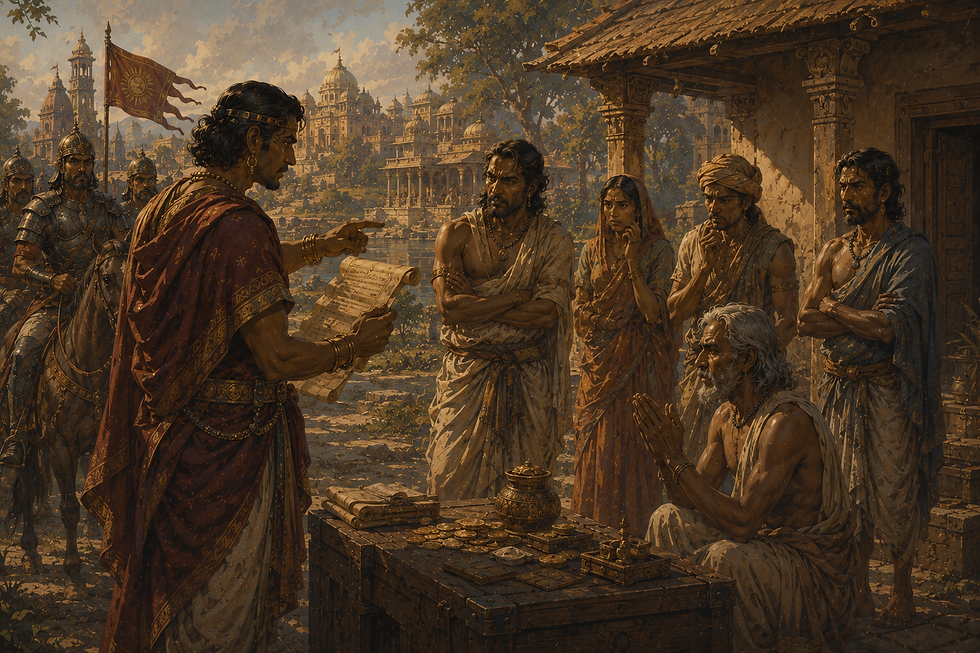


Comments