
.png)

Ancient Texts: Kautilya's Arthashastra - Chapters 6-10 (Part 2 of Book 3)
- A. Royden D'Souza

- Jun 7
- 62 min read
The first five chapters of Book III erected the scaffolding of justice: the structure of courts, the qualifications of judges, the procedures for filing suits, the rules of evidence, and the solemn oath that binds a witness to truth.
These were the instruments of the law—the courtroom, the bench, the plaint, the deposition, the verdict. With the machinery in place, Kautilya now turns to the substance of the law itself.
Chapters 6 through 10 of Arthashastra address the most intimate bonds that hold society together: marriage, family, and inheritance. Kautilya legislates the forms of marriage, the rights and duties of wives and husbands, the grounds for divorce and abandonment, the property a woman brings into marriage and what she may take when she leaves.
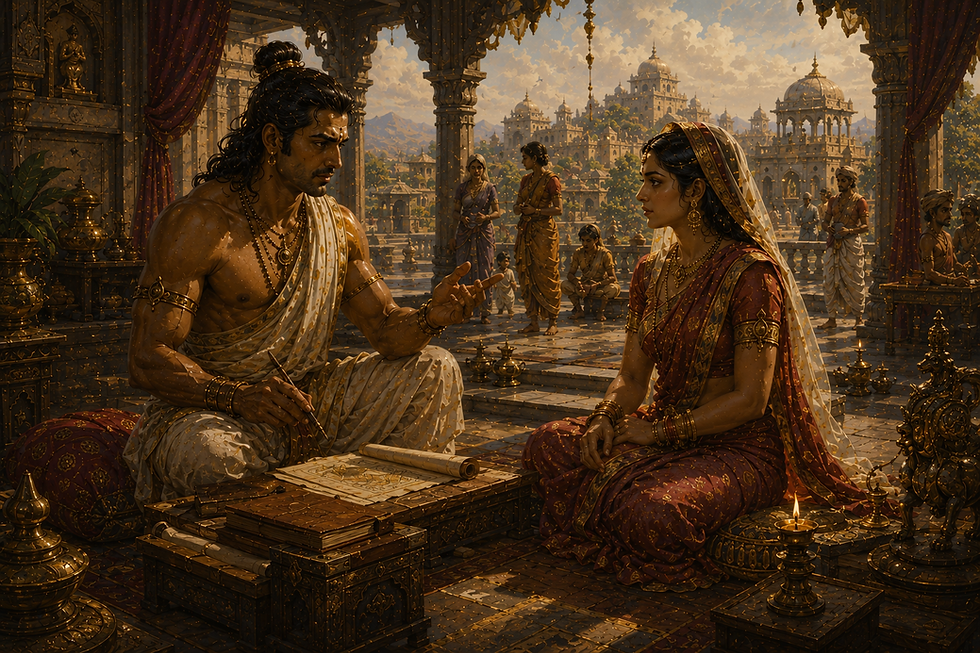
He defines the inheritance rights of sons, daughters, widows, and the unborn. He prescribes maintenance for wives who have been wronged, and penalties for husbands who fail to provide it. These are not abstract principles; they are the detailed, practical rules that govern the most fundamental human relationships.
The law Kautilya lays down in these chapters is strikingly pragmatic. Marriage is both a sacrament and a contract, and when the contract is broken, the law provides remedies—not merely moral exhortations. A woman deserted by her husband is entitled to maintenance. A son born outside wedlock has a claim, though a lesser one, on his father's property.
A widow who remarries may forfeit her first husband's estate, but she does not forfeit the property she brought with her. The law does not punish women for the failures of men. It does not leave the weak without recourse.
What emerges is a portrait of the state as the guardian of the household. The judge who hears a wife's petition for maintenance, the court that partitions an inheritance among quarrelling brothers, the law that protects a daughter's dowry from being swallowed by her husband's debts—these are not merely legal functions.
They are the sinews of a stable society, as essential as the granary or the toll-gate. The tortoise's shell is held together not only by iron and stone but by the bonds of marriage, the lines of inheritance, and the assurance that the law will uphold what is right when those bonds are strained.
Book III of Arthashastra: Concerning Judges (Dharmastha)
The third book, Dharmastha (धर्मस्थ), translates to "Concerning Judges" or "On the Administration of Justice." Where Book I forged the king from within and Book II built the machinery of economic administration, Book III establishes the legal framework through which the state resolves disputes, punishes wrongdoing, and maintains the social order.
Its central argument is that a kingdom without law is a kingdom without foundation; the king's discipline and the superintendent's efficiency are meaningless if the people cannot trust the courts to deliver justice.
The book's 20 chapters provide a comprehensive code of civil and criminal law, covering marriage, inheritance, debt, contracts, assault, defamation, theft, and the procedures by which judges investigate and adjudicate every form of dispute.

Chapter VI: Special Shares in Inheritance
Goats shall be the special shares of the eldest of sons, born of the same mother, among Brahmins; horses among Kshatriyas; cows among Vaisyas; and sheep among Sudras.
The blind of the same animals shall be the special shares to the middlemost sons; species of variegated colour of the same animals shall be the special shares to the youngest of sons.
In the absence of quadruped, the eldest shall take an additional share of the whole property excepting precious stones; for by this act alone, he will be bound in his duty to his ancestors.
The above method is in accordance with the rules observed among the followers of Usanas.
The father being dead, his carriage and jewellery shall be the special share to the eldest; his bed, seat, and bronze plate in which he used to take his meals (bhuktakamsyam), to the middlemost; and black grains, iron, domestic utensils, cows and cart to the youngest.
The rest of the property, or the above things, too, may be equally divided among themselves. Sisters shall have no claim to inheritance; they shall have the bronze plate and jewellery of their mother after her death.
An impotent eldest son shall have only one-third of the special share usually given to the eldest; if the eldest son follows a condemnable occupation or if he has given up the observance of religious duties, he shall have only one-quarter of the special share; if he is unrestrained in his actions he shall have nothing.
The same rule shall hold good with the middlemost and youngest sons; of these two, one who is endowed with manliness (manushopetah), shall have half the special share usually given to the eldest.
With Regard to Sons of Many Wives: Of sons of two wives of whom only one woman has gone through all the necessary religious ceremonials, or both of whom have not, as maidens, observed necessary religious rites, or one of whom has brought forth twins, it is by birth that primogenitureship is decided.
Shares in inheritance for such sons as Suta, Magadha, Vratya and Rathakara shall depend on the abundance of paternal property; the rest, i.e., sons other than Suta, etc., of inferior birth, shall be dependent on the eldest for their subsistence. Dependent sons shall have equal divisions.
Of sons begotten by a Brahmin in the four castes, the son of a Brahmin woman shall take four shares; the son of a Kshatriya woman three shares; the son of a Vaisya woman two shares, and the son of a Sudra woman one share.
The same rule shall hold good in the case of Kshatriya and Vaisya fathers begetting sons in three or two castes in order.
An Anantara son of a Brahmin, i.e. a son begotten by a Brahmin on a woman of next lower caste, shall, if endowed with manly or superior qualities (manushopetah), take an equal share (with other sons of inferior qualities); similarly Anantara sons of Kshatriya or Vaisya fathers shall if endowed with manly or superior qualities, take half or equal shares (with others).
An only son to two mothers of different castes shall take possession of the whole property and maintain the relatives of his father.
A Parasava son begotten by a Brahmin on a Sudra woman, shall take one-third share; a sapinda, (an agnate) or a kulya (the nearest cognate), of the Brahmin shall take the remaining two shares, being thereby obliged to offer funeral libation; in the absence of agnates or cognates, the deceased father's teacher or student shall take the two shares.
Or on the wife of such a Brahmin shall a sagotra, relative bearing the same family name, or a matribandha, relative of his mother, beget a natural son (kshetraja), and this son may take that wealth.

In Simple Terms
The main ideas from this chapter can be understood in these simple points:
Special Shares for the Sons by Birth Order: The law assigns specific animals to the eldest, middlemost, and youngest sons as their special share, varying by the family's community.
Among the priestly community, goats to the eldest; among the warrior community, horses; among the mercantile community, cows; among the serving community, sheep.
The middlemost sons receive the blind of those same animals; the youngest receive the variegated ones. If there are no animals, the eldest takes an additional share of the whole property except precious stones, because the eldest bears the primary duty of ancestor worship.
The Father's Personal Possessions: When the father dies, his personal items are distributed as special shares. The eldest receives his carriage and jewellery.
The middlemost receives his bed, seat, and the bronze plate from which he ate his meals. The youngest receives black grains, iron, domestic utensils, cows, and a cart.
The rest of the property is divided equally—or even these personal items may be pooled and divided equally, if the brothers agree. Sisters do not inherit from the father, but they receive their mother's bronze plate and jewellery after her death.
Penalties for Unworthiness: The special share of the eldest is not unconditional. An impotent eldest son receives only one-third of the usual special share.
An eldest son who follows a condemnable occupation or has abandoned religious duties receives only one-quarter. An eldest son who is unrestrained in his actions receives nothing. The same principle applies to the middlemost and youngest.
If either of them is endowed with manliness—with virtue and capacity—he may receive half the special share usually given to the eldest.
Sons of Many Wives: The chapter addresses polygamous households. If a man has two wives, and only one underwent the full religious ceremonies of marriage, or if both did not observe the proper rites before marriage, or if one bore twins, primogeniture is determined by birth order alone—the firstborn son takes the special share, regardless of which wife bore him.
Sons of Different Mothers from Different Communities: This is the most complex provision. If a father begets sons with women of different communities, the sons inherit in proportion to their mother's status.
A son of a mother from the priestly community receives four shares; from the warrior community, three shares; from the mercantile community, two shares; from the serving community, one share.
The same descending proportion applies when a father from the warrior or mercantile communities has sons by women of lower communities.
The Anantara and Parasava Sons: An Anantara son—one born to a mother of the next lower community—may, if he is especially virtuous and capable, receive an equal or half share with the other sons.
A Parasava son—born to a mother from the serving community and a father from the priestly community—receives only one-third share.
The remaining two-thirds goes to the father's agnates or cognates, who are obliged to perform the funeral rites. If there are no such relatives, the father's teacher or student takes the two-thirds share.
The Son Begotten for the Dead: If a man dies without a qualified heir, a relative bearing the same family name or a relative of his mother may beget a son on his widow, and that son inherits the property. This is the practice of levirate, ensuring that the lineage continues and that funeral offerings are made.
Case Study: An Ancient King's Application
The Mughal imperial household provides a vivid case study of the Kautilyan principles of special shares and the hierarchy of sons based on their mothers' status.
The Mughal emperor typically had multiple wives of varying ranks: chief wives of royal blood, secondary wives of noble families, and concubines of lower status.
The sons of these wives inherited not equally but in proportion to their mothers' rank—a direct parallel to the Kautilyan system of differentiated shares.
The Mughal succession was not governed by primogeniture alone. The eldest son did not automatically inherit the throne. Instead, the emperor's favour, the mother's status, and the son's own capacity determined the outcome.
The wars of succession that followed the deaths of Shah Jahan and Aurangzeb were fought among brothers whose claims varied with their mothers' ranks and their own demonstrated abilities—the Kautilyan principle of manliness (manushopetah) made dynastic war.
Within the Mughal nobility, the Kautilyan practice of special shares persisted. The eldest son received his father's ceremonial weapons, his personal jewellery, and often the family's ancestral home. The younger sons received lesser properties, cash, or appointments.
The daughters did not inherit land but received dowries and jewellery from their mothers—the Kautilyan rule that sisters have no claim to the father's property but receive their mother's personal wealth.
The Mughal practice of levirate—a brother marrying his deceased brother's widow—was occasionally observed, particularly when the widow was of childbearing age and the family wished to preserve the lineage and property. This was the Kautilyan rule of the kshetraja son, begotten on the widow by a kinsman to continue the line.
The British colonial administration later attempted to standardise inheritance under Anglo-Indian law, but the customary practices descended from the Kautilyan and Dharmashastric traditions persisted in many princely states and landed families well into the twentieth century.
In Modern Times
In modern India, the Kautilyan system of special shares—where the eldest son received specific animals, personal possessions, and an additional portion—has been entirely abolished.
The Hindu Succession Act, 1956, establishes equal shares for all sons and daughters in the property of a father dying intestate.
The eldest son has no special claim to the carriage, the jewellery, or the bronze plate. The youngest son has no special claim to the black grains and iron utensils. All class I heirs—sons, daughters, widow, mother—share equally.
The Kautilyan hierarchy of sons based on their mothers' status—the son of the priestly mother receiving four shares, the son of the serving mother receiving one—is gone. The modern law makes no distinction between children based on the status of their mother.
All children, whether born of a first wife, a second wife, or any other union recognised by law, inherit equally from their father.
The Kautilyan exclusion of sisters from the father's inheritance has been reversed. The 2005 amendment to the Hindu Succession Act granted daughters equal coparcenary rights in ancestral property, making them full heirs alongside their brothers.
The Kautilyan rule that sisters receive only their mother's bronze plate and jewellery is a relic of a legal world that no longer exists.
The Kautilyan provision that an impotent, irreligious, or unrestrained son forfeits part or all of his special share finds no direct modern parallel.
A son's moral character does not affect his inheritance rights under modern law. However, a son who murders his father is disqualified from inheriting under the Hindu Succession Act—a distant echo of the ancient principle that the unworthy heir may be disinherited.
The Kautilyan practice of levirate—begetting a son on a widow to continue the dead man's line—has been obsolete for centuries. Modern adoption law provides a legal mechanism for continuing a family line without the need for the ancient practice.
The Arthashastran world of differentiated shares, special animal portions, and inheritance by maternal status has passed, but the core principle endures: the law must provide clear, enforceable rules for the transfer of property from one generation to the next.
Paniyadvipa, Domain of Varuni, Dominion of Panchasthavi – The Gramika’s Court The court of the Gramika sat under a pillared pavilion of sun-bleached stone, open on all sides to the salt breeze that carried the scent of the distant sea. Pani was a fishing and trading settlement on the coast, and its chief—Gramika Madava—was a weathered old man who had administered justice here for twenty years. He sat on a low wooden dais, flanked by two Punditas learned in the Edicts of the Ekaśastram: Sriman Vasudatta and Srimati Sumitra. Three village elders—a Shura named Bhairavadatta, a Vanija named Ratnapala, and an Akula named Dhimana—sat on reed mats to his left and right. They all represented the four communities of the village. The Adija were not represented; the outcasts had no voice in the court. The Edict of Reverence required every hearing to open with a prayer to the divinities, and the assembled murmured the sacred words before the Gramika spoke. The scribe, a thin young man named Lekhapala, read the registration aloud: "The year is the tenth of the reign of Lord Varunaraja, Governor of Paniyadvipa and King of Varuni. The season is the dry season. The month of winds. The fortnight of the waning moon. The fourth day. The dispute concerns the division of inheritance of the late Vanija merchant Dhananjaya. The petitioner is Narayana, eldest son of the deceased, of the Vanija community. The respondent is Somadeva, second son of the deceased, also of the Vanija community by birth, though his mother is Akula. Also joined is Amba, widow of the deceased and mother of Somadeva." Gramika Madava nodded slowly. His face was stern. The presence of an Akula-born son claiming Vanija inheritance was a delicate matter under the Edicts. "The parties are present. Let the petitioner speak." Narayana rose. He was a tall, thin man of thirty years, dressed in the fine cotton of a prosperous merchant, his fingers adorned with rings. His face was composed but his eyes held the sharpness of long calculation. "Honoured Gramika, my father Dhananjaya was a merchant of the Vanija community. He married twice. My mother, Lakshmi, was of pure Vanija blood, married with the full rites of the sacred water. She died when I was a child. My father then took Amba, a woman of the Akula community, as his second wife. She bore him Somadeva." He paused, and his voice hardened. "My father's second marriage was a violation of the Edict of Purity. The Edict commands: 'None shall form bonds with members of other varnas. Should such mingling occur, the betterborn individual shall immediately become lesserborn.' My father, by marrying an Akula, made himself Akula. His estate should therefore pass entirely to me, his only pure Vanija son. I seek the whole inheritance. Somadeva, as the son of an impure union, has no claim." A murmur passed through the court. The Pundita Sumitra's face remained impassive, but her eyes flickered toward the Gramika. Somadeva rose. He was twenty years old, broad-shouldered, his hands calloused from ropes and barrels, his sun-browned face set with barely controlled anger. "Honoured Gramika, my brother speaks the Edicts as though they were a weapon to cut me out of my father's house. I do not dispute the law. But if the law is to be applied strictly, then let it be applied to all. My father married my mother openly. He lived with her for twenty years. He acknowledged me as his son before this entire village. He never declared himself fallen, and no Pundita ever declared him fallen. If the Edict of Purity was violated, why was it not enforced while he lived? Why does my brother invoke it only now, when the inheritance is at stake?" Amba, the widow, knelt quietly. Her hair was grey, her sari plain, but her voice was steady. "Honoured Gramika, I do not ask for myself. The Edict of Service commands the Akula to obey without question. I have obeyed. I served my husband faithfully. I raised my son to serve his father's house. If the Edict of Purity condemns my marriage, then condemn me. But do not condemn my son for the circumstances of his birth." The Pundita Sumitra leaned forward. Her voice was cold and precise. "The petitioner Narayana invokes the Edict of Purity. He is correct that the Edict forbids bonds between varnas. But he is incorrect in his application. The Edict says that the betterborn individual shall become lesserborn. Dhananjaya, by marrying an Akula, became Akula himself. His estate is therefore the estate of an Akula. Narayana, as his son by a Vanija wife married before the fall, may have a claim. But the Edict does not automatically strip Somadeva of his share. The Edict of Punishment says that each soul walks the path set by the divinities. The path of inheritance is set by custom, and custom has long recognised the Anantara son—the son of a mother of the next lower community." Bhairavadatta, the Shura elder, spoke. His voice was hard. "The Edict of Purity exists to preserve the divine order. Mingling of blood corrupts the varnas. Dhananjaya corrupted himself. But the boy Somadeva did not corrupt himself—he was born into corruption through no fault of his own. The law does not punish the child for the sins of the parent. If it did, half this village would be Adija." Ratnapala, the Vanija elder, examined the ledger that Somadeva had placed on the table. "The boy worked. He led a caravan through the hills. He brought back profit. Whatever his mother's birth, he served his father's house. The Edict of Service commands the Akula to obey and fulfill their duties. Somadeva fulfilled his duties as a son. That must count for something." Narayana's composure cracked. "Honoured Gramika, the Edicts are clear. Purity must be preserved. My father's second marriage was a sin against the divine order. The fruit of a sinful union cannot share equally with the fruit of a pure union. I am willing to grant Somadeva maintenance—food and clothing, as the law provides for the lesserborn. But a share of the estate? No. The Edict of Punishment demands that those who stray from the path face divine punishment. Let his punishment be disinheritance." Gramika Madava raised a hand, and the pavilion fell silent. He sat still for a long moment, his old eyes moving from Narayana to Somadeva to the widow Amba. "The Edict of Purity is clear. Dhananjaya, by marrying an Akula, became Akula. His sin is upon his own head, and the divinities will judge him. But the question before this court is not the state of Dhananjaya's soul. It is the state of his estate." He turned to Narayana. "You argue that your father's fall makes you his sole heir. But the law of inheritance passes property to sons, not to the pure alone. Somadeva is Dhananjaya's son. He was acknowledged. He was raised in his father's house. He laboured for his father's wealth. The Edict of Service commands the Akula to obey and fulfill their duties. Somadeva fulfilled his duty as a son. To strip him of his inheritance now would be to punish him for the obedience the Edict itself commands. That is not justice." He turned to Somadeva. "But you are the son of an Akula mother. Under the old law, you would receive one share to your brother's two. That law has not been abolished, even if it is seldom enforced. And the Edict of Purity casts a shadow over your claim that cannot be entirely ignored." He paused. "The court finds as follows. Dhananjaya's estate shall be divided. Narayana, as the son of the pure Vanija marriage, shall receive two shares. Somadeva, as the son of the Akula marriage and as an Anantara son who has proven his merit through labour, shall receive one share—elevated from the mere food and clothing that his brother would grant him, but less than the equal share he might have claimed if his mother were Vanija. The widow Amba shall receive maintenance from her son's share." He looked at both brothers. "This is not perfect justice. The Edict of Purity has made perfect justice impossible. Your father's sin has tainted this inheritance, and the taint cannot be washed clean. I have divided the estate as best the law allows. Let neither of you speak ill of the other, and let the divinities forgive your father his transgression." Somadeva touched his forehead to the ground. His face was calm, but his hands trembled. He had won something—more than nothing, less than equality. Narayana bowed, his expression a mask of cold satisfaction. He had won the larger share, though not the whole. Amba wept silently. After the court had emptied, the Pundita Sumitra lingered near the pavilion with the Vanija elder Ratnapala. The salt breeze had turned cool, and the sea glittered in the distance. "The Gramika gave the higher-born son two shares and the lower-born one," Sumitra said. "He followed the letter of the old law, though he might have given them equal. Was that justice?" "The Edicts are not written to be just," Ratnapala replied. "They are written to preserve purity. Dhananjaya violated the Edict of Purity, and his sons are paying the price. The Gramika could not ignore the Edict, but he could soften its blow. The boy Somadeva received a share—more than his brother wanted to give, less than he deserved. That is the best the law can do in an impure world." The Gramika, overhearing, paused at the edge of the pavilion. His face was tired. "The Edicts are the divinities' command, and I am bound to enforce them. But the divinities also allow mercy for the innocent. Somadeva did not choose his mother. He did not choose his father's sin. The law must be upheld, but the innocent must not be crushed. That is the burden of the judge—to balance the Edicts against the facts of a fallen world." |

Chapter VII: Distinction Between Sons
My preceptor says that the seed sown in the field of another shall belong to the owner of that field. Others hold that the mother being only the receptacle for the seed (mata bhastra), the child must belong to him from whose seed it is born. Kautilya says that it must belong to both the living parents.
The son begotten by a man on his wife who has gone through all the required ceremonials is called aurasa, natural son; equal to him is the son of an appointed daughter (putrikaputra); the son begotten on a wife by another man, appointed for the purpose, and of the same gotra as that of the husband; or of a different gotra, is called kshetraja; on the death of the begetter, the kshetraja son will be the son to both the fathers, follow the gotras of both, offer funeral libations to both, and take possession of the immovable property (riktha) of both of them; of the same status as the kshetraja is he who is secretly begotten in the house of relatives and is called gudhaja, secretly born; the son cast off by his natural parents is called apaviddha and will belong to that man who performs necessary religious ceremonials to him; the son born of a maiden (before wedlock) is called kanina; the son born of a woman married while carrying is called sahodha; the son of a remarried woman (punarbhatayah) is called paunarbhava.
A natural son can claim relationship both with his father and his father's relatives; but a son born to another man can have relationship only with his adopter.
Of the same status as the latter is he who is given in adoption with water by both the father and mother and is called datta. The son who, either of his own accord or following the intention of his relatives, offers himself to be the son of another, is called upagata. He who is appointed as a son is called kritaka; and he who is purchased is called krita.
On the birth of a natural son, savarna sons shall have one-third of inheritance while asavarna sons shall have only food and clothing.
Sons begotten by Brahmins or Kshatriyas on women of next lower caste (anantaraputrah) are called savarnas; but on women of castes lower by two grades are called asavarnas. (Of such asavarna sons), the son begotten by a Brahmin on a Vaisya woman is called Ambashtha; on a Sudra woman is called Nishada or Parasava.
The son begotten by a Kshatriya on a Sudra woman is known as Ugra; the son begotten by a Vaisya on a Sudra woman is no other than a Sudra. Sons begotten by men of impure life of any of the four castes on women of lower castes next to their own are called Vratyas.
The above kinds of sons are called anuloma, sons begotten by men of higher on women of lower castes.
Sons begotten by a Sudra on women of higher castes are Ayogava, Kshatta, and Chandala; by a Vaisya, Magadha, and Vaidehaka; and by a Kshatriya, Suta. But men of the names, Suta and Magadha, celebrated in the Puranas, are quite different and of greater merit than either Brahmins or Kshatriyas. The above kinds of sons are pratiloma, sons begotten by men of lower on women of higher castes, and originate on account of kings violating all dharmas.
The son begotten by an Ugra on a Nishada woman is called kukkuta and the same is called Pulkasa, if begotten in the inverse order. The son begotten by an Ambashtha on a Vaidehaka woman is named Vaina; the same in the reverse order is called Kusilava. An Ugra begets on a Kshatta woman as vapaka. These and other sons are of mixed castes (Antaralas).
A Vainya becomes a Rathakara, chariot-maker, by profession. Members of this caste shall marry among themselves. Both in customs and avocations they shall follow their ancestors. They may either become Sudras or embrace any other lower castes excepting Chandalas.
The king who guides his subjects in accordance with the above rules will attain to heaven; otherwise he will fall into the hell.
Offsprings of mixed castes (Antaralas) shall have equal divisions of inheritance.
Partition of inheritance shall be made in accordance with the customs prevalent in the country, caste, guild (sangha), or the village of the inheritors.

In Simple Terms
The main ideas from this chapter can be understood in these simple points:
The Great Debate — Who Does the Child Belong To? Kautilya presents a fundamental legal and philosophical dispute. One school holds that the seed sown in another's field belongs to the field's owner—the child born to a wife belongs to the husband, regardless of who fathered it.
Another school holds that the mother is merely the receptacle; the child belongs to the man whose seed it is. Kautilya's own position is that the child belongs to both living parents—a middle path that acknowledges both biological and social parenthood.
Twelve Kinds of Sons: The chapter catalogues a comprehensive taxonomy of sonship. The aurasa is the natural son, born to a wife in a fully consecrated marriage—the highest form of sonship. Equal to him is the putrikaputra, the son of an appointed daughter, where a man without sons designates his daughter to bear a son who will be his heir.
The kshetraja is a son begotten on a wife by another man appointed for the purpose, of the same lineage as the husband—the son of a levirate union. The gudhaja is secretly born in the house of relatives. The apaviddha is a son cast off by his natural parents and adopted by the man who performs his religious ceremonies.
The kanina is a son born to a maiden before marriage. The sahodha is a son born to a woman who was pregnant at the time of her marriage.
The paunarbhava is the son of a remarried woman. The datta is a son given in adoption by both parents with the ceremonial pouring of water. The upagata is a son who offers himself for adoption. The kritaka is a son appointed as such. The krita is a son purchased.
The Primacy of the Natural Son: On the birth of a natural son, all other categories of sons are relegated. Savarna sons—those born of mothers of the same or next lower community—receive only one-third of the inheritance.
Asavarna sons—those born of mothers two grades lower—receive only food and clothing. The natural son is the true heir; all others are substitutes, tolerated but not equal.
Anuloma and Pratiloma Sons: Anuloma sons are those begotten by men of higher community on women of lower community. Each combination has a specific name: Ambashtha, Nishada, Parasava, Ugra, Vratya.
These are recognised, though their status is below that of the natural son. Pratiloma sons are those begotten by men of lower community on women of higher community—a reversal of the proper order.
These unions produce Ayogava, Kshatta, Chandala, Magadha, Vaidehaka, and Suta. They are considered the result of kings violating all dharma. Kautilya notes that the Sutas and Magadhas of the Puranas, however, were of great merit—ancient exceptions to the general rule.
Mixed Communities and Their Occupations: The children of mixed unions form new communities. A Vainya, for example, becomes a Rathakara, a chariot-maker, by profession.
These communities marry among themselves, follow their ancestral customs and trades, and may either become Sudras or adopt other lower communities, except the Chandala, the most stigmatised group.
The King's Duty and Local Custom: The king who governs according to these rules attains heaven; the king who does not falls into hell.
Yet the chapter ends with a remarkable concession: partition of inheritance shall be made in accordance with the customs prevalent in the country, community, guild, or village of the inheritors. The detailed rules are the framework, but local custom prevails. The law is not a single iron grid; it is a flexible net that adapts to the diversity of the kingdom.
Case Study: An Ancient King's Application
The Mughal Empire's mansabdari system—the ranking of nobles by military command and revenue assignment—provides a case study of the Kautilyan distinction between sons in practice.
The Mughal nobility, like the Kautilyan father, had to decide which sons would inherit what. The eldest son of the highest-ranking wife typically received the largest share of the father's wealth and the highest mansab rank. Sons of secondary wives received lesser ranks.
Sons of concubines or slave women—the Kautilyan asavarna sons—often received only maintenance or minor appointments.
The Mughal emperor himself had to manage the claims of sons by different wives. Shah Jahan's four sons by Mumtaz Mahal—Dara Shikoh, Shah Shuja, Aurangzeb, and Murad Baksh—were all aurasa sons, born of a fully consecrated marriage.
They were all potential heirs, and their competition destroyed the empire's stability for a decade. The Kautilyan rule that the natural son is the primary heir did not prevent war when there were multiple natural sons.
The Mughal practice of appointing daughters' sons—the putrikaputra—was rare but not unknown. A nobleman without sons might designate his daughter's son as his heir, and the emperor might confirm the appointment. The Kautilyan taxonomy of twelve kinds of sons provided the legal vocabulary for such arrangements.
The Mughal Empire also produced communities of mixed origin—the Kautilyan Antaralas. The children of Mughal nobles and local women formed new communities with specific professions and customs. The Mughal court included Rajput wives, Persian wives, and local concubines, and the children of these unions occupied different ranks in the imperial hierarchy.
The British colonial administration later attempted to rationalise inheritance under Anglo-Indian law, but the customary distinctions between sons persisted in many parts of India well into the modern period.
The Kautilyan taxonomy of sons, with its precise names and precise shares, was the legal grammar of a world in which sonship was a matter of law, not merely biology.
In Modern Times
In modern India, the Kautilyan taxonomy of twelve kinds of sons has been entirely superseded. The Hindu Succession Act, 1956, does not distinguish between an aurasa son, a kshetraja son, a datta son, or a krita son.
All sons, whether natural or adopted, inherit equally. The Hindu Adoptions and Maintenance Act, 1956, governs adoption and provides a single legal framework for the adopted son, who is now the only recognised substitute heir. The ancient categories of gudhaja, kanina, sahodha, and paunarbhava have no modern legal existence.
The Kautilyan distinction between anuloma and pratiloma unions—marriages across community lines, with different legal consequences for the children—has been abolished.
The modern law does not classify children by the relative status of their parents' communities. All children, regardless of their parents' backgrounds, are entitled to inherit equally from their parents.
The Kautilyan rule that the birth of a natural son reduces the shares of other sons to one-third or to mere food and clothing is gone. The modern law does not prioritise the natural son over the adopted son. Once adopted, a son has the same rights as a natural son.
The ancient hierarchy of sonship, with its meticulous gradations of legitimacy and inheritance, has been replaced by a single, simple rule: all sons are equal.
The Kautilyan provision that local custom prevails over the general rules of inheritance survives in the modern recognition of customary law in certain tribal and community contexts. But the general trend of modern Indian law has been toward uniformity, away from the bewildering diversity of custom that Kautilya himself acknowledged and deferred to.
The ancient world of twelve kinds of sons, each with a name and a share and a place in the funeral rites, has vanished. What remains is the principle that the law must determine who is a son and what a son inherits.
Paniyadvipa, Domain of Varuni, Dominion of Panchasthavi – The Gramika’s Court The court of the Gramika sat under a pillared pavilion of sun-bleached stone, open on all sides to the salt breeze. Gramika Madava presided on a low wooden dais, flanked by the Punditas Vasudatta and Sumitra. The village elders—Shura Bhairavadatta, Vanija Ratnapala, and Akula Dhimana—sat on reed mats. The Edict of Reverence had been recited. The scribe, Lekhapala, read the registration aloud: "The year is the tenth of the reign of Lord Varunaraja, Governor of Paniyadvipa and King of Varuni. The season is the dry season. The month of winds. The fortnight of the waxing moon. The tenth day. The dispute concerns the claim of a secretly born son to the inheritance of the late Pundita Somasharma. The petitioner is Devadatta, son of the late Vanija merchant Ratnadatta and the Vanija woman Lakshmi, claiming also to be the kshetraja son of the late Pundita Somasharma. The respondent is Vishnusharma, brother of the late Somasharma, of the Pundita community." Gramika Madava’s face was stern. A secret-born son claiming Pundita blood was a grave matter under the Edicts. Devadatta, a young man of twenty-two with the rough hands of a labourer, spoke first. "Honoured Gramika, I was raised as the son of the Vanija merchant Ratnadatta. But my mother, Lakshmi, on her deathbed, told me the truth. During my father Ratnadatta’s long absence on a trading voyage, the Pundita Somasharma came to our house in secret. He lay with my mother. I was born of that union. Ratnadatta, returning, accepted me as his own, but the blood in my veins is Somasharma’s. Somasharma acknowledged this before his death. He had no other sons. I claim the right to perform his funeral rites and inherit his property as his kshetraja son." Vishnusharma, a heavy Pundita with cold eyes, rose. "Honoured Gramika, this is an outrage. My brother, a Pundita, is accused of a secret sin with a Vanija woman. The Edict of Purity forbids all bonds between varnas. If my brother did such a thing—and I do not admit it—he would have become Vanija by that very act, and his estate would have passed to me as his natural heir. But the accusation is a lie. This boy is a Vanija, the son of a Vanija, seeking to steal a Pundita’s property. There is no proof. A deathbed whisper is not evidence." Sumitra, the Pundita priestess, leaned forward. "The petitioner claims a secret union. The Edict of Purity is absolute: mingling of blood degrades the betterborn. If Somasharma lay with a Vanija woman, he fell. But was there acknowledgment? The petitioner says Somasharma acknowledged him before death. Where is the witness to that acknowledgment?" Devadatta produced a small clay tablet, cracked and worn. "Somasharma gave this to my mother before he died. It bears his seal and his words: 'The boy is mine.'" Ratnapala, the Vanija elder, examined the tablet. "The seal is Somasharma’s. The writing is a single line. It does not name the boy. It does not name the mother. It could have been written for any purpose." Bhairavadatta, the Shura elder, spoke bluntly. "A secret union, a secret acknowledgment, a secret son. The Edicts do not recognise secrets. They recognise purity. If a Pundita sins in the dark, he is still a sinner. The boy is a Vanija. Let him remain a Vanija." Devadatta’s voice cracked. "I am Somasharma’s blood." "You are the blood of a sin," Vishnusharma shot back. "And the Edict of Punishment says that those who stray from the path invite divine punishment. Your very existence is a punishment upon your mother’s house. Do not bring it upon ours." Gramika Madava raised a hand. Silence fell. He looked at the clay tablet, then at Devadatta, then at Vishnusharma. "The Edict of Purity is the law of this land. It forbids all bonds between varnas. If a Pundita lies with a Vanija woman, he becomes Vanija. But the Edict also forbids secret sin. The petitioner’s mother and the late Somasharma, if this union occurred, committed a grave transgression. They hid it. They did not confess. They did not seek purification. The law cannot reward such conduct by granting a son inheritance. To do so would encourage others to sin in secret, hoping their children might one day profit." He paused. "The court finds that there is insufficient proof of Somasharma’s paternity. The tablet is ambiguous. The mother’s deathbed words are hearsay. No witness saw the acknowledgment. No ceremony was performed. The petitioner is the son of Ratnadatta, a Vanija. He shall remain a Vanija. He has no claim to the estate of Somasharma, which shall pass to his natural brother, Vishnusharma." Devadatta bowed his head. His face was pale, but he did not weep. He had expected this. Vishnusharma’s thin smile returned. "But," the Gramika continued, "the court also finds that Vishnusharma has spoken of his brother’s alleged sin in public, blackening the name of a dead Pundita without absolute proof. For defaming the dead, he shall pay a fine of fifty karsapanas to the temple of the divinities." Vishnusharma’s smile vanished. After the court had emptied, Sumitra lingered with Ratnapala. "The Gramika denied the son everything. Was that justice?" "The Edicts are not written for justice," Ratnapala replied. "They are written for purity. A secret sin has no witness, no protection. The boy was born of darkness, and the law left him there. If Somasharma had openly acknowledged his fall and married the woman, becoming Vanija, the son might have had a claim. But he did not. He sinned and hid. The law does not reward the hidden." The Gramika, overhearing, paused. "The Edict of Purity demands that mingling be punished. The Edict of Sanctity demands that the higher varna remain unsullied. Today, the memory of a Pundita was tarnished, and a Vanija boy learned that secret blood has no voice in the light. That is the law, and I am its servant." |

Chapter VIII: Buildings
Disputes concerning Vastu are dependent for settlement on the evidences to be furnished by people living in the neighbourhood. Houses, fields, gardens, building of any kind (setubandhah), lakes and tanks are each called Vastu.
The fastening of the roof of a house to the transverse beam by means of iron bolts is called setu (karna-kilaya-sabandho nugriham setuh). In conformity to the stability of the setu, houses shall be constructed. Not encroaching upon what belongs to others, new houses may be constructed.
Foundation (pade bandhah) shall be 2 aratnis by 3 padas. Except in the case of temporary structures for the confinement of women for ten days, all permanent houses shall be provided with a dunghill (avaskara), water course (bhrama), and a well (udapanum). Violation of this rule shall be punished with the first amercement.
The same rule shall hold good regarding the necessity of constructing closets, pits and water courses on festive occasions.
From each house a water course of sufficient slope and 3 padas or 11 aratnis long shall be so constructed that water shall either flow from it in a continuous line or fall from it (into the drain). Violation of this rule shall be punished with a fine of 54 panas.
Beginning with a pada or an aratni, an apartment measuring 3 padas by 4 padas shall be made for locating the fire for worship (agnishtham), or a waterbutt (udanjaram), or a corn-mill (rochanim), or a mortar (kuttinin). Violation of this rule shall be punished with a fine of 24 panas.
Between any two houses or between the extended portions of any two houses, the intervening space shall be 4 padas, or 3 padas. The roofs of adjoining houses may either be 4 angulas apart, or one of them may cover the other.
The front door (anidvaram) shall measure a kishku; there shall be no impediment inside the house for opening one or the other of the folds of the door. The upper story shall be provided with a small but high window.
If a neighbouring house is obstructed by it, the window should be closed. The owners of houses may construct their houses in any other way they collectively like, but they shall avoid whatever is injurious. With a view to ward off the evil consequences of rain, the top of the roof (vanalatyaschordhvam) shall be covered over with a broad mat, not blowable by the wind.
Neither shall the roof be such as will easily bend or break. Violation of this rule shall be punished with the first amercement. The same punishment shall be meted out for causing annoyance by constructing doors or windows facing those of others houses except when these houses are separated by the king's road or the high road.
If a pit, steps, water-course, ladder, dung-hill, or any other parts of a house offer or cause annoyance to outsiders, or in any way obstruct the enjoyment of others (bhoganigrahe cha), or cause water to collect and thereby injure the wall of a neighbouring house, the owner shall be punished with a fine of 12 panas.
If the annoyance is due to feces and urine, the fine shall be double the above. The water-course or gutter shall offer free passage for water; otherwise the fine shall be 12 panas.
The same fine (12 panas) shall be meted out not only to a tenant who, though asked to evacuate, resides in the house, but also to the owner who forces out a renter who has paid his rent (from his house), unless the renter is involved in such acts as defamation, theft, robbery, abduction, or enjoyment with a false title. He who voluntarily evacuates a house shall pay the balance of the annual rent.
If any one of a party does not take part in the construction of a building which is intended for the common use of all the members of that party or if any one obstructs another member of a party in making use of any part of such a building, he shall be fined 12 panas. Similarly if any one mars another's enjoyment of such a building, he shall be fined double the above.
With the exception of private rooms and parlours (angana), all other open parts of houses as well as apartments where fire is ever kindled for worship or a mortar is situated shall be thrown open for common use.

In Simple Terms
The main ideas from this chapter can be understood in these simple points:
Neighbours Settle Building Disputes: Disputes about houses, fields, gardens, tanks, and lakes are called Vastu disputes. They are settled primarily by the evidence of neighbours—the people who live nearby and know the boundaries, the history, and the facts. The law trusts local knowledge.
A House Must Be Properly Built: The foundation must be 2 aratnis by 3 padas—a standard measurement that ensures stability. The roof must be securely fastened to the transverse beam with iron bolts. This is called the setu, and the entire house must be built in conformity with the strength of its setu. New houses may be built, but only on one's own land, without encroaching on the property of others.
Every House Must Have Sanitation and Water: Every permanent house must have a dunghill, a water course for drainage, and a well. The only exception is a temporary structure for a woman's confinement after childbirth, which may last ten days. Violation of this rule incurs the first amercement—a heavy fine. The same applies to the construction of closets, pits, and drains for festive occasions when many guests gather.
The Water Course Must Work: The drain from each house must have sufficient slope and be either 3 padas or 11 aratnis long. It must carry water either in a continuous flow or a clean fall into the main drain. A blocked or badly built drain costs the owner 54 panas.
Space for the Sacred and the Practical: Every house must have a room of 3 padas by 4 padas for the sacred fire, the water-butt, the corn-mill, or the mortar. This is the household's working heart—worship and food preparation combined. Failure to provide this space costs 24 panas.
Space Between Houses: Houses must be separated by 4 padas or at least 3 padas. Roofs must be 4 angulas apart, or one roof may overlap the other if the neighbours agree. The front door must be a kishku wide, and nothing inside the house may block the door's movement.
Upper-storey windows must be small and high; if they overlook a neighbour and cause annoyance, they must be closed. Neighbours may build their houses as they collectively agree, but they must avoid whatever harms others.
Roofs Must Be Sound: The roof must be covered with a broad mat that the wind cannot lift, and it must not bend or break easily. A defective roof that threatens neighbours or passers-by incurs the first amercement. Doors or windows that face directly into a neighbour's house are forbidden unless a royal road or high road separates the two houses.
Nuisances Are Punished: If a pit, steps, drain, ladder, dunghill, or any other part of a house annoys outsiders, obstructs others' enjoyment of their property, or causes water to collect and damage a neighbour's wall, the owner is fined 12 panas. If the nuisance is from feces or urine, the fine is doubled. A blocked gutter that does not let water pass freely also costs 12 panas.
Landlord and Tenant: A tenant who refuses to leave after being asked to vacate is fined 12 panas. But a landlord who forces out a renter who has paid his rent is also fined 12 panas—unless the renter is guilty of defamation, theft, robbery, abduction, or holding the property under a false title. A tenant who leaves voluntarily before the lease ends must pay the balance of the annual rent. The law protects both sides of the rental contract.
Common Buildings and Shared Spaces: If a building is meant for common use—a shared wall, a communal hall, a joint facility—any member of the group who refuses to contribute to its construction or obstructs another's use of it is fined 12 panas.
Anyone who deliberately mars another's enjoyment of the common building pays double that fine. Private rooms and parlours are exempt from common use, but open spaces, rooms where the sacred fire burns, and rooms with a mortar must be accessible to all who share the building.
Case Study: An Ancient King's Application
The Mauryan capital of Pataliputra, as described by the Greek ambassador Megasthenes around 300 BC, was the direct architectural expression of the Kautilyan building code. The city was a vast parallelogram, roughly nine miles long and one and a half miles wide, surrounded by a wooden palisade with 570 towers and 64 gates. But it was the regulation of the interior—the houses, streets, and drains—that most closely followed the rules laid down in the Arthashastra.
Megasthenes records that the Mauryan city was administered by a board of officers who supervised the construction and maintenance of buildings. These officers ensured that houses were built to standard, with proper foundations, adequate space between them, and functioning drains.
The Kautilyan rule that a house must have a dunghill, a water course, and a well was enforced in Pataliputra, where archaeological excavations have uncovered sophisticated drainage systems, brick-lined wells, and designated waste-disposal areas in residential quarters.
The Kautilyan requirement of space between houses—four padas or at least three—was reflected in the grid layout of Pataliputra's streets. Houses did not encroach upon one another, and the royal road, the king's highway, served as the divider that the Arthashastra prescribes for houses whose doors faced each other.
The city's wooden architecture, however, proved vulnerable to fire and decay, and the Kautilyan rules on roof construction—that roofs must be covered with wind-proof matting and must not easily bend or break—were matters of life and death in a city built largely of timber.
The Mauryan city administration also adjudicated the very Vastu disputes that Kautilya describes. The neighbourhood committees, composed of elders, were the first resort for boundary disputes, and their evidence was the basis for the decisions of the city superintendent, the Nagaraka.
A merchant whose new window overlooked a neighbour's courtyard, or a householder whose drain flooded the lane, would find himself before these officials, paying the fines the Arthashastra prescribes.
The system was not merely punitive; it was preventive. The Mauryan state invested in public drains, roads, and water supply precisely to reduce the private nuisances that generated litigation. The Kautilyan balance—private rights protected by clear rules, public goods provided by the state—was the foundation of Pataliputra's order, and it remained the model for Indian urban governance long after the Mauryan Empire had fallen.
In Modern Times
In modern India, the Kautilyan law of buildings survives in the municipal building codes, the Apartment Ownership Acts, the Easements Act, and the Rent Control Acts. The Kautilyan requirement that every house have a well, a drain, and a dunghill is the ancestor of modern sanitation and building regulations.
The municipal corporation now requires every house to have a toilet, a water connection, and a drainage system, and failure to provide these can result in the building being declared unfit for habitation.
The Kautilyan rule that space must be left between houses is the origin of the modern setback requirement, which mandates minimum distances between buildings for light, air, and fire safety. The Kautilyan prohibition on doors and windows that invade a neighbour's privacy is the ancestor of the modern easement of light and air, codified in the Indian Easements Act, 1882. A window that overlooks a neighbour's courtyard can still be challenged in court today.
The Kautilyan rule that a blocked drain costs the owner 12 panas is the ancestor of the modern municipal fine for obstructing a public drain. The Kautilyan rule that a tenant who refuses to leave is fined, and a landlord who wrongfully evicts a paying tenant is fined, is the ancestor of the modern Rent Control Act, which protects tenants from arbitrary eviction while also providing remedies for landlords against tenants who overstay.
The Kautilyan principle that building disputes are settled by the evidence of neighbours survives in the modern practice of boundary disputes being adjudicated by the testimony of local residents and the records of the patwari. The ancient Vastu dispute, decided by the elders of the lane, is now decided by the civil judge, but the evidence is still the testimony of those who live nearby and know the facts.
The Kautilyan world, in which a dunghill and a well were the minimum standard for every house, has passed. But the principle that the state regulates the built environment—that a house is not merely private property but part of a shared neighbourhood, and that the law must balance the rights of the individual owner with the rights of the community—endures.
Kanchi, Kūrmapura, the Court of Justice – Mid-Morning The court scribe, Lekhapala, read the registration aloud: "The year is the thirteenth of King Simhavarma Sura. The season is Grishma. The month is Jyeshtha. The fortnight is the waxing moon. The date is the fourteenth day. The nature of the dispute is a Vastu complaint. The petitioner is Sumedha, a physician of the western quarter of Kūrmapura. The respondent is Dhanadasa, a merchant of the same quarter." The six chairs behind the polished teak bench were filled. Dharmagupta presided. Shrutavati and Vedananda flanked him. Gajakesha, Rudravarma, and Vamanagupta sat in the amatyas' chairs. Sumedha spoke first. He was a thin, precise man of fifty years, his hands still from long practice. "My lords, the respondent built a new upper storey on his house three months ago. In doing so, he constructed a window that opens directly onto the inner courtyard of my house. My wife and daughters can no longer walk in their own courtyard without being seen by his servants and guests. I asked him to close the window. He refused. I ask the court to order its closure and to fine him for the nuisance." Dhanadasa, a stout merchant with a loud voice, rose to answer. "My lords, the window is small and high. It lets in light and air. My house is my own. I may build as I please on my own land. The physician is overly sensitive. A window is not a nuisance." Shrutavati leaned forward. "The law says that an upper storey shall be provided with a small but high window. If a neighbouring house is obstructed by it, the window should be closed. The petitioner's courtyard is overlooked. His privacy is invaded. The law is clear." Dhanadasa's face reddened. "But the window does not obstruct his house. It merely overlooks his courtyard. The law says 'obstructed,' not 'overlooked.' A courtyard is not a room." Vedananda spoke. "The law also says that if any part of a house offers or causes annoyance to outsiders or obstructs the enjoyment of others, the owner shall be fined. The petitioner's enjoyment of his own courtyard is obstructed. His wife and daughters cannot use it without being watched. That is annoyance. That is obstruction." Gajakesha examined a sketch of the two houses, drawn by a court surveyor. "The window is positioned directly above the petitioner's courtyard. It is small, but it commands a full view of the enclosed space. The petitioner's family has no alternative courtyard. The window must be closed." Dharmagupta nodded. "The court finds that the respondent's window, though lawfully small and high, causes annoyance to the petitioner and obstructs his family's enjoyment of their own property. The window shall be closed within seven days. The respondent shall pay a fine of twelve panas for the nuisance, and the costs of this suit." Dhanadasa bowed his head, his loud voice finally quiet. Sumedha touched his forehead to the floor. After the court had emptied, Shrutavati said to Vedananda, "A small window, a quiet courtyard, a wife who cannot walk in her own home—and the law intervenes. Is that not a small matter for the king's judges?" "No matter is small that touches a family's peace," Vedananda replied. "The law protects not only walls and roofs, but the life within them. The merchant built his window without thought. The physician could not practise his art in a house full of anger. The law restores what was broken. That is not small. That is the foundation of all order." Vamanagupta, passing by, paused. "The sage Suracharya wrote that houses may be built in any way neighbours collectively like, but they must avoid whatever is injurious. The merchant forgot the second part of that rule. The court reminded him." |
Chapter IX: Sale of Buildings, Boundary Disputes, Determination of Boundaries, and Miscellaneous Hindrances
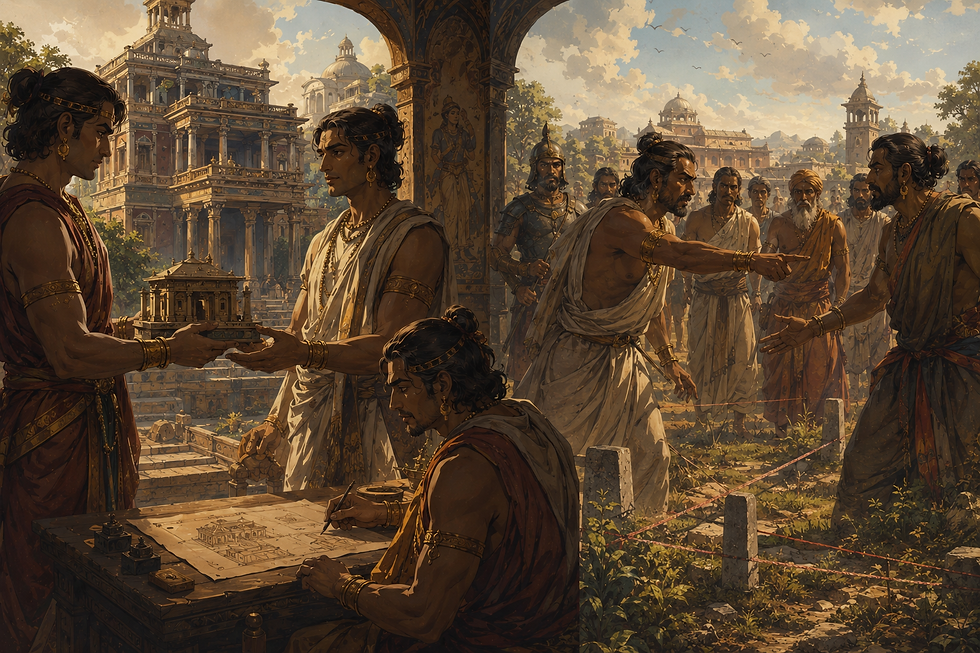
Rich persons among kinsmen or neighbours shall in succession go for the purchase of land and other holdings. Neighbours of good family, forty in number and different from the purchasers above mentioned, shall congregate in front of the building for sale and announce it as such. Accurate description of the exact boundaries of fields, gardens, buildings of any kind, lakes or tanks shall be declared before the elders of the village or of the neighbourhood.
If, on crying aloud thrice "Who will purchase this at such and such a price"? no opposition is offered, the purchaser may proceed to purchase the holding in question.
If at this time the value of the property is increased by bidding even among persons of the same community, the increased amount together with the toll on the value shall be handed over into the king's treasury. The bidder (vikrayapratikroshta) shall pay the toll.
Bidding for a property in the absence of its owner shall be punished with a fine of 24 panas. If the owner does not come forward even on the expiration of seven nights, the bidder may take possession of the property. Sale of building, etc., (vastu) to other than the bidder shall be punished with a fine of 200 panas; if the property is other than buildings, etc., (vastu), the fine for the above offence shall be 24 panas. Thus the sale of buildings is dealt with.
Boundary Disputes: In all disputes regarding the boundary between any two villages, neighbours or elders of five or ten villages (panchagrami dasagrami va) shall investigate the case on the evidence to be furnished from natural or artificial boundary marks.
Elders among cultivators and herdsmen, or outsiders who have had the experience of former possession in the place, or one or many persons personally acquainted with the boundary marks under dispute shall first describe the boundary marks, and then, wearing unusual dress (viparitaveshah), shall lead the people to the place.
If the boundary marks just described are not found, a fine of 1,000 panas shall be imposed on the misleading or guilty person. If, however, they arrive at the exact spot, the party who have either encroached upon the boundary or have destroyed the boundary marks shall be similarly punished.
The king shall beneficially distribute among others those holdings which have no boundary-marks or which have ceased to be enjoyed by any person.
Disputes About Fields: Disputes concerning fields shall be decided by the elders of the neighbourhood or of the village. If they are divided in their opinions, decision shall be sought for from a number of pure and respectable people, or the disputants may equally divide the disputed holding among themselves.
If both of these methods fail, the holding (vastu) under dispute shall be taken possession of by the king. The same rule shall hold good in the case of a holding for which no claimant is forthcoming; or it may beneficially be distributed among the people. Occupation of a holding (vastu) by force shall be punished as theft.
If a holding is taken possession of by another on some reasonable grounds, he shall be made to pay to the owner some rent, the amount of which is to be fixed after mature considerations of what is necessary for the subsistence of the cultivator of the holding by him.
Encroachment upon boundaries shall be punished with the first amercement. Destruction of boundaries shall be punished with a fine of 24 panas.
The same rules shall hold good in disputes concerning hermitage in forests, pasture lands, high roads, cremation-grounds, temples, sacrificial places, and places of pilgrimage. Thus the determination of boundaries is dealt with.
Miscellaneous Hindrances: All kinds of disputes shall depend for their settlement on the evidence to be furnished by neighbours.
Of pasture lands, fields (kedara), flower gardens, a threshing-floor (khala), houses, and stables of horses (vahanakoshtha), hindrance to any one coming first in order shall be removed in preference to the one or more coming later in the series.
With the exception of people in forests of Brahmins and of Soma-plants, temples, and places of sacrifice and pilgrimage, any person causing, while making use of a by-path to go to tanks, rivers, or fields, damage to the seeds sown in the fields of others, shall pay as much compensation to the sufferers as is equivalent to the damage.
If the owner of any one of the following, viz., wet-fields, parks, or any kinds of buildings, causes damage to the rest owned by others, the fine shall be double the value of the damage. The water of a lower tank shall not submerge the field irrigated by a higher tank.
The natural flow of water from a higher to a lower tank shall not be stopped unless the lower tank has ceased to be useful for three consecutive years. Violation of this rule shall be punished with the first amercement. The same punishment shall be meted out for emptying a tank of its water (tatakavamanam cha).
Buildings of any kind (setubandha), neglected for five consecutive years shall be forfeited, except in calamities.
Remission of Taxes: In the case of construction of new works, such as tanks, lakes, etc., taxes on the lands below such tanks shall be remitted for five years (panchavarshikah pariharah). For repairing neglected or ruined works of similar nature, taxes shall be remitted for four years.
For improving or extending water-works, taxes shall be remitted for three years. In the case of acquiring such newly started works by mortgage or purchase, taxes on the lands below such works shall be remitted for two years. If uncultivated tracts are acquired for cultivation by mortgage, purchase or in any other way, remission of taxes shall be for two years.
Out of crops grown by irrigation by means of wind power or bullocks (vatapravartimanandinibandhayatana) or below tanks, in fields, parks, flower gardens, or in any other way, so much of the produce as would not entail hardship on the cultivators may be given to the Government.
Persons who cultivate the lands below tanks, etc., of others at a stipulated price (prakraya), or for annual rent (avakraya), or for certain number of shares of the crops grown (bhaga) or persons who are permitted to enjoy such lands free of rent of any kind, shall keep the tanks, etc., in good repair; otherwise they shall be punished with a fine of double the loss.
Persons, letting out the water of tanks, etc., at any other place than their sluice gate (apare), shall pay a fine of 6 panas; and persons who recklessly obstruct the flow of water from the sluice-gate of tanks shall also pay the same fine.
In Simple Terms
The main ideas from this chapter can be understood in these simple points:
The Public Sale of Property: The sale of land or buildings is a public event, not a private transaction. Forty neighbours of good family must gather before the building for sale and announce it. The exact boundaries of the property must be described before the elders of the village or neighbourhood.
The seller cries out three times, "Who will purchase this at such and such a price?" If no one objects, the sale proceeds. If bidding raises the price, the increased amount plus the toll goes to the king's treasury.
Bidding on someone else's property in the owner's absence is fined 24 panas. If the owner does not appear within seven nights, the bidder may take possession.
Selling a building to someone other than the bidder is fined 200 panas—a massive penalty. The law ensures that property transfers are transparent, witnessed, and uncontested.
Boundary Disputes Are Settled by Neighbours: Disputes about boundaries between villages are investigated by the elders of five or ten villages. They use natural boundary marks—rivers, hills, trees—and artificial ones—ditches, embankments, stone markers.
The elders who know the boundaries must first describe them from memory, then lead the people to the spot, wearing unusual dress so they cannot be bribed or influenced en route. If the marks they described are not found, they are fined 1,000 panas.
If the marks are found and someone has encroached upon or destroyed them, that person pays the same fine. The law punishes both the false witness and the boundary-thief with equal severity.
Field Disputes: Disputes about fields are decided by the elders of the neighbourhood or village. If they disagree, a larger panel of respected people is consulted. If that fails, the disputants may simply divide the disputed land equally.
If that also fails, the king takes the land and may distribute it to others. Occupation of land by force is treated as theft. If someone occupies another's land with reasonable grounds—perhaps a long lease or a misunderstood boundary—he must pay rent to the owner, the amount to be fixed by considering what the cultivator needs to live on. The law protects both the owner's right and the occupier's subsistence.
Water Rights: This is one of the most detailed sections. The water of a lower tank must not flood the field irrigated by a higher tank. The natural flow from a higher to a lower tank must not be stopped unless the lower tank has been useless for three years.
Emptying a tank of its water is punished with the first amercement. A person who lets water out of a tank anywhere other than the proper sluice gate is fined 6 panas.
A person who obstructs the flow from the sluice gate is also fined 6 panas. The law regulates water with the same precision as land, because water is life in an agricultural society.
Neglected Buildings Are Forfeited: Any building—a house, a tank, an embankment—neglected for five consecutive years is forfeited to the king, except when the neglect is due to calamities such as famine, war, or disease.
The law does not allow useful structures to rot while the owner is absent or indifferent. If the owner cannot maintain it, the state will take it and give it to someone who can.
Tax Remissions for New Works: The state encourages development by granting tax remissions. A new tank or lake earns a five-year remission for the lands below it. Repairing a ruined work earns four years. Improving an existing work earns three years.
Acquiring a newly started work by mortgage or purchase earns two years. Bringing uncultivated land into cultivation earns two years. The principle is clear: the state rewards those who invest in improving the land. But those who cultivate below the tanks of others—as tenants or sharecroppers—must keep the tanks in good repair, or they pay double the loss.
The Neighbour's Evidence Is Supreme: Throughout the chapter, one principle recurs: all disputes depend for their settlement on the evidence of neighbours. The people who live nearby, who know the land and its history, are the ultimate arbiters of fact. The law trusts local knowledge over distant authority.
Case Study: An Ancient King's Application
The Vijayanagara Empire (14th–17th centuries AD), centred on the dry Deccan plateau, built one of the most extensive irrigation systems in Indian history.
The empire's survival depended on a network of tanks, canals, and wells that captured the monsoon rains and distributed them across the fields. The Kautilyan law of water—the precise rules on higher and lower tanks, sluice gates, and the maintenance of embankments—was the legal foundation of Vijayanagara's agricultural prosperity.
The Vijayanagara state appointed a superintendent of tanks, the *Eri-Manya*, who enforced the Kautilyan rules with royal authority. He inspected tanks annually, fined those who let water escape through improper channels, and punished those who obstructed sluice gates.
The Kautilyan prohibition on stopping the natural flow from a higher to a lower tank—unless the lower tank had been useless for three years—was the law of the Vijayanagara countryside. Downstream farmers had rights that upstream farmers could not extinguish.
The empire's inscriptions record boundary disputes settled by the elders of the village. A copper-plate grant from the reign of Krishnadevaraya describes a dispute between two villages over a tank boundary. The elders of five surrounding villages were assembled.
They walked the boundary, identified the markers, and delivered their verdict. The inscription records their names, their decision, and the penalty for anyone who challenged it.
This was Kautilya's procedure—the elders of five or ten villages, the boundary marks, the public testimony—carried out exactly as the Arthashastra prescribes.
The Vijayanagara tax remission policy also followed the Kautilyan schedule. New tanks earned a remission for the cultivators below them. Waste land brought into cultivation earned a remission. The state's willingness to forgo immediate revenue in exchange for long-term expansion of the cultivated area was a deliberate policy, directly descended from the Arthashastra's five-year rule.
When the Vijayanagara Empire fell in 1565, the irrigation system fell with it. The tanks silted up, the sluice gates were destroyed, and the boundary markers were lost. The Kautilyan system of local knowledge, enforced by a strong central state, required both the state and the community to function. When the state collapsed, the community alone could not maintain the system. The lesson was Kautilyan: laws are only as strong as the power that enforces them.
In Modern Times
In modern India, the Kautilyan law of sale, boundaries, and water rights survives in the Transfer of Property Act, 1882, the Indian Easements Act, 1882, the Land Revenue Codes of various states, and the irrigation laws that govern the distribution of canal water.
The Kautilyan public sale of property—the forty neighbours, the three cries, the bidding—is the ancestor of the modern public auction, conducted by the revenue officer or the court, with public notice and open bidding.
The Kautilyan boundary dispute, settled by the elders of five or ten villages, is the ancestor of the modern boundary settlement conducted by the patwari, the tehsildar, and the district collector. The Kautilyan elders who walked the boundary in unusual dress are the ancestors of the modern surveyor who measures the land with chain and compass, and the modern judge who hears the evidence of neighbours and examines the village records.
The Kautilyan water law—the higher tank and the lower tank, the sluice gate, the prohibition on obstruction—is the ancestor of the modern law of riparian rights and the irrigation acts that govern the distribution of canal water in India today. The farmer who opens a sluice gate without permission, or who blocks a watercourse, is violating laws that descend directly from the Arthashastra.
The Kautilyan tax remission for new works is the ancestor of the modern tax holiday for new industries, the remission of land revenue for newly cultivated land, and the various state incentives for investment in infrastructure. The principle that the state should forgo immediate revenue to encourage long-term development is as old as the Arthashastra and as modern as the latest budget.
The Kautilyan forfeiture of buildings neglected for five years is the ancestor of the modern law of adverse possession and the escheat of property to the state when there are no heirs or claimants. The Kautilyan rule that water is a shared resource, that upstream and downstream rights must be balanced, and that disputes are best settled by those who live nearby and know the land—these principles endure, because they are rooted in the physical realities of agriculture and the social realities of village life.
Kūrmapura, the Court of Justice – Late Morning The court scribe, Lekhapala, read the registration aloud: "The year is the thirteenth of King Simhavarma Sura. The season is Grishma. The month is Jyeshtha. The fortnight is the waxing moon. The date is the seventh day. The nature of the dispute is the encroachment of a field boundary. The petitioner is Dharmadatta, a farmer of the village of Panigrama, in the eastern delta. The respondent is Bhimadeva, a farmer of the same village." The six chairs behind the polished teak bench were filled. Dharmagupta presided. Shrutavati and Vedananda flanked him. Gajakesha, Rudravarma, and Vamanagupta sat in the amatyas' chairs. Dharmadatta spoke first. He was a thin, sun-browned man with the hands of a lifelong cultivator. "My lords, my family has farmed the field known as the Lower Paddy for three generations. Its boundary on the eastern side is marked by a line of old stones, set by my grandfather. Three months ago, my neighbour Bhimadeva ploughed over the boundary stones and extended his own field into mine. He has taken approximately two dronas of seed-area—enough to feed a family for a year. I have asked him to restore the boundary. He refuses. I ask the court to order him to return the land and to pay the fine for destroying boundary marks." Bhimadeva, a heavier, louder man, rose to answer. "My lords, the stones were not boundary markers. They were loose rocks that had tumbled from the hillside. I cleared them to plough. The land I ploughed was always mine. Dharmadatta is a liar." Shrutavati leaned forward. "The law says that boundary disputes shall be decided by the evidence of neighbours. Are there neighbours present who know the boundary?" Dharmadatta had brought three elders of Panigrama. The first, an old woman named Tarini, stepped forward. "My lords, I have lived in that village for sixty years. I remember Dharmadatta's grandfather setting those stones. They marked the boundary between the Lower Paddy and Bhimadeva's field. Everyone in the village knows this." The second, a man named Purandara, spoke. "I helped Dharmadatta's father harvest that field for twenty years. The stones were the boundary. Bhimadeva knows this. He ploughed them over because he thought no one would challenge him." The third, a younger farmer named Somadatta, spoke. "I saw Bhimadeva ploughing the stones. I told him they were boundary markers. He laughed and said they were loose rocks. He was lying." Bhimadeva's face reddened. "They are all friends of Dharmadatta! Their testimony is biased!" Vedananda spoke. "The law says that all disputes shall depend for their settlement on the evidence of neighbours. There is no one better placed to know the boundaries of a field than the people who have farmed beside it for decades. The witnesses are consistent. They remember the stones. They saw them removed. Their testimony is credible." Gajakesha examined a palm-leaf record. "The village Gopa's register describes the Lower Paddy's eastern boundary as 'marked by a line of stones.' The register was last updated twelve years ago. The stones were there then. They are not there now. The respondent removed them." Dharmagupta nodded. "The court finds that Bhimadeva encroached upon Dharmadatta's field and destroyed the boundary stones. The penalty for encroachment is the first amercement. The penalty for destruction of boundaries is 24 panas. The respondent shall pay both fines. He shall also restore the boundary stones at his own expense, under the supervision of the village Gopa, within fourteen days. The displaced land—two dronas of seed-area—shall be returned to Dharmadatta, and Bhimadeva shall pay him compensation for the lost crop, calculated at the average yield of the past three seasons." Bhimadeva bowed his head, his loud voice finally silent. Dharmadatta touched his forehead to the floor. After the court had emptied, Shrutavati said to Vedananda, "The old woman remembered stones set sixty years ago. The Gopa's register confirmed her memory. The law trusted the neighbours, and the neighbours spoke true." "The law trusts the people who live with the land," Vedananda replied. "A judge in Kūrmapura cannot know the boundaries of every field in the delta. But the elders of Panigrama know. They have walked those boundaries since childhood. The law is wise to listen to them." Vamanagupta, passing by, paused. "The sage Suracharya wrote that all disputes depend for their settlement on the evidence of neighbours. The neighbours spoke. The boundary is restored. The land returns to its rightful owner. That is the law's work, and it is good." |
Chapter X: Destruction of Pasture-Lands, Fields and Roads, and Non-Performance of Agreements
Persons who obstruct, or make any kind of mischief with the flow of water intended for cultivation shall be punished with the first amercement.
Construction in the sites belonging to others, of any buildings with a view to attract pilgrims thereto, of abodes of worship (chaitya), or of temples of gods; as also the sale or mortgage, or causing the sale or mortgage, of any long continued charitable building (purvanuvrittam dharmasetum) shall be punished with the middlemost amercement.
Those who are witnesses to such transactions shall be punished with the highest amercement excepting in the case of neglected or ruined buildings. In the absence of claimants to dilapidated religious buildings, villagers (gramah), or charitable people (punyasilava) may repair them.
Blocking the Roads: Forms of roads and paths have been dealt with in connection with the construction of forts. (First Chapter, Book II).
Obstruction to roads for inferior beasts or men shall be punished with a fine of 12 panas; to roads for superior beasts 24 panas; to roads for elephants or to those leading to fields, 54 panas; to those leading to any buildings or forests (setuvanapatham), 600 panas; to those for burial grounds or villages, 200 panas; to those for dronamukha, a fortress, 500 panas; and those leading to sthaniya, country parts, or pasture grounds, 1,000 panas.
The same fines shall be meted out in case of ploughing the several roads too deep (atikarshane chaisham); and one-fourth of the same fines for ploughing merely on their surface.
If a cultivator or a neighbour makes encroachment upon a field during the time of sowing seeds, he shall be fined 12 panas, unless the encroachment is due to evils, calamities or intolerable occurrences arising otherwise from the field (anyatra doshopanipatavishahyebhyah).
Settling in Villages: Taxpayers shall sell or mortgage their fields to taxpayers alone; Brahmins shall sell or mortgage their Brahmadaya or gifted lands only to those who are endowed with such lands; otherwise they shall be punished with the first amercement.
The same punishment shall be meted out to a taxpayer who settles in a village not inhabited by taxpayers. If a taxpayer takes the place of another taxpayer, he shall enjoy all the holdings but the house of the latter. Even the house may be given to the new settler.
If a person cultivates an inalienable land of another person who does not cultivate it, such a person shall restore the same after five years enjoyment on taking a certain amount of compensation equivalent to the improvement he made on the lands. Persons who are not taxpayers and who sojourn abroad shall retain the right of ownership (bhogam) of their lands.
The Head-man of the Village: When the head-man of a village has to travel on account of any business of the whole village, the villagers shall by turns accompany him. Those who cannot do this shall pay 1½ panas for every yojana.
If the headman of a village sends out of the village any person except a thief, or an adulterer, he shall be punished with a fine of 24 panas, and the villagers with the first amercement (for doing the same).
Re-entrance into a village for a person previously sent out of it (nirastasya), is explained by settlement of persons in villages (treated of above). At a distance of 800 angulas around every village, an enclosure with timber posts shall be constructed.
Trespassing Cattle: Pasture lands, plains, and forests may be availed of for grazing cattle. For camels or buffaloes allowed to stray after grazing in pasture grounds, the fine shall be one-fourth of a pana; for cows, horses, or asses, one-eighth of a pana; for inferior quadrupeds one-sixteenth of a pana; and for cattle found lying thereon after grazing, fines shall be double the above; for cattle ever found to live in the vicinity of pasture grounds, the fines shall be four times the above.
Bulls, let out in the name of the village deity (gramadevavrishah), cows which have not passed ten days inside the enclosure after calving, or bulls or bullocks kept for crossing cows shall not be punished. If crops are eaten away by animals, the owner or owners of them shall, if proved guilty, be made to pay twice as much as the loss.
Persons driving their cattle through a field without intimating the owner shall be fined 12 panas. Any person who allows his cattle to stray shall be fined 24 panas; cowherds doing the same with the cattle under their care shall be fined half the above. The same punishment shall be meted out for letting cattle graze in flower gardens.
For breaking the fence of fields, the punishment shall be double the above. If cattle are allowed to stray and eat the grains stored in houses, a threshing floor, or a court yard, the owners of the cattle shall pay adequate compensation.
If beasts maintained in reserve-forests are found grazing in a field, they shall be brought to the notice of the forest officers and the beasts shall be driven out without being hurt or killed. Stray cattle shall be driven out by the use of ropes or whips.
Persons hurting them in any way shall be liable to the punishment for assault or violence. Persons who invite (cattle to graze in the fields of others) or who are caught while committing such offences shall by all means be put down. Thus the destruction of pasture lands, fields, and roads is dealt with.
Non-Performance of Agreement: The fine levied on a cultivator who arriving at a village for work, does not work shall be taken by the village itself. He shall refund not only double the amount of the wages he received promising to work, but also double the value of food and drink with which he has been provided.
If the work is one of sacrificial performance (prahavaneshu), then also he shall pay double the amount of the wages. Any person who does not cooperate in the work of preparation for a public show, shall, together with his family, forfeit his right to enjoy the show (preksha).
If a man who has not cooperated in preparing for a public play or spectacle is found hearing or witnessing it under hiding, or if any one refuses to give his aid in a work beneficial to all, he shall be compelled to pay double the value of the aid due from him.
The order of any person attempting to do a work beneficial to all shall be obeyed. Disobedience in such a case shall be punished with a fine of 12 panas. If others unitedly beat or hurt such a person so ordering, each of them shall pay double the amount of the fine usually levied for such offence.
If among the above offenders one is a Brahmin or a person superior to a Brahmin, he shall first be punished. If a Brahmin does not take part in the combined performance of any sacrifice of his village, he shall not be violated, but may be persuaded to pay a share.
The above rules shall also apply to non-performance of agreements among countries (desa), castes, families, and assemblies.
Those who, with their united efforts construct on roads buildings of any kind (setubandha) beneficial to the whole country and who not only adorn their villages, but also keep watch on them shall be shown favourable concessions by the king.

In Simple Terms
The main ideas from this chapter can be understood in these simple points:
Protecting the Water That Feeds the Fields: Anyone who obstructs or interferes with water meant for cultivation is punished with the first amercement. Water is life, and the law treats its obstruction as a serious offence.
Sacred Buildings Cannot Be Sold or Mortgaged: Building a temple or shrine on someone else's land to attract pilgrims is punished with the middlemost amercement—a heavy fine. Selling or mortgaging a long-standing charitable or religious building is similarly punished.
The witnesses to such illegal transactions are punished even more severely, with the highest amercement. The only exception is for ruined or neglected buildings. If a dilapidated temple or rest-house has no claimant, the villagers or charitable people may repair it themselves.
The Road Hierarchy: Blocking a road is punished according to the importance of the road. Obstructing a footpath for minor animals or men: 12 panas. A road for superior beasts: 24 panas. A road for elephants or one leading to fields: 54 panas.
A road to buildings or forests: 600 panas. A road to burial grounds or villages: 200 panas. A road to a fortress: 500 panas. A road to a regional capital, countryside, or pasture grounds: 1,000 panas.
Ploughing a road too deep incurs the same fines; ploughing only the surface incurs a quarter of the fines. The more important the road, the heavier the penalty for blocking it.
Encroachment During Sowing: If a cultivator or neighbour encroaches on a field during sowing time, the fine is 12 panas—unless the encroachment is due to calamities, pests, or other unavoidable problems arising from the encroacher's own field. The law punishes deliberate boundary-pushing but forgives genuine misfortune.
Taxpayers Must Sell to Taxpayers: A taxpayer may sell or mortgage his field only to another taxpayer. A Brahmin may sell or mortgage his gifted land only to another holder of such gifted land. Selling to an outsider is punished with the first amercement.
A taxpayer who settles in a village that has no other taxpayers is also fined. These rules preserve the tax base and prevent the erosion of the revenue system. If a taxpayer takes the place of another taxpayer who has left, he may take all the holdings except the house—though even the house may be given.
If someone cultivates another's land while the owner is absent, he must return it after five years, receiving compensation for the improvements he made. Non-taxpayers who travel abroad retain ownership of their lands.
The Headman's Duties and the Village's Obligations: When the village headman travels on village business, the villagers must accompany him in turns. Those who cannot must pay 1½ panas for every yojana of the journey.
If a headman expels someone from the village who is not a thief or an adulterer, he is fined 24 panas; the villagers who participate are fined the first amercement. Every village must have an enclosure of timber posts at a distance of 800 angulas around it—a boundary that marks the village's jurisdiction and protection.
Trespassing Cattle: The law distinguishes carefully. For cattle allowed to stray after grazing in pasture grounds, camels and buffaloes are fined one-fourth of a pana; cows, horses, or asses, one-eighth; inferior quadrupeds, one-sixteenth.
If cattle are found lying on the pasture after grazing, the fine is doubled. If cattle habitually live near pasture grounds, the fine is quadrupled.
But there are important exceptions. Bulls consecrated to the village deity, cows within ten days of calving, and bulls kept for breeding are never punished. If crops are eaten by animals, the owner pays twice the value of the loss.
Driving cattle through a field without telling the owner: 12 panas. Allowing cattle to stray: 24 panas, or half that if a cowherd is responsible. Letting cattle graze in flower gardens: the same fines. Breaking a field fence: double the above fines.
If cattle eat stored grain in a house, threshing floor, or courtyard, the owner pays adequate compensation. If animals from the king's reserve forests wander into fields, they must be reported to the forest officers, who will drive them out without hurting them.
Stray cattle must be driven out with ropes or whips; anyone who hurts them is punished for assault. Persons who deliberately invite cattle to graze in others' fields are to be put down by all means.
Non-Performance of Agreements: A labourer who comes to a village promising to work and then refuses forfeits his fine to the village. He must refund double the wages he received, plus double the value of the food and drink provided to him. If the work is for a sacrifice, the penalty is still double the wages.
Anyone who refuses to help prepare for a public show forfeits the right to enjoy it, along with his entire family. If he sneaks in to watch in hiding, he pays double the value of the aid he refused. If anyone refuses to help in a work beneficial to all, he pays double the value of his required contribution.
The orders of anyone organising a public work must be obeyed; disobedience costs 12 panas. If people gang up and beat the organiser, each of them pays double the usual fine for assault.
If a Brahmin is among the offenders, he is punished first—because his higher status makes his example more important. But if a Brahmin refuses to contribute to a village sacrifice, he cannot be forced, only persuaded to pay a share.
These rules apply not only to villages but to countries, communities, families, and assemblies. And those who work together to build roads, embankments, and other structures that benefit the whole country, and who adorn their villages and keep watch over them, shall receive favourable concessions from the king.
Case Study: An Ancient King's Application
The Chola dynasty of South India (c. 850–1279 AD) was one of the greatest hydraulic civilisations of the ancient world. Its most famous achievement, the Grand Anicut (Kallanai) across the Kaveri River, was built by King Karikala Chola around the 2nd century AD and remains in use today.
But the Grand Anicut was only the centrepiece of a vast network of canals, tanks, and roads that covered the Kaveri delta, and the entire system was governed by laws that descended directly from the Kautilyan rules on water, boundaries, and public works.
The Chola state appointed a superintendent of water works, the Eri-Variyam, who enforced rules strikingly similar to the Arthashastra's. The Kautilyan prohibition on obstructing the flow of water meant for cultivation was the law of the Chola countryside.
A farmer who blocked a canal or diverted water from a neighbour's field was fined by the village assembly, the sabha, and the fine was proportional to the damage—the Arthashastran first amercement made local.
The Chola state also maintained the road hierarchy Kautilya prescribes. The royal highways that connected the capital at Thanjavur to the provinces were sacred; blocking them was a serious offence. Village roads, tank-bund roads, and footpaths had their own protections.
The Chola inscriptions record fines for encroaching on roads and for ploughing too deep into the road's edge—exactly the graduated fines of the Arthashastra.
The Kautilyan rule that taxpayers must sell only to taxpayers was reflected in the Chola land system. The vellalar, the cultivating landowners, formed the tax base of the empire.
Their lands were registered, and their transfers were supervised by the village assembly. Selling taxpaying land to a non-taxpayer—a temple, a monastery, or a royal servant with immunity—required the permission of the king, and unauthorised transfers were punished.
The Chola village headman, the nattar or perunguri, performed the duties Kautilya describes. He travelled on village business, accompanied by villagers in turn. He could not expel a resident without cause.
The village maintained its own enclosure and its own watch, and the headman was responsible for the repair of tanks, roads, and public buildings. The Kautilyan vision of the village as a self-governing community under the king's law was the reality of the Chola countryside.
The Chola empire's longevity—nearly four centuries—was in part due to this legal infrastructure. When the Chola state finally declined, the irrigation network silted up, the roads fell into disrepair, and the village assemblies lost their authority. The lesson was Kautilyan: laws are only as durable as the power that enforces them.
In Modern Times
In modern India, the Kautilyan law of pasture, fields, roads, and agreements is the ancestor of several distinct bodies of law. The obstruction of water for cultivation is now governed by the Indian Easements Act, 1882, and the various state irrigation acts, which protect the rights of downstream farmers and punish those who block or divert watercourses.
The Kautilyan fine for mischief with water is the ancestor of the modern penalty for violating irrigation regulations.
The Kautilyan road hierarchy—with fines graduated by the importance of the road—is the ancestor of the modern highway acts, the municipal laws against encroachment, and the National Highways Act, 1956. Blocking a national highway today is a serious offence; blocking a village footpath is a lesser one. The principle is unchanged.
The Kautilyan rule that taxpayers must sell only to taxpayers is the ancestor of the modern land revenue codes, which restrict the transfer of agricultural land to non-agriculturists in many states.
The Kautilyan rule that a Brahmin's gifted land could only be sold to another holder of such land is the ancestor of the modern restrictions on the sale of tribal land and the protection of land reforms that grant land to the landless.
The Kautilyan rules on trespassing cattle are the direct ancestor of the Cattle Trespass Act, 1871, which allows the impounding of stray cattle and the recovery of fines from their owners. The Kautilyan exemption for bulls consecrated to the village deity survives in the customary immunity of temple bulls and sacred cows in many parts of India.
The Kautilyan requirement that stray cattle be driven out with ropes or whips, not hurt, is the ancestor of the modern animal cruelty laws that protect even trespassing animals from unnecessary suffering.
The Kautilyan rules on non-performance of agreements—the labourer who takes wages and does not work, the villager who refuses to contribute to public works—are the ancestors of the modern law of contract and specific performance.
The Kautilyan penalty of double the wages and double the food is the ancestor of the modern principle of restitution: a party who breaches a contract must return what he received and pay compensation for the loss.
The Kautilyan principle that those who build public works receive favourable concessions from the king is the ancestor of the modern tax incentives for infrastructure development, the public-private partnership, and the charitable deduction.
The Arthashastran vision of a society in which the state rewards those who contribute to the common good endures in the modern law, even if the specific fines and forfeitures have been replaced by more elaborate legal mechanisms.
Kūrmapura, the Court of Justice – Mid-Morning The court scribe, Lekhapala, read the registration aloud: "The year is the thirteenth of King Simhavarma Sura. The season is Varsha. The month is Sravana. The fortnight is the waxing moon. The date is the third day. The nature of the dispute is the destruction of crops by trespassing cattle. The petitioner is Somadatta, a farmer of the village of Ushtragrama, in the western delta. The respondent is Govinda, a cowherd of the same village." The six chairs behind the polished teak bench were filled. Dharmagupta presided. Shrutavati and Vedananda flanked him. Gajakesha, Rudravarma, and Vamanagupta sat in the amatyas' chairs. Somadatta spoke first. He was a thin, sun-browned man, his hands calloused from the plough. "My lords, I planted two fields of rice this season. The crop was coming up well. Three weeks ago, the respondent's herd—twelve cows and four buffaloes—broke through the fence of my lower field and ate nearly half the crop. I saw the animals myself. I drove them out. I showed the damage to the village headman, who recorded it. The loss is forty panas. I ask the court to order Govinda to pay compensation." Govinda, a broad-shouldered man with the weathered face of a lifetime outdoors, rose to answer. "My lords, I do not deny that my cattle entered Somadatta's field. But the fence was in poor repair. The posts were rotted. A single push from a calf could have breached it. I am not responsible for his negligence. And among the cattle that entered was a bull consecrated to the village deity. The law exempts such a bull from punishment." Shrutavati leaned forward. "The law says that if crops are eaten by animals, the owner shall pay twice the loss. The law does not say the owner's liability depends on the condition of the farmer's fence. The fence may have been weak, but the cattle broke it. The owner is responsible. As for the sacred bull, the law exempts him from the fines for straying—but it does not exempt his owner from paying compensation for the crops he ate. The bull is sacred; the rice is not." Vedananda spoke. "The law also says that persons who allow their cattle to stray shall be fined 24 panas. The respondent allowed twelve cows and four buffaloes to stray into a planted field. The fine is separate from the compensation. Both are due." Govinda's face fell. "My lords, I am a poor man. Forty panas in compensation and 24 in fines—that is more than I earn in a season. I have a family." Gajakesha examined the headman's report. "The damage was assessed at forty panas. The law requires double compensation: eighty panas. The fine for allowing cattle to stray is 24 panas. But the law also says that cowherds doing the same with cattle under their care shall be fined half the above—12 panas. Govinda, you are a cowherd. The cattle were under your care. The fine is 12 panas. The total due is 92 panas." Govinda was silent. Dharmagupta spoke. "The court finds that Govinda's cattle trespassed upon Somadatta's field and destroyed his crop. The compensation due is twice the value of the loss: eighty panas. The fine for straying, as a cowherd, is twelve panas. The total is ninety-two panas. The court recognises that this is a heavy burden for a cowherd. Therefore, the compensation shall be paid in instalments—twenty panas at each harvest for four harvests, with the fine paid first. Somadatta shall repair his fence before the next planting, and the village headman shall inspect it. Govinda shall keep his cattle on the designated pasture grounds and not allow them to stray again. If they trespass a second time, the fines and compensation shall be double." Somadatta touched his forehead to the floor. Govinda did the same, his face pale but resigned. After the court had emptied, Shrutavati said to Vedananda, "The cowherd will be paying for four harvests. The farmer will repair his fence. The sacred bull ate his fill and was not punished. The law seems to spread the burden widely." "The law does not punish the bull," Vedananda replied. "It punishes the man who let him stray. The farmer bears some responsibility for his rotten fence, and the instalments acknowledge that. The law is not a single blow. It is a net that catches everyone who contributed to the loss." Vamanagupta, passing by, paused. "The farmer drove the cattle out without hurting them. That was restraint. The cowherd accepted his debt without defiance. That was responsibility. The court spread the payment across seasons. That was mercy. All of it together—that is what holds the kingdom together." |


Comments