
.png)

Ancient Texts: Kautilya's Arthashastra - Chapters 16-20 (Part 4 of Book 2)
- A. Royden D'Souza

- May 28
- 75 min read
The first fifteen chapters of Book II have constructed the state's economic anatomy in three distinct layers. Chapters 1 through 5 built the physical infrastructure: villages, land divisions, forts, city plans, and treasury vaults.
Chapters 6 through 10 laid down the financial processes: revenue collection, accounting, embezzlement detection, examination of officers, and the craft of royal writs.
Chapters 11 through 15 turned to the substances of wealth: the metals in the earth, the coins in the treasury, the salt in the pans, and the gems in the vault.
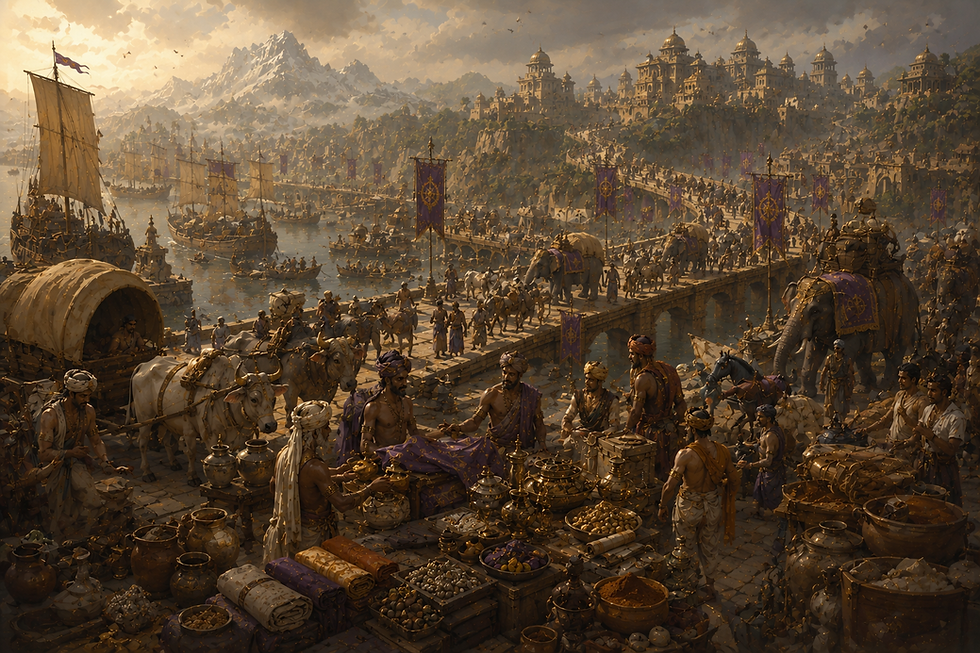
Chapters 16 through 21 of Arthashastra mark a shift from production to circulation. The state has extracted the metal, minted the coin, and harvested the salt. Now it must regulate how these goods move through the economy; how they are weighed, measured, taxed, and traded.
Kautilya turns his attention to the Superintendent of Weights and Measures, the Superintendent of Tolls, the Superintendent of Weaving, the Superintendent of Agriculture, the Superintendent of Liquor, and the Superintendent of Slaughterhouses.
These are the officers who stand at the points of exchange: the marketplace scales, the toll-gate, the textile workshop, the fermentation vat, and the butcher's block.
What emerges is a portrait of the state as the guarantor of fair dealing. Every scale must be tested. Every toll must be calculated by commodity, distance, and season. Every length of cloth must meet the standard. Every field must be sown with the right crop at the right time. Every tavern must be licensed, its liquor taxed, its patrons watched.
Every slaughterhouse must be regulated, its animals inspected, its waste disposed of. In each domain, the superintendent is both inspector and enforcer, ensuring that the kingdom's economic life is not devoured by fraud, adulteration, or chaos.
Kautilya reveals himself in these chapters as a regulator and a standard-setter. He knows the precise dimensions of a royal cubit, the toll rates for every category of merchandise, the seasonal schedule for sowing rice and barley, and the licensing requirements for liquor vendors.
He understands that economic prosperity depends not only on production but on trust—the trust that a merchant's scale is honest, that a toll-collector's assessment is fair, that a weaver's cloth is pure, and that a tavern's drink is unadulterated. The superintendents of these chapters do not produce wealth directly.
They create the conditions in which wealth can be produced and exchanged without fraud or friction. They are the joints and sinews of the tortoise, connecting the shell to the limbs, the treasury to the marketplace, and the king's justice to the daily transactions of his people.
Book II of Arthashastra: Duties of Government Superintendents (Adhyakshaprachara)
The second book, Adhyakshaprachara (अध्यक्षप्रचार), is a dramatic shift in focus. It translates to "The Activity of Superintendents" or "The Conduct of Superintendents." It builds the machinery through which the king's disciplined will reaches every corner of the empire. Its central argument is that a king, however wise and self-controlled, cannot govern alone; he must appoint, direct, and monitor a professional civil service of superintendents (adhyakshas) who manage the kingdom's economic life.
The book's 36 chapters provide a comprehensive blueprint for the administration of agriculture, mining, trade, taxation, forests, mines, manufactories, weights and measures, tolls, and the entire material foundation on which the state rests.

Chapter XVI: The Superintendent of Commerce
The Superintendent of Commerce shall ascertain demand or absence of demand for, and rise or fall in the price of, various kinds of merchandise which may be the products either of land or of water and which may have been brought in either by land or by water path. He shall also ascertain the time suitable for their distribution, centralisation, purchase, and sale.
That merchandise which is widely distributed shall be centralised and its price enhanced. When the enhanced rate becomes popular, another rate shall be declared.
That merchandise of the king which is of local manufacture shall be centralised; imported merchandise shall be distributed in several markets for sale. Both kinds of merchandise shall be favourably sold to the people.
He shall avoid such large profits as will harm the people. There shall be no restriction to the time of sale of those commodities for which there is frequent demand; nor shall they be subject to the evils of centralisation (saṅkuladoṣa).
Or pedlars may sell the merchandise of the king at a fixed price in many markets and pay necessary compensation (vaidharaṇa) proportional to the loss entailed upon it (chhedānurūpam).
The amount of vyājī due on commodities sold by cubical measure is one-sixteenth of the quantity (ṣoḍaśabhāgo mānavyājī); that on commodities sold by weighing balance is one-twentieth of the quantity; and that on commodities sold in numbers is one-eleventh of the whole.
The superintendent shall show favour to those who import foreign merchandise: mariners (nāvika) and merchants who import foreign merchandise shall be favoured with remission of the trade-taxes, so that they may derive some profit (āyatikṣamam parihāram dadyāt).
Foreigners importing merchandise shall be exempted from being sued for debts unless they are local associations and partners (anabhiyogaśchārtheṣvāgantūnāmanyatassabhyopakāribhyaḥ).
Those who sell the merchandise of the king shall invariably put their sale proceeds in a wooden box kept in a fixed place and provided with a single aperture on the top.
During the eighth part of the day, they shall submit to the superintendent the sale report, saying "this much has been sold and this much remains;" they shall also hand over the weights and measures. Such are the rules applicable to local traffic.
As regards the sale of the king's merchandise in foreign countries:
Having ascertained the value of local produce as compared with that of foreign produce that can be obtained in barter, the superintendent will find out by calculation whether there is any margin left for profit after meeting the payments to the foreign king such as the toll (śulka), road-cess (vartanī), conveyance-cess (ātivāhika), tax payable at military stations (gulmadeya), ferry-charges (taradeya), subsistence to the merchant and his followers (bhakta), and the portion of merchandise payable to the foreign king (bhāga).
If no profit can be realised by selling the local produce in foreign countries, he has to consider whether any local produce can be profitably bartered for any foreign produce. Then he may send one quarter of his valuable merchandise through safe roads to different markets on land.
In view of large profits, the deputed merchant may make friendship with the forest-guards, boundary-guards, and officers in charge of cities and of country-parts of the foreign king. He shall take care to secure his treasure (sāra) and life from danger.
If he cannot reach the intended market, he may sell the merchandise at any market free from all dues (sarvadeyaviśuddham).
Or he may take his merchandise to other countries through rivers (nadīpatha).
He shall also gather information as to conveyance-charges (yānabhāgaka), subsistence on the way (pathyadana), value of foreign merchandise that can be obtained in barter for local merchandise, occasions of pilgrimages (yātrakāla), means that can be employed to ward off dangers of the journey, and the history of commercial towns (paṇyapaṭṭanachāritra).
Having gathered information as to the transaction in commercial towns along the banks of rivers, he shall transport his merchandise to profitable markets and avoid unprofitable ones.

In Simple Terms
The main ideas from this chapter can be understood in these simple points:
The Superintendent of Commerce is the State's Chief Economist: His job is not to sit in an office. He studies demand—what people want, when they want it, and how much they will pay. He tracks prices—what is rising, what is falling, and why.
He understands timing; when to buy, when to sell, when to hold, and when to distribute. He is the market intelligence officer of the ancient state.
The State as a Market-Maker: When a commodity is widely available and prices are low, the superintendent centralises it—buys it up, concentrates the supply—and raises the price. When the higher price has become accepted, he adjusts again.
This is not profiteering; it is price stabilisation. The state uses its purchasing power to prevent price collapses that would ruin producers and price spikes that would starve consumers. The goal is not maximum profit but stable, fair markets.
State Goods Get Priority, But Not Monopoly: The king's own merchandise—goods produced on crown lands or in state workshops—is centralised for quality control and price management. Imported goods are distributed widely across many markets so that people everywhere can buy them.
Both are sold at prices that favour the public. The state explicitly avoids "such large profits as will harm the people." This is a public-service mandate, not a profit-maximising corporation.
The Vyājī — A Transparent Transaction Fee: Every sale of state goods carries a small premium: one-sixteenth on goods sold by volume, one-twentieth on goods sold by weight, one-eleventh on goods sold by the piece.
These are not hidden charges; they are declared, standardised, and applied equally. The premium covers the cost of the state's distribution network and ensures the treasury earns a margin without gouging.
Welcoming Foreign Merchants: Foreign traders—mariners and caravan merchants—receive tax remissions so that they can make a profit and keep coming back. They are exempted from being sued for old debts while they are in the kingdom, unless they have local partners or associations.
This is an ancient "ease of doing business" policy: the state wants foreign goods and foreign silver flowing into its markets, and it removes legal harassment as a barrier to trade.
The Wooden Box and the Daily Report: Every state seller places the day's sale proceeds into a wooden box with a single slot on top; a sealed cash register.
At the eighth part of the day, they report to the superintendent: how much was sold, how much remains, and they hand over the weights and measures for inspection. The box cannot be opened casually; the slot ensures cash goes in but cannot be extracted without the superintendent's authority. This is physical cash control.
Foreign Trade — The Profit Calculation: Before sending goods abroad, the superintendent performs a detailed cost-benefit analysis. He lists every expense the caravan or ship will incur: foreign tolls, road-cess, conveyance fees, military-station taxes, ferry charges, food for the journey, and the foreign king's share of the goods.
He subtracts these from the expected sale price. If there is no profit, he considers barter: exchanging local goods directly for foreign goods that can be sold profitably at home. If neither works, the goods do not travel. The state does not trade for prestige; it trades for profit.
The Caravan Leader's Playbook: The merchant leading the state's foreign expedition has a clear set of instructions. He takes only one quarter of the most valuable goods—the rest stays safe. He cultivates friendships with forest-guards, boundary-guards, and city officers along the route. He protects his treasure and his life above all.
If he cannot reach the intended market due to war, bandits, or blocked roads, he sells wherever he can, free of all dues, and returns. He uses rivers when possible—cheaper and often safer than land routes.
He gathers intelligence on transport costs, food supplies, barter values, the timing of pilgrimages (when crowds gather and markets boom), and the history and reputation of every commercial town on the route. He shares this intelligence with the superintendent when he returns.
The State as a Trading Enterprise: This chapter reveals the Kautilyan state as an active commercial player, not merely a tax collector. It produces goods, buys and sells in its own markets, exports and imports across borders, manages prices for public benefit, calculates profit margins on foreign expeditions, and gathers market intelligence systematically.
The Superintendent of Commerce is, in modern terms, the CEO of the state trading corporation, the head of the central bank's market operations, and the minister of commerce—all in one office.
Case Study: An Ancient King's Application
The Chola dynasty of South India (c. 850–1279 AD) operated a state trading network that applied Kautilya's commercial principles on an oceanic scale. The Chola kings did not merely tax private merchants; they were merchants themselves. The state owned ships, financed trading expeditions, and maintained warehouses in foreign ports across Southeast Asia.
The Chola capital at Thanjavur and the port city of Nagapattinam were hubs of state-directed commerce. Chinese, Arab, and Southeast Asian merchants were welcomed with tax remissions—Kautilya's rule that foreign traders should be favoured "so that they may derive some profit."
The Chola state's own ships carried textiles, spices, gems, and forest produce to the Srivijaya Empire (Sumatra), the Khmer Empire (Cambodia), and the Song Dynasty ports of southern China. The state calculated profit margins just as Kautilya prescribed: deducting tolls, port fees, provisions, and foreign duties from the expected sale price, and sending goods only when a net profit was assured.
The Chola state's market interventions mirrored Kautilya's price stabilisation role. Temple inscriptions record that the state bought rice during bumper harvests to prevent prices from collapsing below the cost of cultivation, stored it in granaries, and released it during shortages.
The centralisation of widely distributed grain to enhance its price, followed by the declaration of a new rate when the enhanced rate became accepted, is recorded in Chola revenue inscriptions that specify multiple price tiers for state grain sales.
The foreign trade expeditions were accompanied by diplomatic missions. Chola embassies to China carried both goods and treaties, and the merchants who led them were instructed to cultivate friendships with local officials; Kautilya's rule that the caravan leader should befriend forest-guards, boundary-guards, and city officers.
The Chola navy protected the sea routes, and the state's intelligence network gathered information on foreign markets, pilgrimage seasons, and the reputations of commercial towns; exactly the information the Kautilyan superintendent was required to collect.
The Chola empire's commercial success enriched the state, funded its monumental temple architecture, and sustained its military dominance for three centuries.
When the Chola state declined, it was in part because the Song Dynasty closed its ports to foreign trade and the Srivijaya Empire collapsed, cutting the Chola trading network at both ends. The Kautilyan principle held: a state that trades wisely prospers; a state that loses its trading partners declines.
Takeaway
For the Nation: In modern India, the functions of the Kautilyan Superintendent of Commerce are distributed across several institutions. The Ministry of Commerce and Industry formulates trade policy, negotiates market access, and promotes exports.
The Directorate General of Foreign Trade (DGFT) regulates imports and exports, manages tariff-rate quotas, and administers trade agreements. The State Trading Corporation of India (STC) and the Minerals and Metals Trading Corporation (MMTC) are the direct descendants of the Kautilyan state trading enterprise: they export and import commodities—grains, metals, minerals, fertilisers—on behalf of the government, stabilising domestic prices by buying when prices are low and selling when they are high.
The Essential Commodities Act, 1955 empowers the state to control the production, supply, and distribution of essential commodities, fix prices, and prevent hoarding; the modern legal framework for the Kautilyan principle that the state should centralise goods to stabilise prices and avoid "such large profits as will harm the people."
The Agricultural and Processed Food Products Export Development Authority (APEDA) promotes agricultural exports and gathers market intelligence on foreign demand, prices, and trade barriers; the modern equivalent of the superintendent's intelligence-gathering on foreign markets.
The Arthashastran best practice that endures is the active, intelligent state intervention in markets for public benefit. The Kautilyan superintendent did not merely observe prices; he acted—buying, selling, centralising, distributing—to prevent both glut and scarcity.
The modern Indian state, through the FCI, the STC, and the Essential Commodities Act, retains these powers, but their effective use depends on the quality of market intelligence and the speed of decision-making. The Kautilyan superintendent knew demand, supply, and price for every commodity in real time.
The modern state that relies on outdated data, that hoards grain while prices spike, or that exports during domestic shortages, has abandoned the superintendent's discipline. The Arthashastran best practice is the integration of market intelligence with market action: know the price, predict the trend, and act before the trend becomes a crisis.
For the Corporation: In the modern corporation, the Superintendent of Commerce maps to several roles. The Chief Commercial Officer (CCO) or Head of Sales monitors demand, tracks competitor pricing, and decides when to centralise inventory for a price push and when to distribute widely to capture volume.
The Head of International Business or Export Division calculates the profitability of foreign ventures by deducting every cost—tariffs, transport, duties, local agent fees, currency conversion—from the expected sale price, exactly as the Kautilyan superintendent calculated śulka, vartanī, ātivāhika, and bhāga before dispatching a caravan.
The Revenue Management or Pricing team sets standardised premiums—the modern vyājī—on different product categories and sales channels, ensuring transparency and consistency. The Market Intelligence unit gathers information on demand trends, competitor activity, regulatory changes in foreign markets, and the reputations of distributors and partners in every commercial town on the trade route.
The Internal Controls team ensures that every sales point deposits its proceeds into a secured system—the modern wooden box with a single slot—and that day-end reports reconcile cash received with goods sold.
The Arthashastran best practice for the corporation is the discipline of the profit calculation before the journey begins. The Kautilyan superintendent did not send a caravan abroad and hope for the best; he calculated every cost, estimated every risk, compared barter values, and only dispatched goods when a net profit was assured after meeting all obligations.
The modern corporation that enters a foreign market without calculating the total cost of doing business—tariffs, logistics, local taxes, partner commissions, compliance costs—is a corporation that will discover its profit margin has evaporated somewhere on the road.
The Kautilyan caravan leader who could not reach his intended market sold wherever he could, free of all dues, and returned with his treasure and his life.
The modern corporation that persists in a failing market because it has already sunk the investment, that does not have an exit plan, that does not cultivate relationships with the local "forest-guards and boundary-guards" (regulators, customs officials, local partners), is a corporation that will lose both its treasure and its future.
The Arthashastran trader knew the history of every commercial town. The modern corporation should know no less about every market it enters.
Kingdom of Saha, Kanchi, Kūrmapura, the Office of the Superintendent of Commerce The office stood near the harbour gate, where the river met the western sea near the caravan roads. Its windows were wide and unshuttered, designed to catch the sounds of the marketplace: the cries of the fish-sellers, the rumble of ox-carts laden with grain, the haggling of spice merchants in a dozen languages. The Superintendent of Commerce needed to hear the market before she could govern it. Vasundhara had occupied this office for eight years. She was the daughter of a merchant family that had traded in pepper and sandalwood for four generations, and she had spent her youth in the warehouses and counting-houses of the coastal ports before Gajakesha recruited her into the royal service. She understood markets not as abstractions but as living things—moods, hungers, tides of supply and demand that shifted with the seasons, the harvests, and the rumours of war. Today, the tide was troubling. She stood at her desk, a stack of reports before her: the rice harvest in the eastern delta had been the largest in a decade. The late monsoon had been kind where it had once been cruel, and the fields of Vrishabhavati and the surrounding villages had produced a surplus of nearly forty thousand droṇas beyond the kingdom's normal needs. The granaries were already full from the previous year's buffer stock. The market price of rice had fallen by a third in the past month, and the farmers—the same farmers who had nearly starved in the lean year—were now facing ruin from abundance. "The price must be stabilised," she said to her deputy, a young man named Puranjaya who had been with her for three years. "If we let the glut continue, the farmers will not recover their costs. They will plant less next season, and the year after that we will face scarcity. The cycle must be broken." Puranjaya nodded. "Do we buy? Centralise the surplus?" "We buy. All of it. At a price that covers the farmer's cost of cultivation plus a small margin—not the depressed market rate. We will store the surplus in the coastal warehouses. Then we release it gradually, one quarter at a time, at a price that is fair to both the farmer and the consumer. The treasury will earn a modest vyājī—one-twentieth on the weight—and the market will stabilise." "The treasury can afford the outlay?" "Gajakesha has already approved the funds. The Chamberlain has released the silver. The carts are being loaded as we speak." She moved to a map of the kingdom's trade routes pinned to the wall. "But the surplus is too large for domestic consumption alone. We need an export market. What do we know of the demand for rice in Panchasthavi?" Puranjaya consulted a palm-leaf. "Their harvest was poor this year—a cyclone in the southern sea destroyed their paddies. Their merchants are desperate for grain. But the sea route is long, and the pirates of Daku Marakkar have been active in the straits." "The pirates are a risk. The profit margin must justify the risk." Vasundhara sat at her desk and began to calculate. She listed every expense on a fresh palm-leaf: the cost of hiring a ship and crew, the provisions for the voyage, the tolls at the harbours of Varunapat and Nava Bhumivar, the port fees, the foreign king's share of the cargo, the subsistence for the crew, and the expected price of rice in the island's markets. She compared these against the price at which she could sell the surplus rice at home. The margin, after all deductions, was still substantial—nearly thirty percent net profit. "We will send three ships," she said. "Not the whole surplus—one quarter, as the rules prescribe. The rest stays in the coastal warehouses for domestic sale and buffer. The ships will carry rice and return with spices, pearls, and the blue sapphires. The return cargo will be taxed lightly by them, who are eager for our grain. And their gems will sell at a premium in Kūrmapura." She reached for a fresh scroll and began drafting orders: to the harbour-master, to the captain of the state merchant fleet, to the customs officers at the port, and to the Chamberlain to secure the return cargo upon arrival. The Harbour, Three Days Later The three ships—broad-hulled merchant vessels with the royal tortoise 'Kurma' painted on their sails—rode at anchor in the outer harbour. The rice was being loaded in heavy jute sacks, each stamped with the state seal. The captain, a weathered old sailor named Meghananda who had navigated the southern sea routes for thirty years, stood on the quay beside Vasundhara. "The straits are dangerous this season," he said. "Marakkar's pirates have been emboldened. They captured a Valenta merchantman last month and ransomed the crew. Our navy has increased patrols in the waters of Saha, but the pirates know the coves and the reefs of Panchasthavi better than any patrol." "I have arranged for an escort," Vasundhara said. "Two warships from Rudravarma's southern squadron will accompany you as far as the mid-sea channel. Beyond that, you will be in Panchasthavi's waters. Their own navies patrol there. The pirates rarely venture too close to their capital cities." Meghananda nodded slowly. "And when we reach the port?" "You will present the king's letter of introduction to the harbour-master. You will pay the foreign toll and the port fee; the amounts are specified in the letter, and I have provided the silver. You will sell the rice at the prevailing market price, which our intelligence suggests is three times the Kūrmapura price. You will purchase return cargo with the proceeds: sapphires, pearls, cinnamon, and nutmeg. No textiles—Panchasthavi's textiles are inferior to our own. No salt—we have our own. Only goods that are scarce here and abundant there. You will return within three months, before the monsoon turns. And you will befriend the harbour officials and the city officers. Learn everything you can about their markets, their trade policies, their disputes with neighbouring kingdoms. The state needs intelligence as well as profit." Meghananda touched his forehead to the floor. "It shall be done, Lady Superintendent." The Southern Caravan Gate, One Week Later The second part of Vasundhara's plan involved the land routes. The northern trade road, which wound through the buffer zone and into the hills, had been disrupted by Zarian raids for months. Merchants from the northern hill tribes—traders in wool, hides, and medicinal herbs—had stopped coming. The toll revenues from the northern gate had fallen by half. The markets of Kūrmapura were poorer for their absence. Vasundhara had sent messengers to the hill tribes with a simple offer: any merchant who brought goods to Kūrmapura would receive a remission of one-third of the trade taxes for the first year, and exemption from being sued for old debts while they were in the kingdom, unless they had local partners. The state would also provide armed escorts for the caravans through the most dangerous stretches of the road. The first caravan to accept the offer arrived on a cold morning, led by a grizzled merchant named Dirghanakha who had not traded with the south in three years. His train of fifty pack-mules carried bales of woollen blankets from the mountain looms, bundles of dried medicinal roots, and a small chest of uncut garnets from the northern mines. Vasundhara met him at the gate herself. She inspected his goods, assessed their value, and calculated the reduced toll. She assigned him a stall in the merchants' quarter free of charge for the first month. She introduced him to the guild-master of the textile traders, who was eager for quality wool. She ensured that his mules were stabled and his men were fed. "The remission is generous," Dirghanakha said, his voice rough with surprise. "In Zaria, the tax-collectors of the warlords take first and ask questions later. Here, you welcome us." "You bring goods that our people need," Vasundhara replied. "You bring silver that will circulate in our markets. You bring knowledge of the northern trade routes. The remission is an investment. When the Zarian threat recedes, you will continue to come, and you will tell other merchants that Kūrmapura is open for business. That is worth more than a few coins in toll." Dirghanakha nodded slowly. "The Zarian warlords are a curse on all who trade. But if the southern road is safe, I will return. And I will bring others." "That is all I ask." The Office, the Eighth Part of the Day The day's sales were complete. The wooden cash boxes from the state stalls in the market—the sealed boxes with a single slot on top, into which every coin from the sale of state goods had been dropped—were brought to Vasundhara's office by a line of pedlars and stall-keepers. They carried the boxes on their shoulders like sacred vessels, and they set them down before her desk with visible relief. One by one, the boxes were opened. The coins were counted against the day's sales reports: how much grain sold, how much oil, how much salt, how much cloth. The weights and measures used by the sellers were handed over for inspection; Vasundhara's clerks checked each balance and each droṇa measure against the royal standards, looking for the eight kinds of false balance or any sign of tampering. The clerks found nothing amiss. The total for the day was recorded in the ledger. The coins were bagged and sealed for transfer to the treasury. Vasundhara signed the daily report and dismissed the sellers. Puranjaya lingered. "The northern merchant, Dirghanakha, sold half his wool today at a profit. He has ordered more to be sent from the hills. The remission worked." "It will work as long as the road remains safe. That depends on Rudravarma's patrols and the Zarian warlords' restraint. Commerce cannot thrive where the caravans cannot pass. But we have done what we can." She looked at the map on the wall, at the sea routes and the land routes traced in faded ink. "We will know in three months whether the Mayūrapuri expedition was a success." The Harbour, Three Months Later The three ships returned on the morning tide, their sails stained with salt and sun, their hulls riding low in the water with the weight of their cargo. Captain Meghananda came ashore with a leather satchel stuffed with manifests, receipts, and a personal letter from the harbour-master of Varunapat to the Superintendent of Commerce of the Kingdom of Saha. The rice had sold at three and a half times the Kūrmapura price—better than Vasundhara's projection. The return cargo—sapphires, pearls, cinnamon, nutmeg, and a small chest of uncut diamonds from the island's riverbeds—was valued at nearly four times the cost of the expedition. After all expenses—tolls, port fees, provisions, the crew's wages, the foreign king's share—the net profit to the treasury was forty-two percent. Vasundhara read the manifests in her office, her face unreadable, while Meghananda stood before her, still in his sea-stained clothes. "The pirates?" she asked. "We sighted one of Marakkar's vessels near the straits. The warships drove it off. No loss of life, no loss of cargo. Varunapat's harbour-master sends his regards. He wishes to establish a permanent trading post in Kanchi. He has offered a reciprocal remission of port fees for our ships." Vasundhara set down the manifest. "A permanent trading post. That would mean a steady demand for our grain and textiles, and a steady supply of their gems and spices. The profit would be smaller per voyage but constant. It is worth pursuing." She made a note. "I will raise the matter with Gajakesha and the Maharaja. In the meantime, take your crew to the treasury to receive their bonus. You have earned it." Meghananda bowed and withdrew. The King's Private Study, That Evening Gajakesha presented the quarterly trade report to Simhavarma. The rice stabilisation had cost the treasury twelve thousand silver pieces in procurement but had generated fourteen thousand in domestic sales and export profit. The northern caravan remission had reduced toll revenue by eight hundred pieces but had brought in an estimated two thousand in new trade from returning merchants. The Panchasthavi expedition had netted a forty-two percent return on a five-thousand-piece investment. The overall balance: the treasury was richer by several thousand pieces, the farmers had not been ruined by the glut, the markets were stocked with foreign goods, and a new trading partnership had been opened with a foreign power. "The Superintendent of Commerce has done well," the king said. "She has," Gajakesha replied. "She bought when others were selling, stabilised the price, and exported the surplus. She welcomed foreign merchants with tax remissions and safe roads. She sent ships across the sea and brought back treasure. This is what commerce can be when the state treats it not as a passive tax-collector but as an active participant." Vamanagupta, standing at the window, added: "And she avoided such large profits as would harm the people. The rice price never rose above what a labourer could afford. The northern merchant paid less tax but brought goods that enriched the markets. The Panchasthavi expedition was profitable but not predatory. That is the balance. The state earns its share without devouring the livelihood of its own people or its trading partners." Simhavarma nodded. "Then let the trading post be established. And let Vasundhara be commended for her work. The kingdom's strength is not only in its walls and its elephants. It is in the ships that sail from its harbours and the caravans that pass through its gates." The meeting ended. Outside, the harbour lights flickered on the dark water. The merchants of Kūrmapura, foreign and domestic, closed their stalls for the night. And in her office near the gate, Vasundhara was already preparing the next season's market projections, the next expedition's profit calculation, and the next day's work. The tortoise's shell was not only iron and stone; it was also trade—woven, shipped, bartered, and sold—and it was stronger than any pirate or warlord could break. |

Chapter XVII: The Superintendent of Forest Produce
The Superintendent of Forest Produce shall collect timber and other products of forests by employing those who guard productive forests. He shall not only start productive works in forests, but also fix adequate fines and compensations to be levied from those who cause any damage to productive forests except in calamities.
The following are forest products.
Trees of strong timber (sāradāruvarga): Sāka (teak), tinisa (Dalbergia Ougeinensis), dhanvana, arjuna (Terminalia Arjuna), madhūka (Bassia Latifolia), tilaka (Barleria Cristata), tāla (palmyra), siṃśupa (Dalbergia Sissu), arimeda (Fetid Mimosa), rājādana (Mimosops Kauki), śirīṣa (Mimosa Sirīsha), khadira (Mimosa Catechu), sarala (Pinus Longifolia), tālasarja (Shorea Robesta), aśvakarṇa (Vatica Robesta), somavalka (a kind of white khadira), kasāmra, priyaka (yellow sal tree), dhava (Mimosa Hexandra), and others.
Bamboo: Utaja, Chimiya, Chava, Veṇu, Vaṃsa, Sātina, Kantaka, Bhallūka, and others.
Creepers: Vetra (cane), śokavallī, vāsī (Justicia Ganderussa), śyāmalatā (Ichnocarpus), nāgalatā (betel), and others.
Fibrous plants (valkavarga): Mālatī (Jasminum Grandiflorum), dūrvā (panic grass), arka (Calotropis Gigantea), śaṇa (hemp), gavedhuka (Coix Barbata), atasī (Linum Usitatissimum), and others.
Rope-making material (rajjubhāṇḍa): Muñja (Saccharum Munja), balbaja (Eleusine Indica), and others.
Leaves (patram): Tālī (Corypha Taliera), tāla (palmyra), bhūrja (birch).
Flowers: Kiṃśuka (Butea Frondosa), kusumbha (Carthamus Tinctorius), kuṅkuma (Crocus Sativus).
Medicines: Bulbous roots and fruits.
Poisons: Kālakūṭa, Vatsanābha, Hālāhala, Meṣaśṛṅga, Mustā (Cyperus Rotundus), kuṣṭha, mahāviṣa, vellitaka, gaurārdra, bālaka, mārkata, haimavata, kāliṅgaka, daradaka, kolasāraka, uṣṭraka, and others. Likewise snakes and worms kept in pots are the group of poisons.
Skins: Those of godhā (alligator), seraka, dvīpi (leopard), siṃśumāra (porpoise), siṃha (lion), vyāghra (tiger), hastin (elephant), mahiṣa (buffalo), camara (bos grunniens), gomṛga (bos gavaeus), and gavaya (the gayal).
Bones, bile (pitta), snāyu (tendons), teeth, horn, hoofs, and tails of the above animals as well as of other beasts, cattle, birds and snakes (vyāla).
Metals: Kālāyasa (iron), tāmra (copper), vṛtta, kāṃsya (bronze), sīsa (lead), trapu (tin), vaikṛntaka (mercury?), and ārakūṭa (brass).
Utensils (bhāṇḍa): Those made of cane, bark (vidala), and clay (mṛttikā).
Other things: Charcoal, bran, and ashes. Menageries of beasts, cattle, and birds. Collection of firewood and fodder.
The Superintendent of Forest Produce shall carry on either inside or outside the capital city the manufacture of all kinds of articles which are necessary for life or for the defence of forts.

In Simple Terms
The main ideas from this chapter can be understood in these simple points:
The Forest is a State Asset, Not a Wilderness: The Superintendent of Forest Produce is not a conservationist in the modern sense. He is a resource manager.
The forests belong to the king, and everything they yield—timber, bamboo, creepers, fibres, leaves, flowers, medicines, poisons, skins, bones, metals, charcoal—is harvested, classified, and put to use. The forest is a vast state-owned factory, and the superintendent is its manager.
The Timber Catalogue: Kautilya lists eighteen named varieties of strong timber—teak, arjuna, sal, khadira, and others—each with its specific properties and uses.
This is not random logging; it is selective harvesting based on a precise knowledge of wood types. The state knows which tree makes the best beam for a fortress gate, which makes the best axle for a chariot, which makes the best charcoal for the smelting furnaces.
Bamboo, Creepers, and Fibres: Bamboo is its own category, with eight named varieties. Creepers include cane and betel. Fibrous plants include hemp and flax—the raw materials for rope, cordage, and coarse textiles.
The forest produces the sinews of the economy: the ropes that hoist the sails, the fibres that weave the sacks, the canes that bind the bundles.
Medicines and Poisons: The forest is the kingdom's pharmacy and its armoury of covert weapons. Medicinal roots and fruits are collected, classified, and stored. Poisons—from plant sources like kālakūṭa and vatsanābha, and from animal sources like venomous snakes kept in pots—are state-controlled substances.
They are used for hunting, for warfare (poisoned arrows), and for the darker arts of statecraft described in later books.
Skins, Bones, and Animal Products: The skins of every animal from alligator to elephant are listed, along with their bones, bile, tendons, teeth, horns, hooves, and tails.
Nothing is wasted. The forest is a complete supply chain for leather, glue (from hooves and tendons), ivory, horn tools, and medicinal animal substances.
Metals from the Forest: Iron, copper, bronze, lead, tin, mercury, and brass are listed as forest products, indicating that mining and smelting often occurred within or near forested areas, and that the superintendent of forest produce also oversaw the collection of ores and metals found in his domain—overlapping with the superintendent of mines.
Charcoal, Bran, and Ashes: Even the by-products of forest processing—charcoal from burned wood, bran from grain processed in forest mills, ashes from fires—are collected and stored.
Charcoal fuels the smithies and the lime-kilns. Ashes are used in construction and in chemical processes. A Kautilyan forest leaves no waste.
The Forest Menagerie: The superintendent maintains a menagerie of beasts, cattle, and birds. This is not a zoo for amusement; it is a strategic reserve of live animals—elephants for war, cattle for draught, birds for messaging and poison-detection. The forest is a living arsenal.
Manufacturing On-Site or in the City: The superintendent may establish workshops either inside the forest or in the capital. The forest workshops process raw materials close to the source—sawing timber, tanning skins, smelting ores—reducing transport weight.
The city workshops produce finished goods: furniture, chariots, weapons, utensils. The superintendent controls the entire chain from tree to finished product.
Penalties for Damage: The superintendent fixes fines and compensations for those who damage productive forests. The exception is "calamities"—natural disasters or emergencies where the public need overrides the normal protection. This is an ancient balance between conservation and human necessity.
Case Study: An Ancient King's Application
The Vijayanagara Empire (14th–17th centuries AD) ruled over some of the richest forest tracts in South India—the Western Ghats, the Nilgiris, the Shevaroy Hills—and its forest administration reflected Kautilyan principles with remarkable fidelity.
The empire's demand for timber, elephants, medicinal plants, and fuel was immense, and the state managed its forests as strategic assets rather than unregulated commons.
The Vijayanagara capital at Hampi consumed vast quantities of firewood and charcoal for its palaces, temples, and metallurgical workshops. The iron-smelting sites around the Tungabhadra region required a steady supply of charcoal, which was produced by state-managed foresters who practised selective felling and coppicing.
The Kautilyan principle that nothing should be wasted—charcoal, ashes, and by-products all collected—is visible in the archaeological record of Vijayanagara's industrial zones.
The empire's elephant forests were jealously guarded. The Kautilyan penalty for killing an elephant was death, and Vijayanagara inscriptions record similar severity for those who poached from the royal elephant reserves.
The state maintained a corps of elephant catchers, trainers, and doctors—the anikastha—who reported to the superintendent of forests or directly to the military command.
Timber was classified by species and use. Teak, rosewood, sandalwood, and sal were reserved for royal construction and temple building. The great temple chariots of Vijayanagara, some of which survive, were built from specific woods selected for their strength, workability, and ritual purity—exactly the kind of knowledge Kautilya catalogues in his timber list.
The forest also supplied the Vijayanagara army with poisons for arrows, hides for shields and armour, bamboo for spears and scaffolding, and medicinal plants for the treatment of wounds and diseases. The state controlled the collection and distribution of these materials through a network of forest officers who reported to the central administration.
European travellers, including the Portuguese chronicler Domingo Paes, noted the abundance and variety of forest products in Vijayanagara markets: sandalwood, aloes, camphor, musk, civet, and a vast array of spices and medicinal herbs.
These were not gathered haphazardly; they were the output of a managed system, harvested and processed under state supervision, exactly as Kautilya prescribes.
When Vijayanagara fell in 1565, the forest administration collapsed with it. The elephant forests were abandoned, the timber stands were cut indiscriminately by the conquering armies, and the knowledge of sustainable harvesting that had sustained the empire's material needs for centuries was lost.
The Kautilyan principle held: a state that manages its forests as a renewable resource survives; a state that plunders them collapses.
Takeaway
For the Nation: In modern India, the functions of the Kautilyan Superintendent of Forest Produce are distributed across several institutions. The Indian Forest Service (IFS), established in 1864 and continuing today, manages the nation's forests for timber, non-timber forest products, wildlife, and watershed protection—the direct descendant of the ancient superintendent.
The Forest Survey of India maps and inventories forest resources, classifying timber species and estimating yields, much as Kautilya catalogued his eighteen varieties of strong timber.
The Indian Council of Forestry Research and Education (ICFRE) researches forest products and their utilisation—the modern equivalent of the knowledge base Kautilya assumed his superintendent would possess.
The National Medicinal Plants Board oversees the cultivation and collection of medicinal plants, continuing the ancient practice of harvesting the forest's pharmacy.
The Wildlife Protection Act, 1972, regulates the hunting and trade of animal skins, bones, and other products, with severe penalties for poaching—the modern version of Kautilya's fines for damaging productive forests.
State Forest Development Corporations manage commercial forestry operations, producing timber, bamboo, and other products for sale, exactly as the ancient superintendent "started productive works in forests."
The Arthashastran best practice that endures is the principle that the forest is a productive, renewable asset that must be managed with precise knowledge, not exploited blindly. Kautilya's superintendent knew every species, its properties, and its best use.
The modern Indian state, through its forest surveys and research institutions, possesses this knowledge, but its application is often undermined by illegal logging, encroachment, and corruption.
The Kautilyan penalty for damaging productive forests was severe and consistently enforced. The modern state that fails to protect its forests from illegal exploitation—whether by timber mafias, mining companies, or land grabbers—is a state that is consuming its own future.
The forest that once supplied the kingdom's timber, medicines, and elephants becomes a barren hillside, and the treasury that once collected revenue from forest products must now spend its resources on flood control, soil restoration, and importing what it once grew.
For the Corporation: In the modern corporation, the Kautilyan Superintendent of Forest Produce maps most directly to the Head of Natural Resources or Chief Sustainability Officer in industries that depend on biological raw materials: timber, paper, pharmaceuticals, cosmetics, leather, and food.
The chapter is a template for sustainable resource management. The detailed classification of timber species by their properties—strength, workability, durability—is the origin of modern timber grading and species selection for specific uses.
The comprehensive utilisation of every part of the forest—timber, fibres, medicines, skins, bones, charcoal—is a model of zero-waste manufacturing that modern corporations are only now rediscovering under the name "circular economy."
The principle that production can occur either at the forest site or in the city is the ancient equivalent of deciding between upstream and downstream processing: sawmills near the forest reduce transport costs; furniture workshops near the market capture higher value.
The Arthashastran best practice for the corporation is the integration of resource management with manufacturing. The Kautilyan superintendent did not hand off the timber to another department and forget about it; he oversaw the entire chain from the standing tree to the finished chariot.
The modern corporation that sources raw materials from one supplier, processes them in a separate facility, and sells finished goods through yet another channel often loses visibility and control at the handoffs. The Kautilyan model keeps the entire chain under one authority, ensuring that quality standards are maintained from forest to finished product.
The severe penalties for damaging productive forests are a reminder that the corporation's raw material base is not infinite; over-harvesting, whether of timber or of any renewable resource, destroys the long-term supply.
The corporation that treats its suppliers' forests—or fisheries, or farms—as inexhaustible mines rather than managed ecosystems is a corporation that will eventually face a raw material crisis. The Kautilyan corporation manages its forests to yield timber, medicines, and elephants forever, not just for this quarter's earnings.
Kingdom of Saha, Dandakaranya Forest, the Timber Camp – Dawn The fire had been burning for three days. It was not a wild blaze, whipped by the wind; it was a steady, creeping burn, consuming the undergrowth and licking at the bark of the great sarala pines and the khadira trees that had stood for centuries. The smoke rose in a grey column visible from the watchtowers of the northern elephant forest, and the smell of charred wood drifted as far as the border fortifications at Mandara. Superintendent Bhadra stood at the edge of the burn scar, her boots black with ash. She had been the Superintendent of Forest Produce for six years, responsible for every timber tree, every bamboo grove, every medicinal root and poison vine in the kingdom's forests. She knew each species by its bark, its leaf, and its use. She had personally surveyed the timber stands of Dandakaranya when the elephant forest was carved out and the hermitages of the sages were marked for protection. She had managed the annual harvest of sal and teak for the fortifications at Kūrmapura, the collection of muñja grass for the rope-makers of the western quarter, and the careful extraction of medicinal bulbs for the royal physicians. Now a quarter of the best sarala pine stand—wood that would have provided masts for the navy and beams for the new granary—was blackened and dead. The cause was not natural. Bhadra had traced the fire's origin to a campfire, carelessly built and abandoned by a group of hunters. They had been tracking wild boar through the timber forest, which was permitted only in the designated public hunting grounds to the west. The timber forest was off-limits to all except licensed foresters. The hunters had known this. They had built their fire anyway. "They have been caught," said her deputy, a young forester named Devasena. "The boundary-guards apprehended them near the river. They are being held at the watch-post." Bhadra turned. "How many?" "Three. Two men from the hill tribes, and a merchant from the northern border towns who hired them as guides. They claim they did not know the boundaries of the timber forest. They claim they were lost." "The boundaries are marked with the royal seal every hundred dhanus. They were not lost. They were careless." She began walking toward the watch-post. "The law is clear. Damage to a productive forest, except in calamities, is subject to fines and compensation. This burn scar is not a calamity. It is negligence." The Watch-Post, Late Morning The three hunters knelt before Bhadra on the packed earth of the watch-post compound. The two hill-tribesmen were silent, their ochre-striped faces expressionless. The merchant, a heavyset man named Dirghama, was more voluble. "Lady Superintendent, I swear by the gods that we did not know. The guides said they knew a shortcut through the forest. I am a trader, not a hunter. I would never have risked a fire if I had known the danger." "The dry season," Bhadra said, "has lasted four months. The undergrowth is tinder. Any fire built on open ground will spread. Your guides should have known this. You should have known this. The forest is not a campsite. It is the kingdom's wealth." She turned to Devasena. "What is the extent of the damage?" Devasena consulted a palm-leaf sketch he had drawn that morning. "Approximately two hundred mature sarala pines killed or mortally damaged. Perhaps a hundred more that may recover. The undergrowth will regenerate in three to five years. The pines will take fifty years to regrow to harvestable size. At current timber values, the loss to the treasury is approximately eight hundred silver pieces—four paṇas per mature tree." Bhadra looked at the merchant. "Eight hundred silver pieces. The law requires that those who damage a productive forest pay compensation proportional to the loss. You will pay two hundred pieces—one quarter of the total. Your guides will each pay one hundred pieces, deducted from their wages and hunting fees over five years. The remaining four hundred pieces will be drawn from the forest calamity reserve, because the law also recognises that a fire once started is not fully within the power of any individual to stop. That is my judgment." Dirghama's face went pale. "Two hundred pieces? Lady, that is half my trading capital. It will ruin me." "It will not ruin you. It will remind you to be careful with fire for the rest of your life. The alternative is that the treasury sues you for the full amount in the royal court, where the penalty for damaging the king's forests can be doubled. I am offering you the minimum. Take it." The merchant bowed his head. "I will pay." Bhadra turned to the two tribesmen. "You will work in the forest labour corps for one season, clearing the dead timber and replanting the burn scar. You will be paid a labourer's wage, but your fines will be deducted from it. After that, you may return to your tribes. If you are found in the timber forest again without a license, the penalty will not be a fine." The guides nodded, their faces still unreadable. They understood. The Burn Scar, Six Months Later The monsoon had come and gone. The burn scar was a patch of blackened earth slowly turning green. Bhadra walked among the dead pines with a forester's axe in her hand, marking trees for salvage. The dead timber would be cut and sold—charred wood was still good for charcoal, if not for masts. The undergrowth was already sprouting: muñja grass, fibrous plants, and the first saplings of the next generation of pines. Devasena accompanied her, carrying the work plan for the replanting. "The labour corps has cleared most of the dead timber. The merchant paid his fine in full. The tribesmen have served their season and returned home. One of them has applied for a license to collect medicinal plants in the buffer zone." "Grant it," Bhadra said. "A man who has worked in the forest labour corps knows the boundaries better than most. He will not build a fire again." She stopped at the edge of the scar, where a young khadira sapling had taken root in the cleared ground. "The forest returns, Devasena. That is what Suracharya meant when he called the forest a productive asset. It produces timber, and when the timber is cut, it produces again—if we manage it. If we do not, it becomes a desert. The fine on the hunters was not punishment alone. It was a lesson. And the lesson will spread." She looked out over the green scar, the new growth pushing through the ash. "The pines will take fifty years to return to harvestable size. I will not be superintendent when they are cut. You may be. When you are, remember this fire. Remember that a single careless campfire cost the treasury eight hundred pieces and fifty years of growth. And remember that the law—the fine, the replanting, the labour—made the forest whole again. That is the balance." Devasena nodded. "The balance between use and protection." "Yes. The forest is the kingdom's wealth. But it is also the kingdom's future. We harvest the present. We plant for the future. And we punish those who destroy what belongs to all." She turned and walked back toward the timber camp, where the salvage crews were already loading the dead pines onto ox-carts bound for the charcoal kilns. The forest had burned, but the forest had returned. The tortoise's shell was made of wood and green growth, and it would endure. |

Chapter XVIII: The Superintendent of the Armoury
The Superintendent of the Armoury shall employ experienced workmen of tried ability to manufacture in a given time and for fixed wages wheels, weapons, mail armour, and other accessory instruments for use in battles, in the construction or defence of forts, or in destroying the cities or strongholds of enemies.
All these weapons and instruments shall be kept in places suitably prepared for them. They shall not only be frequently dusted and transferred from one place to another, but also be exposed to the sun.
Such weapons as are likely to be affected by heat and vapour (ūṣmopasneha) and to be eaten by worms shall be kept in safe localities. They shall also be examined now and then with reference to the class to which they belong, their forms, their characteristics, their size, their source, their value, and their total quantity.
Immoveable Machines (sthirayantram): Sarvatobhadra, jāmadagnya, bahumukha, viśvāsaghāti, saṃghāti, yānaka, parjanyaka, ardhabāhu, and ūrdhvabāhu.
Moveable Machines: Pāñchālika, devadaṇḍa, sūkarika, musala, yaṣṭi, hastivāraka, tālavṛnta, mudgara, gadā, spṛktala, kuddāla, āsphāṭima, audhghāṭima, śataghnī, triśūla, and chakra.
Weapons with edges like a ploughshare (halamukhāni): Śakti, prāsa, kunta, hāṭaka, bhindivāla, śūla, tomara, varāhakarna, kanaya, karpana, trāsika, and the like.
Bows: Those made of tāla (palmyra), of chāpa (a kind of bamboo), of dāru (a kind of wood), and śṛṅga (bone or horn) are respectively called kārmuka, kodaṇḍa, druṇa, and dhanus.
Bow-strings: Made of mūrvā (Sansviera Roxburghiana), arka (Calotropis Gigantea), śaṇa (hemp), gavedhu (Coix Barbata), veṇu (bamboo bark), and snāyu (sinew).
Arrows: Veṇu, śara, śalāka, daṇḍāsana, and nārācha are different kinds. The edges of arrows shall be so made of iron, bone or wood as to cut, rend or pierce.
Swords: Nistriṃśa, maṇḍalāgra, and asiyaṣṭi. The handles of swords are made of the horn of rhinoceros, buffalo, of the tusk of elephants, of wood, or of the root of bamboo.
Razor-like weapons: Paraśu, kuṭhāra, paṭṭasa, khanitra, kuddāla, chakra, and kāṇḍachchhedana.
Other weapons: Yantrapāṣāṇa, goṣpaṇapāṣāṇa, muṣṭipāṣāṇa, rochanī (mill-stone), and stones.
Armour made of iron or of skins with hoofs and horns of porpoise, rhinoceros, bison, elephant or cow: Lohajālikā, paṭṭa, kavacha, and sūtraka.
Varieties of armour: Śirastrāṇa (cover for the head), kaṇṭhatrāṇa (cover for the neck), kūrpāsa (cover for the trunk), kañchuka (a coat extending as far as the knee joints), vāravāṇa (a coat extending as far as the heels), paṭṭa (a coat without cover for the arms), and nāgodarikā (gloves).
Instruments used in self-defence (āvaraṇāni): Veti, charma, hastikarṇa, tālamūla, dharmanika, kavāṭa, kiṭika, apratihata, and valāhakānta.
Accessory things (upakaraṇāni): Ornaments for elephants, chariots, and horses as well as goads and hooks to lead them in battle-fields.
Besides the above, such other delusive and destructive contrivances as are treated of in Book XIV together with any other new inventions of expert workmen shall also be kept in stock.
The Superintendent of Armoury shall precisely ascertain the demand and supply of weapons, their application, their wear and tear, as well as their decay and loss.

In Simple Terms
The main ideas from this chapter can be understood in these simple points:
The Armoury is a State-Owned Weapons Factory: The Superintendent of the Armoury does not simply store weapons; he manufactures them.
He employs skilled workmen on fixed wages and fixed deadlines to produce every instrument of war: siege engines, bows, arrows, swords, armour, shields, and the accessories for elephants, chariots, and horses. The state is its own defence contractor.
The Arsenal is a Living Inventory: Weapons are not locked away and forgotten. They are dusted frequently, moved from place to place to prevent damp and rust, and exposed to sunlight to kill worms and mould.
Items sensitive to heat and moisture—leather armour, sinew bow-strings, wooden shields—are stored in climate-controlled conditions. Every weapon is periodically examined for its class, form, characteristics, size, source, value, and total quantity. This is active inventory management, not passive hoarding.
The Machines of War — Immoveable and Moveable: Kautilya distinguishes between two types of siege engines. Immoveable machines (sthirayantram) are large, fixed structures—probably heavy catapults, ballistae mounted on platforms, and defensive engines built into fortifications.
Their names suggest their functions: Sarvatobhadra ("auspicious in all directions"—perhaps a rotating turret), Jamadagnya ("of the Jamadagni line"—perhaps a particularly destructive engine), Bahumukha ("many-faced"—perhaps a multi-directional launcher), Viśvāsaghāti ("trust-destroyer"—perhaps a booby-trap or mine), Saṃghāti ("crusher"), Yānaka ("moving platform"), Parjanyaka ("rain-maker"—perhaps spraying missiles), Ardhabāhu ("half-arm"), and Ūrdhvabāhu ("upraised arm"—perhaps a crane or elevated platform).
Moveable machines are the battlefield weapons that can be transported: Pāñchālika (a doll-like device? perhaps a decoy), Devadaṇḍa ("divine staff"), Śataghnī ("hundred-slayer"—a heavy cylinder studded with spikes, rolled off parapets onto massed attackers), Triśūla (trident-launcher), and Chakra (discus-thrower). These are the weapons that break sieges and slaughter infantry.
The Catalogue of Hand Weapons: The chapter provides a comprehensive list of personal arms. Spears and polearms with ploughshare-like blades (halamukhāni) include the śakti, prāsa, kunta, tomara (a javelin), and varāhakarna ("boar's ear").
Bows are classified by material—palmyra wood, bamboo, hardwood, horn—each with a specific name. Bow-strings are made from plant fibres (hemp, bamboo bark), sinew, or gut. Arrows come in five named varieties with iron, bone, or wooden heads designed to cut, rend, or pierce.
Swords are of three types with handles of rhinoceros horn, buffalo horn, elephant tusk, wood, or bamboo root. Axes, cleavers, and razor-like weapons complete the edged arsenal. And for blunt force, the armoury stocks throwing stones of various sizes and mill-stones.
Armour from Head to Heel: The armour section lists protection for every part of the body: Śirastrāṇa (helmet), Kaṇṭhatrāṇa (neck-guard), Kūrpāsa (chest-plate or trunk armour), Kañchuka (coat to the knees), Vāravāṇa (full-length coat to the heels), Paṭṭa (sleeveless coat), and Nāgodarikā (gloves).
The materials are iron, animal skins, and the tough parts of animals—hoofs, horns, and hide of porpoise, rhinoceros, bison, elephant, and cow. This is a complete suit of armour, assembled piece by piece.
Shields and Defensive Gear: Nine named instruments of self-defence include the Veti, Charma (leather shield), Hastikarṇa ("elephant's ear"—a large shield), and Kavāṭa ("door"—a tower shield). These are not decorative; they are battlefield equipment designed to stop arrows, deflect swords, and protect the bearer.
Accessories for the Animals: War elephants, chariot horses, and cavalry mounts have their own armour and ornaments, plus the goads and hooks used to direct them in battle.
An elephant without its head-plate and its driver's hook is not a war elephant; it is a confused animal. The accessories are as essential as the weapons.
Innovation is Mandatory: The armoury must stock not only the weapons listed but also "such other delusive and destructive contrivances" as are described elsewhere, and "any other new inventions of expert workmen."
The state is required to innovate. If a workman invents a better siege engine or a more lethal arrowhead, the armoury adopts it. There is no ancient equivalent of a procurement freeze.
The Superintendent's Final Duty: He must know the demand for weapons (what the army needs now and in the future), the supply (what is in stock and what can be manufactured), their application (how they are used and by whom), and their wear, tear, decay, and loss.
This is a complete logistics and readiness system. A kingdom that does not know how many arrows it has, or how many will be needed for the next campaign, is a kingdom that will lose its next war.
Case Study: An Ancient King's Application
The Mauryan Empire's arsenal, as described by Megasthenes and reflected in the archaeological record, was a direct implementation of Kautilya's armoury chapter on a vast scale.
Megasthenes records that the Mauryan state maintained a dedicated department for the manufacture and storage of weapons, under the supervision of officers who reported to the central administration.
The Mauryan arsenal produced the weapons Kautilya lists on an industrial scale. Iron arrowheads, spear-points, and sword-blades were manufactured in state workshops using ore from the empire's mines. Bows were made from bamboo and horn, bow-strings from sinew and plant fibre.
The śataghnī—the hundred-slayer—was a real weapon, a heavy iron cylinder that could be rolled off fortification walls onto massed attackers. The Mauryan fortifications at sites like Pataliputra, Kaushambi, and Ujjain were equipped with both immoveable and moveable machines.
Armour production was similarly industrial. The Mauryan soldier was equipped with helmet, neck-guard, body armour, and gloves—the full Kautilyan kit. The army's infantry, cavalry, chariots, and elephants each required different armour and accessories, and the state maintained separate workshops for each.
The climate-controlled storage Kautilya prescribes was not theoretical. The monsoon climate of northern India would destroy leather, sinew, and wood within months if weapons were simply piled in a shed.
The Mauryan arsenal staff were required to dust, move, sun, and inspect every item regularly. The periodic examinations—checking each weapon for its class, form, characteristics, size, source, value, and quantity—were the ancient equivalent of military readiness audits.
The Mauryan army's size—Megasthenes reports 600,000 infantry, 30,000 cavalry, 9,000 elephants, and 8,000 chariots—required an arsenal of staggering capacity. Each soldier needed at least one sword or spear, a bow with multiple strings, and dozens of arrows.
Each elephant required armour and goads. Each chariot required wheels, axles, and weapon mounts. The superintendent of the armoury was responsible for manufacturing, storing, and maintaining all of it, and for ensuring that the army could be fully equipped at a moment's notice.
When Alexander's successors, the Seleucids, encountered the Mauryan army under Chandragupta, they faced a military machine that could outnumber, out-equip, and outlast them.
The 500 war elephants that Seleucus Nicator received in exchange for territory were not captured wild and handed over untrained; they were fully equipped with their armour, goads, and trained drivers. The Mauryan arsenal had supplied everything the elephants and their crews required. The Kautilyan system worked.
Takeaway
For the Nation: In modern India, the functions of the Kautilyan Superintendent of Armoury are distributed across several defence institutions. The Ordnance Factory Board (OFB), established in 1775 and now comprising over forty factories, manufactures weapons, ammunition, and armour for the Indian armed forces—the direct descendant of the state workshop that employed "experienced workmen of tried ability."
The Defence Research and Development Organisation (DRDO) develops new weapons systems and military technology, fulfilling Kautilya's mandate to stock "any other new inventions of expert workmen."
The Directorate General of Quality Assurance (DGQA) inspects and certifies every weapon and piece of equipment before it enters service, performing the periodic examinations that the ancient superintendent conducted for class, form, characteristics, and value.
The Army Ordnance Corps manages the storage, inventory, and distribution of weapons and ammunition to frontline units, dusting and rotating stock to prevent decay and loss. The Armed Forces' demand forecasting and procurement system—though often criticised for delays—is the modern equivalent of the superintendent's duty to "precisely ascertain the demand and supply of weapons."
The Arthashastran best practice that endures is the principle that defence manufacturing must be largely state-controlled, that quality must be independently verified at every stage, and that the arsenal must be ready before the war begins.
Kautilya's superintendent did not wait for a crisis to start manufacturing arrows; he kept the workshops running continuously, the bows strung and unstrung in rotation, the leather oiled against damp, and the iron blades free of rust.
The modern nation that allows its ordnance factories to run at low capacity during peacetime, that fails to maintain its ammunition reserves, or that relies on emergency imports when conflict erupts has abandoned the Kautilyan discipline.
Weapons cannot be conjured in a crisis; they must be manufactured, stored, maintained, and replaced in a continuous cycle. The nation that masters this cycle wins its wars. The nation that neglects it loses them.
For the Corporation: In the modern corporation, the Kautilyan armoury maps to the manufacturing, quality control, and asset management functions of any business that produces physical goods, especially in high-stakes industries like defence, aerospace, automotive, medical devices, and heavy engineering.
The Production Manager is the ancient superintendent: employing skilled workers, setting fixed timelines and budgets, and delivering finished products to specification. The Quality Assurance department performs the periodic examinations: checking every item for its class (model), form (design), characteristics (specifications), size (dimensions), source (batch traceability), value (cost), and total quantity (inventory count).
The Warehouse and Logistics team manages climate-controlled storage, rotates stock to prevent deterioration, and ensures that sensitive materials—the modern equivalent of sinew bow-strings and leather armour—are kept in conditions that preserve their integrity.
The Research and Development (R&D) department is the ancient expert workman bringing "new inventions" to the armoury; the corporation that does not innovate its product line is the corporation that will be outmatched by competitors who do.
The Arthashastran best practice for the corporation is the integration of manufacturing, inspection, storage, and readiness assessment in a single accountable chain. The Kautilyan superintendent knew the demand, the supply, the condition, and the rate of decay of every weapon in his arsenal.
The modern operations executive who cannot state, without consulting a spreadsheet, the current inventory level, the production capacity, the defect rate, and the estimated service life of their critical products is an executive who has lost control of their armoury.
The Kautilyan principle of continuous maintenance—dusting, moving, sunning, inspecting—is a reminder that inventory is not static; it degrades, and the degradation is a cost.
The corporation that treats its finished goods inventory as a dormant asset, to be stored and forgotten, is the corporation that will one day discover its warehouses full of rusted metal and rotted leather. The armoury is not a museum of past production; it is a living reserve of future capability, and it must be managed as such.
Kanchi, Kūrmapura, the Royal Armoury – Late Morning The armoury was a fortress within the fortress. Its walls were stone, its roof was tile, and its single iron-bound door was guarded by soldiers who answered not to the city watch but to the Superintendent of the Armoury alone. Inside, the air was cool and dry—designed to prevent the rust and rot that heat and moisture brought. Racks of spears lined the walls. Bundles of arrows, their iron heads wrapped in oiled cloth, filled the shelves. Swords hung from wooden pegs, their blades gleaming with a thin coat of protective wax. In the far chamber, under a roof open to the sun on clear days, the siege engines rested on wheeled platforms: the śataghnī cylinders, the great crossbows, and the stone-throwers whose names the craftsmen still invoked—Parjanyaka, the rain-maker; Sarvatobhadra, the auspicious-in-all-directions. The new weapon was a śataghnī of a design the armoury had never produced before. The Senapati himself had requested it: a heavier cylinder, studded with longer spikes, designed to be rolled not merely off a parapet onto massed infantry but down a specially constructed ramp onto an enemy siege tower. The old śataghnī could kill a dozen men. This one, if it worked, could destroy a tower. The Superintendent of the Armoury was a woman named Drishadvati. She had been a weaponsmith before Gajakesha appointed her to the office, and her hands still bore the calluses of the hammer and the burn-scars of the forge. She had personally supervised the casting of the new cylinder, the forging of its spikes, and the construction of the test ramp on the armoury's proving ground. Today was the test. Rudravarma was present, his arms folded, his eyes sceptical. Gajakesha had come, more out of duty than enthusiasm; weapons were an expense, and new weapons were an unproven expense. And behind them, almost invisible in the shadows, stood Vamanagupta. "The cylinder weighs twice the standard," Drishadvati said, standing beside the test ramp. "The spikes are forged from Trikutagiri iron, the same ore that supplies the royal swordsmiths. The ramp is built to the specifications of the siege engineers at Mandara. If the weapon works, it will destroy any siege tower the Zarian warlords can build. If it fails—" she shrugged "—we will learn why and build a better one." Rudravarma grunted. "Proceed." The test target was a wooden tower, twenty cubits high, constructed to the known specifications of the Zarian siege engines that had been reported by Varishtha's spies on the northern border. It was a crude thing—timber beams, leather panels, a platform for archers—but it was accurate. The Zarian engineers built for speed, not elegance. Drishadvati signalled to her team. Four men, the armoury's strongest, pushed the śataghnī onto the ramp. The cylinder was massive—eight feet long, its iron surface bristling with spikes the length of a man's forearm. It rested on greased runners. A single iron pin held it in place. "Release," Drishadvati said. The pin was pulled. The śataghnī rolled. It gathered speed down the ramp, its spikes catching the light, and struck the siege tower at the base. The sound was not a crash but a deep, grinding shriek of iron against timber. The tower's lower beams splintered. The tower lurched, tilted, and collapsed in a cascade of broken wood and torn leather. When the dust settled, the śataghnī lay amid the wreckage, its spikes bent but its cylinder intact. The siege tower was a pile of kindling. Rudravarma walked to the edge of the proving ground, staring at the wreckage. Then he turned to Drishadvati. "How many can you produce by the end of the monsoon?" "With the current foundry capacity, six. If the treasury authorises overtime and additional iron from Trikutagiri, perhaps eight." "I will authorise the iron myself," Gajakesha said. "The cost of eight śataghnīs is less than the cost of rebuilding a border fort that a Zarian siege tower has breached." Rudravarma nodded. "Then produce eight. And begin work on a second design—smaller, lighter, portable. The Zarian warlords will learn of this weapon. They will adapt. We must adapt faster." Drishadvati bowed. "It shall be done, Senapati." The Armoury, The Day Before the Weapons Convoy Departs The eight śataghnīs were loaded onto ox-carts, each cylinder wrapped in oiled canvas and secured with iron chains. The convoy would leave at dawn, escorted by a company of Rudravarma's cavalry, bound for the northern border forts where the Zarian threat was greatest. Drishadvati walked among the carts, her palm-leaf inspection ledger in hand. She checked each cylinder for cracks, each spike for looseness, each cart for the condition of its wheels and the security of its load. Her team of armourers and smiths followed, making final adjustments. The soldiers of the escort watched with the quiet approval of men who understood that their lives would depend on the quality of the weapons they guarded. A young armouer named Tapasvi approached her, carrying a bow. "Superintendent, this bow was returned from the northern garrison. The string is frayed, and the wood shows signs of worm-damage. It should be condemned." Drishadvati took the bow and examined it. The bamboo had tiny holes where worms had burrowed, and the string—made of twisted mūrvā fibre—was beginning to unravel. "Condemn it," she said. "Strip the string for cordage, and burn the wood. Record the loss in the quarterly wear report. And check the entire batch from the northern garrison. If one bow has worms, others may be infected." Tapasvi nodded and hurried away. Drishadvati continued her inspection. At the last cart, she found a young cavalry officer running his hand over the spikes of the nearest śataghnī. He withdrew his fingers quickly when he saw her, as though caught touching a sacred object. "It is not a god," Drishadvati said. "It is iron. You may touch it." "It killed a siege tower," the officer said. "They say you designed it yourself." "I designed the casting process. The weapon itself is older than the kingdom. The śataghnī was old when the sage Suracharya described it. I merely made it heavier." The officer looked at the cylinder with something like reverence. "Will it be enough? Against the Zarian towers?" Drishadvati considered. "It will be enough for the towers they have now. When they build better towers, we will build better śataghnīs. That is the nature of the armoury. The enemy adapts, and so do we. The smiths who made this cylinder—" she touched the iron "—will make the next one stronger. The carpenters who built the ramp will design a better ramp. The Senapati will devise new tactics. The armoury is not a place. It is a process." The officer nodded slowly. "And if the process fails?" "Then the kingdom falls. That is why the process cannot fail." She made a final mark on her inspection ledger and turned away. "Sleep well, Lieutenant. The convoy leaves at dawn." |
Chapter XIX: The Superintendent of Weights and Measures
The Superintendent of Weights and Measures shall have the same manufactured.
Weight Standards:
10 seeds of māṣa (Phaseolus Radiatus) or 5 seeds of guñjā (Abrus Precatorius) = 1 suvarṇa-māṣa
16 māṣas = 1 suvarṇa or karṣa
4 karṣas = 1 pala
88 white mustard seeds = 1 silver-māṣa
16 silver māṣas or 20 śaibya seeds = 1 dharaṇa
20 grains of rice = 1 dharaṇa of a diamond
Series of weights: Half-māṣa, one māṣa, two māṣas, four māṣas, eight māṣas, one suvarṇa, two suvarṇas, four suvarṇas, eight suvarṇas, ten suvarṇas, twenty suvarṇas, thirty suvarṇas, forty suvarṇas, and one hundred suvarṇas. Similar series in dharaṇas.
Materials: Weights (pratimānāni) shall be made of iron or of stones available in the countries of Magadha and Mekala; or of such things as will neither contract when wetted, nor expand under the influence of heat.
Balances: Beginning with a lever of six aṅgulas in length and of one pala in the weight of its metallic mass, there shall be made ten different balances with levers successively increasing by one pala in the weight of their metallic masses, and by eight aṅgulas in their length. A scale-pan shall be attached to each of them on one or both sides.
A balance called samavṛttā, with its lever 72 aṅgulas long and weighing 53 palas in its metallic mass shall also be made. A scale-pan of 5 palas in the weight of its metallic mass being attached to its edge, the horizontal position of the lever (samakaraṇa) when weighing a karṣa shall be marked.
To the left of that mark, symbols such as 1 pala, 12, 15 and 20 palas shall be marked. After that, each place of tens up to 100 shall be marked. In the place of Akṣas, the sign of Nāndi shall be marked.
Likewise a balance called parimāṇī of twice as much metallic mass as that of samavṛttā and of 96 aṅgulas in length shall be made. On its lever, marks such as 20, 50 and 100 above its initial weight of 100 shall be carved.
Measures of weight:
20 tulās = 1 bhāra
10 dharaṇas = 1 pala
100 such palas = 1 āyamānī (measure of royal income)
Public balance (vyāvahārikā), servants' balance (bhājinī), and harem balance (antaḥpurabhājinī) successively decrease by five palas compared with āyamānī. A pala in each of the above successively falls short of the same in āyamānī by half a dharaṇa.
The metallic mass of the levers of each of the above successively decreases in weight by two ordinary palas and in length by six aṅgulas. Excepting flesh, metals, salt, and precious stones, an excess of five palas (prayāma) of all other commodities shall be given to the king when they are weighed in the two first-named balances.
A wooden balance with a lever 8 hands long, with measuring marks and counterpoise weights shall be erected on a pedestal like that of a peacock.
Twenty-five palas of firewood will cook one prastha of rice. This is the unit for the calculation of any greater or less quantity of firewood.
Cubic Measures:
1 droṇa which is an āyamāna, a measure of royal income: 200 palas in the grains of māṣa
1 public droṇa: 187½ palas
1 bhājanīya, servants' measure: 175 palas
1 antaḥpurabhājanīya, harem measure: 162½ palas
Āḍhaka, prastha, and kuḍumba are each ¼ of the one previously mentioned.
16 droṇas = 1 vārī
20 droṇas = 1 kumbha
10 kumbhas = 1 vaha
Cubic measures shall be so made of dry and strong wood that when filled with grains, the conically heaped-up portion of the grains standing on the mouth of the measure is equal to ¼th of the quantity of the grains so measured; or the measures may also be so made that a quantity equal to the heaped-up portion can be contained within. But liquids shall always be measured level to the mouth of the measure.
With regard to wine, flowers, fruits, bran, charcoal and slaked lime, twice the quantity of the heaped-up portion (i.e., ¼th of the measure) shall be given in excess.
Prices of measures:
1¼ paṇas for a droṇa
¾ paṇa for an āḍhaka
6 māṣas for a prastha
1 māṣa for a kuḍumba
The price of similar liquid-measures is double the above.
20 paṇas for a set of counter-weights
6⅔ paṇas for a tulā (balance)
The Superintendent shall charge 4 māṣas for stamping weights or measures. A fine of 27¼ paṇas shall be imposed for using unstamped weights or measures.
Traders shall every day pay one kākaṇī to the Superintendent towards the charge of stamping the weights and measures.
Those who trade in clarified butter shall give to purchasers 1/32 part more as taptavyāji (compensation for decrease in quantity owing to its liquid condition). Those who trade in oil shall give 1/64 part more as taptavyāji.
While selling liquids, traders shall give 1/50 part more as mānasrāva (compensation for diminution owing to overflow or adhesion to the measuring can).
Half, one-fourth, and one-eighth parts of the measure kumbha shall also be manufactured.
84 kuḍumbas of clarified butter are held to be equal to a wāraka of the same; 64 kuḍumbas of clarified butter make one wāraka of oil; and ¼ of a wāraka is called ghaṭikā, either of ghee or of oil.

In Simple Terms
The main ideas from this chapter can be understood in these simple points:
Standards Begin with Seeds: The entire system of weights is built on natural seeds—māṣa beans, guñjā seeds, mustard seeds, rice grains. These are not arbitrary; they are nature's constants, available to anyone, anywhere, to verify a weight.
Ten māṣa seeds equal one small unit. Sixteen of those units make a suvarṇa. Four suvarṇas make a pala. The system is decimal and duodecimal at once, practical and precise.
The Balance is a Precision Instrument: Balances are graded by size and capacity. The smallest has a lever of six aṅgulas; the largest public balance has a lever of 96 aṅgulas.
Each balance is marked with measuring lines, calibrated for specific weight ranges, and built from materials that will not warp with moisture or heat. The samavṛttā balance, the workhorse of the treasury, weighs up to 100 palas and is used for most commodities.
The parimāṇī balance, twice as heavy, handles larger loads. There is a separate harem balance, a servants' balance, and a public balance—each scaled to its user and purpose.
The King's Excess: When goods are weighed on the two largest balances, the seller gives an extra five palas per unit to the king—except for flesh, metals, salt, and precious stones, which are exempt.
This prayāma is not a tax; it is compensation for the inevitable loss of weight in handling and transport. The state receives a small surplus on every transaction, but it is transparent, fixed, and limited to specific commodities.
Cubic Measures — Dry vs. Liquid: Grain measures are made of dry, strong wood. They are filled so that the grain heaps up in a cone above the rim—and that heap must equal exactly one-quarter of the measure's flat capacity.
Every merchant's droṇa must heap identically. Liquids, by contrast, are always measured level to the brim—no heaping, no guesswork. Wine, flowers, fruits, bran, charcoal, and slaked lime get double the usual heap, because they are bulky and loose.
A Hierarchy of Measures: There are four different droṇas: the royal āyamāna (200 palas), the public droṇa (187½ palas), the servants' measure (175 palas), and the harem measure (162½ palas). Each is precisely defined, and each is used in a specific context.
The royal measure is the largest; the harem measure, the smallest. The differences are not arbitrary; they reflect the different standards of living and the different expectations of accuracy in each sphere.
Stamping and Sealing: Every weight and measure must be stamped by the Superintendent. The fee is four māṣas per item. Using an unstamped weight or measure incurs a fine of 27¼ paṇas—a heavy penalty, roughly the price of a new balance.
Traders pay a daily fee of one kākaṇī to maintain the stamping service. The stamp is the state's guarantee that the weight is honest.
Compensation for Loss: Butter and oil lose volume when poured—some sticks to the measuring vessel, some evaporates, some is lost to temperature. So sellers of ghee must add 1/32 extra to every sale, and sellers of oil must add 1/64 extra.
All liquid sellers must add 1/50 extra as mānasrāva—the unavoidable loss from overflow and adhesion. These are not optional tips; they are legal requirements, calculated to make every transaction whole.
Firewood, Counters, and Standard Prices: Even firewood is standardised: 25 palas cooks one prastha of rice. From this base, any quantity of cooking fuel can be calculated. A set of counter-weights costs twenty paṇas. A balance costs six and two-thirds paṇas. The prices are fixed, known, and enforced.
Case Study: An Ancient King's Application
The Mauryan Empire, as described by Megasthenes and confirmed by archaeological finds, applied Kautilya's metrological system across its vast territory. The uniformity of weights and measures was a deliberate imperial policy, enforced by superintendents in every provincial capital.
Archaeological excavations at Mauryan sites have unearthed standardised weights made of iron and stone, precisely matching the Kautilyan series: half-māṣa, one māṣa, two, four, eight, and the multiples of suvarṇa.
The weights are remarkably accurate, often varying by less than two percent from their nominal value—a tolerance that would be acceptable in many pre-industrial societies. The materials used are exactly those Kautilya prescribes: iron and dense stone, resistant to moisture and heat.
The balances described by Kautilya have also been found, or at least their components: bronze scale-pans, iron levers with suspension holes, and stone counterweights. The samavṛttā balance with its 72-aṅgula lever and calibrated markings appears to have been the standard for commercial transactions.
The Mauryan state's ability to enforce uniform weights and measures across thousands of miles, from Gandhara to Bengal, was a remarkable administrative achievement.
The stamping system Kautilya describes—the four-māṣa fee, the daily kākaṇī, the heavy fine for unstamped weights—was a practical method of quality control. Every merchant's balance and weights had to be inspected and stamped periodically.
The stamp was both a certification and a deterrent: a merchant who filed down his weights after inspection would be detected at the next inspection by the absence of the stamp or by its tampering.
The compensation formulas for ghee, oil, and liquids are particularly elegant. They recognise that physical processes—adhesion, evaporation, temperature change—inevitably cause loss, and they assign that loss in a fixed, predictable proportion.
The buyer of ghee knows that the seller must add 1/32 extra; the seller knows exactly what his obligation is. There is no haggling, no accusation of cheating, because the law has already settled the matter.
The Mauryan market at Pataliputra, with its fixed prices for measures and balances, its stamped weights, its standardised droṇas, and its legally mandated compensation for liquid loss, was a marketplace governed by trust because it was governed by rules—rules that were visible, measurable, and enforced.
Takeaway
For the Nation: In modern India, the functions of the Kautilyan Superintendent of Weights and Measures are carried out by the Department of Consumer Affairs and the Legal Metrology Act, 2009. The Act governs every commercial weight, measure, and weighing instrument in the country.
Every scale in every market, every petrol pump, every jewellery balance must be verified and stamped by an Inspector of Legal Metrology—the direct descendant of the ancient superintendent who charged four māṣas for stamping.
The penalties for using unstamped or fraudulent weights—fines, imprisonment, licence revocation—echo the Kautilyan fine of 27¼ paṇas.
The modern system of standardised weights—grams, kilograms, litres—is the globalised successor to the seed-based māṣa and pala, but the principle is unchanged: the state, and only the state, defines what a unit of measurement means, and the state enforces that definition in every marketplace.
The Arthashastran best practice that endures is the transparency of compensation. Kautilya's taptavyāji—the extra 1/32 for ghee, the extra 1/64 for oil, the extra 1/50 for all liquids—is the ancestor of modern legal metrology's tolerance standards.
Every measuring instrument has a permissible error. The state does not pretend that measurement is perfect; it acknowledges the imperfection and regulates it.
The modern nation that fails to enforce its weights and measures—that allows shopkeepers to use unstamped scales, that tolerates short-weighting of fuel or food, that does not inspect and penalise—is a nation that has abandoned one of the most fundamental duties of government: ensuring that when a citizen pays for a litre, she receives a litre.
For the Corporation: In the modern corporation, the Kautilyan Superintendent of Weights and Measures maps to the Quality Assurance (QA) and Metrology departments in manufacturing, pharmaceuticals, food processing, and any industry where precise measurement affects product quality, safety, and regulatory compliance.
The QA laboratory maintains reference standards—the modern equivalent of the seed-based māṣa and pala—against which all production-line measurements are calibrated.
The Incoming Inspection team checks that suppliers' weights and measures are honest, just as the ancient superintendent stamped every merchant's balance. The Regulatory Affairs team ensures that the company's measurement systems comply with national and international standards, just as the Mauryan merchant's droṇa had to match the royal āyamāna.
The Arthashastran best practice for the corporation is the principle of transparent, standardised compensation for inevitable loss. Kautilya's taptavyāji and mānasrāva recognise that no process is perfectly efficient—some product is lost to adhesion, evaporation, or temperature change.
The modern manufacturer of liquid products—paint, chemicals, beverages, pharmaceuticals—builds this "overfill" into its production specifications, just as the ancient ghee-seller added 1/32 extra.
The corporation that precisely defines its measurement tolerances, calibrates its instruments at fixed intervals, stamps its own equipment with internal certification marks, and audits its suppliers' measurement systems is a corporation that protects its margins, its customers, and its reputation.
The corporation that neglects metrology—that trusts uncalibrated scales, that does not account for process loss, that tolerates short-weighting of customers—is a corporation that will eventually face regulatory fines, customer lawsuits, and a brand reputation that no amount of marketing can restore.
The stamped balance is the foundation of trust, and trust is the foundation of commerce.
Kūrmapura, the Office of the Superintendent of Weights and Measures – Early Morning The office was a long, open-fronted hall on the edge of the great market square. From its door, the Superintendent could see the grain-sellers' stalls, the oil-presses, the ghee-merchants' clay jars, and the lines of customers who came each morning to buy their prasthas and kuḍumbas of daily necessities. The office itself was a temple of measurement. Along one wall stood a rack of reference weights—iron and polished stone, from the tiny guñjā-seed weight to the massive hundred-suvarṇa block. Along the opposite wall hung a set of balances: the delicate samavṛttā for light goods, the heavy parimāṇī for bulk, and the great wooden balance with its peacock-shaped pedestal that stood in the centre of the room for public demonstrations. The Superintendent was a man named Tulyadatta. He had held this office for eleven years, and his hands were as precise as the balances he tended. He could detect a weight that was off by a single māṣa by the way it settled in the pan. He could tell if a droṇa measure had been shaved on the inside by running his finger along its rim. He was, in the words of the market-women, "the man who keeps the merchants honest." This morning, a dispute had been brought to his office. A ghee-seller named Ghritavahana and a customer named Chitragunha stood before his desk, both angry. Between them on the granite table stood a clay jar of ghee and the kuḍumba measure with which it had been sold. "He charged me for a full kuḍumba," Chitragunha said, "but the measure was not full. I have bought ghee from this stall for three years. I know what a kuḍumba looks like. This was short by at least a finger's width." Ghritavahana spread his hands. "The ghee was warm when I poured it. It settled as it cooled. That is not my fault. The law says I must add one part in thirty-two for taptavyāji. I added it. But even with the addition, warm ghee settles." Tulyadatta picked up the kuḍumba measure. It was a cylindrical copper cup, stamped with his own seal on the rim—the stamp that every measure in the market bore, renewed annually for a fee of four māṣas. He checked the stamp. It was genuine and unaltered. He checked the interior of the measure with a gauge-stick. It was the correct depth and diameter. "The measure is honest," he said. "The stamp is intact." He then took a reference jar of ghee from the shelf—kept at a standard temperature, its volume precisely known—and poured it into the kuḍumba. He let it settle for a count of ten. The ghee came to exactly the brim, with the slight convex meniscus that a full liquid measure should show. "The measure holds a true kuḍumba," Tulyadatta said. "The dispute is not with the measure but with the application of taptavyāji." He turned to Ghritavahana. "You say you added the extra one part in thirty-two. Show me how you measured it." The ghee-seller produced a small copper vessel, also stamped, that he used for the taptavyāji. Tulyadatta examined it. The vessel was marked with a line indicating the required addition for one kuḍumba of ghee. He filled it with water and poured it into a reference measure. The volume was slightly less than one-thirty-second of a kuḍumba—the marking was too low by perhaps the thickness of an inked line. "This measure is inaccurate," Tulyadatta said. "It was probably made by an artisan who did not calibrate it against the royal standard. The fault is small, but over a hundred kuḍumbas sold, it accumulates. You have been under-providing taptavyāji to your customers for an unknown period." Ghritavahana's face went red. "It was an honest mistake. I bought the measure from a copper-smith in the western quarter. He told me it was accurate." "The smith will be summoned and his measures inspected. If he has been selling inaccurate vessels, he will be fined. You, Ghritavahana, will compensate Chitragunha for the ghee he was shorted today, and you will purchase a new taptavyāji measure from the royal depot—stamped and guaranteed. You will also pay the standard fine of twelve paṇas for using an unstamped measure in commerce, even unintentionally." Chitragunha received his compensation—a small pot of ghee, provided on the spot by Ghritavahana—and departed. The ghee-seller lingered. "Superintendent," he said, "I am not a thief. I did not know the measure was wrong." "The law does not require you to be a thief to be fined. It requires you to use stamped measures. You used an unstamped one. The fine is the cost of your ignorance. Pay it, learn from it, and your customers will trust you again." Tulyadatta made a note in his ledger. "And send the copper-smith to me. I wish to examine his entire stock." The Market Square, Two Weeks Later The copper-smith's stock had been inspected, and half his unstamped measures had been confiscated and melted down. The smith had paid a heavy fine and was now required to bring every new vessel to the Superintendent's office for stamping before sale. The ghee-seller Ghritavahana had purchased a new, stamped taptavyāji measure and was doing brisk business, his customers reassured by the public resolution of the dispute. Tulyadatta stood at the door of his office, watching the market. The grain-sellers' droṇas heaped identically. The oil-merchants poured their mānasrāva additions with practised ease. The firewood-sellers stacked their bundles in twenty-five-pala lots, because everyone knew that twenty-five palas of firewood cooked one prastha of rice. The market hummed with transactions, each one measured, each one stamped, each one trusting that a pala was a pala, a prastha was a prastha, and a kuḍumba of ghee was exactly what it claimed to be. The tortoise's shell was held together not only by walls and weapons but by measures—the invisible, inviolable standards that made every exchange in the kingdom fair. And Tulyadatta, the keeper of the standards, watched over them all. |
Chapter XX: Measurement of Space and Time
The Superintendent of Lineal Measure shall possess the knowledge of measuring space and time.
Measures of Length:
8 atoms (paramāṇavaḥ) = 1 particle thrown off by the wheel of a chariot
8 particles = 1 likṣā
8 likṣās = the middle of a yūka (louse) of medium size
8 yūkas = 1 yava (barley) of middle size
8 yavas = 1 aṅgula (¾ of an English inch), or the middlemost joint of the middle finger of a man of medium size
4 aṅgulas = 1 dhanurgraha
8 aṅgulas = 1 dhanurmuṣṭi
12 aṅgulas = 1 vitasti, or 1 chhāyāpauruṣa
14 aṅgulas = 1 śama, śāla, pariraya, or pada
2 vitastis = 1 aratni or 1 prājāpatya hasta
2 vitastis + 1 dhanurgraha = 1 hasta used in measuring balances, cubic measures, and pasture lands
2 vitastis + 1 dhanurmuṣṭi = 1 kiṣku or 1 kaṃsa
42 aṅgulas = 1 kiṣku according to sawyers and blacksmiths, used in measuring grounds for army encampments, forts, and palaces
54 aṅgulas = 1 hasta used in measuring timber forests
84 aṅgulas = 1 vyāma, used in measuring ropes and the depth of digging, in terms of a man's height
4 aratnis = 1 daṇḍa, 1 dhanus, 1 nālikā, and 1 pauruṣa
108 aṅgulas = 1 gārhapatya dhanus (a measure used by carpenters called gṛhapati), used in measuring roads and fort-walls
The same 108 aṅgulas = 1 pauruṣa, used in building sacrificial altars
6 kaṃsas or 192 aṅgulas = 1 daṇḍa, used in measuring lands gifted to Brahmins
Larger measures:
10 daṇḍas = 1 rajju
2 rajjus = 1 parideśa (square measure)
3 rajjus = 1 nivartana (square measure)
3 rajjus + 2 daṇḍas on one side only = 1 bāhu (arm)
1000 dhanus = 1 goruta (sound of a cow)
4 gorutas = 1 yojana
Measures of Time: The divisions of time are: truṭi, lava, nimeṣa, kāṣṭhā, kalā, nālikā, muhūrta, forenoon, afternoon, day, night, pakṣa, month, ṛtu (season), ayana (solstice), saṃvatsara (year), and yuga.
2 truṭis = 1 lava
2 lavas = 1 nimeṣa
5 nimeṣas = 1 kāṣṭhā
30 kāṣṭhās = 1 kalā
40 kalās = 1 nālikā, or the time during which one āḍhaka of water passes out of a pot through an aperture of the same diameter as that of a wire of 4 aṅgulas in length and made of 4 māṣas of gold
2 nālikās = 1 muhūrta
15 muhūrtas = 1 day or 1 night
Such a day and night happen in the months of Caitra and Āśvayuja. Then after the period of six months it increases or diminishes by three muhūrtas.
Measurement by shadow:
When the length of shadow is 8 pauruṣas (96 aṅgulas), it is 1/18th part of the day
When 6 pauruṣas (72 aṅgulas), it is 1/14th part
When 4 pauruṣas, it is 1/8th part
When 2 pauruṣas, it is 1/6th part
When 1 pauruṣa, it is ¼th part
When 8 aṅgulas, it is 3/10th part (trayodaśabhāgaḥ)
When 4 aṅgulas, it is 3/8th part
When no shadow is cast, it is midday
Likewise when the day declines, the same process in reverse order shall be observed.
It is in the month of Āṣāḍha that no shadow is cast in midday. After Āṣāḍha, during the six months from Śrāvaṇa upwards, the length of shadow successively increases by two aṅgulas, and during the next six months from Māgha upwards, it successively decreases by two aṅgulas.
Months and seasons:
Fifteen days and nights together make up one pakṣa. That pakṣa during which the moon waxes is white (śukla) and that during which the moon wanes is bahula.
Two pakṣas make one month (māsa). Thirty days and nights together make one work-a-month (prakarmamāsaḥ). The same with an additional half a day makes one solar month (saura). The same less by half a day makes one lunar month (chāndramāsa). Twenty-seven days and nights make a sidereal month (nakṣatramāsa).
Once in thirty-two months there comes one malamāsa (profane month, i.e., an extra month added to the lunar year to harmonise it with the solar). Once in thirty-five months there comes a malamāsa for Aśvavāhas. Once in forty months there comes a malamāsa for Hastivāhas.
The seasons:
Śrāvaṇa and Proṣṭhapada = the rainy season (varṣā)
Āśvayuja and Kārttika = the autumn (śarada)
Mārgaśīrṣa and Phauṣa = the winter (hemanta)
Māgha and Phālguna = the dewy season (śiśira)
Caitra and Vaiśākha = the spring (vasanta)
Jyeṣṭhāmūlīya and Āṣāḍha = the summer (grīṣma)
Seasons from śiśira and upwards are the summer-solstice (uttarāyaṇa), and those from varṣā and upwards are the winter-solstice (dakṣiṇāyana). Two solstices (ayanas) make one year (saṃvatsara). Five years make one yuga.
The sun carries off 1/60th of a whole day every day and thus makes one complete day in every two months (ṛtau). Likewise the moon falls behind by 1/60th of a whole day every day and falls behind one day in every two months.
Thus in the middle of every third year, they (the sun and the moon) make one adhimāsa, additional month, first in the summer season and second at the end of five years.

In Simple Terms
The main ideas from this chapter can be understood in these simple points:
Measuring the World from Atoms Up: Kautilya's system of length measurement begins at the smallest conceivable unit—the atom—and builds upward through successive multiples of eight: atoms to particles, particles to lice, lice to barleycorns, barleycorns to finger-widths.
This is both a practical system and a philosophical statement: the state's authority extends to measuring the universe from its smallest to its largest dimensions. The base unit is the aṅgula—the width of a middle finger-joint—and from it, every other measure is derived. The cubit (hasta), the bow-length (dhanus), and the league (yojana) all trace back to the finger.
Different Cubits for Different Purposes: There is no single standard cubit. The carpenter's cubit is different from the soldier's cubit, which is different from the tax-collector's cubit, which is different from the forest-measurer's cubit.
Each profession uses a slightly different hasta, calibrated to its specific needs. The sawyer measuring timber uses 54 aṅgulas; the military engineer laying out a camp uses 42; the tax official measuring gifted land uses 192. This is not chaos; it is functional standardisation. Each measure is precisely defined and used consistently within its domain.
From Bow-Shot to Cow-Sound: Larger distances are measured in units that reflect the pre-modern world. A dhanus (bow) is four cubits. A thousand bows make a goruta—the distance at which a cow's lowing can still be heard.
Four gorutas make a yojana—the standard unit of long distance, roughly equivalent to eight or nine miles. These are not arbitrary; they are calibrated to the human sensory experience of the landscape.
Time Measured by Water and Shadow: Kautilya's time measurement system is mechanical, not merely observational. The standard unit, the nālikā, is defined by a water-clock: the time it takes for one āḍhaka of water to drain through a gold wire of precisely specified dimensions.
Two nālikās make a muhūrta; fifteen muhūrtas make a day or night. The day and night are equal (15 muhūrtas each) only at the equinoxes; at the solstices, they differ by three muhūrtas, a variation the system explicitly acknowledges.
The Gnomon — An Ancient Sundial: Shadow-length is the second method of time measurement. A standard vertical rod—the gnomon—casts a shadow whose length is measured in aṅgulas. At midday in the month of Āṣāḍha, at the latitude of the Mauryan capital, the shadow disappears entirely—the sun is directly overhead.
From that point, the shadow lengthens by two aṅgulas each month until the winter solstice, then shortens by two aṅgulas each month until the summer solstice. This is a complete solar calendar, built from a stick in the ground.
Three Kinds of Month: The chapter distinguishes between the solar month (30 days plus half a day), the lunar month (30 days minus half a day), and the sidereal month (27 days—one complete circuit of the moon against the fixed stars).
It also defines the work-month as a flat thirty days—the administrative convenience that the treasury, the storehouse, and the labour corps use to calculate wages, rations, and deadlines. And it knows about intercalary months—the extra months inserted every 32, 35, or 40 months to keep the lunar and solar calendars aligned. This is sophisticated calendrical science.
The Six Seasons and the Solstices: The year is divided into six seasons of two months each: the rains, autumn, winter, the dewy season, spring, and summer.
The solstices—the northward and southward paths of the sun—divide the year into two halves. Five years make a yuga, a small cycle. The system integrates solar, lunar, and seasonal time into a single coherent framework.
The Sun and Moon's Daily Drift: The chapter's final observation is astronomical: the sun gains 1/60th of a day every day, and the moon loses the same amount. Over two months, this accumulates to one full day of drift.
The intercalary month corrects for this drift, keeping the calendar aligned with the seasons. The superintendent of lineal measure is expected to understand all of this—not as an astronomer, but as an administrator who must know when to schedule the harvest tax, when to expect the monsoon, and when to insert the extra month.
Case Study: An Ancient King's Application
The Mauryan Empire's administrative reach required a uniform calendar. Tax deadlines, military campaigns, religious festivals, and agricultural schedules all depended on a shared understanding of time.
Kautilya's chapter on space and time provided the standardised framework that made this possible. The water-clock, the shadow-stick, and the intercalary month were not academic curiosities; they were the operational infrastructure of the imperial state.
The Mauryan calendar, based on the Kautilyan system, persisted in its essentials for two millennia. The six-season year, the lunar months, the intercalary adhimāsa, and the solstice-based year are still used in the Hindu calendar today.
The nālikā water-clock, with its precisely specified gold wire, was used in Indian observatories and temple timekeeping into the early modern period.
The most spectacular later expression of this tradition came not under the Mauryas but under the Rajput king Sawai Jai Singh II (1688–1743), who built the five Jantar Mantar observatories at Delhi, Jaipur, Ujjain, Mathura, and Varanasi.
These observatories contain massive masonry instruments—gnomons, quadrants, and equatorial sundials—that measure time by shadow with extraordinary precision.
The great sundial at Jaipur, the Samrat Yantra, is essentially Kautilya's shadow-stick scaled up to the size of a building: a triangular wall 90 feet high, its shadow moving along a curved scale at the rate of one millimetre per second. The principle—measuring time by the length and position of a gnomon's shadow—is exactly what Kautilya describes.
Jai Singh's observatories were built to update the ancient calendars, to resolve the accumulated discrepancies between the solar and lunar years, and to provide accurate predictions of eclipses and planetary positions.
The project was a direct, if belated, response to the same problem Kautilya's chapter addresses: how does a state keep time accurately enough to govern?
The Mauryan and later Indian states succeeded in this for centuries. The water-clock and the gnomon, maintained by state-appointed timekeepers, regulated temple rituals, market hours, tax deadlines, and military schedules.
The intercalary month, announced by royal proclamation based on astronomical observation, kept the agricultural year aligned with the seasons. When a state lost the capacity to measure time accurately—through neglect of its observatories, loss of its skilled timekeepers, or conquest by a power that imposed a foreign calendar—it lost part of its sovereignty. Time is governance.
Takeaway
For the Nation: In modern India, the functions of the Kautilyan Superintendent of Lineal Measure are distributed across several institutions.
The Survey of India, established in 1767 and continuing today, is the national mapping agency that measures the length and breadth of the country—the direct descendant of the officer who measured roads, forts, and gifted lands in daṇḍas and yojanas.
The National Physical Laboratory (NPL) maintains India's primary standards of length, mass, time, and other physical quantities, calibrating the nation's measuring instruments against atomic clocks and laser interferometry—the modern equivalent of the seed-based weight and the water-clock.
The India Meteorological Department (IMD) tracks the monsoons, the seasons, and the shadowless midday of Āṣāḍha, albeit with satellites and computer models rather than gnomons. The National Calendar of India (the Saka calendar), adopted in 1957, is a lunisolar calendar with intercalary months and six seasons—the direct descendant of the Kautilyan calendar, still used for official purposes alongside the Gregorian calendar.
The Arthashastran best practice that endures is the principle that standardised measurement is a sovereign function. The state, and only the state, defines what an aṅgula means, what an āḍhaka means, what a month means.
When the state cedes this function to private or foreign entities—when it uses another nation's time standard without maintaining its own, when it relies on imported maps, when it allows its measurement infrastructure to decay—it cedes a piece of its sovereignty.
Kautilya's superintendent knew the length of every road, the area of every field, and the exact date of every festival. The modern nation should know no less.
For the Corporation: In the modern corporation, the Kautilyan Superintendent of Lineal Measure maps to the Chief Technology Officer (CTO) or Head of IT Infrastructure, who maintains the corporation's internal clocks, data standards, and measurement systems.
The water-clock and the gnomon are the ancestors of the Network Time Protocol (NTP) servers that synchronise every computer in the enterprise. The standardised cubits for different professions are the origin of different data standards for different departments—sales metrics, engineering tolerances, financial accounting periods—each precisely defined within its domain.
The intercalary month is the ancestor of the leap-second and the fiscal-year adjustment, the periodic corrections that keep the enterprise's calendar aligned with the physical world.
The Arthashastran best practice for the corporation is the principle that measurement standards must be unified, documented, and maintained. Kautilya's different *hastas* for different professions were not contradictory; they were precisely calibrated variations on a single standard, understood by everyone who used them.
The modern corporation that allows different departments to use different definitions of the same metric—sales counting "bookings" while finance counts "revenue," engineering measuring in metric while procurement orders in imperial—is a corporation that will make costly errors.
The Kautilyan corporation defines its standards once, documents them clearly, calibrates its instruments regularly, and ensures that every employee, from the factory floor to the boardroom, speaks the same language of measurement. The gnomon casts a shadow that anyone can read; the corporation's metrics should be no less transparent.
Kūrmapura, the Office of the Superintendent of Lineal Measure – Early Morning The office was unlike any other in the palace complex. Its walls were lined not with ledgers or weapons but with instruments: calibrated rods of iron and seasoned wood, bronze gnomons for measuring shadows, a water-clock with a precisely bored gold-wire aperture, and a great stone table engraved with the official standards of length—the aṅgula, the vitasti, the hasta, the daṇḍa, all marked in inlaid copper. The Superintendent of Lineal Measure was a man named Manavanta. He was sixty-three years old, a former surveyor who had spent his youth measuring roads, fort-walls, and the boundaries of gifted lands under King Narasimhavarma. His hands were steady, his eyes still sharp enough to read the shadow-mark on a gnomon to within a fraction of an aṅgula, and his knowledge of the calendar was so precise that he had correctly predicted the intercalary month three times in his career. He was, in the words of Vamanagupta, "the man who knows where everything begins and ends." Today, two disputes had been brought to his office. The first involved a boundary between two villages in the eastern delta. The second involved the temple of the guardian deity at the city's centre, whose priests claimed the new market hall was encroaching on sacred ground. Both disputes required the same thing: a measurement that both parties would accept as authoritative. Manavanta's deputy, a young woman named Sutara who had been trained in the royal survey school, laid out the instruments for the day's work: the iron rod of one daṇḍa, exactly 192 aṅgulas long, used for measuring gifted lands; the rope of ten daṇḍas, marked at every hasta with coloured thread; and the portable gnomon, a bronze rod of precisely 12 aṅgulas, mounted on a flat stone base, for determining true north by the noon shadow. "The village headmen are waiting in the outer courtyard," Sutara said. "They have been arguing since dawn." "Let them argue," Manavanta said. "The rod does not argue. The shadow does not argue. We will measure, and the measurement will end the argument. That is the purpose of this office." The Eastern Delta, Midday The two villages, Panigrama and Ushtragrama, had been disputing a strip of land along the new irrigation canal for three years. The canal had been dug during the reign of Simhavarma's father, and the old boundary markers—a line of śālmalī trees—had been uprooted during the construction. Each village claimed the canal bank as its own. The dispute had grown bitter; there had been fights, a burned granary, and one death. The Samaharta had referred the matter to Manavanta for a definitive measurement. Manavanta arrived at the canal with Sutara, a scribe, and two witnesses from the district administration. The village headmen stood on opposite banks, each with a cluster of supporters, their faces hostile. The land between them was flat, muddy, and unmarked. "The original grant," Manavanta said, consulting a palm-leaf from the land registry, "was made in the thirty-second year of King Mahendravarma. The boundary was described as 'from the great śālmalī tree on the riverbank, extending eastward for three rajjus along the line of the old cart-track, then south for one rajju to the canal head.' The trees are gone, but the cart-track remains, and the canal head is fixed. We will measure from the canal head." He directed Sutara to plant the iron daṇḍa at the canal head—a stone sluice-gate that had not moved since it was built. Then he unrolled the surveyor's rope, marked at every hasta, and began to walk eastward along the faint depression of the old cart-track. The rope was ten daṇḍas long—a rajju. He walked three rajjus, pausing to adjust for a slight curve in the track, then turned south and walked one rajju. The point where he stopped was on the western bank of the canal. "This," he said, tapping the rod into the earth, "is the boundary. From this point, the land to the east belongs to Ushtragrama. The land to the west belongs to Panigrama. The canal bank itself, being within the boundary of Panigrama, belongs to Panigrama. The water in the canal belongs to the king." The headman of Ushtragrama opened his mouth to protest. Manavanta held up his hand. "The measurement is not my opinion. It is the consequence of the original grant, traced on the ground with a rod whose length is known and a rope whose marks are checked against the royal standard. If you dispute the measurement, you may petition the Samaharta for a re-survey. But the re-survey will produce the same result. The rod does not lie." The headman closed his mouth. The dispute was over. The Temple of Mitra, Late Afternoon The second dispute was more delicate. The temple of Mitra stood at the exact centre of Kūrmapura, as prescribed by the ancient texts. Its precincts were sacred, inviolable. But the new market hall, built by the merchant guild during the expansion of the western quarter, had been constructed so close to the temple's eastern wall that the priests claimed the shadow of the hall fell upon the temple's entrance during the morning pūjā, polluting the sacred space. The chief priest, Acharya Suryavarma, had petitioned the king. The guild-master of the merchants, a wealthy and influential man, had countered that the market hall was built entirely on land purchased from the city and that the priests were exaggerating. The king had referred the matter to Manava. Manavanta stood in the narrow alley between the temple wall and the market hall, his gnomon set up on the temple's eastern threshold. The shadow of the bronze rod fell across the stone, its length precisely measured by Sutara. It was the month of Jyeṣṭha, close to the summer solstice. The sun was high. "The question," Manavanta said to the assembled priests and merchants, "is not whether the shadow falls upon the temple at any time of day. The question is whether it falls upon the temple during the sacred hours of the morning pūjā, which, according to the temple's own ritual calendar, are the first three nālikās after sunrise." He consulted the water-clock that Sutara had set up in the alley—a small bronze pot with the standard gold-wire aperture, calibrated to drain one āḍhaka of water in exactly one nālikā. The clock had been started at sunrise, marked by the first touch of the sun on the temple's eastern spire. The water level showed that two nālikās had passed. The third was beginning. "Observe the shadow," Manavanta said. The gnomon's shadow was shortening as the sun climbed. At the start of the third nālikā, the shadow's tip touched the temple's threshold. By the middle of the nālikā, it had retreated entirely onto the gnomon's base. For the remainder of the sacred hours, the shadow did not fall upon the temple. "The shadow touches the threshold for a portion of one nālikā," Manavanta said. "That is approximately one-thirtieth of the sacred period. It does not fall upon the altar, the idol, or the offering-place. It falls upon the threshold, and only briefly." He turned to Acharya Suryavarma. "Is a shadow on the threshold a pollution?" The Acharya considered. "The ancient texts speak of the shadow of a foreign structure falling upon the temple as a defilement. But they do not specify the threshold as more sacred than the steps or the courtyard. If the shadow does not fall upon the altar, it may be tolerated—provided the merchant guild makes an offering of purification." The guild-master, relieved, agreed immediately. The offering was negotiated on the spot: a new lamp for the inner shrine, a donation of oil for a year, and a small plaque set into the alley wall marking the shadow-line so that no future builder would encroach further. Manavanta packed up his gnomon and water-clock. As he walked back to his office, Sutara asked, "Did you know the shadow would not fall upon the altar?" "I knew the height of the hall, the height of the temple wall, the latitude of the city, the month of the year, and the time of the pūjā. From these, the shadow's length and position can be calculated without setting up a gnomon at all. But calculation alone does not persuade. The gnomon persuades. The water-clock persuades. People believe what they see." The Office of the Superintendent of Lineal Measure, Evening The day's work was recorded in the ledger. The boundary of Panigrama and Ushtragrama was now legally fixed; a copy of the survey would be deposited in the land registry, and new boundary stones, carved with the royal seal, would be set along the line Manavanta had marked. The temple and the market hall were at peace; the offering would be made, and the shadow-line would be marked. Manavanta sat at his desk, the instruments cleaned and stored, the water-clock emptied and dried. Sutara brought him a cup of heated milk. "The intercalary month," she said. "You mentioned it to the Acharya when he asked about the solstice. Will there be one this year?" Manava looked at the calendar carved on the stone table. "By my calculation, the sun and moon will have drifted by one full day in the month of Śrāvaṇa. An adhimāsa will be needed to keep the seasons aligned. I will recommend it to the king next week. The proclamation must be made before the month begins, so that the harvest festivals are not thrown into confusion." Sutara nodded. "And if the king does not proclaim it?" "Then the rains will arrive in the month that is supposed to be dry, the planting will be mistimed, the harvest will fail, and the treasury will be empty. The king will proclaim it." Manava sipped his milk. "The rod measures boundaries. The clock measures time. But the calendar measures the seasons, and the seasons measure the kingdom's life. If we fail at the calendar, we fail at everything." He set down the cup and looked at the instruments on the wall—the rods, the ropes, the gnomons, the water-clock with its tiny golden wire. "Rishi Suracharya wrote that the superintendent of lineal measure shall possess the knowledge of measuring space and time. He did not mean merely knowing how long a yojana is or how many nālikās are in a day. He meant understanding that space and time are the fabric of governance. A boundary dispute is a question of space. A temple shadow is a question of time. The harvest is a question of both. And all of them, in the end, are questions of justice." Sutara was silent for a moment. Then she said, "I will learn the calendar calculations, Superintendent. I will learn them thoroughly." Manavanta almost smiled. "Good. The kingdom will need someone who knows where everything begins and ends, long after I am gone." Outside, the shadows lengthened into evening. The water-clock in the corner dripped its steady count. And the Superintendent of Lineal Measure, the keeper of the kingdom's rods and gnomons, prepared for the next day's work. |
The Calendar of the Kingdom of Saha The Sahan year has twelve months, beginning with Caitra (mid-March to mid-April), which marks the New Year festival of Nava Parva. The year is divided into six seasons of two months each: spring, summer, rains, autumn, pre-winter, and winter. The financial year closes in Āṣāḍha (mid-July). Occasionally, an extra intercalary month is added by royal proclamation to keep the calendar aligned with the seasons. The Twelve Months:
The Six Seasons:
Key Dates for the Treasury and Administration:
The Intercalary Month: Every few years, an extra month is added by royal proclamation to keep the calendar aligned with the sun and seasons. This month is a malamāsa—a "still month." No weddings, no major festivals, no new ventures. It is a time for rest, repairs, and catching up on unfinished work. Characters in a novel might speak of it as an ill-omened time, or a quiet pause before the year resumes. Quick Reference:
|
Conclusion: The Instruments of Order
Chapters 16 through 20 of Book II complete the regulatory framework of the Kautilyan state by establishing the standards that govern commerce, resources, warfare, measurement, and time itself. Where earlier chapters built the physical and financial infrastructure, these chapters construct the invisible architecture of trust and coordination without which no economy can function and no army can fight.
The Superintendent of Commerce (Chapter 16) transforms the state into an active market participant—buying, selling, stabilising prices, welcoming foreign merchants, and calculating profit margins on international trade.
The Superintendent of Forest Produce (Chapter 17) manages the kingdom's natural resources as a renewable asset, cataloguing every species of timber, bamboo, fibre, medicine, and poison. The Superintendent of the Armoury (Chapter 18) oversees the manufacture, storage, and maintenance of every weapon, from the immoveable siege engine to the soldier's glove.
The Superintendent of Weights and Measures (Chapter 19) ensures that every scale in every market is honest, every droṇa is stamped, and every merchant's measure matches the royal standard. The Superintendent of Lineal Measure (Chapter 20) defines the dimensions of space and the divisions of time itself—from the atom to the yojana, from the truṭi to the yuga—making possible the mapping of fields, the timing of harvests, and the synchronisation of the calendar.
Across these five chapters, a single principle operates with the consistency of a natural law: the state is the guarantor of standards. The merchant who sells the king's goods deposits the proceeds in a sealed box. The forester who harvests timber replants the burn scar. The armourer who forges the śataghnī tests it against a siege tower.
The superintendent of weights stamps every balance and fines those who use unstamped ones. The timekeeper proclaims the intercalary month so that the harvest festivals do not drift into the wrong season. Standards are not suggestions; they are the foundation of justice.
The tortoise's shell is measured, weighed, and timed. Its integrity is the integrity of the aṅgula, the pala, the nālikā, and the droṇa—the invisible, inviolable units that make every transaction fair, every arrow straight, and every boundary true.


Comments