
.png)

Ancient Texts: Kautilya's Arthashastra - Chapters 1-6 (Book 5 - Conduct of Courtiers)
- A. Royden D'Souza

- Jun 29
- 87 min read
Updated: Jul 4
The first four books of the Arthashastra constructed the kingdom from the ground up. Book I built the king's self-discipline and personal security. Book II built the machinery of revenue, trade, and the superintendents who managed every aspect of economic life.
Book III built the courts and the civil law that resolved disputes between citizens. Book IV built the apparatus of criminal detection and punishment—the removal of thorns that pricked the body politic. Together, they created a state that was governed, fed, just, and secure.
But a kingdom is not merely a collection of laws, granaries, and spies. It is also a court: a closed world of ambitious men who compete for the king's favour, who whisper in his ear, who control access to his person, and who, if they are disloyal or merely incompetent, can destroy everything the first four books have built.

Chapters 1 through 5 of Book V turn to this world. Kautilya addresses the conduct expected of the king's servants—their discretion, their loyalty, their financial honesty, and their skill in managing the king's affairs. He catalogues the ways in which courtiers embezzle from the treasury, falsify reports, conspire against their masters, and sell the king's secrets.
He prescribes the methods by which the king can test his servants, detect their frauds, and punish their betrayals. And he addresses the delicate art of managing the king's favour—how to reward the loyal without creating arrogance, how to punish the guilty without creating resentment, and how to maintain the balance of power among the competing factions of the court.
These chapters reveal Kautilya as a master of the human heart. He understands that the court is a garden of serpents, and that the king who walks barefoot among them will be bitten. The tortoise's shell, which began as the king's self-discipline and grew to encompass the granary, the court, the prison, and the execution ground, now enters the palace itself. The removal of thorns continues, but the thorns are now the men who stand closest to the throne.
Book V of Arthashastra: The Conduct of Courtiers (Yogavritta)
The fifth book, Yogavritta (योगवृत्त), translates to "The Conduct of Courtiers" or "The Behaviour of Those in Royal Service." Where Book I forged the king from within, Book II built the machinery of economic administration, Book III established the framework of civil law, and Book IV turned to the detection and punishment of criminals and enemies of the state, Book V enters the palace corridors.
Its central argument is that the men who surround the king—his ministers, his advisors, his secretaries, his attendants—are simultaneously his greatest assets and his most dangerous vulnerabilities. A courtier who serves faithfully is the king's eyes and hands; a courtier who conspires is a dagger at the king's throat. The king who does not understand how to manage, test, reward, and punish his courtiers will be devoured by them.

Chapter I: Concerning the Awards of Punishments
Measures necessary to remove the thorns of public peace both in fortified cities and country parts have been dealt with. We shall now proceed to treat of measures to suppress treason against the king and his kingdom.
With regard to those chiefs who, though living by service under the king, are inimically disposed towards him, or have taken the side of his enemy, a spy with secret mission or one in the guise of an ascetic and devoted to the king's cause shall set to work as described before; or a spy trained in the art of sowing the seeds of dissension may set to work, as will be described in connection with the "Invasion of an enemy's villages."
The king in the interests of righteousness may inflict punishment in secret on those courtiers or confederacy of chiefs who are dangerous to the safety of the kingdom and who cannot be put down in open daylight.
A spy may instigate the brother of a seditious minister and with necessary inducements, take him to the king for an interview. The king, having conferred upon him the title to possess and enjoy the property of his seditious brother, may cause him to attack his brother; and when he murders his brother with a weapon or with poison, he shall be put to death in the same spot under the plea that he is a parricide.
The same measure will explain the proceedings to be taken against a seditious Parasava (one who is begotten by a Brahmin on a Sudra wife), and a seditious son of a woman-servant.
Or instigated by a spy, the brother of a seditious minister may put forward his claim for inheritance. While the claimant is lying at night at the door of the house of the seditious minister or elsewhere, a fiery spy (tikshna) may murder him and declare "Alas! the claimant for inheritance is thus murdered (by his brother)." Then taking the side of the injured party, the king may punish the other (the seditious minister).
Spies in the presence of a seditious minister may threaten to beat his brother claiming inheritance. Then "while the claimant is lying at the door of, etc." ... as before.
The same proceedings will explain the quarrel fraudulently caused to crop up between any two seditious ministers, in whose family a son or a father has had sexual intercourse with a daughter-in-law, or a brother with the wife of another brother.
A spy may flatter to the vanity of a seditious minister's son, of gentle manners and dignified conduct by telling him "Though thou art the king's son, thou art kept here in fear of enemies."
The king may secretly honour this deluded person and tell him that "apprehending danger from the minister, I have put off thy installation, though thou hast attained the age of heir apparent."
Then the spy may instigate him to murder the minister. The task being accomplished, he, too, may be put to death in the same spot under the plea that he is a parricide.
A mendicant woman, having captivated the wife of a seditious minister by administering such medicines as excite the feelings of love, may through that wife contrive to poison the minister.
Failing these measures, the king may send a seditious minister with an army of inefficient soldiers and fiery spies to put down a rebellious wild tribe or a village, or to set up a new superintendent of countries or of boundaries in a locality bordering upon a wilderness, or to bring under control a highly-rebellious city, or to fetch a caravan bringing in the tribute due to the king from a neighbouring country.
In an affray (that ensues in consequence of the above mission) either by day or at night, the fiery spies, or spies under the guise of robbers (pratirodhaka) may murder the minister and declare that he was killed in the battle.
While marching against an enemy or being engaged in sports, the king may send for his seditious ministers for an interview. While leading the ministers to the king, fiery spies with concealed weapons shall, in the middle enclosure of the king's pavilion, offer themselves to be searched for admittance into the interior, and, when caught, with their weapons by the door-keepers, declare themselves to be the accomplices of the seditious ministers.
Having made this affair known to the public, the door-keepers shall put the ministers to death, and in the place of the fiery spies, some others are to be hanged.
While engaged in sports outside the city, the king may honour his seditious ministers with accommodation close to his own. A woman of bad character under the guise of the queen may be caught in the apartment of these ministers and steps may be taken against them as before.
A sauce-maker or a sweetmeat-maker may request of a seditious minister some sauce and sweetmeat by flattering him—"thou alone art worthy of such things." Having mixed those two things and half a cup of water with poison, he may substitute those things in the luncheon (of the king) outside the city. Having made this event known to the public, the king may put them (the minister and the cook) to death under the plea that they are poisoners.
If a seditious minister is addicted to witchcraft, a spy under the guise of an accomplished wizard may make him believe that by manifesting (in witchcraft) any one of the beautiful things—a pot containing an alligator, or a tortoise or crab—he can attain his desired end.
While, with this belief, he is engaged in the act of witchcraft, a spy may murder him either by poisoning him or by striking him with an iron bar, and declare that he brought his own death by his proclivity to witchcraft.
A spy under the guise of a physician may make a seditious minister believe that he is suffering from a fatal or incurable disease and contrive to poison him while prescribing medicine and diet to him.
Spies under the guise of sauce-makers and sweetmeat-makers may, when opportunity occurs, contrive to poison him. Such are the secret measures to get rid of seditious persons.
As to measures to get rid of seditious persons conspiring against both the king and his kingdom:—
When a seditious person is to be got rid of, another seditious person with an army of inefficient soldiers and fiery spies may be sent with the mission: "Go out into this fort or country and raise an army or some revenue; deprive a courtier of his gold; bring by force the daughter of a courtier; build a fort; open a garden; construct a road for traffic; set up a new village; exploit a mine; form forest-preserves for timber or elephants; set up a district or a boundary; and arrest and capture those who prevent your work or do not give you help."
Similarly the other party may be instructed to curb the spirit of the above person. When a quarrel arises between the two parties at work, fiery spies under cover may throw their weapons and murder the seditious person; and others are to be arrested and punished for the crime.
When with reference to boundaries, field-produce, and boundaries of houses, or with reference to any damage done to things, instruments, crops, and beasts of burden or on occasions of witnessing spectacles and processions, any dispute, real or caused by fiery spies, arises in seditious towns, villages, or families, fiery spies may hurl weapons and say: "This is what is done to them who quarrel with this man"; and for this offence others may be punished.
When there arises a quarrel among seditious persons, fiery spies may set fire to their fields, harvest-grounds, and houses, hurl weapons on their relatives, friends and beasts of burden, and say that they did so at the instigation of the seditious; and for this offence others may be punished.
Spies may induce seditious persons in forts or in country parts to be each other's guests at a dinner in which poisoners may administer poison; and for this offence others may be punished.
A mendicant woman may delude a seditious chief of a district into the belief that the wife, daughter, or daughter-in-law of another seditious chief of another district loves the former. She may take the jewellery which the deluded chief gives her (for delivery to the wife, daughter, etc.), and, presenting it before the other chief, narrate that this chief in the pride of his youth makes love to the other's wife, daughter, or daughter-in-law. When at night a duel arises between the two chiefs, etc., as before.
The prince or the commander of the army may confer some benefit upon such inimical persons as have been cowed down by a seditious army, and may declare his displeasure against them afterwards. And then some other persons, who are equally cowed down by another seditious army of the king, may be sent against the former along with an army of inefficient soldiers and fiery spies. Thus all the measures to get rid of seditious persons are of the same type.
Whoever among the sons of the seditious persons thus put down shows no perturbance of mind shall receive his father's property. It is only thus that the whole of the country will loyally follow the sons and grandsons of the king, and will be free from all troubles caused by men.
Possessed of forbearance and apprehending no disturbance either in the present or future, the king may award punishments in secret both upon his own subjects and those who uphold the enemy's cause.

In Simple Terms
The main ideas from this chapter can be understood in these simple points:
The Problem of the Untouchable Thorn: Some enemies of the state cannot be dealt with in open court. They are too powerful, too well-connected, or too careful.
To accuse them publicly would be to invite civil war, to divide the kingdom, to force their allies to fight rather than abandon them. The king needs methods that remove the threat without tearing the kingdom apart. This chapter is the manual for those methods.
The Brother as Weapon: A seditious minister may have a brother who covets his position or his property. A spy befriends this brother, offers him the minister's estate and title, and brings him before the king, who confirms the grant. The brother, armed with royal sanction and his own greed, kills the minister—by blade or poison.
Then the king arrests the brother and executes him on the spot as a parricide. Two enemies are removed: the seditious minister by his brother's hand, and the brother by the king's justice. The king remains the punisher of murderers, not the instigator of murder.
The Claimant at the Door: A spy persuades the brother of a seditious minister to demand his share of the family property. The claimant, following the spy's instructions, lies down at the minister's door at night to press his claim. While he sleeps there, a fiery spy murders him. The crime is blamed on the minister: "He killed his own brother to keep the inheritance."
The king, taking the side of the murdered man, executes the minister for the crime. The minister is destroyed, and the king appears as the defender of the wronged.
The False Prince: If the seditious minister has a son of gentle character, a spy may flatter him by suggesting he is the king's true heir, kept from his throne by the minister's influence. The king plays along, telling the young man that he delayed his installation only out of fear of the minister. The spy then urges the young man to kill the minister.
He does. The king then executes him as a parricide. The minister is dead; the son is dead; the king is the punisher of both.
The Love-Potion and the Poison: A mendicant woman, skilled in love-medicines, befriends the wife of a seditious minister and makes her fall in love with another man. Through this infatuated wife, the mendicant woman arranges the poisoning of the minister. The wife, believing she is clearing the way for her lover, becomes the instrument of her husband's death.
The Doomed Mission: The king sends the seditious minister on a military expedition, but gives him an army of useless soldiers and hidden fiery spies. In the chaos of battle—or what appears to be battle—the spies murder the minister and report that he fell fighting the enemy. The minister dies a hero's death, and no one suspects the king.
The Weapons at the Pavilion Gate: The king summons his seditious ministers for an interview. As they are led through the middle enclosure, fiery spies with concealed weapons step forward, offer themselves to be searched, and are caught with their weapons by the door-keepers.
Under questioning, they declare they are the accomplices of the seditious ministers, sent to assassinate the king. The door-keepers execute the ministers on the spot. Later, the fiery spies are themselves hanged—not the same men, but substitutes, so that the secret is never revealed.
The False Queen: During a hunting expedition, the king gives the seditious ministers accommodation near his own. A woman of bad character, disguised as the queen, is found in their apartment. The ministers are accused of violating the royal harem—a capital crime. They are executed, and the king's honour is satisfied.
The Poisoned Luncheon: A sauce-maker or sweetmeat-maker flatters the seditious minister and obtains from him a special sauce or sweetmeat. The cook mixes these with poison and substitutes them into the king's luncheon.
The plot is "discovered," and the minister and the cook are executed as poisoners. The minister is destroyed, and the king appears as the intended victim.
The Witchcraft Trap: If the minister is addicted to witchcraft, a spy in the guise of a wizard convinces him that by performing a certain ritual—manifesting a pot containing an alligator, tortoise, or crab—he can achieve his desires.
While the minister is deep in his ritual, a spy kills him with poison or an iron bar. His death is attributed to his own dangerous dabblings in forbidden arts.
The False Physician: A spy in the guise of a doctor convinces the seditious minister that he has a fatal disease, then poisons him during treatment. The death appears natural—a sick man who died under his physician's care.
The Quarrel Between Two Seditious Persons: The king sends one seditious person on a mission and gives him the authority to raise troops, seize property, and commandeer resources. He instructs another seditious person to oppose the first.
The two clash, and in the resulting conflict, fiery spies kill the first. The second is arrested and executed for the murder. Both are removed.
The Poisoned Dinner: Spies arrange a dinner party among seditious persons. Poisoners in the kitchen add their powders to the food. The guests die, and others are punished for the crime.
The Love-Triangle Trap: A mendicant woman convinces one seditious chief that the wife of another seditious chief loves him. He gives her jewellery to deliver to the woman.
She takes the jewellery to the other chief and tells him that the first chief is pursuing his wife. A duel ensues, and in the darkness, the agents of the state ensure that both men die.
The Inheritance of the Loyal: When the seditious are destroyed, their sons who show no sign of resentment—who accept the king's justice without protest—are allowed to inherit their fathers' property. The kingdom is pacified. The sons of the king's enemies become the loyal servants of the king's sons.
Case Study: An Ancient King's Application
The Mughal Empire, particularly under Aurangzeb (r. 1658–1707), employed methods of eliminating political rivals that closely paralleled the Kautilyan techniques of secret punishment.
Aurangzeb's rise to power was itself a case study in the elimination of seditious brothers. He defeated and executed his elder brother Dara Shikoh after a bitter war of succession, imprisoned his father Shah Jahan, and hunted down his other brothers. But the real Kautilyan art was not in open war; it was in the quieter eliminations that followed.
Aurangzeb's court was a nest of competing factions, and the emperor employed a network of spies and informers to watch his own ministers. The waqai-navis, the news-writers, reported on the conduct of the nobility, and those who were found to be disloyal were often dealt with in ways that left no public trace.
A nobleman who fell from favour might be found dead in his chambers, apparently of a sudden illness. A general who had grown too powerful might be sent on a campaign with inadequate supplies and find himself overwhelmed by the enemy—or by the emperor's own hidden agents. The Mughal court whispered of poison and secret execution, but few dared to speak openly.
The Mughals also employed the Kautilyan technique of using one enemy to destroy another. The Rajput nobles were set against the Persian nobles, the Deccani factions against the northerners. A minister who grew too powerful would find a rival elevated to check him. The emperor remained above the fray, the arbiter of disputes, the punisher of the guilty—even when the guilt had been manufactured by his own agents.
The British East India Company, which later studied Mughal administrative methods, noted the sophistication of the Mughal intelligence network and the emperor's ability to eliminate threats without public scandal. The Kautilyan tradition of secret punishment survived into the Mughal period and, in modified form, into the colonial era.
In Modern Times
In modern India, the Kautilyan methods of secret punishment have no direct legal descendant. The Constitution of India guarantees the right to life and personal liberty under Article 21, and the Supreme Court has held that the right to a fair trial, the right to legal representation, and the right against self-incrimination are fundamental rights. The state cannot secretly eliminate its enemies; it must charge them, try them, and prove their guilt beyond reasonable doubt.
But the Kautilyan techniques survive in the darker corners of statecraft. Intelligence agencies conduct covert operations against internal and external threats. Encounter killings, in which police claim that suspects were shot while resisting arrest or attempting to escape, are a modern echo of the Kautilyan method of sending a seditious minister on a doomed mission and having him killed by hidden agents.
The fake encounter, the staged suicide, the death in custody—these are the modern forms of the ancient art of secret punishment. They are illegal, unconstitutional, and widely condemned, but they persist.
The Kautilyan use of one enemy to destroy another—the brother against the brother, the rival against the rival—is the ancestor of the modern intelligence operation that turns one member of a terrorist cell against the others, or that uses a criminal informant to betray his associates. The modern state does not execute the informant afterwards, as Kautilya did, but the principle of using internal divisions to destroy a threat remains.
The Kautilyan policy of allowing the loyal sons of seditious persons to inherit their fathers' property is the ancestor of the modern principle that guilt is personal and cannot be inherited. The modern state does not punish the children for the crimes of their parents. The Kautilyan distinction between the seditious father who is destroyed and the loyal son who is spared is the ancient root of the modern rule against attainder and corruption of blood.
The Kautilyan chapter is, in the end, a reminder that the state has always had a dark side, and that the difference between the ancient kingdom and the modern democracy is not that the modern state never does such things, but that the modern state is supposed to be constrained by law from doing them. The Arthashastra's manual of secret punishment is a mirror in which every state can see its own worst self.
Kanchi, Kūrmapura, the Royal Palace – The King's Private Study, Night King Simhavarma sat alone at his desk, a single oil lamp burning before him, a palm-leaf report open in his hands. The report was from Varishtha, the Chief of Intelligence, and it was the third such report in as many months. A minister named Vajranaga, who held the portfolio of roads and waterways, had been meeting secretly with envoys from the Zarian Sultanate. The envoys had been tracked by Varishtha's agents from the border to a hunting lodge in the northern hills, and from the hunting lodge to Vajranaga's country estate. The meetings had taken place at night. The contents of their conversations were not fully known, but one of Varishtha's spies, a servant in Vajranaga's household, had overheard the minister say that he was "prepared to facilitate" something—the spy could not hear what—in exchange for a "guarantee of position" after a "change of circumstances." The meaning was clear. Vajranaga was plotting treason. But the evidence was insufficient for a public trial. The servant's testimony was partial. The Zarian envoys had fled across the border. The minister was too powerful, too well-connected, to be arrested on suspicion alone. To accuse him publicly would be to invite his allies in the council to rally to his defence, to divide the court, perhaps even to provoke an armed confrontation. Vajranaga commanded a network of junior ministers and provincial officers, many of whom owed their positions to his patronage. The king could not simply have him seized and tried. A soft knock at the door. Vamanagupta entered, his face as unreadable as ever. He looked at the report in the king's hands and said nothing. "You have read this," Simhavarma said. "I have." "What do you advise?" Vamanagupta sat down on the reed mat opposite the king. "Vajranaga has a younger brother. His name is Devanaga. He is a man of ambition, but no talent. He has lived his whole life in his brother's shadow, consuming his brother's charity, nursing his grievances. He believes—not without reason—that Vajranaga has cheated him of his share of their father's estate. Varishtha's agents have already befriended him. He is ready to be used." "Used how?" "There are several methods. The simplest is this: Devanaga will be brought to you in secret. You will tell him that his brother is a traitor, and that his life is forfeit. You will offer Devanaga his brother's title, his brother's estates, and his brother's seat on the council—in exchange for performing the execution himself. He will accept. He will kill his brother, probably with poison. Then he will be arrested and executed for the murder of his brother. You will have removed both the seditious minister and the man who killed him. The kingdom will see only a murderer brought to justice. No one will know the king's hand was in it." Simhavarma was silent for a long moment. "And if I do not wish to use the brother as a weapon? If I wish to destroy the minister without making a murderer of his own blood?" "There are other ways. A mendicant woman, skilled in herbs, has already befriended Vajranaga's wife. She can be instructed to administer a poison that mimics a fever. The minister will fall ill and die within a week. His physicians will pronounce it a natural death. No scandal. No trial. No brother's blood on the king's hands." "And the evidence of his treason? The envoys? The meetings?" "The evidence will be buried with him. The kingdom does not need to know that a minister was a traitor. It only needs the traitor to be gone. A dead traitor is a dead thorn. Whether he was plucked in public or in secret, the thorn is removed." Simhavarma looked down at the report. "He has served this kingdom for fifteen years. He helped plan the northern road. He oversaw the construction of the bridge at the Red River. He was at my father's deathbed." "Men change," Vamanagupta said. "Or their resentments fester until they rot the soul. Vajranaga believes he should have been Chief Minister. He believes I am a usurper of his rightful place. He believes you are a weak king who does not appreciate his talents. The Zarian envoys have promised him what he thinks he deserves. He is a thorn, Your Majesty. The only question is how to remove him." The king closed his eyes. "The fever. Let it be the fever. I will not make a murderer of his brother." "It shall be done," Vamanagupta said. He rose and walked to the door. "The mendicant woman will visit the minister's wife tomorrow. Within a fortnight, the minister will be dead. Within a month, his replacement will be appointed, and the Zarian envoys will find no allies in Kūrmapura." He paused at the door. "Your Majesty, there is one more thing. The sons of Vajranaga—they are young men, not yet twenty. They know nothing of their father's treason. Varishtha's spies have watched them closely. They show no signs of disloyalty. When their father is dead, they should be allowed to inherit his property. The law says that the sons of the seditious who show no perturbance of mind shall receive their father's estate. It is better that they become loyal servants of the crown than embittered exiles nursing their father's grievances in a foreign court." "Let it be so," Simhavarma said. "The father pays for his own crimes. The sons are innocent." Vamanagupta bowed and left. The lamp burned on. The king sat alone, the report still open before him, and thought of the minister who had been at his father's deathbed, and of the fever that would come, and of the sons who would inherit what their father had lost. The thorn would be removed. The kingdom would continue. The tortoise would draw in its limbs and wait for the next thorn to reveal itself. |

Chapter II: Replenishment of the Treasury
The king who finds himself in a great financial trouble and needs money, may collect (revenue by demand). In such parts of his country as depend solely upon rain for water and are rich in grain, he may demand of his subjects one-third or one-fourth of their grain according to their capacity.
He shall never demand of such of his subjects as live in tracts of middle or low quality; nor of people who are of great help in the construction of fortifications, gardens, buildings, roads for traffic, colonisation of waste lands, exploitation of mines, and formation of forest-preserves for timber and elephants; nor of people who live on the border of his kingdom or who have not enough subsistence.
He shall, on the other hand, supply with grain and cattle those who colonise waste lands. He may purchase for gold one-fourth of what remains, after deducting as much of the grain as is required for seeds and subsistence of his subjects.
He shall avoid the property of forest tribes, as well as of Brahmins learned in the Vedas (srotriya). He may purchase this, too, offering favourable price (to the owners).
Failing these measures, the servants of the collector-general may prevail upon the peasantry to raise summer crops. Saying that double the amount of fines will be levied from those who are guilty (among peasants), they (the king's employees) shall sow seeds in sowing seasons.
When crops are ripe, they may beg a portion of vegetable and other ripe produce except what is gleaned in the form of vegetables and grains. They shall avoid the grains scattered in harvest-fields, so that they may be utilised in making offerings to gods and ancestors on occasions of worship, in feeding cows, or for the subsistence of mendicants and village employees (gramabhritaka).
Whoever conceals his own grain shall pay a fine of eight times the amount in each kind; and whoever steals the crops of another person shall pay a fine of fifty times the amount, provided the robber belongs to the same community (svavarga); but if he is a foreigner, he shall be put to death.
They (the king's employees) may demand of cultivators one-fourth of their grain, and one-sixth of forest produce (vanya) and of such commodities as cotton, wax, fabrics, barks of trees, hemp, wool, silk, medicines, sandal, flowers, fruits, vegetables, firewood, bamboos, flesh, and dried flesh.
They may also take one-half of all ivory and skins of animals, and punish with the first amercement those who trade in any article without obtaining a license from the king. So much for demands on cultivators.
Merchants dealing in gold, silver, diamonds, precious stones, pearls, coral, horses, and elephants shall pay 50 karas. Those that trade in cotton threads, clothes, copper, brass, bronze, sandal, medicines, and liquor shall pay 40 karas. Those that trade in grains, liquids, metals (loha), and deal with carts shall pay 30 karas.
Those that carry on their trade in glass (kacha); and also artisans of fine workmanship shall pay 20 karas. Articles of inferior workmanship, as well as those who keep prostitutes, shall pay 10 karas. Those that trade in firewood, bamboos, stones, earthen-pots, cooked rice, and vegetables shall pay 5 karas.
Dramatists and prostitutes shall pay half of their wages. The entire property of goldsmiths shall be taken possession of; and no offence of theirs shall be forgiven; for they carry on their fraudulent trade while pretending at the same time to be honest and innocent. So much about demands on merchants.
Persons rearing cocks and pigs shall surrender to the Government half of their stock of animals. Those that rear inferior animals shall give one-sixth. Those that keep cows, buffaloes, mules, asses, and camels shall give one-tenth (of their live-stock).
Those who maintain prostitutes (bandhakiposhaka), shall, with the help of women noted for their beauty and youth in the service of the king, collect revenue. So much about demands on herdsmen. Such demands shall be made only once and never twice.
When such demands are not made, the collector general shall seek subscriptions from citizens and country people alike under false pretences of carrying this or that kind of business. Persons taken in concert shall publicly pay handsome donations and with this example, the king may demand of others among his subjects.
Spies posing as citizens shall revile those who pay less. Wealthy persons may be requested to give as much of their gold as they can. Those who, of their own accord or with the intention of doing good, offer their wealth to the king shall be honoured with a rank in the court, an umbrella, or a turban or some ornaments in return for their gold.
Spies, under the guise of sorcerers, shall, under the pretence of ensuring safety, carry away the money, not only of the society of heretics and of temples, but also of a dead man and of a man whose house is burnt, provided that it is not enjoyable by Brahmins.
The Superintendent of Religious Institutions may collect in one place the various kinds of property of the gods of fortified cities and country parts and carry away the property (to the king's treasury).
Or having on some night set up a god or an altar, or having opened a sacred place of ascetics or having pointed out an evil omen, the king may collect subsistence under the pretence of holding processions and congregations (to avert calamities).
Or else he shall proclaim the arrival of gods, by pointing out to the people any of the sacred trees in the king's garden which has produced untimely flowers and fruits.
Or by causing a false panic owing to the arrival of an evil spirit on a tree in the city, wherein a man is hidden making all sorts of devilish noises, the king's spies, under the guise of ascetics, may collect money (with a view to propitiate the evil spirit and send it back).
Or spies may call upon spectators to see a serpent with numberless heads in a well connected with a subterranean passage and collect fees from them for the sight. Or they may place in a borehole made in the body of an image of a serpent, or in a hole in the corner of a temple, or in the hollow of an ant-hill, a cobra, which is, by diet, rendered unconscious, and call upon credulous spectators to see it (on payment of a certain amount of fee).
As to persons who are not by nature credulous, spies may sprinkle over or give a drink of, such sacred water as is mixed with anaesthetic ingredients and attribute their insensibility to the curse of gods. Or by causing an outcast person (abhit yakta) to be bitten by a cobra, spies may collect revenue under the pretext of undertaking remedial measures against ominous phenomena.
Or one of the king's spies in the garb of a merchant, may become a partner of a rich merchant and carry on trade in concert with him. As soon as a considerable amount of money has been gathered as sale-proceeds, deposits and loans, he may cause himself to be robbed of the amount.
This will explain what the examiner of coins and the state-goldsmith may also do.
Or else a spy, in the garb of a rich merchant, or a real rich merchant famous for his vast commerce, may borrow or take on pledge vast quantities of gold, silver, and other commodities, or borrow from corporations bar gold, or coined gold for various kinds of merchandise to be procured from abroad. After having done this he may allow himself to be robbed of it the same night.
Prostitute spies under the garb of chaste women, may cause themselves to be enamoured of persons who are seditious. No sooner are the seditious persons seen within the abode of the female spies than they shall be seized and their property confiscated to the Government.
Or whenever a quarrel arises between any two seditious parties of the same family, poisoners, previously engaged for the purpose, may administer poison to one party; and the other party may be accused of the offence and deprived of their property.
An outcast, under the guise of a high-born man, may claim from a seditious person a large amount of money professed to have been placed in the latter's custody by the claimant, or a large debt outstanding against the seditious person, or a share of parental property.
(An outcast) may pretend to be the slave of a seditious person; and he may represent the wife, daughter, or daughter-in-law of the seditious person as a slave-woman or as his own wife; and when the outcast is lying at the door of the seditious person's house at night or is living elsewhere, a fiery spy may murder him and declare:—"The claimant (of his own property or wife) has been thus killed." And for this offence others (i.e., the seditious person and his followers) shall be deprived of their property.
Or a spy, under the garb of an ascetic, may offer inducements to a seditious person to acquire more wealth by taking in aid the art of witchcraft, and say:—"I am proficient in such witchcraft as brings inexhaustible wealth, or entitles a man to get admission into the king's palace, or can win the love of any woman, or can put an end to the life of one's enemy, or can lengthen the duration of one's life, or can give a son to any one, if desired."
If the seditious person shows his desire to carry on the process of witchcraft securing wealth, the spy may make rich offerings, consisting of flesh, wine, and scent to the deity near an altar in a burial-ground wherein a dead body of a man or of a child with a little quantity of money has been previously hidden.
After the performance of worship is over, the hidden treasure may be dug out and the seditious person, may be told that as the offerings fell short, the treasure is proportionately small; that the richest of offerings should be made to acquire vast amount of treasure, and that he may purchase with the newly-acquired wealth rich offerings. Then he may be caught in the very act of purchasing commodities for offering.
A female spy, under the garb of a bereaved mother, may (in connection with the above case) raise an alarm, crying that her child was murdered (for the purposes of witchcraft).
When a seditious person is engaged in sorcery at night or in a sacrificial performance in a forest, or in sports in a park, fiery spies may murder him and carry away the corpse as that of an outcast.
Or a spy, under the garb of a servant of a seditious person, may mix counterfeit coins with the wages (he has received from his master), and pave the way for his arrest.
Or a spy, under the garb of a goldsmith, may undertake to do some work in the house of a seditious person, and gather in his employer's house such instruments as are necessary to manufacture counterfeit coins.
A spy, under the garb of a physician, may declare a healthy person of seditious character to be unhealthy (and administer poison). Or a spy, attending as a servant upon a seditious person may not only call for an explanation from another fraudulent spy as to how certain articles necessary for the installation of a king and also the letters of an enemy came into the possession of his master, but also volunteer an explanation himself.
Measures such as the above shall be taken only against the seditious and the wicked and never against others. Just as fruits are gathered from a garden as often as they become ripe, so revenue shall be collected as often as it becomes ripe. Collection of revenue or of fruits, when unripe, shall never be carried on, lest their source may be injured, causing immense trouble.

In Simple Terms
The main ideas from this chapter can be understood in these simple points:
The King in Financial Distress: This chapter is a manual for the desperate king. The treasury is empty. The army must be paid. The forts must be repaired. The kingdom faces an emergency—perhaps an invasion, a famine, or a rebellion—and the normal revenues are insufficient.
The king needs money, and he needs it quickly. The chapter provides a graduated series of measures, from the relatively benign to the frankly predatory, for extracting wealth from the kingdom in times of crisis.
The Lawful Demands: Grain and Produce: The king begins with what the land can bear. In regions rich in grain and dependent on rain, he may take one-third or one-fourth of the harvest. But he must spare those who are poor, those who live on poor land, those who work on fortifications and public works, those who colonise wastelands, those who live on the borders, and those who have barely enough to survive.
He must also spare forest tribes and learned Brahmins. For those he does tax, he may purchase a further quarter of what remains after seed and subsistence are deducted, paying in gold. This is not confiscation; it is a forced sale at a fair price.
The Summer Crop and the Gleanings: If the regular harvest is not enough, the king's agents may compel the peasantry to plant a second, summer crop. They may take a portion of the vegetables and produce when ripe.
But they must leave the gleanings—the scattered grains in the harvested fields—for the gods, the cows, the mendicants, and the village servants. The law takes what it needs, but it does not take the portion of the destitute.
The Penalty for Concealment: Anyone who hides his grain to avoid the king's demand pays a fine of eight times the amount concealed. A person who steals another's crops pays fifty times the amount—and if the thief is a foreigner, he is executed.
The law is severe on those who cheat the king's emergency levies and on those who prey upon their neighbours in times of scarcity.
The Tariff on Merchants: The king levies a graded tax on every kind of merchant, based on the value of their trade. Dealers in gold, silver, gems, pearls, coral, horses, and elephants pay the highest rate: fifty karas. Dealers in textiles, metals, medicines, and liquor pay forty.
Grain merchants and carters pay thirty. Glass-dealers and fine artisans pay twenty. Inferior artisans and brothel-keepers pay ten. Firewood-sellers and vegetable-sellers pay five. Actors and prostitutes pay half their earnings.
And goldsmiths—who are assumed to be frauds by nature—lose their entire property, with no forgiveness. The law takes from every trade according to its profitability.
The Tariff on Herdsmen: Those who raise cocks and pigs give half their stock to the state. Those who raise inferior animals give one-sixth. Those who keep cows, buffaloes, mules, asses, and camels give one-tenth.
Brothel-keepers must use the most beautiful women in the king's service to help collect the revenue. The levy falls on every kind of livestock and every kind of commerce.
The Emergency Levy Is a One-Time Measure: The law is explicit: such demands shall be made only once and never twice. The emergency levy is extraordinary, not ordinary.
The king who makes a habit of it destroys the productive capacity of his kingdom and loses the loyalty of his subjects. The levy is a tourniquet, not an amputation.
The False Subscription: If direct levies are not possible—perhaps because the king does not wish to admit his distress—the collector-general may resort to deception. Spies and loyal citizens publicly donate large sums to the treasury, setting an example that others are pressured to follow.
Spies disguised as citizens revile those who give too little. Wealthy persons are flattered into contributing their gold, and those who give generously are rewarded with court rank, umbrellas, turbans, and ornaments. The state uses shame and honour to extract wealth without appearing to tax.
The Plundering of Temples and the Dead: In the most desperate circumstances, the king's agents may seize the property of heretical sects and temples, and the wealth of dead men and those whose houses have burned—provided it is not the property of Brahmins.
The Superintendent of Religious Institutions gathers the wealth of the gods from every temple in the kingdom and delivers it to the treasury. The sacred is not immune to the king's need.
The Manufactured Miracles: This is the most extraordinary section of the chapter. The king's spies create fake miracles to extract money from the credulous. They set up a false god or altar in the night and collect donations for its worship. They point to a tree in the king's garden that has produced untimely flowers and proclaim it a divine sign.
They hide a man in a tree to make demonic noises, then collect money to perform rituals to drive the demon away. They charge admission to see a serpent with many heads in a well—actually a cobra drugged into unconsciousness and placed in a hidden hole.
They drug sceptics with anaesthetic-laced sacred water and tell them their stupor is a divine curse. They even let an outcaste be bitten by a cobra and collect money for the rituals to remedy the omen. The state becomes a carnival huckster, selling fear and wonder to fill its coffers.
The Robbed Partner: A spy becomes the business partner of a rich merchant. Together they accumulate a large sum in goods and money. Then the spy arranges for the entire amount to be stolen—and the stolen goods are delivered to the treasury. The merchant is ruined; the king is enriched.
The Borrowed Fortune: A spy, posing as a wealthy merchant, borrows vast sums in gold, silver, and goods from merchants and guilds, claiming he needs capital for a foreign venture. That night, he arranges to be robbed of everything. The lenders cannot recover their money, and the king's treasury grows.
The Seditious Entrapped: The chapter closes with a series of traps for the seditious. Prostitute-spies lure them into compromising situations, then seize them and confiscate their property.
Poisoners kill one party in a family feud, and the other party is blamed and stripped of their wealth. An outcaste pretends to have a claim on a seditious person's property and is murdered at his door; the seditious person is accused of the crime and his property seized.
A false ascetic tempts a seditious person with promises of witchcraft that will bring inexhaustible wealth; the seditious person is led deeper and deeper into a trap until he is caught in the act of buying offerings for the ritual—and his wealth is taken.
A servant-spy plants counterfeit coins or the tools of a counterfeiter in a seditious person's house. A physician-spy declares a healthy seditious person to be sick and administers poison.
The Limits of Predation: The chapter closes with a crucial qualification: measures such as these shall be taken only against the seditious and the wicked, and never against others. And revenue, like fruit, must be gathered only when ripe.
To gather it unripe—to tax the people beyond their capacity, to seize what they cannot spare—is to destroy the source of future revenue. The king who eats his seed-corn will starve next season.
Case Study: An Ancient King's Application
The Mughal Empire under Aurangzeb (r. 1658–1707 AD) provides a case study in emergency revenue measures that echoes the Kautilyan chapter on replenishment of the treasury. Aurangzeb inherited a vast empire but also a vast military commitment: the Deccan wars, the Rajput rebellions, the Maratha insurgency, and the defence of the northwestern frontier.
The treasury was under constant strain, and the emperor was forced to adopt measures that closely paralleled the Arthashastra's graduated schedule of demands.
The most controversial of Aurangzeb's revenue measures was the reimposition of the jizya, a tax on non-Muslims that had been abolished by his predecessor Akbar. The jizya was a direct levy on the empire's Hindu majority, and it fell most heavily on the poor.
Aurangzeb justified it as a religious obligation, but it also served as a massive infusion of revenue into the imperial treasury at a time of financial crisis.
The Kautilyan principle that the king may make extraordinary demands in times of distress was Aurangzeb's principle, though the Arthashastra would have advised him to spare the poor—a distinction Aurangzeb did not make.
Aurangzeb also employed the Kautilyan method of the "false subscription." The emperor's officials would announce a charitable project—a mosque, a madrasa, a caravanserai—and the nobles would compete to donate, each trying to outdo the others in the emperor's eyes.
The donations flowed into the imperial treasury, and the projects, if they were built at all, were often far less grand than the donations suggested. The Kautilyan spy who publicly donates a large sum to set an example was the Mughal noble who publicly pledged a fortune to the emperor's latest project.
The Mughal state also confiscated the property of seditious nobles, exactly as Kautilya prescribes. A nobleman who rebelled, or who was suspected of conspiring with the Marathas or the Rajputs, was arrested, and his estates were seized by the imperial treasury. The Kautilyan traps for the seditious—the false claim, the planted evidence, the poisoned rival—were the Mughal traps.
The British East India Company, when it later assumed control of the Mughal revenue system, continued the practice of taxing the peasantry heavily in times of war. The Company's revenue demands in the late eighteenth and early nineteenth centuries were so severe that they contributed to the famines that devastated Bengal and other parts of India.
The Kautilyan warning—that revenue must be collected only when ripe, and that the source of revenue must never be injured—was ignored, with catastrophic consequences.
In Modern Times
In modern India, the Kautilyan methods of replenishing the treasury are the ancestors of the emergency taxation powers of the state and the darker techniques of revenue collection that persist in the margins of legality.
The Kautilyan graduated levy on cultivators, merchants, and herdsmen is the direct ancestor of the modern income tax, corporate tax, goods and services tax, and the various cesses and surcharges that the government imposes in times of need.
The Kautilyan rule that the levy shall be made only once and never twice is the ancestor of the modern principle that emergency taxes should be temporary and should expire when the emergency is over.
The Kautilyan exemption for the poor, the border-dwellers, and those engaged in public works is the ancestor of the modern progressive tax system, which taxes the rich at higher rates than the poor, and which provides exemptions and deductions for those who invest in infrastructure and development.
The Kautilyan rule that forest tribes and learned Brahmins are exempt is the ancestor of the modern tax exemptions for tribal communities and for religious and charitable institutions.
The Kautilyan method of the "false subscription"—spies publicly donating large sums to shame others into giving—is the ancestor of the modern political fundraising dinner, at which wealthy donors compete to demonstrate their generosity and their loyalty.
The Kautilyan reward of court rank, umbrellas, and turbans for generous donors is the ancestor of the modern state honour—the Padma awards, the national honours, the naming of buildings and institutions after benefactors.
The Kautilyan plundering of temples and the property of the dead is the ancestor of no modern law. The modern state does not seize the wealth of temples or the estates of the dead to fill its treasury. The Constitution of India guarantees the right to property and the freedom of religion, and the state cannot confiscate the assets of religious institutions without due process and compensation.
The Kautilyan manufactured miracles—the fake god, the demon in the tree, the drugged cobra—are the ancestors of the modern confidence trick, the fraudulent fundraiser, and the fake charity. These techniques are now criminal offences under the Indian Penal Code, prosecuted as cheating, fraud, and criminal breach of trust. The modern state does not employ them; it prosecutes those who do.
The Kautilyan principle that revenue must be collected only when ripe, and that the source must never be injured, is the most enduring wisdom of this chapter.
The modern state that taxes its citizens beyond their capacity, that borrows to fund current consumption, that eats its seed-corn, will eventually face the same fate as the ancient kingdom that ignored Kautilya's warning. The treasury must be replenished, but the tree must be allowed to bear fruit again.
Kūrmapura, the Royal Council Chamber – Late Morning The council had been in session since dawn. King Simhavarma sat at the head of the table, his face drawn. To his right sat Gajakesha, the Samaharta, his ink-stained fingers resting on a stack of palm-leaf ledgers. To his left sat Rudravarma, the Senapati, his scarred hands folded on the table before him. Vamanagupta stood at the window, silent as always. The other ministers filled the chairs around the table, their expressions ranging from worried to grim. The news from the north was bad. The Zarian warlord Behram had united three of the border tribes and was marching on the frontier forts with an army of twelve thousand men. The garrisons at Mandara and the northern pass were undermanned and undersupplied. The army needed reinforcements, and reinforcements needed silver. The treasury, already strained by the construction of the new irrigation canal in the eastern delta and the expansion of the elephant corps, did not have enough to fund a full campaign. Gajakesha had presented the figures that morning. The army required forty thousand panas for wages, provisions, weapons, and transport. The treasury had a net balance of twelve thousand. The normal revenues—the land tax, the tolls, the customs duties, the mining royalties—would bring in another ten thousand over the next three months. That left a shortfall of eighteen thousand panas. The money had to be found, and found quickly. "The law," Gajakesha said, his voice steady, "provides for times such as these. The king may demand of his subjects an extraordinary levy. The wealthier districts can bear one-third or one-fourth of their grain harvest. The merchants can be assessed according to their trade. The herdsmen can contribute a portion of their stock. The levy is to be made only once, and it is to spare the poor, the border-dwellers, and those engaged in public works." Rudravarma leaned forward. "How much can be raised, and how quickly?" "If we levy one-fourth of the grain in the eastern delta—the richest agricultural region—and assess the merchants of Kūrmapura at the prescribed rates, and take one-tenth of the cattle from the western pastures, we can raise twelve thousand panas within two months. The remaining six thousand can be borrowed from the temple treasuries, to be repaid from the next year's revenues." A murmur passed through the council. The Finance Minister, a cautious man named Dhanasena, spoke up. "The merchants will resist. The cultivators will complain. The herdsmen will hide their cattle. We have never imposed such a levy in this reign. The people are not accustomed to it." "The people are not accustomed to a Zarian army at their gates either," Rudravarma replied. "The levy is better than the alternative. If Behram breaches the border, he will take everything. The merchants will lose their goods. The cultivators will lose their fields. The herdsmen will lose their herds—not one-tenth, but all. The levy is a shield. The invasion is a sword." Simhavarma raised his hand. "The law permits the levy, but it also commands us to spare those who cannot bear it. Gajakesha, you will ensure that the poor villages are exempt. The border districts, which are already suffering from Zarian raids, will pay nothing. The forest tribes, the Brahmins, and those who are working on the new irrigation canal will also be exempt. The burden will fall on those who can bear it, and it will fall only once." He turned to Vamanagupta. "Mahamatya. Your counsel." Vamanagupta stepped forward from the window. "The levy is necessary. The kingdom cannot fight without silver. But the levy must be explained to the people. They must understand that their grain and their cattle are not being taken for the king's pleasure, but for their own protection. The town criers must proclaim the reason in every market. The village headmen must explain it to every household. The people will grumble, but they will pay, if they know that their sons and their fields are being defended." He paused. "There is also the question of the seditious. The crisis will bring them out of the shadows. Some will refuse to pay, not because they cannot, but because they wish to weaken the king. Others will use the levy as a pretext to stir up discontent. Varishtha's spies should be instructed to watch for such persons. When they reveal themselves, they should be dealt with—not publicly, but in secret. The levy will fill the treasury, but it will also reveal the kingdom's enemies. Both purposes are served." Simhavarma nodded. "Let it be done. Gajakesha, prepare the assessment schedules. Rudravarma, prepare the army. The levy will be announced tomorrow. The campaign will begin within the month. The kingdom will defend itself, and the people will understand that their sacrifice is the price of their safety." The council rose. The ministers filed out. Gajakesha remained, his ledgers open before him. "The levy will be unpopular," he said quietly. "I will be the man who took their grain. They will curse my name for a generation." "They cursed my father's name when he imposed the levy for the Red River campaign," Simhavarma replied. "But the campaign was won, and the border was secured, and the people prospered for thirty years. They curse the tax-collector in the season of payment and bless him in the season of peace. You will survive their curses." Gajakesha almost smiled. "I will survive. And the treasury will be replenished. And the Zarians will be driven back. That is the arithmetic of the levy, Your Majesty. The people pay, the army fights, the kingdom endures." "The tortoise endures," Vamanagupta said from the doorway. "The shell is repaired with silver. The limbs are extended with grain. The levy is the price of the shell. The people pay it, and they sleep safe within it. That is the bargain of the kingdom." |

Chapter III: Concerning Subsistence to Government Servants
In accordance with the requirements of his forts and country parts, the king should fix under one-fourth of the total revenue the charges of maintaining his servants. He should look to the bodily comforts of his servants by providing such emoluments as can infuse in them the spirit of enthusiasm to work. He should not violate the course of righteousness and wealth.
The sacrificial priest (ritvig), the teacher, the minister, the priest (purohita), the commander of the army, the heir-apparent prince, the mother of the king, and the queen shall (each receive) 48,000 (panas per annum). With this amount of subsistence, they will scarcely yield themselves to temptation and hardly be discontented.
The door-keeper, the superintendent of the harem (antarvamsika) the commander (prasastri), the collector-general, and the chamberlain, 24,000. With this amount they become serviceable.
The prince (kumara), the nurse of the prince, the chief constable (nayaka), the officer in charge of the town (paura) the superintendent of law or commerce (vyavaharika), the superintendent of manufactories (karmantika), members of the council of ministers, the superintendents of country parts and of boundaries, 12,000. With this they will be loyal and powerful supporters of the king's cause.
The chiefs of military corporations, the chiefs of elephants, of horses, of chariots and of infantry and commissioners (pradeshtarah), 8,000. With this amount they can have a good following in their own communities.
The Superintendents of infantry, of cavalry, of chariots and of elephants, the guards of timber and elephant forests, 4,000.
The chariot-driver, the physician of the army, the trainer of horses, the carpenter, (vardhaki), and those who rear animals (yoniposhaka), 2,000.
The foreteller, the reader of omens, the astrologer, the reader of Puranas, the storyteller, the bard (magadha), the retinue of the priest, and all superintendents of departments, 1,000.
Trained soldiers, the staff of accountants and writers, 500.
Musicians (kusilava), 250. Of these, the trumpet-blowers (turyakara) shall get twice as much wages as others. Artisans and carpenters, 120.
Servants in charge of quadrupeds and bipeds, workmen doing miscellaneous work, attendants upon the royal person, body-guards, and the procurer of free labourers shall receive a salary of 60 panas.
The honourable play-mate of the king (aryayukta), the elephant-driver, the sorcerer (manavaka), miners of mountains (sailakhanaka), all kinds of attendants, teachers, and learned men shall have honorarium ranging from 500 to 1,000 (panas) according to their merit.
A messenger of middle quality shall receive 10 panas for each yojana he travels; and twice as much when he travels from 10 to 100 yojanas.
Whoever represents the king in the rajasuya and other sacrifices shall get three times as much as is paid to others who are equal to him in learning; and the charioteer of the king (in the sacrifices), 1,000.
Spies such as the fraudulent (kapatika), the indifferent (udasthita), the house-holder, the merchant, and the ascetic 1,000.
The village-servant (gramabhritaka), fiery spies, poisoners and mendicant women, 500 (panas).
Servants leading the spies, 250 or in proportion to the work done by them.
Superintendents of a hundred or a thousand communities (varga) shall regulate the subsistence, wages, profits, appointment, and transference (vikshepa), of the men under them.
There shall be no transference of officers employed to guard the royal buildings, forts, and country parts. The chief officers employed to superintend the above places shall be many and shall permanently hold the same office.
The sons and wives of those who die while on duty shall get subsistence and wages. Infants, aged persons, or deceased persons related to the deceased servants shall also be shown favour. On occasions of funerals, sickness, or child-birth, the king shall give presentations to his servants concerned therein.
When wanting in money, the king may give forest produce, cattle, or fields along with a small amount of money. If he is desirous to colonise waste lands, he shall make payments in money alone; and if he is desirous of regulating the affairs of all villages equally, then he shall give no village to any (of his servants).
Thus the king shall not only maintain his servants, but also increase their subsistence and wages in consideration of their learning and work.
Substituting one adhaka for the salary of 60 panas payment in gold may be commuted for that in kind.
Footmen, horses, chariots, and elephants shall be given necessary training in the art of war at sunrise, on all days but those of conjunction (of planets). On these occasions of training, the king shall ever be present and witness their exercise.
Weapons and armour shall be entered into the armoury only after they are marked with the king's seal.
Persons with weapons shall not be allowed to move anywhere unless they are permitted by a passport.
When weapons are either lost or spoilt, the superintendent shall pay double their value; an account of the weapons that are destroyed shall be kept up.
Boundary-guards shall take away the weapons and armour possessed by caravans unless the latter are provided with a passport to travel with weapons.
When starting on a military tour, the king shall put his army in action. On such occasions, spies, under the garb of merchants, shall supply to military stations all kinds of merchandise for double the quantity of the same to be repaid in future. Thus not only is there afforded an opportunity for the sale of the king's merchandise, but also is there a way opened for a good return for the wages paid.
Thus, when both the receipts and expenditure are properly cared for, the king will never find himself in financial or military difficulties. Such are the alternatives with regard to subsistence and wages.
Spies, prostitutes, artisans, singers, and aged military officers shall vigilantly examine the pure or impure conduct of military men.

In Simple Terms
The main ideas from this chapter can be understood in these simple points:
The One-Fourth Rule: The king must limit the total cost of maintaining his government servants to no more than one-quarter of the kingdom's total revenue. This is a fiscal rule: the state cannot consume itself in salaries.
The remaining three-quarters must be available for public works, the army, the granaries, and the reserve against calamities. The king who allows his servants' salaries to eat up more than a quarter of his income is on the path to bankruptcy.
The Salary Schedule: Kautilya prescribes the first comprehensive pay scale in recorded history. Every position in the kingdom has a fixed annual salary, from the highest to the lowest.
The highest-paid officials—the royal priest, the teacher, the prime minister, the commander-in-chief, the heir-apparent, the queen mother, and the queen—each receive 48,000 panas a year, a sum so large that they "will scarcely yield themselves to temptation."
The second tier—the door-keeper, the harem superintendent, the collector-general, the chamberlain—receive 24,000. The third tier—the princes, the city officers, the council members, the superintendents—receive 12,000.
The scale descends through the military chiefs (8,000), the elephant and cavalry superintendents (4,000), the chariot-drivers and physicians (2,000), the astrologers and bards (1,000), the soldiers and clerks (500), the musicians (250), the artisans (120), and finally the labourers and bodyguards (60). The salary is a public measure of the value the state places on each role.
The Principle of Adequate Maintenance: The king must provide his servants with enough to live comfortably, so that they are not tempted to steal. The highest officials receive enough that they "will scarcely yield themselves to temptation and hardly be discontented."
The middle ranks receive enough to be "serviceable" and "loyal and powerful supporters of the king's cause." The military chiefs receive enough to "have a good following in their own communities." The salary is not merely compensation; it is a tool of governance. A well-paid servant is an honest servant. A poorly-paid servant is a thief waiting to happen.
Honorariums for the Learned: Certain persons—the king's honourable companion, the elephant-driver, the sorcerer, the miner, the attendants, the teachers, and the learned—do not have fixed salaries.
They receive honorariums ranging from 500 to 1,000 panas, according to their merit. The law recognises that some contributions cannot be measured by a fixed scale and must be rewarded by the king's discretion.
The Messenger's Pay: A messenger of middle quality receives 10 panas for each yojana he travels. If he travels between 10 and 100 yojanas, his pay is doubled. The law pays by distance, recognising that the messenger's hardship increases with every yojana he covers.
The Spy Pay Scale: Spies are paid according to their type and skill. The high-level spies—the fraudulent disciple, the indifferent ascetic, the householder-spy, the merchant-spy, the ascetic-spy—receive 1,000 panas.
The village servants, fiery spies, poisoners, and mendicant women receive 500 panas. The servants who lead the spies receive 250 panas, or more if their work merits it. The state pays its secret agents well, because a spy who is underpaid is a spy who will sell his information to the highest bidder.
No Transfer for Guard Officers: Officers who guard the royal buildings, forts, and country parts are not transferred. They remain in their posts permanently. The law recognises that security requires continuity.
A guard who knows every corner of the palace, every face in the fortress, every path in the countryside, is more effective than one who is rotated every year. And by making these officers many in number, the state ensures that no single guard commander can amass too much power.
Pensions and Benefits: The state provides for the families of those who die on duty. Sons and wives receive subsistence and wages. Infants, the aged, and the relatives of deceased servants are shown favour. On occasions of funerals, sickness, or childbirth, the king gives gifts to his servants. The state is a lifelong employer, and it cares for its own.
Payment in Kind: When the treasury is short of gold, the king may pay his servants in forest produce, cattle, or land, along with a small amount of money. If he is colonising waste lands, he pays in money alone.
If he wishes to keep all villages equally under his direct control, he gives no village to any servant. The law provides flexibility in the medium of payment. The salary may be commuted from gold into grain at the rate of one adhaka for 60 panas.
The King's Presence at Training: The footmen, horses, chariots, and elephants must be trained in the art of war at sunrise every day, except on days of planetary conjunction. The king must be present to witness their exercises. The army must see its king watching them, and the king must see his army preparing for war.
Weapons Control: Weapons and armour are stamped with the king's seal before they enter the armoury. No one may move about with weapons without a passport. Boundary-guards confiscate the weapons of caravans that lack a passport. A superintendent who loses or spoils weapons pays double their value. The state controls the instruments of violence absolutely.
The Military Tour and the Merchant-Spies: When the king marches to war, spies disguised as merchants supply the military stations with goods, offering double the quantity to be repaid in future. This serves two purposes: it provides the army with supplies, and it creates a market for the king's own merchandise, generating a return on the wages paid to the soldiers. The campaign is not merely an expense; it is also an opportunity for the state to do business.
The Surveillance of the Army: Spies, prostitutes, artisans, singers, and aged military officers vigilantly examine the pure or impure conduct of military men. The army is watched as closely as the court. A disloyal soldier is as dangerous as a disloyal minister.
Case Study: An Ancient King's Application
The Gupta Empire (c. 320–550 AD) maintained a system of official compensation that evolved from the Kautilyan salary schedule into the more complex land-grant system that characterised later Indian feudalism.
The Gupta inscriptions, particularly the copper-plate grants, reveal a hierarchy of officials who were paid in a combination of cash and land, reflecting the Arthashastra's principle that payment may be commuted into kind when the treasury is short of gold.
The highest Gupta officials—the mahadandanayaka (chief justice), the mahapratihara (chief door-keeper), the mahasandhivigrahika (minister of peace and war)—received salaries comparable to the Kautilyan 48,000-pana bracket, though the Gupta payments were often made in the form of revenue grants from specific villages rather than cash.
The Kautilyan rule that the king may give fields instead of gold became the Gupta practice, and the practice eventually became the system: the land-grant replaced the salary, and the official became a landlord.
The Gupta military officers—the senapati, the mahapilupati (chief of elephants), the mahasvapati (chief of horses)—were paid at rates that matched the Kautilyan schedule for military chiefs. The Gupta army was a professional force, and its officers were compensated well enough to maintain their own followings, exactly as Kautilya prescribes.
The Gupta state also maintained the Kautilyan principle that the total cost of government should not exceed a fixed proportion of revenue. The Gupta land-tax was one-sixth of the produce, and the salaries and grants to officials were paid from this share.
The system worked for two centuries, but as the empire weakened, the land-grants became permanent and hereditary, the officials became independent lords, and the central treasury lost its revenue base.
The Kautilyan warning—that the king should give no village to any servant if he wishes to keep all villages under his direct control—was forgotten, and the Gupta Empire fragmented.
In Modern Times
In modern India, the Kautilyan salary schedule is the direct ancestor of the pay scales of the Government of India. The modern civil service is organised into a hierarchy of pay grades, from the highest-ranking secretary to the government (the Kautilyan minister at 48,000 panas) to the lowest-ranking peon (the Kautilyan labourer at 60 panas).
The modern pay scale is based on the recommendations of the Pay Commission, which periodically reviews the salaries of government servants and adjusts them to reflect the cost of living and the need to attract and retain talent—exactly the Kautilyan principle that the king should look to the bodily comforts of his servants.
The Kautilyan one-fourth rule—that the total cost of government servants should not exceed one-quarter of the revenue—is the ancestor of the modern fiscal discipline that seeks to limit the government's wage bill as a proportion of GDP.
The modern Indian government's salary and pension bill is a significant portion of its total expenditure, and the question of whether it is sustainable is a perennial subject of debate. The Kautilyan warning—that a state that consumes too much of its revenue in salaries will find itself in financial difficulties—is as urgent now as it was in the fourth century BC.
The Kautilyan principle that the king may pay in kind when short of gold is the ancestor of the modern practice of providing government servants with housing, medical benefits, and other non-cash compensation in addition to their salaries.
The modern civil servant's total compensation package includes not only the monthly salary but also the government quarter, the medical reimbursement, the pension, and the various allowances. The Arthashastra's "forest produce, cattle, or fields" have become the modern government colony, the CGHS dispensary, and the contributory provident fund.
The Kautilyan provision for the families of those who die on duty—pensions, subsistence for widows and children, gifts on occasions of sickness and childbirth—is the direct ancestor of the modern government pension system, the family pension, the compassionate appointment, and the various welfare schemes for government employees. The modern state, like the Kautilyan, is a lifetime employer, and it cares for its own.
The Kautilyan spy pay scale—1,000 panas for high-level agents, 500 for field operatives, 250 for handlers—is the ancestor of the modern intelligence agency's pay structure. The modern spy is a civil servant, paid according to grade and entitled to the same pension and benefits as any other government employee.
The Kautilyan principle that a spy who is underpaid will sell his information to the highest bidder remains the fundamental principle of intelligence compensation.
The Kautilyan weapons control—the king's seal on every weapon, the passport for armed travel, the confiscation of weapons from unlicensed caravans—is the ancestor of the modern Arms Act, 1959, which requires a license for the possession and carrying of firearms. The modern state, like the Kautilyan, controls the instruments of violence.
Kūrmapura, the Office of the Samaharta – Early Morning Gajakesha sat at his desk, a stack of palm-leaf ledgers before him, his ink-stained fingers moving steadily down the columns. It was the month of Ashadha, the month of the annual closing of accounts, and every superintendent, every clerk, every officer in the kingdom's service was waiting for his salary review. The law required that the king's servants be paid according to their rank and their merit, and the law required that the total cost of their salaries not exceed one-quarter of the kingdom's revenue. Gajakesha had been calculating for three days, and the balance was precarious. The kingdom's revenue for the year had been four hundred thousand panas. One-quarter of that—one hundred thousand—was the maximum that could be spent on salaries, wages, and benefits. The current salary bill, if every officer were paid at the prescribed rate, came to ninety-six thousand. That left a margin of four thousand for the honorariums, the pensions, the death benefits, and the occasional gifts to servants in sickness or childbirth. It was enough, but barely. The door opened and a young clerk entered, bowing. "Samaharta, the Superintendent of Weaving is here. She wishes to discuss the wages of the widows and crippled women employed in the state workshops." "Send her in," Gajakesha said, not looking up from his ledgers. The Superintendent of Weaving, a woman named Tantuvardhini, knelt before the desk. She was a thin, precise woman with the careful hands of a lifelong weaver. "Samaharta, I have reviewed the wages of the women in the spinning hall. The law prescribes that a servant shall receive wages according to the work done. The widows and crippled women spin as much thread as the able-bodied women, but they are paid at the lower rate—60 panas a year—because they are classified as 'miscellaneous workmen.' I request that they be reclassified as artisans, with a salary of 120 panas. The difference is sixty panas each, for forty women, a total of two thousand four hundred panas." Gajakesha looked up. "Two thousand four hundred is more than half the remaining margin. If I grant your request, I will have less than two thousand left for the honorariums, the pensions, and the emergency gifts. The law requires me to keep the total salary bill under one hundred thousand. If it exceeds that, the treasury will be in deficit, and the king will have to borrow from the temple funds." "The law also requires the king to look to the bodily comforts of his servants," Tantuvardhini replied. "These women are not miscellaneous workmen. They are skilled spinners. They produce thread of the same quality as the women classified as artisans. To pay them half the wage for the same work is unjust." Gajakesha was silent for a moment. Then he made a note in his ledger. "I will reclassify them. The two thousand four hundred will be found. But I will reduce the honorarium of the court astrologer by five hundred panas—he has been inaccurate in his predictions this year—and I will defer the construction of the new stable for the royal horses until next year. The margin will hold." Tantuvardhini touched her forehead to the floor. "The women will be grateful, Samaharta." "They will be paid what they deserve," Gajakesha replied. "The law does not distinguish between the able-bodied and the crippled when the work is the same. The wage is for the thread, not for the body that spins it." The Royal Palace – The King's Private Study, Evening Simhavarma sat at his desk, the salary schedule open before him. Gajakesha had presented the final accounts that afternoon. The total salary bill was ninety-eight thousand, five hundred panas—within the one-quarter limit by a margin of fifteen hundred. The king had approved it, and the payments would begin the next day. Vamanagupta stood at the window, watching the sun set over the city. "The Superintendent of Weaving argued for her women," he said. "And the Samaharta found the money by cutting the astrologer and deferring the stable. The system works." "The system works because Gajakesha knows every pana in the treasury and every servant in the kingdom," Simhavarma replied. "He knows that the astrologer's predictions were wrong, and he knows that the horses can wait another year for their new stable. He knows the name of every widow in the spinning hall and the wage she receives. The kingdom is governed by such knowledge." He looked down at the schedule. At the top of the list, his own name was not written, but his mother's was: the queen mother, entitled to 48,000 panas a year, the same as the prime minister and the commander-in-chief. His wife, the queen, was also entitled to 48,000. His son, Prince Devananda, as heir-apparent, was also entitled to 48,000. The three of them together cost the treasury 144,000 panas—more than the entire salary budget for all the other servants combined. The law provided for the royal family at the highest rate, but the law did not require that the royal family actually take the money. Simhavarma had never drawn his own salary; he lived from the privy purse, the income of the crown lands, which were managed separately. His mother and his wife drew half their entitlement and returned the rest to the treasury. The royal family, by custom, took less than the law allowed. "The salaries are paid," Simhavarma said. "The servants are content. The treasury is within its limit. The kingdom is well served." "The kingdom is well served because the servants are well paid," Vamanagupta replied. "A hungry servant steals. A discontented servant conspires. A servant who knows that his family will be cared for if he dies serves with his whole heart. The salary is not a cost; it is an investment. The treasury that skimps on wages will pay ten times as much in theft and treason." He turned from the window. "The sage Suracharya wrote that the king should provide such emoluments as can infuse in his servants the spirit of enthusiasm to work. The widows in the spinning hall will spin better thread tomorrow, because they know they are valued. The astrologer will study the stars more carefully, because he knows his errors have been noted. The soldiers will fight harder, because they know their families will not starve if they fall. The salary is the sinew of the kingdom. The king who pays well is a king who is well served." Simhavarma nodded. "And the king who pays poorly?" "Does not remain king for long." Vamanagupta bowed and left the room. The king sat alone, the salary schedule open before him, the names of his servants written in neat columns, each one a thread in the great web of the kingdom. The tortoise's shell was held together by such threads, and the threads were paid for in silver. |
Chapter IV: The Conduct of a Courtier
Whoever possesses enough experience of the world and its affairs may, through the influence of an interested friend, seek the favour of a king who is endowed with amiable qualities and is possessed of all the elements of sovereignty.
He may court the favour of any king provided he thinks:—Just as I am in need of a patron, so is this king possessed of a taste for good advice and is of amiable character.
He may even court the favour of such a king as is poor and destitute of the elements of sovereignty, but never, of such a one as is of a depraved character: whoever, as a king, is destitute of good temper and amiable character cannot, by reason of his habitual hatred of the science of polity and an inborn proclivity to evil ways, maintain his sovereignty, though he is possessed of immense sovereign power.
Having obtained admittance to an amiable king, he shall give the king instructions in sciences. Absence of contradiction from the king will render his position secure.
When his opinion is sought about present or future schemes needing much thought and consideration, he may boldly and sensibly, and with no fear of contradiction from the assembly of ministers, pronounce his opinion so as to be in harmony with the principles of righteousness and economy. When required, he may answer questions on points of righteousness and economy (and tell the king):
"Following the rule that there should be no delay in putting down by force even a strong confederacy of wicked people, you should apply force against the wicked, if they have a strong support; do not despise my advice, character and secrets; and by means of gestures, I shall prevent you from inflicting punishments on any one, when you are going to do so either willfully or under provocation."
With such agreements with the king, he (a courtier) may enter on the duty assigned to him. He shall sit by the side of, and close to, the king and far from the seat of another courtier.
He shall avoid speaking slyly against the opinion of any member of the assembly; he shall never make incredible or false statements; nor loud laughter with no cause for jest, and loud noise and spittle.
He shall also avoid talking to another in secret, mutual conversation with another in the assembly (of ministers), appearing in royal dress in the public, haughtiness, buffoonery, open request for gems and promotions, seeing with one eye, biting the lips, brow-beating, interrupting the king while speaking, enmity with a strong party, association with women, pimps, messengers of foreign kings, enemies, inimical parties, dismissed officers, and wicked people, stubborn adherence to a single purpose, and contact with any confederacy of men.
Without losing the opportune moments, he should speak of the king's interest; of his own interest when in company with persons friendly to him; and of others interests in a suitable time and place, and in conformity to the principles of righteousness and economy.
When asked, he should tell the king what is both good and pleasing, but not what is bad, though pleasing; if the king is pleased to listen, he may secretly tell what, though unpleasant, is good.
He may even keep silence, but should never describe what is hateful; by abstaining from talking of what the king hates, even undesirable persons have become powerful when, seeing that the king likes only pleasant things without caring for their evil consequences, they have followed his will.
While laughing in jest, he should avoid loud laughter; he shall avoid evil aspersions against others, nor ascribe evil to others; he shall forgive evil done to himself and have as much forbearance as the earth.
Self-protection shall be the first and constant thought of a wise man; for the life of a man under the service of a king is aptly compared to life in fire; whereas fire burns a part or the whole of the body, if at all, the king has the power either to destroy or to advance the whole family, consisting of sons and wives, of his servants.

In Simple Terms
The main ideas from this chapter can be understood in these simple points:
Choosing a King to Serve: The courtier must choose his master carefully. A king who is amiable, who possesses the elements of sovereignty, and who has a taste for good advice is a master worth serving. A king who is poor or weak may also be served.
But a king of depraved character—one who hates the science of polity, who is habitually evil—must never be served, no matter how much power he possesses. Such a king cannot maintain his sovereignty, and his servants will be destroyed with him. The first duty of the courtier is to choose a master who is not a monster.
The Contract Between King and Courtier: Before entering service, the courtier should make a kind of contract with the king. The courtier will give honest advice, will help the king put down the wicked, and will signal the king privately when he is about to punish someone in anger.
In return, the king will not despise the courtier's advice, character, or secrets. This is not a written contract; it is an understanding, a mutual recognition that the relationship is based on trust and service, not servility.
How to Sit and How to Behave: The courtier sits close to the king, apart from other courtiers. He does not speak against the opinions of others in the assembly. He does not tell lies or make wild claims. He does not laugh loudly without cause, make noise, or spit.
He does not whisper to others, appear in royal dress in public, act with arrogance, play the buffoon, openly ask for gems or promotion, or interrupt the king while he is speaking. The courtier's physical conduct is as important as his verbal counsel. He is watched at every moment, and every gesture is judged.
The Enemies to Avoid: The courtier must avoid a long list of dangerous associations: women, pimps, messengers of foreign kings, enemies, dismissed officers, wicked people, and confederacies of men. He must avoid making enemies of powerful parties.
He must not stubbornly adhere to a single purpose when circumstances change. The court is a web of relationships, and the courtier who entangles himself in the wrong ones will be destroyed.
When to Speak and What to Say: The courtier speaks of the king's interest when the opportunity arises. He speaks of his own interest only among friends. He speaks of others' interests only at the right time and place. When the king asks, he tells the king what is both good and pleasing.
He never tells the king what is bad, even if it is pleasing to hear. If the king is willing to listen, the courtier may secretly tell him what is good, though it is unpleasant. The courtier who tells the king only what he wants to hear is a flatterer, not a servant. The courtier who tells the king hard truths in public is a fool. The wise courtier tells the king the truth, but in private, and only when the king is ready to hear it.
The Power of Silence: Sometimes the courtier must keep silent. He must never describe what the king hates. By avoiding what the king hates, even otherwise undesirable persons have become powerful. Silence is not weakness; it is survival. The courtier who speaks when he should be silent destroys himself.
Forgiveness and Forbearance: The courtier forgives wrongs done to himself. He has as much forbearance as the earth. He does not seek revenge against his enemies in the court. He does not ascribe evil to others. The court is full of those who will destroy themselves through their own malice; the courtier need not help them. Patience is a weapon.
Life in Fire: The chapter closes with the most famous metaphor in the Arthashastra: the life of a man in the service of a king is like life in fire. Fire may burn a part or the whole of the body. But the king can destroy or advance the entire family—sons, wives, all of them. The king's power is greater than fire, and the courtier's first duty is to protect himself. Self-protection is the first and constant thought of a wise man.
Case Study: An Ancient King's Application
The Mughal Empire under Akbar (r. 1556–1605 AD) produced one of the most celebrated courtiers in Indian history: Raja Birbal, whose wit, wisdom, and loyalty became legendary. Birbal's career at Akbar's court is a living illustration of the Kautilyan principles of conduct for a courtier.
Birbal chose his master wisely. Akbar was precisely the kind of king Kautilya describes as worth serving: amiable, possessed of a taste for good advice, endowed with the elements of sovereignty. Akbar actively sought out men of talent and learning, regardless of their religion or background.
He was not a depraved king who would destroy his servants on a whim. Birbal, recognizing this, entered his service and rose to become one of the Navaratnas, the Nine Jewels of the court.
Birbal practiced the Kautilyan art of telling the king what was good, though unpleasant, in a manner that the king could accept. The famous stories of Birbal's wit—often involving a moral lesson disguised as a jest—are examples of the Kautilyan principle that the courtier should tell the king hard truths in private, in a way the king can hear.
Birbal never publicly contradicted Akbar, never embarrassed him before the assembly. He used humour, parable, and indirection to guide the emperor away from folly.
Birbal also practiced the Kautilyan art of avoiding dangerous associations. He did not ally himself with the factions that divided the Mughal court—the Rajput nobles against the Persian nobles, the orthodox Muslims against the liberals.
He remained above the fray, loyal only to Akbar. He did not openly ask for wealth or promotion; the emperor gave him both freely, recognizing his value.
Birbal's death, in battle against the Yusufzai tribes in 1586, illustrates the Kautilyan warning that life in the king's service is life in fire. Akbar was devastated by the loss and mourned him deeply. Birbal had served his master faithfully, and his master had valued him. But the fire of service had consumed him in the end.
In Modern Times
In modern India, the Kautilyan conduct of a courtier is the ancestor of the modern civil service code of conduct, the All India Services (Conduct) Rules, 1968, and the various codes of ethics that govern the behaviour of public servants.
The Kautilyan courtier who avoids speaking against colleagues, who does not ask openly for promotion, who does not associate with enemies of the state or with corrupt factions—this is the modern civil servant who is expected to maintain political neutrality, to avoid conflict of interest, and to serve the government of the day loyally without becoming a partisan.
The Kautilyan principle that the courtier tells the king what is good, though unpleasant, in private, is the ancestor of the modern civil servant's duty to give honest and fearless advice to the political executive.
The modern bureaucrat who tells the minister only what the minister wants to hear is a failure. The modern bureaucrat who tells the minister hard truths in public is a fool. The wise bureaucrat tells the minister the truth, in private, with the data to back it up, and lets the minister decide.
The Kautilyan warning that life in the king's service is life in fire is the ancestor of the modern understanding that public service is a high-risk profession. The modern civil servant can be transferred, suspended, prosecuted, or destroyed by a vindictive political master.
The Kautilyan advice to choose one's master carefully—never to serve a depraved king—is the modern advice to avoid serving a corrupt or authoritarian political executive, if one values one's career and one's soul.
The Kautilyan list of behaviours to avoid—loud laughter, spittle, whispering, appearing in royal dress, buffoonery, interrupting the king—is the ancestor of the modern civil service training in etiquette, dress, and deportment.
The modern bureaucrat who dresses flamboyantly, who jokes loudly in meetings, who interrupts the minister, who openly campaigns for promotion—this bureaucrat will not last long. The courtier's art is the art of self-presentation, and it is as vital now as it was in Kautilya's time.
The Kautilyan principle of self-protection—that it is the first and constant thought of a wise man—is the modern principle of career management. The modern civil servant must navigate the politics of the department, avoid the enemies who would destroy him, and position himself for advancement without appearing ambitious. The fire is still fire, and the wise servant still protects himself.
Kanchi, Kūrmapura, the Royal Palace – The Corridor Outside the Council Chamber The young man's name was Dhananjaya, and he was twenty-three years old. He had been appointed to the king's service only three months earlier, a junior secretary in the office of the Samaharta, recommended by his uncle, who was a friend of Gajakesha's deputy. He was clever, well-educated, and eager to prove himself. He was also, as Vamanagupta had quietly noted, dangerously unaware of the nature of the court. The incident that brought him to Vamanagupta's attention occurred during a council meeting. The king had asked for opinions on a proposal to increase the tolls on the northern trade road. Dhananjaya, sitting at the back of the chamber as a recorder, had audibly snorted when the Finance Minister had given his estimate of the additional revenue the tolls would bring. The snort had not gone unnoticed. The Finance Minister had glared. The king had raised an eyebrow. Gajakesha had made a note in his ledger that had nothing to do with finance. The next morning, Dhananjaya was summoned to Vamanagupta's private study. The Chief Minister sat at his desk, a single palm-leaf before him, blank. He did not offer Dhananjaya a seat. The young man stood before him, his face pale, his hands clasped behind his back. "You snorted," Vamanagupta said. "My lord, I—" "You snorted during a council meeting. The Finance Minister was speaking. You expressed contempt for his figures. You did this publicly, before the king, before the entire assembly. You are twenty-three years old. You have been in the king's service for three months. You have no family, no patron, no allies. And you have just made an enemy of the Finance Minister, who has served this kingdom for twenty years and whose brother is the Superintendent of Mines. Do you understand what you have done?" Dhananjaya's voice was barely a whisper. "I did not think, my lord." "No. You did not think." Vamanagupta leaned back. "The sage Suracharya wrote that the life of a man in the service of a king is like life in fire. Fire burns a part or the whole of the body. The king can destroy or advance your entire family. You have no family yet, but you have a future. That future is now in danger because you could not control your nose." He paused. "Do you know why the Finance Minister gave the estimate he did? The true revenue from the toll increase would be four thousand panas a year. The Finance Minister estimated three thousand. He did this deliberately, because he knows that the toll-collectors will skim a thousand panas into their own pockets, and he would rather underestimate the revenue than promise what cannot be delivered. His estimate was not a mistake; it was a calculation. Your snort was not wisdom; it was ignorance." Dhananjaya bowed his head. "What should I do, my lord?" "You will go to the Finance Minister this afternoon. You will apologise. You will tell him that you are young and foolish, and that you spoke without understanding. You will not make excuses. You will not explain that his figures were wrong—he knows they were wrong, and he knows you know, but the apology is not about the figures; it is about the respect you failed to show. Then you will never speak of this again. You will sit quietly in the council chamber. You will take your notes. You will learn. And when, after several years, you have earned the right to speak, you will speak—privately, to the king or to me, not publicly, not to shame another minister. Do you understand?" "Yes, my lord." "Good. The sage also wrote that self-protection shall be the first and constant thought of a wise man. You have not been wise. But you may yet learn. Go now, and do not snort again." Dhananjaya touched his forehead to the floor and left. Vamanagupta watched him go, then made a note on the blank palm-leaf: one word. "Salvageable." The young man had made a mistake, but he had listened. That was more than most courtiers ever did. The Council Chamber – One Year Later Dhananjaya sat in his accustomed place at the back of the chamber, his stylus and palm-leaf ready. He had not spoken out of turn in a year. He had not snorted, sighed, or rolled his eyes. He had taken his notes, learned the intricacies of the kingdom's finances, and earned the quiet respect of Gajakesha's office. The Finance Minister, whom he had offended, had accepted his apology and, over time, had come to treat him with cautious courtesy. The incident was forgotten. The king was speaking. The question of the day was whether to grant a tax remission to the eastern delta, which had suffered a poor harvest. The Finance Minister argued against it; the treasury was still recovering from the Zarian campaign. The Superintendent of Agriculture argued for it; the farmers needed relief, or they would plant less next season and the harvest would be worse. Simhavarma listened to both, then turned to the back of the chamber. "Dhananjaya. You have been in my service for over a year. You have listened to many debates. What is your view?" Dhananjaya rose. His voice was steady. "Your Majesty, the Finance Minister is correct that the treasury cannot afford a full remission. The Superintendent of Agriculture is correct that the farmers need relief. Perhaps a partial remission—half the tax for this season—would balance both needs. The treasury would still receive some revenue, and the farmers would know that the king has not forgotten them in their hardship." The Finance Minister nodded slowly. The Superintendent of Agriculture smiled. The king looked at Vamanagupta, who permitted himself the faintest of nods. "A sensible proposal," Simhavarma said. "Let it be done." After the council had dispersed, Vamanagupta found Dhananjaya in the corridor. "You spoke well," the Chief Minister said. "You found the middle path. You did not contradict either minister. You did not claim to know more than they did. You offered a solution that both could accept. You have learned." "I had a good teacher, my lord." "The sage Suracharya wrote that the courtier should speak of the king's interest when the opportunity arises. You spoke of the kingdom's interest. You spoke of the farmers' interest. You spoke nothing of your own interest. That is the art. You may yet survive the fire." |
Chapter V: Time-Serving
When employed as a minister, he (the courtier) shall show the net revenue that remains after all kinds of expenditure are met with. He shall also give the exact particulars—as this is thus—of whatever work is external, internal, secret, open, costly, or negligible.
He shall follow the king in his pursuits after hunting, gambling, drinking, and sexual pleasures. Ever attending upon the king, he shall, by flattery, endeavour to arrest his fall into evil habits and save him from the intrigues, plots, and deceptions of enemies. He shall also endeavour to read the mind and appearance of the king.
By way of collecting his wandering thoughts into a resolve, the king exhibits in his appearance and movements his inclination, anger, pleasure, sorrow, determination, fear, and change in the pairs of opposite feelings.
"By cognising wisdom in others, he is pleased; he attends to the speech of others; he gives a seat; allows himself to be seen in private; does not suspect in places of suspicion; takes delight in conversation; spontaneously looks to things without being reminded; tolerates what is said agreeably to reason; orders with smiling face; touches with the hand; does not laugh at what is commendable; commends the qualities of another behind him; remembers (the courtier) while taking luncheon; engages himself in sports accompanied by (the courtier); consults (the courtier) when in trouble; honours the followers of the courtier; reveals the secret; honours the courtier more and more; gives him wealth; and averts his troubles;—these are the signs of the king's satisfaction (with the courtier)."
The reverse of the above indicates his (the king's) displeasure. Still, we shall describe them in plain terms:—
Angry appearance when the courtier is in sight; evading or refusal to hear his speech; no inclination to give him a seat or to see him; change in syllables and accents while talking to him; seeing with one eye; brow-beating; biting the lips; rise of sweat; hard breathing and smiling with no palpable cause; talking to himself; sudden bending or raising of the body; touching the body or the seat of another; molestation to another; contempt of learning, caste, and country (of the courtier); condemnation of a colleague of equal defects; condemnation of a man of opposite defects; condemnation of his opponent; failure to acknowledge his good deeds; enumeration of his bad deeds; attention to whoever enters into the chamber; too much gift; uttering falsehood; change in the conduct and attitude of visitors to the king; nay, the courtier shall also note the change in the life of animals other than men.
Katyayana holds that this (king) showers his favours broad-cast.
Kaninka Bharadvaja says that Krauncha (a bird) has moved from right to left.
Dirgha Charayana says that this (king) is (like) a grass.
Ghotamukha says that (he is like) a wet cloth.
Kinjalka says that (he is like) an elephant pouring over water.
Pisuna is of opinion that one should declare him to be a chariot-horse.
The son of Pisuna says that mortification ensues when his opponent is courted.
When wealth and honour are discontinued, such a king may be abandoned; or by recognising the character of the king as well as his own defects, he may rectify himself; or he may seek the protection of one of the best friends of the king.
Living with the king's friend, the courtier has to endeavour to remove, through the medium of his own friends, the defects of his master, and then come back to his original place, no matter whether the king is alive or dead.

In Simple Terms
The main ideas from this chapter can be understood in these simple points:
The Minister's Duty of Clarity: The courtier must present the kingdom's finances honestly: the net revenue, the expenditure, the balance. He must give exact particulars of every work, whether internal or external, secret or open, costly or trivial.
The king cannot govern in ignorance, and the minister who hides the truth—whether to protect himself or to flatter the king—betrays his trust. The first duty of the courtier is to tell the king what is.
Following the King into His Pleasures: The courtier must accompany the king in his personal pursuits: hunting, gambling, drinking, and sexual pleasures. This is not for the courtier's enjoyment; it is for the king's protection.
The courtier who is present at the king's leisure is present to guide him away from excess, to whisper caution when the king is about to make a fool of himself, to save him from the intrigues of those who would use his pleasures to manipulate him. The courtier must serve the king even in the king's vices.
Reading the King's Mind: The king reveals his inner state through his appearance and movements. His inclination, anger, pleasure, sorrow, determination, fear—all these are visible to the trained eye. The courtier must learn to read these signs, because the king will not always speak his mind. The king's body is a text, and the courtier must be a reader of that text.
The Twenty-Two Signs of the King's Favour: Kautilya provides a detailed catalogue of the signs that the king is pleased with a courtier. The king who is pleased listens to the courtier's speech, gives him a seat, allows private meetings, does not suspect him without cause, enjoys his conversation, remembers him without being reminded, tolerates reasonable disagreement, gives orders with a smile, touches him with his hand, praises him behind his back, remembers him even at meals, invites him to sports, consults him in trouble, honours his followers, reveals secrets to him, honours him increasingly, gives him wealth, and protects him from harm. These are the marks of royal favour, and the courtier who possesses them is secure.
The Twenty-Two Signs of the King's Displeasure: The reverse signs are equally detailed. The king who is displeased shows anger when the courtier appears, refuses to hear him, denies him a seat, changes his tone of voice, looks at him with one eye, frowns, bites his lips, sweats, breathes hard, smiles without reason, talks to himself, shifts his body abruptly, touches another's seat or body, harms another in the courtier's presence, shows contempt for the courtier's learning or caste or country, criticises a colleague who shares the courtier's faults, praises a rival, fails to acknowledge the courtier's good deeds, enumerates his bad deeds, pays attention to whoever enters the room, gives too much—a suspicious generosity—or utters falsehoods. The courtier must watch even the behaviour of animals, for the king's mood affects all creatures in his presence.
The Ancient Teachers on the King's Nature: Several ancient authorities are quoted, each offering a cryptic metaphor for the king's behaviour. Katyayana says the king scatters favours broadly, like seeds. Kaninka Bharadvaja says the bird Krauncha has moved from right to left—an omen. Dirgha Charayana says the king is like grass, which bends with every wind.
Ghotamukha says he is like a wet cloth, heavy and clinging. Kinjalka says he is like an elephant spraying water—powerful, unpredictable, drenching some and missing others. Pisuna says one should declare the king to be a chariot-horse—noble, but needing guidance. The son of Pisuna warns that mortification follows when the king favours the courtier's rival.
When to Abandon the King: If the king withdraws wealth and honour from the courtier, the courtier may abandon him. But there are other options: the courtier may recognise the king's character and his own faults, and reform himself.
Or he may seek the protection of one of the king's best friends, living with that friend and working to remove the king's defects through the friend's influence.
Then, whether the king is alive or dead, the courtier may return to his original place. The courtier is not a slave; he has choices. But those choices must be made with care, and the path back to favour must be cultivated even in exile.
Case Study: An Ancient King's Application
The Arthashastra's own author, or the figure to whom it is attributed, provides the most vivid case study of the Kautilyan courtier. Chanakya—also known as Kautilya and Vishnugupta—was the prime minister of Chandragupta Maurya, the founder of the Mauryan Empire. His conduct at court, as recorded in the historical and literary traditions, exemplifies the principles of this chapter.
Chanakya followed the king into his personal life, not as a companion in pleasure but as a protector. The Mudrarakshasa, a classical Sanskrit play, depicts Chanakya as constantly watchful, always present, guiding Chandragupta away from the traps set by his enemies. He did not participate in the king's pleasures, but he was never far from them, because he knew that the king's leisure was the moment of greatest vulnerability.
Chanakya also read the king's mind. The historical tradition portrays him as a master of human psychology, able to anticipate the king's moods and to adjust his counsel accordingly. He knew when to speak and when to be silent, when to press a point and when to withdraw. The Kautilyan catalogue of the signs of royal favour and displeasure reads like a manual written from long experience.
Perhaps most strikingly, Chanakya embodied the Kautilyan principle that the courtier must tell the king what is good, though unpleasant. He did not flatter Chandragupta; he challenged him. The legends of Chanakya's sternness—his refusal to indulge the king's whims, his insistence on policy over pleasure—reflect the ideal of the courtier as the king's conscience, not his echo.
When Chandragupta eventually abdicated and became a Jain ascetic, Chanakya remained in the service of his son, Bindusara. The Kautilyan instruction that the courtier may return to his original place, whether the king is alive or dead, was Chanakya's own practice. He served the dynasty, not merely the man, and he adapted to the new king as he had to the old.
In Modern Times
In modern India, the Kautilyan art of time-serving is the ancestor of the modern political advisor, the chief of staff, the private secretary, and the senior civil servant who manages the relationship with the political executive.
The Kautilyan courtier who presents the net revenue and the exact particulars of every work is the modern finance secretary who presents the budget and the economic survey.
The Kautilyan courtier who follows the king into his pleasures to guide him away from excess is the modern aide who manages the prime minister's schedule, who controls access to the leader, who whispers caution when the leader is about to make a mistake.
The Kautilyan catalogue of the signs of royal favour and displeasure is the ancestor of the modern political skill of reading the room, of knowing when the boss is pleased and when the boss is angry, of understanding the unspoken signals that govern every hierarchical organisation. The modern civil servant who cannot tell when the minister is losing confidence in him is a civil servant who will soon be transferred to a punishment posting.
The Kautilyan advice on when to abandon the king—when wealth and honour are discontinued—is the ancestor of the modern recognition that sometimes the honourable course is to resign. The modern civil servant who serves a corrupt or abusive political master faces the same choice as the Kautilyan courtier: stay and try to reform the master, seek the protection of a friend, or leave. The Arthashastra does not demand blind loyalty; it recognises that there are limits to what a servant can endure.
The Kautilyan principle that the courtier may return to his original place, whether the king is alive or dead, is the ancestor of the modern career civil servant who serves successive governments of different parties.
The modern bureaucrat serves the state, not the party, and returns to the same desk when the government changes. The courtier's art is the art of permanence in a world of change.
Kūrmapura, the Royal Palace – The Corridor Outside the Council Chamber, Dawn Dhananjaya, the young secretary who had once snorted in a council meeting, now stood in the corridor waiting for the king to emerge from his private chambers. He had been in the royal service for three years. He had learned to read the king's moods as a sailor reads the sky. He had learned to watch the small signs—the angle of the king's head, the set of his jaw, the way his fingers tapped the arm of the throne—and to adjust his own conduct accordingly. This morning, he was waiting for a different reason. A matter had arisen that required the king's immediate attention—a dispute between the Superintendent of Tolls and a merchant from Valenta, who claimed his goods had been unfairly confiscated. The merchant had appealed to the king directly, and the king had asked Dhananjaya to prepare a summary of the case. The door opened. Simhavarma emerged, dressed in the simple white dhoti of a scholar, his face still soft from sleep. Dhananjaya studied him in the brief moment before the king noticed him. The king's eyes were clear, his breathing even, his mouth relaxed. No anger. No sorrow. No sign of the hard breathing or the bitten lip that indicated displeasure. The king was in a good mood. "Your Majesty," Dhananjaya said, bowing. "The Valenta merchant's case. I have prepared the summary you requested." Simhavarma nodded and took the palm-leaf. He read it as they walked toward the council chamber. "The Superintendent confiscated the silk because the merchant's pass was not stamped at the border. The merchant claims he was never told his pass needed a stamp. You recommend returning the silk and fining the Superintendent for negligence." "Yes, Your Majesty. The pass was valid in every other respect. The merchant is a regular trader on this route. The Superintendent has been overzealous before—three complaints in the past year. A fine would remind him that the law protects traders as well as taxing them." The king was silent for a moment. Then he smiled—a genuine smile, not the tight, mirthless grimace that Dhananjaya had learned to fear. "Well argued. I will rule as you suggest." He touched Dhananjaya lightly on the shoulder—the touch of the hand, one of the twenty-two signs of favour—and continued into the council chamber. Dhananjaya followed, his heart light. The king was pleased. The signs were good. The Same Corridor – One Week Later The signs had changed. Dhananjaya stood in the same corridor, but this time he was not waiting to deliver a report. He was waiting because the king had summoned him, and the summons had been delivered not by the king's usual messenger but by a junior clerk whom Dhananjaya did not know. The clerk had been curt. "The king wants you in the council chamber. Now." No please. No explanation. That was the first sign. When Dhananjaya entered the council chamber, the king did not look at him. He was speaking to the Finance Minister, and he continued speaking, his eyes fixed on the older man's face, as though Dhananjaya were not there. That was the second sign—the refusal to acknowledge his presence. Dhananjaya took his accustomed seat at the back of the chamber. The king did not offer him a seat closer to the throne, as he sometimes did when he was in a good humour. That was the third sign. The meeting proceeded. The king did not ask Dhananjaya for his opinion. He did not even glance in his direction. When Dhananjaya rose to speak on a point of procedure, the king cut him off with a wave of his hand. "I have heard enough on that matter. Next." That was the fourth sign—the refusal to hear his speech. Dhananjaya sat down, his face calm, his heart pounding. He knew the signs. He had studied them. The king was displeased with him, and he did not know why. After the meeting, he sought out Vamanagupta. The Chief Minister was in his private study, a single oil lamp burning before him, a palm-leaf open on his desk. He looked up as Dhananjaya entered. "You have seen the signs," Vamanagupta said. It was not a question. "Yes, my lord. I do not know the cause." "The cause is the Valenta merchant. The Superintendent of Tolls whom you had fined is the nephew of the queen's chamberlain. The chamberlain complained to the queen. The queen spoke to the king at dinner last night. The king does not like to be told that his servants are corrupt, and he likes even less to be told by a junior secretary whom he had begun to favour. You embarrassed him before his wife. He is displeased." Dhanajaya's face was pale. "What should I do?" "You should wait. The king's displeasure is real, but it is not deep. He is not a depraved king; he does not destroy his servants for a single mistake. The signs you saw—the averted eyes, the refusal to hear you, the cutting off of your speech—these are signs of irritation, not of hatred. If the king hated you, he would not let you sit in the chamber at all. You would be dismissed or worse. You are being punished, but you are not being destroyed. Wait. Continue to do your work. Do not complain, do not defend yourself, do not seek the king's favour. Let the storm pass. In a week or two, the queen will have forgotten the matter, and the king will remember that you served him well." "And if the signs worsen?" "Then you must consider whether to abandon the king's service. But that time has not come. The sage Suracharya wrote that the courtier may recognise the king's character and his own defects, and rectify himself. You have no defect to rectify; you gave honest advice. But you must recognise the king's character: he is a man who does not like to be corrected in his judgments, especially by those he has favoured. You will be more careful in future. You will present your corrections privately, not in the council. You will learn the art of telling the king what is good, though unpleasant, in a way that does not shame him before others. You have not been destroyed. You have been taught." Dhananjaya touched his forehead to the floor. "I will learn, my lord." "You will. You have already learned to read the signs. That is the first lesson. The second is to survive them." Vamanagupta returned to his palm-leaf. Dhananjaya left the room, the signs of displeasure still burning in his mind, the lesson of survival slowly taking root. |
Chapter VI: Consolidation of the Kingdom and Absolute Sovereignty
The minister shall thus avert the calamities in which the king is involved; long before the apprehended death of the king, he shall, in concert with his friends and followers allow visitors to the king once in a month or two (and avoid their visits on other occasions) under the plea that the king is engaged in performing such rites as are calculated to avert national calamities, or are destructive of enemies, or capable of prolonging life or of procuring a son.
On appropriate occasions, he may show a pseudo-king not only to the people, but also to messengers coming from friends or enemies; and this (false) king shall make the minister his mouth-piece in conversing with them as deserved. And through the medium of the gate-keeper and the officer in charge of the harem, the minister shall (pretend to) receive the orders of the king.
Displeasure or mercy to wrong-doers shall be shown only indirectly. Both the treasury and the army shall be kept under the command of two reliable and confidential persons and in a single locality, either within the fort or at the boundary of the kingdom.
Cognates, princes, and other chiefs of the royal family may be employed in works such as the capture of a chief who, employed as a commander of a fort or the tracts of wilderness, has turned inimical along with a strong band of supporters; or they may be sent on an expedition full of difficulties, or to visit the family of the king's friend.
Whoever, among the neighbouring kings, seems to threaten with an invasion may be invited for some festival, marriage, capture of elephants, purchase of horses, or of merchandise, or for taking possession of some lands ceded to him, and captured; or such an enemy may be kept at bay by an ally till an agreement of not condemnable nature is made with him; or he may be made to incur the displeasure of wild tribes or of his enemies; or whoever among his nearest relatives is kept under guard may be promised a portion of his territory and set against him.
Or with the help of nobles and princes of the king's family, the minister may have the heir-apparent installed and show him to the public.
Or having, as pointed out in the chapter concerning the awards of punishments, removed the thorns of the kingdom, he may conduct the administration.
Or if a chief among the neighbouring kings seems to give trouble, the minister may invite him, saying "come here and I shall make thee king," and then put him to death; or he may be kept at bay by taking such measures as can ward off dangers.
Or having gradually placed the burden of administration on the shoulders of the heir-apparent, the minister may announce the death of the king to the public.
In case of the king's demise in an enemy's land, the minister, having brought about an agreement between the enemy and a friend pretending to be an enemy of the dead king, may withdraw himself; or having installed in the king's fort any one of the neighbouring kings, he may withdraw himself; or having installed the heir-apparent, he may set the army against the enemy; and when attacked by the enemy, he may take, as detailed elsewhere, such measures as can ward off dangers.
"Thus," says Kautilya, "the minister shall invest himself with the powers of sovereignty."
"Not so," says Bharadvaja, "the king lying on his death-bed, the minister may set up the princes and other chiefs of the royal family against one another or against other chiefs. Whoever attacks the kingdom may be put to death under the plea of disturbance and annoyance to the people; or having secretly punished the chief rebels of the royal family and brought them under his control, the minister shall himself take possession of the kingdom, for on account of the kingdom the father hates his sons, and sons their father; why then should the minister who is the sole prop of the kingdom (be an exception to it)? Therefore he shall never discard what has, of its own accord, fallen into his hands; for it is a general talk among the people that a woman making love of her own accord will, when discarded, curse the man.
"An opportunity will only once offer itself to a man who is waiting for it, and will not come a second time when he may be desirous of accomplishing his work."
"But it is," says Kautilya, "unrighteous to do an act which excites popular fury; nor is it an accepted rule. He shall, therefore, install in the kingdom such a son of the king as is possessed of amiable qualities. In the absence of a prince of good character, he may place before himself a wicked prince, or a princess, or the pregnant queen, and tell the other ministers:—'This is your caste (kshepa); look to the father of this (boy) as well as to your own valour and descent; this (boy) is merely a flag; and yourselves are the lords; pray, how shall I act'?"
As he is saying this, others, taken in confidence before, shall say in reply:—"Who else than the one of your lead is capable of protecting the mass of the people of the four castes of the king?" Then the other ministers will certainly agree to it. Accordingly he shall install a prince, a princess, or the pregnant queen, and show him or her to all the royal relations as well as to the messengers coming from friends or enemies.
He shall provide the ministers and military officers with increased subsistence and salary, promising them that "This (boy) will, after attaining full age, increase your emolument still more." He shall likewise promise the chief officers in charge of the forts and country parts as well as the parties of both the friends and enemies. He shall then take necessary steps to educate and train the prince.
Or he may install a child begotten on the princess by a man of the same caste. He shall keep as a representative of the prince one who is of the same family, of little valour and of beautiful appearance, lest the mother's mind may be agitated with wild apprehensions. He shall justly protect her. He shall not provide himself with luxurious means of enjoyment. As to the king, he may provide him with new chariots, horses, jewels, dress, women and palaces.
When the prince comes of age, he may request the prince to relieve him from the intellectual worry. He may abandon the king, if he (the king) is displeased; and follow him if he is pleased. If he is disgusted with the ministerial life, he may go to a forest or a long sacrifice, after having informed the queen of the safeguards and persons that are employed to bring up the prince.
Even if the king is held by the chiefs under their influence, the minister may, through the medium of the king's favourites, teach him the principles of polity with illustrations, taken from the Itihasa and Purana.
Having taken the garb of an accomplished ascetic, the minister may ingratiate himself with the king; and having brought the king under his influence, he may take coercive measure against the seditious.

In Simple Terms
The main ideas from this chapter can be understood in these simple points:
Managing the King's Final Days: When the king is dying or incapacitated, the minister must manage the transition without revealing the king's weakness. Visitors are restricted, supposedly so the king can perform life-prolonging rites.
A double—a pseudo-king—may be shown to the public and to foreign envoys, while the minister speaks on his behalf. Orders are received through the gate-keeper and the harem officer, creating the impression that the king still rules. The minister governs without appearing to govern.
Securing the Treasury and Army: The two pillars of state power—the treasury and the army—must be placed under the command of two trusted persons and kept in a single, secure location, either within the capital fort or at the kingdom's boundary. Whoever controls the money and the soldiers controls the kingdom.
Neutralizing Rival Princes: Princes and royal kinsmen who might challenge the succession are sent on dangerous missions: capturing a rebellious fort commander, leading an expedition into hostile territory, or visiting a foreign ally. They are kept busy, far from the centre of power, where they cannot conspire.
Dealing with Threatening Neighbours: A neighbouring king who threatens invasion may be invited to a festival, a wedding, a horse-purchase, or a land-grant ceremony—and captured when he arrives. Or he may be delayed by an ally while the kingdom prepares its defences.
Or his own relatives, kept as hostages, may be promised a share of his territory and set against him. The minister uses every tool of diplomacy and deception to keep external enemies at bay during the vulnerable transition.
The Great Debate — Should the Minister Seize the Throne? This is the central philosophical drama of the chapter. Kautilya presents the argument for usurpation through the voice of the sage Bharadvaja. The king is dying. The princes will fight among themselves.
The minister, who is the sole prop of the kingdom, should seize power for himself. A father hates his sons for the sake of the kingdom; sons hate their father. Why should the minister be different? Opportunity knocks only once. A woman who offers herself freely will curse the man who refuses her. The argument is seductive, pragmatic, and ruthless.
Kautilya's Response — Install the Heir, Govern Through Him: Kautilya rejects Bharadvaja's argument. To seize the throne is to commit an act that "excites popular fury" and violates accepted norms. The usurper will face rebellion, conspiracy, and eternal suspicion. Instead, the minister should install a legitimate heir—a son of the king who possesses amiable qualities.
If there is no good prince, the minister may install a wicked prince, or a princess, or even the pregnant queen, as a figurehead. He tells the other ministers: "This child is merely a flag; you are the lords. Who else but I can protect the kingdom?" The ministers, already prepared by the minister's agents, respond: "No one but you can lead us." The figurehead is installed, and the minister governs in his name.
The Regency: The minister increases the salaries of the military and the bureaucracy, promising that the young king will increase them further when he comes of age. He promises the same to the officers of the forts and the provinces, and to both friends and enemies.
He educates the prince. If there is no prince at all, he may even arrange for a child to be begotten on a princess by a man of the same caste, and install that child as the heir.
The Minister's Self-Restraint: The minister must not indulge himself. He must not seize the luxuries of kingship. He provides the young king with chariots, horses, jewels, women, and palaces, but takes none for himself. He lives modestly, governs justly, and protects the queen and the prince. His power is real, but his appearance is humble.
When the prince comes of age, the minister may request to be relieved. If the new king is displeased, the minister may retire. If the king is pleased, the minister may remain. If the minister is weary of the burden, he may retire to the forest or to a life of sacrifice, after informing the queen of the safeguards in place.
The Minister as Ascetic: Even if the king is under the influence of wicked chiefs, the minister may, through the king's favourites, teach him the principles of good governance using stories from the epics and histories.
And if necessary, the minister may take the garb of an ascetic, ingratiate himself with the king, and, once trusted, take strong measures against the seditious. The minister's ultimate loyalty is to the kingdom, not to his own ambition.
Case Study: An Ancient King's Application
The Arthashastra's own author provides the most compelling case study of the principles of this chapter. Chanakya, the prime minister of Chandragupta Maurya, faced the problem of succession when Chandragupta abdicated and became a Jain ascetic.
The historical and literary traditions, particularly the Mudrarakshasa and the accounts preserved in the Puranas and Jain texts, depict Chanakya as the model of the Kautilyan minister who consolidates the kingdom without seizing the throne.
Chandragupta's son, Bindusara, was the legitimate heir. Chanakya did not attempt to usurp the throne, though he had the power, the army, and the treasury at his command. Instead, he installed Bindusara and governed through him, exactly as Kautilya prescribes.
He increased the salaries of the military and the bureaucracy, maintained the security of the kingdom, and educated the young king in the principles of statecraft.
The transition was not without its dangers. The Jain tradition records that a rival named Subandhu, one of Bindusara's ministers, conspired against Chanakya and eventually caused his downfall—or his retirement, depending on the account.
Chanakya, in some versions of the story, withdrew from the court and starved himself to death, a form of the "going to the forest" that Kautilya prescribes for the minister who is weary of the burden. In other versions, he simply faded from power, his work done, the kingdom secure in the hands of Chandragupta's son.
Chanakya's conduct exemplifies the Kautilyan rejection of Bharadvaja's counsel. He had the opportunity to seize the throne. He had no rival who could match his intellect or his control of the state apparatus. But he chose to serve the dynasty rather than supplant it.
The Mauryan Empire survived the transition from its founder to his son, and from his son to his grandson, Ashoka—a continuity that was due in part to Chanakya's decision to install the heir rather than seize the crown.
In Modern Times
In modern India, the Kautilyan consolidation of the kingdom during a succession crisis is the ancestor of the constitutional provisions for presidential and prime ministerial succession.
The modern state does not rely on a minister to manage the transition in secret; the Constitution provides a clear line of succession, and the transfer of power is public and orderly. But the Kautilyan principles survive in the less formal mechanisms of political transition.
The Kautilyan minister who restricts access to the dying king is the ancestor of the modern chief of staff or family spokesperson who controls the flow of information during a leader's final illness.
The Kautilyan pseudo-king shown to the public is the ancestor of the staged photograph, the prerecorded video, the carefully managed public appearance that maintains confidence even when the leader is incapacitated.
The Kautilyan rule that the treasury and the army must be secured during a transition is the ancestor of the modern principle that the central bank and the military must remain apolitical and under civilian control during a change of government. The modern state that loses control of its treasury or its army during a succession crisis is a state that will soon cease to exist.
The great debate between Bharadvaja and Kautilya—should the strongman seize power or install the legitimate heir?—is the perennial question of every succession crisis. The modern answer, in democratic societies, is clear: the legitimate heir, as defined by the constitution, must be installed.
The military strongman who seizes power, the minister who cancels elections and declares himself president for life—these are the heirs of Bharadvaja, not of Kautilya. The Arthashastra, for all its ruthlessness, ultimately rejects the usurper in favour of the regent who serves the legitimate heir.
The Kautilyan minister who lives modestly, who does not seize the luxuries of kingship, who educates the young prince and then retires when the prince comes of age—this is the model of the statesman who serves the state rather than himself.
The modern equivalent is the caretaker prime minister, the interim president, the civil servant who holds the reins of power during an election and then hands them over to the winner. The Kautilyan ideal is service, not self-aggrandizement.
Kūrmapura, the Royal Palace – The King's Private Chambers, Night King Simhavarma lay on his bed, his face pale, his breathing shallow. The fever had come suddenly, three days ago, and the royal physicians had done everything they could. The fever had not broken. The king was not dying—not yet—but he was too weak to govern. He could barely speak. He could not hold a stylus. He could not sit on the Lion Throne. In the corridor outside the king's chamber, Vamanagupta stood alone. He had not slept in three days. He had not left the palace. He had not allowed anyone to see the king except the physicians and the queen. The council had been told that the king was performing a life-prolonging ritual and could not be disturbed. The envoys from Valenta, who had arrived two days earlier expecting an audience, had been told the same. A proclamation had been issued in the king's name, drafted by Vamanagupta and sealed with the royal seal, granting a tax remission to the eastern delta. The people believed the king still governed. But the king did not govern. Vamanagupta governed. The door to the king's chamber opened, and Queen Madhavi emerged, her face drawn with exhaustion. "He is sleeping," she said. "The physician says the fever may break tonight or it may not. He cannot be disturbed." "He will not be disturbed," Vamanagupta said. "Your Majesty, there is a matter I must discuss with you. The treasury and the army. I have placed them under the joint command of Gajakesha and Rudravarma, both of whom are loyal. The treasury is in the vault beneath this palace. The army is in its barracks, and Rudravarma has cancelled all leave. No troops will move without my personal order." The queen looked at him. "You are preparing for the worst." "I am preparing for every possibility. If the king recovers, none of this will matter. If he does not—" He paused. "If he does not, Prince Devananda must be installed immediately. He is twenty years old. He is trained. He is ready. But the transition must be managed. The neighbouring kings must not see weakness. The seditious ministers—those who might try to place another on the throne—must be neutralized. The army must be loyal. The treasury must be secure. All of this must happen before anyone outside this palace knows that the king is dead." "And if someone inside this palace reveals it?" "That has been anticipated. The servants who attend the king are all agents of Varishtha. The physicians have been sworn to secrecy on pain of death. The gate-keepers have been instructed to admit no one without my permission. The palace is sealed. The kingdom does not yet know that its king is ill." The queen was silent for a moment. Then she said, "You could take the throne yourself, Vamanagupta. You have the treasury. You have the army. You have the spies. You have governed this kingdom for thirty years. Who would stop you?" Vamanagupta's face was expressionless. "I would stop myself, Your Majesty. The sage Suracharya wrote that it is unrighteous to do an act which excites popular fury. I have served three kings of this dynasty. I will not betray the third for the sake of a throne I do not want. My duty is to install the heir and govern in his name until he is ready to govern alone. That is what I will do." "And if Devananda does not want you to govern in his name?" "Then I will retire to the forest. The sage also wrote that the minister who is weary of the burden may go to a long sacrifice. I have served long enough. I am not afraid of the forest." The queen looked at him for a long moment. "You are a strange man, Vamanagupta. You have more power than anyone in this kingdom, and you want nothing for yourself." "I want the kingdom to endure," he replied. "That is all I have ever wanted." The Council Chamber – Three Days Later The fever had broken. King Simhavarma was weak but alive, propped on cushions in his private chamber, sipping broth. The crisis had passed. The kingdom had never known how close it had come to a succession. Vamanagupta stood before the king's bed, a palm-leaf report in his hand. "The Valenta envoys have been received. The tax remission has been proclaimed. The treasury is intact. The army is in its barracks. No one outside this palace knows that Your Majesty was ever ill." Simhavarma looked at his Chief Minister. His voice was a rasp. "You governed in my name." "I did what was necessary, Your Majesty." "And if I had died? Would you have installed Devananda?" "I would have installed Devananda, secured the treasury and the army, increased the salaries of the officers to ensure their loyalty, and governed as regent until he was ready to rule alone. Then I would have asked to be relieved. If he was displeased with me, I would have retired to the forest." Simhavarma almost smiled. "You have it all planned." "I have had thirty years to plan, Your Majesty. The sage Suracharya wrote that the minister shall avert the calamities in which the king is involved. That is my duty. I have performed it." The king closed his eyes. "I am glad you are not ambitious, Vamanagupta." "I am ambitious, Your Majesty. I am ambitious for the kingdom." He bowed and left the chamber. The crisis was over. The tortoise had drawn in its limbs, and the shell had held. The kingdom continued. |

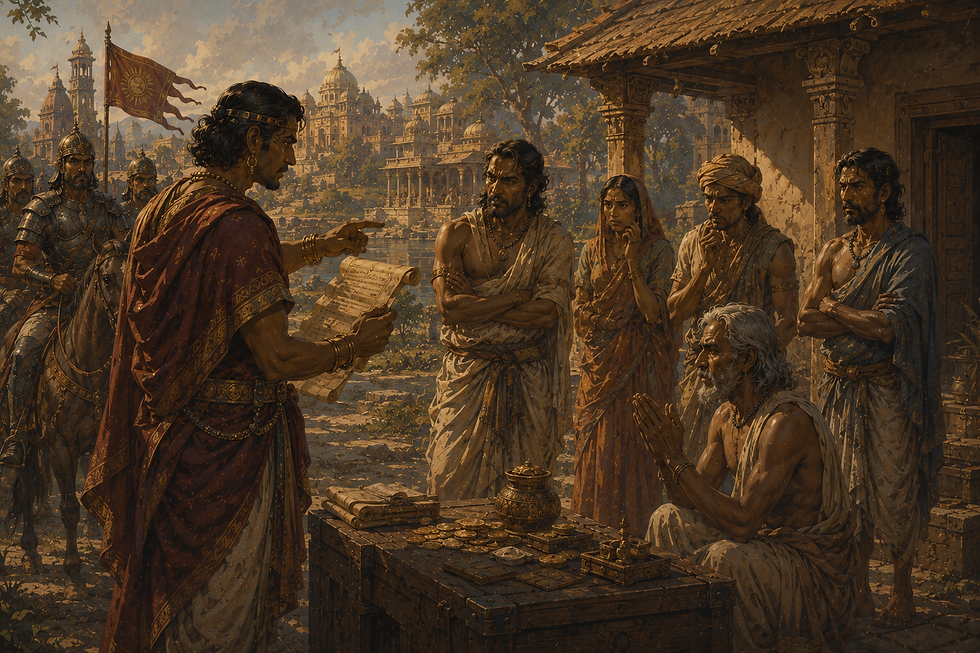


Comments