
.png)

Ancient Texts: Kautilya's Arthashastra - Chapters 1-5 (Book 4 - Removal of Thorns)
- A. Royden D'Souza

- Jun 15
- 63 min read
The first three books of the Arthashastra constructed the edifice of the Kautilyan state. Book I built the king—his discipline, his council, his spies, his personal security. Book II built the economic machinery—the superintendents who managed the villages, mines, treasuries, mints, storehouses, and trade routes.
Book III built the legal order—the courts that resolved disputes, enforced contracts, protected marriage and inheritance, and punished civil wrongs. Together, they created a kingdom that was governed, fed, and just.
Chapters 1 through 5 of Book IV of Arthashastra mark a decisive turn from the resolution of private disputes to the detection and destruction of public enemies. The law no longer waits for a plaintiff to bring a complaint; it goes hunting.

Kautilya addresses the surveillance of criminals through networks of spies disguised as merchants, ascetics, and fortune-tellers. He prescribes the methods for identifying those who live beyond their means and must therefore be funding their lifestyle through secret crime.
He catalogues the tell-tale signs of the embezzler, the poisoner, the counterfeiter, and the seditious agitator. And he empowers the king's officers to arrest, interrogate, and punish—using methods that do not shrink from deception, torture, or summary execution when the security of the realm demands it.
These chapters reveal the Arthashastra in its most ruthless and pragmatic form. Kautilya understands that the state has enemies who cannot be reached by the slow procedures of civil justice. The thief who steals by night, the official who skims the revenue, the priest who preaches rebellion, the foreign agent who sows dissension—these are the thorns in the kingdom's flesh, and they must be removed with the sharpest instruments available.
The tortoise's shell, which was forged in the king's self-discipline, reinforced by the granary and the mint, and hardened in the courts of civil law, now grows spines. The king's peace is not merely administered; it is enforced. The removal of thorns is the surgery of the state, and the surgeon's hand must be steady, unflinching, and precise.
Book IV of Arthashastra: The Removal of Thorns (Kantaka-shodhana)
The fourth book, Kantaka-shodhana (कण्टकशोधन), translates to "The Removal of Thorns" or "The Purging of Malefactors." Where Book I forged the king from within, Book II built the machinery of economic administration, and Book III established the framework of civil law, Book IV turns to the dark underside of the state—the detection, pursuit, and punishment of criminals, conspirators, and enemies within the kingdom.
Its central argument is that a kingdom, however well-governed in peace, is constantly threatened by those who would subvert it from within: thieves, fraudsters, corrupt officials, seditious priests, poisoners, and secret agents of foreign powers. The king who neglects the removal of these thorns will find his kingdom bleeding from a thousand hidden wounds.

Chapter I: Protection of Artisans
Three Commissioners (pradeshtarah) or three ministers shall deal with measures to suppress disturbance to peace (kantakasodhanam kuryuh).
Those who can be expected to relieve misery, who can give instructions to artisans, who can be trusted with deposits, who can plan artistic work after their own design, and who can be relied upon by guilds of artisans, may receive the deposits of the guilds. The guilds (sreni) shall receive their deposits back in time of distress.
Artisans shall, in accordance with their agreement as to time, place, and form of work, fulfill their engagements. Those who postpone their engagements under the excuse that no agreement as to time, place and form of work has been entered into shall, except in troubles and calamities, not only forfeit one-fourth of their wages, but also be punished with a fine equal to twice the amount of their wages.
They shall also make good whatever is thus lost or damaged. Those who carry on their work contrary to orders shall not only forfeit their wages, but also pay a fine equal to twice the amount of their wages.
Weavers: Weavers shall increase the threads (supplied to them for weaving cloths) in the proportion of 10 to 11 (dasaikadasikam). They shall otherwise, not only pay either a fine equal to twice the loss in threads or the value of the whole yarn, but also forfeit their wages.
In weaving linen or silk cloths (kshaumakauseyanam), the increase shall be 1 to 1½. In weaving fibrous or woollen garments or blankets (patronakambaladukulanam), the increase shall be 1 to 2. In case of loss in length, the value of the loss shall be deducted from the wages and a fine equal to twice the loss shall be imposed.
Loss in weight (tulahine) shall be punished with a fine equal to four times the loss. Substitution of other kind of yarn, shall be punished with a fine equal to twice the value of the original.
The same rules shall apply to the weaving of broad cloths (dvipatavanam). The loss in weight in woollen threads due to threshing or falling of hair is 5 palas.
Washermen: Washermen shall wash clothes either on wooden planks or on stones of smooth surface. Washing elsewhere shall not only be punished with a fine of 6 panas, but also be subject for the payment of a compensation equal to the damage.
Washermen wearing clothes other than such as are stamped with the mark of a cudgel shall be fined three panas. For selling, mortgaging, or letting out for hire the clothes of others, a fine of 12 panas shall be imposed.
In case of substitution of other clothes, they shall not only be punished with a fine equal to twice the value of the clothes, but also be made to restore the true ones.
For keeping for more than a night clothes which are to be made as white as a jasmin flower, or which are to attain the natural colour of their threads on washing on the surface of stones, or which are to be made whiter merely by removing their dirt by washing, proportional fines shall be imposed.
For keeping for more than 5 nights such clothes as are to be given thin colouring, for more than six nights such as are to be made blue, for more than 7 nights such as are to be made either as white as flowers or as beautiful and shiny as lac, saffron, or blood and such clothes as require much skill and care in making brilliant, wages shall be forfeited.
Trustworthy persons shall be judges in disputes regarding colour and experts shall determine the necessary wages.
For washing the best garments, the wages shall be one pana; for those of middle quality, half a pana; and for those of inferior quality one-fourth of a pana. For rough washing on big stones, the wages shall be one-eighth of a pana.
In the first wash of red-coloured clothes, there is a loss of one-fourth part (of the colour); in the second wash, one-fifth part. This explains subsequent losses. The rules pertaining to washermen are also applicable to weavers.
Goldsmiths: Goldsmiths who, without giving information (to the government), purchase from unclean hands silver or golden articles without changing the form of the articles shall be fined 12 panas; if they do the same changing the form of the articles (i.e., melting), they shall be fined 24 panas; if they purchase the same from the hands of a thief, they shall be fined 48 panas; if they purchase an article for less than its value after melting it in secret, they shall be liable to the punishment for theft; likewise for deception with manufactured articles.
When a goldsmith steals from a suvarna gold equal to the weight of a masha (1/16th of a suvarna), he shall be punished 200 panas; when he steals from a silver dharana silver equal to the value of a masha, he shall be fined 12 panas.
This explains the proportional enhancement of punishments. When a goldsmith removes the whole amount of the gold (karsha) from a suvarna by apasarana method or by any other deceitful combination (yoga), he shall be punished with a fine of 500 panas.
In case of contaminating them (gold and silver) in any way, the offence shall be regarded as loss of their intrinsic colour.
One masha shall be the fee for the manufacture of a silver dharana; for the manufacture of a suvarna, one-eighth of the same; or fees may be increased to twice the above according to the skill of the manufacturer. This explains the proportional increase of fees.
Fees for the manufacture of articles from copper, brass, vaikrinataka, and arakuta shall be five percent. In the manufacture of articles from copper, one-tenth of the copper will be lost. For the loss of a pala in weight, a fine of twice the loss shall be imposed. This explains the proportional increase of punishments.
In the manufacture of articles from lead and tin, one-twentieth of the mass will be lost. One kakani shall be the fee for manufacturing an article of a pala in weight of the above. In the manufacture of articles from iron, one-fifth of the mass will be lost; two kakanis shall be the fee for manufacturing an article of a pala in weight from iron. This explains the proportional increase of fees.
When the examiner of coins declares an unacceptable current coin to be worthy of being entered into the treasury or rejects an acceptable current coin, he shall be fined 12 panas. When the examiner of coins misappropriates a masha from a current coin of a pana, the tax (Vyaji) of five percent on the coin having been duly paid, he shall be fined 12 panas.
This explains the proportional increase of fines. When a person causes a counterfeit coin to be manufactured, or accepts it, or exchanges it, he shall be fined 1,000 panas; he who enters a counterfeit coin into the treasury shall be put to death.
Scavengers: Of whatever precious things sweepers come across while sweeping, one-third shall be taken by them and two-thirds by the king. But precious stones shall be wholly surrendered to the king. Seizure of precious stones shall be punished with the highest amercement.
A discoverer of mines, precious stones, or treasure troves shall, on supplying the information to the king, receive one-sixth of it as his share; but if the discoverer happens to be a peon (bhritaka), his share shall be only one-twelfth of it.
Treasure troves valued beyond 100,000 shall wholly be taken by the king. But if they are of less value, the discoverer shall receive one-sixth of it as his share.
Such treasure troves as a man of pure and honest life can prove to be his ancestral property shall wholly be taken by the man himself. Taking possession of a treasure trove without establishing such claim shall be punished with a fine of 500 panas. Taking possession of the same in secret shall be punished with a fine of 1,000 panas.
Medical Practice: Physicians undertaking medical treatment without intimating (to the government) the dangerous nature of the disease shall, if the patient dies, be punished with the first amercement. If the death of a patient under treatment is due to carelessness in the treatment, the physician shall be punished with the middle-most amercement.
Growth of disease due to negligence or indifference (karmavadha) of a physician shall be regarded as assault or violence.
Musicians: Bands of musicians (kusilavah) shall, during the rainy season, stay in a particular place. They shall strictly avoid giving too much indulgence or causing too much loss (atipatam) to any one. Violation of the above rule shall be punished with a fine of 12 panas.
They may hold their performances to their liking in accordance with the procedure of their country, caste, family, profession, or copulation.
The same rules shall apply to dancers, dumb-players and other mendicants. For offences, mendicants shall receive as many lashes with an iron rod as the number of panas imposed on them. Wages for the works of other kinds of artisans shall be similarly determined.
Thus traders, artisans, musicians, beggars, buffoons and other idlers who are thieves in effect though not in name shall be restrained from oppression on the country.

In Simple Terms
The main ideas from this chapter can be understood in these simple points:
Three Commissioners Guard the Peace: The state appoints three commissioners or three ministers whose sole job is to suppress disturbances to the peace—kantaka-shodhana, the removal of thorns. These are the troubles, criminals, cheats, and exploiters who prick the kingdom's peace. The commissioners are the state's surgeons.
The Guilds and Their Deposits: Artisans belong to guilds—srenis—which are both professional associations and mutual-aid societies. The guilds deposit their collective funds with trusted individuals who can relieve distress, instruct artisans, plan artistic work, and be relied upon.
In times of trouble, the guilds can withdraw their deposits. The state protects this system of collective security.
Artisans Must Keep Their Agreements: Every artisan works under a contract that specifies the time, place, and form of the work. If an artisan delays, claiming no such agreement was made, he forfeits a quarter of his wages and pays a fine of twice his wages—unless the delay was caused by genuine trouble or calamity.
If an artisan works contrary to the orders given, he forfeits all his wages and pays a fine equal to twice his wages. The law enforces the contract strictly.
The Weaver's Obligations: When a weaver receives raw thread, he must return finished cloth with the thread count increased—a standard allowance for the natural tightening of the weave. For ordinary cloth, ten threads become eleven.
For linen or silk, the increase is smaller. For wool, the increase is larger. If the finished cloth is shorter than ordered, the weaver loses wages and pays a fine of twice the loss. If it is lighter than it should be—meaning thread has been stolen—the fine is four times the loss.
Substituting cheaper yarn for the yarn provided costs twice the value of the original. The law follows the thread from the spindle to the loom.
The Washerman's Rules: Washermen must wash on wooden planks or smooth stones. Washing elsewhere—in a dirty stream, on rough rocks that tear the cloth—costs a fine of 6 panas plus compensation for any damage. A washerman who wears the customer's clothes himself, or sells them, or pawns them, pays a fine of 12 panas.
Substituting inferior clothes for the ones received costs twice the value. The law also sets deadlines: a simple whitening must be done overnight; a coloured wash within five or six nights; a brilliant finish within seven. Delay costs the washerman his wages. The law protects the clothes on the washing-stone as carefully as the gold in the treasury.
The Goldsmith's Temptations: The goldsmith works with the most portable and valuable of all materials, and the law watches him with special intensity. Buying gold or silver from suspicious sources without reporting it: 12 panas.
Melting such goods down to disguise their origin: 24 panas. Buying from a known thief: 48 panas. Buying stolen goods at a discount after secretly melting them: treated as theft. Stealing even a tiny amount—one masha of gold from a suvarna—costs 200 panas. Stealing the entire amount of gold by chemical extraction or other trickery: 500 panas.
The goldsmith's fees are fixed: one masha for making a silver piece, one-eighth of a masha for a gold piece, with bonuses for exceptional skill. For copper, brass, and other metals, the fee is five percent of the value, with standard allowances for loss in the fire.
The examiner of coins—the man who decides whether a coin is genuine—is watched as closely as the goldsmith. Passing a counterfeit coin costs 1,000 panas; entering a counterfeit into the king's treasury is death.
Scavengers and Treasure: Even the sweepers are regulated. If a sweeper finds something valuable in the dust—a dropped coin, a lost jewel—he keeps one-third and gives two-thirds to the king. But precious stones must be surrendered entirely.
Concealing a found gem costs the highest amercement. A person who discovers a mine, a gem deposit, or a buried treasure and reports it to the king receives one-sixth as a reward—one-twelfth if he is a state employee.
Treasure worth more than 100,000 panas goes entirely to the king. But a person who can prove that the treasure is his own ancestral property keeps it all. Taking a treasure without proving ownership costs 500 panas; taking it secretly costs 1,000.
The Physician's Duty: A physician who treats a patient without telling the government the dangerous nature of the disease is fined the first amercement if the patient dies. If the death was due to carelessness, the fine is the middlemost amercement.
Negligence that worsens the disease is treated as assault. The law does not expect the physician to work miracles, but it demands honesty and competence.
Musicians and Mendicants: Travelling musicians must stay in one place during the rainy season. They must not exploit their audiences or cause excessive loss to anyone. Violation costs 12 panas. The same rules apply to dancers, mime-players, and other performers.
Mendicants—wandering beggars and ascetics—who commit offences are whipped with an iron rod, one lash for each pana of the fine. The law distinguishes the respectable poor from the fraudulent, and it punishes the latter with physical pain.
Case Study: An Ancient King's Application
The Vijayanagara Empire (14th–17th centuries AD) was built by artisans. The great temples of Hampi, the royal palaces, the irrigation works, the bronze images, the painted murals—all were the work of guilds organised on the Kautilyan model.
The Vijayanagara inscriptions, particularly those on the walls of the Virupaksha and Vitthala temples, record the names of guilds, their contracts, their wages, and their disputes.
The Vijayanagara guilds functioned exactly as the Arthashastra describes. A guild of stone-carvers would contract with the temple authorities to carve a mandapa or a gopuram. The contract specified the time, the place, and the form of the work—the number of pillars, the height of the tower, the intricacy of the carvings.
The guild deposited funds with a trusted elder, who could relieve members in distress. If the work was delayed without cause, the guild forfeited wages and paid fines. If the work was done contrary to the design, the guild paid double the wages.
The Vijayanagara weavers were renowned across the Indian Ocean for their cotton textiles. The state regulated their work as Kautilya prescribes. The weaver who received a quantity of cotton thread was expected to return cloth of a specified length, width, and weight.
Short length or light weight meant fines and forfeited wages. The substitution of inferior thread was punished severely. The state's interest was in maintaining the reputation of Vijayanagara cloth in the markets of Arabia, East Africa, and Southeast Asia.
The Vijayanagara goldsmiths worked under the strictest supervision. The empire's coinage—the gold varaha—was a symbol of royal authority, and its purity was guarded with the death penalty.
A goldsmith who debased the coin, or who bought stolen gold, or who extracted gold from the king's metal by chemical trickery, was punished as Kautilya prescribes. The Vijayanagara rulers understood that the wealth of the empire rested on the honesty of its artisans.
The Vijayanagara system survived the empire's fall in 1565. The guilds dispersed, but their customs passed into the traditions of the craftsmen of South India. The weavers of Kanchipuram, the stone-carvers of Mahabalipuram, the bronze-casters of Kumbakonam—all are the heirs of the Kautilyan guilds.
In Modern Times
In modern India, the Kautilyan protection of artisans is the ancestor of several distinct bodies of law and administration. The regulation of weavers, washermen, and goldsmiths is the ancestor of the modern factory acts, the labour codes, the consumer protection laws, and the quality-control standards enforced by the Bureau of Indian Standards.
The Kautilyan guild—the sreni—is the direct ancestor of the modern trade union, the cooperative society, and the professional association. The Kautilyan guild's deposit fund, held by a trusted elder for the relief of distressed members, is the ancestor of the modern provident fund, the employees' state insurance scheme, and the trade union welfare fund.
The Kautilyan contract between the artisan and the customer—specifying time, place, and form of work—is the ancestor of the modern service contract, the work order, and the project agreement. The penalty for delay without cause is the ancestor of the modern liquidated damages clause. The penalty for work done contrary to orders is the ancestor of the modern action for breach of contract.
The Kautilyan regulation of the goldsmith—the fixed fees, the standard allowances for loss in the fire, the severe penalties for theft and adulteration—is the ancestor of the modern regulation of jewellers by the Bureau of Indian Standards, the hallmarking scheme, and the various state laws against gold smuggling and adulteration.
The Kautilyan death penalty for entering counterfeit coin into the treasury is the ancestor of the modern offence of counterfeiting currency, which carries a maximum sentence of life imprisonment under the Indian Penal Code.
The Kautilyan regulation of the physician—the duty to inform the government of the dangerous nature of the disease, the penalty for death caused by carelessness—is the ancestor of the modern law of medical negligence, codified in the Indian Medical Council Act and enforced by the consumer courts.
The Kautilyan physician who worsened a patient's condition through negligence was guilty of assault; the modern doctor who commits medical negligence is liable for damages and may lose his license.
The Kautilyan regulation of treasure trove—the duty to report a find, the reward of one-sixth, the penalty for concealment—is the direct ancestor of the Indian Treasure Trove Act of 1878, which remains in force.
The modern finder of treasure must report it to the collector; if it is declared treasure, the finder receives a share, and the rest goes to the government. Concealment is a criminal offence. The law has not changed in two thousand years.
Kingdom of Saha, Kanchi, Kūrmapura, the Office of the Commissioners – Mid-Morning The three commissioners sat in a plain room behind the Court of Justice—a room without ornament, without windows facing the street, without anything that could distract from the work of removing thorns. Their names were Dandapani, Arthagupta, and Dharmapala. They were not judges, though they worked closely with the courts. They were investigators, prosecutors, and enforcers of the king's peace against those whose crimes required more than a civil fine. Today, a goldsmith named Suvarnakara stood before them, his hands bound, his face pale. Beside him stood the city guards who had arrested him, and on the table before the commissioners lay the evidence: a small clay crucible, a lump of lead, and a gold necklace that had been returned to its owner lighter than when it was given. Arthagupta, a thin, precise man who had been a goldsmith himself before entering the king's service, examined the necklace. "The owner, a merchant named Dhanapala, gave this necklace to Suvarnakara for repair. The clasp was broken. The goldsmith was to mend the clasp and return the necklace. When Dhanapala received it, he weighed it. It was lighter by one masha. He complained to the city guard. The guard searched Suvarnakara's workshop and found this crucible, still warm from the fire, with traces of gold in the slag. The goldsmith had removed the gold by heating the necklace with lead—the apasarana method." Suvarnakara, a man of middle age with the powerful hands of his trade, spoke in a voice that trembled. "My lords, the loss was accidental. The necklace was old. The gold was worn. When I heated it to mend the clasp, some of the gold was lost in the fire. That is the nature of the work. The law allows for loss in the fire." Dandapani, a broad-shouldered former soldier, leaned forward. "The law allows a specific loss—one-tenth for copper, one-twentieth for lead and tin, one-fifth for iron. For gold and silver, the law allows no loss, because gold and silver do not evaporate in the fire. They can be melted and reshaped, but they do not diminish. The only way gold leaves a necklace is if the goldsmith takes it. You took it." Arthagupta held up the crucible. "The slag contains gold mixed with lead. That is the apasarana method: you heat the gold with lead, the lead absorbs the gold, and you later separate them and keep the gold. This was no accident. This was theft." Dharmapala, the eldest of the three, a man who had served as a judge before being appointed a commissioner, spoke the verdict. "The law says that when a goldsmith steals from a suvarna gold equal to the weight of one masha, he shall be fined 200 panas. You stole one masha from the merchant's necklace. The fine is 200 panas. You shall also return the stolen gold to the merchant, or its value in silver. And you shall forfeit your license to work as a goldsmith in this city for one year. If you are caught stealing again, your hands will be cut off." Suvarnakara fell to his knees. "My lords, 200 panas—I do not have such a sum. I have a family. If I cannot work for a year, they will starve." Dharmapala's voice was not unkind, but it was final. "You should have thought of your family before you put the lead into the crucible. The law protects the merchant who trusts you with his gold. The law also protects honest goldsmiths, whose reputation is damaged by every thief in their trade. You may pay the fine in instalments, worked off in the state labour corps. Your family will receive a subsistence allowance from the guild's distress fund—the law provides for the innocent, even when it punishes the guilty." After the goldsmith was led away, Arthagupta said to his colleagues, "The apasarana method is an old trick. The lead absorbs the gold, and the goldsmith separates them later. It leaves the necklace looking whole but lighter. Only a careful owner, who weighs his gold before and after, ever discovers the theft." "Most owners do not weigh," Dandapani replied. "They trust the goldsmith. That is why the law watches the goldsmith so closely. Trust is the gold of the marketplace. When a goldsmith steals, he steals not only metal but trust. The fine is heavy because the damage is greater than one masha." Dharmapala nodded. "The law cannot stand beside every workbench. But it can make the penalty so severe that the goldsmith thinks twice before he puts the lead into the fire. Today, one goldsmith learned that lesson. The others will hear of it. The fire will still burn, but the lead will stay on the shelf." |

Chapter II: Protection of Merchants
The Superintendent of Commerce shall allow the sale or mortgage of any old commodities (purana bhandanam) only when the seller or mortgagor of such articles proves his ownership of the same. With a view to prevent deception, he shall also supervise weights and measures.
Difference of half a pala in such measures as are called parimani and drona is no offence. But difference of a pala in them shall be punished with a fine of 12 panas. Fines for greater differences shall be proportionally increased.
Difference of a karsha in the balance called tula is no offence. Difference of two karshas shall be punished with a fine of 6 panas. Fines for greater differences shall be proportionally increased.
Difference of half a karsha in the measure called adhaka is no offence; but difference of a karsha shall be punished with a fine of 3 panas. For greater differences, fines shall be proportionally increased.
Fines for differences in weight in other kinds of balances shall be inferred on the basis of the above rule.
When a merchant purchases by a false balance a greater quantity of a commodity and sells under the same nominal weight a less quantity by the same or another false balance, he shall be punished with double the above fines.
Deception on the part of a seller to the extent of one-eighth part of the articles valued at a pana and sold by number shall be punished with a fine of 96 panas.
The sale or mortgage of articles such as timber, iron, brilliant stones, ropes, skins, earthenware, threads, fibrous garments, and woollen clothes as superior though they are really inferior shall be punished with a fine of 8 times the value of the articles thus sold.
When a trader sells or mortgages inferior as superior commodities, articles of some other locality, as the produce of a particular locality, adulterated things, or deceitful mixtures, or when he dexterously substitutes other articles for those just sold (samutparivartimam), he shall not only be punished with a fine of 54 panas but also be compelled to make good the loss.
By making the fine two panas for the loss of the value of a pana, and 200 panas for that of 100, fines can be determined for any of such false sales.
Those who conspire to lower the quality of the works of artisans, to hinder their income, or to obstruct their sale or purchase shall be fined thousand panas.
Merchants who conspire either to prevent the sale of merchandise or to sell or purchase commodities at higher prices shall be fined 1,000 panas.
Middlemen who cause to a merchant or a purchaser the loss of one-eighth of a pana by substituting with tricks of hand false weights or measures or other kinds of inferior articles shall be punished with a fine of 200 panas. Fines for greater losses shall be proportionally increased commencing from 200 panas.
Adulteration of grains, oils, alkalis, salts, scents, and medicinal articles with similar articles of no quality shall be punished with a fine of 12 panas.
It is the duty of the trader to calculate the daily earnings of middlemen and to fix that amount on which they are authorised to live; for whatever income falls between sellers and purchasers (i.e., brokerage) is different from profit.
Hence authorised persons alone shall collect grains and other merchandise. Collection of such things without permission shall be confiscated by the Superintendent of Commerce.
Hence shall merchants be favourably disposed towards the people in selling grains and other commodities.
The Superintendent of Commerce shall fix a profit of five per cent over and above the fixed price of local commodities, and ten per cent on foreign produce. Merchants who enhance the price or realise profit even to the extent of half a pana more than the above in the sale or purchase of commodities shall be punished with a fine of from five panas in case of realising 100 panas up to 200 panas. Fines for greater enhancement shall be proportionally increased.
In case of failure to sell collected merchandise wholesale at a fixed rate, the rate shall be altered. In case of obstruction to traffic, the Superintendent shall show necessary concessions.
Whenever there is an excessive supply of merchandise, the Superintendent shall centralise its sale and prohibit the sale of similar merchandise elsewhere before the centralised supply is disposed of. Favourably disposed towards the people, shall merchants sell this centralised supply for daily wages.
The Superintendent shall, on consideration of the outlay, the quantity manufactured, the amount of toll, the interest on outlay, hire, and other kinds of accessory expenses, fix the price of such merchandise with due regard to its having been manufactured long ago or imported from a distant country (desakalantaritánam panyánam).

In Simple Terms
The main ideas from this chapter can be understood in these simple points:
Old Goods Need Proof of Ownership: No one may sell or pawn old goods without proving they own them. The Superintendent of Commerce enforces this rule to prevent the sale of stolen property. A person offering an old necklace or a used plough must show how he came by it. The law closes the market to thieves.
The Tolerance of Scales: The law recognises that no scale is perfectly accurate. A difference of half a pala in a large measure, or half a karsha in a smaller one, is tolerated as the natural margin of error. But beyond that margin, fines begin.
The fines are precisely calibrated: 12 panas for a pala's difference in a drona, 6 panas for two karshas' difference in a tula, 3 panas for a karsha's difference in an adhaka. The larger the discrepancy, the larger the fine. The law does not demand impossible perfection, but it punishes deliberate short-weighting.
The Double-Cheating Merchant: The worst offender is the merchant who buys with one false scale and sells with another—buying heavy, selling light, and pocketing the difference at both ends of the transaction. His fine is double the ordinary fine. The law understands that the merchant who cheats both supplier and customer is doubly guilty.
Deception by Number, by Quality, by Origin: The merchant who short-counts—selling a dozen and giving eleven—pays 96 panas if the deception is one-eighth of the value. The merchant who sells inferior timber as superior, or ropes that will snap, or dyed cloth as the natural colour, pays a fine of eight times the value of the goods.
The merchant who passes off goods from one place as the produce of another—ordinary rice as the famous rice of the eastern delta, or local wool as the wool of the northern hills—pays 54 panas and must make good the loss. The law protects the buyer from every form of commercial fraud.
Conspiracy Against Artisans and Markets: Merchants who conspire to lower the quality of artisans' work, to reduce their income, or to block their buying and selling are fined 1,000 panas.
Merchants who conspire to corner a market, prevent the sale of goods, or fix prices at artificially high levels are also fined 1,000 panas. The law protects competition and punishes the cartel.
The Middleman's Tricks: The middleman—the broker, the agent, the commission-seller—who substitutes false weights or inferior goods by sleight of hand, even to the loss of one-eighth of a pana, is fined 200 panas. The fine is heavy because the middleman's crime is committed in trust, behind the back of both buyer and seller.
Adulteration: Mixing good grain with bad, pure oil with cheap oil, genuine medicine with inert powder—the fine is 12 panas. The adulterator poisons the daily life of the people, and the law, while it does not impose the massive fines reserved for fraud, still punishes the offence.
The Middleman's Living: The trader must calculate what his middlemen earn each day and fix the amount on which they are permitted to live. Brokerage—the income that falls between seller and buyer—is not profit; it is a wage for a service, and it must be regulated. Unauthorised persons may not collect grain or merchandise; their collections are confiscated.
The Fixed Profit Margin: The state fixes the maximum profit a merchant may earn. On local goods, the profit must not exceed five per cent above the fixed price. On foreign goods, the profit may go up to ten per cent, reflecting the greater risk and cost of long-distance trade.
A merchant who takes even half a pana more than these margins is fined—starting at five panas for every hundred panas of excess profit. The law prevents profiteering.
Managing Supply and Price: If the fixed price proves too high to sell the goods, the Superintendent may lower it. If traffic is obstructed—by floods, by bandits, by war—he may grant concessions to merchants to keep goods moving.
When a particular commodity floods the market, the Superintendent centralises its sale and forbids the sale of similar goods elsewhere until the central supply is sold. The merchants who sell this centralised supply receive daily wages—they are not permitted to profit from the glut, but they are not left to starve.
The Superintendent sets the price of goods based on the cost of production, the tolls paid, the interest on the capital invested, the hire of transport, and all other expenses, with due allowance for goods that have travelled far or been stored long. The state, not the market, determines the just price.
Case Study: An Ancient King's Application
The Gupta Empire (c. 320–550 AD) presided over a flourishing commercial society in which merchants, artisans, and guilds operated under a legal framework that closely followed the Kautilyan model. The Gupta period is often called the "Golden Age" of India, and its prosperity was built in part on the regulation of commerce.
The Gupta guilds, known as shrenis, functioned as both commercial associations and regulatory bodies. The guild enforced the Kautilyan rule that old goods could only be sold with proof of ownership. A merchant who wished to sell a used item had to produce a witness or a document establishing his title. The guild maintained records of stolen goods, and a member who traded in such goods was expelled and prosecuted.
The Gupta guilds also enforced the Kautilyan standards for weights and measures. The guild's own officers inspected the scales and weights of every member, and discrepancies beyond the permitted tolerance were fined. The Gupta inscriptions record fines imposed on merchants for using false balances, and the amounts correspond closely to the Kautilyan schedule.
The Kautilyan fixed profit margin—five per cent on local goods, ten per cent on foreign—was enforced by the Gupta guilds. A merchant who charged more was fined by the guild and, in serious cases, expelled.
The guild acted as a cartel in the positive sense: it prevented its members from gouging customers and thereby maintained the reputation of the guild as a whole.
The Gupta state also enforced the Kautilyan rule against market conspiracies. The inscriptions record cases in which merchants conspired to corner the grain market during a famine and were punished with heavy fines and the confiscation of their hoarded stocks. The Kautilyan penalty of 1,000 panas for such conspiracies was the law of the Gupta countryside.
The Gupta commercial system survived the collapse of the empire in the sixth century. The guilds persisted, and their regulations passed into the customary law of Indian trade.
The Arab geographers who visited India in the ninth and tenth centuries noted the honesty of Indian merchants and the precision of their weights—a reputation that was the legacy of the Kautilyan and Gupta regulation of commerce.
In Modern Times
In modern India, the Kautilyan protection of merchants is the ancestor of several distinct bodies of law. The rule that old goods may only be sold with proof of ownership is the ancestor of the modern law on stolen property and the requirement that pawnbrokers and second-hand dealers maintain records of their transactions.
The regulation of weights and measures is the direct ancestor of the Legal Metrology Act of 2009, which governs every scale, weight, and measure used in commerce.
The Kautilyan tolerance for small errors in measurement—half a pala, half a karsha—is the ancestor of the modern concept of permissible error in metrology. The Kautilyan fines for deliberate short-weighting are the ancestors of the modern penalties under the Legal Metrology Act, which can include fines and imprisonment for using false weights or measures.
The Kautilyan prohibition on selling inferior goods as superior, or goods from one place as the produce of another, is the ancestor of the modern law on misrepresentation and false advertising, codified in the Consumer Protection Act of 2019.
The modern consumer who buys a saree labelled "pure silk" that turns out to be polyester has the same remedy as the Kautilyan buyer who was sold local wool as the wool of the northern hills: compensation and a penalty on the seller.
The Kautilyan penalty for adulteration—12 panas—is the ancestor of the modern Prevention of Food Adulteration Act and the Food Safety and Standards Act, which impose fines and imprisonment on those who adulterate food, drugs, and cosmetics.
The Kautilyan list of adulterable goods—grains, oils, salts, scents, medicines—is substantially the same list that the modern food inspector checks.
The Kautilyan fixed profit margin—five per cent on local goods, ten per cent on foreign—is the ancestor of the modern Essential Commodities Act, which empowers the government to fix the maximum price of essential goods and to punish profiteering.
The modern state does not fix profit margins across the entire economy, but it retains the power to do so in times of scarcity, and it exercises that power through the Drug Price Control Order and similar mechanisms.
The Kautilyan rule that the Superintendent must set prices based on the cost of production, tolls, interest, and transport is the ancestor of the modern cost-plus pricing used in government procurement and in regulated industries.
The Kautilyan rule that the Superintendent may lower the price if goods do not sell is the ancestor of the modern markdown, the clearance sale, and the market-driven adjustment of prices.
The Kautilyan rule against market conspiracies—fining merchants who conspire to fix prices or corner a market—is the direct ancestor of the modern Competition Act of 2002, which prohibits anti-competitive agreements, abuse of dominant position, and combinations that reduce competition.
The Kautilyan fine of 1,000 panas for such conspiracies is the ancestor of the modern penalty of up to ten per cent of the turnover of the conspiring companies.
Kūrmapura, the Office of the Superintendent of Commerce – Late Morning The Superintendent of Commerce, Vasundhara, sat at her desk in the office near the harbour gate, the same office from which she had once sent ships to Panchasthavi and welcomed hill merchants with tax remissions. But today, she was not a promoter of trade. She was a hunter of fraud. Before her stood a merchant named Kuberasena, a heavyset man whose oiled hair and silk tunic spoke of prosperity. On the table between them lay a balance scale—a fine instrument of polished bronze with a lever of seventy-two angulas, the standard samavritta balance used in the city's markets. Beside it lay a set of counterweights, stamped with the royal seal. And beside those lay a second set of weights, identical in appearance to the first, but different in one crucial respect: each weight was lighter by a fraction of a karsha. Vasundhara had discovered the second set that morning during a surprise inspection of Kuberasena's stall in the spice market. The merchant had been buying pepper from the hill caravans using the heavy weights, and selling the same pepper to the city's cooks using the light weights. The difference was small—a fraction of a karsha on each transaction—but over a year, it amounted to a small fortune. "The law," Vasundhara said, "allows a difference of one karsha in the tula balance without penalty. Your heavy weights and your light weights differ by three karshas. That is beyond the tolerance. The fine for a difference of two karshas is six panas. For three karshas, it is proportionally higher—nine panas. But you did not merely possess false weights. You used them to buy heavy and sell light. The law says that when a merchant purchases by a false balance a greater quantity and sells by a false balance a lesser quantity, the fine is double. Your fine is eighteen panas for each transaction in which the false weights were used. From your records, that is at least forty transactions. The total fine is seven hundred and twenty panas." Kuberasena's face had gone the colour of old ash. "My lady, I am a poor man. Seven hundred and twenty panas—I cannot pay it. It will ruin me." "You are not a poor man," Vasundhara replied. "You are a rich man who became rich by stealing from the hill tribes who sold you pepper and from the city cooks who bought it. The law does not ruin you. It takes back what you stole and adds a penalty. You will pay the fine, and you will surrender the false weights to be melted down. Your stall in the spice market will be closed for one month, and when it reopens, you will use only weights issued by this office and inspected every fortnight. If you are caught cheating again, your license to trade will be revoked permanently." Kuberasena bowed his head. He had no words. After the merchant had gone, Vasundhara's deputy, Puranjaya, said, "Seven hundred and twenty panas is a heavy fine. He will remember it." "He will remember it, and the other merchants will hear of it," Vasundhara replied. "The law does not forbid profit. The law allows five per cent on local goods and ten per cent on foreign. That is a fair return for a fair merchant. But the merchant who buys with one scale and sells with another is not a merchant. He is a thief. The spice market will be cleaner for his absence." Puranjaya looked at the false weights on the table. "The difference was so small. Three karshas. A pinch of pepper. How did you detect it?" "Because I do not trust merchants," Vasundhara said. "I trust weights. Every scale in this city is inspected, and every weight is stamped. Kuberasena's stamped weights were honest—he kept those for the inspectors. His false weights were kept under the counter, for his customers. But a customer who had been cheated grew suspicious and complained. That is how the net closes. One complaint, one inspection, and the false weights are on the table. The law does not need to watch every transaction. It only needs to watch the scales." |

Chapter III: Remedies Against National Calamities
There are eight kinds of providential visitations: They are fire, floods, pestilential diseases, famine, rats, tigers (vyalah), serpents, and demons. From these shall the king protect his kingdom.
Fire: During the summer, villages shall carry on cooking operations outside. Or they shall provide themselves with the ten remedial instruments (dasamuli).
Precautionary measures against fire have been dealt with in connection with the description not only of the duties of superintendents of villages, but also of the king's harem and retinue. Not only on ordinary days, but also on full-moon days shall offerings, oblations, and prayers be made to fire.
Floods: Villagers living on the banks of rivers shall, during the rainy reason, remove themselves to upcountries. They shall provide themselves with wooden planks, bamboos, and boats.
They shall, by means of bottle-gourds, canoes, trunks of trees, or boats rescue persons that are being carried off by floods. Persons neglecting rescue with the exception of those who have no boats, etc., shall be fined 12 panas.
On new and full-moon days shall rivers be worshipped. Experts in sacred magic and mysticism (mayayogavidah), and persons learned in the Vedas, shall perform incantations against rain. During drought shall Indra (sachinatha), the Ganges, mountains, and Mahakachchha be worshipped.
Pestilences: Such remedial measures as will be treated of in the 14th book shall be taken against pestilences. Physicians with their medicines, and ascetics and prophets with their auspicious and purificatory ceremonials shall also overcome pestilences.
The same remedial measures shall be taken against epidemics (maraka = killer). Besides the above measures, oblations to gods, the ceremonial called Maha-kachchhavardhana, milking the cows on cremation or burial grounds, burning the trunk of a corpse, and spending nights in devotion to gods shall also be observed.
With regard to cattle diseases (pasuvyadhimarake), not only the ceremony of waving lights in cowsheds (nirajanam) shall be half done, but also the worship of family-gods be carried out.
Famines: During famine, the king shall show favour to his people by providing them with seeds and provision (bijabhaktopagraham). He may either do such works as are usually resorted to in calamities; he may show favour by distributing either his own collection of provisions or the hoarded income of the rich among the people; or seek for help from his friends among kings.
Or the policy of thinning the rich by exacting excessive revenue (karsanam), or causing them to vomit their accumulated wealth (vamanam) may be resorted to. Or the king with his subjects may emigrate to another kingdom with abundant harvest. Or he may remove himself with his subjects to seashores or to the banks of rivers or lakes.
He may cause his subjects to grow grains, vegetables, roots, and fruits wherever water is available. He may, by hunting and fishing on a large scale, provide the people with wild beasts, birds, elephants, tigers or fish.
Rats: To ward off the danger from rats, cats and mongooses may be let loose. Destruction of rats that have been caught shall be punished with a fine of 12 panas.
The same punishment shall be meted out to those who, with the exception of wild tribes, do not hold their dogs in check. With a view to destroy rats, grains mixed with the milk of the milk-hedge plants (snuhi: Euphorbia Antiquorum), or grains mixed with such ingredients as are treated of in the 14th book may be left on the ground.
Ascetics and prophets may perform auspicious ceremonials. On new and full-moon days rats may be worshipped. Similar measures may also be taken against the danger from locusts, birds and insects.
Snakes: When there is fear from snakes, experts in applying remedies against snake poison shall resort to incantations and medicines; or they may destroy snakes in a body; or those who are learned in the Atharvaveda may perform auspicious rites.
On new and full moon days, snakes may be worshipped. This explains the measures to be taken against the dangers from water-animals.
Tigers: In order to destroy tigers, either the carcasses of cattle mixed with the juice of madana plant, or the carcasses of calves filled with the juice of madana and kodrava plants may be thrown in suitable places.
Or hunters or keepers of hounds may catch tigers by entrapping them in nets. Or persons under the protection of armour may kill tigers with arms. Negligence to rescue a person under the clutches of a tiger shall be punished with a fine of 12 panas.
Similar sum of money shall be given as a reward to him who kills a tiger. On new and full moon days mountains may be worshipped. Similar measures may be taken against the inroad of beasts, birds, or crocodiles.
Demons: Persons acquainted with the rituals of the Atharvaveda, and experts in sacred magic and mysticism shall perform such ceremonials as ward off the danger from demons.
On full-moon days the worship of Chaityas may be performed by placing on a verandah offerings such as an umbrella, the picture of an arm, a flag, and some goat's flesh. In all kinds of dangers from demons, the incantation "we offer thee cooked rice" shall be performed.
The king shall always protect the afflicted among his people as a father his sons. Such ascetics as are experts in magical arts, and being endowed with supernatural powers, can ward off providential visitations, shall, therefore, be honoured by the king and made to live in his kingdom.

In Simple Terms
The main ideas from this chapter can be understood in these simple points:
The Eight Calamities: The state identifies eight threats that come not from human enemies but from nature and the supernatural: fire, floods, pestilence, famine, rats, tigers, snakes, and demons. The king is responsible for protecting his people from all of them.
The state's duty does not stop at the frontier or the courtroom; it extends to the forces of nature and the unseen world.
Fire—Prevention and Ritual: Villages must cook outside during the dry summer months. Every household must keep the ten fire-fighting tools ready. The rules for fire safety in the harem and the palace apply to every village.
And on ordinary days and full-moon days alike, the people must make offerings to fire—not merely as worship, but as a constant reminder of its danger.
Floods—Preparation and Rescue: Riverbank villagers must move to higher ground during the rains. They must keep boats, planks, and bamboos ready. Anyone who sees a person being swept away by a flood and does not attempt rescue—unless he has no boat or means—is fined 12 panas.
The law imposes a duty of rescue. Rivers are worshipped on new and full-moon days. In times of drought, Indra the rain-god, the Ganges, the mountains, and the deity Mahakachchha are worshipped. The state uses both practical measures and ritual to manage water.
Pestilence—Medicine and Magic: Physicians with their medicines, and ascetics with their rituals, both have a role in fighting disease. The state deploys both the rational and the supernatural.
Cattle diseases are treated with the ceremony of waving lights in the cowsheds and the worship of family gods. The law does not choose between science and faith; it uses both.
Famine—The King's Full Arsenal: Famine is the most terrible of calamities, and the king's response must be comprehensive. He must provide seed and food to the people. He must undertake public works to provide employment.
He must distribute his own stores and, if necessary, compel the rich to disgorge their hoarded grain—the policy of "thinning" and "vomiting." He may seek help from allied kings. He may lead his people to a land of plenty.
He may move them to the seashore or to rivers and lakes where food can be found. He may organise mass hunting and fishing to feed them. The king who sits in his palace while his people starve is no king at all.
Rats, Locusts, Birds, and Insects: When rats threaten the harvest, cats and mongooses are released to hunt them. Poisoned grain—mixed with the milk of the milk-hedge plant—is scattered. Ascetics perform rituals.
And, strikingly, anyone who kills a rat that has already been caught is fined 12 panas. The law protects the rat once it is captured—perhaps because a caught rat cannot harm the grain, or because the rat is a sacred animal to be killed only by the proper means, or because the state wants the rats killed by poison and cats, not by random cruelty. The same measures apply to locusts, birds, and insects.
Snakes—Experts and Rituals: Snake experts use incantations and medicines. Snakes may be destroyed en masse if they become a plague. The Atharvaveda specialists perform rites. Snakes are worshipped on new and full-moon days. The state treats the snake as both a natural danger and a sacred being.
Tigers—Poison, Traps, and Courage: Tigers are killed by poisoned carcasses left in their hunting grounds, by hunters with nets and hounds, or by armoured men with weapons. A person who does not attempt to rescue someone seized by a tiger is fined 12 panas.
A person who kills a tiger receives a reward of 12 panas. The law encourages courage and punishes cowardice. Mountains are worshipped on new and full-moon days.
Demons—The Unseen Enemy: The Atharvaveda specialists and the experts in magic perform ceremonies to ward off demons. Offerings of umbrellas, flags, pictures of arms, and goat's flesh are placed on verandahs. The incantation "we offer thee cooked rice" is chanted. The state does not dismiss the supernatural; it incorporates it into the official response to calamity.
The King as Father: The chapter closes with a command: the king shall always protect the afflicted among his people as a father protects his sons. And ascetics with magical powers shall be honoured and kept in the kingdom, for they can ward off calamities that ordinary measures cannot reach.
Case Study: An Ancient King's Application
The Mauryan Empire, under Chandragupta and his successors, faced the periodic famines that have always afflicted the Indian subcontinent.
The Arthashastra's famine provisions—distributing the king's stores, compelling the rich to disgorge their hoards, providing seed and food, organising public works, and seeking help from allied kings—were not theoretical. They were the operating manual of the Mauryan state.
Megasthenes records that the Mauryan administration maintained vast granaries from which grain was distributed during shortages. The Kautilyan rule that half of all grain collected must be held in reserve against calamities was the foundation of Mauryan famine policy. The state did not rely on the market to feed the hungry; it intervened directly, using its stored wealth to keep its people alive.
The Mauryan state also practised the policy of "thinning the rich" during famine. The Arthashastra elsewhere provides that in times of emergency, the king may levy special taxes on the wealthy, compel them to surrender their hoarded grain, and even confiscate the property of those who refuse to contribute to the public relief.
This was not socialism; it was survival. A king who allowed his people to starve while the rich feasted would soon have no kingdom to rule.
The Mauryan state also undertook the public works Kautilya prescribes. Inscriptions from the period record the construction of tanks, wells, and irrigation channels during famines, providing employment to the hungry and improving the land for future harvests. The Kautilyan principle that the king should "do such works as are usually resorted to in calamities" was the origin of what would later be called famine relief works—the ancestor of the modern MNREGA.
The Mauryan state also worshipped the gods and performed the rituals Kautilya prescribes. Ashoka's edicts record his devotion to the gods and his efforts to spread dhamma. The Kautilyan integration of practical relief and religious ritual was the policy of the Mauryan kings.
In Modern Times
In modern India, the Kautilyan remedies against national calamities are the ancestors of the National Disaster Management Authority (NDMA), the National Disaster Response Force (NDRF), the Indian Meteorological Department, the public health system, the Public Distribution System, and the various state-level disaster relief mechanisms.
The Kautilyan rule that villagers must move to higher ground during floods is the ancestor of the modern flood evacuation plan. The Kautilyan fine for failing to rescue a drowning person is the ancestor of the modern duty to rescue, codified in some jurisdictions and morally binding in all. The Kautilyan provision of boats, planks, and bamboos is the ancestor of the modern prepositioning of disaster relief supplies.
The Kautilyan deployment of physicians and medicines against pestilence is the ancestor of the modern public health response to epidemics. The Kautilyan combination of medical treatment and religious ritual is the ancestor of the modern recognition that epidemic response must address not only the physical disease but also the psychological and spiritual needs of the affected population.
The Kautilyan worship of rivers and mountains is the ancestor of the modern environmental awareness that natural features must be respected and preserved.
The Kautilyan famine response—distributing the king's grain, compelling the rich to share their hoards, providing seed and employment, seeking help from allies—is the direct ancestor of the modern famine relief operation. The Public Distribution System, which provides subsidised grain to the poor, is the descendant of the Kautilyan granary.
The Mahatma Gandhi National Rural Employment Guarantee Act (MNREGA), which guarantees employment to rural households, is the descendant of the Kautilyan public works during famine. The Essential Commodities Act, which empowers the government to control the price and distribution of food, is the descendant of the Kautilyan policy of "thinning the rich."
The Kautilyan measures against rats, locusts, and insects are the ancestors of the modern pest control operations conducted by the agricultural extension services. The Kautilyan use of cats, mongooses, and poisoned grain is the ancestor of the modern integrated pest management, which combines biological controls with chemical treatments.
The Kautilyan measures against tigers—poisoned carcasses, hunters with nets, armoured men with weapons—are the ancestors of the modern wildlife management operations that relocate or, as a last resort, destroy man-eating tigers.
The Kautilyan fine for failing to rescue a person from a tiger is the ancestor of the modern recognition that the state has a duty to protect its citizens from dangerous wildlife, and that citizens have a duty to assist one another in danger.
The Kautilyan command that the king shall protect the afflicted as a father protects his sons is the eternal standard for all disaster response, in every age and every country.
The Village of Vrishabhavati, Western Delta – The Month of Sravana The rains had been heavy that year, heavier than any in living memory. The river that watered the delta had risen and risen until it licked at the bunds of the fields, then overtopped them, then swept them away entirely. The village of Vrishabhavati, built on slightly higher ground, had become an island in a brown sea. The waters swirled around the houses, carrying uprooted trees, dead cattle, and the wreckage of granaries. King Simhavarma had come himself. He stood on the roof of the village headman's house, the largest structure still above water, looking out over the drowned fields. Beside him stood Gajakesha, the Samaharta, who had already begun calculating the cost of relief. Behind them, a fleet of boats—flat-bottomed river craft commandeered from the ferrymen of the southern crossings—was unloading sacks of rice, bundles of blankets, and clay pots of fresh water. The headman, old Harita, knelt before the king. "Your Majesty, we have lost twenty-three persons. Most were swept away in the first night, when the bund broke. We have recovered eighteen bodies. Five are still missing. The granary is destroyed. The seed-grain for next season is gone. The cattle—" his voice broke. "The cattle are drowned or scattered. We have nothing left." Simhavarma raised him up. "You have your lives, and you have your king. The state granary at the market town has already been opened. The boats you see are bringing enough rice to feed this village for three months. The seed-grain will be replaced from the royal stores. The cattle will be replaced from the crown herds. You will rebuild your houses, and the crown will provide the timber. You will rebuild your bunds, and the crown will provide the labour. You are not alone." Gajakesha stepped forward, his ledger already open. "The cost of relief for this village and the two others affected by the flood will be approximately twelve thousand panas. The treasury can bear it. The reserve granaries hold sufficient grain. The crown herds at the western pasture can spare fifty head of cattle. The timber can be brought from the Dandakaranya forest. The work can begin as soon as the waters recede." Simhavarma nodded. "Let it begin. And let it be recorded that in the twelfth year of my reign, the kingdom faced a flood and did not let its people drown or starve. The king protects the afflicted as a father protects his sons. That is not a saying; it is a duty." A young woman, her clothes still wet, her face streaked with mud, approached the king. "Your Majesty, my husband was swept away in the flood. I tried to hold him, but the current was too strong. I could not save him." Simhavarma looked at her, and his voice was gentle. "You did what you could. The law does not punish those who try and fail. It punishes those who do not try at all. Your husband will be counted among the lost, and his name will be remembered in the temple prayers. You will receive a widow's pension from the crown, and your children, if you have any, will be cared for." The woman wept. The king turned to the headman. "The law also says that those who neglect to rescue a person being carried off by floods shall be fined twelve panas. Were there any such in this village? Any who had boats or planks and did not use them?" The headman hesitated. "There was one, Your Majesty. A fisherman named Jala. He had a boat, and he used it—but only to save his own goods. He refused to carry others, though they begged him. He said his boat was too small." "Where is he now?" "He is here, in the village. He survived." Simhavarma's expression hardened. "Bring him to me." The fisherman, a sullen man with a guilty face, was brought before the king. He fell to his knees. "Your Majesty, my boat was small. I feared it would sink if I took more. I was afraid." "The law does not excuse fear when the lives of others are at stake," Simhavarma said. "You had a boat. You refused to use it to save your neighbours. The fine is twelve panas. You will pay it. And you will work for the next three months, without wages, helping to rebuild the houses and the bunds that the flood destroyed. The labour of your hands will do what your heart would not." The fisherman bowed his head, weeping. The king turned away. That evening, as the boats continued their work and the villagers huddled in the upper rooms of the surviving houses, the priests of the village kindled a fire on the roof of the headman's house. They poured ghee into the flames and chanted the ancient verses. They worshipped the river, which had taken so much, and prayed that it would spare what remained. The king stood with them, his head bowed, his hands raised to the fire. Gajakesha stood beside him. "The practical and the ritual together. The boats and the prayers. The grain and the offerings. That is the way of the Arthashastra." "The way of the kingdom," Simhavarma replied. "The king feeds the body and the priests feed the soul. Both must be fed, or neither will survive." The fire burned on, reflected in the dark water that still covered the fields. The boats moved through the darkness, carrying rice and hope. The king remained on the roof, watching, until the last boat was unloaded and the last prayer was said. The flood had taken much, but it had not taken everything. The kingdom would rebuild. The king had been a father to his people, and the people, huddled in their ruined homes, knew it. |
Chapter IV: Suppression of the Wicked Living by Foul Means
Measures necessary for the protection of countries have been briefly dealt with in connection with the description of the duties of the Collector-general. We are now going to treat of in detail such measures as can remove the disturbing elements of peace.
The Collector-general shall employ spies disguised as persons endowed with supernatural power, persons engaged in penance, ascetics, world trotters (chakra-chara), bards, buffoons, mystics (prachchhandaka), astrologers, prophets foretelling the future, persons capable of reading good or bad time, physicians, lunatics, the dumb, the deaf, idiots, the blind, traders, painters, carpenters, musicians, dancers, vintners, and manufacturers of cakes, flesh and cooked rice, and send them abroad into the country for espionage.
The spies shall ascertain the fair or foul dealings of villagers, or of the Superintendents of villages and report the same. If any person is found to be of foul life (gudhajivi), a spy who is acquainted with similar avocation shall be let loose upon him.
On acquiring friendship with the suspected person who may be either a judge or a commissioner, the spy may request him that the misfortune in which a friend of the spy is involved may be warded off and that a certain amount of money may be accepted. If the judge accedes to the request, he shall be proclaimed as the receiver of bribes and banished. The same rule shall also apply to commissioners.
A spy may tell the congregation of villages (gramakutam) or its superintendent that a wealthy man of wicked character is involved in some trouble and that this opportunity may be availed of to squeeze money from him. If either the one or the other complies with the spy, banishment shall be ordered under the proclamation of "extortion."
Under the pretence of having been charged with criminal offence, a spy may, with promise of large sums money, begin to deal with false witnesses. If they agree with him, they shall be proclaimed as false witnesses and banished. Manufacturers of counterfeit coins shall also be treated similarly.
Whoever is believed to secure for others the love of women by means of magical charms, drugs or ceremonials performed on cremation grounds may be approached by a spy with the request that the wife, daughter, or daughter-in-law of some one, whom the spy pretends to love may be made to return the love and that a certain amount of money may be accepted.
If he consents to it, he shall be proclaimed as one engaged in witchcraft (samvadanakaraka) and banished. Similar steps may be taken against persons engaged in such witchcraft as is hurtful to others.
Whoever is suspected of administering poison (rasa = mercury) to others by reason of his talking of it or selling or purchasing mercury, or using it in preparing medicines, may be approached with the tale that a certain enemy of the spy may be killed and that a certain amount of money may be received as reward.
If he does so, he shall be proclaimed as a poisoner (rasada), and banished. Similar steps may be taken against those who deal with medicines prepared from madana plant.
Whoever is suspected of manufacturing counterfeit coins in that he often purchases various kinds of metals, alkalis, charcoal, bellows, pincers, crucibles, stove, and hammers, has his hands and cloths dirty with ashes and smoke, or possesses such other accessory instruments as are necessary for this illegal manufacture, may be requested by a spy to take the latter as an apprentice, and being gradually betrayed by the spy, such person, on proclamation of his guilt as the manufacturer of false coins, shall be banished.
Similar steps may be taken against those who lower the quality of gold by mixing it with an alloy, or deal with counterfeit gold (suvarna = coin ?).
There are thirteen kinds of criminals who, secretly attempting to live by foul means, destroy the peace of the country. They shall either be banished or made to pay an adequate compensation according as their guilt is light or serious.

In Simple Terms
The main ideas from this chapter can be understood in these simple points:
The Spy Network Reaches Everywhere: The Collector-General deploys spies in an astonishing variety of disguises. They pose as holy men, ascetics, wandering pilgrims, bards, buffoons, astrologers, fortune-tellers, physicians, madmen, the deaf, the dumb, the blind, traders, painters, carpenters, musicians, dancers, wine-sellers, and sellers of cakes, meat, and cooked rice. No profession is above suspicion. No village is too remote. The spy network is the state's immune system, and it covers the entire body of the kingdom.
The Principle of the Decoy: When a person is suspected of living by foul means—bribery, extortion, false witness, counterfeiting, witchcraft, poisoning—the state does not simply arrest him. It tests him.
A spy who knows the suspect's trade approaches him with a fabricated story: a friend in trouble, an enemy to be killed, a woman to be seduced, a coin to be counterfeited. The spy offers money and asks for the suspect's illegal help.
If the suspect agrees, his guilt is proved, and he is banished. The decoy is the state's instrument of proof. The suspect condemns himself by his own consent.
The Corrupt Judge: A spy befriends a judge or commissioner and, after gaining his confidence, asks him to use his influence to help a friend in trouble—in return for money. If the judge accepts the bribe, he is publicly proclaimed as a receiver of bribes and banished. The judge who sells justice loses his place in the kingdom.
The Extortionate Village Headman: A spy tells the village council or its superintendent that a rich man is in trouble and that this is a good time to squeeze money from him. If the council or the superintendent takes the bait, they are proclaimed as extortioners and banished. The state protects even the wicked rich from the predatory officials who would prey on them.
The False Witness: A spy pretends to be a man accused of a crime who needs false witnesses to save him. He offers money to those willing to lie under oath. If they agree, they are proclaimed as false witnesses and banished. The law that protects the truth in court is enforced by the same method: the decoy who tempts the corrupt to reveal themselves.
The Counterfeiter: A spy identifies a suspected counterfeiter by the tell-tale signs: the frequent purchase of metals, chemicals, charcoal, and the tools of the mint; hands and clothes stained with ash and smoke. The spy approaches the suspect and asks to be taken as an apprentice in the illegal trade.
Once the suspect has revealed his methods, he is proclaimed as a counterfeiter and banished. The state destroys the false coin by destroying the man who makes it.
The Love-Witch: A person who claims to be able to compel love through charms, drugs, or cemetery rituals is approached by a spy who pretends to desire the wife, daughter, or daughter-in-law of another. The spy offers money for the witch's services.
If the witch agrees, he is proclaimed as a practitioner of forbidden arts and banished. The state does not deny that such magic may work; it simply forbids its use.
The Poisoner: A person who talks of poisons, buys or sells mercury, or uses it in medicines is suspected of being a poisoner. A spy approaches him with a tale of an enemy to be killed and offers money for the deed. If the suspect agrees, he is proclaimed as a poisoner and banished. The state uses the poisoner's own greed to trap him.
The Thirteen Kinds of Secret Criminals: The chapter closes with a summary: there are thirteen kinds of criminals who secretly attempt to live by foul means and destroy the peace of the country. They shall be banished or made to pay compensation according to the gravity of their guilt. The state does not merely punish the overt criminal; it hunts the hidden one.
The decoy, the spy, the false friend—these are the weapons of a state that understands that the most dangerous criminals are those who never show their faces in the light.
Case Study: An Ancient King's Application
The Mughal Empire maintained a vast intelligence network that closely followed the Kautilyan model. The waqai-navis (news-writers) and sawanih-navis (confidential reporters) posted to every province were the direct descendants of the Kautilyan spies disguised as traders, ascetics, and physicians. Their reports, collected in the akhbarat, gave the emperor a daily picture of his empire.
The Mughal intelligence system also employed the Kautilyan method of the decoy. The emperor's own agents would approach a suspected corrupt official with a fabricated story—a bribe to be paid, a verdict to be bought, a tax to be evaded—and observe the official's response.
If the official accepted the bribe, the agent reported him, and the official was dismissed, fined, or executed. The Mughal state, like the Kautilyan, understood that the most effective way to detect corruption was to offer it and see who bit.
The Mughal emperor Aurangzeb was particularly vigilant against corruption among the qazis, the judges. The Fatawa-i-Alamgiri records that qazis who accepted bribes were dismissed and their property confiscated. The Kautilyan rule that a corrupt judge should be proclaimed and banished was the Mughal practice, adapted to Islamic law.
The Mughal intelligence system also hunted counterfeiters and poisoners. The imperial mint at Delhi was guarded, and the penalty for counterfeiting was death—the Kautilyan penalty for entering false coin into the treasury.
Poisoners were executed, and those who dealt in mercury and other suspicious substances were watched. The Mughal state, like the Kautilyan, understood that the hidden criminal was the most dangerous.
The Mughal intelligence system declined in the eighteenth century, as the empire weakened. The waqai-navis became corrupt, selling their reports to the highest bidder. The decoy operations ceased. The state lost its sight, and the thorns grew unchecked. The lesson was Kautilyan: a kingdom that ceases to watch its officials will soon be devoured by them.
In Modern Times
In modern India, the Kautilyan suppression of the wicked living by foul means is the ancestor of several distinct institutions and legal doctrines. The Kautilyan spy disguised as a trader, a physician, or an ascetic is the direct ancestor of the modern undercover police officer, the CBI inspector posing as a bribe-giver, and the intelligence agent operating under non-official cover.
The Kautilyan method of the decoy—offering a bribe to a suspected official and arresting him if he accepts—is the direct ancestor of the modern sting operation. The Prevention of Corruption Act, 1988, specifically provides for the use of trap cases, in which a public servant is caught accepting a bribe in the presence of independent witnesses.
The Kautilyan judge who accepted the spy's money was banished; the modern official caught in a CBI trap is prosecuted and imprisoned.
The Kautilyan list of disguises for spies—ascetics, astrologers, physicians, traders, musicians, cake-sellers—is a reminder that intelligence operatives must blend into the society they watch. The modern intelligence agency recruits from every walk of life, and its agents adopt whatever cover is necessary to gain access to the target.
The Kautilyan identification of the counterfeiter by his purchases of metals, chemicals, and tools is the ancestor of the modern financial intelligence unit, which tracks suspicious transactions and identifies criminals by their spending patterns.
The Kautilyan spy who became the counterfeiter's apprentice is the ancestor of the modern undercover agent who infiltrates a criminal organisation.
The Kautilyan list of thirteen kinds of secret criminals—the corrupt judge, the extortionate headman, the false witness, the counterfeiter, the love-witch, the poisoner, and the others—is the ancestor of the modern penal code, which catalogues the varieties of crime and prescribes the punishment for each.
The Kautilyan penalty of banishment has been replaced by imprisonment, but the principle is the same: the secret criminal, once exposed, must be removed from the society he has preyed upon.
Kūrmapura, the Office of the Three Commissioners – Early Morning The three commissioners—Dandapani, Arthagupta, and Dharmapala—sat in their plain room behind the Court of Justice. Before them knelt a man dressed in the rough woollen tunic of a hill trader. His name was Virupaksha, and he was not a trader. He was one of Varishtha's most skilled agents, a spy who had served the kingdom for fifteen years in a dozen disguises. Today, he was a merchant from the northern hills, carrying a grievance and a purse of silver. "There is a judge in the eastern quarter," Dandapani said. "His name is Keshava. He has been on the bench for nine years. His verdicts have been... inconsistent. Merchants who appear before him tend to win their cases, regardless of the evidence. Several of those merchants have been seen visiting his house at night. We suspect he is taking bribes, but we have no proof." "You will be the proof," Arthagupta said. "You will approach Keshava as a merchant from the hills whose brother has been wrongly accused of theft. The brother is facing trial before Keshava himself. You will offer the judge one hundred panas to acquit your brother. The judge will either accept or refuse. If he accepts, you will signal the guards, and he will be arrested. If he refuses, you will thank him and leave. He will never know he was tested." Virupaksha touched his forehead to the floor. "I understand, my lords. When do I approach him?" "Tonight." The House of Judge Keshava, Eastern Quarter – Night Virupaksha, dressed now in the fine cotton of a prosperous merchant, knocked at the judge's door. A servant admitted him to a small, dimly lit chamber where Keshava sat alone, a palm-leaf ledger open before him. The judge was a thin man with a scholar's stooped shoulders and eyes that missed nothing. "My lord," Virupaksha said, bowing low, "I am a merchant from the northern hills. My younger brother, Dhanadasa, has been accused of stealing a bolt of silk from a Valenta trader. The accusation is false—my brother is an honest man, framed by a rival. His trial comes before you tomorrow. I beg you, my lord, to see that justice is done." Keshava's eyes were steady. "If your brother is innocent, the evidence will show it. You have no need to beg." Virupaksha leaned closer and lowered his voice. "The evidence is uncertain, my lord. Witnesses can be mistaken. But a wise judge can see the truth even when the evidence is unclear." He placed a leather pouch on the table. "One hundred panas. For your wisdom." Keshava looked at the pouch. The silence stretched. Then, slowly, he reached out and drew the pouch toward him. "Your brother's case will be heard tomorrow. I will do what I can." Virupaksha bowed again and withdrew. As he passed through the outer door, he gave a slight nod to the two city guards who waited in the shadows. They stepped forward, and Virupaksha returned with them to the inner chamber. Keshava looked up, his face suddenly pale. "What is this?" "This is the proof," Virupaksha said. "I am an agent of the king's commissioners. The silver you accepted is marked with the royal seal. You have been tested, and you have been found corrupt." The guards seized the judge. The pouch of silver was taken as evidence. Keshava did not resist. His face was the colour of old ash. The Court of the Commissioners – The Next Morning Keshava knelt before the three commissioners. The pouch of silver lay on the table, its contents counted and recorded. Virupaksha stood to one side, his testimony given. "You accepted a bribe of one hundred panas to influence your judgment in a case before your court," Dharmapala said. "The law is clear. A judge who receives bribes shall be proclaimed as such and banished. You will be taken to the central market at midday, where a herald will announce your crime. Then you will be escorted to the border and expelled from the kingdom. Your property will be confiscated to the crown. Your name will be struck from the roll of judges." Keshava's voice was a whisper. "I have served this kingdom for nine years. I have decided hundreds of cases. I made one mistake. One moment of weakness. Must I lose everything?" "The law does not ask how many times you were honest," Arthagupta replied. "It asks whether you were honest when the test came. You were not. The judge who sells one verdict will sell more. The bribe that begins at one hundred panas will grow to a thousand. The corruption that starts in one chamber will spread to the entire court. You are not being punished for nine years of service. You are being punished for one act of betrayal. That is the law." After the judge had been led away, Dandapani said to Virupaksha, "You did well. The decoy worked." "The decoy always works," Virupaksha replied, "if the suspect is guilty. I have used this method a dozen times. The honest judge refuses the bribe and reports the approach. The corrupt judge accepts and is caught. The decoy does not create guilt. It reveals it." Dharmapala nodded. "The state cannot watch every judge in every court. But it can test them, one by one, when suspicion arises. The honest have nothing to fear. The corrupt have everything to fear. That is the balance." Arthagupta closed the ledger. "The herald will make the proclamation at midday. By sunset, Keshava will be beyond the border. The story will spread. Every judge in the kingdom will know that the silver in the pouch may be the trap that ends his career. Some will be tempted, and some will fall. But fewer than if there were no decoy, no test, no commissioners. The law is a net, and the net is always being mended." |
Chapter V: Detection of Youths of Criminal Tendency by Ascetic Spies
On availing themselves of the opening made by ordinary spies sent in advance, special spies pretending to be endowed with supernatural powers may, under the pretence of knowing such incantations as cause rapid speed in running away, or render persons invisible, or cause hard fastened doors to open, induce highway robbers to robbery; and may under the pretence of knowing such incantations as secure the love of women, entice adulterers to take part in criminal actions planned for the purpose of proving their criminal intentions.
On taking these enthusiasts thus induced to a village, where persons under the guise of women and men are previously stationed and which is different from the one intended to be reached, the youths may be told that it is difficult to reach in time the village aimed at and that the power of incantation may be seen then and there alone.
Having opened the doors seemingly with the power of incantation, the youths may be asked to get in. Having, in the midst of wakeful watchmen under concert, rendered the youths invisible with incantation, they may be asked to go into the interior.
Having caused the watchmen seemingly sleepy, the youths may, as ordered, move the beds of the watchmen with no hesitation. Persons under the guise of others' wives may, seemingly under the influence of incantation, please the youths.
Soon after the youths have actually experienced the powers of incantation, they may be taught the recitation and other accessory procedure of that art. They may afterwards be asked to test the power of their new learning in plundering such houses as contain articles or money with marks of identification, and simultaneously caught hold of in the very act.
They may either be arrested while selling, purchasing, or mortgaging articles with marks of identification, or caught hold of while under intoxication brought about by medicinal drinks (yogasuramatta).
From these youths thus arrested may be gathered information regarding the past life of them and of their accomplices. Spies under the disguise of old and notorious thieves may similarly associate with robbers and, instituting similar measures, cause the latter to be arrested.
The Collector-general shall exhibit these arrested robbers and announce to the public that their arrest is due to the instructions obtained from the king who has learnt the divine art of catching robbers: "I shall similarly catch hold of other robbers again and again, and you, people, ought to prevent any one of your own kinsmen from his wicked deeds."
Whoever is known, through the information of spies, to have been a robber of yoking ropes, whips and other (agricultural) implements may be arrested and told that his arrest is due to the omniscient power of the king.
Spies under the disguise of old and notorious robbers, herdsmen, hunters, or keepers of hounds may mix themselves with criminal tribes living in forests, and conspire with them to attack villages or caravanserais which, according to previous plan, contain plenty of counterfeit gold and other articles.
During the tumult, they may be killed by armed men concealed for the purpose. Or on their securing plenty of stolen treasure, the robbers may either be made to eat such food as is mixed with the intoxicating juice of madana plant, or caught hold of either while sleeping with fatigue caused by incessant movements or while under intoxication due to the drinking of medicinal beverage on the occasions of religious festivals.
The Collector-general shall exhibit in public these and other arrested criminals and proclaim the omniscient power of the king among the people at large.

In Simple Terms
The main ideas from this chapter can be understood in these simple points:
The Bait of Magic: The state understands what tempts young men into a life of crime. For the would-be thief, it is the promise of supernatural powers: incantations that make a man run faster, become invisible, or open locked doors without a key.
For the would-be adulterer, it is the promise of love-charms that make any woman yield. Spies disguised as holy men and sorcerers offer these powers to youths of criminal tendency. The bait is set, and the fish are given a taste.
The Staged Village: The youths are led to a fake village—a trap constructed entirely by the state. The houses are staffed with spies disguised as sleeping watchmen. The "wives of others" are actually female agents. When the ascetic-spy chants his incantation, the doors open—not by magic, but because the watchmen have been instructed to open them.
The youths, believing they are invisible, move through the village, shift the beds of the "sleeping" guards, and enjoy the company of the "wives." Everything they experience is a performance designed to convince them that the magic is real.
The Training and the Trap: After the youths have witnessed the power of the incantations, the ascetic-spy offers to teach them the secrets. They learn the chants, the rituals, the supposed words of power. Then comes the test: they are told to use their new skills to rob a house containing marked goods.
They attempt the crime—and are seized in the act by armed men who have been waiting for exactly this moment. The trap closes. The youths are arrested, not merely for their intentions, but for an actual crime committed in the presence of witnesses. The evidence is irrefutable.
The Interrogation: From the arrested youths, the state extracts information about their past crimes, their accomplices, their methods, and their contacts. The trap not only catches the immediate offenders; it yields intelligence that unravels wider criminal networks. A single decoy operation can lead to dozens of arrests.
The Public Exhibition: The Collector-General displays the arrested criminals before the people and announces that their capture was made possible by the king's divine knowledge. The king, it is proclaimed, has mastered the art of catching robbers.
The people are warned that the king will catch more, and they are urged to restrain their own kinsmen from wickedness. The state uses the spectacle of punishment to project an image of omniscience. Fear becomes a tool of governance.
The Hunt for Criminal Tribes: The same methods are used against organised bands of robbers living in the forests. Spies disguised as old thieves, herdsmen, hunters, or dog-keepers infiltrate these communities. They conspire with the robbers to attack a caravan or a village that has been stocked with counterfeit gold and other marked goods.
When the robbers strike, armed men hidden nearby fall upon them and kill them. Or, if the robbers seize their loot and escape, they are later poisoned with madana-laced food, or captured while sleeping from exhaustion, or arrested while drunk at a festival. The state hunts the hunter with infinite patience and infinite cunning.
The Omniscient King: The chapter closes with a command: the Collector-General shall exhibit these criminals and proclaim the omniscient power of the king. The king does not need to see everything; he only needs to make his people believe he does.
The decoy, the fake village, the staged magic, the marked goods, the hidden soldiers—all of it serves a single purpose: to create the impression that crime is impossible because the king is watching. The illusion of omniscience is a weapon, and the state wields it with precision.
Case Study: An Ancient King's Application
The Vijayanagara Empire (14th–17th centuries AD) faced persistent threats from organised criminal tribes, particularly the Kallars of the Tamil country. The Kallars were a martial community who practised cattle-rustling, highway robbery, and village raids as a way of life. The Vijayanagara state, like the Kautilyan, did not merely punish these crimes; it hunted the criminals using infiltration, deception, and the deliberate cultivation of the king's mystique.
The Vijayanagara inscriptions and the accounts of foreign travellers record the methods used against the Kallars. Spies and informers were planted in Kallar villages, posing as traders, wandering ascetics, or displaced farmers.
These agents identified the leaders, mapped their hideouts, and reported their movements to the royal officers. The Kautilyan method of the decoy—the spy who befriends the criminal and leads him into a trap—was the Vijayanagara method.
The Vijayanagara state also used the Kautilyan tactic of the staged attack. A caravan carrying royal treasure would be sent through Kallar territory, its route deliberately leaked to the robbers. When the Kallars struck, they found not merchants but soldiers.
The ambushers were ambushed. The survivors were publicly executed, their bodies displayed on the roads as a warning.
The Vijayanagara kings cultivated the image of omniscience. The emperor Krishnadevaraya was said to know of crimes committed in the most remote corners of his empire, and his swift justice was legendary.
The Kautilyan proclamation—that the king has mastered the divine art of catching robbers—was the Vijayanagara proclamation. The empire's survival depended as much on the fear it inspired in its enemies as on the loyalty it inspired in its subjects.
The Kallars were never fully subdued—they survive as a community to this day—but the Vijayanagara state kept them in check for three centuries through a combination of infiltration, deception, military force, and the calculated cultivation of terror.
In Modern Times
In modern India, the Kautilyan detection of youths of criminal tendency is the ancestor of the modern sting operation, the undercover police investigation, and the intelligence-led policing that targets organised crime.
The Kautilyan ascetic-spy who offers magical powers to the impressionable youth is the modern undercover officer who poses as a member of a criminal gang, offering money, protection, or drugs to recruit new members—and who then arrests them when they commit their first crime.
The Kautilyan fake village—a complete environment constructed to entrap criminals—is the ancestor of the modern controlled delivery, in which law enforcement allows a consignment of drugs, weapons, or counterfeit goods to proceed under surveillance, in order to identify and arrest the entire network that handles it.
The Kautilyan marked goods—articles with identifying marks that can be traced—are the ancestor of the modern marked currency, the dye pack, and the electronic tracker.
The Kautilyan public exhibition of arrested criminals is the ancestor of the modern press conference in which the police display seized weapons, drugs, or counterfeit currency before the media. The purpose is the same: to project competence, to deter potential criminals, and to reassure the public that the state is winning the war against crime.
The Kautilyan proclamation of the king's omniscience is the ancestor of the modern state's claim to surveillance capability. The modern government does not claim divine knowledge, but it does claim technological omniscience: CCTV cameras, facial recognition, phone tracking, data mining. The Kautilyan illusion of the all-seeing king has become the modern reality of the surveillance state.
The Kautilyan infiltration of criminal tribes by spies disguised as herdsmen, hunters, and dog-keepers is the ancestor of the modern intelligence operation in which agents penetrate terrorist groups, insurgent movements, and organised crime syndicates.
The Kautilyan method of killing the robbers during the tumult of their own attack is the ancestor of the modern encounter killing, in which police claim that armed suspects were shot while resisting arrest.
The Kautilyan method of poisoning the robbers' food with madana is the ancestor of the modern targeted operation, in which a wanted criminal is neutralised by any means necessary.
The ethical question that runs through this chapter—when is the state justified in using deception, entrapment, and extra-judicial killing to suppress crime?—is as urgent now as it was in Kautilya's time.
The Arthashastra's answer is clear: the state must use whatever means are necessary to remove the thorns that bleed the kingdom. The modern debate over police methods, intelligence oversight, and human rights is the continuation of that ancient argument.
Kūrmapura, a House in the Northern Quarter – Night The house had been empty for three months, its owner a merchant who had sailed for Panchasthavi and would not return until the following spring. The city guards who patrolled the street at night had been instructed to avoid this particular house. The neighbours had been told, quietly, that the house was under a temporary quarantine for pestilence and should be avoided. In truth, the house was a stage. Inside, a dozen of Varishtha's agents waited in the darkness. They were dressed as sleeping watchmen, as merchants' wives, as servants. Their weapons were hidden, their instructions precise. They had been waiting for three nights. Tonight, the decoy would bring his catch. The decoy was an ascetic named Somasharma, a man of perhaps sixty years with a white beard, matted hair, and the calm, otherworldly gaze of one who had spent decades in meditation. He was not an ascetic. He was one of Varishtha's most experienced agents, and he had played the part of the holy man so long that he sometimes forgot where the performance ended and his own soul began. Three weeks earlier, he had appeared in the southern market, sitting cross-legged under a banyan tree, his eyes half-closed, murmuring incantations that no one had ever heard before. A small crowd had gathered. He had performed a minor miracle—a locked box opened at his touch, a coin disappeared from one hand and reappeared in the other—and the crowd had gasped. The young men in particular had drawn closer. They always did. Among them were two brothers, sons of a cloth-dyer, named Chitragupta and Somadatta. They were eighteen and sixteen years old, restless, poor, and hungry for something more than a life of boiling vats and stained hands. They had approached the ascetic after the crowd dispersed and asked him, in voices thick with hope, whether he could teach them the secrets of his power. Somasharma had smiled. "The power cannot be taught," he said. "But it can be given, to those who prove themselves worthy. Are you worthy?" The brothers had sworn they were. Somasharma had led them through a series of small tests. He had taught them a chant that, he claimed, would make a sleeping man sleep deeper. They had tried it on the watchman at the dyer's workshop, and the watchman—who was one of Varishtha's agents, and who had been instructed to feign sleep—had indeed slept. The brothers were convinced. The magic was real. Tonight, Somasharma had told them, they would prove themselves worthy of the greater secrets. They would rob a house. The brothers stood in the dark alley behind the empty house, their hearts pounding. Somasharma stood between them, his hand raised, his voice a low murmur. The chant was nonsense, a string of syllables that meant nothing, but the brothers believed. When Somasharma touched the back door, it swung open—opened from inside by a waiting agent. "You see?" the ascetic whispered. "The power opens what is closed. Go inside. The watchmen will not see you. The incantation has made you invisible to their eyes." The brothers crept into the house. In the main room, two men dressed as watchmen sat on stools, their heads nodding, their eyes closed. They did not stir as the brothers passed. One of the brothers, bolder than the other, reached out and touched a watchman's shoulder. The watchman did not react. The magic was real. In the inner chamber, a woman lay on a bed, her face veiled, her body still. She was an agent, a former courtesan named Madhavi who had served the intelligence corps for five years. She did not move as the brothers entered. She had been instructed to feign a drugged sleep, the result of another of Somasharma's incantations. "The master said we could take what we wanted," Chitragupta whispered. "The silver, the jewels. He said the power protects us." They moved through the house, gathering ornaments, a small chest of coins, a silk shawl. Everything they took was marked with a tiny symbol—a serpent coiled around a lotus—that identified it as belonging to the state. As they were about to leave, Somasharma appeared in the doorway. "You have done well," he said. "The power is yours. But there is one more test. The goods you have taken must be sold. Take them to the stall of the dealer in the eastern market—the one with the red awning. Tell him the ascetic sent you. He will give you a fair price." The brothers, flushed with success and the thrill of their newfound power, agreed. They left the house, the stolen goods hidden under their cloaks, and vanished into the night. The Eastern Market – The Next Morning The dealer with the red awning was named Vrishabha. He was a heavyset man with a false smile and a genuine greed. He was also an agent of the state. When the brothers laid the marked goods on his counter, he examined them, nodded, and offered a price far below their value. The brothers, eager and naive, accepted. As they pocketed the coins, the city guards appeared. They had been waiting in the alley behind the stall. The brothers were seized, the marked goods recovered, the coins confiscated. The dealer smiled and closed his stall. His work was done. The Office of the Three Commissioners – Midday The three commissioners—Dandapani, Arthagupta, and Dharmapala—sat in their plain room. Before them knelt the two brothers, their faces pale, their hands bound. On the table lay the marked goods: the silver ornaments, the small chest of coins, the silk shawl. Beside them stood Somasharma, the ascetic, no longer in his holy robes but in the plain tunic of a state agent. "You robbed a house," Dandapani said. "You stole goods belonging to the king. You sold those goods to a dealer. You have been caught in possession of marked property. The penalty for robbery is the middlemost amercement. But you are young, and you were led into this crime by a decoy. The court may show mercy." Chitragupta, the elder brother, spoke in a voice that shook. "The ascetic—he told us the magic would protect us. He said we would be invisible." "The magic," Arthagupta replied, "was a lie. The watchmen were awake. The doors were opened from inside. The woman on the bed was an agent. The dealer in the market was an agent. The ascetic is an agent. Everything you believed was a performance, designed to reveal what you were when you thought no one was watching. You were thieves." Somadatta, the younger brother, began to weep. "We did not know. We thought it was a game. We thought we could not be caught." "The law does not ask what you thought," Dharmapala said. "The law asks what you did. You robbed a house. You sold stolen goods. But the law also asks why you did it, and whether you can be redeemed. You are young. You have no previous crimes. The court will sentence you to one year of labour on the crown lands, where you will work and learn a trade. At the end of that year, if your conduct is good, you will be released. The state does not destroy those it can reform." The brothers touched their foreheads to the floor. They were weeping, but they were alive. They would have a second chance. After the brothers had been led away, Somasharma approached the commissioners. "The younger one, Somadatta—he was reluctant. His brother pushed him. He might have been saved earlier, if someone had reached him before the hunger for more took hold." "The state cannot save every boy before he falls," Dandapani replied. "It can only catch him after he falls, and offer him a way back. Some take it. Some do not. The net catches all, but the mercy is for those who will learn." Arthagupta nodded. "The fake village, the false magic, the marked goods—all of it is a mirror. We hold it up to the young, and they show us what they are. The ones who refuse the bait are already safe. The ones who take it are revealed. The law does the rest." |

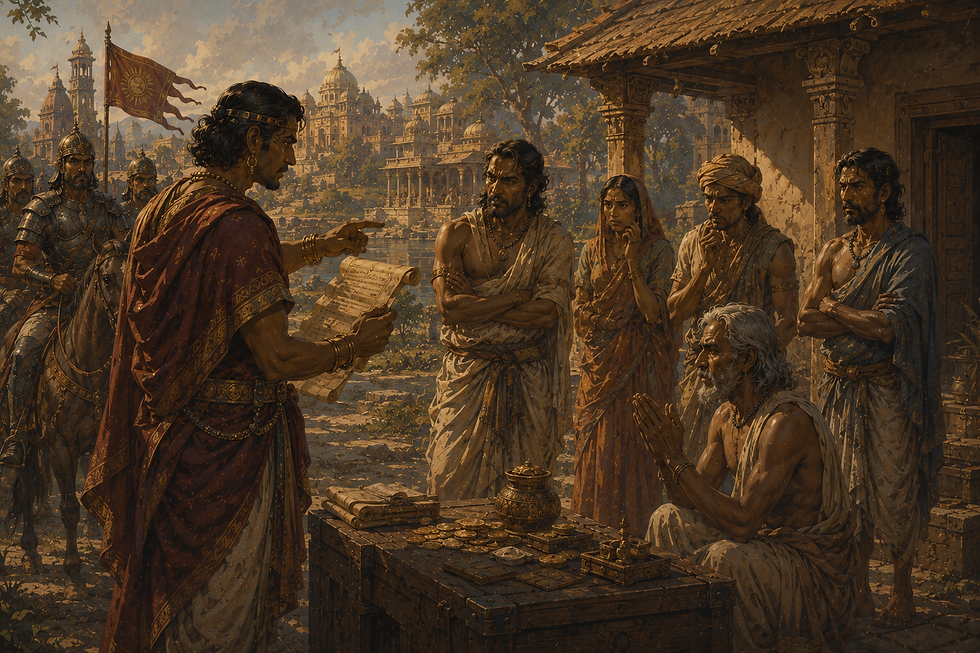


Comments