
.png)

Ancient Texts: Kautilya's Arthashastra - Chapters 1-2 (Book 6 - The Source of Sovereign States)
- A. Royden D'Souza

- Jul 5
- 25 min read
The first five books of the Arthashastra constructed the kingdom from the inside out. Book I built the king's self-discipline. Book II built the machinery of revenue, trade, and administration. Book III built the courts and the civil law.
Book IV built the apparatus of criminal justice and the removal of internal thorns. Book V built the court and the conduct of courtiers. Together, they created a state that was governed, fed, just, secure, and politically stable.
But a kingdom, however well-ordered internally, does not exist in a vacuum. Beyond its borders lie other kingdoms—some friendly, some hostile, some waiting to see which way the wind blows. Chapters 1 and 2 of Book VI introduce the foundational concept of Kautilyan foreign policy: the rajamandala, the circle of kings.

The king at the centre—the vijigishu, the would-be conqueror—is surrounded by concentric rings of enemies, allies, and neutrals. His immediate neighbour is his natural enemy. The neighbour beyond that neighbour is his natural ally. The pattern repeats, creating a mandala of twelve kings, each defined by their position relative to the conqueror at the centre.
These two chapters lay out the elements of sovereignty, the classification of kings, and the sources of strength and weakness. Kautilya defines what makes a king a great king, a mediocre king, or a weak king.
He catalogues the calamities that can befall a kingdom—internal strife, external invasion, financial collapse, the death of a capable ruler—and he teaches the king how to assess his own position and the positions of those around him. The mandala is a map, and the king must learn to read it before he can move.
The tortoise's shell, which began as the king's self-discipline and grew to encompass the entire apparatus of the state, now learns to navigate the wider world. The king who understands the circle of kings understands that no enemy is permanent, no ally is eternal, and the only constant is the shifting geometry of power. The source of sovereign states is the mandala itself, and the king who masters the mandala masters his fate.
Book VI of Arthashastra: The Source of Sovereign States (Mandala-Yoni)
The sixth book, Mandala-Yoni (मण्डलयोनि), translates to "The Source of the Circle of States" or "The Origin of the Mandala." Where Book I forged the king from within, Book II built the machinery of economic administration, Book III established the framework of civil law, Book IV turned to the detection and punishment of criminals, and Book V navigated the treacherous world of the court, Book VI lifts the king's gaze beyond his own borders.
Its central argument is that no kingdom exists in isolation. Every king is surrounded by other kings—friends, enemies, and those who are neither—and the relationships among them form a mandala, a circle, a dynamic and ever-shifting pattern of alliance and hostility. The king who does not understand the mandala will be crushed by it. The king who masters it will conquer.
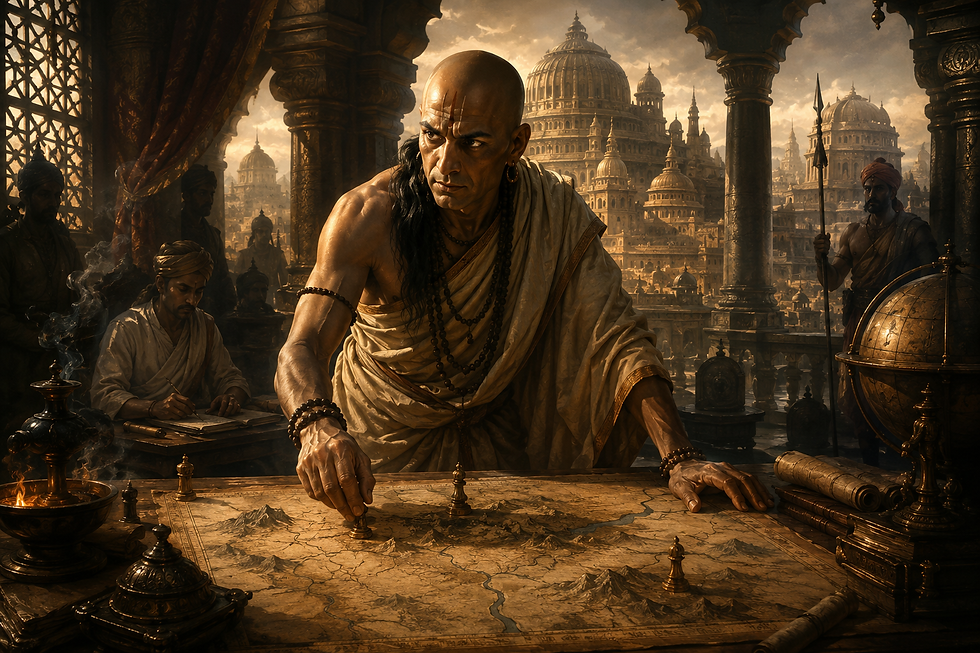

Chapter I: The Elements of Sovereignty
The king, the minister, the country, the fort, the treasury, the army and the friend are the elements of sovereignty.
Of these, the best qualities of the king are:—
Born of a high family, godly, possessed of valour, seeing through the medium of aged persons, virtuous, truthful, not of a contradictory nature, grateful, having large aims, highly enthusiastic, not addicted to procrastination, powerful to control his neighbouring kings, of resolute mind, having an assembly of ministers of no mean quality, and possessed of a taste for discipline;—these are the qualities of an inviting nature.
Inquiry, hearing, perception, retention in memory, reflection, deliberation, inference and steadfast adherence to conclusions are the qualities of the intellect. Valour, determination of purpose, quickness, and probity are the aspects of enthusiasm.
Possessed of a sharp intellect, strong memory, and keen mind, energetic, powerful, trained in all kinds of arts, free from vice, capable of paying in the same coin by way of awarding punishments or rewards, possessed of dignity, capable of taking remedial measures against dangers, possessed of foresight, ready to avail himself of opportunities when afforded in respect of place, time, and manly efforts, clever enough to discern the causes necessitating the cessation of treaty or war with an enemy, or to lie in wait keeping treaties, obligations and pledges, or to avail himself of his enemy's weak points, making jokes with no loss of dignity or secrecy, never brow-beating and casting haughty and stern looks, free from passion, anger, greed, obstinacy, fickleness, haste and back-biting habits, talking to others with a smiling face, and observing customs as taught by aged persons;—such is the nature of self-possession.
The qualifications of a minister have been described in the beginning, middle, and at the close of the work.
Possessed of capital cities both in the centre and the extremities of the kingdom, productive of subsistence not only to its own people, but also to outsiders on occasions of calamities, repulsive to enemies, powerful enough to put down neighbouring kings, free from miry, rocky, uneven, and desert tracts as well as from conspirators, tigers, wild beasts, and large tracts of wilderness, beautiful to look at, containing fertile lands, mines, timber and elephant forests, and pasture grounds, artistic, containing hidden passages, full of cattle, not depending upon rain for water, possessed of land and waterways, rich in various kinds of commercial articles, capable of bearing the burden of a vast army and heavy taxation, inhabited by agriculturists of good and active character, full of intelligent masters and servants, and with a population noted for its loyalty and good character;—these are the qualities of a good country.
The excellent qualities of forts have already been described. Justly obtained either by inheritance or by self-acquisition, rich in gold and silver, filled with an abundance of big gems of various colours and of gold coins, and capable to withstand calamities of long duration is the best treasury.
Coming down directly, from father and grandfather (of the king), ever strong, obedient, happy in keeping their sons and wives well contented, not averse to making a long sojourn, ever and everywhere invincible, endowed with the power of endurance, trained in fighting various kinds of battles, skilful in handling various forms of weapons, ready to share in the weal or woe of the king, and consequently not falling foul with him, and purely composed of soldiers of Kshatriya caste, is the best army.
Coming down directly from father and grandfather, long-standing, open to conviction, never falling foul, and capable of making preparations for war quickly and on a large scale, is the best friend.
Not born of a royal family, greedy, possessed of a mean assembly of ministers, with disloyal subjects, ever doing unrighteous acts, of loose character, addicted to mean pleasures, devoid of enthusiasm, trusting to fate, indiscreet in action, powerless, helpless, impotent, and ever injurious, is the worst enemy. Such an enemy is easily uprooted.
Excepting the enemy, these seven elements, possessed of their excellent characteristics are said to be the limb-like elements of sovereignty.
A wise king can make even the poor and miserable elements of his sovereignty happy and prosperous; but a wicked king will surely destroy the most prosperous and loyal elements of his kingdom.
Hence a king of unrighteous character and of vicious habits will, though he is an emperor, fall a prey either to the fury of his own subjects or to that of his enemies.
But a wise king, trained in politics, will, though he possesses a small territory, conquer the whole earth with the help of the best-fitted elements of his sovereignty, and will never be defeated.

In Simple Terms
The main ideas from this chapter can be understood in these simple points:
The Seven Limbs of the Kingdom: The state is a body, and it has seven limbs. The king is the head. The minister is the eyes. The country is the torso. The fort is the arms. The treasury is the mouth. The army is the legs. The friend is the ears.
Each limb must be strong for the body to function. A kingdom with a wise king but a weak army is like a man with a clear mind but broken legs—he can see where he wants to go, but he cannot move.
The Qualities of the Ideal King: Kautilya's portrait of the ideal king runs to more than fifty qualities, but they fall into four groups. The qualities of an inviting nature: high birth, godliness, valour, respect for elders, virtue, truthfulness, gratitude, ambition, enthusiasm, decisiveness.
The qualities of intellect: inquiry, listening, perception, memory, reflection, deliberation, inference, and firm conclusions. The aspects of enthusiasm: valour, determination, quickness, honesty.
And the nature of self-possession: sharp intellect, strong memory, energy, skill in arts, freedom from vice, fairness in punishment and reward, dignity, foresight, opportunism, cunning in diplomacy, wit without vulgarity, freedom from anger, greed, obstinacy, haste, and back-biting, a smiling face, and respect for tradition. The king must be all of these things, or at least as many as possible.
The Qualities of the Ideal Country: A good country has capital cities at its centre and its borders. It produces enough food to feed its own people and to help outsiders in times of famine. It is difficult for enemies to invade—free of marshes, rocks, deserts, and wilderness. It is free of conspirators and dangerous wild animals.
It is beautiful, fertile, rich in mines, timber, elephants, and pastures. It has hidden passages, abundant cattle, and water that does not depend on rain alone. It has roads, waterways, and trade goods. It can support a large army and heavy taxes. Its farmers are hardworking and of good character. Its people are loyal.
The Qualities of the Ideal Treasury: The treasury must be justly acquired—not stolen, not extorted. It must be rich in gold, silver, gems, and coined money. It must be large enough to withstand long calamities: famines, sieges, wars. A kingdom with a weak treasury is a kingdom that cannot pay its soldiers, and unpaid soldiers become rebels.
The Qualities of the Ideal Army: The best army is hereditary—soldiers whose fathers and grandfathers served the same king. They are strong, obedient, content, and their families are well cared for. They are willing to go on long campaigns.
They are invincible, enduring, trained in all kinds of warfare, skilled with all weapons, and loyal to the king through good and bad. They are composed of men of the warrior caste—professional soldiers, not conscripted peasants.
The Qualities of the Ideal Friend: The best ally is one whose friendship is old—going back to the time of the king's father and grandfather. He is open to reason, never treacherous, and capable of mobilizing for war quickly and on a large scale. A friend who hesitates, who demands too much, who may switch sides—this is not a friend but a liability.
The Portrait of the Worst Enemy: Kautilya provides an equally detailed portrait of the ideal enemy to destroy. He is not of royal birth, greedy, surrounded by incompetent ministers, ruling over disloyal subjects.
He is unrighteous, loose in character, addicted to petty pleasures, devoid of enthusiasm, trusting to fate rather than effort, indiscreet, powerless, helpless, impotent, and habitually cruel. Such an enemy is easily uprooted. The implication is clear: if you find yourself facing such a king, attack. If you find yourself becoming such a king, reform—or prepare to fall.
The King Makes the Elements: The chapter closes with a crucial observation. A wise king can make even poor and miserable elements prosperous.
A wicked king will destroy even the most flourishing elements. The elements of sovereignty are not fixed; they are shaped by the king who rules them. A small kingdom with a great king will grow. A great empire with a wicked king will crumble. The king is the decisive element.
Case Study: An Ancient King's Application
The rise of Chandragupta Maurya (r. c. 321–297 BC) from obscurity to the throne of the first pan-Indian empire is a case study in the application of Kautilya's seven elements of sovereignty. Every element was built or acquired through deliberate policy, guided by Chanakya, the author of the Arthashastra.
Chandragupta himself was the first element. He was not born a king; his origins are disputed, with some traditions claiming he was the son of a Nanda prince and a low-caste woman, others that he was a Kshatriya of the Moriya clan.
But he possessed, or acquired, the qualities Kautilya lists: valour, enthusiasm, intelligence, self-possession, and a willingness to learn from the aged. Chanakya, the aged teacher, was his second element—the minister of unparalleled genius.
The country was the third element. Chandragupta began with no territory at all. He built his kingdom by first seizing the Nanda Empire's capital at Pataliputra, then expanding westward against the Greek satraps left by Alexander, then southward into the Deccan.
The forts of the Mauryan Empire—Pataliputra, Ujjain, Taxila—were the fourth element, and they were built or strengthened to Kautilyan specifications.
The treasury was the fifth element, filled initially with the wealth of the conquered Nandas, whom tradition describes as hoarders of immense riches. The army was the sixth element—the Mauryan military, which Greek sources estimate at 600,000 infantry, 30,000 cavalry, 9,000 elephants, and 8,000 chariots.
It was a hereditary force, loyal, well-paid, well-trained, and invincible. The friend was the seventh element—and Chandragupta made his most important alliance through marriage, sealing a treaty with Seleucus Nicator, Alexander's successor in the east, who ceded the Indus territories in exchange for five hundred war elephants and a matrimonial alliance.
Chandragupta's empire was the seven elements made flesh. The Arthashastra's theoretical framework was tested and proven in the creation of the largest empire the Indian subcontinent had yet seen.
In Modern Times
In modern India, the Kautilyan elements of sovereignty are the ancestors of the modern understanding of state capacity. The king is the political executive—the prime minister and the cabinet. The minister is the civil service, the bureaucracy, the advisors who turn policy into administration.
The country is the territory, the population, the natural resources, the infrastructure. The fort is the national defence—the army, the navy, the air force, the border fortifications, the cybersecurity. The treasury is the economy, the tax base, the foreign reserves, the fiscal capacity of the state.
The army is the military, but also, in a broader sense, the coercive power of the state—the police, the intelligence agencies, the capacity to enforce the law. The friend is the network of alliances, the diplomatic relationships, the international agreements that multiply the state's power.
The Kautilyan insight that these seven elements are "limb-like"—that they must all be strong for the body to function—is the insight behind the modern concept of comprehensive national power. A nation with a brilliant leader but a broken economy is crippled.
A nation with a mighty army but a corrupt bureaucracy is paralyzed. A nation with vast territory but a disloyal population is hollow. The modern state, like the Kautilyan kingdom, must cultivate all seven elements simultaneously.
The Kautilyan closing observation—that a wise king can make even poor elements prosperous, and a wicked king will destroy even the best—is the perennial truth of leadership.
The same country, the same resources, the same people will flourish under one leader and wither under another. The elements of sovereignty are not fixed by fate; they are shaped by the quality of governance.
Kūrmapura, the Royal Council Chamber – Late Morning King Simhavarma sat at the head of the council table, a single palm-leaf before him, blank. He had been king for thirteen years, and in that time he had fought one war, built one new capital, reorganized the treasury, expanded the elephant corps, and weathered a succession crisis that the kingdom had never known about. He was, by any measure, a successful king. But he was not content. He looked around the table. To his right sat Vamanagupta, his Chief Minister, the second element of his sovereignty. Vamanagupta was old now, his hair grey, his face lined, but his mind was as sharp as ever. To his left sat Gajakesha, the Samaharta, the man who knew every pana in the treasury and every grain in the granaries. Beside Gajakesha sat Rudravarma, the Senapati, the commander of the army, his scarred hands folded on the table. The other ministers filled the remaining chairs: the Superintendent of Fortifications, the Superintendent of Trade, the Chief of Intelligence Varishtha, and the young Prince Devananda, who was being trained for the day when he would sit in his father's chair. "The sage Suracharya," Simhavarma said, "wrote that there are seven elements of sovereignty. The king, the minister, the country, the fort, the treasury, the army, and the friend. I have spent thirteen years trying to strengthen each of them. I want to know whether I have succeeded. I want each of you to tell me the truth—not what I want to hear, but what is." He turned to Vamanagupta. "You are the minister. You are the second element. What is your assessment of the first element—the king?" Vamanagupta's expression did not change. "Your Majesty has the qualities of an inviting nature. You are born of a high family, the Sura dynasty. You are godly—you perform the rites and honour the sages. You possess valour—you led the army against the Zarians yourself. You see through the medium of aged persons—you have kept me at your side, and you have sought the counsel of Acharya Shankara and others. You are virtuous, truthful, grateful, ambitious, and enthusiastic. You are not addicted to procrastination. You have an assembly of ministers of no mean quality." He paused. "You are also occasionally quick to anger, and you do not easily forgive those who have wronged you. But these are minor faults in a king who possesses the major virtues." Simhavarma nodded slowly. "And the third element—the country?" Gajakesha answered. "The country is prosperous. The eastern delta produces enough grain to feed the kingdom and export a surplus. The western coast brings in trade from Panchasthavi. The northern frontier, which was devastated by the Zarian raids five years ago, has been rebuilt. The new villages are settled, the fields are under cultivation, and the border forts are garrisoned. The country has mines, timber forests, elephant forests, and pasture lands. It has roads and waterways. It can bear the burden of the army and the taxes. The people are loyal—the tax revenues have never been higher, and the complaints have never been fewer." "The fourth element—the forts?" The Superintendent of Fortifications, an old engineer named Varahamihira, answered. "Kūrmapura is the strongest fort in the kingdom. The three ditches, the rampart, the towers, the hidden passage—all are maintained and inspected daily. The northern border forts at Mandara and the Red River crossing have been strengthened with new walls and additional granaries. The southern coastal forts guard the harbours. No enemy can enter this kingdom without passing through one of our fortresses." "The fifth element—the treasury?" Gajakesha spoke again. "The treasury is full. The net balance, after all expenditure, is one hundred and twenty thousand panas. The gold reserves are secure in the underground vault. The granaries are at three-quarters capacity, with the remaining quarter held in reserve against calamity. The treasury can withstand a siege of two years or a war of one year without borrowing." "The sixth element—the army?" Rudravarma answered. "The army is strong. The hereditary troops—the maula—number five thousand. They are loyal, well-paid, and well-trained. The hired troops—the bhrita—number three thousand. The guild troops—the sreni—number two thousand. The elephant corps has sixty trained tuskers. The cavalry is mounted on the best Marunashva and Trakya horses. The chariot corps is small but effective on the plains. The army has not been defeated in battle since the Zarian campaign, and the soldiers know it." "The seventh element—the friend?" Varishtha, the Chief of Intelligence, spoke. He rarely spoke in council, but when he did, everyone listened. "We have no friend, Your Majesty. We have the Valenta city-state, which is a neutral trading partner, not an ally. We have the Panchasthavi domains, which are friendly but distant and cannot send troops. We have the hill tribes, who are tributaries, not allies. The Zarian Sultanate is our enemy. The Maeran city-state is our enemy's friend. If we were attacked tomorrow by a coalition of Zaria and Maera, we would fight alone." A silence fell over the chamber. Simhavarma looked at Varishtha. "You are saying that the seventh element is missing." "I am saying that the seventh element is the one we have neglected. Your Majesty has spent thirteen years strengthening the king, the minister, the country, the forts, the treasury, and the army. But we have made no lasting alliance. We have no friend who will send troops when we are attacked. We are strong, but we are alone." Vamanagupta spoke. "The sage Suracharya wrote that a wise king can make even the poor and miserable elements of his sovereignty happy and prosperous. The seventh element is not miserable, but it is poor. It must be cultivated. We must find an ally." Simhavarma looked at the blank palm-leaf before him. "Then that is the task of the next year. Varishtha, you will prepare a list of potential allies—kings who are old in their friendship, open to conviction, and capable of mobilizing quickly. We will send envoys. We will offer marriages. We will offer trade concessions. We will do whatever is necessary to fill the seventh seat at this table." He looked around the chamber. "The sage also wrote that a king of unrighteous character will fall a prey to his enemies, though he is an emperor. We are not unrighteous. We are not weak. But we are incomplete. The tortoise has six limbs. It needs the seventh. We will find it." |

Chapter II: Concerning Peace and Exertion
Acquisition and security (of property) are dependent upon peace and industry. Efforts to achieve the results of works undertaken is industry (vyayama). Absence of disturbance to the enjoyment of the results achieved from works is peace.
The application of the six-fold royal policy is the source of peace and industry. Deterioration, stagnation, and progress are the three aspects of position.
Those causes of human make which affect position are policy and impolicy (naya and apanaya); fortune and misfortune (aya and anaya) are providential causes. Causes, both human and providential, govern the world and its affairs.
What is unforeseen is providential; here, the attainment of that desired end which seemed almost lost is (termed) fortune. What is anticipated is human; and the attainment of a desired end as anticipated is (due to policy).
What produces unfavourable results is impolicy. This can be foreseen; but misfortune due to providence cannot be known.
The king who, being possessed of good character and best-fitted elements of sovereignty, is the fountain of policy, is termed the conqueror.
The king who is situated anywhere immediately on the circumference of the conqueror's territory is termed the enemy.
The king who is likewise situated close to the enemy, but separated from the conqueror only by the enemy, is termed the friend (of the conqueror).
A neighbouring foe of considerable power is styled an enemy; and when he is involved in calamities or has taken himself to evil ways, he becomes assailable; and when he has little or no help, he becomes destructible; otherwise (i.e., when he is provided with some help), he deserves to be harassed or reduced. Such are the aspects of an enemy.
In front of the conqueror and close to his enemy, there happen to be situated kings such as the conqueror's friend, next to him, the enemy's friend, and next to the last, the conqueror's friend's friend, and next, the enemy's friend's friend.
In the rear of the conqueror, there happen to be situated a rearward enemy (parshnigraha), a rearward friend (akranda), an ally of the rearward enemy (parshnigrahasara), and an ally of the rearward friend (akrandasara).
That foe who is equally of high birth and occupies a territory close to that of the conqueror is a natural enemy; while he who is merely antagonistic and creates enemies to the conqueror is a factitious enemy.
He whose friendship is derived from father and grandfather, and who is situated close to the territory of the immediate enemy of the conqueror is a natural friend; while he whose friendship is courted for self-maintenance is an acquired friend.
The king who occupies a territory close to both the conqueror and his immediate enemy in front and who is capable of helping both the kings, whether united or disunited, or of resisting either of them individually is termed a Madhyama (mediatory) king.
He who is situated beyond the territory of any of the above kings and who is very powerful and capable of helping the enemy, the conqueror, and the Madhyama king together or individually, or of resisting any of them individually, is a neutral king (udasina),—these are the (twelve) primary kings.
The conqueror, his friend, and his friend's friend are the three primary kings constituting a circle of states. As each of these three kings possesses the five elements of sovereignty, such as the minister, the country, the fort, the treasury, and the army, a circle of states consists of eighteen elements.
Thus, it needs no commentary to understand that the (three) Circles of States having the enemy (of the conqueror), the Madhyama king, or the neutral king at the centre of each of the three circles, are different from that of the conqueror. Thus there are four primary Circles of States, twelve kings, sixty elements of sovereignty, and seventy-two elements of states.
Each of the twelve primary kings shall have their elements of sovereignty, power, and end. Strength is power, and happiness is the end.
Strength is of three kinds: power of deliberation is intellectual strength; the possession of a prosperous treasury and a strong army is the strength of sovereignty; and martial power is physical strength.
The end is also of three kinds: that which is attainable by deliberation is the end of deliberation; that which is attainable by the strength of sovereignty is the end of sovereignty; and that which is to be secured by perseverance is the end of martial power.
The possession of power and happiness in a greater degree makes a king superior to another; in a less degree, inferior; and in an equal degree, equal. Hence a king shall always endeavor to augment his own power and elevate his happiness.
A king who is equal to his enemy in the matter of his sovereign elements shall, in virtue of his own righteous conduct or with the help of those who are hostile or conspiring against his enemy, endeavor to throw his enemy's power into the shade; or if he thinks:—
"That my enemy, possessed as he is of immense power, will yet in the near future, hurt the elements of his own sovereignty, by using contumelious language, by inflicting severe punishments, and by squandering his wealth; that though attaining success for a time yet he will blindly take himself to hunting, gambling, drinking and women; that as his subjects are disaffected, himself powerless and haughty, I can overthrow him; that when attacked, he will take shelter with all his paraphernalia into a fort or elsewhere; that possessed as he is of a strong army, he will yet fall into my hands, as he has neither a friend nor a fort to help him; that a distant king is desirous to put down his own enemy, and also inclined to help me to put down my own assailable enemy when my resources are poor; or that I may be invited as a Madhyama king,"—for these reasons the conqueror may allow his enemy to grow in strength and to attain success for the time being.
Throwing the circumference of the Circle of States beyond his friend's territory, and making the kings of those states as the spokes of that circle, the conqueror shall make himself as the nave of that circle.
A reducible or a conquerable enemy will, when placed between a conqueror and the conqueror's friend, appear to be growing in strength.

In Simple Terms
The main ideas from this chapter can be understood in these simple points:
Peace and Industry: The Twin Foundations: Kautilya opens with a deceptively simple observation. All acquisition and security of property depend on two things: peace and industry. Industry is the effort to achieve results. Peace is the absence of disturbance to the enjoyment of those results.
You must work to gain wealth, and you must have peace to keep it. The six-fold policy—the art of knowing when to make peace, when to wage war, and all the gradations in between—is the source of both.
The Three Aspects of Position: Every king's position can be described in one of three ways: deterioration (losing ground), stagnation (neither gaining nor losing), or progress (gaining). The king must know which of these describes his current situation before he can decide what to do.
Human and Providential Causes: The causes of change in a king's position are of two kinds. Human causes are policy (good decisions) and impolicy (bad decisions)—these can be foreseen and controlled. Providential causes are fortune and misfortune—these cannot be foreseen. The wise king controls what he can control and prepares for what he cannot.
The Conqueror and the Circle of Kings: This is the heart of the chapter. At the centre of any strategic analysis stands the conqueror (vijigishu)—the king who is analysing the situation. His immediate neighbour is his natural enemy.
The neighbour beyond that enemy is his natural friend (because that king also shares a border with the enemy and therefore shares an interest in containing him). This pattern—enemy, friend, enemy, friend—radiates outward in concentric rings.
The Twelve Primary Kings: Kautilya identifies twelve distinct positions in the mandala:
In front of the conqueror: the enemy, the friend, the enemy's friend, the friend's friend.
In the rear of the conqueror: the rearward enemy, the rearward friend, the ally of the rearward enemy, the ally of the rearward friend.
Beyond these: the Madhyama (the "middle" king, situated between the conqueror and his enemy, capable of helping either), and the Udasina (the neutral king, powerful enough to affect the outcome but not directly involved).
The Four Circles and Seventy-Two Elements: The mandala is not a single circle but a system of four interlocking circles, each with a different king at its centre. Each circle contains three primary kings (the central king, his friend, and his friend's friend).
Each of these three has five internal elements (minister, country, fort, treasury, army). The arithmetic produces twelve primary kings, sixty elements of sovereignty, and seventy-two elements of states. This is a complete map of the geopolitical universe.
The Three Kinds of Strength: Strength is of three kinds. Intellectual strength is the power of deliberation—the ability to think, plan, and outwit. The strength of sovereignty is the possession of a full treasury and a strong army. Physical strength is martial power—the actual capacity to fight and win. The king must cultivate all three.
The Three Kinds of Ends: The ends that strength can achieve are also threefold. The end of deliberation is what can be achieved by thinking and planning alone. The end of sovereignty is what can be achieved by wealth and military power.
The end of martial power is what can be achieved only by perseverance in actual combat. The king must know which kind of end he is pursuing before he chooses his means.
Superiority, Inferiority, Equality: A king who possesses more power and happiness than another is superior. One who possesses less is inferior. One who possesses equal is equal. This simple calculus determines the entire strategy: the superior king should attack, the inferior king should seek peace or alliance, and the equal king should wait for an advantage.
The Patient Conqueror: Kautilya closes with a remarkable strategic insight. Sometimes the best course is to let an enemy grow. If the enemy, though powerful, is destroying his own elements of sovereignty—insulting his ministers, punishing his people cruelly, squandering his wealth, indulging in hunting, gambling, drinking, and women—then time is on the conqueror's side. The enemy's apparent strength is actually the seed of his destruction. The patient conqueror waits, and watches, and strikes only when the enemy has weakened himself.
The Nave and the Spokes: The final image is of a wheel. The conqueror is the nave—the hub. The other kings are the spokes. The circumference is the boundary of the known world. The conqueror who can make himself the hub of this wheel, with all other kings radiating outward from him, has achieved the ultimate strategic position.
Case Study: An Ancient King's Application
The Mauryan Empire under Chandragupta and Chanakya was the first Indian state to apply the mandala theory systematically to its foreign policy. The geopolitical situation after Alexander's death in 323 BC was a perfect illustration of the Kautilyan circle of kings.
Chandragupta, the conqueror, was situated at the centre of his mandala. His immediate neighbours to the northwest were the Greek satraps left by Alexander—Seleucus Nicator being the most powerful. These satraps were, in Kautilyan terms, the natural enemies.
Beyond the satraps lay the Greek kingdoms of the eastern Mediterranean—Ptolemaic Egypt, Antigonid Macedon—which were the natural friends, because they shared an interest in containing Seleucus.
Chandragupta applied the six-fold policy with precision. When Seleucus was strong, Chandragupta sought peace—the treaty of 305 BCE, in which Seleucus ceded the Indus territories in exchange for five hundred war elephants and a marriage alliance.
This was sandhi, peace, made from a position of relative strength after the Mauryan victory in the Punjab. The elephants that Chandragupta gave to Seleucus were not a gift; they were a strategic investment. They helped Seleucus defeat his western rivals, which kept him occupied and away from India.
When Seleucus was distracted by his wars in the west, Chandragupta expanded southward into the Deccan. This was yana, preparing for war and advancing, against enemies who were not protected by any powerful ally. The mandala shifted with each conquest. The conquered kings became elements of the Mauryan empire. The circle of states was redrawn.
Chanakya's genius lay in seeing the entire mandala at once—the twelve kings, the four circles, the shifting alliances, the opportunities hidden in apparent threats. The Mauryan Empire was not built by brute force alone; it was built by a strategic intelligence that understood the geometry of power.
In Modern Times
In modern India, the Kautilyan mandala theory is the ancestor of modern geopolitics, international relations theory, and the strategic doctrines of the Indian state.
The concept that a nation's immediate neighbour is its natural enemy, and the neighbour beyond that neighbour is its natural friend, has been a guiding principle of Indian foreign policy since independence. Pakistan is the immediate neighbour and the natural enemy.
China, beyond Pakistan, was historically a natural friend—until China itself became a direct threat. The mandala has shifted, as mandalas always do.
The three kinds of strength—intellectual, sovereign, and physical—are the ancestors of the modern concepts of soft power, economic power, and hard power. The modern nation, like the Kautilyan kingdom, must cultivate all three.
A nation with a brilliant diplomatic corps but a weak economy is the equivalent of a king with intellectual strength but no treasury. A nation with a mighty military but a dysfunctional political system is the equivalent of a king with martial power but no intellectual strength.
The Kautilyan typology of kings—the conqueror, the enemy, the friend, the rearward enemy, the Madhyama, the Udasina—is the ancestor of the modern strategic analysis that classifies nations as allies, adversaries, competitors, and neutrals.
The modern diplomat who maps the interests of all the relevant states in a regional crisis is doing what Kautilya taught: drawing the mandala.
The Kautilyan insight that a king may allow his enemy to grow if the enemy is destroying himself is the ancestor of the modern strategic patience that watches a rival nation decay from within—through corruption, misrule, demographic decline, or economic mismanagement—without direct confrontation. The Cold War strategy of containment was, in Kautilyan terms, a policy of waiting for the enemy to weaken himself while avoiding direct war.
The Kautilyan image of the conqueror as the nave of a wheel, with all other kings as spokes, is the ancestor of the modern vision of a nation that is the indispensable power at the centre of a global alliance system. The United States in NATO, India in its neighbourhood, China in its sphere of influence—all are attempting, in different ways, to become the nave of their respective wheels.
Kūrmapura, the Royal Council Chamber – Late Morning A great map lay unrolled on the council table, a map unlike any the kingdom had possessed before. It showed not only the territory of Saha—its cities, its rivers, its forts, its roads—but also the territories of all the surrounding kingdoms. To the north, the Zarian Sultanate, shaded in red. Beyond Zaria, the lands of the nomad clans. To the east, Valenta, a small circle of blue, the city-state that was a trading partner but not an ally. Beyond Valenta, the Maeran city-state, a darker blue, hostile to Saha. To the south, the sea, and beyond the sea, the islands of Panchasthavi, a friendly trading power but too distant to send troops. To the west, the desert, and beyond the desert, the hill tribes, tributaries but not friends. King Simhavarma stood at the head of the table, a stylus in his hand. Around the table sat his ministers: Vamanagupta, Gajakesha, Rudravarma, Varishtha, and Prince Devananda, who was being trained to read the map. "This," Simhavarma said, pointing to the map, "is the mandala. The circle of kings. The sage Suracharya wrote that every king stands at the centre of such a circle. His immediate neighbour is his enemy. The neighbour beyond that enemy is his friend. The neighbour beyond that friend is his enemy's friend. The pattern repeats until the edge of the known world." He drew a circle around Kūrmapura with his stylus. "I am the conqueror—the vijigishu. I am the centre. My immediate neighbour to the north is Zaria. Zaria is my natural enemy. My immediate neighbour to the east is Valenta. Valenta shares a border with Zaria. Valenta is my natural friend—or should be." He drew another circle. "Beyond Zaria are the nomad clans. They share a border with Zaria. They are Zaria's enemy. Therefore they are my friend—or could be, if I cultivated them. Beyond Valenta is Maera. Maera shares a border with Valenta. Maera is Valenta's enemy. Therefore Maera is my enemy—and Maera is already allied with Zaria, which confirms the mandala." He drew a line behind Kūrmapura, to the south and west. "In my rear are the sea and the desert. The sea is not a kingdom; it is a barrier. The desert is not a kingdom; it is a wilderness. But the hill tribes live in that wilderness, and they could become a rearward enemy if they were ever united under a single chief. They are not. They are tributaries. But they must be watched." He stepped back from the table. "This is the geometry of power. Every kingdom in this mandala is watching every other kingdom. If I move against Zaria, Valenta may help me—or may stay neutral, waiting to see who wins. If Zaria moves against me, Maera may help Zaria. The nomad khans may raid Zaria's rear, or they may stay out of the fight. The outcome depends not only on the strength of my army but on the choices of every other king in the circle." Devananda studied the map. "And Panchasthavi? The island kingdom?" "Panchasthavi is the Udasina—the neutral king. It is too far away to be directly affected by any war on this mainland. But it is powerful enough to affect the outcome if it chooses to intervene. It could send ships, gold, or mercenaries to either side. The neutral king is the wild card in the mandala. We must ensure that Panchasthavi remains neutral—or, better, that it becomes our friend." Vamanagupta spoke. "The mandala is not fixed. It shifts with every marriage, every treaty, every war, every death of a king. The map you see today is not the map your father saw, and it is not the map your son will see. The conqueror who does not redraw his mandala every year is a conqueror who will be surprised by his enemies." Simhavarma nodded. "Then we will redraw it every month. Varishtha, your spies will report any change in the alliances of our neighbours. Gajakesha, your treasury will fund the envoys who will cultivate the nomad khans and reassure Panchasthavi. Rudravarma, your army will be ready to move if the mandala shifts against us." He looked at the map one last time. "The sage Suracharya wrote that the conqueror shall make himself the nave of a wheel, and make the other kings the spokes. That is our task. We are the hub. The circle turns around us." |



Comments