
.png)

Sage Narada: The Messenger of Gods
- A. Royden D'Souza

- Nov 17, 2025
- 3 min read
Early Satya (Krita) Yuga
Before the heavens were layered into worlds, before devas had courts and demons had kingdoms, before Dharma and Adharma took form, there was sound.
Not speech. Not chant. A vibration—soft, ancient, waiting for a singer. From that vibration emerged a luminous wanderer.

He had no father, no mother, no birth. He was the song that creation needed. This was Narada, as the Vedas first whisper of him, a being woven of sound, a hymn walking on two feet, a messenger who traveled the three realms without obstruction.
He carried a rudimentary vīṇā, glowing with firelike resonance, whose strings hummed with Ṛgvedic metre. The gods recognized him instantly, not as a child, but as a voice older than dawn.
Nārada of the Brāhmaṇa Age
In the Brāhmaṇas, he becomes an adviser, a ritual expert, a bridge of knowledge. Kings and sages sought him out.

Once a king asked:
“What separates man from darkness?”
Nārada touched his heart and replied:
“The understanding of light. And the courage to walk toward it.”
His presence was always brief—soft steps, a few words, then gone again, like a song that refuses to linger too long in any single world.
Narada: The Mind-Born Sage
When the Purāṇas blossomed, the universe became populated with new tales, and into these tales stepped a new, more familiar Nārada. He was still resplendent. Still wandering. Still luminous with knowledge.
But now he was also:
a devarṣi,
a devotee,
a cosmic catalyst,
the voice that breaks stagnation,
the mischief-maker who is secretly a guardian of dharma.
In the Purāṇic telling, Brahmā meditated on devotion, knowledge, and sound. From his contemplation emerged a sage holding a shining vīṇā.

Brahmā’s face brightened.
“My son, you will move between all worlds. No door shall bar you, no god shall silence you, no power shall bind you.”
Nārada bowed, but his smile already hinted at the upheavals he would someday cause.
The Wanderer Between Worlds
Nārada did not build huts. He did not stay with kings. He never acquired wealth. He owned only:
his vīṇā (Mahati),
the mantra “Nārāyaṇa… Nārāyaṇa…”,
and an unending curiosity for the hearts of beings.
His presence would drift across realms like a breeze carrying the scent of distant forests. Sometimes devas heard him singing in the sky. Sometimes rakṣasas heard him laugh softly in their caves. Sometimes mortals glimpsed him in dreams.
Nārada: The One Who Starts Stories
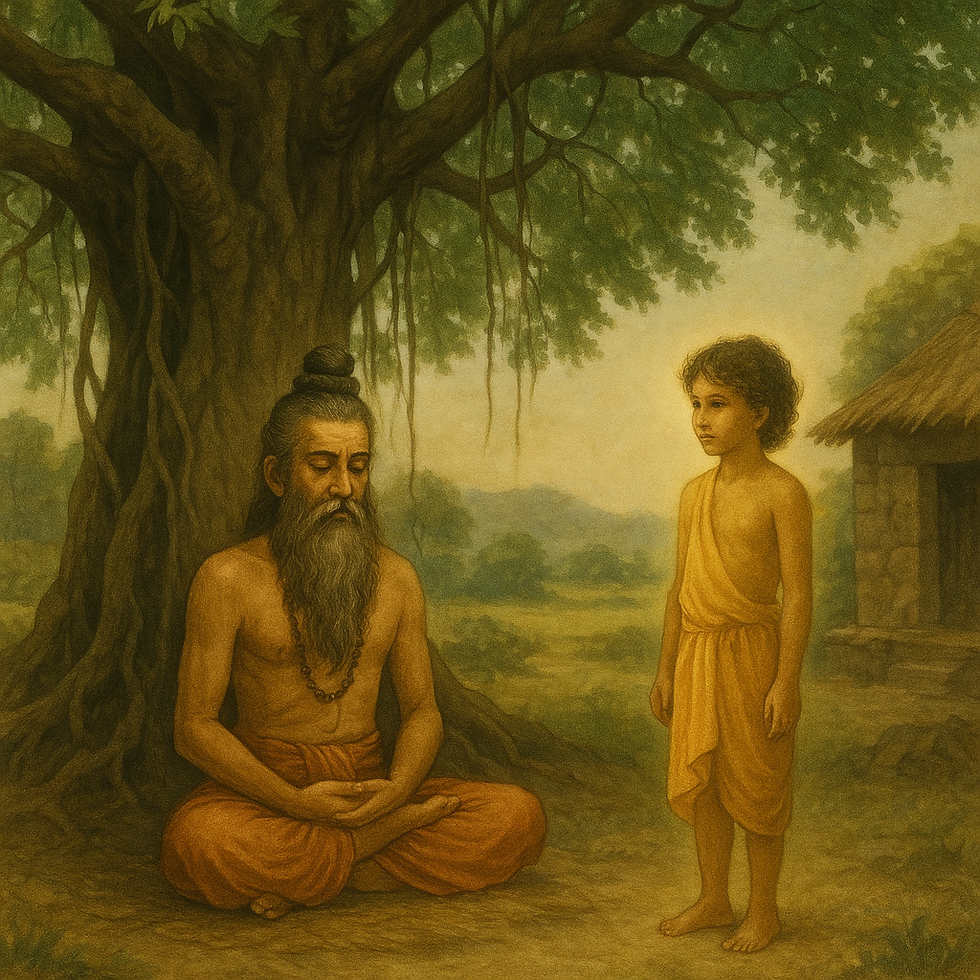
Every great epic begins with his footstep. He creates Dhruva’s destiny. A child cries in the forest. Nārada kneels, wiping Dhruva’s tears.
“Why seek comfort from the world when the Lord Himself will embrace you?”
Dhruva becomes a star.

He whispers devotion to Prahlāda. While Prahlāda is in the womb, Nārada teaches Kayādhū sacred knowledge. Prahlāda is born radiant with bhakti.
He awakens karmic storms. He provokes kings, taunts gods, challenges sages, and unmasks hidden flaws—all with one goal:
“Let dharma rise, even if the world must shake first.”
He is not a troublemaker. He is the flame that burns away stagnation.
His Love for Nārāyaṇa
Despite all his movement, Nārada’s heart has a single anchor: Nārāyaṇa. Sometimes he sits beside a river, eyes closed, vīṇā humming softly, whispering:
“Nārāyaṇa…Nārāyaṇa…”
Even gods fall silent when he sings. Vishnu often smiles and says:

“Come, my wandering son. What truth have you discovered today?”
Nārada and Brahmā: A Cosmic Father-Son Dynamic
Nārada often questions Brahmā, sometimes to the point of irritation. Once Brahmā burst out:
“You will ruin the peace of heaven with your meddling!”
Nārada bowed deeply and replied:
“Peace without truth is only silence, Father.”
Brahmā exhaled, half-angry, half-admiring.
Nārada in the Mahābhārata
He appears in the epic like a comet—sudden, brilliant, directional. He counsels Yudhiṣṭhira on kingship. He disciplines the arrogant. He warns Yādavas of coming destruction. He consoles Kuntī. He appears to Bhīma, Arjuna, and even Kṛṣṇa.

His words are arrows of clarity. Sometimes sweet. Sometimes crushing. He sees what others refuse to see.
Nārada does not age. He does not die. He does not belong to any single realm. He walks in heaven, sits by hermits in forests, crosses the sky singing, drifts through the cosmos sowing awakening.
He is the wind of dharma—invisible, unstoppable, irresistible. He is the first voice of creation and the last whisper before dissolution. He is laughter wrapped in wisdom, music wrapped in insight, movement wrapped in devotion. He is Nārada.
REFERENCES:
Vedic
Ṛgveda 10.39–40 — Nārada as divine singer, traveler
Ṛgveda 1.18, 8.13 — Aṅgirasa-Nārada linkage
Atharva Veda 11.7 — Nārada and the cosmic knowledge of sound
Brāhmaṇa & Upaniṣad
Śatapatha Brāhmaṇa — Nārada as ritual-knower
Chāndogya Upaniṣad 7.1–7.3 — Nārada’s dialogue with Sanatkumāra
Bṛhadāraṇyaka Upaniṣad — mentions of Nārada’s knowledge
Purāṇic
Viṣṇu Purāṇa 1.5–1.7 — Nārada as mind-born son of Brahmā
Bhāgavata Purāṇa 1.5–6 — Nārada’s origin, devotion to Viṣṇu
Bhāgavata 4.8–4.12 — Nārada and Dhruva
Bhāgavata 7.7–7.8 — Nārada and Prahlāda
Epic
Mahābhārata (Śānti, Vana, Udyoga) — Nārada’s instructions to kings, sages, warriors


Comments