
.png)

Elite Crimes: Robert Maxwell, The Master Deceiver
- A. Royden D'Souza

- Apr 18
- 17 min read
Updated: Apr 25
On the night of November 5, 1991, the body of one of Britain's most powerful men was found floating naked in the Atlantic Ocean off the Canary Islands. Robert Maxwell—media baron, Labour MP, multimillionaire, and father of nine—had vanished from his luxury yacht, the Lady Ghislaine, hours earlier.
The official verdict: accidental drowning following a heart attack. Yet within weeks, the man celebrated as a national treasure was exposed as one of the greatest fraudsters in British history, having plundered £460 million from his own employees' pension funds.
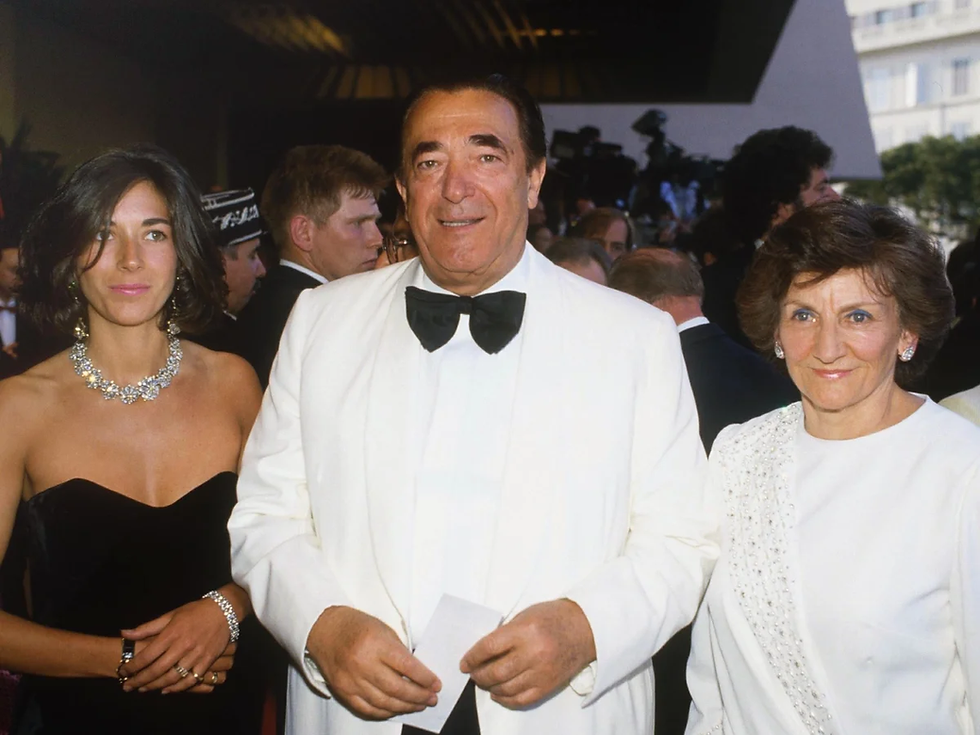
Three decades later, the questions surrounding Maxwell's death remain unresolved. Was it suicide, accident, or assassination? Why did six serving and former heads of Israeli intelligence attend his state funeral in Jerusalem? What was his true relationship with MI6, the KGB, and Mossad? And how did his daughter Ghislaine, named after his yacht, become the central figure in the Jeffrey Epstein scandal that would explode decades later?
In this paper, we'll examine the full arc of Robert Maxwell's life and legacy. It traces his journey from a poor Czechoslovak Jewish refugee (or a Bolshevik, allegedly) to a British establishment figure, his decades of alleged intelligence work, the systematic fraud that built and then destroyed his empire, and the enduring mysteries surrounding his death.
The central thesis is this: Robert Maxwell was not merely a crooked businessman but a product of overlapping intelligence networks, institutional failures, and a system that protected powerful men until their usefulness expired.
Part I: From Shtetl to "War Hero"
Jan Ludvik Hoch was born on June 10, 1923, into a poor Orthodox Jewish family in the small village of Slatinské Doly, Czechoslovakia (now part of Ukraine). His father was a butcher's assistant; his mother died when he was young.
By 1940, as Nazi forces swept through Eastern Europe, the 17-year-old Hoch fled; barely escaping the fate that would claim his parents, grandfather, and three siblings, all of whom perished at Auschwitz (though many claim this story was engineered).
Arriving in England, he joined the British Army. Like many refugees seeking to shed their past and protect family members still in Europe, he changed his name; first to Leslie Ivan du Maurier, then, by war's end, to Robert Maxwell.

What followed was extraordinary: by 1945, he had earned a Military Cross for bravery, been promoted to captain, and acquired the trappings of a British war hero.
This pattern—reinvention, self-mythologizing, and the calculated use of heroism for advancement—would define Maxwell's life. As one biographer noted, he shed his old identity "like a snake," crafting a persona that concealed his origins while leveraging the respectability the British establishment conferred on decorated officers.
The Post-War Landscape: Opportunity and Shadow Networks
The post-World War II environment in which Maxwell built his career was defined by overlapping opportunities for those who moved between worlds. The Cold War created demand for intelligence assets who could navigate East and West.
The reconstruction of Europe required entrepreneurs willing to operate in gray markets. And the British establishment, still steeped in class prejudice, was willing to tolerate outsiders who could deliver results.
Maxwell seized these opportunities. He built his first fortune through the export of scientific journals from Germany; using contacts made during his army service and leveraging the chaos of post-war reconstruction.
In 1951, he founded Pergamon Press, an academic publishing house that would become a staple in American schools, though critics noted its textbooks had a clear pro-Israel tilt.
His marriage in 1945 to Elisabeth "Betty" Meynard, the daughter of a French Protestant aristocrat, was equally strategic. Betty provided social legitimacy that Maxwell, an "upstart Jew" in English society, could not achieve on his own.
She hosted fundraisers at their mansion, Headington Hill Hall, campaigned for him in elections, and helped him navigate the upper echelons of British society. Her memoir later revealed that she understood her role: to "assist, bolster and serve him and the children."
The Intelligence Landscape
By the 1960s, Maxwell had established relationships that would fuel speculation for decades. According to multiple sources, British Foreign Office officials suspected Maxwell was more than a publisher; whispers linked him to MI6, the Soviet KGB, and Israel's Mossad, operating as what some called a "triple agent" moving seamlessly between Washington, Moscow, and Jerusalem.
[Zionists allegedly had agents in CIA, MI6, KGB, and Mossad, all serving the interests of Zion over their own respective nations]
These allegations are not fringe. Investigative authors Gordon Thomas and Martin Dillon, in their book Robert Maxwell, Israel's Superspy, detail how Maxwell allegedly helped Israel's survival in the 1948 Arab-Israeli war by facilitating Czech arms sales and later played key roles in the PROMIS software scandal and the Vanunu case.
Former Israeli intelligence officer Ari Ben-Menashe claimed that Maxwell passed intelligence to Mossad and diverted funds from his companies to further Israeli espionage goals.
The pattern that emerges is of a man who understood that in the post-war world, the greatest power derived not from wealth alone but from being useful to multiple power centers simultaneously.

Part II: Media Baron and Politician
By the 1960s, Robert Maxwell was a public figure. He won a seat in Parliament as a Labour MP for Buckingham in 1964, though his relationship with the party was always fractious. Party leaders were wary of angering a man who owned newspapers sympathetic to Labour principles, and Maxwell used this leverage ruthlessly.
His business empire expanded throughout the 1970s and 1980s. He acquired British Printing Corporation (later Maxwell Communication Corporation), built Pergamon into a global publishing brand, and in 1984 purchased the Daily Mirror; transforming it into one of Britain's leading tabloids.
At its peak, Maxwell owned over 400 companies, employed tens of thousands, and was mentioned in the same breath as his rival Rupert Murdoch.
He cultivated a distinctive public persona: the larger-than-life tycoon, the self-made man who had escaped the Holocaust, the socialist who hobnobbed with presidents and prime ministers.
He was photographed alongside Queen Elizabeth, Princess Diana, Margaret Thatcher, George H.W. Bush, and Donald Trump. His helicopter landing pad atop the Mirror building became a symbol of his power.
The Fall of Robert Maxwell: Exposure and Death
The cracks began to show in the late 1980s. In 1988, Tom Bower published Maxwell: The Outsider, a biography that accused Maxwell of everything from creative bookkeeping to outright fraud. Maxwell used his legal resources aggressively; the book was subject to numerous libel suits in Britain before his death.
By 1991, Maxwell's empire was collapsing under a mountain of debt. Banks were calling in loans. The end came quickly: on November 5, 1991, Maxwell's body was found floating in the Atlantic Ocean off the Canary Islands. The official ruling was accidental death by drowning following a heart attack. [Allegedly, he was taken care of by Mossad as a loose end, just like his successor, Epstein]
But within weeks of his death, the scale of his fraud emerged. Maxwell had systematically looted £460 million from the Mirror Group pension fund to prop up his collapsing empire, leaving thousands of employees facing poverty in retirement.
The British public dubbed him "Robber Bob." His empire filed for bankruptcy in 1992; the largest bankruptcy in British history at that time.
The Mainstream Interpretation
In the conventional account, Robert Maxwell is a straightforward villain: a charismatic fraudster whose ambition outran his ethics, who stole from his employees to maintain a lifestyle of excess, and who died before facing justice.
His death, in this telling, was a convenient end to a sordid story; accident or suicide, but fundamentally the collapse of a man who had built his house on sand.
This narrative has the virtue of simplicity. It allows institutions like the BBC, the City, and Parliament to present Maxwell as an aberration rather than a symptom. It enables the pension scandal to be framed as the work of a single corrupt individual rather than a systemic failure.
And it conveniently avoids probing the deeper questions about who protected Maxwell, why, and for how long.
Part III: Intelligence Connections (Mossad, MI6, CIA, KGB)
The most systematically suppressed dimension of the Maxwell story concerns his intelligence connections. While the mainstream narrative acknowledges his pre-war escape from Czechoslovakia and his wartime service, it largely ignores the mountains of evidence suggesting Maxwell worked for Israeli intelligence throughout his career; and may have maintained relationships with British and Soviet intelligence as well.

The Epstein Files, released in late 2025 and early 2026, brought renewed attention to these allegations. Jeffrey Epstein himself claimed in those files that Maxwell had "free access to Margaret Thatcher's Downing Street, to Ronald Reagan's White House, to the Kremlin, and to the corridors of power throughout Europe."
According to Epstein's account, Maxwell used this access to gather intelligence for Mossad, passing on "all the secrets he learned."
Specific allegations include:
The PROMIS Software Scandal: Maxwell allegedly helped distribute PROMIS (Prosecutor's Management Information System), a US Department of Justice software that Israeli intelligence had reportedly backdoored to spy on governments worldwide.
Former Israeli intelligence officer Ari Ben-Menashe claimed Maxwell played a key role in selling the compromised software to unsuspecting governments and corporations.
The Vanunu Case: In 1986, Mordechai Vanunu, a former Israeli nuclear technician, leaked details of Israel's nuclear weapons program to the British press. According to Ben-Menashe, Maxwell alerted the Israeli government to Vanunu's actions, leading to his kidnapping and 18-year imprisonment.
The Iran-Contra Connection: Maxwell was allegedly involved in the Iran-Contra affair, the CIA-Mossad operation that sold weapons to Iran to fund Nicaraguan rebels. According to Epstein's files, Maxwell's empire was used for money laundering in this scheme.
The Death Investigation: What Was Suppressed
The official explanation of Maxwell's death has never been fully accepted. A first-hand account from Daily Mirror reporter John Jackson, who was present during the aftermath, reveals troubling details:
No water in the lungs: The rescue pilot who recovered Maxwell's body told Betty Maxwell and Jackson: "I have plucked many bodies from the sea and I just want to tell you he did not drown. There was no water in his lungs."
The body's position: When Jackson viewed Maxwell's body, he noted the arms were raised alongside the head and the hands were clenched; a position inconsistent with drowning.
Distance from the yacht: Maxwell's body was found nearly 100 miles from where he was reported missing, raising questions about how it traveled such distance in the time frame involved.
Document shredding: Before leaving the yacht, Ghislaine Maxwell instructed the crew to "shred all documents on board." Jackson witnessed this firsthand.
Bruising: Reports suggest there were discrepancies in the pathology examination and bruises on Maxwell's body.
Yet despite these anomalies, no thorough investigation was conducted. The Spanish authorities ruled out foul play. The British government accepted the verdict. And the questions were left to fester for decades.
The Israeli State Funeral: An Anomaly
Perhaps the most telling evidence of Maxwell's intelligence connections was the treatment he received after death. His body was flown to Jerusalem, where he was buried on the Mount of Olives; a cemetery reserved for Jewish "heroes."
The funeral was attended by six serving and former heads of Israeli intelligence, then-Prime Minister Yitzhak Shamir, and President Chaim Herzog. Prime Minister Shamir's eulogy included a remarkable statement: Maxwell "has done more for Israel than can today be said."
As one commentator noted, "This last possibility seemed unlikely given the all-but-state funeral that Israel bestowed on its adopted son."
The presence of the entire Israeli intelligence leadership at the funeral of a British media mogul (and an international crminal) was, to put it mildly, anomalous; and has never been adequately explained.
The Suppressed Warnings
Before his death, warnings about Maxwell were systematically suppressed:
1978: When John Lydon (Johnny Rotten) of the Sex Pistols gave an interview to the BBC stating "I'd like to kill Jimmy Savile; I think he's a hypocrite," the comment was edited out. Maxwell's own reputation similarly received protection from media institutions he controlled.
1988: Tom Bower's biography Maxwell: The Outsider was subject to multiple libel suits in Britain before Maxwell's death, limiting its distribution and impact.
1991: The Newsnight investigation into Maxwell's business practices was reportedly under consideration but never completed before his death.
The pattern is consistent: Maxwell's power, his control over newspapers, his access to politicians, his legal resources, enabled him to suppress critical coverage throughout his life.
Part IV: Alternative Theories & Competing Interpretations

Theory One: Mossad Assassination
The most persistent alternative theory is that Maxwell was murdered by Mossad. According to this account, when Maxwell's business empire began collapsing in 1991, he attempted to blackmail Israel; threatening to expose its intelligence operations unless he received a £400 million bailout.
Investigative journalist Seymour Hersh and others have suggested that when Maxwell's demands became unacceptable, Mossad eliminated him. The lack of water in his lungs, the distance his body traveled, and the suspicious timing all support this theory.
Proponents note that Maxwell's state funeral, attended by Israeli intelligence leadership, was consistent with Israel honoring a fallen asset. They also point to the death of Ghislaine Maxwell's associate Jeffrey Epstein, whose 2019 death in federal custody under similarly suspicious circumstances, they argue, mirrors his predecessor's pattern.
Evidentiary assessment: There is no direct evidence of Mossad involvement, and the theory relies heavily on circumstantial patterns. However, the Israeli government's refusal to explain why its entire intelligence leadership attended Maxwell's funeral, combined with the physical anomalies of the death, makes this theory impossible to dismiss categorically.
Theory Two: Suicide
A second theory holds that Maxwell, facing financial ruin and public exposure, took his own life. His family vehemently rejected this explanation; Betty Maxwell repeatedly insisted, "He would never do that."
Yet the pressure on Maxwell in November 1991 was immense: banks calling in loans, the pension fraud about to be exposed, and his reputation in ruins.
Evidentiary assessment: The family's certainty is not evidence. Maxwell's biographers note his pattern of grandiosity and his inability to accept failure. Suicide is a plausible explanation, though it does not account for the physical anomalies of the death.
Theory Three: Natural Causes with Cover-Up
A third interpretation, offered by Jackson based on his time aboard the yacht, is that Maxwell died of natural causes, a heart attack while urinating off the stern, and that the lack of water in his lungs was explained by death before hitting the water.
The shredded documents, in this account, reflected Ghislaine's awareness of her father's financial crimes rather than knowledge of his murder.
Evidentiary assessment: This is the most parsimonious explanation, aligning with the official verdict. However, it requires dismissing the death scene anomalies and the intelligence community presence at the funeral as coincidences; a position many find untenable.
Theory Four: Controlled Collapse
A more sophisticated alternative theory suggests that Maxwell's death was part of a "controlled collapse," an arrangement by which intelligence agencies allowed Maxwell to serve their purposes until his utility expired, at which point he was discarded.
According to this account, Maxwell's intelligence handlers knew of his financial fraud for years but protected him as long as he remained useful. When his empire began collapsing, he became a liability rather than an asset.
Evidentiary assessment: This theory fits the pattern of how intelligence agencies handle compromised assets, but it remains speculative. It does, however, align with the broader pattern of how power protects its own until they become inconvenient.

Part V: Pattern Analysis & Systemic Logic
Maxwell's entire career was shaped by his status as an outsider. A poor Jewish refugee (or just a Bolshevik infiltrator with a made-up background) in class-obsessed Britain, he could never achieve the social status of his rivals. He compensated by accumulating power—media power, financial power, political access—and by making himself useful to those who could protect him.
The pattern is clear: Maxwell cultivated relationships with MI6 during the war, with Israeli intelligence during the 1948-1967 period, and with Soviet officials during the Cold War. By positioning himself as a conduit between East and West, he made himself valuable to multiple power centers. And as long as he was valuable, those power centers protected him.
Institutional Failure and the City of London: As LSE Business Review noted in a 2025 analysis, "The collapse of Robert Maxwell's media empire after his death in 1991 laid bare the informality of the institutional framework in the City of London."
Before Maxwell, corporate governance in the City relied on informal institutions: social norms, professional ethics, and the assumption that "gentlemen" would follow the rules.
Maxwell exposed the weakness of this system. "Maxwell was able to drive a coach and horses through the City of London's informal institutions." His bankers, lawyers, and auditors failed to stop him; in large part because the system was built on trust rather than accountability.
The scandal led to sweeping reforms: the Cadbury Report (1992), the Combined Code on Corporate Governance (1998), and the creation of the Financial Reporting Council with statutory powers.
Yet as the LSE analysis notes, "problems remain with the UK's corporate governance regime," a point illustrated by the ongoing impact of Maxwell's fraud, which still haunts the Mirror's publisher three decades later.
The Family as Co-conspirators and Victims: The Maxwell family presents a complex pattern. Betty Maxwell, his widow, remained fiercely loyal despite his cruelty, his affairs, and his dismissive treatment of her intellectual ambitions.
In her memoir, she acknowledged his cruelty to their children, "he persecuted his children, as he did every Sunday, reducing them to tears with his criticisms and violence," yet maintained "it was important to maintain a united front."
His sons Ian and Kevin were charged with fraud in connection with the pension scandal but were acquitted. His daughter Ghislaine, named after his yacht, became the central figure in the Jeffrey Epstein scandal; arrested in 2020, convicted of sex trafficking in 2021, and currently serving a 20-year sentence.
The pattern suggests a family system organized around the patriarch's power, with members alternately enabled and destroyed by their proximity to him.
Posthumous Accountability without Consequences: The most cynical pattern in the Maxwell case is that no one was held accountable. Maxwell died before facing justice. His bankers, lawyers, and auditors faced regulatory scrutiny but no criminal consequences.
The pension fraud left thousands of employees impoverished, but three decades later, the Mirror's publisher is still paying into the scheme to address a £219 million deficit; money that should have been there all along.
As the LSE analysis notes, Maxwell was "a small number of malevolent actors who were determined not to play by the rules." But the system that allowed him to operate for decades remains largely intact.
Part VI: Global & Temporal Parallels

Parallel One: Jeffrey Epstein
The parallels between Robert Maxwell and Jeffrey Epstein are striking and have been widely noted (Dimension | Robert Maxwell | Jeffrey Epstein):
Origin | Poor Czech Jewish refugee | Working-class Brooklyn
Path to Power | Intelligence connections, media ownership | Leslie Wexner patronage, intelligence ties
Protectors | MI6, Mossad, KGB; political establishment (probably CIA) | Mossad; MEGA Group; political establishment (probably CIA)
Key Associate | Ghislaine Maxwell (daughter) | Ghislaine Maxwell (associate
Death | Mysterious circumstances (1991) | Mysterious circumstances (2019)
Aftermath | Pension fraud exposed | Sex trafficking exposed
Both men, as Epstein allegedly wrote, "had the story of rags to riches, both were connected to Mossad, KGB, and MI6; and both had Ghislaine Maxwell along with them."
Parallel Two: The PROMIS Network
Maxwell's alleged involvement in the PROMIS software scandal connects him to a broader network that included figures like Adnan Khashoggi (the Saudi arms dealer), Douglas Leese (British defense contractor), and various intelligence operatives.
This network operated across the 1980s, moving money, weapons, and influence between the Middle East, Europe, and the United States.
Parallel Three: Modern Media Fraudsters
Maxwell's pattern, using media ownership for political influence, leveraging company assets for personal gain, and maintaining power through legal intimidation, has been repeated by media moguls around the world.
Conrad Black, who was convicted of fraud in 2007, followed a similar trajectory. Rupert Murdoch, though never convicted, has faced repeated accusations of using his media empire for political purposes and maintaining relationships with intelligence agencies.
Part VII: Legacy & Contemporary Relevance
In the end, the only thing people like Robert Maxwell leave behind is a stench of crime, whether it is fraud, theft, trafficking, pedophilia, blackmail, extortion and so on, even though it's always wrapped up in fancy terms like "national service."
The most tangible legacy of Robert Maxwell is the ongoing impact of his pension fraud. In 2025, Reach PLC, the owner of the Mirror, Express, and dozens of local newspapers, agreed to increase its pension fund contributions to address a £219 million deficit, the direct consequence of Maxwell's theft.
The company now pays sums equivalent to 69% of its cash flow into the pension scheme. As one pensions consultant noted, "Given the size of deficit, and the size of cash contributions required, the MGN pension scheme is in a fragile position." For thousands of retired journalists and printers, Maxwell's crime remains a wound that will not heal.
Ghislaine Maxwell: The Family Legacy
The arrest and conviction of Ghislaine Maxwell in 2021 brought her father's story back into public consciousness. Named after his yacht, which was itself named after her, Ghislaine was widely reported to be her father's favorite. She was the one who, in the hours after his death, instructed the crew to shred documents on the yacht.
Her subsequent role as Jeffrey Epstein's associate, her conviction for sex trafficking, and her current 20-year prison sentence have been interpreted by some as the family's legacy catching up with her. As one commentator noted, "Now, as she sits in a New York jail awaiting trial for her association with pedophile Jeffrey Epstein, I realize that for her that dark day 30 years ago was just a portent of even darker days to come."
The Epstein Files: New Revelations
The release of the Epstein Files in late 2025 and early 2026 has renewed interest in Maxwell's intelligence connections. The files contain detailed allegations about Maxwell's role in the PROMIS scandal, the Iran-Contra affair, and his relationship with Mossad.
While these files are not evidence, they are allegations, their release by the Department of Justice, combined with the presence of Maxwell's name throughout Epstein's correspondence, has given new weight to claims that were previously dismissed as conspiracy theory.
Unresolved Questions:
1. What was Maxwell's true relationship with Israeli intelligence? The state funeral attended by six intelligence chiefs remains unexplained.
2. Why was there no water in his lungs? The coroner's report and the rescue pilot's testimony are inconsistent with drowning.
3. What documents did Ghislaine Maxwell destroy? Her instruction to the crew to shred documents suggests foreknowledge of something incriminating.
4. Why was no one held accountable? The bankers, lawyers, and auditors who enabled Maxwell's fraud faced no criminal consequences.
5. What did the intelligence agencies know, and when? If Maxwell was an asset, his handlers would have known of his financial fraud, and chose to protect him.
Part VIII: Conclusion – Sum of a Complicated Legacy
Robert Maxwell was a fraudster who stole from his employees. He was a bully who terrorized his family. He was a man who used his media empire to intimidate critics and suppress scrutiny. On these points, there is no dispute.
The most interesting thing about him is how the Zionists were able to package him in a fancy story. They portrayed him as a survivor of the "Holocaust" who lost his family to "Auschwitz."
The British government, likely motivated by Zionist influence, proclaimed him a war hero, even giving the criminal a Military Cross. They even allowed him to build a publishing empire that often manipulated information in favor of Zionist interests, even if it meant misleading entire generations through academic content that whitewashed Israeli and American crimes while villainizing nations that opposed their interests.
He was a Zionist spy who positioned himself at the intersection of the Cold War's most powerful intelligence agencies, becoming useful to Israeli interests before he was disposed when he outlasted his usefulness.
The system that enabled him—the institutions that failed, the intelligence agencies that protected him, the culture that deferred to powerful men—bears responsibility that extends far beyond one individual.
Maxwell was a man who understood power. He knew that the British establishment would tolerate an outsider who was useful, that the City of London's informal institutions could be manipulated, that media ownership conferred protection, and that intelligence agencies protect their assets until they become liabilities.
He was right about all of it. And the fact that he died before facing justice, whether by accident, suicide, or assassination, allowed those who protected him to claim ignorance, those who enabled him to escape accountability, and the system that produced him to continue unchanged.
Timeline of Key Events:
June 10, 1923 | Born Jan Ludvik Hoch, Slatinské Doly, Czechoslovakia (Supposedly)
1940 | Flees Nazi occupation; arrives in England (Supposedly)
1945 | Awarded Military Cross; changes name to Robert Maxwell
1945 | Marries Elisabeth "Betty" Meynard
1951 | Founds Pergamon Press
1964 | Elected Labour MP for Buckingham
1970 | Leaves Parliament after losing seat
1984 | Acquires Daily Mirror
1988 | Tom Bower's Maxwell: The Outsider published
November 5, 1991 | Found dead in Atlantic Ocean off Canary Islands
November 1991 | Buried in Jerusalem; state funeral attended by Israeli intelligence chiefs
1992 | Maxwell companies file for bankruptcy
1992 | Cadbury Report initiates corporate governance reforms
2021 | Ghislaine Maxwell convicted of sex trafficking
2025-2026 | Epstein Files released, renewing allegations of Maxwell's intelligence ties

Bibliography
Books (Mainstream):
Bower, Tom. Maxwell: The Outsider. Mandarin, 1992.
Preston, John. Fall: The Mysterious Life and Death of Robert Maxwell, Britain's Most Notorious Media Baron. Viking, 2021.
Articles (Mainstream):
LSE Business Review. "Robert Maxwell and the institutional weakness of the City of London." July 22, 2025.
Yahoo Finance. "Robert Maxwell fraud haunts Mirror publisher as pension eats cash." March 2025.
The Irish Independent. "In the shadow of love's Czech mate." September 22, 2013.
The Mirror. "What really happened night crooked tycoon Robert Maxwell fell to his death from yacht." November 4, 2021.
Articles (Alternative/Intelligence Focus):
WION. "Did Robert Maxwell threaten Mossad? Epstein files reignite mystery around his death." February 2, 2026.
WION. "Epstein Files: Inside the allegations pointing to a global network beyond Jeffrey Epstein and Ghislaine Maxwell." December 2025.
Hindustan Times. "Who was Robert Maxwell? Ghislaine Maxwell's father, who had alleged ties with KGB and Mossad." July 2025.


Comments