
.png)

Classical World: India, From Rajputs to Sultans
- A. Royden D'Souza

- Apr 11
- 32 min read
The Gupta collapse around 550 AD did not plunge India into a dark age. It did something far more interesting: it unleashed a millennium of regional efflorescence.
Where the ancient period had seen the rise of two short‑lived pan‑Indian empires (Maurya and Gupta), the classical period that followed produced no single successor.
Instead, a kaleidoscope of regional powers like the Pratiharas in the west, Palas in the east, Rashtrakutas in the Deccan, Cholas in the far south, and a dozen other dynasties in between carved the subcontinent into competing but culturally interpenetrating spheres.
Political fragmentation became the norm. Yet during this very period of fragmentation, India exported Buddhism to East Asia, developed the mathematical concept of zero, built the Khajuraho and Brihadisvara temples, and produced Sanskrit and Tamil literature of enduring sophistication.

The classical period (c. 550–1200 AD) was defined by a fundamental tension between political decentralization and cultural integration.
No single dynasty could replicate the Gupta’s ritual hegemony, but a shared civilisational framework—Sanskrit as a trans‑regional elite language, Puranic Hinduism as a flexible theological matrix, and a feudal samanta system that allowed local rulers to participate in larger imperial formations—enabled cultural unity without political unification.
The period also witnessed the final transformation of Indian religions: Buddhism retreated from its strongholds in the north and east, while Puranic Hinduism absorbed local deities into its ever‑expanding pantheon, and the Bhakti movement (already incipient in the Tamil country) began its long march across the subcontinent.
External forces, including Arab invasions from the west (beginning in the 8th century) and Turkic raids from the northwest (from the 11th century), imposed new pressures that would culminate in the establishment of the Delhi Sultanate, conventionally taken as the end of the “classical” or “early medieval” phase.
Previous Paper: Ancient India, From Kuru Dynasty to Gupta Empire
Part I: The Kannauj Triangle and the Rajput Polities

The collapse of Gupta power left a power vacuum in the Gangetic plain. From this chaos emerged the Pushyabhuti dynasty (also known as the Vardhanas), originally feudatories of the Guptas ruling from Sthanvishvara (modern Thanesar, Haryana).
The dynasty reached its apogee under Harshavardhana (c. 590–647 AD), whose reign represents the last attempt to create a pan‑northern empire before the Muslim conquests.
Harsha came to the throne under dramatic circumstances. His elder brother, Rajyavardhana, was murdered by the king of Bengal (Sasanka of the Gauda kingdom), and his sister Rajyashri was taken captive.
Ascending in 606 AD, Harsha launched a campaign of reconquest that eventually brought most of northern India under his control, from Kamarupa (Assam) in the east to the Narmada River in the south.
He shifted his capital from Thanesar to Kanyakubja (Kannauj), a strategically located city on the Ganges that would become the most contested prize in Indian politics for the next three centuries.
Harsha’s reign is exceptionally well documented, thanks to two major sources: the Harshacharita (“The Deeds of Harsha”), a Sanskrit biography written by his court poet Bana, and the travelogue of the Chinese Buddhist pilgrim Xuanzang (Hiuen Tsang), who spent several years at Harsha’s court.
Xuanzang describes a prosperous kingdom, a powerful army (including 5,000 elephants and 20,000 cavalry), and a king who was personally a patron of Buddhism yet tolerant of all sects.
Harsha’s religious profile is a revealing example of classical‑period statecraft. He was a Shaivite by birth, but after meeting Xuanzang he became a zealous patron of Buddhism, convening a grand assembly at Kannauj that was attended by both Brahmanical and Buddhist scholars, and later a great Buddhist council at Prayaga (Allahabad).
Harsha was also remembered in Tibetan Buddhist tradition as an incarnation of the bodhisattva, and some Buddhist texts credit him with building thousands of stupas.
Yet his coins bear both Buddhist (standing Buddha) and Hindu (Shiva, Parvati) imagery, and he continued to patronise Brahmanical rituals. This pattern—strategic pluralism—was the classical equivalent of Ashoka’s Dhamma: a way to hold a diverse empire together by favouring no single sect while projecting an image of universal benevolence.
The limits of Harsha’s empire were sharply defined by the Chalukyas of Badami. When Harsha attempted to expand south of the Narmada, he was repulsed by the Chalukya king Pulakeshin II (c. 610–642 AD).
The Aihole inscription of Pulakeshin boasts that he “crushed the pride of Harsha,” a claim corroborated by Xuanzang, who notes that Harsha’s southern expedition failed. The Narmada remained the effective boundary between the northern and Deccan spheres for the next half‑millennium.
Harsha died without an heir in 647 AD. His empire, held together largely by his personal authority, dissolved immediately. Kannauj became a prize for which a succession of dynasties would fight, and the political fragmentation of the classical period began in earnest.
The Tripartite Struggle for Kannauj
For roughly 250 years, the city of Kannauj was the centre of a three‑way contest that drew in the major powers of the subcontinent. The Gurjara‑Pratiharas of western India, the Palas of Bengal and Bihar, and the Rashtrakutas of the Deccan each sought to control the city and, by extension, the rich agricultural and trade routes of the Ganges plain. Historians call this the “tripartite struggle,” and its ebb and flow shaped the political map of classical India.

The Gurjara‑Pratiharas (c. 730–1036 AD)
The Pratiharas emerged from the Gurjara region (Rajasthan/Gujarat) and rose to prominence by containing Arab expansion.
In the early 8th century, Arab armies of the Umayyad Caliphate had conquered Sindh (711 AD) and threatened to push further into the subcontinent. Nagabhata I (c. 730–760 AD) defeated an Arab invasion, earning the dynasty the role of “gatekeepers of the west.”
The Pratiharas later made Kannauj their capital and, under Mihira Bhoja (c. 836–885 AD) and Mahendrapala I (c. 885–910 AD), controlled a territory that stretched from the border of Sindh in the west to Bengal in the east and from the Himalayas to the Narmada; comparable in extent to the Gupta empire at its height.
The Pratiharas were staunch patrons of Hinduism, and their coinage featured the Varaha (boar) incarnation of Vishnu as a symbol of their sovereignty.

The Palas of Bengal and Bihar (c. 750–1174 AD)
The Palas rose in the eastern Gangetic plain, a region that had been relatively peripheral under the Guptas but now became a major centre of Buddhist learning and political power.
The dynasty’s founder, Gopala, was said to have been elected by a council of chieftains; an event that some sources describe as one of the first democratic elections in South Asia since the Mahajanapadas.
The Palas reached their zenith under Dharmapala (c. 770–810 AD) and Devapala (c. 810–850 AD), who briefly controlled Kannauj and established a short‑lived empire that stretched from the Himalayas to the Vindhyas and from Bengal to the Punjab.
Unlike the Hindu Pratiharas, the Palas were dedicated Buddhists (Mahayana and Tantric), and they patronised the great mahaviharas (Buddhist universities) of Nalanda, Vikramashila, Somapura, and Odantapuri.
These institutions attracted scholars from across Asia, including Tibet, China, Korea, Japan, and Southeast Asia, becoming the primary conduits for the transmission of Buddhism to East Asia.

The Rashtrakutas of the Deccan (c. 753–982 AD)
The Rashtrakutas, originally feudatories of the Chalukyas of Badami, overthrew their overlords in 753 AD and established a Deccan empire that would rival any in the subcontinent.
Under Dantidurga and Krishna I, the Rashtrakutas expanded northward, capturing Kannauj and interfering in the tripartite struggle. The most famous Rashtrakuta ruler, Amoghavarsha I (r. 814–878 AD), was as much a scholar as a warrior.
He authored part of the Kavirajamarga (“The Royal Path of Poets”), the earliest surviving Kannada literary work, and was a patron of Jainism, though his kingdom included large Hindu and Buddhist populations.
The Rashtrakutas are also remembered for the Kailasa temple at Ellora; a megalithic structure carved from a single rock face, attributed to Krishna I, and widely regarded as the zenith of Indian rock‑cut architecture.
The tripartite struggle had no decisive winner. By the end of the 10th century, all three dynasties had exhausted themselves. The Pratiharas were weakened by internal succession disputes and by raids from the north; the Palas were beset by rebellions in their eastern provinces; the Rashtrakutas were overthrown by the revived Western Chalukyas. The stage was set for new powers to rise; and for a new kind of invader to enter from the northwest.
The Rajput Polities and the Coming of the Turks
As the great empires fragmented, a new political form emerged across North and Central India: the Rajput kingdom.
The term “Rajput” (from Sanskrit rajaputra, “son of a king”) is somewhat anachronous for the early medieval period, but it captures the emergence of a warrior aristocracy that claimed kshatriya status and traced its lineage to the sun, the moon, or (in some cases) the sacrificial fire.

The Paramaras of Malwa (c. 948–1305 AD): Based at Dhara (modern Dhar) and later Mandu, the Paramaras rose to prominence under Bhoja (c. 1010–1055 AD), a polymath king who was a renowned Sanskrit scholar (author of over 80 works), a patron of poets, and the builder of the Bhojeshwar temple and the Bhojtal (a massive artificial lake).
Bhoja’s Paramara kingdom was one of the most culturally vibrant courts of the period, attracting scholars, artists, and philosophers from across the subcontinent.
The Chandelas of Jejakabhukti (c. 831–1315 AD): The Chandelas ruled Bundelkhand (central India) and are best known for the temple complex at Khajuraho (built in the 10th–11th centuries).
The Khajuraho temples, with their famous erotic sculptures, are among the most sophisticated examples of Nagara‑style Hindu architecture. The Chandelas also built the formidable hill forts of Kalinjar and Ajaigarh.
Their dynasty faced repeated raids from the Ghaznavids and later the Ghurids, and their power waned after the invasions of the 12th–13th centuries.
The Chahamanas (Chauhanas) of Shakambhari (c. 6th–12th centuries): The Chahamanas ruled parts of Rajasthan and were the most formidable opponents of the early Turkish invasions.
Prithviraj III (c. 1178–1192 AD) defeated Muhammad Ghori at the First Battle of Tarain (1191 AD), but was decisively defeated at the Second Battle of Tarain (1192 AD); a watershed event that opened the Gangetic plain to Turkic rule.
The Gahadavalas of Kannauj (c. 1089–1197 AD): The Gahadavalas briefly restored Kannauj as a centre of power in the late 11th and 12th centuries, but they were overwhelmed by the Ghurids in the late 1190s.
The rise of the Rajput polities coincided with a new external threat: Turkic invasions from Central Asia. Mahmud of Ghazni (r. 998–1030 AD) raided northern India repeatedly between 1000 and 1026 AD, targeting the rich temple treasuries of Mathura, Thanesar, and Somnath (Gujarat).
Mahmud was not a conqueror of territory (he did not establish permanent rule in India), but his raids devastated the political and economic infrastructure of the Pratiharas and their successors, and his propagandists framed his campaigns as a holy war (jihad) against Hindu idolatry.
The decisive turn came with the Ghurid dynasty of Afghanistan. Muhammad Ghori (r. 1173–1206 AD) launched a systematic campaign to conquer northern India. After the victory at Tarain (1192), Ghori’s general Qutb-ud-din Aibak established a sultanate at Delhi, marking the beginning of Muslim political rule in the core of the subcontinent.
By 1206, when Aibak declared himself the first Sultan of Delhi, the classical period of independent Hindu and Buddhist polities in North India had effectively ended.

Part II: The Deccan – Chalukyas and Rashtrakutas
The Deccan plateau followed a trajectory distinct from both the north and the far south. Its first great empire was that of the Chalukyas of Badami (Vatapi), who rose to power in the mid‑6th century as the Kadamba kingdom declined.

Pulakeshin I (r. 543–566 AD) established his capital at Badami and performed the ashvamedha horse sacrifice, asserting sovereign status. But it was his grandson, Pulakeshin II (r. 610–642 AD), who elevated the dynasty to imperial status.
Pulakeshin II’s reign was defined by two major campaigns: his successful resistance to Harshavardhana’s southern expansion (c. 620–634 AD), and his conquest of the eastern Deccan, which brought the rich Krishna‑Godavari delta under Chalukya control.

His Aihole inscription (composed by the poet Ravikirti) lists his conquests in elaborate Sanskrit verse and boasts of his victory over Harsha. Yet Pulakeshin’s empire was short‑lived: in 642 AD, the Pallavas of Kanchipuram captured and sacked Badami, and Pulakeshin himself was killed in battle. The Chalukyas recovered, but they never again achieved the same reach.
The Chalukyas were notable for their religious eclecticism. While they were predominantly Shaivite (they built magnificent Shiva temples at Badami, Aihole, and Pattadakal), they also patronised Buddhism (the Buddhist caves at Badami are Chalukya foundations) and Jainism.

Their architecture is crucial to the history of the Deccan: the rock‑cut temples of Badami (Caves 1–4), the experimental temples of Aihole (over 120 structures representing multiple architectural styles), and the culminating structural temples of Pattadakal (a UNESCO World Heritage site) together document the evolution of Deccani temple architecture from cave‑cut to monumental structural forms.
The Chalukya style is often called “Karnata‑Dravida,” a hybrid that blends northern (Nagara) and southern (Dravida) elements; an apt metaphor for the Deccan’s cultural position.
The Rashtrakutas

The Rashtrakutas, who overthrew the Badami Chalukyas, built the most extensive empire the Deccan had yet seen. At its height under Krishna I (r. 756–773 AD) and Amoghavarsha I (r. 814–878 AD), the Rashtrakuta realm stretched from the Tapti River in the north to the Kaveri in the south, and from Gujarat in the west to the eastern coast.
They were also a major player in the tripartite struggle, intervening repeatedly in Kannauj and briefly capturing the city.
The Rashtrakutas are justly famous for the Kailasa temple (Cave 16) at Ellora. Unlike most rock‑cut monuments, which are carved into cliffs, the Kailasa temple is a freestanding megalith: the architects carved a massive trench around a block of rock and then sculpted that block into a temple, complete with a gateway, a Nandi pavilion, a main shrine, and subsidiary shrines.

The temple’s sculptural program includes some of the most dramatic reliefs in Indian art, including the Ravana shaking Mount Kailasa and the Descent of the Ganges.
The temple’s construction, traditionally attributed to Krishna I, required the removal of an estimated 200,000 tonnes of rock and remains one of the most ambitious architectural projects of the pre‑industrial world.
Amoghavarsha I (r. 814–878 AD) was a different kind of ruler: a scholar‑king who abdicated his throne in old age to become a Jain ascetic. He authored the Kavirajamarga, a Kannada treatise on poetics, and patronised the Jain philosopher Jinasena, who completed the Adipurana (a major Jain epic) at his court.
Amoghavarsha’s reign demonstrates how deeply Jainism had penetrated the Deccan elite: unlike the north, where Jainism remained a mercantile and ascetic tradition, in the Deccan it became a royal religion.
The Rashtrakutas declined in the late 10th century, weakened by succession disputes and by the rising power of their former feudatories, the Western Chalukyas of Kalyani (c. 973–1189 AD). The Western Chalukyas never matched the territorial extent of the Rashtrakutas, but they presided over a vibrant period of Deccani culture, including the production of magnificent Kannada literature (the poet Ranna was their court ornament) and the construction of elegant temples at Lakkundi, Gadag, and Dharwad.
The Yadavas, Kakatiyas, and the Late Deccan
By the late 12th century, the Western Chalukya empire had fragmented into regional successor states that would eventually be absorbed by the Delhi Sultanate:
The Yadavas of Devagiri (c. 1187–1317 AD): Originally feudatories of the Chalukyas, the Yadavas established an independent kingdom in the western Deccan, with their capital at Devagiri (modern Daulatabad). They were patrons of Marathi literature and built impressive fortifications, but they were defeated by Alauddin Khalji in 1307 AD.
The Kakatiyas of Warangal (c. 1083–1323 AD): The Kakatiyas emerged in the Telangana region and built a powerful kingdom centred on the fortress of Warangal. They are known for their distinctive temple architecture (the Thousand Pillar Temple, the Ramappa Temple) and for their resistance to the Delhi Sultanate. Warangal fell to the Khalji and later Tughlaq forces in the early 14th century.
The Hoysalas (c. 1026–1343 AD): Ruling from the Malnad region of Karnataka, the Hoysalas produced the most sophisticated temple architecture of the late classical Deccan.
The Hoysaleshwara temple at Halebidu, the Chennakeshava temple at Belur, and the Kesava temple at Somanathapura are covered with an extraordinary density of sculptural ornament; so dense that the surface of the temple seems to writhe with deities, dancers, and mythical beasts.
The Hoysalas were finally crushed by the armies of the Delhi Sultanate in the early 14th century, but their artistic legacy was absorbed by the emerging Vijayanagara Empire.

Part III: South India – Pallavas and Cholas
The Pallavas, whose origins are still debated (they were possibly of Chola or Naga extraction), emerged as a major power in the Tamil country after the decline of the Satavahanas.
Their capital was the temple city of Kanchipuram, which became a centre of Sanskrit and Tamil learning, as well as a pilgrimage destination for both Hindus and Jains.
The Pallava dynasty is conventionally divided into early Pallavas (c. 275–550 AD) and later Pallavas (c. 550–897 AD), but the period of greatest cultural production was from the late 6th through the 8th centuries.

Two Pallava kings are especially significant for art history:
Mahendravarman I (r. c. 600–630 AD): A poet, playwright, and musician, Mahendravarman was the first Pallava to commission rock‑cut temples. His inscription at the Mandagapattu temple boasts that he built a shrine “without using brick, timber, metal, or mortar”—the first structural stone temple in South India.
He also composed the Sanskrit farce Mattavilasa Prahasana (“The Drunkard’s Farce”), a satirical take on Buddhist, Jain, and Brahmanical sects that reveals the competitive religious environment of the period. Mahendravarman was a Jain in his youth and converted to Shaivism, but his patronage extended across sects.
Narasimhavarman I (r. 630–668 AD): Known as “Mamalla” (“Great Wrestler”), Narasimhavarman avenged his father’s defeat by the Chalukyas: he captured and sacked Badami (642 AD), killed the Chalukya king Pulakeshin II, and assumed the title Vatapikonda (“Conqueror of Vatapi”).
He was also the patron of the Mahabalipuram monuments: the Pancha Rathas (five monolithic chariots carved from single boulders) and the open‑air Descent of the Ganges relief (one of the largest bas‑reliefs in the world).
Mahabalipuram was a port city, and its monuments reflect the Pallavas’ maritime ambitions; they maintained trade links with Southeast Asia, and Pallava influence can be traced in the early art of the Srivijaya empire (Sumatra).
The Pallavas were also responsible for the first structural temples of the Tamil country. Narasimhavarman II (Rajasimha, r. 700–728 AD) built the Shore Temple at Mahabalipuram (a structural stone temple, not rock‑cut) and the Kailasanatha temple at Kanchipuram, which became the prototype for later Tamil temple architecture.
The Chola Empire
The Cholas, who had flourished as a kingdom during the Sangam Period, re‑emerged as a major power in the 9th century AD. The medieval Cholas transformed themselves from a minor Tamil kingdom into a maritime empire that projected power across the Bay of Bengal.

Rajaraja I (r. 985–1014 AD) was the architect of this transformation. When he ascended the throne, the Chola kingdom was confined to the Thanjavur–Tiruchirappalli heartland; the Cheras controlled the Malabar ports, the Pandyas dominated the south, and the Western Chalukyas pressed from the Deccan.
Rajaraja reversed all of this. He conquered the Chera and Pandya kingdoms, absorbed the Maldives and Lakshadweep, and launched a naval campaign that conquered northern Sri Lanka and made the island a Chola province.
His military campaigns were funded by a sophisticated system of revenue administration, detailed in the Uttaramerur inscription (a remarkable document of local self‑government), and by the wealth of the Kaveri delta; the rice‑bowl of the Tamil country.
But Rajaraja’s most enduring monument is the Brihadisvara (Rajarajesvara) temple at Thanjavur, completed in 1010 AD. The temple’s vimana (tower) rises to 66 metres (216 feet), making it the tallest temple tower in India at the time of its construction.

The entire temple is built of granite (a notoriously difficult stone to carve), and its walls are covered with inscriptions detailing the temple’s endowment, the administration of its rituals, and the political ideology of the Chola state.
The Brihadisvara temple was not merely a place of worship: it was a royal mausoleum, a treasury, a granary, and a theatre for the performance of royal ritual. The temple’s name, Rajarajesvara (“Lord of Rajaraja”), equated the god Shiva with the king himself, a classic example of the co‑optation of religion for political legitimation.
Rajendra I (r. 1014–1044 AD) expanded his father’s conquests to their greatest extent. He completed the subjugation of Sri Lanka (the Chola capital there was at Polonnaruwa) and, most famously, launched a naval expedition that conquered parts of the Srivijaya empire (Sumatra, the Malay Peninsula, and Java).
The expedition was ostensibly a commercial move to secure the trade routes between India and China, but it was also an assertion of Chola maritime supremacy. Rajendra founded a new capital at Gangaikondacholapuram (“The City of the Chola Who Conquered the Ganges”) and built a Brihadisvara temple there to match his father’s at Thanjavur.
The temple’s vimana is slightly smaller, but its sculptural program, including dramatic depictions of Shiva as Nataraja and as Bhikshatana, is among the finest of the Chola period.
The later Cholas (1044–1279 AD) faced increasing pressure from the resurgent Chalukyas and from the Pandyas of Madurai. The Chola empire gradually shrank to its Tamil heartland.
The dynasty’s last great ruler, Kulothunga III (r. 1178–1218 AD), faced a devastating Pandya invasion that sacked Thanjavur. The Chola line ended in 1279 AD, when the last king, Rajendra III, was defeated by the Pandyas.
The Pandyas of Madurai and the Road to Vijayanagara
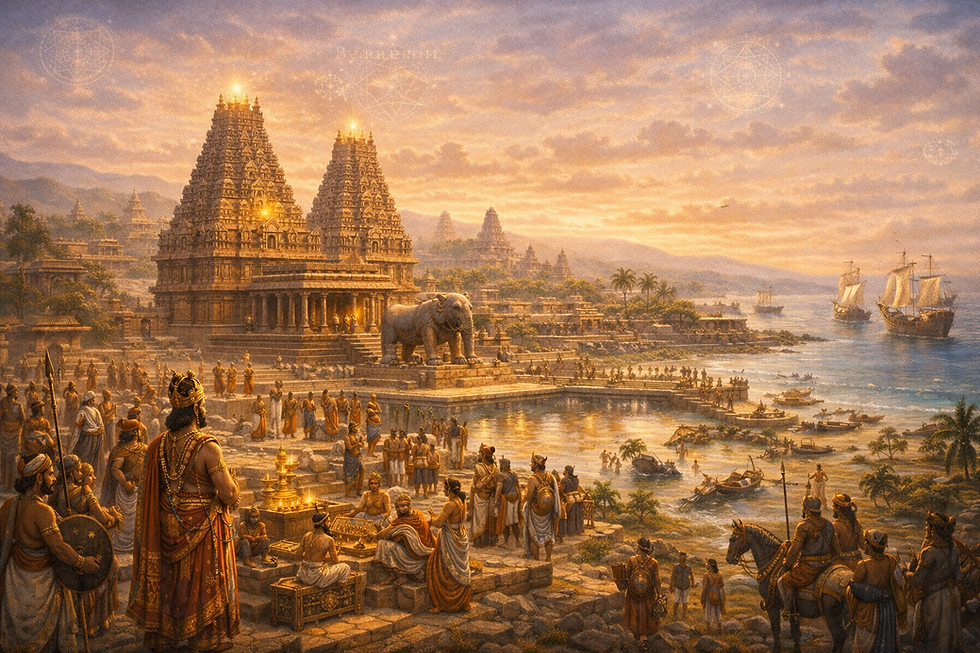
The Pandyas, one of the three crowned kings of the Sangam period, re‑emerged in the 6th century AD as a force in the southern Tamil country. They reached their zenith in the 13th century, after the decline of the Cholas.
Maravarman Sundara Pandya I and Jatavarman Sundara Pandya I (c. 1251–1268 AD) expanded the Pandya kingdom to include most of the Tamil country, Kerala, and parts of Sri Lanka, and they constructed the magnificent Srirangam temple (the largest functioning Hindu temple in the world) and the Jambukeswara temple at Tiruchirappalli.

The Pandyas were also the first South Indian dynasty to face the full force of the Delhi Sultanate. In 1311 AD, Malik Kafur, a general of Alauddin Khalji, raided Madurai and plundered the Meenakshi temple.
The Pandya kingdom collapsed into chaos, and the south entered a period of instability that would be resolved only by the rise of the Vijayanagara Empire (1336–1646 AD).
Vijayanagara, which consciously styled itself as a protector of Hindu dharma against the Deccan sultanates, is conventionally treated as a separate period, but its origins lie in the classical foundations laid by the Pallavas and Cholas.
The Bhakti Movement in the Tamil Country
No discussion of South India in this period would be complete without the Bhakti movement; the devotional turn that reshaped Hinduism from a ritual‑oriented Brahmanical system into a popular, emotional, and vernacular religion.
The Bhakti movement originated in the Tamil country between the 6th and 9th centuries AD, centuries before it spread to other regions of India.
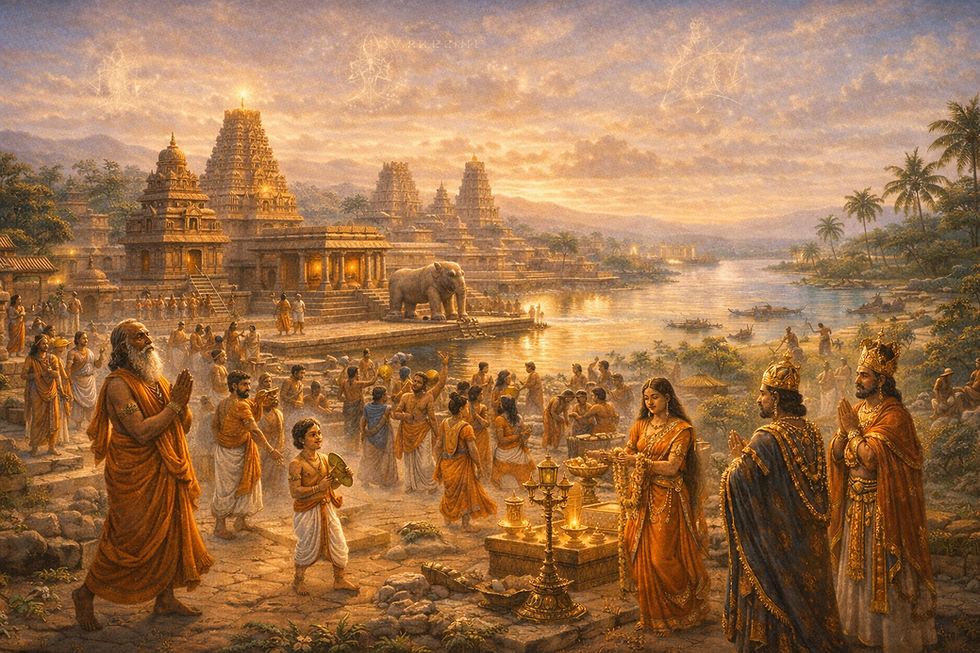
Two groups of poet‑saints were central:
The Nayanars (Shaivite poets, 6th–9th centuries): The Nayanars were 63 poet‑saints (the number is conventional) who sang hymns of devotion to Shiva in Tamil. The three most famous Nayanars are Appar, Sundarar, and Sambandar (often called the “Tevaram Trio”).
Their hymns were collected as the Tevaram and are still sung in Shaivite temples today. The Nayanars often criticised the institutional power of the Brahmins, championed temple worship over Vedic sacrifice, and promoted the idea that devotion (bhakti) was superior to ritual knowledge.
The Alvars (Vaishnava poets, 6th–9th centuries): The Alvars were 12 poet‑saints who sang hymns in Tamil to Vishnu and his avatars (especially Krishna and Rama). Their most famous member is Nammalvar (c. 9th century AD), whose Tiruvaymoli (4,000 hymns) is considered the core text of the Sri Vaishnava tradition.
The Alvars’ hymns were compiled as the Divya Prabandham (often called the “Tamil Veda”). Like the Nayanars, the Alvars challenged Brahmanical orthodoxy: they taught that devotion was open to all, regardless of caste or gender, and that the deity could be accessed directly through love and surrender.
The Bhakti movement was not merely a religious phenomenon: it was also a political and social revolution. The Pallava and Chola kings patronised the Nayanars and Alvars, commissioning temple icons of the saints and incorporating their hymns into temple ritual.
By co‑opting the Bhakti poets, the state transformed a potentially subversive popular movement into an instrument of royal legitimation.
The temples of the Chola period—Thanjavur, Gangaikondacholapuram, Darasuram—are as much monuments to the Chola kings’ alliance with the Bhakti movement as they are shrines to Shiva or Vishnu.

Part IV: The Northeast – Pala, Kamarupa, and Kangleipak
While the Pratiharas and Rashtrakutas fought over the north and the Deccan, the Pala dynasty (c. 750–1174 AD) ruled Bengal and Bihar, creating the last great Buddhist imperium in the subcontinent.
The Palas are a striking exception to the general decline of Buddhism in post‑Gupta India: they were dedicated Mahayana and Tantric Buddhists, and they used state resources to support the great monastic universities that made eastern India a centre of Buddhist learning for all of Asia.

Gopala (r. 750–770 AD), the dynasty’s founder, was said to have been elected by a council of chieftains to end a period of political chaos; a remarkable instance of early medieval electoral politics.
His son Dharmapala (r. 770–810 AD) and grandson Devapala (r. 810–850 AD) expanded the Pala kingdom into an empire that briefly controlled Kannauj and much of northern India. But the Palas’ lasting legacy was not territorial but intellectual.
Under Pala patronage, the great mahaviharas (Buddhist monastic universities) flourished:
Nalanda (already a major centre since the Gupta period) received lavish Pala support. The Pala kings built several of Nalanda’s monasteries and established endowments for its monks. Nalanda’s library was said to have housed millions of manuscripts and attracted scholars from China, Tibet, Korea, and Southeast Asia.
Vikramashila was founded by Dharmapala in the late 8th century and became the premier centre of Tantric Buddhist learning. Its curriculum emphasised esoteric rituals, mandalas, and yogic practices that were not taught at Nalanda. Atis Dipankara (982–1054 AD), the great Bengali monk who reformed Tibetan Buddhism, studied and taught at Vikramashila.
Somapura Mahavihara (in present‑day Bangladesh) was a massive monastic complex built by Dharmapala, with a central shrine that remains one of the largest Buddhist structures in South Asia. The site is now a UNESCO World Heritage site.
Odantapuri (established by Gopala) and Jagaddala (founded by the later Palas) completed the network of Pala‑period mahaviharas.
The Palas’ support for Buddhism was not exclusive: they also patronised Hindu temples and Jain institutions, and their inscriptions record land grants to Brahmins.
But their identity as Buddhist kings shaped their foreign policy: they maintained diplomatic relations with the Buddhist courts of Srivijaya (Sumatra) and Tibet, and they sent missions to the Pala court of Java. The Pala period was the last moment when Buddhism in India enjoyed royal patronage on a grand scale.
The Pala dynasty declined in the 12th century, weakened by internal rebellions and by the expansion of the Hindu Sena dynasty (who took control of Bengal in the mid‑12th century).
The Buddhist mahaviharas were sacked by Turkish forces in the early 13th century: Nalanda was destroyed in 1193 AD by Bakhtiyar Khalji, and Vikramashila fell around 1203 AD.
The destruction of these institutions effectively ended organised Buddhism in eastern India, though Buddhist practices continued in Nepal, Tibet, and Southeast Asia.
The Kamarupa Kingdom
The kingdom of Kamarupa (roughly modern Assam) maintained an independent trajectory from the classical period through the early medieval.
The Varman dynasty (c. 350–650 AD) was the first historically attested ruling house, but the Mlechchha dynasty (c. 655–900 AD) and the Pala dynasty of Kamarupa (not to be confused with the Palas of Bengal; c. 900–1140 AD) followed.

Kamarupa’s location in the Brahmaputra Valley, sandwiched between the Tibetan plateau and the hills of Northeast India, made it a crossroads of cultures.
The kingdom maintained diplomatic relations with the Guptas (the Allahabad Pillar inscription lists “Kamarupa” among the frontier kingdoms that paid tribute to Samudragupta), and later with Harshavardhana (the Kamarupa king Bhaskaravarman allied with Harsha). Bhaskaravarman also sent an embassy to the Tang court in China in the 7th century.
The Kamarupa kings were primarily Hindu (Shaivite, with some Vaishnava influence), but they also patronised Buddhism and local tribal cults.
The kingdom’s inscriptions are in Sanskrit, but the local population spoke and wrote in early Assamese, a language that began to diverge from Magadhi Prakrit during this period. Kamarupa was finally absorbed into the wider Indian political orbit by the Ahom dynasty, which established itself in the 13th century.
The Meitei Kingdom of Kangleipak
The Meitei kingdom of Kangleipak (roughly modern Manipur), which was introduced in Part I of the Ancient India Whitepaper, continued its independent development throughout the classical period. The Meitei maintain a dynastic tradition that traces their kings to 1445 BC, but the first historically verifiable rulers appear in the 1st millennium AD.
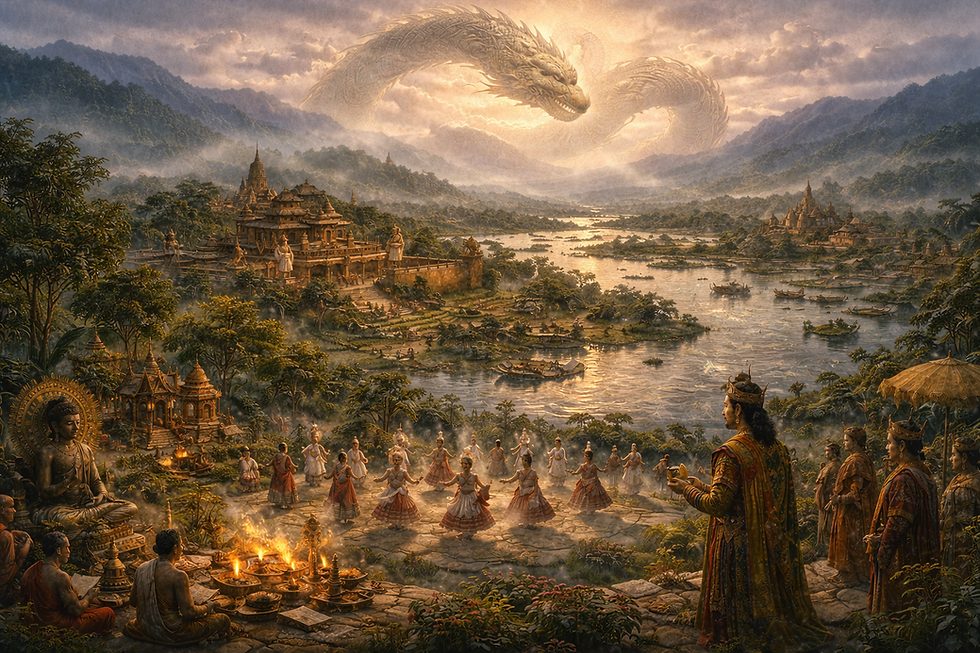
The Meitei had a distinct religion, Sanamahism, which involved the worship of ancestral deities, nature spirits, and the supreme god Pakhangba (often depicted as a serpent or a dragon). Sanamahism was organised around sacred groves (the Umang Lai) and ritual performances that included martial dances, drumming, and possession.
The Meitei also developed a sophisticated script (Meitei Mayek), which was used for the Puya (sacred texts), the most important of which, the Wakoklon Heelel Thilen Salai Amailon Pukok Puya, is dated by tradition to 1398 BC.
The Meitei kingdom was also the origin of the game of polo (Sagol Kangjei), which was played on ponies as a training exercise for cavalry. The world’s oldest polo ground, the Imphal Polo Ground, is said to have existed since the 15th century BC, though the modern game was codified in the 19th century.
During the classical period, the Meitei expanded their territory and developed a centralised administrative system. They resisted incursions from the Ahom kingdom and from various Burmese polities.
The Meitei’s gradual adoption of Hinduism began in the 15th century and accelerated in the 18th century under royal patronage, but Sanamahism survived among the Meitei and has experienced a revival in recent decades.
Part V: Religious and Cultural Transformations
The classical period saw the final flourishing of Buddhism in its land of origin; and its effective extinction. By 1200 AD, Buddhism had largely disappeared from the Gangetic plain and the Deccan, surviving only in Nepal, in the Himalayan fringe, and in the maritime networks of the Bay of Bengal (the Chola period saw a brief Buddhist revival under Rajaraja I, who granted land to the Buddhist vihara at Nagapattinam).

The decline of Buddhism in India has been the subject of much scholarly debate. The traditional view, that Buddhism was “absorbed” into Hinduism, is too simplistic. More accurate is the observation that Buddhism lost royal patronage.
The Palas were the last dynasty to sponsor Buddhist institutions on a large scale. When the Sena dynasty overthrew the Palas in Bengal (c. 1150 AD), they favoured Hinduism and reduced support for Buddhist monasteries.
The Turkish invasions of the early 13th century delivered the coup de grâce: the destruction of Nalanda, Vikramashila, and Odantapuri eliminated the institutional base of organised Buddhism in the east.
Yet Buddhism did not simply vanish. Buddhist philosophy (especially the logic of Dharmakirti and the epistemology of Dignaga) was absorbed into Hindu Vedantic systems, and Buddhist meditation practices influenced the Nath yogi traditions.
The Buddha was incorporated into the Hindu pantheon as an avatar of Vishnu; the ultimate act of absorption through identification. But as a separate, institutionally supported religion, Buddhism in India had effectively ended by 1200 AD.
The Consolidation of Puranic Hinduism
The classical period was the age of the Puranas. The major Puranas (Vishnu, Shiva, Markandeya, Bhagavata, Agni, etc.) were finalised during this period, though their composition spanned several centuries.
The Puranas performed a crucial ideological function: they provided a common mythological framework that could accommodate the vast diversity of local cults and regional deities. A local goddess in Bengal, a tribal deity in the Deccan, a village guardian in Tamil Nadu; all could be identified as a manifestation (avatar, shakti, or amsha) of Vishnu, Shiva, or the Devi.
The Puranas also codified the varna (caste) system and the rites of passage (samskaras) that marked a Hindu’s life. They prescribed the duties of kings, the rituals of temples, and the ethics of everyday life. In the absence of a centralised political authority, the Puranas provided a shared civilisational grammar that could be adapted to local conditions.
The classical period also saw the rise of the temple as the centre of Hindu life. The early Pallava, Chalukya, and Chola temples were not just places of worship; they were economic institutions (landlords who managed extensive endowments), educational institutions (centres of learning), and political institutions (stages for royal ritual).
The temple’s role in the classical period can be understood as a complement to the feudal state: the king granted land to the temple; the temple legitimised the king’s rule; and the temple’s priests and functionaries formed a literate, organised class that could serve as administrators. The temple was, in effect, a parallel state.
Regional Literatures and the Vernacular Turn
The classical period witnessed the emergence of regional literatures alongside Sanskrit. The process began in the Tamil country, where the Sangam anthologies and the Bhakti hymns of the Nayanars and Alvars established Tamil as a literary language equal to Sanskrit.
The 9th‑century Kavirajamarga (the earliest Kannada literary work) was produced under the Rashtrakuta king Amoghavarsha, signalling the rise of Kannada as a court language.
The Telugu language, which had been used for inscriptions since the 6th century, developed a literary tradition under the patronage of the Eastern Chalukyas and the Kakatiyas. The earliest Assamese and Odia texts also date from the late classical period.
This “vernacular turn” was not a rejection of Sanskrit but a complement to it. The same court that sponsored a Sanskrit poet would also sponsor a Kannada or Tamil poet.
The regional languages became vehicles for the same Puranic stories and Bhakti themes, but they also allowed for the expression of local identities and the circulation of literature among non‑elite audiences. The vernacular literatures of the classical period laid the foundation for the mature literary traditions of the medieval and modern periods.
The Climax of Indian Temple Architecture
The classical period produced the most celebrated temple architecture in India. Three major styles emerged:

Nagara (northern) style: Characterised by a curvilinear shikhara (tower) and a cruciform ground plan. The temples of Khajuraho (Chandela dynasty, 10th–11th centuries) are the finest examples of the mature Nagara style, with their soaring shikharas, intricate sculptural programs, and the famous erotic panels that have made Khajuraho a symbol of Indian temple art.
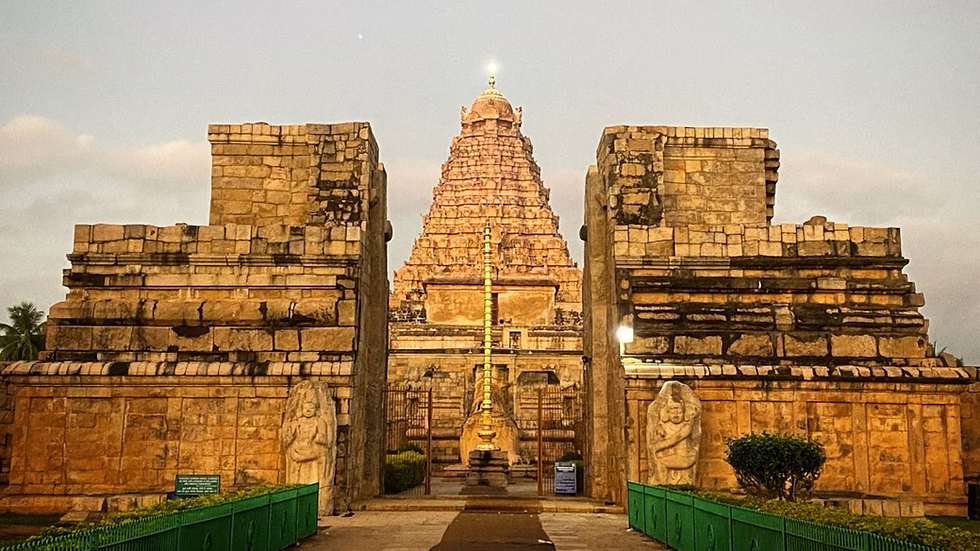
Dravida (southern) style: Characterised by a pyramidal vimana (tower) composed of storeys (often with a barrel‑vaulted roof) and a large gopuram (gateway tower) that came to dominate the temple complex in the later period.
The Chola temples at Thanjavur, Gangaikondacholapuram, and Darasuram represent the climax of the Dravida style. The Brihadisvara temple at Thanjavur is notable for its 66‑metre vimana, which is entirely hollow; an engineering feat that has never been replicated.

Vesara (Deccani) style: A hybrid of Nagara and Dravida elements, the Vesara style flourished under the Chalukyas and the Hoysalas. The Hoysaleshwara temple at Halebidu and the Chennakeshava temple at Belur are covered with an extraordinary density of sculptural ornament, depicting scenes from the Ramayana, the Mahabharata, and the Puranas in minute, often overlapping detail.
The construction of these temples required enormous resources: quarrying, transporting, and carving stone; training and managing hundreds of artisans; and organising the supply of provisions for the labour force.
The temples were statements of royal power, and their inscriptions record the endowments of land, cattle, and gold that supported their ritual operations.
Science, Mathematics, and Medicine
The classical period continued the scientific traditions that had flourished under the Guptas. The most important figure was Brahmagupta (b. 598 AD), whose Brahmasphutasiddhanta (“The Opening of the Universe”) established the rules for arithmetic with zero and negative numbers.
Brahmagupta defined zero as the result of subtracting a number from itself and described its properties in multiplication and division. His work was translated into Arabic and transmitted to the Islamic world, where it influenced the development of algebra.
Other notable scholars include:
Bhaskara II (Bhaskaracharya, b. 1114 AD): His Siddhanta Shiromani (“Crown of Treatises”) covered arithmetic, algebra, geometry, and astronomy. He anticipated concepts of differential calculus and developed a method for solving quadratic equations.
Sushruta’s compendium (which originated in the ancient period) was continuously revised and expanded during the classical period. The Ashtanga Hridayam (“The Heart of Medicine”) of Vagbhata (c. 7th century AD) synthesised the Sushruta and Charaka traditions and became the standard textbook of Ayurveda.
Astronomy remained closely tied to astrology (jyotisha), and the classical period produced several important astronomical works, including the Pancha‑siddhantika of Varahamihira (6th century AD).
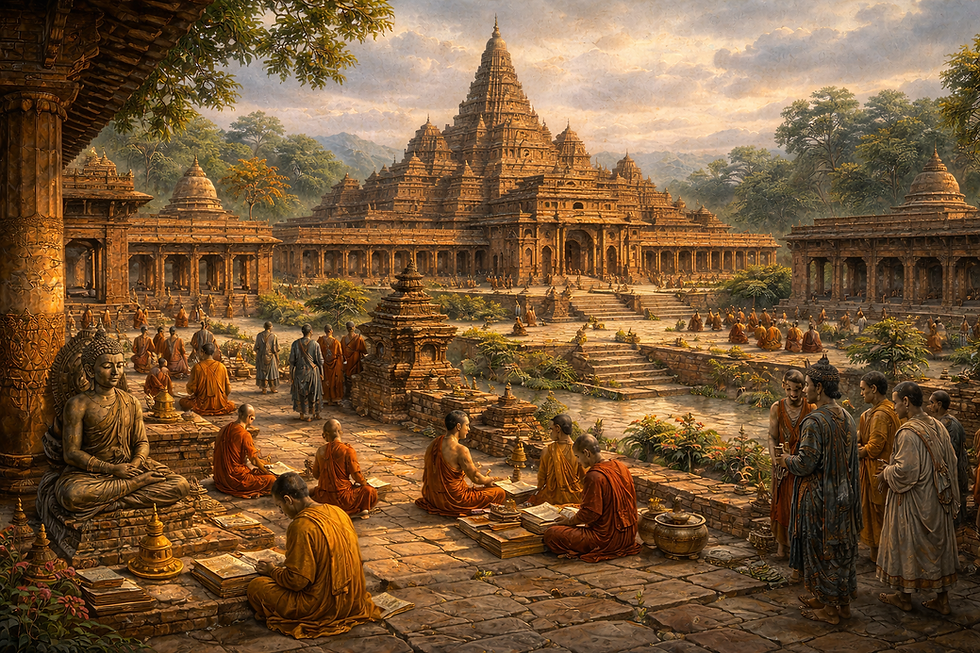
The scientific achievements of the classical period were not isolated to a few geniuses. They were embedded in a broader culture of mathematical and astronomical education, centred on the temple schools and the mahaviharas (especially Nalanda, which had a department of astronomy).
Part VI: Classical India in Global Context
The political history of classical India exhibits several persistent patterns that distinguish it from the ancient period:
The samanta system: The feudal structure that emerged under the Guptas became the dominant form of political organisation. A powerful king would conquer or accept the submission of lesser kings, who would retain their thrones as samantas (feudatories), paying tribute and providing military contingents.
When central power weakened, the samantas became independent. This system was more resilient than the Mauryan model of direct administration, but it was also more unstable.
The Kannauj prize: From Harsha’s time until the Ghurid conquest, control of Kannauj was the primary objective of northern powers. The city’s strategic location on the Ganges, its symbolic status as the capital of the Gupta empire, and its control over the trade routes of the Gangetic plain made it the most valuable political asset in the north.
The tripartite dynamic: The competition among the Pratiharas (west), Palas (east), and Rashtrakutas (south) is the classic example of the “three‑body problem” in Indian politics. No single power could eliminate the other two, and the ebb and flow of their conflicts produced a dynamic equilibrium that lasted for centuries.
Religious legitimation: All classical dynasties used religious patronage to legitimise their rule. Hindu kings performed ashvamedha sacrifices (or their symbolic equivalents), built temples, and claimed divine descent.
Buddhist kings (the Palas) patronised the sangha and sponsored the great mahaviharas. Jain kings (the Rashtrakutas under Amoghavarsha) endowed Jain monasteries and sponsored Jain scholars. In every case, the state co‑opted religion to project an image of cosmic order and moral authority.
The persistence of the gana‑sangha ideal: Even in the classical period, when monarchy was the norm, the republican ideals of the ancient gana‑sanghas survived in the form of local assemblies.
The Uttaramerur inscription (c. 920 AD) describes the election of village committees in the Chola kingdom, with detailed rules for eligibility, voting, and tenure.
These assemblies were not democratic in the modern sense (they excluded women and low‑caste members), but they represent a remarkable continuity of non‑monarchical governance.
Classical India in Global Context
The period 550–1200 AD was a time of profound transformation across Eurasia and Africa:
Western Europe (the “Dark Ages” to the High Middle Ages): While India was building the Khajuraho and Brihadisvara temples, Europe was emerging from the post‑Roman “Dark Ages.”
The Carolingian Renaissance (8th–9th centuries) and the Ottonian Renaissance (10th century) produced notable art and architecture, but European urbanisation and literacy rates remained far below Indian levels.
The Crusades (1095–1291 AD) opened European eyes to the wealth and sophistication of the Islamic world and, indirectly, to India.
The Islamic world (Umayyads, Abbasids, Fatimids): The Islamic caliphates were the most powerful political and cultural forces in the Mediterranean and West Asia. The Abbasid Caliphate (750–1258 AD) centred on Baghdad sponsored a translation movement that preserved and advanced Greek philosophy, science, and medicine.
Indian mathematics (including the concept of zero) was translated into Arabic during this period, and Indian astronomers influenced the work of Al‑Biruni and other Islamic scholars.
The Byzantine Empire: The Eastern Roman Empire survived the fall of the west and continued as a major power until its final collapse in 1453. The Byzantines maintained diplomatic relations with India (the Chola emperor Rajendra I received an embassy from the Byzantine emperor Constantine IX in the 11th century).
China (Tang, Song dynasties): The Tang (618–907 AD) and Song (960–1279 AD) dynasties were contemporary with India’s classical period. The Song dynasty, in particular, achieved remarkable levels of technological innovation (printing, gunpowder, paper money) and urbanisation.
Chinese pilgrims (Xuanzang, Yijing) visited India in the 7th century and wrote detailed accounts of Indian Buddhism. The Chola navy’s expedition against Srivijaya (1025 AD) was partly motivated by competition with China for control of the Strait of Malacca.
Southeast Asia (Srivijaya, Khmer Empire, Champa): The classical period saw the “Indianisation” of Southeast Asia, as Indian trading networks, Buddhist and Hindu missionaries, and Indianised courts spread Sanskrit, the Puranas, and Indian architectural styles across the region.

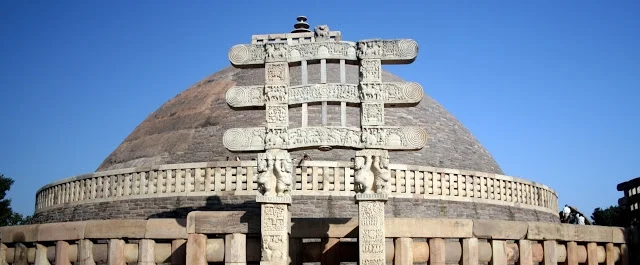
The Khmer Empire (c. 802–1431 AD) built Angkor Wat (the largest religious monument in the world) as a temple to Vishnu, modelled on the cosmic mountain of Meru and incorporating Indian iconographic conventions. The Chola expedition against Srivijaya (1025 AD) was an anomaly in what was otherwise a peaceful exchange of goods and ideas.
The Americas: The Maya, Toltec, and Mississippian cultures flourished in the Americas, but there is no evidence of contact with India during this period. The collapse of the Maya city‑states (c. 9th century AD) was roughly contemporary with the decline of the Pratiharas and Palas, but the causes were independent.
Classical India in Global Chronological Context (Period | India | China | Islamic World | Europe | Southeast Asia):
c. 550–750 AD | Harsha; Chalukyas of Badami; Pallava zenith | Sui reunification; Tang (618–907 AD) | Umayyad Caliphate (661–750 AD) | Merovingian decline; Carolingian rise | Srivijaya (Sumatra) founded
c. 750–1000 AD | Tripartite struggle; Rashtrakuta zenith; Pala zenith; Pratihara zenith | Tang golden age (Xuanzang’s travels) | Abbasid Caliphate (750–1258 AD) | Charlemagne (800 AD); Viking Age | Sailendra dynasty (Borobudur, 8th–9th c.)
c. 1000–1200 AD | Chola zenith; Rajput polities; Pala decline; Turkish invasions | Song dynasty (960–1279 AD); technological revolution | Seljuk Empire (11th–12th c.); Ghaznavids (Indian raids) | Crusades (1095–1291 AD); Norman conquest of England | Khmer Empire (Angkor Wat, 12th c.)
Part VII: Conclusion – The Classical Legacy
The classical period (c. 550–1200 AD) was not the age of a single pan‑Indian empire. It was, rather, the age of regional empire: the Chalukyas, Rashtrakutas, and Cholas in the south; the Pratiharas, Palas, and various Rajput dynasties in the north; the Palas in the east.
This fragmentation was not a sign of civilisational decline. It was, instead, the condition for an extraordinary efflorescence of regional cultures, each adapting the shared civilisational framework (Sanskrit, Puranic Hinduism, the samanta system) to local conditions.
The classical period bequeathed to later India several enduring legacies:
The triumph of the temple: The classical temple, with its elaborate rituals, its economic power, and its role as a centre of art and learning, became the most characteristic institution of medieval India. The temple building traditions of the Pallavas, Cholas, Chalukyas, and Hoysalas directly influenced the later architecture of Vijayanagara, the Nayakas, and the Marathas.
The Bhakti movement: Although Bhakti originated in the Tamil country in the classical period, it spread across India in the later medieval and early modern periods, reshaping Hinduism from a ritual‑centred Brahmanical religion into a popular, devotional faith. The hymns of the Nayanars and Alvars are still sung in temples today, and the Bhakti saints of the classical period are venerated as founders of living traditions.
The vernacular literatures: The emergence of Kannada, Telugu, Assamese, and early Bengali as literary languages laid the groundwork for the mature literary traditions of the medieval and modern periods. The same process, the rise of vernacular literature alongside Sanskrit, was occurring simultaneously in Europe (the rise of Romance languages, Old English, Old High German) and in the Islamic world (Persian, Turkish, Urdu).
The transmission of Buddhism to East Asia: The Pala‑period mahaviharas trained the monks who carried Buddhism to Tibet, Mongolia, and China. The destruction of Nalanda and Vikramashila in the early 13th century was a catastrophic blow to organised Buddhism in India, but the Pala legacy survived in the Tibetan Buddhist canon, which preserves many works that were lost in their original Sanskrit.
The mathematics of zero: The classical period’s mathematical innovations—Brahmagupta’s rules for zero and negative numbers, Bhaskara’s anticipations of calculus—were transmitted to the Islamic world and, from there, to Europe. The “Arabic numerals” that the modern world uses are, in fact, Indian numerals transmitted through Arab intermediaries.
The classical period ended not with a single event but with a cascade of them: the Ghurid conquest of northern India (1192–1206 AD); the destruction of Nalanda and Vikramashila (1193–1203 AD); the decline of the Chola empire (1279 AD); the fall of the Rashtrakutas and the Western Chalukyas.
By 1300 AD, a new political order had emerged: the Delhi Sultanate in the north, the Bahmani Sultanate and the Vijayanagara Empire in the south. The classical world of regional Hindu and Buddhist kingdoms had given way to the age of the sultanates.
Yet the classical legacy was not erased. The temples of Khajuraho, Thanjavur, and Belur still stand. The hymns of the Nayanars and Alvars are still sung. The mathematics of zero is still used. And the political fragmentation of the classical period, with its dynamic equilibrium of competing powers, remains the template for later Indian history.
India has rarely been unified under a single ruler. It has, instead, been unified by a civilisation: a shared language of art and ritual, a common vocabulary of myth and devotion, and a flexible political system that allowed for the co‑existence of many kingdoms within a single civilisational frame.
Appendix A: Timeline of Classical India
543–566 AD | Pulakeshin I establishes Chalukya kingdom at Badami | Deccan power emerges
606–647 AD | Reign of Harshavardhana | Last pan‑northern empire before Muslim conquests
610–642 AD | Reign of Pulakeshin II | Chalukya zenith; repulses Harsha
c. 600–630 AD | Mahendravarman I’s rock‑cut temples | First stone temples in South India
630–668 AD | Narasimhavarman I captures Badami | Pallava zenith; Mahabalipuram monuments
c. 711 AD | Arab conquest of Sindh | First Muslim polity in India
c. 730 CE | Nagabhata I defeats Arab invasion | Pratiharas emerge as “gatekeepers of the west”
750 AD | Gopala elected first Pala king | Buddhist dynasty in Bengal/Bihar
753 AD | Dantidurga overthrows Chalukyas; Rashtrakuta dynasty begins | Deccan empire rises
756–773 AD | Krishna I builds Kailasa temple at Ellora | Zenith of Indian rock‑cut architecture
c. 770–810 AD | Dharmapala’s reign; Vikramashila founded | Pala zenith; Buddhist mahaviharas
c. 814–878 AD | Amoghavarsha I | Rashtrakuta zenith; Kannada literature
c. 836–885 AD | Mihira Bhoja | Pratihara zenith; largest empire since Guptas
850 AD | Vijayalaya Chola captures Thanjavur | Chola revival begins
985–1014 AD | Rajaraja I | Chola zenith; Brihadisvara temple built
998–1030 AD | Mahmud of Ghazni’s raids | Pratihara decline; temple destructions
1014–1044 AD | Rajendra I | Chola navy conquers Srivijaya
c. 1010–1055 AD | Bhoja Paramara | Malwa zenith; Sanskrit scholarship
1030 AD | Al‑Biruni completes Tarikh al‑Hind | Islamic scholar’s account of India
1191–1192 AD | Battles of Tarain | Prithviraj Chauhan defeats (1191) then is defeated by (1192) Muhammad Ghori
1193 AD | Bakhtiyar Khalji destroys Nalanda | End of organised Buddhism in India
1206 AD | Qutb-ud-din Aibak declares Delhi Sultanate | Beginning of Muslim rule in North India
Appendix B: Key Sites and Monuments of Classical India
Badami (Vatapi) | Karnataka | Chalukyas of Badami | 6th–7th c. | Rock‑cut caves; Bhutanatha temple
Aihole | Karnataka | Chalukyas of Badami | 6th–7th c. | “Cradle of Indian temple architecture”; 120+ structures
Pattadakal | Karnataka | Chalukyas of Badami | 7th–8th c. | UNESCO site; Virupaksha temple
Ellora Caves | Maharashtra | Rashtrakutas | 8th c. | Kailasa temple (Cave 16); Buddhist, Hindu, Jain caves
Mahabalipuram | Tamil Nadu | Pallavas | 7th–8th c. | Pancha Rathas; Shore Temple; Descent of the Ganges
Kanchipuram | Tamil Nadu | Pallavas, Cholas | 7th–9th c. | Kailasanatha temple; Vaikuntha Perumal temple
Khajuraho | Madhya Pradesh | Chandelas | 10th–11th c. | Nagara‑style temples; erotic sculpture
Thanjavur (Brihadisvara) | Tamil Nadu | Cholas | 1010 AD | 66 m vimana; Chola bronze sculpture
Gangaikondacholapuram | Tamil Nadu | Cholas | 11th c. | Rajendra I’s temple; smaller than Thanjavur
Darasuram (Airavatesvara) | Tamil Nadu | Cholas | 12th c. | Chola bronze casting; UNESCO site
Nalanda | Bihar | Palas (and earlier) | 5th–12th c. | Buddhist mahavihara; destroyed 1193 AD
Vikramashila | Bihar | Palas | 8th–12th c. | Tantric Buddhist centre; destroyed c. 1203 AD
Somapura Mahavihara | Bangladesh | Palas | 8th c. | Largest Buddhist monastery in South Asia
Belur (Chennakeshava) | Karnataka | Hoysalas | 12th c. | Hoysala temple; intricate sculpture
Halebidu (Hoysaleshwara) | Karnataka | Hoysalas | 12th c. | Hoysala zenith; star‑shaped platform
Warangal (Thousand Pillar Temple) | Telangana | Kakatiyas | 12th c. | Kakatiya architecture
Martand Sun Temple | Kashmir | Karkotas | 8th c. | Unique Kashmiri temple architecture

Bibliography
Mainstream History and Archaeology:
Keay, J. (2000). India: A History. Atlantic Monthly Press.
Kulke, H., & Rothermund, D. (2016). A History of India (6th ed.). Routledge.
Singh, U. (2009). A History of Ancient and Early Medieval India. Pearson.
Thapar, R. (2002). Early India: From the Origins to AD 1300. University of California Press.
Regional Dynasties and Political History:
Champakalakshmi, R. (1996). Trade, Ideology and Urbanization: South India 300 BC to AD 1300. Oxford University Press.
Nagaraju, S. (1981). The Chalukyas of Badami. Bangalore University.
Sastri, K. A. N. (1955). A History of South India. Oxford University Press.
Sastri, K. A. N. (1955). The Cholas (2nd ed.). University of Madras.
Sharma, R. S. (2001). Early Medieval Indian Society: A Study in Feudalism. Orient Longman.
Religion and Bhakti:
Hardy, F. (1983). Viraha‑Bhakti: The Early History of Krsna Devotion in South India. Oxford University Press.
Pechilis, K. (2012). The Graceful Guru: Hindu Female Gurus in India and the United States. Oxford University Press.
Zvelebil, K. V. (1974). Tamil Literature. Otto Harrassowitz.
Art and Architecture:
Dehejia, V. (1997). Indian Art. Phaidon.
Harle, J. C. (1994). The Art and Architecture of the Indian Subcontinent. Yale University Press.
Kramrisch, S. (1946). The Hindu Temple. University of Calcutta.
Michell, G. (1988). The Hindu Temple: An Introduction to Its Meaning and Forms. University of Chicago Press.
Primary Sources in Translation:
Bana’s Harshacharita: Cowell, E. B., & Thomas, F. W. (1897). The Harsa‑carita of Bana. Royal Asiatic Society.
Xuanzang’s Record of the Western Regions: Beal, S. (1884). Si‑yu‑ki: Buddhist Records of the Western World. Trübner.
The Kavirajamarga: Narasimhachar, R. (1940). Kavirajamarga. Kannada Sahitya Parishat.
The Tevaram (Tamil Shaiva hymns): Peterson, I. V. (1989). Poems to Siva: The Hymns of the Tamil Saints. Motilal Banarsidass.
The Divya Prabandham (Tamil Vaishnava hymns): Narayanan, V. (1994). The Vernacular Veda: Revelation, Recitation, and Ritual. University of South Carolina Press.
The Uttaramerur inscription: Venkayya, V. (1904). Annual Report on Epigraphy. Archaeological Survey of India.


Comments