
.png)

Ancient World: Judea, the People of Yahweh (Judah/Israel)
- A. Royden D'Souza

- Apr 30
- 32 min read
Few topics in ancient history generate as much acrimony as the existence of a “United Monarchy” under David and Solomon. The biblical narrative (1 Kings 4:21) describes a glorious empire stretching from the Euphrates to the border of Egypt, with Jerusalem as its magnificent capital.
Yet after more than a century of excavation, no indisputable architectural or epigraphic trace of such a tenth‑century BC empire has been found in Jerusalem.
The Tel Dan Stele (late ninth century BC) refers to the “House of David” (bēt Dawīd), confirming that a dynasty bearing David’s name was recognized by neighboring Aramaeans, but it does not confirm the biblical portrayal of a vast, centralized state. The mystery, and the controversy, lies precisely in this gap between text and ground.

The story of ancient Israel/Judea/Palestine is not a simple unfolding of a single ethnic or national destiny. Rather, it is a layered fabric of continuous habitation, punctuated by migrations, elite manipulation of ritual and genealogy, and a protracted, contested fusion of indigenous and external traditions.
What later generations would call “Israelite religion” and “Jewish identity” were products of selective memory, ritual innovation, and deliberate suppression of alternative voices; processes that are visible in the archaeological record once we set aside the assumption that any single narrative holds a monopoly on truth.
This paper covers the entire arc from the first hominin presence (~1.4 Ma) through the formation of the centralized Judahite state and the Babylonian Exile (586 BC). It integrates archaeology, textual criticism, genetics, and comparative history.
All traditional narratives—indigenous, nationalist, colonial—are treated as data to be analyzed, not as truth-claims to be defended or debunked a priori.
Where evidence is disputed, competing interpretations are presented with explicit assessment of their evidentiary basis. Genetic evidence is included with clear caveats about what it can and cannot prove (e.g., ancestry ≠ language, uniparental markers track only single lineages).
Part I: Land, First Inhabitants, and Deep Time
The southern Levant is a narrow land-bridge (~100–150 km wide) between Africa and Eurasia, bounded by the Mediterranean to the west and the Syrian-Arabian desert to the east.
Its four longitudinal zones—coastal plain, central highlands, Jordan Rift Valley, and Transjordanian plateau—created sharply differing micro-environments.

During glacial periods, when much of Eurasia was inhospitable, the Levant served as a refuge and corridor for hominin dispersals. Lake Lisan (the Pleistocene precursor of the Dead Sea) expanded and contracted dramatically, influencing local ecology.
These geological realities determined settlement patterns, migration routes, and the distribution of resources critical for human evolution.
Earliest Human Presence (Lower and Middle Paleolithic)
The earliest documented occupation is at עובידיה (Ubeidiya) in the Jordan Valley, dated to ca. 1.4 million years ago (Early Acheulian). With handaxes, cleavers, and flakes, Ubeidiya represents one of the oldest hominin sites outside Africa, predating even Dmanisi (Georgia, 1.8 Ma) in comparable richness. The presence of Homo erectus sensu lato is inferred.
Later Acheulian sites include Gesher Benot Ya‘akov (ca. 780 ka), which has yielded evidence of controlled fire use and butchery of large mammals, and Tabun Cave (Mount Carmel), whose sequence spans from the Acheulo-Yabrudian to the Mousterian.
The Middle Paleolithic (250–48 ka) in the Levant is uniquely important because it documents the coexistence and alternating occupation of Neanderthals and anatomically modern humans (AMH):
Tabun and Amud Caves yielded characteristic Neanderthal remains (e.g., Amud 1, dated to ~55 ka).
Skhul and Qafzeh Caves yielded AMH remains dated to ca. 90–120 ka, with crania showing a mixture of archaic and modern features, often interpreted as evidence of an early, ultimately failed, African exodus.
The מערת קסם (Qesem Cave), occupied from 400 ka to 200 ka, shows particularly sophisticated behavior: habitual fire use (hearths repeatedly burned at the same spot), systematic large-game hunting (fallow deer, aurochs), food sharing, and tooth analysis suggesting a non-Homo erectus lineage; possibly a distinct hominin population or early Neanderthal.
Pre‑Agricultural Societies (Epipaleolithic)
The התרבות הנאטופית (Natufian culture) (15,000–11,500 BP) was extraordinary: sedentary or semi‑sedentary communities emerged before agriculture.
Natufians at sites such asעין מלחה (ʿAin Mallaha) (Eynan) lived in round stone houses, buried their dead with ornaments (dentalium shell headdresses, bone tools), and produced the world’s oldest known bread-like food at Shubayqa 1 (14,400 BP).
The Natufian toolkit included sickles for harvesting wild cereals, mortars, and carved stone objects, indicating a symbolic complexity that foreshadows later Neolithic ritual.
The transition to sedentism, however, was not irreversible; some Natufian groups reverted to mobility during the harsh Younger Dryas (12,800–11,500 BP).
Comparative Box: Deep Time Developments (Region | ~1.5 Ma | ~100 ka | ~12,000 BP):
Southern Levant | Ubeidiya (Early Acheulian) | Skhul/Qafzeh AMH, Neanderthals alternating | Natufian sedentism, early bread
East Africa | Olduvai Gorge H. habilis/erectus | Omo Kibish AMH (ca. 195 ka) | Early Saharan pastoralism
Europe | Atapuerca (H. antecessor, ~1.2 Ma) | Neanderthal dominance, Châtelperronian | Magdalenian reindeer hunters, cave art
East Asia | Yuanmou/Lantian (~1.7 Ma) | Liujiang AMH (~68 ka) | Jomon pottery (Japan, ~16 ka)
South Asia | Attirampakkam (~1.5 Ma) | Jwalapuram (pre-/post-Toba) | Microlithic industries in Sri Lanka
Pattern noted: The Levant repeatedly served as a biogeographical crossroads where multiple hominin lineages met, interacted, and left a palimpsest of cultural innovations.

Part II: Early Complex Societies
The Pre‑Pottery Neolithic A (PPNA) (ca. 10,000–8,800 BC) marks the first appearance of permanent villages. At Jericho (Tel es‑Sultan), a community of 2–3,000 people built a massive stone wall (4 m high, 2 m thick) and an 8.5‑m‑tall circular stone tower around 8000 BC; among the oldest monumental structures in the world.
The tower’s internal stairway and lack of domestic debris suggest it may have served a communal ritual or defensive function; recent geological analysis hints at possible flood control. Another PPNA site, Göbekli Tepe (in modern Turkey, but culturally linked to the northern Levantine PPNA), with its T‑shaped pillars and animal reliefs, demonstrates that large-scale ritual architecture predates agriculture in the region.

The succeeding Pre‑Pottery Neolithic B (PPNB) (8,800–6,500 BC) saw the full domestication of emmer wheat, einkorn, barley, lentils, chickpeas, flax, and legumes, alongside domesticated goats, sheep, and later cattle and pigs.
This “Neolithic crop package” was assembled in the Levant and later spread to Europe and beyond. Settlements grew to unprecedented sizes: ʿAin Ghazal in Jordan covered 10–15 hectares with up to 2,500 inhabitants, featuring multi-room rectangular mud-brick houses with lime-plaster floors.
Social Stratification, Craft Specialization, and Trade
PPNB society was still relatively egalitarian, but emerging differentiation is visible in burial customs and ritual objects.
At ʿAin Ghazal, plastered skulls—human skulls covered with tinted plaster and inset with cowrie shells for eyes—were placed in caches, likely representing ancestor veneration.
Anthropomorphic statues (up to 1 m tall) were also produced from plaster over reed armatures, attesting to ritual specialists.
Long-distance trade networks extended hundreds of kilometers: obsidian from central Anatolia (Cappadocia) reached Levantine PPNB sites; bitumen from the Dead Sea was used for hafting; greenstone and exotic minerals were exchanged. This integration suggests incipient regional elites who controlled the circulation of prestige goods.
Early Religious Cosmology
The plastered skulls and statuary suggest a cosmology centered on ancestor cults and the human form. The circular communal buildings at Jericho and the ritual structures at Göbekli Tepe (while outside the strict study area, they influenced the southern Levant) indicate that communal ritual was a driving force for early sedentism.
The fertility of the land, domesticated animals, and the cycle of death and regeneration were likely central themes. No temples per se have been identified, but domestic shrines and ritual deposits of figurines (including the famous “Naḥal Ḥemar” cave masks) suggest that the sacred was intertwined with the domestic.
Comparative Box: The Agricultural Revolution in Global Context (Region | Domestication Timing | Key Sites | Monumental Architecture):
Southern Levant | 10,500–8,800 BP | Jericho, ʿAin Ghazal, Netiv HaGdud | Tower of Jericho, plastered skulls, statues
Fertile Crescent (north) | 11,000–9,000 BP | Göbekli Tepe, Çayönü, Nevalı Çori | T‑shaped pillars, communal cult buildings
China (Yellow/Yangtze) | 9,000–7,000 BP | Jiahu, Peiligang, Hemudu | Early pottery, jade objects, waterlogged timbers
Mesoamerica | 9,000–4,000 BP (maize) | Guilá Naquitz, Tehuacán | Later Olmec centers; early ballcourts
New Guinea | 10,000 BP (taro, banana) | Kuk Swamp | Agricultural drainage systems
Key difference: In the Levant, monumental ritual structures predate agriculture, while in most other regions they develop centuries or millennia after domestication.
Part III: The Rise of Chiefdoms and Early States
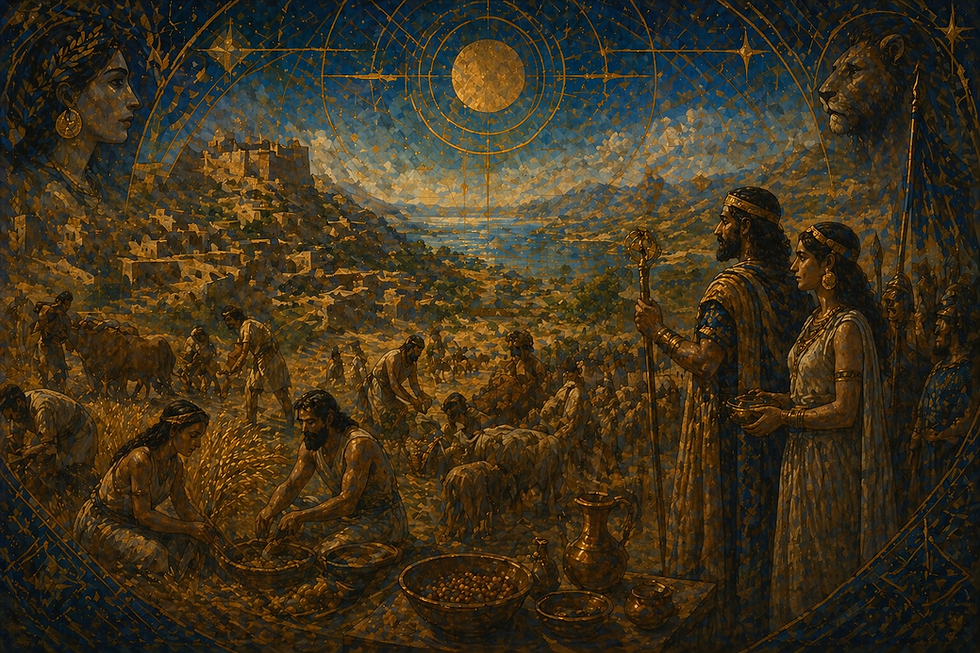
The Ghassulian culture (named after Teleilat Ghassul) flourished during the Chalcolithic, especially in the Jordan Valley and Negev.
This period witnessed the first serious metallurgy: copper tools, weapons, and ritual objects, smelted from ores at Timna (Negev) and Feinan (Jordan).
The Nahal Mishmar hoard, 442 copper objects including crowns, scepters, mace heads, and ibex figurines, discovered in a cave near the Dead Sea, likely belonged to a regional cult center and reflects a society with ritual hierarchy and long-distance exchange (ivory from Africa, basalt from the Golan).
Burial practices evolved into secondary ossuary burial: bones were collected and placed in decorated ceramic ossuaries shaped like houses or animals, often deposited in subterranean caves. Some ossuaries feature human facial features; further evidence of complex death rites and possibly an emerging elite class.
However, no clear palaces or administrative centers have been found, suggesting a chiefdom level of organization, with power vested in ritual specialists and lineage heads rather than kings.
Early Bronze Age: The First City-States
The Early Bronze I saw the first truly fortified urban centers. By EB II–III (ca. 3000–2400 BC), walled towns like Megiddo, Beth Shean, Tell el-Farʿah (North), Ai (et-Tell), and Jericho had palaces, temples, and administrative buildings.
A distinctive Khirbet Kerak ware (ca. 2700 BC) associated with migrants from the Caucasus/Anatolia (the Kura-Araxes culture) appears in the north, indicating both population movement and cultural transmission.
The EB IV / Intermediate Bronze Age (ca. 2400–2000 BC) saw an urban collapse throughout the southern Levant, perhaps linked to a regional climatic drying event (the 4.2 ka event). The population reverted to pastoralism and seasonally occupied villages, a pattern that would repeat itself throughout the region’s history.
Middle Bronze Age: Canaanite City-States and Amorite Dynasties
The MB IIA marked a rapid re‑urbanization, fueled by the arrival of new populations often termed “Amorites.” Massive fortification systems—steep earthen glacis ramparts—appeared at Hazor, Dan, Megiddo, Shechem, and other major tells.
These fortified centers became the seats of Canaanite kings. Royal tombs at Tel Dan and Tel Kabri (with Minoan-style wall paintings) demonstrate intense wealth concentration and long-distance contacts.
Culturally, this period sees the emergence of distinctly Canaanite religious symbolism, including bronze figurines of Baʿal and Astarte, and the wide use of the Proto-Canaanite alphabet. Egyptian texts of the Middle Kingdom refer to the “Asiatics” (‛3mw) and depict Canaanite chieftains bringing tribute.
Late Bronze Age: Canaan under Imperial Rule
Following the expulsion of the Hyksos (who had ruled Egypt and had strong Canaanite connections), the New Kingdom pharaohs invaded and subjugated Canaan. The Amarna letters (14th century BC) are a diplomatic archive of ~350 cuneiform tablets found at Tell el-Amarna, Egypt.
Written in Akkadian, the lingua franca of the time, they reveal a fractious landscape: Canaanite vassal kings like ʿAbdi-Ḫeba of Jerusalem and Labʾayu of Shechem constantly jockeyed for power, accused each other of disloyalty, and pleaded for Egyptian military support against a disruptive social element—the ʿApiru/Ḫabiru.
These are described as landless bands of outlaws, mercenaries, and sometimes rebels who sold their services to rival kings or operated independently.
The ʿApiru hold particular fascination because their name is linguistically related to “Hebrew” (עבריʿIḇrī), though the Amarna letters clearly describe a social class rather than an ethnic group. The connection is plausible but not equivalent; the later "Israelites" may have partially derived from such disenfranchised elements.
Key Late Bronze sites like Hazor (the largest Canaanite city, with an upper and lower city covering 80 ha) and Megiddo show rich material culture, Egyptianizing artifacts, and temples dedicated to Canaanite deities.
The Ugaritic texts (from Ras Shamra in Syria) are crucial for reconstructing Canaanite religion: they detail the pantheon headed by El, his consort Athirat/Asherah, and the warrior Baʿal, whose conflict with Yamm (Sea) and Mot (Death) became central to later Israelite mythmaking.
The Collapse and the Emergence of “Israel”
Around 1200 BC, the Late Bronze Age system collapsed throughout the Eastern Mediterranean. In Canaan, Egyptian garrisons withdrew, trade routes disintegrated, and many Canaanite cities were destroyed, abandoned, or shrank drastically.
In the ensuing Iron I (ca. 1200–1000 BC), the highlands of the central hill country saw a rapid increase in small, unfortified villages; the “Israelite highland settlement” phenomenon.
Hundreds of new sites, typically 0.5–1 ha with populations under 100, appear in the hill country of Ephraim, Manasseh, and Judah. The material culture is distinctive:
A distinct four-room house plan (actually a three-room with a rear broad room) used as both dwelling and animal pen.
Collared-rim storage jars (though not exclusive to Israelites, they are prevalent in highland sites).
A notable absence of pig bones; a dietary taboo that distinguishes these highland villages from contemporary Philistine and Canaanite lowland settlements, where pig remains constitute up to 20% of faunal assemblages. This is one of the earliest tangible archaeological markers of an emerging “Israelite” identity.
The Merneptah Stele (1208 BC) is the earliest extra‑biblical attestation of “Israel” as a people. The inscription reads: “Israel is laid waste; his seed is not.”
Crucially, the determinative hieroglyph used classifies Israel as a people/nomadic group, not a city-state or a territory; consistent with the archaeological picture of a decentralized, tribal society.
Introducing Writing: From Cuneiform to the Alphabet
Writing reached the southern Levant in two great waves. During the Middle and Late Bronze Ages, Canaanite scribes employed Akkadian cuneiform on clay tablets for international correspondence (Amarna letters).
At the same time, a revolutionary alphabetic script emerged: the Proto-Canaanite script (derived from Egyptian hieroglyphic models) first attested in the Serabit el-Khadim inscriptions and later in a handful of short texts at Lachish and elsewhere.
By the Iron I, this script evolved into the Phoenician/Hebrew linear alphabet; a system of 22 consonantal signs that enabled far broader literacy than the hundreds of cuneiform signs. Its earliest uses, however, were for administrative labels, dedicatory inscriptions, and memorial stelae; all serving elite and state functions.
Controversies: Indigenous State Formation vs. External Conquest
Few debates in ancient history match the intensity of the origins of Israel. Four major models have competed:
Unified Conquest | W.F. Albright (mid‑20th c.) | Israelites under Joshua invaded and destroyed Canaanite cities en masse | Contradicted by archaeology: Jericho and Ai were either unfortified or uninhabited in LB IIB. Most cities show no destruction layer.
Peaceful Infiltration | A. Alt, M. Noth (mid‑20th c.) | Pastoral nomads peacefully infiltrated the highlands and gradually coalesced into tribes | Consistent with settlement pattern but lacks positive material evidence. Overly reliant on biblical analogies.
Peasant Revolt | G. Mendenhall, N. Gottwald (1960s–70s) | Disaffected Canaanite peasants, including ʿApiru, revolted against their city-state overlords and fled to the highlands, forming an egalitarian “Yahweh-alone” society | Social-revolutionary model is theoretically elegant but finds no direct archaeological evidence. Yahweh’s early cult likely originated south of Canaan, not in the highlands.
Indigenous Development (Current Consensus) | I. Finkelstein, W. Dever, T. Thompson, A. Faust | Israelites emerged gradually from Canaanite society through a complex process of ethnogenesis that included pastoralists, resedentarized farmers, and possibly some returnees from Egypt. They defined themselves in opposition to Philistines and remaining Canaanite city‑states. | Supported by ceramic continuity with LB Canaanite assemblages, architectural forms, and absence of conquest layers. Explains pig taboo as boundary marker. Acknowledges the biblical narrative as a later literary construct that compressed centuries of memory.
The consensus today is that early Israel was indigenous to Canaan. The settlement pattern, pottery, and architecture all point to a demographic shift within local populations rather than from outside.
The process may have involved elements of all earlier models: some peasants fled oppression, some pastoralists settled down, some tribal alliances were forged.
The biblical conquest narrative was composed centuries later, likely in the 7th–6th centuries BC, to provide a unifying origin myth for a kingdom that needed a glorious past.
Part IV: The First Unified Polity or Classical State

The Iron Age II (1000–586 BC) saw the rise of two distinct Israelite polities:
The Kingdom of Israel (Samaria) in the north, controlling the fertile Jezreel Valley, Galilee, and parts of Transjordan. Its capital moved from Tirzah to the newly built Samaria by King Omri (ca. 880 BC). The Kurkh Monolith of Shalmaneser III (853 BC) lists “Ahab the Israelite” as contributing 2,000 chariots and 10,000 foot soldiers to a coalition against Assyria; a formidable military contribution indicating a major state.
The Kingdom of Judah in the south, with its capital at Jerusalem. It was smaller, poorer, and more rugged, centered on the Judean hills. The Tel Dan Stele (9th century) and the Mesha Stele (Moabite Stone, ca. 840 BC) refer to the “House of David,” confirming a Judahite royal dynasty.
The United Monarchy Debate
The biblical account of a single, glorious United Monarchy under Saul, David, and Solomon (ca. 1025–928 BC) is one of the most fiercely contested topics. The definitive positions:
Maximalist | K. Kitchen, Y. Garfinkel, A. Mazar (Modified Conventional Chronology) | The Tel Dan Stele proves a Davidic dynasty. Khirbet Qeiyafa is a fortified Judahite city (~1000 BC) proving early state organization. “Solomonic” six‑chambered gates at Hazor, Megiddo, and Gezer (1 Kings 9:15) indicate unified royal building programs. Jerusalem’s Large Stone Structure may be David’s palace.
Minimalist | N.P. Lemche, T. Thompson, P. Davies (Copenhagen School) | The Tel Dan Stele is an Aramaic inscription that may not refer to a Judahite king; the reading as “House of David” is plausible but not certain. Jerusalem was a village in the 10th century; no monumental architecture. The biblical texts were written in the Persian or Hellenistic period and project later realities backward. The United Monarchy is a literary fiction.
Centrist / Low Chronology | I. Finkelstein, D. Ussishkin, A. Fantalkin | David and Solomon were historical figures, but their “empire” was a modest highland chiefdom at most. Jerusalem was a small, fortified village with perhaps 2,000 inhabitants; not an imperial capital. The biblical narrative retrojects the power and grandeur of the 8th‑century northern kingdom or the 7th‑century Judah of Josiah onto a much more modest past. Khirbet Qeiyafa is a fortified site, but its identity (Judahite? Canaanite?) is disputed. Low chronology redates “Solomonic” gates to the 9th century (Omride dynasty).
The key archaeological sites:
Khirbet Qeiyafa (~1000 BC): A casemate-walled hilltop site overlooking the Elah Valley. Excavator Yosef Garfinkel argues it is a Judahite fortress from the time of David, citing an ostracon with Proto-Canaanite script, an absence of pig bones, and the site’s position facing Philistines. David Ussishkin reinterprets it as a Canaanite cultic compound, noting the casemate wall is not defensive but demarcates sacred space; the “admin building” is a temple. The debate remains unresolved.
Jerusalem’s Large Stone Structure: Eilat Mazar identified it as David’s palace. Critics note the stratigraphy is complex, with Iron I and II walls intermixed, and the interpretation is over-enthusiastic.
The “Solomonic” gates: At Megiddo, Hazor, and Gezer, six-chambered gateways once dated to the 10th century are now widely redated (by low chronology) to the 9th century, built by the Omride kings of northern Israel.
In conclusion, the United Monarchy as described in the Bible almost certainly did not exist in that form. A modest highland chiefdom centered on Jerusalem may have coalesced under a chieftain named David, whose dynasty later became the stuff of legend. The grandeur of Solomon’s empire is a retrojection from later monarchic ideals.
Administrative Systems, Legal Codes, and Economy
The Samaria Ostraca (early 8th century BC) record shipments of oil and wine from royal estates to the capital, demonstrating a redistributive economy under royal control.
The Lachish letters (ostraca from the early 6th century BC) provide a glimpse into military administration and communication on the eve of the Babylonian destruction. They mention a military officer reading dispatches and show that literacy extended beyond a tiny scribal elite.
Legal codes, such as the Covenant Code (Exodus 21–23) and later the Deuteronomic Code, reflect a mixed agricultural and pastoral society with provisions for slavery, land tenure, and social justice. However, the dating of these texts is hotly disputed; they may codify Iron Age II norms but were likely expanded and edited in exilic and post-exilic periods.
Taxation took the form of corvée labor (forced work on royal building projects, a memory preserved bitterly in 1 Kings 12) and tithes to the Temple. The economy was primarily agrarian, with olive oil and wine as major exports, particularly from the north.
Monumental Architecture and the Codification of Religion
The northern kingdom’s capital Samaria boasted a magnificent ivory-inlaid palace, excavated by Harvard expeditions. The ivories show Egyptian and Phoenician motifs, attesting to the cosmopolitan tastes of the Omride court. At Dan and Bethel, temples with golden calves were established as royal sanctuaries rivaling Jerusalem, part of a deliberate political theology to separate the northern tribes from Judean centralization.
In Judah, Hezekiah’s Broad Wall (late 8th century) in Jerusalem’s western expansion and the Siloam Tunnel (inscription) attest to the city’s growth under Assyrian pressure, as refugees from the fallen northern kingdom flooded south.
Josiah’s reform (622 BC) centralized worship in the Jerusalem Temple, destroying local high places (bamot) and outlawing Asherah, solar worship, and child sacrifice.
Critical Subsection: Fabricated or Embellished Royal Lineages
The Davidic genealogy preserved in the Bible is demonstrably ideological and manipulated for political purposes:
1. Gaps and omissions: Matthew’s genealogy (Matt 1:1–17) organizes Jesus’ ancestors into three sets of fourteen generations (from Abraham to David, David to Exile, Exile to Jesus), but to achieve this symbolic number it skips three historical kings between Joram and Uzziah (Ahaziah, Joash, Amaziah). This act of deliberate numerical theology demonstrates that genealogies were not neutral records.
2. Saulide line suppression: The Deuteronomistic historian writes that “Michal the daughter of Saul had no child to the day of her death” (2 Sam 6:23). This statement closes the Saulide lineage, eliminating a competing royal family that might still exist in the author’s time, centuries later. The biblical narrative consistently favors Davidic south over Saulide north.
3. Northern kingdom delegitimization: Every northern king is condemned as an illegitimate usurper who “walked in the ways of Jeroboam ben Nebat.” Yet archaeology and extra-biblical records show that Israel was far larger, richer, and more powerful than Judah. The deuteronomistic editor writes from a Judean perspective after the north’s destruction, crafting a theological explanation for Israel’s fall.
4. Retrojected claims to antiquity: The genealogies linking David to Judah and ultimately to Abraham appear to be post-exilic constructions designed to unite disparate tribal traditions under a single patriarchal banner, claiming a deep history that the archaeological record does not support.
5. The succession narrative (2 Samuel 9–20; 1 Kings 1–2): This literary masterpiece—often called the “Court History”—is so psychologically sophisticated and politically astute that many scholars consider it a near-contemporary document. Yet it too serves an agenda: it legitimizes Solomon’s seizure of the throne against the older Adonijah and explains away David’s moral failings. It is propaganda of genius.

Part V: Religious Cosmology and Its Evolution
Israelite religion did not emerge in a vacuum but from a Canaanite polytheistic matrix. The great library of clay tablets from Ugarit (destroyed ca. 1200 BC) reveals the pre-Israelite pantheon in breathtaking detail:

El (also called Elyon, “Most High”): The aging, compassionate creator god, father of the gods and of humanity, dwelling at the “sources of the two deeps.” He presides over the divine council (ʿdt ʾlm).
Athirat (biblical Asherah): El’s consort, the “creatress of the gods,” mother goddess of fertility, often depicted holding serpents or as a stylized tree.
Baʿal (Hadad): The storm god, the divine warrior who rides the clouds, defeats Yamm (Sea) and Mot (Death), and is proclaimed king. His mythology is central to the Ugaritic Baʿal Cycle.
Astarte (Athtart): Goddess of love and war, equivalent to Mesopotamian Ishtar.
Anat: Warrior maiden goddess, sister of Baʿal, famous for her savage battle-frenzy.
A divine council of secondary deities including Shapash (sun goddess), Yarikh (moon god), Kothar-wa-Hasis (craftsman god), and others.
Elements of this mythology were directly inherited by early Israel: Yahweh’s storm theophany (fighting sea monsters, riding clouds) borrows heavily from Baʿal. The divine council (Psalm 82; 1 Kings 22:19–22) mirrors El’s council. The epithet Elyon transfers to Yahweh.
The Emergence of Yahwism: From Polytheism to Monolatry
Yahweh’s earliest attested mention is from the Soleb temple in Sudan (14th century BC), where Egyptian inscriptions list the “Shasu-land of Yhwʒ”—linking Yahweh’s early cult to nomadic pastoralists in the Edom/Seir region (southern Transjordan).
The biblical poetry in Deuteronomy 33:2 and Judges 5:4–5 also locates Yahweh’s origin in Seir/Edom, suggesting the deity migrated northward into the highland settlement zone.
In its early form, Yahwism was polytheistic:
Yahweh was the national god of Israel and Judah, analogous to Chemosh (Moab), Milcom (Ammon), and Qos (Edom). He had a consort, Asherah, as attested by the 8th-century BC inscriptions at Kuntillet ʿAjrud (“I bless you by Yahweh of Teman and by his Asherah”) and Khirbet el‑Qom (“Yahweh and his Asherah”). Asherah’s cult symbol, a wooden pole or stylized tree, stood beside Yahweh’s altars in many local shrines.
He presided over a pantheon of lesser divine beings; the “Sons of God” (bene ha-Elohim, Genesis 6:2; Job 1:6) or the “Host of Heaven” (ṣeḇāʾ ha-Šāmayim), which included sun, moon, and stars, whom the prophets railed against.
The concept of exclusive monotheism developed slowly. A key milestone is the monolatrous theology: Yahweh-alone religion, which demanded exclusive worship of Yahweh without denying the existence of other gods.
This is expressed in the first commandment (“You shall have no other gods before me”) and in Elijah’s contest with the prophets of Baʿal on Mount Carmel (1 Kings 18), which acknowledges Baʿal’s existence but insists Yahweh is supreme for Israel.
True monotheism, the denial that any other gods exist at all, is a late development, crystallizing only during the Babylonian Exile (6th century BC) and post-exilic period, most famously in Second Isaiah (Isaiah 43:10: “Before me no god was formed, nor shall there be any after me”).
Religion as State Ideology
The Jerusalem Temple, built by Solomon (according to tradition), was central to royal legitimation. It housed the Ark of the Covenant, the footstool of Yahweh’s invisible throne, guarded by massive cherubim.
The Davidic king was Yahweh’s “son” and viceroy on earth (Psalm 2:7: “You are my son; today I have begotten you”; 2 Samuel 7:14: “I will be a father to him, and he shall be a son to me”).
Royal psalms and hymns (Psalms 29, 47, 93, 95–99) depict Yahweh as cosmic king, subduing the chaotic waters and establishing his temple on the cosmic mountain; directly borrowed from Baʿal’s kingship mythology at Ugarit.
The temple cult, with its animal sacrifices, appointed priesthood (the Aaronides), and pilgrimages, served both theological and economic functions, centralizing surplus and legitimizing the Davidic dynasty.
The Deuteronomic reform under King Josiah (622 BC, according to 2 Kings 22–23) was a watershed. It:
Centralized all sacrificial worship in Jerusalem alone, destroying local high places (bamot) throughout Judah and even into the former northern kingdom.
Removed the Asherah from the Temple and abolished the qedeshim (cult personnel associated with non-Yahwistic rites).
Suppressed the worship of the “Host of Heaven” and solar chariots.
Tied the national destiny strictly to covenant fidelity to Yahweh alone.
Archaeology corroborates a widespread destruction or abandonment of rural shrines in late 7th‑century Judah, consistent with such a centralization. A hoard of dozens of female figurines, pillar figurines identified with Asherah, found in a cave near Jerusalem’s Temple Mount may reflect the very “nonconformist” cult objects that Josiah’s purge targeted.
Syncretism, Absorption, and Suppression
The evolution of Israelite religion was a complex process of absorbing, demoting, and eventually demonizing the old gods:
El was absorbed into Yahweh. In Exodus 6:2–3, Yahweh reveals that he appeared to the patriarchs as “El Shaddai” (God Almighty), merging the identities.
Deuteronomy 32:8–9 (in the Dead Sea Scrolls and LXX version) preserves the original distinction: “When Elyon apportioned the nations, when he divided humankind, he fixed the boundaries of the peoples according to the number of the Sons of God. Yahweh’s own portion was his people, Jacob his allotted share.”
Here Yahweh is one of the “Sons of El,” each assigned a nation. The Masoretic Text later changed “Sons of God” to “Sons of Israel” to obscure this polytheistic past.
Baʿal was demonized. His name became a term of abuse (“Baʿal-Zebub,” Lord of the Flies > Beelzebub, prince of demons). Fertility rites associated with Baʿal and Asherah were condemned as “whoring.”
Asherah was turned into forbidden groves (asherim), her figurines smashed by reformers. The Kuntillet ʿAjrud pithos even depicts a pair of deities (Yahweh of Samaria and his Asherah?) with a stylized tree, a visual reminder of the suppressed goddess.
Cosmic monstrosity: The primordial sea monster Leviathan (Lotan in Ugaritic) and Yam (Sea), vanquished by Baʿal, became Yahweh’s defeated foes (Psalm 74:13–14; Isaiah 27:1), preserving the myth but transferring its hero.
Religious Cosmologies (Civilization | Chief Deity | Divine Council | State Integration | Syncretism & Absorption):
Israel/Judah | Yahweh (El merged) | Asherah (consort originally), angels, “Sons of God” | King as divine viceroy; Temple as cosmic axis | Absorption of El/Baʿal; Asherah suppressed; divine council demoted to angels
Mesopotamia | Anu/Enlil/Marduk | Igigi/Anunnaki | King as shepherd/caretaker | Enûma Eliš elevates Marduk; syncretism of city gods
Egypt | Amun-Re | Ennead of Heliopolis | Pharaoh as living Horus, son of Re | Solar theology merges cults; Amun-Re supreme
Shang China | Di (帝, High God) | Ancestral spirits, nature gods | King as sole intermediary for divination | Absorption of local deities by royal ancestors
Vedic India | Indra/Varuna | Adityas/Vasus/Rudras | Rājan (king) consecrated through rājasūya | Gods later absorbed into Vishnu/Shiva complex
Part VI: Hidden, Manipulated, or Censored Dimensions

The Hebrew Bible as we have it is a Judahite, Davidic, and Deuteronomistic product, edited after the destruction of the northern kingdom and canonized under Persian and, later, Hellenistic influence.
It systematically:
Omitted or denigrated northern royal houses. King Omri, one of Israel’s most powerful kings (he founded Samaria, subdued Moab, and is mentioned in the Mesha Stele and Assyrian annals), is given a scant eight verses (1 Kings 16:21–28) and condemned as “more evil than all who were before him.” The Omride dynasty’s massive building projects, attested archaeologically, are credited to Solomon in a Judean textual appropriation.
Closed the Saulide lineage (Michal’s childlessness).
Retrojected the primacy of Jerusalem. In the 10th century BC, Jerusalem was a small, rural village compared to the northern sites. Yet the biblical writers present it as the chosen central sanctuary from the time of David; a theological and political revision.
Marginalized Peoples: Creating the “Other”
The biblical narrative creates sharp ethnic boundaries that archaeology reveals as fluid. The Canaanites, portrayed as a people destined for total destruction (ḥerem), were, in all likelihood, the ancestors of most Israelites.
The conquest narrative served to justify emerging Israelite identity in opposition to the remaining Canaanite city-states and, later, the half-Canaanite northern kingdom.
The Philistines, described as uncircumcised archenemies, were part of the larger Sea Peoples migration. Ancient DNA from the Ashkelon cemetery (published 2019) demonstrates that early Iron Age Philistines carried a southern European ancestry (related to Sardinian, Iberian, and Aegean populations), but this genetic signal disappeared within two centuries through extensive intermarriage with the local Levantine population.
The Philistines were culturally distinct but never biologically isolated; they were absorbed, not annihilated.
Other groups written to the margins:
The “foreign women” in Ezra-Nehemiah (ca. 450 BC) whom returning exiles were forced to divorce were likely indigenous women who had not undergone the exile; that is, the “people of the land” who had maintained continuous worship and customs now deemed illegitimate by the returning purists.
The Samaritans, who maintained their own version of Israelite religion centered on Mount Gerizim and possessed a competing Torah (the Samaritan Pentateuch), were stigmatized as syncretists and schismatics by the Jerusalem establishment.
Alternative Archaeological Interpretations
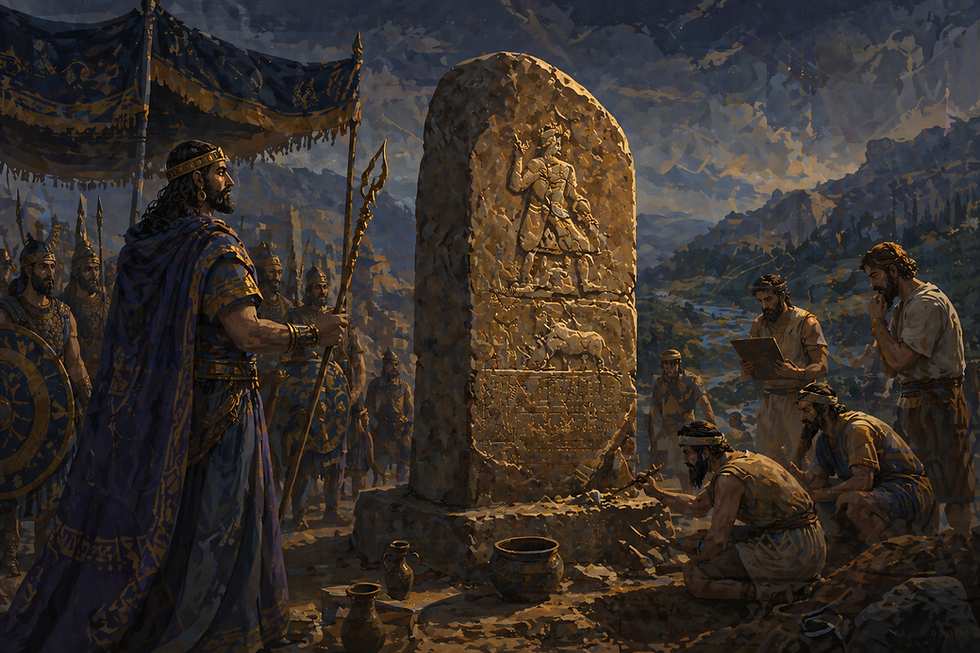
Case Study 1 — The Tel Dan Stele
Majority view: The three basalt fragments form an Aramaic victory inscription of Hazael, King of Aram-Damascus (ca. 850 BC), claiming to have killed “[Jo]ram son of Aha[b], king of Israel” and “[Ahaz]iah son of [Jehoram, kin]g of the House of David.” The reading bēt Dawīd is widely accepted.
Challenged view: Early minimalists (Lemche, Thompson) questioned authenticity, suggesting the fragments did not belong to the same stele or that “Dawīd” could be a place name or title, not a dynasty.
Assessment: The epigraphic consensus now firmly supports the “House of David” reading. However, the stele’s fragmentary nature leaves much unclear. Even if it refers to a “House of David,” it does not confirm the existence of a vast United Monarchy; only that a dynasty with that name existed and was known to Arameans in the 9th century. The reality of David remains probable but extremely difficult to characterize.
Case Study 2: Khirbet Qeiyafa
Garfinkel’s interpretation: A Judahite fortress, ~1000 BC, proving a centralized state under David. Features: casemate wall, Iron IIA pottery, no pig bones, an ostracon with Proto-Canaanite.
Ussishkin’s reinterpretation: The casemate wall encloses a cultic compound, not a fortress; the “gate” is rather a cultic entrance. The site may have been a brief-lived Philistine or Canaanite ritual center.
Assessment: The aniconic nature (no cult figurines) is distinctive and suggestive of aniconic early Yahwism. Qeiyafa may represent an early Judahite attempt to mark its western border, but its identification as proof of a Davidic empire is over-claimed.
Lost Cosmologies: The Erasure of Pre-Yahwistic Deities
The transition from Canaanite polytheism to Jewish monotheism was not a smooth evolution but a violent, deliberate erasure, visible in the text and soil:
Asherah: Once present in the Jerusalem Temple (2 Kings 21:7; 23:6), Asherah worship was common in household cults. The thousands of pillar figurines found in domestic contexts in Judah (8th–7th centuries BC) probably represent her. The reforms of Hezekiah and Josiah attempted to extirpate her, but continued popular devotion is attested by the prophetic polemics.
The Host of Heaven: Worship of sun, moon, and stars, imported under Assyrian influence, was practiced even in the Temple (2 Kings 23:11–12), with horses and chariots dedicated to the sun. Solar imagery, such as the winged sun disk, appears on 8th-century Judahite seals.
Molech/child sacrifice: The tophet (place of child sacrifice) in the Valley of Hinnom (Gehenna) and biblical condemnations suggest that some Israelites practiced rites later deemed abominable. The Carthaginian parallels (Tophet of Salammbô) suggest this was a genuine, though horrific, West Semitic religious practice suppressed by Yahwistic orthodoxy.
Recurring Patterns Across the Ancient Period (Pattern ID | Description | Archaeological / Textual Examples):
P‑1: Co‑optation of Ritual | New elites appropriate existing sacred sites, myths, and practices to legitimize power | David’s Jerusalem (Jebusite sanctuary); Josiah’s centralization of worship; Yahweh absorbing El’s titles (Elyon, Shaddai) and Baʿal’s storm imagery
P‑2: Strategic Adoption | Foreign technologies, scripts, and ideologies adopted and adapted for local advantage | Adoption of Phoenician alphabet for Hebrew; Assyrian administrative practices (cuneiform influence); Phoenician ivory and temple design
P‑3: Narrative Unification | Creation of a single “master narrative” by weaving disparate traditions, suppressing alternatives | Deuteronomistic History stitching northern (Ephraimite) and southern (Judahite) traditions into a unified “Israel”; retrojection of monotheism onto the Patriarchs
P‑4: Genealogical Engineering | Rulers construct or modify lineages to link themselves to mythical, divine, or prestigious pasts | Davidic genealogy traced to Abraham; Matthew’s 3×14 scheme; Saulide line closure; reattribution of Omride works to Solomon
P‑5: Religious Monopolization | Centralization of cult to control population, surplus, and political loyalty | Josiah’s destruction of rural bamot (622 BC); Hezekiah’s earlier reform; suppression of Samaritan temple on Mount Gerizim
P‑6: Ethnic Boundary Formation through Taboos | Dietary, bodily, and marriage taboos create group identity in contrast to neighbors | Pig avoidance (no pig bones in highland villages vs. Philistine 20%); circumcision; “foreign women” expelled in Ezra-Nehemiah
P‑7: Absorption by Dilution | Distinct ethnic groups disappear into majority population through intermarriage and acculturation, while textual narrative claims annihilation | Philistine European genetic signal vanishes within two centuries; “Canaanites” not destroyed but absorbed into “Israel”
P‑8: Catastrophe as Catalyst | Military/political catastrophe leads to creative theological transformation | Fall of Samaria (720) pushes Judaean reform; Babylonian Exile (586) catalyzes monotheism and scripture-writing

Comparative Application of Patterns (Pattern | Israel/Judah | Mesopotamia | Shang China | Inca Andes):
Co‑optation of ritual | David’s use of Jerusalem; Yahweh absorbs El/Baʿal | Enḫeduanna merges Inanna/Ishtar; Sargon patronizes temples | Shang kings monopolize oracle-bone divination | Inca adopt local huacas into state cult
Strategic adoption | Phoenician alphabet → Hebrew script; Assyrian records | Sumerian cuneiform adapted to Akkadian | Bronze technology from Eurasian steppe | Quipu for admin; Chimú irrigation
Narrative unification | Deuteronomistic History | Sumerian King List (antediluvian kings, single dynasty) | Shang royal annals; later Zhou “Mandate” | Capac cuna (royal genealogy) justifies rule
Genealogical engineering | David linked to Abraham; Solomon given Omride glory | Sargon’s “born of a high priestess” legend; Ur-Nammu’s divine parentage | Shang descent from Di (High God) | Manco Cápac myth: descended from Inti (Sun)
Religious monopolization | Josiah’s reform destroys bamot | Nabonidus relocates cults to Babylon; Marduk supreme | Shang royal ancestral cult excludes others | Inca mummies in Cuzco’s temple of the sun
Ethnic boundary formation | Pig taboo, circumcision | Sumerians vs. Amorites (racialized in later texts) | Zhou “Huaxia” vs. “barbarians” (Yi, Di, Rong) | Inca vs. “chunchos” (forest savages)
Part VII: Global & Temporal Parallels

3000 BC — The Dawn of States (Region | Development | Comparison with the Southern Levant):
Mesopotamia | Uruk period: first true cities (Uruk: 250 ha), writing (proto-cuneiform), monumental temples (Eanna complex), bureaucratization | Levant still in EB I: small walled towns with a few hectares, no true writing, no bureaucracy. Intense trade with Egypt (Naqada II–III) introduces prestige goods.
Egypt | Early Dynastic: Narmer unifies Upper and Lower Egypt, divine kingship emerges, hieroglyphs, massive funerary architecture (Abydos, Saqqara) | Egyptian influence on southern coastal sites (e.g., Tel Erani with Egyptian pottery and serekhs). But Canaan remains politically fragmented; power vested in local chieftains, not pharaohs.
Indus Valley | Early Harappan (Ravi phase) coalescing into the Mature Harappan; planned cities, weight system, seals | No urbanism of this scale anywhere in the Levant; the contrast highlights how the Levant was a cultural crossroads but not an independent early state incubator.
Norte Chico (Peru) | Caral-Supe: monumental platform mounds, irrigation, no ceramics yet | Levant had ceramics but no contemporary monumentality on the Norte Chico scale. The Levant in 3000 BC was a periphery to the Egyptian and Mesopotamian cores.
1200 BC — The Late Bronze Age Collapse and Regeneration (Region | Development | Comparison with the Southern Levant):
Aegean | Mycenaean palaces collapse, Linear B writing lost, “Dark Age” begins. Sea Peoples migrations | Philistines (Peleset) settle in the southern coastal plain; their Aegean-style pottery (Mycenaean IIIC:1b) marks their arrival. Collapse opens space for highland settlement.
Egypt | Ramesses III repulses Sea Peoples but empire declines; withdraws from Canaan after Ramesses VI (ca. 1130 BC) | The power vacuum allows the Israelite highland villages to emerge without Egyptian interference. Beth Shean, the last Egyptian garrison, abandoned around 1130 BC.
Anatolia | Hittite Empire collapses ca. 1180 BC; Neo-Hittite city-states survive in Syria | Disruption of northern trade routes; Aramaeans move into Syria, eventually forming Aram-Damascus, a major rival to Israel.
Mesopotamia | Assyria temporarily weak after Tukulti-Ninurta I’s death; Aramean incursions | Assyrian weakness provides a window for indigenous Levantine state formation. Later, Assyria would return as a world-conquering empire.
Levant | Iron I: Highland villages (Israel), coastal Philistine pentapolis (Gaza, Ashkelon, Ashdod, Ekron, Gath), Canaanite enclaves in valleys | A multi-ethnic patchwork; conflict and cultural differentiation drive the ethnogenesis of Israel.
1000–586 BC — The Age of Levantine Kingdoms in a World of Empires (Region | Development | Comparison):
Egypt | Third Intermediate Period (21st–25th dynasties): fragmentation, Libyan and Nubian pharaohs. No imperial interventions in Levant until brief incursions. | Egyptian weakness allows independent Israel and Judah. Shishak (Shoshenq I, ca. 925 BC) campaign is recorded both in the Bible (1 Kings 14:25–26) and in his Karnak relief, but it was a raid, not re-conquest.
Assyria | Neo-Assyrian Empire (911–612 BC): first true world empire, mass deportations, sophisticated administration. Shalmaneser III (853 BC), Tiglath-Pileser III (conquest of Galilee, 732 BC), Sargon II (destruction of Samaria, 720 BC), Sennacherib (siege of Jerusalem, 701 BC). | Israel crushed and deported (“Ten Lost Tribes”). Judah becomes an Assyrian vassal. Hezekiah’s revolt leads to Sennacherib’s devastation of Judah, though Jerusalem miraculously survives, fueling a theology of Zion’s inviolability.
Babylonia | Neo-Babylonian Empire (626–539 BC): Nebuchadnezzar II destroys Jerusalem (586 BC), Temple burnt, mass exile. | The Exile is the single most formative event for Jewish identity, transforming a state religion into a portable, text-centered faith.
Greece | Geometric and Archaic periods: rise of polis, colonization, Homeric epics composed. | Early Greek philosophers (Thales, Anaximander) are contemporaries of Israelite prophets (Jeremiah, Ezekiel). Both regions independently pioneer the alphabet and critical thought, but within very different political structures (city-state vs. kingdom).
India | Vedic period: composition of Rig Veda, emergence of caste system, janapadas (early tribal states). | Indo-Aryan migrations and Vedic religion show parallels: a pantheon (Indra, Varuna) with a storm-god (Indra) conquering a serpent (Vritra), resembling Baʿal vs. Yamm/Leviathan. The rajasuya consecration ritual parallels Israelite royal anointing.
China | Western Zhou (1046–771 BC): feudal system, Mandate of Heaven ideology, Book of Documents. | The Zhou “Mandate of Heaven” as divine legitimization of rule, revocable upon misrule, is structurally parallel to Israelite covenantal theology: loyalty to Yahweh brings national blessing; apostasy brings conquests and exile.
South Arabia | Sabaean kingdom, Marib Dam, temple of Almaqah (moon god). | Trade in frankincense and myrrh passes through the Levant; the Queen of Sheba story (1 Kings 10) may reflect distant memories of Sabaean-Levantine contacts.
Phoenicia | Tyre, Sidon, Byblos: maritime commercial empire, colonies (Carthage founded ca. 814 BC). | Israel’s close neighbor; Hiram of Tyre provided materials for the Temple (according to the Bible). Phoenician art, script, and temple architecture heavily influenced both Israel and Judah.
Structural Similarities and Differences in State Formation:
Religion as state apparatus: The Jerusalem Temple functions like Mesopotamian temple-states, Shang royal ancestor worship, or Inca solar temples; centralizing ritual to centralize power.
Genealogical legitimation: The concern with unbroken dynasty is universal: Davidic dynasty ≈ Zhou “Mandate of Heaven” ≈ Egyptian pharaonic claims of divine birth ≈ Sumerian King List’s antediluvian kings.
Writing as administrative and ideological tool: Ostraca from Samaria and Lachish mirror the administrative use of cuneiform in Mesopotamia and oracle bones in Shang China, though on a vastly smaller scale.
Ethnogenesis via opposition: Identity defined against “others” (Canaanites, Philistines) parallels Greeks vs. “barbarians,” Chinese Huaxia vs. “Yi/Di,” Vedic Arya vs. Dasa.
Unique Features of the Levantine Case:
Small scale, huge impact: The kingdom of Judah at its height controlled perhaps 3,000 km²—a speck compared to Egypt or Assyria. Yet, because of the Bible, its cultural footprint on world history is disproportionate.
Textual exceptionalism: The Hebrew Bible is the first major literature to combine history, law, prophecy, and poetry into a single, continuously edited corpus. No other small Levantine state produced anything comparable; Ammon, Moab, Edom left only brief inscriptions. This textual output is directly tied to the crises that threatened national existence.
Failure as catalyst: The collapse of the state (586 BC) did not end the religion but radicalized it, producing pure monotheism and scripture. In contrast, the fall of other ancient states often meant the end of their gods.
Part VIII: Conclusion — Synthesis and Legacy
The conflict between royal centralization (Josiah’s reform, Jerusalem priesthood) and local religion (bamot, Asherah, household pillar figurines, ancestor veneration) is a constant throughout the Iron Age. It reflects a deeper structural tension between the demands of the state and the inherited polytheistic, clan-based religion of the people.
“Israelite religion” was never pure. It was always a synthesis; absorbing El, battling and absorbing Baʿal, suppressing but never fully eradicating Asherah, transforming Yahweh from a desert storm-god of Seir into a transcendent, exclusive, universal deity. This transformation was gradual, contested, and incomplete until after the Exile.
The Exodus, the conquest of Canaan, the Davidic covenant, the Solomonic golden age; these were all shaped and reshaped by successive generations of scribes to serve immediate political and theological ends. Genealogies were engineered to solidify power, eliminate rivals, and connect the present to a prestigious, sometimes mythical, past.
The foundations laid in this ancient period proved extraordinarily durable. The Babylonian Exile (586–539 BC) was not the end but a crucible: it shattered the institutional framework (Temple, monarchy, land) and forced a creative theological transformation that produced Judaism as a portable, text-based religion centered on Torah study, prayer, and community.
The patterns established in the Iron Age—genealogical engineering, suppression of alternatives, centralization of worship, ethnic boundary formation—would continue to operate throughout the Second Temple period and into the Rabbinic era, including the final canonization of the Hebrew Bible and the marginalization of the Samaritans.
Net Assessment: The creation of a unified Israelite/Jewish identity was achieved through selective memory, ritual innovation, genealogical fabrication, and strategic absorption of external influences.
The biblical narrative, a brilliant work of theological historiography, succeeded in convincing millions that it was the other way around, that a pure monotheism was given at Sinai and maintained by a chosen people against external contamination.
The archaeological record, the Ugaritic texts, the inscriptions at Kuntillet ʿAjrud, and the genetic data from Ashkelon all tell a different, messier, more human story: one of convergence, conflict, and creative adaptation. The mystery of United Monarchy, with which we began, is thus emblematic of the entire enterprise.
The gap between the biblical empire and the archaeological reality is not a problem to be solved but a fact to be understood; a fact that reveals the very process by which a modest highland chiefdom transformed itself, in memory and imagination, into a chosen nation with an eternal covenant. That transformation is the true wonder, and it is the subject of this whitepaper.
Detailed Timeline:
~1,400,000 BC | Earliest hominins at Ubeidiya | Lithic assemblages (Acheulian)
~780,000 BCE | Gesher Benot Ya‘akov: fire use, butchery | Burnt flint, charred wood
~400,000–200,000 BC | Qesem Cave: habitual fire, blade production, faunal remains | U-Th dating, lithic refits
~90,000–120,000 BC | AMH at Skhul and Qafzeh caves | Skeletal remains (mixed archaic/modern)
~15,000–11,500 BP | Natufian culture: sedentism, early bread | Ain Mallaha, Shubayqa 1
~10,000–8,800 BC | PPNA: Tower of Jericho, first villages | Tel es-Sultan
~8,800–6,500 BC | PPNB: domesticates, plastered skulls at ʿAin Ghazal | Statues, obsidian trade
~4500–3500 BC | Ghassulian Chalcolithic: copper, ossuaries | Nahal Mishmar hoard
~3000–2400 BC | EB II–III: first walled cities, Kura-Araxes migration | Megiddo, Beth Shean, Khirbet Kerak ware
~2000–1550 BC | MB IIA–C: Canaanite city-states, Amorite influx | Glacis ramparts, Hazor palace
~1550–1200 BC | LB: Egyptian imperial rule, Amarna letters | Ugaritic texts, Apiru references
~14th c. BC | “Shasu-land of Yhwʒ” in Egyptian texts | Soleb temple inscription
~1208 BCE | Merneptah Stele: first mention of “Israel” | Egyptian Museum, Cairo
~1200–1000 BC | Iron I: Israelite highland settlement, Philistine pentapolis | Four-room houses, pig taboo, Ashkelon DNA
~1000 BC | Khirbet Qeiyafa fortified | Radiocarbon date, ostracon
~853 BC | Battle of Qarqar: Ahab of Israel coalition | Kurkh Monolith
~850–830 BC | Tel Dan Stele: “House of David” | Aramaic fragments
~840 BC | Mesha Stele: Moabite rebellion, mentions Omri and “House of David” | Dhiban
~732 BC | Tiglath-Pileser III conquers Galilee | Assyrian annals, Megiddo destruction
~720 BC | Fall of Samaria, Sargon II, Israel becomes Assyrian province | Assyrian records, Samaria ostraca
~701 BC | Sennacherib’s campaign: sack of Lachish, siege of Jerusalem | Lachish reliefs (Nineveh), Siloam Tunnel
~622 BC | Josiah’s reform | 2 Kings 22–23; destruction of bamot
~586 BC | Fall of Jerusalem, Temple destroyed by Nebuchadnezzar II | Babylonian Chronicle, Lachish letters, destruction layer
Key Sites and Artifacts with Descriptions:
Ubeidiya | Lower Paleolithic (~1.4 Ma) | Earliest hominins in Levant; Acheulian tools
Qesem Cave | 400–200 ka | Habitual fire use, possible distinct hominin
Skhul/Qafzeh | ~90–120 ka | Earliest AMH outside Africa; burial with grave goods
ʿAin Mallaha | Natufian | Early sedentism, stone dwellings, burials
Jericho (Tower) | PPNA | Oldest known fortification tower
ʿAin Ghazal | PPNB | Plastered skulls, large statues, ancestor cult
Nahal Mishmar Hoard | Chalcolithic | 442 ritual copper objects, early “elite” regalia
Ugarit (Ras Shamra) | LB | Canaanite mythological texts (Baʿal Cycle)
Amarna Letters | 14th c. BC | Diplomatic archive, ʿApiru references
Merneptah Stele | 1208 BC | First mention of Israel as a people
Khirbet Qeiyafa | ~1000 BC | Potential early Judahite fortress; pig taboo
Kurkh Monolith | 853 BC | Ahab’s chariot force, extrabiblical reference to Israel
Tel Dan Stele | 9th c. BC | “House of David” inscription
Kuntillet ʿAjrud | 8th c. BC | “Yahweh and his Asherah” inscriptions, drawings
Samaria Ostraca | 8th c. BC | Royal administrative records
Hezekiah’s Tunnel | late 8th c. | Waterworks, Siloam inscription
Lachish Letters | early 6th c. BC | Military correspondence, literacy

Bibliography
Mainstream Archaeology/History:
Finkelstein, Israel, and Neil Asher Silberman. The Bible Unearthed: Archaeology’s New Vision of Ancient Israel and the Origin of Its Sacred Texts. Free Press, 2001.
Dever, William G. Who Were the Early Israelites and Where Did They Come From? Eerdmans, 2003.
Mazar, Amihai. Archaeology of the Land of the Bible, 10,000–586 B.C. Doubleday, 1990.
Kitchen, Kenneth A. On the Reliability of the Old Testament. Eerdmans, 2003.
Smith, Mark S. The Early History of God: Yahweh and the Other Deities in Ancient Israel. Eerdmans, 2nd ed. 2002.
Faust, Avraham. Israel’s Ethnogenesis: Settlement, Interaction, Expansion and Resistance. Equinox, 2006.
Genetic and Scientific Studies:
Agranat-Tamir, L., et al. “The Genomic History of the Bronze Age Southern Levant.” Cell 181.5 (2020): 1146–1157.e21.
Feldman, M., et al. “Ancient DNA sheds light on the genetic origins of early Iron Age Philistines.” Science Advances 5.7 (2019): eaax0061.
Bar-Yosef, Ofer, and A. Nigel Goring-Morris. “The Natufian culture in the Levant, threshold to the origins of agriculture.” Evolutionary Anthropology 6.5 (1998): 159–177.
Alternative or Contested Interpretations:
Thompson, Thomas L. The Mythic Past: Biblical Archaeology and the Myth of Israel. Basic Books, 1999.
Lemche, Niels Peter. The Israelites in History and Tradition. Westminster John Knox, 1998.
Davies, Philip R. In Search of “Ancient Israel.” Sheffield Academic Press, 1992.
Ussishkin, David. “Was Khirbet Qeiyafa a Cultic Compound?” Israel Exploration Journal 72.1 (2022): 99–117.
Whitelam, Keith W. The Invention of Ancient Israel: The Silencing of Palestinian History. Routledge, 1996.
Primary Sources in Translation (with Critical Notes):
The Amarna Letters (ed. William L. Moran). Johns Hopkins, 1992. Note: Reflects elite diplomatic perspective; does not represent non‑elite populations. Historically situates Canaanite city-state rivalries.
The Ugaritic Baal Cycle (trans. Mark S. Smith). Brill, 1994. Note: Fragmentary tablets; reconstruction relies heavily on comparative philology. Essential for understanding the religious substrate of Israelite religion.
The Babylonian Chronicles (trans. A.K. Grayson, 1975; new ed. J.-J. Glassner, 2004). Note: State propaganda but provides chronological anchors independent of the biblical text. Distinguish from later royal inscriptions which inflate victories.
Hebrew Bible (Deuteronomistic History). Note: Use Biblia Hebraica Stuttgartensia. Composition spans centuries; final form in Persian/Hellenistic period. Must be read with rigorous source criticism; contains authentic 8th–6th c. material embedded in later editorial frameworks. The Septuagint and Dead Sea Scrolls often preserve earlier textual variants (e.g., Deuteronomy 32:8).

Comments