
.png)

Ancient Scripture: Rig Veda (Hymns 1.16 - 1.20: Part 4 of Mandala 1)
- A. Royden D'Souza

- Jun 8
- 23 min read
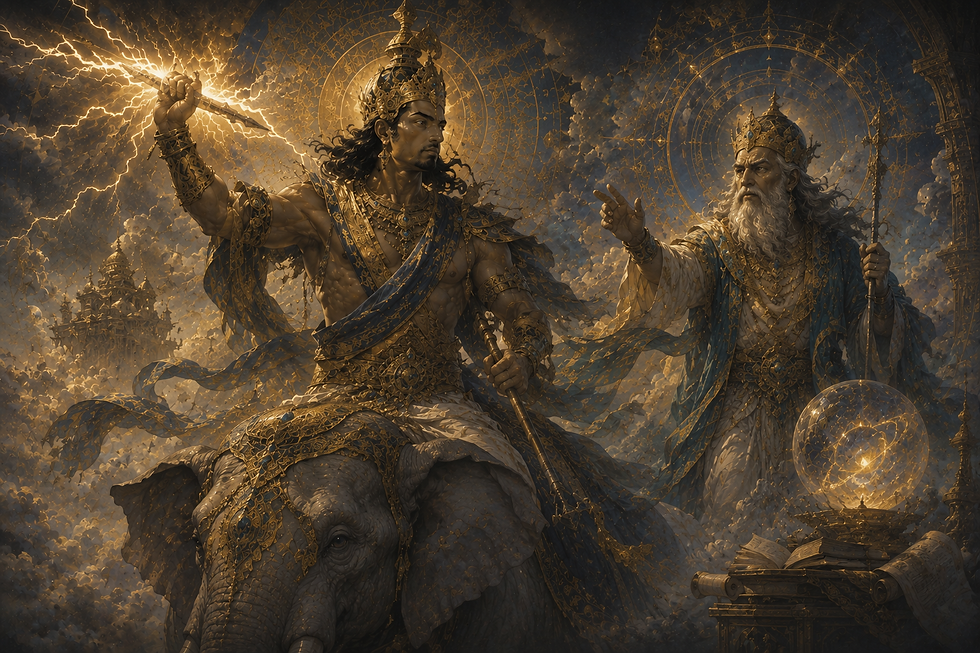
Maṇḍala 1 is the largest book of the Rig Veda, containing 191 hymns. It is a collection of songs from multiple seer families, and its themes cover a wide range of deities; Agni, Indra, the Ashvins, Varuna, Mitra, and many others. It opens, fittingly, with an invocation to Agni, the god of fire, who acts as the divine messenger between humans and gods.
Rig Veda: Hymn 1.16 – To Indra (with the Ṛtus, the Seasons)
Seer (Ṛṣi): Medhātithi Kāṇva
Deity (Devatā): Indra (with the Ṛtus)
Meter (Chandas): Gāyatrī

Verses
इन्द्रा॑ याहि॒ न म॑न्दसे॒ सोमं॑ पिब वृषभ ।
सु॒तं सू॒रिभि॒रा ग॑हि वि॒श्वेभि॑रि॒ह दे॒वेभिः॑ ॥१॥
indrā yāhi na mandase somaṃ piba vṛṣabha |
sutaṃ sūribhir ā gahi viśvebhir iha devebhiḥ ||1||
O Indra, come for our exhilaration, drink the Soma, O Bull. Come to the pressed drink with the patrons, with all the gods here.
इन्द्र॑ ऋतु॒भिः सह॑ सोमं पिब वृत्रहन् ।
सु॒तं सू॒रिभि॒रा ग॑हि वि॒श्वेभि॑रि॒ह दे॒वेभिः॑ ॥२॥
indra ṛtubhiḥ saha somaṃ piba vṛtrahan |
sutaṃ sūribhir ā gahi viśvebhir iha devebhiḥ ||2||
O Indra, together with the Seasons drink the Soma, O Vṛtra-slayer. Come to the pressed drink with the patrons, with all the gods here.
इन्द्र॑ ऋतु॒भिस्त्वं सोमं पिब वृत्रहन् ।
सु॒तं सू॒रिभि॒रा ग॑हि वि॒श्वेभि॑रि॒ह दे॒वेभिः॑ ॥३॥
indra ṛtubhis tvaṃ somaṃ piba vṛtrahan |
sutaṃ sūribhir ā gahi viśvebhir iha devebhiḥ ||3||
O Indra, you with the Seasons drink the Soma, O Vṛtra-slayer. Come to the pressed drink with the patrons, with all the gods here.
आ या॑हि वसन्त॒ आ या॑हि ग्रीष्म ऋतूनां पते ।
आ या॑हि वर्षा॒ आ या॑हि शरद्धेमन्त॒ आ या॑हि शिशिर॒ आ या॑हि ॥४॥
ā yāhi vasanta ā yāhi grīṣma ṛtūnām pate |
ā yāhi varṣā ā yāhi śarad dhemanta ā yāhi śiśira ā yāhi ||4||
Come, Spring; come, Summer—O lord of the Seasons. Come, Rains; come, Autumn; come, Winter; come, the Dewy Season.
इन्द्र॑ सोमं पिब ऋतु॒भिरा वि॑श्वैः सखि॒भिर्यु॒तः ।
म॒रुत्वा॑न्सोमं पिब वृत्रहन्नि॒हाग॑हि ॥५॥
indra somaṃ piba ṛtubhir ā viśvaiḥ sakhibhir yutaḥ |
marutvān somaṃ piba vṛtrahann ihāgahi ||5||
O Indra, drink the Soma with the Seasons, united with all your friends. Accompanied by the Maruts, drink the Soma, O Vṛtra-slayer; come here.
इन्द्र॑ ऋतु॒भिरा ग॑हि सोमं पिब वृषभ ।
सु॒तं सू॒रिभि॒रा ग॑हि वि॒श्वेभि॑रि॒ह दे॒वेभिः॑ ॥६॥
indra ṛtubhir ā gahi somaṃ piba vṛṣabha |
sutaṃ sūribhir ā gahi viśvebhir iha devebhiḥ ||6||
O Indra, come with the Seasons; drink the Soma, O Bull. Come to the pressed drink with the patrons, with all the gods here.
इन्द्र॑ सोमं पिब ऋतु॒भिः सह॑ सू॒रिभिः॑ ।
वि॒श्वेभिः॑ सखि॒भिर्यु॒तः सोमं पिब वृत्रहन् ॥७॥
indra somaṃ piba ṛtubhiḥ saha sūribhiḥ |
viśvebhiḥ sakhibhir yutaḥ somaṃ piba vṛtrahan ||7||
O Indra, drink the Soma together with the Seasons, with the patrons. United with all your friends, drink the Soma, O Vṛtra-slayer.
आ त्वा॑ विशन्तू॒षसो॑ वृत्र॒हाण॑मिन्द्रम् ।
अनु॑ त्वा॒ वरु॑णो मि॒त्रो अ॒ग्निः ॥८॥
ā tvā viśantūṣaso vṛtrahāṇam indram |
anu tvā varuṇo mitro agniḥ ||8||
May the Dawns enter you, Indra, the Vṛtra-slayer. May Varuṇa, Mitra, Agni follow you.
इन्द्र॑ ऋतु॒भिः सह॑ सोमं पिब वृत्रहन् ।
सु॒तं सू॒रिभि॒रा ग॑हि वि॒श्वेभि॑रि॒ह दे॒वेभिः॑ ॥९॥
indra ṛtubhiḥ saha somaṃ piba vṛtrahan |
sutaṃ sūribhir ā gahi viśvebhir iha devebhiḥ ||9||
O Indra, together with the Seasons drink the Soma, O Vṛtra-slayer. Come to the pressed drink with the patrons, with all the gods here.
What Does This Hymn Say?
Hymn 1.16 is a concluding litany. It does not introduce new material but gathers the refrains and invocations that have defined Medhātithi’s sequence into a single rolling prayer.
Verses 1–3 open with three variations on the same core call: Indra, come, drink Soma—as Bull, with the Seasons, with the patrons, with all the gods. Each verse varies the address slightly, shifting from “O Bull” to “O Vṛtra‑slayer,” while the second line remains almost unchanged. The effect is one of steady, rhythmic accumulation.
Verse 4 repeats the great summoning of the six seasons from Hymn 1.15, calling Spring, Summer, Rains, Autumn, Winter, and the Dewy Season to the sacrifice. Indra is addressed as “lord of the Seasons,” tying the entire turning year to this single moment of Soma offering.
Verse 5 brings back the Maruts and all friends, uniting Indra’s battle troop with the seasonal patrons. Verses 6 and 7 continue the refrain, now addressed to “O Bull” and “O Vṛtra‑slayer,” repeating the same cadence of invitation.
Verse 8 breaks into a cosmic image: the Dawns enter Indra, and Varuṇa, Mitra, and Agni follow him. This line appears also in earlier hymns, and here it seals the prayer with a vision of the whole divine order moving in Indra’s wake.
Verse 9 closes the hymn by returning to the exact same line that has been chanted throughout: “drink Soma with the Seasons, with the patrons, with all the gods.” The prayer ends where it began, creating a ring of sound that encloses the sacrifice.
The entire hymn functions as a slow, deliberate gathering of all the powers called upon across Hymns 1.11 to 1.15—Indra, the Maruts, the Seasons, the All‑Gods, the Dawns, Varuṇa, Mitra, Agni—into a final, unhurried act of welcome.
Understanding Indra: The Gathering of All Circles
With Hymn 1.16, Medhātithi Kāṇva closes his six‑hymn sequence. If the previous hymns moved outward from Indra alone to Indra‑Agni, the Āprī deities, the All‑Gods, and the Seasons, this final hymn folds everything back into one continuous refrain.
A Liturgical Conclusion: The repetitions in this hymn are not artistic failure; they are the very structure of a closing rite. In Vedic practice, certain hymns serve as “nigada,” recited passages that stitch together the discrete offerings into a seamless whole.
Hymn 1.16 does exactly this: it takes the key invocations that have been scattered across the preceding five hymns and threads them onto a single string. The worshipper who recites this hymn after the others has essentially repeated the entire sequence in compressed form.
The Refrain as a Circle: The refrain “sutaṃ sūribhir ā gahi viśvebhir iha devebhiḥ”—“come to the pressed drink with the patrons, with all the gods here”—is the most repeated line in Medhātithi’s corpus. By placing it at the end of nearly every verse, he turns the hymn into a steady, heartbeat rhythm.
The ear comes to expect it, and the expectation itself becomes a form of participation. The sacrifice is not a single moment but a sustained act of calling, and the refrain is the breath that sustains it.
The Return of the Dawns: Verse 8’s image of the Dawns entering Indra and the other gods following him is a miniature of the whole Vedic cosmos. The Dawns are the first light, the daily renewal; Indra is the center into which they flow; Varuṇa, Mitra, and Agni are the order, the covenant, and the fire that trail in his wake.
By placing this verse near the end, Medhātithi reminds the hearer that the Soma rite is not an isolated event but part of the daily, seasonal, and cosmic rhythm that the gods themselves inhabit and sustain.
The End of a Voice: With this hymn, Medhātithi Kāṇva’s voice falls silent. His contribution to the Rig Veda is brief but perfectly formed: an intimate call to Indra, a joint summoning of Indra‑Agni, the formal Āprī liturgy, the universal invitation to the All‑Gods, the seasonal gathering, and now this final, all‑encompassing litany.
He took the traditions established by Madhucchandā and wove them into a new texture—more communal, more liturgical, more tender. The next hymns will belong to other seers, other clans, other visions.
But Medhātithi’s quiet, rhythmic refrains have anchored the opening book of the Rig Veda in the steady turning of the seasons and the endless hospitality of the sacrifice.

Hymn 1.17 – To Indra and Varuṇa
Seer (Ṛṣi): Kutsa Āṅgirasa
Deity (Devatā): Indra and Varuṇa (Indrā-Varuṇau)
Meter (Chandas): Gāyatrī (verses 1, 2, 4, 5), Triṣṭubh (verse 3)

Verses
इन्द्रा वरु॑णयोर॒हं स॒म्राजो॒रव॒ आ वृ॑णे ।
ता नो॑ मृळात ई॒दृशे॑ ॥१॥
indrā varuṇayor ahaṃ samrājor ava ā vṛṇe |
tā no mṛḻāta īdṛśe ||1||
I choose the help of Indra and Varuṇa, the two universal kings. May they be gracious to us in such a (hymn/pressing) as this.
गोपा॑यन्ति नो धि॒यो विश्वं॑ नः सु॒क्षिती॒रपि॑ ।
तयो॑र॒हं स॒ख्याय॒ ये ॥२॥
gopāyanti no dhiyo viśvaṃ naḥ sukṣitīr api |
tayor ahaṃ sakhyāya ye ||2||
They guard our prayers; all our good dwellings, too. I (come) to the friendship of those two.
इन्द्रा॑वरुणा यु॒वमिद्या॒थना॑ सु॒तसो॑मस्य धे॒नाः ।
यु॒वं र॒यिं पु॑रु॒वीर॑मु॒त त्मना॑ सहस्रपो॒षं य॑जथः ॥३॥
indrāvaruṇā yuvam id yāthanā sutasomasya dhenāḥ |
yuvaṃ rayiṃ puruvīram uta tmanā sahasrapoṣaṃ yajathaḥ ||3||
O Indra and Varuṇa, you two indeed come to the streams of pressed Soma. You two, by your own nature, bestow wealth rich in many heroes and with a thousandfold nourishment.
इन्द्रा॑वरुणा यु॒वम॒स्मान॒भि मृ॑ळतं यु॒वम् ।
अवो॑भिर्यु॒वं नो॑ अवतम् ॥४॥
indrāvaruṇā yuvam asmān abhi mṛḻataṃ yuvam |
avobhir yuvaṃ no avatam ||4||
O Indra and Varuṇa, you two be gracious to us, you two. With your helps, you two protect us.
इन्द्रा॑वरुणा यु॒वं सु॒तस्य॑ सोम॑स्य पी॒तये॑ ।
आ या॑त॒मा नो॑ गृ॒हम् ॥५॥
indrāvaruṇā yuvaṃ sutasya somasya pītaye |
ā yātam ā no gṛham ||5||
O Indra and Varuṇa, for the drinking of the pressed Soma, come here, come to our home.
What Does This Hymn Say?
This is the first hymn in the Rig Veda addressed to Indra and Varuṇa jointly. It is a simple, intimate prayer that seeks the protection and friendship of the two sovereign gods.
Verse 1 opens by stating a choice: the seer “chooses” the help of Indra and Varuṇa, calling them “universal kings” (samrājau). The word “ava” (help) is the first object of the hymn, and the plea is for graciousness in the present ritual.
Verse 2 names what the two kings guard: the worshipper’s prayers (dhiyaḥ) and all their peaceful settlements (sukṣitīḥ). The seer then declares that he “comes to the friendship” of those two. The term sakhyāya (friendship) is central—the relationship is not that of a subject to a distant lord, but of a friend to two mighty but accessible allies.
Verse 3 shifts to the Soma ritual. Indra and Varuṇa come to the streams of pressed Soma (dhenāḥ—literally “milch streams,” a metaphor for the flowing offering). The verse then states that they, by their own inherent power, bestow wealth with many heroes and a thousandfold nourishment. The act of coming to Soma automatically releases their generous nature.
Verse 4 returns to a direct plea: “You two be gracious to us, you two. With your helps, you two protect us.” The pronoun yuvam (you two) is hammered repeatedly, making the couple’s presence felt in every phrase.
Verse 5 is the simplest, most homely invitation: “For the drinking of the pressed Soma, come here, come to our home.” The ritual space is a “home” (gṛham), and the two great kings are asked to step inside it as guests.
The entire hymn breathes warmth and directness. There is no long praise, no enumeration of cosmic deeds—just the steady, personal call to two great friends.
Understanding Indra-Varuṇa: The Dual Sovereignty of Force and Law
With Hymn 1.17, Kutsa Āṅgirasa introduces a divine pair that will recur throughout the Rig Veda: Indra and Varuṇa. Their union is not arbitrary; it brings together two complementary dimensions of divine power.
Indra — The Warrior King: Indra is the god of action, of battle, of the Soma‑fueled charge that smashes Vṛtra and releases the pent‑up waters and light. He is the “Vṛtra‑slayer,” the bull, the wielder of the thunderbolt. In earlier hymns, Indra appeared alone or with the Maruts, his storm‑troop. His power is expansive, generous, and immediate.
Varuṇa — The Sovereign of Ṛta: Varuṇa, who has not yet been the sole subject of a hymn in our series (though he appeared in 1.2 with Mitra), is the god of the cosmic order, Ṛta. He watches over truth and falsehood, binding sinners with his fetters and releasing the truthful. His eye is the sun; his spies are everywhere. He is the king of the moral and natural law. Where Indra is force, Varuṇa is order.
Why They Are Joined: By calling Indra and Varuṇa together as “samrājau” (universal kings), Kutsa invokes the full spectrum of divine rulership. A kingdom needs both strength and law. Victory without order is chaos; order without strength is vulnerable.
Indra conquers, Varuṇa maintains. Indra shatters the enemies, Varuṇa ensures that the world runs by truth. Together, they are the complete sovereign power.
Friendship with Two Kings: The seer’s repeated emphasis on “friendship” (sakhya) is remarkable. One does not merely serve these kings; one enters their alliance.
The sacrifice is the meeting place, the Soma is the shared drink, and the home (gṛham) is where they are invited. The kingship of Indra and Varuṇa does not distance them from the worshipper; it makes them the most powerful friends one could have.
The Kutsa Connection: Kutsa is known in Vedic tradition as a close companion of Indra. Though Varuṇa is equally invoked here, the intimacy of the address reflects a seer who is accustomed to speaking with gods as allies. The short, five‑verse hymn feels less like a formal liturgy and more like a quick, confident call to two protectors who are known to respond.
The Place in the Series: Hymn 1.17 follows Medhātithi’s grand seasonal closing (1.16) and begins a new mini‑sequence by Kutsa. The shift is striking: from the communal, litany‑like gathering of all gods and seasons, we now zoom in on a specific, potent pair.
Kutsa will continue with hymns to Indra (1.18) and other deities, but this first hymn establishes his signature tone—direct, personal, and grounded in the friendship that the Soma sacrifice makes possible.
A Note on the Seer: Kutsa Āṅgirasa
With Hymn 1.17, the voice shifts again. The seer is Kutsa Āṅgirasa, a descendant of the ancient priestly clan of Aṅgiras. The name Kutsa appears in several hymns and is associated with a bold, sometimes combative, relationship with Indra.
The Vedic Introduction: In the Rig Veda, Kutsa is a ṛṣi of the Āṅgirasa lineage. He appears as the seer of hymns 1.17–1.19 and several others in later maṇḍalas.
Vedic lore tells of Kutsa as a companion of Indra, even riding in the same chariot with the god to battle. He is sometimes called “the Kutsa” and, in one famous episode, is said to have been mistaken for Indra by the enemy, causing confusion and victory.
His hymns are direct, personal, and often express a close, almost friendship-based bond with the gods he invokes.
The Purāṇic and Epic Introduction: Later texts expand Kutsa’s story. In some Purāṇas, Kutsa is listed among the early ṛṣis and is said to have been a son of Aṅgiras. In the Mahābhārata and other collections, he is sometimes involved in conflicts with other sages, such as a rivalry with the sage Ṛjīśvan, and his name appears in genealogies.
The intimacy with Indra seen in the Vedic hymns becomes, in later tales, a full-fledged narrative: Kutsa calling on Indra in dire need, Indra taking him into his chariot, and the two fighting side by side. The hymns themselves, however, give only the barest hints of this closeness—the voice is that of a seer who speaks to gods as if they were present allies.

Hymn 1.18 – To Indra (and Brahmanaspati)
Seer (Ṛṣi): Kutsa Āṅgirasa
Deity (Devatā): Indra (verses 1–5), Brahmanaspati (verses 6–9)
Meter (Chandas): Gāyatrī (verses 1–5), Triṣṭubh (verses 6–9)
Verses
इन्द्रा॒ यो वृ॒षा वृष्णि॒येभिः॒ समो॑काः शतक्रतो ।
अच्छा॑ वा॒जं न वी॒तये॑ ॥१॥
indrā yo vṛṣā vṛṣṇiyebhiḥ samokāḥ śatakrato |
acchā vājaṃ na vītaye ||1||
O Indra, you who are the bull, dwelling together with your bull-like powers, O Śatakratu, go forth to the prize as if for enjoyment.
यो ध॒र्ता भुव॑नानां॒ य उ॒स्राणा॑म॒पीच्या॒ वेद॒ नामा॑नि ।
स नो॑ धि॒या देव॑ वा॒जाय॑ गो॒पाय॑से नः ॥२॥
yo dhartā bhuvanānāṃ ya usrāṇām apīcyā veda nāmāni |
sa no dhiyā deva vājāya gopāyase naḥ ||2||
You who are the supporter of the worlds, who know the secret names of the dawns (or cows)—protect us, O god, with wisdom, for the prize; you guard us.
यस्मि॑न्वि॒श्वा अधि॒ श्रियो॒ रण॑न्ति स॒प्त संसदः॑ ।
इन्द्रं॑ वा॒जाय॑ हवामहे ॥३॥
yasmin viśvā adhi śriyaḥ raṇanti sapta saṃsadaḥ |
indraṃ vājāya havāmahe ||3||
In whom all glories delight, the seven assemblies—him, Indra, we call for the prize.
इन्द्रा॒ यथा॒ ह्यस्ति॑ ते॒ वसु॑ दे॒वेषु॑ गौ॒रिषु॑ ।
तथा॒ नो अ॒द्य सा॑तये शग्धि वाजेषु वज्रिवः ॥४॥
indrā yathā hy asti te vasu deveṣu gauriṣu |
tathā no adya sātaye śagdhi vājeṣu vajrivaḥ ||4||
O Indra, as surely as your wealth exists among the gods and among the cows, so today help us to win, O thunderbolt‑wielder, in the contests.
इन्द्र॒ ये च॒ नो गृ॒हे ये रा॑य॒ उप॑स्तिरे ।
ता नो॑ रक्षतु॒ शर्म॑ च यच्छतु प्रशस्य॒था ॥५॥
indra ye ca no gṛhe ye rāya upastire |
tā no rakṣatu śarma ca yacchatu praśasyathā ||5||
O Indra, those who are in our home and those who serve the wealth—protect them, and grant them shelter, according to your praise.
बृह॑स्पते॒ जुष॑स्व नो ह॒व्यानि॑ विश्वदेव्य ।
रास्व॒ रत्ना॑नि दा॒शुषे॑ ॥६॥
bṛhaspate juṣasva no havyāni viśvadevya |
rāsva ratnāni dāśuṣe ||6||
O Bṛhaspati, enjoy our offerings, O god of all gods. Grant treasures to the worshipper.
शुचि॑मर्कैर्बृह॒स्पति॑मध्व॒रेषु॑ नमस्यत ।
प्रति॑ ह॒व्यानि॑ नीयसे ॥७॥
śucim arkair bṛhaspatim adhvareṣu namasyata |
prati havyāni nīyase ||7||
Bow to Bṛhaspati, the pure one, with chants in the sacrifices. You are led to the offerings.
यो अ॒ग्निर्बृह॒स्पति॒र्यो वसु॒र्यो अ॒यं दि॒वि ।
तम॒स्मभ्यं॒ सुवीर्यं॑ दे॒वो दे॒वेभि॒रा भ॑रत् ॥८॥
yo agnir bṛhaspatir yo vasur yo ayaṃ divi |
tam asmabhyaṃ suvīryaṃ devo devebhir ā bharat ||8||
He who is Agni, Bṛhaspati, the Vasu, and who is here in the sky—may that god, with the gods, bring us good heroism.
यो विश्वा॑नि॒ वार्या वसू॑नि॒ मानु॑षा॒ यो वसु॑र्यो दि॒वि क्षय॑ति ।
स नो॑ दे॒वः सु॒वीर्यं॑ दे॒वो वि॒श्वेभि॒रा भ॑रत् ॥९॥
yo viśvāni vāryā vasūni mānuṣā yo vasur yo divi kṣayati |
sa no devaḥ suvīryaṃ devo viśvebhir ā bharat ||9||
He who possesses all desirable goods, the human ones, the Vasu, who dwells in the sky—may that god bring us good heroism, the god with all the gods.
What Does This Hymn Say?
This hymn divides naturally into two parts: verses 1–5 call upon Indra with his familiar attributes, while verses 6–9 shift to Brahmanaspati (Bṛhaspati), the lord of prayer and ritual formulation.
The Indra Section (verses 1–5): Verse 1 opens with an image of Indra as the bull, dwelling with his own bull‑like powers. He is asked to go toward the prize, as if toward a feast. Verse 2 praises Indra as the supporter of the worlds and the knower of the secret names of the dawn‑cows—a mystical knowledge—and asks for protective wisdom.
Verse 3 states that all glories and the seven assemblies (perhaps the seven priestly clans or the seven rivers) find joy in Indra; for this reason he is called for the prize.
Verse 4 makes a confident assertion: as surely as Indra’s wealth exists among gods and cows, so surely he will help the worshippers win today. Verse 5 turns to the household: protect those in our home and those who serve wealth, and grant shelter.
The Brahmanaspati Section (verses 6–9): Verse 6 addresses Bṛhaspati directly for the first time, asking him to enjoy the offerings and grant treasures. Verse 7 instructs the worshippers to bow to the pure Bṛhaspati with chants; he is led to the offerings.
Verse 8 identifies Bṛhaspati with Agni, with the Vasus, and with the one in the sky, asking him to bring good heroism along with all the gods.
Verse 9 repeats the request, naming him as the possessor of all desirable goods, both human and divine, who dwells in the sky, and asks for heroism.
The hymn thus moves from the physical might of Indra to the ritual and cosmic potency of Bṛhaspati, uniting the two great forces that secure victory and well‑being.
Understanding Brahmanaspati: The Lord of the Sacred Formulation
With Hymn 1.18, Kutsa Āṅgirasa introduces a deity who will become increasingly important in the Vedic pantheon: Brahmanaspati, also called Bṛhaspati. He is the lord (pati) of the brahman—the sacred formulation, the power of the uttered prayer that shapes reality.
Who Is Brahmanaspati? Brahmanaspati is the divine priest par excellence, the counterpart of Agni as the human priest. If Agni is the fire that carries the offering, Brahmanaspati is the word that gives the offering its meaning and force.
He is often identified with or closely associated with Bṛhaspati, whose name means “lord of the vast” or “lord of the prayer.” In later Hinduism, Bṛhaspati becomes the guru of the gods and the regent of the planet Jupiter, but in the Rig Veda he is primarily the master of the ritual chant, the one who makes the sacrifice effective by his very presence.
The Link Between Indra and Brahmanaspati: This hymn places Indra and Brahmanaspati side by side without a break. The logic is ritual: Indra is the force that conquers, but that force is awakened and directed by the power of the brahman, the correctly formulated hymn.
A warrior needs a charioteer; Indra needs the prayer that calls him, shapes his power, and sends him into battle. Brahmanaspati is that prayer made divine.
Kutsa’s sequence thus mirrors the structure of the sacrifice itself: after calling Indra and Varuṇa as sovereign protectors (1.17), he now calls the power of the word that makes the entire invocation effective.
The Identification with Agni and the Vasus: Verses 8 and 9 identify Brahmanaspati with Agni (“he who is Agni, Bṛhaspati”) and with the Vasus, the gods of light and wealth. This identification is not a confusion but a theological insight: the same divine reality that burns as fire, shines as the Vasus in the sky, and formulates the sacred word is one.
The prayer that the priest speaks, the fire that carries it, and the heavenly light that receives it are all aspects of a single divine order.
The Cosmic Dimension: Verse 2 attributes to Indra (and by extension to the prayer that empowers him) the knowledge of the “secret names of the dawns.” This is a profound Vedic idea: the cows of dawn have hidden names, known only to the seer and the god.
Brahmanaspati, as the lord of the sacred word, is the one who knows these names and can use them to release the light. The hymn thus hints at the esoteric dimension of the ritual: the sacrifice is not just a physical offering but a precise articulation of hidden cosmic relationships, and Brahmanaspati is the master of that articulation.
The Place in Kutsa’s Sequence: Kutsa’s first three hymns (1.17–1.19) are tightly bound. 1.17 called Indra and Varuṇa as the two universal kings. 1.18 now calls Indra and Brahmanaspati as the two forces that together win the prize.
The next hymn (1.19) will address Agni and the Maruts. Kutsa is systematically covering the allied powers that surround the central figure of Indra, each pair adding a new layer of ritual and cosmic support. The voice remains intimate, the requests concrete, and the underlying confidence in the gods’ friendship unshaken.
Hymn 1.19 – To Agni (with the Maruts and the Aśvins)
Seer (Ṛṣi): Kutsa Āṅgirasa
Deity (Devatā): Agni (with the Maruts; the Aśvins are addressed in verse 3)
Meter (Chandas): Gāyatrī

Verses
अ॒ग्निं मी॒ळ्हुषा॑मधि॒ वि वो॑ मदे॒ वि वो॑ मदे ।
हिर॑ण्यवर्ण॒मद्भु॑तम् ॥१॥
agnim mīḻhuṣām adhi vi vo made vi vo made |
hiraṇyavarṇam adbhutam ||1||
Agni, above the liberal ones—for your exhilaration, for your exhilaration—golden‑hued, wondrous.
अ॒ग्निं य॒न्तुर॑मध्व॒राणां॑ चिकि॒त्वान॑म॒द्भुत॑म् ।
सूर्य॑स्य मा॒नुषं॒ पुर॑म् ॥२॥
agniṃ yanturam adhvarāṇāṃ cikitvānam adbhutam |
sūryasya mānuṣam puram ||2||
Agni, the charioteer of the sacrifices, the knowing one, the wondrous—the human city of the Sun.
अ॒ग्निर्जा॒तो अथ॑र्वभिर्वि॒द्युच्छ॒स्त्रैः सु॑श॒स्तिभिः॑ ।
सोम॑स्य पि॒तुम॑श्विना ॥३॥
agnir jāto atharvabhir vidyuc chastraiḥ suśastibhiḥ |
somasya pitum aśvinā ||3||
Agni, born among the Atharvans with brilliant blades, with lovely praises—O Aśvins, (he brings) the food of Soma.
अग्ने॒ वि वी॑हि वी॒तये॑ य॒ज्ञं दे॒वेषु॑ मेधिर ।
एह्य॑ग्ने अध्व॒राणा॑म् ॥४॥
agne vi vīhi vītaye yajñaṃ deveṣu medhira |
ehy agne adhvarāṇām ||4||
O Agni, go forth widely for the feast; the sacrifice is among the gods, O wise one. Come, Agni, of the rites.
एह्य॑ग्ने मरुत्सखा य॒ज्ञं नो॑ अध्व॒राणा॑म् ।
उ॒रौ दे॒वः सु॒शंस॑सि ॥५॥
ehy agne marutsakhā yajñaṃ no adhvarāṇām |
urau devaḥ suśaṃsasi ||5||
Come, Agni, with the Maruts as your friends, to our sacrifice of the rites. In the wide space, O god, you are well praised.
What Does This Hymn Say?
This short, five‑verse hymn is a single, rhythmic invitation to Agni, drawing him down from the heights of the liberal gods and into the human sacrifice, surrounded by his storm‑friends, the Maruts.
Verse 1 hails Agni as “above the liberal ones”—that is, higher than all generous givers—and calls him with the repeated cry “for your exhilaration, for your exhilaration.” The phrase “golden‑hued, wondrous” portrays the fire in all its brilliant, ever‑new glory.
Verse 2 names Agni as the “charioteer of the sacrifices” who knows all and is wondrous. He is then called “the human city of the Sun”—a striking metaphor that likely identifies the sacrificial altar, where Agni shines, as the earthly counterpart of the sun’s heavenly city. The fire on earth is a piece of the sun brought down to men.
Verse 3 shifts briefly to Agni’s birth among the Atharvan priests, with brilliant blades (the flames) and lovely praises. Then, in the same breath, the seer addresses the Aśvins, the twin horsemen, telling them that Agni brings the food of Soma. This links the fire‑god to the Soma‑offering and to the early morning gods of healing and rescue.
Verse 4 calls Agni to “go forth widely for the feast,” meaning to spread himself through the sacrifice and among the gods. The verse ends with the simple “Come, Agni, of the rites.”
Verse 5 closes with the heart of the hymn: “Come, Agni, with the Maruts as your friends, to our sacrifice.” The Maruts, who have so often accompanied Indra, are here invited as Agni’s companions. The final line, “In the wide space, O god, you are well praised,” places the whole ritual in a vast, open, heavenly expanse where Agni shines and is glorified.
Understanding Agni: The Charioteer and the Maruts’ Friend
With Hymn 1.19, Kutsa Āṅgirasa brings Agni back to the forefront—this time not as the household priest or the cosmic messenger, but as the charioteer of the sacrifice and the friend of the storm‑gods, the Maruts.
Agni as Charioteer: Verse 2 calls Agni “the charioteer of the sacrifices” (yantur adhvarāṇām). This is a rich image: the sacrifice is a vehicle, a journey to the gods, and Agni is the one who drives it. He knows the way (cikitvān, the knowing one), and his chariot is wondrous.
The phrase “the human city of the Sun” suggests that the sacrificial altar, where Agni burns, is a human‑built mirror of the sun’s heavenly abode. The fire on earth is the sun’s embassy among mortals.
Agni and the Atharvans: Verse 3 mentions Agni’s birth among the Atharvans, an ancient family of fire‑priests. Atharvan is the mythical first priest who churned Agni out of the wood, and his descendants are the Atharvans, closely linked with the Atharva Veda.
The “brilliant blades” are the flames that leap up when the fire is kindled. By recalling this birth, the seer roots the present sacrifice in the primordial act of fire‑kindling.
The Aśvins and the Soma: The sudden address to the Aśvins in verse 3 (“O Aśvins”) may seem out of place in a hymn to Agni, but it reveals the seamless weave of the ritual: Agni brings the Soma, the Aśvins are early‑morning drinkers of Soma, and their healing presence joins the sacrifice at the point where the offering is made.
Kutsa, who has already shown a fondness for pairing deities, here unites the fire‑god with the twin horsemen in a single verse.
The Maruts as Agni’s Friends: The most distinctive feature of this hymn is the epithet “marutsakhā”—“with the Maruts as your friends.” In the previous hymns, the Maruts were Indra’s storm‑troop, dancing and roaring alongside the thunder‑wielder.
But here, they are Agni’s companions. The fire and the wind are natural allies: the wind fans the flame, carries the smoke skyward, and spreads the fragrance of the offering.
By calling Agni to come “marutsakhā,” Kutsa invokes the full elemental power of the sacrifice—the blazing fire fed by the rushing wind, together ascending to the gods.
The Wide Space: The final words, “in the wide space, O god, you are well praised,” expand the ritual from the enclosed altar to the vastness of the cosmos.
Agni is not confined to a single hearth; he fills the wide space of heaven and earth, and the praise of the worshippers rises into that boundlessness.
It is a fitting close for a hymn that began with Agni “above the liberal ones” and ends with him shining in the wide, open expanse.
Kutsa’s Closing Pair: With this hymn, Kutsa completes his opening triplet (1.17–1.19). He has invoked Indra‑Varuṇa as the universal kings, Indra‑Brahmanaspati as the force of battle and prayer, and now Agni with the Maruts as the charioteer of the sacrifice and the fire‑wind alliance.
Each hymn paired a major god with a complementary power, building a dense, interlocking network of divine support. Kutsa’s voice is personal, confident, and liturgically precise. The next hymns will open new themes, but the foundation of divine friendship he laid will echo through the entire Maṇḍala.
Hymn 1.20 – To the Ṛbhus
Seer (Ṛṣi): Medhātithi Kāṇva
Deity (Devatā): Ṛbhus (Ṛbhu, Vāja, Vibhvan)
Meter (Chandas): Gāyatrī (verses 1–6), Triṣṭubh (verse 7), Jagatī (verse 8)

Verses
ये त्रयो॑ रु॒द्रिया॑सो॒ ये सप्त॑ स॒प्तयः॑ पु॒रा ।
ताना र॑भू॒नभ॑यं वो अभि॒ष्टये॑ ॥१॥
ye trayo rudriyāso ye sapta saptayaḥ purā |
tān ā rabhūn abhayaṃ vo abhiṣṭaye ||1||
Those three who are of Rudra’s line, and those who were the seven sevenfold ones of old—those Ṛbhus I call upon, fearless, for your aid.
यदी॑ र॒थं न मात॑स्थुः कि॒मय॑मेकमिद्रथ॒मा त॑स्थुः के च॒नाप॑रे ।
इ॒हेह॑ जाग्रतो॒ मदो॑ अध्व॒राणा॑म् ॥२॥
yadī rathaṃ na mātasthuḥ kim ayam ekam id ratham ā tasthuḥ ke canāpare |
iheha jāgrato mado adhvarāṇām ||2||
If they have not mounted the chariot, why has this one alone become a chariot? Some others, too, have mounted. Here, here is the exhilaration of the rites, awake.
द॒धिक्रां॒ वा अ॑कृणुतं य॒था सोमं॑ नृ॒चक्ष॑सौ ।
अश्व॑स्य॒ शीर्ष्णा॑ प्रथ॒मं र॒थस्य॒ चक्रे॑ अकृणुतम् ॥३॥
dadhikrāṃ vā akṛṇutaṃ yathā somaṃ nṛcakṣasau |
aśvasya śīrṣṇā prathamaṃ rathasya cakre akṛṇutam ||3||
You two made the Dadhikrā horse, as you made the Soma, O you who watch over men. With the horse’s head you first made the two wheels of the chariot.
याभ्यां॑ प्र॒जाप॑तिरजयत्स्व॒र्गं लो॒कमुदारः॑ ।
ते नो॑ रभवः सुता॒सो मधु॑मन्तो अभि॒ष्टये॑ ॥४॥
yābhyāṃ prajāpatir ajayat svargaṃ lokam udāraḥ |
te no rabhavaḥ sutāso madhumanto abhiṣṭaye ||4||
By whom Prajāpati conquered the heavenly world, the wide one—those Ṛbhus of ours, the pressed ones, rich in sweetness, are for our aid.
यु॒वं वस्त्र॑मकृणुतं॒ यु॒वमश्वो॑त्तराणि च ।
याभ्यां॒ सामा॑नि॒ गाय॑थो यु॒वं मानु॑षाणि च ॥५॥
yuvaṃ vastram akṛṇutaṃ yuvam aśvottarāṇi ca |
yābhyāṃ sāmāni gāyatho yuvaṃ mānuṣāṇi ca ||5||
You two made the garment, you two the excellent horses. With which you sing the Sāmans, and you two the human songs.
आ वां॒ रथं॒ यमि॑व॒ वृष॑ण्वन्त आ॒शवः॑ ।
आ वां॒ सोमा॑स आगमन्नृभु॒र्न याभि॒रूत॑ये ॥६॥
ā vāṃ rathaṃ yam iva vṛṣaṇvanta āśavaḥ |
ā vāṃ somāsa āgaman ṛbhur na yābhir ūtaye ||6||
Your chariot has come, like Yama’s, drawn by powerful swift steeds. Your Soma draughts have arrived, O Ṛbhu, for the help by which you protect.
र॒थं ये च॒क्रुर्वा॒जिने॒ वने॒ गां ये अकृ॑ण्वत ।
ये अश्वि॑ना॒ ये भिष॑जौ॒ ये रोद॑सी उ॒भे इद॑ग्मन् ॥७॥
rathaṃ ye cakrur vājine vane gāṃ ye akṛṇvata |
ye aśvinā ye bhiṣajau ye rodasī ubhe id agman ||7||
They who made the chariot for the swift horse in the forest, who formed the cow, who are the Aśvins, the healers, who reached both the Heaven and Earth.
ये अश्वा॒न्ये गामकृ॑ण्वत॒ ये रथाँ॒ अकृ॑ण्वत ।
य ऊ॒र्ध्वा भुव॑नानि स्व॒स्तये॑ रभवो नो अवन्तु ॥८॥
ye aśvān ye gām akṛṇvata ye rathām̐ akṛṇvata |
ya ūrdhvā bhuvanāni svastaye rabhavo no avantu ||8||
They who formed horses, who formed the cow, who formed the chariot, who raised the worlds on high for well‑being—may the Ṛbhus help us.
What Does This Hymn Say?
This hymn is an invocation to the Ṛbhus—the three divine artisans, Ṛbhu, Vāja, and Vibhvan—who were once mortal but attained godhood by their wondrous skills. The seer calls them to the Soma ritual, celebrates their legendary works, and asks for their aid.
Verse 1 identifies the Ṛbhus as “those three of Rudra’s line” and also connects them to “the seven sevenfold ones of old”—perhaps the ancient seers or the seven priests of the primordial sacrifice. The seer calls upon them fearlessly for help.
Verse 2 is somewhat elliptical: if the Ṛbhus have not yet mounted the chariot, why does one thing alone become a chariot? It suggests that the Ṛbhus’ creative power transforms single objects into something far greater. The verse then declares that the exhilaration of the ritual is present here and now, awake.
Verse 3 praises a specific feat: the two Ṛbhus (Ṛbhu and Vāja, or perhaps two of the three) created the divine horse Dadhikrā, just as they prepared Soma. They also used the head of a horse to fashion the first two wheels of the chariot. This intertwines the creation of the sacrificial horse and the ritual vehicle.
Verse 4 tells that Prajāpati conquered the heavenly world “by whom”—meaning by the Ṛbhus’ works, or by the Soma they prepared. The Ṛbhus are described as “pressed ones, rich in sweetness,” a metaphor linking them to the Soma juice itself, which they perfected.
Verse 5 addresses two of them directly: “You two made the garment, you two the excellent horses.” They sing Sāmans (the chants of the Sāma Veda) and human songs, linking their craftsmanship to sacred music.
Verse 6 announces the arrival of their chariot, swift and powerful like Yama’s, and the arrival of the Soma draughts for their protection.
Verse 7 summarizes their greatest works: they made the chariot for the swift horse in the forest, they formed the cow, they are the Aśvins (healers), and they reached both Heaven and Earth. The identification with the Aśvins is unusual and suggests that the Ṛbhus’ healing and creative powers overlap with those of the twin gods.
Verse 8 closes with a litany of their creations—horses, the cow, the chariot—and says they “raised the worlds on high for well‑being.” The final line is a simple plea: “May the Ṛbhus help us.”
Understanding the Ṛbhus: The Mortals Who Became Gods
With Hymn 1.20, the Rig Veda introduces a unique group of deities: the Ṛbhus. They are not primordial gods but artisans who earned their divinity through skill, and their story offers a powerful meditation on work, creativity, and the sacrificial act itself.
Who Are the Ṛbhus? The Ṛbhus are three brothers: Ṛbhu (skill), Vāja (swiftness, prize), and Vibhvan (the fashioner). Their names reflect their natures.
They are the sons of Sudhanvan, a descendant of Aṅgiras, and in the Vedic myth they were originally mortals who achieved immortality by the excellence of their handiwork. The gods, especially the Aśvins and Savitṛ, recognized their prowess and granted them a share in the Soma sacrifice.
The Deeds That Made Them Gods: The hymn celebrates their legendary creations:
They made the chariot of the Aśvins, which moves without horses or with a single horse.
They fashioned the divine cow, the source of all abundance.
They created the two horses of Indra, or the horse Dadhikrā.
They divided the single sacrificial cup of Tvaṣṭṛ into four cups, thereby establishing the proper Soma ritual.
They made their aged parents young again.
They performed the first sacrifice, or perfected the rites.
These acts are mentioned across various hymns. In 1.20, the emphasis is on the chariot, the horse, and the preparation of Soma—the vehicles of the sacrifice and the means of divine communication.
Mortal to Immortal — The Power of Works: The Ṛbhus are a profound theological statement: even mortals can become gods through the perfection of their craft. Their skill (apas, the same “active power” asked for in 1.12) is what elevates them.
They are the patron saints of artisans, poets, and priests—anyone who shapes raw material into something wondrous. By calling them to the Soma sacrifice, the seer invokes the transformative power of human skill blessed by the divine.
The Ṛbhus and the Soma: Verse 4 calls them “pressed ones, rich in sweetness,” identifying them directly with the Soma juice. They are the ones who perfected the pressing, straining, and offering of Soma. When the worshipper presses the stalks and pours the juice, he is re‑enacting the Ṛbhus’ primordial work.
Thus the sacrifice is not just an offering to the gods but a continuation of the very act that made the Ṛbhus divine. Every Soma ritual is a participation in their immortality.
Why This Hymn Follows the Preceding Ones: Medhātithi Kāṇva’s earlier hymns (1.11–1.16) moved from Indra to the Āprī deities, the All‑Gods, and the Seasons. After Kutsa’s triad of paired deities (1.17–1.19), Medhātithi returns with a hymn to the Ṛbhus.
This is a natural liturgical progression: after invoking the great cosmic powers, the ritual now turns to the divine craftsmen who actually fashion the implements of sacrifice—the chariot that brings the gods, the cup that holds the Soma, the horse that speeds the offering, and the songs that carry the prayer. The Ṛbhus ground the lofty theology in the tangible acts of making and doing.


Comments