
.png)

Ancient Scripture: Rig Veda (Hymns 1.6 - 1.10: Part 2 of Mandala 1)
- A. Royden D'Souza

- Jun 2
- 25 min read
Updated: Jun 15
Maṇḍala 1 is the largest book of the Rig Veda, containing 191 hymns. It is a collection of songs from multiple seer families, and its themes cover a wide range of deities; Agni, Indra, the Ashvins, Varuna, Mitra, and many others. It opens, fittingly, with an invocation to Agni, the god of fire, who acts as the divine messenger between humans and gods.
Rig Veda: Hymn 1.6 – To Indra (with the Maruts)
Seer (Ṛṣi): Madhucchandā Vaiśvāmitra
Deity (Devatā): Indra (accompanied by the Maruts)
Meter (Chandas): Gāyatrī

Verses
यु॒ञ्जन्ति॑ ब्र॒ध्नम॑रु॒षं चर॑न्तं॒ परि॑ त॒स्थुषः॑ ।
रोच॑न्ते रोच॒ना दि॒वि ॥१॥
yuñjanti bradhnam aruṣaṃ carantaṃ pari tasthuṣaḥ |
rocante rocanā divi ||1||
They yoke the tawny, ruddy one, who moves around the stationary ones. The lights shine in the sky.
यु॒ञ्जन्त्य॑स्य॒ काम्या॒ हरी॒ विप॑क्षसा॒ रथे॑ ।
शोणा॑ धृ॒ष्णू नृ॒वाह॑सा ॥२॥
yuñjanty asya kāmyā harī vipakṣasā rathe |
śoṇā dhṛṣṇū nṛvāhasā ||2||
They yoke his two desirable bay horses, full-winged, to the chariot—crimson, bold, bearing the hero.
के॒तुं कृ॒ण्वन्न॑के॒तवे॒ पेशो॑ मर्या अपे॒शसे॑ ।
स॒मु॒षद्भि॑र्जायथा नो वृषेति वृषणः श्रु॒तम् ॥३॥
ketuṃ kṛṇvann aketave peśo maryā apeśase |
samuṣadbhir jāyathā no vṛṣeti vṛṣaṇaḥ śrutam ||3||
Making a banner for the bannerless, a form for the formless—you were born with the dawn-flushers. "So, O bull," they said, "hear us, O bulls."
अथा॑ दे॒वानां॑ वपुः॒ स्मय॑च्च॒क्षूणि॒ सूर्य॑स्य ।
अग्र॑ आयो॒ यथा॑ यु॒जे ॥४॥
athā devānāṃ vapuḥ smayac cakṣūṇi sūryasya |
agra āyo yathā yuje ||4||
Then the form of the gods—the smiling eyes of the Sun—went forward, as one yokes (a horse).
यु॒नक्त॑ सीम॒भि धे॑नवो॒ विव॑क्ष॒ एष्य॒द्भ्यः॑ ।
सखा॒ सख्ये॑ वरी॒वृतः॑ ॥५॥
yunakta sīm abhi dhenavo vivakṣa eṣyadbhyaḥ |
sakhā sakhye varīvṛtaḥ ||5||
The milk-cows yoked him, desiring to bear him forth to those who seek him—a friend turned again to friendship.
प्र यद्वह॑न्ति वह॒ता स॒माने॑षु वि॒क्ष्वा जना॑ अभि॒ युधः॑ ।
वने॑षु पू॒र्वीः पि॑प्रु॒षः ॥६॥
pra yad vahanti vahatā samāneṣu vikṣv ā janā abhi yudhaḥ |
vaneṣu pūrvīḥ pipruṣaḥ ||6||
When the rivers carry along the flowing one to battle in the common clans, the abundant ones that swell in the woods.
त्वामु॒ग्रमव॑से चर्षणी॒सहं॒ राज॑न्दे॒वेषु॑ हूमहे ।
विश्वा॒ सु नो॑ विथु॒रा पि॑पर्हि ॥७॥
tvām ugram avase carṣaṇīsahaṃ rājan deveṣu hūmahe |
viśvā su no vithurā piparhi ||7||
You, the mighty, the overpowerer of men, O King among the gods, we call upon for help. Carry us safely across all dangers.
यो नः॒ सास॒द्विच॑ष्य॒श्च सा॒तये॒ तिग्म॑शृङ्गो॒ वृषो॒ न वज्र॑हस्तः ।
स नो॑ दिवो वि॒दथा॑नि गम्याः ॥८॥
yo naḥ sāsad vicaṣyaś ca sātaye tigmaśṛṅgo vṛṣo na vajrahastaḥ |
sa no divo vidathāni gamyāḥ ||8||
He who will grant us victory and far-sightedness for winning—sharp-horned like a bull, with the thunderbolt in hand—may he come to our assemblies from heaven.
यस्य॑ सं॒स्थे न वी॒र्या॑णि॒ वि यो म॒न्दसा॑नो॒ विव॑यत् ।
उ॒ग्रस्य॑ वृत्र॒घ्नो दे॒वस्य॒ वृथावोः ॥९॥
yasya saṃsthe na vīryāṇi vi yo mandasāno vivayat |
ugrasya vṛtraghno devasya vṛthāvoḥ ||9||
Whose heroic deeds are without number; who, when exhilarated, sunders everything—the mighty god, the Vṛtra-slayer, the wanderer at will.
प्र नू॒३॒॑नं ब्रह्म॑णा॒मस्तु॑ वि॒श्वतः॑ प्र च॒र्षणि॑भ्यः ।
स नो॑ विश्वेभि॒र्दे॒वेभि॑र्यज्ञि॒यो अरि॑रप॒श्चाद्द॑धातु नः ॥१०॥
pra nūnam brahmaṇām astu viśvataḥ pra carṣaṇibhyaḥ |
sa no viśvebhir devebhir yajñiyo arir apaścād dadhātu naḥ ||10||
Now let our prayer go forth from all sides, forth to the peoples. May he, the worshipful one, with all the gods, place our enemies behind us.
What Does This Hymn Say?
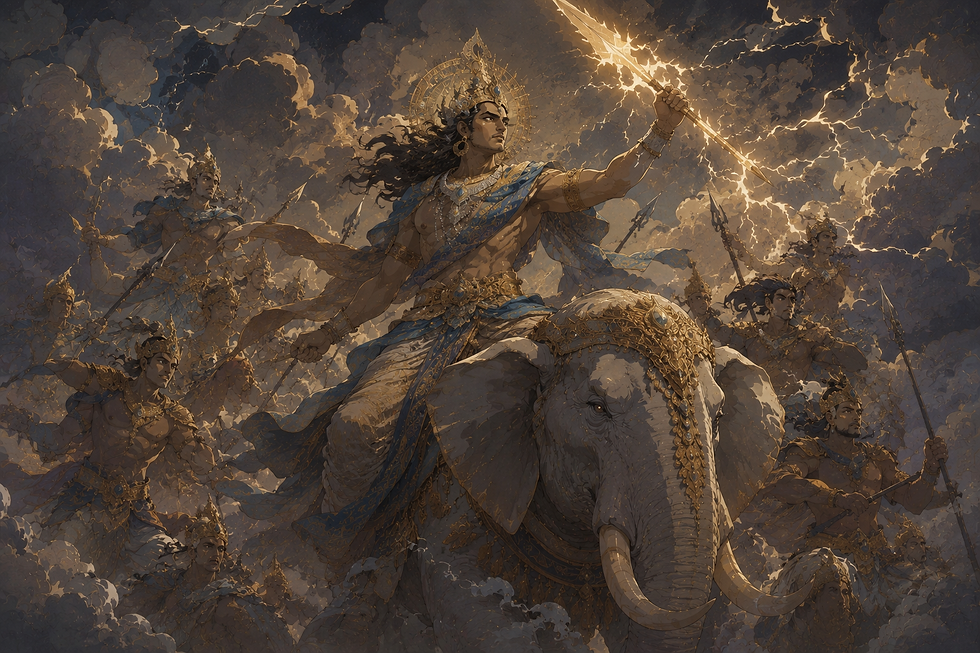
This hymn is a dramatic, imagistic celebration of Indra’s arrival—his chariot being yoked, his journey to the sacrifice, and his mighty deeds as Vṛtra-slayer and king.
Verses 1–2: The Yoking of the Ruddy Sun-Horse
The hymn opens with an image of yoking: “They yoke the tawny, ruddy one”—a description of the sun or the dawn-horse that moves around the stationary worlds. The “lights shine in the sky.”
Then the seer turns to Indra’s own horses: two desirable bays, full-winged, crimson, bold, yoked to his chariot. The Maruts are implied as the ones who do the yoking—they prepare Indra’s war-chariot. This is a visual spectacle of light and colour.
Verses 3–4: Banner for the Formless
The Maruts are addressed directly: they make a “banner for the bannerless, a form for the formless.” This likely refers to Indra himself, who, though formless, is given visible manifestation by the Maruts’ attendance.
Then the dawn-flushers (the Maruts or the first lights) declare: “So, O bull, hear us.” The “smiling eyes of the Sun” then appear—dawn breaking—as a chariot is yoked.
Verses 5–6: The Milk-Cows and the Rivers
A mysterious shift: milk-cows yoked him, desiring to carry him to those who seek him—perhaps the Soma oblations personified as cows.
Then rivers carry a flowing one to battle, “abundant ones that swell in the woods.” These are the Soma streams, swelling and rushing into the sacrifice, fueling Indra’s battle-march.
Verse 7: The Call for Help
The seer now speaks directly: “You, the mighty, overpowerer of men, King among the gods, we call upon for help. Carry us safely across all dangers.” This is a personal plea, simple and urgent.
Verses 8–9: The Sharp-Horned Bull and the Vṛtra-Slayer
Indra is described as one who grants victory and far-sightedness, “sharp-horned like a bull, with the thunderbolt in hand.” His heroic deeds are numberless; when exhilarated by Soma, he “sunders everything.” He is the Vṛtra-slayer, the wanderer at will—free and unstoppable.
Verse 10: The Concluding Prayer
The final verse sends out the prayer in all directions, to all peoples, and asks that Indra, the worshipful one, together with all the gods, place all enemies behind the worshippers.
The hymn is a cascade of images: yoking, dawn-light, sun, horses, cows, rivers, bull, thunderbolt, victory. It builds a cinematic vision of Indra’s procession from heaven to sacrifice, culminating in a prayer for protection and victory.
Understanding Indra: The Chariot, the Maruts, and the Dawn Procession
This hymn deepens the portrait of Indra by focusing on the moment before battle—the preparation of his chariot, the assembly of his troop, and his radiant arrival.
The Yoking Ritual: The first two verses describe the yoking of horses—a ritual of preparation. In the Vedic world, yoking a chariot is the act that transforms a resting warrior into a moving force. The Maruts are the ones who yoke Indra’s two bay horses.
These horses are harī—the same word used for the golden-yellow hue of the sun. By yoking his horses, the Maruts enable Indra to move from the unmanifest to the manifest, from stillness to action.
The “banner for the bannerless” suggests that Indra himself is formless spirit, and it is only through the Maruts’ attendance and the ritual yoking that he takes on visible, powerful form.
The Maruts as Indra’s Revealers: In Hymn 1.5, the Maruts were mentioned only once, as Indra’s companions. Here, they are active agents. They yoke his horses, give him a banner, and announce his birth with the dawn-flushers.
They are the ones who make Indra accessible—they transform his invisible might into visible splendour. Without them, Indra would be a distant, unapproachable power. With them, he becomes a king riding in a chariot, surrounded by a singing, storming host.
The Dawn Connection: The “smiling eyes of the Sun” and the dawn imagery connect Indra to the daily renewal of light. Indra’s battle against Vṛtra is often associated with the release of the dawns.
The Maruts, as dawn-flushers, share in this work. The hymn implies that every sunrise is a re-enactment of Indra’s victory—the serpent of darkness is slain, and the cows (the light) are released.
The Bull and the Wanderer: Verse 9 calls Indra vṛthāvah—the wanderer at will. This is a fascinating title. Indra is not bound by any law or limitation. He goes where he pleases, conquers what he wishes, and his will is unfettered.
Combined with the image of the sharp-horned bull, we see a god of raw, directed force—guided by the Soma’s exhilaration, yoked by his companions, and unleashed upon the enemies of his worshippers.
Connecting the Series: Hymn 1.4 gave us Indra as the solitary Soma-drinker and friend. Hymn 1.5 introduced the Maruts and the Vṛtra-slaying. Hymn 1.6 now paints the full picture: the preparation of the chariot, the dawn procession, the yoking by the Maruts, and Indra’s unstoppable, untamed nature.
The sequence is preparing for the great battle narrative that will eventually unfold. But for now, the series is still establishing Indra’s identity, layer by layer, through the eyes of the Soma-priest who watches the dawn break and knows his god is coming.

Hymn 1.7 – To Indra
Seer (Ṛṣi): Madhucchandā Vaiśvāmitra
Deity (Devatā): Indra
Meter (Chandas): Gāyatrī

Verses
इन्द्र॒मिद्गा॒थिनो॑ बृ॒हदिन्द्र॑म॒र्केभि॑र॒र्किणः॑ ।
इन्द्रं॒ वाणी॑रनूषत ॥१॥
indram id gāthino bṛhad indram arkebhir arkiṇaḥ |
indraṃ vāṇīr anūṣata ||1||
The chanters sing of Indra alone—the lofty one; the singers of sacred songs sing of Indra; the voices sing to Indra.
इन्द्र॒ इद्धर्योः॒ सचा॒ संमि॑श्ल॒ आ व॑चो॒युजा॑ ।
इन्द्रो॑ व॒ज्री हि॑र॒ण्ययः॑ ॥२॥
indra id dharyoḥ sacā saṃmiśla ā vacoyujā |
indro vajrī hiraṇyayaḥ ||2||
Indra alone is joined with his two bay horses, yoked by his word alone; Indra is the thunderbolt-wielder, the golden one.
इन्द्रो॑ दी॒र्घाय॒ चक्ष॑स॒ आ सूर्यं॑ रोहयद्दि॒वि ।
वि गोभि॒रद्रि॑मैरयत् ॥३॥
indro dīrghāya cakṣasa ā sūryaṃ rohayad divi |
vi gobhir adrim airayat ||3||
Indra made the Sun rise in the sky for long seeing; he split the mountain apart with his cows.
इन्द्र॒ वाजे॑षु नोऽव सहस्रप्रधनेषु च ।
उ॒ग्र उ॒ग्राभि॑रू॒तिभिः॑ ॥४॥
indra vājeṣu no 'va sahasrapradhaneṣu ca |
ugra ugrābhir ūtibhiḥ ||4||
O Indra, help us in the contests and in the thousandfold battles, O mighty one, with mighty aids.
इन्द्रं॑ व॒यं म॑हाध॒न इन्द्र॒मर्भे॑ हवामहे ।
युजं॑ वृ॒त्रेषु॑ व॒ज्रिण॑म् ॥५॥
indraṃ vayaṃ mahādhana indram arbhe havāmahe |
yujaṃ vṛtreṣu vajriṇam ||5||
We call upon Indra in great wealth, we call upon Indra in small—the ally against the Vṛtras, the thunderbolt-wielder.
स नो॑ ददातु॒ तां र॒यिमु॒रुं पि॒शङ्ग॑संदृशम् ।
इन्द्र॒ पते॑ र॒थीत॑मः ॥६॥
sa no dadātu tāṃ rayim uruṃ piśaṅgasaṃdṛśam |
indra pate rathītamaḥ ||6||
May he give us that wealth—wide, of golden-brown appearance. O Indra, lord, greatest charioteer.
इन्द्रं॑ व॒यं सु॒ते ह॑वामहे॒ यो न॒ इद्धृ॒दि स्थि॒तः ।
स नः॑ सहस्र॒धार॑या पुरं॒धिवा॑ज॒सात॑ये ॥७॥
indraṃ vayaṃ sute havāmahe yo na id dhṛdi sthitaḥ |
sa naḥ sahasradhārayā purandhi-vājasātaye ||7||
We call upon Indra at the pressing—he who is established in our heart. May he, with his thousand-streamed (Soma), be here for us, for the winning of abundance and wisdom.
इन्द्रो॑ द॒धीचो॑ अ॒स्थभि॑र्वृ॒त्राण्यप्र॑तिष्कुतः ।
ज॒घान॑ नव॒तीर्नव॑ ॥८॥
indro dadhīco asthabhir vṛtrāṇy apratiṣkutaḥ |
jaghāna navatīr nava ||8||
Indra, with the bones of Dadhyanc, slew the Vṛtras, unresisted—nine and ninety.
इ॒च्छन्नश्व॑स्य॒ यच्छिरः॒ पर्व॑ते॒ष्वप॑श्रितम् ।
तद्वि॑दच्छर्य॒णाव॑ति ॥९॥
icchann aśvasya yac chiraḥ parvateṣv apaśritam |
tad vidac charyaṇāvati ||9||
Seeking the head of the horse, which was hidden away in the mountains, he found it in Śaryaṇāvat.
अत्राह॒ गोर॑मन्वत॒ नाम॒ त्वष्टु॑र॒पीच्य॑म् ।
इ॒त्था च॒न्द्रम॑सो गृ॒हे ॥१०॥
atrāha gor amanvata nāma tvaṣṭur apīcyam |
itthā candramaso gṛhe ||10||
There indeed they thought upon the secret name of the cow of Tvaṣṭṛ, thus in the house of the Moon.
What Does This Hymn Say?
This hymn is a concentrated portrait of Indra—the singer’s supreme subject, the solar hero, the thunderbolt-wielder, the ally in every circumstance, and the possessor of hidden, world-shaping knowledge.
Verses 1–2: Indra as the Sole Song
The hymn opens with a cascade of synonyms for singers: gāthinas, arkinas, vāṇīs. All of them sing of Indra alone, and Indra alone is the one yoked with his two bay horses, joined with them by his own word.
He is the golden thunderbolt-wielder. There is no preamble; the hymn plunges straight into exclusive devotion.
Verse 3: Indra’s Solar and Rocky Deeds
This compact verse holds two cosmic acts: Indra raises the Sun into the sky for long, far-seeing vision, and he splits the mountain open with the help of his cows (the light, the dawns). It is a miniature creation story—the release of light and the opening of the closed world.
Verses 4–5: Indra in Every Battle
The seer asks for Indra’s help in contests and in “thousandfold battles,” with mighty aids. Then verse 5 beautifully balances scale: we call on Indra in great wealth and in small—he is the ally against Vṛtras in any situation.
Verses 6–7: Wealth and the Heart
The prayer becomes specific: grant us wealth “wide, of golden-brown appearance”—perhaps golden treasure or the hue of Soma itself. Indra is the greatest charioteer.
Then verse 7 adds an intimate note: Indra is established in the heart; he is called at the Soma pressing with his “thousand-streamed” power for the winning of abundance and wisdom (purandhi).
Verses 8–10: The Bones of Dadhyanc and the Secret Name
The final three verses are dense with mythic allusion. Indra slew ninety-nine Vṛtras using the bones of the ancient seer Dadhyanc. The story, briefly: Dadhyanc possessed secret knowledge (the “honey-doctrine”) that the Aśvins wanted; they replaced his head with a horse’s head, and when Indra later used his bones—strong with that wisdom—they became an invincible weapon.
Verse 9 speaks of Indra seeking the horse’s head hidden in the mountains and finding it in Śaryaṇāvat. Verse 10 then closes with a mysterious line: “They thought upon the secret name of the cow of Tvaṣṭṛ, thus in the house of the Moon.”
This likely refers to the hidden identity of the Soma or the cosmic cow—the source of nourishment and inspiration—whose secret is known only in the lunar realm of Soma.
Understanding Indra: The Thunderbolt, the Sun, and the Hidden Knowledge
This hymn presents Indra at his most concentrated: the supreme recipient of song, the cosmic actor, the personal ally, and the guardian of a profound, hidden knowledge.
The Golden Thunderbolt-Wielder: Verse 2 calls Indra vajrī hiraṇyayaḥ—the golden thunderbolt-wielder. The vajra is Indra’s defining weapon, forged by Tvaṣṭṛ (the divine craftsman), and its golden colour signifies its brilliance, its unstoppable force, and its connection to the sun.
Unlike earlier hymns that focused on the Soma-drinking that empowers Indra, this hymn emphasises the weapon itself. It is yoked to him as naturally as his bay horses are yoked by his word alone. The thunderbolt is not just a tool; it is part of Indra’s identity.
The Raiser of the Sun: Verse 3, though brief, is cosmically vast: Indra made the Sun rise in the sky for long seeing. This is a creative act, a gift of vision to all beings. He also split the mountain with his cows.
In Vedic cosmology, the mountain is Vala or the cloud-mountain that holds the dawns captive. Indra’s act of splitting it releases light and nourishment.
Together, these two acts—raising the Sun and splitting the mountain—define Indra as the god who opens the closed world and establishes the order of day and night.
Indra in the Heart: Verse 7 introduces a strikingly personal dimension: “We call upon Indra at the pressing—he who is established in our heart.”
This is not a remote deity; he dwells within the worshipper. The Soma pressing is the external ritual, but Indra’s true seat is the heart. The “thousand-streamed” power is both the Soma and the inner flow of devotion and insight.
Indra, in this sense, is not just a cosmic warrior but an indwelling presence that brings purandhi—abundance and inspired wisdom.
The Secret of the Bones and the Cow: The last three verses transport the listener into a different register—the realm of esoteric myth. Indra’s weapon, the thunderbolt, is here made from the bones of Dadhyanc, a seer who knew the “honey-doctrine” (the secret of Soma). The bones, infused with that wisdom, become an invincible weapon that slays ninety-nine Vṛtras.
This tells us that Indra’s power is not brute force alone; it is power infused with knowledge. The horse’s head hidden in the mountains, found in Śaryaṇāvat (a place associated with Soma), and the secret name of Tvaṣṭṛ’s cow known in the house of the Moon—all point to a hidden, luminous wisdom that underlies Indra’s victories.
The “cow” is likely Vāc (Speech) or the Soma cow, and the “house of the Moon” is the celestial Soma realm. Indra is the one who seeks, finds, and wields this secret knowledge.
Connecting the Series: Hymn 1.4 introduced Indra as the Soma-drinking friend. Hymn 1.5 placed him with the Maruts and his Vṛtra-slaying. Hymn 1.6 showed the yoking of his chariot and the dawn procession.
Now, Hymn 1.7 completes a picture: it affirms Indra as the sole object of song, the cosmic opener, the inner presence, and the wielder of a thunderbolt forged from secret wisdom.
The series is moving from the external ritual toward the inner mysteries of the Vedic world—and this hymn, with its reference to Dadhyanc and the hidden name, is the first step into that deeper layer.

Hymn 1.8 – To Indra (with the Maruts)
Seer (Ṛṣi): Madhucchandā Vaiśvāmitra
Deity (Devatā): Indra (accompanied by the Maruts)
Meter (Chandas): Gāyatrī

Verses
इन्द्र॑ सा॒नसिं॑ र॒यिं स॑ह॒स्रां पु॑रु॒भोज॑सम् ।
अ॒स्मभ्यं॑ चि॒त्रवा॑हनम् ॥१॥
indra sānasiṃ rayiṃ sahasrāṃ purubhojasam |
asmabhyaṃ citravāhanam ||1||
O Indra, bring us wealth that wins and conquers, thousandfold, rich in many enjoyments, and wondrously conveyed.
यस्मि॑न्निन्द्र मी॒ढुष॑ः स॒प्त य॒ज्ञा नि॒वीष॑ति ।
अर्वा॑वसुः पुरु॒प्रियः॑ ॥२॥
yasminn indra mīḍhuṣaḥ sapta yajñā nivīśati |
arvāvasuḥ purupriyaḥ ||2||
In whom, O Indra, the seven offerings of the liberal worshipper take their seat—him, the bringer of wealth, the friend of many.
इन्द्र॑ त्वा य॒ज्ञैरि॑लते॒ पूर्वी॑षु प्र॒त्नव॑द्भुवः ।
सु॒तेषु॒ स्तोम्ये॒ वह॑ ॥३॥
indra tvā yajñair iḻate pūrvīṣu pratnavad bhuvaḥ |
suteṣu stom ye vaha ||3||
O Indra, the worshippers praise you with sacrifices among many peoples, as of old. Carry us to the Soma draughts worthy of praise.
इन्द्र॒ ये सु॒युजं॒ युजं॒ मरु॑तो॒ ये च॑ सु॒त्वनः॑ ।
तेभि॑र्वज्र॒हस्त॒मा ग॑हि ॥४॥
indra ye suyujaṃ yujaṃ maruto ye ca sutvanaḥ |
tebhir vajrahastam ā gahi ||4||
O Indra, those Maruts who are well-yoked and those Soma-pressers who are yoked together—with them, O thunderbolt-handed one, come.
म॒रुत्वाँ॑ इन्द्र वृष॒भो रणा॑य॒ पिबा॒ सोम॑मनुष्व॒धम् ।
आ सि॑ञ्चस्व ज॒ठरे॒ मध्व॑ ऊ॒र्मिम् ॥५॥
marutvām̐ indra vṛṣabho raṇāya pibā somam anuṣvadham |
ā siñcasva jaṭhare madhva ūrmim ||5||
O Indra, accompanied by the Maruts, drink the Soma as a bull for battle, according to your nature. Pour into your belly a wave of honey.
इन्द्र॑ त्वा वृष॒भं सु॒ते पिब॑न्तं मरुतां ग॒णे ।
आ प॑वस्व दे॒ववा॑हैः ॥६॥
indra tvā vṛṣabhaṃ sute pibantaṃ marutāṃ gaṇe |
ā pavasva devavāhaiḥ ||6||
O Indra, you the bull, drinking the pressed Soma in the troop of Maruts—purify yourself with the god-bearing (horses).
इन्द्र॑ सान॒सवे॒ वह॒ रयिं॑ वी॒रव॑तीमिषम् ।
विश्वा॑ दी॒दित॑मृष्व ॥७॥
indra sānasave vaha rayiṃ vīravatīm iṣam |
viśvā dīditam ṛṣva ||7||
O Indra, to the one who presses Soma bring wealth consisting of heroes, strength, and all-shining, O lofty one.
इन्द्रे॒हि मत्स्यन्ध॑सो॒ विश्वे॑भिः सोम॒पर्व॑भिः ।
म॒हाँ अ॑भि॒ष्टिरोज॑सा ॥८॥
indrehi matsy andhaso viśvebhiḥ somaparvabhiḥ |
mahām̐ abhiṣṭir ojasā ||8||
O Indra, come! Rejoice in the Soma juice with all its Soma-stalks. Great is your assistance with might.
इन्द्रं॑ व॒यं म॑हाय॒नादिन्द्रं॒ त्वोता॑सो॒ अग्न॑ये ।
अथा॒ स्तोमं॑ य॒जाम॑हे ॥९॥
indraṃ vayaṃ mahāyanād indraṃ tvotāso agnaye |
athā stomaṃ yajāmahe ||9||
We would greatly honour Indra; protected by Indra, we offer prayer to Agni. And then we worship with a hymn of praise.
इन्द्रा॑ ग॒णानां॑ त्व॒मसि॒ विश्व॑भूः पुरु॒ष्टुतः॑ ।
उ॒त त्वा॑ वृत्र॒हा पति॒र्जना॑नां पू॒र्वपी॑तये सुव॒र्विदे॒ वाजे॑भ्यो॒ वाजि॑नं हुवेमहि ॥१०॥
indrā gaṇānāṃ tvam asi viśvabhūḥ puruṣṭutaḥ |
uta tvā vṛtrahā patir janānāṃ pūrvapītaye suvarvide vājebhyo vājinaṃ huvemahi ||10||
O Indra, you are the lord of the hosts, the all-creator, praised by many. And you, the Vṛtra-slayer, the lord of the peoples—we call upon you, the swift one, for the first drink, for the finding of the sun, for the winning of spoils.
What Does This Hymn Say?
This hymn is a full-throated call for wealth, victory, and the overwhelming, tangible gifts that Indra bestows when he drinks Soma with his Maruts.
Verses 1–3: The Desired Wealth
The seer opens by asking Indra directly for wealth—not any wealth, but *sānasiṃ rayiṃ*: conquering, winning wealth, a thousandfold treasure “rich in many enjoyments” and “wondrously conveyed” (perhaps in a marvellous chariot).
Verse 2 explains that this wealth is the place where the seven offerings of the liberal worshipper come to rest—Indra himself becomes the container of the gifts flowing back to the giver. Verse 3 recalls that this is an ancient pattern: the worshippers praise Indra with sacrifices among many peoples, and ask to be carried to the Soma draughts.
Verses 4–6: The Maruts and the Drinking
Now the Maruts enter explicitly. The well-yoked Maruts and the Soma-pressers form a combined company; Indra is asked to come with them all, thunderbolt in hand. Verse 5 is the heart of the ritual: “Accompanied by the Maruts, drink the Soma as a bull for battle… Pour into your belly a wave of honey.”
The Maruts form the drinking-troop; Indra is the bull among them. Verse 6 adds that, drinking in that troop, he should “purify himself with the god-bearing horses”—his bay steeds that carry the divine presence.
Verses 7–9: The Prayer for Heroes and Assistance
The request becomes specific: bring wealth that consists of heroes (*vīravatīm iṣam*) and all-shining strength. Then, a simple, urgent call: “Come! Rejoice in the Soma juice with all its stalks. Great is your assistance with might.”
Verse 9 widens the circle: the worshippers honour Indra, and protected by him, they offer prayer to Agni, then worship with a hymn of praise. Indra’s protection enables the entire ritual order.
Verse 10: The Lord of Hosts
The final verse, longer and in a different cadence, is a majestic closing. Indra is the lord of the hosts (gaṇānām), the all-creator, praised by many, the Vṛtra-slayer, the lord of the peoples.
The seer calls him for the first drink, for the finding of the sun, for the winning of spoils. The verse compresses Indra’s entire cosmic function—sovereignty, creation, dragon-slaying, light-finding, and wealth-winning—into a single, resonant call.
The hymn is thus a petition that moves from desired treasure through ritual drinking, the Maruts’ companionship, and finally to the grand acknowledgment of Indra’s all-encompassing lordship.
Understanding Indra: The Bringer of All Desirable Wealth
Hymn 1.8 completes a sequence that began with Hymn 1.4. Across these five Indra hymns, the seer has built a portrait layer by layer: the solitary Soma-drinker (1.4), the Vṛtra-slayer with the Maruts (1.5), the dawn-charioteer yoked by the Maruts (1.6), the wielder of secret knowledge (1.7), and now, the giver of conquering, hero-rich wealth.
This final hymn of the Indra cluster grounds all that power in a single, urgent human desire: abundance.
The Conquering Wealth: The opening word sānasiṃ (winning, conquering) sets the tone. The wealth Indra gives is not static possession; it is wealth that actively conquers—it expands, overcomes rivals, and keeps growing. It is “wondrously conveyed” (citravāhanam), perhaps carried in Indra’s own marvellous chariot.
In the Vedic world, wealth means cattle, horses, gold, strong sons, and above all, victory in the contests (vāja) that structure tribal life. Indra is the divine patron of that victory.
The Maruts as Drinking Companions: This hymn, more than the previous ones, emphasises the Maruts as Indra’s fellow-drinkers. They are the troop (gaṇa) with whom Indra drinks. The drinking is not solitary; it is a communal, roaring, bull-like act.
Indra pours into his belly “a wave of honey” (madhva ūrmim). This honey is both the sweet Soma and the resulting sweetness of all the blessings that will flow to the worshippers.
The Maruts, as always, amplify and accompany—they are the well-yoked ones who ensure the chariot of Indra’s power moves.
The First Drink and the Finding of the Sun: The final verse introduces a crucial ritual concept: pūrvapīti—the first drink. Indra is called to receive the very first Soma libation. This is a privilege of the foremost god.
By granting Indra the first drink, the worshippers secure his presence and his commitment. The verse then links this to suvarvide—finding the sun, the light. Indra’s drinking leads directly to the release of cosmic light and the winning of spoils. The ritual, the myth, and the gift of prosperity are one continuous movement.
Why This Hymn Closes the Indra Sequence: Hymn 1.8 is the last of Madhucchandā’s Indra hymns in this opening series. It brings together all the earlier themes—Soma, Maruts, Vṛtra-slaying, chariot, thunderbolt, wealth—and adds a note of completion: Indra is the lord of hosts, the all-creator, the one praised by many.
The opening cluster of the Rig Veda has now fully established Indra as the central divine figure of the Soma ritual. From here, the hymns will begin to explore other deities and dimensions, but Indra will return again and again, always the bull, the drinker, the giver.
Hymn 1.9 – To Indra
Seer (Ṛṣi): Madhucchandā Vaiśvāmitra
Deity (Devatā): Indra
Meter (Chandas): Gāyatrī (with variations)

Verses
इन्द्रा॑ याहि॒ न म॑न्दसे॒ सोम॑स्य पी॒तये॑ गहि ।
राज॑न्वज्री हिर॒ण्ययः॑ ॥१॥
indrā yāhi na mandase somasya pītaye gahi |
rājan vajrī hiraṇyayaḥ ||1||
Come, Indra, for our exhilaration—come to drink the Soma, O King, wielder of the golden thunderbolt.
इन्द्र॒ त्वम॑सि वृत्र॒हा वा॒जी सू॒रिः पु॑रु॒हूतः॑ ।
आ या॑हि॒ मरु॑त्वाँ॒ इति॑ ॥२॥
indra tvam asi vṛtrahā vājī sūriḥ puruhūtaḥ |
ā yāhi marutvām̐ iti ||2||
O Indra, you are the Vṛtra-slayer, the prize-winner, the patron, the much-invoked one. Come—accompanied by the Maruts.
य॒दा सु॒तं पिबे॒दिन्द्र॒ त्वं वृ॒त्राणि॑ जिघ्नसि ।
तदा॑ त्वा म॒रुतो॑ ग॒णः ॥३॥
yadā sutaṃ pibed indra tvaṃ vṛtrāṇi jighnasi |
tadā tvā maruto gaṇaḥ ||3||
When you drink the pressed Soma, O Indra, you smash the Vṛtras. Then the Marut troop assists you.
य॒दा सु॒तं पिबे॒दिन्द्रो॑ वृ॒त्राणि॑ जिघ्नते॒ तदा॑ ।
स विश्वा॑ वा॒जा आ भ॑रत् ॥४॥
yadā sutaṃ pibed indro vṛtrāṇi jighnate tadā |
sa viśvā vājā ā bharat ||4||
When Indra drinks the pressed Soma, then he smashes the Vṛtras. He brings home all spoils of victory.
इन्द्रा॑ याहि॒ मरु॑त्वाँ॒ सोमं॑ पिबा वृषभ ।
आ सि॑ञ्चस्व ज॒ठरे॒ मध्व॑ ऊ॒र्मिम् ॥५॥
indrā yāhi marutvām̐ somaṃ pibā vṛṣabha |
ā siñcasva jaṭhare madhva ūrmim ||5||
Come, Indra, with the Maruts; drink the Soma, O Bull. Pour into your belly a wave of honey.
इन्द्र॑ त्वा य॒ज्ञ ई॑ळते पू॒र्वीषु॑ प्र॒त्नव॑द्भुवः ।
सु॒तेषु॒ स्तोम्ये॒ वह॑ ॥६॥
indra tvā yajña īḻate pūrvīṣu pratnavad bhuvaḥ |
suteṣu stom ye vaha ||6||
O Indra, the sacrifice reveres you among many peoples, as of old. Convey us to the Soma draughts worthy of praise.
इन्द्रं॑ व॒यं म॑हाय॒नेन्द्रं॒ त्वोता॑सो॒ अग्न॑ये ।
अथा॒ स्तोमं॑ यजामहे ॥७॥
indraṃ vayaṃ mahāyanendram tvotāso agnaye |
athā stomaṃ yajāmahe ||7||
We would greatly honour Indra; protected by Indra, we offer prayer to Agni. And then we worship with a hymn of praise.
इन्द्रा॑ ग॒णानां॒ त्वम॑सि॒ विश्व॑भूः पुरु॒ष्टुतः॑ ।
उ॒त त्वा॑ वृत्र॒हा पति॒र्जना॑नां पू॒र्वपी॑तये सुव॒र्विदे॒ वाजे॑भ्यो॒ वाजि॑नं हुवेमहि ॥८॥
indrā gaṇānāṃ tvam asi viśvabhūḥ puruṣṭutaḥ |
uta tvā vṛtrahā patir janānāṃ pūrvapītaye suvarvide vājebhyo vājinaṃ huvemahi ||8||
O Indra, you are the lord of the hosts, the all-creator, praised by many. And you, the Vṛtra-slayer, the lord of the peoples—we call upon you, the swift one, for the first drink, for the finding of the sun, for the winning of spoils.
What Does This Hymn Say?
This hymn is a direct, urgent series of calls to Indra—each verse a fresh invitation to come, drink, and conquer. It does not develop a single narrative but rather gathers a bouquet of Indra’s essential qualities, repeating the core plea with variations.
Verse 1 opens with the simplest, most intimate call: come for our exhilaration, come to drink, O golden-thunderbolt king. There is no intermediary; the worshipper speaks straight to the god.
Verse 2 names Indra by his titles—Vṛtra-slayer, prize-winner, patron, much-invoked—and then adds the crucial request: come with the Maruts. The troop is never far from their chief.
Verse 3–4 form a pair that states the ritual-mythic logic: when you drink Soma, you smash Vṛtras (verse 3 to Indra directly; verse 4 stating the same truth in the third person). The Marut troop assists, and Indra brings home all the spoils. This is the transactional heart of the Soma sacrifice: the offering empowers the god, and the god releases the world’s riches.
Verse 5 shifts into the imagery of feasting: come, Bull, drink, and fill your belly with a wave of honey. The Soma is not just a drink; it is a flood of sweetness poured directly into the god.
Verse 6 acknowledges that this is an ancient pattern—the sacrifice reveres Indra among many peoples—and asks him to carry the worshippers to the Soma draughts. The ritual is a vehicle, and Indra is the driver.
Verse 7 widens the circle: honouring Indra, protected by him, the worshippers then offer prayer to Agni and sing a hymn. Indra’s protection enables the entire ritual order.
Verse 8 closes with a grand, longer cadence, compressing Indra’s entire cosmic identity into a single invocation: lord of hosts, all-creator, much-praised, Vṛtra-slayer, lord of peoples—called for the first drink, for the finding of the sun, for the winning of spoils.
The hymn is not a story but a sustained, rolling call—the sound of a community determined to bring the mighty one among them.
Understanding Indra: The Much-Invoked Friend and the Logic of the Call
Hymn 1.9 distills Indra’s relationship with his worshippers into its simplest, most repetitive form. If the earlier hymns built Indra’s portrait through preparation (yoking the chariot), power (the thunderbolt), and cosmic deed (slaying Vṛtra and raising the sun), this hymn is the act of calling itself. It shows the Soma ritual as a relentless, joyful summons.
The Much-Invoked One: Indra is*puruhūtaḥ—“much invoked.” He is called again and again, not because he is reluctant, but because the need for his gifts is constant, and the Soma that draws him is always freshly pressed. The hymn’s structure—nine verses of direct address—mirrors the persistent, rhythmic call of the pressing stones. Each verse is a new wave of invitation.
The Logic of Drinking and Conquering: Verses 3–4 make explicit the transactional logic that underlies all these early hymns: Indra drinks → Indra smashes Vṛtra → Indra brings spoils.
There is no mythic narrative here, only the statement of a law. The worshipper does not beg; they feed the god and then announce the inevitable result. This is the confidence of the ritual: the Soma is offered, so the victory is already certain.
The Wave of Honey: Verse 5’s image of Indra pouring a “wave of honey” into his belly unites the physical and the cosmic. Honey (madhu) is the sweetness of Soma, but it is also the resulting sweetness of all blessings—cows, rain, sons, fame—that will flow back to the worshipper. Indra’s belly becomes the reservoir from which the world’s abundance is distributed.
The Place of This Hymn in the Series
Hymn 1.1 invoked Agni, the fixed flame, the centre. Hymns 1.2–1.3 expanded the circle to Vāyu, the Aśvins, the All-Gods, and Sarasvatī. Hymns 1.4–1.8 then focused overwhelmingly on Indra: his Soma-drinking, his chariot, his thunderbolt, the Maruts, the secret knowledge of Dadhyanc’s bones.
Now Hymn 1.9 pauses that building momentum and gathers all the threads into a pure, repetitive call—a kind of refrain before the series moves forward. It says, in effect: this is what we do; we call him, we feed him, he conquers, and we receive. It is the simplest, most fundamental statement of the Vedic worshipper’s relationship with the king of the gods.
Hymn 1.10 – To Indra (with the Maruts)
Seer (Ṛṣi): Madhucchandā Vaiśvāmitra
Deity (Devatā): Indra (accompanied by the Maruts)
Meter (Chandas): Gāyatrī (verse 1–9), Anuṣṭubh (verse 10), Jagatī (verse 11), Triṣṭubh (verse 12)
Verses
गाय॑न्ति त्वा गाय॒त्रिणोऽर्च॑न्त्य॒र्कम॒र्किणः॑ ।
ब्र॒ह्माण॑स्त्वा शतक्रत॒ उद्वं॒शमि॑व येमिरे ॥१॥
gāyanti tvā gāyatriṇo 'rcanty arkam arkiṇaḥ |
brahmāṇas tvā śatakrata ud vaṃśam iva yemire ||1||
The Gāyatrī singers sing to you; the Arka singers chant your Arka; the Brahman priests, O Śatakratu, have raised you like a bamboo pole.
यत्सा॒नोः सानु॒मारु॑ह॒द्भूर्यस्प॑ष्ट॒ कर्त्व॑म् ।
तदिन्द्रो॒ अर्थं॑ चेतति यू॒थेन॑ वृ॒ष्णिरे॑जति ॥२॥
yat sānoḥ sānum āruhad bhūry aspaṣṭa kartvam |
tad indro arthaṃ cetati yūthena vṛṣṇir ejati ||2||
When he climbs from ridge to ridge, much is there to be done that is not yet manifest. Then Indra perceives the goal; the bull stirs with his herd.
यु॒क्ष्वा हि के॒शिना॒ हरी॒ वृष॑णा कक्ष्य॒प्रा ।
अथा॑ न इन्द्र सोमपा इ॒ह क॒ण्वानां॑ बृ॒हस्प॑तेः ॥३॥
yukṣvā hi keśinā harī vṛṣaṇā kakṣyaprā |
athā na indra somapā iha kaṇvānāṃ bṛhaspateḥ ||3||
Yoke your two maned bay horses, the bulls whose girths are full. Then, O Indra, drinker of Soma, come here to the Kaṇvas, to Bṛhaspati's (sons).
इन्द्रा॑ याहि श॒तक्र॑तो ये॒ना वृ॒त्राणि॑ जिघ्नसि ।
अ॒स्मभ्यं॑ वृत्रहन्वृषा य॒मेन॑ रु॒द्र व॑र्तनिः ॥४॥
indrā yāhi śatakrato yenā vṛtrāṇi jighnasi |
asmabhyaṃ vṛtrahan vṛṣā yamena rudra vartaniḥ ||4||
Come, Indra, Śatakratu, by which (path) you smash the Vṛtras. For us, O Vṛtra-slayer, O bull, come with the Yama-like, Rudra-pathed (Maruts).
पिबा॒ सोम॑मिन्द्र॒ मरु॑त्वता सु॒तम् ।
आ सि॑ञ्चस्व ज॒ठरे॒ मध्व॑ ऊ॒र्मिम् ॥५॥
pibā somam indra marutvatā sutam |
ā siñcasva jaṭhare madhva ūrmim ||5||
Drink the Soma, O Indra, pressed with the Marut troop. Pour into your belly a wave of honey.
त्वं हि सोम॒पा मदो॑ ब्रह्म॒विद्वृ॑त्र॒हान्न॑वे ।
शु॒ष्मी शवि॑ष्ठ साद॒ने वि च॑र्षणे ॥६॥
tvaṃ hi somapā mado brahmavid vṛtrahān nave |
śuṣmī śaviṣṭha sādane vi carṣaṇe ||6||
For you are the Soma-drinking intoxication, the knower of prayer, the Vṛtra-slayer, ever new. O impetuous one, O strongest, in the seat of the wide-ranging (gods).
स नो॒ वाजे॑षु चोदयेन्द्र वृ॒त्राणि॑ जिघ्नतः ।
अ॒भि ति॒ग्मेन्द्र॒ वज्र॑मुप धेहि वि॒दद्व॑सु ॥७॥
sa no vājeṣu codayendra vṛtrāṇi jighnataḥ |
abhi tigmendra vajram upa dhehi vidadvasu ||7||
Urge us on, O Indra, in the contests as we smash the Vṛtras. Lay your sharp thunderbolt upon us, O finder of wealth.
इन्द्र॑ शु॒ष्ममा भ॑रा॒ मयि॑ त्वा सोम॒पीत॑ये ।
उ॒रुं कृ॑णुष्व वाजिनं॒ विश्वे॑ ते॒ मरु॑तो गृ॒हे ॥८॥
indra śuṣmam ā bharā mayi tvā somapītaye |
uruṃ kṛṇuṣva vājinaṃ viśve te maruto gṛhe ||8||
Bring impetuous might to me, Indra, for the drinking of Soma. Make wide the swift one (the path or the horse); all the Maruts are in your house.
आ त्वा॒ विश॑न्तू॒षसो॑ वृ॒त्रहा॑ण॒मिन्द्र॑म् ।
अनु॑ त्वा॒ वरु॑णो मि॒त्रो अ॑ग्निः ॥९॥
ā tvā viśantūṣaso vṛtrahāṇam indram |
anu tvā varuṇo mitro agniḥ ||9||
May the Dawns enter you, Indra, the Vṛtra-slayer. May Varuṇa, Mitra, Agni follow you.
प्र ते॒ पूर्वा॑णि॒ कर॑णानि वि॒प्रा वि॒द्वाँ आ॑ह वि॒दुषे॒ करां॑सि ।
यथा॑यथा वृष्णियानि॒ स्वगू॒र्ता वृ॒त्रेष्वि॑न्द्रो नृ॒तम॑ उ॒त्थिता॑नि ॥१०॥
pra te pūrvāṇi karaṇāni viprā vidvām̐ āha viduṣe karāṃsi |
yathāyathā vṛṣṇiyāni svagūrtā vṛtreṣv indro nṛtama utthitāni ||10||
The wise singer declares your former deeds to the wise one—the deeds, the bull-like acts, well-proclaimed, O Indra, the most manly, risen against the Vṛtras.
अन॑प्तम॒प्सु दु॑ष्ट॒रं सोमं॒ पवि॑त्र॒ आ मृ॑ज ।
अथेन्द्र पात॒वे वृषा॑ म॒रुत्व॑द्वृष्णो अर्पय ॥११॥
anaptam apsu duṣṭaraṃ somaṃ pavitra ā mṛja |
athendra pātave vṛṣā marutvad vṛṣṇo arpaya ||11||
The Soma untouched by water, hard to pass—polish it in the strainer. Then, O Indra, the bull, place it for drinking, with the Maruts, O bull.
ये ते॒ मरु॑तो॒ ये च॑ वी॒रा रथ॑स्पतिं कृ॒णवै॑ सू॒रयः॑ ।
अध॒ प्रति॒ भर॑ध्व॒ इन्द्र॑ सू॒रिभ्यो॑ अ॒मृतो॑ अ॒स्त्रव॑न्नहि॒ता वि॑मु॒च्य॑ ॥१२॥
ye te maruto ye ca vīrā rathaspatiṃ kṛṇavai sūrayaḥ |
adha prati bharadhva indra sūribhyo amṛto astravann ahitā vimucya ||12||
Those Maruts of yours, and the heroes, the patrons—may I make them chariot-lords. Then, O Indra, the immortal one, having shot, having released the hidden ones, bring back (wealth) to the patrons.
What Does This Hymn Say?
This is the final hymn of Madhucchandā's opening Indra cycle, and it gathers all the previous motifs—singing, yoking, drinking, Vṛtra-slaying, wealth—into a rich, varied-textured close. The metre shifts three times, marking changes in tone.
Verses 1–3: The Singers, the Climb, the Yoking
The hymn opens by naming three types of ritual singers: the Gāyatrī-chanters, the Arka-singers, and the Brahman priests. They have "raised Indra like a bamboo pole"—an image of erecting a standard, a visible rallying point.
Verse 2 describes Indra climbing "from ridge to ridge," a mountain image suggesting progressive conquest, perceiving what is not yet manifest. Then in verse 3 the seer calls for the yoking of the maned bay horses, naming the Kaṇva clan—perhaps indicating this hymn was used in a different ritual circle than the previous hymns.
Verses 4–6: The Call, the Drinking, the Nature of Indra
Indra is asked to come by the path that smashes Vṛtras, with the Maruts who are "Yama-like" and "Rudra-pathed"—associating the storm-troop with the ancestors (Yama) and the wild god Rudra. Verse 5 repeats the core refrain from earlier hymns: drink Soma, fill your belly with honey. Verse 6 names Indra as the intoxication itself, the knower of prayer, the Vṛtra-slayer who is ever new.
Verses 7–9: Urging, Might, and the Dawns
The seer asks Indra to urge them on in battle even as they smash Vṛtras—a merging of divine and human action. The sharp thunderbolt is asked to be "laid upon us," perhaps meaning protection or empowerment.
Verse 8 asks for might and a wide path. Then verse 9 invokes a beautiful image: the Dawns enter Indra, and Varuṇa, Mitra, and Agni follow him—a cosmic procession.
Verses 10–12: The Deeds, the Soma, and the Final Charge
The metre shifts to longer lines. Verse 10 states that the wise singer declares Indra's former deeds to the wise listener, the bull-like acts risen against Vṛtras. Verse 11 instructs the purification of Soma—untouched by water, strained—for Indra to drink with the Maruts.
The final verse calls upon the Maruts, heroes, and patrons, asking Indra to shoot his arrows, release the hidden ones, and bring back wealth. The hymn ends with a warrior's charge.
Understanding Indra: The Final Gathering of the Opening Cycle
Hymn 1.10 closes Madhucchandā's extraordinary sequence. Across ten hymns, this seer has opened the Rig Veda with a complete portrait of the Vedic ritual world: Agni the centre, Vāyu the breath, the Aśvins the swift healers, Sarasvatī the flowing word, and Indra the supreme warrior. This final hymn does not introduce new themes but weaves all existing threads into a tapestry.
The Raised Pole: The image of Indra raised like a bamboo pole (verse 1) is striking. It suggests a standard or flagstaff—visible from afar, a rallying point for the community.
Indra is not just a god to be invoked; he is the banner under which the clan fights and wins. The threefold singers—Gāyatrī, Arka, Brahman—represent the full range of Vedic liturgy, all united in raising Indra aloft.
The Ridge-Climbing Bull: Verse 2's image of climbing from ridge to ridge, the bull stirring with his herd (the Maruts), captures Indra's progressive conquest.
Each ridge is an obstacle overcome, each Vṛtra a new height reached. The "much to be done that is not yet manifest" suggests that Indra's work is ongoing, creative, revealing what was hidden.
The Cosmic Procession: Verse 9 is especially beautiful: the Dawns enter Indra, and Varuṇa, Mitra, and Agni follow him. After all the battle imagery, this verse shows Indra as the centre of a harmonious cosmic order.
The Dawns—symbols of renewal, light, and the gifts of each day—flow into him. The other great gods follow in his wake. Indra is not a solitary tyrant; he is the head of a divine community.
The Hidden Ones Released: The final verse speaks of shooting arrows and releasing ahitā—the hidden ones, the serpents, the pent-up treasures.
This is the Vṛtra myth in its simplest form: the serpent holds back the world's riches; Indra, with his Maruts and heroes, shatters the obstruction and brings the spoils home. The hymn ends, fittingly, with the distribution of wealth to the patrons.
The End of the Opening Movement
With Hymn 1.10, the Rig Veda's first movement is complete. Madhucchandā has established the fundamental ritual relationship: humans kindle Agni, press Soma, and sing; Indra drinks, conquers, and gives.
The remaining hymns of Mandala 1 will be seen by other seers—Śunaḥśepa, Gotama, Kutsa, and many others—and will explore new deities, new stories, and new depths. But the ground has been laid. The first voice of the Veda, the son of Viśvāmitra, has given us the keys to the entire Vedic world
Who Is Madhucchandā Vaiśvāmitra, the First Voice in Mandala 1 in Rig Veda?
"Vaiśvāmitra" means "son/descendant of Viśvāmitra." So the hymns were composed by Madhucchandā, who is indeed a son of the great sage Viśvāmitra—the same Viśvāmitra who later becomes the teacher and guardian of Rāma in the Rāmāyaṇa.
Viśvāmitra himself is the towering figure: a king turned brahmarṣi, the seer of the sacred Gāyatrī mantra (Rig Veda 3.62.10), and the sage who takes the young Rāma and Lakṣmaṇa into the forest to protect his sacrifice and eventually leads Rāma to Sītā's svayamvara.
Madhucchandā is Viśvāmitra's son, and it is he—not the sage himself—who "sees" the very first hymns of the Rig Veda (1.1–1.10, possibly more). So the first voice of the Veda belongs to the son of the Rāmāyaṇa's great sage.
Viśvāmitra himself is the seer of many hymns, especially the bulk of Maṇḍala 3 of the Rig Veda, along with his clan. So the family lineage is deeply intertwined with the very structure of the Veda.
It's a beautiful connection: the father (Viśvāmitra) is the composer of the Gāyatrī and the teacher of Rāma; his son (Madhucchandā) is the first human voice we hear when the Rig Veda opens.


Comments