
.png)

Ancient Asia: Yamnaya Culture, the Indo-European Architects
- A. Royden D'Souza

- Apr 28
- 34 min read
Few archaeological cultures have reshaped our understanding of human prehistory as profoundly as the Yamnaya; a people whose name, derived from the Russian word for "pit" (яма, yama), belies the monumental scale of their impact.
From their heartland in the vast grasslands stretching between the Southern Bug, Dniester, and Ural rivers, the Yamnaya emerged during the late Copper Age to early Bronze Age, approximately 3300–2600 BC, and proceeded to set in motion demographic, linguistic, and cultural transformations that continue to echo in the genetic makeup and languages of nearly half the world's population today.

This culture, also known as the Pit Grave culture or Ochre Grave culture, was defined by the Russian archaeologist Vasily Gorodtsov following his excavations near the Donets River in 1901–1903.
But what Gorodtsov uncovered was far more than a regional burial tradition; he had stumbled upon the archaeological signature of the Proto-Indo-Europeans, the ancestral speakers of a language family that would eventually span from Iceland to India & Sri Lanka, from Portugal to Siberia.
The central question is as profound as it is contentious: how did a semi-nomadic pastoralist society, possessing no cities, no writing system, and no centralized state apparatus, achieve one of the most transformative demographic expansions in human history?
The answer lies at the intersection of archaeology, linguistics, genetics, and paleoclimatology; a story of technological innovation, ecological adaptation, social organization, and, perhaps most controversially, the interplay of migration, violence, and disease.
This paper will trace the Yamnaya from their earliest origins among the Eneolithic cultures of the Volga-Ural region to their ultimate dissolution into successor societies. It will explore every facet of their civilization: the emergence of the kurgan burial tradition, the political and social structures that enabled high mobility, the pastoral economy underpinned by dairy production and wagon transport, the military technologies that facilitated expansion, the religious beliefs inscribed in stone stelae and funerary rituals, and the complex external relations that brought them into contact with the urban civilizations of the Caucasus and the Balkans.
Special attention will be devoted to the Yamnaya's contested legacy as the vector of Indo-European languages; a hypothesis that has moved from the scholarly fringes to mainstream acceptance in the wake of the ancient DNA revolution, yet remains the subject of vigorous debate.
The "Kurgan hypothesis," first formulated by Marija Gimbutas in the 1950s and later refined by David Anthony, posits that the Yamnaya were not merely a Bronze Age culture but the linguistic ancestors of the Hittites, Greeks, Romans, Celts, Germans, Slavs, Persians, and Indo-Aryan Indians. Meaning, the spread of their languages can be traced back to their roots in this culture.
As a 2023 Leiden University study concluded, following the ancient DNA revolution, "it can no longer be doubted that the Indo-European languages spoken in Europe and Central and South Asia were brought there...by population groups from the Pontic–Caspian steppes who had belonged to the archaeologically defined Yamnaya culture."
This paper will not simply list facts; it will weave a narrative that situates the Yamnaya within the broader currents of Eurasian prehistory, comparing their rise to contemporary developments in Mesopotamia, Egypt, the Indus Valley, and China.
It will confront the controversies that surround them, from debates over the timing of horse domestication to questions about the role of violence and disease in their expansion, and will engage with alternative sources, including local chronicles, mythological traditions, and archaeological anomalies that challenge the mainstream narrative.
What emerges is a portrait of a people who were, in the words of one scholar, "the visible archaeological expression of a social adjustment to high mobility; the invention of the political infrastructure to manage larger herds from mobile homes based in the steppes."
The Yamnaya were not empire-builders in the conventional sense; they left no palaces, no temples, no written records. But they left something more enduring: their genes, their language, and their worldview imprinted upon the evolving fabric of Eurasia.
Order of Indo-Iranian Migrations
Yamnaya culture (This Paper)
Poltavka culture
Sintashta culture
Alakul culture
Fëdorovo culture
Bactria-Margiana Archaeological Complex (BMAC)
Beshkent & Vakhsh
Indo-Aryan & Iranian divergence
Gandhara Grave / Swat culture (Vedic-IVC Synthesis)
Painted Grey Ware culture (Later Vedic Period)
Yaz culture (Iran)

Part I: Origins and Rise
The origins of the Yamnaya culture lie not in a single moment of creation but in a gradual coalescence of diverse Eneolithic (Copper Age) traditions that had flourished on the Pontic–Caspian steppe for millennia.
By the time the Yamnaya emerged as a distinct archaeological horizon around 3500–3300 BC, the steppe had already witnessed the rise and fall of several antecedent cultures, each contributing elements to the Yamnaya synthesis.
The most immediate predecessors of the Yamnaya included the Sredny Stog culture (c. 4500–3500 BC) of the Dnieper-Donets region, the Khvalynsk culture (c. 4900–3500 BC) of the middle Volga, the Samara culture of the Volga region, the Dnieper–Donets culture, and the Repin culture.

Further south, the Maykop culture (c. 3700–3000 BC) of the North Caucasus represented a more technologically advanced, metallurgically rich society that would exert significant influence on the Yamnaya, particularly in the realm of metalworking and prestige goods.
To the west, the Cucuteni–Trypillia culture (c. 5050–2950 BC), a sprawling network of agricultural settlements that at its peak included some of the largest Neolithic towns in Europe, provided a neighboring civilization with which the Yamnaya would eventually interact, sometimes through trade and sometimes through conflict.
The Formation of the Yamnaya Genetic and Cultural Synthesis
Recent archaeological research has identified the Mykhailivka culture on the lower Dnieper River, Ukraine (c. 3600–3400 BC), as forming the core of the early Yamnaya culture.
This settlement, with its fortifications and evidence of specialized craft production, represents a transitional phase between the preceding Eneolithic societies and the fully developed Yamnaya horizon.
The Yamnaya people themselves were the product of a profound genetic admixture event; the merger of two distinct ancestral populations that had evolved separately for thousands of years. On one side were the Eastern Hunter-Gatherers (EHGs), descendants of the ancient Mal'ta–Buret' culture of Siberia who had spread into Eastern Europe, carrying primarily Y-haplogroup R1b and R1a lineages.
On the other side were the Caucasus Hunter-Gatherers (CHGs), a population that had inhabited the mountainous isthmus between the Black and Caspian Seas. The Western Steppe Herder (WSH) ancestry that defines the Yamnaya is best modeled as an admixture of EHG and CHG in roughly equal proportions, with the majority of the Y-DNA haplogroup contribution coming from EHG males.
This genetic synthesis was not merely a demographic event; it was a cultural revolution. The fusion of EHG and CHG populations created a new type of society, one uniquely adapted to the challenges and opportunities of the open steppe.
The EHGs brought traditions of mobile hunting and fishing, while the CHGs contributed knowledge of animal husbandry, metallurgy, and perhaps early forms of social stratification (hierarchical ranking). The resulting Yamnaya package—pastoral nomadism, kurgan burial, wagon transport, and a distinctive material culture—would prove extraordinarily successful.
The Emergence of the Kurgan Tradition
The defining characteristic of the Yamnaya, the feature that gives the culture its name, is the kurgan, a burial mound erected over a pit grave.
The tradition of constructing earthen tumuli had precedents in earlier Eneolithic cultures, but the Yamnaya transformed it into a universal practice, erecting kurgans across the entire expanse of the Pontic–Caspian steppe.

A typical Yamnaya kurgan contained a rectangular or oval pit dug into the ground, often lined with wood or stone. The deceased was placed on their back or in a contracted (fetal) position, and the body was liberally sprinkled with red ochre; a practice that gives the culture its alternative name, the Ochre Grave culture.
The ochre, often found in substantial quantities, may have held symbolic significance related to blood, life, or rebirth. Grave goods varied by region and status: in the eastern Yamnaya burials, grave goods were more common, with a higher proportion of male burials and more male-centered rituals than in the western areas.
These goods could include copper or bronze weapons, tools, pottery, ornaments, and the remains of sacrificed livestock; typically cattle, sheep, and horses.
The kurgan was not merely a tomb; it was a statement of territory, a marker of lineage, and a monument to the individual. As one analysis notes, "each stele was installed on the mound in memory of a specific deceased person who enjoyed authority in his tribe."
In a landscape of seemingly endless grasslands, kurgans served as enduring landmarks, anchoring mobile pastoralists to ancestral lands.
The Geopolitical Circumstances Enabling Emergence
The rise of the Yamnaya cannot be understood without reference to the broader environmental and technological context of the late fourth millennium BC. Around 3500–3000 BC, the climate of the Eurasian steppe underwent significant aridification, becoming drier and cooler.
This climatic shift had profound consequences: the rich agricultural societies of southeastern Europe, such as the Cucuteni–Trypillia culture, found their traditional farming practices increasingly untenable, leading to the collapse of their massive tell settlements around 3600–3400 BC.
For pastoralist populations, however, the same climatic changes that undermined agriculture proved advantageous. As the grasslands became more arid, herds needed to be moved frequently to access fresh pasture. The Yamnaya, with their newly developed capabilities for mobile pastoralism, were uniquely positioned to exploit this situation.
As one scholar observes, "the need for additional pastures to support these herds may have driven the heightened mobility of the Middle and Late Bronze Age periods."
Three technological innovations, in particular, enabled the Yamnaya to capitalize on these environmental conditions:
Horse domestication and riding: While debate continues about exactly when and where horses were first domesticated, the Yamnaya were certainly among the earliest peoples to exploit horses for transport, alongside the use of wheeled wagons. The horse transformed the steppe from a barrier into a highway.
The wheeled wagon: The invention of the four-wheeled wagon and two-wheeled cart, drawn most likely by oxen, revolutionized mobile pastoralism. Wagons served as mobile homes, allowing entire communities to move their possessions, their elderly, and their young across vast distances.
The Yamnaya horizon is "the visible archaeological expression of a social adjustment to high mobility; the invention of the political infrastructure to manage larger herds from mobile homes based in the steppes."
Dairying: Lipid residue analysis of pottery has demonstrated that the Yamnaya practiced systematic dairying, processing milk from sheep, goats, and cattle into storable products like cheese and yogurt. Dairy products provided a reliable, nutrient-dense food source that could sustain populations through winter and during long migrations.
Thus, the Yamnaya emerged not as a conquering horde bursting onto the scene but as the product of a long evolutionary process—genetic, cultural, and technological—that equipped them to thrive in an environment that was simultaneously challenging and full of opportunity.

Part II: The Nature of Yamnaya Political Organization
The Yamnaya left no royal inscriptions, no administrative archives, no genealogical lists of kings. To speak of "rulers" or "dynasties" in the conventional sense is therefore problematic; yet the archaeological record reveals clear evidence of hierarchical social organization and political authority.
The Yamnaya operated as a chiefdom system, a form of political organization that falls between egalitarian bands and state-level societies. Chiefdoms are characterized by centralized leadership, inherited social status, and the concentration of power and wealth in the hands of a few individuals. In the Yamnaya case, this hierarchical structure is most clearly visible in the kurgan burials.

Evidence for Social Stratification
Analysis of 394 burials from 281 kurgans in the Volga-Ural interfluve has provided detailed insights into Yamnaya social structure. The labor costs associated with kurgan construction varied enormously: some kurgans were modest affairs, while others required the coordinated effort of hundreds of people over extended periods.
The richest graves contained elaborate grave goods—copper and bronze weapons, tools, jewelry, and the remains of sacrificed animals—while poorer burials contained few or no grave goods.
Some scholars have suggested that Yamnaya society may have exhibited a tripartite structure of three differentiated social classes, akin to the priest-warrior-farmer division later attested in Indo-European societies such as those described in the Rigveda and the Avesta.
However, as Mallory and Adams caution, "the evidence available does not demonstrate the existence of specific classes such as priests, warriors, and farmers." The available data can support a model of ranked societies with inherited status but does not necessarily indicate the fully developed caste-like divisions of later Indo-European populations.
Metallurgists and other craftsmen appear to have enjoyed special status in Yamnaya society, and "metal objects are sometimes found in large quantities in elite graves." This suggests that control over metal production and distribution was a significant source of political power.
Regional Variation and Political Fragmentation
The Yamnaya culture was never a unified political entity. Rather, it is best understood as a horizon; a broad cultural phenomenon characterized by shared burial practices, material culture, and economic strategies, but fragmented into numerous independent or semi-independent chiefdoms.
Regional variation is evident in burial practices, with eastern Yamnaya areas characterized by a higher proportion of male burials and more male-centered rituals than western areas.
The four main regional variants of the Yamnaya culture identified by archaeologists are:
Mykhailivka variant | Lower Dnieper | Fortified settlement; core early Yamnaya culture
Khvalynsk variant | Upper Volga | Earlier Eneolithic roots; transitional to Yamnaya
Dnieper–Donets variant | Dnieper-Donets interfluve | Strong continuity with earlier foraging traditions
Samara variant | Middle Volga | Easternmost variant; links to subsequent Poltavka culture
This regional diversity reflects the reality of steppe politics: in a landscape where mobility was essential and distances immense, no single chiefdom could project power across the entire Yamnaya range.
The horizon represents a common cultural template, a shared set of practices and beliefs, rather than a political federation.
Succession and Leadership
The archaeological evidence suggests that Yamnaya leadership was likely patrilineal and hereditary. The predominance of male burials in the richest kurgan graves, often accompanied by weapons and symbols of status, indicates that political authority was transmitted through the male line.
The absence of written records means we cannot reconstruct individual rulers or genealogies, but the consistency of the burial pattern across the Yamnaya range suggests a stable system of inherited status.
Some scholars have drawn connections between the Yamnaya political structure and the later Indo-European institution of the rāj (Sanskrit for "king") or rex (Latin).
The Proto-Indo-European lexicon reconstructed by linguists includes terms for "king" (\h₃rḗǵs) and "clan" (\ḱelh₂-), suggesting that the Yamnaya may have possessed concepts of political authority that would develop into the kingships of later Indo-European societies. However, direct evidence for such institutions in the Yamnaya archaeological record remains elusive.
The Horizon as Political Infrastructure
One of the most insightful characterizations of the Yamnaya comes from David Anthony, who describes it as "the visible archaeological expression of a social adjustment to high mobility; the invention of the political infrastructure to manage larger herds from mobile homes based in the steppes."
This "political infrastructure" likely consisted of:
Seasonal aggregation points: Locations where multiple bands would gather at specific times of the year for rituals, marriages, trade, and coordinated action.
Alliance networks: Kinship and marriage ties linking distant chiefdoms, facilitating the exchange of goods, information, and military support.
Shared ideology: The kurgan burial tradition and associated rituals created a common identity that transcended local loyalties.
This political infrastructure, rather than any centralized authority, was the secret to Yamnaya success. It enabled high mobility while maintaining social cohesion, and it provided a template that would be adopted—along with Yamnaya genes and language—by the cultures that succeeded them.
Part III: Pastoralism and Dairy

The Yamnaya economy was fundamentally based upon animal husbandry, supplemented by fishing, foraging, and the manufacture of ceramics, tools, and weapons.
The Yamnaya are best characterized as mobile pastoralists or semi-nomadic herders, who moved their herds across the steppe in seasonal patterns, returning to traditional grazing grounds and kurgan cemeteries year after year.
A landmark 2022 study published in Nature Ecology & Evolution analyzed dietary proteins from the dental calculus of 45 individuals spanning the Neolithic to Greco-Roman periods in the Pontic–Caspian Steppe.
The findings revealed that sheep dairying accompanied the earliest forms of Eneolithic pastoralism in the North Caucasus. During the fourth millennium BC, Maykop and early Yamnaya populations focused dairying exclusively on sheep while reserving cattle for traction and other purposes.
The study documented a subsequent "breakdown in livestock specialization and an economic diversification of dairy herds coinciding with aridification during the subsequent late Yamnaya and North Caucasus Culture phases."
This diversification, moving from sheep-only dairying to a more mixed strategy, was likely an adaptation to the increasingly dry conditions, as different animals have different tolerances for aridity and different grazing requirements.
Cattle played a particularly important role in Yamnaya society. The linguistic reconstruction of Proto-Indo-European reveals a rich vocabulary for cattle, including words for "bull," "cow," "ox," "herd," and "to pasture." Cattle provided meat, milk, leather, and—critically—traction for the wheeled wagons that were essential to Yamnaya mobility.
Horses, while present, may have been less central to Yamnaya diet than often assumed. Recent genetic studies have debated the timing of horse domestication, with some evidence suggesting that the modern domestic horse originated from a different population than previously thought.
What is clear is that the Yamnaya used horses for transport and possibly riding, alongside the use of wheeled wagons for bulk mobility across the grasslands.
Dairy and the Yamnaya Expansion
The role of dairying in enabling Yamnaya expansion cannot be overstated. Milk and dairy products are uniquely valuable for mobile pastoralists: they provide a reliable source of nutrition that can be consumed without slaughtering the animal, and dairy products can be processed into storable forms (cheese, yogurt, ghee) that last through winter and during long migrations.
As one analysis notes, "new research published in the journal Nature strongly suggests dairying played a major role in the expansion of nomadic Yamnaya populations in the Early Bronze Age."
The milk revolution—the ability to digest lactose into adulthood—spread through natural selection in pastoralist populations, providing a significant nutritional advantage.
While the Yamnaya themselves likely had relatively low frequencies of lactase persistence (the genetic mutation that allows adults to digest milk), they processed milk into fermented products that reduced lactose content, making dairy accessible to the entire population.
Material Culture and Craft Production
Despite their mobility, the Yamnaya produced a distinctive material culture that is remarkably consistent across the entire Pontic–Caspian steppe. Their ceramics were typically coarse ware, often cord-impressed or incised with geometric patterns.
The pottery is generally undecorated or simply decorated, reflecting the practical needs of mobile pastoralists rather than elaborate artistic traditions.
Metallurgy occupied a special place in Yamnaya society. The Yamnaya were not the first metallurgists in the region—that honor belongs to the Maykop culture of the North Caucasus—but they adopted and adapted metalworking technologies to their mobile lifestyle.
Metal objects included:
Copper and bronze axes, particularly the distinctive Utevka type axes, which "were primarily used as military weaponry and belonged to representatives of the Yamnaya society elite."
Daggers and spearheads, indicating the importance of personal weaponry.
Ornaments, including earrings, bracelets, and beads, which served as markers of status and wealth.
Tools, including awls, chisels, and knives, essential for leatherworking, woodworking, and other crafts.
The technology of single-edged copper axes, whose oldest exemplars in Europe come from the North Caucasus (Maykop and Novosvobodnaya cultures), spread "with the arrival of the Yamnaya culture...in the Northern Balkans and Central Europe along the Danube, through the Northern Pontic region."
This demonstrates the role of Yamnaya migrations in the transmission of metallurgical knowledge.
Settlements and Mobility
The Yamnaya left remarkably few permanent settlements. As one study notes, "settlements became effectively absent on the steppe for the next two millennia" following the adoption of mobile pastoralism. This is not because the Yamnaya had no settlements, but because their mobile wagon camps are "almost impossible to find archaeologically."
The Yamnaya wagon, a four-wheeled, ox-drawn vehicle, served as a mobile home, carrying not just people but also possessions, food stores, and perhaps even dismantled structures.
These wagons allowed the Yamnaya to follow seasonal grazing patterns without sacrificing the comforts of settled life. The archaeological signature of wagon use includes characteristic wear patterns on the axles, which have been found in Yamnaya contexts across the steppe.
Some semi-permanent settlements did exist, particularly in areas with access to water and reliable pasture. The Mykhailivka settlement on the lower Dnieper, with its fortifications and evidence of specialized craft production, represents the most substantial Yamnaya settlement known to archaeology.
Here, archaeologists have found evidence of permanent structures, metalworking facilities, and a degree of social complexity that suggests Mykhailivka may have served as a regional center.
Trade and External Relations
The Yamnaya were not isolated; they participated in extensive trade networks that connected the steppe to the Caucasus, the Balkans, and beyond. These networks facilitated the exchange of:
Copper and bronze objects from the Caucasus and Carpathian Basin.
Amber from the Baltic, which has been found in Yamnaya contexts far to the south.
Obsidian from the Caucasus, used for sharp-edged tools.
Exotic ornaments and prestige goods that marked elite status.
The trade relationships that developed between local groups and Yamnaya newcomers "resulted in a flow of material and ideas to the Eurasian Steppe to the east."
The Yamnaya were not passive recipients of trade goods; they contributed animal products, hides, wool, and perhaps horses to these exchange networks.
Daily Life and Subsistence
The daily life of the average Yamnaya herder would have revolved around the rhythms of animal husbandry: moving herds to fresh pasture, milking sheep and cattle, processing dairy products, tending to sick or injured animals, and protecting the herd from predators and rustlers. Meat would have been consumed primarily during winter or at ceremonial feasts, when animals were slaughtered.
The diet was supplemented by fishing (particularly in river valleys) and foraging for wild plants. The Yamnaya were not exclusively meat-eaters; they gathered berries, nuts, tubers, and other plant foods when available. The dental calculus analysis revealed traces of plant consumption, though plant remains are poorly preserved in the archaeological record.
Social dynamics were organized around extended kinship groups, likely patrilineal clans that traced descent through the male line. The predominance of male burials in elite contexts suggests that political authority and perhaps property ownership were transmitted through the male line. Women's roles are less visible archaeologically, but they would have been essential to household production, including dairy processing, textile manufacture, and child-rearing.
Part IV: Warfare in Yamnaya Society

The Yamnaya were not the "foreign marauders who rode the steppes looking for plunder and riches" of popular imagination, but neither were they peaceful herders. The archaeological record indicates that warfare and interpersonal violence were significant features of Yamnaya society, particularly during the period of their expansion.
The study of 394 burials from the Volga-Ural interfluve revealed that approximately 80% of central kurgan burials contained male skeletons with evidence of violent trauma, surrounded by "metal daggers and axes."
This pattern of wealthy male burials with weapons and signs of violent death suggests that elite status was closely tied to military prowess. The "culture of honor" that characterized later Indo-European societies appears to have deep roots in the Yamnaya period.
Weapons and Equipment
Yamnaya weaponry reflected the technological capabilities of the early Bronze Age. Copper and bronze axes were the primary weapons of elite warriors. The Utevka type axes, "found within the cultures of the Circumpontian cultural zone of the Early Bronze Age," were "primarily used as military weaponry and belonged to representatives of the Yamnaya society elite."
Stone battle axes continued to be used alongside metal weapons, reflecting the transitional nature of the Copper Age/Bronze Age boundary.
Daggers of various sizes were used for close combat. Spearheads were used for thrusting and throwing. Bows and arrows were likely used for hunting and warfare, though organic components rarely preserve.
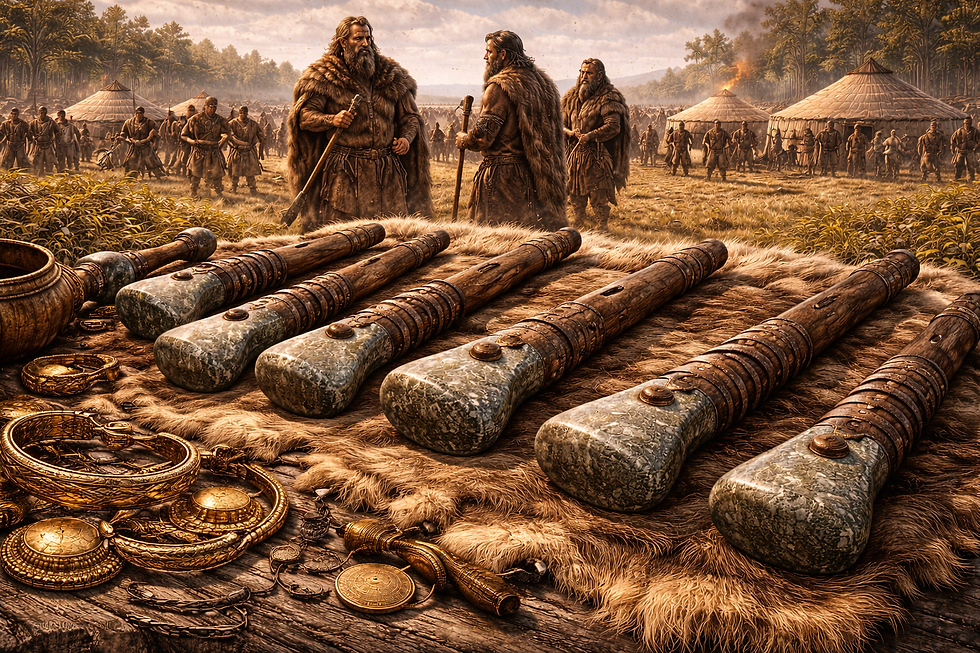
The stone battle axe deserves special mention. These distinctive weapons, often beautifully crafted from polished stone, became a symbol of warrior status across much of Europe during the Yamnaya expansion. The "Battle Axe culture" of Scandinavia is named for these weapons, which were adopted by Corded Ware populations who derived their ancestry from the Yamnaya.
Fortifications and Military Architecture
The Yamnaya were not known for constructing fortifications; their mobile lifestyle made fixed defenses impractical. However, the Mykhailivka settlement, with its fortifications, suggests that even mobile pastoralists recognized the need for defended positions in certain contexts.
More typical was the use of natural defenses: river valleys, steep slopes, and other geographic features that provided protection.
Horse-Based Mobility and Military Advantage
The Yamnaya did not fight from horseback in the manner of later steppe nomads like the Scythians or Mongols. The chariot, a spoke-wheeled vehicle used for warfare, would not be developed until the Sintashta culture (c. 2100–1800 BC), which emerged from Yamnaya-related populations.
However, the Yamnaya's ability to move rapidly across the steppe using horses and wagons gave them a strategic advantage over more sedentary populations.
As one analysis notes, "wagons and horseback riding made possible a new, more mobile form of pastoralism." This mobility could be translated into military advantage: the ability to concentrate forces rapidly at a point of conflict, to pursue fleeing enemies, and to withdraw from disadvantageous engagements.
The Expansion Westward
The most dramatic expression of Yamnaya military and demographic power was the expansion into Europe. Around 3000 BC, Yamnaya-related groups began moving westward, crossing the Carpathian Mountains and spreading into the Danube Valley and beyond.
This movement brought them into contact—and conflict—with the agricultural populations of Old Europe, including the remnants of the Cucuteni–Trypillia culture and the emerging Corded Ware horizon.
The impact of this expansion was transformative. In some regions, the Yamnaya and their descendants replaced up to 75% of the existing genetic profile, as ancient DNA studies of Corded Ware skeletons from Germany have demonstrated.
The "paucity of metals in Yamnaya graves contrasted with the wealth of bronze weapons and tools in the emerging Bronze Age cultures of Europe," suggesting that the Yamnaya may have benefited from access to European metal sources that had previously been unavailable to them.
The Expansion Eastward and the Formation of Sintashta
The Yamnaya expansion was not exclusively westward. Around the same time, Yamnaya-related groups also moved eastward, into the region of the southern Urals.
This eastern expansion would eventually give rise to the Poltavka culture (c. 2800–2200 BC) and, after a further back-migration of Corded Ware peoples from Europe, to the Sintashta culture (c. 2100–1800 BC).
The Sintashta, in turn, would develop the spoke-wheeled chariot and expand further east, becoming the ancestors of the Indo-Iranian peoples who would eventually spread into Central Asia, Iran, and India.
Warfare and the Spread of Pathogens
A controversial but increasingly supported hypothesis suggests that the Yamnaya may have carried pathogens, including the bacteria that cause plague (Yersinia pestis), to which European agricultural populations had no immunity.

As one analysis notes, "the impact of the Yamnaya expansion on the pathogen load in Neolithic societies" may have paralleled "the impact of diseases on Native Americans" following European colonization.
If correct, this would mean that disease, not just military conquest, facilitated the Yamnaya demographic takeover of Europe.

Part V: Culture and Religion
The kurgan was more than a burial mound; it was a sacred monument, a statement of lineage and territory, and a point of connection between the living and the dead.
The labor required to construct a kurgan was substantial, suggesting that the community was mobilized for the purpose, and the ritual activities associated with kurgan construction likely reinforced social bonds and political authority.
The placement of kurgans in the landscape was not random. Kurgans were often erected on high ground, visible from great distances. In the featureless expanse of the steppe, these mounds served as navigation markers, territorial claims, and anchor points for seasonal migrations.
The dead—or rather, the ancestors buried in the kurgans—continued to play an active role in the lives of the living, defining the landscape and legitimating the authority of their descendants.
Anthropomorphic Stelae: The Earliest Indo-European Art
One of the most remarkable features of Yamnaya material culture is the anthropomorphic stone stela; an upright stone slab, often carved with schematic human features and symbols of status and authority. Over 300 such stelae have been documented in eastern Ukraine alone.
These stelae, often referred to as "kurgan stelae" or "stone babas," feature "schematic anthropomorphic carvings emphasizing the upper body of male figures, typically warriors or elites, with broad shoulders, extended arms, and waists marked by belts."
Some stelae also depict weapons—daggers, axes, and bows—as well as belts, jewelry, and clothing that signify status and warrior identity.
The stelae were positioned atop or beside kurgan burial mounds, serving as memorials or ritual markers for the deceased. They reflect "a cultural emphasis on individual agency and martial prowess in mobile communities."
The stelae thus provide a rare window into Yamnaya self-representation: they chose to depict themselves not as herders or family men, but as warriors, standing tall with weapons and symbols of authority.
One particularly important example is the Kevermes stone stela from the Great Hungarian Plain, which was determined to have been "removed from a Yamnaya kurgan and repurposed several millennia later."
This stela "testifies to complex dynamics of long-distance mobility and cultural exchange" across the Carpathian Basin, demonstrating that the Yamnaya left material traces far beyond their core territory.
Religion and Worldview
The religious beliefs of the Yamnaya are known only indirectly, through burial practices, material culture, and linguistic reconstruction. However, the available evidence suggests a worldview centered on several key themes:
Ancestor veneration: The elaborate kurgan burial tradition indicates that the dead, particularly elite ancestors, were the focus of significant ritual attention. As one analysis concludes, "each stele was installed on the mound in memory of a specific deceased person who enjoyed authority in his tribe."
The kurgans themselves may have served as focal points for ancestor cults, with rituals performed at the mounds to honor the dead and seek their intercession.
Animism and natural forces: The Yamnaya worldview "was deeply animist and ancestral. The sky, sun, and river were not deities in form, but forces with will, spoken to through fire, stone, and blood."
This animistic orientation, seeing agency and personality in natural phenomena, is characteristic of many pastoralist societies and is reflected in the reconstructed Proto-Indo-European lexicon, which contains words for sky (dyēus), earth (dhéǵhōm), sun (séh₂ul), and moon (méh₁nōt).
The Great Goddess: Some scholars have identified evidence for a "Great Goddess cult" in Yamnaya burials. A 2010 study argued that "such interpretation permits to confirm existence of the Great Goddess Cult in the religion of Indo-Iranians owing to these archaeological data."
Figurines and stelae depicting female figures have been found in Yamnaya contexts, though their interpretation remains debated.
Fire rituals: The later Indo-Iranian cultures, particularly the Fëdorovo branch of the Andronovo horizon, were known for their fire cults and cremation practices.
While the Yamnaya themselves typically practiced inhumation rather than cremation, the importance of fire in later Indo-European religions (the Vedic agni, the Avestan atar) suggests that fire ritual had deep roots in the steppe tradition.
The "culture of honor": Some scholars have linked the Yamnaya with the "sociocultural theory of culture of honor," a value system in which personal reputation and willingness to avenge insults are paramount.
This "culture of honor," which has been documented in modern pastoralist societies from the Caucasus to the American West, may explain the high levels of violent trauma observed in Yamnaya burials and the emphasis on warrior identity in the stelae.
Art and Symbolic Expression
Beyond the anthropomorphic stelae, Yamnaya artistic expression is relatively limited. Their pottery was functional rather than decorative, and they left no cave paintings or elaborate metalwork comparable to the Scythian "animal style" that would emerge millennia later.
However, petroglyphs (rock carvings) associated with the Yamnaya have been documented in the Don region, depicting animals, human figures, and geometric symbols.
The Yamnaya-Afanasevo figurative tradition represents a coherent artistic style that spanned from the Pontic steppe to southern Siberia, demonstrating the connections between the Yamnaya and their eastern contemporaries.
This tradition, which included both statuary and megalithic monuments, represents one of the earliest expressions of Indo-European symbolic culture.
Linguistic Evidence for Culture
The reconstruction of the Proto-Indo-European language, the hypothetical ancestor of the Yamnaya speech, provides additional insights into their culture.
The PIE lexicon includes words for:
Pastoralism: gʷou- (cattle), h₂ówis (sheep), h₁éḱwos (horse), poh₂im- (flock/herd), melh₂- (to milk)
Wheeled vehicles: kʷékʷlos (wheel), h₂éiθos (axle), h₁éǵʰi- (yoke)
Social organization: h₃rḗǵs (king), wéyk- (clan/lineage), déms pótis (master of the house)
Religion: dyēus (sky god), gʰóstis (guest/host relationship), yéwos (law/ritual)
This lexicon points to a society that was pastoralist, patriarchal, hierarchical, and possessed of a sophisticated religious and legal vocabulary.
The presence of words for wheeled vehicles, a technology that appears in the archaeological record around 3500–3300 BC, has been used to date the separation of the Proto-Indo-European speech community, with the Yamnaya representing the late stage of this linguistic tradition.
Part VI: External Relations and the World Context
The Yamnaya did not exist in isolation. Their expansion occurred against a backdrop of dramatic changes across Eurasia, from the rise of the first dynasties in Egypt and Mesopotamia to the flourishing of the Indus Valley civilization. Understanding the Yamnaya requires situating them within this broader global context.

Relations with the Maykop Culture (North Caucasus)
The Maykop culture (c. 3700–3000 BC) of the North Caucasus was a contemporary of the early Yamnaya. The Maykop people were more technologically advanced than the Yamnaya, producing elaborate gold and silver objects, sophisticated bronze weapons, and monumental burial structures.
The relationship between the Yamnaya and Maykop appears to have been complex, involving both trade and competition.
The Maykop probably served as a conduit for metal and metallurgical knowledge, with "single-edged copper axes, whose oldest exemplars in Europe come from the North Caucasus (the Maykop and Novosvobodnaya cultures)," spreading "with the arrival of the Yamnaya culture" into the Balkans and Central Europe.
At the same time, the Maykop may have drawn on steppe resources, including horses and pastoral products.
Relations with the Cucuteni–Trypillia Culture
To the west, the Yamnaya came into contact with the Cucuteni–Trypillia culture (c. 5050–2950 BC), a vast network of agricultural settlements that at its peak included some of the largest Neolithic towns in Europe.

The relationship between the two cultures appears to have been characterized by competition, conflict, and ultimately, the collapse of the Cucuteni–Trypillia way of life.
Around 3600–3400 BC, the Cucuteni–Trypillia mega-settlements began to decline. As one analysis notes, "Steppe type graves appear on the Danube 4500-4200 BC, by 4300 BC Varna / Karanovo tell towns witnessed a near total collapse."
The following Cernavodă culture "showed mixture of Old Europe and Steppe customs and genes," indicating that the Yamnaya did not simply destroy the Cucuteni–Trypillia culture but integrated with it, producing a hybrid society.
The climatic deterioration that began around 2600–2500 BC may have exacerbated this process, as "the climate at the beginning of the Bronze Age becomes colder and drier and many European farming communities became weakened, opening the way west for new settlers."
Relations with the Corded Ware and Bell Beaker Cultures
The most consequential external relationship of the Yamnaya was with the Corded Ware culture (c. 2900–2350 BC) of northern and central Europe.
The Corded Ware people, who derived approximately 73% of their ancestry from the Yamnaya, are widely considered the direct descendants of the Yamnaya in Europe.
However, there is a significant genetic puzzle: while the Yamnaya belonged primarily to Y-haplogroup R1b, the Corded Ware people "belonged mostly to haplogroup R1a. No R1a has ever been found in a Yamnaya fossil."
This paternal lineage mismatch raises "questions about how the Corded Ware people could be related to the Yamnaya."
Several hypotheses have been proposed:
Sampling bias: The Yamnaya graves excavated to date may not represent the full diversity of Yamnaya male lineages. R1a might be found in future excavations.
Social stratification: R1b and R1a may have been associated with different social strata within Yamnaya society, with only the R1b elite being buried in the large kurgans that have been the focus of archaeological investigation.
Language spread, not demic diffusion: The Corded Ware may have adopted Yamnaya language and culture without large-scale Yamnaya male migration, though this conflicts with the genetic evidence for substantial Yamnaya ancestry.
The Bell Beaker culture (c. 2800–1800 BC) represents another descendant of the Yamnaya expansion. According to David Anthony, a westward migration west of Carpathians into Hungary as Yamnaya, transforming into Bell Beaker occurred, possibly ancestral to the Indo-Celtic language branch (though this is disputed).
Interestingly, the Bell Beaker people, and most modern Western Europeans, belong to haplogroup R1b, but not the same clade as the Yamnaya, who belonged to a highly divergent L23 clade, known as the 'eastern' R-GG400 variant.
This means that the Yamnaya did not contribute haplogroup R1b directly to modern western Europeans; the R1b in modern Western Europe comes from a different population, likely the Bell Beaker people who were themselves admixed with earlier European populations.
Relations with the Sintashta and Andronovo Cultures
To the east, Yamnaya-related populations gave rise to the Poltavka culture (c. 2800–2200 BC) and, after a back-migration of Corded Ware peoples from Europe, to the Sintashta culture (c. 2100–1800 BC). The Sintashta, in turn, developed into the Andronovo culture (c. 1800–900 BC), which spread across Central Asia and ultimately gave rise to the Indo-Iranian peoples.
This "back migration from Corded Ware also contributed to Sintashta and Andronovo," and "in these groups, several aspects of the Yamnaya culture are present."
The Sintashta are particularly notable for developing the spoke-wheeled chariot, which would revolutionize Bronze Age warfare and facilitate the expansion of Indo-Iranian languages into Iran and India.
Global Parallel Developments
To appreciate the Yamnaya in global context, it is useful to compare their timeline with contemporary developments in other civilizations:
3500-3300 BC | Mykhailivka core forms; earliest wagons | Late Predynastic (Naqada II/III) | Uruk period; invention of writing | Early Harappan | Yangshao culture | Cucuteni-Trypillia at peak
3300-3100 BC | Yamnaya horizon defined; earliest kurgans | Unification of Upper/Lower Egypt | Early Dynastic period; Sumerian city-states | Ravi Phase; early urbanism | Majiayao culture | Megalithic traditions emerge
3100-2900 BC | Westward expansion begins; Corded Ware emerges | Early Dynastic period (1st-2nd Dynasties) | Early Dynastic period; Gilgamesh | Kot Diji Phase; urbanization | Liangzhu culture | Corded Ware spreads; Bell Beaker emerges
2900-2600 BC | Peak of Yamnaya expansion; climate deterioration begins | Old Kingdom begins; Pyramid Age | Early Dynastic III; Lagash, Ur | Mature Harappan; Mohenjo-Daro | Longshan culture | Yamnaya-derived Corded Ware dominates
2600-2500 BC | Climate deterioration intensifies; Yamnaya declines | Fourth Dynasty; Great Pyramid | Akkadian Empire (c. 2334 BC) | Mature Harappan at peak | Longshan black pottery | Corded Ware regional variants
Trade Networks and Cultural Exchange
The Yamnaya participated in extensive trade networks that connected the steppe to the great civilizations of the ancient world. These networks facilitated the exchange of:
Copper and tin from the Caucasus and Central Asia, essential for bronze production
Amber from the Baltic, which has been found in Mycenaean and Egyptian contexts
Horses and horse-drawn vehicles, which spread from the steppe into the Near East and China
Cattle and sheep, which had been domesticated earlier but were spread further by steppe pastoralists
Metallurgical knowledge, transmitted along the Danube and into Central Europe
The trade and social relationships that developed between Yamnaya groups and local communities resulted in a flow of material and ideas to the Eurasian Steppe to the east. The Yamnaya were not simply barbarian invaders but participants in a complex network of exchange that spanned Eurasia.
Part VII: Decline and Collapse
The Yamnaya culture did not suddenly collapse; it gradually dissolved as climatic and demographic pressures reshaped the steppe world. The critical turning point appears to have been a period of severe climate deterioration that began around 2600–2500 BC.
As one study documents, "Gradually the climate deteriorated starting from 2,600-2,500 BC." This aridification had profound effects on the steppe environment, reducing available pasture and forcing pastoralist populations to adapt their herding strategies or move to more favorable regions.
The dairying study documented "a breakdown in livestock specialization and an economic diversification of dairy herds coinciding with aridification during the subsequent late Yamnaya and North Caucasus Culture phases, followed by severe climate deterioration during the Catacomb and Lola periods."
The need for additional pastures to support these herds may have driven the heightened mobility of subsequent periods.
The Rise of Successor Cultures
As the climate worsened, the Yamnaya horizon fragmented into regional successor cultures:
To the west, the Catacomb culture (c. 2800–2000 BC) emerged in the North Pontic region. This culture, which took its name from the distinctive catacomb-like burial chambers, represented a mixture of Yamnaya and local traditions. The Catacomb people exploited river valleys and watershed areas only during summer, indicating a more constrained pattern of mobility than the classic Yamnaya.
To the east, the Poltavka culture (c. 2800–2200 BC) emerged in the Volga-Ural region. The Poltavka were direct descendants of the Yamnaya, maintaining many Yamnaya traditions while also developing regional characteristics. The Poltavka would eventually contribute to the formation of the Sintashta culture, which gave rise to the Indo-Iranians.
To the north, the Corded Ware culture (c. 2900–2350 BC) had already emerged as a derivative of the Yamnaya expansion, carrying Yamnaya ancestry and cultural elements into northern and central Europe.
The Srubna culture (c. 1900–1200 BC) would eventually emerge in the Volga region as a successor to both the Yamnaya and Poltavka traditions.
The Demographic Transition
The decline of the Yamnaya as a distinct archaeological culture was not a population extinction but a demographic transition. The Yamnaya people did not disappear; they merged with local populations, adopted new cultural practices, and evolved into new configurations.
As one analysis notes, the late population of the Yamna/Budzhak and Catacomb cultures of the Northwest Black Sea region developed in parallel for a long time XXV-XX centuries BC and in the end of the III millennium they became an integral part of a new incoming social organism.
The mixed (multiritual) graves, multiritual funeral goods found in the graves of both autochthonous populations and newcomers allow us to suppose that this coexistence could be quite peaceful. This suggests that the transition from Yamnaya to successor cultures was not marked by large-scale conflict but by gradual integration and cultural change.
The Legacy in DNA
The Yamnaya left a lasting genetic legacy. The Western Steppe Herder (WSH) ancestry that defines the Yamnaya is found at substantial levels in contemporary European, West Asian, and South Asian populations.
As one 2019 study noted, the Yamnaya expanded into Europe and Asia and the spread of the Indo-European language family is a direct consequence of these migrations.
The Yamnaya genetic legacy is particularly pronounced in northern Europe, where populations derive 40-50% of their ancestry from steppe pastoralists. A 2024 study even suggested that Yamnaya people endowed northern Europeans today with a heightened genetic risk for multiple sclerosis—a sobering reminder that the migrations of the past continue to shape human health in the present.
The Final Years
The Yamnaya as a distinct archaeological culture faded from the steppe around 2600–2500 BC. The last Yamnaya burials date to this period, after which the kurgan tradition continued but with modified practices.
The "Yamnaya horizon" gave way to regional variations that would eventually develop into the Bronze Age cultures of the steppe; Catacomb, Poltavka, Srubna, and ultimately, the Sintashta and Andronovo cultures that would carry Indo-Iranian languages into Asia.
The final Yamnaya rulers, if such a concept is meaningful for a decentralized horizon, left no monumental inscriptions, no tombs to rival the pyramids of Egypt. Their legacy was not in stone but in genes and language: the biological and linguistic inheritance that would shape the course of Eurasian history for millennia to come.
Part VIII: Controversies & Conspiracies

The Kurgan Hypothesis: The identification of the Yamnaya with the Proto-Indo-Europeans—the Kurgan hypothesis—has been one of the most contested ideas in archaeology. First formulated by Marija Gimbutas in the 1950s, the hypothesis proposed that the spread of Indo-European languages was driven by a series of expansions from the Pontic steppe.
Gimbutas's theory was controversial from the start. It challenged the prevailing view that Indo-European languages had spread from Anatolia with the Neolithic revolution (the Anatolian hypothesis championed by Colin Renfrew).
Moreover, Gimbutas's characterization of the Yamnaya as "kurganized" patriarchal warriors who destroyed the peaceful, goddess-worshipping civilizations of "Old Europe" struck many as simplistic and ideologically driven.
However, the ancient DNA revolution of the 2010s dramatically transformed the debate. As one Leiden University study stated, it can no longer be doubted that the Indo-European languages spoken in Europe and Central and South Asia were brought there...by population groups from the Pontic–Caspian steppes who had belonged to the archaeologically defined Yamnaya culture.
The Y-Chromosome Puzzle
One of the most persistent controversies concerns the Y-chromosome haplogroups of the Yamnaya and their descendants. As noted earlier, the Yamnaya belonged primarily to haplogroup R1b, while the Corded Ware people—their supposed direct descendants—belonged mostly to haplogroup R1a. No R1a has ever been found in a Yamnaya fossil.
This discrepancy raises questions about the nature of the relationship between Yamnaya and Corded Ware. Several explanations have been proposed:
Social stratification hypothesis: The R1b individuals buried in kurgans represented an elite stratum of Yamnaya society; the R1a individuals may have been of lower status and buried in less visible graves that have not been excavated.
Language spread through women: Perhaps the Corded Ware adopted Indo-European language and culture through Yamnaya women rather than men, leading to a different Y-chromosome profile.
Corded Ware as parallel branch: The Corded Ware may have derived from a different steppe population that was closely related to the Yamnaya but had a different Y-chromosome composition.
Sampling bias: Future excavations may yet uncover Yamnaya R1a graves.
This debate remains unresolved and continues to generate heated discussion among geneticists and archaeologists.
The Horse Domestication Debate
Another major controversy concerns the timing and location of horse domestication. The Yamnaya are often portrayed as horse-riding warriors, but recent genetic studies have complicated this picture.
One analysis contradicts the previous theory that the Yamnaya, Bronze Age pastoralists, domesticated horses around 3000 BC. The team said, 'This study could end the debate on the origin and spread of modern domesticated horses'. The implication is that horse domestication may have occurred later than previously thought, or in a different location.
If the Yamnaya were not the first horse domestication, what does this mean for our understanding of their mobility and expansion? The answer may lie in the wagon: even without horseback riding, the wheeled wagon, drawn by oxen, provided a transformative degree of mobility.
The Role of Violence and Disease
Gimbutas characterized the Yamnaya as violent conquerors who destroyed the peaceful civilizations of Old Europe. More recent scholarship has tempered this view, emphasizing integration and cultural exchange alongside conflict.
The evidence for violence is clear: approximately 80% of central kurgan burials contained male skeletons with evidence of violent trauma, surrounded by weapons. However, the interpretation of this violence remains debated. Was it endemic raiding between rival Yamnaya chiefdoms, or did it represent conquest of non-steppe populations?
A newer hypothesis suggests that the Yamnaya may have carried pathogens, particularly plague (Yersinia pestis), to which European agricultural populations had no immunity.
If correct, this would mean that disease, not just military conquest, facilitated the Yamnaya demographic takeover. This hypothesis has been compared to the impact of Old World diseases on Native Americans following 1492.
The Gimbutas Legacy and Academic Controversy
Marija Gimbutas remains a controversial figure. Her admirers praise her as a pioneer who recognized the importance of the steppe in Indo-European origins and who challenged patriarchal narratives in archaeology. Her critics accuse her of romanticizing "Old Europe" and projecting modern political concerns onto the prehistoric past.
As one Wikipedia discussion noted, some scholars consider the Kurgan hypothesis a specimen of '19th-century European nationalism'. The controversy continues, with some archaeologists preferring to focus on the Yamnaya culture itself rather than on Gimbutas's broader theories about patriarchal conquest and goddess worship.
Alternative Sources and Marginal Traditions
The search for the Indo-European homeland has generated a vast literature, much of it speculative. Alternative theories include:
The Anatolian hypothesis: Proposed by Colin Renfrew, this theory suggests that Indo-European languages spread with the Neolithic revolution from Anatolia, beginning around 7000 BC. While the ancient DNA evidence has largely discredited this theory, it retains some supporters.
The Armenian hypothesis: Suggests that the Indo-European homeland was in the Armenian highlands. This theory has been revived by some genetic studies that identify the Caucasus as a source of Yamnaya ancestry.
The Indian Indigenous Aryan theory: Holds that Indo-Aryan languages are indigenous to India and that the Yamnaya migrations never occurred. This theory is not supported by the genetic or archaeological evidence but remains influential in certain political circles.
The Paleolithic Continuity Theory: Proposes that Indo-European languages have been spoken in Europe since the Paleolithic, with little significant migration. This theory is considered fringe by mainstream scholarship.
The "Curse of the Kurgans" and Popular Reception
In popular culture, the Yamnaya have been variously portrayed as heroic 'Aryan' ancestors, barbaric invaders, or mysterious horse-lords. The Nazi appropriation of Indo-European mythology—including the term "Aryan"—has left a lasting stain on the study of steppe prehistory, and some scholars are cautious about emphasizing the Yamnaya's role in European ethnogenesis.
The Yamnaya have also featured in speculative and conspiracy literature, with some authors claiming that they possessed advanced technologies or esoteric knowledge. These claims have no basis in the archaeological evidence but reflect the enduring power of the mysterious ancient culture trope.
Part IX: Legacy and Interpretations
The most tangible legacy of the Yamnaya is in the genes of modern Eurasians. The Western Steppe Herder (WSH) ancestry that defines the Yamnaya is found at substantial levels in populations from Ireland to India, and in some northern European populations, steppe ancestry accounts for nearly half of all genetic heritage.
The YMPACT research project (2019-2024) was a successful international and interdisciplinary effort to understand the massive changes having taken place in Europe some 5000 years ago, with its reverberations still visible today when it comes to European genetic ancestry, social organisation, and languages.
The Linguistic Legacy
The spread of Indo-European languages—from English to Hindi, from Spanish to Russian—is perhaps the Yamnaya's greatest cultural legacy. As one study concluded, the spread of the Indo-European language family is a direct consequence of these migrations of Yamnaya individuals into Europe and Asia.
The Yamnaya did not speak Proto-Indo-European in its final form—linguistic reconstruction suggests that PIE evolved over millennia—but they represent the closest archaeological correlate of the late Proto-Indo-European speech community.


The Social and Cultural Legacy
The social structures of the Yamnaya—patriarchal, hierarchical, warrior-oriented—were transmitted to their descendants and shaped the development of European and Asian societies for millennia. The tripartite ideology (priest, warrior, farmer) that appears in Vedic and Avestan texts has its roots in the social organization of the steppe.
The kurgan tradition itself (the burial mound) spread across Europe and Asia, persisting in various forms into the Iron Age and even the Middle Ages. The royal kurgans of the Scythians, the tumuli of the Etruscans, and the burial mounds of the Anglo-Saxons all owe something to the Yamnaya tradition.
The Yamnaya in Modern Scholarship
The study of the Yamnaya has been transformed by the ancient DNA revolution. Where once scholars debated the Indo-European homeland based on linguistic reconstruction and archaeological analogy, they can now track actual population movements through genetic analysis.
David Anthony's 2007 book The Horse, the Wheel, and Language: How Bronze-Age Riders from the Eurasian Steppes Shaped the Modern World represents the most comprehensive synthesis of the evidence, integrating archaeology, linguistics, and genetics into a coherent narrative of Yamnaya expansion.
The Yamnaya in Popular Culture
The Yamnaya have begun to appear in popular culture, from documentaries to historical fiction. Their portrayal often emphasizes the dramatic aspects of their story: the horse, the wagon, the expansion, the genetic impact. However, the popular image of the Yamnaya as a unified, conquering "people" obscures the complexity of their society; decentralized, varied, and adaptive.
Future Research Directions
Many questions about the Yamnaya remain unanswered:
What was the exact relationship between Yamnaya and Corded Ware? The Y-chromosome puzzle remains unsolved.
When and where were horses domesticated? The evidence continues to be debated.
How much violence was involved in Yamnaya expansion? The pathogen hypothesis requires further testing.
What was the role of women in Yamnaya society? The archaeological record is heavily biased toward male burials.
How did the Yamnaya manage social cohesion across vast distances? The nature of their political infrastructure remains obscure.
Future excavations, particularly in the Volga-Ural region, where many kurgans remain unexcavated, may provide answers to these questions. The continued application of ancient DNA analysis, proteomics, and isotopic studies will undoubtedly yield new insights.
Conclusion
The Yamnaya culture was more than a collection of Bronze Age pastoralists; it was a transformative force in human history. From their heartland on the Pontic-Caspian steppe, the Yamnaya expanded across Eurasia, reshaping the genetic makeup, linguistic landscape, and social structures of the continent.
They developed new technologies—the wagon, the dairy economy, advanced metallurgy—that enabled high mobility and demographic expansion. They erected kurgans that still dot the steppe, and carved stone stelae that preserve the image of the Yamnaya warrior. They spoke a language that would evolve into the tongues of billions.
The Yamnaya were not empire-builders in the conventional sense. They left no cities, no writing, no centralized state. But their legacy endures in the genes of modern Europeans and Asians, in the languages we speak, and in the social structures that shape our world. They were, in a very real sense, the architects of the Indo-European world.
As the ancient DNA revolution continues to unfold, our understanding of the Yamnaya will undoubtedly deepen. But the fundamental picture is now clear: a people of the steppe, mobile and adaptable, whose expansion five millennia ago set the course for the demographic and linguistic map of the modern world.

Bibliography
Primary Archaeological Sources:
Morgunova, N. L., & Khokhlova, O. S. (2013). "Chronology and Periodization of the Pit-Grave Culture in the Region Between the Volga and Ural Rivers Based on Radiocarbon Dating and Paleopedological Research." Radiocarbon, 55(3), 1234-1245.
Anthony, D. W. (2007). The Horse, the Wheel, and Language: How Bronze-Age Riders from the Eurasian Steppes Shaped the Modern World. Princeton University Press.
Mallory, J. P., & Adams, D. Q. (1997). Encyclopedia of Indo-European Culture. Fitzroy Dearborn.
Genetic Studies:
Allentoft, M. E., et al. (2015). "Population genomics of Bronze Age Eurasia." Nature, 522, 167-172.
Haak, W., et al. (2015). "Massive migration from the steppe was a source for Indo-European languages in Europe." Nature, 522, 207-211.
Narasimhan, V. M., et al. (2019). "The formation of human populations in South and Central Asia." Science, 365(6457).
Scott, A., et al. (2022). "Emergence and intensification of dairying in the Caucasus and Eurasian steppes." Nature Ecology & Evolution, 6, 813-822.
Malmström, H., et al. (2019). "The genomic ancestry of the Scandinavian Battle Axe Culture people and their relation to the broader Corded Ware horizon." Proceedings of the Royal Society B, 286(1912).
Linguistic Studies:
Kroonen, G., et al. (2023). "Proto-Indo-Anatolian, the 'Anatolian split' and the 'Anatolian trek': a comparative linguistic perspective." Leiden University.
Cultural and Art Historical Studies:
Telehin, D. I. (2000). "The Anthropomorphic Stelae of the Ukraine: The Early Iconography of the Indo-Europeans." Journal of Indo-European Studies Monograph Series, No. 11.
"Kurgan stelae." Grokipedia.
Climate and Environmental Studies:
"North-West Caspian Sea Steppe: Environment and Migration Crossroads of Pastoral Culture Population During the Third Millennium BC." Springer.
YMPACT Project:
"The Yamnaya Impact on Prehistoric Europe (YMPACT)." CORDIS, European Commission. (2019-2024).


Comments