
.png)

Age of Empires: The Kuru Dynasty
- A. Royden D'Souza

- Apr 19
- 31 min read
Updated: Apr 20
In the annals of South Asian history, few political formations carry the weight of the Kuru Kingdom. Emerging from the mists of the late Bronze Age around 1200 BC, this union of Indo-Aryan tribes in the region of modern Haryana, Delhi, and western Uttar Pradesh represents nothing less than the first recorded state-level society in the Indian subcontinent since the decline of the Indus Valley Civilization.
Yet the significance of the Kurus extends far beyond their political primacy. This was the civilization that codified the Vedas, transformed Vedic religion into Brahmanism, and laid the cultural foundations upon which Hinduism would later be built.

The Kuru kingdom occupies a unique position at the intersection of history, archaeology, and epic literature. For centuries, its story has been refracted through the lens of the Mahabharata, the great Sanskrit epic that transformed Kuru dynastic struggles into a cosmic drama of dharma and adharma.
But behind the myth lies a historical polity whose innovations in statecraft, ritual, and social organization would echo through Indian history for three millennia.
This paper traces the complete arc of the Kuru kingdom: from its mythologized origins in the Battle of the Ten Kings, through its golden age under Parikshit and Janamejaya, to its eventual decline and absorption into the Mahajanapada states of the fifth century BC.
It explores the archaeological evidence of the Painted Grey Ware culture that corresponds to the Kurus, the textual traditions of the Vedas and Brahmanas that preserve their intellectual achievements, and the enduring controversies that surround their origins and legacy.
Throughout, we will maintain a strict focus on the Kuru kingdom as a historical phenomenon; the first state in India, the shaper of Vedic civilization, and the foundation upon which classical Indian culture was built.
Part I: Origins and Rise — The Indo-Aryan Legacy

To understand the emergence of the Kuru kingdom, one must first situate it within the broader context of Indo-Aryan migration into the Indian subcontinent. The early Vedic period (1500–1000 BC) saw the gradual movement of Indo-Aryan peoples from the regions of modern Afghanistan and the Punjab into the northwestern subcontinent.
These were a pastoral people, organized into tribes (jana) rather than kingdoms, whose society was centered on cattle herding, horse sacrifice, and the composition of hymns to gods such as Indra, Agni, and Soma.
Yet these early Vedic peoples were not the first to bear this culture; they were one branch of a much older ancestral stem. Thousands of years earlier, on the Eurasian steppe, a single people had shared a language, a pantheon, and a way of life.
From the Sintashta culture (2200–1750 BC) and the Andronovo horizon (2000–1150 BC) that succeeded it, waves of Indo-Iranian speakers began to spread outward across the steppe and into Central Asia.

At some point in the second millennium BC, this community began to fragment. One group moved southwest, crossing into the Iranian plateau, where they would become the Avestan people; the carriers of the Avesta, the sacred texts of what would later crystallize as Zoroastrianism.
Another group turned southeast, crossing the Hindu Kush into the northwestern Indian subcontinent, bringing with them the nascent hymns that would become the Rigveda.
For centuries, these two branches developed in parallel, preserving the memory of their shared origin in their languages and their gods. The Sanskrit of the Vedas and the Avestan of the Zoroastrian scriptures are so closely related that they appear almost as dialects of a single tongue.
The Vedic soma, the sacred ritual drink, was the Avestan haoma; the Vedic sacrificial rite (yajña) was the Avestan yasna. Many of the same divine names appear in both traditions, though often with reversed moral valences: the Vedic deva (god) became the Avestan daeva (demon), while the Avestan ahura (lord) found its echo in the Vedic asura; a term that in the earliest hymns still meant "lord" but gradually acquired darker connotations.
The central ethical concept of cosmic order, ṛta in Sanskrit, was asha in Avestan. These parallels are so extensive that scholars speak of a common Indo-Iranian religious inheritance; a shared world of chariot warriors, fire sacrifices, and hymns to gods of sky, storm, and light.
Yet the split also produced divergence. In Iran, the prophetic figure of Zarathustra (Zoroaster) reformed this ancient inheritance, centering worship on Ahura Mazda as the supreme, uncreated deity and framing existence as a cosmic struggle between truth (asha) and falsehood (druj). The daevas—the old gods—were rejected as demonic.
In India, no such prophetic rupture occurred. Instead, the Vedic tradition developed through accretion and systematization, with the old gods—Indra, Agni, Varuna—retaining their prominence while new ritual and philosophical elaborations accumulated around them.
By the time the two branches re-encountered one another in the mid-first millennium BC, they had become distinct religious worlds: one organized around the revealed hymns of the Rigveda and the authority of the Brahmin priesthood, the other around the teachings of Zarathustra and the dualistic vision of the Gathas.
But the shared ancestry remained legible in their languages, their rituals, and the deep structures of their thought; a reminder that the Vedic religion that would shape the Kuru kingdom was never an isolated phenomenon, but one current in a broader stream of Indo-Iranian tradition flowing across the highlands of Central Asia and into the plains of Iran and India.
The Rigveda, the oldest of the Vedic texts, provides the primary window into this early period. Its hymns depict a world of tribal chieftains (rajan) who led their people in battle, protected their cattle from raiders, and performed sacrifices to secure divine favor.
The geography of the Rigveda centers on the Sapta Sindhu—the "Land of Seven Rivers"—which corresponds to the Punjab and the Indus Valley.
But by the time of the later hymns of the Rigveda, a shift was underway. The focus was moving eastward, from the Indus system to the Sarasvati River and the western reaches of the Gangetic plain. And at the center of this transition stood the Bharata tribe.
The Battle of the Ten Kings: The Founding Moment

The foundational event in Kuru history, preserved in the 18th hymn of the 7th Mandala of the Rigveda, is the Battle of the Ten Kings (Dāśarājña). This conflict, likely fought around 1400–1300 BC on the banks of the Paruṣṇī River (modern Ravi), pitted the Bharata chieftain Sudas against a formidable coalition of ten rival tribes.
The confederation opposing Sudas included the Purus, Yadus, Turvasas, Anus, Druhyus, Alinas, Pakthas, Bhalanas, Shivas, and Vishanins. Though seemingly an unequal contest, Sudas emerged victorious through a combination of strategic brilliance and divine favor.
The Rigveda describes how Indra, the patron god of the Bharatas, intervened on Sudas's behalf, breaching the embankments of the Ravi River to drown many of the opposing warriors.
The aftermath of this battle reshaped the political landscape of northern India. The Bharatas, victorious, occupied the territory of their chief rivals, the Purus, establishing themselves in the region around the Sarasvati River.
But more significantly, the battle set in motion a process of tribal consolidation. The Bharatas and Purus, erstwhile enemies, eventually merged to form a new tribal union, the Kuru, named after a legendary ancestor.
Michael Witzel, a leading scholar of Vedic history, suggests that the Battle of the Ten Kings may have served as the "nucleus" or prototype for the far more elaborate Kurukshetra War described in the Mahabharata.
What began as a historical conflict over river resources and tribal hegemony would, over centuries of retelling, transform into the foundational epic of Indian civilization.
The Formation of the Kuru State

The period following the merger of the Bharata and Puru tribes saw the emergence of something unprecedented in the Indian subcontinent: a true state-level society.
The Kuru kingdom, which took shape around 1200–1000 BC, represented a qualitative leap in political organization from the tribal chieftaincies of the early Vedic period.
Several factors enabled this transformation. First, the adoption of iron technology, referred to in the Atharvaveda as śyāma āyasa ("dark metal"), allowed for more effective clearing of the forests that covered much of the Gangetic plain.
This facilitated a shift from pastoralism to settled agriculture, creating the surplus necessary to support a centralized state.
Second, the Kuru heartland in the Kurukshetra region (modern Haryana) offered fertile land and strategic control over trade routes connecting the Punjab to the Ganga-Yamuna Doab.
Third, the Kurus developed a new model of political authority that combined military prowess with ritual supremacy.
The first Kuru capital was at Āsandīvat, identified with modern Assandh in Haryana. Later texts mention Hastinapura (modern Hastinapur in Uttar Pradesh) and Indraprastha (associated with modern Delhi) as major Kuru cities.
The shift of capitals over time reflects the eastward expansion of Kuru power and the gradual consolidation of control over the Upper Gangetic Doab.
Mythological Origins: The Kuru Ancestry
The historical origins of the Kuru state are overlaid with a rich mythological tradition preserved in the Mahabharata and the Puranas. According to these texts, the Kuru lineage traced its descent from Pururavas Aila, a legendary king of the lunar dynasty (Chandravamsha).

Pururavas was said to be the son of Ila, a ruler whose realm was located in Central Asia, possibly in Bactria (modern Balkh in Afghanistan).
The Puranic genealogies place the Kuru dynasty within the broader lineage of the Ailas (descendants of Pururavas) and the Bharatas.
The name "Kuru" itself is said to derive from King Kuru, an ancestor who gave his name to the dynasty and to the sacred region of Kurukshetra.
This mythological ancestry served to legitimate Kuru claims to primacy among the Indo-Aryan tribes, positioning them as the inheritors of an ancient and prestigious lineage.
Some scholars have noted intriguing connections between these legendary genealogies and Central Asian origins. The designation of Kuru princes as "Karddameyas" (descendants of Karddama) connects them to the river Karddama, which ancient texts locate in Persia (modern Iran).
The Matsya Purana locates the realm of Pururavas's parent in Illa-vrta varsa near Mount Meru (the Pamirs). And the Mahabharata itself attests that the ancestors of the Kauravas and Pandavas originally migrated from Uttarakuru, a region beyond the Himalayas.

Part II: The Structure of Kuru Kingship
The Kuru kingdom was governed by a system that combined elements of elective monarchy, aristocratic council, and ritual authority. The king (rajan) was not an absolute ruler but governed with the assistance of several key institutions and officials.
The sabhā (assembly) and samiti (common council) served as deliberative bodies where nobles and tribal elders could voice their opinions. The samiti was a broader assembly of the jana (tribe), while the sabhā was a more select council of nobles and elders.
While the king held ultimate authority, his power was constrained by the need to maintain the support of these assemblies and of the powerful Kshatriya clans that formed the backbone of Kuru society.

A rudimentary administration supported the king's rule. Key officials included:
The purohita (chief priest), who performed the vital rituals that legitimated royal authority
The senani (army commander), who led the king's forces in war
The gramani (village headman), who oversaw local administration
Spies and messengers (spasha and duta), who kept the king informed of events in his realm and beyond
The king extracted tribute (bali) from his subjects and from weaker neighboring tribes. This revenue supported the royal household, the army, and the elaborate ritual sacrifices that were central to Kuru kingship.
Parikshit: The Consolidator
The first Kuru king to emerge clearly from the textual record is Parikshit. The Atharvaveda (XX.127) praises Parikshit as the "King of the Kurus," the ruler of a thriving and prosperous realm. He is credited with consolidating Kuru control over the Kurukshetra region and establishing the foundations of Kuru power.

Parikshit's significance lies not only in his military achievements but in his role as a patron of Brahmanical ritual. The Shatapatha Brahmana, a later Vedic text, describes Parikshit as a king who performed the ashvamedha (horse sacrifice), a ritual that asserted dominance over neighboring rulers.
The horse sacrifice, one of the most elaborate of the Vedic rites, involved setting a consecrated horse loose to wander for a year; any king who stopped or seized the horse was forced to pay tribute or face war. The successful completion of this ritual by Parikshit signaled Kuru dominance over the surrounding territories.
Janamejaya: The Expander
Parikshit's son and successor, Janamejaya, continued his father's work of consolidation and expansion. The Shatapatha Brahmana and other late Vedic texts portray Janamejaya as a great conqueror who performed the ashvamedha and extended Kuru power eastward into the Ganga-Yamuna Doab.

Janamejaya's reign is also associated with important developments in Vedic literature. According to tradition, it was during Janamejaya's reign that the great snake sacrifice (sarpasattra) was performed, a ritual that features prominently in the opening sections of the Mahabharata.
The Mahabharata frames its narrative as a recitation to Janamejaya by the sage Vaishampayana, making the Kuru king the epic's first audience.
The reigns of Parikshit and Janamejaya represent the zenith of Kuru power, roughly corresponding to the period 1200–900 BC. During this time, the Kuru kingdom was the dominant political and cultural force in northern India, setting the patterns of statecraft and ritual that would be emulated by later kingdoms.
Succession Patterns and Challenges
While the Kuru kingship was generally hereditary, succession was not always smooth. The Mahabharata preserves traditions of internal strife within the Kuru dynasty, culminating in the great war between the Kauravas and Pandavas.
While this epic conflict is a legendary elaboration, it may reflect genuine historical tensions over succession and territorial control within the Kuru lineage.
The Vedic texts themselves provide glimpses of political instability. The Shatapatha Brahmana mentions conflicts between the Kurus and their eastern neighbors, the Panchalas, suggesting that the boundaries between these two powerful states were contested and shifting.
The relationship between the Kurus and Panchalas appears to have alternated between alliance and rivalry, with intermarriage between the ruling houses common.
A significant challenge to Kuru authority came from the Salva (or Salvi) tribe, described as non-Vedic in the sources. The Salva invasion of Kurukshetra dealt a severe blow to Kuru power and is identified as a key factor in the decline of the Kuru state.
The defeat by the Salvas forced the Kurus to retreat eastward and contributed to the shift of political and cultural primacy to the Panchala kingdom.
Transition to the Later Period
By the late Vedic period (c. 900–500 BC), the Kuru kingdom had entered a phase of decline. The center of Vedic culture shifted eastward to the Panchala realm, whose king, Kesin Dalbhya, was the nephew of the late Kuru king. The Panchalas, once Kuru rivals, now emerged as the dominant power in the Gangetic plain.
According to post-Vedic Sanskrit literature, the Kuru capital was transferred from Hastinapura to Kaushambi (in the lower Doab) after Hastinapura was destroyed by floods. This transfer, mentioned in the Puranas and the Mahabharata, may reflect both environmental pressures and the political upheavals within the Kuru family that followed the Salva invasion.
By the 6th century BC, the Kuru dynasty had evolved into two distinct janapadas (territorial states): the Kurus themselves, ruling over the Upper Doab, Delhi, and Haryana, and the Vatsas, ruling over the Lower Doab. The Vatsa branch of the Kuru dynasty was further divided into branches at Kaushambi and at Mathura.
The Kuru Republic

By the time of the Buddha (6th–5th centuries BC), the Kuru state had undergone a remarkable political transformation. Buddhist sources describe the Kurus as a gaṇasaṅgha; a republican or oligarchic state ruled by an assembly of nobles rather than a hereditary monarch.
According to these sources, the Kuru chieftain was called Koravya and belonged to the Yuddhiṭṭhila (Yudhiṣṭhira) gotta (clan). The Kuru republic was centered on the city of Indapatta (Indraprastha, modern Delhi) and extended for seven leagues. Another prominent Kuru city was Hatthinipura (Hastinapura).
The 4th-century BC Arthashastra of Kautilya also attests to the Kurus as following the rajashabdopajivin ("king consul") constitution, a form of republican government. The grammarian Panini (c. 5th century BC) lists the Kurus among the fifteen powerful Kshatriya janapadas of his time, with Hastinapura as their capital.
This transition from monarchy to republic is one of the most intriguing features of Kuru political evolution. It may reflect a reaction to the failures of hereditary rule, the rise of new social forces within Kuru society, or the influence of republican models from other Indo-Aryan tribes. Whatever the cause, it demonstrates the political flexibility of the Kuru state and its ability to adapt to changing circumstances.
Part III: Society and Economy

One of the most significant social developments of the Kuru period was the codification of the fourfold varna (class) system. The early Rigvedic society had recognized a simpler division between arya (noble) and dasa (servant), but the Kuru era saw the elaboration of this into a more complex hierarchy.
The four varnas as they emerged in Kuru society were:
Brahmins: The priestly class, responsible for performing rituals, preserving sacred knowledge, and providing religious guidance
Kshatriyas: The warrior-aristocracy, who ruled, fought, and administered justice
Vaishyas: The commoners; farmers, herders, traders, and artisans
Shudras: Servants and laborers, often drawn from non-Aryan populations
This hierarchy was not merely a matter of social status but carried profound religious significance. The Brahmin and Kshatriya varnas were designated as the "twice-born" (dvija), eligible for initiation into Vedic study and ritual. The Vaishyas, though also twice-born, occupied a lower status. The Shudras were excluded entirely from Vedic ritual.
The Kuru state played a crucial role in promoting this varna hierarchy. The kings and their Brahmin priests arranged the Vedic hymns into collections and developed new rituals that upheld the social order and strengthened class distinctions. High-ranking nobles could perform elaborate sacrifices that exalted their status over the common people.
Material Life in the Kuru Kingdom
The archaeological record of the Painted Grey Ware (PGW) culture provides a vivid picture of material life in the Kuru kingdom. PGW sites, numbering over 1,500 across northern India, correspond closely to the geographical and chronological range of the Kuru state.
The characteristic pottery of this culture, fine grey ware decorated with geometric patterns in black, shows a remarkable degree of standardization. Bowls of two shapes dominate: shallow trays and deeper bowls with a sharp angle between the walls and base.
The limited decorative repertoire includes vertical, oblique, or criss-cross lines, rows of dots, spiral chains, and concentric circles.
The people of the PGW culture cultivated rice, wheat, millet, and barley. They domesticated cattle, sheep, pigs, and horses; the last of which held particular importance in Vedic ritual and warfare. The plow was used for cultivation, enabling more intensive agriculture than the earlier slash-and-burn methods.
Settlement patterns reveal a clear hierarchy. While most PGW sites were small farming villages, "several dozen" emerged as relatively large towns. The largest of these, such as Hastinapura, Mathura (approximately 375 hectares), and Ahichatra (at least 40 hectares), were fortified by ditches or moats and embankments made of piled earth with wooden palisades.
These fortifications, though simpler than the elaborate stone walls that would appear after 600 BC, attest to the growing complexity of Kuru society and the need for defense.
Excavations at sites like Bhagwanpura in the Kurukshetra district have revealed large houses that may have been elite residences. Fired bricks, which would have been expensive to produce, were used in construction, perhaps for Vedic altars.
Storage bins for surplus grain, stone weights, paved streets, and water channels indicate a "fairly evolved, proto-urban or semi-urban stage" of development.
Trade and Craftsmanship
The Kuru kingdom participated in extensive trade networks that connected the Gangetic plain to distant regions. Ornaments of gold, copper, ivory, and semi-precious stones have been found at PGW sites, indicating both wealth and long-distance exchange.
Specialized crafts flourished. Ivory-working is attested archaeologically, as is the production of glass and faience. Terracotta figurines of humans and animals, as well as "incised terracotta discs with decorated edges and geometric motifs," have been found; these discs likely had "ritual meaning" and may have represented symbols of deities.
A few stamp seals with geometric designs have been discovered, though they bear no inscription. This contrasts with both the earlier Harappan seals, which carried Indus script, and the later Northern Black Polished Ware seals, which were inscribed with Brahmi characters.
Urban and Rural Life
The shift from pastoralism to settled agriculture in the Kuru period transformed daily life. The earlier Rigvedic society, centered on cattle herding and mobile households, gave way to a more sedentary existence. Villages and towns replaced temporary encampments, and land became a primary source of wealth.
The grama (village) was the basic unit of settlement. Each village was governed by a headman (gramani), who collected taxes, settled disputes, and represented the village to the king. The gramani was often a figure of considerable local authority, and the position was sometimes hereditary.
Urban life, though still nascent, emerged in the larger PGW towns. These centers housed not only farmers but also specialized artisans, merchants, priests, and warriors. The fortifications that surrounded many of these towns suggest that security was a primary concern; a reflection of the competitive political environment of the late Vedic period.
Part IV: Military and Expansion
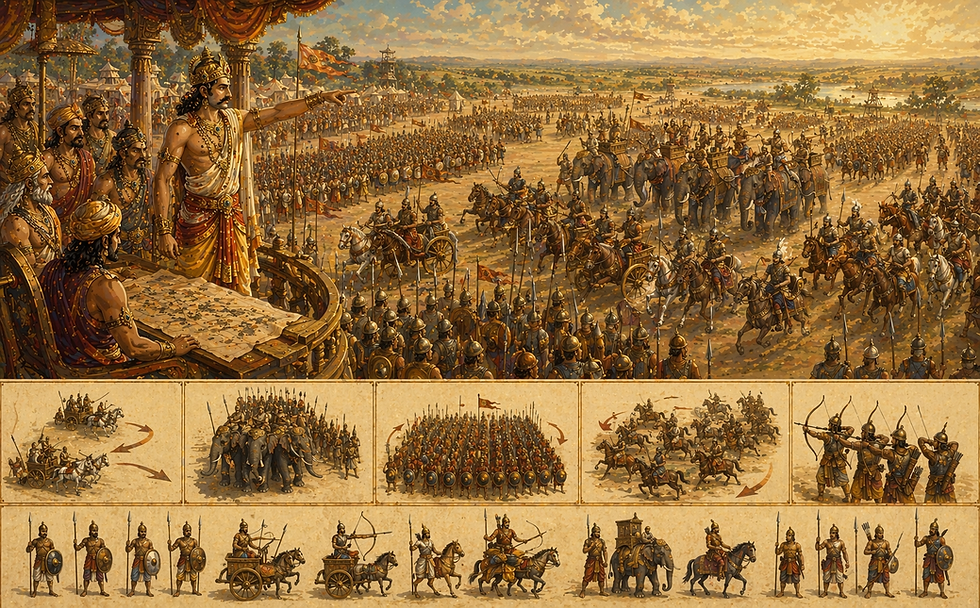
Army Composition and Tactics: The Kuru military drew its strength from the Kshatriya warrior class, who were trained from youth in the arts of war.
The senani (army commander) led the king's forces, which consisted of:
Rathin: Chariot warriors, the elite of the army
Ashvarohin: Cavalry, increasingly important in the late Vedic period
Pattin: Infantry, the bulk of the army
Gaja: Elephants, a later addition that may have become important after contact with eastern regions
The chariot was the supreme weapon of Vedic warfare. Light and fast, drawn by two horses, it carried a warrior and his charioteer into battle. The Rigveda hymns are filled with praise for chariot warriors, and the ability to fight from a chariot was a mark of aristocratic status.
The adoption of iron technology during the Kuru period revolutionized warfare. Iron weapons like swords, spearheads, and arrowheads were harder and held their edge longer than their bronze predecessors. Iron-tipped plows also allowed for more intensive agriculture, supporting larger armies.
Fortifications and Military Architecture: The fortifications of the Kuru period, though modest by later standards, represent an important development in military architecture. Towns like Hastinapura and Ahichatra were protected by earthen ramparts reinforced with wooden palisades, surrounded by moats or ditches.
These fortifications served multiple purposes. They protected against raids by rival tribes, asserted control over territory and trade routes, and symbolized the authority of the king. The construction of such defenses required the mobilization of significant labor and resources; further evidence of the Kuru state's organizational capacity.
Major Campaigns: The military history of the Kuru kingdom can be divided into three phases.
The Formative Period (c. 1400–1200 BC): This period was dominated by the Battle of the Ten Kings and its aftermath. The Bharata victory under Sudas enabled the merger of the Bharata and Puru tribes and the establishment of Kuru dominance in the Kurukshetra region.
The Expansionist Period (c. 1200–900 BC): Under Parikshit and Janamejaya, the Kuru kingdom expanded eastward into the Ganga-Yamuna Doab. The performance of the ashvamedha by these kings asserted Kuru supremacy over neighboring rulers, and their armies extended Kuru control as far as the borders of Panchala.
The Defensive Period (c. 900–600 BC): The Kuru kingdom came under increasing pressure from rival powers. The Salva invasion dealt a severe blow to Kuru power, forcing a retreat from the Kurukshetra heartland. The shift of the capital to Kaushambi reflects this contraction.
The Role of Warfare in State Formation: Warfare was not merely a means of expansion for the Kuru kingdom but a central mechanism of state formation. The tribute extracted from conquered territories supported the royal court and the military.
The threat of war encouraged the consolidation of villages into larger political units. And the ideology of the warrior-king, legitimated by Vedic ritual, provided a powerful justification for centralized authority.
The ashvamedha or horse sacrifice, in particular, served as a tool of imperial expansion. By setting a consecrated horse to wander for a year, the king challenged any ruler who would stop it to battle. Those who submitted paid tribute; those who resisted faced war.
The successful completion of this ritual demonstrated the king's power and extended his influence over distant territories.

Part V: Culture and Religion
The Kuru kingdom's most enduring legacy lies in the realm of religion. During the Kuru period, the diffuse ritual traditions of the early Vedic age were systematized and codified into what scholars call the "classical synthesis" or "Brahmanical orthodoxy."
The key innovation of the Kuru period was the collection and arrangement of the Vedic hymns into the samhitas (collections) that form the basis of the four Vedas. The Rigveda, already largely composed in the earlier period, was redacted into its final form. The Samaveda, Yajurveda, and Atharvaveda were compiled and arranged for ritual use.

Alongside the Vedas, the Kuru period saw the composition of the Brahmanas; prose texts that explained the meaning and proper performance of Vedic rituals.
These texts, such as the Shatapatha Brahmana, provide detailed instructions for the construction of altars, the recitation of hymns, and the conduct of sacrifices. They also contain the earliest speculations on the nature of the cosmos and the relationship between ritual and cosmic order.
The shrauta rituals, the orthodox sacrificial system of Brahmanism, took shape in the Kuru kingdom. These rituals, which continue to be performed in modified form to this day, centered on the fire sacrifice (yajna).
Through the precise recitation of hymns and the offering of oblations into the sacred fire, the sacrificer could achieve various ends; prosperity, sons, victory in battle, or even immortality.
The Ashvamedha: Horse Sacrifice

The ashvamedha, or horse sacrifice, was the most elaborate and prestigious of the Vedic rituals. Its performance was reserved for powerful kings seeking to assert their dominance over neighboring rulers.
The ritual unfolded over a year or more. A consecrated horse was set loose to wander at will, accompanied by a band of warriors. The lands through which the horse passed were claimed for the king, and any ruler who challenged the horse faced war.
When the horse returned, it was sacrificed in a complex ceremony involving the symbolic marriage of the king to the horse, the recitation of thousands of hymns, and the distribution of vast wealth to the priests who conducted the ritual.
The ashvamedha served both religious and political functions. It asserted the king's authority over territory and other rulers. It demonstrated the king's wealth and generosity. And it ritually enacted the king's role as the upholder of cosmic order (rita), linking his earthly rule to the divine realm.
The Development of Early Vedanta
The later part of the Kuru period saw the emergence of the Upanishads, the philosophical texts that form the foundation of Vedanta. Though most Upanishads date to the post-Kuru period, the earliest, such as the Brihadaranyaka and Chandogya, may have been composed in the Kuru-Panchala region during the late Vedic era.
These texts moved beyond the ritual concerns of the Brahmanas to explore the nature of reality, the self, and liberation. They introduced the concepts of brahman (the ultimate reality) and atman (the individual self), and taught that liberation (moksha) came through knowledge of their identity.

The Kuru-Panchala Cultural Sphere
The Kurus were closely associated with their eastern neighbors, the Panchalas, in the development of Vedic culture. Together, they formed a cultural sphere that set the standard for Vedic orthodoxy.
The Brahmanas describe the Kuru-Panchala region as the "land of the Brahmins" where the rituals were performed with the greatest precision and the speech was the purest.
This cultural partnership extended to ritual practice. The rajasuya (royal consecration) and ashvamedha were performed by Kuru and Panchala kings alike. Intermarriage between the two royal houses was common, and the Brahmin priests who served one court often served the other.
The Mahabharata, though composed centuries later, reflects this close relationship by setting the great war between the Kauravas (Kurus) and the Pandavas, who were allied with the Panchalas through marriage, in the Kuru-Panchala region.
Part VI: External Relations and the World Context
The Kuru kingdom was surrounded by a ring of competing polities. To the east lay the Panchalas, sometimes allies, sometimes rivals.
To the south were the Surasenas and the Matsyas. To the north, beyond the Himalayas, lay the Uttarakuru, a region of legend associated with Kuru origins. To the west, across the Punjab, were the remnants of the Puru tribe and other groups.
The relationship with the Panchalas was particularly significant. These two states, occupying the Upper and Central Gangetic plain, shared language, culture, and religious traditions.
Yet they also competed for dominance. The Salva invasion that weakened the Kurus opened the way for Panchala ascendancy, and by the late Vedic period, the center of Brahmanical culture had shifted eastward.
The Wider World
The Kuru kingdom did not exist in isolation. Trade routes connected the Gangetic plain to the Persian plateau, Central Asia, and beyond. The horses essential for Vedic ritual and warfare were imported from Central Asia, as India lacked indigenous horse-breeding capabilities.
Parallel Global Developments (c. 1200–500 BC):
China | Western Zhou Dynasty (1046–771 BC); Spring and Autumn Period (771–476 BC) | Mandate of Heaven doctrine; iron technology emerges; Confucius (551–479 BC)
Mesopotamia | Neo-Assyrian Empire (911–609 BC); Neo-Babylonian Empire (626–539 BC) | Largest empire yet seen; library of Ashurbanipal; conquest of Judah
Egypt | Third Intermediate Period; Late Period | Foreign rule (Kushite, Assyrian, Persian)
Greece | Greek Dark Ages; Archaic Period (c. 800–480 BC) | Homeric epics; colonization; rise of city-states; first Olympic Games (776 BC)
Iran | Median Empire (c. 678–549 BC); Achaemenid Empire (550–330 BC) | Unification of Iranian peoples; Cyrus the Great; conquest of Babylon
Israel/Palestine | Kingdoms of Israel and Judah (c. 1000–586 BC) | Solomon's Temple; Babylonian captivity
Italy | Etruscan civilization; founding of Rome (753 BC) | Growing Mediterranean trade
The Kuru kingdom was thus a contemporary of some of the most significant developments in ancient world history. The same centuries that saw the codification of the Vedas in India witnessed the composition of the Homeric epics in Greece, the rise of the Neo-Assyrian Empire in Mesopotamia, and the foundation of Rome.
Note: Vedas were passed down orally for many centuries before codification. Codification refers to the consolidation and compilation of the Vedas in written text.
Technological and Cultural Transmission
The emergence of the Kuru kingdom was built upon a foundation shaped both by deep ancestral migrations and later regional exchanges. It is essential to distinguish between the cultural package brought by the Indo-Aryan migrations (language, ritual, and the horse) and subsequent technological diffusion (iron).
The Horse and Ritual: The centrality of the horse (ashva) in Vedic society was not the result of trade routes or "continued contact" with Central Asia; it was a direct inheritance of the Indo-Aryan migration into the subcontinent.
The domesticated horse and the technology of the spoke-wheeled chariot were absent from the urban centers of the Indus Valley Civilization. They were brought into the Punjab and the Gangetic plains by pastoral groups whose ancestors originated on the Eurasian Steppe.
The horse was not an object that traveled alone; it traveled with the people who bred it, rode it, and composed hymns to it.
The Shared Indo-Iranian Inheritance: The parallels between Vedic sacrifice and Zoroastrian ritual are not evidence of lateral contact between two established civilizations, but rather evidence of common ancestry. Before the split that sent one branch into South Asia and another onto the Iranian plateau, the Proto-Indo-Iranian people shared a unified religious vocabulary.
The Vedic concept of rita (cosmic order) and the Zoroastrian asha are linguistic and theological cognates; descendants of a single ancestral concept (Hr̥tás). Likewise, the ritual drink soma in India and haoma in the Avesta are not parallel discoveries but the divergent regional practices of a single ancient cult.
These traditions were carried into India in the minds and mouths of the Indo-Aryans, not transmitted along trade networks centuries later.
Iron Technology: In contrast to the horse and the core ritual system, the arrival of iron-working technology (c. 1200 BC) is a classic example of technological diffusion that occurred after the Vedic people had settled.
Post-Migration Upgrade: The earliest Vedic texts (the Rigveda) know only copper or bronze (ayas). It is only in the later Vedic literature (the Atharvaveda and Yajurveda) that we find a clear distinction for "black metal" (śyāma ayas).
Near Eastern Influence: This technology likely filtered into the subcontinent from the Near East via the Iranian plateau. This process involved the movement of metallurgical knowledge and perhaps specialist smiths, but it did not bring a new language or a new population. It was a technological upgrade adopted by an already established Indo-Aryan-speaking society in the Gangetic plains, which subsequently fueled the expansion of agriculture and the clearing of forests.
In summary, the Kuru period was shaped by two distinct processes: the migration of a people who provided the linguistic, ritual, and equestrian backbone of Vedic culture, and the later diffusion of iron technology that transformed the material landscape of the region.
Part VII: Decline and Collapse
The turning point in Kuru fortunes was the invasion of the Salva (or Salvi) tribe. The Vedic texts describe the Salvas as non-Vedic, perhaps representing a different cultural tradition. Their invasion of Kurukshetra dealt a severe blow to Kuru power and forced the abandonment of the traditional Kuru heartland.

The defeat by the Salvas triggered a chain of events that reshaped the political landscape of northern India. The center of Vedic culture shifted eastward to the Panchala kingdom, whose king, Kesin Dalbhya, was the nephew of the late Kuru king. The Kurus, displaced from their homeland, retreated to the Upper Doab, where they established a new capital at Kaushambi.
Flood and Relocation
The Puranas and the Mahabharata attribute the decline of Hastinapura to a catastrophic flood. According to these accounts, the Ganga River changed course, sweeping away the capital and forcing the Kurus to relocate. The new capital at Kaushambi, in the lower Doab, became the center of Kuru power.
While the flood narrative may be legendary, it likely reflects genuine environmental pressures. The Ganga, flowing through the alluvial plain of northern India, is subject to frequent course changes.
The abandonment of Hastinapura, confirmed by archaeological evidence, would have been a traumatic event for the Kuru state, undermining its economic base and political authority.
Fragmentation and Republicanism
By the 6th century BC, the Kuru kingdom had fragmented into smaller polities. The main Kuru dynasty ruled from Kaushambi, while branches controlled Mathura and other centers. In the Kuru heartland, the state transformed into a gaṇasaṅgha (republic) centered on Indraprastha.
This fragmentation reflected the broader political changes sweeping northern India in the post-Vedic period. The janapadas (territorial states) of the 6th century were smaller and more numerous than the larger kingdoms of the earlier period.
They competed with one another for resources and influence, setting the stage for the rise of the Mahajanapadas; the sixteen great states that would dominate the political landscape of the Buddha's time.
Absorption into the Mahajanapada System
By the 5th century BC, the Kuru kingdom had become something of a backwater. The great Mahajanapadas—Magadha, Kosala, Vatsa, and others—had eclipsed the earlier Vedic states in wealth, power, and territory. The Kurus retained their ancient prestige and their sacred status as the heartland of Brahmanical culture, but they no longer wielded political dominance.
The Kuru kingdom continued to exist as a minor state, ruled by a chieftain called Koravya, until its absorption into the expanding Magadhan Empire in the 4th century BC. The rise of the Nanda dynasty and the subsequent Mauryan Empire under Chandragupta Maurya (c. 321–185 BC) would sweep away the last remnants of Kuru independence.
Part VIII: Controversies and Conspiracies
No discussion of Kuru origins can avoid the controversial question of Indo-Aryan origins. The scholarly consensus based on linguistic, archaeological, and genetic evidence holds that the Indo-Aryan peoples migrated into India from Central Asia around 1500–1200 BC.
The Kuru state emerged from the merger of these migrating groups with existing populations in the Kurukshetra region.
However, this view is contested by some Indian scholars and archaeologists who argue for an indigenous origin of the Indo-Aryans. In this view, the Vedic culture developed entirely within India, and the Kurus were the heirs of an unbroken tradition stretching back to the Indus Valley Civilization.
Proponents of this view point to the continuity between the Late Harappan and Painted Grey Ware cultures at sites like Bhagwanpura and Alamgirpur as evidence of cultural continuity rather than foreign intrusion.
Counter-argument: This approach, however, relies on a selective, "pick-and-choose" reading of the evidence to suit a conclusion already made. While proponents of the indigenous origin theory correctly highlight elements of cultural continuity in material artifacts like pottery, this is not incompatible with the established scientific consensus.
The consensus, drawn from a convergence of linguistics, archaeology, and most powerfully, recent large-scale ancient DNA studies, points to a more complex reality: the Vedic period was the result of a merger between migrating Steppe pastoralist groups and the existing, post-Harappan populations of the subcontinent.
Genetic evidence confirms that while the people of the Indus Valley Civilization lacked Steppe ancestry, this ancestry appeared in the region after the decline of the Harappan cities, admixing with the local populace to form groups like the "Ancestral North Indians."
Furthermore, the deep linguistic and ritual parallels between the Vedas and the ancient Iranian Avesta cannot be explained by trade; they are the result of a shared Proto-Indo-Iranian ancestral culture that was carried into both South Asia and the Iranian plateau by human migration.
Therefore, the narrative of an "unbroken tradition" stretching back to the IVC without external input is not supported by the full weight of modern, multidisciplinary scholarship.
The debate is highly politicized in contemporary India, where questions of Aryan origins intersect with issues of national identity, caste politics, and religious affiliation.
Alternative Chronologies
The conventional dating of the Kuru kingdom to c. 1200–500 BC is based on a combination of textual analysis and archaeological evidence. However, some scholars, particularly those sympathetic to the indigenous Aryan thesis, propose much earlier dates. Radiocarbon dates from some PGW sites have produced surprisingly early results, including 2160 BC and 2170 BC at Gosna in Mathura, and 2310 BC at Kampil.
These early dates, if confirmed, would push the origins of the PGW culture back to the third millennium BC, potentially overlapping with the late Harappan period. They would also require a significant rethinking of the relationship between the PGW culture and the Vedic texts, which most scholars date to the second millennium.
However, the early dates from Gosna are controversial. The samples were collected from the spoil of an illegally excavated mound, and the association with PGW pottery is uncertain. Most archaeologists continue to date the PGW culture to c. 1200–600 BC, with earlier dates requiring further confirmation.
Counter-argument: Even if the early radiocarbon dates from Gosna and Kampil were to be confirmed by future stratified excavations, they would not resolve the fundamental issue of Vedic origins.
The Painted Grey Ware (PGW) culture is an archaeological assemblage, a collection of pottery styles and material remains, while the Vedic culture is a linguistic and ritual complex. It is entirely plausible that the material traditions of the late Harappan people persisted and evolved into the PGW tradition over a long duration, potentially stretching back into the third millennium BC.
However, this material continuity does not account for the sudden appearance of the Indo-Aryan language, the horse-complex, and the specific Steppe-derived ritual vocabulary (e.g., soma, rta, hotr) found in the Rigveda.
The genetic record is also unambiguous on this point: the Steppe ancestry component that is absent in Indus Valley Civilization DNA samples appears in post-Harappan South Asia only after 1500 BC, admixing with the local population over centuries.
Furthermore, the cultural synthesis that characterizes later Hinduism—such as the absorption of a "Proto-Shiva" figure from Indus Valley iconography into the Vedic pantheon of Rudra—was not instantaneous. It was a slow, multi-century process of merger and negotiation between the migrating Indo-Aryan elite and the indigenous post-Harappan populace.
An earlier date for PGW pottery simply indicates that local potters were active earlier; it does not retroactively insert the Indo-Aryan language, the chariot, or the Steppe genetic signature into the third millennium BC.
The Vedic period as we understand it textually begins only with the fusion of these two distinct streams—the incoming Steppe traditions and the deep-rooted Indus Valley heritage—a fusion that the broader archaeological and genetic evidence firmly places after 1500 BC.
The Mahabharata
The relationship between the Kuru kingdom of history and the Kuru dynasty of the Mahabharata is a matter of enduring debate. The Mahabharata tells of a great war between the Kauravas (descendants of King Kuru) and the Pandavas (their cousins), a conflict that drew in kingdoms from across India and culminated in the near-annihilation of both sides.
Some scholars see in this epic conflict a memory of the Battle of the Ten Kings, greatly expanded and mythologized over centuries of oral transmission. Others argue that the Mahabharata reflects not a single event but the long struggle for dominance between the Kurus and Panchalas, with the Pandavas representing the Panchala side.
Still others, including many Indian scholars, take the Mahabharata war as a historical event, dating it to various times between 1500 and 900 BC.
A recent interpretation by Sangeeth Varghese and Zac Sangeeth argues that the Mahabharata war was not between the Pandavas and Kauravas at all, but between the great kingdoms of Kuru and Panchala.
In this view, the Pandavas were Panchala surrogates, their conflict with the Kauravas reflecting the deeper rivalry between the two states. The war ended with the Panchalas victorious but exhausted, their royal line decimated, leaving the Pandavas, themselves Kuru in blood but Panchala in alliance, to rule.
While this interpretation is speculative, it highlights the complex relationship between the epic narrative and the historical realities of the Vedic period.
The Flood of Hastinapura: History or Legend?
The story of Hastinapura's destruction by flood appears in the Puranas and the Mahabharata but is absent from Vedic texts. Some scholars take this as evidence that the flood narrative is a later addition, reflecting the relocation of the Kuru capital from Hastinapura to Kaushambi in the post-Vedic period. Others see in it a memory of genuine environmental catastrophe.
Archaeological excavations at Hastinapura have revealed evidence of flooding. The site shows a break in occupation between the PGW levels and the later Northern Black Polished Ware levels, consistent with abandonment followed by resettlement. However, whether this abandonment was caused by a single catastrophic flood or by the gradual shift of the river channel remains unclear.
The flood narrative may also have symbolic meaning. In the Mahabharata, the flood that destroys Hastinapura is tied to the curse of a sage and the sins of the Kuru kings.
It serves as a purification, washing away the old order to make way for the new. Whether this reflects historical events or literary invention, it captures the sense of transformation that marked the end of the Kuru period.
The Vanished Kuru Dynasty
One of the most intriguing questions in Kuru history is what became of the Kuru dynasty after the 5th century BC. The Buddhist sources describe the Kurus as a republic, with a chieftain called Koravya rather than a king. The Arthashastra confirms this republican constitution. Yet later sources speak of the Kuru dynasty as extinct, its lineage absorbed into other royal houses.
The answer may lie in the rise of the Vatsa kingdom. The Vatsas, a branch of the Kuru dynasty, ruled from Kaushambi and Mathura. They may have been the main line of Kurus in the post-Vedic period, with the Kuru republic representing a collateral branch.
The Vatsa king Udayana (c. 6th century BC) is a celebrated figure in Buddhist and Jain literature, but his dynasty's connection to the Kurus was eventually forgotten.
By the time of the Mauryan Empire, the Kuru name survived only as a geographical designation—Kurukshetra, the Kurujangala—and as a memory preserved in epic and Puranic literature. The Kuru state had vanished, but its cultural legacy endured.
Part IX: Legacy and Interpretations
The Kuru kingdom's most enduring legacy is the Brahmanical synthesis it created. The Vedas, compiled and codified under Kuru patronage, became the foundation of Hindu religious tradition. The rituals developed in Kuru sacrificial grounds—the shrauta rites—continue to be performed in modified form to this day. The varna system, elaborated in the Kuru period, structured Indian society for millennia.
The Kuru kingdom was the crucible in which Vedic religion was transformed into Brahmanism. This transformation—the systematization of ritual, the codification of texts, the elaboration of social hierarchy—set the template for Indian civilization.
Subsequent states, from the Mauryas to the Guptas, would look back to the Kuru model as they constructed their own forms of kingship and governance.
The Mahabharata, the great Sanskrit epic, is the most famous product of Kuru memory. Composed over centuries beginning in the post-Vedic period, the Mahabharata uses the Kuru dynasty as the vehicle for exploring questions of dharma, kingship, and the nature of existence.
The epic's central conflict, the war between the Kauravas and Pandavas, is a Kuru family feud. The battlefield is Kurukshetra, the sacred region of Kuru power. The heroes are Kuru princes, and the villain is the Kuru usurper Duryodhana. Even the epic's frame narrative, the recitation of the story to King Janamejaya, Parikshit's son, connects the text to the historical Kuru dynasty.
The Mahabharata is not history, but it is deeply historical. It preserves the memory of the Kuru kingdom, its customs, its conflicts, and its values. It reflects the political realities of the post-Vedic period—the rise of the Mahajanapadas, the growth of urbanism, the spread of new religious movements—while looking back to an earlier age for its setting. In the Mahabharata, the Kurus achieved the immortality denied them in the political realm.
The Kuru Model of Kingship
The Kuru kingdom established a model of kingship that would influence Indian political thought for centuries. The Kuru king was not an absolute ruler but governed in partnership with his priests and nobles. He derived his authority from his performance of sacrifice, his protection of his people, and his lineage; preferably tracing descent from the sun or moon.
This model, elaborated in the Dharmaśāstra literature of the post-Vedic period, became the ideal against which later kings were measured. The Mauryan emperor Ashoka, though a Buddhist, presented himself in terms derived from Vedic kingship; as a protector of his people, a patron of religion, and a ruler whose authority derived from divine favor.
The Gupta emperors, who revived Vedic ritual in the 4th century AD, explicitly modeled themselves on the Kuru kings, performing ashvamedha sacrifices to legitimate their conquests.
Modern Scholarship and Popular Culture
The Kuru kingdom has been the subject of intense scholarly study since the 19th century. The discovery of the Painted Grey Ware culture and its identification with the Kurus has been one of the great achievements of Indian archaeology.
Textual scholars have traced the evolution of the Vedic texts and their relationship to Kuru society. Historians have reconstructed the political and social structures of the Kuru state from scattered references in the Brahmanas and Upanishads.
In popular culture, the Kuru kingdom is known primarily through the Mahabharata. The epic has been adapted countless times; in literature, film, television, and theater. The Kuru princes, their conflicts, and their tragic fates are familiar to millions of Indians who may know nothing of the historical Kuru state.
The Kurukshetra battlefield is a pilgrimage site, and the Bhagavad Gita, the philosophical dialogue embedded in the Mahabharata, is one of the most widely read texts in the world.
The Eternal Kuru
The Kuru kingdom vanished over two millennia ago, absorbed into the Mauryan Empire and forgotten as a political entity. But its legacy endures. The Vedas, compiled in its courts, remain the foundation of Hindu tradition. The rituals developed in its sacrificial grounds continue to be performed. The social hierarchy it codified shaped Indian society for two thousand years.
Appendix A | The Kuru Royal Lineage (According to the Mahabharata and Puranas):
Pururavas Aila | Founder of lunar dynasty | Mythical ancestor of Kurus
Ayu | Son of Pururavas I
Yayati Nahusha | Son of Ayu | Famous for his exile and restoration
Puru | Son of Yayati | Ancestor of the Puru tribe
Bharata | Descendant of Puru | Ancestor of the Bharata tribe; kingdom named Bharata after him
Kuru | Descendant of Bharata | Ancestor of the Kuru dynasty; Kurukshetra named for him
Shantanu | Kuru king | Father of Bhishma
Chitrangada | Son of Shantanu | Died young
Vichitravirya | Son of Shantanu | Died without heirs
Dhritarashtra | Son of Vichitravirya's widow by Vyasa | Father of Kauravas
Pandu | Son of Vichitravirya's widow by Vyasa | Father of Pandavas
Yudhishthira | Son of Pandu | Eldest Pandava; became king after the war
Parikshit | Grandson of Arjuna | Historical king praised in Atharvaveda
Janamejaya | Son of Parikshit | Historical king; patron of sarpasattra
Appendix B | Major Archaeological Sites of the Kuru Kingdom:
Hastinapura | Uttar Pradesh | Capital city; evidence of flood destruction
Indraprastha | Delhi | Kuru capital in Buddhist period
Mathura | Uttar Pradesh | Largest PGW site (375 hectares)
Ahichatra | Uttar Pradesh | Fortified settlement; early fortifications
Bhagwanpura | Haryana | Overlap of Late Harappan and PGW; large houses; fired bricks
Assandh | Haryana | Candidate for Āsandīvat, early Kuru capital
Kaushambi | Uttar Pradesh | Later Kuru capital after flood
Gosna | Uttar Pradesh | Early radiocarbon dates (2160 BC)

References
"Painted Grey Ware culture," Wikipedia.
"Kuru (kingdom)," Wikipedia (archived).
"Kuru kingdom," Wikipedia.
"Battle of the Ten Kings," Wikipedia.
"Kuru Kingdom: Difference between revisions," Wikipedia.
Varghese, Sangeeth and Zac Sangeeth, "Two scholars say Mahabharata war wasn't between Pandavas & Kauravas but Panchala & Kurus," ThePrint, 2023.
"Vedic period," Wikipedia.
"కురు సామ్రాజ్యం," Telugu Wikipedia.


Comments