
.png)

Ramayana (4): Ahalya - Rama Breaks the Curse
- A. Royden D'Souza

- Nov 7, 2025
- 4 min read
Late Treta Yuga
It was a clean morning when they left Siddhāśrama, air sharp, light pale, the grass still beaded with cold. They left as they had come, without display. The sages bowed and offered fruit and curds. A young acolyte ran after them with a bundle of arrows Lakṣmaṇa had left near a tree.
He grinned shyly and ran back when Lakṣmaṇa thanked him. At the gate, Viśvāmitra paused and looked, not with eyes but with the feeling of a man who knows each tree by the weight of its shade. He nodded and stepped onto the road.

They turned east toward Mithilā.
Viśvāmitra spoke as they walked. He told them of Janaka, king of that land, a man who loved questions and answers and held his court open to scholars. He told them of a bow kept in that court, a bow so heavy in its blessing that many kings had failed to lift it.
“He holds a svayaṃvara for his daughter. We will go as guests. What comes, comes.”
As they walked, Rāma thought of the night and of choices. Of the arrow that kills and the arrow that spares. Of a circle drawn in clay and held by voices. Of a demon who would wake with seawater in his mouth and fear in his belly.
He felt no pride. He felt the clean tiredness of a task finished. He glanced at Lakṣmaṇa, who was watching the road ahead with a small, content line at the corner of his mouth. It mirrored his own feeling.
Toward evening, they crossed a stretch where the forest thinned and the land rolled in low grass. A herd of deer stood at a distance, heads high, ears turning to follow the sound of their steps. The sky burned orange at the edge and then softened.
Viśvāmitra stopped and pointed with his staff. “We will camp here.”

They ate, prayed, and lay under the open sky. Before sleep took them, Viśvāmitra told one short tale, the way old men do when a day has required much and words must fit lightly in the dark.
“When I began that rite, I did not pray for safety,” he said. “I prayed to do my work without bending. The rest, I trusted to you two. You kept faith.”
Lakṣmaṇa asked:
“Guru, was the one you spared, Mārīca, truly dangerous?”
“Yes,” Viśvāmitra said. “Some dangers you end. Some you send far enough that they do not reach your gate again. It is wisdom to know which is which.”
Silence fell. A breeze moved the grass. Somewhere far off, a nightjar called. In the morning they would walk again, and the talk of a bow would become more than talk.
For now, the brothers slept, and the sage kept the last watch because habit and care made it easy for him to give the boys an hour more of rest.
Behind them, Siddhāśrama kept its calm. Before them, Mithilā waited.
The Hermitage of Gautama
Viśvāmitra walked ahead, staff just touching the earth, sometimes tapping when he marked a change in soil or measure. Rāma and Lakṣmaṇa followed beside, not behind, not servants, not children, but those who had shared the flame-watch and had earned speech from equals.
They crossed groves of mahua and fig, saw farmers already moving tools on their shoulders, saw women drawing morning water. Dust rose soft from the path. The day warmed.
By the third day they came to a clearing where the trees bent as if they had once witnessed something they could not forget. The path opened to a hermitage, but it was empty. Quiet in a way that was not natural. Air too still.
Viśvāmitra stopped.
“Here lived Gautama the seer. Here his wife Ahalyā still dwells, but unseen.”
Rāma felt the hush, as if someone watched from between the grain of sunlight. The sage spoke the old wound without embellishment.
Indra had come in the guise of Gautama. Ahalya had been clever enough to seek certainty, but not clever enough to turn away when the certainty she sought was not pure certainty, but desire and flattery wearing the form of trust.
Ananda tradition says: In that instant of half-mistaken yielding, Ahalyā felt herself watching her own mind as if it were someone else’s:
“So this is how delusion begins — not with a fall — but with one thought not cut away in time.”

Gautama had returned at the wrong moment, and in fury cursed both. Indra lost his glory for a time. Ahalyā was made ash and shadow, living, but not living, until a foot pure in dharma, one who held no lust or greed or stain, would set foot upon this ground.
The Lifting of Ahalya's Curse
Rāma did not speak. He only walked forward, the dry step his sole sound, and his heel touched the threshold stone. It was like breath returned to the world.
A shape became visible. A woman, eyes calm with long penance, hands joined.
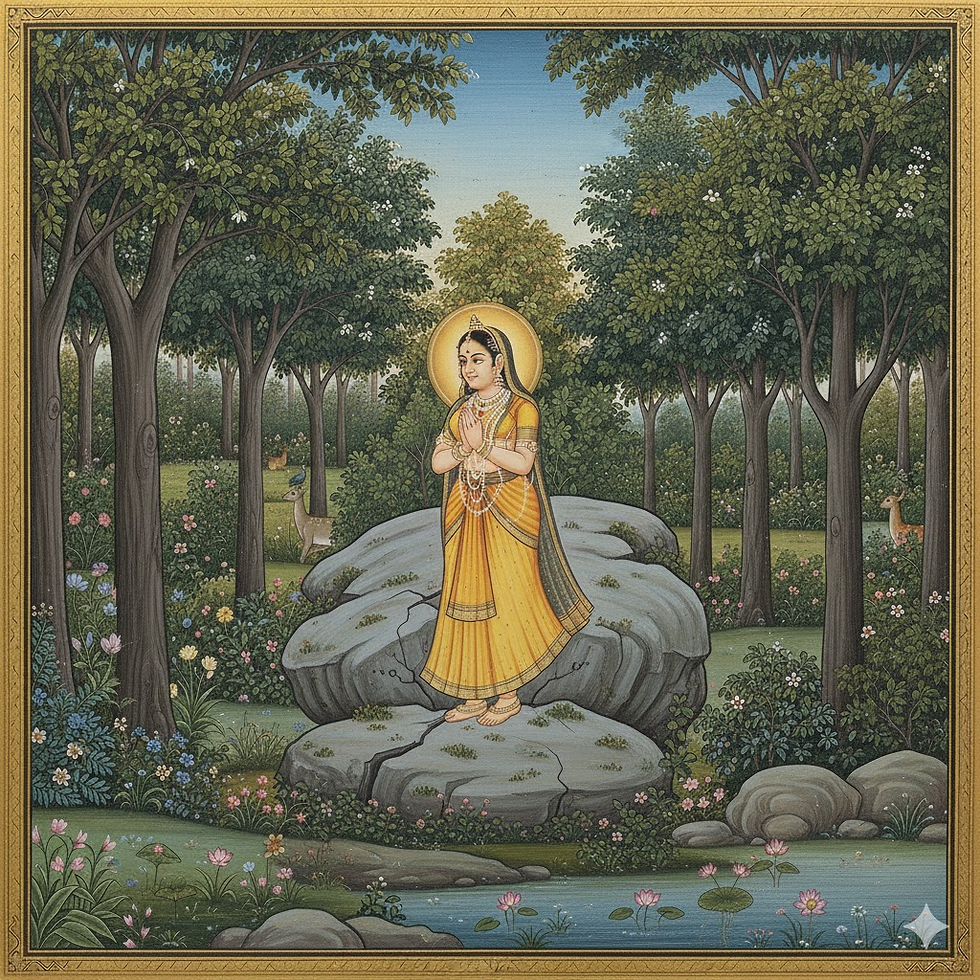
Ahalya bowed, not searching his face, simply accepting that the time had come.
Gautama himself arrived at that moment, as if drawn backward into his own ending, and stood beside her. The rage of ages had burned away. Nothing remained but the clear recognition of truth.
He blessed Rāma.
And the hermitage felt inhabited again, as if color had returned where it had been drained.
They left at second light the next day. The plains of Videha spread out broad and clean. Herds grazed. The roads widened. Travelers spoke of Janaka, his fairness, his mind, his vow, and of a bow that no man could so much as nudge.
By the eighth day the southern gate of Mithilā rose, white stone, banners straight in the wind, guards whose posture held neither arrogance nor slackness.
Viśvāmitra looked back once.
“Here, the bow waits.”
And they walked in.
Sources:
Primary
Valmiki Rāmāyaṇa — Bāla KāṇḍaTravel after siddhāśrama + arrival at Gautama’s āśrama: 1.39 – 1.44
Ahalyā curse episode + redemption: 1.44 – 1.49
Journey toward Mithilā & entering Videha lands: 1.50 – 1.51
Approach to Mithilā city proper: 1.52
Secondary / Parallel
Kamban — Bala Kāṇḍam (Ahalyā episode more emotionally symbolic)
Ananda Rāmāyaṇa — Ahalyā episode with more explicit self-reflection passages


Comments