
.png)

Chakshusha Manu: The Sixth Manvantara
- A. Royden D'Souza

- Nov 14, 2025
- 5 min read
Very Late Satya (Krita Yuga)/Very Early Treta Yuga
When the Raivata Manvantara came to its serene and quiet end, the gentle radiance of the Abhūtarajasas faded, the Saptarṣis of that era withdrew into subtle realms, and Viṣṇu’s manifestation Vaikuṇṭha dissolved like a whisper into the endless stillness.
The cosmos inhaled. A heavier wind moved through creation. Another turning of the great wheel approached—one marked by instability, subtle imbalance, and the foreshadowing of a coming dissolution.
The Origin of Chakshusha
Chakshusha did not come from the line of Priyavrata, unlike the previous Manus. He came from the lineage of the Cakṣus, a race of semi-divine visionaries who were said to be born of the eye of Brahmā, hence the name:
Cākṣuṣa = “He who is of the Eye,”or “He who sees with the cosmic vision.”

His birth was unusual. His mother dreamt of a vast celestial eye opening in the sky, releasing a beam of pure clarity that struck her heart. When he was born, his eyes shone like deep amber, reflecting things beyond the physical world.
The sages whispered:
“This child sees the hidden currents of the world.”
He grew into a calm, tall youth with a penetrating gaze, not harsh, but absolutely truthful. A glance from him felt like a question: Do you see clearly? For clarity was his nature.
The Choosing of Cākṣuṣa
As the Fifth Manvantara ended, the gods tested him.
Test of Sight: They placed before him an illusion, a beautiful celestial palace with perfect symmetry. Most would be deceived. Cākṣuṣa said, “This is hollow. I see no life-source within.” The illusion dissolved instantly.
Test of Compassion: They brought him a wounded Asura child, a trick to test his impartiality. He healed the child without hesitation. “Vision without compassion,” he said, “becomes cruelty.”

Test of Steadiness: The earth was shaken under him; the sky roared; the winds shrieked. Cākṣuṣa stood, unmoving, as though his feet were roots reaching into the cosmos.
The Devas bowed. Thus Cākṣuṣa became the Sixth Manu, the lord of the manvantara preceding our own.
The Cākṣuṣa Manvantara Begins
The universe reshaped itself once more. This was an era of increasing turbulence. Light and shadow clashed in new ways, and the cosmic balance required a firm but sensitive hand.
The Devas of This Era, The Apyas: The gods of this age were the Apyas, beings with fluid brilliance like rippling water. Their movements were graceful, their bodies shimmering blue-white like moonlit rivers.
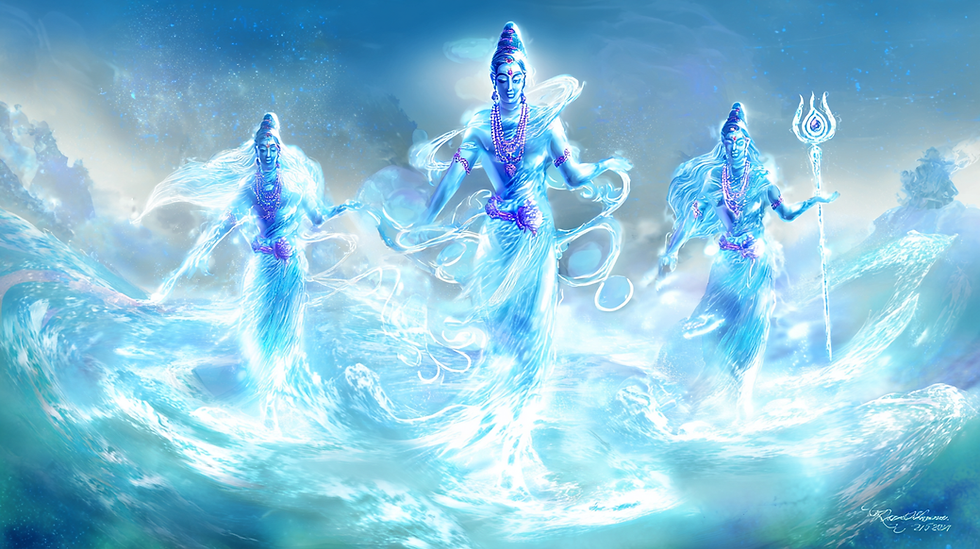
They excelled in healing, purification, and elemental harmony.
Indra of This Era, Manojava: The king of the gods was Indra Manojava (also called Manojapa, Manoja, and Camumān in variants).
The name means:
“He who moves with the speed of thought.”
Manojava was swift, sharp-minded, and deeply intuitive, a perfect complement to a Manu of vision.
The Seven Sages: The Saptarṣis of this era were: Havishmān, Prāṇa, Dāksha, Tapasvī, Sutapa, Jyotiṣmān, and Haviṣmat (with slight variations in different Purāṇas).
They became pillars of discipline in a world that was slowly losing stability.
Rising Chaos and the Asura Strain
During Cākṣuṣa’s reign, the world began to show signs of instability.
Rivers swelled beyond measure.
Sages reported disturbances in the sacrificial fires.
Seasons began slipping out of order.
The Daityas and Dānavas, long held back in previous ages, re-emerged with new cunning. They wielded psychic manipulation, bending minds and thoughts.

The Apyas Devas, fluid but not forceful, were intimidated. Indra Manojava fought swiftly, but the Asuras’ mental assaults disrupted even his clarity.
The worlds grew anxious. Whenever mental darkness obscures Dharma, Viṣṇu intervenes.
Viṣṇu’s Avatar: Aja (Ajita)
In this manvantara, Viṣṇu manifested as Ajita (“the Unconquered”)— also called Aja, the unborn one. He appeared not as a warrior, but as a radiant celestial shepherd, with eyes that seemed to hold the memory of cosmic dawn.

His glow was gentle, yet no darkness could survive it. Ajita descended among the Apyas, and with his soft voice alone, dispelled the psychic fog cast by the Asuras.
The Asuras of the underworld rose together, three warlords hardened by terrifying austerities, their minds sharpened like blades in the dark.
The first unleashed a storm of illusions: phantoms twisting the sky, forms that flickered between fear and desire. Ajita smiled gently, and the illusions crumbled like rotted cloth before the dawn of His presence.
The second, swollen with dual fury, charged with two mouths roaring contradictory truths, a cacophony meant to split the minds of gods. Ajita lifted His hand, and both voices fell silent, as though swallowed by a boundless calm.
The third summoned fire born of corrupted tapas, a heat meant to unravel creation. Ajita received the blaze without flinching, absorbing its force into His cool, luminous form, as a mother draws away a child’s fever.
The Asuras’ strength collapsed. Their minds cleared of their self-made storms. They retreated into the deeper caverns of Rasātala, stripped of the arrogance that had twisted their power.
Peace returned. The Apyas regained their fluid clarity. Indra Manojava found his certainty restored. The three worlds breathed again.
Cākṣuṣa’s Age of Watchfulness and Decline
Unlike earlier eras that moved in harmony, the Cākṣuṣa age was a period of gradual deterioration. Cākṣuṣa ruled wisely, but the universe itself was preparing for a great event —the flood that would someday sweep away his era and lead to the rise of Vaivasvata Manu, our present Manu.
Cākṣuṣa fathered noble sons —Uru, Puru, Satadyumna, Tapasvī, Sutapas, and others (depending on Purāṇic variations).
He taught them vigilance, for his era was one where:
Disorder rose slowly.
Beings struggled to maintain clarity.
Dharma had to be continuously reinforced.
In this era occurred the early omens of the coming dissolution —earthquakes, massive rains, disruptions in cosmic rhythms. Cākṣuṣa spent much of his reign mitigating imbalance, like a king holding back tides with vision and wisdom.
The End of the Cākṣuṣa Age
As the manvantara neared its end, the cosmic waters began to stir. The sages reported that the Garbhodaka Ocean was swelling. Animals behaved strangely. Seers foresaw an era-ending deluge.
This was the age immediately preceding the famous Flood that births Vaivasvata Manu, the Seventh Manu — our current one.
But the flood had not yet arrived. That story belongs to the next era. Cākṣuṣa, seeing the signs, retired to the forests near the celestial Sarasvatī, where he meditated upon the cycles of creation and dissolution.
In the final twilight of his reign, he closed his eyes, and his vision — the very gift that had defined him —expanded until his form dissolved into pure sight, merging with the cosmic Eye.
Thus ended the sixth manvantara, and the universe turned toward the Seventh Manu — Vaivasvata, the survivor of the great cosmic Flood.
REFERENCES:
Bhāgavata Purāṇa
8.1.12 — Cākṣuṣa listed as the Sixth Manu; Apyas Devas; Indra Manojava; Saptarṣis.
8.5.37 — Viṣṇu’s avatāra Ajita for the Cākṣuṣa Manvantara.
8.13.7 — Further structure of the sixth manvantara.
Viṣṇu Purāṇa
3.1.19–22 — Devas (Apyas), Indra names, sages, sons of Cākṣuṣa.
3.2 — Notes on Ajita avatāra and disturbances.
Matsya Purāṇa
Chapters 144–145 — Fluctuations in Deva groups and sages for this manvantara.
Vāyu Purāṇa
Chapter 68 — Confirms Devas, Indra Manojava, and cosmic changes in this era.
Brahmāṇḍa Purāṇa
3.1–3.2 — Additional notes on the sixth manvantara and its sages.
Skanda & Padma Purāṇas
Traditional references to Asuras Ariṣṭa, Dvimūrdhā, and Hara during early manvantaras.


AO88 mình thấy bạn bè nhắc hoài nên cũng ghé thử cho biết thôi. Không có chơi hay đọc kỹ gì đâu, chủ yếu mở ra xem giao diện họ làm kiểu gì. Vừa vào là thấy trang nhìn khá sáng sủa, khoảng trống vừa đủ nên không bị rối mắt. Mấy phần thông tin được chia thành từng khối riêng, nhìn phát là biết cái nào thuộc mục nào, khỏi phải dò. Mình cũng để ý cái thanh menu đặt khá dễ thấy, bấm qua lại mấy chỗ nhanh gọn chứ không phải quay vòng tìm nút. Lướt tầm vài phút là quen tay, kiểu bố cục thân thiện cho người chỉ ghé xem sơ sơ như mình. Nói…
Kèo bóng đá trực tuyến mình thấy người ta nhắc nhiều quá nên cũng bấm vào coi thử cho biết thôi. Không phải kiểu ngồi đọc kỹ hay phân tích gì đâu, mình chỉ lướt nhanh xem giao diện có dễ chịu không. Vừa vào cái thấy trang làm khá sáng sủa, khoảng trắng vừa đủ nên nhìn không bị bí, kéo xuống cũng đỡ mệt mắt. Thông tin được chia thành từng khối riêng nên mình liếc một cái là biết chỗ nào đang nói về cái gì, không bị dính hết vào nhau. Mình cũng để ý mấy bảng dạng cột trình bày gọn, chữ không quá nhỏ nên đọc nhanh vẫn bắt kịp. Menu để ngay chỗ…
tài xỉu kubet dạo này mình thấy nhiều người nhắc nên cũng bấm vào xem thử cho biết. Mình chỉ lướt nhanh chứ không ngồi đọc kỹ, chủ yếu xem cách họ làm giao diện và sắp nội dung ra sao. Cảm giác đầu tiên là trang nhìn gọn gàng, không bị rối mắt, chữ dễ nhìn và kéo xuống khá mượt. Có đoạn họ nhắc dữ liệu giao dịch được mã hóa 256-bit nên mình cũng thấy yên tâm hơn chút khi xem qua. Mình thích kiểu họ chia nội dung thành từng khối rõ ràng, tiêu đề nổi bật nên muốn tìm phần giới thiệu hay thông tin cơ bản thì liếc là thấy ngay. Nói chung nhìn…
BALL88 mình mới ghé thử vì thấy bạn bè nhắc, chủ yếu vào xem giao diện với cách họ trình bày thôi. Cảm giác đầu tiên là trang nhìn hiện đại, chia khối rõ ràng nên lướt khá nhẹ mắt, không bị kiểu nhồi chữ. Mấy tiêu đề chủ đề đặt nổi, kéo xuống là biết mình đang ở phần nào, hợp với người mới vào lần đầu như mình. Mình cũng để ý họ nhắc tới chuyện hoạt động có giấy phép Curacao ngay trong nội dung, nên đọc qua thấy yên tâm hơn chút chứ không mơ hồ. Menu điều hướng đặt dễ thấy, bấm qua lại giữa các mục mượt, và các khối nội dung được gom…
X8 mình thấy bạn bè nhắc hoài nên cũng ghé thử cho biết, chủ yếu coi giao diện có dễ dùng không chứ không rảnh đọc kỹ từng chỗ. Vừa vào là thấy bố cục chia mảng khá rõ, nhìn lướt một cái là biết phần nào nằm ở đâu, không bị dồn chữ hay rối mắt. Mình thích nhất là cái menu để ngay chỗ dễ thấy, bấm qua lại mấy mục mà không bị “lạc đường”, kiểu điều hướng mượt và nhanh. Màu sắc cũng vừa phải, không chói, nên ngồi xem một lúc vẫn ổn. Nói chung cảm giác như họ sắp xếp nội dung theo từng khối tách biệt, canh cột gọn gàng nên kéo xuống…