
.png)

Ancient Texts: The Great Tree of Hindu Scripture
- A. Royden D'Souza

- May 3
- 31 min read
Updated: May 4
Let us begin not with a book, but with a sound. The hour is long before dawn, and the air is cold enough to see your breath. A father and son are seated on the packed earth, facing one another, barely visible in the last light of the dying cooking-fire.
The man leans forward, shapes his mouth with an exactness that has been rehearsed every morning for thirty years, and breathes out a single syllable: Agni. Not just a word, but a pitch, a rhythm, a precise collision of tongue and palate; a sound he received as a child from his own father, who received it from his, who received it from his. The boy repeats it. The vibration passes from one living body to another, unchanged.
There is no manuscript to consult, no papyrus, no birch-bark. The entire library exists only in the architecture of human memory. And for a moment, that is enough; because the syllable is not merely the name of fire. It is a thread in a fabric that has been weaving itself for generations.
Across the centuries that follow, that single thread will be braided with thousands of others. Those hymns will be puzzled over by priests, unfolded by philosophers, bent into legal codes, sung into epics, wept into devotional poetry, and whispered into the ears of disciples in temple courtyards.
Several thousand years later, the seed of spoken word has become what may be the most intricate, self-diversifying, and stubbornly oral tree of sacred literature ever produced by a civilization. And the only ink ever needed was the breath.

This tree of Hindu Scripture has a distinctive living pattern. It never closed its canon with a definitive council or a fixed list. Instead, it grew organically: a Vedic mantra planted in the soil of the Indus plain sending shoots into ritual manuals, philosophical treatises, auxiliary sciences, sectarian revelations, and epic narratives that together form an intellectual ecology of unmatched breadth.
The trunk divided; the branches crossed and intertwined; even the shoots that explicitly rejected the Vedic root were indelibly shaped by the ecosystem it created. To study Hindu scripture is therefore not to read a book but to enter a forest.
This paper traces the entire organic growth of that forest – from the first whispered hymns of the Indo‑Āryan people to the global dissemination of the Bhagavadgītā and the Yogasūtra in the twenty‑first century.
It follows a comprehensive map that includes the four Vedas, their internal stratification, the four Upavedas, the six Vedāṅgas, the four Upāṅgas with their detailed sub‑sections, the six Āstika Darśanas (orthodox philosophical systems), the Prasthānatraya of Vedānta (Upaniṣads, Brahmasūtra, and Bhagavadgītā), the Nāstika Darśanas (Bauddha, Jaina, and Cārvāka), the six Āgamas (Śaiva, Śākta, and Vaiṣṇava), and the vast Smṛti canopy; the Purāṇas, the Itihāsas, the Dharmaśāstras, the Bhakti poetry, and the Stotra literature.
The goal is not a catalogue but a narrative; the story of how a people’s encounter with the sacred, articulated first in sacrificial hymns addressed to Agni and Indra, gradually unfolded into a civilisation’s comprehensive vision of reality, encompassing everything from the structure of the atom to the path of loving devotion, from the grammar of logic to the mystery of consciousness itself.
Part I: Deepest Roots of Hindu Scripture – The Four Vedas

The Vedas are the foundation upon which the entire edifice of Hindu scripture rests. The word veda derives from the Sanskrit root vid, “to know,” and the texts are understood, within the tradition, not as compositions but as revelations, śruti, “that which is heard.”
The Ṛṣis, the seers, did not invent the hymns, it is said; they perceived them, tuning their consciousness to a cosmic vibration that predates all human expression.
Scholarly consensus places the composition of the earliest Ṛgvedic hymns in the period 1500–1200 BC, though traditional Hindu dating pushes this timeline back by several millennia. The composers were the Ārya, a term denoting nobility and cultivated speech rather than race, who had migrated into the north‑western regions of the Indian subcontinent and whose language, Vedic Sanskrit, belongs to the Indo‑European family.
The Ṛgveda preserves hymns addressed to thirty‑three principal deities, including Indra (the warrior‑king of the gods), Agni (the fire that mediates between heaven and earth), Varuṇa/Varuna-Mitra (the upholder of cosmic order, ṛta), Soma (the deified ritual drink), and Uṣas (the dawn).
Crucially, this was not a literary culture in the modern sense. The Vedas were composed, refined, and transmitted entirely through oral means for perhaps a thousand years before any commitment to writing.
The technology of memorisation developed to support this – the pāṭha traditions of continuous recitation (saṃhitā‑pāṭha), word‑by‑word recitation (pada‑pāṭha), and intricate interwoven patterns (krama‑pāṭha, jaṭā‑pāṭha, ghanā‑pāṭha) – is one of the marvels of human cognitive achievement.
To recite the ghanā‑pāṭha of a text is to recite it forwards, backwards, and in a lattice of permutations so sophisticated that it constitutes a built‑in error‑correcting code, making textual corruption virtually impossible. This civilisation invested its most sophisticated intellectual energies not in building monuments, but in preserving sound.

The Saṃhitā Quartet: A Living Body of Sound
The core of each Veda is its Saṃhitā; literally a “collection” of mantras arranged for ritual and contemplative use. There are four such collections, each with a distinct character and function.
Ṛgveda Saṃhitā (∼1500–1200 BC): The oldest and most foundational, containing 1,028 sūktas (hymns) arranged in ten maṇḍalas (books). Maṇḍalas II through VII are the oldest, each attributed to a specific family of Ṛṣis – the Gṛtsamadas, the Viśvāmitras, the Vasiṣṭhas, and others.

Maṇḍala IX is devoted entirely to Soma Pavamāna, the pressing and purification of the sacred soma plant. Already in the famous Nāsadīya Sūkta (Ṛgveda 10.129), the Hymn of Creation, we encounter a speculative voice that questions the very origin of the cosmos, wondering if even the gods know how it all began:
“Who really knows? Who will here proclaim it? Whence was it produced? Whence is this creation? The gods came afterwards, with the creation of this universe. Who then knows whence it has arisen?” (Ṛgveda 10.129.6)
This hymn is the seed that will later germinate into the Upaniṣadic quest for ultimate reality.
Yajurveda Saṃhitā (∼1200–1000 BC): The “Veda of Sacrificial Formulas.” Unlike the Ṛgveda’s poetic hymns, the Yajurveda is a priestly manual; a book of prose formulas (yajus) to be uttered by the adhvaryu priest during the performance of elaborate śrauta rituals.

It exists in two major recensions. The Śukla (White) Yajurveda, represented by the Vājasaneyi Saṃhitā in the Mādhyandina and Kāṇva śākhās, presents the mantras in a relatively clear, unmixed arrangement.
The Kṛṣṇa (Black) Yajurveda, preserved in the Taittirīya, Maitrāyaṇī, Kaṭha‑Kapiṣṭhala, and Caraka‑Kaṭha śākhās, interweaves mantras with explanatory prose, making it an invaluable source for understanding Vedic ritual thought.
Sāmaveda Saṃhitā (∼1200–1000 BC): The “Veda of Melodies.” It contains 1,875 verses, nearly all drawn from the Ṛgveda but set to precise musical notation for chanting by the udgātṛ priest during the Soma sacrifice.

The Sāmaveda is the fountainhead of Indian musicology. Its precise melodic patterns, using a seven‑note scale that is the ancestor of later Indian classical music, demonstrate that the Vedic tradition was never purely textual but encompassed a sophisticated science of sound, a recognition that how a mantra is sung is as important as its semantic content.
Atharvaveda Saṃhitā (∼1000–900 BC): The youngest Veda, and in many ways the most intimate. Its 730 hymns, arranged in twenty kāṇḍas, are radically different in tone.

Where the Ṛgveda propitiates cosmic deities, the Atharvaveda addresses the immediate concerns of everyday life: healing spells against fever and consumption, charms for love and prosperity, imprecations against enemies, prayers for the king’s welfare, and incantations for harmony in the household.
It preserves a stratum of folk religion that predates the priestly systematisation of the other Vedas; a world of local spirits, herbal remedies, and domestic ritual. Its inclusion, after some resistance, as the fourth Veda represents the incorporation of autochthonous, non‑Āryan elements into the Vedic fold, a syncretic moment of enormous consequence for the later development of Hinduism.
The Śākhās: The Forest of Branches
Each Veda was originally preserved not in a single uniform version but through numerous śākhās; recensional schools, each with its own slight variations in text, accent, and ritual practice. The Muktikopaniṣad mentions twenty‑one śākhās for the Ṛgveda, one hundred and one for the Yajurveda, one thousand for the Sāmaveda, and nine for the Atharvaveda.
Of these, today only a handful survive. The Ṛgveda is known in the Śākala śākhā only, with surviving fragments of the Bāṣkala. The Yajurveda survives in five, partially six, śākhās: two of the White (Mādhyandina and Kāṇva) and four of the Black (Taittirīya, Maitrāyaṇī, Caraka‑Kaṭha, and Kapiṣṭhala‑Kaṭha). The Sāmaveda survives in the Kauthuma and Jaiminīya traditions, and the Atharvaveda in the Śaunakīya and Paippalāda.
The loss of these śākhās represents one of the great tragedies in the history of human textual culture. Thousands of verses, ritual traditions, and philosophical variants that once constituted the living diversity of Vedic practice now exist only as names in ancient catalogues. Yet what remains is still vast: a coherent, multi‑layered oral library that provides the seedbed for everything that follows.
The Fourfold Stratification: From Mantra to Upaniṣad

What is often loosely called a “Veda” is actually a layered structure. Each Veda is internally stratified into four historical and conceptual layers that, when read in their traditional sequence, chart the spiritual evolution of the Vedic people:
1. Saṃhitā (∼1500–1000 BC): The foundational mantra collection; the hymns and formulas addressed to the deities. This is the layer of inspired poetry and ritual invocation.
2. Brāhmaṇa (∼900–700 BC): Prose commentaries attached to each Veda that explain the intricate mechanics of the sacrifice. The Śatapatha Brāhmaṇa of the White Yajurveda, in one hundred adhyāyas, is the most comprehensive and famous.
In the Brāhmaṇas, the sacrifice (yajña) is elevated to a cosmic principle: the universe itself is seen as originating from the primordial sacrifice of the cosmic giant Prajāpati. The Brāhmaṇas also develop the concepts of karma (ritual action) and the āśrama system (the four stages of life).
3. Āraṇyaka (∼700–600 BC): The “Forest Texts,” intended for those who have withdrawn from society to a life of contemplation in the wilderness. The Bṛhadāraṇyaka, Taittirīya, and Aitareya Āraṇyakas are the most significant.
They represent a bridge between the external ritualism of the Brāhmaṇas and the internalised philosophy of the Upaniṣads. The sacrifice is reinterpreted as an internal, meditative process; the prāṇāgnihotra, the offering of breath into the inner fire.
4. Upaniṣad (∼800–300 BC): The culmination of the Vedic revelation, known as Vedānta; “the end of the Veda.” The Upaniṣads shift the primary concern from yajña (external sacrifice) to jñāna (knowledge); specifically, knowledge of the identity between the individual self (ātman) and the ultimate reality (brahman).
The Chāndogya, Bṛhadāraṇyaka, Taittirīya, Aitareya, Kaṭha, Praśna, Muṇḍaka, Māṇḍūkya, Kena, and Īśā are the earliest and most revered. They introduce the doctrines of saṃsāra (rebirth), karma (as a moral law governing rebirth), and mokṣa (liberation through knowledge) that would become the philosophical bedrock of all subsequent Hindu thought.
The Taittirīya Upaniṣad, for instance, maps human being into five concentric sheaths. Annamaya (food), prāṇamaya (vital breath), manomaya (mind), vijñānamaya (intellect), and ānandamaya (bliss). The immortal ātman dwells at the core, beyond even bliss.
The Māṇḍūkya Upaniṣad, in just twelve verses, explores the four states of consciousness. Waking, dreaming, deep sleep, and turīya (the transcendent fourth). It identifies the sacred syllable Om as the sonic embodiment of all four states.
The Chāndogya Upaniṣad preserves, in the famous dialogue between Uddālaka Āruṇi and his son Śvetaketu, the foundational teaching: “tat tvam asi, Śvetaketo” – “That thou art, Śvetaketu.”
This fourfold structure – Saṃhitā, Brāhmaṇa, Āraṇyaka, Upaniṣad – is not merely a literary classification; it records, in its very order, the spiritual journey of the Vedic people from ritualistic invocation of external deities to the inward quest for the unconditioned Self.
Part II: The Applied Branches – The Four Upavedas
If the four Vedas form the trunk of the scriptural tree (with the roots being the Proto-Vedic oral traditions), the Upavedas (“subsidiary Vedas”) are the first major branches that adapt Vedic knowledge to specific domains of human flourishing.

There are traditionally four, each associated with one of the Vedas:
Āyurveda: The Science of Life
Associated with the Ṛgveda and the Atharvaveda, Āyurveda is the ancient Indian system of holistic medicine whose very name – āyus (life) + veda (knowledge) – declares its scope. The foundational texts are three, collectively known as the Bṛhat Trayī (the “Great Triad”):
The Caraka Saṃhitā (c. 2nd century BC), attributed to Agniveśa and later redacted by Caraka, focuses on kāyacikitsā (internal medicine). It develops a sophisticated theory of three bodily humours (doṣas: vāta‑wind, pitta‑bile, kapha‑phlegm) and seven bodily tissues (dhātus), and it discusses the nature of health as a dynamic equilibrium between body, mind, and spirit.
The Suśruta Saṃhitā (c. 3rd century AD), attributed to the sage Suśruta, focuses on śalyatantra (surgery). Suśruta describes over three hundred surgical procedures, including rhinoplasty (reconstruction of the nose), cataract extraction, and lithotomy, using over one hundred and twenty surgical instruments, and his classification of surgical techniques into eight categories (aṣṭavidha śastrakarma) remains an intellectual landmark.
The Aṣṭāṅga Hṛdayam (c. 6th century AD) of Vāgbhaṭa is a masterly synthesis of the Caraka and Suśruta traditions, written in lucid verse that makes it one of the most memorised medical texts in history. Its eight sections (aṣṭāṅga) cover the full range of Āyurvedic medicine from paediatrics to rejuvenation therapy.
Later texts such as the Mādhava Nidāna (on diagnosis), the Śārṅgadhara Saṃhitā (on pharmacy), and the Bhāvaprakāśa (a comprehensive compendium) further expanded the Āyurvedic corpus.
Dhanurveda: The Science of Warfare
Linked to the Yajurveda, Dhanurveda encompasses archery, martial arts, and the science of war. Though its independent treatises are largely lost, significant passages survive embedded in the epics, the Purāṇas, and the Arthaśāstra.
The Agni Purāṇa (chapters 249–252) preserves a systematic Dhanurveda manual that classifies weapons into four categories: yantramukta (projectile weapons thrown by machines), pāṇimukta (weapons thrown by hand, such as spears), muktasandhārita (weapons that are thrown but can be retrieved), and amukta (weapons that are never thrown, such as swords and maces).
The legendary preceptors of Dhanurveda include Viśvāmitra, Bhṛgu, and Bharadvāja. The epic Mahābhārata is replete with descriptions of elaborate battle formations (vyūhas) – the cakravyūha, the garuḍavyūha, the makaravyūha – that reveal a highly developed tactical science.
Gāndharvaveda: The Science of Music, Dance, and Drama
Associated with the Sāmaveda, and thus organically linked to the Vedic science of chant, Gāndharvaveda is the systematisation of Indian performing arts. The foundational text is the Nāṭyaśāstra of Bharata (c. 200 BC–200 AD), an encyclopaedic treatise in thirty‑six chapters that covers everything from theatre architecture to the grammar of gesture.
Bharata’s theory of rasa, the eight (later nine) fundamental emotional flavours that art can evoke: śṛṅgāra (love), hāsya (laughter), karuṇa (sorrow), raudra (anger), vīra (heroism), bhayānaka (fear), bībhatsa (disgust), adbhuta (wonder), and (later) śānta (peace), became the cornerstone of Indian aesthetics and remains essential to every classical Indian art form.
The subsequent musical literature, the Saṅgīta Ratnākara of Śārṅgadeva (13th century), the Saṅgīta Darpana of Dāmodara, and the regional treatises of the Hindustani and Carnatic traditions – all trace their lineage to this Sāmavedic root.
Arthāśāstra and Sthāpatyaveda: Contenders for the Fourth Upaveda
The fourth Upaveda is a subject of variation. Some traditions list Arthaśāstra (the science of statecraft, politics, and economics), associated with the Ṛgveda. The Arthaśāstra of Kauṭilya (c. 4th century BC) is a masterpiece of political realism, discussing taxation, espionage, law, foreign policy, and the duties of the king in fifteen books with a pragmatic empiricism.
Other traditions substitute Sthāpatyaveda (the science of architecture, sculpture, and town planning), associated with the Atharvaveda. The principles of vāstuśāstra are elaborated in the Mānasāra, the Mayamata, the Samarāṅgaṇa Sūtradhāra, and the South Indian Śilpaśāstras, which govern everything from the orientation of a temple to the proportions of the deity’s image.
Both traditions are valid; the Upaveda list is not dogmatically fixed but represents the application of Vedic principles to different spheres of temporal life.
Part III: The Six Limbs of the Vedic Body – The Vedāṅgas
For the Veda to be properly recited, understood, and applied, auxiliary disciplines are necessary. These are the six Vedāṅgas, literally “limbs of the Veda” – the tools without which the Vedic corpus cannot be comprehended or preserved.
The Muṇḍaka Upaniṣad (1.1.5) is the earliest text to name them, and the Pāṇinīya Śikṣā (41–42) personifies the Veda as a cosmic being, the Vedapuruṣa, whose limbs these six disciplines constitute: Chandas are His two feet, Kalpa are His two arms, Jyotiṣa are His eyes, Nirukta is His ears, Śikṣā is His nose, and Vyākaraṇa is His mouth.

Śikṣā (Phonetics) – The Nose of the Vedapuruṣa
Śikṣā governs the correct pronunciation, accentuation, and euphonic combination (sandhi) of Vedic sounds. In a purely oral tradition, a single mispronounced syllable could alter meaning or potency; hence the science of phonetics was paramount.
Each Vedic śākhā developed its own Prātiśākhya text that codified the rules of articulation (sthāna: place of articulation; prayatna: effort), the three Vedic pitch accents (udātta – raised, anudātta – not raised, svarita – a combination), and recitational tempo.
Kalpa (Ritual Procedure) – The Arms of the Vedapuruṣa
Kalpa translates the theoretical knowledge of the Brāhmaṇas into practical manuals for ritual performance. The Kalpasūtras are divided into four sub‑categories:
Śrautasūtras: Manuals for the solemn public sacrifices requiring three or five fires; the Agniṣṭoma, the Darśapūrṇamāsa, the Aśvamedha. The Baudhāyana, Āpastamba, Kātyāyana, and Āśvalāyana Śrautasūtras are among the most important.
Gṛhyasūtras: Manuals for the domestic (gṛhya) rites; birth ceremonies (jātakarma), initiation (upanayana), marriage (vivāha), funerals (antyeṣṭi), and the daily pañcamahāyajña (five great offerings).
Dharmasūtras: The earliest codes of sacred law (see Part VI).
Śulbasūtras: The “rules of the cord,” containing the geometric principles for constructing the sacrificial altar. The Baudhāyana Śulbasūtra contains the earliest known statement of what Western tradition calls the Pythagorean theorem, methods for squaring the circle, and approximations of √2 – evidence of a sophisticated mathematical culture embedded within ritual requirements.
Vyākaraṇa (Grammar) – The Mouth of the Vedapuruṣa
Vyākaraṇa is the discipline of linguistic analysis, and its supreme monument is Pāṇini’s Aṣṭādhyāyī (c. 5th century BC).
Pāṇini’s achievement was to describe the entire Sanskrit language, Vedic and classical, through a formal system of 3,959 sūtras, using a meta‑language of phonological codes, case endings, and operational rules that functions, in effect, as a generative grammar.
The Aṣṭādhyāyī is organised into eight books, each of four quarters, and proceeds through a carefully sequenced set of rules (sūtras), metarules (paribhāṣās), and appendices (gaṇapāṭhas, dhātupāṭhas).
The subsequent commentarial tradition, Kātyāyana’s vārttikas and Patañjali’s Mahābhāṣya (c. 2nd century BC), formed the Trimuni (three sages) tradition that secured Sanskrit as the intellectual language of India for two millennia.
Nirukta (Etymology) – The Ears of the Vedapuruṣa
Nirukta is the discipline that explains archaic Vedic words whose meanings had become obscure even to the Brāhmaṇa period. The sole surviving text is Yāska’s Nirukta (c. 6th–5th century BC), which is itself a commentary on earlier Nighaṇṭu word‑lists.
Yāska develops a theory of meaning, arguing that all nouns derive ultimately from verbal roots (dhātus), and that a word’s etymological meaning (yauġika) and its conventional meaning (rūḍhi) must be distinguished.
He also preserves the oldest known debate in Indian linguistics: the nairuktas, who held that all words are etymologically derived from verbal roots, versus the vaiyākaraṇas, who held that some words are conventional and arbitrary.
Chandas (Prosody) – The Feet of the Vedapuruṣa
Chandas is the science of poetic metre. The Vedic metres, Gāyatrī (three lines of eight syllables), Triṣṭubh (four of eleven), Jagatī (four of twelve), and Anuṣṭubh (four of eight, later the standard śloka of classical Sanskrit), are not merely aesthetic choices but are held to possess intrinsic spiritual potencies.
The Chandaḥśāstra attributed to Piṅgala (c. 2nd century BC) systematised the theory of Vedic and classical metres, and in the course of his analysis of binary patterns (a guru syllable = 1, a laghu syllable = 0), he described the binary numeral system and the mathematical sequence now known in the West as Pascal’s triangle; centuries before their “discovery” in Europe.
Jyotiṣa (Astronomy and Astrology) – The Eyes of the Vedapuruṣa
Jyotiṣa addresses the determination of the proper time and celestial alignment for Vedic rituals. The Vedāṅga‑Jyotiṣa of Lagadha (c. 1200 BC) is the earliest extant Indian astronomical text, using a five‑year yuga cycle to compute calendrical data.
Over time, Jyotiṣa developed three main branches:
Siddhānta (mathematical astronomy): Culminating in Āryabhaṭa’s Āryabhaṭīya (499 AD), which proposed a heliocentric model (the earth rotates on its axis), and Varāhamihira’s Pañcasiddhāntikā.
Saṃhitā (natural astrology): The study of omens, earthquakes, rainfall, and other natural phenomena.
Horā (predictive astrology): The casting of horoscopes based on planetary positions at the moment of birth, developed in texts like the Bṛhat‑Pārāśara‑Horā‑Śāstra and Jātaka‑Pārījāta.

Part IV: The Supporting Limbs – The Four Upāṅgas
While the Vedāṅgas are directly necessary for Vedic study, the Upāṅgas (“supplementary limbs”) constitute the broader intellectual framework within which the Vedic worldview is systematised, justified, and disseminated.

The standard enumeration includes these four, each with its own family of texts and sub‑fields:
Pūrva‑Mīmāṃsā (The Philosophy of Vedic Hermeneutics)
Founded by Jaimini in the Mīmāṃsāsūtra (c. 3rd century BC), Pūrva‑Mīmāṃsā develops a comprehensive system of Vedic interpretation. Its twelve chapters address: the nature of dharma (which is known only through Vedic injunction), the distinction between injunction and commendatory statement, the relative strength of different texts, the means of resolving apparent contradictions, and the doctrine of the eternality of sound (śabda‑nityatā).
Mīmāṃsā develops a sophisticated theory of language: words are not conventional signs but inherently connected to the objects they denote, a connection that is beginningless (anādi‑sambandha).
Two major sub‑schools developed: the Bhāṭṭa school (founded by Kumārila Bhaṭṭa, 7th century) and the Prābhākara school (founded by Prabhākara, 7th‑8th centuries). Their debate over whether the Vedas are authorless (apauruṣeya) or the work of a trustworthy author is one of the most important in Indian philosophy of religion.
Nyāyavistara (The Expansion of Logic)
This Upāṅga encompasses the logical and epistemological disciplines that provide the rational foundation for philosophical discourse. It includes Nyāya, Vaiśeṣika, and the vast literature of debate manuals and dialectical treatises.
Because these are also independent Darśanas, detailed treatment is reserved for Part VI below. Here it is sufficient to note that their classification as an Upāṅga captures their instrumental role: they are the tools that make philosophical argument possible.
Purāṇa and Itihāsa (The Narrative Memory of the Tradition)
The Purāṇas and the Itihāsas (the two epics) are traditionally classified together as the third Upāṅga; the narrative, historical, and mythological memory of the tradition.
The Itihāsas (“thus it verily happened”) are:

The Rāmāyaṇa of Vālmīki (c. 5th–4th century BC): Comprising approximately 24,000 verses in seven kāṇḍas (books), it narrates the life of Prince Rāma; his exile, the abduction of his wife Sītā by the demon‑king Rāvaṇa, and her recovery with the aid of Hanumān and the vānara army. The Rāmāyaṇa establishes the ideal of maryādā; the righteous boundary within which the good life is lived.

The Mahābhārata of Vyāsa (c. 4th century BC–4th century AD): The longest epic poem in the world, containing over 100,000 verses in eighteen parvans (books). It narrates the devastating war between the Kaurava and Pāṇḍava cousins, but its narrative embraces cosmology, theology, philosophy, ethics, and law.
The epic famously declares: “Whatever is found here may be found elsewhere; what is not found here is found nowhere” (Ādi Parvan 62.53). Attached to it is the Harivaṃśa, a genealogy and mythology of Kṛṣṇa that bidges epic and Purāṇa.
Embedded in the Bhīṣma Parvan of the Mahābhārata is the Bhagavadgītā (see Part VII).
The Mahapuranas (Major Puranas)

The Purāṇas (“ancient narratives”) are encyclopaedic texts that contain mythology, cosmology, genealogy, theology, ritual, pilgrimage, and law. The corpus includes:
Eighteen Mahāpurāṇas (major Purāṇas): Traditionally classified by the Padma Purāṇa into three groups of six according to the guṇas (cosmic qualities):
Sāttvika Purāṇas (associated with Viṣṇu): Viṣṇu, Bhāgavata, Nāradīya, Garuḍa, Padma, and Varāha.
Rājasa Purāṇas (associated with Brahmā): Brahmāṇḍa, Brahmavaivarta, Mārkaṇḍeya, Bhaviṣya, Vāmana, and Brahma.
Tāmasa Purāṇas (associated with Śiva): Śiva, Liṅga, Skanda, Agni, Matsya, and Kūrma.
The Upapuranas (Minor Puranas)
Since the Purāṇas themselves propose different lists, no single set of eighteen names is universally authoritative.
A "Standard" Primary Roster: The Devī Bhāgavata Purāṇa (Book 1, Chapter 3) provides one of the most definitive canonical lists in scripture. This list of eighteen consists of:
Sanatkumāra (Ādi Upapurāṇa)
Narasimha
Nāradīya (Brihannāradīya)
Śiva
Durvāsasa
Kāpila
Mānava
Auśanasa
Varuṇa
Kālikā
Śāmba (Sāmba)
Nandi (Nandikeśvara)
Saura
Pārāśara
Āditya
Māheśvara
Bhāgavata (or Bhārgava, see details below)
Vāsiṣṭha
Significant Canonical Variations: Due to the fluidity of the canon, other major scriptures offer considerably different lists that are equally valid from their own sectarian perspectives. A highly respected secondary list comes from the Kūrma Purāṇa, which notably differs in its final selections:
Ādya (Sanatkumāra)
Nārasimha
Skānda
Śivadharma
Durvāsasokta
Nāradīya
Kāpila
Vāmana
Auśanasa
Brahmāṇḍa
Vāruṇa
Kālikā
Māheśvara
Sāmba
Saura
Pārāśara
Mārīca
Bhārgava
Key differences you can spot include the Kūrma Purāṇa listing Skānda (a text often considered a Mahāpurāṇa), Śivadharma, Vāmana (another text more famous as a Mahāpurāṇa), Brahmāṇḍa, and Mārīca, while omitting names from the first list, such as the Śiva Upapurāṇa, Mānava, Āditya, and Vāsiṣṭha.
A Wider Constellation of Important Works: Scholarly study over the last century has identified a much larger body of texts that fall under the Upapurāṇa genre, even if they aren't found on every list of eighteen.
Key texts often included in this wider constellation are:
Viṣṇudharmottara Purāṇa: A famous text heavily cited in classical treatises on art, architecture, and astrology.
Devī‑Bhāgavata Purāṇa: An extremely important Śākta scripture, sometimes placed by its followers on par with the principal Purāṇas.
Śiva‑Rahasya Purāṇa: A late text popular in South Indian Śaiva traditions.
Gaṇeśa Purāṇa and Mudgala Purāṇa: The two central texts of the Gāṇapatya sect, dealing with Lord Gaṇeśa.
There are also others, such as the Ekāmra Purāṇa, Bhaviṣyottara Purāṇa, Kalki Purāṇa, and Bṛhaddharma Purāṇa, that were composed in subsequent centuries.
The Kalki Purāṇa was composed in eastern India (likely Bengal) and extant in manuscripts from the early eighteenth century, it is a prophetic Vaiṣṇava text dedicated entirely to the future advent of Kalki, the tenth and final avatāra of Viṣṇu.
Structured in three aṃśas, it narrates the birth of Lord Kalki to the Brāhmaṇa couple Sumati and Viṣṇuyaśa in the village of Śambhala, his marriage to Padmāvatī, and his eschatological mission to destroy the forces of adharma and inaugurate the Satya Yuga.
Although openly derivative in its verses, drawing heavily on the Viṣṇu and Bhāgavata Purāṇas, the Kalki Purāṇa has enjoyed wide popularity and functions as the primary scriptural source for the Kalki avatāra.
Other texts that belong to this wider constellation of later Upapurāṇas include the Gaṇeśa Purāṇa and the Mudgala Purāṇa (the two foundational scriptures of the Gāṇapatya tradition), the Viṣṇudharmottara Purāṇa (an encyclopaedic work famous for its sections on art, architecture, and iconography), the Bhaviṣyottara Purāṇa, the Bṛhaddharma Purāṇa, and the Śiva‑Rahasya Purāṇa.
Among these upapuranas, the Bhāgavata Purāṇa (18,000 verses in twelve skandhas) holds pride of place. Its tenth book is an exquisite account of Kṛṣṇa’s childhood, youth, and amorous sports in Vṛndāvana that has inspired more art, music, and poetry than any other single Sanskrit text.
The Skanda Purāṇa is the longest, containing over 81,000 verses and functioning as a vast pilgrimage guide to the sacred geography of India. The Mārkaṇḍeya Purāṇa contains the Devī‑Māhātmya, the foundational scripture of Goddess‑centered Śāktism.
Together they demonstrate that the Purāṇic impulse to assimilate mythology, theology, and ritual into a comprehensive narrative remained creatively active well into the medieval and early modern periods.
Dharmaśāstra (The Science of Sacred Law)

The Dharmaśāstras are the treatises on dharma; righteous conduct, law, and social order. They develop from the Dharmasūtras embedded in the Kalpasūtras. The major texts are:
Mānava‑Dharmaśāstra (Manusmṛti, c. 2nd century BC–2nd century AD): Containing 2,700 verses in twelve chapters, it codified varṇāśramadharma (duties by class and life‑stage), rājadharma (the king’s duties), vyavahāra (civil and criminal law), and prāyaścitta (penance).
Yājñavalkya Smṛti: More systematic and concise than Manu, with a more liberal treatment of women’s property rights and śūdra status. It is divided into three kāṇḍas: Ācāra (ritual conduct), Vyavahāra (civil law), and Prāyaścitta (atonement).
Nārada Smṛti: Focuses primarily on vyavahāra (jurisprudence), and is often called the “juridical Smṛti.”
Parāśara Smṛti: Regarded as the most authoritative Dharmaśāstra for the Kali Yuga (the present age).
Bṛhaspati Smṛti and Kātyāyana Smṛti: Known only through fragments and citations.
The commentarial tradition on these texts, especially Vijñāneśvara’s Mitākṣarā (11th century) on the Yājñavalkya Smṛti, became the foundation of Anglo‑Hindu law under British rule and remains operative in Indian courts today.
A comprehensive list of Smṛti authors, as enumerated in the Yājñavalkya Smṛti, numbers twenty, including Manu, Yājñavalkya, Atri, Viṣṇu, Hārīta, Uśanas, Aṅgiras, Yama, Āpastamba, Saṃvarta, Kātyāyana, Bṛhaspati, Parāśara, Vyāsa, Śaṅkha, Likhita, Dakṣa, Gautama, Śātātapa, and Vaśiṣṭha.
Part V: The Six Āstika Darśanas
The six Āstika Darśanas, the “orthodox” philosophical systems that accept the Vedas as an authoritative means of knowledge, represent the mature intellectual systematisation of Hindu thought. Each is a complete worldview, with its own epistemology (theory of valid knowledge), metaphysics (theory of reality), and soteriology (path to liberation).

They are conventionally presented in three complementary dyads:
Sāṃkhya: The Enumeration of Reality
Attributed to the sage Kapila and systematised in Īśvarakṛṣṇa’s Sāṃkhyakārikā (c. 4th century AD), Sāṃkhya is a radical dualism: it posits two irreducible realities – puruṣa (pure consciousness, the eternal witness) and prakṛti (primal matter, composed of the three guṇas: sattva – luminosity, rajas – activity, tamas – inertia).
When the equilibrium of the guṇas is disturbed by the mere proximity of puruṣa, prakṛti unfolds a cosmic evolution:
Prakṛti → Mahat (cosmic intellect) → Ahaṃkāra (ego principle) → Manas (mind) + 5 Jñānendriyas (sense capacities) + 5 Karmendriyas (action capacities) + 5 Tanmātras (subtle elements) → 5 Mahābhūtas (gross elements: space, air, fire, water, earth).
Together, these are twenty‑three evolutes. With the two fundamental principles (puruṣa and prakṛti), there are twenty‑five tattvas in total.
Liberation is kaivalya; the discriminative knowledge by which puruṣa realises its absolute separateness from prakṛti and from the suffering that arises from misidentification. Sāṃkhya is non‑theistic; it sees no need for a creator God, and its influence on the development of Yoga, Āyurveda, and Vedānta is immense.
Yoga: The Practical Path of Union
Patañjali’s Yogasūtra (c. 2nd century BC–4th century AD) adopts Sāṃkhya’s metaphysics but adds a twenty‑sixth tattva – īśvara, a special puruṣa untouched by afflictions (kleśas) and karmic residues, who is the teacher of the ancients and the object of meditative devotion.
Patañjali’s aṣṭāṅga‑yoga (eight‑limbed path) is one of the most influential spiritual technologies in human history:
1. Yama (ethical restraints: non‑violence, truthfulness, non‑stealing, celibacy, non‑possessiveness)
2. Niyama (observances: purity, contentment, austerity, self‑study, devotion to īśvara)
3. Āsana (posture)
4. Prāṇāyāma (breath control)
5. Pratyāhāra (withdrawal of the senses)
6. Dhāraṇā (concentration)
7. Dhyāna (meditation)
8. Samādhi (absorption, the final state of cognitive integration culminating in asaṃprajñāta samādhi, seedless absorption)
The later development of Haṭha Yoga produced its own scripture: Svatmārāma’s Haṭha Yoga Pradīpikā (15th century), the Gheraṇḍa Saṃhitā, and the Śiva Saṃhitā, which add practices of bodily purification (ṣaṭkarma), mudrā, bandha, and kuṇḍalinī awakening that are not found in Patañjali.
Nyāya: The Logic of Right Reasoning
Founded by Akṣapāda Gautama in the Nyāyasūtra (c. 2nd century AD), Nyāya is the school of epistemology and logic. It accepts four pramāṇas (valid means of knowledge): perception (pratyakṣa), inference (anumāna), comparison (upamāna), and verbal testimony (śabda).
The Nyāya theory of inference is articulated through a five‑membered syllogism (pañcāvayava):
1. Pratijñā (proposition): There is fire on the mountain.
2. Hetu (reason): Because there is smoke.
3. Udāharaṇa (example): Wherever there is smoke, there is fire, as in the kitchen.
4. Upanaya (application): There is smoke on the mountain.
5. Nigamana (conclusion): Therefore, there is fire on the mountain.
Nyāya distinguishes three types of debate: vāda (honest debate aimed at truth), jalpa (debate aimed at victory), and vitaṇḍā (destructive criticism). It catalogues twenty‑two fallacious rejoinders (jāti) and twenty‑two grounds of defeat (nigrahasthāna).
The later tradition of Navya‑Nyāya (New Logic), inaugurated by Gaṅgeśa’s Tattvacintāmaṇi (c. 1325 AD), developed a technical language of extraordinary precision, introducing the concept of avaccheda (limitor) to handle the logical structure of properties, and a sophisticated theory of absence (abhāva) that distinguished constant absence from prior and posterior absences.
Vaiśeṣika: The Atomism of Distinction
Founded by Kaṇāda in the Vaiśeṣikasūtra (c. 3rd century BC), Vaiśeṣika is a pluralistic realism that analyses reality into seven padārthas (categories): substance (dravya), quality (guṇa), action (karma), universality (sāmānya), particularity (viśeṣa), inherence (samavāya), and (later added) non‑existence (abhāva).
The substances are nine: earth, water, fire, air (the four atomic elements), space (ākāśa, the medium of sound), time (kāla), direction (dik), self (ātman), and mind (manas). The four atomic substances are composed of indivisible, eternal atoms (paramāṇus) which combine to form dyads, triads, and the gross objects of experience. This atomic theory, while not the product of experimental science, is a remarkable rationalist anticipation of material atomism.
Nyāya and Vaiśeṣika merged around the 10th century AD, forming the combined Nyāya‑Vaiśeṣika school, which became the common logical language of all subsequent Indian philosophy.
Pūrva‑Mīmāṃsā: The Hermeneutics of Ritual
Already discussed under Upāṅgas (Part IV). As a Darśana, Mīmāṃsā provides the most rigorous theory of language and interpretation in Indian philosophy, including the doctrines of apūrva (the unseen potency generated by ritual action), the authorlessness of the Vedas, and the self‑validating nature of knowledge (svataḥ‑prāmāṇya).
Two main sub‑schools, the Bhāṭṭa (founded by Kumārila) and the Prābhākara, debated the nature of sentence meaning: the Bhāṭṭa held that words primarily express their individual meanings which are then combined (abhihitānvaya), while the Prābhākara held that words express their meanings only in relation to the total sentence meaning (anvitābhidhāna).
Vedānta (Uttara‑Mīmāṃsā)
Because of its centrality, Vedānta is treated in full in Part VII below. As a Darśana, it is the philosophical inquiry into the meaning of the Upaniṣads, grounded in the Prasthānatraya (the threefold canon).
Part VI: The Three Pillars of Vedānta – The Prasthānatraya
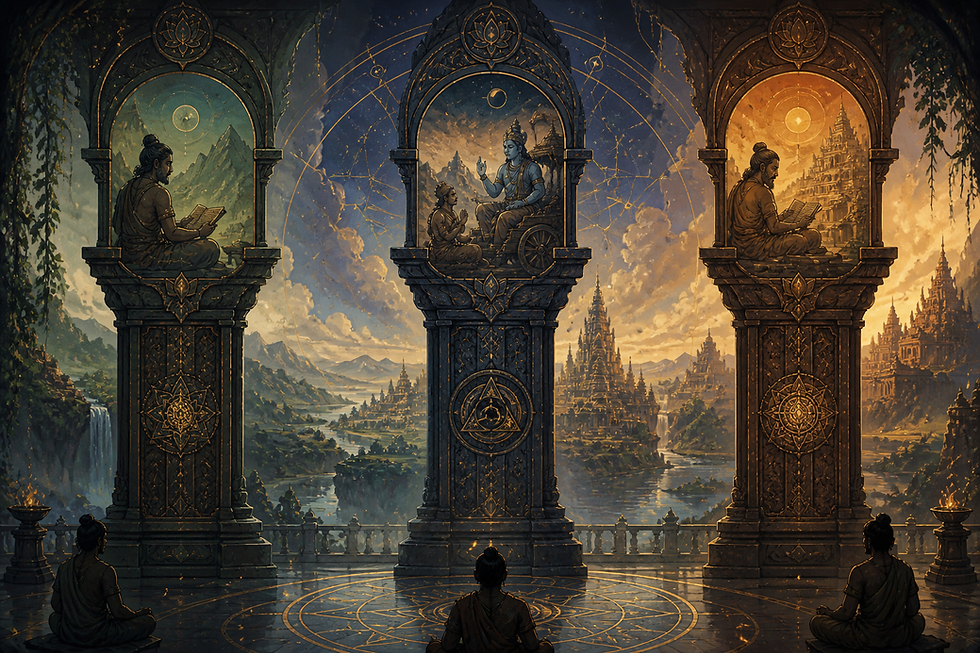
The Upaniṣads: The Śruti‑Prasthāna (Revealed Foundation)
The Upaniṣads represent the summit of Vedic revelation. The term upa‑ni‑ṣad literally means “sitting near” the teacher, suggesting a secret teaching transmitted in intimate discipleship.
The Muktikopaniṣad lists a canon of 108 Upaniṣads, grouped into a sophisticated taxonomy:
13 Mukhya (Principal) Upaniṣads: The earliest and most authoritative, belonging to the Vedic period (∼800–300 BC).
21 Sāmānya Vedānta Upaniṣads: General Vedāntic texts of later composition.
20 Sannyāsa Upaniṣads: Dealing with renunciation and the monastic life.
14 Vaiṣṇava Upaniṣads: Dedicated to Viṣṇu.
14 Śaiva Upaniṣads: Dedicated to Śiva.
8 Śākta Upaniṣads: Dedicated to the Goddess (Shakti).
20 Yoga Upaniṣads: Dealing with yogic practice and physiology.
The Mukhya Upaniṣads are generally enumerated as ten or twelve (the Daśopaniṣads or Dvādaśopaniṣads): Īśā, Kena, Kaṭha, Praśna, Muṇḍaka, Māṇḍūkya, Taittirīya, Aitareya, Chāndogya, Bṛhadāraṇyaka, and sometimes including the Śvetāśvatara, Kauṣītaki, and Maitrāyaṇīya.
The Bṛhadāraṇyaka (the “Great Forest Upaniṣad”) is the largest and perhaps the most profound, containing the famous dialogue between Yājñavalkya and his wife Maitreyī on the nature of love and immortality:
“It is not for the sake of the husband, my dear, that the husband is loved, but for the sake of the Self. It is not for the sake of the wife, my dear, that the wife is loved, but for the sake of the Self. It is not for the sake of the sons that the sons are loved, but for the sake of the Self.” (Bṛhadāraṇyaka Upaniṣad 2.4.5)
The Brahmasūtra: The Nyāya‑Prasthāna (Logical Foundation)
The Brahmasūtra (also called the Vedāntasūtra, Śārīraka‑sūtra, or Bhikṣu‑sūtra), attributed to Bādarāyaṇa (c. 400 BC–200 AD), is a collection of 555 aphorisms organised into four adhyāyas (chapters), each of four pādas (quarters).
The sūtras are so extremely compressed that they are unintelligible without commentary, and their deliberate ambiguity is a feature, not a bug: it requires each generation to interpret the text anew.
The structure of the Brahmasūtra follows a rigorous dialectical method:
Adhyāya I (Samanvaya): Harmonisation of Upaniṣadic texts to show that they all point to Brahman as the cause of the universe.
Adhyāya II (Avirodha): Demonstration that Vedānta is not contradicted by other Darśanas; Sāṃkhya, Yoga, Nyāya, and the Nāstika schools.
Adhyāya III (Sādhana): The means to liberation; renunciation, meditation, the nature of the liberated soul.
Adhyāya IV (Phala): The fruits of knowledge; the path of the departing soul and the nature of brahmaloka.
The major Vedāntic schools each produced a commentary (bhāṣya) on the Brahmasūtra:
Śaṅkara (c. 788–820 AD): Śārīraka‑Mīmāṃsā‑Bhāṣya, establishing Kevalādvaita (Absolute Non‑dualism). Brahman alone is real; the world of name and form is mithyā (empirically real but not ultimately real).
Rāmānuja (1017–1137 AD): Śrī‑Bhāṣya, establishing Viśiṣṭādvaita (Qualified Non‑dualism). Brahman is qualified by the real existence of conscious souls and unconscious matter as its body. Bhakti and prapatti (surrender) are the primary means to liberation.
Madhva (1238–1317 AD): Anuvyākhyāna and other commentaries, establishing Dvaita (Radical Dualism). Brahman (Viṣṇu), individual souls, and matter are eternally and irreducibly distinct.
Nimbārka: Vedānta‑Pārijāta‑Saurabha, establishing Dvaitādvaita (Dualistic Non‑dualism).
Vallabha: Aṇu‑Bhāṣya, establishing Śuddhādvaita (Pure Non‑dualism). The world is not illusory but a real manifestation of Brahman’s līlā.
The Acintya‑Bhedābheda school of Caitanya (1486–1534 AD) is based on the Bhāgavata Purāṇa and the Gītā rather than a formal Brahmasūtra commentary, but it has been given a scholastic foundation in the Śrī‑Caitanya‑caritāmṛta and Baladeva Vidyābhūṣaṇa’s Govinda‑Bhāṣya.
The Bhagavadgītā: The Smṛti‑Prasthāna (Practical Application)
Embedded in the Bhīṣma Parvan of the Mahābhārata (chapters 23–40), the Bhagavadgītā (“The Song of the Lord”) is the most widely read and influential scripture in Hinduism. Its eighteen chapters describe a battlefield dialogue between Arjuna, paralysed by moral crisis on the eve of the Kurukṣetra war, and Kṛṣṇa, his charioteer and the supreme Lord.
Kṛṣṇa unfolds a comprehensive spiritual teaching that integrates three paths:
Karma‑yoga (the path of selfless action): Act without attachment to the fruits of action, dedicating all actions to the Divine.
Jñāna‑yoga (the path of knowledge): Know the Self as the eternal, imperishable witness, distinct from the perishable body and mind.
Bhakti‑yoga (the path of loving devotion): Surrender the whole being in love to the personal Lord (Kṛṣṇa), who will liberate the devotee from all karma.
The Gītā resolves the central tension in Indian spirituality, between engagement with the world and renunciation of it, by teaching that true renunciation is not the physical abandonment of action but the inner renunciation of attachment and egoism (naiṣkarmya‑siddhi).
Its classical commentaries include those by Śaṅkara (emphasising jñāna), Rāmānuja (emphasising bhakti within a Viśiṣṭādvaita framework), Madhva, and the modern interpretations of Aurobindo, Gandhi, Vivekananda, and Radhakrishnan.
Part VII: The Dissenting Voices – The Nāstika Darśanas

The term nāstika (from na asti – “it is not”) refers to philosophical schools that do not accept the Vedas as a valid means of knowledge. They emerged from the same śramaṇa milieu that nourished the Upaniṣads, and they were in continuous, productive dialectical relationship with the āstika traditions.
Bauddha Darśana (Buddhism)

Founded by Siddhārtha Gautama (c. 5th–4th century BC), the Buddha/Shakyamuni (“the Awakened One”), this tradition proposes:
Four Noble Truths: Life is pervaded by duḥkha (suffering); suffering has a cause (samudaya: craving, tṛṣṇā); suffering can cease (nirodha: nirvāṇa); and there is a path to cessation (mārga: the Noble Eightfold Path; right view, right intention, right speech, right action, right livelihood, right effort, right mindfulness, right concentration).
Three Marks of Existence: Anitya (impermanence), duḥkha (suffering), and anātman (no permanent self). The denial of ātman is the most radical doctrinal departure from the Vedic tradition.
Pratītyasamutpāda (Dependent Origination): All phenomena arise in dependence on causes and conditions. The twelve‑link chain (dvādaśāṅga‑pratītyasamutpāda) traces the conditioned arising of suffering from ignorance (avidyā) to old‑age‑and‑death.
Four major philosophical schools developed within Indian Buddhism:
1. Vaibhāṣika: Realist; both external objects and mental states are ultimately real.
2. Sautrāntika: Representationalist; external objects are inferred from mental representations.
3. Yogācāra (Vijñānavāda): Idealist; only consciousness exists; the external world is a projection.
4. Mādhyamaka: Founded by Nāgārjuna (c. 2nd century AD); all phenomena are empty (śūnya) of intrinsic nature (svabhāva); ultimate reality is beyond all conceptual elaboration.
The Buddhist‑Nyāya debate on epistemology and the nature of the self is one of the most productive intellectual rivalries in history.
Jaina Darśana (Jainism)

Traced to Mahāvīra (the 24th Tīrthaṅkara, 6th century BC), Jainism is built on three foundational doctrines:
Anekāntavāda (Non‑absolutism): Reality is irreducibly complex; no single perspective captures it fully.
Syādvāda (Conditional Predication): Any statement about a thing can be true in some respect, false in another, both, inexpressible, and combinations thereof; the sevenfold predication (saptabhaṅgī).
Ahiṃsā: Non‑violence is the supreme ethical principle, extended to all living beings in thought, word, and deed.
Jaina ontology posits two fundamental categories: jīva (sentient consciousness) and ajīva (non‑sentient substance – matter, space, time, the principles of motion and rest).
Liberation (kaivalya) is attained through the Three Jewels: right faith, right knowledge, and right conduct. The Jaina canon consists of forty‑five texts: twelve Aṅgas, twelve Upaṅgas, ten Prakīrṇakas, six Chedasūtras, two Cūlikāsūtras, and four Mūlasūtras.
The Tattvārthādhigama Sūtra of Umāsvāti (c. 2nd century AD) is the first systematic philosophical treatise of the tradition.
Cārvāka (Lokāyata)
The materialist school, attributed to Bṛhaspati, accepts perception alone as a valid means of knowledge. It denies inference, testimony, and all supersensible realities; God, soul, karma, rebirth, liberation.
In ontology, only the four elements (earth, water, fire, air) are real; consciousness arises from their combination. Its ethics is a straightforward hedonism: yāvaj jīvet sukhaṃ jīvet – “as long as you live, live happily; run up debts and drink ghee.”
The Cārvāka original sūtras are lost; knowledge depends entirely on the refutations preserved by opponents.
Part VIII: The Sectarian Revelations – The Six Āgamas
The Āgamas (literally “that which has come down”) are the scriptures of the theistic, temple‑centred traditions of Hinduism. While the Vedas are nigama, the Āgamas are understood as a distinct revelation, often directly from Śiva, Viṣṇu, or the Goddess (Shakti), adapted for human worship in the present age.

They emphasise four pādas (sections): jñāna (philosophy), yoga (meditation), kriyā (ritual), and caryā (conduct).
The Āgamas are classified into three major streams, but within the broader Tantric tradition they are further subdivided by guṇa into Tantra (sāttvika), Yāmala (rājasa), and Dāmara (tāmasa), totalling 192 texts, with sixty‑four Āgamas current in each of three regions: Aśvakrānta, Rathakrānta, and Viṣṇukrānta.
Śaiva Āgamas (28 Mūlāgamas)
The Śaiva tradition recognises twenty‑eight principal Āgamas. The ten Śivabheda Āgamas and eighteen Raudrabheda Āgamas together constitute the canon.
Major texts include the Kāmika, Yogaja, Cintya, Kāraṇa, Ajita, Dīpta, Sūkṣma, Sahastra, Aṃśumat, Suprabheda, Vijaya, Niḥśvāsa, Svāyambhuva, Anala, Vīra, Raurava, Makuṭa, Vimala, Candrajñāna, Bimba, Prodgīta, Lalita, Siddha, Santāna, Sarvokta, Pārameśvara, Kiraṇa, and Vātula.
These texts range from dualistic Śaiva Siddhānta (God, selves, and the world are three eternally distinct realities) to the radically non‑dualistic Trika of Kashmir Śaivism, which sees the entire universe as the self‑expression (vimarśa) of Śiva’s consciousness.
Śākta Āgamas (64 Tantras)
The Śākta Āgamas, numbering sixty‑four, are the scriptures of Goddess‑centred spirituality. They include texts of extraordinary philosophical and ritual sophistication:
Kulārṇava Tantra: A comprehensive manual of Kaula practice.
Mahānirvāṇa Tantra: One of the most widely known, dealing with the dakṣiṇācāra (right‑hand) path.
Jñānārṇava Tantra: A philosophical treatise on non‑dual Śākta doctrine.
Mālinīvijaya Tantra: A foundational text of Kashmir Śaivism, though technically a Śākta Āgama.
Rudra‑Yāmala and Brahma‑Yāmala: The Yāmalas, classified as rājasa Āgamas, which describe the more esoteric dimensions of Tantric practice.
The Śrī Vidyā corpus, including the Vāmakeśvarīmata, Yoginī‑hṛdaya, and the Saundaryalaharī attributed to Śaṅkara, represents the highest philosophical articulation of Śāktism, centred on the worship of the goddess Tripurasundarī (Lalitā) through the Śrī Yantra and the Śrī Vidyā mantra.
The Śākta Tantras are further classified by region: sixty‑four each for Aśvakrānta (eastern India), Rathakrānta (northern India), and Viṣṇukrānta (western and southern India).
The Yāmalas (rājasa texts, including Rudra‑Yāmala, Viṣṇu‑Yāmala, Brahmā‑Yāmala, Umā‑Yāmala, Bhairava‑Yāmala, and others) and the Dāmaras (tāmasa texts, including Śaiva‑Dāmara, Yoga‑Dāmara, Brahma‑Dāmara, Durga‑Dāmara, Gandharva‑Dāmara, and Sarasvatī‑Dāmara) form sub‑categories of the Tantric canon.
Vaiṣṇava Āgamas: Pāñcarātra and Vaikhānasa
The Vaiṣṇava Āgamas are divided into two streams:
Pāñcarātra Saṃhitās (over 200 texts): The Sāttvata, Pauṣkara, Jayākhya, Ahirbudhnya, Pārameśvara, Īśvara, and Lakṣmī‑tantra are primary.
Pāñcarātra theology teaches that Viṣṇu (Nārāyaṇa) manifests in five modes: para (transcendent), vyūha*(emanation as Saṅkarṣaṇa, Pradyumna, Aniruddha), vibhava (incarnations), antaryāmin (indweller), and arcā (the consecrated temple image).
Vaikhānasa Āgamas: A smaller, more conservative Vaiṣṇava Āgamic tradition with approximately twenty‑five texts, preserved mainly in the temple of Tirupati.
The Vaikhānasa Sūtras prescribe a ritual system that blends Vedic fire‑sacrifice with image worship. The Vaikhānasa tradition claims the sage Vikhanas as its founder.
Part IX: The Literature of Bhakti, Stotra, and Tantra

Beginning in Tamil Nadu around the 6th century AD, a religious revolution swept across India: the Bhakti movement. Its premise was simple but radical; that the highest spiritual realisation is open to all, regardless of caste, gender, or learning, through the path of loving devotion (bhakti) to a personal deity.
Its primary medium was vernacular poetry, which bypassed the Sanskrit gatekeepers and spoke directly to the hearts of ordinary people.
The Tamil Śaiva Canon (Tirumuṟai): The Nāyaṉmārs (sixty‑three Śaiva saints) composed devotional poetry compiled into twelve books. The Tēvāram (books I‑VII, by Appar, Campantar, and Cuntarar), the Tiruvācakam (book VIII, by Māṇikkavācakar), and the Tirumantiram (book X, by Tirumūlar) are the most revered. Together, they constitute the twelve‑book Tirumuṟai, regarded by Tamil Śaivas as a “Tamil Veda.”
The Tamil Vaiṣṇava Canon (Nālāyira Divyaprabandham): The twelve Āḻvārs, spanning the 6th to 9th centuries – Poykai, Pūtam, Pēy (the three earliest, known as the mudal‑āḻvārs), Tirumaḻicai, Nammāḻvār, Madhurakavi, Kulaśekhara, Periyāḻvār, Āṇṭāḷ (the sole female saint), Toṇḍaraḍippoḍi, Tiruppāṇ, and Tirumaṅgai – sang hymns of ecstatic devotion to Viṣṇu that were compiled by Nāthamuni in the 9th‑10th centuries as the Nālāyira Divyaprabandham (“The Four Thousand Divine Compositions”).
This collection is revered as the “Tamil Veda.” Nammāḻvār’s Tiruvāymoḻi, the longest single work within the canon, has been called “the Upaniṣads in Tamil.”
The Vīraśaiva Vacanas (Karnataka, 12th century): Basava, Akka Mahādevī, Allama Prabhu, and other Vīraśaiva saints composed vacanas; short, intense prose‑poems in Kannada that rejected temple worship, caste hierarchy, and ritual formalism in favour of direct, personal devotion to Śiva as Kūḍalasaṅgamadēva.
The Mahārāṣṭra Vārkarī Tradition: The Abhaṅgas (devotional songs) of Jñāneśvar (13th century), Nāmdev, Eknāth (16th century), and Tukārām (17th century) made the Vārkarī tradition one of the most vibrant vernacular spiritual movements, centred on the deity Viṭṭhala of Pandharpur.
The North Indian Bhakti Renaissance (14th–17th centuries): Kabīr (a weaver who transcended both Hindu and Muslim orthodoxies with his stark, mystical poetry), Mīrābāī (a Rajput princess whose padas of love for Kṛṣṇa have become part of the Indian soul), Sūrdās (the blind poet of Braj whose Sūrsāgar narrates Kṛṣṇa’s childhood with matchless tenderness), and Tulsīdās (whose Rāmcaritmānas in Avadhī Hindi re‑told the Rāmāyaṇa as an act of devotion and remains the most recited scripture in North India).
The Stotra Literature: Hymns of Praise
The stotra (hymn of praise) literature forms a vast sub‑genre of Sanskrit devotional poetry, ranging from the philosophically profound to the popularly accessible:
Śaiva Stotras: Śaṅkara’s Śivānandalaharī, the Śivamahimna Stotra attributed to Puṣpadanta, and the Śiva‑Pañcākṣara Stotra.
Vaiṣṇava Stotras: Śaṅkara’s Viṣṇu‑Sahasranāma‑Bhāṣya, Kulaśekhara’s Mukundamālā, Vedānta Deśika’s Dayā‑Śataka, and the Nārāyaṇīyam (a condensed retelling of the Bhāgavata Purāṇa in 1,036 verses).
Śākta Stotras: Śaṅkara’s Saundaryalaharī and Ānandalaharī, the Devī‑Māhātmya (embedded in the Mārkaṇḍeya Purāṇa), and the Lalitā‑Sahasranāma.
The Tantric Sub‑Division: Nigama and Āgama
Within the Tantric universe, a further distinction is made. The supreme scriptural authority –Śruti – is said to be of two forms: Nigama (the Vedas, in which the Ṛṣi is the questioner and the Deity answers) and Āgama (the Tantras, in which the Goddess – Śakti – asks the questions and Śiva – the supreme God – answers).
This dialogical structure is the defining feature of Hindu Tantric literature. Some traditions swear by Nigama, others by Āgama; still others hold them to be complementary expressions of a single non‑dual revelation.
The Tantric corpus is further classified by guṇa: Tantra (sāttvika, oriented toward liberation), Yāmala (rājasa, oriented toward a mixture of worldly success and liberation), and Dāmara (tāmasa, oriented primarily toward magical and worldly attainments).
The classic enumeration counts sixty‑four Tantras, sixty‑four Yāmalas, and sixty‑four Dāmaras, though many are lost or survive only in fragments.
Part X: The Smṛti Corpus – The Complete Taxonomy

To summarise the full range of what constitutes Smṛti: the corpus is, in its most comprehensive sense, a universe of derivative works rooted in or inspired by Śruti.
It includes:
Six Vedāṅgas | Śikṣā, Kalpa, Vyākaraṇa, Nirukta, Chandas, Jyotiṣa
Itihāsa‑Purāṇa | Rāmāyaṇa, Mahābhārata (including the Harivaṃśa and Bhagavadgītā), eighteen Mahāpurāṇas, eighteen Upapurāṇas
Dharmaśāstra | Dharmasūtras, Mānava‑Dharmaśāstra, Yājñavalkya‑smṛti, Nārada‑smṛti, Parāśara‑smṛti, and associated commentaries
Darśana Sūtras | Foundational sūtras of the six Āstika systems and their commentaries
Āgama and Tantra | The sectarian revelations of Śaiva, Śākta, and Vaiṣṇava traditions
Kāvya (Belles‑Lettres) | The classical poetic works–the mahākāvyas of Kālidāsa, Bhāravi, Māgha–which, though not “scriptural” in the narrow sense, are saturated with Purāṇic and Vedāntic themes and function as a form of secular scripture
Nibandhas (Digests) | Medieval compendia that systematised Dharmaśāstra for practical legal application
Bhakti Literature | Vernacular devotional poetry in Tamil, Kannada, Marathi, Hindi, Bengali, and other languages
All Smṛti texts are regarded as ultimately rooted in Śruti, and their authority, while secondary and conditional, covers every aspect of individual and social life that Śruti does not directly address.
Part XI: Conclusion – The Unfinished Tree

We have traced the complete architecture of what is arguably the most complex, the most self‑diversifying, and the most enduring tree of sacred literature ever produced by a single civilization.
We have travelled through the writing of four Vedas, ritual systematisation of the Brāhmaṇas, the philosophical revolution of the Upaniṣads, the growth of the auxiliary sciences, the flowering of the orthodox philosophical systems, the triple foundation of Vedānta, the dissenting rationality of the Nāstika schools, the theistic revelations of the Āgamas, and the vernacular democratisation of the Bhakti movement.
What holds this immense diversity together is not a single creed, a single book, or a single priesthood. It is, rather, a shared cultural and conceptual ecosystem.
The law of karma, transmigration, the possibility of liberation (mokṣa), the authority, however defined and however contested, of the seer’s vision: these are the invisible threads that connect texts as chronologically and temperamentally distant as the Nāsadīya Sūkta and the Mahānirvāṇa Tantra, as the logical aphorisms of Gautama and the ecstatic love‑songs of Mīrābāī.
This tree is not a fossil. It is still growing. In the 19th and 20th centuries, reformers like Rammohan Roy, Dayānanda Sarasvatī, Vivekānanda, and Gandhi reinterpreted the scriptures to address colonialism, modernity, and social justice.
The global yoga movement, the mindfulness revolution, and the academic study of Hindu traditions have brought these texts to a worldwide audience in ways their composers could never have imagined.
Digital technologies are now making manuscripts accessible that were once locked in monastic libraries, and new translations continue to appear in languages from Swahili to Japanese.
The study of this tree is, therefore, not an exercise in antiquarianism. It is an encounter with a civilization’s most sustained attempt to articulate the nature of reality, the purpose of human life, and the path to lasting freedom.
The Vedic Ṛṣis described their hymns as leaves on an imperishable cosmic tree, rooted above in the transcendent, branching below into the world of time (Bhagavadgītā 15.1). That tree, first imaged in the hymns of the Ṛgveda and given its most famous exposition in the Gītā, has only become more vast and more intricate in the three thousand years since.
But every new leaf – every new commentary, every new translation, every new act of understanding – draws its life from the same ancient sap: the conviction that reality can be known, that the knower is not ultimately separate from the known, and that the journey from darkness to light, from mortality to immortality, is the journey for which the human heart was made.


Comments